Category: Culture

Just words!

Odds are you have already seen this!

Reason I state that is, as of yesterday morning, some 19,070,066 viewings of the following video had taken place.

But so what!

That number shows that despite the advertising insertions, despite the video promoting a commercial concern at the close, there are plenty of us who want to be reminded of the power of words.

Whatever words we utter should be chosen with care

for people will hear them and be influenced by them

for good or ill.

Buddha.

Footnote:

Jean and I were pottering around yesterday afternoon getting everything ready for Ranger’s arrival planned for Tuesday.  In the back of my mind was some self-criticism for just sticking today’s post up in front of you, in the sense that it was just too easy.  Not that the message isn’t powerful but does it relate to the essence of this blog – exploring what we can learn from dogs?

Then it struck me as blindingly obvious! Of all the things that dogs offer us humans, the one key aspect of their integrity is their unconditional love.   The way that dogs love us acknowledges our existence at a ‘being-to-being’ level.

That’s the power of that short video. That the passing lady stopped and acknowledged the existence of the blind beggar-man.

We all need to be reminded of that all the time!

Picture parade thirty-five.

The second instalment of pieces of wisdom.

If you missed the first set from Bob Derham they were last week.

RD8

oooo

RD9

oooo

RD10

oooo

RD11

oooo

RD12

oooo

RD13

oooo

RD14

oooo

Come back in a week’s time for the third and final set.

In the interim, have a peaceful week.

Real democracy.

This news really brightened my day!

Or, perhaps I should have written that sub-heading, “Adding a gloss to what are mostly bright days!”.

What on earth am I rabbeting on about?

From time to time on Learning from Dogs I have touched on the topic of democracy.  The most recent post of any relevance was on the 27th January this year in a post called Unconditional love.  In essence that blog post was recording an email exchange between Martin Lack, Chris Snuggs and Patrice Ayme. Let me reproduce a part of that ‘discussion’:

Paul: Chris/Martin, To my way of thinking, there is a more fundamental issue at work. That is the corrupting effect of power. I’m certain you know the famous saying. Thus whatever fine motives propel a person to enter politics, that person seems unable to avoid the call of power and its corrupting effect. The only hope is that key countries, and none so key as the USA, evolve a better, more representative, political process. Otherwise, I fear for the coming years.

Patrice: I agree with Paul 100%. I saw the call of power. Unimaginable. People just get insane. There are also filtering systems to insure they get that way (it starts right away with one week retreats in extremely posh resorts; does not matter if you are capitalist, socialist, blueist, reddist, ecologist, independentist, etc.).

Chris: Agreed. It has been clear time and time again throughout history. Well, so much is obvious, but WHAT TO DO about it?

A) We must end the practice of having career politicians: you serve a maximum of TEN years, at the end of which you go.

B) Inherited wealth allowing the building up of immensely powerful family dynasties over generations must be ended. It is simply untenable. The rich-poor gap is getting obscene everywhere, and money is of course power. My “Abolish inheritance” idea will be wildly unpopular because we are naturally acquisitive and “greedy” and of course would hit those with most to lose who also therefore have the most power.

Patrice:  With all due respect, Chris and Martin sound rather naïve… Huge wealth and power is where it’s at. And it attracts to politics first, foremost, and soon uniquely, those it attracts most, namely the basest sort.

Without in any way of knowing in a reliable manner, as in statistically reliable, the attitudes of folk, nonetheless there is no question that a huge number of the ordinary folk that live around us here in Merlin, Joesephine County, Oregon and others that one meets in the course of being ‘out and about’ are worried; frequently deeply worried.

Worried about the “Huge wealth and power ..” and the gross inequalities that flow from that.

So with that in mind, consider the pleasant surprise offered me when I read the day’s roundup from the Permaculture Research Institute email distribution and it included:

The Missing Part of the Internet – Collaborative Decision-Making Made Easy with Loomio

The world needs a better way to make decisions together

“The new era of digital democracy is one source of hope. New formats for web-based participation, like Loomio, and enablers of grassroots engagement… are flourishing.” —The Huffington Post

Democracy isn’t just about politics — it’s people getting together and deciding how things should be. It’s a skill we can practice with people wherever we are: in our workplaces, our schools, and our communities.

Loomio is a user-friendly tool for collaborative decision-making: not majority-rules polling, but actually coming up with solutions that work for everyone. We’re a small team in New Zealand, and we’ve built a prototype that people are already doing great things with. Now we’re crowdfunding so we can build the real thing: a new tool for truly inclusive decision-making.

It was but a hop and a skip to go to the Loomio website and read:

The world needs a better way to make decisions together.

Help us build it.

Loomio is free and open software for anyone, anywhere, to participate in decisions that affect them

and then with a further mouse-click on the Crowdfunding link to read:

THE WORLD NEEDS A BETTER WAY TO MAKE DECISIONS TOGETHER.

Democracy isn’t just about politics – it’s people getting together and deciding how things should be. It’s a skill we can practice with people wherever we are: in our workplaces, our schools, and our communities.

Loomio is a user-friendly tool for collaborative decision-making: not majority-rules polling, but actually coming up with solutions that work for everyone. We’re a small team in New Zealand, and we’ve built a prototype that people are already doing great things with. Now we’re crowdfunding so we can build the real thing: a new tool for truly inclusive decision-making.

At this point, I should declare an involvement.  Jean and I decided to donate a modest amount.  Thus it is not from an impartial position that I close today’s post with the following video.  Bet you will be impressed!

If you enjoyed that video then do watch the following TED Talk.

Published on Aug 4, 2013

Ben Knight is part of a cooperative social enterprise building Loomio, an online tool for collaborative decision-making being used by thousands of people in more than 20 countries. Ben will be picking through ideas around how technology can enable everyday democracy.

This could be a most interesting development!

Mid-week story

Too good to wait until the week-end!

(And a big thanks to Dan Gomez for sending it my way.)

ooOOoo

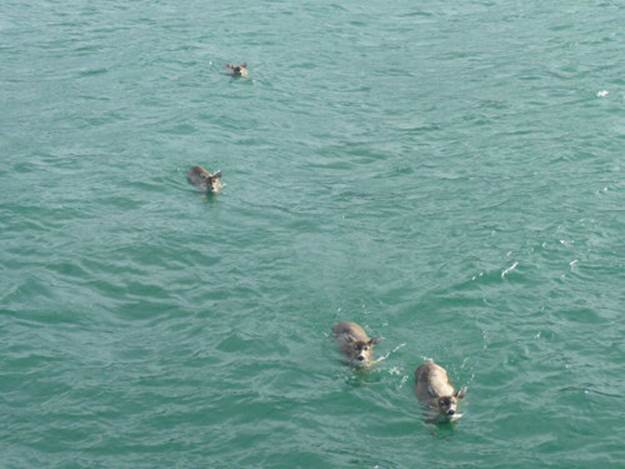
Went Fishing, Caught 4 Deer

A once in the history of mankind kind of thing. The Best Day Of Fishing Ever!

Some fishing stories are a little hard to believe but this guy has pictures to prove his story. Like me, you will heard of salmon jumping into boats, but never anything quite like this…

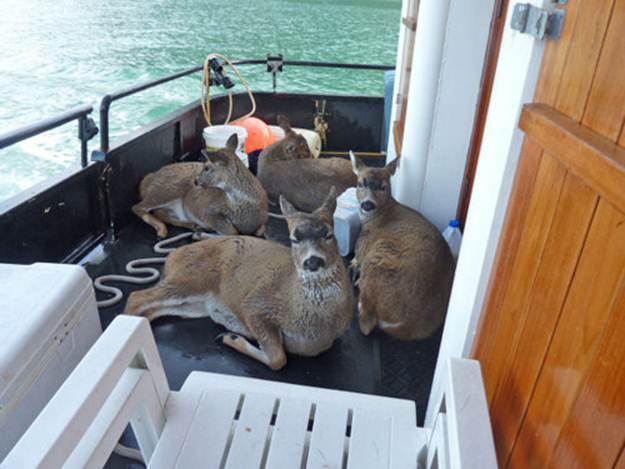
Tom Satre told the Sitka Gazette that he was out with a charter group on his 62-foot fishing vessel when four juvenile black-tailed deer swam directly toward his boat.

a_00t4

Once the deer reached the boat, the four began to circle the boat, looking directly at us. We could tell right away that the young bucks were distressed. I opened up my back gate and we helped the typically skittish and absolutely wild animals onto the boat. In all my years fishing, I’ve never seen anything quite like it! Once on board, they collapsed with exhaustion, shivering.

ass

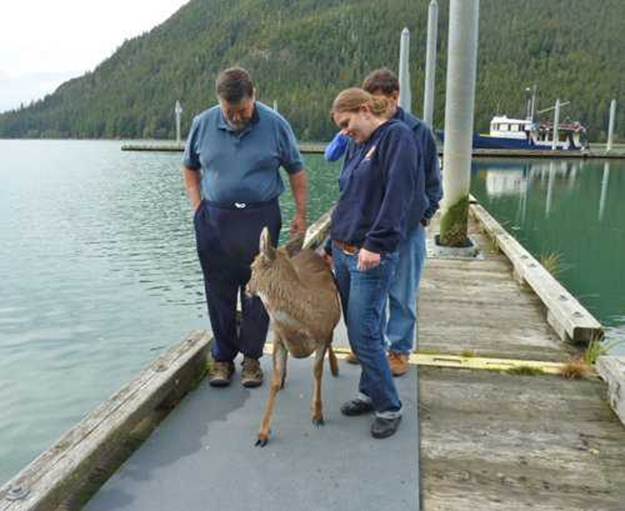
This is a picture I took of the rescued bucks on the back of my boat, the Alaska Quest. We headed for Taku Harbour.  Once we reached the dock, the first buck that we had pulled from the water hopped onto the dock, looked back as if to say ‘thank you’ and disappeared into the forest. After a bit of prodding and assistance, two more followed, but the smallest deer needed a little more help.

a_sf003
This is me carrying the little guy.

oooo

a_00ff2

My daughter, Anna, and son, Tim, helped the last buck to its feet. We didn’t know how long they had been in the icy waters or if there had been others who did not survive.  My daughter later told me that the experience was something that she would never forget, and I suspect the deer felt the same way as well!”

Kindness is the language the blind can see and the deaf can hear.” – Mark Twain

Story dated October, 2010

ooOOoo

I have no idea if it is a true story, although the photographs suggest it is, but so what!  Any reminder of how precious our wild life is will always be welcomed on Learning from Dogs!

Picture parade thirty-four

Pieces of wisdom.

After the run of eye-wateringly beautiful pictures of dogs and small children, the third and final set being a week ago, I was gently panicking as to how to follow that up.  Then dear friend, Bob Derham, came to the rescue, the first seven of which are offered today.

RD1

oooo

RD2

oooo

RD3

oooo

RD4

oooo

RD5

oooo

RD6

oooo

RD7

oooo

More from Capt. Bob next week.

Sometimes one just has to wonder ….

…. about the most peculiar species of all: man!

A number of essays and items from a variety of sources have passed my screen in recent times that ….. well, you complete the sentence! Let me illustrate; in no particular order.

I have long been a follower of the writings of George Monbiot.  Those who haven’t come across Mr. Monbiot before can avail themselves of his background and dip into his articles, many of which underscore my proposition that we really are a peculiar race.  For example, just three days ago George Monbiot published an article under the title of The Benefits Claimants the Government Loves.  It highlights one mad aspect of UK Policy.

Corrupt, irrational, destructive, counter-productive: this scarcely begins to describe our farming policy.

By George Monbiot, published in the Guardian 4th March 2014

Just as mad cow disease exposed us to horrors – feeding cattle on the carcasses of infected cattle – previously hidden in plain sight, so the recent floods have lifted the lid on the equally irrational treatment of the land. Just as BSE exposed dangerous levels of collusion between government and industry, so the floods have begun to expose similar cases of complicity and corruption. But we’ve heard so far just a fraction of the story.

You really do need to read the article in full to get your arms around the terrible state of affairs of the UK benefits scandal.  But try this:

As a result of these multiple failures by the government, even Farmers’ Weekly warns that “British soils are reaching crisis point” (16). Last week a farmer sent me photos of his neighbours’ fields, where “the soil is so eroded it is like a rockery. I have the adjoining field … my soil is now at least 20 cm deeper than his.” In the catchment of the River Tamar in Devon, one study suggests, soil is being lost at the rate of five tonnes per hectare per year (17).

I could go on. I could describe the complete absence of enforceable regulations on the phosphates farmers spread on their fields, which cause eutrophication (blooms of algae which end up suffocating much of the freshwater ecosystem) when they run into the rivers. I could discuss the poorly-regulated use of metaldehyde, a pesticide that is impossible to remove from drinking water (18). I could expand on the way in which governments all over Europe have – while imposing a temporary ban for flowering crops – permitted the use of neonicotinoid insecticides for all other purposes, without any idea of what their impact might be on animals in the soil and the rivers into which they wash. The research so far suggests it is devastating, but they were licensed before any such investigation was conducted (19).

There is just one set of rules which are effective and widely deployed: those which enforce the destruction of the natural world. Buried in the cross-compliance regulations is a measure called GAEC 12 (20). This insists that, to receive their money, farmers must prevent “unwanted vegetation” from growing on their land. (The rest of us call it wildlife habitat). Even if their land is producing nothing, they must cut, graze or spray it with herbicides to get their money. Unlike soil erosion, compaction and pollution, breaches of this rule are easy to detect and enforce: if the inspectors see trees returning to the land, the subsidy can be cut off altogether.

Perhaps a clue to the extreme unfairness of who is in receipt of UK benefits can be explained by the fact expressed by George Monbiot above, “The biggest 174 landowners in England take £120m between them.

With that in mind, let’s move on.  Move on to a recent essay from Patrice Ayme: WAR MAKES HISTORY! To say it makes disturbing reading is, trust me, an understatement.  But in the context of the UK’s rich landowners, as George Monbiot explained above, try this closing extract from Patrice’s essay:

We are a deeply equalitarian species. Out of equality rises our superior cultural performance. Plutocracy, the rule of the Dark Side, denies giving, love, and the equality which make us possible. Thus plutocracy is a denial of our species. Only an anger great enough to destroy it, will save us, and the biosphere. And there is hope: greed is neither as natural, nor as strong as anger.

It’s time to get angry against dictator Putin. Angry now is better than very sorry tomorrow.

War makes history. Of this we must think, if we want to make history better.

Patrice Aymé

Frankly, my own knowledge of these ‘dark forces’, of the influence of money and power, is practically zero. But the more that one looks at the madness of so many aspects of mankind’s existence, the more one thinks the truth, as Patrice writes it, is the real truth.  Indeed, here’s how Patrice opens his essay:

WAR MAKES HISTORY

HERE WE GO AGAIN

The earlier unjustifiable, unprovoked fascism, greedy plutocracy, imperial overstretch, murderous paranoia and other aspects of the Dark Side get smashed, the better.

Such is the most basic lesson of the 1930s.

For the millions of us that live relatively comfortable lives, it’s easy to read this stuff, nod sagely, and wonder if the heating needs to be left on this coming night.  But, pardon the pun, wake-up calls as to the approaching nightmares (sorry!) are not hard to find.

Try this from an interview with Elizabeth Kolbert, as recently published on Grist:

In “The Sixth Extinction,” Elizabeth Kolbert reports from the frontlines of a dying world

By 

betsy-kolbert-cropped
University of Montana

The New Yorker writer and acclaimed author Elizabeth Kolbert has a penchant for depressing topics. Her 2006 book, Field Notes from a Catastrophe, helped push climate change into the mainstream (with bonus points for not mincing words in the title).

Now that climate change is safely keeping most of us up at night, Kolbert turned her pen to another big bummer: the sixth extinction. We’re currently losing species at a rate of 1,000 to 10,000 times higher than unassisted nature wiping out the occasional newt. While humans weren’t responsible for the last five mass extinctions, our fingerprints are all over this one. Yep: We collectively have the force of an asteroid when it comes to erasing species (high five, guys!) and for the most part, our response has been classic Urkel.

That interview concludes:

Q. You also write about some efforts to save species. Could you share some of those?

A. I happened to go to the San Diego Zoo, where they have a very impressive conservation program. I was there to see something called the “frozen zoo.” It’s just a bunch of vats of liquid nitrogen with cell lines from, in many cases, highly endangered animals and, in one case, an animal that doesn’t exist anymore, a Hawaiian bird. The idea is pretty much what it sounds like: You have these cell lines, you’re going to keep them alive forever, and eventually people are going to figure out how to resurrect some of these species. Or maybe if you don’t want to go quite that sci-fi, we’ll take the cell lines, we’ll do a DNA analysis, we’ll try to figure out why this population is having trouble.

They took me to see this bird named Kinohi, one of the last Hawaiian crows. He’s “reluctant to part with his genetic material,” let’s put it that way. He had been taken from this breeding facility on Maui to San Diego, and he is ministered to by a PhD physiologist who is trying to, let’s say, pleasure this bird, so that he will give up some sperm, so she can artificially inseminate a bird back in Maui. When I visited he had not yet, you know, come through. She was literally preparing to try again — I don’t know if it has ever worked, I should call her.

That was really, to me, emblematic of this crazy situation we find ourselves in. We’re incredibly smart, we’ve figured out how to freeze cell lines and quite possibly bring back extinct animals — we’re willing to pleasure crows. And yet, the Hawaiian Islands are called the extinction capital of the planet — it’s an absolutely devastated ecosystem. Many, many birds are extinct already; those that aren’t are just clinging to existence. Those forces are not changing and, in fact, things are getting worse. There used to be no mosquitoes in Hawaii; there are now mosquitoes. They carry avian malaria, and as the climate warms, avian malaria is moving up the slopes so that even these refugees species that are high on the mountains are increasingly not there. A lot of birds are in terrible trouble there.

All of these things are happening at once and, once again, they’re all true. People are devoting a lot of time and energy and love to trying to preserve these species, and meanwhile the world is increasingly screwed up. So that is how I end the book: They can both be true; it’s not one or the other.

Did you notice the reference to yet another example of mankind’s madness? “That was really, to me, emblematic of this crazy situation we find ourselves in. We’re incredibly smart, we’ve figured out how to freeze cell lines and quite possibly bring back extinct animals — we’re willing to pleasure crows. And yet, the Hawaiian Islands are called the extinction capital of the planet — it’s an absolutely devastated ecosystem.

I believe inherently that the great majority of individuals are good people.  Take Kevin Richardson for instance. Not for him money and power.  Just a passion to save lions.  Oh, and hugging them!  Just watch, and be moved.

Don’t know how to close this? Maybe using a quotation from Ernest Hemingway:

The world breaks everyone, and afterward many are strong at the broken places.

So in these broken times, let all the good people come out strong – stronger than those who are corrupt, irrational, destructive and counter-productive!

It is the ultimate time for hope and faith in the power of goodness!

The engine under the hood!

A reflection on WordPress that powers so many blogs.

All too often in life, it’s very easy to take things for granted.  Such as the software that powers Learning from Dogs and so many other blogs right across the world, namely WordPress.  What prompted this?  Reading the February WordPress report.

ooOOoo

WordPress.com by the Numbers: The February Hot List

Ben Huberman, Editor at WordPress.com

February was another eventful month at WordPress.com. Here’s the lowdown on what we’ve all been up to.

It might be the shortest month of the year, but that certainly didn’t stop WordPress.com users from making February another month to remember. Frigid weather, suspenseful curling matches, The Lego Movie: nothing could keep you away from your sites. Enjoy this winter tale of blogging success.

The blog’s the thing

We were joined this month by no fewer than 1,670,000 new sites and blogs — that’s almost three times the population of Wyoming. Welcome, welcome, welcome.

Old bloggers or new, you set to work with zeal: you wrote nearly 40,000,000 posts this month (if each stood for an hour, it would be enough time to walk to the sun — and back). You made sure not to miss a beat by tapping away on your devices: 2,230,000 posts were published on iPhones and iPads, about a million on your Android devices, and nearly 200,000 came from the BlackBerry crowd.

A contribution to The Daily Post’s recent photo challenge, Threes, by rodocarda.

In case you were curious — we know you were! — you collectively wrote 9.4 billion words. That would roughly be the word count in Shakespeare’s collected plays — if the Bard had the stamina to write them 10,000 times.

As always, you weren’t exactly shy engaging with your fellow bloggers. You liked their posts 7,300,000 times, and left more than 48,000,000 comments.

Is that a widget that I see before me?

Your sidebars got some serious love this month, with 1,360,000 widgets added. The most popular ones? Text Widgets with 145,000, followed by 94,000 Image Widgets.

You also made your posts come alive, embedding 11,600,000 YouTube videos, 3,000,000 image galleries, and 265,000 SoundCloud tracks.

Now Is the Winter of Our Disco Tent

Yes, for those of us who live in the Northern Hemisphere, February was cold (please don’t gloat, Floridians). Which might explain the 24,659 posts tagged with winter and the 942 with polar vortex. The daydreamers among us wrote 4,861 posts about the sun, and 416 about Barbados (rumor has it the piña coladas are better in the latter).

Of course, winter is always coming for Game of Thrones fans, who, as loyal as direwolves, wrote 1,553 posts about a show that isn’t starting until April.

A contribution to The Daily Post’s recent photo challenge, Treasure, by theweeklyminute.

February was dominated by talk of Sochi (10,587 posts) and the Olympics (16,283). For some unfathomable reason, more bloggers published about hockey (a stunning 77,218 posts) than about curling (1,117). Then again, more posts were written about Lego (1,972) than about curling, probably because it’s harder to blog while vigorously brushing ice.

We can’t omit what’s possibly the most anticipated stat of all: in February, dogs (10,060 posts) still beat cats (5,729).

What else kept us warm last month? Laughter — 24,720 posts were added to the humor topic. Unsurprisingly, the month that gave us Valentine’s (6,988 posts) let itself be swept off its feet by love, with 103,147 posts. Please note that this is an odd number — isn’t it ironic? (Alanis Morissette: 40 posts.)

What feats we did last month

February was a hectic month behind the scenes, too, with Automatticians — including four new ones — working hard to make WordPress.com the best it can be (if that sounds like fun, join us!).

We redesigned our sharing and reblogging functions for a smoother, more streamlined look. We added two more blogging ebooks to our collection. And we just introduced ecommerce plugins to our WordPress.com Business users, making it possible, for the first time, to turn your sites into complete online storefronts.

Singl, one of ten new themes added in February.

Finally, if you’re looking to update the look of your site, there’s no better time to try out some of our new themes. In the past month we introduced ten themes (four of them free!) to our Theme Showcase. Take a look at Axon,MayerTuned BalloonYumblogLensHexaSinglMH MagazineCirca, and Quadra — you won’t regret it.

Spring Equinox is right around the corner — we can’t wait to see what you accomplish this month!

ooOOoo

Now if all that isn’t amazing then take a look at the number of people who, like me, are ‘followers’ of WordPress.

You are following this blog

You are following this blog, along with 14,195,761 other amazing people

Gob-smacking is the term that comes to mind!

What we really have to learn from dogs!

And many more of Nature’s creatures besides.

The answer? Unconditional love. (11 words.)

OK, that’s it for today’s post! 😉

oooo

Those that know this blog know that posts of just eleven words coming from yours truly are as rare as hen’s teeth.  So stay with me!

The number of LfD followers has just passed 900.  To say that I am amazed, grateful and humbled still feels like an inadequate response.  Thank you: to everyone of you.

One of those new followers left a recent comment that said, ” I love this blog, dedicated to dogs ..”  It struck me that as the number of new followers has increased significantly in recent times that it wouldn’t do any harm to return to the principles behind Learning from Dogs.

For it’s not a blog about dogs per se but about the qualities that we, as in mankind, have to learn from dogs.

The starting point is truth; as in what is truth?  Such a straightforward question of just three words requires many more words, indeed a book, to answer. A little over two years ago, I published a post called The evolution of the domestic dog, that included the following:

Way back in 2007 I was working with a good friend of mine, Jon, who lives in SW England. Anyway, Jon spoke of the philosophies of Dr. David Hawkins.  David Hawkins has written a number of books including Truth vs Falsehood: How to Tell the Difference which I read a few years ago and found very convincing.

Dr David Hawkins of Veritas Publishing, Sedona, Arizona.

Here’s how Amazon describes the book,

The exploration into the truth of man’s activities is unique, intriguing, and provocative. From a new perspective, one quickly grasps the levels of truth expressed by the media, the arts, writers, painters, architecture, movies, TV, politics, and war, as well as academia and the greatest thinkers and philosophies through the ages and up to present-day science and advanced theories of the nature of the universe. Most importantly, the ego and its structure are revealed to facilitate the understanding of religious and spiritual truths expressed by the mystics and enlightened sages over the centuries. It becomes apparent why the human mind, unaided, has been intrinsically incapable of discerning truth from falsehood. A simple test is described that, in seconds, can solve riddles that have been irresolvable by mankind for centuries. This book delivers far more than it promises.

Here’s the description of the book on David Hawkin’s website,

Reveals a breakthrough in documenting a new era of human knowledge. Only in the last decade has a science of Truth emerged that, for the first time in human history, enables the discernment of truth from falsehood. Presented are discoveries of an enormous amount of crucial and significant information of great importance to mankind, along with calibrations of historical events, cultures, spiritual leaders, media, and more.

A science of consciousness developed which revealed that degrees of truth reflect concordant calibratable levels of consciousness on a scale of 1 to 1,000. When this verifiable test of truth was applied to multiple aspects of society (movies, art, politics, music, sociology, religion, scientific theories, spirituality, philosophy, everyday Americana, and all the countries of the world), the results were startling.

Trust me, I am (slowly) getting to the point!

Dr. Hawkins created a ‘map’ of those calibrated levels of consciousness, see details of that map here.  Also, it wasn’t too difficult to find a plain B&W version on the Web, reproduced below.

Map of Consciousness, copyright Dr. David Hawkins

As you can see when you study the map, the boundary between ‘truth’ and ‘falsehood’ is the calibrated level of 200, the blue line in the above described as ‘The beginning of integrity’.

Anyway, back to Jon.  When I used to visit him, I always had Pharaoh with me and he would settle down behind my chair and let the human talk just flow over him, happy at some dog level to be included.

One day Jon was talking about the different levels of consciousness and looked over at Pharaoh asleep on the floor and said, “Do you that dogs are integrous!”  I responded that I didn’t know that, please tell me more.

Jon continued, “Yes, dogs have been calibrated as having a level of consciousness in the zone of 205 to 210.”

So dogs, horses, cats and many other warm-blooded species of animals are fundamentally integrous creatures.  Creatures that display the qualities of unconditional love, trust, courage, integrity and forgiveness.  Just see where those emotions appear on David Hawkin’s ‘map’ above.  However of all those animals, dogs have been man’s longest companion by far, perhaps all the way back to neolithic times.

So what gets written about Learning from Dogs is what we, as in society, have to learn from dogs. Because the time for mankind to place integrity, as in integrity of thought, word and deed, at the highest pinnacle of our domain is fast running out.

Going to close with a photograph taken yesterday afternoon here at home in Oregon, showing a pair of geese that are giving every indication of using our ‘island’ in our so-called pond as their base for having their goslings!

The integrity of Nature!

Some content on this page was disabled on August 23, 2017 as a result of a DMCA takedown notice from Susan Hawkins. You can learn more about the DMCA here:

https://wordpress.com/support/copyright-and-the-dmca/

A short story – The Kiss.

The power of the short story.

Funny how things run at times!

Back on the 20th, just six days ago, I published a post under the title of Oregon wolves, and book writing!  Frankly, it was a bit of a hotch-potch of a post but it did include a reference to Melinda Roth’s book Mestengo, that Jean adored and I was finding delightful before ‘circumstances’ caused me to put the book to one side.  For ‘circumstances’ read an email from the said Melinda.  That, in turn, was the result of a comment that Melinda left on that post, namely:

Just read and re-read your draft of Chapter 23. Extraordinary. I hope you’re not going to leave us hanging… (sending you a private email to further make my point).The draft of Chapter 23 is good, good stuff. I found myself totally caught up without even knowing what came before.

It would be wrong for me to share the whole of that email without Melinda’s prior permission but I am comfortable in revealing this:

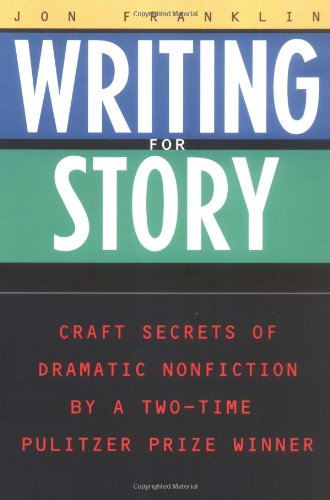
Another book you might consider (not that you have time if you’re going to get this book finished) is “Writing for Story” by Jon Franklin:

This a a very quick read, and I highly recommend it. There are a million books out there about writing, but this one gets straight to the point in a business-like manner and gives THE best advice about how to structure a non-fiction (or fiction) book. The author has won two Pulitzer prizes and uses his two winning pieces as examples – line by line – of how he structures a story.

This book is my bible.  One day I was a ho-hum journalist writing mediocre stories. Then I read this book and the first story I wrote afterwards – following his guidelines – became a finalist for the Penn/Faulkner award. I don’t credit myself for this: I credit Jon Franklin and his book.
41I1HXek2iL

Jon Franklin’s book arrived last Monday and I’m already half-way through reading it.  Wow, what a fantastic book.  Because it sets out the power of the art of the short story, or more accurately, the power of the narrative non-fiction story.  From page 23:

Then, in the ’60s, Truman Capote, a novelist, short-story writer, and playwright, performed a literary experiment that opened the way for a new kind of literature. Capote recognized and accepted the public’s growing interest in nonfiction but objected to the genre’s traditional dry style.  What would happen, he asked, if a true story were told in the form of a novel.

If you go to Jon’s website, there’s a link to one of his short stories, Mrs. Kelly’s Monster, that is in the book.  Do read it.  Trust me, you will be impressed, enthralled and inspired.

So the logic and power of Jon’s argument slammed me full in the face. And, if you will forgive me, offered some comfort to this tyro author struggling with his first book; a nonfictional book.  Because this approach of nonfiction drama resonated with me.  For way back in the late 60s I had worked as a freelance journalist for a Finnish magazine, KotiPosti, writing about Finns all across Australia (long story in itself!) and much more by luck than anything else, had written stories in the style of a ‘true story told in the form of a novel.’

Moving on over 40 years, to when Jean and I were living in Payson, Arizona, we both attended a creative writing class held at the local college.  One of my stories that came out of that class was published not so long ago on Learning from Dogs: Messages from the Night.

Which is all a long preamble to say that one of the many, many things that Jean and I share includes ‘putting pen to paper’ – story writing.

The following short story was also written by Jean when we were attending that writing course in Payson. Enjoy. I know you will.

ooOOoo

The Kiss

by

Jean Handover

She sat at the end of the bar.  Her misery was palpable.  An invisible shroud that hunched her shoulders and bent her head over the glass of wine.  She peered into the pale liquid like it were a pool to drown in.

She was pretty in a faded way.  Trying hard; skirt a little too short, blouse a little too low and blood red lipstick.  Dark for a pinched mouth.  A slim body the way I liked it!  All around were drunken revellers whilst she remained in a bubble.  I wanted to take her in my arms and crush her to my body and burst that bubble.

Hoisting my beer, I ambled to the stool beside her.  She didn’t stir.  Seemed unaware of my presence.  I looked at our reflections in the mirror opposite.  Then at Rose the barmaid.  Rose of the buzzcut and tattoos.  The tattoo on her neck.  Then a small voice, “Why would anyone have lips tattooed on their neck?”

“Guess that’s where Rose likes to be kissed,” I said, taking a gulp of my beer and casting a glance in her direction.

“Yeah, that is a nice place for a kiss.”

She turned and a small smile twitched her lips.  “I shouldn’t have come here.  I’m not used to this scene,” she said.

“How long have you been divorced?” I asked.

“How can you tell I’m divorced?” she replied.

“Your ring finger has a wide indent.”

She fanned her fingers and looked.  “Dead giveaway, isn’t it,” she wanely replied.

“What happened?” I asked.

“He came home one night and said he’d found someone else!”

“Younger woman?” I asked.

“No worse, a younger man!”

“Oops!” I said.

She swivelled in the stool and faced the crowd.  The shroud was slipping perceptively.  I finished my beer and beckoned for Rose to bring us another round.  The divorcee was prettier that I thought at first.  Her hand pushed a lock of hair behind an ear and trailed down her neck, then smoothing her skirt rested on a rounded knee.  A fluid sensuous motion.  I wanted to touch that hand.

“Oh God, no,” she gasped.  Eyes large and face suddenly flushed.  “It’s him with the boyfriend.  They’ve just come in.”

“Don’t worry, Babe.  Let’s just walk right past and get out of here.”

I took her hand and as we strolled past the two men I gently leaned over and kissed her on the neck.  On the same place as Rose’s tattoo.

My lips lingered and with my arm around her waist, we drifted out into the night.

“That felt so good, what’s your name?” I asked.

“Elizabeth.  What’s yours?” she asked.

“Melissa.”

Copyright © 2012, 2014 Jean Susan Handover

ooOOoo
Meet the dogs – Casey

On to dog number five.

If you are new to this series then Ruby’s story of last week will link you to all the dogs written about so far.  Today, here is Jean’s account of how Casey became part of the family.

ooOOoo

Casey

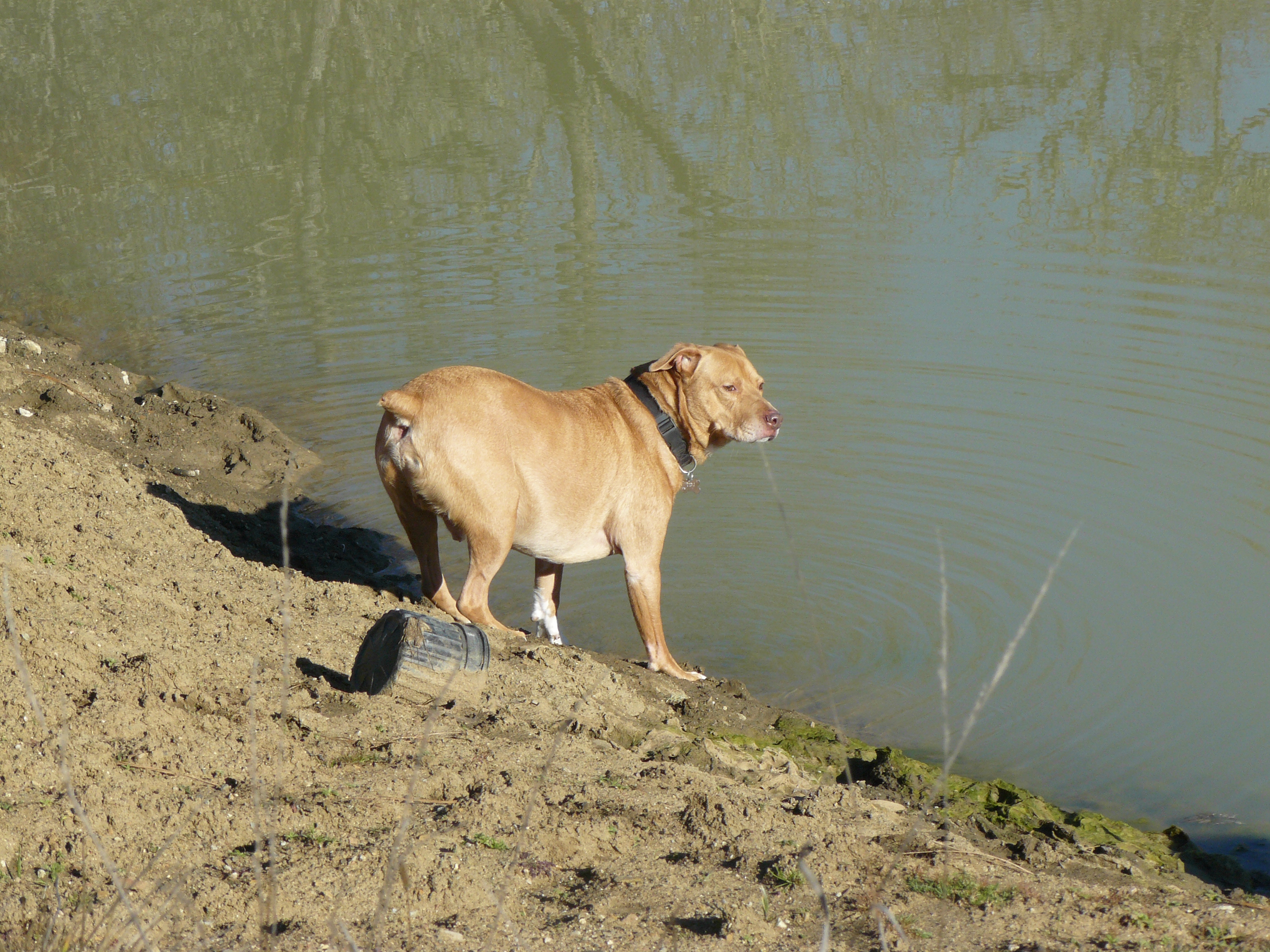
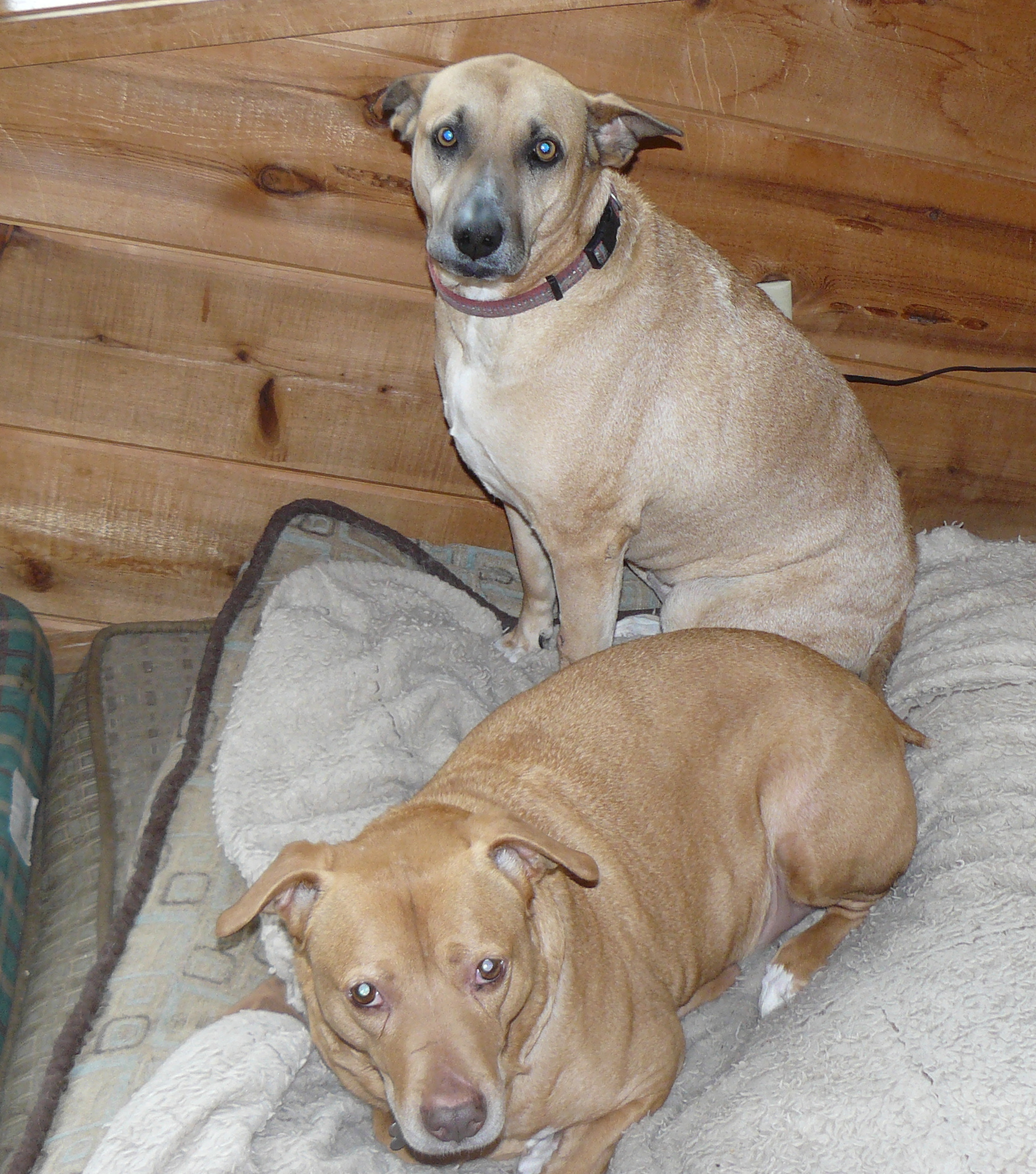
Casey, at home; picture taken a month ago.

Every Friday, the Payson Roundup newspaper would devote a full page to the Humane Society, displaying some of the cats and dogs they had for adoption. I would read about each animal and quietly wish I could bring them all home.

I was particularly taken with one dog that had appeared several times in this Friday page.  His name was Casey and he was a six-year-old Pit Bull mix.  Unfortunately, at home (we were then living in Payson, AZ) we were ‘maxed out’ with a total of 14 dogs in three different sections of our house.  We just couldn’t take Casey.

I had volunteered to be a dog-walker at the Humane Society dog shelter.  But after two sessions walking dogs, I just couldn’t look at these sad little faces without breaking down in tears. I switched my efforts to working at the Society’s Thrift Store.  That was great fun and, at least, it felt as though I was still helping the animals. Nonetheless, I was very impressed with the animal shelter.  They did their utmost to re-home the animals in their care.

Ruby’s ‘pack’ here at home included Phoebe and Tess, rescue dogs from Mexico.   Recently, Phoebe had died with leukaemia and Tess with bone cancer leaving Ruby on her own.  Ruby was a dog that didn’t mix at all well with the other dogs, as was explained in last week’s post.

The next Friday, the Payson Roundup showed the Society’s ‘lonely hearts club’, highlighting animals that had been in care for a long time.  The first dog shown was Casey.  I telephone Chandra, the lady responsible for adoptions, and asked if Paul and I could bring Ruby to the shelter to find a companion for her. When we were at the shelter, Chandra asked us if we had anything against Pit Bulls. Of course we didn’t.  Ruby was introduced to Casey and, as they say, the rest was history.  Casey and Ruby right from the start were just wonderful together.

Ruby behind Casey.
Ruby behind Casey.

Subsequently, I learned from Chandra that Casey had been in care for over a year and, had we not taken him home, his days were numbered at the shelter.  There were many cheers and tears when I signed the adoption paper for Casey.

Casey now lives in the kitchen group here in Oregon: Paloma, Ruby, Lilly and Casey.  As with all our dogs, Casey is so happy to have our 14 acres to play in.  He is also the sweetest natured of dogs and will try to climb on to your lap at the first opportunity.  I have always been a great advocate of Pit Bulls and Pit Bull mixes and have never come across a mean one.

Thus, if you are in the position to adopt a dog, please consider Pit Bulls and Pit Bull mixes for the Pit Bull is a much-maligned breed.

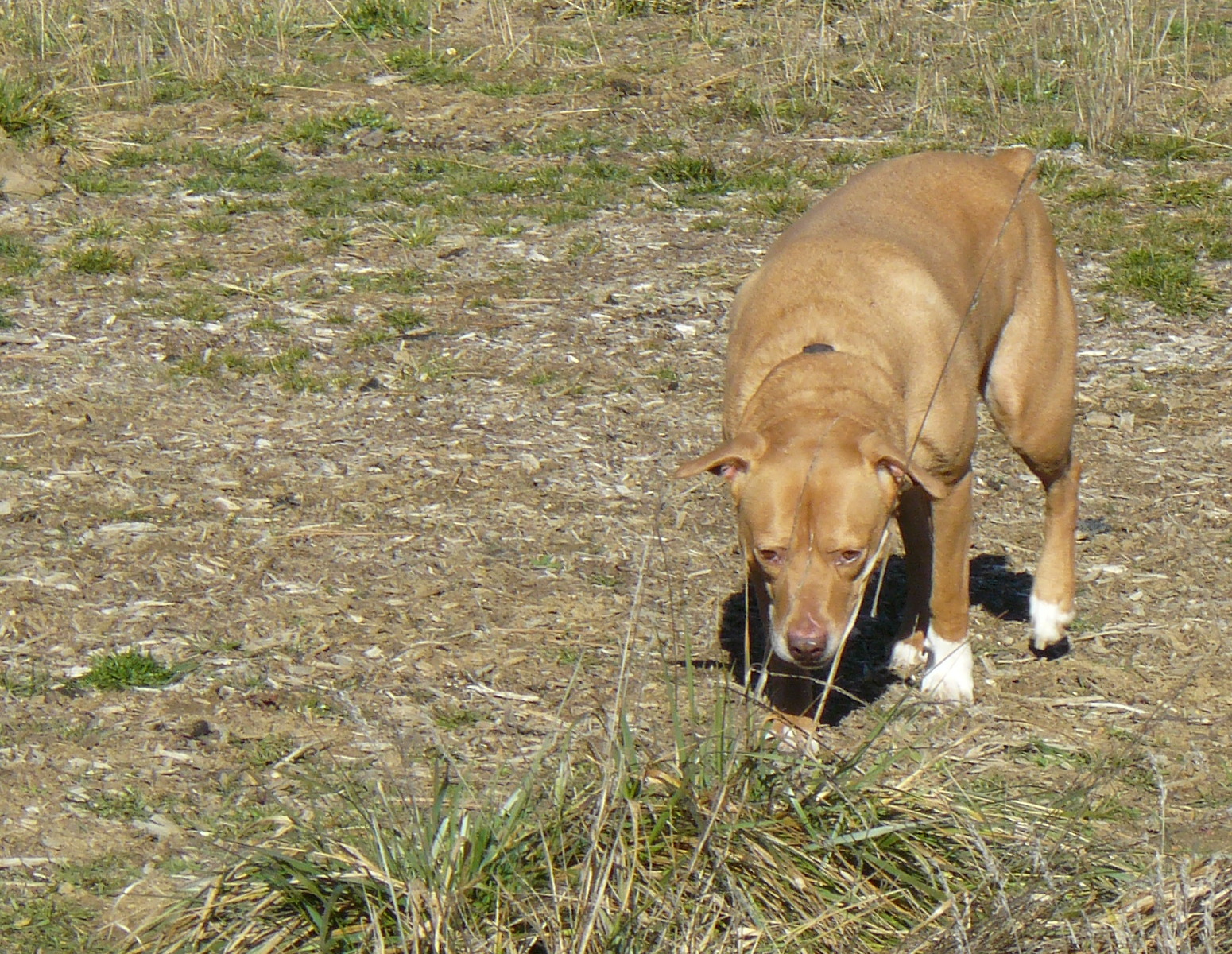
Casey demonstrating a dog's focussing skills!
Casey demonstrating a dog’s focussing skills!

ooOOoo

Meet dog number six next week.