I’m really showing my age and cultural upbringing through the choice of this title to today’s post.
For The Goon Show was an integral part of my ‘education’ during my formative years. Spike Milligan was an outstanding actor in The Goon Show, a comedy legend, along with Peter Sellers and Harry Secombe; not forgetting the narratives from Wallace Greenslade.
The Goon Show ran from 1951 to 1960 (I was born in 1944) broadcast by the BBC Home Service.
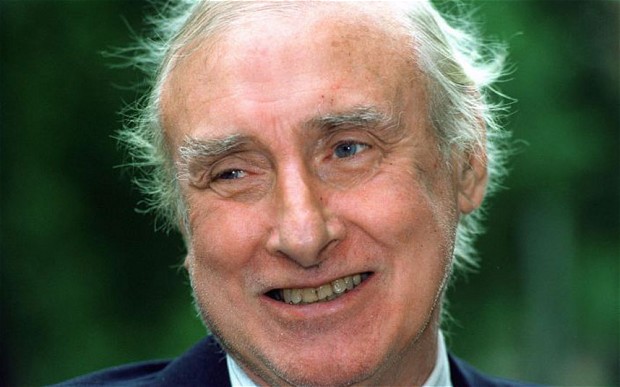
Spike Milligan after receiving his Order of the British Empire (OBE) in 1992.
What’s this all leading up to?
Simply that a recent speech by George Monbiot reveals such utter madness in the upper echelons of the United Kingdom that only reflecting on The Goon Show offers any meaning to this old Brit. Not that the USA escapes Mr. Monbiot’s analysis.
Here’s how the speech opens:
The Pricing of Everything
Ladies and gentlemen, we are witnessing the death of both the theory and the practice of neoliberal capitalism. This is the doctrine which holds that the market can resolve almost all social, economic and political problems. It holds that people are best served, and their prosperity is best advanced, by the minimum of intervention and spending by the state. It contends that we can maximise the general social interest through the pursuit of self-interest.
To illustrate the spectacular crashing and burning of that doctrine, let me tell you the sad tale of a man called Matt Ridley. He was a columnist on the Daily Telegraph until he became – and I think this tells us something about the meritocratic pretensions of neoliberalism – the hereditary Chair of Northern Rock: a building society that became a bank. His father had been Chair of Northern Rock before him, which appears to have been his sole qualification.
While he was a columnist on the Telegraph he wrote the following:
The government “is a self-seeking flea on the backs of the more productive people of this world. … governments do not run countries, they parasitize them.”(1) He argued that taxes, bail-outs, regulations, subsidies, interventions of any kind are an unwarranted restraint on market freedom. When he became Chairman of Northern Rock, Mr Ridley was able to put some of these ideas into practice. You can see the results today on your bank statements.
In 2007 Matt Ridley had to go cap in hand to the self-seeking flea and beg it for what became £27 billion. This was rapidly followed by the first run on a British bank since 1878. The government had to guarantee all the deposits of the investors in the bank. Eventually it had to nationalise the bank, being the kind of parasitic self-seeking flea that it is, in order to prevent more or less the complete collapse of the banking system. (2)
You can read the full transcript and look up the references over on the George Monbiot website.
However, a real bonus is that his speech (delivered without notes!), his SPERI Annual Lecture, hosted by the Sheffield Political Economy Research Institute at the University of Sheffield, was recorded on video.
Please set aside a quiet hour (and a tad) to listen to George Monbiot and wonder at the goon show that we are all acting out! In fact, watching his speech and his answers to a number of questions from the audience will give you something that the transcript just can’t convey. Watch it! You will be inspired!
(SPERI Annual Lecture by George Monbiot: “The Pricing of Everything” at the Octagon in Sheffield, UK, on 29th April 2014.)
Back to dear old Spike Milligan and to close with what seems like a very apt quote of his.
“All I ask is the chance to prove that money can’t make me happy.“
The second, and last, episode of the BBC Clouds Lab programme offers an intriguing message.
On Monday, I published a post under the title of The clouds above us. The second episode demonstrated that even in atmospheric conditions of near vacuum, intense cold and very low humidity, conditions that would kill a human in seconds, there was microscopic bacteriological material to be found.
Exploring the troposphere
The troposphere is a turbulent layer of air that begins at the Earth’s surface and ranges from 23,000-65,000 feet above sea level, depending on the latitude, season and the time of day. Its name originates from the Greek word tropos, meaning change. It’s now known that bacteria actually exists in clouds and scientists believe that it plays a significant part in the creation of rain but little is known about life higher up. Microbiologist Dr Chris Van Tulleken has discovered that living bacteria can exist well above 10,000ft in a hostile environment with low pressure, increased UV radiation, freezing temperatures, high winds and no oxygen or water.
What I took away from watching the programme was that the minimum conditions necessary for living bacteria were far more harsh than one might expect. In other words, finding living bacteria in other solar systems might not be such a science-fiction idea.
With that in mind, I’m republishing an essay that Patrice Ayme wrote in 2013. I’m grateful for his permission to so do.
ooOOoo
40 Billion Earths? Yes & No.
Up to twenty years ago, a reasonable opinion among scientists was that there might be just one solar system. Ours. Scientists like to project gravitas; having little green men all over didn’t look serious.
However, studying delicately the lights of stars, how they vary, how they doppler-shift, more than 1,000 planets have been found. Solar systems seem ubiquitous. Astronomers reported in 2013 that there could be as many as 40 billion habitable Earth-size planets in the galaxy. However, consider this:
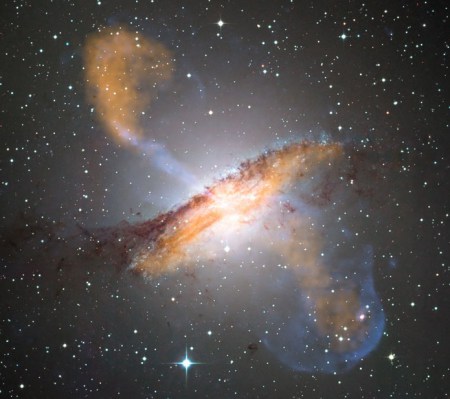
Centaurus A: Lobes Of Tremendous Black Hole Explosion Fully Visible.
Yes, that’s the center of a galaxy, and it has experienced a galactic size explosion from its central black hole.
One out of every five sun-like stars in our galaxy has a planet the size of Earth circling it in the Goldilocks zone, it seems — not too hot, not too cold — with surface temperatures compatible with liquid water. Yet, we have a monster black hole at the center of our giant galaxy, just like the one exploding above.
The Milky Way’s black hole is called Sagittarius A*. It exploded last two million years ago. Early Homo Erectus, down south, saw it. The furious lobes of the explosion are still spreading out, hundreds of thousands of light years away.
We are talking here about explosions potentially stronger than the strongest supernova by many orders of magnitude (depending upon the size of what’s falling into Sagittarius. By the way, a cloud is just heading that way).
Such galactic drama has a potential impact on the presence of advanced life. The richer the galaxy gets in various feature the situation looks, the harder it looks to compute the probability of advanced life.
The profusion of habitable planets is all the more remarkable, as the primitive methods used so far require the planet to pass between us and its star.
(The research, started on the ground in Europe, expanded with dedicated satellites, the French Corot and NASA’s Kepler spacecraft.). Sun-like stars are “yellow dwarves”. They live ten billion years.
From that, confusing “habitable” and “inhabitated”, the New York Times deduced: “The known odds of something — or someone — living far, far away from Earth improved beyond astronomers’ boldest dreams on Monday. “
However, it’s not that simple.
Primitive bacterial life is probably frequent. However advanced life (animals) is probably very rare, as many are the potential catastrophes. And one needs billions of years to go from primitive life to animals.
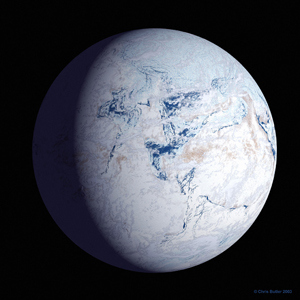
After life forms making oxygen on Earth appeared, the atmosphere went from reducing (full of strong greenhouse methane) to oxidizing (full of oxygen). As methane mostly disappeared, so did the greenhouse. Earth froze, all the way down to the equator:
When Snowball Earth Nearly Killed Life.
Yet volcanoes kept on belching CO2 through the ice. That CO2 built up above the ice, caused a strong greenhouse, and the ice melted. Life had survived. Mighty volcanism has saved the Earth, just in time.
That “snowball Earth” catastrophe repeated a few times before the Earth oxygen based system became stable. Catastrophe had been engaged, several times, but the disappearance of oxygen creating life forms had been avoided, just barely.
Many are the other catastrophes we have become aware of, that could wipe out advanced life: proximal supernovas or gamma ray explosions.
Cataclysmic eruption of the central galactic black hole happen frequently. The lobes from the last one are still visible, perpendicularly high off the galactic plane. The radiation is still making the Magellanic Stream simmer, 200,000 light years away. Such explosions have got to have sterilized a good part of the galaxy.
In 2014 when part of the huge gas cloud known as G2 falls into Sagittarius A*, we will learn better how inhospitable the central galaxy is for advanced life.
Many of the star systems revealed out there have surprising feature: heavy planets (“super Jupiters“) grazing their own stars. It’s unlikely those giants were formed where they are. They probably swept their entire systems, destroying all the rocky planets in their giant way. We don’t understand these cataclysmic dynamics, but they seem frequent.
Solar energy received on Earth fluctuated and changed a lot, maybe from one (long ago) to four (now). But, as it turned out just so that Earthly life could survive. Also the inner nuclear reactor with its convective magma and tectonic plates was able to keep the carbon dioxide up in the air, just so.
The Goldilocks zones astronomers presently consider seem to be all too large to allow life to evolve over billions of years. They have to be much narrower and not just with red dwarves (the most frequent and long living stars).
One of our Goldilocks, Mars, started well, but lost its CO2 and became too cold. The other Goldilocks, Venus, suffered the opposite major technical malfunction: a runaway CO2 greenhouse.
Mars’ axis of rotation tilts on the solar system’s plane enormously: by 60 degrees, over millions of years. So Mars experiences considerable climatic variations over the eons, as it goes through slow super winters and super summers (it’s imaginable that, as the poles melt, Mars is much more habitable during super summers; thus life underground, hibernating is also imaginable there).
Earth’s Moon prevents this sort of crazy hyper seasons. While, differently from Venus, Earth rotates at reasonable clip, homogenizing the temperatures. Venus takes 243 days to rotate.
It is startling that, of the four inner and only rocky planets, just one, Earth has a rotation compatible with the long term evolution of advanced life.
Earth has also two striking characteristics: it has a very large moon that store much of the angular momentum of the Earth-Moon system. Without Moon, the Earth would rotate on itself once every 8 hours (after 5 billion years of braking by Solar tides).
The Moon used to hover at least ten times closer than now, when earth’s days were at most 6 hours long.
The tidal force is the difference between gravitational attraction in two closely separated places, so it’s the differential of said attraction (which is proportional to 1/dd; d being the distance). Hence the tidal force is inversely proportional to the cube of the distance.
Thus on early Earth tides a kilometer high were common, washing back and forth every three hours. a hyper super tsunami every three hours, going deep inside the continents. Not exactly conditions you expect all over the universe.
Hence biological material fabricated on the continental margins in shallow pools would get mixed with the oceans readily. That would guarantee accelerated launch of life (and indeed we know life started on Earth very fast).
The theory of formation of the Moon is wobbly (recent detailed computations of the simplest impact theory do not work). All we know for sure, thanks to the Moon rocks from Apollo, is that the Moon is made of Earth mantle materials.
Somehow the two planets split in two. (Fission. Get it? It maybe a hint.)
Another thing we know for sure is that Earth has, at its core, a giant nuclear fission reactor, keeping Earth’s core hotter than the surface of the sun. An unimaginable liquid ocean of liquid iron deep down inside below our feet undergoes iron weather. Hell itself, the old fashion way, pales in comparison.
Could the Moon and the giant nuclear reactor have the same origin? This is my provocative question of the day. The Moon, our life giver, could well have formed from giant nuclear explosions, of another of our life givers, what became the nuke at the core. I can already hear herds of ecologists yelp in the distance. I present the facts, you pseudo-ecologists don’t decide upon them. It’s clear that nuclear fission is not in Drake equation: if nothing else, it’s too politically incorrect.
All the preceding makes this clear:
Many are the inhabitable planets, yet few will be inhabitated by serious denizens.
This means that the cosmos is all for our taking. The only question is how to get there. The closest stars in the Proxima, Beta and Alpha Centauri system are not attainable, for a human crew, with existing technology.
However, if we mastered clean colossal energy production, of the order of the entire present energy production of humanity, we could get a colony there (only presently imaginable technology would be fusion).
Giordano Bruno, professor, astronomer, and priest suggested that there were many other inhabitated systems around the stars. That insult against Islam meant Christianity was punished the hard way: the Vatican, the famous terrorist organization of god crazies, put a device in Giordano’s mouth that pierced his palate, and having made sure that way that he could not tell the truth, the terrorists then burned him alive. After seven years of torture.
The horror of truth was unbearable to theo-plutocrats.
Now we face something even worse: everywhere out there is very primitive life. It is likely gracing 40 billion worlds. But, if one has to duplicate the succession of miracles and improbabilities that made Earth, to earn advanced life, it may be just here that civilization ever rose to contemplate them.
Congratulations to India for launching yesterday a mission to Mars ostensibly to find out if there is life there (by finding CH4; while life is presently unlikely, Mars has much to teach, including whether it started there). That’s the spirit!
The spirit is to have minds go where even imagination itself did not go before.
If we sit back, and look at the universe we have now, from Dark Matter, to Dark Energy, to Sagittarius, to the nuclear reactor below, to billions of Earths, to a strange Higgs, to Non Aristotelian logic, we see a wealth, an opulence of possibilities inconceivable twenty years ago.
Progress is not just about doing better what was done yesterday. It’s also about previously inconceivable blossoms of entirely new mental universes.
The more that man tries to interfere the more that man screws up.
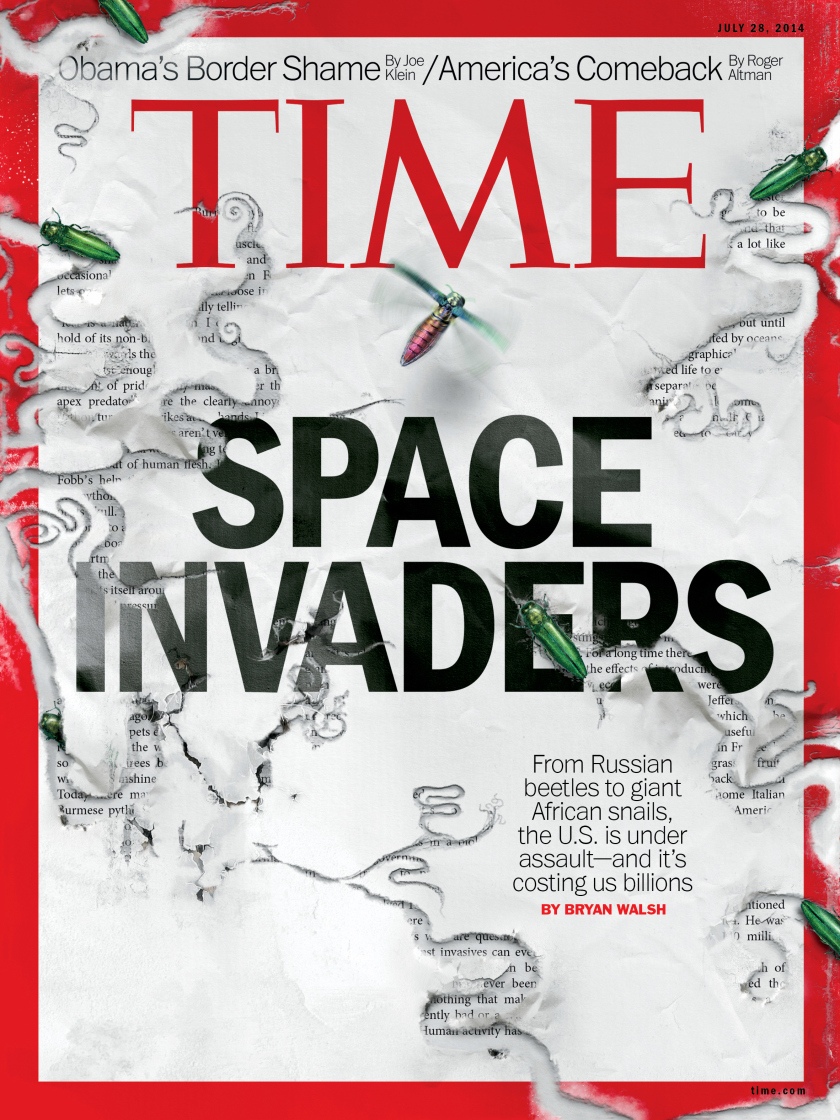
Jeannie and I subscribe to Time Magazine. This week’s edition had a pretty eye-catching cover that required a second look.
Illustration by Justin Metz for Time. Photo reference for emerald ash borer courtesy of PDCNR—Forestry Archive, Bugwood.org
That cover referred to the lead article concerning invasive species, “From giant snails to Asian carp, alien wildlife is on the move.“, written by Bryan Walsh. The essence of the article is that man’s global activities are responsible, albeit often unwittingly, for the movement of a wide range of species across national borders. My own reaction to the article was that it was typical of the many ‘scare’ stories the media present but that at the end of the day, nothing will change. However the last two paragraphs of the article did resonate with me.
Human beings have become the dominant force on the planet, so much so that many scientists believe we’ve entered an entirely new geological epoch: the Anthropocene. We have already been shaping the planet unintentionally, through greenhouse-gas emissions and global trade and every other facet of modern existence. The challenge now is to take responsibility for that power over the planet and use it for the right ends – all the while knowing that there is no single correct answer, no lost state of grace we can beat back toward.
How we respond to the thickening invasions that we ourselves loosed will be part of that answer – which is only just. There is one species that can claim to be the most dominant invasive of all time. From its origins in Africa, this species has spread to every corner of the world and every kind of climate. Everywhere it goes, it displaces natives, leaving extinction in its wake, altering habitat to suit its needs, with little regard for the ecological impact. Its numbers have grown nearly a millionfold, and its spread shows no sign of stopping. If that invasive species sounds familiar, it should. It’s us.
Thus with that article from Time in mind, it was very pertinent to see the latest essay from George Monbiot. It reinforces, in spades, the sentiment expressed by Bryan Walsh in those paragraphs above and is republished here on Learning from Dogs with the generous permission of George Monbiot.
ooOOoo
A One Way Street to Oblivion
As soon as an animal becomes extinct, a new bill proposes, it will be classified as “non-native”.
By George Monbiot, published on the Guardian’s website, 21st July 2014
Can any more destructive and regressive measures be crammed into one bill?
Already, the Infrastructure Bill, which, as time goes by, has ever less to do with infrastructure, looks like one of those US monstrosities into which a random collection of demands by corporate lobbyists are shoved, in the hope that no one notices.
So far it contains (or is due to contain) the following assaults on civilisation and the natural world:
– It exempts fracking companies from the trespass laws
– Brings in a legal requirement for the government to maximise the economic recovery of petroleum from the UK’s continental shelf. This is directly at odds with another legal requirement: to minimise the UK’s greenhouse gas emissions
– Introduces the possibility (through Clauses 21 and 22) of a backdoor route to selling off the public forest estate. When this was attempted before, it was thwarted by massive public protest.
– further deregulates the town and country planning system, making life even harder for those who wish to protect natural beauty and public amenities
Enough vandalism? Not at all. There’s yet another clause aimed at suppressing the natural world, which has, so far, scarcely been discussed outside parliament. If the Infrastructure Bill is passed in its current state, any animal species that “is not ordinarily resident in, or a regular visitor to, Great Britain in a wild state” will be classified as non-native and subject to potential “eradication or control”. What this is doing in an infrastructure bill is anyone’s guess.
At first wildlife groups believed it was just poor drafting, accidentally creating the impression that attempts to re-establish species which have become extinct here – such as short-haired bumblebees or red kites – would in future be stamped out. But the most recent Lords debate scotched that hope: it became clear that this a deliberate attempt to pre-empt democratic choice, in the face of rising public enthusiasm for the return of our lost and enchanting wildlife.
As Baroness Parminter, who argued unsuccessfully for changes to the bill, pointed out, it currently creates
“a one-way system for biodiversity loss, as once an animal ceases to appear in the wild, it ceases to be native.”
She also made the point that it’s not just extinct species which from now on will be treated as non-native, but, as the bill now stands, any species listed in Schedule 9 of the Wildlife and Countryside Act 1981.
Among those in Schedule 9 are six native species that have already been re-established in Britain (the capercaillie, the common crane, the red kite, the goshawk, the white-tailed eagle and the wild boar); two that are tentatively beginning to return (the night heron and the eagle owl); and four that have been here all along (the barn owl, the corncrake, the chough and the barnacle goose). All these, it seems, are now to be classified as non-native, and potentially subject to eradication or control.
After the usual orotund time-wasting by aristocratic layabouts (“my ancestor Sir Ewen Cameron of Lochiel, who was known as the great Sir Ewen … killed the last wolf in Scotland” etc), the minister promoting the bill, Baroness Kramer, made it clear that the drafting was no accident. All extinct species, it appears, are to be treated as non-native and potentially invasive. At no point did she mention any of the benefits their re-establishment might bring, such as restoring ecological function and bringing wonder and delight and enchantment back to this depleted land.
Here is a list, taken from Feral, of a few of the animals which have become extinct recently (in ecological terms) and which probably meet the bill’s new definition of non-native: “not ordinarily resident in, or a regular visitor to, Great Britain in a wild state”. Some would be widely welcomed; others not at all, but it’s clear that a debate about which species we might welcome back is one that many people in this country want to have, but that the government wants to terminate. There’s a longer list, with fuller explanations and a consideration of their suitability for re-establishment, in the book.
European Beaver: became extinct in Britain in the mid-18th Century, at the latest. Officially re-established in the Knapdale Forest, Argyll. Unofficially in the catchment of the River Tay and on the River Otter, in Devon.
Wolf: The last clear record is 1621 (not 1743 as commonly supposed). It was killed in Sutherland. As far as I can determine, neither Sir Ewen Cameron nor any of the other blood-soaked lairds and congenital twits from whom Lord Cameron of Dillington is descended were involved.
Lynx: The last known fossil remains date from the 6th Century AD, but possible cultural records extend into the 9th Century.
Wild Boar: The last truly wild boar on record were killed on the orders of Henry III in the Forest of Dean, in 1260. Four small populations in southern England, established after escapes and releases from farms and collections.
Elk or Moose (Alces alces): The youngest bones found in Britain are 3,900 years old. Temporarily released in 2008 into a 450-acre enclosure on the Alladale Estate, Sutherland.
Reindeer: The most recent fossil evidence is 8,300 years old. A free-ranging herd grazes on and around Cairn Gorm in the Scottish Highlands.
Wild horse: The most recent clearly-established fossil is 9,300 years old. Animals belonging to the last surviving subspecies of wild horse, Przewalski’s (Equus ferus przewalskii), graze Eelmoor Marsh in Hampshire.
Forest bison, or wisent: Likely to have become extinct here soon before the peak of glaciation, between 15,000 and 25,000 years ago. A herd was temporarily established at Alladale in 2011.
Brown bear: probably exterminated around 2000 years ago.
Wolverine: survived here until roughly 8,000 years ago.
Lion: the last record of a lion in the region is a bone from an animal that lived in the Netherlands – then still connected to Britain – 10,700 years ago.
Spotted hyaena: around 11,000 years ago.
Hippopotamus: it was driven out of Britain by the last glaciation, around 115,000 years ago, and hunted to extinction elsewhere in Europe about 30,000 years ago.
Grey whale: the most recent palaentological remains, from Devon, belonged to a whale that died around 1610 AD.
Walrus: late Bronze Age, in the Shetland Islands.
European Sturgeon: possibly as recently as the 19th Century.
Blue stag beetle: probably 19th Century.
Eagle owl: the last certain record is from the Mesolithic, 9,000-10,000 years old . But a possible Iron Age bone has been found at Meare in Somerset. Now breeding in some places, after escaping from collections.
Goshawk: wiped out in the 19th Century. Unofficially re-established in the 20th Century, through a combination of deliberate releases and escapes from falconers.
Common crane: last evidence of breeding in Britain was in 1542. Cranes re-established themselves through migration in the Norfolk Broads in 1979, and have bred there since then. Now breeding in two other places in eastern England. Re-introduced in 2010 to the Somerset Levels.
White Stork: last recorded nesting in Edinburgh in 1416. In 2004 a pair tried to breed on an electricity pole in Yorkshire. In 2012 a lone bird built a nest on top of a restaurant in Nottinghamshire.
Spoonbill: the last breeding records are 1602 in Pembrokeshire and 1650 in East Anglia. In 2010 a breeding colony established itself at Holkham in Norfolk.
Night Heron: last bred here in either the 16th or 17th Century, at Greenwich. Today it is a scarce visitor.
Dalmatian Pelican: remains have been found from the Bronze Age in the Cambridgeshire Fens and from the Iron Age in the Somerset levels, close to Glastonbury. A single mediaeval bone has been found in the same place.
These and many others are now to be classified as officially non-native, unless this nonsense can be stopped.
Incidentally, determining what is and isn’t a native species, let alone what “should” or “should not” be living here, is a much more complicated business than you might imagine, as Ken Thompson’s interesting book, Where Do Camels Belong?, makes clear. He also points out that some species which are initially greeted with horror and considered an ecological menace soon settle down as local wildlife learns to prey on them or to avoid them. Sometimes they perform a useful ecological role by filling the gaps created by extinction. He overstates his case, and glosses over some real horror stories, but his book is an important counterweight to attempts to create a rigid distinction between native and non-native wildlife.
Many species introduced to this country by human beings are now cherished as honorary members of our native wildlife. Here are just a few I’ve come across. How many of you knew that they were all brought here by people?:
Brown hare
Little owl
Field poppy
Corncockle
Crack willow
Greater burdock
Pheasant’s eye
Cornflower
Wormwood
Mayweed
White campion
Isn’t this an interesting subject? Unfortunately government ministers seem to know to know nothing about it and to care even less. They are crashing through the middle of delicate interactions between people and the natural world like bulldozers in a rainforest.
I will close today’s post with another, very recent, story in The Guardian, that opens, thus:
Wild beaver kits born in Devon
Thursday 17 July 2014
One of the first wild beavers to be seen in England in centuries and due to be taken into captivity has given birth to three young.
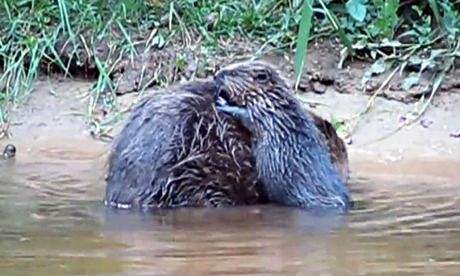
Local retired environmentalist Tom Buckley captured the three young beavers climbing all over their mother. Photograph: Tom Buckley/Apex
A wild beaver due to be taken into captivity has given birth to at least three young.
The young, known as kits, were born to the family of two adult and one juvenile European beavers (Castor fiber) that were spotted living on the river Otter in Devon earlier this year, in what was believed to be the first sighting of the species in the wild in England in 500 years.
All that is left for me to do is to quote a little from a recent letter from John Hurlburt.
Our future depends on the air we breathe. Our lives depend upon rivers of living water. Our health requires the blessings of organic agriculture. Our energy streams through us from the cosmos.
We are warrior animals. Peace must come from within. Non-violence is our best choice. We have the magnificent opportunity to wake up as an animal that is grateful and sings in harmony with the Earth.
The present is surrounded by the past and the future. We float on the wings of compassion and wisdom with a sacred responsibility for the Nature of all Creation.
A team of scientists take to the skies in one of the world’s largest airships, for a unique exploration of Earth’s most precious and mysterious environment – the atmosphere.
In an example of what might be called a massive change of topic from yesterday’s post on Integrity and democracy, today’s offering to you, dear reader, is about the magnificent atmosphere upon which we all depend.
Here’s a clue.
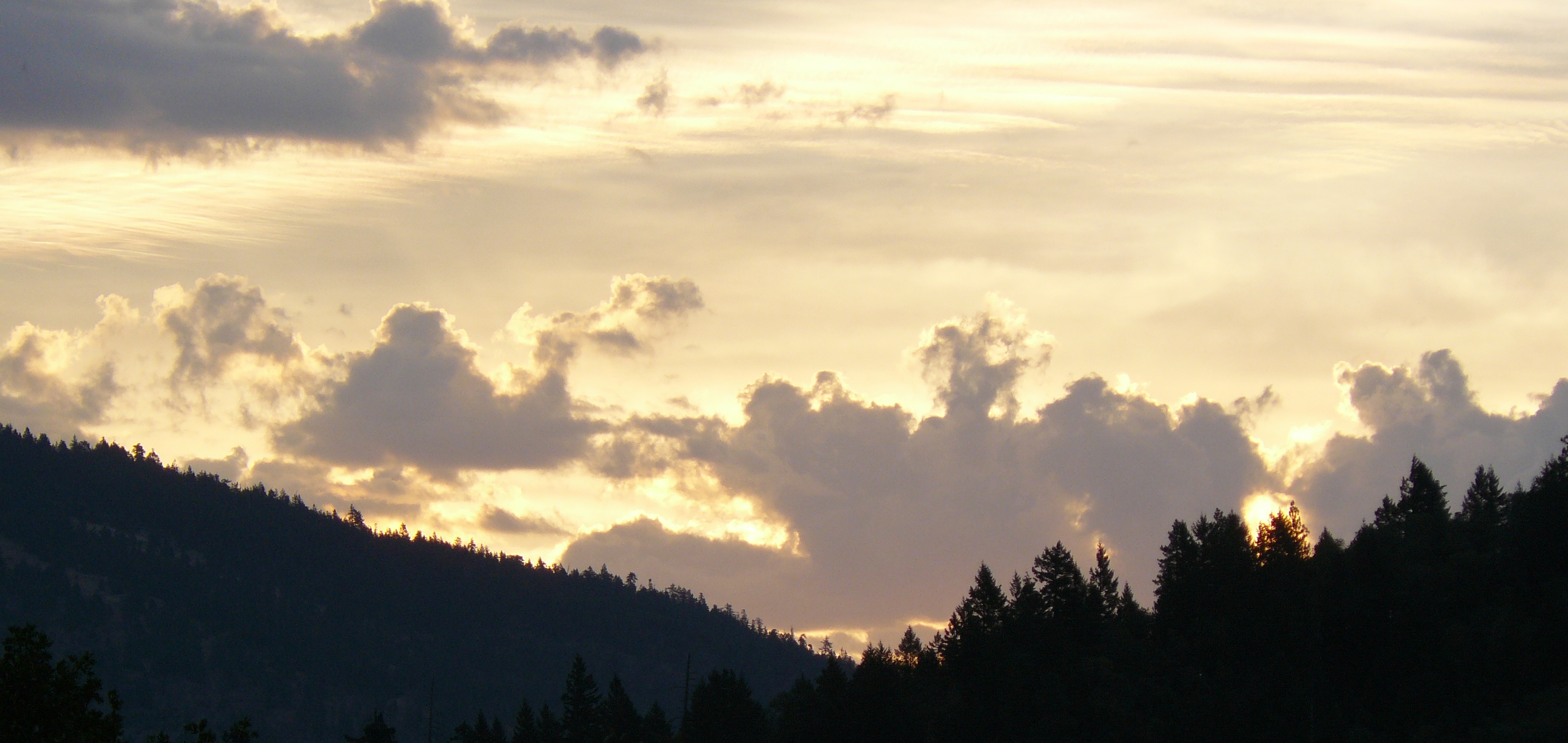
Sunrise to our North-East at a little after 7am on Sunday, 13th July, 2014.
Every Breath We Take: Understanding Our Atmosphere
The air around us is not just empty space; it is an integral part of the chemistry of life. Plants are made from carbon dioxide, nitrogen nourishes the soil and oxygen gives us the energy we need to keep our hearts pumping and our brains alive. But how did we come to understand what air is made of? How did we come to know that this invisible stuff around us contains anything at all?
Gabrielle Walker tells the remarkable story of the quest to understand the air. It’s a tale of heroes and underdogs, chance encounters and sheer blind luck that spans the entire history of science. It began as a simple desire to further our knowledge of the natural world, but it ended up uncovering raw materials that have shaped our modern world, unravelling the secrets of our own physiology and revealing why we are here at all.
There is much more to explore on the website, including this trailer to the programme.
Oh, here’s another ‘clue’ from Oregon.
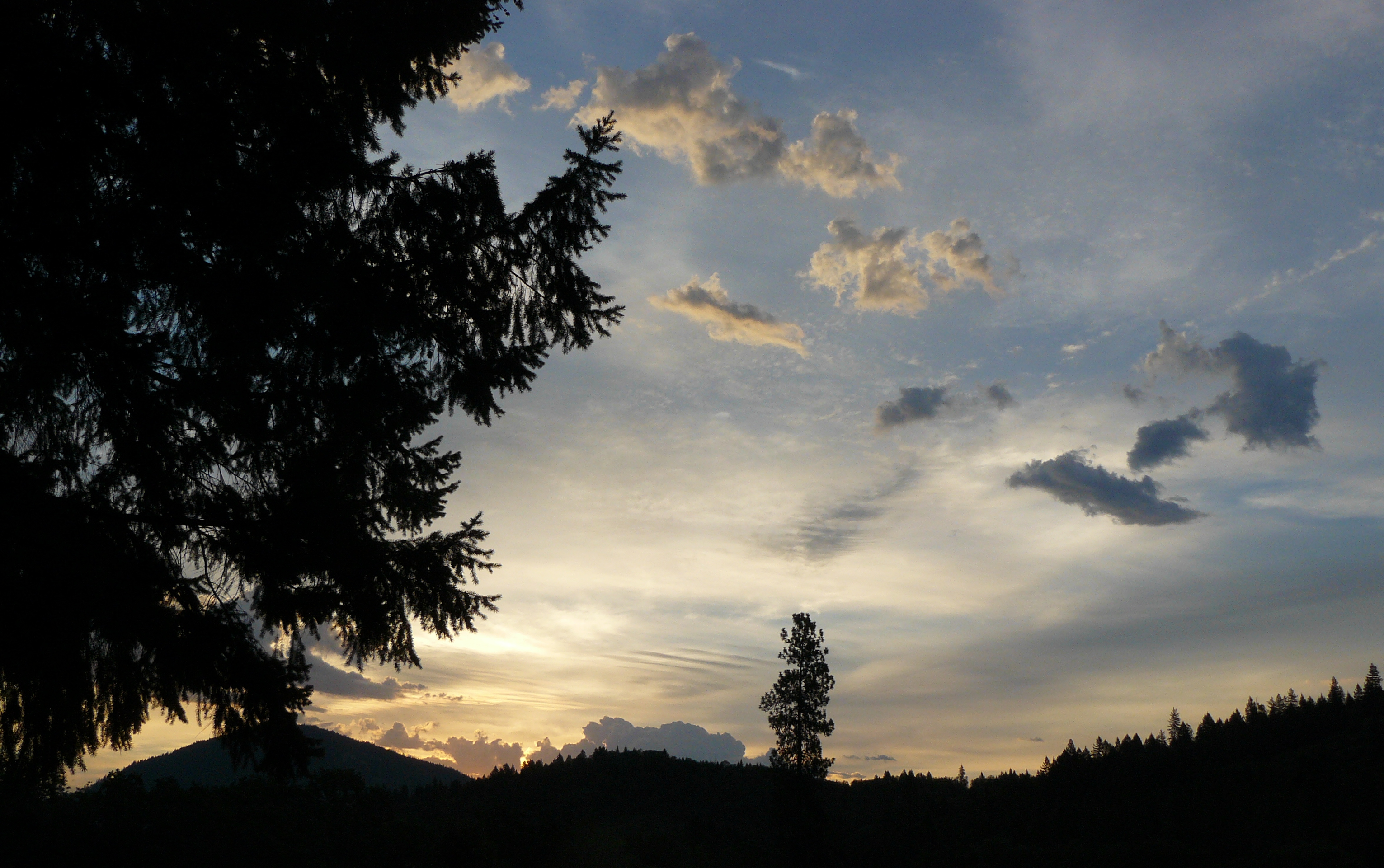
Same morning, same sunrise.
The presenter of the BBC series is Felicity Aston who writes on her BBC Blog:
I joined Operation Cloud Lab: Secrets Of The Skies as the expedition leader and also as a meteorologist.
The plan was to fly from Florida to California, looking at the science of the skies.
But as well as scientists, there were plenty of other people on the team including three pilots, a ground crew of 14 that followed the airship by road and a full production team including two camera crews. Not everyone could be on board at once – the airship would never have got off the ground!
But I was really fortunate to spend a lot of time on board and flew most of the way across the continent.
Exploring in three dimensions rather than being limited to making observations from the ground was a revelation to me.
The clouds in the tropics around the Gulf of Mexico are huge, and being in the sky with them really brought home the vast scale of the forces at work.
Towering cumulus cloud in Florida.
We were able to travel over, under and through these monsters, revealing that clouds are about as far from the popular image of light and fluffy floating puffs of cotton wool as you can get! They are dense and heavy and full of destructive energy.
I remember looking down at the cloud layer from a plane as a child, and daydreaming about exploring this new world of unknown places, so I was very excited the first time we flew straight through a cloud.
I leaned out of the airship as far as I dared into the heart of a cloud and found that it was a dark, damp mass of floating fog (of course!) – no mysterious worlds – my childhood fantasies were crushed!
There’s more to read on her blog as well as some stupendous photographs of clouds.
So if this gives you a thrill then don’t delay in watching the full-length Episode One on YouTube before it gets taken down. (Warning: if you watch the opening first few minutes you will be hooked for the full hour!)
Now to close with, yes you guessed it, my final ‘clue’ from Oregon.
“Democracy is when the indigent, and not the men of property, are the rulers.”
Thus said Aristotle.
Here’s another quote from more recent times.
“The supreme quality for leadership is unquestionably integrity. Without it, no real success is possible, no matter whether it is on a section gang, a football field, in an army, or in an office.”
So said President Dwight D. Eisenhower.
oooo
Today’s post started as an ill-defined idea in my head following me reading a recent essay over on Patrice Ayme’s blog. It was his (her?) post of the 17th July in which was written, “Representative democracy has to be destroyed as an ideal.” and later,
Meanwhile the French People would be well advised to search for a new form of government more appropriate to the modern world, and the increasing democracy we all dearly need.
One does not have to look very far for inspiration: the Confoederatio Helvetica next door, an independent, and central part of the Franks’ Francia, is enjoying a much more direct form of democracy.
that caused me to leave a comment,
I read a deeper malaise in your essay, Patrice, and that is the failure of ‘representative’ democracy in country after country around the world. In fact, it’s inspiring me to write a post over on LfD about the possibilities for truly democratic government.
that, in turn, was replied to by Patrice:
Please go ahead, Paul, and keep me informed! ;-)! And you are completely right. Representative democracy is actually oligarchic representation. Athenians had 80,000 citizens, and 80,000 legislators. France has about 1,000 times more citizens, and one half of a thousandth (1/2,000) fewer legislators. That makes the French democratic index half of a million times less than the Athenians!
Let me step back for a moment.
Over the life of this blog, I have touched on the vulnerability of human life on this planet more than once. It’s not being at all smart to say that mankind is crapping on its own doorstep and our future is in severe doubt. The reason I say it’s not smart is simply because millions of people almost certainly think that or something pretty damn close.
Maybe the huge divide between what ‘the man in the street’ knows makes common sense and the terrible lack of common sense shown by so many of our governments is at the root of the problem. In other words, our representative democratic system isn’t working.
Here’s a letter from the pages of the Tampa Bay Times from just last Tuesday.
Tuesday’s letters: Our democratic system is at risk
There are thoughtful, informed people who are worried that our democratic system of government is not working and the whole enterprise is at risk. I think there is only one solution to the problem: to elect people who have demonstrated the ability to work cooperatively with others and solve problems.
It is foolish to think that the personalities of members of Congress change when they arrive in Washington. A worrisome number were fools, buffoons and rigidly ideological before they were elected, and there is no realistic possibility that anyone or anything can change their personalities after they are elected and while they are in office.
It is a crisis long in the making. Most students finish high school with little or no understanding of American history or the way their government works. There is no understanding of the idea of citizenship and the heavy responsibility imposed on citizens who live in a democratic republic. There has never been so much information so easily available that could allow people to make wise use of their votes. But without the perspective of education and a deep understanding that voting is everything in our system of government, it all may slip away.
Roger C. Benson, St. Petersburg
“to elect people who have demonstrated the ability to work cooperatively with others and solve problems.”
I wouldn’t argue at all with the wisdom in those words. But I would add to it.
It’s my sense that many citizens in many countries feel that the whole business of government has got to large, too complicated, too remote and, frankly, has less to do with working “cooperatively with others and solve problems” than with feeding its own mouth. Take voter turnout.
Voter turnout in the USA; 1824 – 2008
Why such high levels of absenteeism; for want of a better description?
Let’s go back to the Athenians as Patrice mentioned. Plenty on the web to read but this article caught my eye.
Athenian Democracy: a brief overview
Christopher W. Blackwell, edition of February 28, 2003
· Summary ·
This article was originally written for the online discussion series “Athenian Law in its Democratic Context,” organized by Adriaan Lanni and sponsored by Harvard University’s Center for Hellenic Studies. Its purpose is to introduce, very briefly, the institutions of the Athenian democracy during the late 5th century BCE through the end of the radical democracy in the late 4th century. This is a companion-piece to “The Development of Athenian Democracy,” also written for the CHS’s discussion series.
· Introduction ·
The city of Athens lived under a radically democratic government from 508 until 322 BCE. Before the earlier date there was democracy to be found here and there in the government of Athens, and democratic institutions survived long after the latter date, but for those 186 years the city of Athens was self-consciously and decidedly democratic, autonomous, aggressive, and prosperous. Democracy in Athens was not limited to giving citizens the right to vote. Athens was not a republic, nor were the People governed by a representative body of legislators. In a very real sense, the People governed themselves, debating and voting individually on issues great and small, from matters of war and peace to the proper qualifications for ferry-boat captains (for the latter, see Aeschin. 3.157).1 The Athenian democracy was not, of course, a free-for-all of mob rule. The Athenians understood the value of checks and balances and of enforcing time for reflection before acting. They understood that professionalism is necessary in certain jobs, that accountability was necessary of most jobs, and that some jobs required absolute job-security. The system evolved over time, suffered two complete breakdowns in the 5th century, and is certainly open to criticism at many points during its history. Nevertheless, it was coherent enough during those two centuries that we can describe it, in general terms, without being too far wrong on any point. And despite its moments of imprudence, injustice, and indecision, it was an experiment remarkable enough to deserve our attention.
The early history of Athenian Democracy and its development is the subject of another article in this series. This general description of how the Athenians governed themselves will focus on the 4th century BCE, both because the democracy was most fully developed during that time and because the majority of our evidence either comes from that period, or describes the the Athenian government during that period.
Now there’s much more to read here for those so interested but I want to highlight a section from the above. This section:
In a very real sense, the People governed themselves, debating and voting individually on issues great and small, from matters of war and peace to the proper qualifications for ferry-boat captains. The Athenian democracy was not, of course, a free-for-all of mob rule. The Athenians understood the value of checks and balances and of enforcing time for reflection before acting. They understood that professionalism is necessary in certain jobs, that accountability was necessary of most jobs, and that some jobs required absolute job-security.
So from 322 BCE to 2014 AD!
A few days ago, Jeannie needed to change some details regarding her US Social Security payment. We saw that it could be done online. As one would expect, setting up online access for Jean meant jumping through a number of security hoops. All more or less sorted in 20 minutes.
It was clear that it would be incredibly difficult for someone to fraudulently break into her online SSA account. Think of the millions who perfectly happily manage their bank accounts online.
Ergo, there are no technical issues why every single eligible voter in the USA (and many other countries) couldn’t move towards governing themselves in a direct manner just like the Athenians. Indeed, voting in the USA at times of Presidential elections is permitted. But all that is doing is participating in a system that isn’t delivering real democracy.
We need to govern ourselves: “debating and voting individually on issues great and small, from matters of war and peace to the proper qualifications for ferry-boat captains.” Because humanity is facing some issues that are very great indeed!
Or have I missed something bloody obvious?
oooo
I opened today’s post with two quotations. I shall close by offering another two.
“If we don’t hang together, we most assuredly will hang separately.”
Benjamin Franklin advising the original continental congress of what became the United States of America.
“A key political question today is: Do you support the well-being of the Earth and the life that the Earth supports?“
From a good friend and supporter of this blog who chooses to remain anonymous. Who then added: “This question has spiritual, natural and rational implications which frame the debate in terms of human values greater than money.”
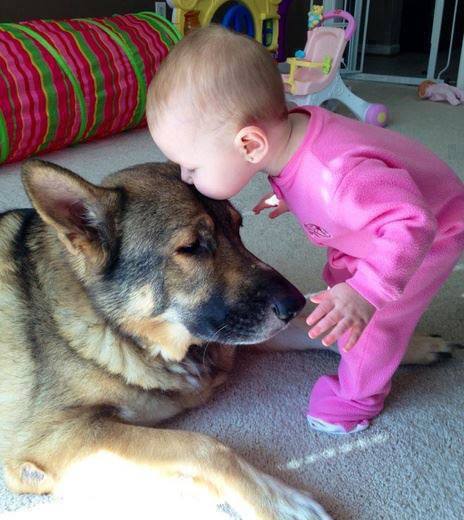
There are so many aspects of the dog world that we have to learn. Top of the list of what we must learn from dogs is unconditional love.
You all know how if you approach a strange dog with love in your heart, how that dog senses your love immediately and responds in the same loving fashion.
So approach every conscious being in your life with love in your heart. It will truly change the world!
So with that in mind, it seemed very appropriate to follow up yesterday’s post that included the essay by Chris Johnstone on celebration with this short film from Rick Hanson. Especially just now.
Published on Nov 7, 2013
Hardwiring Happiness : The Hidden Power of Everyday Experiences on the Modern Brain. How to overcome the Brain’s Negativity Bias.
Rick Hanson is a neuropsychologist and the author of Hardwiring Happiness: The New Brain Science of Contentment, Calm, and Confidence, best selling author of Buddha’s Brain, founder of the Wellspring Institute for Neuroscience and Contemplative Wisdom and an Affiliate of the Greater Good Science Center at UC Berkeley, he’s been an invited speaker at Oxford, Stanford, and Harvard, and taught in meditation centers worldwide.
A fascinating essay courtesy of Transition Network in the UK
I have very little doubt that I share with the majority of ‘common folk’ out there a feeling of these being dark and desperate times. I’m not even going to list the things that, on an almost daily basis, come along under the category of ‘doom and gloom’.
Yet it is also pretty widely known that change is embraced much more easily through reward. In other words, we commit to change, in a thousand different ways, from the expectation of reward: reward in many varied and numerous ways, many of them non-financial, of course.
The challenge for us all is that the negative has great pulling power. If we read news websites, watch television, read newspapers, and more, we are exposed essentially to wall-to-wall bad news.
So how on earth do we keep our spirits up? How on earth do we maintain hope in there being a positive way forward? Whatever ‘way forward’ translates to in terms of the individual?
Over in the UK there is the website of the Transition Network. From that home page one can link across to a number of blogs. Anyway, recently on Rob Hopkins’ blog there was a very interesting essay by Chris Johnstone about the power of celebration. Read it and reward yourself for so doing! 😉
Chris Johnstone works in the area of the psychology of resilience, sustainable happiness and is co-author, with Joanna Macy, of Active Hope: how to face the mess we’re in without going crazy. [1.] Chris appeared at both the Unleashing of Transition Town’s Totnes and Lewes, and has interacted with different Transition groups ever since. He’s also an accomplished musician (you can hear him playing briefly at the end of the podcast of our interview). I started by asking him why celebration matters:
“I’m just thinking about how important food is. Without food, we wither away. Food is nourishment. We also have needs for psychological nourishment or psycho-spiritual nourishment, emotional nourishment. I see celebration as one of those things that nourishes us psychologically, emotionally, spiritually. I was thinking about this also in terms of how important celebration is in keeping us going.
One of the thought blocks that people bump into sometimes is the voice that says “well what’s the point of doing this?” What celebration does is it gives us an answer to that. I think of it as helping shifting us from a going nowhere story where we feel we’re making no progress and have no direction to what I think of as a going somewhere story, where we feel that we’re on the way somewhere because we’re celebrating and marking important steps along the way.
What are the risks of not pausing to celebrate, do you think?
If you don’t pause to first of all notice that you’ve made any progress, it’s very easy to feel that you’re not making any progress. If you’re not making any progress, one of the risks for burnout is that loss of meaning where you lose the sense that there’s a point to what you do. Basically you run dry.
I see one of the parallels here as sustainable agriculture. One of the keys of sustainable agriculture is to nourish the soil. If you look after the soil, you get good crops. In terms of personal productivity, I think it would be to have sustainable activism. The parallel to topsoil is, I guess, our enthusiasm. We need to look after our enthusiasm for something. If we don’t, our enthusiasm gets thin like thin topsoil and you can get to a point where there’s no enthusiasm left and you just have that sense of, well what’s the point. You lose the oomph, you lose the energy, and you lose the plot.
What does good celebration look like? What for you would be the ingredients of a good celebration?
You can do it alone. It’s good to have ways where we notice the steps that we’re taking by ourselves and find some way of marking those and reinforcing those, but I’d say that celebration generally is much better in company. It’s also socially bonding and there’s very interesting research here about what really makes a difference in relationships.
There’s a psychologist called Shelley Gable who worked at the University of California, Los Angeles, and she was trying to work out what are the vital things that really make a difference and she recorded lots and lots of relationships. One area of communication that seemed to make a key difference in relationships was the response to good news.
If one person had good news and shared it with the other and the other person responded to the good news by being ‘joy in the joy of another’, by celebrating the good news, that deepened trust, that deepened the sense of satisfaction in the relationship. But if somebody shared good news and it passed by without notice or even worse, the person tried to persuade them that really it was bad news, that led to a drop in the level of satisfaction in the relationship that was so strong that Shelley Gable found that she could work who was at higher risk of breaking up over the next 12 months just by looking at their response to good news, whether somebody celebrated the good news when it was shared, or whether somebody passed it by or poured cold water on it.
There was a thing that I wrote for this month’s framing editorial that was my attempt at what some of the ingredients of good group celebrations might look like. What does celebration on a more day to day basis in a group like a Transition group – how can we design it into our meetings, our everyday rather than having something we just do once a year?
I’d say there’s something here about celebration needing to be meaningful. It’s asking yourself “what exactly is it that we are celebrating?” What we’re doing with celebration is celebrating the things we appreciate, the things that we value. By having a shared celebration, what you’re doing is reinforcing the system of values, the shared system of values within that group. In terms of what keeps us going, it’s really important to celebrate success. So what comes up there is we need to look at how do we notice success, how do we notice progress and how do we define that?
It’s particularly important when working for social change, for social and ecological justice, that we can often have a lot of disappointment and frustration along the way. If we only celebrate the really big things, the really big victories, we can have long gaps between the celebrations which makes us feel that we’re losing, that we’re not making progress. And so therefore I think what’s really important is to look at the mini victories along the way, and to both celebrate the positive outcomes that happen, but also to celebrate the effort put in, and one way of doing that is just to find some way of appreciating what has been done, so for example research on our mood shows that one of the things that improves mood is both the experience and also the expression of gratitude.
One of the ways that you can build celebration into everyday meetings and things is just finding some way to appreciate each other, appreciate the steps that we’ve been taking. If you’ve noticed that someone’s worked really hard on something, to have some gap in a meeting, some agenda item in the meeting where you just notice the things that have been done and the effort put in, and find some way of valuing them, marking them, noting them.
It might be first of all there’s a slot for anyone who’s got any good news to share and then to celebrate that, but also has anyone got any appreciations of gratitude to express. To actually build that into part of a group culture that we take time to notice and celebrate the steps we notice each other taking, and also if somebody has noticed a step that we’ve taken, for it to be completely more than fine, I’d say brilliant, for us to step forward and say – one thing I’m pleased about, you may not have seen this but one thing I’ve done is… where we take time to notice and to celebrate the steps we’ve taken ourselves.
It’s great when other people can notice it, but we don’t want to end up feeling resentful because no one cheered for this hard piece of work I did. We actually get better at stepping out there and saying – yes, I’m really pleased that I did this, I’m really pleased that I did that, because when we mark the steps that we’re taking, we reinforce that in a way that helps us keep taking those steps.
The environmental movement, in as much as I’ve been around it for the last 25 years or so, feels to be fairly spectacularly bad at stopping and celebrating. The culture is like a marathon, “got to keep going, got to keep going”, so there’s lots of burnout. Why do you think the environmental movement has been so poor at that?
Partly it’s the scale of the tasks that we face. We can’t have a party to celebrate climate change being sorted out, because that’s probably not going to happen in our lifetime. There’s already problems in the post, as it were, from the carbon that’s already been released into the atmosphere. The task is so huge that we could be working, well, there’s 168 hours in the week and we could be working all of those for a whole year and still feel that there’s more and more to do. There’s two things here.
There’s the to-date thinking which is where we look at what we’ve done so far, but there’s also to-go thinking where we look at what we’ve still got to go, the distance we’ve still got to cover. When we look at the distance we’ve still got to cover, it’s further than we can get in our lifetime, so that’s the trouble as I see it. We can just be working, working, working, and feel that there’s always more to go.
But also if we only focus on the work that’s still to be done, the danger is we just get exhausted. We become like what we’re doing to the fields of wheat around the world – we harvest them unsustainably and end up depleting the soil. I’d say that activist enthusiasm is a vital renewable resource, and we need to get much more skilful about how we treasure it. How we look after it in a way that can help it grow.
My last question is, can you think of one celebratory event that you were particularly moved by or inspired by which could be a story that might be useful for Transition groups to hear?
I’ve shared a number with you that I really delight in. One that comes to mind is when the two of us spoke together at the launch of Transition Town Totnes. It was the official unleashing of Transition Town Totnes and that was years ago now. But I think that was in 2006, so eight years ago now. What we do is celebrate launches of things in a way that we’re marking them and saying – hey, this is the beginning of something. We don’t know what will happen, but we’re marking our very clear intention.
There’s a form of energy, I call it ACACI which means A Clear and Committed Intention. It’s like a form of psychological energy. When you have strong, clear and committed intention, it drives you on. One of the ways of building that up is to have a launching celebration. I really enjoyed that event with you. We spoke together at the unleashing of Transition Town Lewes as well and we’ve both been back there since then. You wrote recently in your July 1st blog about being at their 7 year celebration and I was there at their 5 year celebration.
If you have a party to begin something, then you can also revisit that point some years on. So they become markers in time. We can say yes, we were here when this began, we celebrated the launch of this. And now here we are meeting again, this number of years later and we also celebrate the effort put in and the steps taken and the distance covered in that between time.
What you do there is build in the journey approach to change. This sense that we’re on a cultural migration. That’s why I love the term Transition. Transition is about moving from one place to another and we mark the steps along the way. So we celebrate when we begin this journey with the unleashing, the launch, but we keep coming back to that at periodic intervals and say – hey, we’re still on this journey. It’s still important to us.
While there might be some steps forward and some steps back and frustrations and disappointments along the way, there will always be things that we can look at and say yeah, that’s what we did and I feel really good about that.
When you mark the things that you feel good about, you get something which I call afterglow. This is the warm feeling of satisfaction after you’ve done something or noticed something that you feel good about. That’s what keeps us going, it’s fuel for the journey. So back to that original idea that celebration is a form of psychological nourishment and it’s absolutely vital to keep ourselves going.
You’re a very gifted musician and you managed to weave music and getting everybody moving and joining in as well. What’s the role of music in that, do you think?
It’s so interesting, because they’ve found bits of bone that have been turned into flutes that are 20,000 years old. I see music as a form of social glue. It draws people together. There’s something very remarkable that can happen when people move rhythmically together. It’s where we shift out of just seeing ourselves as separate individuals to where we sing and dance together it reinforces our connectivity, our sense of being part of something larger.
That’s great – actually ‘great’ is an understatement. I talked about psychological nourishment, also how do we reinforce and grow social capital? Social capital is the wealth that comes out of relationships. Shared music and dance is one of the ways that happens.
I wanted to know more about Chris and very quickly came to this place, from where I read:
Chris Johnstone
Chris Johnstone is a medical doctor, author, and coach who worked for nearly twenty years as an addictions specialist in the UK National Health Service. A former Senior Teaching Fellow at Bristol University Medical School, he trains health professionals in behavioral medicine and gives courses exploring the psychological dimensions of planetary crisis. Chris is known for his work pioneering the role of resilience training in promoting positive mental health, developing self-help resources and setting up the Bristol Happiness Lectures. He is author of Find Your Power: A Toolkit for Resilience and Positive Change (2nd Ed, 2010) and co-presenter of The Happiness Training Plan CD (2010).
Chris has been a trainer in the Work That Reconnects for more than two decades, working with Joanna on many occasions and running facilitator trainings in the United Kingdom. In 2004 he set up the free email newsletter [2.] The Great Turning Times, which is now read by thousands of people throughout the world. He has been active in the Transition movement since its very beginnings and contributed to a chapter on the psychology of change in The Transition Handbook by Rob Hopkins.
After many years living in Bristol, Chris recently moved to the North of Scotland, where he lives with his wife, Kirsty, their dogs and chickens, pursuing his love of growing fruit in their evolving forest garden. He continues his coaching and training work, as well as his writing and music. His website is at www.chrisjohnstone.info
He runs workshops and a facilitator training in the Work That Reconnects in the UK. Details at: www.facilitationforlifeonearth.org.
He also offers online courses in Active Hope, Resilience, Sustainable Happiness and Change-Making Skills at www.resiliencehappinesschange.com.
[1.] The following video is from the Active Hope theme.
[2.] If you wish to subscribe to the newsletter, then the link may be found on this page. (I have just done so.)
A republication of an essay on the history of dogs.
Dr. George Johnson
For some time I have been aware of an essay authored by Dr. George Johnson under his On Scienceseries page umbrella. As that page explains:
ON SCIENCE is a weekly science column written by me (George Johnson), published initially in the St. Louis Post Dispatch, and now in the online newspaper St. Louis Beacon (stlbeacon.org). For over 30 years I taught biology to college students at Washington University. For the last decade of these years, I taught a freshman course that introduced nonscience majors to current issues where science plays a key role, issues such as AIDS, the environment, cloning, genetic engineering, and evolution.
The course was intended to give them the tools to think about these issues as citizens and voters. I write my column as a way of teaching the general public about these same issues.
Most people are very interested in science, but put off by the terminology. When you don’t know what the words mean, it’s easy to slip into thinking that the matter is difficult, when actually the ideas are simple, easy to grasp, and fun to consider. It’s the terms that get in the way, that stand as a wall between citizens and science.
It is the intent of my column to turn those walls into windows, so that readers can peer in and join the fun. Analogies are my tool. In each column I look for simple analogies that relate the matter at hand to things we all know. As science, analogies are not exact, but I do not count myself compromised. Analogies trade precision for clarity. If I do my job right, the key idea is not compromised by the analogy I use to explain it, but rather revealed.
Anyway, the particular essay that I was very interested in was, unsurprisingly, one about the history of the domestic dog.
I wrote Dr. Johnson asking for permission to publish his essay here on Learning from Dogs and promptly received such permission. Indeed, better than that, here is his reply email:
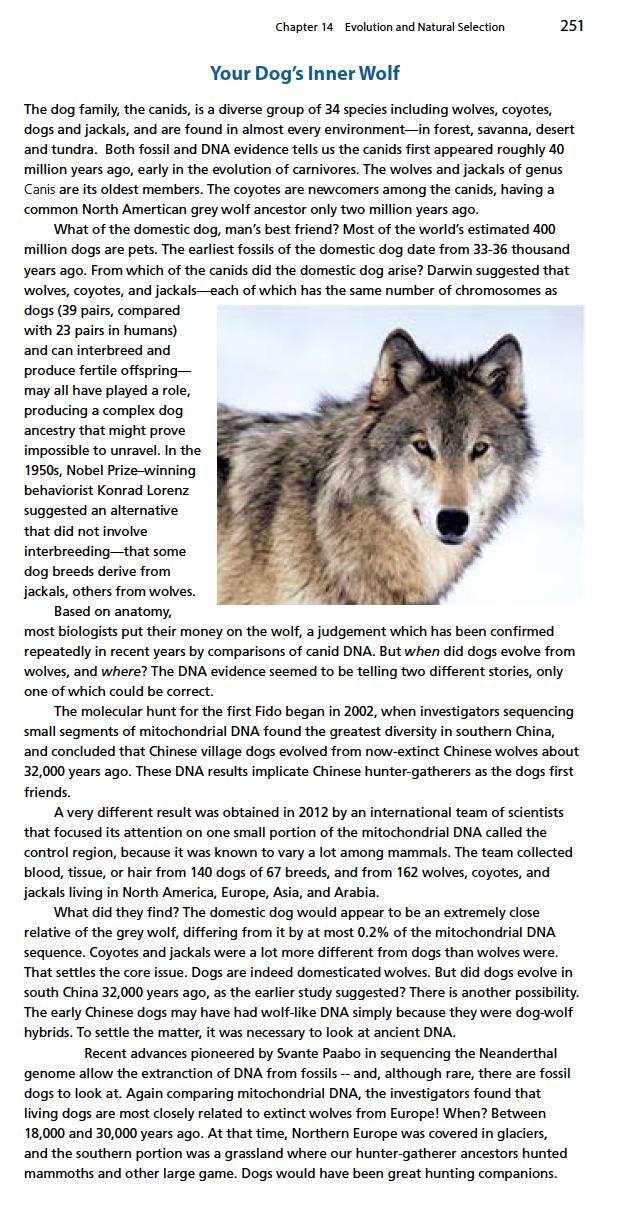
By all means, but please cite a revised version of the article (in ESSENTIALS OF THE LIVING WORLD, 5e, George B Johnson, McGraw Hill Publ., 2015). It is somewhat shorter, but more up-to-date. I enclose a copy of the relevant page below.
Yes, on the 15th July, 2009, I published my first post! Five years ago today! That first post was called Parenting lessons from dogs; a shortish post that I republish now.
Much too late to make me realise the inadequacies of my own parenting skills, I learnt an important lesson when training my GSD (who is called Pharaoh, by the way). That is that putting more emphasis into praise and reward for getting it right ‘trains’ the dog much quicker than telling it off. The classic example is scolding a dog for running off when it should be lots of hugs and praise for returning home. The scolding simply teaches the dog that returning home isn’t pleasant whereas praise reinforces that home is the place to be. Like so many things in life, very obvious once understood!
Absolutely certain that it works with youngsters just the same way.
Despite being a very dominant dog, Pharaoh showed his teaching ability when working with other dogs. In the UK there is an amazing woman, Angela Stockdale, who has proved that dogs (and horses) learn most effectively when being taught by other dogs (and horses). Pharaoh was revealed to be a Beta Dog, (i.e. second in status below the Alpha Dog) and, therefore, was able to use his natural pack instinct to teach puppy dogs their social skills and to break up squabbles within a pack.
When you think about it, don’t kids learn much more (often to our chagrin!) from other kids than they do from their parents. Still focusing on giving more praise than punishment seems like a much more effective strategy.
As was read somewhere, Catch them in the act of doing Right!
According to my stats page, Learning from Dogs has accumulated 1,000,624 viewings, with a ‘best-ever’ of 3,980 for Trust me, I’m an engineer, courtesy of Bob Derham in March, 2013. A total of 2,125 posts have been published. Plus, it has been a wonderful journey for yours truly with ever so many great connections made across the world of blogging over these last five years. As evidenced by the rest of today’s post.
Regular readers will have seen comments from Alex Jones. He is a Brit living in Colchester, Essex in England and is the author of the blog The Liberated Way. He and I follow each other’s blogs.
I discover my values and personal insights from how I react to what I see and experience in the world around me. I reacted in anger at the greed and vanity of money investors in business ideas in the US reality television series Shark Tank on YouTube. I reacted in dismay at the wasteful stupidity portrayed in a video on consumerism: people queuing for a week to get hold of the latest iPhone, whose only enhancement from the last was its colour; IKEA marketing telling consumers to throw out perfectly good possessions; Apple designing a new type of screw on its smartphones in order to prevent people repairing damaged phones, thus encouraging waste; the extensive scams brands go to called obsolescence to make objects the consumer buys break quickly increasing waste and needless replacement. The contempt the modern economic paradigm has to this planet is at odds with our human ancestors, and at odds with my worldview.
I am part of a new business paradigm, where I can compete against rivals on equal terms with innovation and clever strategies, but where I care for the planet earth in the same manner as I cared for the grasshopper this morning and my oak saplings. In thinking on these matters in the garden this morning, my garden fox Amber appeared, yawned, then went to sleep in the sun.
Two days ago, another blogger signed up to follow this place. He writes under the name of Cully and his blog is Ahaa. As I always do, I went across to take a look at Cully’s blog, liked what I saw, especially this ‘header’ post on Gaia. Very promptly I was given permission to republish that post here.
ooOOoo
Gaia
It’s Time To Stop Living On The Earth and Start Cohabitating With Her – The Earth is a Sentient Living Organism
We are saturated with information and we are used to clipping and selecting segments of what news is thrown our way every day. We can process very little of it for use later on and it is well known that we only see ‘pertinent’ information as information that already supports our existing belief system. This narrow mindset is one of the main reasons why things don’t change. It is why we are happy to listen to shallow news, we simply don’t have time to do anything else. In this we kid ourselves we really don’t need to know which celebrity is dealing with addiction or changing partners.
On this page we hope to introduce a topic that will inspire you to contemplate, even meditate on its importance.
Gaia is more widely accepted now than when it was first introduced, and you’re not being asked to believe it wholesale and certainly not see it as a part of the New Age or hippy movement. Hopefully though whatever you think about our planet you will find it to be a useful platform to consider AND TAKE ACTION on the health of the environment that we are leaving our children.
It is easy …as with all the other scares that we hear about every day to think that we are too small, or that it is a governmental or corporate problem, so why spend any time considering it.
Whatever your particular mindset, Gaia related activities will become increasingly connected and important to leaving a beautiful world behind us. The study of planetary habitability is partly based upon extrapolation from knowledge of the Earth’s conditions, as the Earth is the only planet currently known to harbour life
The Gaia hypothesis, also known as Gaia theory or Gaia principle, proposes that organisms interact with their inorganic surroundings on Earth to form a self-regulating, complex system that contributes to maintaining the conditions for life on the planet. Topics of interest include how the biosphere and the evolution of life forms affect the stability of global temperature, ocean salinity, oxygen in the atmosphere and other environmental variables that affect the habitability of Earth.
The hypothesis, which is named after the Greek goddess Gaia, was formulated by the scientist James Lovelock and co-developed by the microbiologist Lynn Margulis in the 1970s. While early versions of the hypothesis were criticized for being teleological and contradicting principles of natural selection, later refinements have resulted in ideas highlighted by the Gaia Hypothesis being used in subjects such as geophysiology, Earth system science, biogeochemistry, systems ecology, and climate science. In 2006, the Geological Society of London awarded Lovelock the Wollaston Medal largely for his work on the Gaia theory.
It will take an enormous amount of time to create a menu that covers everything related to Gaia, please be patient or if the time help out in any small way that you can 🙂
respect
[If you haven’t watched this BBC programme about James Lovelock and his history of scientific understanding about how our planet works then settle down and watch it. I assure you that you will be entranced. PH]
ooOOoo
What can I say!
Other than to be extremely grateful for the opportunity to ramble on and make so many good friends, WordPress style, over these last five years.
Another gem of an essay from guest writer John Hurlburt.
It was just a short while ago, on the 26th June, that I posted a guest essay from John under the title of Arrogance ‘R Us. It was very well received with twenty-two ‘Likes’ and, without exception, many favourable comments.
Therefore I am delighted to offer another of John’s essays; again beautifully crafted as you are about to see.
ooOOoo
Independence Day
Human beings on planet Earth are a tiny component of the Nature of the Cosmos. Life is an experiential opportunity which obeys Natural cycles and adapts in order to survive and grow. Cosmic awareness is unlimited. The statistical probability of consciousness awareness being a purely local phenomenon is so remote that it’s actually ridiculous to consider.
Human awareness is limited. We’re a very young cosmic species. Sometimes we don’t see much beyond the end of our own noses. We need to learn to play nicely with other children before we go much further beyond the living nest called Earth that we consistently befoul.
Time changes. In a consciously aware biological world, we may choose to build for the future or to ignore the future in favor of our short term lives. Those who accept change and make a coordinated effort to adapt have a better probability for a future than those who fear change. Responsibility to adapt to change comes with the territory.
What’s happening on Earth today is simply a matter of Mother Nature cleansing herself of an unhealthy species that’s lost track of the spiritual, natural and reasonable moral foundation necessary for equitable balance. Our problem today is that we tend to blindly follow the noisy mouthpieces of unified financial interests into bottomless pits. The pits are already dry or are rapidly drying.
We’re aware of the opportunity of each new day at the depth of our being. We’re aware that anything can happen and probably will sooner or later. It’s easy to develop a blasé attitude of acceptance without action. Why worry about it? It’s difficult to accept the truth about our self and make the effort necessary to change. What a drag ….
Nature is telling us that it’s time for Final Exams. How much have we learned? Are we aware or are we unaware of being unaware? Do we know that today is the tomorrow we dreamed of yesterday? What will be the harvest of our lives?
At a time when the Nature of our planet is changing rapidly, there’s an understandable cultural, social and economic churning taking place. Human history, particularly our wisdom tradition, record human successes and failures in adapting to the natural constant of change. Records of natural disasters date back to verbal histories of a great flood and beyond. We continue to ignore the obvious.
Ego keeps us in denial of our natural reality. Ego is our common villain as we lose what little that remains of our natural heritage through ignorance and arrogance. Ego is fear driven. We fear losing something we think we have or not getting something we believe we want or need.
Fear fuels anger. Anger fuels hate. Hate fuels war. War escalates the level of planetary destruction dramatically while doing relatively little to slow the relentless expansion of our ravenous species.
We are inclusively blessed at this very moment with the opportunity to make a positive difference in a negatively inclined world. Consider how attractive positive is to negative.
We need to proceed as the way opens and cross the next bridge as we come to it based on an emerging set of unifying human values which places the Nature of whatever we call God above and beyond the inventions and opinions of a species which has as yet to be proven trustworthy.
Speaking of trust, we have as yet to learn to trust our own realty as cosmically energized creatures sharing a transitory biological learning experience. Support for environmental suicide and global murder is insane.
We gain sanity and serenity through surrender. Recovery and healing follow surrender in direct relation to an increasing understanding of how everything fits together and an acceptance of our true purpose to live as stewards of Creation.