Again, another long day of hammering away at the keyboard.
One of the items that I incorporated into ‘the book’ was a story told to me back in 2009. I had forgotten just how wonderful this true story was.
So it is repeated today. You will love it; of that I have no doubt!
oooo
An amazing true story of a relationship between a wild wolf and a man.
This is a story of a particular event in the life of Tim Woods told to me by his brother, DR. It revolves around the coming together of a man sleeping rough, with his dog, on Mingus Mountain, and a fully grown female Grey Wolf. Mingus is in the Black Hills mountain range between Cottonwood and Prescott in Arizona, USA.
DR and his brother, Tim, belong to a large family; there are 7 sons and 2 daughters. Tim had a twin brother, Tom, and DR knew from an early age that Tim was different.
As DR explained,
Tim was much more enlightened than the rest of us. I remember that Tim and Tom, as twin brothers, could feel each other in almost a mystical manner. I witnessed Tom grabbing his hand in pain when Tim stuck the point of his knife into his (Tim’s) palm. Stuff like that! Tim just saw more of life than most other people.
The incident involving the wolf was when Tim was in his late 40s and, as mentioned, was living in a rough shack on the mountain. The shack was simply a plywood shelter with an old couch and a few blankets for the cold nights. The dog was companion, guard and a means of keeping Tim in food; the dog was a great hunter. But Tim was no stranger to living in the wild.
DR again,
Tim was ex-US Army and a great horseman. There was a time when he was up in the Superstition Mountains, sleeping rough, riding during the day. At night Tim would get the horse to lay down and Tim would sleep with his back next to the horse for warmth.
Anyway, Tim was up on Mingus Mountain using an old disk from an agricultural harrow as both a cook-pan and plate. After he had finished eating, Tim would leave his ‘plate’ outside his shack. It would be left out in the open over night.
Tim became aware that a creature was coming by and licking the plate clean and so Tim started to leave scraps of food on the plate. Then one night, Tim was awoken to to the noise of the owner of the ‘tongue’ and saw that it was a large, female gray wolf.
The wolf became a regular visitor and Tim became sure that the wolf, now having been given the name Luna by Tim, was aware that she was being watched by a human.
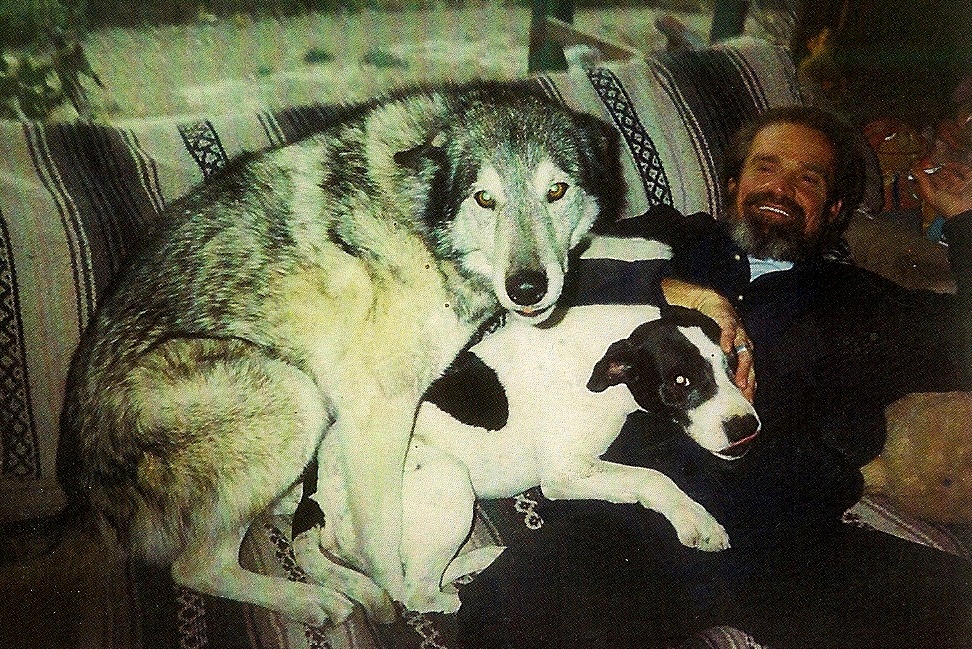
Over many, many months Luna built up sufficient trust in Tim that eventually she would take food from Tim’s outstretched hand. It was only now a matter of time before Luna started behaving more like a pet dog than the wild wolf that she was. The photo below is a scan from a traditional photograph and is unaltered.
Luna, the wild wolf, taken in 2006.
From now on, Luna would stay the night with Tim and his dog, keeping watch over them.
DR also recalls,
I remember Tim being distraught because, without warning, Luna stopped coming by. Then a few months later back she was. Tim never did know what lay behind her absence but guessed it might have been because she went off to have pups.
Unfortunately, this wonderful tale does have a sad ending.
About two years ago, Tim lost his dog. He was awakened to hear a pack of coyotes yelping and his dog missing.
Then tragically some 6 months later Tim contracted a gall bladder infection. Slowly it became worse.
By the time he realised that it was sufficiently serious to require medical treatment, it was too late. Despite the best efforts of modern medicine, Tim died on June 25th, 2009, just 51 years young.
So if you are ever out on Mingus Mountain and hear the howl of a wolf, reflect that it could just be poor Luna calling out for her very special man friend.
With very grateful thanks to DR for sharing such a special story.
A very timely item sent to me by neighbour, Dordie.
I say timely because it was nearly 6pm before I stopped writing ‘the book’. It was a tough day of research and cross-checking and seeking permission to republish essays from other authors and magazines. That’s the reason that my next NaNoWriMo chapter is not being published in thirty minutes time. Still waiting for some of those permissions.
So ‘thank you’ Dordie.
Do you know that when a woman wears a leather dress…
Exciting Rosetta space mission inspires a magical short film
A very good 7-minute film, called Ambition. It’s not like any film about space exploration you’ve ever seen. The Rosetta comet mission lies at its heart.
Everything about the European Space Agency’s Rosetta mission – which, in August, caught up to Comet 67P/Churyumov–Gerasimenko and began moving in tandem with it – has been fantastic so far. For us space buffs, this mission has gone a long way toward fulfilling our fantasies about what might be accomplished in outer space. It’s caused us to remember why we got so excited about space exploration in the first place. And now – just weeks before Rosetta will send a lander to the surface of its comet – ESA and Platige Image have released a very good short film, called Ambition. It’s not a space documentary, or like any film about space exploration you’ve ever seen. It doesn’t focus so much on the mission itself – although the Rosetta mission does lie at the heart of the film – as on why we need to go into space.
The film features an apprentice magician and her master, talking about the making of solar systems.
I won’t tell you more; you should watch the film. It might touch your heart in ways you’ve forgotten, as the Rosetta mission itself has touched mine.
Tomek Baginski directed the film Ambition, which stars Aiden Gillen – who played Littlefinger in Game of Thrones – and Aisling Franciosi. Its producers shot Ambition on location in Iceland and produced it primarily in Poland. Its first public screening was October 24, 2014 during the British Film Institute’s celebration of Sci-Fi: Days of Fear and Wonder, at the Southbank, London.
By the way, Tim Reyes at UniverseToday.com has written a very good essay about the film Ambition, and what it means in the context of U.S. and European space efforts, and in the larger context of our striving to meet challenges in the world today. He also says you should watch the film. Because it’s about what it means to want to know what’s possible.
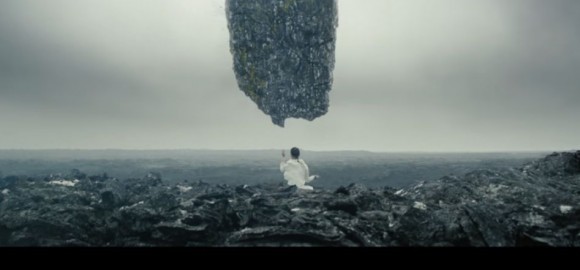
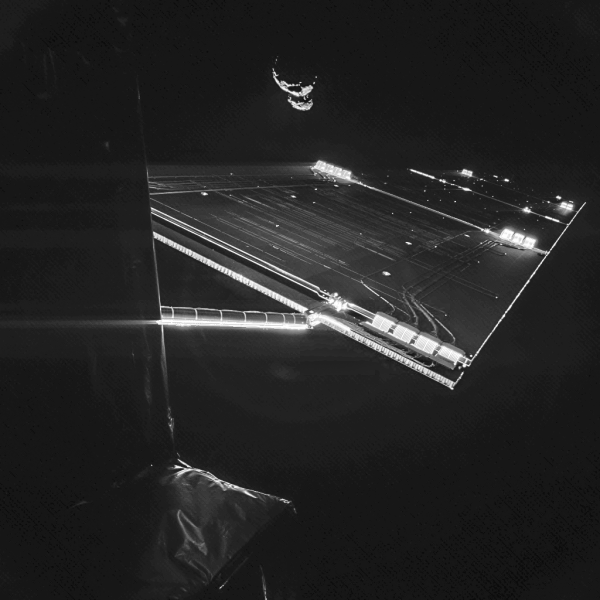
In the film Ambition, a young magician tries to build a solar system … but fails.Did you assume this was an artist’s concept? It’s not. It’s a real image. It’s the Rosetta spacecraft’s selfie with comet 67P/Churyumov–Gerasimenko, imaged Sunday, September 7, 2014. Image via ESA/Rosetta/Philae/CIVA
Bottom line: A very good 7-minute film, called Ambition. It’s not like any film about space exploration you’ve ever seen. The Rosetta comet mission lies at its heart.
ooOOoo
And here is that film.
Published on Oct 24, 2014
Ambition is a collaboration between Platige Image and ESA. Directed by Tomek Bagiński and starring Aidan Gillen and Aisling Franciosi, Ambition was shot on location in Iceland, and screened on 24 October 2014 during the British Film Institute’s celebration of Sci-Fi: Days of Fear and Wonder, at the Southbank, London.
I had my surgical procedure for the removal of a benign prostatic enlargement (BPE) last Tuesday and was back home by 6pm. However, having a catheter and a collection bag attached to me for Tuesday and Wednesday nights inhibited a decent night’s sleep. The catheter was removed on Thursday morning and I was confident of getting a good night. Wrong! I found myself having to get up and pee more-or-less every hour of the night. Apparently, according to the nurse to whom I spoke yesterday, my bladder would have still been extremely sore making any form of urine retention impossible.
All a long-winded way of me saying that my creative juices were non-existent when I wanted to get today’s post completed.
So please accept the following and hope it puts a smile on your face. (To make matters worse, I forgot which kind reader sent it to me!)
ooOOoo
MURPHY’S OTHER 15 LAWS
Light travels faster than sound. This is why some people appear bright until you hear them speak.
A fine is a tax for doing wrong. A tax is a fine for doing well.
He, who laughs last, thinks slowest.
A day without sunshine is like, well, night.
Change is inevitable, except from a vending machine.
Those who live by the sword get shot by those who don’t.
Nothing is foolproof to a sufficiently talented fool.
The 50-50-90 rule: Anytime you have a 50-50 chance of getting something right, there’s a 90% probability you’ll get it wrong.
It is said that if you line up all the cars in the world end-to-end, someone from California would be stupid enough to try to pass them.
If the shoe fits, get another one just like it.
The things that come to those who wait, may be the things left by those who got there first.
Give a man a fish and he will eat for a day. Teach a man to fish and he will sit in a boat all day drinking beer.
Flashlight: A case for holding dead batteries.
God gave you toes as a device for finding furniture in the dark.
When you go into court, you are putting yourself in the hands of twelve people, who weren’t smart enough to get out of jury duty.
It is said that the first casualty in war is truth!
In yesterday’s post Vested interests, perhaps, I featured an article brought to my attention by dear friend, Dan Gomez. Namely an article featured in the UK’s Daily Mail newspaper that was headlined: ‘There is NO climate crisis’: Man-made global warming is a lie and not backed up by science, claims leading meteorologist.
Dan’s strong belief is that labelling the natural change in the world’s climate as anthropogenic global warming (AGW) serves governments and many large institutions incredibly well because it offers greater leverage to raise taxes. In other words, Dan has no doubt that the climate is changing, but as a result of natural forces that go back long before the days of man. In other words, it is being ‘sold’ as the direct result of man’s activities because it makes it easier to apply taxes and levies for purposes not related to climate matters.
As John Coleman was reported as saying:
John Coleman, who co-founded the Weather Channel, claims that the belief humans are causing climate change is not backed up by science.
In an open letter attacking the UN, the 80-year-old from San Diego, said that what ‘little evidence’ there is for global warming points to natural cycles in temperature.
‘There is no climate crisis,’ he wrote. ‘The ocean is not rising significantly. The polar ice is increasing, not melting away. Polar bears are increasing in number. ‘Heat waves have actually diminished, not increased. There is not an uptick in the number or strength of storms.
‘I have studied this topic seriously for years. It has become a political and environment agenda item, but the science is not valid.’
Now I am as sceptical about the workings of governments as the next man. But I find it incredibly difficult to believe that AGW is a myth, hoax or conspiracy. There is a wall of science to say that we, as in man, are dangerously close to going over the edge, going beyond ‘tipping points’ from which there is no returning.
A quick dip into Wikipedia tells us [my emphasis]:
Scientific understanding of the cause of global warming has been increasing. In its fourth assessment (AR4 2007) of the relevant scientific literature, the Intergovernmental Panel on Climate Change (IPCC) reported that scientists were more than 90% certain that most of global warming was being caused by increasing concentrations of greenhouse gases produced by human activities. In 2010 that finding was recognized by the national science academies of all major industrialized nations.
Affirming these findings in 2013, the IPCC stated that the largest driver of global warming is carbon dioxide (CO2) emissions from fossil fuel combustion, cement production, and land use changes such as deforestation.
Only last Wednesday there was an item on Naked Capitalism that opened [again, my emphasis]:
J.D. Alt: Have We Passed the Tipping Point of Biological Collapse?
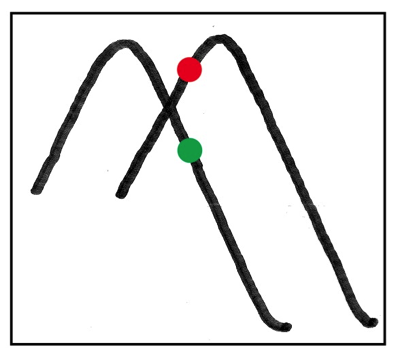
The squiggle illustrated here may look like the Ebola virus, but it isn’t. The resemblance is just an eerie coincidence. It’s actually a graphical snapshot of the classic “Predator-Prey Model.” This mathematical exercise, first developed in the 1920s, serves as the introductory basis for a more recent NASA funded effort which produced—amidst a brief flurry of news and commentary last spring—the startling conclusion that a complete collapse of modern civilization may now be “irreversible.”
The NASA study involved the creation and running of a more elaborate model—HANDY (Human and Nature Dynamics)—which simulates the human consumption of naturally replenishing systems, as well as (intriguingly, given today’s news cycle) wealth and income inequality between two classes of citizens: “Elites” and “Commoners.” Now a new study, just released by the World Wildlife Fund, reports a grim statistic suggesting the abstract mathematics of the HANDY Model may be more than just a theoretical exercise. According to the WWF, in the last forty years—from 1970 to 2010—the Earth has lost over HALF (52%) of its wildlife population.
There are yards and yards of solid information all over the internet about our changing climate. The loss of wildlife, the destruction of forests and wild lands is beyond argument, and those aspects of this ‘modern’ world are most certainly the direct result of man’s activities! Our inability to stop growing as a global population is insane. Our inability to stop seeing continual economic and material growth as a ‘good thing’ is insane. We need massive change – now!
Therein lays the problem. Because, whether or not there is an approaching climate catastrophe as a result of man’s activities is, in a very real sense, irrelevant. If that seems a bizarre thing to write, I mean it is irrelevant in terms of what you and I, ordinary people trying to lead civilised lives, can do to make a difference.
Patrice Ayme recently published a post under the title of Total Plutocracy covering the death of Christophe de Margerie when his jet hit a snow plough on a Moscow runway at midnight, flipped on its back, caught fire, and skidded across. All four on board died.
Now the accidental death of any person is a tragedy, make no mistake, but as Patrice revealed in his post, this particular accident did raise some interesting aspects. Here’s a little of what Patrice wrote:
With 200 billion Euros in revenue, TOTAL SA is not far behind the French government budget. TOTAL’s profits are 14 billion Euros (“Soyons serieux!” laughed Margerie). It pays nearly no tax in France, having concentrated there its money losing refineries.
Other countries get nearly all their fuel from French refineries; TOTAL has also a green light to frack in Britain. So this is not just a French situation. TOTAL is one of the five great oil companies concentrating the fossil fuel firepower. Those companies have the best technology. Some of TOTAL’s specialties are very deep water drilling, and using steam to extract tar oil in Canada.
What was de Margerie doing at midnight? Flying back to France, after meeting with Putin and Medvedev, late at night.
That’s how these guys are: great fun. Putin was recently invited to Milan for a big time European meeting. He arrived several hours late to visit with Merkel, who was not amused. After keeping her up past midnight, he motored to Berlusconi’s mansion, and the two plutocrats reveled together until 4 am. (We don’t know how many female teenagers were in attendance to further their studies.)
The next European meeting was at 8am, and Putin showed up.
Supposedly Margerie had just told Medvedev and Putin to cool it with Ukraine. At least that’s the massaging message Margerie’s minions floated after his death.
Why was Margerie so important to the Russian dictators? Because the six “supermajor” oil companies have the advanced technology. After all, they recruit from the best universities in the world (that’s paid by taxpayers). TOTAL SA was the spearhead of high tech development for hydrocarbon production in Russia. Among other things, it’s helping to build a gas liquefaction plant in the far north, to load special ships with methane (something TOTAL does with Qatar, in the world’s largest such installation).
Once a ship is fully loaded, it has several times the explosive power deployed at Hiroshima (such a catastrophic accident has not happened yet, but it’s just a matter of time).
When citizen Lambda dies, Mr. Anybody, nobody official cares. When a major plutocrat dies, our leaders, even our socialist leaders, weep, and present the accident as a national, even international tragedy.
Is the death of a plutocrat worth that much more, that all this public weeping has to occur?
And, by the way, who and what has authorized Mr. Margerie to lead his own foreign policy? Who authorized him to make nice with thermonuclear dictators? To the point of allowing their survival?
I recommend that you read it in full for it says so much about what is wrong with these present times: so much inequality and so many abuses of power.
Just the other day the Guardian newspaper published an article under the title of: Richest 1% of people own nearly half of global wealth, says report.
The richest 1% of the world’s population are getting wealthier, owning more than 48% of global wealth, according to a report published on Tuesday which warned growing inequality could be a trigger for recession.
According to the Credit Suisse global wealth report (pdf), a person needs just $3,650 – including the value of equity in their home – to be among the wealthiest half of world citizens. However, more than $77,000 is required to be a member of the top 10% of global wealth holders, and $798,000 to belong to the top 1%.
“Taken together, the bottom half of the global population own less than 1% of total wealth. In sharp contrast, the richest decile hold 87% of the world’s wealth, and the top percentile alone account for 48.2% of global assets,” said the annual report, now in its fifth year.
On October 8th, George Monbiot published an essay in The Guardian newspaper under the title of The Toll-Booth Economy. The opening lines set the theme.
Corporate power is the real enemy within, but none of the major parties will confront it.
The more power you possess, the more insecure you feel. The paranoia of power drives people towards absolutism. But far from curing them of the conviction that they are threatened and beleaguered, it becomes only stronger.
On Friday, the Chancellor of the Exchequer, George Osborne, claimed that business is under political attack on a scale it has not faced since the fall of the Berlin wall. He was speaking at the Institute of Directors, where he was introduced with the claim that “we are in a generational struggle to defend the principles of the free market against people who want to undermine it or strip it away.” A few days before, while introducing Osborne at the Conservative party conference, Digby Jones, formerly the head of the Confederation of British Industry, warned that companies are at risk of being killed by “regulation from Big Government” and of drowning “in the mire of anti-business mood music encouraged by vote-seekers.” Where is that government and who are these vote-seekers? They are a figment of his imagination.
Indeed, I will. Go on with just one more reference. From the Smithsonian. An article that started, as follows:
Five Conflicts and Collapses That May Have Been Spurred by Climate Change
Earth’s changing climate has been a spectre in centuries of civil conflict and, at times, the collapse of whole civilizations
By Natasha Geiling
smithsonian.com
October 20, 2014
Is climate change a matter of national security? In a warming world, sea-level rise, drought and soil degradation are putting basic human needs such as food and shelter at risk. In March, the U.S. Department of Defense called climate change a “threat multiplier,” saying that competition for resources “will aggravate stressors abroad such as poverty, environmental degradation, political instability and social tensions—conditions that can enable terrorist activity and other forms of violence.”
Connecting climate change to a global increase in violence is tricky, and attempts to make such a link receive a fair amount of criticism. A hotter planet doesn’t automatically become a more conflict-ridden one. The 2000s, for instance, saw some of the highest global temperatures in recorded history—and some of the lowest rates of civil conflict since the 1970s.
But there are historical examples of civilizations that did not fare well when faced with drastic environmental change, and those examples may offer a window into the future—and even help prevent catastrophe. “We can never know with 100-percent certainty that the climate was the decisive factor [in a conflict],” says Solomon Hsiang, assistant professor of public policy at the University of California, Berkeley. “But there’s a lot of cases where things look pretty conspicuous.”
Earlier on I ventured the idea that whether or not an approaching climate catastrophe was a result of man’s activities was, in a very real sense, irrelevant. Because of the lack of individual power to make a real difference, especially a political difference.
What is relevant is improving the way we govern ourselves. The abuses of money and power are too widespread to be ignored. We need to start with strong local democracies and thence building a system of global governance that really is of the people by the people for the people.
I’m being very brave and stepping into the climate change cauldron!
Learning from Dogs has been posting a wide range of items for well over five years. Indeed, today’s post is number 2,238!
Over those five years, my position regarding climate change or global warming has been pretty clear: a belief in the proposition that man’s behaviours are changing the very climate of our planet. For instance, a little over a year ago I posted under the title Sceptical about global warming? It opened:
Learning from Dogs is not a blogsite about climate change!
Why, you may ask, do I start today’s post with that sub-heading? Because, I am conscious that many of my posts do touch on this subject. For example, just two days ago there was Breaking news. Then there was the piece about the climate implications for Phoenix, Arizona. Followed the next day by the changes in the flow of the jet stream across the North Atlantic with all the weather implications for North-West Europe.
Indeed, as the heading to today’s post makes clear, this is also about the changes going on to our planet.
Learning from Dogs is about a different way of living and behaving. A campaign, if one wants to call it that, to show that the way that modern man is living is corrupt. Not with a big ‘C’ but still in the sense of living a dishonest life. Learning from Dogs attempts to show that our wonderful dogs, a source of so much love and pleasure for so many millions, offer us an example of a life in and of this planet.
If there was ever a time in the history of man when we needed being reminded of our frailty and vulnerability, it is now. As the following so starkly illustrates.
A new study of ocean warming has just been published in Geophysical Research Letters by Balmaseda, Trenberth, and Källén (2013). There are several important conclusions which can be drawn from this paper.
Completely contrary to the popular contrarian myth, global warming has accelerated, with more overall global warming in the past 15 years than the prior 15 years. This is because about 90% of overall global warming goes into heating the oceans, and the oceans have been warming dramatically.
Then last week-end, Dan Gomez, friend for over 40 years, sent me the following:
Weather Channel Founder: Global Warming Science ‘Not Valid’
Meteorologist John Coleman, who co-founded The Weather Channel, says the claim that human activity is leading to global warming is no longer scientifically credible.
Instead, the “little evidence” there is for rising global temperatures points to a “natural phenomenon,” Coleman asserts.
In an open letter to the United Nations’ Intergovernmental Panel on Climate Change (IPCC), he wrote: “There is no climate crisis. The ocean is not rising significantly. The polar ice is increasing, not melting away. Polar bears are increasing in number.
“Heat waves have actually diminished, not increased. There is not an uptick in the number or strength of storms.
“I have studied this topic seriously for years. It has become a political and environmental agenda item, but the science is not valid.”
Coleman says he based his views on the findings of the Nongovernmental International Panel on Climate Change (not to be confused with the U.N. panel), a body of scientists and scholars who assess the science of global warming.
“There is no significant man-made global warming at this time. There has been none in the past and there is no reason to fear any in the future,” says Coleman, who was the original meteorologist on “Good Morning America.”
“Efforts to prove the theory that carbon dioxide is a significant greenhouse gas and pollutant causing significant warming or weather effects have failed.
“There has been no warming over 18 years.”
The U.N.’s IPCC argues that their research shows man-made global warming will lead to extreme weather events becoming more frequent and unpredictable, the Express in Britain reported.
Climate expert William Happer, a professor at Princeton University, expressed support for Coleman’s claims.
“No chemical compound in the atmosphere has a worse reputation than CO2, thanks to the single-minded demonization of this natural and essential atmospheric gas by advocates of government control [of] energy production,” Happer said.
“The incredible list of supposed horrors that increasing carbon dioxide will bring the world is pure belief disguised as science.”
What Dan had seen was an article in the UK Daily Mail that, in turn, was echoed on the US WesternJournalism blogsite. Here’s how that Daily Mail story opens:
Climate change has been proven to be a lie, according to a leading meteorologist.
John Coleman, who co-founded the Weather Channel, claims that the belief humans are causing climate change is not backed up by science.
In an open letter attacking the UN, the 80-year-old from San Diego, said that what ‘little evidence’ there is for global warming points to natural cycles in temperature.
‘There is no climate crisis,’ he wrote. ‘The ocean is not rising significantly. The polar ice is increasing, not melting away. Polar bears are increasing in number. ‘Heat waves have actually diminished, not increased. There is not an uptick in the number or strength of storms.
‘I have studied this topic seriously for years. It has become a political and environment agenda item, but the science is not valid.’
John Coleman, the original meteorologist for ABC’s Good Morning America and the founder of The Weather Channel, which launched in 1982, wrote an open letter to the UCLA’s Hammer Forum urging them “to re-examine their plan” for their forum, scheduled for this past Thursday, after they announced their experts, both of whom believe in climate change science.
Coleman has made his position against climate change science clear in the past.
“There is no significant man-made global warming at this time, there has been none in the past and there is no reason to fear any in the future. Efforts to prove the theory that carbon dioxide is a significant ‘greenhouse’ gas and pollutant causing significant warming or weather effects have failed. There has been no warming over 18 years.”
The Weather Channel founder cites professors from Princeton University, Massachusetts Institute of Technology (MIT), Harvard Smithsonian Observatory, and the University of Alabama, along with “9,000 Ph.D scientists” who agree with him.
“Yet at your October 23 Hammer Forum on Climate Change you have scheduled as your only speakers two people who continue to present failed science as though it is the final and complete story on global warming/climate change. This is a major mistake.”
Coleman urged the UCLA group to reconsider, noting he is not a “flat Earther,” or a “paid shill of the Koch Brothers.”
In a discussion yesterday with Dan, he was of the clear mind that, yes, the climate is changing, as it always has over eons of time, but that the degree of change that is directly attributed to man’s affairs is minute. Then all around me I see sign after sign, read article after article, that we, as in mankind, are relentlessly ‘fouling our own nest’ and the time left for us to learn how to live sustainably on this planet is fast running out.
Can we get to the truth? The topic will be continued tomorrow!
Today, I have an appointment with a urologist surgeon at the Rogue Regional Medical Centre in Medford, about an hour south of where we live in Merlin. All being well I should be out the same day but will need to take it easy for a couple of days thereafter. I’m curious about the experience of having a general anaesthetic; the first one I have had.
Also this week I need to get my head down and commit to another month of writing under the NaNoWriMo banner.
Last November, participating in the National Novel Writing Month was critical in me completing a draft start of 56,000 words of my book Learning from Dogs. Despite it not being a novel and despite me wanting to continue the draft rather that start another writing project, NaNoWriMo have accepted me for a second time. I’m very grateful because, fingers crossed, by the end of this coming November I should be within reach of my target of 120,000 words for a non-fiction book.
November also brings along a ’70’ birthday for me, a birthday for Jean later on in the month and our wedding anniversary in the middle of the month.
So you know where this is leading, don’t you!
Creative blog writing is going to be a little thin on the ground for the next four weeks – (What was that you said? Something about creative writing frequently being thin on the ground?!)
There will be a post every day but if I get squeezed for time I will repost something previously published in this place. I will also republish items of general interest that catch my eye on the broader front of the big-wide-web!
Going to close today by sharing a photograph of the recent solar eclipse. There have been many published but this one seemed especially beautiful. It was part of a set over on the EarthSky blogsite.
Sunset partial solar eclipse, with sea birds, from the beach in Englewood, Florida, overlooking the Gulf of Mexico. Photo by K. King.
Note: As tomorrow’s post will explain, the next few weeks will be encroaching seriously on my blogging time. So it was very timely to receive this guest essay from John in the last couple of days and even more generous of him to give me permission to republish it.
It will make an interesting comparison to an item from Dan Gomez being published on Thursday.
ooOOoo
Notes on Dealing With Imminent Catastrophe
We know that our world economy is leveraged at least twenty-five times beyond any earthly material foundation. Regardless of this reality, we have made an artificial global economy more real than our physical world. This situation only makes sense when we recognize that we’re being encouraged to re-establish our awareness of reality. It’s a final exam time for a leading edge species of clever monkeys.
Nature has tolerated human activities for millions of years. Now that our demographics ravenously swarm the globe, belch poisons into the five mile band of air that sustains surface life on earth, dumps wastes and toxins into streams, rivers, lakes and oceans, and arrogantly refuses to understand obvious warnings; Nature is reacting.
For those who are inclined to either or choices, in accordance with the physical Law of Entropy, the decision is between pursuing constructive or destructive actions. For those who are more spiritually oriented, there is no question. In either case, we know what needs to be done.
Our first order of business is to stabilize our inclusive global economy through green initiatives that are operated for profit without damage to the eco-system. Yes, this sounds impossible the first time we think about it. Can we come up with a better plan? Not really, when we stop and honestly consider our situation. We’re poised on the brink of a material, economic and cultural collapse created by human beings.
Wars continue to be waged world wide over territory and rapidly diminishing fossil fuel resources. We have essentially lost trust in each other as equal members of a common community we call Earth. And, we are rapidly losing faith in the unsustainably inflated symbol of trust we call Money.
A green economy is our best solution for the multiple problems that plague us. Here’s why and a few suggestions about how we go about the process. Essentially, our critical need for renaissance is a process of education, formation and transformation.
When we return to the land as a global priority, the use of solar energy can replace massive industrial electrical generators running on fossil fuel derivatives. Most industrial generators may be easily converted to bio-diesel fuel. Industrial diesel generators worldwide can be converted to bio-fuel overnight. No mechanical adaptation is required.
Electric cars already set speed records at Europe’s classic racetracks. Solar electric cars are on the horizon. A bio-diesel engine to power a golf cart costs about $500 today and is available from Amazon.
There’s a natural need for co-operation when we return to the land and collectively re-establish our financial roots. First, we recognize that each of our actions affects the well being of the earth and its inhabitants. Second we realize that we are responsible for the well being of the Earth which sustains our being.
Third, we re-establish our natural connection with the unity of a living universe. We begin with the community gardens and farmer’s markets that are already operational, and rebuild accordingly.
When we are foolish, we act independently for our personal well being. When we are wise, we act together for the well being of the earth and each other. Growing our own food not only assures that what we eat will be free of chemical by-products; it also makes us aware of how fragile our consumer supply lines have become. Recycling our food waste as fertilizer completes a natural growth cycle.
By the way, a back yard greenhouse can produce enough bio-fuel to operate a diesel vehicle and a solar panel array can generate enough energy to charge your electric car. How much money does this save each year?
We don’t need nuclear reactors that sometimes melt down and sicken us with a continual stream of radiation carried by the tides and the winds of an integrated planet. We don’t need the wastes of nuclear reactors that poison the earth for millennium.
We don’t need nuclear weapons capable of destroying most, if not all, of the life on earth in an all out suicidal war. The only creatures to survive the holocaust of nuclear war would need to be radiation resistant; shielded deep underground or deep under the sea.
Harnessing wind, water and geothermal energy are wiser ways to keep our world energized in a green economy. A combination of habitats and communities powered by solar and geothermal energy will produce a new building boom as we shed the skin of our former infrastructure and a green architectural industry emerges.
Recycling the components of our technological world not only reduces our industrial waste, it decreases the cost of manufacture. Similarly, adapting and reusing what we already have decreases our personal expenses and reduces our demands on the earth.
These are only a few of the ideas which are already possible. Many more are already in the process of becoming our greater reality.
Still think such a massive transformation is impossible? If so, please know that you remain in our prayers.
There is hope for tomorrow. Science consistently opens new doors. Faith in the Nature of God of which we are each an infinitesimal part makes us unified and strong as a consciously aware biological species.
Enough of the world of spying and whistleblowing and back to stuff that is really important!
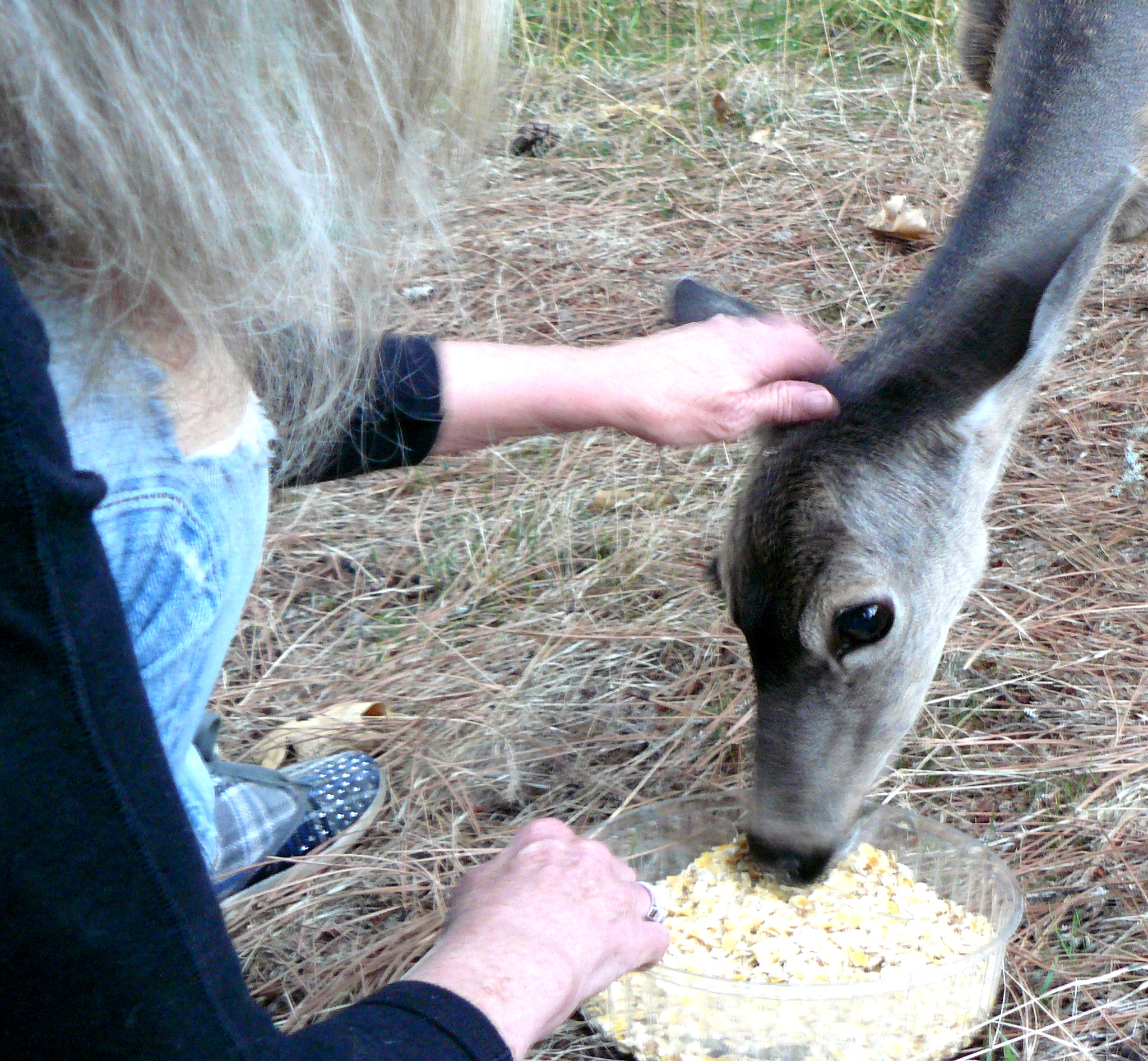
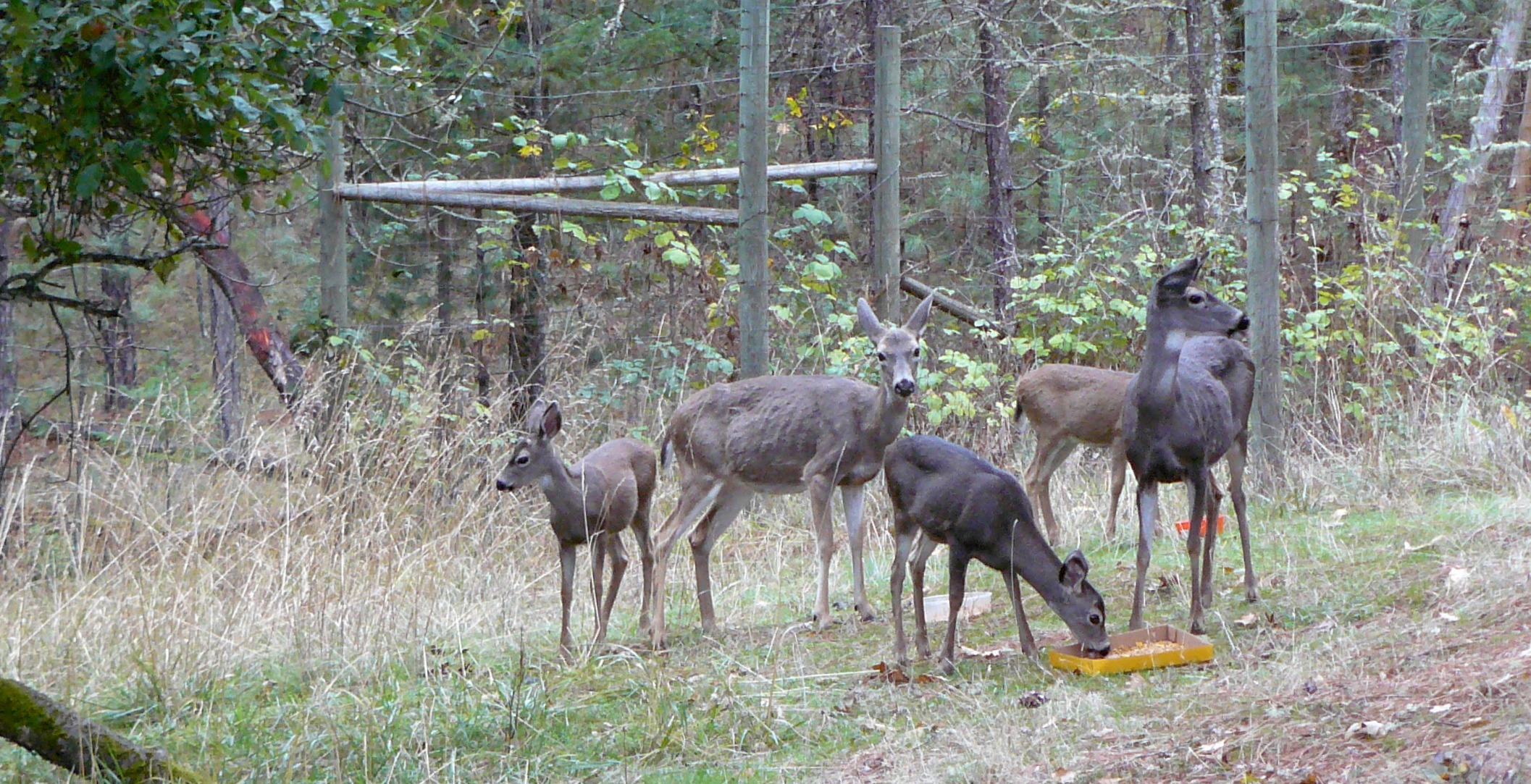
Many will recall that on the 10th October, under the heading of Utterly beyond words!, I wrote about a deer befriending us to the point that Jean was able to stroke its neck as it was feeding. The post included this photograph.
Then, unbelievably, the wild deer continues feeding as Jean fondles the deer’s ear.
Inevitably, being the softies that we are, we have continued to put out feed, in the form of cob or cracked corn, most days.
The word among the local deer population clearly has been passed around!
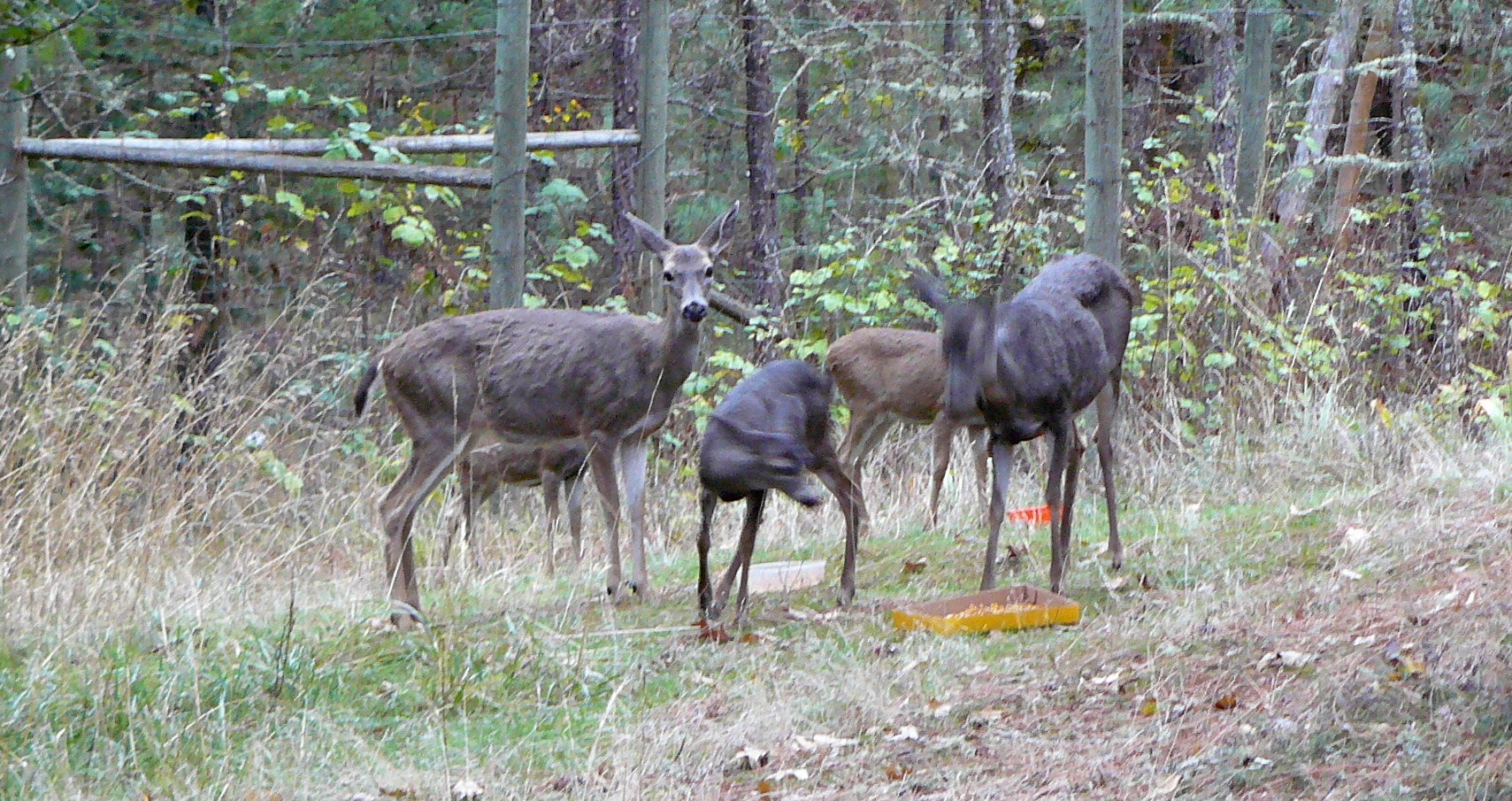
For here’s a photograph taken automatically on the night of the 19th October.
Time of the shot was a little before 5am.
Then on the 22nd, just three days ago, these photographs were taken shortly after 10am.
More food and it isn’t even supper time!
oooo
Come on ladies, eat up! You never know when a dog will charge around the corner!
oooo
That’s more like it!
One fear that Jean and I had was that they would become vulnerable to an attack by our dogs. But the deer have quickly wised up to when dogs are being let out of the front or kitchen doors and are off like darts into the forest just a few yards away.
Yesterday, the central theme of my post was the essay from Tom Engelhardt where he interviews Laura Poitras on the back of the recent release of her film Citizenfour. You will recall that I closed the post as follows:
On first reading the TomGram I found myself nodding vigorously, metaphorically speaking, with the whole thrust of the essay.
Then what appeared to be small uncertainties started appearing in my mind.
Those will be the subject of tomorrow’s post.
To set the background to what follows, you need to know a little about my own military experiences; which is not saying very much!
I was born in London six months to the day before WWII ended; at least the European side of things. When I got to the age of being vulnerable to a call-up if circumstances so dictated, I thought I would influence things by volunteering to join the United Kingdom’s Royal Naval Reserve or the RNR. The world in the early 60’s especially in Europe was far from stable. Thus, I signed up with London Division, RNR that was headquartered on HMS President, moored on the River Thames in the centre of London.
HMS President.
I served as a Radio Operator in the RNR from 1963 to 1968. Inevitably, as a radio operator I was security cleared and, in time, as I was promoted up the ranks, allowed to handle traffic up to but not including “Top Secret: Captain’s Eyes Only”.
In 1968 I decided to emigrate to Australia and resigned from the RNR. The parting advice was that the knowledge I had acquired prevented me, for my own safety, from entering any country hostile to NATO for a period of a further 5 years. Including the Soviet Union; naturally.
At the end of 1970, living and working in Sydney, I was planning to attend Expo70 in Japan and then travel on to Helsinki, Finland. One look at the atlas made it clear that a wonderful way of travelling westwards was via the Russian Trans-Siberian express.
So off I trotted to the British Embassy in Sydney to seek advice about entering Russia in this fashion. One of the military guys, on hearing about my concerns, laughed his head off and said, “The Russians will know more about you than we do!” Then, becoming more serious, he added: “My friend, if you ever find yourself in a difficult corner anywhere in a country hostile to the West, just find a way of transmitting your RNR Service Number to us and we’ll take care of things”. To this day, well over 40 years later, I still remember my service number.
Returning to the subject of the American security ‘apparatus’, Laura Poitras answered a question from Tom Engelhardt that seems very pertinent.
TE: To ask the same question another way, what would the world be like without Edward Snowden? After all, it seems to me that, in some sense, we are now in the Snowden era.
LP: I agree that Snowden has presented us with choices on how we want to move forward into the future. We’re at a crossroads and we still don’t quite know which path we’re going to take. Without Snowden, just about everyone would still be in the dark about the amount of information the government is collecting. I think that Snowden has changed consciousness about the dangers of surveillance. We see lawyers who take their phones out of meetings now. People are starting to understand that the devices we carry with us reveal our location, who we’re talking to, and all kinds of other information. So you have a genuine shift of consciousness post the Snowden revelations.
What struck me was the point about a changed consciousness. That is healthy. Without doubt.
The technology available to the governments of countries with regard to the gathering of all sorts of data represents a place where we haven’t been before. Inevitably, learning how best to govern that data, with both a small ‘g’ and a large ‘G’, is going to be a traveled road where some wrong turnings are made from time to time.
If the Edward Snowden affair has accelerated that learning process, then that seems nothing but good.
If all I knew about Edward Snowden were his portrait in Laura Poitras’ documentary, Citizenfour, I’d probably regard him as a conscientious, brave young man, maybe an American hero. But Poitras, a very talented filmmaker who flipped from journalist to collaborator in this story long ago, has chosen to leave a lot out.
Snowden’s claim as a whistleblower, exposing the National Security Agency’s violations of civil liberties, rests on some of the documents that he leaked, which reveal that the NSA’s domestic surveillance was far more extensive than anyone had imagined—and, in a few instances, conducted in defiance of orders from the Foreign Intelligence Surveillance Court.
However, many other documents—which he downloaded at the NSA facility in Hawaii and turned over to Poitras and the Guardian’s Glenn Greenwald in Hong Kong—go far beyond exposures of spying on Americans.
Judging from Snowden-derived stories in the Guardian and the Washington Post, some of these documents also detail NSA intercepts of email and cellphone conversations by Taliban fighters in Pakistan; assessments of CIA assets in several foreign countries; and surveillance of cellphone calls “worldwide” that (in the Post’s words) allows the NSA “to look for unknown associates of known intelligence targets by tracking people whose movements intersect.” In Snowden’s first interview abroad, with the South China Morning Post, he disclosed that the NSA routinely hacks into hundreds of computers in Hong Kong and China. Just last week a story co-authored by Poitras in Greenwald’s new publication, the Intercept, revealed—again, based on Snowden-supplied documents—that the NSA has undercover operatives in Germany and China.
Whatever you think about foreign intelligence operations, the NSA’s core mission is to intercept communications of foreign governments and agents. If Snowden and company wanted to take down an intelligence agency, they should say so. But that has nothing to do with whistleblowing or constitutional rights.
The National Security Agency/Central Security Service (NSA/CSS) leads the U.S. Government in cryptology that encompasses both Signals Intelligence (SIGINT) and Information Assurance (IA) products and services, and enables Computer Network Operations (CNO) in order to gain a decision advantage for the Nation and our allies under all circumstances.
The Information Assurance mission confronts the formidable challenge of preventing foreign adversaries from gaining access to sensitive or classified national security information. The Signals Intelligence mission collects, processes, and disseminates intelligence information from foreign signals for intelligence and counterintelligence purposes and to support military operations. This Agency also enables Network Warfare operations to defeat terrorists and their organizations at home and abroad, consistent with U.S. laws and the protection of privacy and civil liberties.
I read, “to gain a decision advantage for the Nation and our allies under all circumstances” as meaning maintaining a positive security for the Nation. My home nation as it happens.
While the scale may be beyond comparison, the principle of maintaining a secure nation or home strikes me as no different as locking the doors of our house when we go off somewhere. And that’s even with nine dogs in the house!
Given that what any ex-head of GCHQ might say, the recent words from Sir Iain Lobban, as reported by the BBC, were not extreme; far from it.
Sir Iain Lobban.
A dimly lit bunker beneath Whitehall – perhaps a suitable venue for a man to say farewell to a 31-year career in what had been one of the most secret parts of the British state.
Sir Iain Lobban was joined by an assortment of spies and securocrats including former heads of GCHQ and the current chief of MI6. It was a venue not chosen by chance.
As he leaves his position as director of GCHQ, Sir Iain used his speech to try to connect the work of today’s GCHQ with its predecessor at Bletchley Park which supplied vital information to Sir Winston Churchill who, from the same bunker, directed Britain’s wartime efforts.
Then, the mission was intercepting and breaking the Enigma code used by the German military to communicate. Dealing with today’s threats, Sir Iain argued, involved going online.
“Those who would do us harm don’t want to be found. They choose certain routers or applications to hide in the darkest places of the internet. We have to enter that labyrinth to find them. We work to crack their defences,” he told the audience.
Sir Iain took aim at those who saw spy agencies polluting a free internet. “We all now know that the beautiful dream of the internet as a totally ungoverned space was just that – a beautiful dream.
“Like all utopian visions, it was flawed because it failed to account for the persistence of the worst aspects of human nature.
“Alongside the blessings – the comprehensive information, the communities of interest, the commercial opportunities and efficiencies – there are the plotters, the proliferators and the paedophiles.”
Being reported later on as saying:
“The people who work at GCHQ would sooner walk out the door than be involved in anything remotely resembling ‘mass surveillance’.” he asserted.
“Secret does not have to equal sinister,” he went on to say, blaming the idea partly on the portrayal of intelligence in popular culture.
Poitras hopes the documentary will allow audiences to reach their own conclusions about Snowden, who is wanted in the United States on charges brought under the Espionage Act and is viewed as either a traitor or a hero.
Only time will tell if the USA is overdoing the ‘mass’ aspect of surveillance, or if it’s right for this age in the affairs of man.
That nothing can be constructed perfectly the first time around is a truism for life at all scales. Thank goodness I’m living in a country where I feel able to offer these thoughts.









 Learning from Dogs