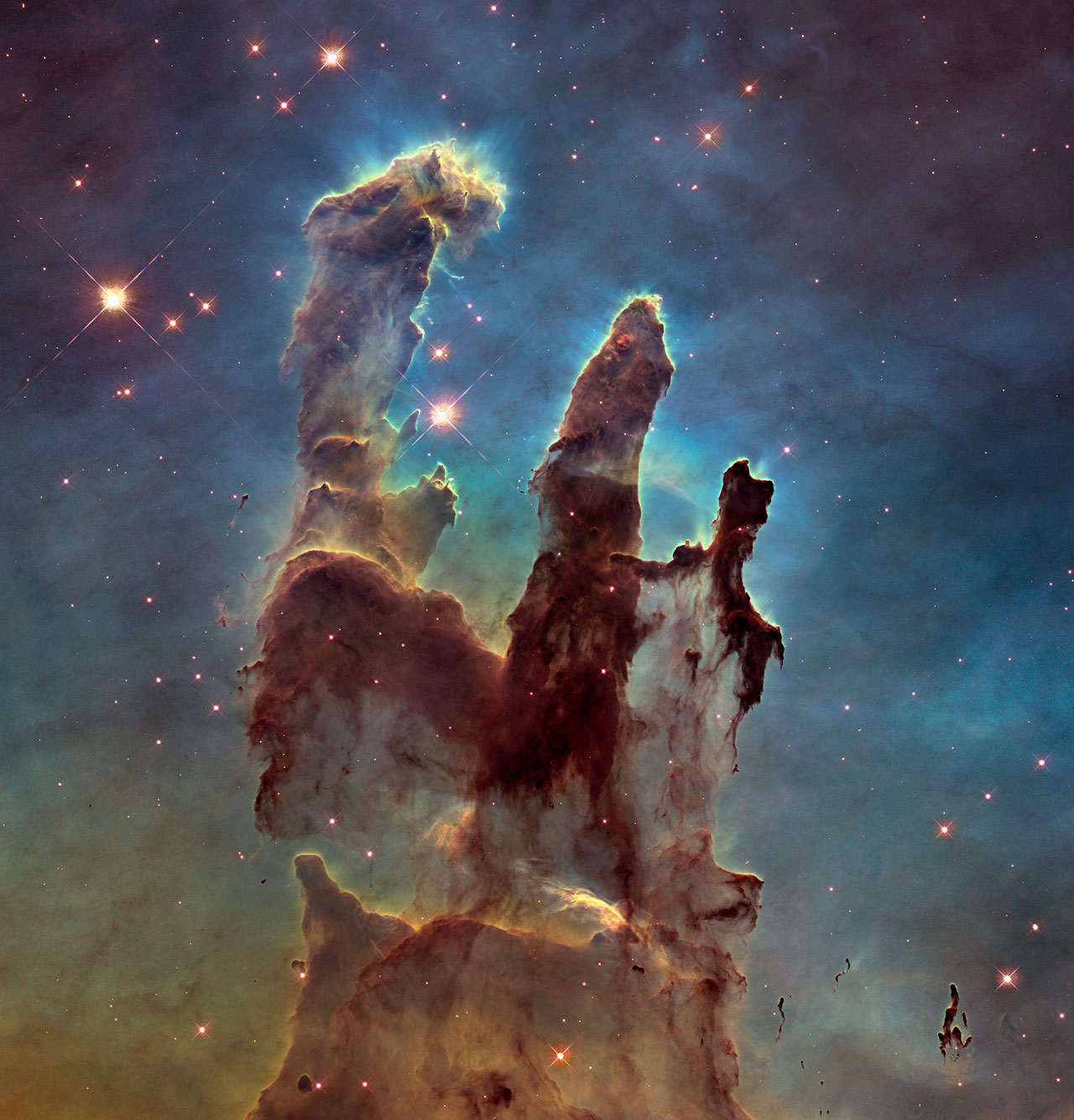
The NASA/ESA Hubble Space Telescope has revisited one of its most iconic and popular images: the Eagle Nebula’s Pillars of Creation. This image shows the pillars as seen in visible light, capturing the multi-coloured glow of gas clouds, wispy tendrils of dark cosmic dust, and the rust-coloured elephants’ trunks of the nebula’s famous pillars. The dust and gas in the pillars is seared by the intense radiation from young stars and eroded by strong winds from massive nearby stars. With these new images comes better contrast and a clearer view for astronomers to study how the structure of the pillars is changing over time.
I subscribe to EarthSky and the link to this image and background information was in yesterday’s daily summary. The mind-blowing facts are that the Eagle Nebula is found in the constellation Serpens and is 6,500 light-years away from our dear planet. To put that into context, that is 38,210 trillion miles from us. The star cluster associated with the nebula is about 5.5 million years old.
EarthSky has the very interesting text of the NASA Press Release regarding this new, high-resolution image.
For me, I just want to let that image wash over me. Not least because it reminds me that I am a very lucky person to be living at a time when one can lose oneself in such sights.
Here’s the image again, this time without the explanation.
A return to a theme previously presented in this place.
The primary motivation for today’s post was to continue the theme in my post last Wednesday: Canada – Ellesmere Island, that featured the most beautiful film from the BBC about the wolves on Ellesmere: Snow Wolf Family and Me.
Now it struck me that in writing a blog called Learning from Dogs there was a fair chance that the history of dogs had been featured before. I ran a quick search through previous posts using the search term ‘history of dogs’. There were a number of returns. Such as the republication of an article by Mark Derr: The Wolf Who Stayed last November. Then there was a post called Dogs and Wolves: Fascinating Research in February, 2014. Back in 2013, a post Dogs and Man: An eternity of a relationship.
Yet, all these and more didn’t quite offer what I am presenting today. (Well, that’s my story!)
First up was the chance finding of a blog called Bioventures. On the 11th September, 2013 there was a post published by D.K. Taylor under the title of: The Science of Dogs: Dogs Vs. Wolves. Here’s how it started:
While watching The Science of Dogs, one portion of the documentary that interested me was the comparison of domestic dogs verses wolves. I knew beforehand that dogs and wolves behaved differently, but it was not until now that I knew much about these differences. Wolves depend upon their pack only, while dogs have been taught to rely on humans to meet many of their needs. The difference must be extreme for it to have been so obvious in the demonstration with the meat and rope from the documentary! (For anyone in the class that watched the other documentary: A piece of meat was tied to a rope, and a wolf kept pulling at it and trying to solve the problem for itself while the dog almost immediately looked to the nearby human for help.)
A study by a team of American and Swedish researchers published on Jan. 23 in the Journal of Nature, shows that dogs have more genes involved in starch metabolism than wolves.
The finding suggests that this was a major factor in the evolution process of the wolf. No one knows exactly when or how our ancestors began to be so closely linked to dogs, but archaeological evidence indicates that it was thousands of years ago.
One theory suggests that modern behavior of the dogs came from the hunters that used wolves as guards or fellow hunters.
But another theory – that underpins the study – suggests that domestication began when the wolves began to approach the villages in search of food, stealing the remains left by people.
This practice became increasingly common and as a result, wolves began to live around humans. According to this second hypothesis, when we became sedentary and dependent on agriculture, waste dumps created around our settlements soon became the power source of many wolves, explains Erik Axelsson, of the University of Uppsala.
You will need to go here to read the full article, but I will offer this further piece:
Dr. Axelsson and colleagues examined the DNA of more than 50 modern breeds – from the Cocker Spaniel to the German Shepherd.
They then compared their genetic information with 12 wolves from around the world. They scanned DNA sequences of the two canids in areas with large differences. They assumed that these areas contained genes that could help explain the domestication of dogs. Axelsson’s team identified 36 regions, with more than one hundred genes.
The analysis detected the presence of two major functional categories – genes involved in brain development and starch metabolism.
The latter suggests that dogs have many more genes encoding enzymes needed to break down starch, a feature that could have been advantageous to the ancestors who rummaged among the wheat and corn of the farmers.
“The wolves also have these genes, but not used as efficiently as dogs,” said Dr. Axelsson.
“When we look at the wolf genome, we only see one copy of the gene [for the amylase enzyme] on each chromosome. When we look at the dog genome, we see a range from two to fifteen copies; and on average a dog carries seven copies more than the wolf.”
“That means the dog is a lot more efficient at making use of the nutrition in starch than the wolf.”
As for the genes related to brain development, these probably reflect some of the behavioral differences we now see in the two canids.
The dog is an animal that is much more docile, which is probably due to the past humans preferring to work with animals that were easier to tame.
“Previous experiments have indicated that when you select for a reduction in aggressiveness, you obviously get a tamer animal but you also get an animal that retains juvenile characteristics much longer during development, sometimes into adulthood,” said Dr. Axelsson.
This may help explain why it is said that dogs act like puppies throughout their lives.
The study of the origin of dogs is still, in many ways, a puzzle.
Fossil evidence suggests that some populations have been around for tens of thousands of years, long before the advent of agriculture. One reason why it is so difficult to determine the time of this change of behavior is that domestication may have occurred more than once.
Over on YouTube, there are many videos about the subject of ‘the science of dogs’, albeit many of them lengthy. But so what!
I have gone for a 2013 Documentary film that has found its way on to YouTube: Wolf and Human – The Creation of The Dog (Full Nature Documentary). It is 90-minutes long and, at the time of writing this post, Jean and I haven’t watched it. We will this evening. But it comes highly rated and I very much hope it is a good film. The title of the film is perfectly aligned with the theme of today’s post. (N.B. We had bandwidth issues last night and gave up the struggle after just eleven minutes. Despite the poor resolution of the video, it still looked like an interesting video to watch in full.)
Following yesterday’s post about Ellesmere Island and the white wolves, I had plans to write more about the history of the wolf and the dog. (Oh, and thank you so much for the great way you all reacted to yesterday’s post.)
But events transpired to get in the way.
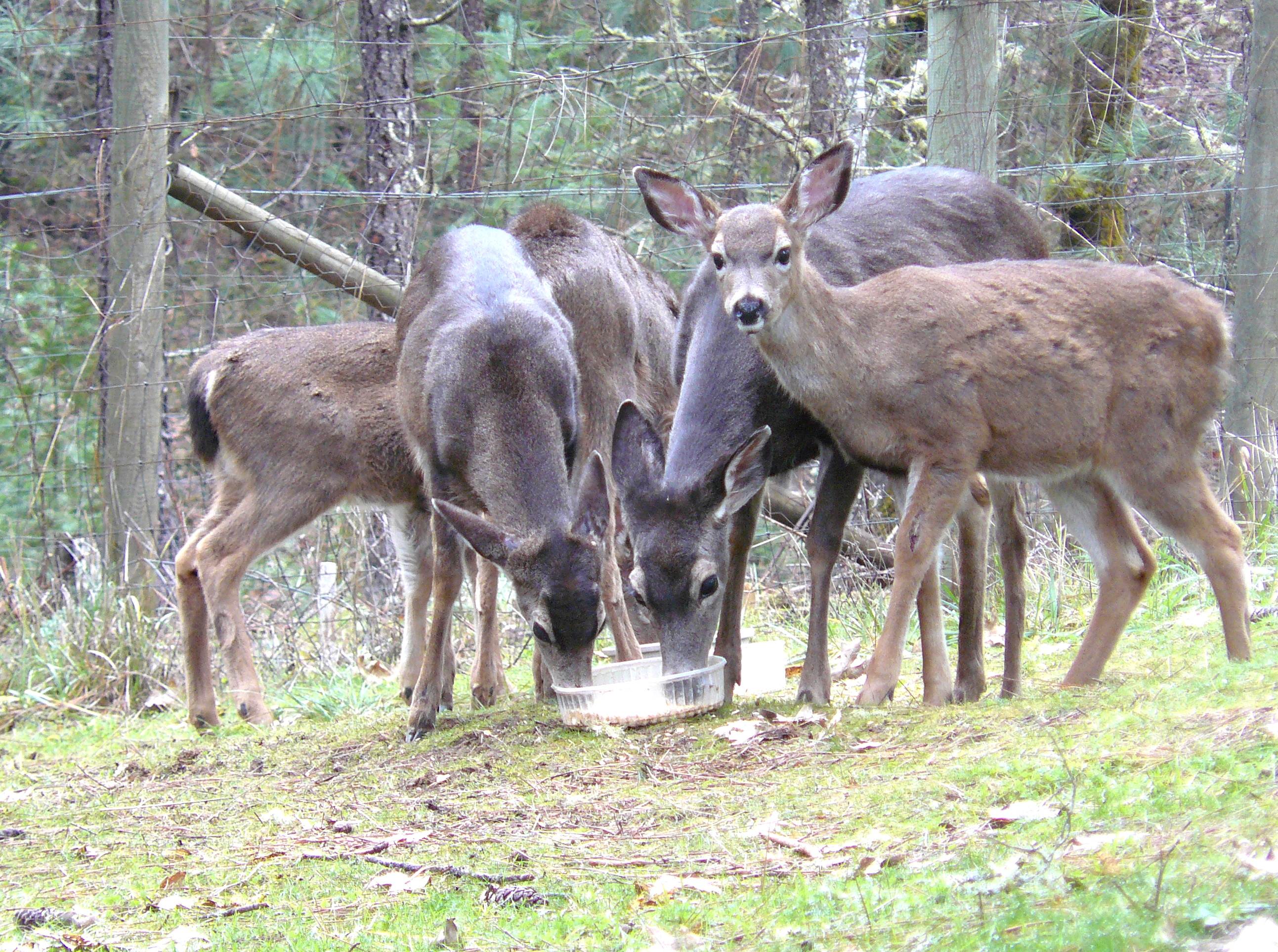
We were longer in Grants Pass in the morning than anticipated, then it was time for a quick lunch, get the fire going again, go through a rather bulging inbox, and then I was in the mood to start the post. I stood up to stretch and noticed that the deer that we feed most days were waiting impatiently.
So outside to put down some feed for the deer, then hover around, just captivated by them, decide to grab the camera from indoors and take a picture,
then, while I was outside realised that I ought to bring some logs in for the fire, and …… you get the scene, I’m sure.
I sat down at my PC to start the post and knew that I was stressing about there not being enough time to do it justice.
Gave myself a talking to about writing a blog was not something to stress about and looked for a ‘fill-in’ for today.
Opened an email recently sent to me from long-time UK friend, Neil Kelly, and discovered Neil had included in the email the most wonderful, evocative, serenely beautiful photograph of a rambler from calmer, more peaceful times. It really had to be shared with you.
Bronwen is a UKCP-accredited psychotherapist with nine years experience and a practice in Cambridge, Suffolk and Hungary. She is trained in the Karuna Institute in Devon in core process psychotherapy, which was the first mindfulness-based therapy in the UK. She adds to this her unique understanding of western and eastern spiritual traditions, combined with findings in new science – to find ways of helping individuals align with their true destiny. She runs retreats and workshops and group work at different times of the year.
I was vaguely aware of the name. Perhaps unsurprisingly as I was familiar with the work of the Karuna Institute at their beautiful location at Widecombe-in-the-Moor, Dartmoor, Devon, some eighteen miles from where I used to live in Harberton, Devon.
Widecombe-in-the-Moor
Anyway, back to the theme of today’s post. Back to Jon Lavin’s email with the link. This is how that essay from Dr. Rees opened:
by Bronwen Rees on January 1, 2015
In the face of the on-going and now undeniable social, economic, environmental and political crises, there are plenty of seeds of ‘emergence’ that point to a new way forward. These are flowering in the area of sustainability, spirituality, and the reworking of ancient systems of wisdom. They point to a new way of being and relating where, it is implied, one can manifest at will one’s desires.
Whilst there is a distinct truth in much of this, and many examples where this can obviously work (vis the outpouring of new technological companies providing ever more zany products), they are very early developments fostering to individual satisfaction rather than being consciously channeled into the benefits of the collective. The scale of change in terms of consciousness has largely not yet been realized. One of the main reasons for this is the as yet imbalance in the relationship between the collective and the individual, and the lack of a conscious ethical foundation.
I sort of understood the central message but the words were getting in the way. Take this later paragraph, for instance:
Humanity is at a bifurcation point – a point of irreversible change – where conscious choice determines the future that is created. Neo-Darwinian theorists would argue that this is merely a point of survival, and given the current scientific data about the material conditions – peak oil, energy, economic chaos, severe mental health issues, the conditions would suggest that we are as a species heading for disaster. Balanced between over-population and yet greater and greater individualization with more and more apparent choice – how can the two perspectives be reconciled on this seemingly increasingly small planet?
Indeed, my email reply to Jon, having struggled through the full essay said: “Good day to you, Jon, Yes, what a fascinating essay albeit written in a manner that makes it a very tough read! Nevertheless, I have no doubt that the good Dr. is spot on in her analysis.”
The very next item opened in my email inbox was notification of a new post from Sue Dreamwalker: My Dream ∼ Translated I just had to share. Let me, in turn, share Sue’s post with you; with her kind permission, I should add.
ooOOoo
My Dream ∼ Translated I just had to share
“Don’t only practice your art, but force your way into its secrets, for it and knowledge can raise men to the divine.” ― Ludwig van Beethoven
On Jan 3rd I had a Dream.. Please click on the music video below so you can get a sense of some of my experience.. .. Sunday I tried to capture some of the images I had in the dream… So I painted.. But I saw Oh so so much more………
In the beginning of the dream.. She was Me.. As I began to sing.. but then I became the observer.. This has to be the best Dream experience ever… .. So I had to share.. I heard the Music… Music like I have never heard upon this earth… the video music is about as close as I can get to that feeling of being exalted to a higher place.. I am still so excited I cannot tell you the Love I felt within this experience.. If this is the beginning of 2015.. Whoooooh… Let it roll……..
My Dream..
“She stood in a gown that was a rich golden brown. Its fabric shimmered catching the light that reflected from the crystals of natural quartz that sprang up around her. The gown was long and flowing not only did it reach the floor, but it spiralled out around her in a never ending dance as it became one with the sphere of the Earth.
Sue’s painting.
She took a deep breath; here she stood in the centre of the globe called Gaia.
Her hair was so long the wind picked it up to billow out behind her in long tresses. Birds flew in and amongst her strands of hair, Insects and butterflies danced within making it their home.
With breath still poised, she raised her arms like a conductor of an orchestra. She expanded her lungs and she began to Sing…. Her Soprano voice was pure. The moment her voice vibration raised higher the spiral of her gown buried deeper into the Earth. The Grass became part of her gown. Trees sprang forth from the folds of it swaying to her melody of love; Flowers opened their blooms, each petal giving separate notes in a wonderful exotic dance of harmonic ripples.. Love notes rippled like the keys of the piano. The buds on the trees open their leaves their notes sounded deeper like a million cello’s. Birds sang their flute like songs and the butterflies wings danced lighter than bell chimes.
Water trickled into streams, clear and sparking like the strings of the violin.. They swelled in a crescendo in waves that beat the rocks crashing in like kettle drums smashing like symbols into glistening spray..
The Whales joined in her song a mournful lament, while deep in the jungle the elephants gave a low rumble to acknowledge they had heard.. The roar of the Big Cats were heard above the cries of the orangutan’s
As the Thunderous machines of man cut swaths leaving deep scars that screeched like vultures circling over head, to give way to silence………. as they circled over the corpses of everything left dying in its wake..
She paused……………. ready to continue…….. Her arms raised high above her head, she Sang.. her voice becoming a crescendo with the Earth, her breath became the Spiral.. Her Hair became the Wind.. The notes she sang sprang forth from her mouth forming hearts and stars.. Every living creature now joined in her song…
She knew her Song of love was being joined by so many more.. She was ONE with ALL.. She was part of our Earth Mother..”
~~~~
I hope you enjoyed reading about this Dream and I hope you enjoyed listening to the wonderful music of the PianoGuys
See you all very soon…
~Sue~
ooOOoo
In a very strange way, I read the same messages from Dr. Rees and from Sue but presented in such opposite ways: one way so complex and one way to clear. So strongly reinforced by their respective closing words. Here’s Dr. Rees:
Whilst there is real potential for the expansion of consciousness, this does not by any means suggest that this will arise without individual effort and struggle. All the enlightened masters of the past needed to move through this gateway – the difference between then and now is that the conditions are far riper for more individuals to undergo this – and indeed can be seen as a biological necessity for the survival of the human species. Thus as individuals, we cannot avoid this, but what we can do, and indeed as a biological and spiritual imperative, we can support one another and help organize ourselves in dedication of this purpose, in a mutual recognition of each individual uniqueness yet shared destiny.
Here are Sue’s closing words: “She knew her Song of love was being joined by so many more.. She was ONE with ALL.. She was part of our Earth Mother..”
However, there is one uniting theme I read from both of them: Hope!
How the hard choices actually allow us to define who we are.
Jean and I watched a TED Talk a few evenings ago. The title of the talk was: How to make hard choices. It was delivered by philosopher Ruth Chang who one discovers from her website:
Ruth Chang
I am a philosopher at Rutgers University, New Brunswick. Before arriving at Rutgers, I was a Junior Research Fellow at Balliol College, Oxford where I was completing my dissertation. I’ve also held visiting positions in the philosophy department at the University of California, Los Angeles and the University of Chicago Law School. Before my life as a philosopher, I worked as a law associate on a (pro bono) death penalty case and several (non pro bono) product liability cases. I have a J.D. from Harvard Law School and an A.B. from Dartmouth College.
Now I am not going to pontificate about this talk; all I will say is that it is a) very interesting, and b) highly relevant to millions of us when, from time to time, we are faced with the tough decisions to make.
The video is a little less than 15 minutes long. I’m fairly certain that you will be enchanted by Ruth Chang’s proposition as much as Jean and I were.
Published on Jun 18, 2014
Here’s a talk that could literally change your life. Which career should I pursue? Should I break up — or get married?! Where should I live? Big decisions like these can be agonizingly difficult. But that’s because we think about them the wrong way, says philosopher Ruth Chang. She offers a powerful new framework for shaping who we truly are.
A repeat posting of a wonderful joke from earlier times.
Good friend from my English days, Bob Derham, a few days ago sent me the well-known joke about the dog for sale. At first, I had forgotten that I had posted a slightly modified version back in April, 2012. When I re-read it, I had to repost it today. It’s wonderful.
oooo
DOG FOR SALE
New home needed for this wonderful animal.
A guy is driving around the back streets of Bristol, England.
He sees a sign in front of an unkempt terraced house: ‘Talking Dog For Sale‘, so he rings the bell and the owner appears and tells him the dog is in the garden.
The guy goes into the backyard and sees a nice looking Labrador retriever sitting there.
‘You talk?‘ he asks.
‘Yep,’ the Lab replies.
After the guy recovers from the shock of hearing a dog talk, he says ‘So, what’s your story?‘
The Lab looks up and says, ‘Well, I discovered that I could talk when I was pretty young.. I wanted to help the government, so I told the SAS. [Special Air Service or SAS is a corps of the British Army]
In no time at all they had me jetting from country to country, sitting in rooms with spies and world leaders, because no one figured a dog would be eavesdropping.‘
‘I was one of their most valuable spies for eight years running…
But the jetting around really tired me out,and I knew I wasn’t getting any younger so I decided to settle down. I signed up for a job at the airport here in Bristol to do some undercover security. You know, wandering near suspicious characters and listening in, that sort of thing. I uncovered some incredible dealings and was awarded a batch of medals.’
‘Then I got married, had a load of puppies, and now I’m just retired.‘
The guy is amazed. He goes back in and asks the owner what he wants for the dog.
‘Ten quid,’ the guy says.
‘Ten quid? This dog is amazing! Why on earth are you selling him so cheap?‘
‘Because he’s a liar. He’s never been out of the garden all his life!’
It’s the way I tell ’em!
oooo
Really hope that many of you haven’t come across this wonderful joke before!
A reflection of the future year; this last day of 2014
I struggled for some time, wondering what to write for this day: December 31st, 2014. Part of me wanted to be light and cheerful. Yet, nothing came to mind in terms of what to write that wouldn’t be pointless or inane. Then dear Colin who writes the blog Wibble – just another glitch in the matrix posted yesterday: Are we ready for 2015? Here’s that post:
Are we ready for 2015?
I’m not sorry for sounding somewhat melodramatic, here: what we face is nothing less than the archetypical existential threat. You may well
Graph (hand-drawn in 2008) showing that carbon emissions must peak by 2015 to keep global warming to the internationally agreed upper limit of 2°C (the point beyond which we risk runaway climate change).
dismiss me as ‘alarmist’: but if you were in a crowded theatre and you were to hear me shout “FIRE!” — what would you do then?
When, in late 2009, I first saw The Age of Stupid, I was struck by one scene in which ‘a man in a shed’ stated, quite categorically, that humanity’s carbon emissions had to peak by around 2015 in order for us to avoid the risks of passing beyond 2°C above the average pre-industrial global temperature. Almost everyone agrees that two degrees centigrade of warming is the threshold beyond which we will face serious risk of uncontrollable planet-wide climate change effects of potentially catastrophic proportions. And I do mean ‘civilisation-ending’.
This is not histrionics; it’s based upon very solid science. The ‘man in the shed’ is Mark Lynas, author of ‘Six Degrees: Our Future on a Hotter Planet,’ which won the Royal Society’s science book of the year award in 2008. In the short video clip below he speaks from that same year, and his message is blunt: he says we have “seven years” to stabilise global carbon emissions to avoid the risk of climate change accelerating beyond our ability to control it.
The problem is that 2008 + 7 = 2015. Those seven years are up: we’ve squandered them.
Now, I don’t know if you’ve been paying attention — perhaps you’re more focused upon the fortunes of your favourite football team, or the latest antics on ‘Strictly’ or Eastenders; maybe your mind is firmly on your house or job move, or where your children are going to school next year, or any one of the myriad of (relative) trivia such as the ‘immigrant problem’, or the ‘war on terror’ — so in case you’re not familiar with the current situation:
Global carbon emissions are not slowing towards a peak in this coming year. On the contrary, emissions are soaring beyond anything humans have ever previously managed. I’m talking BIG numbers. Yay, us: we’re beating all records.
So… What are your new year resolutions?
On reading the blog post I found myself leaving a comment that seemed to encapsulate my inner fears, explaining why I was struggling to find a light and cheerful tone for today’s post. Here is that comment that I left for Colin:
I hesitate to offer a view. Not because I don’t agree with your article, agree totally, but because I’m afraid that I can’t offer any original thoughts. There is a growing awareness of the need to change, even some quasi-political ambitions that the world ‘needs to talk about climate change’, but no sign that we are anywhere close to a global response of emergency proportions.
Despite being a person with a naturally positive view of life, for reasons I can’t articulate, I have a profound sense of gloom about the New Year. Maybe a result of recently becoming aware of my own mortality. Maybe, an unspoken fear of some huge global catastrophe, natural or otherwise, just around the corner. I hope that I am wrong. Then if I am wrong, it is suggesting that 2015 will be more of the same and, as you so acutely point out, more of the same is the last thing this natural world of ours requires.
So make of that what you will! (And apologies for rambling on a tad!)
Happy New Year to you and all your loved ones.
Then something struck me. It’s no good just giving up and having a moan. Each and every one of us has to find a motivation for changing. Or, if the scale of global change required is just too overwhelming a prospect, then embrace these times as just one of the planet’s natural thresholds; global changes that have been going on for billions of years.
As we come to the end of 2014, it’s natural to reflect on the year that has gone by, as well as to look forward to the new year ahead. This is a time for “kind sight”.
Below are two journalling exercises to explore, now that the rush of the Holidays is over. I like to think of this as a Middle Ground pause. A time for being present, reflecting and allowing your inner wisdom to inspire you for whatever comes next.
Take a few moments to let yourself get settled and comfortable. Start by reflecting with “kind sight” on the past year. “Kind sight” means being kind to yourself, instead of being critical or judging. With “kind sight” we are able to see mistakes as lessons, and life’s challenges as times of resiliency and personal growth.
Ask yourself the following questions and write down your answers:
What happened during 2014…
What was a highlight?
What was a lowlight?
What was a surprise?
What do I feel proud of?
What do I feel grateful for?
What did I learn (or am still learning) from either the highlights or lowlights?
Some people do a month by month reflection, while others evaluate important areas in their lives. (For example – career, family, health, hobbies, learning, contribution, spirituality, travel, environment, self-care, personal growth).
Once you’ve reflected on 2014, write a Future Gratitude Letter:
This is a letter to yourself written a year in advance, describing all the things that you are grateful for during the year. Start with the date December 31st, 2015 and address it to yourself.
Include who you’ve become and what you now have or are moving towards. Be careful not to include anything that feels like a “have to” goal or something that you “should” achieve.
This is a letter of “kind sight” for the year ahead. The key is in the energy. If your energy feels uplifted when you think about the things you’re grateful for in a year’s time, then you are tapping into your own passion and inner wisdom.
This can be a revealing and inspiring process, letting the creative juices and intention begin it’s journey.
ooOOoo
Val’s recommendation is fabulous. Maybe, just maybe, I’ll have a go myself. And if I do write the letter, it will be published in this place.
So!
However you feel about yourself and about the future, whether you are gloomy and downcast, or upbeat and hopeful, never forget that you are a valid human being, a unique individual, and capable of amazing things.
So go and hug a dog and wish yourself the very best for 2015!
A Happy New Year to all – and thank you for your wonderful support of this blog these past years!
Not only to the aircraft but to all the many individuals who made it happen!
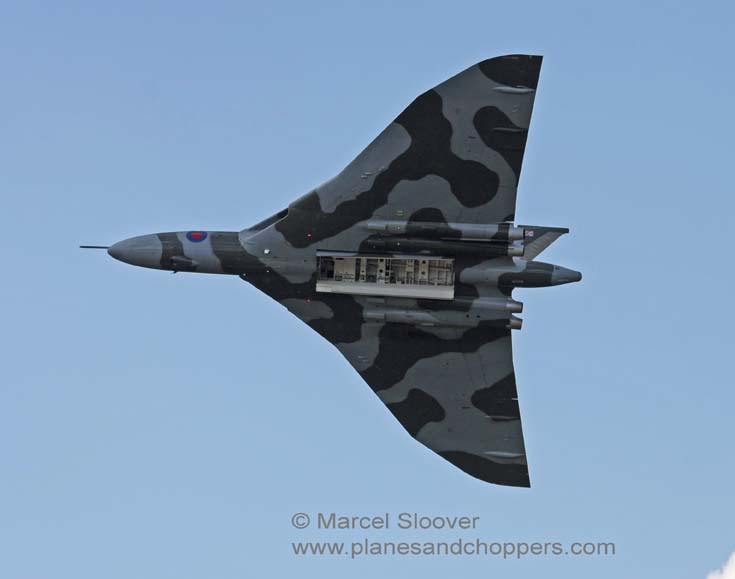
As I mentioned in yesterday’s post Nostalgia with wings, today I was going to write about a particular aircraft: The Avro Vulcan.
I chose the image above because it resonated so strongly with the comment left by Hariod Brawn that I included in yesterday’s post. Namely:
I took my father [who test-piloted the Vulcan and Victor. PH] to see Vulcan XH558 fly what was then thought to be its final flight (it subsequently was overhauled and took to the skies again). It flew along the length of the runway at a 45 degree angle with its bomb bay doors open. On the inside of the doors in huge letters was the single word ‘farewell’. It was really quite an emotional experience both for my father and myself.
There’s a lengthy item on WikiPedia about this aircraft. I will repost a couple of parts of that article.
Avro Vulcan XH558 (civil aircraft registration G-VLCN) The Spirit Of Great Britain is the only airworthy example of the 134 Avro Vulcan V bombers that were operated by the Royal Air Force from 1953 until 1985. Vulcan XH558 served with the RAF between 1960 and 1985 in the bomber, maritime reconnaissance and air-to-air refuelling roles. The RAF operated XH558 as a display aircraft from 1986 until 1992, when budget cuts forced its retirement.
It is operated by the Vulcan to the Sky Trust as a display aircraft, funded entirely by charitable donations and the UK Heritage Lottery Fund. It is registered with the United Kingdom Civil Aviation Authority as G-VLCN but has an exemption to fly in Royal Air Force markings as XH558.
Restoration to flight
The engineering staff of the Vulcan Operating Company (the engineering arm of Vulcan to the Sky Trust, owners of XH558) worked to return Vulcan XH558 to flight, with the first test flight taking place on 18 October 2007. They were supported by the “Vulcan to the Sky” club, a supporters and fundraising organisation. Though the website carried an announcement on 1 August 2006 that the project was in danger of being abandoned due to lack of finance, the target of raising the remaining £1.2m was achieved on 31 August 2006, thanks to a high-profile publicity campaign orchestrated by the supporters club, Vulcan to the Sky Club (formerly Vulcan 558 Club).
Time had almost run out for XH558 when Sir Jack Hayward, a British philanthropist, donated £500,000, which topped off the £860,000 already raised by Vulcan to the Sky Club and Friends. Although the aircraft restoration was nearly complete, the aircraft was not ready for the flypast down The Mall in London for the 25th Anniversary of the Falklands conflict on 17 June 2007 or the RAF Waddington Airshow and the Royal International Air Tattoo (RIAT).
It was intended that the Vulcan would fly during at least one UK airshow during the 2007 season, but due to delays in returning the aircraft to flight, mainly down to delays in the return of refurbished flight-critical components, the aircraft was not ready for the display season.
On 16 August 2007, the aircraft started engine testing on the airfield at Bruntingthorpe. On the next day, XH558’s No.3 Rolls-Royce Olympus 202 jet engine was run for the first time in over 20 years. This is a different engine from that used by XH558 during its final season with the RAF’s Vulcan Display Flight in 1992, with all four of the Vulcan’s original Olympus 202 engines having been replaced by zero-hour units which had been stored since 1982. The VTS Team also has another four fully inhibited engines in stock. The removed engines were either scrapped, sectioned for display or passed on to VRT’s XL426 at Southend. Another milestone in the restoration project was achieved on 22 August 2007, when all four of XH558’s Olympus engines were run at nearly full power settings, for short intervals.
The first post-restoration flight, which lasted 34 minutes, took place on 18 October 2007.
What a great project!
Now to a couple of videos. (There are many to chose from on YouTube, by the way.)
The first is a 45-minute documentary that I have only watched for the first few minutes, but it looks a good one.
and the second is much shorter but reveals to great effect the wonderful sound of the Vulcan’s engines.
Published on Oct 28, 2012
When the engines exceed 92% power, the Vulcan makes this cool howl sound.
He [my father] was an RAF pilot during the war and through to the early 1960’s. He test-piloted the Vulcan and Victor, though started on what he called ‘string bags’, by which he meant Tiger Moths. In between he flew the Spitfire, Lancaster, Meteor and specialised in flying in electrical storms, about which he wrote a manual for the RAF.
……
I took my father to see Vulcan XH558 fly what was then thought to be its final flight (it subsequently was overhauled and took to the skies again). It flew along the length of the runway at a 45 degree angle with its bomb bay doors open. On the inside of the doors in huge letters was the single word ‘farewell’. It was really quite an emotional experience both for my father and myself.
I thought it would be nice to include some video of XH558; that will be tomorrow’s post. For today, I wanted to reminisce from my own private flying days.
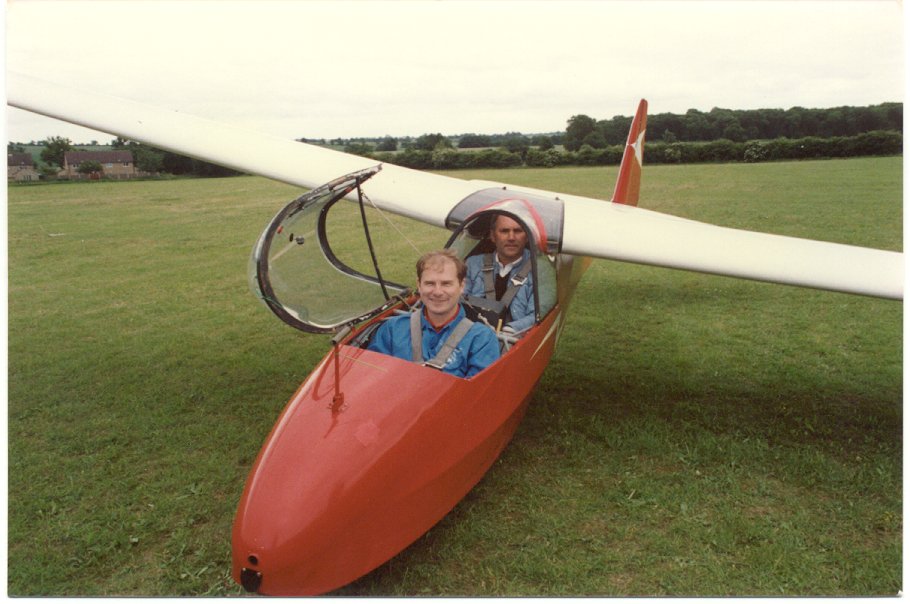
A K-7 two-seat glider.
My first exposure to private flying was on the 7th June, 1981 when, at Rattlesden Gliding Club in Suffolk, I was taken up for two air-experience circuits in a two-seater glider known as a ‘K7’. I was immediately hooked! Those experience flights leading to a 4-minute flight (flight number 46) on the 6th September, 1981 that has the remark in my pilot’s log book: Solo! Now fast forward to October, 1984 and my log book shows me attending a gliding instructor’s course at Lasham, resulting in me being issued with a British Gliding Association (BGA) Assistant Instructor Rating on the 14th October. (105/84).
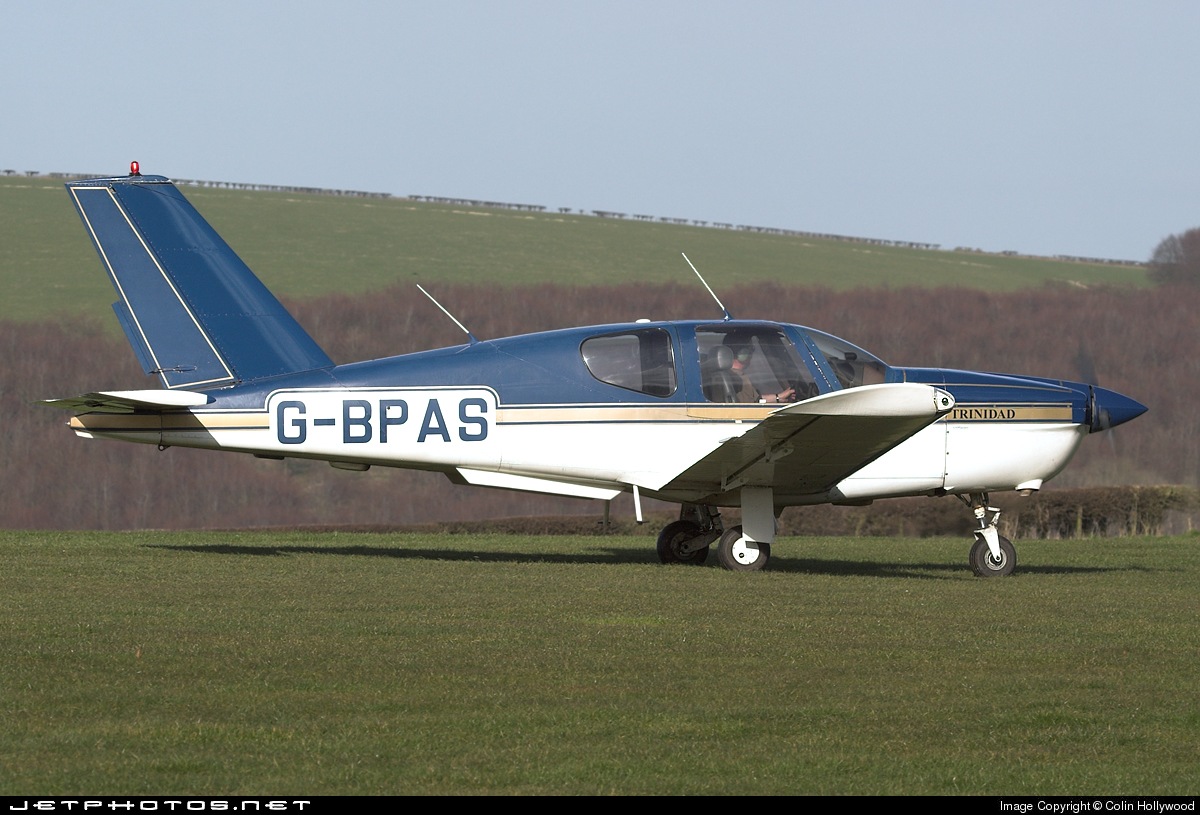
Over on the power side of things, in March, 1984, I started Private Pilot training at the Suffolk Aero Club at Ipswich Airport and gained my PPL on the 9th November, 1984. Subsequently, gaining my Instrument Rating in July, 1999 when I was then operating from Exeter Airport and flying frequently for business purposes. For that ‘serious’ flying I used a Socata TB20, a French retractable, single-engined aircraft, based at Exeter. A very fine, long-distance aircraft.
TB20, G-BPAS, photographed at Compton Abbas airfield (EGHA).
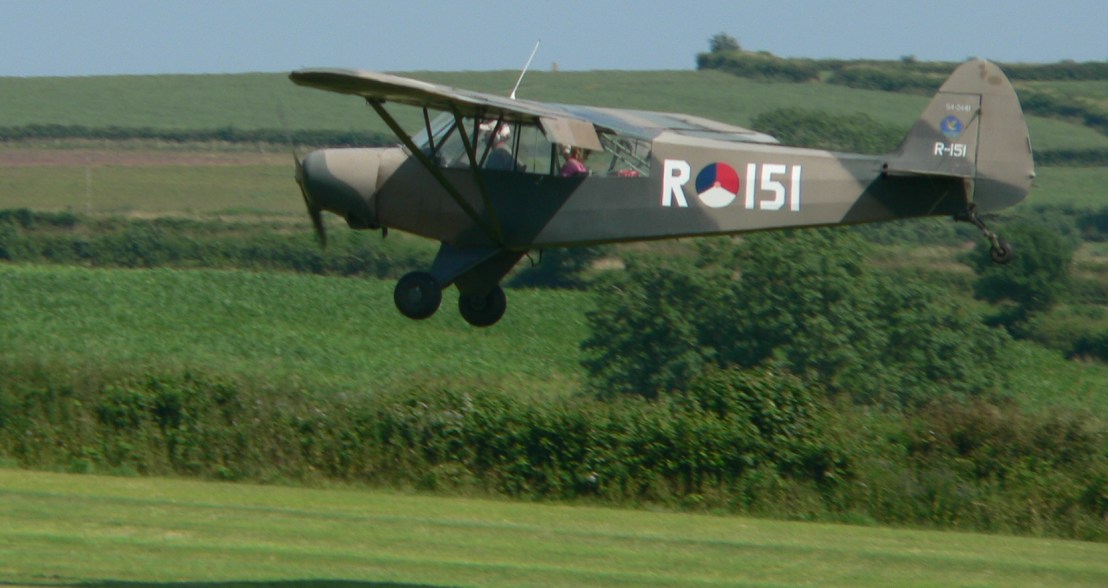
But the aircraft that I had the most fun flying was a dear old Piper Super Cub. Here’s the background to the aircraft.
Piper Super Cub, L-21B, R-151
A/C Construction No. 18-3841, Frame No. 18-3843
Original Engine, Lycoming 135 Type 0-290-D2, 54/2441
Romeo 151 was one of a batch of 298 L-21’s delivered in 1954. There were 584 L-21B’s produced by Piper for military use, the ‘L’ standing for Liaison. The L-21B’s were PA-18-135’s with civil Lycoming 0-290-D2 engines, glasswork as most L-21A’s and L-18’s and a gross weight of 1760 lbs.
This aircraft was delivered to Koninklijke Luchtmacht, Dutch Air Force, on the 1st July, 1954 and registered R-151. After various homes R-151 transferred to the Dutch civil register as PH-GER, 1st April 1976 with 4,458 hours and shortly thereafter was registered to Vlieclub Hoogeveen, Certificate Number 2380.
On the 27th March, 1981 the aircraft was delivered to the UK with a total time of 5,043 hours and in September, 1981 became G-BIYR; ‘YR’. In April, 1983 YR was the first of type to be given a Public Transport CofA (Certificate of Airworthiness) and was used for training at Tollaton. YR reverted to a Private CofA in January, 1984 when purchased by Mike and Barbara Fairclough. The aircraft had by then accumulated 5,120 hours.
In 1992, YR was re-engined with a Lycoming 150HP, 0320-A2B No. L49809-27A (zero hours). Finally on the 2nd June, 1995 the aircraft was repainted in her original Dutch insignia and given CAA (UK Civil Aviation Authority) permission to use the original call-sign: Romeo 151.
The aircraft was based at and flown from Watchford Farm airstrip in South Devon, England.
Now forgive the nostalgic photographic memories!
Yours truly approaching Watchford Farm airstrip in South Devon, EnglandFlying in the French Alps with Mont Blanc in sight9,300 ft up in the French Alps!
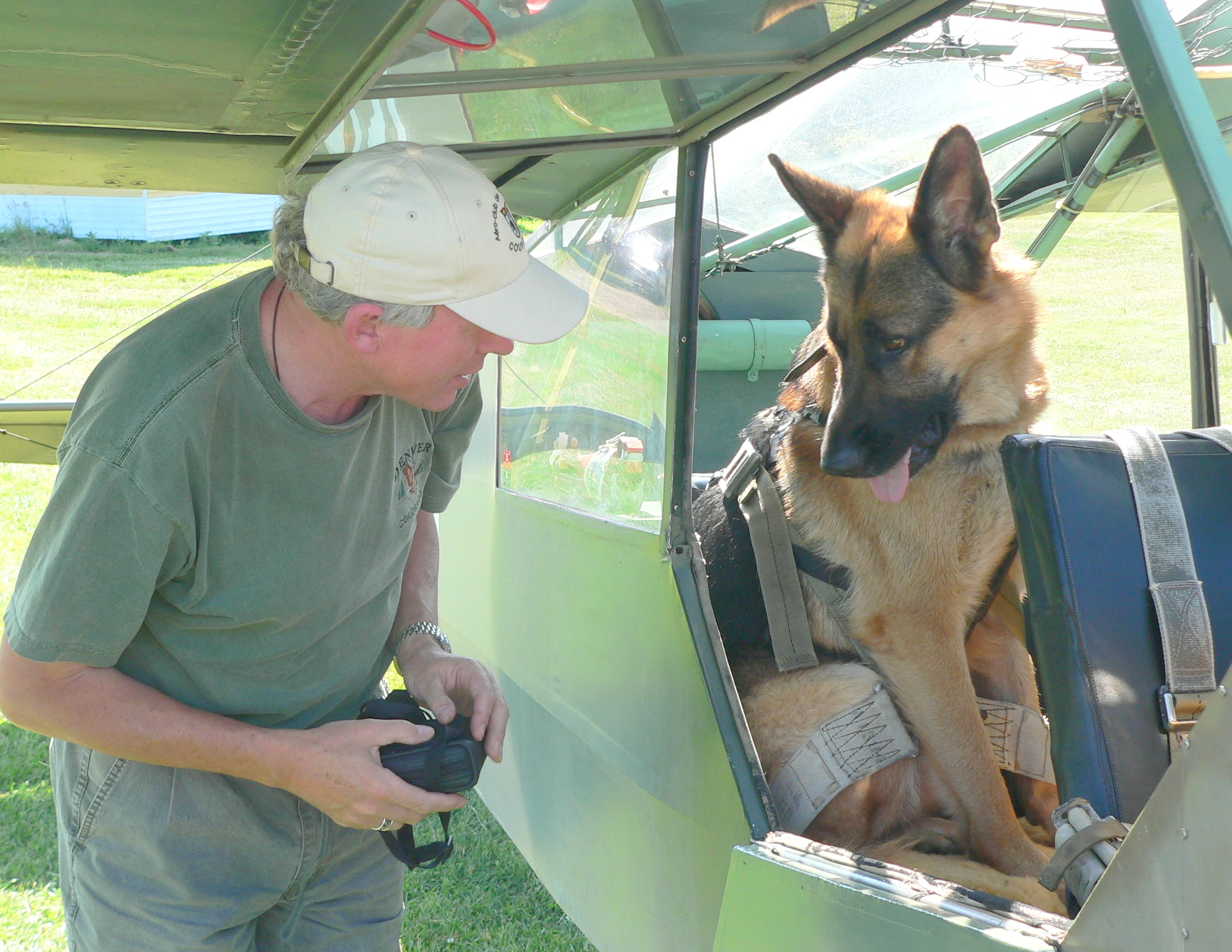
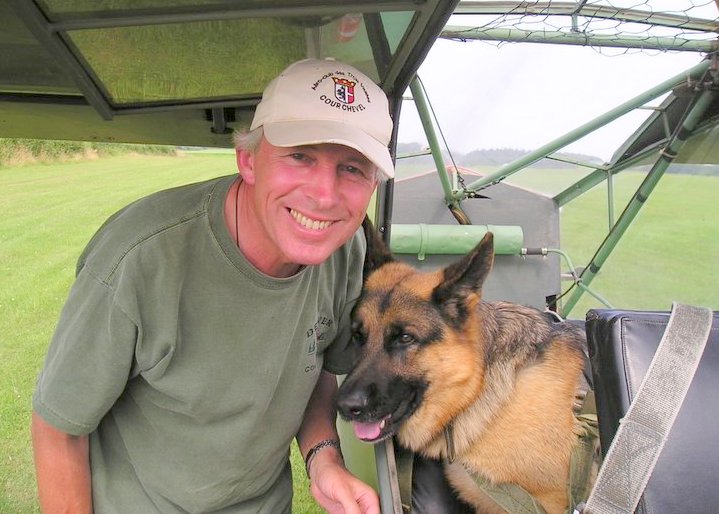
Every time I went to the airfield with Pharaoh he always tried to climb into the cockpit. So one day, I decided to see if he would sit in the rear seat and be strapped in. As the next picture shows, there was absolutely no problem with that!
Come on Dad, let’s get this thing off the ground!
My idea had been to fly a gentle circuit in the aircraft. First, I did some taxying around Watchford’s large grass airfield to see how Pharaoh reacted. He was perfectly behaved.
But then I thought long and hard about taking Pharaoh for a flight. In the Piper Cub there is no autopilot so if Pharaoh struggled or became agitated it would have been almost impossible to fly the aircraft and cope with Pharaoh sitting in the seat behind me. So, in the end, I abandoned the idea. The chances are that it would have been fine. But if something had gone wrong, the outcome just didn’t bear thinking about.
Thus we elected for taxying all around the airfield which, as the next picture shows, met with full doggie approval. The date was July 2006.
That was fun!
So enough of my recollections for today – tomorrow the Vulcan XH558.