Category: Culture

The Pen: Conclusion.

Reflections on what makes us who we are.

(Please note that this is a long post that potentially may be upsetting for some readers. Please trust me when I say there is no intention to upset anyone. I should add that the motivation for writing The Pen is from reading Sue Dreamwalker’s recent post Cracking our Inner Shells.)

Yesterday, I wrote about the circumstances of my father’s death on December, 20th 1956. I wrote:

I became twelve-years-old in November, 1956. Just six weeks after my twelfth birthday, on the evening of December 19th, 1956, my mother, as normal, came into my bedroom to kiss me goodnight. However, what transpired was very far from normal.

For she sat down on the edge of the bed and told me that my father was not well and may not live for much longer. To this day, I can still see her sitting on the edge of the bed, adjacent to my knees covered by the sheet and bedcover, a very drawn look on her face.

I had been aware of my father being at home in bed for a while but had no notion whatsoever, prior to this moment, that he was seriously unwell. In hindsight, it was more than I could emotionally embrace for not only did I not go back into my parent’s bedroom and again say goodnight to my father, I went off to sleep without any problem.

During that night, in the early hours of December 20th, my father died, the family doctor attended and my father’s body was removed; I slept through it all and awoke in the morning to find my father gone.

It’s also relevant to reveal that it was deemed potentially too upsetting for my sister, Elizabeth, my junior by four years, and me to attend my father’s cremation.

Upper Barn, Harberton.

OK! Fast forward to 2006. I was happily married to Julie, my third wife, and had been since the year 2000. Her daughter from a previous marriage, Amy, was also part of the family.  We were living in a three-bedroomed converted stone barn known as Upper Barn in the village of Harberton, a few miles west of Totnes, Devon, South-West England. A lovely tranquil home in a very tranquil village; population 300 persons.

I had my two wonderful sisters, Corinne and Rhona, from my father’s first marriage, living within short distances. My  work, home-based, involved offering entrepreneurial mentoring to local business owners, and my wife and I had a wonderful local network of good friends. Indeed, in the last months of 2006 I had been working with a professional psychotherapist, Jon, as he was expanding his client base from individuals to working within companies. And Pharaoh had been in the family since 2003!  It seemed about as perfect as it could be for me.

December 20th, 2006 was the fiftieth anniversary of my father’s death. I could never settle into the pre-Christmas mood until after the 20th December each year and this anniversary day seemed more poignant than ever. I had missed my father since the day he had died in 1956.

As it happened, that same day Julie seemed off-colour. She was frequently in the bathroom during the day and, naturally, I was concerned. Towards the end of the day I asked what was troubling her. Julie replied that she had had a miscarriage earlier that afternoon.  A year after my son and daughter had been born to my first wife in 1972/1973, I had opted to have a vasectomy! Julie’s miscarriage was not of my making.

I won’t go into the details of how my life exploded but will just say that it was traumatic in every way imaginable.

In desperation, a few weeks into the New Year of 2007, I called my psychotherapist business client, Jon, and begged him to take me on as his client.  He was initially uncertain, stating that we already had a relationship, but agreed on the understanding that if he thought the counselling relationship wasn’t properly established then he would ask me not to continue working with him. Of course, I agreed.

I want to offer what has been written elsewhere by me, explaining what happened in my fourth counselling session with Jon back in 2007. Clearly my memory of what was said can’t be word perfect but the essence of the dialogue is accurate.

“Paul, when we had our first session and I asked you to relate the key life events that came to you, the first event you spoke of was the death of your father. Tell me more about that time of your life.”

“I don’t have clear memories of my father much before he died that year. He was a lot older than my mother, some eighteen years, and I had been the product of a liaison between them; my father being married at the time. They met when they were both members of an amateur orchestra in London during the height of the Second World War. My father had had two daughters with his wife and longed for a son. I came along just six months before the end of the war.”

I paused for a few moments, sensing how dipping back to that December in 1956 was making me feel uncomfortable.

“I had turned twelve-years-old in early November 1956. Just finished my first term at Grammar School. To be honest, I can’t recall when my father became ill and how long he had been bed-ridden. But on the evening of December 19th, after I had kissed my father goodnight and jumped into my bed next door, my mother came in, closed my bedroom door, sat on the edge of my bed and told me that my father was very ill and that he may not live for much longer.

It clearly didn’t register with me at any significant emotional level because I went off to sleep without any problem. But when I awoke in the morning, Mum told me that my father had died during the night, the family doctor had attended and my father’s body had been removed from the house.”

Jon looked at me and quietly asked, “What feelings do you have about that night and that morning?”

“To be honest, Jon, I have an almost complete absence of feelings. I’ve often tried to discover what I truly felt at the time or, indeed, what I feel all these years later. But the best I have ever been able to come up with is that I was never able to say goodbye. In fact, because it was decided that it would be too upsetting for me, I wasn’t even present at the funeral and cremation, thus reinforcing my sense of not saying goodbye to my father.”

There was a pause before Jon asked his next question. “So, Paul, you have a son and a daughter. What are their ages?”

“My son, Alex, is now thirty-five and my daughter, Maija, thirty-four.”

Jon put his hands together fingers-to-fingers and lent his chin against them. “So your son would have been twelve in 1984. That was when you were very busy running your own business, if I recall.”

I nodded in reply.

“So Paul, let’s say that during that year of 1984 you had been diagnosed with some terminal illness, say cancer, as with your father. That you were given a life expectancy of six months or so. What thoughts come to mind?”

“Jon, you mean in the sense of what it would have meant for Alex and Maija?”

Jon nodded.

“Wow, what a truly terrible thing to reflect upon. But what comes to mind without doubt is that I would have walked away from my business immediately. After all, it very soon wasn’t going to be my business. My kids were still living at home, of course. I would have wanted to share every minute of my life with them. Try to let them understand as much about me, who I was, what I believed in, what made Paul Handover the person he was.”

Jon almost breathed the next question into the air of the room. “Translate the circumstances of the death of your father across to your son. What I mean by that is Alex experiencing the same circumstances from your death. What’s your reaction to that situation, admittedly hypothetical situation, thank goodness?”

I reacted with an immediate passion. “To know that I was terminally ill and to keep that from my son and daughter; that’s terrible, no it’s disgusting. Then to compound it by having everything associated with my death and the disposal of my body denied to Alex and Maija …..,” I left the sentence unfinished before adding, “It’s cruel beyond description. My poor children wouldn’t have a clue as to why they were excluded from what is, whether or not one agrees with it, one of life’s most important moments.”

Jon seemed to hold my anger in the room all about us, as he asked, “How would you reword your last sentences in the manner of a headline; in just a few words?”

I hardly hesitated. “The word that comes to mind is rejection. Alex and Maija, aged twelve and eleven, losing their father in a way that suggested they weren’t important. Yes, that’s it. They would see it as a total rejection of them by their father. Not unreasonably, I might add.”

There was a silence in the room that seemed to go on forever. Then Jon said, “Paul, we are not quite up to the hour but I’m going to suggest you just sit here quietly with Pharaoh and let yourself out when you are confident of being OK to drive home.”

He added, almost as an afterthought, “Just let today settle itself into your consciousness just however it wants to. Don’t force your thoughts either way, neither dwelling on today nor preventing thoughts naturally coming to the surface of your mind. As we have discussed before, pay attention to your dreams. Maybe have a notebook by your bedside so you can jot down what you have been dreaming about. I’ll see you next Friday same time, if that’s alright with you.”

When a crossroads is neither a roadway, nor a choice of pathways, when that crossroads is in our minds, we seldom know it’s there or that we’ve made the choice to take one path and not the other until it’s long past. Sometimes, the best you can do is look for the tiniest clues as to which path one has taken in life and where one is really heading.

I had read that in a book quite recently although, typically, could no longer remember the name of the said book. It had spoken to me in a way that I couldn’t fathom, but of sufficient strength and clarity for me to jot it down on a sheet of paper. I had been sorting papers out on my desk on the Sunday following that last session with Jon when I came across the sheet. The words hammered at me again, but in a way that was now so much more full of meaning than the first time around.

Because, to my very great surprise, my nights’ sleeps on Friday and Saturday had not only been dream free but had taken me to a place of such sweet contentment that it was almost as though I had been reborn. Alright, perhaps reborn was a little over the top, but there was no question that I was in an emotional place quite unlike anything I could ever before recall. Almost as if for the first time in my life I truly liked who I was.

On the Sunday morning, after I had taken Pharaoh over to the woods for our regular walk, I called in on Corinne and shared a cup of tea with her. As I was leaving, Corinne asked me if I was alright. In querying why she had asked, Corinne simply said, “Oh, I don’t know. There’s something different about you today that I can’t put my finger on. A happiness about you that I haven’t seen in ages, possibly never seen in you.”

I gave my sister a long and deep hug and gently said, “I miss our father at times, don’t you?”

She answered, “Oh, I miss him too, miss him so much at times. He was such a wonderful, gentle man who lived for his children. Then to die at such a young age.”

As the week rolled by, I found a truth that had been denied me for the whole of my life. I couldn’t wait to share it with Jon. As I drove across to Torquay, I was full of what I wanted to say.

Jon could tell that I was fit to burst. Indeed, I had hardly sat down on the chair when Jon asked me how my week had gone.

“Jon, It’s been an amazing week. I’ve at last understood some fundamental aspects of my life.”

“That sounds wonderful, Paul, do tell me more.”

“Well, it’s this. I have now realised the emotional consequences of the way my father’s death was handled. In other words, what became hidden deep in my subconscious, far from sight, so to speak, was a belief of having been emotionally rejected. That despite that being so far down in my subconscious world, it clearly explained two conscious ways in which I behave.”

Jon’s demeanour, his wonderful listening demeanour, encouraged me to continue. “The first thing that came to me was the reason why I have been so unfortunate in my relationships with women. Well this is how I figured it out. Whenever a woman took a shine to me, I would do anything and everything to come over as a potentially attractive spouse. In other words, I was being driven by a terrible fear of rejection, rather than rationally wondering if this woman had the potential to be a woman I would love as a wife. Ergo, I oversold myself and, inevitably, made poor long-term relationships; Julie being the classic example.”

I paused and took a sip from the glass of water that was on the small table by my side.

“But the positive aspect of my fear of rejection is that throughout the whole of my business and professional life, I have been successful. Because, I have always put the feelings of the other person above my own as a means of avoiding rejection. Jon, I can’t tell you what a release this has been for me.”

“Paul, that’s a fabulous example of how when we really get to know the person we are, how it then gives us a psychological freedom, a freedom to be the person we truly are, to be happy with ourselves.”

He continued, “One thing I should mention is this. It’s likely that what happened to you back in December 1956 is not necessarily ‘hard-wired’ but certainly is a very deep-rooted emotional aspect of who you are. This new-found awareness will be of huge value to you but that sensitivity to rejection is not going to disappear; probably never will. The difference is that you are now aware of it and quite quickly you will spot the situations, as they are happening, that stir up those ancient feelings. The difference is this new self-awareness will deliver a much deeper emotional understanding of who you are and why you behave in the way you do.”

There was a wonderful sense of peace and calm in the room that ran on for some minutes.

Then Jon just voiced what seemed like the perfect closing thought. “Paul, this mindfulness you have so beautifully revealed is wonderful. You do know you are fine, don’t you!”

I was motivated to reveal these details of my past by what Sue wrote in her recent post Cracking our Inner Shells. She included these words:

Sometimes we have to go within to the silent places we all have in order to find out what is really going on with our emotional bodies. Even knowing all the things I do, we are within our Human form to learn and grow..

I needed to ask myself a few questions as to why I was feeling so lost, depressed and sad… More was going on than just bereavement. Yes the fall I had had,both bruised and shook me, but what else was shaking me to the core?

For those who know a little about my Soul Journey, You will also know that my own Mother and I had not spoken for 10 years prior to her passing some eleven years ago now….Despite many attempts I knew I was only wounding myself more by continually trying to bridge the rift, to be continually rejected.. So this rejection and other issues related to overwork and stress, resulted in a Nervous Breakdown in my mid forties..

So when my Mother died, while I was sad, I guess I never really grieved her loss. Because to me.. I had grieved her long before her death as lost to me.. As I had had to shut down my emotions to cope with her rejection.. I had undergone counselling within my breakdown, and my Mother jumped up at every dark corner of why even in my teens I had suffered from deep depression.

We often go through whole chapters of our lives creating a protective shell around ourselves because we need it in order to heal from some early trauma. I know I had built many such Layers of shell around myself from various experiences over the years..

I recommend you read Sue’s post in full.

But more than that, I recommend that if you have any sense of there being hidden parts of your consciousness that would be better brought to the light, then you involve a professional counsellor or psychotherapist. For the reward will be beyond measure.

As mine was.

For on December 14th, 2007 I first met Jean when invited to San Carlos in Mexico for the Christmas period by Suzann and Don Reeves; Suzann being the sister of my very long-term Californian friend Dan Gomez.

Jean and I have now known each other for over seven years and have been married for over four years. I love her beyond imagination. Because I can reveal to Jean the strange, quirky, often fragile person that I am. And I am loved for who I am by Jean.
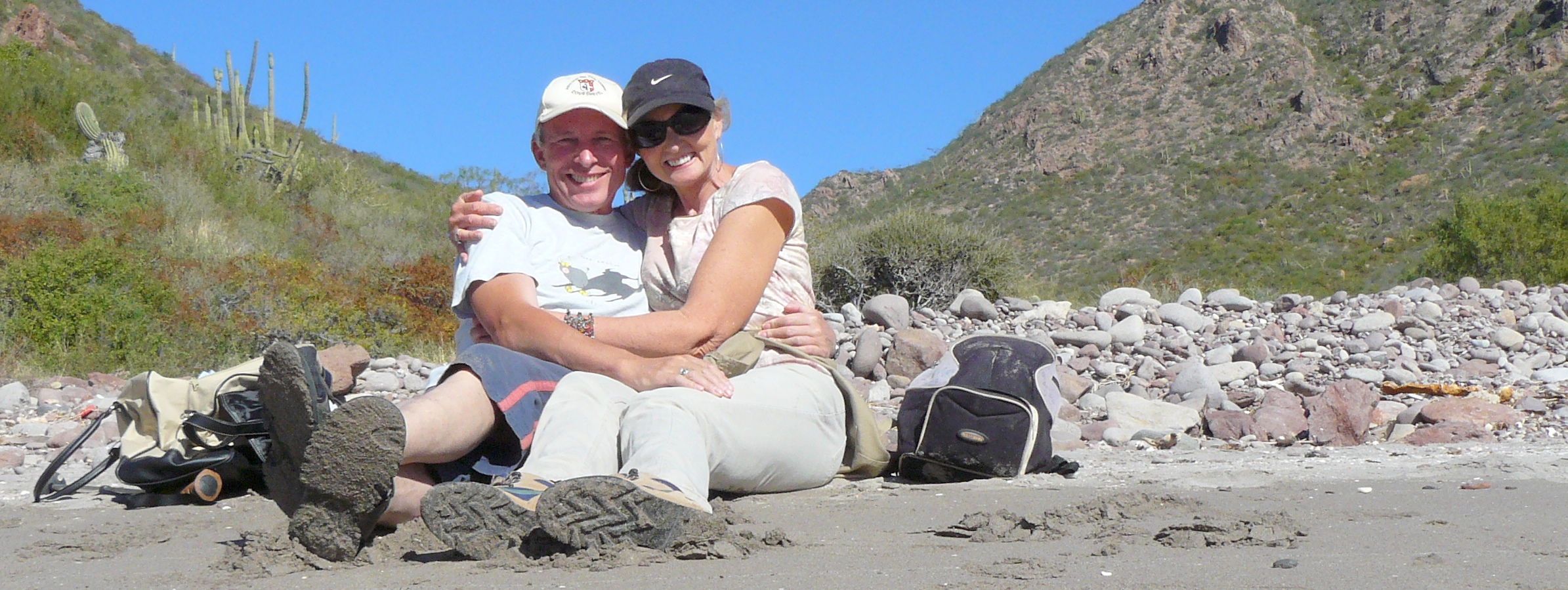
6th January, 2008. Jean and me on a beach in Mexico.

This is the poem I wrote for Jean for this Valentine’s Day just gone.

What’s in a number?

Numbers spell out so much.

From a year of birth,
To a year of death,
From a chance event,
To a predictable breath.

Numbers spell out so much more.

From the day that we met,
To the year we were joined,
From the day we married,
To this day of love today.

So many days of happiness.

Yet numbers that spill beyond the digits.

For they are reflections of times a past,
And they are beacons of our lives,
Numbers that carry so much meaning,
To places so far beyond their count.

Yet today there is a number,
A number that carries all thoughts of love,
Almost endless thoughts of love from me to you,
Two little figures that say seventy-four.

For seventy-four months ago,
This very day,
I met you,
And you met me.

I loved you so soon,

Loved you so well.

And still do.

If you have read this far then well done! 🙂 If only one person has been touched by my experiences then that is wonderful.

I shall close by publishing a paragraph towards the end of Sue’s blog post.

Only you can know the how’s and why’s of your life. The answers that you seek can be found when you start answering your own questions, Sometimes we have to get a little lost in order to find oneself again.. But the journey in finding oneself is all part of our Earth Journey.

All of you take very good care of yourself.
P1150363

The Pen

Reflections on what makes us who we are.

(This is a two-part post, with the concluding part tomorrow.)

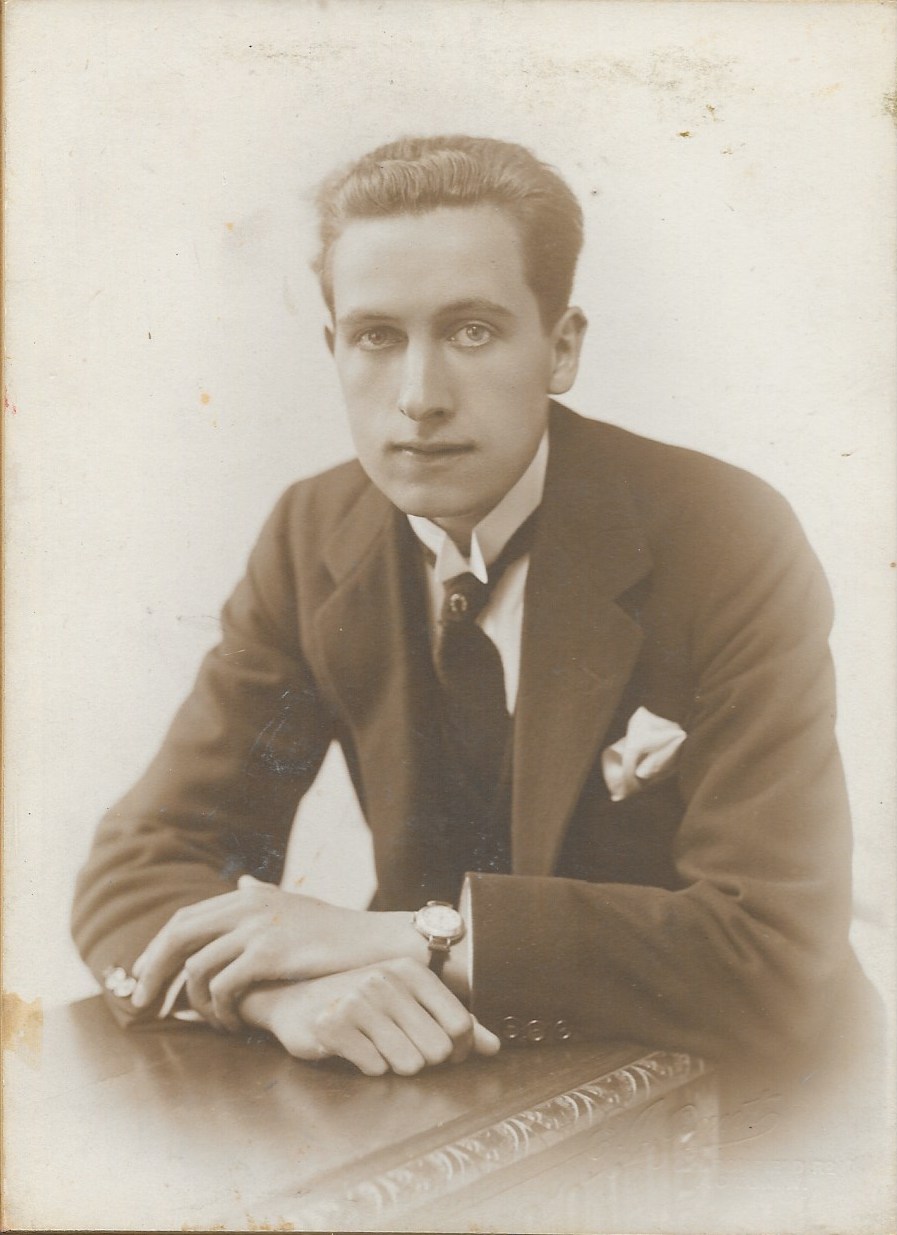
My father was born on June 15th, 1901.

Here is a photograph taken of him on his twenty-first birthday.

asasas
Frederick William Handover – June 15th, 1922

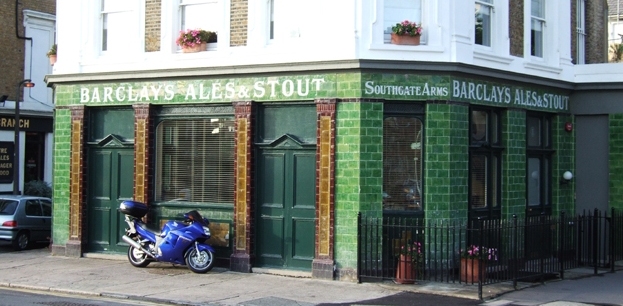
He was an architect for Barclay Perkins & Co., a London firm of brewers.  Here are the opening words of the Wikipedia entry.

The Anchor Brewery was an English brewery located in Southwark, London. Established in 1616, by the early nineteenth century it was the largest brewery in the world. From 1781 it was operated by Barclay Perkins & Co, who merged with Courage in 1955. The brewery was demolished in 1981.

A Barclays Public House in Southgate, London N1. Picture from The Brewery History Society.

I was born in November, 1944 and at the start of the school year in September 1956, me aged eleven, I started in the first term of Preston Manor County Grammar School near Preston Road, Wembley, just a few miles from where we all lived. (Mother, father, me and Elizabeth, my younger sister by four years.) Frankly, I had been regarded as a bit of a dreamer at my primary school and more than a few were surprised that I passed the ’11+’ exams, a prerequisite for attending a grammar school in those days.

I became twelve-years-old in November, 1956. Just six weeks after my twelfth birthday, on the evening of December 19th, 1956, my mother, as normal, came into my bedroom to kiss me goodnight. However, what transpired was very far from normal.

For she sat down on the edge of the bed and told me that my father was not well and may not live for much longer. To this day, I can still see her sitting on the edge of the bed, adjacent to my knees covered by the sheet and bedcover, a very drawn look on her face.

I had been aware of my father being at home in bed for a while but had no notion whatsoever, prior to this moment, that he was seriously unwell. In hindsight, it was more than I could emotionally embrace for not only did I not go back into my parent’s bedroom and again say goodnight to my father, I went off to sleep without any problem.

During that night, in the early hours of December 20th, my father died, the family doctor attended and my father’s body was removed; I slept through it all and awoke in the morning to find my father gone.

Now fast forward just a few years.

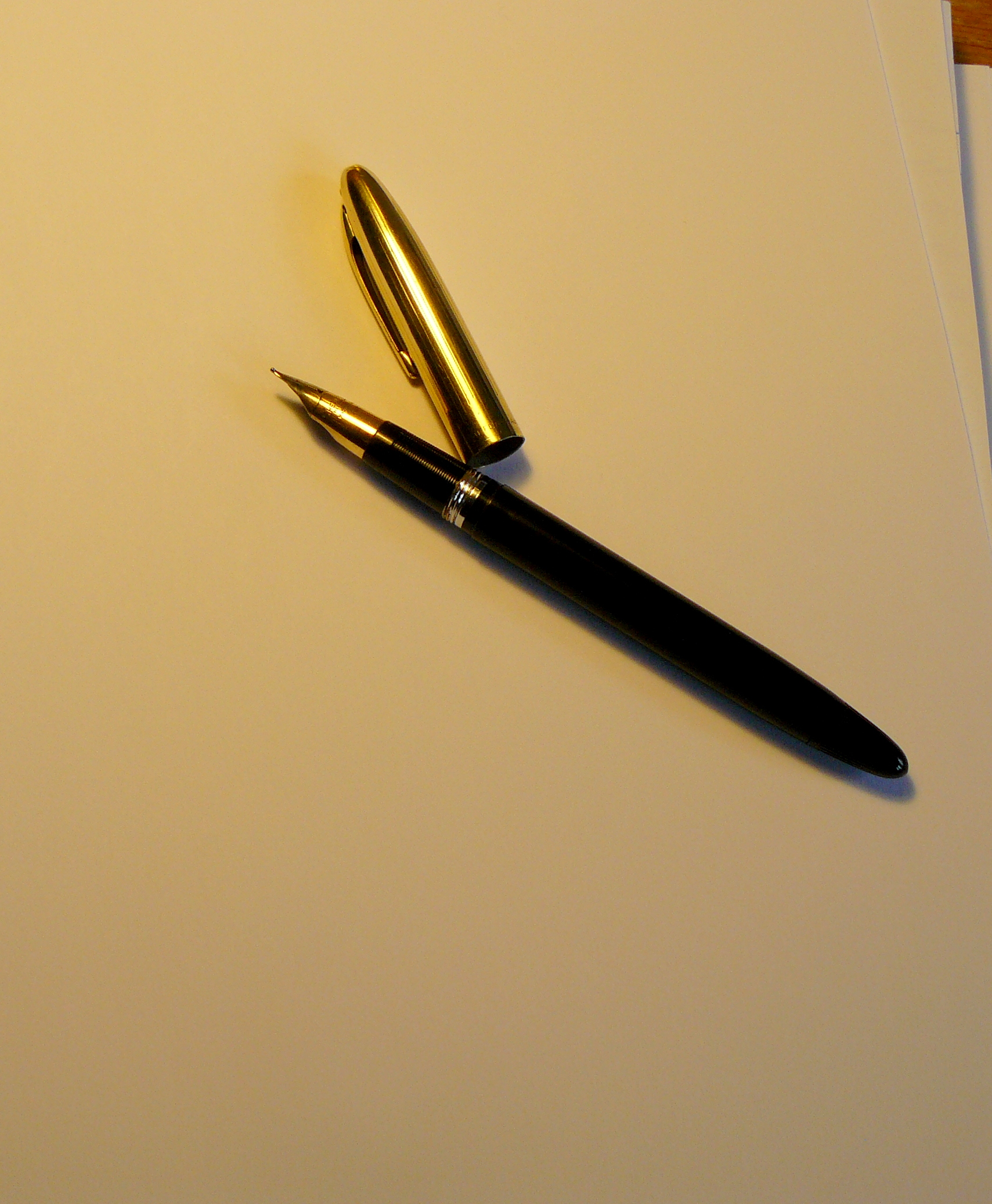
It’s too long ago now for me to recall who it was who gave me my father’s fountain pen that he used on a daily basis when he was alive. It is a Sheaffer Crest Snorkel with a 14K gold Triumph nib with a platinum plated tip.

I have had the pen for nearly sixty years and treasure it, as you can imagine.  But in recent times it was not functioning properly and I put it down to old age, and transferred to a modern pen.

By a wonderful stroke of luck I recently came across an American company, Pendemonium, who restore and service a wide range of pens, including Sheaffer pens of the age of my father’s pen; that particular model first was produced in 1952.

On Saturday, the restored Sheaffer pen was sent back to me.  It is a real joy to find that it writes so well and remains a living memory of my father from so long ago.

My father's Sheaffer fountain pen.
My father’s Sheaffer fountain pen.

Now all you dear readers must be wondering just what on earth I’m rambling on about!

My answer will be offered in Part Two that will be posted tomorrow.

But I will give you a clue.

Go across to Sue Dreamwalker’s blogsite and read her recent post Cracking our Inner Shells!

See you tomorrow.

Picture parade eighty-three

Turning over a beautiful leaf!

Yet another wonderful item sent across to me by neighbours Dordie and Bill.

Delicate Leaf Cuttings By Omid Asadi

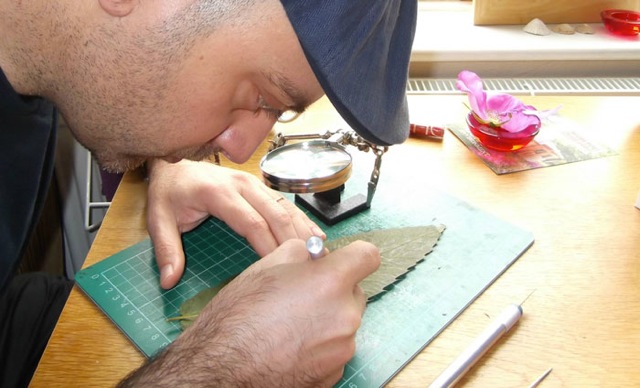
My name is Omid Asadi and I currently live in Manchester, United Kingdom. I created this work with carving and cutting techniques on actual fallen leaves using a craft knife and a needle. I always try to create pieces with a message, not just beautiful art. Some of these messages or ideas come from my world view, poems, stories, global problems and philosophy. I’m also inspired by other artists’ and designers’ works.

Here’s the man in action.

Omidintro
I use a craft knife or scalpel and needle. It is not like a paper cutting because each part needs a certain pressure to cut. If I make a mistake, I destroy maybe hundreds of hours of work.

 oooo

Leaf's Mind. I’m very attentive to beautiful fallen leaves. Suddenly,  I started SEEING them, not simply looking at them.
Leaf’s Mind.
I’m very attentive to beautiful fallen leaves. Suddenly,
I started SEEING them, not simply looking at them.

oooo

Carriage. I believe that we look at many things everyday, but don’t SEE them.  For example, apples had been falling from trees for thousands of years,  but only Isaac Newton truly saw that and, thanks to him,  our lives have changed forever.
Carriage.
I believe that we look at many things everyday, but don’t SEE them.
For example, apples had been falling from trees for thousands of years,
but only Isaac Newton truly saw that and, thanks to him,
our lives have changed forever.

oooo

Dandelion.
Dandelion

oooo

Che Guevara
Che Guevara

oooo

Love
Love

oooo

Eagle
Eagle

Another set of these remarkable cuttings in a week’s time.

The Rose

Embracing St. Valentines Day and the power of love. (With huge gratitude to Sue Dreamwalker who included the following song from Bette Midler in Sue’s tribute to the loss of her dear Aunt on January 28th, 2015.)

Feeding the souls of man and dog!

A most fabulous idea of sharing poetry in the wild.

One of the great advantages of having a dog, or nine, is that there are endless opportunities to go walking with them.

The other day, Jean and I became aware of the most wonderful idea: The Stanza Stones Walk. Here’s how that walk is explained on the website:

THE STANZA STONES PROJECT

The Stanza Stones Walk: An Alternative devised by Mick Melvin.

A fifty mile upland walk from Marsden to Ilkley visiting the six Stanza Stones carved with poems written by Simon Armitage.

Why create an alternative walk?

I have created this walk as an alternative to the 47 mile trail created by the team working with the Ilkley Literature Festival, not because it is my intention to denigrate the walk which was produced by the team. Far from it, the trail which they created is a fine outing and one that will satisfy the desires of most people wishing to visit the Stanza Stones.

My purpose was to devise an upland walk linking the stones which did not stick to recognised footpaths or to existing well-known walking trails. This has not always been possible, since I felt that it was necessary to follow the Pennine way or Millennium Way on occasions, in order to visit significant places of interest i.e. Blackstone Edge.

In addition I believe that considering the walk was motivated by literature, it should visit the places that inspired some of the area’s finest writers, Haworth and Mytholmroyd. My objective is to create six more circular walks to each of the stones which will be suitable for a day’s walking. These walks will be posted on the site as I complete them.

The seven Stanza Stones, each carved with a poem written by the poet Simon Armitage, are at locations which in general follow the Pennine watershed. The Stanza Stones project, which started at Ilkley Festival in August 2010, is focused on poems specially written by Simon stirred by his response to the Pennine Watershed and the relationship between the landscape and language of Yorkshire. The seven stones will form a permanent moorland trail across the watershed from Ilkley to Marsden the home town of the poet. The Stanza Stones poems are reproduced here by kind permission of Simon Armitage.

Isn’t that an incredibly wonderful idea!

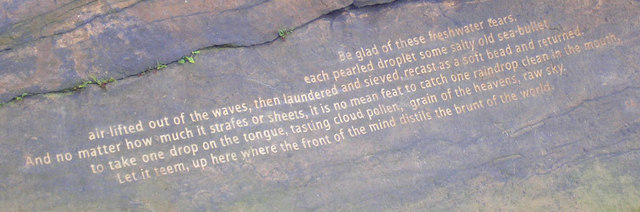
Here’s a photograph of one of the stones bearing Simon Armitage’s poetry.

stone
Cows Mouth Quarry


Blackstone Edge

The third Stanza Stone has now been completed at Cow’s Mouth Quarry near Blackstone Edge. The quarry is situated about 20 minutes walk along the track (Pennine Way) which starts at the White House pub. The Pub is on the A58 road between Halifax and Littleborough just beyond Blackstone Edge Reservoir. As you approach the quarry from the White House, watch for a small stone arched bridge spanning the catch water drain on you right about 75 yards before the crags. The path from the bridge affords a close up view of the face carrying the carving. The poem can also be seen from the main path if you continue along the gravelled track. A circular walk can be made if you continue on the track, taking the right turn to White Holme Reservoir returning to Blackstone edge and the White House on a good path over Byron Edge.

RAIN

Be glad of these freshwater tears,
Each pearled droplet some salty old sea-bullet
Air-lifted out of the waves, then laundered and sieved, recast as a soft bead and returned.
And no matter how much it strafes or sheets, it is no mean feat to catch one raindrop clean in the mouth,
To take one drop on the tongue, tasting cloud pollen, grain of the heavens, raw sky.
Let it teem, up here where the front of the mind distils the brunt of the world.
© Simon Armitage 2010

Whether or not you will ever have the chance to enjoy this walk, do go across to the Stanza Stones website and just revel in the poetry and the nature.

You can find out more about the poet, Simon Armitage, here on The Poetry Foundation’s website.

Surely a walk to feed the souls of both man and dog!

Caring changes lives

Possibly the most important lesson to be learnt from dogs.

As is the way, a number of separate happenings seemed to be ‘singing from the same song sheet’ in bringing about today’s post.

Earlier yesterday morning Jean and I had a meeting with the executive director of an important charity that is helping the many homeless and disadvantaged young persons in this part of Oregon. For example, Jean and I were told that there were 300-500 homeless teenagers in Josephine County alone (Josephine County is where our home is.)

One of the ideas that was floated in the conversation was how kids are so loving to animals and whether our dogs and horses might help.

Then later, when back home, I recalled that over two years ago I published a post called Sticks and stones.

It wasn’t a long post and is republished now.

oooo

Sticks and stones

I make no apologies for today’s post being more emotional and sentimental. The phrase ‘sticks and stones may break my bones but names will never hurt me‘ is well known throughout the English-speaking world and surprisingly goes back some way.  A quick web search found that in the The Christian Recorder of March 1862, there was this comment:

Remember the old adage, ‘Sticks and stones will break my bones, but words will never harm me’. True courage consists in doing what is right, despite the jeers and sneers of our companions.

So if in 1862 the saying was referred to as an ‘old adage’ then it clearly pre-dated 1862 by some degree. A few days ago, Dusty M., here in Payson, AZ, sent me a short YouTube video called The Power of Words.  I’m as vulnerable as the next guy to needing being reminded about what’s important in this funny old world.

Then I started mulling over the tendency for all of us to be sucked into a well of doom and gloom.  Take my posts on Learning from Dogs over the last couple of days, as an example. There is no question that the world in which we all live is going through some extremely challenging times but anger and negativity is not going to be the answer.  As that old reference spelt out so clearly, “True courage consists in doing what is right, despite the jeers and sneers of our companions.” So first watch the video,

then let me close by reminding us all that courage is yet something else we can learn from dogs.

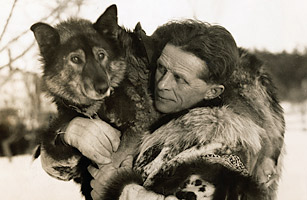
Togo the husky

In 1925, a ravaging case of diphtheria broke out in the isolated Alaskan village of Nome. No plane or ship could get the serum there, so the decision was made for multiple sled dog teams to relay the medicine across the treacherous frozen land. The dog that often gets credit for eventually saving the town is Balto, but he just happened to run the last, 55-mile leg in the race. The sled dog who did the lion’s share of the work was Togo. His journey, fraught with white-out storms, was the longest by 200 miles and included a traverse across perilous Norton Sound — where he saved his team and driver in a courageous swim through ice floes.

More about Togo another day.

oooo

 One of the comments left to that post back in November, 2012 was from Virginia Hamilton. Her website, Canine Commandos, is about just that: dogs helping youngsters. This is what Virginia wrote:

Our sermon today was about sticks and stones which is perfect timing because my sixth graders are throwing words at each other and it is hurting. So I looked up the phrase and found you. We were shown the video in a faculty meeting and since you tie into dogs I was hoping to find “the answer.” When you look at the website you’ll see out community project where I have twenty schools training in three shelters. One would think that because these kids are so loving to the animals that they could pass that kindness to each other. Any words of wisdom? Also check this out. Thank you, Virginia.

Now I would be the first to admit that there’s a difference between a homeless young person and a gifted young person. Yet the difference may not be so great. In this one sense: that caring for an animal changes lives and what young people, from all backgrounds and circumstances, need to learn is the power of unconditional love.

Not just caring for dogs, horses and cats, by the way.

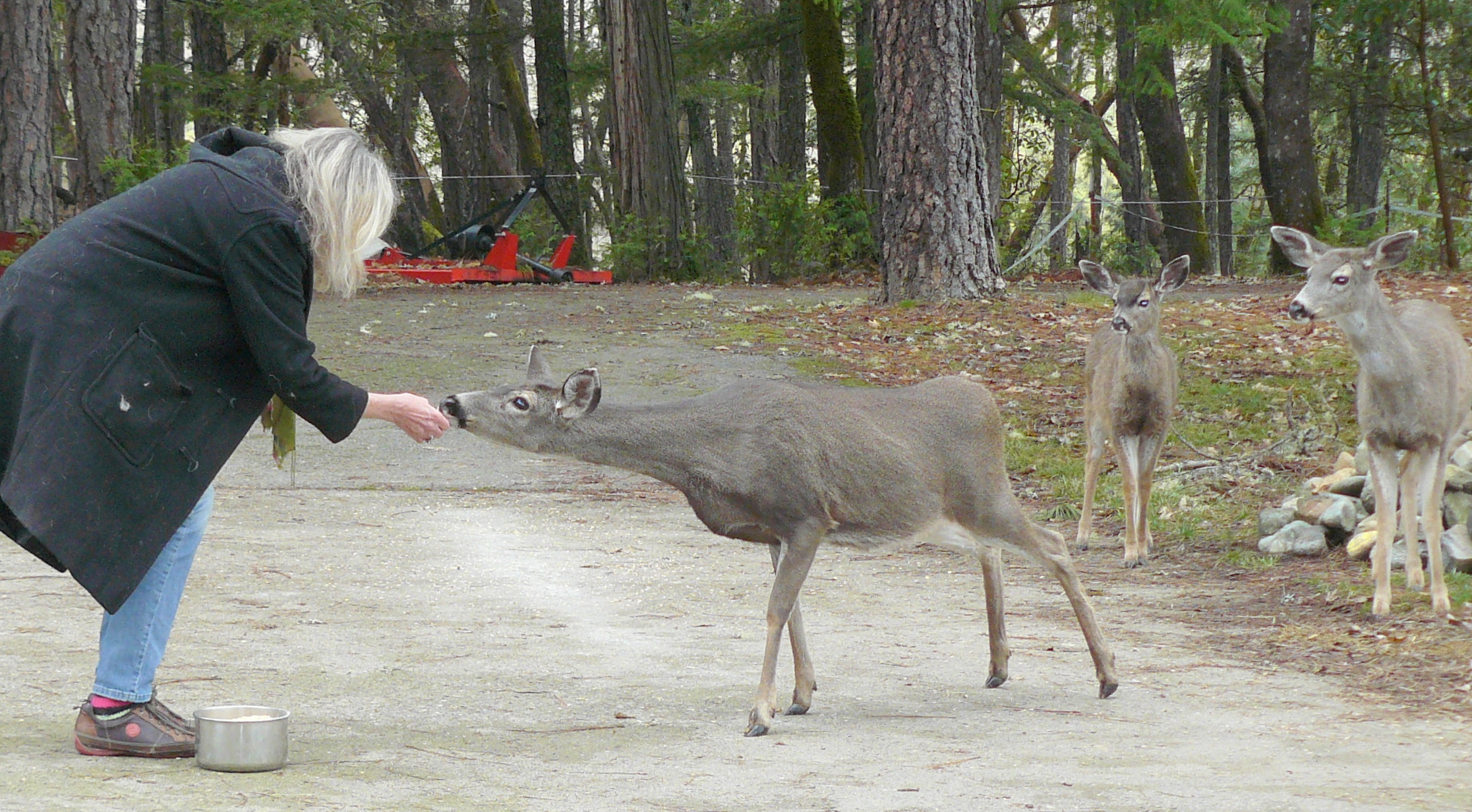
Wild deer trusting Jean.

Stepping back from the future!

In more ways than one.

I freely admit that I have been putting off today’s post, and I’m not sure why.

Maybe it’s the continuing escalation of words between the West and Russia over the Ukraine? (But for some clarity do read this analysis written by Anatol Lieven, Professor, Georgetown University’s School of Foreign Service in Qatar.)

Maybe it’s because my last republication of a George Monbiot essay was so hopeful. Indeed, the blog post was called Voting for hope. Whereas today’s Monbiot essay is very sad.

Maybe it’s because I am not immune to the temptations that are described.

But whatever the reasons, there can be no denying that there is a real sense of finding the modern world increasingly strange and frequently upsetting.

That theme continues today with the republication of a George Monbiot essay that he released on his blog a week ago.

ooOOoo

Lost in the 21st Century

3rd February 2015

Consumerism has broken its promise. Perhaps now we can begin to reconnect.

By George Monbiot, published in the Guardian 4th February 2015

A woman walks into a department store. She takes in the racks and stacks of stuff, the sugared music, the sale signs, the listless customers shuffling through the aisles, and is moved – suddenly and to her own astonishment – to shout. “Is this all there is?!”. An assistant comes round from behind his till. “No madam. There’s more in our catalogue.”

This is the answer we have been given to everything, the only answer. We might have lost our attachments, our communities, our sense of meaning and purpose, but there will be more money and more stuff with which to replace them. Now that the promise has evaporated, the size of the void becomes intelligible.

It’s not that the old dispensation was necessarily better: it was bad in different ways. Hierarchies of class and gender crush the human spirit as effectively as atomisation. The point is that the void that was filled with junk is a void that could have been occupied by a better society, built on mutual support and connectedness, without the stifling stratification of the old order. But the movements that helped to smash the old world were facilitated and co-opted by consumerism.

Individuation, a necessary response to oppressive conformity, is exploitable. New social hierarchies, built around positional goods and conspicuous consumption, took the place of the old. The conflict between individualism and egalitarianism, too readily ignored by those who helped to break the oppressive norms and strictures, does not resolve itself.

So we are lost in the 21st Century, living in a state of social disaggregation that hardly anyone desired, but that is an emergent property of a world reliant on rising consumption to avert economic collapse, saturated with advertising and framed by market fundamentalism. We inhabit a planet our ancestors would have found impossible to imagine: 7 billion people, suffering an epidemic of loneliness. It is a world of our making but not of our choice.

Now it appears that the feast to which we were invited is only for the few. Figures released last week show that wages in the United Kingdom are lower than they were 13 years ago(1). A fortnight ago, Oxfam revealed that the top 1% now possesses 48% of the world’s wealth(2); by next year it will own as much as everybody else put together. On the same day, an Austrian company unveiled its design for a new superyacht. It will be built on the hull of an oil tanker, 918 feet long(3). There will be 11 decks, three helipads, theatres, concert halls and restaurants, electric cars to take the owner and his guests from one end of the ship to the other, and a four-storey ski slope.

In 1949, Aldous Huxley wrote to George Orwell, to argue that his dystopian vision was the more convincing(4). “The lust for power can be just as completely satisfied by suggesting people into loving their servitude as by flogging and kicking them into obedience. … The change will be brought about as a result of a felt need for increased efficiency.” I don’t believe he was wrong.

Consumerism is at odds with common purpose: you could pay your taxes or you could spend the money on a new car(5). It stifles feeling, dulling our concern for other people. Freedom to spend displaces other freedoms, as lotus eating allows us to forget our losses. Most forms of peaceful protest are now banned, but no one stops us from devouring the resources upon which future generations will depend. All this helps the global oligarchs to rip holes in the social safety net, find relief from the constraints of both democracy and taxation, and enclose and privatise our common weal.

Just as human society has been pulled apart by consumerism and materialism, pushing us into an unprecedented Age of Loneliness(6), so ecosystems have been shattered by the same forces. It is the consumerist mindset, raised to the global scale, that now threatens us with climate breakdown, catalyses a sixth great extinction, imperils global water supplies and strips the soil upon which all human life depends(7).

But nor do I believe that the acceptance of servitude Huxley envisaged is a permanent state. Wage stagnation, the brutality of the new conditions of employment, the breaking of the link between educational attainment and social advancement, the impossibility, for many young people, of finding good housing, all these confront us with the question that could be deferred only during conditions of rising general prosperity: is this all there is?

As the growth of Syriza and Podemos suggests, we cannot build political movements to challenge these issues unless we also build society. It is not enough to urge people to change their politics: we must create not only communities of interest but also communities of mutual support, offering the security, survival and respect that the state will no longer provide.

In a remarkable series of contemplations, extending beyond its familiar brief, Friends of the Earth has begun to explore how we might reconnect(8), with each other and with the natural world. It is looking, for example, at new models for urban living(9), based on sharing rather than competitive consumption: the sharing not just of cars and appliances and tools, but also of money (through credit unions and micro-finance) and power. This means community-led decision-making, over transport, planning and, perhaps, rent levels, minimum and maximum wages, municipal budgets and taxation. Such initiatives are not a substitute for government action – like David Cameron’s Big Society they are meaningless without facilitation from the state – but they can bring people together with a sense of shared purpose, ownership and mutual support that centralised decision-making can never provide.

Friends of the Earth also supports the empathy revolution championed by the author Roman Krznaric(10), and lifelong education that might counter the ever narrower schooling now inflicted on our children, whose purpose is to prepare people for jobs they will never have, in the service of an economy ordered for the benefit of others.

In these ideas and movements we find the glimmerings of an answer to the question: no, this is not all there is. There is attachment. Despite the best efforts of those who believe there is no such thing as society, we have not lost our ability to connect.

http://www.monbiot.com

References:

1. http://www.theguardian.com/business/2015/jan/30/british-wage-slump-post-financial-crisis-uk

2. http://www.theguardian.com/business/2015/jan/19/global-wealth-oxfam-inequality-davos-economic-summit-switzerland

3. http://www.dailymail.co.uk/travel/travel_news/article-2916523/Welcome-aboard-gold-superyacht-size-OIL-TANKER-indoor-ski-slope-board-BMWs-five-helicopters.html

4. http://www.lettersofnote.com/2012/03/1984-v-brave-new-world.html

5. See also the discussion of Rami Gabriel’s work (2013. Why I buy: Self, taste, and consumer society in America. University of Chicago Press) in Friends of the Earth, December 2013. Consumption and identity: A review of literature which is relevant to the question: ‘what is a better foundation for people’s identity than consumption?’ http://bit.ly/1ECZopQ

6. http://www.theguardian.com/commentisfree/2014/oct/14/age-of-loneliness-killing-us

7. http://www.theguardian.com/environment/georgemonbiot/2014/jun/05/the-farming-lobby-has-wrecked-efforts-to-defend-our-soil

8. http://www.foe.co.uk/page/big-ideas-change-world

9. http://www.foe.co.uk/page/big-ideas-cities

10. http://www.romankrznaric.com/

ooOOoo

Tomorrow, I want to offer the example of someone who has been sufficiently strong to take one small step back to sanity.

A very ancient relationship!

Life, at times, seems to go full circle.

The sub-heading was prompted by me doing research for a writing project. I was doing a google search on the history of the relationship between dogs and humans and top of the returns was a post published by Learning from Dogs back in July 2012! Typically, I had forgotten that post. When I clicked on the link and read it right through, it seemed a brilliant idea to republish it today.

oooo

The woof at the Door.

The grandeur of the ancient relationship between dog and man.

A couple of weeks ago, I came across a fascinating article that had been published in American Scientist magazine (online version) written by Professor Pat Shipman.  The article provided the background and evidence to support the proposition that dogs may have been man’s best friend for thousands of years longer than we realized.

Very quickly I came across Pat Shipman’s website and learnt that this is one clever lady. As her About page explains,

CAREER SUMMARY

Prof. Shipman

I am internationally known as a paleoanthropologist and conducted research for many years in Africa on human evolution and the animal communities in which humans evolved.

I have conducted research on material from sites in France, Spain, the United States, Java, Ethiopia, Kenya, Tanzania, and South Africa.  I have written more than 50 scholarly articles, appearing in journals such as Nature, Science, Journal of Archaeological Science, Paleobiology, Journal of Human Evolution, and Current Anthropology.

I have written more than 100 articles in popular science magazines or newspapers, including The Guardian, The New York Times, The Times Literary Supplement, American Scientist, Discover, and Natural History. Two of my books were featured on the cover of The New York Times Book Review: The Neadertals and Taking Wing. Taking Wing won the Phi Beta Kappa prize for science book of the year and was a runner-up for the LA Times Science Book prize.

My book on Homo erectus, Wisdom of the Bones, was co-authored by Alan Walker and won the Rhone-Poulenc Prize in science writing.

My books have been widely praised as compelling, accessible, and highly readable, with a strong narrative thread. Reviewers frequently comment upon the meticulous research that underpins my books, a feature I consider to be my trademark.

My most recent popular science book, The Ape in the Tree, written with Alan Walker, was called by The Vancouver Sun “part adventure story, part cutting-edge science.” In a Science magazine review, the book was praised as “a fine account of new ways to puzzle out the behaviors of fossilized animals from odd scraps of bone.” Another reviewer raved, “Wonderfully engaging and insightful, The Ape in the Tree, is sure to become a classic in the literature on human origins.” MacArthur fellow John Fleagle wrote in the Quarterly Review of Biology, “Science writing doesn’t get any better than this.” In 2009, this book was awarded the W.W. Howells Book Prize by the American Anthropological Association.

In Britain, my new biography of Mata Hari, Femme Fatale, was selected as The Book of the Week by BBC radio. Each day during the week, an actress gave dramatic readings from the book on the air for fifteen minutes.

With The Animal Connection, I return to paleoanthropology and consider the influence of our connection with animals on human evolution and the origin of modern human behavior.

See what I mean!

Anyway, as you can readily understand, as the author of a blog that writes about what we can learn from this ancient relationship between the dog and man, it struck me as wonderful if I might be permitted to republish in full that article.  Prof. Shipman promptly gave me such permission.

So today, I am doing just that and tomorrow I want to write more about Pat Shipman’s latest book, The Animal Connection.

ooOOoo

The Woof at the Door

Dogs may have been man’s best friend for thousands of years longer than we realized

Pat Shipman

It’s funny how much difference a single letter makes. A “woof” at the door is a very different thing from a wolf at the door. One is familiar, domestic, reassuring; the other is a frightening apparition of imminent danger. The distinction between our fond companions and the ferocious predator of northern climes goes back a long way.

Dogs are descended from wolves, probably the gray wolf. Some scientists argue that, because dogs and wolves can and do interbreed, they shouldn’t be considered to be separate species at all. They believe that domestic dogs are only a subspecies or variant of the gray wolf, Canis lupus, and ought to be called Canis lupus familiaris (the familiar or domestic wolf) instead of Canis familiaris (the familiar or domestic dog). Although the ability to interbreed and produce fertile offspring is a tried-and-true criterion for recognizing that two populations are really variants of a single species, the reality is more nuanced. We cannot know whether dog-wolf hybrids will thrive and survive, or die out, in the long run.

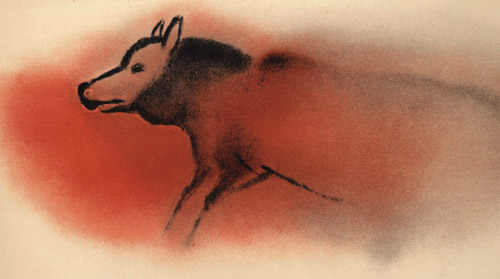
Prehistoric cave paintings rarely depict wolves or other carnivores. This watercolor tracing of a cave painting was made by the archaeologist Abbé Henri Breuil in the early 1900s from the Grotte de Font-de-Gaume in France. The 17,000-year-old cave paintings number about 250 and mostly show bison and mammoths—only one is thought to be a wolf. Canids may have been domesticated by this point; it is possible that portraying wolves and humans was taboo.
Paul Bahn

Certainly we expect to be able to distinguish a dog from a wolf if we see one. Of course, domestic dogs are wildly variable in size and shape, thanks to several hundred years of selective breeding. Some have long, fluffy coats; others have tightly curled, nearly waterproof coats and webbed feet. Some are leggy and swift, whereas others are solid, stoutly built guard dogs. Some fit neatly into a pocketbook, but others barely fit into a compact car. As Robert K. Wayne of the University of California at Los Angeles declares, “Dogs show more diversity in appearance than any other mammal.”

What is it that tells us this animal is “dog” and that one is “wolf?”

Modern wolves and dogs can be distinguished reasonably easily by their appearance. The most telling feature of dogs is the snout, which is significantly shorter and wider than wolves’ snouts. Only a few dog breeds with extremely elongated, slender snouts, such as Irish wolfhounds, surpass wolves in “snoutiness.”

But a crucial part of the difference we perceive is in the animals’ manner and attitude towards humans. Domesticated dogs are just that: canids that live in the house or domicile of humans. They are genetically disposed to seek out human attention and approval and to accept human leadership. Wolves are not.

How did this important change come about? Probably in the distant past, humans took in a wolf cub, or even a whole litter of cubs, and provided shelter, food and protection. As the adopted cubs matured, some were aggressive, ferocious and difficult to handle; those probably ended up in the pot or were cast out. The ones that were more accepting of and more agreeable to humans were kept around longer and fed more. In time, humans might have co-opted the natural abilities of canids, using the dogs’ keen noses and swift running skills, for example, to assist in hunting game. If only the most desirable dogs were permitted to breed, the genes encoding for “better” dogs would continue to be concentrated until the new domesticated species (or subspecies) was formed.

Time to Tame

The creation of a domestic, useful, familiar canid by years of selectively breeding wild and terrifying wolves was almost certainly unplanned. The wolf at the beginning of the process of domestication was tamed—made individually docile—but the essential fact is that, over time, the offspring of those initial wolves were genetically inclined to be more tractable.

Domestication was one of the most brilliant accidents in the entire history of humankind. What’s more, we got it right the first time: Dogs were the original trial animal, and successful product, of such an accident—the happy outcome of years of unwitting experiments and dumb luck.

How long does domestication take? Nobody knows. In an experiment, Russian biologists kept a breeding colony of silver foxes and intentionally selected for breeding those with the least fear and the least aggression toward humans. After 10 generations, 18 percent of the foxes sought human contact and showed little fear. After 30 or so generations, a “domesticated fox” had been created.

The catch is that this experiment was deliberate and strictly controlled. The foxes could not breed with wild foxes and dilute the changing gene pool. Human contact was minimized so animals could not be tamed by their handlers. And because of the experiment’s scientific intent, no one could say, “Oh this one is so cute, let’s let it breed even if it is a little aggressive.” So in the case of dogs, without all these controls, the process could have taken much longer.

Another way of estimating the time at which domestic dogs originated is to consider their genetic differences from wolves. One prominent group of researchers, including Robert Wayne, along with Carles Vilà of the Uppsala University in Sweden and their collaborators, initially estimated in 1997 that dogs diverged from gray wolves 100,000 to 135,000 years ago. After more study, they revised their divergence date to between 40,000 and 100,000 years ago. Another group, led by Peter Savolainen of the Royal Institute of Technology in Sweden, favored the Chinese wolf, a subspecies of the gray wolf, as the probable ancestor and estimated in 2002 that it was domesticated between 15,000 and 40,000 years ago.

How do these genetic estimates stack up against the fossil record? Until 2009, the oldest known remains of domestic dogs were two adult skulls dated to between 13,000 and 17,000 years ago, from Eliseevichi, a region in Russia. Both had the relatively broad, short snout typical of dogs, and both were large, heavy animals, nearly the size of great Danes.

Then a team led by Mietje Germonpré of the Royal Belgian Institute of Natural Sciences reported a stunning new finding in the February 2009 issue of Journal of Archaeological Science: a nearly complete fossil dog skull dated to 31,680 + 250 years ago.

Another Look

Germonpré and her colleagues thought that researchers might have overlooked early prehistoric dogs in the fossil record of the Upper Paleolithic, so they analyzed skulls of large canids (wolves or dogs) from various European sites. The Upper Paleolithic time period spanned 40,000 to 10,000 years ago and is divided into sections based on the artifacts from those times. By convention, each span is named for a culture of people who made the artifacts, and the people, in turn, are usually named for the geographical location where the artifacts were found. The Epigravettian culture existed from 14,000 to 10,000 years ago; before that, the Magdalenian culture thrived from 18,000 to 10,000 years ago; and skipping back a few sections, the Aurignacian culture occurred from 32,000 to 26,000 years ago.

In order to identify the fossil skulls accurately, Germonpré’s team first analyzed a large reference sample of 48 wild, modern wolves and 53 dogs belonging to 11 different breeds. They also examined five skulls (including the ones found in Eliseevichi) that were firmly established as prehistoric domesticated dogs.

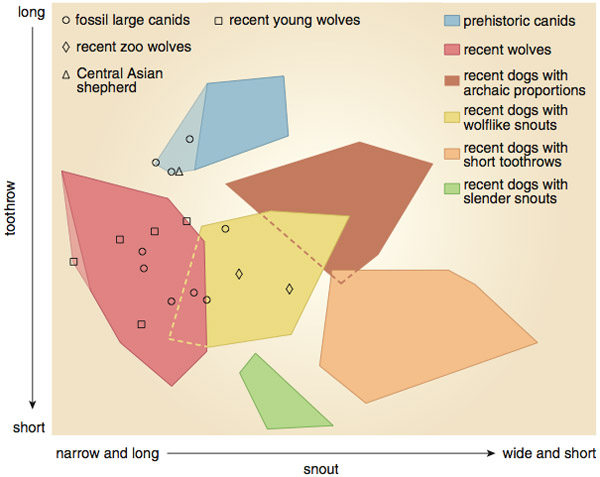
In order to establish the morphological differences between wolves and dogs, a group of researchers led by Mietje Germonpré statistically analyzed skulls from 48 modern, wild wolves and 53 modern dogs from 11 breeds, as well as five skulls that were previously established to be from prehistoric dogs. Recent wolves (pink) and prehistoric dogs (blue) clustered into their own groups, based on the length of their toothrows and the shape of their snouts. Modern dogs clustered into four groups, with some overlap in their areas. Recent dogs with archaic proportions included huskies (brown), recent dogs with wolflike snouts included German shepherds (yellow), recent dogs with short toothrows included great Danes (orange), and recent dogs with slender snouts included doberman pinscers (green). One modern dog, a Central Asian shepherd, clustered with the prehistoric dogs. The group then classified new skulls into the established groupings; examples that fell slightly outside of the ranges but that are statistically likely to be within the group are shown as lighter-shaded areas. Recent young wolves fell into the recent-wolf group, whereas wolves kept in captivity were classifed as recent dogs with wolflike snouts. Fossil canid skulls divided between the recent-wolf group and the prehistoric-dog group, with one falling in the group of recent dogs with wolflike snouts.
Stephanie Freese, data courtesy of Mietje Germonpré.

The team used statistical analysis of cranial and dental measurements on the skulls to sort the reference sample into six natural clusters. One cluster contained modern wolves. Another consisted of recent dogs of archaic proportions (such as chow-chows and huskies); a single specimen of a Central Asian shepherd was closer to this group than any other but fell outside it. A third cluster included dogs, such as German shepherds and malinois, which have wolflike proportions. These three groups overlapped each other in their cranial proportions. A fourth group of modern dogs has short toothrows—the length of the jaw that contains teeth—and includes such breeds as great Danes, mastiffs and rottweilers. This group overlapped slightly with the archaic-proportioned dog group but not with the others.

The fifth and sixth clusters were completely separate from all others. One consisted of dogs with extremely long, slender snouts, such as Doberman pinschers. The final group, which had long toothrows and short, broad snouts, was made up of the prehistoric dogs. Statistically, the team’s ability to identify any individual specimen as belonging to the correct group was highly significant and accurate.

Using these clusters as reference categories, Germonpré and colleagues used a statistical technique (called discriminant function analysis ) to assign 17 unknown fossil canid skulls to the established categories. Not all of the “unknowns” were truly unknown, however. Five were immature modern wolves that might have had different proportions because of their age, two were wolves that had been kept in captivity, and one was the Central Asian shepherd that didn’t cluster into any of the groups. Additional unknowns were 11 fossil skulls from sites in Belgium, the Ukraine and Russia, although two of these fossil skulls proved to be too incomplete to classify.

The technique correctly classified all of the immature wolves as wolves, but the two zoo wolves were classified as recent dogs with wolflike snouts. Five of the fossil skulls also fell easily into the modern wolf group; although two of these specimens fell into the region of measurements that overlapped with the group of recent dogs with wolflike snouts, they had a higher statistical probability of being wolves. One fossil skull fit directly into the group of recent dogs with wolflike snouts, even though this specimen was clearly ancient.

The remaining three fossil skulls—one from Goyet Cave in Belgium and one each from Mezin and Mezhirich in the Ukraine—resembled each other closely. All three were classified as prehistoric dogs with probabilities of 99 percent, 73 percent and 57 percent, respectively, as was the (modern) Central Asian shepherd, with a 64 percent probability. In addition, the Mezin skull was odd enough in appearance (for a wolf) that another researcher has suggested it might have been a captive wolf. Germonpré and her team were delighted with these results.

The group also successfully extracted mitochondrial DNA (mtDNA) from seven ancient canid bones from Goyet Cave and Trou des Nutons in Belgium. Rather than damage precious skulls, they sampled only bones in which wolves and dogs differ little, so they presumed all of those they sampled for mtDNA were wolves. From each sample, they sequenced a segment of the mtDNA that is highly variable in living wolves and dogs. Each fossil had a unique mtDNA sequence, or haplotype , in this region, which could not be matched with any known sequences for modern wolves (of which there are about 160) or modern dogs (of which more than 1,000 exist) stored in GenBank, a database of all publicly available nucleotide sequences.

“I was not so surprised at the rich genetic diversity of the fossil wolves,” says Germonpré, because there have been other studies with similar findings. Foxes and wolves underwent a severe bottleneck in population size at the end of the last Ice Age, and many genetic lineages went extinct at this time.

“But we were surprised at the antiquity of the Goyet dog,” Germonpré adds. “We expected it would probably be Magdalenian,” perhaps 18,000 to 10,000 years old. This outcome would fit with their results for the Mezin and Mezhirich skulls, which were found with Epigravettian artifacts roughly 14,000 to 10,000 years old. When the age of this specimen from Goyet was directly dated using accelerated mass spectroscopy radiocarbon-dating techniques, the team found that it was not 18,000 years old, but almost twice as old as the next oldest dog, placing the Goyet dog in the Aurignacian period.

A Time of Change

The Goyet dog fossil shows that the domestication of the first animal was roughly contemporaneous with two fascinating developments in Europe.

Around this time, Europeans began producing objects that are recognizable as art. Some of the earliest known art objects from Europe include the remarkable cave paintings of Chauvet Cave in France, the oldest of which were made 32,900 ± 490 years ago. None of the hundreds of glorious Chauvet paintings show wolves. However, the cave preserves something even more haunting: the footprints of a human child about four-and-a-half feet tall, as well as many footprints of large canids and bears.

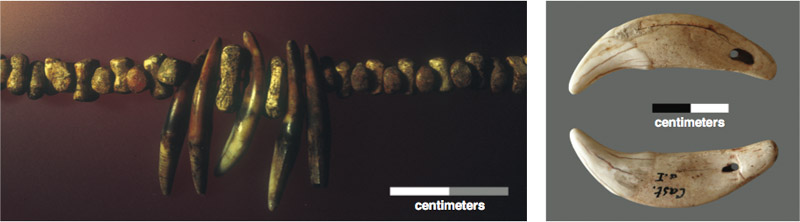
Around 33,000 years ago, humans began perforating teeth for use in decoration. Although canid teeth made up a very small percentage of the total fauna teeth available, they were used in a majority of the ornaments. Fangs from foxes and wolves appear to have been favorites. One example of a perforated wolf tooth (shown in two views at right) is from Abri Castanet in France and has been dated to 33,000 years ago. A strand of beads interspersed with fox teeth came from the Russian site of Sungir and has been dated to 24,000 years ago (left). There is no specific evidence that canid teeth were used in necklaces; the fox-teeth strand may have been a belt.
Randall White

Michel-Alain Garcia of the Centre National de la Recherche Scientifique in Nanterre noticed in 1999 that one track of canid prints appears to accompany the child’s prints. These canid prints, unlike the others, have a shortened middle digit on the front paw: a characteristic of dogs. Garcia suggested that the child and dog might have explored the cave together. Charcoal from a torch the child carried is 26,000 years old.

The Upper Paleolithic cultures of Europe are famous for the flowering of all kinds of exquisite art: sculptures, carvings, paintings and engravings. Animals are common and readily recognizable subjects. Prehistoric art expert Paul Bahn notes that depictions of carnivores, including wolves or dogs, and of humans are rare. Bahn conjectures that portraying wolves and humans might have been taboo.

Anne Pike-Tay of Vassar College offers another perspective. She observes that the scarcity of artistic depictions of carnivores parallels their scarcity in the fossil faunas of the Upper Paleolithic. If domesticated dogs were helping humans hunt, she speculates that they might have been placed in a completely different symbolic category from other animals.

“What if dogs were put in the ‘human family’ category as an extension of the hunter, and like humans, warranted no (or very few) painted or engraved depictions?” she wonders.

The second development of the Aurignacian period is the appearance of objects of personal adornment: jewelry. Although beads and perforated objects occurred much earlier in Africa, the earliest such objects in Europe appeared about 40,000 years ago. At 33,000 years ago, early Aurignacian people began perforating animal teeth (and occasionally human teeth) to wear as pendants or other ornaments, such as belts.

Which teeth did they choose? Among their favorite sources are what have been identified as fangs of foxes and wolves. These identifications might better be termed “small or large canids,” because until now no one has considered the possibility that dogs might have been domesticated so long ago. Besides, identifying a single canid tooth specifically as dog or wolf would be difficult, if not impossible.

Randall White of New York University argues that Aurignacian and later people chose to wear objects that displayed their identity or membership in a certain group or clan. Like gang colors or a t-shirt that proclaims its wearer to be a fan of a particular band, ancient people wore things that made their allegiances clear.

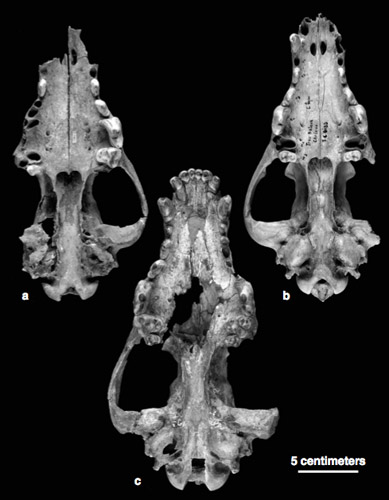
Fossils have helped to establish a far earlier timeframe for dog domestication. A paleolithic canid skull from Goyet in Belgium, about 31,000 years old, has traits characteristic of a dog rather than a wolf (a). When compared to wolves from a similar era, one from Trou Ballu (b) and one from Trou des Nutons (c) in France, the Goyet dog has a relatively wider snout and larger carnassial teeth, and it also has a wider braincase.
Elsevier Ltd.

White observes that the teeth Aurignacian people chose to wear were obviously not a random sample of the animals in the fauna. For example, the fauna from the Grotte des Hyènes (Cave of Hyenas) at Brassempouy, France, is dominated by horses, aurochs (a type of cattle) and reindeer—mostly as food remains that often show cutmarks or charring—as well as hyenas, which probably lived in the cave when humans did not. Wolves are rare, making up less than 3 percent of the total fauna. Of approximately 1,600 animal teeth at Brassempouy, only about 2 percent were modified for use as ornaments. However, nearly two-thirds of the ornaments are teeth of wolves or foxes. The rest of the perforated teeth are from other rare species: bear, humans and red deer. None of the teeth of the most common species were used as ornaments at Brassempouy.

Did someone who wore a perforated canid tooth 33,000 years ago proclaim him- or herself to be one of the group that domesticated dogs?

Possibly. Domesticating dogs was a remarkable human achievement that doubtless provided a definite selective advantage to those who accomplished it successfully. They might well have had reason to brag about their accomplishment by wearing canid teeth.

Bibliography

  • Germonpré, M., et al. 2009. Fossil dogs and wolves from Paleolithic sites in Belgium, the Ukraine and Russia: Osteometry, ancient DNA and stable isotopes. Journal of Archaeological Science 36:473–490.
  • Morey, D. F. 1994. The early evolution of the domestic dog. American Scientist 82:336–347.
  • Ostrander, E. A. 2007. Genetics and the shape of dogs. American Scientist 95:406–413.
  • Savolainen, P., et al. 2002. Genetic evidence for an East Asian origin of domestic dogs. Science 298:1610–1613.
  • Trut, L. N. 1999. Early canid domestication: The farm-fox experiment. American Scientist 87:160–169.
  • Vilà, C., et al. 1997. Multiple and ancient origins of the domestic dog. Science 276:1687–1689.

© Sigma Xi, The Scientific Research Society

ooOOoo

What amazing animals they are and what a beautiful relationship between dog and man. For rather a long time!

Picture parade eighty-two

As I wrote last week:

Something a little different for this week. Mother Nature Network put out an email earlier in January that opened, thus:

Dear friend of Mother Nature, We all see the beauty in a sunset or in a gorgeous painting, but can you appreciate the art in bacteria, climate images or preserved animal remains? These beautiful examples show how for centuries, art and science have danced a well-choreographed routine. The result has been some breathtaking creativity.

The pictures were so wonderful that I have offered the first six for today and the balance in a week’s time.

So without further ado, here is the balance of those paintings.

Leonardo da Vinci

As if he wasn’t busy enough, Italian painter, architect, engineer, sculptor and inventor Leonardo da Vinci was also fascinated with anatomy. He was so intrigued by the human body that by the end of his life da Vinci claimed he had dissected more than 30 corpses. He filled pages and pages with incredibly detailed drawings of body parts, accompanied by thousands of explanatory notes. U.K. heart surgeon Frances Wells, author of “The Heart of Leonardo,” recalled seeing da Vinci’s drawings for the first time as a medical student, “I remember thinking that they were far better than anything we had in modern textbooks of anatomy,” he said. “They were beautiful, accurate, absorbing – and there was a liveliness to them that you just don’t find in modern anatomical drawings.”

oooo

sas

Earth as art

The Earth looks pretty darn cool from way, way up in the sky. Technically, NASA’s Landsat series of Earth observation satellites are critical for understanding scientific issues related to land use and natural resources. But really, they take some pretty remarkable images of mountains, valleys, islands and just general patterns in the forests and grasslands. Showing off this natural artistic sensibility, the U.S. Geological Survey created a series of “Earth as Art” images that are absolutely gorgeous. (And if you’re a fan, don’t miss NASA’s global maps, which are mesmerizing.)

oooo

asas

Climate science

Marco Tedesco, associate professor of earth and atmospheric sciences at City College of New York, sees the beauty in climate science. Coastal flooding. Cloud cover. Melting ice. To make climate work more attractive to the less weather-obsessed, he gathered colleagues from his school’s music, graphic design and video game design departments. The project, called Polarseeds, resulted in a multimedia art exhibit featuring photography, music and video, all centered on the beauty in climate science. Data on Greenland’s melting ice was transformed into music and the gallery featured photos of cracking ice.

oooo

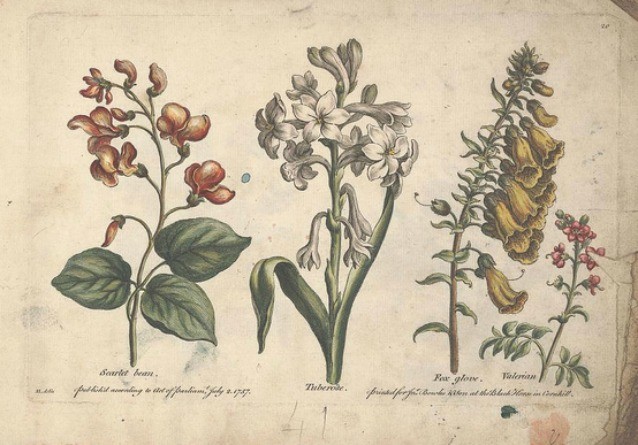
Botanical illustrations

Centuries ago, botanical drawings were key to helping people keep records of plants that had healing properties. The incredibly detailed illustrations of herbs and other plants were designed so that botanists and doctors could recognize the species for medicinal purposes. The oldest surviving example of botanical art, the Codex Vindebonensis, dates back to 512 A.D. The illustrations became more detailed and accurate as the centuries unfolded and now have taken on an artistic rather than medical purpose. There has been a recent resurgence in the art form through groups such as the American Society of Botanical Artists.

oooo

fgdfgdf

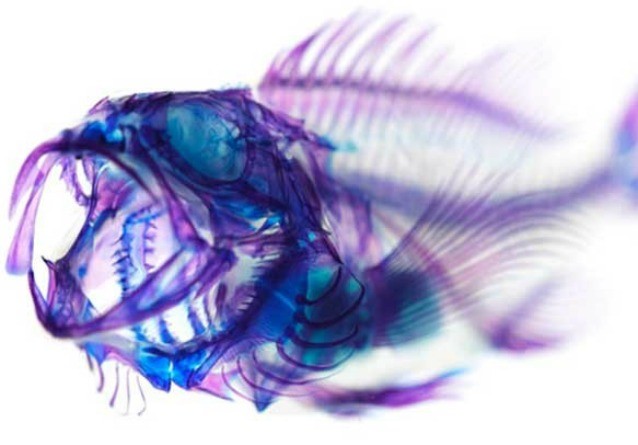
Preserved animal art

Japanese artist Iori Tomita sees beauty in death. He blends chemistry and art as he explores the natural beauty of the skeletal system in sea life. In his series “New World Transparent Specimens,” Tomita chemically bleaches and then dyes preserved animal bodies of fish, turtles, seahorses and other creatures. A chemical mix breaks down the protein and muscle, but leaves the collagen so the bodies keep their forms. Dyes then color the bones and tendons of the specimens, which are preserved in brightly lit glycerin.

oooo

bnmbnmbn

Pharaoh’s serpent

Mercury thiocyanate is an inorganic chemical compound that makes for some pretty dramatic moving art when it’s ignited. In the science world, mercury thiocyanate (typically present as a white powder) has several uses in chemical synthesis, but its real claim to fame is in pyrotechnics. When it’s lit, the compound produces a long spiraling column of ash and smoke that looks like a moving snake. These used to be sold in firework stores, but now you’re only likely to see them in a chemistry class because of claims of toxicity. The modern version is a nontoxic “black snake” that makes a less spectacular — albeit safer — presentation.

oooo

Back to wonderful photographs next Sunday.