More on how dogs adapt to challenges in their lives.
(As readers picked up from my closing comment in yesterday’s part of this story, technology has rather interfered with events. ‘Touch wood’ things appear to be back to normal!)
Yesterday’s article (thanks to Paul Gilding for the link) was about the stray dogs in Moscow. Before musing on the more general nature of how dogs survive as strays, there is a video on YouTube about these Muscovite dogs. Just over 7 minutes long, it further underlines the amazing adaptability of the domesticated dog when thrust into self-survival.
As regular readers of Learning from Dogs will know, before Jean and I met, Jean had spent a large part of her life rescuing dogs in the San Carlos area of Mexico, much of that with Suzann (who was instrumental in Jean and me meeting!). Indeed, when Jean and I moved up to Payson in February, 2010 we had with us, much to the amusement of the American border staff at the Nogales crossing, 12 dogs and 6 cats, all rescues except my German Shepherd dog, Pharaoh.
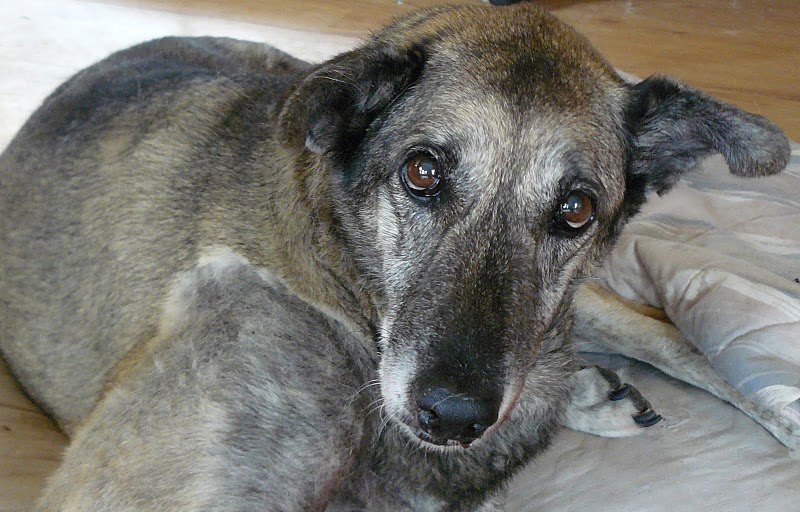
So Jean has lots of stories about how the far-too-many stray dogs in San Carlos developed strategies for staying alive. Dhalia, see story below, shows her feral habits when we go out for a walk in the forest by constantly looking for food, despite the fact that she is a well-fed, happy and contented dog. Jean recounts finding Dhalia,
It was in 2005, about three months after Ben died (Jean’s husband). I was driving out to the small Mexican fishing port of La Manga where there were many stray dogs. The aim was to feed them on a regular basis and hope that they would become sufficiently comfortable with my presence so that they could be caught, so that they may be spayed or neutered and then offered for adoption.
On the way there, I drove past a couple of dogs running alongside the highway. Dogs frequently did this looking for ‘road-kill’ that they could feed on. I stopped the car wanting to put out some food and water.
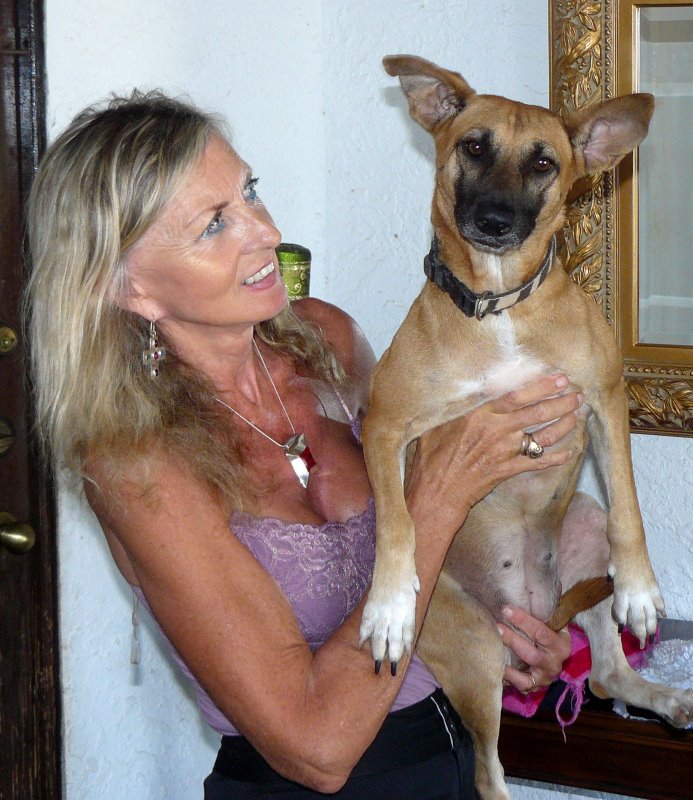
One of the dogs was so feral that it immediately took off into the bush. I turned around and the other dog was standing about ten feet away. It was cadaverous and obviously suffering from mange but cautiously came up to the food, sniffed carefully and then started to eat. That dog allowed me to pick it up and then sat quietly with me on the front seat of the car while I continued to La Manga. It sense immediately that it was safe and from that day has remained with me. I named her Dhalia.
Dhalia in Jean's arms, November 2008
Fast forward to today. Dhalia is one of Pharaoh’s group of dogs and is a sweet and loving animal.
Finally, a couple of other stories to give you a feeling about these rescue dogs. One from August 2009 about a dog called Lucky Lucy. The other about Corrie, both stories from Suzann.
Being in the present is the key message that we can learn from dogs. Why is this so important?
‘Drink your tea slowly and reverently, as if it is the axis
on which the world earth revolves – slowly, evenly, without
rushing toward the future. Live the actual moment. Only this moment is life.’ ~Thich Nhat Hanh
[my blue emboldening]
Unlike Jon, I muse as an ‘amateur’ when I sense that the human psyche is attracted to fear. I use that word ‘attracted’ simply because some stimuli that touch our consciousness seem to have more force than others. Ergo, the response to the simple question of asking someone how they are, is likely to me more engaging if they come up with some form of crisis reply than by saying, “Everything’s fine, thanks!” Look at how the news media use the power of fear to capture our attention.
There is a strong biological explanation for this. From the Science daily website,
The amygdala (Latin, corpus amygdaloideum) is an almond-shape set of neurons located deep in the brain’s medial temporal lobe. Shown to play a key role in the processing of emotions, the amygdala forms part of the limbic system.
In humans and other animals, this subcortical brain structure is linked to both fear responses and pleasure. Its size is positively correlated with aggressive behaviour across species. In humans, it is the most sexually-dimorphic brain structure, and shrinks by more than 30% in males upon castration.
Conditions such as anxiety, autism, depression, post-traumatic stress disorder, and phobias are suspected of being linked to abnormal functioning of the amygdala, owing to damage, developmental problems, or neurotransmitter imbalance.
For more information about the topic Amygdala, read the full article at Wikipedia.org
I am going to get to the point of this article but stay with me a little longer. Let’s look some more at the ‘fight or flight’ aspect of our brains. From the website, How Stuff Works,
It’s dark out, and you’re home alone. The house is quiet other than the sound of the show you’re watching on TV. You see it and hear it at the same time: The front door is suddenly thrown against the door frame. Your breathing speeds up. Your heart races. Your muscles tighten.
An instant later, you know it’s the wind. No one is trying to get into your home.
For a split second, you were so afraid that you reacted as if your life were in danger, your body initiating the fight-or-flight response that is critical to any animal’s survival. But really, there was no danger at all. What happened to cause such an intense reaction? What exactly is fear? In this article, we’ll examine the psychological and physical properties of fear, find out what causes a fear response and look at some ways you can defeat it.
What is Fear?
Fear is a chain reaction in the brain that starts with a stressful stimulus and ends with the release of chemicals that cause a racing heart, fast breathing and energized muscles, among other things, also known as the fight-or-flight response. The stimulus could be a spider, a knife at your throat, an auditorium full of people waiting for you to speak or the sudden thud of your front door against the door frame.
The brain is a profoundly complex organ. More than 100 billion nerve cells comprise an intricate network of communications that is the starting point of everything we sense, think and do. Some of these communications lead to conscious thought and action, while others produce autonomic responses. The fear response is almost entirely autonomic: We don’t consciously trigger it or even know what’s going on until it has run its course.
Because cells in the brain are constantly transferring information and triggering responses, there are dozens of areas of the brain at least peripherally involved in fear. But research has discovered that certain parts of the brain play central roles in the process:
Thalamus – decides where to send incoming sensory data (from eyes, ears, mouth, skin)
Sensory cortex – interprets sensory data
Hippocampus – stores and retrieves conscious memories; processes sets of stimuli to establish context
Amygdala – decodes emotions; determines possible threat; stores fear memories
Hypothalamus – activates “fight or flight” response
Now I originally called this article Present Perfect but WordPress quickly indicated that the title had already been used. Once again, the old memory cells are failing me! In fact the post of the name Present Perfect was published on the 8th June, just a couple of months ago. Glad that I was reminded because from that article in June,
Did you see Mr. Holland’s Opus? About Glenn Holland’s lifetime of teaching music to a high school band. In one scene he is giving a private lesson to Gertrude. She is playing clarinet, making noises that can only be described as other-worldly. He is clearly frustrated. As is she. Finally Mr. Holland says, “Let me ask you a question. When you look in the mirror what do you like best about yourself?”
“My hair,” says Gertrude.
“Why?”
“Well, my father always says that it reminds him of the sunset.”
After a pause, Mr. Holland says, “Okay. Close your eyes this time. And play the sunset.”
And from her clarinet? Music. Sweet music.
Sometime today, I invite you to set aside the manual, or the list, or the prescription.
Take a Sabbath moment. . . close your eyes and play the sunset.
Mary Oliver describes such a moment this way, “. . .a seizure of happiness. Time seemed to vanish. Urgency vanished.”
Because, in such a moment, we are in, quite literally, a State of Grace. In other words, what we experience here is not as a means to anything else.
If I am to focused on evaluating, I cannot bask in the moment.
If I am measuring and weighing, I cannot marvel at little miracles.
If I am anticipating a payoff, I cannot give thanks for simple pleasures.
If I am feeling guilty about not hearing or living the music, I cannot luxuriate in the wonders of the day.
Beautiful thoughts all woven around the power of focusing on the moment (if you want to catch up on the full article it is here).
Jon’s article last Monday was all about the way forward in a positive, well-being sense. In that article Jon showed the Maslow Hierarchy of Needs pyramid. It’s reproduced again below; spend a few moments absorbing the nature and sense of each level in that hierarchy.
Now ponder on that fear – ‘fight or flight’ – response. Most likely it’s going to be initiated in the ‘Safety’ level but flick straight down one level to the ‘Physiological’ layer. All very primitive stuff and utterly out of our control! Remember from the extract above, “The fear response is almost entirely autonomic.”
Even modest amounts of these fear responses is very wearying, very unsettling. Remember Jon touched on that when he wrote,
The point I’m trying to make is that the same panic I notice in many of the companies I work in, and in me, is based on fear of the unknown and on a lack of trust in all its forms. I’ve deliberately underlined that last phrase because it is so incredibly important. The truth is that we get more of what we focus on. So we can choose to focus on the constant news of more difficulties, hardship and redundancies, or we can focus on what is working.
So because our fear response is entirely autonomic and because there is so much out there, all around us, pulling those autonomic strings we have to actively, quite deliberately, do what dogs (and many other animals) do quite naturally. We deliberately have to focus on spending time being in the present!
There was a recent piece from Leo Babauta about being in the present. While he doesn’t touch on the underlying biology of why we humans are so ‘attracted’ to fear, he does offer some excellent advice about being in the present.
No matter how out-of-control your day is, no matter how stressful your job or life becomes, the act of being present can become an oasis. It can change your life, and it’s incredibly simple.
Look at Lorraine’s website (a recent visitor to Learning from Dogs). In particular this piece, from which I quote,
3. The Serenity Prayer – all about accepting the things I cannot change and changing the things I can.
4. People are always more important than things. Things can mostly be replaced but people cannot.
5. Do it now – if there is something to be done, then what is stopping me from doing it straight away?
6. If I appreciate and look after what I have now, there will be a positive flow back to me in the future. If I am neglectful and ungrateful with what I have now, I cannot expect to be rewarded with more in the future.
7. Be quiet and keep breathing – no one will know how crazy I feel inside
8. Don’t hold on to people or things too tightly. Be open to letting go and letting be.
9. It is really important to let others know that I love them. They need to know now and often. Love isn’t just a beautiful feeling – show it by how I act and speak with those I love.
10. I can’t make anyone love me and I can’t fix anyone by loving them. I may have a script for how life should be but I have no control over other people, places or things. Go with the flow and accept what is.
(The blue emboldening is mine – highlighting the power of now.)
Grandson Morten - peace in the present
“Live the actual moment. Only this moment is life.”
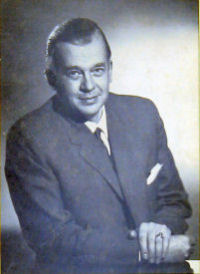
Ernst Friedrich “Fritz” Schumacher (16 August 1911 – 4 September 1977)
Ernst Friedrich "Fritz" Schumacher
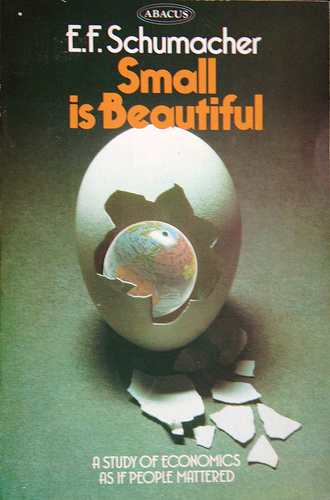
It seems amazing to realise both that this far-sighted man was born a century ago this day and that his incredibly influential book, Small is Beautiful, was published 38 years ago.
The book has been hugely influential. Indeed, my gut sense is that it probably started the whole ‘green’ movement. The Times Literary Supplement of October 6, 1995 regarded E.F. Schumacher’s 1973 book Small Is Beautiful: a study of economics as if people mattered as among the 100 most influential books published since the end of the Second World War.
Just a personal note that for many years I lived just a few miles from Dartington in Devon (UK) where Schumacher College was founded in 1991. Named after the great man, it provided, and still does, learning for sustainable living. Perhaps no surprise at all that nearby Totnes became the world’s first ‘transition town’.
Want to find out more? Then go to the New Economics Institute website here and discover,
The New Economics Institute is a US organization that uniquely combines vision, theory, action, and communication to effect a transition to a new economy — an economy that gives priority to supporting human well-being and Earth’s natural systems. Our multidisciplinary approach employs research, applied theory, public campaigns, and educational events to describe an alternative socio-economic system that is capable of addressing the enormous challenges of our times. Our premise is that a fair and sustainable economy is possible and that ways must be found to realize it.
The Institute, formerly the E. F. Schumacher Society, is working in close partnership with the New Economics Foundation from London to add the programs and experience developed in the UK to its own work in the US.
Finally, to get a flavour of this wonderful man and the amazing legacy that he has left the planet, watch this short video of E.F. Schumacher answering a question from the moderator about whether or not Buddhist Economics can work in the West. (Question & Answer Panel at Great Circle Center, 3/19/77. Peter Gillingham Collection, E. F. Schumacher Library Archives.)
In Paul Gilding’s book, The Great Disruption, there is a chapter called When the Dam of Denial Breaks. On page 121 Paul Gilding writes this,
To argue we are naturally greedy and competitive and can’t change is like arguing that we engage naturally in murder and infanticide as our forebears the chimps do and therefore as we did. We have certain tendencies in our genes, but unlike other creatures we have the proven capacity to make conscious decisions to overcome them and also the proven ability to build a society with laws and values to enshrine and, critically, to enforce such changes when these tendencies come to the surface.
So don’t underestimate how profoundly we can change. We are still capable of evolution, including conscious evolution. This coming crisis is perhaps the greatest opportunity in millennia for a step change in human society.
The United States of America gets a lot of stick, rightly so, for it’s greedy consumption of energy, especially the use of coal. According to the World Coal Association, the USA in 2010 produced 932 million tons of hard coal, second in the world to China that produced 3,162 million tons.
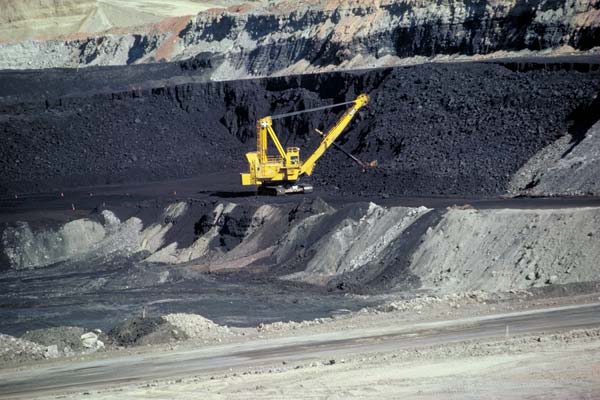
Coal mine in Wyoming
But the one thing that the USA has shown time and time again is that it has the capacity to change very quickly, especially when the country, from its leaders to its entrepreneurs, senses a global leadership opportunity. With that in mind, read the latest release from the Earth Policy Institute, reproduced below,
AUGUST 10, 2011 A Fifty Million Dollar Tipping Point?
Lester R. Brown
At a press conference on July 21, New York City Mayor Michael Bloomberg announced that he was contributing $50 million to the Sierra Club’s Beyond Coal Campaign. Michael Brune, head of the Sierra Club, called it a “game changer”. It is that, but it also could push the United States, and indeed the world, to a tipping point on the climate issue.
It is one thing for Michael Brune to say coal has to go, but quite another when Michael Bloomberg says so. Few outside the environmental community know who Michael Brune is, but every business person knows Michael Bloomberg as one of the most successful business entrepreneurs of his generation.
The Sierra Club’s Beyond Coal Campaign has two main goals. The first is to prevent the permitting and construction of new coal-fired power plants. So far 153 proposed power plants have been taken off the board. The second goal is to close the 492 existing plants. The Sierra Club lists 71 plants already scheduled for total or partial closure, most of them by 2016.
The efforts to stabilize climate will be won or lost with coal, the world’s largest source of carbon emissions. The effort to phase out coal is now well under way in the United States, the world’s second ranking coal user after China.
There are likely to be many ripple effects from the Bloomberg grant. To begin with, it may encourage other philanthropists to invest in climate stabilization.
The prospect for investment in coal, already deteriorating, will weaken even faster. In August 2010, the Rainforest Action Network (RAN) announced that several leading U.S. investment banks, including Bank of America and J.P. Morgan, had ceased lending to companies involved in mountaintop removal coal mining. Now with Bloomberg’s opposition, investors will be even more wary of coal.
The Bloomberg-Sierra initiative again focuses attention on the 13,200 lives lost each year in the United States due to air pollution from burning coal. If deaths from black lung disease among coal miners are included the number climbs even higher. The number of coal-related deaths in one year dwarfs total U.S. fatalities in the Iraq and Afghanistan wars. We invest heavily in protecting the lives of our troops in the Middle East, and rightly so. Bloomberg is saying let’s do the same for our people at home.
In addition, this initiative brings attention to the health care costs to society of burning coal. These are currently estimated at more than $100 billion per year, roughly $300 for every person in the United States or $1,200 for a family of four. These costs are real, but it is the American people, not the coal companies, who shoulder the burden.
Further reinforcing the urgency of phasing out coal are the more extreme weather events that climate scientists have been warning about for decades. During the first half of 2011 we watched TV news channels become weather channels. First it was a record number of tornadoes in one month, including the one that demolished Tuscaloosa, Alabama. Then, a few weeks later, an even more powerful tornado demolished Joplin, Missouri. As drought and heat sparked record or near-record wildfires in Arizona, New Mexico, and Texas, the lower Mississippi Basin was flooding. Searing heat waves scorched the southern Great Plains, the Midwest, and the East Coast. Intense heat has continued to break records across the country as Texas suffers its most severe one-year drought on record.
For coal, the handwriting is on the wall. Between 2007 and 2010, coal use in the United States dropped 8 percent. (See data.) Meanwhile, more than 300 new wind farms came online, totaling over 23,000 megawatts of generating capacity—the electricity output equivalent of 23 coal-fired power plants.
When people were asked in a national poll where they would like to get their electricity from, only 3 percent opted for coal. Despite the coal industry’s heavy expenditures to promote “clean coal,” it is still a loser in the public mind.
In addition to the Sierra Club, RAN, and a talented team of Earthjustice lawyers, the anti-coal movement also has allies in Friends of the Earth and Greenpeace, the latter with its highly developed capacity to focus public attention on environmental issues. This was evident in May when a Greenpeace team of eight daring activists scaled the 450-foot Fisk coal plant smokestack located in Chicago and painted “Quit Coal” on it. They were drawing public attention to the deadly air pollution in the city coming from the plant.
As the United States closes its coal-fired power plants, it sends a message to the world. With Michael Bloomberg’s grant bolstering the Sierra Club’s well-organized program to phase out coal, we can now imagine a coal-free United States on the horizon. The United States could again become a world leader, this time in stabilizing climate.
“The United States could again become a world leader, this time in stabilizing climate.” That would be a dream come true, a dream of unimaginable consequences.
Over a couple of months ago, Tess was diagnosed with bone cancer, in the shoulder joint of her right front leg. The vet thought that she might have only a very few weeks to live, this particular form of cancer being aggressive.
As it happened, Tess kept going for much, much longer. But this morning (Wednesday at the time of writing) Jean made the agonising decision to end the pain for Tess. Despite a daily dose of strong pain-killer tablets, this morning Tess was breathing more laboriously and showing clear signs of tiring. It was time.
For me it was the first time that I had been with a loved animal that had to be euthanised and it was hard.
A few pictures to keep her memory alive.
Tess, far left (next to the plant pot), and friendsJean & Tess, a few moments before leaving.Dear Tess, you are out of pain and at peace.
Let me close with the same poem that was published when we lost our little Poppy,
“There is one best place to bury a dog.
“If you bury him in this spot, he will
come to you when you call – come to you
over the grim, dim frontier of death,
and down the well-remembered path,
and to your side again.
“And though you call a dozen living
dogs to heel, they shall not growl at
him, nor resent his coming,
for he belongs there.
“People may scoff at you, who see
no lightest blade of grass bent by his
footfall, who hear no whimper, people
who may never really have had a dog.
Smile at them, for you shall know
something that is hidden from them,
and which is well worth the knowing.
“The one best place to bury a good
dog is in the heart of his master.”
Ben Hur Lampman —
from the Portland Oregonian Sept. 11, 1925
A new book about dogs by John Bradshaw offers a theme for today.
Yesterday, I mentioned an article from the current issue of The Economist. Also in that issue was a review of a new book from John Bradshaw, called Dog Sense: How the New Science of Dog Behaviour Can Make You a Better Friend to Your Pet. You can read the review here. But in terms of the theme of today’s post, read this paragraph from that review,
Dogs are not like nicely brought-up wolves, says the author, nor are they much like people despite their extraordinary ability to enter our lives and our hearts. This is not to deny that some dogs are very clever or that they are capable of feeling emotion deeply. But their intelligence is different from ours. The idea that some dogs can understand as many words as a two-year-old child is simply wrong and an inappropriate way of trying to measure canine intellect. Rather, their emotional range is more limited than ours, partly because, with little sense of time, they are trapped almost entirely in the present. Dogs can experience joy, anxiety and anger. But emotions that demand a capacity for self-reflection, such as guilt or jealousy, are almost certainly beyond them, contrary to the convictions of many dog owners.
That last sentence is key, “But emotions that demand a capacity for self-reflection, such as guilt or jealousy, are almost certainly beyond them, contrary to the convictions of many dog owners.”
So in yesterday’s post, when I wrote about the terrible uncertainty that millions and millions of humans must be experiencing, there is no useful metaphor available to link this human idea to how the dogs feel; as John Bradshaw writes, this level of reflection is just beyond them.
We hug a dog (or any animal) to escape from matters complex. As Sue Miller wrote so beautifully, “I was taken up by them [pets] and their life and energy, by what they needed and asked of me. I let go of everything difficult or complex in my life. As I was driving home, I thought of all this, and it seemed to me that I’d chosen work which offered me daily the presence of pure innocence, a forgiveness for all my human flaws.”
So accept the gift of pure innocence that our pets give us.
But what ‘gift’ can we humans accept that relates to the very complex world that we humans see all around us?
What about hope? Let’s accept the gift of hope. As I wrote recently in an email to a friend (before the London riots burst upon our consciousness),
‘Hope’ is going to be the key message over the coming weeks and months because the feeling that the ‘end of the world is nigh’ is incredibly strong, well it is to me!
Of course, the ‘end of the world’ feeling is, as you well know from me, really the end of an era. But an era where for decades money has equalled power; ergo money has equalled control.
Now the speed of change must be terrifying to millions across the world. So out of that terror must come a new order, a new way of understanding that how we have treated our planet is a busted model and that it is time, indeed the 11th hour as it were, to find that new order, of love and sustainability with our planet, both in earthly and spiritual ways.
We must have faith in the hope that we are living through the chaotic transition from an era of greed and destruction to one where we have a future that goes on for thousands of years.
“Everyone thinks of changing the world, but no one thinks of changing himself.” Leo Tolstoy
I am going to refer to some ideas before explaining from whom they came, and when.
Try this: the term “future shock” is defined as a certain psychological state of individuals and entire societies. The shortest definition for the term is a personal perception of “too much change in too short a period of time”.
Or try this: society is undergoing an enormous structural change, a revolution from an industrial society to a “super-industrial society”. This change will overwhelm people, the accelerated rate of technological and social change leaving them disconnected and suffering from “shattering stress and disorientation” – future shocked. It was stated that the majority of social problems were symptoms of the future shock.
Stay with me a little longer as I pose a few questions. How do you feel at the moment? Slightly unsure of where the world is going right now? Feeling a little unsettled?
Why those questions? With the Dow Jones index heading down through 11,130 (at the time of writing on the 8th) and ‘chaos across markets’ headlines all over the place these are very unsettling times
Last week’s edition of The Economist had five pages about the present uncertain times in the USA.
The numbers keep being revised inexorably downwards
The rough news did not end there. The Bureau of Economic Analysis (BEA) revised its numbers back through the recession, revealing a downturn more serious than previously understood. The BEA’s first estimate of output in the fourth quarter of 2008, published in January of 2009, showed a contraction of 3.8%, later revised to a 6.8% drop. The new numbers change the figure yet again, to a shocking 8.9% fall in GDP. For 2009 as a whole, the American economy shrank by 3.5% rather than the previously reported 2.6%. American output has yet to reattain its 2007 peak. On a per-person basis, inflation-adjusted GDP stands at virtually the same level as in the second quarter of 2005. America is six years into a lost decade. [my emphasis]
So back to those comments about ‘future shock’. They come from a gentleman known across the world for his writings as a futurist, Alvin Toffler. His website is here and there is a good review of the man and his works on Wikipedia.
Alvin Toffler, born 1928
Toffler’s book, Future Shock, from 1970 was prescient in forecasting …. well here’s how it is written on Wikipedia,
Toffler argues that society is undergoing an enormous structural change, a revolution from an industrial society to a “super-industrial society“. This change will overwhelm people, the accelerated rate of technological and social change leaving them disconnected and suffering from “shattering stress and disorientation” – future shocked. Toffler stated that the majority of social problems were symptoms of the future shock. In his discussion of the components of such shock, he also popularized the term “information overload.”
But there’s an aspect that wasn’t even on the horizon when Toffler was writing that book in the late 60s – the end of growth. That is creating a whole new level of change and ‘information overload’, in my opinion.
Just a few days ago, I reviewed the Paul Gilding book The Great Disruption. I quoted this extract from the very start of the book,
This means things are going to change. Not because we will choose change out of philosophical or political preference, but because if we don’t transform our society and economy, we risk social and economic collapse and the descent into chaos. The science on this is now clear and accepted by any rational observer. While an initial look at the public debate may suggest controversy, any serious examination of the peer-reviewed conclusions of leading science bodies shows the core direction we are heading in is now clear. Things do not look good.
These challenges and the facts behind them are well-known by experts and leaders around the world, and have been for decades. But despite this understanding, that we would at some point pass the limits to growth, it has been continually filed away to the back of our mind and the back of our drawers, with the label “Interesting – For Consideration Later” prominently attached. Well, later has arrived.
Indeed, ‘later’ has arrived. The ‘future’ is now here!
Watch the first 10 minutes of the Future Shock film made back in 1972 and ponder.
The following four parts are easily found on YouTube.
God grant me the serenity to accept the things I cannot change, the courage to change the things I can, and the wisdom to know the difference. Reinhold Niebuhr
Author Sue Miller perfectly articulates our relationship with dogs and cats.
As a rest to the number of non-fiction books that I have been reading over the past few months, Jean recommended a novel she recently finished, While I Was Gone, by Sue Miller. It’s featured on Oprah’s Book Club, from which I quote,
About the Book
A decade ago she put a face on every mother’s worst nightmare with her phenomenal best-seller The Good Mother. Now, Sue Miller delivers a spellbinding novel of love and betrayal that explores what it means to be a good wife.
In the summer of 1968, Jo Becker ran out on the marriage and the life her parents wanted for her, and escaped–for one beautiful, idyllic year–into a life that was bohemian and romantic, living under an assumed name in a rambling group house in Cambridge. It was a time of limitless possibility, but it ended in a single instant when Jo returned home one night to find her best friend lying dead in a pool of blood on the living room floor.
Now Jo has everything she’s ever wanted: a veterinary practice she loves, a devoted husband, three grown daughters, a beautiful Massachusetts farmhouse. And if occasionally she feels a stranger to herself and wonders what happened to the freedom she once felt, or how she came to be the wife, mother, and doctor her neighbors know and trust–if at times she feels as if her whole life is vanishing behind her as she’s living it–she need only look at her daughters or her husband, Daniel, to recall the satisfactions of family and community and marriage.
But when an old housemate settles in her small town, the fabric of Jo’s life begins to unravel: seduced again by the enticing possibility of another self and another life, she begins a dangerous flirtation that returns her to the darkest moment of her past and imperils all she loves.
While I Was Gone is an exquisitely suspenseful novel about how quickly and casually a marriage can be destroyed, how a good wife can find herself placing all she holds dear at risk. In expert strokes, Sue Miller captures the precariousness of even the strongest ties, the ease with which we abandon each other, and our need to be forgiven. An extraordinary book, her best, from a beloved American writer.
Have to say that even though there’s an obvious gender difference between me, the heroine and the author, I found the book tough reading , as in emotional, from time to time. Especially, the euthanasia of Arthur the dog towards the end of Chapter 7 – Jo is a vet. A few paragraphs I just couldn’t read . But then on page 137 in Chapter 8, comes this,
Pure bliss.
I stood in the center of the yard for a moment and tilted my head back to let the soft snow touch my face. The dogs pranced and rolled for pure joy in the pale, gray-brown light. They chased each other wildly. I made snowballs and threw them; the dogs leapt and bit at where they’d disappeared. As they played, their muzzles whitened, their paws pilled up.
I left them reluctantly and came back in. Watson trailed me around as I did my chores, watching me soberly. I shut him out of the cat room, where we had only two boarders. I let one of them out to roam and use the litter pan while I checked its cage. I put more food down. Then I went back out and worked my way through the dogs’ cages. Two of them had had accidents, so I cleaned up and changed their bedding. Several of them had their own food, in cans – those dishes needed to be washed. Water refreshed, kibbles set out for the others.
I went to the cat room, put the first cat back and let the other one out. Then I called the reluctant dogs in. Watson greeted each one like a tiny worried mother, licking at their snow, fussing about how they smelled. Slowly I recaged them. I released Lucky and let him go outside for his solitary run while I refilled his food and water dishes. Three dogs needed medications. I put the last cat back in, called Lucky inside, locked up.
And while I did all this, I thought only of them, of the dogs and cats, of their requests for affection, of their comical or passionate relationships to one another, of the performance of their bodily functions. I was taken up by them and their life and energy, by what they needed and asked of me. I let go of everything difficult or complex in my life.
It reminded me of my days at Dr. Moran’s, caring for the dogs and cats he boarded and treated. It reminded me of what a comfort it had been to me, even just physical escape into the lives of animals. As I was driving home, I thought of all this, and it seemed to me that I’d chosen work which offered me daily the presence of pure innocence, a forgiveness for all my human flaws.
the presence of pure innocence, a forgiveness for all my human flaws Impossible to add anything; so I won’t!
A passing visit to the American biologist, E. O. Wilson
E O Wilson
Edward Osborne Wilson was born in June 1929 thus making him, at this time of writing, just into his 82 year. His biological specialty is myrmecology. Got that? Myrmecology. And if you, like me, didn’t have a clue as to what myrmecology is and had to look it up, it is the study of ants. Blow me down, there is even a myrmecology blogsite!
So where is this all heading?
One of the things that we do know about dogs, especially if we go way back into the dim and distant times when they behaved more like the grey wolf, from which the species ‘dog’ genetically originates 100,000 years ago, is that their social order, their pack behaviour, was highly stable. As an aside, when Jean was rescuing dogs in San Carlos, Mexico during the years that she lived there with her late husband she readily observed that the stray dogs, of which there were too many, had a natural propensity to group up into their historic pack formations. (And as an aside to my aside, Jean’s close friend of many years, Dan’s sister Suzann, today carries on the splendid work of looking after stray dogs from her San Carlos house!)
OK, back to the plot!
E O Wilson’s study of ants has revealed much about social order and organisation. The following YouTube video was from a PBS programme, aired in May, 2008, from which I quote (that is the PBS website),
Program Description
At age 78, E.O. Wilson is still going through his “little savage” phase of boyhood exploration of the natural world. In “Lord of the Ants,” NOVA profiles this soft-spoken Southerner and Harvard professor, who is an acclaimed advocate for ants, biological diversity, and the controversial extension of Darwinian ideas to human society.
Actor and environmentalist Harrison Ford narrates this engaging portrait of a ceaselessly active scientist and eloquent writer, who has accumulated two Pulitzer Prizes among his many other honors. Says fellow naturalist David Attenborough: “He will go down as the man who opened the eyes of millions ’round the world to the glories, the values, the importance of—to use his term—biodiversity.”
It’s a fascinating film, truly engaging, so do settle down for a relaxing 53 minutes and watch,
Now there’s more to this and I do want to continue with the theme of this Post tomorrow.
So for now, look in on the E O Wilson Biodiversity Foundation’s website and I’ll see you tomorrow.






 Learning from Dogs