Category: Core thought

Dr. Michael Mann

A review of Michael Mann’s new book The Hockey Stick and the Climate Wars: Dispatches from the Front Lines.

I’m republishing in full a recent Post on Kate’s fabulous blogsite Climate Change.  As a degree student, Kate is a fantastic representative of the generation that is going to have to deal in full with all the crap that my generation (born 1944) has brought about!  Learn more about her here.  Anything that can spread the word to those, especially in my age group, that are climate change denialists is no bad thing.

The Hockey Stick and the Climate Wars

February 22, 2012 by climatesight

Available from Columbia Press

Throughout all the years of public disputes about climate change, arguably no scientist has taken as much flak as Dr. Michael Mann. This mild-mannered paleoclimatologist is frequently accused of fraud, incompetence, scientific malpractice, Communism, and orchestrating a New World Order. These charges have been proven baseless time and time again, but the accusations continue. Dr. Mann’s research on climate change is inconvenient for those who wish to deny that current global temperatures are unusual, so he has become the bulls-eye target in a fierce game of “shoot the messenger”. In “The Hockey Stick and the Climate Wars: Dispatches from the Front Lines”, a memoir of his experiences, Michael Mann finally speaks out.

The story begins quite harmlessly: an account of how he became a scientist, from childhood curiosity to graduate work in theoretical physics to choosing climate science on a whim out of the university course calendar. For those who have followed Dr. Mann’s research over the years, there is some great backstory – how he met his coauthors Ray Bradley and Malcolm Hughes, the formation of the IPCC TAR chapter about paleoclimate, and how the RealClimate blog operates. This book also filled in some more technical gaps in my understanding with a reasonably accessible explanation of principal component ananlysis, a summary of millennial paleoclimate research before 1998, and an explanation of exactly how Mann, Bradley and Hughes’ 2008 paper built on their previous work.

Dr. Mann’s 1998 paper – the “hockey stick” – was a breakthrough because it was the first millennial reconstruction of temperature that had global coverage and an annual resolution. He considered the recent dramatic rise in temperatures to be the least interesting part of their work, because it was already known from instrumental data, but that part of the paper got the most public attention.

It seems odd for a scientist to downplay the importance of his own work, but that’s what Dr. Mann does: he stresses that, without the hockey stick, the case for climate change wouldn’t be any weaker. Unfortunately, his work was overemphasized on all sides. It was never his idea to display the hockey stick graph so prominently in the IPCC TAR, or for activists to publicize his results the way they did. Soon the hockey stick became the holy grail of graphs for contrarians to destroy. As Ben Santer says, “There are people who believe that if they can bring down Mike Mann, they can bring down the IPCC,” and the entire field of climate science as a result.

Michael Mann is an eloquent writer, and does a fabulous job of building up tension. Most readers will know that he was the target of countless attacks from climate change deniers, but he withholds these experiences until halfway through the book, choosing instead to present more context to the story. The narrative keeps you on your toes, though, with frequent allusions to future events.

Then, when the full story comes out, it hits hard. Death threats, and a letter full of suspicious white powder. Lobby groups organizing student rallies against Mann on his own campus, and publishing daily attack ads in the campus newspaper. Discovering that his photo was posted as a “target” on a neo-Nazi website that insisted climate change was a Jewish conspiracy. A state politician from the education committee threatening to cut off funding to the entire university until they fired Mann.

Throughout these attacks, Dr. Mann consistently found trails to the energy industry-funded Scaife Foundation. However, I think he needs to be a bit more careful when he talks about the links between oil companies and climate change denial – the relationship is well-known, but it’s easy to come off sounding like a conspiracy theorist. Naomi Oreskes does a better job of communicating this area, in my opinion.

Despite his experiences, Michael Mann seems optimistic, and manages to end the book on a hopeful note about improvements in climate science communication. He is remarkably well-adjusted to the attacks against him, and seems willing to sacrifice his reputation for the greater good. “I can continue to live with the cynical assaults against my integrity and character by the corporate-funded denial machine,” he writes. “What I could not live with is knowing that I stood by silently as my fellow human beings, confused and misled by industry-funded propaganda, were unwittingly led down a tragic path that would mortgage future generations.”

“The Hockey Stick and the Climate Wars” leaves me with a tremendous empathy for Dr. Mann and all that he has gone through, as well as a far better understanding of the shouting match that dominates certain areas of the Internet and the media. It is among the best-written books on climate science I have read, and I would highly recommend it to all scientists and science enthusiasts.

“The Hockey Stick and the Climate Wars” will be released on March 6th, and the Kindle version is already available.
Facing the fear.

A guest post from Amy Johnson.

Introduction

About a week ago, via the blogsite Paleo Works, a couple of comments brought me into contact with Amy.  Of course being an Englishman any woman with the name of Amy Johnson is going to cause a double-take on the name.  This Amy shared the same name as the English pioneering aviator Amy Johnson, albeit from an earlier era, the aviator that is!

An exchange of emails between Amy and myself revealed an experience that Amy had when she was very young, and I asked Amy if she would like to write a guest post.  This, then, is Amy’s story about overcoming a fear of dogs.

Amy J.

I have a cousin who is about the same age as me.  My cousin’s mom, my aunt, used to babysit me and the dog in question, a big female, reddish golden retriever was always around and like any retriever was a loving, and lovable, happy-go-lucky dog.

The event goes back to when both my cousin and I were about four-years-old, maybe just five.  For some inexplicable reason the dog attacked my cousin.  I grew up believing the dog may have been frightened, startled, but I don’t think it was provoked.  Certainly, the dog didn’t have any history of biting.

Anyway, that attack on my cousin caused a ton of stitches, 15 or 17, and scarred us both.  Physical scars for my cousin and emotional scars for me.  As an aside, I don’t remember the dog ever being around again so am fairly confident the dog was put to sleep.

Thus ever since that event, I’ve moved through life with this crippling fear of dogs.  Throughout the remainder of my childhood and into my teen years I masked my fear pretending not to be afraid of dogs.  It seemed like the whole world loved dogs, and my fear made me feel oddly isolated.

Of course, dogs always sensed my fear and they would usually bark like crazy around me – or jump.  I ended up equating dog barking as screaming or yelling, and it was quite disturbing.  I would tense up frozen in fear.

Dogs, like humans, come with all kinds of personalities, from one extreme where they are so calm and laid back you wonder whether they even have a pulse to the another extreme of being so ferocious sounding with snarly barky faces and totally tensed bodies.

When a dog was approaching me on the sidewalk, just minding his own business and ignoring me, I would walk far away into the street or grass to be at a safe distance.  I avoided dogs at all costs, because like any human, I tried my best to avoid negative emotions; anxiety, fear, worry.

Thus I avoided dogs my whole life, that is, until my niece Emma came into the world.  Emma loves dogs, all dogs.  Barky dogs, jumpy dogs, big dogs, little dogs, scrappy dogs, arrogant dogs.  If you had a dog, Emma would literally stalk you until you allowed her to pet and offer love to your dog.

Barking and jumping dogs never ever deterred Emma; she lights up with love and openness to all dogs.  And via her openness and pure love, compassion and joy for dogs Emma has helped me understand that most dogs are a-ok.  They aren’t barking screaming, they are barking excitement!  They aren’t jumping to chomp my cheek, they are jumping to lick my lips – eewww, but oh what a light bulb that was turned on in me!   I feel immense gratitude for Emma helping me move beyond this debilitating fear and for me being open to accepting her help.

It is so true that we can learn from dogs, indeed we can learn from everyone and everything, if we are open to learning and absorbing new information, open to reflection and inner stillness, open to course-corrections along our way.

Thank you Amy, I have no doubt that will reach out to many readers.

The challenge of change

A personal muse.

Today’s Post was prompted by a recent email, here it is in full,

Dear Brian et al,

I know it’s really tough, but we have to figure out a way to take the message of the Steady State Economy  viral.

We HAVE to.

Every time I look at who has signed the petition at www.steadystate.org,  I am inspired, because the signers come from all over the world. But two or three a day?

Certainly, I’m not telling you anything you don’t know. I’ve tried on my own, and when I talk to folks one-on-one, they often enthusiastically sign, but they don’t “pay it forward.”>What can we do together to break through this wall of apathy?

Very best regards,

Carla Rautenberg
Cleveland, Ohio

I was one of the 8 addressees, for reasons that I am not really sure about.  But it doesn’t matter.  Here are my thoughts.

There is no doubt in my mind that the present course of mankind on this planet is not sustainable.  There is much on Learning from Dogs from my ‘pen’ and others that supports that view.  As Carla writes, when one speaks to others, the majority seem to share that view.

So what is it about change that is so difficult?  Well, I’m not competent to give a reliable answer to that but a web search on change delivers yards of material and even more quotations.  Just as a random example, here is a website that offers ‘The 45 Most Inspiring Quotes on Change.‘  But do you know what?  There’s only one which, to my mind, hits at the real heart of change.  It was this one,

“All great changes are preceded by chaos.” -Deepak Chopra

Last week I published a short story that ended,

The message from the night, as clear as the rays of this new day’s sun, the message to pass to all those he loved. If you don’t get lost, there’s a chance you may never be found.

‘Chaos’, ‘getting lost’ are expressions of, to use a relatively modern phrase, ‘tipping points’ !  It seems to me that real motivation to change can only come when one’s present world is falling apart in spades.

Then, and only then, those that offer clear ways forward will be held up as saviours.

So there’s my thought for the day!  And if any of you wonderful readers have further thoughts and contributions, please offer them as comments.  Big thank-you.

Rob Hopkins and ‘engaged optimism’.

A wonderful enlightened approach to the challenges facing our beautiful planet.

Rob Hopkins is a remarkable fellow.  In so many ways he is the most unlikely person to have kicked off almost single-handedly, a gathering world-wide revolution.

Rob Hopkins

There’s a very good description of the man on his Transition Culture website, from which I have republished this segment,

He is the co-founder of Transition Town Totnes and of the Transition Network. This grew out of many years experience in education, teaching permaculture and natural building, and setting up the first 2 year full-time permaculture course in the world, at Kinsale Further Education College in Ireland, as well as co-ordinating the first eco-village development in Ireland to be granted planning permission.

He is author of ‘The Transition Handbook: from oil dependence to local resilience’, which has been published in a number of languages, and which was voted the 5th most popular book taken on holiday by MPs during the summer of 2008, and more recently of ‘The Transition Companion: making your community more resilient in uncertain times’, published in October 2011.  He publishes the blog www.transitionculture.org, recently voted ‘the 4th best green blog in the UK’(!).  He tweets as @robintransition, and and recently came 11th in the PeerIndex-driven Sustainability Drivers List.

I am as guilty as the next person in promoting ‘doom and gloom’ when it comes to what mankind is doing to this planet.  I devoted a couple of thousand words to that theme in a guest sermon that appeared on Learning from Dogs a week ago.  That’s not to say that unless mankind, in the millions, changes in significant ways then avoiding a catastrophy to our species, and many others, is going to be hugely difficult.

But motivating us all to change is far better undertaken from a position of positive guidance and inspiration, than out of fear!

So when Jean and I listened to a recent BBC radio broadcast by Rob as part of the BBC Radio 4 Four Thought series we were blown away by the guidance and inspiration that Rob presented.

It’s 15 minutes of hope, and you too can listen to it from anywhere in the world by going here or by going here.

This is how the BBC introduces the programme,

Rob Hopkins, co-founder of the Transition Culture movement, believes that “engaged optimism” is the best way to face the global challenges of the future, be it climate change, oil supplies running out or the economic downturn. He believes initiatives enabling people to produce their own goods and services locally – from solar powered bottled beer to micro currencies like the Brixton pound – are the best way to build community resilience. Four Thought is a series of talks in which speakers give a personal viewpoint recorded in front of an audience at the RSA in London.
Producer: Sheila Cook.

So do listen to the programme and then click across to the Transition Culture website where Rob has posted a transcript of his talk.  Please, whatever your plans today find time to listen to the programme and read the transcript.  Here’s how Rob closes his talk,

I often end talks I give with Arundhati Roy’s quote “another world is not only possible, she is on her way.  On a quiet day I can hear her breathing”.  I think we might adapt her quote, so that, in the context of this bottom-up drive for more resilient communities, communities better prepared for uncertain times, it is not only a case of hearing another world breathing, but being able to see her around us, already setting up local businesses, reviving her local economy, setting up bakeries, breweries, food hubs, mentoring scores of young people with business ideas, attracting inward social investment finance, creating the models whereby people can invest in their communities and see them being strengthened and supported.

That’s why I get out of bed in the morning, because I feel that the potential in our getting this right is so exquisite that it’s all I can do, and because the grim predictability of what will happen if we do nothing is just unthinkable, especially in relation to the challenge of climate change.  If we are able to turn things around on the scale we need to turn them around on, to replace vulnerability, carbon intensity and fragility with resilience, it will be an achievement our children will tell tales about, sing songs about.  I hope I am there to hear them.  Thank you.

Another world is on her way!

Another beautiful world is on her way!

Words of wisdom

Leaning on a recent item from Terry Hershey

As many of you will appreciate, this has been a bit of a week.  It started last Sunday with my contribution to the national ‘preach-in’ for the health of our planet, and ended with the sad loss of Phoebe.  I normally post something light-hearted or trivial for the week-end but seem to be in a more reflective mood just now (Friday).

For some time I have subscribed to the weekly spiritual offering from Terry Hershey and am going to republish a story that came out from Terry Hershey on the 13th.

Letting go and walking

February 13, 2012

Some of us think holding on makes us strong, but sometimes it is letting go. Herman Hesse.

Uncertainty is the only certainty there is, and knowing how to live with insecurity is the only security. John Allen Paulos

When you let go of trying to get more of what you don’t really need, it frees up oceans of energy to make a difference with what you have. Lynne Twist

And now the story,

There is a Tibetan story about an earnest young man seeking enlightenment. (Earnest people must think this quite unfair–since they play a central role in most parables and stories about enlightenment.)

A famous sage passes through the man’s village. The man asks the sage to teach him the art of meditation. The sage agrees. He tells the man, “Withdraw from the world. Mediate every day in the specific way I will teach you. Do not waver and you will attain enlightenment.”

The earnest man follows the sage’s instructions to the letter. Time passes–and no enlightenment. Two years, five, ten, twenty pass.

It happens that the sage once again passes through the man’s village. The man seeks him out, grumbling that despite his best intentions and devotion and diligent efforts, he does not achieve enlightenment. “Why?”

The sage asks, “What type of meditation did I teach you?
The man tells him.

The sage says, “Oh, what a terrible mistake I made! That is not the right meditation for you. You should have done another kind altogether. Too bad, for now it is too late.”

Disconsolate, the man returns to his cave. Staking his life on the sage’s instructions, and now believing he is without hope, the man abandons all his wishes and efforts and need to control his road to enlightenment. He does not know what to do. So, he does what knows best: he begins meditating. And in a short while, much to his astonishment, his confusion begins to dissolve, and his inner world comes to life. A weight falls away and he feels lighter, and regenerated. When he walks out of the cave, the sky is bluer, the snow capped mountains whiter, and the world around him more vivid.

There is no doubt that all too often, our efforts–to succeed or achieve or attain–get in the way of our living. It brings to mind my favorite Robert Capon quote, “We live life like ill-taught piano students. So inculcated with the flub that will get us in dutch, we don’t hear the music, we only play the right notes.”

I understand. I was weaned on a spirituality that predicated itself on artifice. In other words, the importance is placed upon appearance, rather that just being. (It was vital to “look spiritual.” Which begs the question, “What do spiritual people look like?” As a boy, I always thought the “spiritual people” looked as if some part of their clothing was a size too small.)

What is it we are holding on to–so rigid, so firm, white-knuckled in our determination?  At some point, we’ve got to breathe.  Just breathe.  Without realizing it (and after the sage’s disheartening news), the man in the story “let go.”

He let go of the need to see life as a problem to be solved.
He let go of the need to have the correct answers (or experiences) for his “enlightenment.”
He let go of the need to see his spiritual life in terms of a formula.
He let go of the restraints that come from public opinion.

Abandon your masterpiece, sink into the real masterpiece.
Leonard Cohen

Without realizing it, he took Leonard Cohen’s advice. He abandoned his “masterpiece”–the perception of what he needed to accomplish, or how he needed to appear, or what he needed to feel–in order to allow himself to sink down into this life, this moment, even with all of its uncertainty and insecurity.

So a big thank you to Terry Hershey for those words of wisdom.


Reaching out across nations.

An unanticipated reward from Blogging.

When I started writing Learning from Dogs, way back on July 15th 2009, I didn’t have a clue as to the world I was entering, figuratively speaking.  But there have been many unanticipated rewards including the great pleasure of the way that this strange virtual world of the Internet brings people together.  One connection recently made was with a young Bangladeshi living in the city of Dhaka, more of his background here.

Nakib recently published a powerful and moving Post and has been gracious in allowing me to republish it, as follows:

The vulture that waited for the child to die

Given below is the 1994 Pulitzer price-winning photograph taken by Kevin Carter during the Sudan famine of 1994.

The photo shows a famine-stricken child crawling towards a United Nations food camp, which was located at least one kilometer away from the place shown. The vulture on the other hand is waiting eagerly for the child to die so that it can devour it.

I do not know what message the photograph revokes on your head but every time I look at it I feel blessed that I have been provided enough at least to satisfy my hungry stomach and keep me energetic enough to write blogs. I feel small and humble when I think of all the people suffering out there— homeless and starved— yet trying their best to make some sense of the complex notion known as life. It tells me that I have been blessed for a reason, for a purpose, and whatever I have been provided with should not go in vain. I can infer that my powers should be used well, at least for that little kid on the above photograph for whom Fate had sealed a quicksand of reality too hard to acknowledge for many of us hedonists out here.

Most importantly, to me the photograph conveys an emotion; a reality that many of us are too blind to grasp. I think of how people throughout the world are suffering to no ends yet amidst everything trying again and again to find the silver lining associated with the black cloud. I realize that there is a lot happening outside my comfortable apartment and Biology textbook that needs looking after, that there is a lot of people who strive hard yet achieve nothing in return. It amazes me when I try to ponder God’s sense of justice and egalitarianism.

So is it okay for the blessed 25% of the population in this world to waste everything that life has given them while the the rest 75% live amidst severe poverty, oppression and inequality?  Is it okay to go overboard with New Year parties while exactly at the same hour millions of people across the globe are suffering from the fangs of social deprivation? Is it okay to let things be as they are and forget about everything so as to harmoniously embrace useless ambitions and lustful desires?

Have we all truly forgotten to share our wealth and about the latent human being that exists inside everyone of us? Have we truly gottten rid of all those emotions that make us human beings? Is this what the world is for: for some to live lavishly while for the rest to suffer endlessly?

Three months after he took the photograph Kevin Carter, after suffering from several periods of depression, committed suicide.

Dated on the day the photo was taken, the following note was found from his diary:

Dear God, I promise I will never waste my food no matter how bad it can taste and how full I may be. I pray that He will protect this little boy, guide and deliver him away from his misery. I pray that we will be more sensitive towards the world around us and not be blinded by our own selfish nature and interests. I hope this picture will always serve as a reminder to us that how fortunate we are and that we must never ever take things for granted.

As for the child, no one really knows what happened to him; not even the South African photographer who had left the place immediately after the photo was taken. I try to appease myself by saying that the child never existed in the first place. God simply intended to provide us with a glimpse of the truth of life, to remind us how blessed we are. I hope this is true.

oooOOOooo

Very, very moving and beautifully expressed.

Ecology and faith

The National Preach-In held the week-end of February 11th/12th.

Some while ago, I signed up for a week-end organised by the Arizona Interfaith Power & Light.  It was part of a national programme inviting faith leaders from across the country to give sermons and reflections on climate change over the weekend of February 10-12, 2012.  My interest was simply to learn more about the week-end.

Then I quickly discovered that Father Dan from our church, St. Paul’s, had also signed up.  In my innocence I offered to help in any way which was quickly met by a response that bowled me over, “Well, you can be the homilist and give the sermon!”  Thus it came about that at yesterday’s 8am and 10am services yours truly rather uncertainly delivered the sermon.  John H., who with my dear wife Jeannie, did so much to turn my rambling thoughts into a coherent theme, encouraged me to publish the sermon as today’s Post on Learning from Dogs.  It now follows.

oooOOOooo

St. Paul’s Episcopal Church, Payson, Arizona

The 6th Sunday after the Epiphany

Year B

February 12th, 2012

2 Kings 5:1-14 X Psalm 30 1:13 X 1 Corinthians 9:24-27 X Mark 1:40-45

It was just a photograph. OK, one taken 43 years ago but, so what! Well, the late Galen Rowell, the famous Californian wilderness photographer called it, “the most influential environmental photograph ever taken.”

We are talking about the photograph called ‘Earthrise’ taken from Apollo 8 on December 24th, 1968 during the first manned mission to the Moon. Each of you should have a copy of that picture close by. Look at it now and let your imagination be carried back to that Apollo 8 capsule and that momentous experience.

As the Earth rose above the horizon of the moon, NASA astronaut Frank Borman uttered the words, “Oh my God! Look at that picture over there! Here’s the Earth coming up. Wow, is that pretty.” Bill Anders then took the ‘unscheduled’ photograph.

Then recall that evening, Christmas Eve 1968, when the three NASA crew members took turns reading from the book of Genesis to what was probably the biggest audience ever in the history of television, Frank Borman finishing with the words, “God called the dry land earth, and the gathering of the waters He called seas; and God saw that it was good.

Our planet is good, and so beautiful, and so precious to life. Life that arose in just a fraction of time after the Solar System formed 3.7 billion years ago; the oldest traces of life have been found in fossils dating back 3.4 billion years. That miracle of life.

Who hasn’t gazed into a clear, Arizonan, night sky and been lost in the beauty above our heads. Or felt the wind, flowing across ancient lands, kiss our face. We stand so mite-like, so insignificant in all this immensity of creation; God’s creation.

Our dreams, our hopes and failures, everything we are, have ever been and ever will be, nothing more than a swirl of dust across a desert track.

Jeremiah was called to be a prophet in 626 BC, some 2,638 years ago. In Jeremiah 12:4 he wrote, “How long will the land mourn, and the grass of every field wither? For the wickedness of those who live in it, the animals and the birds are swept away…

Words from so long ago! But Jeremiah would, surely, have gasped with disbelief had he realised how, some 2,600 years later, ‘the land now mourns and the grasses so wither’.

Jeremiah reveals much that we all could learn about ourselves. The other prophets couldn’t be accused of hiding behind their work but Jeremiah, out of all of them, allowed us to see the evidence of his own spiritual condition. He was a man of deep feelings and sensibilities and in his book there are five laments over the serious spiritual and moral condition of God’s people. That’s us, by the way!

In that time of Jeremiah, the world population was 100 million persons; slightly less than the population of Mexico today.

Some 1,350 years later, 1,000 A.D., the global population was 265 million.

But by the year 2,000 A.D., our population had increased to 6,000 millions! Put another way, that’s an increase of 5.7 million people every year for a 1,000 years !

Any guesses on the increase in the last 12 years, since 2,000? Well, the global population has increased by 990 million. About 90 million every year!

It is utterly unsustainable at present levels of Western consumption, let alone with poorer nations trying to ‘catch up’.

Last September, our House of Bishops issued A Pastoral Teaching. Our Bishops believe those ancient words of Jeremiah describe these present times. They call us to repentance, to change.

That Pastoral Teaching, in part, says, “Christians cannot be indifferent to global warming, pollution, natural resource depletion, species extinctions, and habitat destruction, all of which threaten life on our planet. Because so many of these threats are driven by greed, we must also actively seek to create more compassionate and sustainable economies that support the well-being of all God’s creation.

Our bishops refer to The Anglican Communion Environmental Network that calls to mind the dire consequences that our environment faces, again I quote: “We know that we are now demanding more than the earth is able to provide. Science confirms what we already know: our human footprint is changing the face of the earth and because we come from the earth, it is changing us too. We are engaged in the process of destroying our very being. If we cannot live in harmony with the earth, we will not live in harmony with one another.

Let those words enter our souls: “If we cannot live in harmony with the earth, we will not live in harmony with one another.” Planet Earth mirrors our souls! Nothing new about that. In 1975, Berkeley physicist Fritjof Capra wrote in his book The Tao of Physics, “we can never speak of nature without, at the same time, speaking about ourselves”.

Fr. Dan reflected in his January 22nd sermon on the questions, “Am I really free? Can I really change?” ….. and continued with the words from Jesus, “The time is fulfilled, the Kingdom of God has come near, Repent.” Fr. Dan reminded us that the word ‘repent’ indicates that we can change. We can change, we must, and we will.

Otherwise we will learn the truth of that Cree prophecy, “When all the trees have been cut down, when all the animals have been hunted, when all the waters are polluted, when all the air is unsafe to breathe, only then will you discover you cannot eat money.

OK, from out of the mouths of North American Braves to out of the mouths of English babes.

The ‘eat money’ phrase reminds me of a story I heard years ago, back in England. You need to imagine a dilapidated, rural Anglican church with a dwindling congregation. A young boy was given a five pound note to put in the collection plate. When the offering came around, he didn’t put it in. However, after the end of the service, he went up to the vicar, shook his hand and gave him the five pound note. The vicar asked him, “Why are you giving me this money? Why didn’t you put it in the collection plate?”

The young boy answered, “Because my Mummy told me you’re the poorest vicar we’ve ever had!”

Let me stay in Britain. Martin Rees is a British cosmologist and astrophysicist and has been Britain’s Astronomer Royal since 1995.

Sir Martin Rees, indeed Lord Rees as he is now, has been Master of Trinity College, Cambridge since 2004 and was President of the Royal Society between 2005 and 2010.

In a presentation in 2005, he said this, “We can trace things back to the earlier stages of the Big Bang, but we still don’t know what banged and why it banged.

Lord Rees continued, “But the unfinished business for 21st-century science is to link together cosmos and micro-world with a unified theory. And until we have that synthesis, we won’t be able to understand the very beginning of our universe. You want to not only synthesise the very large and the very small, but we want to understand the very complex. And the most complex things are ourselves, midway between atoms and stars.”

Hang on to that word ‘midway’ as I continue reading from Rees’ presentation.

We depend on stars to make the atoms we’re made of. We depend on chemistry to determine our complex structure. We clearly have to be large, compared to atoms, to have layer upon layer of complex structure. We clearly have to be small, compared to stars and planets — otherwise we’d be crushed by gravity.

And in fact, we are midway. It would take as many human bodies to make up the sun as there are atoms in each of us. The geometric mean of the mass of a proton and the mass of the sun is 50 kilogrammes (110 lbs), within a factor of two of the mass of each person here. Well, most of you anyway!

Back to me! Just reflect on the magnificence of that fact! Science and poetry so beautifully woven together. We, as in humankind, the poetic manifestations of God’s unbelievable creation. Our relationship with the atoms perfectly balanced with our relationship with the sun. Brings a whole new meaning to seeing starlight in the eyes of the one you love!

It is all so beautiful, so magical, so spiritual, so God-like. It is also so fragile and vulnerable.

There is a copy of that Pastoral Teaching available for you on your way out of Church. I implore you to read it, nay more than read it, hold it close to your heart. Within that teaching all of us are invited to join our Bishops in a 5-point commitment for the good of our souls and the life of the world, our beautiful planet; the essence of those 5 points being:

That we, as brothers and sisters in Christ, commit ourselves:

  • To repent all acts of greed, over-consumption, and waste;
  • To pray for environmental justice, for sustainable development;
  • To practice environmental stewardship and justice, energy conservation, the use of clean, renewable sources of energy; and wherever we can to reduce, reuse, and recycle;
  • To uproot the political, social, and economic causes of environmental destruction and abuse;
  • To advocate for a “fair, ambitious, and binding” climate treaty, and to work toward climate justice through reducing our own carbon footprint and advocating for those most negatively affected by climate change.

As our Bishops wrote, “May God give us the grace to heed the warnings of Jeremiah and to accept the gracious invitation of the incarnate Word to live, in, with, and through him, a life of grace for the whole world, that thereby all the earth may be restored and humanity filled with hope.”

I started with the taking of a photograph 43 years ago that forever changed our view of our planet. Now is the time to change our relationship with our planet, to love it and cherish it; it’s the only one we have. Otherwise, we may not have another 43 years left.

Or in the words from today’s Psalm, “O LORD my God, I cried out to you, and you restored me to health.

Amen.

The three amigos

Big thanks to Suzann for forwarding this to me.

Despite the fact that this has been widely circulated on the Web, I hadn’t come across it and it makes a lovely week-end item.

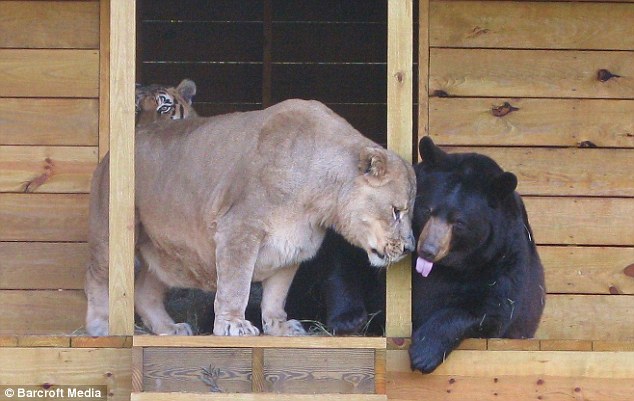
They make an unlikely trio but Baloo the bear, Leo the lion and Shere Khan the tiger have forged an unusually strong bond.

Considering that they would be mortal enemies if they ever were to meet in the wild, it is stunning to see their unique and genuine friendship in these intimate pictures.

Rescued eight years ago during a police drugs raid in Atlanta , Georgia , the three friends were only cubs at the time at barely two months old.  They had been kept as status symbol pets by the drug barons.

Living with the zoo's founders for the past eight years, Shere Khan, Baloo and Leo have now moved to a purpose built habitat Photo: BARCROFT

Delivered to the Noah’s Ark Animal Rescue Centre in Locust Grove, Georgia, the decision was made to keep the youngsters together, because of their budding rapport. ‘We could have separated them, but since they came as a kind of family, the zoo decided to keep them together,’ said Diane Smith, assistant director of Noah’s Ark. ‘To our knowledge, this is the only place where you’ll find this combination of animals together.’

Living with the zoo’s founders for the past eight years, Shere Khan, Baloo and Leo have now moved to a purpose-built habitat where the US public can now witness first hand their touching relationships.

We didn’t have the money to move them at first,’ said Diane.  ‘Now their habitat is sorted and they have been moved away from the children’s zoo areas where the public couldn’t really get a good look.’

It is possible to see Baloo, who is a 1000lb bear, Shere Khan, a 350lb tiger and Leo the Lion, who is also 350lbs, messing around like brothers.  ‘They are totally oblivious to the fact that in any other circumstance they would not be friends.’

Handled by Charles and Jama Hedgecoth, the zoo’s owners and founders, the three friendly giants appear to have no comprehension of their animal differences.

Baloo and Shere Khan are very close,’ says Diane, ‘That is because they rise early, and as Leo is a lion, he likes to spend most of the day sleeping.  It is wonderful and magical to see a giant American Black Bear put his arm around a Bengal and then to see the tiger nuzzle up to the bear like a domestic cat.  When Leo wakes up the three of them mess around for most of the day before they settle down to some food.’

Surprisingly for three apex predators with the power to kill with a single bite or swipe of their paw, they are very relaxed around each other.

They eat, sleep and play together,’ said Jama.  ‘As they treat each other as siblings they will lie on top of each other for heat and simply for affection.  At the moment they are getting used to their new habitat.  Shere Khan is being quite reticent about the move, but Baloo, the bear, is very good at leading him on and making him feel comfortable and safe.’

Explaining that the three ‘brothers’ have always seemed to share a unique bond, Charles said: ‘Noah’s Ark is their home and they could not possibly be separated from each other.  You just have to remember who you’re dealing with when you are with them, though.  It’s when you forget that these fellows are wild animals that you get yourself in trouble.’

The trio’s new habitat had to be constructed carefully, in order to accommodate its occupants.

Jama said: ‘The clubhouse had to be very sturdy for the guys, because they all sleep in it together.’

She added: ‘We had to include a creek, because the tiger and the bear both like to be in water.’

Climate and truth, footnote.

So many vested opinions!

Regular readers will know that I published recently, in two parts, a post with the heading of Climate, truth and integrity, the first part being here and the second part here.

To me the arguments supporting the premise that mankind is engaged in the process of destroying our very being are powerful and convincing.  But if there is any serious scientific doubt, then I am reminded of that saying in aviation circles about a risk to the safety of an aircraft, “If there’s any doubt, there’s no doubt!”  Surely, that’s the stance the climate change skeptics should be taking!  Because when the evidence of global warming, pollution, natural resource depletion, species extinctions, and habitat destruction is drawn together and there are no skeptics left, then will the last person left alive please switch the lights off!

Anyway, I’m going to republish, with permission, a recent Post that appeared on Tom Engelhardt‘s powerful blogsite, Tom Dispatch.  It was written by Bill McKibben of 350.org fame.  Here it is,

Tomgram: Bill McKibben, Why the Energy-Industrial Elite Has It In for the Planet

Posted by Bill McKibben at 9:39am, February 7, 2012.

Introduction

Two Saturdays ago, I was walking with a friend in a park here in New York City.  It was late January, but I was dressed in a light sweater and a thin fall jacket, which I had just taken off and tied around my waist.  We were passing a strip of bare ground when suddenly we both did a double-take.  He looked at me and said, “Crocuses!”  Dumbfounded, I replied, “Yes, I see them.”  And there they were, a few clumps of telltale green shoots poking up from the all-brown ground as if it were spring.  Such a common, comforting sight, but it sent a chill through me that noticeably wasn’t in the air.  Even the flowers, I thought, are confused by our new version of weather.

Later that same week, as temperatures in the Big Apple crested 60 degrees, I was chatting on the phone with a friend in Northampton, Massachusetts.  I was telling him about the crocuses, when he suddenly said, “I’m looking out my window right now and for the first time in my memory of January, there’s not a trace of snow!”

Of course, our tales couldn’t be more minor or anecdotal, even if the temperatures that week did feel like we were on another planet.  Here’s the thing, though: after a while, even anecdotes add up — maybe we should start calling them “extreme anecdotes” — and right now there are so many of them being recounted across the planet.  How could there not be in a winter, now sometimes referred to as “Junuary,” in which, in the United States, 2,890 daily high temperature records have either been broken or tied at last count, with the numbers still rising?  Meanwhile, just to the south of us, in Mexico, extreme anecdotes abound, since parts of the country are experiencing “the worst drought on record.”  Even cacti are reportedly wilting and some towns are running out of water (as they are across the border in drought-stricken Texas).  And worst of all, the Mexican drought is expected to intensify in the months to come.

And who can doubt that in Europe, experiencing an extreme cold spell the likes of which hasn’t been seen in decades — even Rome had a rare snowfall and Venice’s canals were reported to be freezing over — there are another set of all-too-extreme anecdotes.  After all, in places like Ukraine, scores of the homeless are freezing to death, pipes are bursting, power cuts are growing, and maybe even an instant energy crisis is underway (at a moment when the European Union is getting ready to cut itself off from Iranian oil).

That’s just to begin a list.  And yet here’s the strange thing.  At least in this country, you can read the “freaky” weather reports or listen to the breathless TV accounts of unexpected tornadoes striking the South in January and rarely catch a mention of the phrase “climate change.”  Given the circumstances, the relative silence on the subject is little short of eerie, even if worries about climate change lurk just below the surface.  Which is why it’s good to have TomDispatch regular Bill McKibben, author of Eaarth: Making a Life on a Tough New Planet, take a clear-eyed look at American denialism and just what it is we prefer not to take in. Tom

The Great Carbon Bubble
Why the Fossil Fuel Industry Fights So Hard

By Bill McKibben

If we could see the world with a particularly illuminating set of spectacles, one of its most prominent features at the moment would be a giant carbon bubble, whose bursting someday will make the housing bubble of 2007 look like a lark. As yet — as we shall see — it’s unfortunately largely invisible to us.

In compensation, though, we have some truly beautiful images made possible by new technology.  Last month, for instance, NASA updated the most iconic photograph in our civilization’s gallery: “Blue Marble,” originally taken from Apollo 17 in 1972. The spectacular new high-def image [see below, Ed] shows a picture of the Americas on January 4th, a good day for snapping photos because there weren’t many clouds.

It was also a good day because of the striking way it could demonstrate to us just how much the planet has changed in 40 years. As Jeff Masters, the web’s most widely read meteorologist, explains, “The U.S. and Canada are virtually snow-free and cloud-free, which is extremely rare for a January day. The lack of snow in the mountains of the Western U.S. is particularly unusual. I doubt one could find a January day this cloud-free with so little snow on the ground throughout the entire satellite record, going back to the early 1960s.”

In fact, it’s likely that the week that photo was taken will prove “the driest first week in recorded U.S. history.” Indeed, it followed on 2011, which showed the greatest weather extremes in our history — 56% of the country was either in drought or flood, which was no surprise since “climate change science predicts wet areas will tend to get wetter and dry areas will tend to get drier.” Indeed, the nation suffered 14 weather disasters each causing $1 billion or more in damage last year. (The old record was nine.) Masters again: “Watching the weather over the past two years has been like watching a famous baseball hitter on steroids.”

In the face of such data — statistics that you can duplicate for almost every region of the planet — you’d think we’d already be in an all-out effort to do something about climate change. Instead, we’re witnessing an all-out effort to… deny there’s a problem.

Our GOP presidential candidates are working hard to make sure no one thinks they’d appease chemistry and physics. At the last Republican debate in Florida, Rick Santorum insisted that he should be the nominee because he’d caught on earlier than Newt or Mitt to the global warming “hoax.”

Most of the media pays remarkably little attention to what’s happening. Coverage of global warming has dipped 40% over the last two years. When, say, there’s a rare outbreak of January tornadoes, TV anchors politely discuss “extreme weather,” but climate change is the disaster that dare not speak its name.

And when they do break their silence, some of our elite organs are happy to indulge in outright denial. Last month, for instance, the Wall Street Journal published an op-ed by “16 scientists and engineers” headlined “No Need to Panic About Global Warming.” The article was easily debunked. It was nothing but a mash-up of long-since-disproved arguments by people who turned out mostly not to be climate scientists at all, quoting other scientists who immediately said their actual work showed just the opposite.

It’s no secret where this denialism comes from: the fossil fuel industry pays for it. (Of the 16 authors of the Journal article, for instance, five had had ties to Exxon.)Writers from Ross Gelbspan to Naomi Oreskes have made this case with such overwhelming power that no one even really tries denying it any more. The open question is why the industry persists in denial in the face of an endless body of fact showing climate change is the greatest danger we’ve ever faced.

Why doesn’t it fold the way the tobacco industry eventually did? Why doesn’t it invest its riches in things like solar panels and so profit handsomely from the next generation of energy? As it happens, the answer is more interesting than you might think.

Part of it’s simple enough: the giant energy companies are making so much money right now that they can’t stop gorging themselves. ExxonMobil, year after year, pulls in more money than any company in history. Chevron’s not far behind. Everyone in the business is swimming in money.

Still, they could theoretically invest all that cash in new clean technology or research and development for the same. As it happens, though, they’ve got a deeper problem, one that’s become clear only in the last few years. Put briefly: their value is largely based on fossil-fuel reserves that won’t be burned if we ever take global warming seriously.

When I talked about a carbon bubble at the beginning of this essay, this is what I meant. Here are some of the relevant numbers, courtesy of the Capital Institute: we’re already seeing widespread climate disruption, but if we want to avoid utter, civilization-shaking disaster, many scientists have pointed to a two-degree rise in global temperatures as the most we could possibly deal with.

If we spew 565 gigatons more carbon into the atmosphere, we’ll quite possibly go right past that reddest of red lines. But the oil companies, private and state-owned, have current reserves on the books equivalent to 2,795 gigatons — five times more than we can ever safely burn. It has to stay in the ground.

Put another way, in ecological terms it would be extremely prudent to write off $20 trillion worth of those reserves. In economic terms, of course, it would be a disaster, first and foremost for shareholders and executives of companies like ExxonMobil (and people in places like Venezuela).

If you run an oil company, this sort of write-off is the disastrous future staring you in the face as soon as climate change is taken as seriously as it should be, and that’s far scarier than drought and flood. It’s why you’ll do anything — including fund an endless campaigns of lies — to avoid coming to terms with its reality. So instead, we simply charge ahead.  To take just one example, last month the boss of the U.S. Chamber of Commerce, Thomas Donohue, called for burning all the country’s newly discovered coal, gas, and oil — believed to be 1,800 gigatons worth of carbon from our nation alone.

What he and the rest of the energy-industrial elite are denying, in other words, is that the business models at the center of our economy are in the deepest possible conflict with physics and chemistry. The carbon bubble that looms over our world needs to be deflated soon. As with our fiscal crisis, failure to do so will cause enormous pain — pain, in fact, almost beyond imagining. After all, if you think banks are too big to fail, consider the climate as a whole and imagine the nature of the bailout that would face us when that bubble finally bursts.

Unfortunately, it won’t burst by itself — not in time, anyway. The fossil-fuel companies, with their heavily funded denialism and their record campaign contributions, have been able to keep at bay even the tamest efforts at reining in carbon emissions. With each passing day, they’re leveraging us deeper into an unpayable carbon debt — and with each passing day, they’re raking in unimaginable returns. ExxonMobil last week reported its 2011 profits at $41 billion, the second highest of all time. Do you wonder who owns the record? That would be ExxonMobil in 2008 at $45 billion.

Telling the truth about climate change would require pulling away the biggest punchbowl in history, right when the party is in full swing. That’s why the fight is so pitched. That’s why those of us battling for the future need to raise our game. And it’s why that view from the satellites, however beautiful from a distance, is likely to become ever harder to recognize as our home planet.

Bill McKibben is Schumann Distinguished Scholar at Middlebury College, founder of the global climate campaign 350.org, a TomDispatch regular, and the author, most recently, of Eaarth: Making a Life on a Tough New Planet.

Follow TomDispatch on Twitter @TomDispatch and join us on Facebook.

Copyright 2012 Bill McKibben

This photo was taken on January 4, 2012.

Most Amazing High Definition Image of Earth – Blue Marble 2012

January 25, 2012

*Updated February 2, 2012: According to Flickr, “The western hemisphere Blue Marble 2012 image has rocketed up to over 3.1 million views making it one of the all time most viewed images on the site after only one week.”

A ‘Blue Marble’ image of the Earth taken from the VIIRS instrument aboard NASA’s most recently launched Earth-observing satellite – Suomi NPP. This composite image uses a number of swaths of the Earth’s surface taken on January 4, 2012. The NPP satellite was renamed ‘Suomi NPP’ on January 24, 2012 to honor the late Verner E. Suomi of the University of Wisconsin.

Suomi NPP is NASA’s next Earth-observing research satellite. It is the first of a new generation of satellites that will observe many facets of our changing Earth.

Suomi NPP is carrying five instruments on board. The biggest and most important instrument is The Visible/Infrared Imager Radiometer Suite or VIIRS.

To read more about NASA’s Suomi NPP go to: www.nasa.gov/npp

Credit: NASA/NOAA/GSFC/Suomi NPP/VIIRS/Norman Kuring