Category: Core thought

Synchronicity of minds, part one.

A collection of essays and ideas that unite in a common theme.

Back in those times before dogs became the domesticated friends of man, the leader of the pack, the alpha female, had two key pack roles.  One of them was having first pick of the males, for mating purposes, and the other was knowing when their territory was no longer conducive to her pack’s interests.  When that happened the ‘boss lady’ was the one to signal that the pack had to find another, more beneficial, homestead.

While mankind is in desperate need of learning so many of the qualities of dogs the one example that is beyond us is finding a new homestead. This planet is the only homestead we have.

This basic and fundamental concept seems to be missing from the minds of leaders and power-brokers.  Missing big time!

Coincidentally, over recent days there have been three essays from three different authors that scream out the madness, to put it nicely, of the way of our world just now. Let me dip into those three essays.

First, to a recent essay from Tom Engelhardt over at TomDispatch.

American Jihad 2014 
The New Fundamentalists 
By Tom Engelhardt

In a 1950s civics textbook of mine, I can remember a Martian landing on Main Street, U.S.A., to be instructed in the glories of our political system.  You know, our tripartite government, checks and balances, miraculous set of rights, and vibrant democracy.  There was, Americans then thought, much to be proud of, and so for that generation of children, many Martians were instructed in the American way of life.  These days, I suspect, not so many.

Still, I wondered just what lessons might be offered to such a Martian crash-landing in Washington as 2014 begins.  Certainly checks, balances, rights, and democracy wouldn’t top any New Year’s list.  Since my childhood, in fact, that tripartite government has grown a fourth part, a national security state that is remarkably unchecked and unbalanced.  In recent times, that labyrinthine structure of intelligence agencies morphing into war-fighting outfits, the U.S. military (with its own secret military, the special operations forces, gestating inside it), and the Department of Homeland Security, a monster conglomeration of agencies that is an actual “defense department,” as well as a vast contingent of weapons makers, contractors, and profiteers bolstered by an army of lobbyists, has never stopped growing.  It has won the undying fealty of Congress, embraced the power of the presidency, made itself into a jobs program for the American people, and been largely free to do as it pleased with almost unlimited taxpayer dollars.

The expansion of Washington’s national security state — let’s call it the NSS — to gargantuan proportions has historically met little opposition.  In the wake of the Edward Snowdenrevelations, however, some resistance has arisen, especially when it comes to the “right” of one part of the NSS to turn the world into a listening post and gather, in particular, American communications of every sort.  The debate about this — invariably framed within the boundaries of whether or not we should have more security or more privacy and how exactly to balance the two — has been reasonably vigorous.  The problem is: it doesn’t begin to get at the real nature of the NSS or the problems it poses.

If I were to instruct that stray Martian lost in the nation’s capital, I might choose another framework entirely for my lesson.  After all, the focus of the NSS, which has like an incubus grown to monumental proportions inside the body of the political system, would seem distinctly monomaniacal, if only we could step outside our normal way of thinking for a moment.  At a cost of nearly a trillion dollars a year, its main global enemy consists of thousands of lightly armed jihadis and wannabe jihadis scattered mainly across the backlands of the planet.  They are capable of causing genuine damage — though far less to the United States than numerous other countries — but not of shaking our way of life.  And yet for the leaders, bureaucrats, corporate cronies, rank and file, and acolytes of the NSS, it’s a focus that can never be intense enough on behalf of a system that can never grow large enough or be well funded enough.

It’s a long, deeply thoughtful essay that deserves your full read.  This is how it closes:

After 12 long years in Afghanistan and an Obama era surge in that country, the latest grim National Intelligence Estimate from the U.S. intelligence community suggests that no matter what Washington now does, the likelihood is that things there will only go from bad enough to far worse.  Years of a drone campaign against al-Qaeda in the Arabian Peninsula hasstrengthened that organization; an air intervention in Libya led to chaos, a dead ambassador, and a growing al-Qaeda movement in northern Africa — and so it repetitively goes.

Similarly, intelligence officials brag of terrorist plots — 54 of them! — that have been broken up thanks in whole or in part to the National Security Agency’s metadata sweeps of U.S. phone calls; it also claims that, given the need of secrecy, only four of them can be made public.  (The claims of success on even those four, when examined by journalists, have proved less than impressive.)  Meanwhile, the presidential task force charged with reviewing the NSA revelations, which had access to a far wider range of insider information, came to aneven more startling conclusion: not one instance could be found in which that metadata the NSA was storing in bulk had thwarted a terrorist plot. “Our review,” the panel wrote, “suggests that the information contributed to terrorist investigations by the use of section 215 telephony meta-data was not essential to preventing attacks.” (And keep in mind that, based on what we do know about such terror plots, a surprising number of them were planned or sparked or made possible by FBI-inspired plants.)

In fact, claims of success against such plots couldn’t be more faith-based, relying as they generally do on the word of intelligence officials who have proven themselves untrustworthy or on the impossible-to-prove-or-disprove claim that if such a system didn’t exist, far worse would have happened.  That version of a success story is well summarized in the claim that “we didn’t have another 9/11.”

In other words, in bang-for-the-buck practical terms, Washington’s national security state should be viewed as a remarkable failure.  And yet, in faith-based terms, it couldn’t be a greater success.  Its false gods are largely accepted by acclamation and regularly worshiped in Washington and beyond.  As the funding continues to pour in, the NSS has transformed itself into something like a shadow government in that city, while precluding from all serious discussion the possibility of its own future dismantlement or of what could replace it.  It has made other options ephemeral and more immediate dangers than terrorism to the health and wellbeing of Americans seem, at best, secondary.  It has pumped fear into the American soul.  It is a religion of state power.

No Martian could mistake it for anything else.

Tom Engelhardt, a co-founder of the American Empire Project and author of The United States of Fear as well as a history of the Cold War, The End of Victory Culture, runs the Nation Institute’s TomDispatch.com. His latest book, co-authored with Nick Turse, is Terminator Planet: The First History of Drone Warfare, 2001-2050.

Follow TomDispatch on Twitter and join us on Facebook or Tumblr. Check out the newest Dispatch Book, Ann Jones’s They Were Soldiers: How the Wounded Return From America’s Wars — The Untold Story.

Copyright 2014 Tom Engelhardt

Now let’s move from the USA to the UK.  George Monbiot penned an essay on the 6th January about the growing loss of freedoms in my old home country.  He opens:

Dead Zone

January 6, 2014

A shocking new bill threatens to make this country feel like a giant shopping mall.

By George Monbiot, published in the Guardian 7th January 2014

Until the late 19th Century, much of our city space was owned by private landlords. Squares were gated, streets were controlled by turnpikes. The great unwashed, many of whom had been expelled from the countryside by acts of enclosure, were also excluded from desirable parts of town.

Social reformers and democratic movements tore down the barriers, and public space became a right, not a privilege. But social exclusion follows inequality as night follows day, and now, with little public debate, our city centres are again being privatised or semi-privatised. They are being turned by the companies that run them into soulless, cheerless, pasteurised piazzas, in which plastic policemen harry anyone loitering without intent to shop.

Streetlife in these places is reduced to a trance-world of consumerism, of conformity and atomisation, in which nothing unpredictable or disconcerting happens, a world made safe for selling mountains of pointless junk to tranquilised shoppers. Spontaneous gatherings of any other kind – unruly, exuberant, open-ended, oppositional – are banned. Young, homeless and eccentric people are, in the eyes of those upholding this dead-eyed, sanitised version of public order, guilty until proven innocent.

Then a few paragraphs later, the essay continues:

The existing rules are bad enough. Introduced by the 1998 Crime and Disorder Act, anti-social behavour orders (Asbos) have criminalised an apparently endless range of activities, subjecting thousands – mostly young and poor – to bespoke laws. They have been used to enforce a kind of caste prohibition: personalised rules which prevent the untouchables from intruding into the lives of others.

You get an Asbo for behaving in a manner deemed by a magistrate as likely to cause harassment, alarm or distress to other people. Under this injunction, the proscribed behaviour becomes a criminal offence. Asbos have been granted which forbid the carrying of condoms by a prostitute, homeless alcoholics from possessing alcohol in a public place, a soup kitchen from giving food to the poor, a young man from walking down any road other than his own, children from playing football in the street. They were used to ban peaceful protests against the Olympic clearances.

Inevitably, over half the people subject to Asbos break them. As Liberty says, these injunctions “set the young, vulnerable or mentally ill up to fail”, and fast-track them into the criminal justice system. They allow the courts to imprison people for offences which are not otherwise imprisonable. One homeless young man was sentenced to five years in jail for begging: an offence for which no custodial sentence exists. Asbos permit the police and courts to create their own laws and their own penal codes.

All this is about to get much worse. Tomorrow the Anti-social Behaviour, Crime and Policing Bill reaches its report stage (close to the end of the process) in the House of Lords. It is remarkable how little fuss has been made about it, and how little we know of what is about to hit us.

The bill would permit injunctions against anyone of 10 or above who “has engaged or threatens to engage in conduct capable of causing nuisance or annoyance to any person.” It would replace Asbos with Ipnas (Injunctions to Prevent Nuisance and Annoyance), which would not only forbid certain forms of behaviour, but also force the recipient to discharge positive obligations. In other words, they can impose a kind of community service on people who have committed no crime, which could, the law proposes, remain in force for the rest of their lives.

The bill also introduces Public Space Protection Orders, which can prevent either everybody or particular kinds of people from doing certain things in certain places. It creates new dispersal powers, which can be used by the police to exclude people from an area (there is no size limit), whether or not they have done anything wrong.

Please read the original essay in full as well as refer to background links that were included in that original.  I will offer the closing paragraphs.

The Home Office minister, Norman Baker, once a defender of civil liberties, now the architect of the most oppressive bill pushed through any recent parliament, claims that the amendments he offered in December will “reassure people that basic liberties will not be affected”(11). But Liberty describes them as “a little bit of window-dressing: nothing substantial has changed.”(12)

The new injunctions and the new dispersal orders create a system in which the authorities can prevent anyone from doing more or less anything. But they won’t be deployed against anyone. Advertisers, who cause plenty of nuisance and annoyance, have nothing to fear; nor do opera lovers hogging the pavements of Covent Garden. Annoyance and nuisance are what young people cause; they are inflicted by oddballs, the underclass, those who dispute the claims of power.

These laws will be used to stamp out plurality and difference, to douse the exuberance of youth, to pursue children for the crime of being young and together in a public place, to help turn this nation into a money-making monoculture, controlled, homogenised, lifeless, strifeless and bland. For a government which represents the old and the rich, that must sound like paradise.

www.monbiot.com

The last of the three essays was about Europe, being an essay on Naked Capitalism two days ago.

Written by Don Quijones, a freelance writer and translator based in Barcelona, Spain who also publishes the blog Raging Bull-Shit, the essay was originally posted at Testosterone Pit.

Death By A Thousand Cuts: The Silent Assassination Of European Democracy

As is gradually dawning on more and more people across the old continent, the European Union is riddled with fatal flaws and defects. Chief among them is the single currency which, rather than serving as the Union’s springboard to global dominance, could well be its ultimate undoing.

Another huge problem with the EU is its acute lack of transparency. Staggering as it may seem, in the last 20 years the Union has not passed a single audit. Indeed, so opaque is the state of its finances that in 2002 Marta Andreasen, the first ever professional accountant to serve as the Commission’s Chief Accountant, refused to sign off the organization’s 2001 accounts, citing concerns that the EU’s accounting system was “open to fraud.” After taking her concerns public, Andreasen was suspended and then later sacked by the Commission.

However, by far the EU’s greatest — and certainly most dangerous — structural flaw is its gaping democratic deficit. To paraphrase Nigel Farage, the stridently anti-EU British MEP, not only is the EU undemocratic, it is fundamentally anti-democratic.

Yet again, the essay must be read in full.  As with the others, I will include the closing paragraphs:

Of course none of this would be possible if it weren’t for the abject failure of modern nation-state democracy — not only in Europe, but across the globe. As Mair wrote in the first paragraph of his book, although the political parties themselves remain, “they have become so disconnected from the wider society, and pursue a form of competition that is so lacking in meaning, that they no longer seem capable of sustaining democracy in its present form.”

The European elites have masterfully exploited this crisis of representative democracy and the resultant voter disaffection and apathy to enshrine a new system of rule by bureaucrats, bankers, technocrats and lobbyists (as I reported in Full Steam Ahead For the EU Gravy Train, Brussels is home to the second biggest lobby industry in the world, just behind Washington). If anything, we can expect this trend to accelerate in 2014 as the Eurocrats seek to consolidate their power grab through the imposition of EU-wide banking and fiscal union. Once that’s done, the quest for the holy grail of full-blown political union will begin in earnest.

Whether the EU is able to pull of this ultimate coup de grace in its decades-long coup d’état will depend on two vital factors: its ability to continue preventing economic reality from impacting the financial markets; and the willingness of hundreds of millions of European people to be herded and corralled into a new age of technocracy.

oooo

the abject failure of modern nation-state democracy — not only in Europe, but across the globe.

Don Quijones wrote that with a focus on Europe.  But also a recognition that right across the world the rights and safeguards of everyday citizens are being dangerously undermined.  I will return tomorrow with Part Two and an insight into the growing power of those everyday citizens.


Legitimate anger.

What a greedy, selfish race of people we can be at times!

I’m writing about the subject of elephants.  Or, to put it more precisely and distastefully, the murder of elephants. For the ivory in their tusks.

The post was prompted by a recent item over on Chris Snuggs’ blog Nemo Insula Est.  Chris and I have known each other for quite a few years now; since the time that he was Head of Studies at the French college, ISUGA, in Quimper, France and where I attended as a visiting teacher running a class on Sales & Marketing.

Chris has allowed me to republish the piece in full.  Please read today’s post and then come back tomorrow to see in what ways we can all help.

ooOOoo

The Human Shame in Northern Kenya

03JAN

One of my NYRs was to stop reading bad news, but that lasted about 6 hours ….. there is of course so much of it, and so much that is utterly depressing. One of the first of 2014 was an article in “The Independent”:

Elephant Appeal: Few are willing to say just how bad the poaching crisis is – the elephant population may easily fall into terminal decline

Tragic, to the extreme!

You can get all the details from the article – which is pretty harrowing, with surviving elephants described as being “stricken with grief” as they cluster round their slaughtered brethren – but basically, elephants in the Tsavo East National Park in Northern Kenya are under threat of extinction from poachers from Somalia. This provoked a number of reactions on my part:

DEMAND

  • The price of ivory depends on the demand and supply. The former is very strong and apparently rising, especially in China. For extraordinarily moronic and selfish reasons, ivory is considered artistic and – for example – tiger and rhinoceros parts medicinal and/or possessing aphrodysiac properties.
  • Can China really do NOTHING to stop this cultural abomination? People in the west for the most part stopped acquiring ivory years ago.
  • If China – and other Asia nations – cannot or will not do anything, should the west not apply more pressure? Same applies of course to China’s support of North Korea. YES, sanctions are painful, but nothing NON-painful is likely to work.

THE POACHERS

  • They are execrable, of course …… and yet, many may be extremely poor, and indeed ignorant. There is no excuse in the strictest sense, but it may to some extent be understandable if they see a chance to make several years’ normal income in a single day. This is no different from City bankers, or indeed the Enron directors and many others: greed is sadly rampant on our planet.
  • But  the poachers are not only ignorant and destitute farmers: terrorists are now apparently turning to the ivory trade, too.
  • There are insufficient funds to patrol the parks properly. Kenya is just one more corrupt African state where politicians earn a fortune while basic needs and services are severely underfunded.

MORALITY

I always wonder what if anything goes through the minds of those who spend these obscene sums on frippery and personal self-glorification. Do they ever think that their money could do immense good elsewhere? Would WE be just the same in their shoes?

Is there any solution to this greed?

ooOOoo

Chris wrote his post motivated by the article in The Independent UK newspaper.  But that newspaper was not alone in promulgating the despicable killings of these smart and magnificent creatures.  Here’s a story that was in the UK Daily Telegraph newspaper a year ago.

Horror as entire family of elephants slaughtered for ivory

Armed wildlife rangers on Tuesday night fanned out across eastern Kenya in pursuit of ivory poachers who killed an entire family of 12 elephants in the country’s worst single such slaughter since the 1980s.

By , Nairobi

5:26PM GMT 08 Jan 2013

Eleven adults and one infant calf died in a “targeted and efficient” attack highlighting the growing professionalism of poachers bankrolled by international criminals supplying soaring demand for ivory in the Far East.

Six of the animals lay in one heap, their tusks hacked out with machetes.

None of the family group managed to flee further than 300 yards before they were gunned down and their ivory removed.

The calf, less than a year old, is believed to have been crushed by its dying mother as she fell to the ground.

“It is unimaginable, a heinous, heinous crime,” said Paul Udoto, spokesman for the Kenya Wildlife Service (KWS).

“We have not seen such an incident in recent memory, it’s the worst single loss that we have on record, and our records go back almost 30 years.

“These were professional killers. The attack was targeted and efficient.”

The poachers, armed with automatic rifles, had already fled but there were hopes last night that a massive search involving foot patrols, a dozen vehicles and three aircraft could still find them.

“Every possible resource is being deployed to track down these criminals,” Mr Udoto said. “They will feel the full force of the law.”

But the area where the elephants were killed, in the north of Kenya’s largest wildlife reserve, Tsavo East National Park, is sparsely populated, has few roads, and lies close to Kenya’s border with Somalia.

Privately, conservationists said they feared the poachers and their haul of 22 tusks, worth an estimated GBP175,000 on the Asian market, would already have escaped.

The attack was the latest in a surge of elephant deaths that has seen the number of the animals killed for their ivory in Kenya increase sevenfold in five years, from fewer than 50 in 2007 to 360 in 2012, according to KWS figures.

The increase has led many wildlife experts to declare the current situation a crisis worse even than the mass slaughter of Africa’s elephants in the 1970s and 1980s, which led to a global ivory trade ban in 1989.

I don’t have permission to republish the article so please go here and read the full piece and view a couple of harrowing photographs.

Then come back tomorrow and explore how you and I can do something to help. Please.

The Pain and the Hope, continued.

Part Three of reflections on where we are today.

Those of you who watched Part One of Awakening the Dreamer that was published yesterday could be excused for thinking that it was a very gloomy window on our world at the start of 2014.

Park those feelings and watch Part Two.

The Hope

[vimeo http://vimeo.com/52496263]

ooOOoo

Tomorrow, Friday, I will complete this run of four days by dropping in on a few of the organisations named in these films plus a few other items.

The Pain and the Hope

Part Two of reflections on where we are today.

First things first!

A very Happy New Year to you and all your loved ones!

Yesterday (I’m tempted to write last year!), I posted a little tale about the donkey in the well; essentially a message about being happy.

My original plan for today was to post a series of photographs of some animals next door that our neighbours, Larry and Janell, have recently adopted.

But then Jean and I watched a documentary two evenings ago that had us both spellbound. The documentary, Awakening the Dreamer, consisted of two 45-minute films.  The first highlighting the precarious nature of our present times.  The second showing the accelerating pace of people all across the world actively changing things for the better.  Hence the title of the post The Pain and the Hope.

So here’s Part One.   I do so hope you can find the time to watch it.

The Pain

ooOOoo

Approaching the New Year!

Part One of reflections on where we are today.

Depending on just where in the world you are, the New Year of 2014 is anything from a few to twenty-four hours away.  How that year turns out will, to a very great extent, depend on millions and millions of behaviours.  In other words, the behavioural choices each of us makes. Because, as millions of us already understand, our world on this, our only, Planet is facing changes potentially beyond our imagination.  Caring for our Planet and all of life upon it is meaningless without those behavioural choices being the right ones for our Planet.

A couple of days ago, I read the following on Facebook.  It seemed an appropriate tale for the start of 2014.

ooOOoo

Now what?
Now what?

One day a farmer’s donkey fell down into a well. The animal cried piteously for hours as the farmer tried to figure out what to do. Finally, he decided the animal was old and the well needed to be covered up anyway; it just wasn’t worth it to retrieve the donkey.

He invited all his neighbors to come over and help him. They all grabbed a shovel and began to shovel dirt into the well. At first, the donkey realized what was happening and cried horribly. Then, to everyone’s amazement he quieted down.

A few shovel loads later, the farmer finally looked down the well. He was astonished at what he saw. With each shovel of dirt that hit his back, the donkey was doing something amazing. He would shake it off and take a step up.

As the farmer’s neighbors continued to shovel dirt on top of the animal, he would shake it off and take a step up. Pretty soon, everyone was amazed as the donkey stepped up over the edge of the well and happily trotted off!

MORAL :

Life is going to shovel dirt on you, all kinds of dirt. The trick to getting out of the well is to shake it off and take a step up. Each of our troubles is a steppingstone. We can get out of the deepest wells just by not stopping, never giving up! Shake it off and take a step up.

Remember the five simple rules to be happy:

  1. Free your heart from hatred – Forgive.
  2. Free your mind from worries – Most never happens.
  3. Live simply and appreciate what you have.
  4. Give more.
  5. Expect less from people but more from yourself.

You have two choices … smile and close this page, or pass this along to someone else to share the lesson.

ooOOoo

Part Two of these reflections is tomorrow.

A very Happy New Year to you.

We must rewild!

It sounds counter-intuitive but it may be the only way forward.

Regular visitors to Learning from Dogs will know that from time to time I refer to the essays of George Monbiot. I was recently browsing Mr. Monbiot’s website and learnt that in July 2013 he gave a TED Talk on Rewilding.  It was called: For more wonder, rewild the world.

Here is that talk.  Do watch it first.

http://www.youtube.com/watch?v=8rZzHkpyPkc

Published on Sep 9, 2013

Wolves were once native to the US’ Yellowstone National Park — until hunting wiped them out. But when, in 1995, the wolves began to come back (thanks to an aggressive management program), something interesting happened: the rest of the park began to find a new, more healthful balance. In a bold thought experiment, George Monbiot imagines a wilder world in which humans work to restore the complex, lost natural food chains that once surrounded us.

The talk reminded me that a couple of months ago Patrice Ayme published an essay called REWILDING US.  With Patrice’s permission that essay is republished here in full.

ooOOoo

REWILDING US.

REALITY IS WILD & FEROCIOUS. IGNORING IT IS INHUMAN.

And Presents A Civilizational Risk.

Princeton is freaking out. Flesh devouring aliens are lurking out in the woods, threatening academia’s fragile thoughts. Krugman:

‘From the Princeton Town Topics, which used to be all about (a) parking (b) deer:

A growing population of coyotes in the wooded area bordering the Institute for Advanced Study has motivated the Princeton Animal Control Advisory Committee to recommend that sharpshooters be hired to help handle the problem. “There is a big pack over at the Institute Woods,” officer Johnson said this week. “I’m having a lot of complaints that they follow people around.”‘

You Can’t Always Eat Who You Want

The “Mountain Lion”, is a relative of the Cheetah (erroneously put in the cat family, felis, until last year or so). It has 40 names, in English alone, and is found from the American Arctic to Patagonia, from the sea shore to the high mountains. The weight above is that of the female. Males are heavier (typically up to 100 kilograms). The heaviest puma shot in Arizona was 300 pounds (136 kilos).

The lion/cougar/puma is capable of jumping up twenty feet from a standstill (yes, 6 meters; horizontally, 14 meters). It is capable of killing a grizzly (pumas and ‘golden bears’ were famous for their naturally occurring furious fights to death in California). The feline’s crafty method consisted of jumping on top of the bear, and blinding him with furious pawing. Top speed: 50 mph, 80 km/h. (By the way, there used to be pure cheetahs in North America, recently exterminated by man. I propose to re-install the Asian cheetah in the USA, in a sort of cheetah diplomacy with Iran.)

The philosophical question here is: what is this world all about? Is it about living on our knees, or ruling among animals and wilderness?

Why would Princeton panic about small canids? Because they don’t obey the established order?

Coyotes are totally clever, and not at all dangerous (being so clever). They have very varied voices, when in packs. Going out and shooting them is really primitive, and misses the main point of having nature around. That is: to teach humility, and teach the richness of our planet, visit hearts with emotional diversity, and minds with complexity.

Bears and Mountain Lions are a completely different matter. They are both extremely clever too, but can be very dangerous.

Running and hiking in the Sierra, I got charged by scary bears several times. I view this dangerosity as a plus, but it never loses my mind, and I got scared nearly out my wits more than once.

Once, in a national Park on the coast, I literally ran into two large lions in 30 minutes! Then I got charged by a large elk before he realized I was not a lion. Other high notes were finding a bear cub on the trail in the near vertical mountain side, on the way down, as dusk was coming.

Another high point was the large bear by the trail, who was lying like a bear rug, at 9pm, in an apparent ruse to let me approach until he could jump at his prey, as he did, before realizing that I was not a deer, something that obviously infuriated him. He was torn between making the human into dinner, and the instinct that this would turn badly for him.

In Alaska I was charged by a moose with her progeny… although I did not go as fast as an experienced mountain biker who happened to be there too, the anti-grizzly cannister in my hand emboldened me to succeed in a circuitous move  to proceed towards my distant destination, something facilitated by the calf’s crash into some obstacle, drawing his mother’s concern. Mountain running often requires to proceed, no matter the obstacles in the way, when one is too far to turn around.

Bears know rocks, they have been hurt by them, and so they fear airborn rocks (throw the rock on something noisy, to impress; I had to hit, with a very large rock, a charging bear directly, once; it fled; it was killed by rangers later after he caused a flesh wound to somebody else; some will find all this very violent; well, it is, that’s part of the whole point).

Mountain Lions are better charged and/or, roared or barked at. They fear insane behavior.

In general making lots of noise helps, with bears and lions. I don’t have clever tricks to suggest for bathing safely in the murky icy Pacific. Although I assume that the presence of sea lions bobbing on the surface placidly is indicative of the absence of an obvious white shark prowling… In any case the Pacific is so cold, you will probably die of cardiac arrest before you are devoured.

In Africa, there are about 500,000 elephants. 25,000 to 30,000 are killed, a year, to send the ivory to east Asia (China, Vietnam). So African elephants may disappear. This is beyond tragic, it’s irreplaceable. Elephants understand people’s gestures, without any learning (they apparently learn to use trunk gestures among themselves). One is talking about extremely intelligent animals here. (In contrast, chimpanzees have great difficulties understanding human gestures.)

Intelligence and culture are dominant among apex mammals. That’s what makes them so superior. Washington State had the smart idea to shoot full grown adult male mountain lions. Thus mountain lion society and culture collapsed, uneducated teenagers took over, and incidents with humans exploded (something about the quiet macho society!).

A Japanese specialist of chimpanzee intelligence who happens to have a bear in his lab, found that the bear did not underperform chimpanzees on mental tasks (that’s actually a problem with bears; being so clever, they can be unpredictable, one can never know what they have up their sleeve, like the one who mimicked a bear rug, above, or one who drove a car in Tahoe). A number of social mentally advanced animals (sea mammals, parrots) use advanced languages.

So what are my recommendations? The Princeton Institute for Advanced Studies ought to realize that, if it wants to become really brainy, it ought to give our fellow species a chance. They are part of what make our minds, in full.

Elephants and rhinoceroses used to be all over Europe and North America. They ought to be re-introduced right away, using Indian and African species (rare camels too; later, thanks to genetic engineering, part of those could be replaced by re-engineered ancient species, such as the Mammoth). Lions and leopard-like species ought to be reintroduced too.

It can work: in the San Francisco Bay Area, there is an impressive population of mountain lions.  I had many close calls (in the most recent incident, a few weeks ago, a lion peed an enormous and dreadfully smelling amount on a trail I was making a loop on, obviously to show me he owned the territory, a total wilderness reserve a few miles from Silicon Valley… especially at dusk).

However, the lions are extremely good at avoiding people (although one got killed by police in downtown Berkeley in the wee hours of the morning). They will all be collared in the next ten years, to find out what is going on. With modern technology (collars!) and sophisticated human-animal culture, there is no reason why extremely dangerous, but clever species could not live in reasonable intelligence with humans.

So rewilding is possible. It’s also necessary. Why? So we humans can recover our hearts, and our minds.

Whether we like it or not, we are made for this wild planet. By forgetting how wild it is, by shooting it into submission, we lose track of the fact human life, and civilization itself, are much more fragile than they look.

And thus, by turning our back to the wilds, we lose track of what reality really is. Worse: we never discover all what our minds can be, and how thrilling the universe is. We are actually bad students who refuse to attend the most important school, that taught by reality itself.

Rewilding is necessary, not just to instill a mood conducive to saving the planet, but also to remake us in all we are supposed to be.

Expect Evil, And Don’t Submit.

These are the times when, once again, the plutocratic phenomenon is trying to take over. That’s when the few use the methods of Pluto to terrorize and subjugate the many (to constitute what is variously named an elite, oligarchy, or “nomenklatura“, or aristocracy, that is, a plutocracy).

And how is that possible? Because the many have been made into a blind, stupid, meek herd (I refer to Nietzsche for the condemnation of the herd mentality).

How do we prevent that? Nietzsche advocated the mentality of the “blonde beast“. That meant the lion (and not what the Nazis claimed it was; few were as anti-Nazi as Nietzsche). Why lion? Because lions are domineering. I learned in Africa that one could go a long way with wild lions, as long as one gave them respect, and time to get out of the way. However, disrespecting a lion means death.

Lions don’t accept to live on their knees. When abominable forces from the giant Persian theocratic plutocracy put the tiny Athenian democracy in desperate military situations, Athenians fought like lions. And democracy won.

Yet, 150 years later, when fascist, plutocratic, but apparently not as abominable, Macedonian forces put Athens in a difficult situation, Athenians surrendered. They did not fight like lions. Democracy would not come back to Athens for 23 centuries (and only thanks to the European Union).

We will not defeat plutocracy if we do not rewild ourselves. First: Let there be lions.

***

Patrice Ayme

ooOOoo

Yet something else we need to learn from dogs.

Photograph taken 25th April, 2012.

The above photograph was taken of young Cleo, just fifteen months old, showing that her innate skills of being in the wild were alive and well, despite thousands of years of dogs being domesticated animals.  Ergo, humans could manage just as well.

Animal rights.

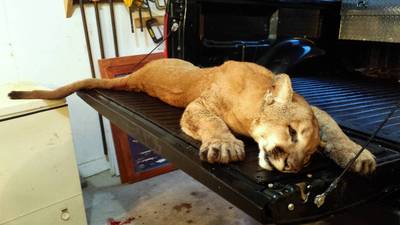
This cougar was looking for love.

I forget how I came across this editorial in the Chicago Tribune but it was published a month ago, to the day.  What is more to the point is that the editorial was inspiring and I vowed to republish it.  With the absence of any formal permission to republish the editorial I thought it best to leave it for a few weeks.  When you read it you will realise just why it needed to be shared with you.

ooOOoo

Editorial: The cougar killed in Illinois was looking for love

ILLINOIS DEPARTMENT OF NATURAL RESOURCESThis cougar was shot last week by a state conservation officer in Whiteside County. The animal needn’t really have been killed.
ILLINOIS DEPARTMENT OF NATURAL RESOURCES.
This cougar was shot last week by a state conservation officer in Whiteside County. The animal needn’t really have been killed.

He was lean, athletic and had traveled hundreds of miles, most likely from the Black Hills of southwestern South Dakota. He had attacked no one as he passed hundreds of towns and many more farms, each of them a lethal threat to his mission. Yet for lack of a better wildlife management plan in Illinois, the young cougar couldn’t get past a conservation officer armed with a state-issued rifle.

The necropsy says the cougar killed last week as he hid near Morrison, 130 miles west of Chicago, died of gunfire. In truth he died of official neglect: Even though more cougars and possibly wolves likely will be visiting Illinois, state lawmakers and the Department of Natural Resources haven’t forged policies that could allow the tranquilization, capture and survival of animals whose ancestors blissfully roamed the Midwest long before humans intruded on their turf.

Given his hunting skills, the young male could have homesteaded anywhere in the Upper Midwest and dined on the bountiful deer population for the rest of his life. Instead, his four huge paws carried out the imperative that drove him: With larger, older males driving him away from the females on their home ranges, this cougar came looking for love.

A farmer called authorities to report a large cat running from a cornfield toward his farmstead and, sure enough, a responding conservation officer found the cat under a corncrib, probably hiding until darkness would allow it to flee.

We won’t second-guess the officer, who consulted with law enforcement and wildlife personnel before killing the cougar. That said, this was an outcome that didn’t have to be. A magnificent creature might well be headed back to South Dakota if Illinois had learned lessons after Chicago police shot and killed a cornered cougar in the Roscoe Village neighborhood five years ago.

What all of us, legislators included, have to understand is that the return of feline or canine predators to their traditional realms doesn’t mean the animals want to hurt anyone. Even as this episode unfolded, millions of National Geographic readers were receiving the magazine’s December issue, with an 18-page spread: “Ghost Cats … Cougars are quietly reclaiming lost ground.” The relevant passage: “Cougars have attacked humans on about 145 occasions in the U.S. and Canada since 1890. Just over 20 of those assaults — an average of one every six years — proved fatal.”

Yet in this case, with an animal that had threatened no one while bypassing thousands of Midwesterners, a DNR spokesman rationalized that, “Public safety is what we’ll make the decision on every time.” The rest of DNR’s explanation is similarly lame: The department otherwise would have had to find someone to capture and move the animal. This officer thought the situation too unsafe to call a veterinarian to tranquilize the cat. Conservation officers don’t carry tranquilizer guns. That thinking led the DNR to the specious excuse that if the officer had shot the cougar with the wrong dosage of tranquilizer, the animal could have been harmed or killed accidentally. That excuse evokes the February 1968 explanation from a U.S. major to an Associated Press correspondent about the Vietnamese provincial city of Ben Tre: “It became necessary to destroy the town to save it.”

We were struck by sensible comments last week from Bruce Patterson, curator of mammals at Chicago’s Field Museum, who wonders why this animal had to be shot when it evidently was hiding during daylight and hadn’t threatened anyone: “It’s possible to manage wildlife while still keeping it around.”

When we editorialize about humans slaying wild predators, some readers say our concern should be — as it constantly is — directed instead to the needless killings of young people, and not toward one lost, probably frightened animal.

Fair enough, although it’s possible to think about both. Just as we know there will be more homicides, we know that more big predators likely are coming to Illinois. So we’ll look back to what we expressed after the 2008 killing of the cougar in Roscoe Village: We hope Illinois comes away from last week’s episode with more than one dead cougar and a communal sadness. Illinois should develop a reliable protocol that errs on the side of trying to preserve the life of the lost animal — not of making the ad hoc decision to kill it and then resolving the ambiguities in favor of that decision.

That’s what happened here. A logical first step now: Give cougars protection under the Illinois Wildlife Code; they lack that protection now only because there is no known breeding population in this state. But with trail cameras capturing photos of one or more cougars in Jo Daviess, Morgan, Pike and Calhoun counties last fall, the animals evidently are re-establishing themselves in a state where they haven’t been known to live since 1870. In recent years, wolves have dipped into Jo Daviess, the state’s northwest corner. A black bear even visited there, evidently for a few days.

Lawmakers, DNR officials, you can do better. So can the rest of us, first by using sites such as cougarnet.org to offset our visceral fear with scientific knowledge.

Wild animals roam this state. Always have and, we hope, always will. As we urged here in 2008: The same Illinois that was unprepared for the last cougar had better get ready for the next. He’s probably en route.

ooOOoo

As you contemplate your New Year resolutions for 2014 please resolve to protect our animals.

Words fail me!

But there is a very good ending!

There was an item in a recent set of links from Naked Capitalism that caught my eye.

It was a link to a story on Huffington Post that I am taking the liberty of republishing.

ooOOoo

Left To Die In A Trash Heap, Abandoned Dog Gets Remarkable Second Chance

The Huffington Post  |  By  Posted: 12/13/2013 5:19 pm EST

A moving video of the extraordinary recovery — and resilience — of an abandoned dog who was left to die in a trash heap is reminding us this week of the healing power of love, friendship and second chances.

On Nov. 15, when Eldad Hagar first laid eyes on Miley, an abandoned dog living among piles of trash on the outskirts of Los Angeles, his heart broke.

“When I got there, I almost couldn’t believe what I was seeing,” Hagar, the co-founder of animal rescue organization Hope For Paws, told The Huffington Post of his first encounter with the pup. “It’s almost as if this place was struck by a tsunami.”

Miley, covered in mange and infections, was so lifeless and defeated that Hagar, who recorded the dog’s rescue on camera, says she “didn’t even have the energy” to run away from him as he approached her.

Mileytrash1

Hagar says he rushed to Miley’s side after he heard about the pooch’s plight from a local resident. The tipster told him that Miley had been living in the trash heap for at least a few months. It is believed that she was abandoned by her owners.

Though he knew that Miley wouldn’t be in good shape, Hagar says he was still shocked when he finally made contact with her. Her physical deterioration was “definitely one of the worst cases” he’d ever seen, he said.

He knew he had to get Miley to a hospital right away.

Gaining the pup’s trust was no easy feat, however. Hagar says he offered her food and sat with her in the pile of trash for an hour before she was finally ready to leave with him. Then he got her into his car to be brought to the vet.

“She was very lucky we rescued her when we did, because her condition would have continued to deteriorate until she would have died a miserable and painful death,” Hagar said.

After examining Miley, veterinarian Dr. Lisa Youn discovered that the pooch wasn’t just suffering from mange and bacterial infections, but parasites and malnutrition, as well.

“She was in so much pain,” Hagar said.

Mileytrash2

Over the next two weeks, Miley got intensive medical care and was treated with antibiotics, medicine for parasites and frequent medicated baths. Slowly but surely, her spirits began to lift.

It wasn’t, however, until Miley found a best friend that her recovery took a dramatic turn for the better.

Miley met Frankie the chihuahua after he was rescued from a sewer tunnel by Hagar and a friend. The tiny dog had almost drowned, Hagar said, because of a spell of heavy rain.

“He was so scared of everything,” Hagar wrote of Frankie in the video. “Miley took Frankie under her wing and they quickly became really good friends.”

Mileytrash3

Miley and Frankie, who are wonderfully affectionate with each other, are said to be doing well.

The “worst part is behind [them],” Hagar told the HuffPost, adding that Miley should be “100 percent” in a few months.

Watch the adorable duo playing with each other in the video above. To find out more about the work that Hope For Paws does, visit the organization’s website andFacebook page.

ooOOoo

That first YouTube video also had the following comment:

Published on Dec 12, 2013

Please make a small donation to Hope For Paws and help us start 2014 strong with many more rescues. A $5 donation from many people would make all the difference to so many animals: HopeForPaws.org
Hope For Paws took care of Miley’s vet care, but she is now fostered by our friends from The Fuzzy Pet Foundation. Please visit their website to fill an application to adopt her: fuzzyrescue.org
Little guest star – Frankie was also rescued by Hope For Paws (with help from Lisa Chiarelli), and is now being fostered by our friends from The Forgotten Dog Foundation. If you would like to adopt him, please fill an application here: theforgottendog.org
Thanks 🙂
Eldad

The Hope For Paws website is here.  Please, please make a small Christmas donation.  It makes such a difference.  Chapter Twenty-Three of The Book comes out in thirty minutes and, I hope, goes a long way to demonstrate the value of our relationship with dogs over thousands upon thousands of years.

Picture parade twenty-one

A very local coming together.

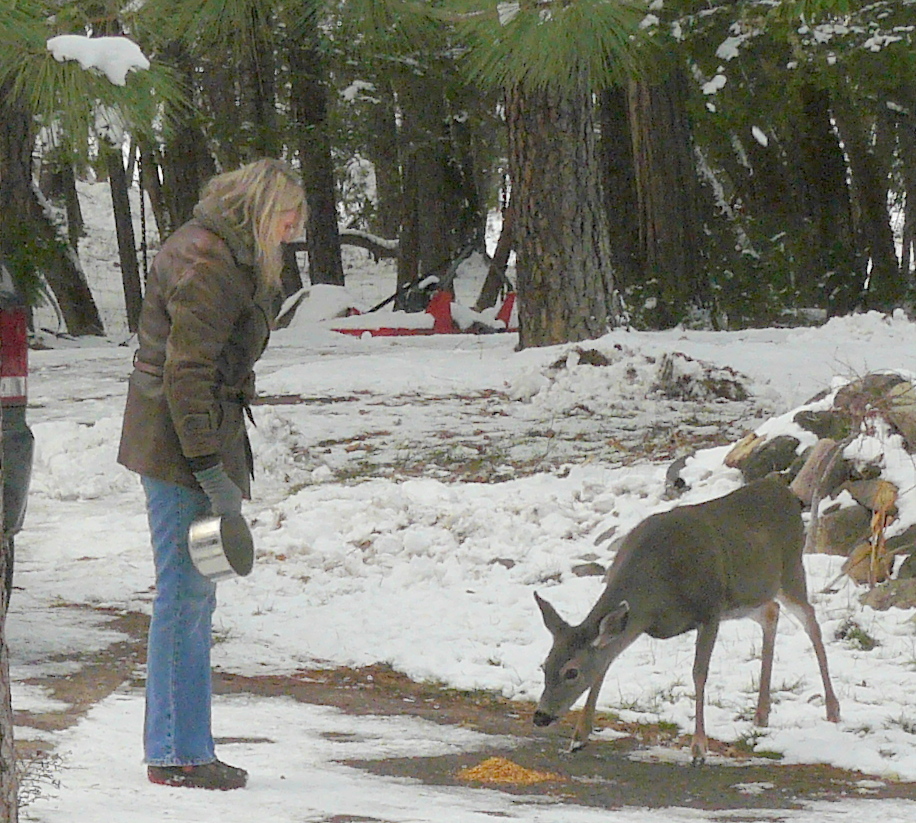
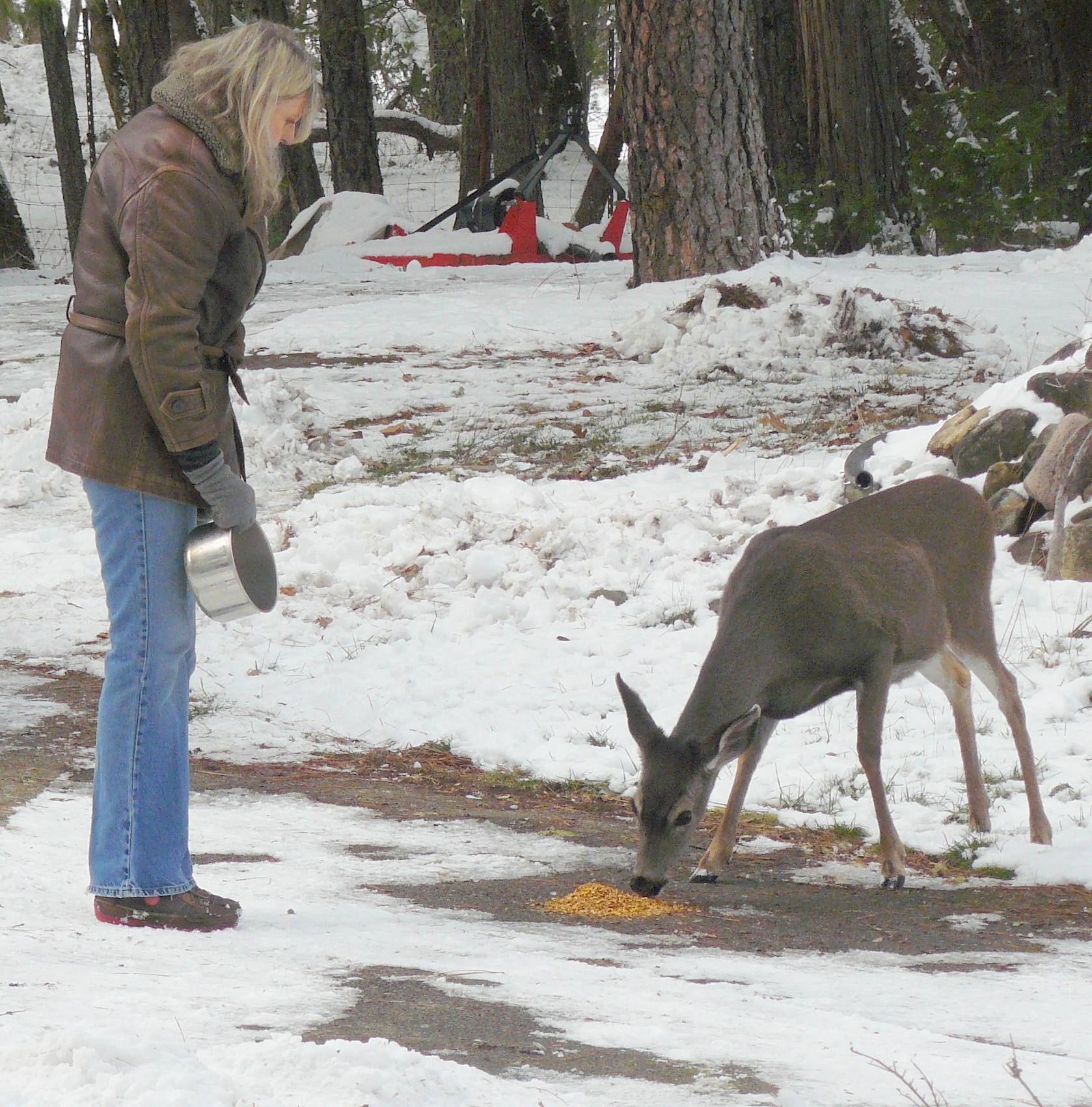
This is a very parochial set of pictures.  In that they are of one event that took place last Tuesday, the 10th.  Jean has been putting out food for the local deer for a few weeks in common with neighbours Dordie and Bill.  The wild deer have slowly accepted Jean’s efforts to feed them.

Anyway, last Tuesday afternoon a single deer took the step of feeding on the cob that was put out, with Jean still present.  I grabbed my camera and took the following pictures.

Looking for food, as per usual.

oooo

Patiently waiting for Jean to come out.

oooo

Here comes food!
Here comes food!

oooo

Hunger overcoming fear.

oooo

P1140133
I think this person likes me!

oooo

P1140132
A very precious coming together.

oooo

P1140134
The precious bond from one to the other.

oooo

P1140135
The start of a long relationship.

It was just a magical to be behind the camera as it was for Jean to be accepted by this most beautiful of wild animals.  Two or three deer have now become regular visitors in the afternoons when we put out food for them.