Category: Core thought

We are what we eat.

Integrity and honesty should certainly apply to what we eat!

Published author Deborah Taylor-French has her own blog Dog Leader Mysteries. She and I follow each other’s blog and I’m very grateful for the connection, as indeed I am with so many other fellow bloggers.

Thus that was how I came to learn of a recent post from Deborah about how rabbit meat is being used for human consumption.  On the face of it, nothing wrong in eating rabbit but wait until you have read Deborah post, that is republished here with her kind permission.

ooOOoo

Tell Whole Foods: Do not sell bunnies

Tell Whole Foods, “Don’t sell bunny meat!”

Farm animals suffer greatly in the United States of America. Plus this suffering comes to us well documented. Before the U.S. Congress passes laws allowing Ag-Gag [see my footnote] states to make it illegal for people to photograph, video or report animal abuse inside or outside their meat plants.

The disturbing truth? Pet rabbits now sold for meat at Whole Foods Market come from being raised in U.S.A. Ag-gag states. What’s wrong with that? Everything.

Big farms doing business in Ag-gag states operate free from animal welfare laws.

In fact these huge meat farms have made laws against taking photographs, video recording or any reporting of animal abuse. What have they got to hide?

Enough. All too many cruel animal farming practices already hurt farm animals, enough to make most of us sick. The Humane Society of the United States and the Animal Defense Fund continue working to legally raise farm animal welfare practices. Most Americans know that farm animals do not receive acceptable room for walking nor a humane standard of care. Before we let another category of animal become victims of Ag-gag farm cruelty, we need to improve farm animals welfare.

Adopted from Rohnert Park Animal Shelter.

Rabbits die of fright.

They share the species lagomorph.

There are about eighty species of lagomorph include thirty species of pika, twenty species of rabbit and cottontail, and thirty species of hare family. Wikipedia

I learned about this issue of Whole Foods Market, selling a new category of animal for meat through a volunteer at my local shelter. Kathy, along with volunteers from Save a Bunny and a Southern California group, are working to raise awareness pet rabbits should not end up as mainstream Big Farm meat products. Why?

Whole Foods Market buys meat rabbits from Ag-gag states. If Whole Foods succeeds, farm animal suffering will fall on whole other category of animals, pet rabbits.

It comes as no secret in United States that farm animals end up being raised inhumanely. If you have ever read about the Ag-gag states and how they are able to prosecute anyone willing to go undercover and take photographs and videos to report the truth on this ongoing unnecessary torture of farm animals. What meat animals endure in the U.S.A. is nothing less than cruelty, it’s time we changed that, before adding anymore farm animals.

Nine facts hidden in Ag-gag pig farms

  1. Millions of meat pigs live, eliminate and sleep in cramped spaces.
  2. The environment these pigs endure smell rank. Their wastes drain into a central open sewer and their housing is so unclean many of them die.
  3. Meat pigs lack all exercise to the extreme point that their legs break.
  4. Pigs housed in huge warehouses with thousands of other pigs, hear others screaming day and night from pain.
  5. Female pigs, sows, live horrible lives in gestation crates.
  6. Gestation crates built for female pigs force them to stand up for 24-hours per day. Farmers do not allow pigs to walk or lie down. Gestation crates, notoriously painful for animals, need to be banned. Often the pigs’ legs break because their bones grow soft, due to not being allowed to walk.
  7. Big meat farms build bars underneath sows to brace broken legs.
  8. The meat pig lives in constant physical pain, terror, fear and unhappiness. When piglets die, often in these unsanitary conditions, their bodies get ground up and mixed into the food the sows eat. So mother pigs eat their own young.Pigs do not live as cannibals. Why should they be forced to eat their own young?
  9. What horrible animal welfare to make pigs eat their own young. It’s incomprehensible that animals must live like this so that people can eat pork barbecue, pork steak and pork ribs.

How can they call these farms? Not giving animals room to walk, sit or lie down? Meat farm animals get denied their normal and natural behaviors. They never see the light of the sun nor feel the earth nor wind.

What U.S.A. meat farms won’t let us see.

After four years of hesitation and never mentioning recordings of farm animals lack of good welfare, I break my silence.

Much of the time I avoid eating meat. From now on, I will be seeking out small sustainable and local farms. We have several nearby that do not inflict senseless cruelty on pigs, chickens and cows. After study of commercially farmed pork and chicken and beef, I have returned to my original vegetarian and fish eating ways.

My footnote. As a non-American I didn’t fully understand the phrase “Ag-gag”. Deborah kindly explained it as follows:

Several states have passed laws against anyone photographing, video recording or reporting on animal abuse inside massive meat farms. The Humane Society of the United States keeps working (under cover to film the truth of this unsanitary and cruel business) but now they can arrest anyone caught, send reporters to jail and sue anyone trying to inform the public.

ooOOoo

I know for a fact that Deborah would love that this item is shared and republished as far and wide as possible. Please help.

For spreading the word and being very careful about the meat that we eat are the only ways to put a stop to these unbelievably cruel practices, and the ‘Ag-gag’ laws.

We all have a story to tell.

Featuring David Isay and StoryCorps.

Jean and I were late back home on Wednesday evening and after our evening meal only had half-an-hour or so before it was time for bed.

We browsed some of the talks on TED (we don’t have TV) and noticed one that sparked our interest: Everyone around you has a story the world needs to hear.  This is how the talk was introduced on TED.

Dave Isay opened the first StoryCorps booth in New York’s Grand Central Terminal in 2003 with the intention of creating a quiet place where a person could honor someone who mattered to them by listening to their story. Since then, StoryCorps has evolved into the single largest collection of human voices ever recorded. His TED Prize wish: to grow this digital archive of the collective wisdom of humanity. Hear his vision to take StoryCorps global — and how you can be a part of it by interviewing someone with the StoryCorps app.

It was a remarkable and fascinating talk and, thanks to YouTube, I’m able to share it with you.

I have no doubt that after watching Dave Isay’s talk you will want to go to the StoryCorps website.

Will return to this another day.

And human madness!

Reality will intrude whatever we believe.

Fitting in very neatly with yesterday’s post And human wisdom?, on Tuesday evening Jean and I sat down after dinner and watched a documentary film that was available on the website Top Documentary Films. It was called Our Rising Oceans and was introduced, thus:

In the opening moments of Our Rising Oceans we learn that global catastrophe lies beneath the awe-inspiring pale blue skies and ghostly white icescapes of West Antarctica. The scientific data regarding the effects of climate change on the ongoing process of glacial melting is overwhelming. Yet according to the many subjects featured in the film, a staggering percentage of the public remains doubtful, and our politicians and other policy influencers remain hesitant to act due to ill-informed skepticism and corporate interests.

In response to those naysayers, VICE founder and host Shane Smith ventures to the epicenter of the crisis to discover firsthand the science by which these changes are being observed, and the dire consequences of inaction.

Antarctica is starting to melt,” warns expert glaciologist Dr. Eric Rignot. Over the past twenty years, Dr. Rignot has analyzed reams of carefully procured data, and his discoveries indicate a rapidly deteriorating environment which could forever alter the fate of mankind. Here, in the midst of the Antarctic plains, wind is circulating at an unprecedented rate and pushing warm waters underneath the massive sheets of ice. This dynamic effectively melts these sheets from the bottom up, and has a profoundly distressing impact on rising sea levels.

Over the course of the film, Dr. Rignot is joined by a host of additional scientists who dedicate their lives to bearing witness to these calamitous changes, and pursuing solutions against the opposition of politicized stagnation. But even in the absence of this opposition, the disastrous effects of climate change may be too far gone to rectify. Dr. Rignot contends that even the strictest emission regulations cannot reverse the tides of a redefining global landscape. Others testify that additional environmental protection policies may slow the process, but will by no means guarantee the sustainability of future generations.

But even the slivers of hope which do exist seem impossible to realize given the gridlock of governmental leadership within the United States, as its representatives remain sharply divided on the mere existence of climate change. “I think it’s almost like denying gravity now,” says Vice President Joe Biden in an interview which closes the film. Our Rising Oceans paints a powerful portrait of a planet on the brink of ruin, and the political dysfunction which continues to push it over the edge.

Now in that opening paragraph I deliberately used the expression “was available” because when I came to check that the video, a YouTube video, was available, I received a “This video is private.” message.

So all I can do is to offer you the link to the Top Documentary Film page for Our Rising Oceans and hope that you are able to freely watch the full documentary. The link is here.

The documentary was scary and only confirmed the truth of what Jean and I instinctively felt – that unless those who lead and comprise all the governments of the free world react to the truth of where this planet is heading, and react soon, then the next great extinction is guaranteed. The first great extinction that is man-made!

If for whatever reason the video is unavailable to you then, at least, do watch the trailer.

For if we, as in humanity, turn a blind eye to this then reality will have a way of reminding us of what science already knows: significant sea-level rises are guaranteed.

Here’s a recent item from the Washington Post.

A hundred years from now, humans may remember 2014 as the year that we first learned that we may have irreversibly destabilized the great ice sheet of West Antarctica, and thus set in motion more than 10 feet of sea level rise.

Meanwhile, 2015 could be the year of the double whammy — when we learned the same about one gigantic glacier of East Antarctica, which could set in motion roughly the same amount all over again. Northern Hemisphere residents and Americans in particular should take note — when the bottom of the world loses vast amounts of ice, those of us living closer to its top get more sea level rise than the rest of the planet, thanks to the law of gravity.

The findings about East Antarctica emerge from a new paper just out in Nature Geoscience by an international team of scientists representing the United States, Britain, France and Australia. They flew a number of research flights over the Totten Glacier of East Antarctica — the fastest-thinning sector of the world’s largest ice sheet — and took a variety of measurements to try to figure out the reasons behind its retreat. And the news wasn’t good: It appears that Totten, too, is losing ice because warm ocean water is getting underneath it.

Read the full piece here.

Welcome to the new world!

Storm surge on a Louisiana highway shows the affects of rising sea levels. (Credit: NOAA)

Once again, I’m going to be predictable in saying that our dogs wouldn’t be as half as mad as to deny the truth of what man is doing to our planet!

And human wisdom?

No other planet to move to!

The title of today’s post picks up the theme of yesterday’s post Dog Wisdom, that incorporated a wonderful essay from Mark Rostenko about the wisdom of dogs.

The words in the sub-heading came to me because, unlike wild dog packs, we do not have the luxury of our ‘alpha female’ deciding her pack’s territory is no longer viable and they needed to move on.

All of which serves as an introduction to a recent essay from Martin Lack over on the blog Lack of Environment. Martin is well qualified to write on such matters as climate as he has been a Fellow of the Geological Society (FGS) since 1992 and a Chartered Geologist (CGeol) since 1998.  His essay was published on the 15th March and is called Merchants of Doubt need to do the math.

ooOOoo

A feature-length documentary, based on the content of the Merchants of Doubt book by Naomi Oreskes and Erik Conway, went on general release at movie theatres in the USA this weekend.

As Desmogbog.com points out, it has already attracted the attention of an odd mixture of ideologically-motivated deniers of the reality of anthropogenic climate disruption.

I say “odd” because, as per the above link, those who prefer to see climate science as a conspiracy to raise taxes (and install worldwide Communist government via the United Nations, etc.) include both longstanding disputers of inconvenient science like Fred Singer (who questions whether the movie is defamatory) and self-confessed non-experts like James Delingpole.

Both of the above would have done well to watch a recent BBC Four (television) programme – Climate Change by Numbers. In contrast to just about every other programme about climate change that you might have seen, this one is presented by three mathematicians. A 30-second trailer is inserted below but, if you have not seen the full 74-minute programme (opens in a new window), I really would recommend it.

http://www.youtube.com/watch?v=k2nyUAGezg4

The programme focuses on three numbers:
— 0.85 Celsius – the rise in average global surface temperatures since the 1880s.
— 95% – the certainty of the scientific community that this is primarily human-caused.
— 1 trillion tonnes – humanity’s carbon budget to avoid 0.85 increasing to 2 Celsius.

Along the way, the programme highlights the early work of Svante Arrhenius – who determined that a halving of atmospheric CO2 could cause a 4 Celsius drop in temperature (and therefore that a doubling of CO2 will cause a 4 Celsius rise).

With regard to the accuracy of computer models, the programme highlights the way in which this has been proven by their ability to predict the cooling effects of large volcanic eruptions.

With regard to our carbon budget, the programme highlights the fact that humanity has already burnt 0.5 trillion tonnes and, unless radical changes are made to global trends, will burn the remaining 0.5 trillion tonnes within 30 years. It also points out that, as ongoing events might well suggest, even 2 Celsius could have severe and pervasive impacts (as the IPCC described them last year).

All very inconvenient for libertarians everywhere, I guess.

See also:

https://lackofenvironment.wordpress.com/2013/11/19/greedy-lying-bar-stewards-guilty-of-crimes-against-humanity/

https://lackofenvironment.wordpress.com/2013/10/11/a-summary-of-the-climate-departure-research-of-mora-et-al/

ooOOoo

NB: The link that Martin offers to the full programme is a version on YouTube that is chock-full of adverts; seemingly inserted every ten minutes or so.  Unfortunately, other YouTube videos of the same BBC programme also seem to have too many adverts.

Please don’t let that put you off watching a critically important message. Plus, as you watch the video, do stick under your hat the following note from Martin.

Thanks, Paul. There is one thing you might care to add (which I forgot to mention), which is this:

The final third of the programme includes a discussion of ‘extreme value analysis’ (EVA), which Wikipedia helpfully describes as “a branch of statistics… [that] seeks to assess… the probability of events that are more extreme than any previously observed“. Flood defences like the Woolwich Barrier on the Thames estuary were designed using EVA. However, crucially, EVA assumes that average parameter values do not change over time. Therefore, given that climate change invalidates this assumption, it is now accepted that London will need greater protection from flooding in the future. Athough not explicit in my original post, this was why I included a link to the ‘Climate Departure’ reseach of Mora et al., which estimates the regional variation in the date by which future climates will have departed from what has hitherto been considered normal.

So here is that full BBC Documentary.

http://www.youtube.com/watch?v=3zqkPmM_hj4

Now where’s that spare planet!

Smart thinking – something else to learn from our dogs?

Because some of the things we humans do are insanely stupid!

Here’s a picture of Oliver taken yesterday afternoon.

Becoming a dear, smart dog. (And those eyes!)

A few days ago, I was sitting in our living room on one of our settees (more or less where Oliver was sitting when the photograph above was taken) with my knees up against a low coffee table; the table separates our two settees.

On the settee to my left lay Cleo and on the floor across my feet slept Hazel.

It was clear that Oliver wanted to join me on the settee but couldn’t work out if there was room.  I shifted about two feet to my left leaving an Oliver-sized gap to my right. However, Oliver couldn’t come past my knees, from left to right as it were, because of Hazel. He very quickly worked out to run around behind the settee and jump up into the space I had newly created to my right.

Don’t worry if I lost you!

The point I am making is that Oliver, who has grown into the most delightful young adult dog, with a gorgeous temperament, demonstrates daily a keen intelligence and a nose for working things out quickly.

All of which is a preamble for me wondering if among the list of qualities that we humans should learn from dogs we should add intelligence.

For there’s been a few items around the ‘blogosphere’ that have highlighted how silly we can be.

Take this item that recently was featured on Grist.

Walmart’s new green product label is the most misleading yet.

A giant, 150-foot roll of bubble wrap may not be your idea of an environmentally friendly product, but over at Walmart.com this one-pound ball of plastic now boasts a special “Sustainability Leaders” badge. It’s one of more than 3,000 products tagged with this new green label, which Walmart executives unveiled last week, together with a web portal where shoppers can find these items.

Dozens of news accounts hailed the giant retailer’s move as a significant step toward clearing up the confusion and misleading information that often greet consumers trying to make ecologically responsible choices. “The world’s largest retailer took a major and important step toward helping all of us shop more smartly,” declared corporate sustainability consultant Andrew Winston in Harvard Business Review. Triple Pundit concurred: “It’s about to get a lot easier for Walmart.com shoppers to make the responsible choice.”

Actually, a green-minded online shopper is likely to find Walmart’s new badge confusing, murky, and downright misleading. I searched the bubble wrap’s product page high and low for its secret sauce, the invisible feature that makes it a smarter choice amid the many seemingly less harmful packing options available, but found no explanation.

It turns out that the key to this mystery lies in a remarkable disclaimer tucked into the middle of the home page of Walmart’s sustainability shopping portal: “The Sustainability Leaders badge does not make representations about the environmental or social impact of an individual product.” (my emphasis)

You can read the full item here, and you should! It’s unbelievably stupid, apart from being highly misleading, to my mind because when the word gets around it will damage the trust that all retailers need from their customers. And don’t even bring up the notion of integrity!

Then over on George Monbiot’s blogsite, there is a recent essay about the UN and progress on climate change. Here’s how it starts (and I’m republishing it in full tomorrow):

Applauding Themselves to Death

If you visit the website of the UN body that oversees the world’s climate negotiations, you will find dozens of pictures, taken across 20 years, of people clapping. These photos should be of interest to anthropologists and psychologists. For they show hundreds of intelligent, educated, well-paid and elegantly-dressed people wasting their lives.

The celebratory nature of the images testifies to the world of make-believe these people inhabit. They are surrounded by objectives, principles, commitments, instruments and protocols, which create a reassuring phantasm of progress while the ship on which they travel slowly founders. Leafing through these photos, I imagine I can almost hear what the delegates are saying through their expensive dentistry. “Darling you’ve re-arranged the deckchairs beautifully. It’s a breakthrough! We’ll have to invent a mechanism for holding them in place, as the deck has developed a bit of a tilt, but we’ll do that at the next conference.”

Humans have the potential to be incredibly smart thinkers, and down the ages there have been many such thinkers.

But!

Over on the Patrice Ayme blogsite there have been a couple of recent essays that highlight examples of both stupid thinking and the rewards that flow from smart thinking. In one essay, Added Value in the XXI Century, Patrice writes:

SUPERIORITY OF THE WEST?

Why did the West become so superior? Or China, for that matter?

Technology. Superior technology. Coming from superior thinking. Both the Greeks and the Chinese had colossal contempt for barbarians. (In both cases it went so far that the Greeks lost everything, and the Chinese came very close to annihilation).

Around the year 1000 CE, the Vietnamese (it seems) invented new cultivars of rice, which could produce an entire crop, twice a year. The population of East Asia exploded accordingly.

A bit earlier, the Franks had invented new cultivars of beans. The Frankish Tenth Century was full of beans. Beans are nutritious, with high protein.

Homo is scientific and technological. Thus, two million years ago, pelt covered (tech!) Homo Ergaster lived in Georgia’s Little Caucasus, a pretty cold place in winter. And the population was highly varied genetically (showing tech and travel already dominated).

A GREATER OBSESSION WITH FREEDOM MADE THE WEST SUPERIOR:

Here is the very latest. Flour was found in England, in archeological layers as old as 10,000 years before present. It was pure flour: there were no husks associated. The milling had been done, far away. How far? Well the cultivation of wheat spread to Western Europe millennia later. The flour had been traded, and brought over thousands of miles. Most certainly by boat. Celtic civilization, which would rise 5,000 years later, was expert at oceanic travel.

What’s the broad picture? Not just that prehistoric Englishmen loved their flat bread, no doubt a delicacy. Advanced technology has permeated Europe for much longer than is still understood now by most historians. Remember that the iceman who died in a glacier, 5,000 years ago, was not just tattooed, and had fetched in the lowlands a bow made of special wood. More telling: he carried antibiotics.

Then in a subsequent essay, What Is It To Think Correctly?, Patrice opens, thus:

What Is It To Think Correctly?

Some say that correct thinking has to do with avoiding “logical fallacies”. That is, of course, silly. Imagine a pilot in a plane. Suppose she avoids all logical fallacies. Where does the plane go? Nowhere. Thinking correctly is more than avoiding logical “fallacies”.

One needs more than logic, to proceed: one needs e-motion, or motivation (both express the fact that they are whatever gets people to get into action; the semantics recognizes that logic without emotion goes nowhere).

There is another, related, fallacy in thinking that correct thinking is all about avoiding “logical fallacies”.

I don’t have the answers to the conundrum of stupid thinking a la Walmart and the United Nations (not an exclusive list; by far) but I do believe that the only way for humanity to overcome what looks like a very dangerous era ahead is through smarter thinking!

Oh, nearly forgot.

Oliver will be happy to run classes on smart thinking!

Please help.

Reblogged from Exposing the Big Game

I follow the blogsite Exposing the Big Game. The bye-line on the home page explains, “Forget Hunter’s Feeble Rationalizations and Trust Your Gut Feelings: Making Sport of Killing Is Not Healthy Human Behavior“. Some of the posts that are published are incredibly difficult to read.

But this post does at least allow those that hate hunting for sport to register their feelings.

ooOOoo

Who the F**k Hunts Giraffes for Sport and How You Can Stop Them

giraffes

Please sign and share these petitions.

Stop trophy hunting giraffes
http://www.thepetitionsite.com/929/929/857/stop-trophy-hunting-giraffes/

Stop hunting giraffes for sport
http://forcechange.com/12033/stop-hunting-giraffes-for-sport/

Stop any kind of safari hunting in South Africa
https://www.causes.com/actions/1742571-stop-any-kind-of-safari-hunting-in-south-africa

Stop the savage and sickening trophy and sport hunting
http://www.thepetitionsite.com/1/stop-the-savage-and-sickening-trophy-and-sport-hunting/

Complete ban on trophy hunting in South Africa and a full census
http://www.gopetition.com/petitions/complete-ban-on-trophy-hunting-full-census-carried-ou.html?

Stop the legal killing of wildlife in trophy hunting
http://www.gopetition.com/petitions/stop-the-legal-killing-of-wildlife-stop-hunting/sign.html

End WWF partnership with pro-hunting lobby
https://secure.avaaz.org/en/petition/Yolanda_Kakabadse_is_WWFs_International_President_and_USAID_WWF_End_your_partnership_with_the_USA_ProHunting_Lobby_Group/

Ban lion farming and trophy hunting
http://www.thepetitionsite.com/147/069/549/ban-lion-farming-and-trophy-hunting/?cid=FB_TAF

Stop the canned hunting of large cats in South Africa
https://www.change.org/p/ms-lakela-kaunda-stop-the-canned-hunting-of-large-cats-in-south-africa

USF&WService save the lions from mass extinction
https://secure.avaaz.org/en/petition/US_Fish_and_Wildlife_Service_Save_African_Lions/?sfmqQib

Zambian tourist board: to reinstate ban on hunting lions and leopards
https://secure.avaaz.org/en/petition/

ooOOoo

If you have any issues with any of the links, just move on. Please sign just as many as you can.

Animal healing

The power of our beautiful creatures to heal us.

Yet again, another example of a post almost writing itself.

Let me explain.

Yesterday, I published a post about being sensitive to the world around us.

Then this morning there was a new post from Sue Dreamwalker under the title of Fear of the Future. It was uncharacteristically downbeat for Sue.

Now most who follow me know I try to bring a positive touch within my posts… Yet to be quite honest with you all I am really struggling right now to lift myself from the doldrums of my own thoughts.

The key to conquering our fears lies in awareness. When we identify the irrational thoughts that frighten us and replace them with positive affirming ones.

Argh… all easier said than done..

You would think with my inner Knowing, and my Spiritual mind I should be the last person to take a nose dive into that Pit of depression.. Especially when I dredged its depth before and vowed that I had been there done that and worn the T-shirt and I refuse to wear it again.

I could blame it on my Fall which left me feeling bruised with aching, muscles which are still healing.. And I could blame it on grief as I lost a very beloved Aunt last week. I could blame my fatigue on me deciding to move a whole wall of books out the spare bedroom with wrists still recovering from the sprains of the fall.. And I could blame it on the weather being cold and miserable.. I could even blame it on the state of the world, or the Planets .. I have a whole host of excuses I could fall back upon to justify why I am feeling tired and jaded..

Many left comments including me. I spoke of the reward of hugging a dog. My words included:

I don’t have answers other than to feel what you are feeling. All I hang onto when I spend too much time thinking of my own mortality is that the answer, the answer to the moment, is to bury one’s face into the warm, soft fur of a dog. They seem to sense my need at these times. (And that isn’t meant to sound like me devaluing the love and affection that I receive from Jean!)

In other words, that contact with the warm dog holds me in the present and before long the reinforcement of living that present, loving moment puts the unknown future into perspective.

Another comment was left by blogger Rajagopal that included this wonderful tale:

The only thing that I have seen working in my life is to keep living, as much as possible, in the present. There is nothing to fear, either of the now or of the future.

In this context, wish to leave you with the story of the pregnant deer; in a forest, a pregnant deer is about to give birth. She finds a remote field near a strong-flowing river, that looks like a safe place, as she starts going into labour. At the same moment, dark clouds gather in the sky and streaks of lightning sets off a forest fire. The deer looks to her left and sees an approaching hunter with arrow pointed at her. To her right, the deer spots a hungry lion speeding towards her. What can the pregnant deer do? She is in labour! What will happen? Will the deer survive? Will she give birth to the fawn and will it survive? Or will everything be burnt by the forest fire? Or will she perish to the hunter’s arrow? Or does a horrible end await her at the hands of the hungry lion? Constrained by the fire on one side, the flowing river on the other and boxed in by her natural predators, the deer is apparently left with no option. What does she do? Well, she focuses on delivering and giving birth to a new life.

The sequence of events that follows is the Lightning strikes and blinds the hunter, who releases the arrow which zips past the deer and strikes the hungry lion. It starts to rain heavily and the forest fire is slowly doused by rain water. The deer gives birth to a healthy fawn….In our life too there are moments when we are confronted with negative thoughts and possibilities on all sides, so powerful as to overwhelm us. May be we can learn from the deer. The priority of the deer at that given moment was to give birth as safely as possible.

The rest was not in her hands and any change in her focus would have most likely impeded giving birth to the fawn. In the midst of the severest storm, we just have to maintain presence of mind and do what is in our control…the Cosmic power will take care of the rest…best wishes… Raj.

Finally, there was a recent new follower of this place. Her name is Emma and she writes the blog The Muse in the Mirror. Emma was kind enough to grant me permission to republish a post from last December about the healing power of Llamas. Enjoy!

ooOOoo

Llama Loving; The healing power of Llamas

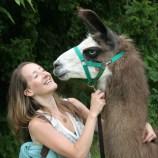
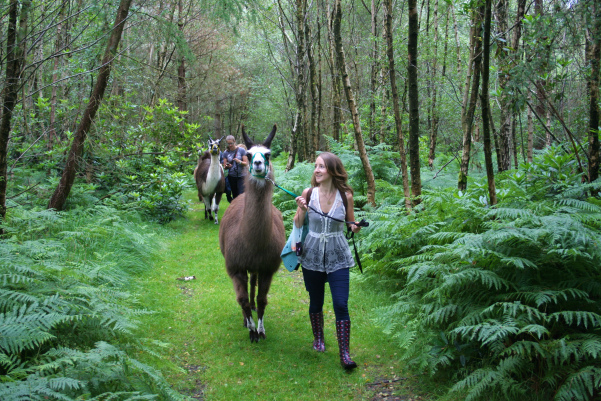
emma1It’s official; I LOVE llamas. There, I said it, put out there for the world to know! I love their gentle, sensitive nature, friendly disposition and most of all their goofy, giggle-worthy expressions, which never fail to bring a smile to my face! Concerned that my llama loving status was bordering on obsession, I was beginning to question whether my love for these comical camelids was founded on anything other than sheer amusement! Thankfully as I researched further my findings confirmed that these beautiful animals are much more than a pretty (funny) face!!!

Llama Therapy

emma2
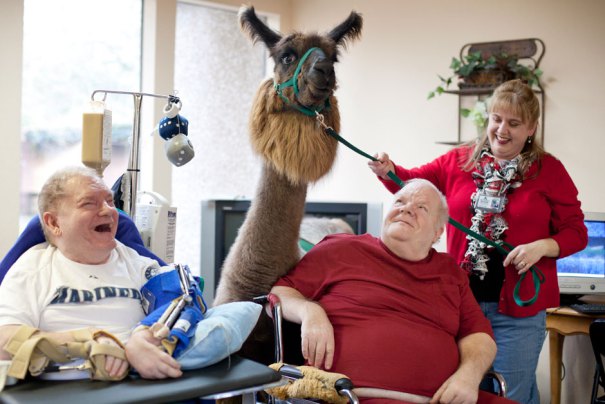
Llama Marisco visits patients at Bellingham Health and Rehabilitation Center in Washington, USA. © Jen Osborne Photography

I squealed in delight when Colours Magazine published the story about The Delta Society, a non-profit organization that licenses animals for therapy

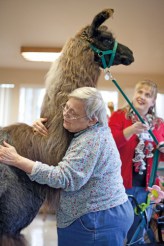
Holly Barto hugs a therapy llama at Bellingham Health and Rehabilitation Center, USA © Jen Osborne Photography

in USA. The adorable photo’s lay testament to the happiness that llama’s bring to residents at Bellingham Health and Rehabilitation Center in Washington, USA. Llama Marisco (pictured above), and Llama N.H. Flight of the Eagle (pictured right) are trained therapists, who spread comfort and joy as they stop at each bed to kiss the patients or have a hug. Resident Holly Barto remarked that…

It was heaven. Just emotionally – to be able to touch an animal and hold an animal close.

Another example of the profound healing benefits of llama’s can be seen in this adorable video below showing Rojo the therapy llama and Napoleon the therapy alpaca from Mtn Peaks Therapy Llamas & Alpacas, in Vancouver, WA USA. A non-profit corporation, which offers therapy teams to visit hospitals and schools in the area. The expressions on people’s faces are heart warming to say the least!

Who knew such fluffed-up, carrot munching mammals could bring so much joy.

Laughter is the best medicine.

emma4
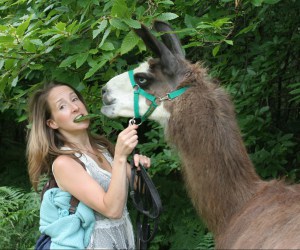
Llama Dave is disgruntled by the fact I was munching in on his dinner!

If I am having an off day, the first thing I reach for is a funny llama picture. Better still, a visit to the local llama park soon blasts my bad moon into infinity and beyond! A good giggle-fest at the Ashdown Forest Llama park, in East Sussex, dissolves the blues and confirms that laughter really is the best medicine! (See my picture gallery below to see me with some of the residents of the Ashdown Forest Llama park!).

There’s a very good reason behind the saying Laughter is the best medicine. Research suggests that people feel less pain after a good laugh, because it causes the body to release chemicals that act as a natural painkiller. ‘Professor Robin Dunbar of Oxford University, who led the research, believes that uncontrollable laughter releases chemicals called endorphins into the body which, as well as generating mild euphoria, also dull pain.’ (BBC)

It is common knowledge that animals in general make us happier and brighten our spirits. A growing body of scientific research now suggests that interacting with animals can make us not only happier, but healthier too. That helps explain the increasing use of animals for therapeutic purposes in hospitals, hospices, nursing homes, schools, jails and mental institutions.

The use of pets in medical settings actually dates back more than 150 years, says Aubrey Fine, a clinical psychologist and professor at California State Polytechnic University. Fine who has written several books on the human-animal bond says:

One could even look at Florence Nightingale recognizing that animals provided a level of social support in the institutional care of the mentally ill,”

So there you have it, next time you’re feeling blue, you know what to do! Head on out to your nearest llama park to insight those warm fuzzy feelings from a fluffy four legged llama! Check out my favourite selection of Llama and Alpaca pics below, guaranteed to bring a smile to any face!!

emma5

ooOOoo

Note: That last photograph above is only one of a wonderful collection of Llama photographs that Emma included in her blog post. Do drop across there and admire all the wonderful pictures.

The incredible healing power of hugging an animal.

Sensitivity to the world around us.

The more we give up, the more we ‘own’.

It is a very common, understandable trait of us humans to put our own lives first.  I mean that much more in the psychological sense than in the sense of our daily activities although what we think and feel, inevitably, influences how we behave. One of the fabulous qualities of our dogs is that they are so much more sensitive to the world around them than to their own internal thoughts and feelings. Right from the early years of having Pharaoh in my life I was aware that he ‘read’ my emotions easily and soon became an instinctive ‘friend’, especially when I was troubled.

Years later, all of the dogs love it when Jean and I are in happy, positive places and you can see how our human states of mind link so directly to the mood of our dogs.

All of which is my introduction to an essay recently read over on the Big Think blogsite. Specifically, one about living empathically. The essay is called: Let’s Make 2015 “The Year of Living Empathetically” and here are the opening paragraphs:

Let’s Make 2015 “The Year of Living Empathetically”

by JOAN COLE DUFFELL

I began the new year on a very positive – and inspiring – note after reading Eric Liu’s latest commentary on “Radical Empathy”.

The founder and CEO of Citizen University, Liu shows us that laying aside our egos – our need to be in the right – in favor of standing in the shoes of others, is key to addressing so many of the problems that we (once again) confronted in 2014.

This insight – without question – is a wake-up call to our country as 2015 unfolds.

That’s why I think we should resolve to make 2015 “The Year of Living Empathetically.”

We need to make the practice of empathy our New Year’s exercise regimen, our social-emotional diet for the next 365 days.

  • Let’s practice empathy at home, with our spouses and kids.
  • Let’s practice empathy in the workplace, as we give and receive feedback, and credit others’ contributions generously.
  • Let’s practice empathy in the classroom, especially when kids are struggling and need our support.
  • Let’s practice empathy in public service, as we encounter people who look different from us, and whose lives matter every bit as much as our own.
  • Let’s practice empathy as we encounter people on the street, who may be less fortunate, and are just as human.
  • Let’s practice empathy when resolving conflict, whether interpersonally or on a global-political level.
  • And let’s practice empathy in local and state governments, and in the halls of Congress, so that we might truly listen in order to solve real problems

If all this sounds like a tall order – you’re right; it is.

As Brene Brown, a research professor at the University of Houston Graduate College of Social Work, points out, empathy is a challenging personal choice that requires us to become vulnerable in an effort to connect with another person.

It is not a long essay, so do drop across to here and finish reading it.

As is the way of ideas, serendipity is always actively working ‘under the hood’.

Why do I say that?

Because as soon as I was clear about what I wanted to offer you for today, in to my ‘in-box’ came the latest TED Talk. A talk from Ben Ambridge entitled: 10 myths about psychology: Debunked. It so resonated with today’s theme and is offered below.

http://www.youtube.com/watch?v=ce31WjiVcY0

Published on Feb 4, 2015
How much of what you think about your brain is actually wrong? In this whistlestop tour of dis-proved science, Ben Ambridge walks through 10 popular ideas about psychology that have been proven wrong — and uncovers a few surprising truths about how our brains really work.

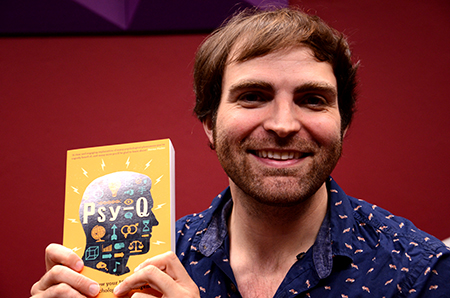
Ben Ambridge is the author of “Psy-Q,” a sparkling book debunking what we think we know about psychology.

Why you should listen?

Ben Ambridge is a senior lecturer in psychology at the University of Liverpool, where he researches children’s language development. He is the author of Psy-Q, which introduces readers to some of the major findings in psychology via interactive puzzles, games, quizzes and tests.

He also writes great newsy stories connecting psychology to current events. His article “Why Can’t We Talk to the Animals?” was shortlisted for the 2012 Guardian-Wellcome Science Writing Prize. Psy-Q is his first book for a general audience.

Dr. Ben Ambridge with his book: Psy xxx
Dr. Ben Ambridge with his book: Psy-Q.

If you want to learn more about the good Professor, here is his webpage on the University of Liverpool‘s website. And here is Ben Ambridge’s personal webpage that lists many, if not all, of his publications.

I honestly can’t find a better picture to close today’s post about sensitivity and empathy than this one below:

Empathy for another in its most beautiful shape.

Loving life unreservedly!

The appalling attitudes of those who kill wild animals for fun!

You will recall that in yesterday’s post, I referred to the fact that Jean and I are supporters of Oregon Wild. If you drop in on the OW blog, one of the items you will read is A New Year for Oregon’s Wolves.  Here’s how it starts:

Jan 12, 2015 | Rob Klavins

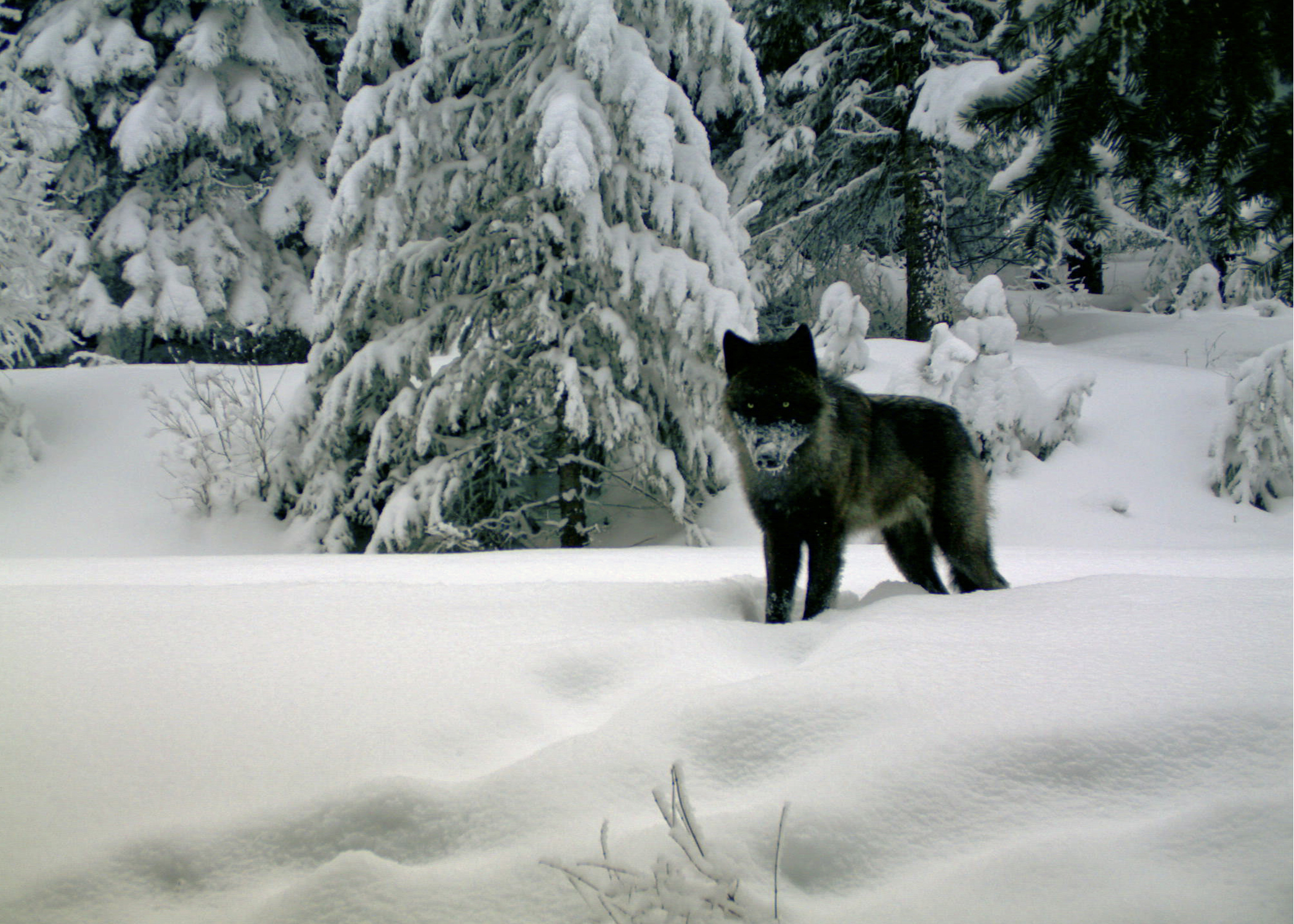
Photo of a young wolf from the Walla Walla Pack taken on Feb 5, 2014. Photo courtesy of ODFW.

A new year provides opportunities for reflection – and prognostication. For wolves in Oregon, 2014 was a good year. Journey finally found his mate and Oregon continued a management paradigm where killing remained an option of last resort. The result was a small but expanding wolf population and a continued decrease in conflict.

However, it’s not an understatement to say that 2015 is poised to be among the most consequential years for Oregon’s wolf recovery since the passage of the Endangered Species Act in 1973.

After a hard-fought legal settlement, Oregon’s fragile wolf recovery is back on track under the most progressive plan in the country. Though the plan is working for all but the most extreme voices, the Oregon Department of Fish & Wildlife (ODFW) is re-igniting old conflicts by caving to political pressure and giving serious consideration to weakening basic protections for wolves.

Moving on but staying in theme; so to speak.

For a few months now, I have been subscribing to a blog called Exposing the Big Game.  Here’s a little from their About page.

front-cover-low-res6

This blog site is a haven for wildlife and animal advocates, a wildlife refuge of sorts, that’s posted “No Hunting,” as any true sanctuary should be. Just as a refuge is patrolled to keep hunters and poachers from harassing the wildlife, this blog site is monitored to keep hunters from disturbing other people’s quiet enjoyment of the natural world.

It is not a message board or a chat room for those wanting to argue the supposed merits of animal exploitation or to defend the act of hunting or trapping in any way, shape or form. There are plenty of other sites available for that sort of thing.

Hunters and trappers: For your sake, I urge you not to bother wasting your time posting your opinions in the comments section. This blog is moderated, and pro-hunting statements will not be tolerated or approved. Consider this fair warning—if you’re a hunter, sorry but your comments are going straight to the trash can. This is not a public forum for animal exploiters to discuss the pros and cons of hunting.

We’ve heard all the rationalizations for killing wildlife so many times before; there’s no point in wasting everyone’s time with more of that old, tired hunter PR drivel. Any attempt to justify the murder of our fellow animals will hereby be jettisoned into cyberspace…

Well two days ago, Lydia Millet wrote an opinion piece for the New York Times that was republished on Exposing the Big Game. It was about the American Gray Wolf.  I asked permission to republish it in full here.

ooOOoo

Opinion: High Noon for the Gray Wolf

By LYDIA MILLET JAN. 18, 2015

In December 2011, a wild gray wolf set foot in California, the first sighting in almost a century. He’d wandered in from Oregon, looking for a mate. In October 2014, for the first time in almost three-quarters of a century, a gray wolf was seen loping along the forested North Rim of the Grand Canyon, in Arizona. She had walked hundreds of miles, probably from Wyoming or Idaho.

The return of these animals to the homes of their ancestors — however fleeting — was a result of their 40-year protection under the Endangered Species Act.

OR-7, or “Journey,” as schoolchildren named the first wolf, had been born to the Imnaha pack, the first one in Oregon for many decades. When he wandered south, his brother, OR-9, wandered east. Shortly after he crossed into Idaho (where wolves are not protected), he was shot dead. OR-7 lived on, after his repeated incursions into California (where wolves are protected), to sire a litter of pups just north of the state line. He became the subject of a documentary — in California, even a wolf can be a star.

The story of the Grand Canyon wolf, though, may be over: Three days after Christmas, it appears, she was shot and killed in Utah by a man media outlets have called a “coyote hunter.” (A DNA test is pending.)

For almost two centuries, American gray wolves, vilified in fact as well as fiction, were the victims of vicious government extermination programs. By the time the Endangered Species Act was passed, in 1973, only a few hundred of these once-great predators were left in the lower 48 states. After numerous generations of people dedicated to killing wolves on the North American continent, one generation devoted itself to letting wolves live. The animals’ number has now risen to almost 5,500, thanks to their legal protection, but they still occupy less than 5 percent of their ancient home range.

Since 1995, the act has guided efforts to raise wolves in captivity, release them, and follow them in the wild. Twenty years ago this month, the first gray wolves were reintroduced to Yellowstone National Park.

But this fragile progress has been undermined. Since 2011, the federal government has moved to remove federal protection for gray wolves in the Northern Rocky Mountains (Idaho, Montana and Wyoming) and in the western Great Lakes (Minnesota, Wisconsin and Michigan), the two population centers. Management of the species was turned over to these states, which responded with a zeal that looks like blood lust.

Relying on the greatly exaggerated excuse that wolves threaten cattle and sheep, the states opened their doors to the killing of wolves. (In some states, bait can be used to lure the animals to their deaths; in Montana, private landowners can each kill 100 wolves each year; in Wisconsin, up to six hunting dogs on a single wolf is considered fair play.) Legions of wolf killers rose to the challenge, and the toll has been devastating: In just three and a half years, at least 3,500 wolves have been mowed down.

There’s been an outcry from conservationists, ecologists and people who simply like wolves, but this has not stopped the killers. Some say wolves are a threat to their livestock investments (despite the existence of generous rancher-compensation programs in all wolf states save Alaska); others invoke fear of wolves; still others appear to revel in killing. Online, you can find pictures of wolf carcasses held up proudly as trophies and men boasting of running over wolves with their cars. Judges have started to step in. In September, a federal court decided that wolf management in Wyoming — which had allowed people to kill as many wolves as they wanted, throughout 84 percent of the state — should be returned to the federal government. In December, also in response to a lawsuit, another federal court reinstated protections for wolves in the western Great Lakes. These decisions should make clear that the states alone simply can’t be entrusted with the future of our wolves.

In Washington, the threats persist. The Fish and Wildlife Service is considering a proposal that would strip federal protection from almost all gray wolves in the lower 48 states, not just the ones in the Rockies and the Midwest. Meanwhile, right-wing Republicans in the new Congress are champing at the bit to remove the wolves from protection under the act — politics trumping science.

President Obama should direct the Fish and Wildlife Service to retain protection for wolves; if it doesn’t, they could be wiped off the face of the American landscape forever. A unified wolf-recovery plan for the nation is required. Not only do wolves play an important role in keeping wilderness wild, but they were here long before we were, and deserve to remain. Not for nothing was the environmentalist Aldo Leopold transformed by the sight of a “fierce green fire” in a dying wolf’s eyes.

I’ve seen wild gray wolves only once, as they trotted across a dirt road in front of my own family car in a New Mexican forest. There were three of them on the road, no doubt a wolf family, and three of us in the car: my husband, my daughter and me. In the back seat, my little girl was engrossed in a picture book and didn’t look up fast enough. I want her to have another chance; I want her to keep living in a world where something beautiful and wild lurks at the edge of sight.

Lydia Millet is the author, most recently, of the novel “Mermaids in Paradise.”

ooOOoo

Going back to that blog post over on Exposing the Big Game, I was inspired by many of the comments. Here are two examples:

From Rosemary Lowe (who blogs over on EARTH for Animals)

I so agree with your comments, Roger. Here we are, staring at the Faces of Extinction, while, so-called “wildlife groups” grovel, hat in hand, to these agencies, and to the ranchers and hunters, offering yet another “collaboration” or “compromise” so we “can all work together.” I am sickened as to how many of these groups make no apology about having hunters/ranchers on their boards and on their staff. An all out War against these special interests, and their agencies does not seem to be on group’s agenda. So much has already been lost. As you stated, so little is left: the massive slaughter of native wild animals & wild habitats since the 1800’s is criminal, yet there seems to be little passion about it.

Here from Sharon Lee Davies-Tight (who blogs over on Word Warrior Davies-Tight)

Thanks for the article. Strange isn’t it – the killing spree for sport against the wolves for their predatory behavior, yet these same people aren’t calling their behavior or the behavior of hunting dogs predatory?

Finally, here’s the trailer to that film about the wolf OR7

Please do all you can to ensure that federal protection for gray wolves in all US states is maintained.

How we treat wild animals defines how we treat the planet – the only one we have!