Category: Core thought

The social strength of communities

A solid reminder of a key lesson from dogs.

I was researching for a chapter on Communities for my book and came across a wonderful essay by an Erik Kennedy. It was so brimful of common-sense that I wanted to share it with you.

The essay was entitled: On the Social Lives of Cavemen. Here’s how it opens:

essays

by erik d kennedy

On the Social Lives of Cavemen

Tribal Living in the Modern World

May 2011

Introduction: The Gustatory Lives of Cavemen

We may be the pinnacle of millions of years of evolution, but we’re throwing our birthright straight out the window of our comfortable suburban homes. In this essay, we’re going to discuss walking across our family-sized lawn, climbing over our questionably large picket fence, and retrieving that birthright.

Then a little later on, Mr Kennedy writes (my emphasis):

The Tribe

Human beings are no strangers to group living. Call it a family trait. Our closest animal relatives spend a good bulk of their time eating bugs off of their friends’ back. While I’m overjoyed we’re not social in that manner, I’m less pleased that we’re not social more to that degree. In study after study, having and spending time with close friends is consistently correlated with happiness and well-being. And yet, the last few decades in America have seen a remarkable decline in many things associated with being in a tight-knit social circle—things like family and household size, club participation, and number of close friends. Conversely, we’ve seen an increase in things associated with being alone—TV, commutes, and the internet, for example.

This trend is quite unhealthy. It’s no surprise that humans are social animals—but it may be surprising that we’re such social animals that merely joining a club halves your chance of death in the next year—or that living in a close-knit town of three-generation homes can almost singlehandedly keep you safe from heart disease.

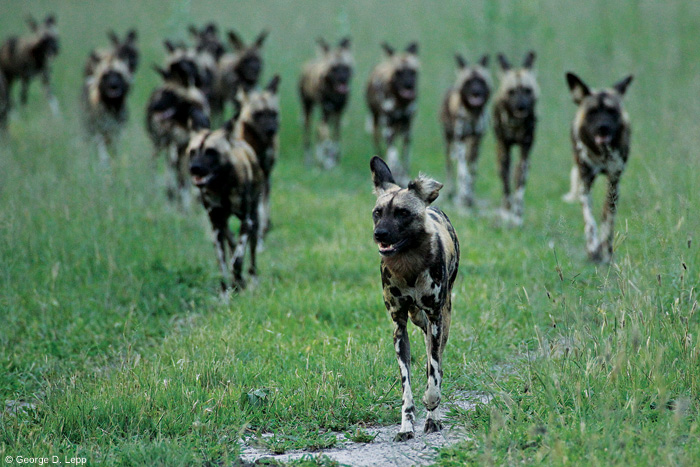
Any of you that have a few dogs around you at home know what wonderful close-knit groups they make. Frequently highlighted here on Learning from Dogs.

Group of wild dogs from a photograph taken by George Lepp.

Dogs offer many beautiful examples of the benefits of community. For the reason that their ancient genes, long before they became domesticated animals, still guide their behaviours. When dogs lived in the wild, their natural pack size was around fifty animals. There were just three dogs that had pack status; the alpha, beta and omega dogs. Or more usefully described as the Mentor, Minder and Nanny dogs. (As is still the case in wild dog pack families.)

As has been explained previously in this place, all three dogs of status, wild or domesticated, are born into their respective roles, with their ‘duties’ in their pack being instinctive. There was no such thing as competition for that role as all the other dogs in that natural pack grouping would be equal participants with no ambitions to be anything else.

One doesn’t need to reflect for very long before the obvious question arises: If fifty dogs is the optimum number for a pack of dogs, is there a limit to the number of people we can have in the human equivalent of a pack?

Well, says anthropologist Robin Dunbar, that number is about 150 persons. Robin Dunbar achieved fame by drawing a graph that plotted primates’ social group size as a function of their brain sizes. He inputted the average human brain size into his model, and up came the number 150. Beyond that number is past the upper bounds for both hunter-gatherer tribes and Palaeolithic farming villages. More than that, it appears that everything from startup employee counts to online social networks show this number as a fairly consistent maximum for creating and maintaining close social ties.

Once more, a great lesson from our dogs – wrap the strength of a community around you.

More sharing of ideas

A positive message from George Monbiot.

I ran out of writing time yesterday so looked for a quick and easy post to offer you.

Not that that undervalues what is presented; far from it!

George Monbiot’s essays are frequently on topics that concern him and rightly so. However, last Thursday George published an essay that offers real hope to those that want to see an end to the ceaseless news of lost species.  It is called Otter Joy and is published with George Monbiot’s kind permission.

ooOOoo

Otter Joy

The return of Britain’s otters offers a glimpse of rewilding’s great rewards

By George Monbiot, published on the Guardian’s website, 7th May 2015

I spent last week travelling with my family across the Scottish Highlands, meeting land managers to discuss possibilities of rewilding. The speed of change there is astonishing, and opportunities for a mass restoration of living systems are emerging faster than I could have imagined even a year ago. I’ll be writing about this in a few weeks, when Rewilding Britain is launched.

But for now I want to talk not about the practicalities of rewilding but about its essence: the reason why this idea excites and inspires me so much that I’ve chosen to devote much of the rest of my life to it.

During our tour across the Highlands we stopped for a few days in the village of Shieldaig, at the head of a sea loch on the west coast. We took a cottage overlooking Shieldaig Island, partly because, for the past few years, white-tailed eagles have been nesting there. After becoming extinct in Britain in 1916, this magnificent bird, bigger than a golden eagle, was reintroduced to the island of Rum in 1975. It has been spreading slowly along the west coast. (It could have moved further across Scotland were it not for shooting and poisoning by grouse estates and others). This is one of the species I would love to see returning to much of the rest of Britain.

Unfortunately, the eagles have chosen another place to nest this year. But there were other returning species to see. I woke one morning when it was still dark, and lay in bed until I heard the song thrush in the sycamore behind the cottage start to sing. I slipped out as the light began to rise over the hills.

There’s a path that leads out of the village, winding north over the headlands and around the small bays of Loch Shieldaig. The willow warblers in the trees along the path had started to sing, and from behind the crest of a hill I heard the cry of an unfamiliar raptor – listening later to recordings, I felt it might have been a white-tailed eagle. There was not a tremor of wind and the air was clear. I could see the promontories and islands stepping away for many miles across a polished sea.

As I came over a low ridge, I noticed a disturbance in the water below me, a few metres from the shore. I dropped into the heather and watched. A moment later, two small heads broke from the sea, then the creatures arced over and disappeared again.

After another moment, the larger one – the dog otter – scrambled out of the water with something thrashing in its mouth. He dropped it onto the rocks, gripped it again, then chewed it up. Then the bitch emerged from the sea beside him, also carrying something, that she dispatched just as quickly. They plunged in again, and I watched the trails of bubbles they made as they rummaged round the roots of the kelp that filled the shallow bay.

When they emerged once more, each with a fish in its mouth, I was able to identify the quarry. They were catching rocklings: small, very slippery fish of the same olive-brown as the kelp. Over the next half hour, each of them caught about fifteen. I marvelled at their ability to grab such difficult prey. I loved the slick, swift movements with which they dived and dolphined and twisted underwater. It looked to me like an expression of pure joy.

Hiding among the rocks and heath, I could keep ahead of the otters without being seen, as they foraged round the coast. As the cliffs became lower, I found myself coming ever closer to them. Then, though I don’t know why, the otters emerged from the water without fish, shook themselves out, and climbed up the rocks, long low bodies undulating, towards me. The dog grunted and huffed while his mate made a high whickering noise. They kept raising their heads and staring in my direction. But as I was buried in the heather and they have weak eyesight, I doubt they could have seen me. Soon they were standing about 20 or 30 feet away, raising their bristly little faces to smell the air. I could hear them panting.

Then they turned and rippled back down the rocks, slipped into the water with scarcely a splash and started hunting round the coast once more. Soon they disappeared around a cliff I couldn’t negotiate.

I walked back elated, recharged with wonder and enchantment. A week later, the feeling still buoys me up.

While many species in this country are in rapid decline, the otter is among the few whose prospects are improving. This is partly because it’s no longer hunted, and partly because of a reduction in the organochlorine insecticides that accumulated up the food chain. But, especially in England, it still inhabits just a fraction of its former range.

Otters are an adaptable species that, given the chance, can quickly recolonise the habitats from which they have been excised. Their hesitant return sharpens the hopes of those of us who want a wilder Britain, who strive for the re-establishment of magnificent, enthralling wildlife that you don’t have to travel halfway around the world to see.

Already otters are beginning to appear in a few towns and cities. As they become accustomed to their protected status, they’re likely to become less shy and easier to watch, bringing nature’s wonders closer to the lives of people who have become disconnected from the living planet. If our advocacy of the widespread return to Britain of animals such as beavers, boar and lynx succeeds (and one day, perhaps, of wolves, bison, pelicans, bluefin tuna and whales of several species), the opportunities for re-enchantment will begin to blossom in places that are currently little more than wildlife deserts.

Everyone should be able to experience such marvels, and to step outside the ordered, regulated, predictable world of our own making, that sometimes seems to crush the breath out of us.

www.monbiot.com

ooOOoo

If you, like me, are uncertain what the White-tailed eagle looks like then here’s a photograph of one.

Image: Niall Benvie. RSPB.

The image was taken from a news item on the website of the Royal Society for the Protection of Birds and opens:

2011 has proved another record breaking year for breeding pairs of Scotland’s largest bird of prey. White-tailed eagles soared to new heights despite heavy storms throughout the 2011 breeding season.

Conservationists, and many sea eagle enthusiasts, had been concerned that the high winds felt across Scotland in May could have had a detrimental impact on breeding white-tailed eagles at the vulnerable part of the season when most nests contain small chicks. Indeed, some nests failed including that of BBC Springwatch star, nicknamed “Itchy”, who experts fear lost his chicks in the storm.

However, the bad weather failed to blow the species off course. Recent survey figures for the 2011 breeding season reveal that there were 57 territorial pairs in Scotland, an increase of 10 per cent on the previous year. A total of 43 young fledged successfully from these nests.

George’s essay also mentioned the Scottish sea otter.

RICHARD PETERS photography

This image came from a post on Richard Peters’ Wildlife Photography blog which is very well worth visiting.

Sharing Ideas.

There’s no limit to learning.

I can’t recall how but recently I came across an online source of analysis, ideas and research that calls itself The Conversation. In their folder How we’re different, (in part) they explain:

The Conversation US launched as a pilot project in October 2014. It is an independent source of news and views from the academic and research community, delivered direct to the public.

Our team of professional editors work with university and research institute experts to unlock their knowledge for use by the wider public.

Access to independent, high quality, authenticated, explanatory journalism underpins a functioning democracy. Our aim is to promote better understanding of current affairs and complex issues. And hopefully allow for a better quality of public discourse and conversation.

We aim to help rebuild trust in journalism. All authors and editors sign up to our Editorial Charter. All contributors must abide by our Community Standards policy. We only allow authors to write on a subject on which they have proven expertise, which they must disclose alongside their article. Authors’ funding and potential conflicts of interest must also be disclosed. Failure to do so carries a risk of being banned from contributing to the site.

The Conversation launched in Australia in March 2011 and​ the UK in May 2013.

So with no further ado, and within the terms of The Conversation, may I share:

What does it mean to preserve nature in the Age of Humans?

Ben A Minteer, Arizona State University and Stephen Pyne, Arizona State University

Is the Earth now spinning through the “Age of Humans?” More than a few scientists think so. They’ve suggested, in fact, that we modify the name of the current geological epoch (the Holocene, which began roughly 12,000 years ago) to the “Anthropocene.” It’s a term first put into wide circulation by Nobel-Prize winning atmospheric chemist Paul Crutzen in an article published in Nature in 2002. And it’s stirring up a good deal of debate, not only among geologists.

The idea is that we needed a new planetary marker to account for the scale of human changes to the Earth: extensive land transformation, mass extinctions, control of the nitrogen cycle, large-scale water diversion, and especially change of the atmosphere through the emission of greenhouse gases. Although naming geological epochs isn’t usually a controversial act, the Anthropocene proposal is radical because it means that what had been an environmental fixture against which people acted, the geological record, is now just another expression of the human presence.

It seems to be a particularly bitter pill to swallow for nature preservationists, heirs to the American tradition led by writers, scientists and activists such as John Muir, Aldo Leopold, David Brower, Rachel Carson and Edward Abbey. That’s because some have argued the traditional focus on the goal of wilderness protection rests on a view of “pristine” nature that is simply no longer viable on a planet hurtling toward nine billion human inhabitants.

Given this situation, we felt the time was ripe to explore the impact of the Anthropocene on the idea and practice of nature preservation. Our plan was to create a salon, a kind of literary summit. But we wanted to cut to the chase: What does it mean to “save American nature” in the age of humans?

We invited a distinguished group of environmental writers – scientists, philosophers, historians, journalists, agency administrators and activists – to give it their best shot. The essays appear in the new collection, After Preservation: Saving American Nature in the Age of Humans.

Getting the chronology right, it turns out, matters less than we might think. The historian J R McNeill recounts the difficulty in fixing a clear start date for the Anthropocene. (Should it coincide with the late Pleistocene megafaunal extinctions? The rise of agriculture? The birth of the industrial era in the 19th century? The mid-20th century uptick in carbon emissions?) Wherever we peg it, McNeill argues, the future of nature preservation in America will increasingly be shaped by environmental traditions more congruent with notions of a human-driven world.

Is humanity now ‘too big for nature?’ (Photo by Mark Klett)
Trails of Weekend Explorers, near Hanksville, CC BY-NC-ND

It’s a view shared by ecologist Erle Ellis. We’ve simply “outgrown” nature, Ellis argues, and so we have to become more comfortable within the “used and crowded planet” we’ve made. Andrew Revkin, author of the Dot Earth environmental blog for the New York Times, sounds a similar theme, arguing that the whole idea of “saving” a nature viewed outside the human presence is an anachronism. What we need instead, he suggests, is to focus on restoring a bipartisan politics able to cope with the challenges of living in and managing a human-driven world.

But all this talk of a more human-driven world and a species that is now “too big for nature” is dismissed by wilderness activist Dave Foreman, who spies a dark future awaiting us if we continue on the current path. Foreman condemns the vision of the “Anthropoceniacs” who he argues are promoting nothing less than the technological takeover of life on the planet. We need to remind ourselves, he writes, “that we are not gods.”

The need for humility courses throughout After Preservation. But it’s joined by an equally strong plea for pragmatism and more intelligent control. As science journalist Emma Marris writes, the desire to restrain ourselves in nature may ironically prove self-defeating if it means we can’t intervene to prevent present and future species extinctions. The biologist Harry Greene echoes this view with his manifesto to “rewild” the Anthropocene by actively introducing cheetahs, elephants, camels and lions to North America as proxies for the long-lost megafauna of the Pleistocene. It’s a rebooting of the wilderness idea – or maybe a wilderness 2.0 – for the technological age.

Regardless of how the Anthropocene debate plays out, environmental science and policy experts Norm Christensen and Jack Ward Thomas remind everyone how hard it is to implement whatever we want on the ground without unexpected consequences. Thomas, a former chief of the US Forest Service, describes how the unpredictability of ecosystems can result in cases in which the preservationist agenda becomes complicated as ecosystems change in surprising ways (for instance, when an unplanned growth in the barred owl population starts to displace the protected northern spotted owl in the Pacific Northwest).

The Anthropocene has become an environmentalist Rorshach. (Photo by Mark Klett)
Computer Monitor Washed Down Stream by Flood Waters, Salt River, CC BY-NC-ND

Much of the discussion of the Anthropocene must hinge on values. But many of our authors conclude that it also needs grounding in a deeper and more nuanced understanding of history. As historians Donald Worster and Curt Meine point out, even if purist notions of the wilderness may no longer be realistic in the Anthropocene, it would be a grave mistake to jettison our environmental traditions and the commitment to protecting as much wildness as we can.

Even so, many suggest that nature conservation will have to evolve in order to reflect a more diverse constituency, an urban population not well served by the older preservationist values and images. Or, as ecologist Michelle Marvier and The Nature Conservancy’s Hazel Wong sum it up, “Move over, Grizzly Adams.”

The debate wasn’t settled at the end of After Preservation but we didn’t expect it to be. The argument has deep roots, as the writer and climate activist Bill McKibben reminds us in his coda to the book. And in one way or another, pragmatists and preservationists have been at odds since the birth of the American conservation movement in the late 19th century. The Anthropocene debate is only the most recent replaying of this enduring struggle.

What way forward? We think John McPhee probably got it about right nearly forty years ago in his memorable portrait of modern Alaska, Coming into the Country:

Only an easygoing extremist would preserve every bit of country. And extremists alone would exploit it all. Everyone else has to think the matter through – choose a point of tolerance, however much the point might tend to one side.

Our hope is that After Preservation will help us choose that point of tolerance as we puzzle through the environmental ethos of the Anthropocene. We’ve little choice: it’s going to be a challenge confronting the meaning and work of nature preservation for some time to come.

The Conversation

Ben A Minteer is Arizona Zoological Society Endowed Chair at Arizona State University.
Stephen Pyne is Regents Professor in the School of Life Sciences at Arizona State University.

This article was originally published on The Conversation.
Read the original article.

ooOOoo

No matter what people tell you, words and ideas can change the world.” Robin Williams

OK, Time for Change!

George Monbiot’s devastating analysis of British politics.

Note to readers:

When you start reading the following introduction, ahead of George Monbiot’s essay, you may be excused for thinking I have lost the plot!  However, trust me there is a purpose. For this blog is called Learning from Dogs.

Introduction

We know that the relationship between Planet Earth and man, as in H. sapiens, goes back around 200,000 years.

We also know, indicated by DNA evidence, that the dog separated from the grey wolf about 100,000 years ago.

The relationship between dogs and man goes back thousands of years as well; “The going theory is that dogs were domesticated somewhere between 15,000 and 40,000 years ago.“[1]

Certainly, the dog was the first animal to be domesticated by man. In fact, some archaeologists speculate that without the dog man could not have been such a successful ‘hunter-gatherer’ allowing, in time, man to evolve into farming; the real start of modern man.

But what of today?

There is little doubt that many people, even with the minimum of awareness about the world that we live in, are deeply worried. On so many fronts there are forbidding and scary views. It feels as though all the certainty of past times has gone; as if all the trusted models of society are now broken. Whether we are talking politics, economics, employment or the environment, nothing seems to be working.

Why is this? What’s the cause?

It would be easy to condemn man’s drive for progress and an insatiable self-centredness as root causes. But it’s not the case, certainly not the whole case.

The root cause is clear. It is this. How mankind has developed is the result of mankind’s behaviours. All of us behave in many ways that are hugely damaging to the survival of our species upon this planet. It is likely that these behaviours are little unchanged over thousands of years.

But 2,000 years ago, the global population of man was only 300 million. It took 1,200 years for that global population to become 1 billion; in 1800. Now track the intervals as we come forward in time.

In 1927, just 127 years later, the two-billionth baby was born. In 1960, only 33 years on, the three-billionth baby. Just 16 years on, in 1974, the four-billionth baby was born. In 1987, 13 years later, five billion. Around October 1999, the sixth-billionth baby was born! It’s trending to a billion every decade. In other words, a 100-million population growth every year, or about 270,000 more persons every single day!

Combine man’s historic behaviours with this growth of population and we have the present situation. A totally unsustainable situation disconnected from the finite planet that supports us.

The only viable solution is to amend our behaviours. To tap into the powers of integrity, self-awareness and mindfulness and change our game.

We all have to work with the fundamental, primary relationships we have with each other and with the planet upon which we all depend. We need a level of consciousness with each other and with the living, breathing planet that will empower change. We need spiritual enlightenment. And we need it now!

That is why we have so much to learn from dogs. They are man’s best friend. They are man’s oldest friend. They have a relationship with us that is very special; possibly verging on the telepathic.[2]

They can show us how we need to live our lives. Now!

[1] The Origin of Dogs, Scientific American, August 20th, 2009
[2] Refer Dr Rupert Sheldrake best known for his theory of morphic fields and morphic resonance

The George Monbiot essay.

(I hope as you read his essay, you can now understand the reasoning behind my introduction.)

Republished with the very kind permission of Mr. George Monbiot.

ooOOoo

Code of Silence

Almost all the issues worth debating are left unmentioned in this election.

By George Monbiot, published in the Guardian 6th May 2015

Political coverage is never more trivial or evanescent than during an election. Where we might hope for enlightenment about the issues on which we will vote, we find gossip about the habits and style of political leaders, an obsession with statistically meaningless shifts in opinion polls and empty speculation about outcomes. (All this is now compounded by the birth of a royal baby, which means that our heads must simultaneously be dunked in a vat of sycophantic slobber). Anyone would think that the media didn’t want us to understand the choices confronting us.

While analysis of the issues dividing the political parties is often weak, coverage of those they have collectively overlooked is almost non-existent. The Conservatives, Labour, the Liberal Democrats and even the SNP might claim to be at each other’s throats, but they have often reached consensus about which issues are worthy of debate. This article will list a few of the omissions.

The first is so obvious that it should feature in every political discussion: the corrupt and broken system under which we will vote. The argument I’ve heard several Labour activists use – “vote for us because it’s the best we can hope for under first-past-the-post” – would carry more weight if Labour had any plans to change the system.

Where are the furious arguments about the UK’s unreformed political funding, that allows billionaires and corporations to buy the politics they want? Where is the debate about the use and abuse of royal prerogative by successive prime ministers? Where is there even a mention of the democratic black hole at the heart of Britain, into which hopes for financial and fiscal reform are sucked: the Corporation of the City of London, whose illegitimate powers pre-date the Magna Carta?

Here’s a fact with which politicans should be assailed every day: the poor in this country pay more tax than the rich. If you didn’t know this – and most people don’t* – it’s because you’ve been trained not to know it through relentless efforts by the corporate media. It distracts us by fixating on income tax, one of the few sources of revenue that’s unequivocally progressive. But this accounts for just 27% of total taxation. Overall, the richest tenth pay 35% of their income in tax, while the poorest tenth pay 43%, largely because of the regressive nature of VAT and council tax. The Equality Trust found that 96% of respondents to its survey would like a more progressive system. But where is the major party mobilising this desire, or even explaining the current injustice?

A comprehensive failure to tax land and property is a policy shared by the three major English parties, mansion tax notwithstanding. None of them seems to mind that this failure helps to replace the entrepreneurial society they claim to support with an economy based on rent and patrimonial capital. None of them seems to mind that their elaborate fiscal ringfencing of land and buildings clashes with their professed belief that capital should be used productively.

Nor will any of them mount an effective challenge to kleptoremuneration: executives siphoning off wealth they had no role in creating. None seek to modify a limited liability regime so generous that it allowed the multi-millionaire authors of the financial crisis, such as Fred Goodwin and Matt Ridley, to walk away from the pain they helped to inflict without forfeiting a penny.

Even these issues are trivial by comparison to the unacknowledged cloud that hangs over our politics: the impossibility of infinite growth on a finite planet. All major parties and media outlets are committed to never-ending economic growth, and use GDP as the primary measure of human progress. Even to question this is to place yourself outside the frame of rational political debate.

To service this impossible dream, we must work relentlessly, often in jobs that deliver no social utility and cause great harm. Who in politics is brave enough to propose that we work less and enjoy life more? Who will challenge working conditions characterised by ridiculous quotas and impossible demands, or reform a social security regime more draconian and intrusive than day release from prison? Who is prepared to wonder aloud what all this striving and punishment is for?

And how about some acknowledgement of the epidemic of loneliness, or the shocking rise in conditions such as self-harm, eating disorders, depression, performance anxiety and social phobia? Evidently, these are not fit and proper subjects for political discourse, which creates the impression that those who suffer them are not fit and proper electors.

How about some arguments over the loss of public space? Or a debate about what’s happening to children, confined as never before within four walls, both at school and at home? How about some recognition of the radical changes in transport demand, that are likely, in the age of peak car and peak plane, to render redundant the new roads and airports to which all the large parties are committed? Forget it.

The national and global collapse of biodiversity, the horrifying rate of soil loss, the conflict between aspirations to minimise climate change and maximise the production of fossil fuels: none of these are put before voters as issues of significant difference. All major parties tacitly agree to carry on as before.

Politicians will not break these silences voluntarily. They are enforced by a narrow and retentive public discourse, dominated by the corporate media and the BBC, that ignores or stifles new ideas, grovels to the elite and ostracises the excluded, keeping this nation in a state of arrested development.

After this election, we need to think again; to find new means of pushing neglected issues onto the political agenda. We might try to discover why the social media have so far mostly failed to fulfill their democratising promise. We might seek new ways of building political communities, using models as diverse as Podemos and evangelical Christianity. We might experiment with some of the Latin American techniques that have helped to transform politics from the bottom up. However we do it, we should never again permit democracy to be reduced to so narrow a choice.

www.monbiot.com

* 68% of respondents to the Equality Trust’s Survey believed that households in the highest 10% income group pay more of their income in tax than households in the lowest 10% income group.

ooOOoo

(Readers in other countries will easily be able to identify their country’s version of the issues that Mr. Monbiot speaks about.)

Conclusion

Sooner or later, and preferably sooner, each and every one of us must start looking at ourselves in the mirror, every morning, and say, “What behaviour will I change today to save this planet for all future generations?

The power of a single word!

Happy Birthday Dan! (And that word is ‘fortnight’!)

Back in September, 2013 I wrote a post called Closing my windows. It explained how I first met Dan Gomez; now some thirty-six years ago. Let me republish the relevant section:

Earlier on I wrote about launching Wordcraft, the word-processing software for personal computers. That was in early 1979 and later that year I was invited to present Wordcraft at an international gathering of Commodore dealers held in Boston, Mass.

During my presentation, I used the word ‘fortnight’ unaware that Americans don’t use this common English word.  Immediately, someone about 10 rows back in the audience called out, “Hey, Handover! What’s a fortnight?

It released the presenter’s tension in me and I really hammed up my response in saying, “Don’t be so silly, everybody knows the word fortnight!” Seem to remember asking the audience at large who else didn’t know the word.  Of course, most raised their arms!

Now on a bit of a roll, I deliberately started using as many bizarre and archaic English words that came to me.  Afterwards, the owner of the voice came up to me and introduced himself.  He was Dan Gomez, a Californian based in Costa Mesa near Los Angeles and also involved in developing software for the Commodore.

Dan became my US West Coast distributor for Wordcraft and was very successful. When Dataview was sold, Dan and I continued to see each other regularly and I count him now as one of my dear friends.  Through knowing Dan I got to know Dan’s sister Suzann and her husband Don.  It was Su that invited me to spend Christmas 2007 with her and Don at their home in San Carlos, Mexico.  Jean also lived in San Carlos and was close friends with Su. Together they had spent many years rescuing feral dogs from the streets of San Carlos and finding new homes for them.

Thus it was that I met Jean.  Discovering that Jean and I were born 23 miles apart in London!

So from ‘Hey, what’s a fortnight’ to living as happily as I have ever been in the rural countryside of Oregon.  Funny old world!

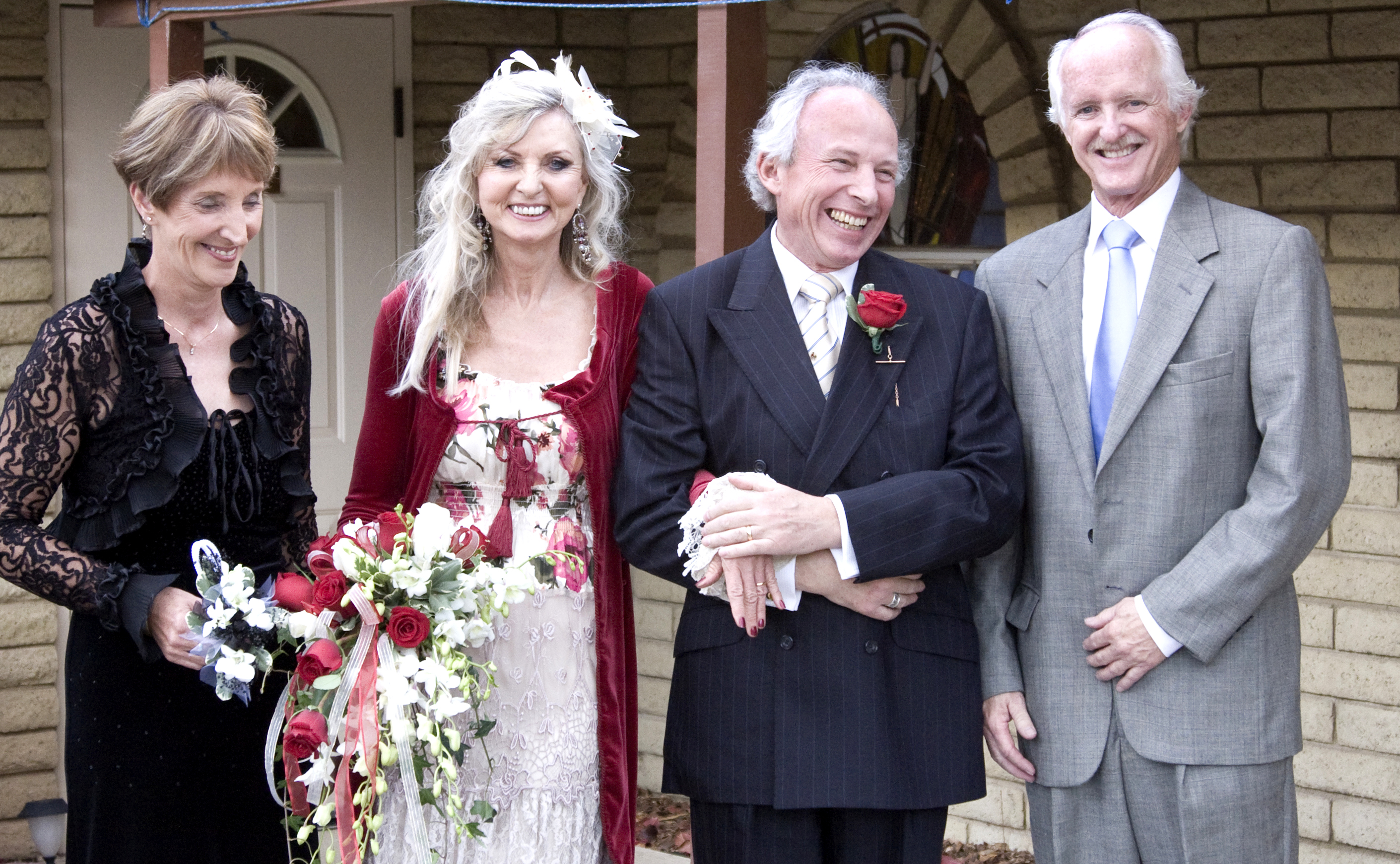
The marriage of Jean and Paul wonderfully supported by Diane, maid of honour, and best man, Dan Gomez.
Dan Gomez – Best Man, and Diane Jackson – Bridesmaid when Jean and I were married;  November 20th 2010.

It is Dan’s birthday today. One of those big birthday milestones in life. (And it would be wrong for me to openly state his age today but just let me say that Dan would be seeing a sixties birthday again!)

So to my very dear and special friend …..

Happy Birthday!

Standing for our wolf cubs

Without our wolf pups there would be no dog pups.

Saw this featured on Howling For Justice back on March 9th, this year and today seemed a perfect time to feature it here after yesterday’s Standing for our puppies post.

ooOOoo

Wolf Pack Caring For Their Four Little Ones…

http://www.youtube.com/watch?v=r1oTr6UpqWg

Time for an uplifting video of a wolf pack caring for their week old pups. They have their hands full! Momma wolf is fighting a losing battle trying to keep them in the den…lol

Enjoy!

===

Video: Courtesy YouTube greenbunting

ooOOoo

Have a great weekend wherever you are.

Standing for our puppies

Protecting the health of our puppies.

Making sure this is as widely known as possible.

With kind thanks to Dog Leader Mysteries for permission to republish in full.

ooOOoo

Puppy Nylabone Bone Recall

Puppies need to chew so give them something safe.

Keep your dog healthy

Please buy your dog food and your dog products from a local pet store or a farm supply. Ask if the business owners or managers subscribe to daily updates on potentially harmful foods, treats and supplements. Ask if they track all lists of recalled pet products everyday they are open.

Use a trustworthy pet food store

A caring and knowledgeable store will pull all recall items each morning then ship them back to the sellers before the pet shop opens their doors to the public. They don’t want your dog getting sick from anything they sell. Naturally, they want to keep your business and have you refer friends and others to shop with them.

The old saying, “An ounce of prevention is worth a pound of cure” is certainly valuable in many ways to dog lovers. Be picky when it comes to buying and giving products to your dog for eating or chewing.

We shop at Western Farm because they assure us that they check all product recalls and pull them off the shelf to be returned to each company that produced any and all pet product recalls.

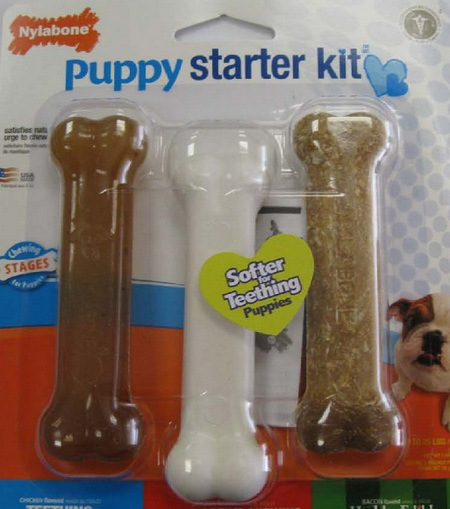
Recalled Nylabone puppy chews 2015.

Salmonella tainted Neptune, NJ Nylabones

“April 22, 2015 — Nylabone Products of Neptune, NJ is recalling one lot of its Puppy Starter Kit dog chews because they have the potential to be contaminated with Salmonella.” The Dog Food Advisor

“The recalled Puppy Starter Kit consists of one lot of dog chews that were distributed nationwide, to Canada and through one domestic online mail order facility. The recalled product comes in a 1.69 ounce package marked with Lot #21935 and UPC 0-18214-81291-3 and with an expiration date of 3/22/18.”

A few responses on Dog Food Advisor

“Be so careful with chew bones, especially if your dog’s a fast eater. I lost a wonderful friend due to a blocked intestine. It was a large chunk of a “digestible” chew bone.”

“I just bought these for my puppy not too long ago. And he chewed up the dark bone and ate it! Next thing I know… He was throwing up for the next 24 hrs – 7 times! Took him to vet and they diagnosed him with an intestinal infection….. Wonder if it was because of the nylabone!”

“Same with my dog! Vomiting and peeing blood! He has a urinary tract infection they said. Same symptoms of salmonella. Call nylabone!! They should foot your vet bills!”

Read more on the Dog Food Advisor

Action, return & complaint

“Consumers who have purchased the affected product should discontinue use of the chews and may return the unused portion to the place of purchase for a full refund.

Those with questions may contact the company at 877-273-7527, Monday through Friday from 8 am – 5 pm Central time. After hours and weekend calls are covered by a third-party poison control center.

U.S. citizens can report complaints about FDA-regulated pet food products by calling the consumer complaint coordinator in your area. Or go to http://www.fda.gov/petfoodcomplaints.

Canadians can report any health or safety incidents related to the use of this product by filling out the Consumer Product Incident Report Form.” The Dog Food Advisor

“Consumers who have purchased 1.69 oz. packages of the Puppy Starter Kit from affected Lot 21935, UPC 0-18214-81291-3, Expiration date of 3/22/18, should discontinue use of the product and may return the unused portion to the place of purchase for a full refund. Consumers with questions may contact the company at 1-877-273-7527, Monday through Friday from 8:00 am – 5:00 pm Central time (after hours/weekends covered by third-party poison control center).” FDA.gov “Safety Recall

Visit The Dog Food Advisor

Get free dog food recall alerts sent to you by email. Subscribe to The Dog Food Advisor’s recall notification list now. [Jean and I have done this!]

ooOOoo

Great alert to all dog owners and I am certain that Deborah, over at Dog Leader Mysteries, would have no problem in this being shared and circulated as far and wide as possible.

Only one way to close!

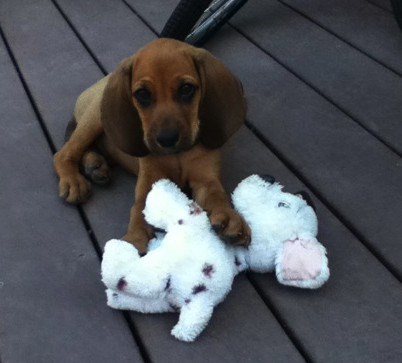
With a picture of a puppy!

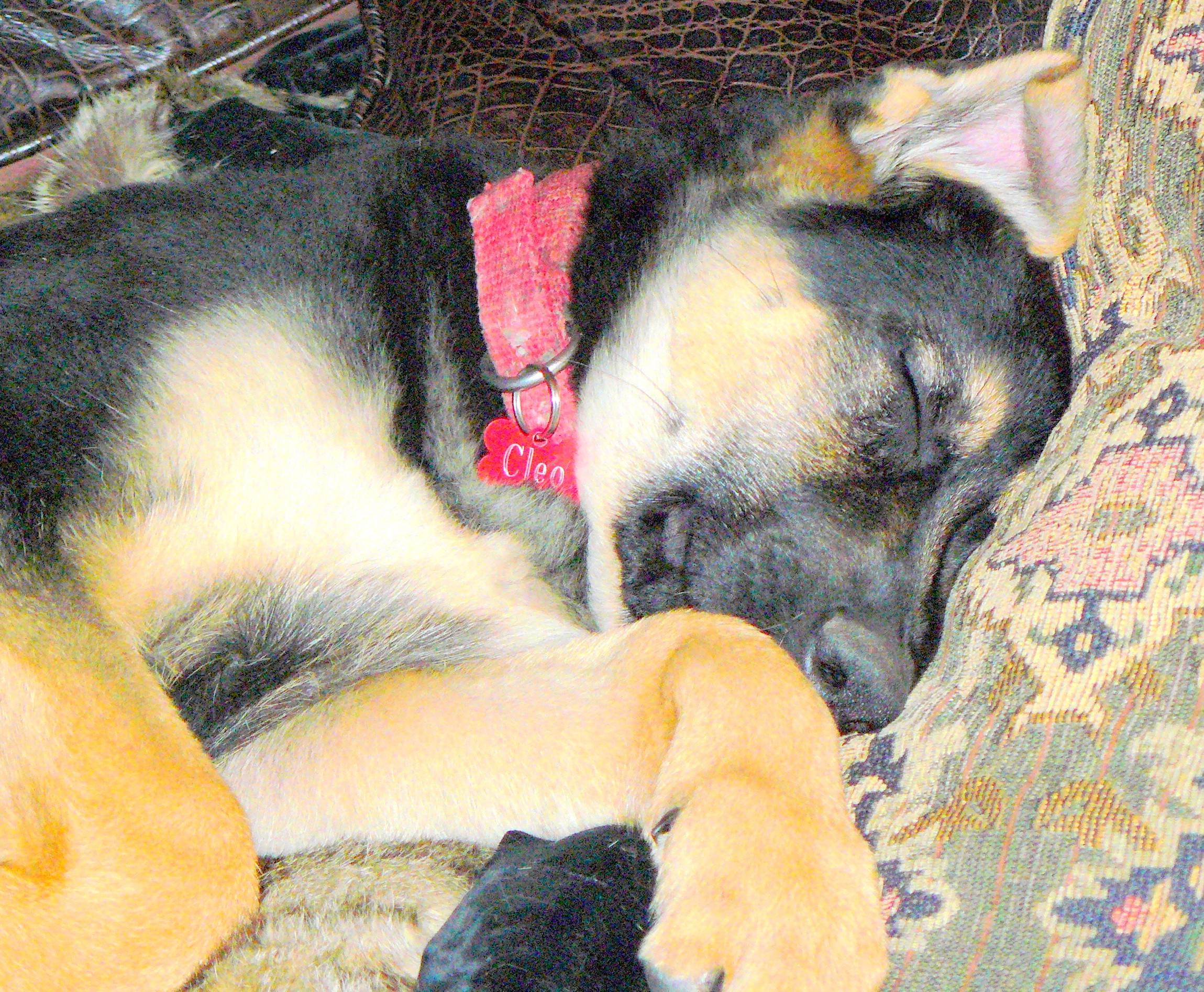
Picture taken of puppy Cleo on the 13th April, 2012 when she was then aged 11 weeks.

Writing 101 Day Seven

Jaw, jaw is so much better than war, war!

Day Seven: Give and Take

Today’s Prompt: Write a post based on the contrast between two things — whether people, objects, emotions, places, or something else.

Remember those “compare and contrast” essays in composition class, in which you’re forced to create a clunky juxtaposition of two arguments? Just because that particular form was a bore doesn’t mean that opposition has no place in your writing.

Bringing together two different things — from the abstract and the inanimate to the living and breathing — creates a natural source of tension, and conflict drives writing forward. It makes your reader want to continue to the next sentence, to the next page. So, focus on your two starkly different siblings, or your competing love for tacos and macarons, or whether thoughts are more powerful than words, or …… you get the idea.

Today’s twist: write your post in the form of a dialogue. You can create a strong opposition between the two speakers — a lovers’ quarrel or a fierce political debate, for example. Or you could aim to highlight the difference in tone and style between the two different speakers — your call!

If you’d like more guidance, check out these ten tips on writing solid dialogue. In case you’re intimidated by dialogue tags — all those “he said,” “she whispered,” etc., here’s a useful overview.

Emulating people’s speech in written form takes practice, and creating two distinct voices could help you see (and hear) the different factors that play into the way we speak, from our diction and accent to our vocabulary and (creative?) use of grammar. (We’ll discuss the topic of voice more formally later in the course; for now, take a stab at writing dialogue on your own.)

Today’s task makes writing about dogs look like a piece of cake!

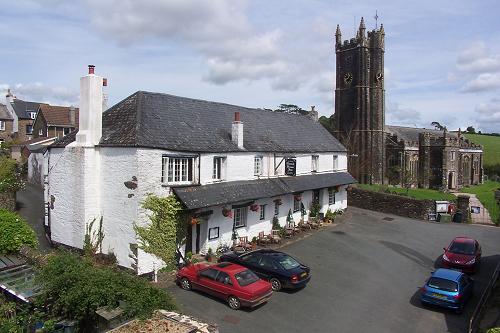
I spent quite some time wondering how to approach this, what to draw upon in terms of my own experiences, what the scene might be. In the end, I chose to write a fictional exchange between me and the landlord, David, of my local pub back in the days of when I lived in Harberton, near Totnes in South Devon. (David and his wife are no longer in residence.)

To help set the scene for you, dear reader, here are two photographs. The first is a view of the pub in the centre of the village of Harberton; population 300 persons.

chi500

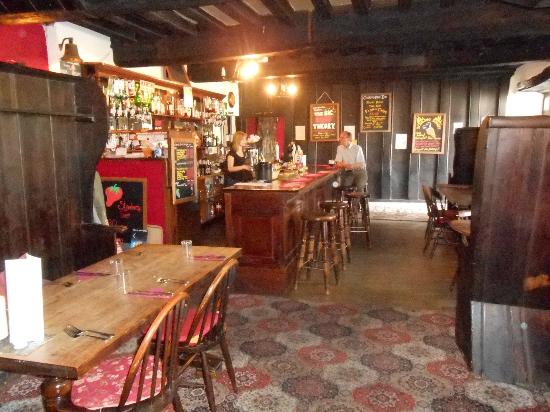
The second image is of the main bar area inside where this fictional conversation is about to take place.  The pub was less than a five-minute walk from my home.

church-house-inn

oooo

“Evening David! Golly, looks like I’m first one in this evening. Must stop looking so keen to have a beer at the end of the day!”

Paul swung his backside onto the corner bar stool and lent his right arm on the bar.

“Good evening to you, Paul. Same as usual?”

“As ever, David.”

David reached out his right arm towards the pump handle at the same time as the fingers of his left hand closed around a pint glass. The sound of the mild ale being poured into the glass was a tonic in itself.

“So how’s your week been, Paul?”

“David, don’t even ask. I seem to have spent most of my waking hours wondering what the hell I’m going to do if the election goes the way it appears to be heading.”

“Well I’m sure Ralph will have clear ideas on that one when he comes in”, David remarked as he handed me the brimming glass of ale.

The pub door squeaked open in the same way it had for time immemorial.

David looked up. “Speak of the devil, here’s the man himself!”

“Somebody call my name?”, boomed out Ralph’s voice.

“David was just saying that you would have clear ideas on the election. But first let me get you a pint, Ralph.”

“Thank you, Paul, that’s mighty gentlemanly of you.”

Ralph removed his light raincoat and sat down next to Paul.

David passed across Ralph’s pint of bitter and took the ten-pound note that Paul held in an outstretched hand.

Ralph took a long swig of his beer and set the glass down on the counter. “So how do you think the election is going to turn out?”

Paul, too, took a good mouthful of his beer and looked across to Ralph. “Well if the media are reporting it correctly, it looks like there’s a better than even chance of UKIP holding the balance of power. And if that happens then I can kiss goodbye to my business!”

David held out Paul’s change in his hand.

“Oh come on, Paul, you can’t mean that! UKIP holding the balance of power will mean an end to the antics of the money-grabbing bastards who have got us into the present mess. Surely, that would be good for you!”

“Ralph, I really wish you are right. But seventy-five percent of my revenue comes from the EU countries and UKIP have pledged to hold a referendum on whether Great Britain stays or leaves the European Union.”

 “Well I don’t know! Me, I just want the quiet life with me and Betty enjoying the rest of our years free from all the damned interference from bloody bureaucratic arses both sides of the Channel!”

“Ralph, I can understand that, truly I can. But I’m a long way from retirement and if my business fails I’m screwed, screwed big time!”

“Paul, you worry too much – let me get you another pint!”

Paul chuckled, “Ralph, you know how to win me over don’t you!”

“Anyway, Paul”, Ralph continued, “rumour has it that you aren’t even spending Christmas with us in the village.”

David, putting the second two pints of beer on the counter in front of Ralph and Paul, looked up, “What’s this I hear? You deserting us this Christmas?”

“Sorry gents, but it’s looking that way. I’ve been invited to spend Christmas with a couple of Americans I’ve known for years.”

“Well it’s alright for some lucky sods,” boomed Ralph, “I’m lucky if I can afford a trip into Totnes.”

He sipped his second pint. “America! Bloody Yanks!”

“I said I have been invited to spend Christmas with some Americans. Doesn’t necessarily mean it will be in the USA.”

“Come on then, tell us it’s somewhere even fancier!”

“Ralph, I’ve been invited to go to Mexico!”

And so it came to pass!

oooo

Well it was fun to write but I’m not certain that I got anywhere close to what today’s Writing 101 theme was looking for.

Oh well, another day tomorrow!

Rescuing has no borders!

Please, please can you help find homes for these gorgeous puppies.

Please read to the end and share this post as widely as you can! Thank you!

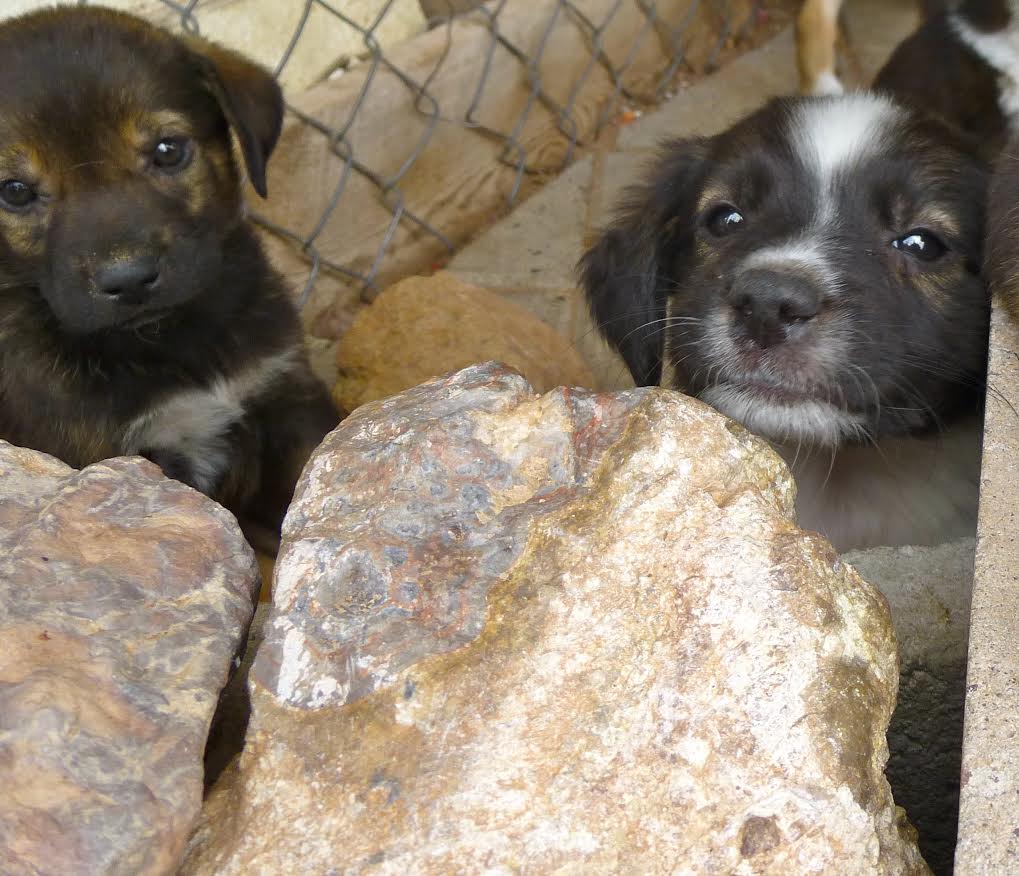
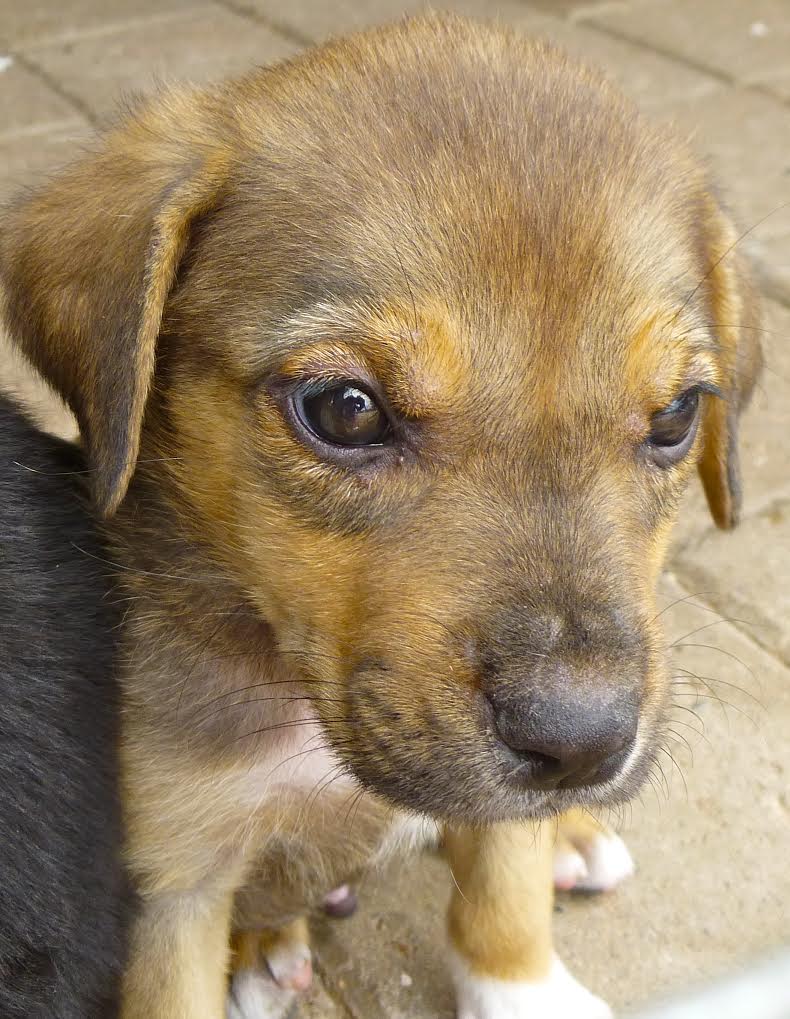
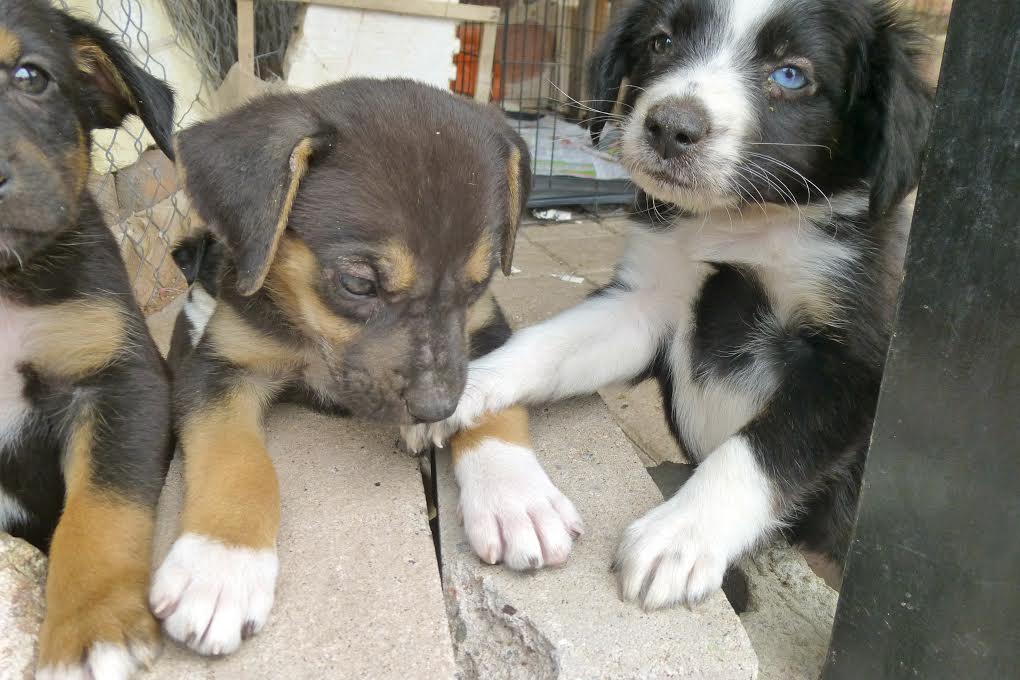
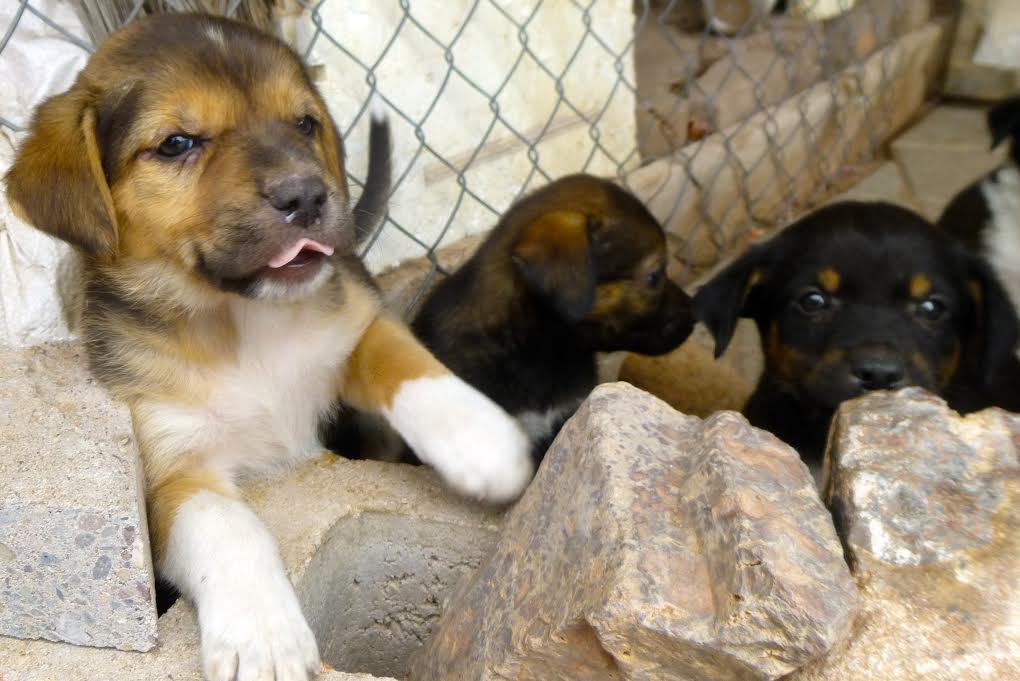
Pup1

Many know that I first met Jean in San Carlos, Mexico over Christmas, 2007.

I met Jean as a result of the kindest gift anyone has given me. Namely, Suzann Reeve, sister of Dan Gomez, whom I have known for 45 years, and Suzann’s husband, Don, invited me to spend Christmas with them at their home in San Carlos.

pup2

Before my arrival on the scene, Jean and Su had worked together for a long time rescuing poor feral dogs off the streets and finding homes for them in the USA.

pup3

After Jean and I moved from San Carlos, with 14 dogs I hasten to add, up to Arizona in 2010, Su has kept going rescuing street dogs and loving them until they can find real homes.

pup4

Many of the Mexican people are so poor that when a female dog has a litter of puppies they sell the puppies for a few pesos and cast the mother dog back out on to the street.

pup5

Our Hazel that we have here at home in Oregon was one such dog and, trust me, never have I experienced a more loving, loyal and affectionate dog.

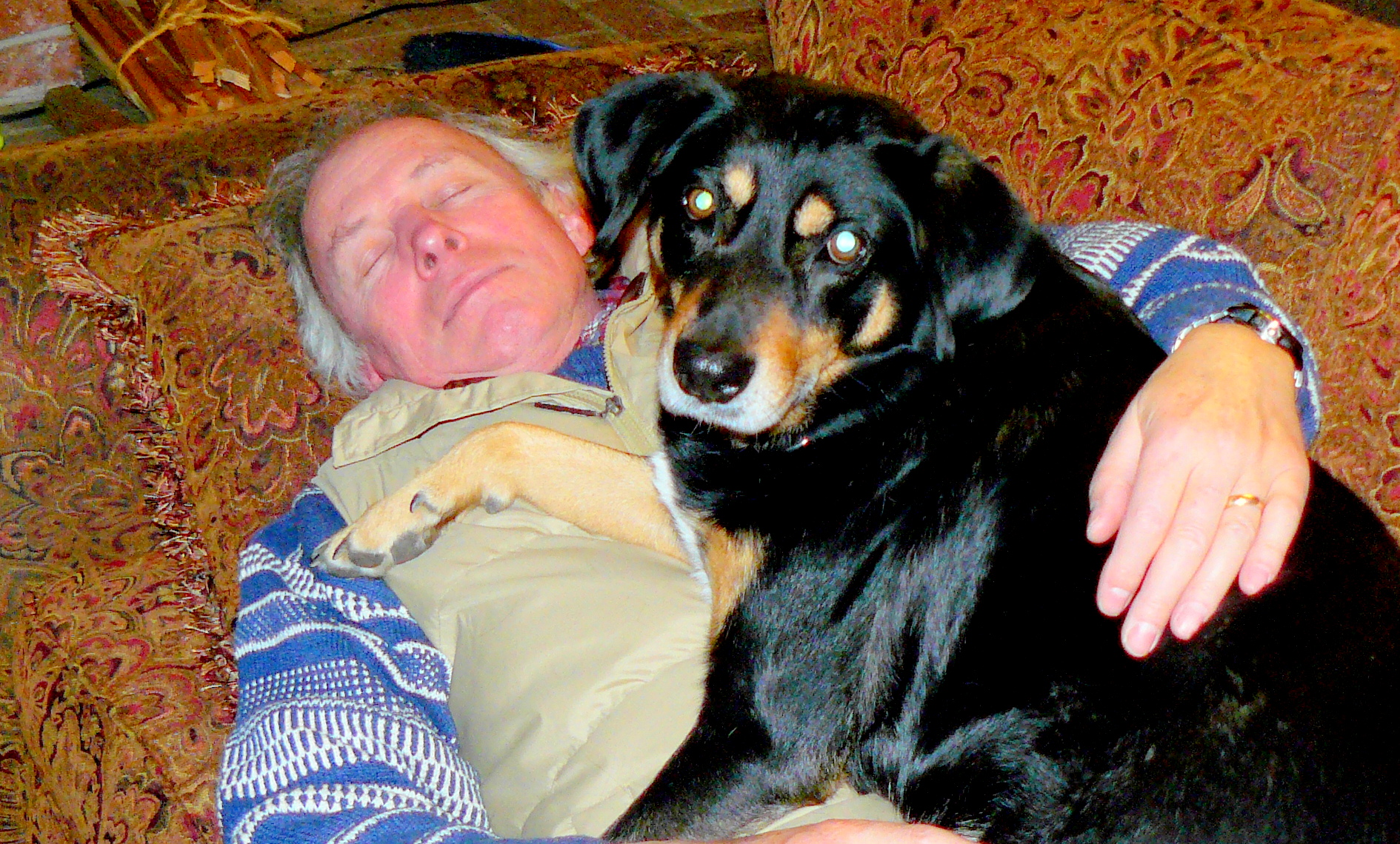
The truest of love between a man and a dog!
Hazel loving up yours truly!

In the last few days, Su has been on the telephone to say that she has a litter of nine puppies and is desperate to find homes for them before too long.

pup6

In answer to my question about the background to the puppies, Su replied:

  • They are reputed to have been born on Valentine’s day, which makes them 8 weeks on April 14th.
  • They are about 6-7 lbs each today.
  • There are 4 girls and 5 boys.

pup7

  • Their mom was feral, but wags her tail ferociously when she spies me with her food bowl!
  • Mom eats steak, bone broth, rice, Kirkland Nature’s Domain canned food, Kirkland dry food. She has cared well for her pups.
  • The pups eat Blue Buffalo canned puppy food mixed in with Kirkland puppy food and some water. they have also received yogurt in their food which I weaned them off as of yesterday.

pup8

  • They will be receiving their first vaccination Monday.
  • They have been wormed twice.
  • They have been given anti-tick spray twice.

pup9

  • Several have at least one blue eye with the other being a brownish grey, some have brown eyes, and the others have light brown eyes.
  • I have their grandmother here at the casa as well, and Sofia is looking for a forever home as well. Bella, the mom of the pups, is a medium sized dog with brown, terra cota and white markings.
  • One of the dads is mostly black with a little white, and the one blue eye.

pup10

  • They were born in a small beach side fishing village in La Manga, Mexico.
  • The mom has a sweet disposition.
  • At least 2 of the pups have alpha tendencies.

pup11


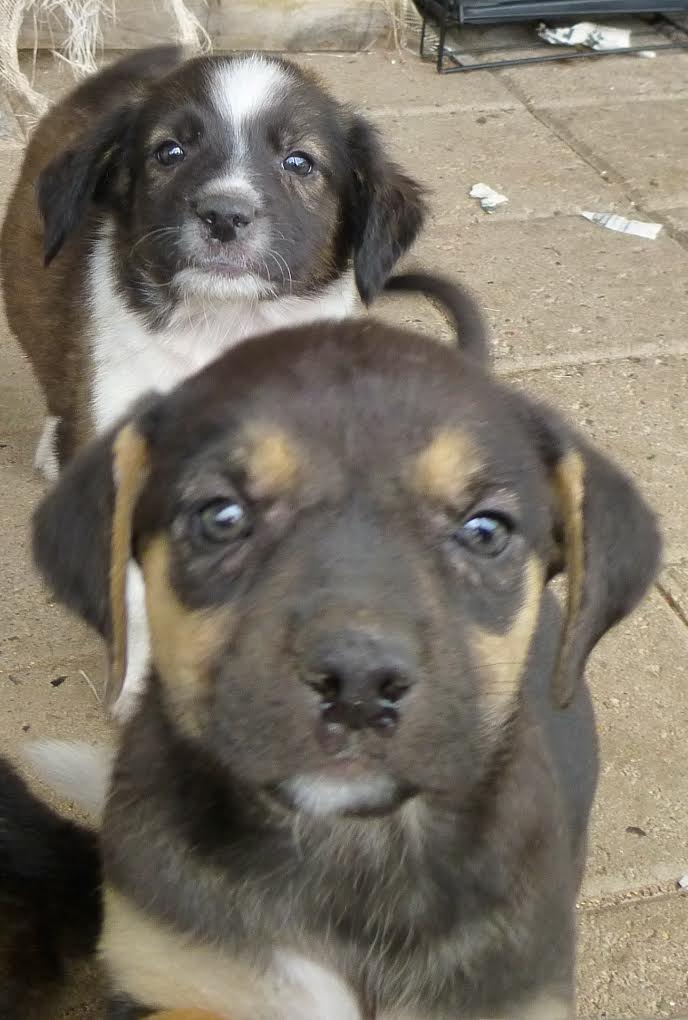
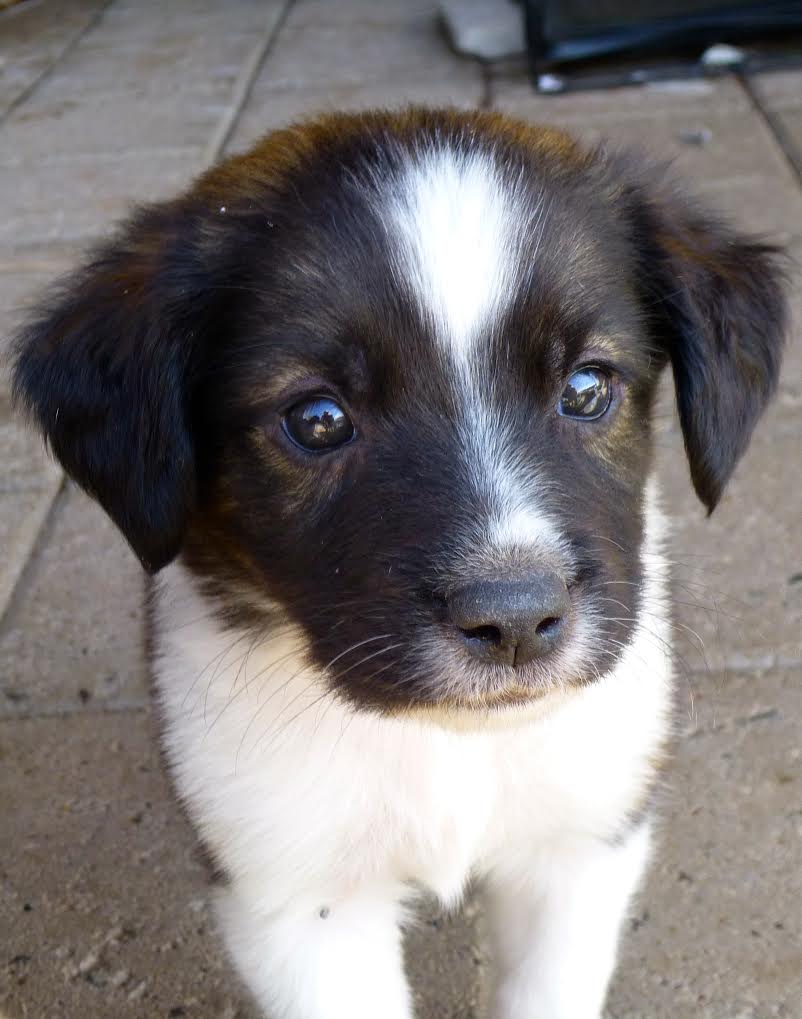
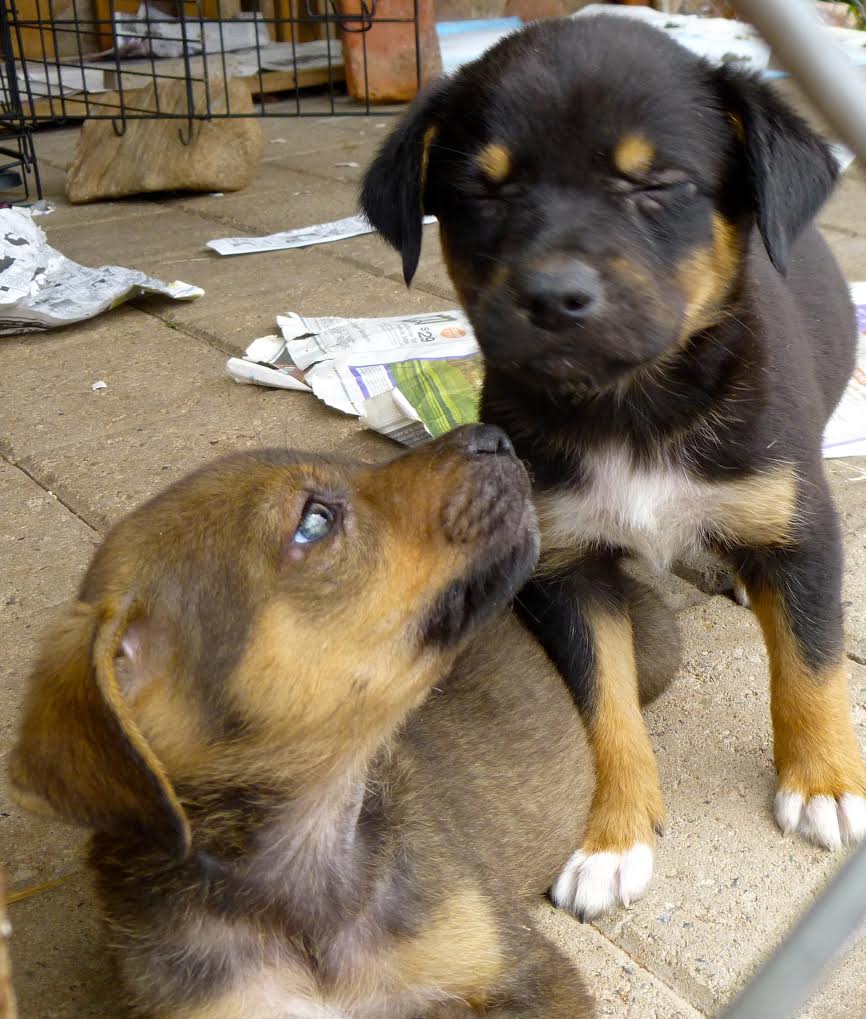
So dear, dear people, if you or anyone you know might be interested in having one of these beautiful puppy dogs then leave a comment without delay.

If you have any questions or queries, likewise articulate that query as a comment to this post. Su will reply to each and every one.

Please share this post as far and wide as you can.

Don’t even hesitate in wondering how Su and all of us can get a puppy from San Carlos to wherever you are – it will be sorted!

Dogs spend their whole lives offering unconditional love to us humans.

Let’s return that love by finding homes for these nine beautiful puppies.

Thank you from the bottom of my heart.

Writing 101 Day Three

Practice makes perfect.

Again, here is the WordPress theme for the day:

Day Three: Commit to a Writing Practice

Today’s Prompt: Write about the three most important songs in your life — what do they mean to you?

Nailing Brahms’ Hungarian Dance Number 5 on your alto sax. Making perfect pulled pork tacos. Drawing what you see. Or, writing a novel. Each requires that you make practice a habit.

Today, try free writing. To begin, empty your mind onto the page. Don’t censor yourself; don’t think. Just let go. Let the emotions or memories connected to your three songs carry you.

Today’s twist: You’ll commit to a writing practice. The frequency and the amount of time you choose to spend today — and moving forward — are up to you, but we recommend a minimum of fifteen uninterrupted minutes per day.

The basic unit of writing practice is the timed exercise. – Natalie Goldberg

Author Natalie Goldberg says to “burn through to first thoughts, to that place where energy is unobstructed by social politeness or the internal censor.” Here are some of her rules of free writing practice from Writing Down the Bones, which we recommend you keep in mind:

  • Keep your hand moving. (Don’t pause to reread the line you’ve just written. That’s stalling and trying to get control of what you’re saying.)
  • Don’t cross out. (That is editing as you write. Even if you write something you didn’t mean to write, leave it.)
  • Don’t worry about spelling, punctuation, grammar. (Don’t even care about staying within the margins and lines on the page.)
  • Lose control.
  • Don’t think. Don’t get logical.
  • Go for the jugular. (If something comes up in your writing that is scary or naked, dive right into it. It probably has lots of energy.)

Jorge Luis Borges said: “Writing is nothing more than a guided dream.” So, what are you waiting for? Get writing. Fifteen minutes. Go. And then, do it again tomorrow, and the day after, and the day after.

Now having written a daily post for well over five years, I’m comfortable with the concept of committing to a writing practice.

Thus I’m going to republish something that gets to the heart of more worldly matters – keeping a smile on your face in these ‘interesting’ times. It comes from a blog that I recently started following: One Regular Guy Writing about Food, Exercise and Living Longer.

ooOOoo

How You Can Benefit from a Positive View on Your Life – WSJ

Regular readers know that I have embraced the theory of positive psychology. I have written a number of posts on the benefits of a positive point of view. You can find an index of them at the end of this post.

Meanwhile, I was thrilled to see Elizabeth Bernstein’s piece in the Personal Journal of Tuesday’s Wall Street Journal entitled “It’s Healthy to Put a Good Spin on Your Life.

think +ve

In a study of a large number of adults in their mid to late 50’s researchers found that “when people displayed higher levels of agency, communion and redemption and lower levels of contamination, their mental health improved. They consider good mental health to be low levels of depression and high levels of life satisfaction and psychological and social well-being.

They explained the four keys to good mental health as follows:

• Agency—Did the subjects feel able to influence and respond to events in life, or did they feel battered around by the whims of external forces?
• Communion—Are the people connected to others or disconnected?
• Redemption—Did the subjects take a negative experience and find some positive outcome?
• Contamination—Did they tell narratives of good things turning bad?

I would like to point you to a post I wrote in May of 2011 called Super Tools for Handling Stress.

In it I quoted Maggie Crowley, Psy.D., a Health Psychologist at the center for Integrative Medicine and Wellness at Northwestern Memorial Physicians Group.

Dr. Crowley listed the following as maladaptive coping strategies:

*Demand our circumstances be different
*Devalue ourselves and others
*Demean/blame ourselves and others
*When the above fail to work, do we choose another strategy?
*Or, do we double our ill-conceived efforts and feed our downward spiral.

She said that we needed something to shift our mental gears out of the stressful/fearful response that triggers that damaging cascade of negative emotion. She suggested the following activities that set off the parasympathetic approach:

*Practicing appreciation
*Making choices that are positive
*Using constructive language
*Employing our strengths and personal power.

I think that there is a great similarity between the four keys to good mental health mentioned in the Journal and the points made by Dr. Crowley in dealing with stressors.

Regarding positive psychology, I have found it answered a lot of questions for me. If you are interested you can explore it in the following posts:

What is Positive Psychology?
How to Harness Positive Psychology for You – Harvard
Breaking down 8 Barriers to Positive Thinking – Infographic
11 Ways to Become a Better, More Positive You
How to Become a Positive Thinker
7 Exercises That Train Your Brain to Stay Positive
Positive, Happy People Suffer Less Pain

Tony.

ooOOoo

This is such incredibly powerful and useful advice with lots of further reading to boot!

For we are bombarded with negative news from all quarters and having a healthy relationship with oneself and, thence, with the world around us is, in the end, what life is all about.