Category: Core thought

Small miracles

It’s not just the rescuing of people that matters.

Last Thursday, the 26th January, the BBC News website published a short video under the heading of: Italian avalanche survivors tell how they stayed alive.

Colleen Barry and Eldar Emric of Associated Press reported in US News:

A couple among the nine survivors of an Italian avalanche that devastated a mountain hotel say they survived nearly 58 hours buried beneath feet of snow by sucking on glass- and mud-filled ice, comforting each other and those nearby, and praying.

Now there’s no way I am belittling that survival; far from it. But 58 hours is a tad under 3 days.

Now read the following that was published on the Care2 site.

ooOOoo

Puppies Rescued 5 Days After Devastating Avalanche in Italy

3199461-largeBy: Laura Goldman    January 26, 2017

After an avalanche buried central Italy’s luxury Hotel Rigopiano and its guests Wednesday, Jan. 18, rescue workers spent days digging in the snow in a desperate attempt to locate any survivors.

About 120,000 tons of snow, 16 feet deep, slammed into the hotel at 60 miles per hour. It took a while for emergency operators to believe the avalanche had occurred. The first man who called to report it was told that everything was fine at the hotel.

When they finally realized a disaster had in fact happened, first responders had to ski to the hotel, which took 12 hours. It took another day until the roads could be cleared with snowplows so emergency vehicles could finally get through.

Despite these circumstances, 11 survivors, including three children, were somehow able to keep themselves alive for over 40 hours by using their cellphones as flashlights to find water. The children, trapped in a game room, ate packets of Nutella and drank bottled water.

By Monday, rescuers were only pulling bodies from the snow and rubble. Discouraged and depressed, they were ready to give up hope.

The rescuers were told there were three puppies at the hotel. They had no idea where they were until they heard a noise in a boiler room inside what remained of the building. It was the three fluffy, white Abruzzo sheepdog puppies, only six weeks old, who had miraculously managed to survive both the avalanche and being stranded for five days.

“They just started barking very softly,” said Sonia Marini, one of the rescuers. “In fact, it was hard to find them right away because they were hidden. Then we heard this very tiny bark and we saw them from a little hole the firefighters had opened in the wall. We expanded the hole and we pulled them out.”

The puppies, born Dec. 4, had survived in an air pocket by eating snow, Walter Milan, the spokesman for Italy’s elite Alpine rescue squad, told the Daily Beast. They are the offspring of Nuvola (Cloud) and Lupo (Wolf), who lived at the hotel and were popular with guests.

Like their lucky litter, Nuvola and Lupo also survived the avalanche, according to a Facebook post by Martina Rossi, who was a bartender at the hotel.

Lupo e Nuvola, i pastori abruzzesi nati e cresciuti all'Hotel Rigopiano, non so come, sono riusciti a raggiungere la mia contrada, una frazione di Farindola (Villa Cupoli) sani e salvi. Questo non può di certo colmare il vuoto e la distruzione che attraversa un paese in ginocchio ancora speranzoso, nell'attesa soltanto di notizie positive, me in prima persona. Ma questi due bellissimi cagnoloni, rivedendoli, di certo sono riusciti a farmi tornare a battere il cuore, almeno per qualche secondo, riportando la speranza.
Lupo e Nuvola, i pastori abruzzesi nati e cresciuti all’Hotel Rigopiano, non so come, sono riusciti a raggiungere la mia contrada, una frazione di Farindola (Villa Cupoli) sani e salvi.
Questo non può di certo colmare il vuoto e la distruzione che attraversa un paese in ginocchio ancora speranzoso, nell’attesa soltanto di notizie positive, me in prima persona.
Ma questi due bellissimi cagnoloni, rivedendoli, di certo sono riusciti a farmi tornare a battere il cuore, almeno per qualche secondo, riportando la speranza.

The three puppies raised the hopes and spirits of the rescuers. “If the puppies survived, humans could as well,” Milan told the Daily Beast. Firefighter Fabio Jerman agreed. “It’s an important sign of life, which gives us hope,” he said.

Sadly, no one else has been found alive. A week after the disaster, 24 bodies have been found and five people are still missing.

In addition to unusually heavy snowfall, the avalanche may have been caused by a series of earthquakes that struck the area the day before.

Last year, devastating quakes killed more than 300 people in Italy. Another fortunate four-legged survivor, a border collie pulled from the rubble two days after an earthquake struck in late October, is being trained to pay it forward as a rescue dog.

Photo credit: YouTube

ooOOoo

Well done the team, as in Walter Milan the spokesman, and the rest of Italy’s elite Alpine rescue squad!

Stories like this put a real smile on my face!


Welcome Kevin

Delighted to introduce Kevin Davies and his guest post.

Regular followers of this place will know that whenever I can I do offer space for a guest blogger. I regret that so many of the persons that ask if I accept guest posts are trying to flog something to you all!

But not Kevin. Here’s a little about him, as supplied by Kevin.

Life can be quite boring without any pets in your life. They can make your day filled with joy, make you smile when you are sad.

My name is Kevin Davies and I am pet lover. The reason why I started this website (https://petloverguy.com) is that I want to share my experience which I have. I can’t imagine my life without pets.

I have always had them since I was little. The first one me and my family had was a cat. Her name was Jenny. She was a Siamese cat with ocean blue eyes, her head was brown with a little bit of white specks, and the rest of her body was white. She was always nice to me, sat in my lap every day and when I petted her she always purred. I lost Jenny when I was 8 and it made me so sad. Actually it still makes me sad and I have never forgotten about her.

ooOOoo

Should I Shave My Dog for the Summer?

by Kevin Davies

dog

It’s a question I hear all the time from pet parents, especially those with relatively long-haired, thick-coated dogs. Should I shave my dog for the summer? Will it make him more comfortable?

Obviously, if your dog is a Poodle, a Shih Tzu, a Lhasa Apso, or another of the “non-shedding” breeds, it’s perfectly fine to shave your dog. But what about the other breeds that aren’t typically shaved for grooming purposes? Can shaving them during the summer months make them more comfortable or will it create problems for them? We’re talking primarily here about long-haired dogs. Chows are a good example though certainly not the only breed in question. The answer is not clear cut and, likely if you ask six different people, you’ll get six different opinions.

There are two lines of thought in this situation. The first line of thought is that the haircoat acts to trap the cooler hair next to the skin and keep the dog cooler. In other words, it works as insulation. The other line of thought is that the fur simply acts like a coat would for a human, making the dog warmer than is necessary.

Frankly, science doesn’t have all the answers to these questions. What we do know is that dogs loose excess heat primarily through panting rather than through the skin. So your dog won’t “sweat” off excess heat like people do, even if shaved. Of course, that doesn’t mean that shaving your dog might not still provide some welcome relief from the heat.

Obviously, there are differences between breeds when it comes to heat tolerance. Likely, there are differences between individual dogs as well. It’s been postulated that black absorbs heat whereas white reflects it. Therefore, dark colored dogs may be less tolerant to heat than lighter colored dogs. I’m not sure whether there’s any truth to that. There are no scientific studies that I know of to prove or disprove the theory. But, from a logical standpoint, it makes sense (to me, anyway).

What does all this mean to you, the dog owner? Should you shave your dog for summer?

I can’t give you a definitive “yes” or “no” answer. What makes sense to me is finding out what works best for your dog. Try shaving your dog and see if he seems more comfortable that way. The hair will grow back quickly for most dogs (more on that in a moment) and, if shaving doesn’t make your dog more comfortable, you don’t have to do it again.

How close should you shave your dog?

I worry about excess exposure to the sun, which may cause sunburn or even contribute to melanomas and other skin diseases. Therefore, I would leave enough fur to provide some protection rather than shaving your dog all the way down to the skin. How close should you trim? Leave perhaps 1/2 inch to an inch of hair length.

There’s one other thing that you should be aware of before you shave your dog though. In most cases, the hair will grow back perfectly normally after shaving. But, in a small number of cases, it may not. This may be remedied in some dogs with the administration of thyroid hormones and/or melatonin. However, not all dogs will respond favorably to these drugs either.

One last precaution: Even if your dog is shaved, you will still need to tailor your dog’s exercise to your individual dog’s situation. Hard exercise (i.e. marathon running, etc.) in hot temperatures is not appropriate for all dogs. Consider your dog’s physical condition and conformation and don’t overdo in the warm weather.

ooOOoo

Don’t know about you but we found that interesting.

Hope there will be more posts from Kevin.

Yet another incredible hero!

The wonderful, inspiring story of what Janey Lowes is doing for dogs in need.

Janey Lowes loving a strteet dog in Sri Lanka
Janey Lowes caring for a street dog in Sri Lanka.

More accurately what Janey Lowes and a whole team are doing for the street dogs of Sri Lanka.

Jean and I saw this story featured on the BBC News website.

The English vet saving Sri Lanka’s street dogs

22 January 2017 Last updated at 00:17 GMT

A vet has left behind her home in England to care for Sri Lanka’s street dogs.

Janey Lowes from Barnard Castle, County Durham, has spent the past two years caring for the neglected animals.

There are about three million street dogs on the island – about 60% of puppies born on the street do not survive to adulthood.

The 28-year-old set up charity WECare Worldwide to raise money to buy the equipment needed to treat the animals and to set up her own clinic in Talalla.

I am pleased that the video clip that was included in the BBC News story has found its way to YouTube.

Inevitably the charity WECare Worldwide has its own website: the home page is here. Then you can read on the charity’s ‘About’ page: (Note: CNVR is the acronym standing for catch-neuter-vaccinate-release.)

CNVR

CNVR is carried out as it is the most humane way to reduce roaming dog populations and reduce the number of unwanted puppies that are dumped on the streets at a very young age. It also allows the females that would inevitably spend their whole lives pregnant to only have to worry about number one when thinking about limited food resources and shelter options, which transforms their lives.

Vaccinating the dog population against Rabies is the most effective way to eliminate the disease in the human population. As an island nation, eradication of Rabies in the near future is a very real possibility and will change the future of both animals and humans here, allowing improved relationships between the two.

CNVR is the backbone of everything we are trying to achieve in Sri Lanka.

But that’s only one part of what they do. Again, as the website sets out:


We focus on 3 main areas here in Sri Lanka.

  • CNVR (catch-neuter-vaccinate-release)
  • Treatment of sick and injured animals
  • Education and training


I shall be making contact with the charity very soon .

Not only to pass on our respect and admiration for what she has accomplished but to see if there are other ways we can help them in what they are doing. I use the word ‘we’ to cover not only Jean and me but also all of you who are close to this blog and who, so frequently, show how much love you have for dogs!

WECare Worldwide will help by providing free veterinary treatment, alongside love, compassion and respectful care of the Ceylon dogs, who make up such a huge part of Sri Lankan heritage and culture, both in the past and the current day.

You will adore this

We can never have too many heroes. Especially if they are dogs!

Just read this gorgeous story that appeared on the Care2 site on January 14th.

ooOOoo

Shelter Dog Nobody Wanted Alerts New Owners to Gas Leak

3198309-largeBy: Laura Goldman   January 14, 2017

Dogs and Learning

In thanks to Yvonne over at Pets, People and Life for prompting me to write this.

In yesterday’s post Yvonne Daniel, the author of the blog Pets, People and Life, said in a comment (my highlights):

Interesting article. When training any of my dogs to learn something ( I should write when TRYING to train my dogs something) I use a high pitched happy voice. I read about the voice thing many years ago and have no idea what book or article that was in. The motive is: to get the dog to understand that you sound happy and enthused. I’m not sure why the high pitched voice is needed, in fact I don’t use it all the time. Maybe I’m not consistent enough. Being able to train a dog is an art. I’m not good at it but my dogs come when I call and generally behave. I’ve taught a few tricks but I wish that I were really good at it.

That motivated me to blow the dust off a couple of blog posts from many years back. Firstly, this one coming up now and then in an hour’s time I will publish a further post about Cleo.

So here’s the first one that goes back to November 2014, when I wrote a post, Understanding the Dog’s World, that included this:

In 2012, the American Veterinary Medical Association reported that there were over 43 million [ 43,346,000] dog-owning households in the USA. That translated to over 36% of the total households in America. With an average of 1.6 dogs per household that came to the astonishing total of 62,926,000 dogs. In just one country!

It is therefore beyond doubt that millions and millions of people, of all ages, all around the world, understand what it is like to have a dog close to them. Likewise, those millions of dogs know what us humans are capable of. But of those millions of humans who have dogs in their lives, how many understand, really understand, the world of the dog?

In my book, in the next chapter after my Prologue, the Puppyhood chapter, I speak of the circumstances that brought me into contact with Angela Stockdale of The Dog Partnership in Devon and how from that association I became aware of the three roles that dogs could be born with: mentor, monitor and nanny.

How, generally speaking, out of every fifty dogs born there were just three born, on average, with those roles and that the bulk of dogs born were straightforward pack members all of equal status.

Irrespective of the fact that we don’t normally own anything like the number that would constitute a natural pack of dogs in the wild, around fifty animals, that doesn’t alter the fact that when a puppy is born it’s social place, from a pack perspective, is ‘hard-wired’ into that puppy.

I am indebted to Angela Stockdale for granting me permission to republish her descriptions of the mentor, monitor and nanny that are available on her website. In terms of man understanding the world of the dog, these descriptions are invaluable.

Here they are:

ooOOoo

What is a Teaching Dog?

A Teaching Dog is a dog who has an instinctive desire to guide and support dogs in their learning canine communication.

A Teaching Dog helps other dogs develop their canine communication skills by displaying different body language to convey different messages. Such as lowering their heads and curving on approach as a polite way to introduce themselves. These essential etiquette skills are invaluable in preventing social issues.

A Teaching Dog teaches dogs canine etiquette to other dogs so they develop their communication skills as they go through the natural ageing process i.e. the transition from puppyhood to adolescence and from adolescence to adulthood. At these essential times, their pupils develop their skills in canine communication to a high level, hence again preventing social issues.

A Teaching Dog has an instinctive desire to guide and support dogs who find communicating difficult. If a dog has an established social issue, a Teaching Dog will actively incite interaction with them in order to teach them how to relax and communicate with them. They will assess how the other dog feels and react accordingly. Keeping their distance if the dog is concerned and approaching thoughtfully when the dog relaxes. I say thoughtfully because that is really important to understand; they think about how to work with a dog.

When a Teaching Dog works, whilst there are some elements of instinctive body language, in the main they will consciously use appropriate body language for the specific situation. They will always maintain control of an interaction but will change their posture from assertive to more inviting in accordance to the other dog’s behaviour.

On sighting the dog they are working with, they will first watch and assess them. This can be done from quite a distance with an experienced Teaching Dog. Eye contact is made but the eyes are averted intermittently whilst the Teaching Dog decides how assertive they need to be, or not as the case may be, with that particular dog. What follows from thereon is purely dependent on the other dog and that particular Teaching Dog’s way of working.

Do all Teaching Dogs teach in the same way?

No. Different Teaching Dogs have different teaching skills and different preferred roles. It is essential to recognise the role each particular Teaching Dog prefers to take. There are three primary Teaching Dog roles – Mentor, Minder and Nanny.

Mentor

A Mentor is normally quietly assertive by nature. They rarely play unless flirting with the opposite sex. However, they generally build the strongest bonds with high ranking dogs of the same sex.

As a Teaching Dog they are passively dominant. They always meet a dog with assertiveness but never hostility. They tend not to use body language to relax a dog as such but often just their presence has a calming effect on most dogs anyway.

If working in a group, they watch from the sidelines and only become involved if absolutely necessary. Mentors can be quite lazy! They will support other Teaching Dogs where needed, showing by example what to do in difficult situations if the other Teaching Dog is not coping.

Other dogs reaction to Mentors vary. Some dogs take great confidence in a Mentor and whilst not necessarily submissive towards them, they are very respectful. Some dogs find a Mentor intimidating and will avoid making contact with them.

Minder

A Minder is totally different to a Mentor in their interaction with dogs they are teaching. When a Minder meets another dog, they actively approach with the intent of interacting with them. A Minder is also naturally assertive but not as strong as a Mentor. When they meet another dog, in the Teaching Situation, they assess the new dog as they approach and use appropriate body language in accordance to the other dog’s reaction to them.

They are more generally more demonstrative than a Mentor and will actively seek interaction within a few minutes of meeting a new dog. This does not necessarily mean that they invite play. If they feel the dog is not ready for that level of interaction, they will converse with them in a more subtle manner.

If the other dog is worried but shows signs of being ready to rush at them, the Minder will stand firmly with their head side on to the dog. Eye contact is made intermittently as the Minder ascertains whether the other dog is calming down or intending to rush at them.

They can stand firm and openly display assertiveness if they need to. Once ‘control’ of the situation has been achieved, a Minder will generally incite status based activities from the other dog. These can be by marking then walking away allowing them to investigate their scent. Or they may invite the other dog into a status game, often instigating a chase.

If the other dog shows signs at trying to drive them away, the Minder will turn their head towards them and eye contact becomes stronger. They do not reposition the rest of their body. If the other dog shows signs of moving away, the Minder will totally drop their body language and move away. They will then reassess the other dog from a distance, before approaching again.

In a group situation, a Minder will monitor the group closely and interrupt any unsociable or unruly behaviour. They interrupt unacceptable behaviour by physically placing themselves between the dogs and will remain there until the tension has reduced. When the dogs in question have calmed down, the Minder will usually walk away and monitor them from a distance. They tend not to interact with the other dogs after harmony has been restored. In effect, they police a group.

Other dog’s reaction to a Minder is either respectful or challenging. Most dogs recognise a Minder as a strong dog and usually respect them. Sometimes polite status games may be played when they first meet.

As the Minder does not naturally command respect in the way a Mentor does, some dogs who have limited canine communication skills and/or adolescents can challenge them. Once the dogs have learned how to ascertain status in a polite manner from the Minder, they will usually then settle and look to the Minder for guidance in future situations.

Nanny

The Nanny is the most amazing of all the Teaching Dogs. Although not their preferred choice, a strong Nanny can take the role of a Minder or Mentor if they need to. They are unique.

They are extremely generous dogs and are at their happiest when everyone else is happy, including other Teaching Dogs. They work very differently to a Mentor and a Minder.

They not only relax a dog who is uncomfortable or anti-social but they also help relax any Mentor or Minder in a group. Few Mentors get overly stressed in a teaching situation but Minders tend to take their job quite seriously, unless really experienced and so can become tense when working.

If they see another Teaching Dog, usually a Minder, showing stress they will also consciously use body language to reduce their tension as well.

Being happier working on a one to one basis or in a group is down to each dog’s personal preference. Although, of all the Teaching Dogs they are more likely to be equally happy in either situation.

When meeting a new dog, they will observe from a distance before making a thoughtful approach. Thoughtful being the operative word as everything a Nanny does is done with thought. The Nanny tends to assess a dog in more depth than the other Teaching Dogs. This means they often take longer in their approach. They rarely communicate with instinctive responses but with conscious body movements, using the eyes in particular, when conversing with another dog.

If a dog is confrontational with them, they will remain strong in their attitude but will incite play, in particular chase games. The game of chase can be a challenge, like the ‘Chase me Charlie’ game children play. Or a game of chase can be used to loosen up a dog who is so stressed they feel unable to move.

The Nanny knows exactly what distance to keep between them and the other dog. If they feel the other dog is too close for comfort or who is becoming too unsociable, they will stop and face the dog and take control again. Once they see the other dog is more relaxed, they will stop running and attempt to converse with them again. They repeat this routine until the other dog stays relaxed and sociable with them.

In a group situation, initially they will monitor from the edge of the group and then actively walk up to each dog individually and check they’re comfortable. This also gives the other dogs confidence as they know the Nanny is there for support should they need it.

Once they have seen every group member, including any other Teaching Dogs, they will then focus on the dogs that feel the most uncomfortable, this is not necessarily the dog who shows outwardly unsociable behaviour.

It could be a dog who becomes withdrawn because they are so stressed. Sometimes they will simply follow and walk alongside a dog who is not comfortable and other times they may invite play. It totally depends on the other dog and how, at that moment, they are feeling. The Nanny may walk alongside another dog and then invite play.

The Nanny will resolve conflict by approaching in a calmer manner than a Minder usually to interrupt the unsociable behaviour. Not necessarily by physically splitting the dogs. They may bark and then play bow and/or literally pat them on the shoulder to attract their attention. A strong confident Nanny will split if they need to but prefer to resolve any conflict by mediation.

When other dogs meet a Nanny, if they have a good command of the canine language they will greet them in friendly, but not submissive manner. A Nanny’s first response to a dog displaying aggression, is to increase the distance between them. But they do not turn their back on the other dog. This would show vulnerability.

They will move away at an angle and stand sideways on to the other dog. This indicates to the other dog that whilst they are not offended and are not going to retaliate, they are also not intimidated. Initially, this can be most confusing for the other dog.

A Nanny excels at being able to recognise signals of stress in other dogs. They will only advance towards the dog to the level the other dog can cope with. As the dog learns that the Nanny will not be coming close enough to pose a threat to them, they begin to relax. In time, the other dog will take confidence from the Nanny and will look to them for guidance in difficult situations.

Is a Teaching Dog the same as the Alpha, Beta and Omega in a wild dog pack?

No. The Teaching Dog is unique to the dog world. Whilst a Mentor is usually a dog of natural Alpha status, an Alpha is not necessarily a Mentor. In fact, many dogs of natural Alpha status can not or do not want to teach. They can not be compared to wolves or any other wild dogs. Teaching Dogs working together are not a pack. They can not be compared to dogs living in a group at home. Some Teaching Dogs do not want to work together with their own group but enjoy working with dogs they know from another family. All Teaching Dogs have equally important roles. There are situations where a Mentor is better able to resolve a conflict and another time a Nanny may be the better dog to the resolve the situation.

How can I find out more about these amazing dogs?

It may sound that it is impossible for dogs to consciously work in this way, particularly the Nanny. Seeing is believing and even then it is almost unbelievable. I run a four-day introductory course on the world of the Teaching Dog. On these courses, participants can bring along their own dog for assessment. But it is important to understand and to recognise that this is not whether your dog can teach but do they want to.

You will see experienced Teaching Dogs in practice. And also those who are at the beginning of their career. I can not, of course, guarantee how they will work as I have not met their pupils yet! You will learn about the Teaching Dog as an individual, see experienced and apprentice Teaching Dogs working on video as well where you can study their conscious body language in different teaching situations.

At this first level, we will cover identifying Teaching Dogs and offering them the right learning ground to develop their natural skills. You can not train a Teaching Dog. A Teaching Dog is born a Teaching Dog. It is dependent on their life’s experiences and living environment as to whether they develop to their full potential. Many allegedly aggressive dogs are actually true Teaching Dogs. In domestic society such dogs have not been able to do what they were born to do; help other dogs without the interference of people trying to tell them how to speak their own language. Their life of frustration has resulted in aggression. Once given the time and freedom to develop their natural teaching skills, any aggressive behaviour disappears.

Time to stop talking and start listening to the real teachers – The dogs themselves

Copyright © 2005 Angela Stockdale

ooOOoo

Thus one of the key learning aspects that Angela offers us humans is that dogs (and horses) learn most effectively when being taught by other dogs (and horses). This was observed countless times by me when Pharaoh was working as a minder teaching dog and using his natural pack instinct to teach puppy dogs their social skills and breaking up squabbles between dogs.

Some closing words from Angela.

I consider myself so lucky for dogs alone to have been my teachers. I learnt from watching how my own dogs responded to another dog’s body language and vice versa their language. Watching, learning and working with Teaching Dogs was the only way I knew. Seeing how these special dogs change the lives of less fortunate dogs, who never had the opportunity to really understand how to communicate with their own species.

I was and always will be in awe of a Teaching Dog’s ability consciously to adapt their body language in accordance to how the other dog was feeling. The result being that they could relax nervous dogs but at the same time maintain control of a problem situation. Remember, dogs talk dog far better than we do.

It came as quite a shock to me when I learnt about other approaches. It seemed foreign for people to have so much input in resolving what were described as ‘ behavioural’ issues. For me, working with these dogs was far more than resolving a behavioural issue. It was about improving the quality of lives of dogs who were not coping with everyday life. If they found dogs or people worrying, sometimes this was shown in displays of aggression. It is important to understand, these dogs were not aggressive, they simply displayed aggressive behaviour.

How on earth to follow that, you might be wondering?

Very simply! By recognising that as much as we have had dogs in our lives, for thousands of years, we do not understand their world, how they truly think, what they feel, and we probably never will.

My second post that was published a while ago follows in an hour’s time.


The dangers of certain brands of peanut butter.

Please read this and share.

(This was first posted on December 8th, 2016. It is being republished because of the mention of peanut butter in the article presented in my post that came out an hour ago.)

ooOOoo

Keep peanut butter away from your dogs!

Because it could kill your beloved companion.

Fellow author Judi Holdeman sent me an email that contained a warning that had been in a recent health newsletter from Jeff Reagan. Here’s the essence of that warning (and my emphasis in parts):

If your dog is anything like my dog, they probably love a good scoop of peanut butter.

As I’m writing this, my pup Ellie is actually snuggled up next to my leg and going to town on her peanut butter filled Kong. She’s in heaven…

But I want to warn you about a NEW problem with dogs and peanut butter.

There’s been a number of reports lately of dogs who are winding up dead because of their beloved peanut butter.

How is this happening?

It has to do with a new ingredient being used in certain peanut butters.

That ingredient is xylitol.

Xylitol is an artificial sweetener that you’ll recognize from things like gum and candy.

And while it’s generally “safe” for humans to eat, it can be deadly for dogs. Just a small amount of it can cause severe liver damage and can even kill your dog.

From my research, I’ve found 5 brands of peanut butter that have recently added xylitol to their ingredients. I’m listing these brands below…

– Go Nuts Co

– Hank’s Protein Plus Peanut Butter

– Krush Nutrition

– Nuts N More

– P28

Now luckily most of these are NOT the most popular brands.

These brands are usually sold at specialty shops or health food stores.

But I still wanted to alert you to this…

Because if your dog is anything like mine, they probably love peanut butter.

So make sure you’re staying away from the brands I listed above.

And double-check the label on your peanut butter to make sure it doesn’t have xylitol in it.

Feel free to forward this email on to your friends or family that have dogs so they are aware of this…

– Jeff Reagan. Editor, Patriot Health Alliance

Please, good people, do share this as far and wide as possible.

Resolutions

In twenty-four hours time it will be January 1st, 2017.

I saw the following recently on the Care2 website and thought that at many levels it would make a wonderful closing post for 2016.

ooOOoo

Seven New Year’s Resolutions to Protect Animals in 2017

3197109-largeBy: s.e. smith December 29, 2016

We’re about to turn over a new leaf on a new year — something I think we’re all pretty excited about — and it’s a good time to sit back, take stock, and think about what we want to do for ourselves, and the world, in 2017.

New year’s resolutions don’t have to be big and fancy, and sometimes they work best when they’re small and manageable, so I rounded up seven totally free ways you can help animals next year, from something you can do weekly (like writing letters) to bigger projects (like fostering animals).

1) Keep an eagle eye on upcoming animal-related legislation.

9768698735_f002511a4e_k
Photo credit: Anthony

Chances are that there’s some animal-related regulation coming your way in 2017 on the local, state and even federal level. This includes laws and ordinances as well as rules, regulations and executive orders. You can make a big difference by weighing in on these issues — sometimes, surprisingly few members of the public comment!

You can take advantage of resources for animal welfare groups and sites like Care2 to keep track of big upcoming government actions. You may want to call or write to support legislation, to ask that it be more robust, or to oppose it, depending on the contents. For legislation, you need to contact your elected official to explain how you feel and provide a concrete action to take, like “Please cosponsor this bill” or “please vote against this bill.” Rules and regulations are opened to public comment by the agencies making them, allowing you to speak at public meetings or submit written comments.

The Federal Register is a great place to search for upcoming regulations — it’s a little bit intimidating at first, but don’t let that put you off!

2) Don’t be sheepish — speak up about nonlethal solutions to predators and pests.

Photo credit: Lennart Tange

No matter where you live, there’s probably a battle brewing over feral cats, mountain lions, raccoons, coyotes, skunks, alligators, or someone else from the non-human world who’s getting squeezed by human incursion into its habitat. Historically, many areas have favored a lethal response to animals deemed “pests.” You can change that — and you already are, across the country. When you see animals on the agenda, speak up to request investigation into a nonlethal solution to a problem.

For example, maybe a feral cat colony is causing controversy in the community. You can talk about how responsible colony management should control numbers and limit annoying smells. You could also discuss how research shows that TNR can be more effective at long-term colony management than just trapping and removing cats — in Florida, they found that doing this just allowed other predators to move in, creating an even bigger headache!

Come backed with research and evidence, rather than emotion. You can look to advocacy groups for their data, but also explore scientific papers, and see how other municipalities are dealing with the same problem, because they may have tips to share.

3) Lend a paw at a local animal welfare organizations.

7623633684_328b5ab21e_z
Photo credit: Chris Perriman

Animal welfare groups can always use volunteer help. At the shelter, they don’t just need a hand with cuddling cats, walking dogs, and handling other species. They need all kinds of help, from more boring stuff like cleaning and filing to web design, social media management, legal counseling, accounting, event planning, and much more. Even something as simple as taking your camera (or your photography class) to the shelter once a week to photograph everyone who’s looking for a home can make a huge difference. It turns out that great shelter photos save lives!

Advocacy groups that don’t run shelters or don’t have one in your area also need help. Lots of mundane office stuff is time consuming, and volunteers can make it go more smoothly, whether you’re stuffing envelopes or answering phones. If you have special training or skills, offer those too, especially if you’re willing to get into a long-term relationship with the group. Pro-bono legal services, for example, are incredibly valuable. Your graphic design skills could help them relaunch an impressive, gorgeous website. You get the idea!

4) Don’t duck the issues — teach youth about animal welfare issues.

Photo credit: Danny Chapman

Many kids love animals, and the best time to hit people with humane messages is when they’re young. Some organizations actually offer humane educator training to help people learn about how to communicate with children about animal welfare issues. Humane educators can lead classes and mentor kids in the community, whether they’re taking people on bird walks and teaching them about ecology or working with kids who are learning to ride horses to teach them how to handle their mounts respectfully and kindly.

If you already are an educator, consider working humane topics into your curriculum. If you’re not, look into what might be required to teach classes at a community center, mentor students in programs like 4-H and FFA, lead educational sessions at a local museum (another great volunteer opportunity!), or come into classrooms with presentations. You may need some training and a background check to work with youth, but once you’re squared away, you can establish lasting relationships with teachers and schools to introduce humane coursework to the classroom and beyond.

5) You’ve goat mail — or at least, someone will after you write a letter on behalf of animals!

Photo credit: Holly Occhipinti

Once a week — or every two weeks, or once a month — resolve to sit down and write a letter. It doesn’t have to be an epic, and you can establish a template, but pick a specific person to target, and go to town. Maybe you want to write a letter-to-the-editor once a month about an animal issue in your community that you’re concerned about. Perhaps you want to write a letter to a corporation to ask them to stop, or start, a practice related to animals — like dropping animal testing, or introducing tougher humane standards to the supply chain.

Keep your letter concise, polite and actionable. Explain why you’re writing, the basis for your concern, the solution you’re recommending and why. You can appeal to issues like cost efficiency, making your town more attractive for visitors, compassion for animals (that’s why we’re here, after all!), falling in line with industry-wide practices, setting an example for others, or any number of other things. Present a clear case for what you’re arguing so that the person reading your letter is moved to act, and has something to bring to other people while trying to convince them to get involved.

6) Be a mother hen — foster somebody in need.

Photo credit: normanack

If you can’t adopt more animals or don’t have room for a full-time friend in your life, consider fostering. Fostering saves lives, getting animals who can’t handle shelter stress or who need a little extra care to a safe place where they can unwind and grow into themselves. Some shelters have foster programs, and many animal welfare groups do — some run almost entirely on fosters, in fact!

Generally, participants in a foster program are provided with food, medication and veterinary expenses to keep things low-key for you. If you have a spare room, fostering can be a great fit for your life, although watch out for foster fail! (When that kitten you swore you were just fostering is still lying on the living room rug ten years later, you are definitely a victim of foster fail.)

When fostering, be honest about what you can and cannot take on: For example, if you have a barn, you might be able to handle horses and sheep, but not notoriously mischievous and curious goats. You might not be able to take a kitten who needs constant feeding, or a dog that has aggression issues.

That said, if you can stretch your comfort zone, do. Some animals need a little extra care because they’ve had a hard life. That makes them vulnerable to euthanasia, and a foster can make all the difference. Things like giving animals fluids or medications, managing diapers, or handling other vet stuff might sound scary, but it’s pretty easy to get the hang of it.

7) Don’t have a cow — on your plate or anywhere else.

Photo credit: Nicolas Vigier

We saved the easiest for last, because chances are that you’re already well on your way with this one. When it comes to what you eat, consider cutting animal products — or at least meat — out of your life. You’ll save a ton of suffering, and also, a ton of money, if you’re trying to cut back in 2017.

If you can’t cut animal products out entirely, consider moderating: Meatless Mondays are popular, for example! Something else that really works for me is a soup exchange — a group of us make huge batches of vegan soup and share them out once a month, so there’s always a go-to vegan meal hanging out in my fridge or freezer when I need it!

While you’re at it, think about what you wear and use, too. Leather is an obvious source of animal suffering, but some people also like to avoid fibers like wool and cashmere (cashmere also comes with a big environmental price tag). You’d also be surprised by where animal products sneak in, from bodycare products to that goop you waterproof your shoes with. (No really. Go look.)

And, of course, cutting animal testing out of your life is valuable too. Growing numbers of cosmetics are produced without the use of animal testing, though it’s always a good idea to independently verify to see if a company is skirting labeling conventions. For example, some companies say “made without animal testing” because they don’t test ingredients on animals, but third party contractors do. Ugh!

If you take medication, you’re caught in the animal testing trap — but it’s worth writing the manufacturer, as well as the FDA, which governs drug testing, to push for alternatives to animal testing so that you have cruelty free options for your health care needs.

You can also make your preference for cruelty free medical supplies clear to your health care providers as well, as they may be able to recommend alternatives if they’re aware that this is a concern for you. (For example, some sutures are made from animal products, which is weird and creepy, and pig valves are used in some valve replacement surgeries. Gross, right?)

Photo credit: Tracy

ooOOoo

All that is required from me is to hope that every one of you has a peaceful and healthy New Year.

If there’s any doubt ….

…. there’s no doubt!

My title and sub-title comes from commercial aviation. It’s one aspect of the safety culture that safely the millions of passengers who embark on a commercial flight each year. (IATA estimate that it will be 3.6 billion in 2016.) In other words, if the flight crew have even an inkling of an issue with the aircraft while in flight they will make an immediate decision to land.

Why I chose this title will become clearer as you read on.

The end of the Second World War so far as Europe was concerned came on May 8th, 1945. In other words: VE Day. London was not a pretty sight in 1945.

Toni Frissell’s famous image of an abandoned boy clutching a stuffed animal in the rubble of 1945 London.
Toni Frissell’s famous image of an abandoned boy clutching a stuffed animal in the rubble of 1945 London. (Image taken from this website page.)

What’s the relevance of May 8th, 1945 to me? Well exactly six months, to the day, before VE Day yours truly was born in Acton which was just six miles West of Marble Arch in the centre of London.

It has been a family legend that when VE Day was announced my mother looked at her six-month-old baby son and announced that he was going to live! For those first six months of my life in London were very dangerous. From that same website page where that photograph above came from one can read (my emphasis):

Nazi Germany continued to bomb London up until 1945 using a variety of delivery methods including V-1 and V-2 rockets. In total 1,115 V-2s were fired at the United Kingdom. The vast majority of them were aimed at London, though about 40 targeted (and missed) Norwich. They killed an estimated 2,754 people in London with another 6,523 injured.

I have very clear mental images of playing in and around bomb sites near our home right up to 1953 when there was a real push to clear the sites away ahead of the Queen’s Coronation on June 2nd, 1953.

German V-2 bomb damage on Uppingham Avenue, Stanmore, just a few miles from home
German V-2 bomb damage on houses in Uppingham Avenue, Stanmore, just a few miles from home. The bomb exploded on March 16th, 1945.

So what’s this all about and why do I see it as relevant to today’s world? Stay with me for a little longer.

Yesterday, Patrice Ayme left a comment to my Private Power post. He opened that comment by saying:

With all due respect, and abundant apologies for the daring image, we can’t write exclusively about dogs, lest we want to finish as dog food. As Paul is suggesting. Indeed I view seriousness in global inquiry as a basic moral duty.

Imagine Jews worrying just about dogs, while Auschwitz was being built; it’s arguably what happened, said Hannah Arendt (I’m paraphrasing; she was hated for it, though…) Some will scoff, but Kim in Korea is building one new H bomb every 5 weeks… One single H bomb, in the ‘right’ place, can kill more than Auschwitz.

On December 27th, Patrice published a post under the title of Isaac Asimov’s Foundation Trilogy. It started:

In the Real World, Foundations Saved Civilization Before:

The combination of imperial collapse followed by re-birth from Foundations within happened several times already, for real.

Civilizations collapsing into Dark Ages from the actions of dozens of millions of people occurred more than once. And then very small groups arose, often within the collapsing empire, and imposed new ways of thinking which enabled civilization to restart.

After I read his post I left a question as a comment: “Are you saying that our present civilization is on the point of collapse?”

Patrice replied:

Well, we are certainly tottering at the edge:
http://www.newyorker.com/news/news-desk/world-war-three-by-mistake
Playing Russian roulette works only that long. Unfortunately demoncrats did not care.

I then went across to that article carried by The New Yorker. It was an article written by Eric Schlosser, author of the book Command and Control: Nuclear Weapons, the Damascus Accident, and the Illusion of Safety and a producer of the documentary Command and Control from 2016.

It’s a long article but an extremely important read. Here are some of the key extracts:

ooOOoo

World War Three, by Mistake

Harsh political rhetoric, combined with the vulnerability of the nuclear command-and-control system, has made the risk of global catastrophe greater than ever.

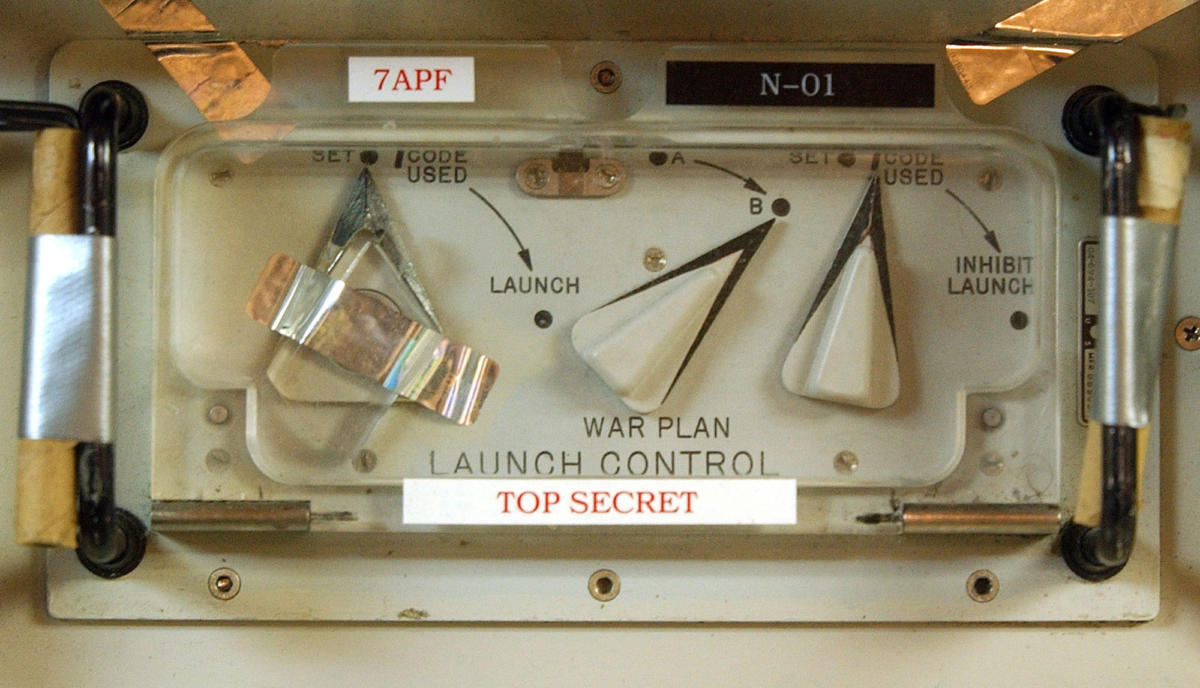
 A dilemma has haunted nuclear strategy since the first detonation of an atomic bomb: How do you prevent a nuclear attack while preserving the ability to launch one?PHOTOGRAPH BY ANDY CROSS / THE DENVER POST VIA GETTY
A dilemma has haunted nuclear strategy since the first detonation of an atomic bomb: How do you prevent a nuclear attack while preserving the ability to launch one? PHOTOGRAPH BY ANDY CROSS / THE DENVER POST VIA GETTY

On June 3, 1980, at about two-thirty in the morning, computers at the National Military Command Center, beneath the Pentagon, at the headquarters of the North American Air Defense Command (NORAD), deep within Cheyenne Mountain, Colorado, and at Site R, the Pentagon’s alternate command post center hidden inside Raven Rock Mountain, Pennsylvania, issued an urgent warning: the Soviet Union had just launched a nuclear attack on the United States. The Soviets had recently invaded Afghanistan, and the animosity between the two superpowers was greater than at any other time since the Cuban Missile Crisis.

U.S. Air Force ballistic-missile crews removed their launch keys from the safes, bomber crews ran to their planes, fighter planes took off to search the skies, and the Federal Aviation Administration prepared to order every airborne commercial airliner to land.

President Jimmy Carter’s national-security adviser, Zbigniew Brzezinski, was asleep in Washington, D.C., when the phone rang. His military aide, General William Odom, was calling to inform him that two hundred and twenty missiles launched from Soviet submarines were heading toward the United States. Brzezinski told Odom to get confirmation of the attack. A retaliatory strike would have to be ordered quickly; Washington might be destroyed within minutes. Odom called back and offered a correction: twenty-two hundred Soviet missiles had been launched.

Brzezinski decided not to wake up his wife, preferring that she die in her sleep. As he prepared to call Carter and recommend an American counterattack, the phone rang for a third time. Odom apologized—it was a false alarm. An investigation later found that a defective computer chip in a communications device at NORAD headquarters had generated the erroneous warning. The chip cost forty-six cents.

[Two paragraphs later]

My book “Command and Control” explores how the systems devised to govern the use of nuclear weapons, like all complex technological systems, are inherently flawed. They are designed, built, installed, maintained, and operated by human beings. But the failure of a nuclear command-and-control system can have consequences far more serious than the crash of an online dating site from too much traffic or flight delays caused by a software glitch. Millions of people, perhaps hundreds of millions, could be annihilated inadvertently. “Command and Control” focusses on near-catastrophic errors and accidents in the arms race between the United States and the Soviet Union that ended in 1991. The danger never went away. Today, the odds of a nuclear war being started by mistake are low—and yet the risk is growing, as the United States and Russia drift toward a new cold war. The other day, Senator John McCain called Vladimir Putin, the President of the Russian Federation, “a thug, a bully, and a murderer,” adding that anyone who “describes him as anything else is lying.” Other members of Congress have attacked Putin for trying to influence the Presidential election.  On Thursday, Putin warned that Russia would “strengthen the military potential of strategic nuclear forces,” and President-elect Donald Trump has responded with a vow to expand America’s nuclear arsenal.  “Let it be an arms race,” Trump told one of the co-hosts of MSNBC’s “Morning Joe.” “We will outmatch them at every pass and outlast them all.”

The harsh rhetoric on both sides increases the danger of miscalculations and mistakes, as do other factors. Close encounters between the military aircraft of the United States and Russia have become routine, creating the potential for an unintended conflict. Many of the nuclear-weapon systems on both sides are aging and obsolete. The personnel who operate those systems often suffer from poor morale and poor training. None of their senior officers has firsthand experience making decisions during an actual nuclear crisis. And today’s command-and-control systems must contend with threats that barely existed during the Cold War: malware, spyware, worms, bugs, viruses, corrupted firmware, logic bombs, Trojan horses, and all the other modern tools of cyber warfare. The greatest danger is posed not by any technological innovation but by a dilemma that has haunted nuclear strategy since the first detonation of an atomic bomb: How do you prevent a nuclear attack while preserving the ability to launch one?

[Going to the closing paragraph]

Every technology embodies the values of the age in which it was created. When the atomic bomb was being developed in the mid-nineteen-forties, the destruction of cities and the deliberate targeting of civilians was just another military tactic. It was championed as a means to victory. The Geneva Conventions later classified those practices as war crimes—and yet nuclear weapons have no other real use. They threaten and endanger noncombatants for the sake of deterrence. Conventional weapons can now be employed to destroy every kind of military target, and twenty-first-century warfare puts an emphasis on precision strikes, cyberweapons, and minimizing civilian casualties. As a technology, nuclear weapons have become obsolete. What worries me most isn’t the possibility of a cyberattack, a technical glitch, or a misunderstanding starting a nuclear war sometime next week. My greatest concern is the lack of public awareness about this existential threat, the absence of a vigorous public debate about the nuclear-war plans of Russia and the United States, the silent consent to the roughly fifteen thousand nuclear weapons in the world. These machines have been carefully and ingeniously designed to kill us. Complacency increases the odds that, some day, they will. The “Titanic Effect” is a term used by software designers to explain how things can quietly go wrong in a complex technological system: the safer you assume the system to be, the more dangerous it is becoming.

ooOOoo

My greatest concern is the lack of public awareness about this existential threat, the absence of a vigorous public debate about the nuclear-war plans of Russia and the United States, the silent consent to the roughly fifteen thousand nuclear weapons in the world.

Is there a dog angle to all of this? You bet! For dogs as well as people are all innocents caught up in the madness of war.

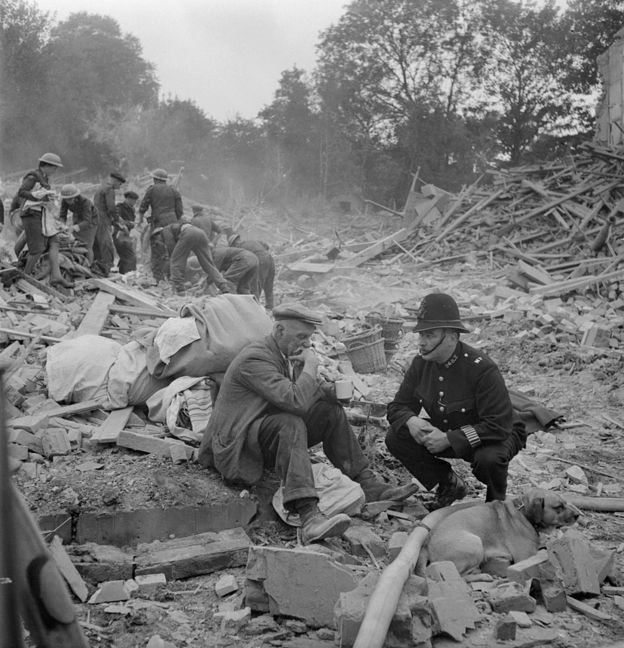
nd sympathy to a now homeless man, who returned home from walking his dog to find his house destroyed and wife killed by a V1 flying bomb. London 1944
A policeman offering sympathy to a now homeless man, who returned home from walking his dog to find his house destroyed and wife killed by a V1 flying bomb. London 1944. (The dog is just below the Policeman’s left shin.)

Now do you see why I entitled today’s post If there’s any doubt. there’s no doubt.

For if we were the flightcrew of the good ship Earth we would be urgently looking for a diversion airfield upon which to land; and land now!

Wherever you are in the world, whatever you are doing, if you share the concern expressed so clearly by Patrice don’t do nothing. Even if all you do is to send a message on one of the social media apps that’s far better than doing nothing. All that evil requires to succeed is for good people to do nothing!

For I haven’t a clue as to when and how my life will come to an end but, as sure as hell, I would prefer that it isn’t six months to the day after the start of World War III.

Especially if that war came about as a mistake!

Rain stopped play!

Sorry good people but the rain yesterday interfered with our Internet connection until early evening.

Then there just wasn’t time to post something for you.

Other than at 6:50 pm we had had 3.17 in of rain since midnight!

It seems like the blink of an eye.

How the years speed past us!

I have lost count of the times in the last year that I have said the following:

Thank goodness that when we were younger we really didn’t understand what it was to be old!

Now being old is to a great extent as much as a thing of the mind as it is of the body. As the saying goes: “One is only as old as you feel!” (Or as many men know it: One is only as old as the woman you feel.)

Moving swiftly on!

Dogs offer us many lessons including what it is to become old, then old and infirm, and then pass away. Which is why so many owners of their beloved dogs spend as much time and care on keeping their elderly dogs as fit as possible as they do on themselves; probably in many cases spending more care and attention on their dogs than on themselves.

ooOOoo

 10 Simple Tips for Keeping Your Old Dog Young

1396029-largeBy: Lisa Spector December 10, 2016

About Lisa

Those of us who love and have dogs know that senior years always approach too fast. Sanchez, my 13 1/2 year old yellow Lab, has had his health challenges this year, but now that he’s gained back his strength and has recovered from E. coli, he’s acting younger than he has in years. I’ve noticed this not only in his energy level, but also in his cognitive abilities and in his engagement with dogs and people around him. I cherish his golden years and am always looking for ways to keep his mind active and alert, and keep him connected with life.

sanchezginainbed-443x3311. Adopt a second, younger dog.

Admittedly, I’ve been a single dog person my entire life… up until five years ago. When it felt like I was agonizing on the decision to expand my canine household, my vet said to me, “Bringing a younger dog into your household will help keep Sanchez younger as he ages.” Sanchez was only seven at the time, and that perspective had never occurred to me. It’s shown itself to be true.

2. Give daily spoonfuls of coconut oil.

I’ve written about the benefits of coconut oil for pets, everything from fur conditioner to paw protection. But, I hadn’t realized that coconut oil helps with canine cognition until I read this Cambridge study. I’ve been giving both Sanchez and Gina a tablespoon of coconut oil nightly for a couple of months. Not only do they love the taste, but I have definitely noticed an improvement in Sanchez’s cognitive abilities.

3. Train him often. 

An old dog not only can learn new tricks, but also loves the attention and benefits from the mental stimulation as much as any age dog. Dogs love to learn, no matter their age. I still spend time training every night with Sanchez. As you can see in the video above, I’ve come up with ways to make his training less physical. But, he still gets rewarded for being involved and staying still. If it gets late, he starts whining and begging for his training time with me. The bonding time is precious and it stimulates him to keep learning and being challenged. He has no complaints about his yummy rewards either.

goldens-cat-sanchez-gina-443x3344. Mix it up.

Although dogs love consistency and build confidence through their routines, it’s sometimes good to mix up that routine as well. I recently was staying with friends and their three Golden Retrievers. While there, Sanchez loved the new smells in their backyard, neglected all of his daily naps and really enjoyed their multi-pet household, including the cats.  Our routine completely changed as my friends generally rise much earlier than me and their dogs are fed right away. I decided to allow my dogs the same privilege while we were there. Of course, Sanchez just loved it. I was surprised how quickly he reverted back to our normal routine when we got home. While he’s making up for his missed naps now, he really enjoyed the change of scenery, people, pets, and general surroundings.

5. Add variety to diet, and consider nutritional needs.

I also add variety to Sanchez’s dog food. While the base is the same (organic meat), the variety comes in the extras. Sometimes I add in canned sardines, other times it’s salmon oil. I alter between any of the following additions: sweet potatoes, carrots, pumpkin, green beans, spinach, kale, apples, and bananas. He’s a Lab and LOVES his food. Surprising him adds to his olfactory delight as well.

6. Add environmental enrichment.

Ohio State University College of Veterinary Medicine defines environmental or behavior enrichment as “the process of manipulating an animal’s environment to increase physical activity & normal species typical behavior that satisfies the animal’s physical and psychological needs.” Music created for senior dogs, with their hearing sensitivities in mind, is a great way to provide auditory stimulation that engages their senses.

7. Incorporate nose work.

Dogs often lose hearing and sight in their senior years. But, as long as they can still smell, they can still find their way around. I’ve honestly met blind and deaf dogs that were still retrieving balls, and I barely noticed any impairment to their sight or hearing. Engage a dog’s nose, and you’ll keep him stimulated.

K9 Nose Work defines this sport as “the fun search and scenting activity for virtually all dogs and people. This easy to learn activity and sport builds confidence and focus in many dogs, and provides a safe way to keep dogs fit and healthy through mental and physical exercise.” I enrolled Sanchez in classes a couple of years ago, and now we play “find” games at home. I hide pieces of liver in boxes spread throughout the living room. He searches for the piece of liver and is rewarded with more liver in the box when he finds it. He LOVES this search game.

8. Play often.

No matter the age, dogs enjoy and benefit from playtime. Even if they don’t have the same physical abilities as their younger canine friends, they can still engage in play. Try a game of hide and seek. Actually, all training and nose-work games should also feel like play to them. Pretend you’re a kid again, and they’ll pick up on your energy and thank you for it.

9. Walk them in new areas.

Again, engaging their nose helps keep them stimulated and interested in their surroundings. Bringing them to a new area for a walk is another way to do that. Sanchez is still often with me in the car. So, once a week, I try and stop in a new area for him to explore.

10. Take time to smell the roses.

Walks may no longer be about physical activity. Move at his pace. Allow him to use his nose as much as he chooses. I’ve learned that it’s not only good for Sanchez, but it’s good for me. He’s teaching me the importance of taking time to slow down and enjoy nature. Honestly, does it ever get any better?

ooOOoo

Our wonderful Pharaoh is getting pretty old now; he was 13 1/2 years-old on December 3rd which is a grand age for a German Shepherd. When he was a young puppy I was advised to get a younger playmate for him when his years were building up. For two reasons. The first being that the younger dog keeps the elderly dog playing and interested in the world. The second reason being that the elder dog will teach the younger dog all the owner’s commands.

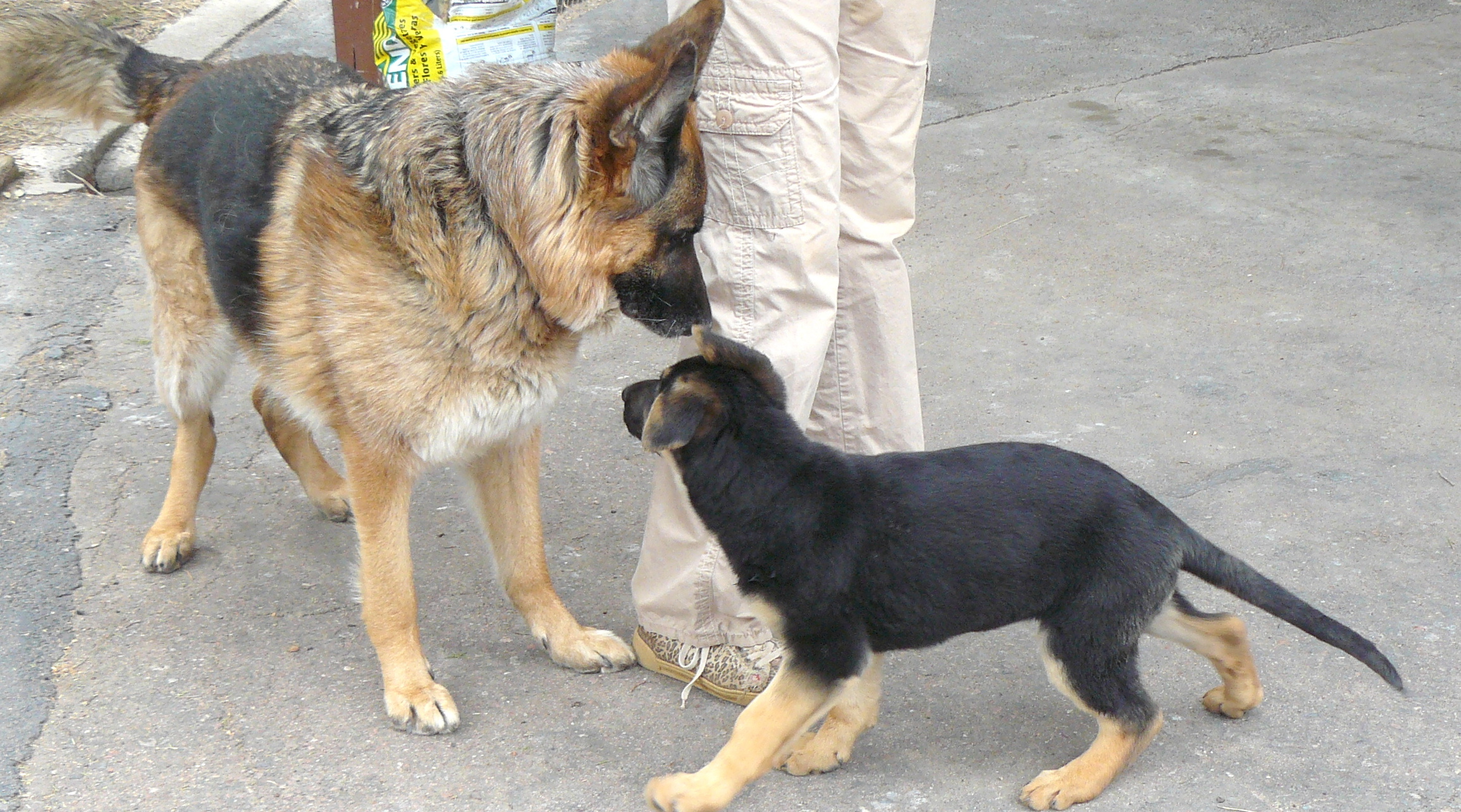
Pharaoh demonstrating his benevolent status with puppy Cleo. April 2012.

Cleo has proved both points. Pharaoh in living with so many dogs around him is most definitely kept engaged and despite his rear hips being so very fragile and weak he still doesn’t miss a turn in going out with the other dogs.

Just to underline how fantastic Pharaoh is doing, his age at the conversion ratio of 1 dog year to 8 human years makes him 108! Or 36 years my senior!