Watch the video to the end to make sense of the title!
The digitally connected world that is now so much a part of our lives brings lots of new issues, dangers and irritations. But it also brings us a great number of tremendous opportunities. TED is one of them.
For those that haven’t come across the TED website it offers a wonderful range of “Riveting talks by remarkable people, free to the world” as summarised here.
Dr Fisher
Thus it was via the TED website that I came across a fascinating talk by Dr Helen Fisher who is a Biological Anthropologist who has specialised on romantic love and connected areas.
Anyway, without any more waffle from me, if you want to be surprised by a number of Dr Fisher’s findings then do watch the TED video that may be found here.
And the reference to the rickshaw driver? Watch the video to the end (23 minutes) to find out.
P.S. since writing the above, I found a YouTube copy of the TED video, which is below. I haven’t watched it to the end to see if the reference to the rickshaw is in it, but I suspect it is.
Humans are often both so funny and tragic at the same time that one does not know whether to laugh or cry on hearing a particular news item. Thus it was for me when reading about Cuba’s apparent ideological U-turn.
The Cuban dogma of the last 50 years has been “State good; private bad.” This is familiar “Communist” territory, so Cubans have been born, grown up and died while being told that “capitalism” was evil, private ownership was bad and that the state was best suited to running everything.
This then was “the truth” for 50 years. But suddenly, amazingly, it seems that this was NOT the truth after all, since now entrepreneurship is to be encouraged in a bid to breathe life into the dinosauric Cuban economy. So, for 50 years Cuba was living a lie? And if so, will those responsible take the blame for these lies?
Errrrmmmm … the heirs and cronies of the apparent lie of over 50 years are the very same people (apart from the conveniently-sidelined Fidel himself, who can of course take the blame whether explicitly or implicitly) who are now proclaiming a new “truth”. So are they admitting their lie, or to be charitable – since XMAS is approaching – their total wrongness?
This is of course the big problem for those enforcing dogma. If there comes a time when the dogma is so manifestly absurd that it has to be changed then the long-time enforcers of the ridiculous are clearly seen to have been wrong for as long as the dogma has been enforced. And of course, the LONGER the dogma has gone on the MORE wrong the enforcers of same are seen to be. So for the dogma-enforcers there is every incentive to NEVER admit the nonsensicality of the dogma, whatever the evidence. Hence the ossification of dogma, when in the end enforcing the dogma is seen as more important than the actual dogma itself.
This is also one reason for the extraordinary conservatism that Humans are often “guilty” of. “Why do we do it that way?” -> “Errrmmmm … we’ve ALWAYS done it that way …”
Well, some credit has to go to the Cuban regime for admitting – tacitly or otherwise – that the last 50 years’ dogma was wrong. Kind as I am, I do not use the word “idiotic”, though some would say that would be more appropriate …… Kind? Am I too kind in giving them any credit at all? After all, in a dictatorship, the only true definition of “truth” is “that which the leadership says is true.”
I haven’t worked out yet whether they are using the common ploy of dogma-changers, the only one in fact that gets them off the hook. This is to say: “Yes, we’ve always believed A was good and B was evil and now we believe the opposite. This is because CIRCUMSTANCES HAVE CHANGED.” Has anyone worked that out yet? The problem with the “Circumstances have changed” argument is of course that circumstances are ALWAYS changing and so dogma PER SE would seem to be a ludicrous way to manage our lives.
Well whatever, the latest pronouncements could have been made by the British centre-right Coalition Party rather than the old-style Cuban Communist Party:
“Our state cannot and should not continue maintaining companies, productive entities, services and budgeted sectors with bloated payrolls [and] losses that hurt the economy,” said the official Cuban labour federation, which announced the news.
George Osbourne, rightist British Chancellor of the Exchequer, would have been quite proud of that newsbite.
One has to wonder how this redefining of “the truth” will go down with the Cuban people. As has been argued, the main problem with changing the dogma is that you have to admit being wrong before, and often massively and for many years. And the longer-term ticking time-bomb is that once you allow questioning of the dogma then you open a door to the questioning of everything. This is why people who enforce dogma don’t really like any sort of questioning whatsoever. Encouraging it is like opening Pandora’s box; where will it all end? And the most hideous question of all of course is: “Don’t we deserve more say in our own government.” or – in the case of a “world-religion”, “Is the whole basis of our “beliefs” (for which we are prepared to kill people for) plain WRONG? Have we been living a LIE for over 1500 years? ” This question is a terrible one for individuals to face, so terrible that their leaders will do ANYTHING to prevent them ever facing it, including of course kill them if the questioning becomes too loud.
This is the real reason why dictatorships don’t like questioning of any kind; mindless sheep would be their preferred populace. A populace that asks too many questions is – frankly – to be avoided like the plague. They are currently plagued in Iran by sheep with very much a mind of their own, which is why oppression is great and increasing of course.
Anyway, I for one rejoice at the Cuban change of direction, even though one has often seen leaders tempted to open Pandora’s box only to violently slam it shut again when they see what starts to happen.
I always admired the Cuban revolution; chucking out a nauseating “Capitalist” mafiosi-style American-backed regime. The problem has been the extreme ossification of Cuban political and economic thought and development since the day Castro took over. Are better days ahead and will Cuba one day end up as a role-model for South America, much as Scandinavia is for the world in general?
The comic in all this? Listening to previous apologists for the former “lie” having to find linguistic justifications for their previous wrongness. This is marvellous for lovers of language as the arts of spin are brought fully into play justifying the previously unjustifiable.
The tragic? Knowing that the livers of the previous lie suffered both from living a lie and from the practical consequences of it, in Cuba’s case a quite unnecessarily high level of poverty in many areas even if there were some compensating factors. As Cuban apologists often say (said?) “The people may be poor but they are happy.” We might say (I assume): “Better to be much better-off and also happy ….”
PS Is the Pope watching all this (and the Islamic hierarchy come to that?) There is plenty of room for dogma change in the Vatican and Mecca …..
This week is a tough one for me with no internet access until the 18th. So I’m quickly offering items from elsewhere that have caught my eye.
Seriously being at rest!
Here’s another thoughtful, and powerful, reminder of the power of peace from Zen Habits.
‘The miracle is not to walk on water. The miracle is to walk on the green earth, dwelling deeply in the present moment and feeling truly alive.’~Thich Nhat Hanh
These days we have an abundance of luxuries, but I’ve found that excess actually decreases my enjoyment of life.
Sure, we can get massive amounts of rich foods, feasting to our heart’s content, stuffing ourselves in alarming displays of gluttony … but is that really enjoyable on a regular basis?
And yes, television can be fun, and so can ridiculously large parts of the Internet, but if it’s always on, if we’re always connected, doesn’t that lower the fun factor?
Excesses lead to all kinds of problems, but the biggest problem is that life is less enjoyable.
I’ve been finding that simplifying things means I can savor life more fully.
Savoring life starts with a mindset. It’s a mindset that believes that excess, that rushing, that busy-ness, that distractedness, isn’t ideal. It’s a mindset that tries instead to:
simplify
do & consume less
slow down
be mindful & present
savor things fully
It’s the little things that make life enjoyable: a walk with a loved one, a delicious book, a chilled plum, a newly blooming tree.
And by simplifying, we can savor life to the fullest.
Some ideas I’ve been considering lately:
1. Coffee: Instead of ordering a latte, mocha, cappuccino with whipped cream and cinnamon and shavings … simplify. Just get pure, good coffee (or espresso), brewed fresh with care and precision, with quality beans, freshly roasted. Make it yourself if you can. Drink it slowly, with little or nothing added, and enjoy it thoroughly.
2. Tea: I recently had tea with Jesse Jacobs, the owner of Samovar Tea Lounge, and he poured two different teas from tiny tea pots: Nishi Sencha 1st Flush and Bai Hao Oolong tea. It was fresh, hand-made tea from real leaves, not a tea bag, and it was simply delicious. Drink it slowly, with your eyes closed, fully appreciating the aroma … wonderful.
3. Workouts: I’ve been a fan of simpler workouts recently. While others might spend an hour to 90 minutes in the gym, going through a series of 10 different exercises, I just do 1-3 functional exercises, but with intensity. So I might do some sprint intervals, or a few rounds of pushups, pullups, and bodyweight squats. Or 400 meters of walking lunges. Let me tell you, that’s a simple but incredible workout. Another I like: five rounds 85-lb. squat thrusters (10 reps) alternated with pushups (10 reps). Today’s workout was three rounds of 15 burpees and 800-meter runs. No rest unless you need it. These are great workouts, but very simple, and very tough. I love them.
4. Sweets: I used to be a sugar addict. Now I still enjoy an occasional dessert, but in tiny portions, eaten very slowly. What I enjoy even more, though, is cold fruit. A chilled peach, some blueberries, a few strawberries, a plum: eat it one bite at a time, close your eyes with each bite, and enjoy to the fullest. So good.
5. Meals: While the trend these days is super-sized meals of greasy, fried things (more than two people need to eat actually), I have been enjoying smaller meals of simplicity. Just a few ingredients, fresh, whole, unprocessed, without chemicals or sauces. My meals usually include: a breakfast of steel-cut oats (cooked) with cinnamon, almonds, and berries; a lunch of yogurt, nuts, and fruit; a dinner of beans or tofu with quinoa and steamed veggies (or sauteed with garlic and olive oil). These simple meals are better because not only are they healthy, each ingredient can be tasted, its flavor fully enjoyed.
6. Reading: While the Internet is chock full of things to read, I’ve been enjoying the simplicity of a paper book, borrowed from the library or a friend (borrowing/sharing reduces natural resources consumed). When I read online, I read a single article at a time, using either the Readability or Clippable bookmarklet to remove distrations, and in full-screen mode in the Chrome browser (hit Cmd-Shift-F on the Mac version or F11 in Windows). It’s pure reading, no distractions, and lovely.
Apologies for the repeat but unable to write a fresh post for the next few days. This post about Kevin has been one of the most popular on Learning from Dogs.
Trust is both taught and learnt!
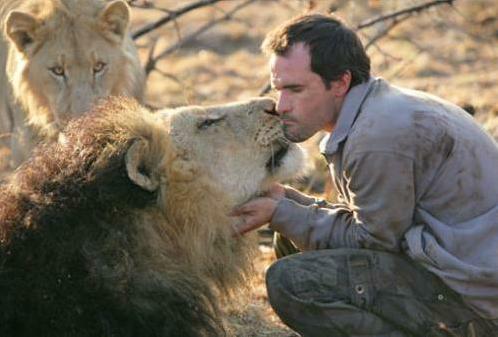
Thanks to Naked Capitalism, we posted an item on the 19th December about an unknown wild-life ranger working in the wildlife refuge area of Lanseria, South Africa. Here was one of the pictures included in that Post:
The Post finished with an appeal to anyone that knew the name of this Ranger. Many of you did and responded; thank you!
His name is Kevin Richardson and there is an interesting account of how he works and some of his ‘experiences’ in Revolution Magazine, luckily with online content. That article is here. It starts thus:
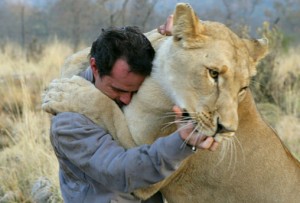
To do this he does not use the common methods of breaking the animal’s spirit with sticks and chains, instead he uses love, understanding and trust. With this unusual method of training he has developed some exceptionally personal bonds with his students. He sleeps with lions, cuddles newborn hyenas, swims with lionesses. Kevin can confidently look into their eyes, crouch to the their level and even lie down with them – all taboos in the normal world of wild animal handling – yet he doesn’t get mauled or attacked.
The article goes on to say that Kevin often works with the animals when they are very young. Thus he is demonstrating very powerfully that how we behave, especially with our children when they are young, creates the environment for building trust out of consistency of deed and thought. (By the way, do read some of the comments posted at the end of that Magazine article – some of them make for powerful reading.)
Kevin Richardson at 'work'.
Luckily, thanks to this wired world we now live in, there is also video of Kevin available on YouTube. A quick search under Kevin Richardson on YouTube will quickly find a number of videos but here are two that I wanted to share with you.
The first will leave you speechless and possibly wet-eyed!
The second is a promotional video by Kevin encouraging us to buy his recent book – and why not!
This is a very remarkable person and it’s an honour to share this with you. We have so much to learn from all animals.
We recently watched a film about an Akita dog called Hachi, Hachikō in Japanese, that demonstrates the loyalty that dogs can have for their human owners.
Here’s the official movie trailer. [UPDATE – for copyright reasons that movie trailer has been removed from YouTube.]
It’s a very moving film – seriously so! Expect to shed many tears. Even more so when one reflects that the Hollywood film is based, reasonably accurately, on a true story. The details of this story are in Wikipedia from which is quoted:
In 1924, Hidesaburō Ueno, a professor in the agriculture department at the University of Tokyo took in Hachikō as a pet. During his owner’s life Hachikō saw him out from the front door and greeted him at the end of the day at the nearby Shibuya Station. The pair continued their daily routine until May 1925, when Professor Ueno did not return on the usual train one evening. The professor had suffered from a cerebral hemorrhage at the university that day. He died and never returned to the train station where his friend was waiting. Hachikō was loyal and every day for the next nine years he waited sitting there amongst the town’s folk.
Hachikō was given away after his master’s death, but he routinely escaped, showing up again and again at his old home. Eventually, Hachikō apparently realized that Professor Ueno no longer lived at the house. So he went to look for his master at the train station where he had accompanied him so many times before. Each day, Hachikō waited for Professor Ueno to return. And each day he did not see his friend among the commuters at the station.
The permanent fixture at the train station that was Hachikō attracted the attention of other commuters. Many of the people who frequented the Shibuya train station had seen Hachikō and Professor Ueno together each day. They brought Hachikō treats and food to nourish him during his wait.
This continued for nine years with Hachikō appearing precisely when the train was due at the station
This hasn’t been the only film about this dog. See below:
Back to the Wikipedia entry:
That same year, another of Ueno’s faithful students (who had become something of an expert on the Akita breed) saw the dog at the station and followed him to the Kobayashi home (the home of the former gardener of Professor Ueno — Kikuzaboro Kobayashi) where he learned the history of Hachikō’s life. Shortly after this meeting, the former student published a documented census of Akitas in Japan. His research found only 30 purebred Akitas remaining, including Hachikō from Shibuya Station.
Professor Ueno’s former student returned frequently to visit the dog and over the years published several articles about Hachikō’s remarkable loyalty. In 1932 one of these articles, published in Tokyo’s largest newspaper, threw the dog into the national spotlight. Hachikō became a national sensation. His faithfulness to his master’s memory impressed the people of Japan as a spirit of family loyalty all should strive to achieve. Teachers and parents used Hachikō’s vigil as an example for children to follow. A well-known Japanese artist rendered a sculpture of the dog, and throughout the country a new awareness of the Akita breed grew.
Eventually, Hachiko’s legendary faithfulness became a national symbol of loyalty.
Hachikō died on March 8, 1935. He was found on a street in Shibuya. His heart was infected with filarial worms and 3-4 yakitori sticks were found in his stomach. His stuffed and mounted remains are kept at the National Science Museum of Japan in Ueno, Tokyo.
Hachiko
The Akita breed has a great reputation for loyalty. But knowing that doesn’t in any way weaken the power of the message for the present times.
A dog offers loyalty, trust and love in exchange for being treated, in turn, with integrity and compassion.
From the Hubble website. Here’s the description of the image:
“Starry Night”, Vincent van Gogh‘s famous painting, is renowned for its bold whorls of light sweeping across a raging night sky. Although this image of the heavens came only from the artist’s restless imagination, a new picture from the NASA/ESA Hubble Space Telescope bears remarkable similarities to the van Gogh work, complete with never-before-seen spirals of dust swirling across trillions of kilometres of interstellar space.
This image, obtained with the Advanced Camera for Surveys on February 8, 2004, is Hubble’s latest view of an expanding halo of light around a distant star, named V838 Monocerotis (V838 Mon).
The illumination of interstellar dust comes from the red supergiant star at the middle of the image, which gave off a flashbulb-like pulse of light two years ago. V838 Mon is located about 20,000 light-years away from Earth in the direction of the constellation Monoceros, placing the star at the outer edge of our Milky Way galaxy.
A single light-year is approximately 6 trillion miles, or 9,460,730,472,580.8 kms for the metric brigade! Thus 20,000 light-years is 120,000 trillion miles, or 120,000,000,000,000,000 miles.
It is beyond imagination – yet it is real!
It humbles one beyond measure that in this short lifetime on mine, science has reached out so far. And then one looks more closely to home and remains appalled that we have learnt so little about living in peace and with integrity on this funny third rock from the Sun.
It’s almost unimaginable that Planet Earth could go the same way. Then again, anyone over the age of, say 60, would find where we are today, in terms of mankind’s long-term survival, equally unimaginable from how the world looked 40 years ago.
Jon Lavin wrote a Post on the 13th June, 2010 entitled, “Dealing with the fear of the known.” I’ve been thinking about that in recent weeks including the comment to Jon’s article from Per. Here’s how Jon closed that article:
If more of us got used to coming out of the mind before making an important decision, and simply sat with the question for a while, the answer would probably present itself.
This will probably raise more questions than it answers but that’s not a bad thing.<!–
And here’s the recent comment from Per:Great advice… but how do we remove the fear of what is known?
Presumably Per was implying that we shouldn’t fear the known. However, I beg to differ here; it is actually fear of the UNKNOWN that is rather pointless (I am not afraid of aliens), while fear of the KNOWN is CRUCIAL to our survival.
But like anything else, you can have too little or too much. Too little, and you survive a very short time. Too much, and you sit cowering in your cellar afraid to go out. As with EVERYTHING in life it is a question of BALANCE.
How do we know how much fear to deploy? Instinct, intelligence, knowledge and experience. If any of these are deficient, we may apply an inappropriate fear quotient.
Let’s take “Global Warming”! How afraid of it should I be? What are my marks out of 10 for the four fear-factors above?
Instinct = 8 – I instinctively fear a situation when my environment is getting hotter, as I don’t know what that will imply. Intelligence = 8 – I am (just) intelligent enough to appreciate the dangers of a rise in temperature. Knowledge = 4 – I have no real idea exactly what is going on or how far it will go; the messages are mixed and I see no real panic among governments. Experience = 0
So, a score of just 20 out of 40, which means IGNORANCE and DOUBT and these add up to FEAR ….. so I am quite afraid.
Home grown vegetables
More apparently, than my leaders seem to be, who can’t even ban flying across the Atlantic at a cost of 60,000 tons of CO2 per day. The question is, will this considerable amount of fear push me into actually DOING something about GW? What is my inertia level and what is my tipping point? What would it take to get me to dig up my garden and plant potatoes? To sell my car and buy a horse? Sadly, humans are in general pretty inert …… it is much easier to do nothing or too little until it is (almost) too late.
So, “fear” is absolutely essential to our survival. If you’re a driver who doesn’t fear accidents then please keep out my my way until you very soon die in one.
Fear is also what pushes me to drive very carefully. People who greedily lent money to Madoff had no fear they would lose it, having lost all control of whatever ration of commonsense and/or logic they might once have had. Perhaps now people will fear rather more about losing their money and therefore invest it more wisely.
To take another topical example, any company in the future (is there one?) drilling for oil in the Gulf of Mexico will fear the lash of Obama’s tongue and stick and this fear will push them to be a bloody sight more careful and to have an effective contingency plan. Actually, why more people don’t have a lot more fear is a mystery to me.
Right, having dealt with fear, we come to our response to it, which is of course the interesting bit. The world is changing so fast that almost all of us have limited control. Even the US President has limited control. This is not comfortable.
How then can we gain more control and become more comfortable? Jon has pointed the way; we must become more self-reliant. Jon will presumably now have much less fear of starving to death, since he is producing a proportion of his own grub. Anyone installing solar-panelled heating will be much less fearful about their electricity being cut off.
I would go further. Anyone owning a horse will or would have much less fear about running out of fuel and being immobile – or more to the point, of being unable to plough and sow his fields, without which we really are stuck. (Incidentally, I am predicting a big comeback for work horses. They are slower, yes, but you can’t breed a tractor (or indeed talk to it) or produce your own fuel, which is where the horse wins out. We’ll have to move more slowly, but then speed is vastly overrated.)
Now Jon with his chickens is a special case. Is there, I wonder, a small element of “fear” in his decision to keep chickens? Humans are complex …. Another major factor pushing Jon down this road could be (and in his case probably is) social responsibility.
It seems pretty clear that if EVERYONE became more self-reliant then vast, expensive, high-consuming centres of production would be scaled down. Unfortunately, social responsibility is not exactly fasionable in today’s consumer world (or we wouldn’t use plastic bags for a start, just to take one small example). Like the vegetarians of 30 years ago, Jon might be seen as an exception if not crank; until of course the fear factor becomes higher and then everyone will try to grow their own potatoes.
So, fear of powerlessness drives us to take initiatives that will help to remove at least some of this fear; a circular but inevitable process. Nothing new about it; the only sad thing is that humans seem to need to travel quite a long way down the path of doom before they really start to react.
This of course is why we did nothing when Hitler invaded the Rheinland in 1936; wait and see seemed easier at the time. It’s also why America totally ignored Jimmy Carter’s ideas of some decades ago about reducing America’s dependence on Arab oil. It was much easier to deride him and do the easy (but totally wrong) thing, especially of course as the oil companies have loads of money and can buy off people who otherwise might see the light.
Well, we’re well past “Wait-and-see” now …… we are now entering the “Do-it-or-else ….” period. And where Jon is of course achieving a double-whammy is that his increasing self-reliance is also GOOD FOR SOCIETY. If everyone were more self-reliant in every way a vast saving in energy and everything else could be achieved. Flying exotic fruits into Britain from South Africa is insane, yet so normal that it seems … errrmmmm … normal.
All this was obvious years if not millennia ago, but the current state of the world has increased the fear factor and is pushing people like Jon down this road. But it is an interesting road. Being self-reliant has multiple advantages, though it will be pretty hard on the rich, who may have to learn how to do things they usually pay underlings to do.
But Jon is in the vanguard of this movement; there is VAST scope for increasing self-reliance. It could and should be an adventure, though it will involve enormous change. The latter of course can also be stressful, but less so when it is clearly a change for the better, as I believe it will be.
On 12th May 1997 former British Foreign Minister Robin Cook made a famous speech in which he outlined his intention to give Britain’s foreign policy an “ethical dimension.”
Here is an extract:
Burma
“Our foreign policy must have an ethical dimension and must support the demands of other peoples for the democratic rights on which we insist for ourselves. The Labour Government will put human rights at the heart of our foreign policy and will publish an annual report on our work in promoting human rights abroad.”
In truth this became something of an albatross since it is easier to pledge an “ethical foreign policy” than to actually deliver it, and sadly Robin Cook never lived to see his brain-child through to maturity. [He died on the 6th August, 2005. Ed.]
However, many were inspired by this speech and felt that a new beginning was being made, one where national interests and economic greed might take second place to “ethics”. However, like many great ideas, it seems to have come to nothing when faced with the cold, hard light of day. And nowhere is the demise of this dream more clear than in the current British Prime Minster’s recent trade mission to India.
Yes, the PM these days is as much a travelling salesman as moral, spiritual and practical leader ….. unfortunately, he chose to visit India the week after this great country had been graced with a visit from the leader of Burma, General Than Shwe.
This “leader” is of course in reality a gangster dictator who seized power after an election gave victory to the democratic opposition. He now rules over a police state from the middle of the jungle, rumouredly using astrology as one of his principal policy-making guides.
Senior General Than Shwe arrived in India on Sunday (25th July) to sign economic agreements. On the first day of his visit, he travelled to Bodh Gaya and Sarnath, two important pilgrimage sites related to the life of Gautama Buddha.
He also laid a wreath at the the site where the world’s most famous non-violent protester, Mahatma Gandhi was cremated; Rajghat in New Delhi. What Gandhi would of thought of that one can only imagine – two days earlier, the Burmese military wiped out a Christian village in Karen State, eastern Myanmar.
This was no great surprise, since this is one of the nastiest, most corrupt and oppressive regimes on Earth. This from Wikipedia: (This is a long extract from Wikipedia but please read it carefully.)
Human rights in Burma are a long-standing concern for the international community and human rights organisations. There is general consensus that the military regime in Burma is one of the world’s most repressive and abusive regimes.Several human rights organisations, including Human Rights Watch and Amnesty International, and the American Association for the Advancement of Science have reported on human rights abuses by the military government.[95][96] They have claimed that there is no independent judiciary in Burma. The military government restricts Internet access through software-based censorship that limits the material citizens can access on-line.[97][98]Forced labour, human trafficking, and child labour are common.[99] The military is also notorious for rampant use of sexual violence as an instrument of control, including allegations of systematic rapes and taking of sex slaves as porters for the military. A strong women’s pro-democracy movement has formed in exile, largely along the Thai border and in Chiang Mai. There is a growing international movement to defend women’s human rights issues.[100]
The Freedom in the World 2004 report by Freedom House notes that “The junta rules by decree, controls the judiciary, suppresses all basic rights, and commits human rights abuses with impunity. Military officers hold all cabinet positions, and active or retired officers hold all top posts in all ministries. Official corruption is reportedly rampant both at the higher and local levels.”[101]
Brad Adams, director of Human Rights Watch’s Asia division, in a 2004 address described the human rights situation in the country as appalling: “Burma is the textbook example of a police state. Government informants and spies are omnipresent. Average Burmese people are afraid to speak to foreigners except in most superficial of manners for fear of being hauled in later for questioning or worse. There is no freedom of speech, assembly or association.”[102]
Evidence has been gathered suggesting that the Burmese regime has marked certain ethnic minorities such as the Karen for extermination or ‘Burmisation’.[103] This, however, has received little attention from the international community since it has been more subtle and indirect than the mass killings in places like Rwanda.[104]
In April 2007, the U.S. Government Accountability Office (GAO) identified financial and other restrictions that the military government places on international humanitarian assistance. The GAO report, entitled “Assistance Programs Constrained in Burma”, outlined the specific efforts of the government to hinder the humanitarian work of international organisations, including restrictions on the free movement of international staff within the country. The report notes that the regime has tightened its control over assistance work since former Prime Minister Khin Nyunt was purged in October 2004. The military junta passed guidelines in February 2006, which formalised these restrictive policies. According to the report, the guidelines require that programs run by humanitarian groups “enhance and safeguard the national interest” and that international organisations coordinate with state agents and select their Burmese staff from government-prepared lists of individuals. United Nations officials have declared these restrictions unacceptable.
Burma’s government spends the least percentage of its GDP on health care of any country in the world, and international donor organisations give less to Burma, per capita, than any other country except India.[105] According to the report named “Preventable Fate”, published by Doctors without Borders, 25,000 Burmese AIDS patients died in 2007, deaths that could largely have been prevented by Anti Retroviral Therapy drugs and proper treatment.[105]
Here’s something very recent:
New Delhi (AsiaNews) – Soldiers from the Burmese Army attacked Tha Dah Der, a Christian village in Karen State, eastern Myanmar, on 23 July, burning 50 homes, a school and a church. Over 600 villagers fled in the jungle as the army advanced, joining 300 more from neighbouring villages who had also abandoned their homes in fear.
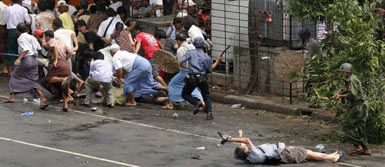
A Burmese photographer dies ....
Yes, we have got used to nasty regimes, and to states sucking up to their psychopathic gangster leaders, but there are limits, surely?
Why is the British Prime Minister grovelling to India (and by the way grossly insulting Pakistan at the same time) when India is laying out the red carpet for the Burmese murderer?
I don’t think “murderer” is too strong a word. Apart from all the usual and well-documented pogroms against minorities (remind anyone of Hitler?) the Burmese mafia government refused to allow international aid agencies to help after the catastrophic 2008 cyclone, the worst in Burma’s history. This condemned hundreds of thousands of Burmese citizens to heartless, needless suffering and certainly cost many lives.
Well, above I asked “why”?
Of course, it’s for selfish national interest. India wants access to Burma’s natural resources, especially oil, while Britain wants industrial contracts with India. Cynics would say Cameron succeeded; a follow-on deal for India to buy British Hawk trainer fighters has just been announced.
But why am I reminded of Goethe’s “Faust”? Is it really worth selling our soul to the Devil (indirectly condoning India’s sickening sycophancy to the Burmese Fuehrer) for the sake of some British jobs? A confirmative answer would seem to suggest that ethics in foreign policy is well and truly dead.
Once again, a vicious dictatorship flourishes by divide and rule. Where is the united international front that might help to put an end to our fellow-humans’ suffering? We managed this unity to help end South African apartheid; have our moral standards declined so much since then?
PS South Africa? Oh weep …. In January 2007, Russia and China vetoed a draft resolution before the United Nations Security Council calling on the government of Myanmar to respect human rights and begin a democratic transition. South Africa also voted against the resolution.
Still, they put on a good World Cup, so that’s all right then ……
A nearly 30-year old film has real relevance for today!
Those of you that read yesterday’s Post right through to the end will have picked up on the fact that after completing that article last Friday, Jean and I watched the movie The Verdict.
Amazingly, this powerful film was released on the 8th December 1982.
So why the connection between the film and the Post written yesterday?
Well yesterday I wrote about two recent examples of, at best, a terrible lack of integrity, or, at worst, blatant examples of powerful institutions lying to us. It troubled me greatly and I found no adequate way of closing the Post expressing my troubles in a succinct and fitting way. Stay with me for a few moments.
In the film The Verdict, Paul Newman plays Frank Galvin – here’s the synopsis from the IMDb website:
Frank Galvin is a down-on-his luck lawyer, reduced to drinking and ambulance chasing. Former associate Mickey Morrissey reminds him of his obligations in a medical malpractice suit that he himself served to Galvin on a silver platter: all parties willing to settle out of court. Blundering his way through the preliminaries, he suddenly realizes that perhaps after all the case should go to court: to punish the guilty, to get a decent settlement for his clients, and to restore his standing as a lawyer.
As one might have guessed, Galvin wins the case against all the odds, which doesn’t in any way reduce the power of the film. Newman was brilliant.
Tackling a medical malpractice case that could revive his once glorious career, attorney Frank Galvin (Paul Newman) questions a key witness, Dr. Thompson (Joe Seneca), in the compelling courtroom drama The Verdict.
At the end of the hearing Galvin rises to give his summation. Technically the case appears utterly lost to his side. Galvin slowly stands, hesitantly looks as his notes, cast the sheet aside and reluctantly addresses the jury.
You know, so much of the time we’re just lost.
We say, “Please, God, tell us what is right; tell us what is true.” And there is no justice: the rich win, the poor are powerless. We become tired of hearing people lie.
And after a time, we become dead… a little dead. We think of ourselves as victims… and we become victims. We become… we become weak. We doubt ourselves, we doubt our beliefs. We doubt our institutions. And we doubt the law.
But today you are the law. You ARE the law. Not some book… not the lawyers… not the, a marble statue… or the trappings of the court. See those are just symbols of our desire to be just. They are… they are, in fact, a prayer: a fervent and a frightened prayer. In my religion, they say, “Act as if ye had faith… and faith will be given to you.” IF… if we are to have faith in justice, we need only to believe in ourselves. And ACT with justice. See, I believe there is justice in our hearts.
Now go back and read my Post of yesterday. Read of the Citi executives paying token fines for lying to investors. Read of the allegation that the 2009 data set in the US GDP report was a “bald-faced lie”.
Now read again, aloud to yourself if you can, the first few sentences of Galvin’s summation. Here they are again (my emphasis).
You know, so much of the time we’re just lost.
We say, “Please, God, tell us what is right; tell us what is true.” And there is no justice: the rich win, the poor are powerless. We become tired of hearing people lie.
And after a time, we become dead… a little dead. We think of ourselves as victims… and we become victims. We become… we become weak. We doubt ourselves, we doubt our beliefs. We doubt our institutions. And we doubt the law.
I firmly believe that this is where millions of ordinary, hard-working, caring citizens of many countries have arrived today because of the lack of integrity, the lack of honesty and the lack of grace shown by so many in positions of power and privilege.
But do not despair because if we do that, then all is lost. No, believe in the power of good men. Back to the summation from the film:
In my religion, they say, “Act as if ye had faith… and faith will be given to you.” IF… if we are to have faith in justice, we need only to believe in ourselves. And ACT with justice. See, I believe there is justice in our hearts.









 Learning from Dogs