Category: Core thought

The DNA of dogs.

What is revealed in most dogs’ genes.

On November 24th this year, The Conversation published an article that spoke of the ancient closeness, as in genetically, of wolves and dogs.

I share it with you. It is a fascinating read.

ooOOoo

Thousands of genomes reveal the wild wolf genes in most dogs’ DNA.

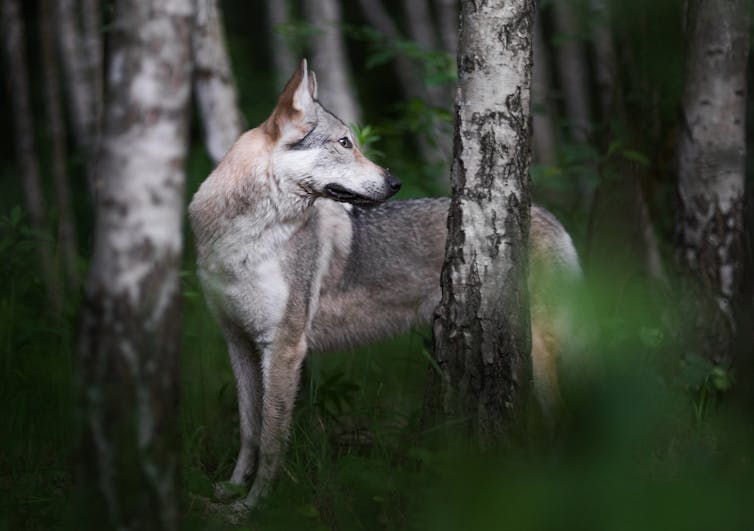
Modern wolves and dogs both descend from an ancient wolf population that lived alongside woolly mammoths and cave bears. Iza Lyson/500px Prime via Getty Images

Audrey T. Lin, Smithsonian Institution and Logan Kistler, Smithsonian Institution

Dogs were the first of any species that people domesticated, and they have been a constant part of human life for millennia. Domesticated species are the plants and animals that have evolved to live alongside humans, providing nearly all of our food and numerous other benefits. Dogs provide protection, hunting assistance, companionship, transportation and even wool for weaving blankets.

Dogs evolved from gray wolves, but scientists debate exactly where, when and how many times dogs were domesticated. Ancient DNA evidence suggests that domestication happened twice, in eastern and western Eurasia, before the groups eventually mixed. That blended population was the ancestor of all dogs living today.

Molecular clock analysis of the DNA from hundreds of modern and ancient dogs suggests they were domesticated between around 20,000 and 22,000 years ago, when large ice sheets covered much of Eurasia and North America. The first dog identified in the archaeological record is a 14,000-year-old pup found in Bonn-Oberkassel, Germany, but it can be difficult to tell based on bones whether an animal was an early domestic dog or a wild wolf.

Despite the shared history of dogs and wolves, scientists have long thought these two species rarely mated and gave birth to hybrid offspring. As an evolutionary biologist and a molecular anthropologist who study domestic plants and animals, we wanted to take a new look at whether dog-wolf hybridization has really been all that uncommon.

Little interbreeding in the wild

Dogs are not exactly descended from modern wolves. Rather, dogs and wolves living today both derive from a shared ancient wolf population that lived alongside woolly mammoths and cave bears.

In most domesticated species, there are often clear, documented patterns of gene flow between the animals that live alongside humans and their wild counterparts. Where wild and domesticated animals’ habitats overlap, they can breed with each other to produce hybrid offspring. In these cases, the genes from wild animals are folded into the genetic variation of the domesticated population.

For example, pigs were domesticated in the Near East over 10,000 years ago. But when early farmers brought them to Europe, they hybridized so frequently with local wild boar that almost all of their Near Eastern DNA was replaced. Similar patterns can be seen in the endangered wild Anatolian and Cypriot mouflon that researchers have found to have high proportions of domestic sheep DNA in their genomes. It’s more common than not to find evidence of wild and domesticated animals interbreeding through time and sharing genetic material.

That wolves and dogs wouldn’t show that typical pattern is surprising, since they live in overlapping ranges and can freely interbreed.

Dog and wolf behavior are completely different, though, with wolves generally organized around a family pack structure and dogs reliant on humans. When hybridization does occur, it tends to be when human activities – such as habitat encroachment and hunting – disrupt pack dynamics, leading female wolves to strike out on their own and breed with male dogs. People intentionally bred a few “wolf dog” hybrid types in the 20th century, but these are considered the exception.

a wolfish looking dog lies on the ground behind a metal fence
Luna Belle, a resident of the Wolf Sanctuary of Pennsylvania, which is home to both wolves and wolf dogs. Audrey Lin.

Tiny but detectable wolf ancestry

To investigate how much gene flow there really has been between dogs and wolves after domestication, we analyzed 2,693 previously published genomes, making use of massive publicly available datasets.

These included 146 ancient dogs and wolves covering about 100,000 years. We also looked at 1,872 modern dogs, including golden retrievers, Chihuahuas, malamutes, basenjis and other well-known breeds, plus more unusual breeds from around the world such as the Caucasian ovcharka and Swedish vallhund.

Finally, we included genomes from about 300 “village dogs.” These are not pets but are free-living animals that are dependent on their close association with human environments.

We traced the evolutionary histories of all of these canids by looking at maternal lineages via their mitochondrial genomes and paternal lineages via their Y chromosomes. We used highly sensitive computational methods to dive into the dogs’ and wolves’ nuclear genomes – that is, the genetic material contained in their cells’ nuclei.

We found the presence of wild wolf genes in most dog genomes and the presence of dog genes in about half of wild wolf genomes. The sign of the wolf was small but it was there, in the form of tiny, almost imperceptible chunks of continuous wolf DNA in dogs’ chromosomes. About two-thirds of breed dogs in our sample had wolf genes from crossbreeding that took place roughly 800 generations ago, on average.

While our results showed that larger, working dogs – such as sled dogs and large guardian dogs that protect livestock – generally have more wolf ancestry, the patterns aren’t universal. Some massive breeds such as the St. Bernard completely lack wolf DNA, but the tiny Chihuahua retains detectable wolf ancestry at 0.2% of its genome. Terriers and scent hounds typically fall at the low end of the spectrum for wolf genes.

a dog curled up on the sidewalk in a town
A street – or free-ranging – dog in Tbilisi, Georgia. Alexkom000/Wikimedia Commons, CC BY

We were surprised that every single village dog we tested had pieces of wolf DNA in their genomes. Why would this be the case? Village dogs are free-living animals that make up about half the world’s dogs. Their lives can be tough, with short life expectancy and high infant mortality. Village dogs are also associated with pathogenic diseases, including rabies and canine distemper, making them a public health concern.

More often than predicted by chance, the stretches of wolf DNA we found in village dog genomes contained genes related to olfactory receptors. We imagine that olfactory abilities influenced by wolf genes may have helped these free-living dogs survive in harsh, volatile environments.

The intertwining of dogs and wolves

Because dogs evolved from wolves, all of dogs’ DNA is originally wolf DNA. So when we’re talking about the small pieces of wolf DNA in dog genomes, we’re not referring to that original wolf gene pool that’s been kicking around over the past 20,000 years, but rather evidence for dogs and wolves continuing to interbreed much later in time.

A wolf-dog hybrid with one of each kind of parent would carry 50% dog and 50% wolf DNA. If that hybrid then lived and mated with dogs, its offspring would be 25% wolf, and so on, until we see only small snippets of wolf DNA present.

The situation is similar to one in human genomes: Neanderthals and humans share a common ancestor around half a million years ago. However, Neanderthals and our species, Homo sapiens, also overlapped and interbred in Eurasia as recently as a few thousand generations ago, shortly before Neanderthals disappeared. Scientists can spot the small pieces of Neanderthal DNA in most living humans in the same way we can see wolf genes within most dogs.

two small tan dogs walking on pavement on a double lead leash
Even tiny Chihuahuas contain a little wolf within their doggy DNA. Westend61 via Getty Images

Our study updates the previously held belief that hybridization between dogs and wolves is rare; interactions between these two species do have visible genetic traces. Hybridization with free-roaming dogs is considered a threat to conservation efforts of endangered wolves, including Iberian, Italian and Himalayan wolves. However, there also is evidence that dog-wolf mixing might confer genetic advantages to wolves as they adapt to environments that are increasingly shaped by humans.

Though dogs evolved as human companions, wolves have served as their genetic lifeline. When dogs encountered evolutionary challenges such as how to survive harsh climates, scavenge for food in the streets or guard livestock, it appears they’ve been able to tap into wolf ancestry as part of their evolutionary survival kit.

Audrey T. Lin, Research Associate in Anthropology, Smithsonian Institution and Logan Kistler, Curator of Archaeobotany and Archaeogenomics, National Museum of Natural History, Smithsonian Institution

This article is republished from The Conversation under a Creative Commons license. Read the original article.

ooOOoo

Well thanks to Audrey Lin and Logan Kistler for this very interesting study. So even modern dogs have visible traces of wolf in their DNA. It is yet another example of the ability of modern science to discover facts that were unknown a few decades ago.

The Truth about Gods, part two

The concluding part of this essay by Patrice Ayme.

ooOOoo

Endowing aspects of the universe with spirituality, a mind of their own, is stupid in this day and age, only if one forgets there are natural laws underlying them. But if one wants to feel less alone and more purposeful, it is pretty smart.    

Patrice Ayme

Here is the inventor of monotheism: Nefertiti. Once a fanatic of Aten, the sun god, she turned cautious, once Pharaoh on her own, backpedalled and re-authorized Egyptian polytheism. (The sun-God, Sol Invictis, was revived by Roman emperor Dioclesian 17 centuries later, in his refounding of Romanitas and the empire. His ultra young successor and contemporary, emperor Constantine, used the revived monotheism to impose his invention of Catholicism. Funny how small the conceptual world is.)

***

The preceding part (see Part One yesterday} contains many iconoclastic statements which made the Articial Intelligence (AI) I consulted with try to correct me with what were conventional, but extremely erroneous, ill-informed data points. AI also use the deranged upside down meta-argument that it is well-known that Christianism is not like that, so I have got to be wrong. Well, no, I was raised as a Catholic child in two different Muslim countries, and also in a Pagan one; the Muslim faiths I knew as child were as different from Suny/Shiah faiths as Christianism is, overall, from Islamism. In other words, I know the music of monotheism. So here are:

***

TECHNICAL NOTES: 

[1] To speak in philosophical linguo, we capture two civilizational “ontologies” (logic of existence):

  1. Polytheistic-personal: relational, distributed, ecological.
  2. Monotheistic-fascistic: hierarchical, authoritarian, abstracted.

[2] Paganus, in a religious sense, appears first in the Christian author Tertullian, around 202 CE, to evoke paganus in Roman military jargon for ‘civilian, incompetent soldier‘ by opposition to the competent soldiers (milites) of Christ that Tertullian was calling for.

[3] ‘FAIR OF FACE, Joyous with the Double Plume, Mistress of Happiness, Endowed with Favour, at hearing whose voice one rejoices, Lady of Grace, Great of Love, whose disposition cheers the Lord of the Two Lands.

With these felicitous epithets, inscribed in stone more than 3,300 years ago, on the monumental stelae marking the boundaries of the great new city at Tell el Amarna on the Nile in central Egypt, the Pharaoh Akhenaten extolled his Great Royal Wife, the chief queen, the beautiful Nefertiti.

Nefertiti (‘the beautiful one has come‘) co-ruled Egypt with her older (and apparently famously ugly, deformed by disease) husband. Egypt was at its wealthiest. She was considered to be a DIVINITY. All her life is far from known, and revealed one fragment of DNA or old text at a time. She ruled as sole Pharaoh after her husband’s death, and seems to have offered to marry the Hittite Prince (as revealed by a recently found fragment: ”I do not wish to marry one of my subjects. I am afraid…” she confessed in a letter to the amazed Hittite emperor.). She apparently decided to re-allow the worship of the many Egyptian gods, and her adoptive son and successor Tutankhaten switched his name to Tutankhamen). Both her and Tutankhamen died, and they were replaced by a senior top general of Akhenatten who both relieved the dynasty from too much inbreeding (hence the deformed Akhenaten) and too much centralism focused on the sun-disk (‘Aten’)  

[4] Those who do not know history have a small and ridiculous view of FASCISM. Pathetically they refer to simpletons, such as Hitler and Mussolini, to go philosophical on the subject.. Google’s Gemini tried to pontificate that ‘labeling the structure of monotheism (especially its early forms) as fascistic’ is anachronistic and highly inflammatory. Fascism is a specific 20th-century political ideology. While the author means authoritarian and hierarchical, using ‘fascistic’ distracts from the historical and philosophical points by introducing modern political baggage. It would be clearer and less polemical to stick to Hierarchical’ or ‘Authoritarian-Centralized.

I disagree virulently with this cognitive shortsightedness of poorly programmed AI. The Romans were perfectly aware of the meaning that the faces symbolized (they got them from the Etruscans). So were the founders of the French and American republics aware of the importance of fascism and the crucial capabilities it provided, the powerful republics which, in the end, succeeded the Roman Republic (which died slowly under the emperors until it couldn’t get up); those two republics gave the basic mentality now ruling the planet.

Fascism is actually an instinct. Its malevolent and dumb confiscation by ignorant  morons such as Hitler and Mussolini ended pathetically under the blows of regimes (the democracies on one side, the fascist USSR on the other) which were capable of gathering enough, and much more, and higher quality fascism of their own to smother under a carpet of bombs the cretinism of the genocidal tyrants. It is actually comical, when reading old battles stories, to see the aghast Nazis out-Nazified by their Soviet opponents (discipline on the Soviet side was a lethal affair at all and any moment.) Or then to see SS commanders outraged by the ferocity of their US opponents. At Bir Hakeim, a tiny French army, 3,000 strong, buried in the sands, blocked the entire Afrika Korps and the Italian army, for weeks, under a deluge of bombs and shells, killing the one and only chance the Nazis had to conquer the Middle East. Hitler ordered the survivors executed, Rommel, who knew he was finished, disobeyed him.   

***

Early Christianism was highly genocidal. The Nazi obsession with the Jews was inherited from Nero (who, unsatisfied with just crucifying Christians (64 CE), launched the annihilation wars against Israel) and then the Christians themselves. There were hundreds of thousands of Samaritans, a type of Jew, with their own capital and temple (above Haifa). Warming up, after centuries of rage against civilization, the Christians under emperor Justinian, in the Sixth Century, nearly annihilated the Samaritans; a genocide by any definition.

Later, by their own count, at a time when Europe and the greater Mediterranean counted around 50 million inhabitants, the Christians, over centuries, killed no less than 5 million Cathars from Spain to Anatolia. Cathars, the pure ones in Greek (a name given to them by their genociders), were a type of Christian). In France alone, in a period of twenty years up to a million were killed, (not all Cathars, but that accentuates the homicidal character). As a commander famously said: ”Tuez les tous, Dieu reconnaitra les siens” (Kill them all, God will recognize his own). The anti-Cathars genocide drive in France, an aptly named ‘crusade‘,  something about the cross, lasted more than a century (and boosted the power of the Inquisition and the Dominicans). The extinction of Catharism was so great that we have only a couple of texts left. 

Want to know about Christianism? Just look at the torture and execution device they brandish, the cross. Christianism literally gave torture and execution a bad name, and it’s all the most cynical hypocrisy hard at work. 

And so on. To abstract it in an impactful way, one could say that much of Christianism instigated Nazism. That’s one of the dirty little secrets of history, and rather ironical as the dumb Hitler was anti-Christian, and still acted like one, unbeknownst to himself, his public, and his critiques; those in doubt can consult the descriptions of the Crusades by the Franks themselves, when roasting children was found to relieve hunger.

Chroniclers like Radulph of Caen (a Norman historian writing around 1118) described it vividly: “In Ma’arra our troops boiled pagan adults in cooking-pots; they impaled children on spits and devoured them grilled.” Other sources, such as Joinville, Fulcher of Chartres and Albert of Aachen, corroborate the desperation and brutality, though they express varying degrees of horror or justification.   These acts were not systematic policy but extreme responses to the hunger and chaos of war, and they were preserved in Frankish narratives as part of the Crusade’s grim legacy. (There were also cases of cannibalism in WW2).

Christianism, when not actively genocidal, certainly instigated a mood, a mentality, of genocide; read Roman emperor Theodosius I about heresy. Here is the end of Theodosius’ famous quote: ‘According to the apostolic teaching and the doctrine of the Gospel, let us believe in the one deity of the Father and of the Son and of the Holy Spirit, in equal majesty and in a holy Trinity. We order the followers of this law to embrace the name of Catholic Christians; but as for the others, we judge them to be demented and ever more insane (dementes vesanosque iudicantes), we decree that they shall be branded with the ignominious name of heretics, and shall not presume to give to their conventicles the name of churches. They will suffer in the first place the chastisement of the divine condemnation and in the second the PUNISHMENT OF OUR AUTHORITY which in accordance with the will of Heaven WE SHALL DECIDE TO INFLICT.

The ‘Men In Black‘ of the Fourth Century destroyed books, libraries and intellectuals, ensuring the smothering of civilization, as intended (destruction of the Serapeum in Alexandria, the world’s largest library) around 391 CE. Contemporary writers like Eunapius and Libanius lamented the ‘rage for destruction’ of the Men In Black. Some non-Christian texts were preserved in monasteries, true, but the point is that Christianism made possible the destruction of non-Yahweh knowledge. This is the problem king David himself already had, the fascism, the power obsessed little mind of Yahweh. Monasteries were often built with a covert anti-Christian mentality, things were complicated. When queen Bathilde outlawed slavery (657 CE), her closest allies were bishops, yet she had to execute other, slave-holding bishops. She also founded and funded four monasteries. Soon the Frankish government passed a law enforcing secular teaching by religious establishments.

The uniforms of the Men In Black were copied later by the Dominicans (‘Black Friars’) who led the genocide of the Cathars, in co-operation with the Inquisition, also dressed in black, and then the SS. Luther. Saint Louis expressed explicitly that nothing would bring them more joy than Jews suffering to death. Saint Louis was more descriptive, evoking a knife planted in the belly of the unbeliever and great pleasure. In Joinville’s Life of Saint Louis (c. 1309), Louis recounts a story of a knight who, during a debate with Jews, stabbed one in the belly with a dagger, saying it was better to “kill him like that” than argue theology.  Louis presented this approvingly as zeal for the faith, and wished he could partake. Although he warned, he wouldn’t do it, that would be illegal. With a faith like that Louis IX could only be canonized in 1297 CE. And, following Saint Louis’ hint, the Nazis removed his legal objection by changing the law in 1933, when they got to power.

Luther gave multiple and extensive ‘sincere advices‘ on how to proceed with the genocide of the Jews in his book: ”The Jews and their Lies”. Here is a sample: “If I had to baptize a Jew, I would take him to the bridge of the Elbe, hang a stone around his neck and push him over, with the words, ‘I baptize thee in the name of Abraham.” 

But Musk’s AI, ‘Grok’ informed me that its basic axiom was that Christianism was never genocidal, but instead ‘suppressive‘. Then it thought hard for ‘nine seconds‘ to try to prove to me, with biased context, that I had exaggerated.

I had not.  

***.  

The entire church was into assassination madness, glorifying in its own cruelty; the chief assassin of Hypatia, a sort of Charlie Manson to the power 1000, was made into a saint: Saint Cyril. Cyril’s minions grabbed Hypatia who had just finished giving a lecture, dragged her in the streets, and stripped her clothing, and then stripped her of her own skin, flaying her with oysters shells, causing her demise. She was the top intellectual of the age. Hypatia met her torturous end in 415 CE. Cyril was made into a saint 29 years later, in 444 CE! With saints like that, who needs Hitler?

Not to say Catholicism was useless; the jealous and genocidal, yet loving and all-knowing Yahweh was always a good excuse to massacre savages and extend civilization on the cheap. The Teutonic Knights, finding the Yahweh fanatics known as Muslims too hard a nut to crack, regrouped in Eastern Germany and launched a very hard fought crusade against the Prussian Natives, who were Pagans. After mass atrocities on both sides, the Teutons won.

The Franks embraced the capabilities of the cross, fully. Having converted to Catholicism, they were in a good position to subdue other Germans, who were Arians (and that they did, submitting Goths and Burgonds, Ostrogoths and Lombards). Three centuries later, Charlemagne used Christianism as an instrument to kill Saxons on an industrial scale, in the name of God, to finally subdue them, after Saxons had terminally aggravated Romanitas for 800 years, driving Augustus crazy

Charlemagne, in daily life, showing how relative Christianism was, and its true Jewish origins, used the nickname ‘David’ for king David, the monarch who refused to obey Yahweh, who had ordered David to genocidize a people (petty, jealous God Yahweh then tortured David’s son to death)

Charlemagne lived the life of a hardened Pagan, with a de-facto harem, etc. More viciously, Charlemagne passed laws pushing for secular, and thus anti-Christian education. Following in these respects a well-established Frankish custom. Charlemagne knew Christianism was a weapon, and he was careful to use it only on the Saxons; internally, there was maximum tolerance: Christians could become Jews, if they so wished.

PA

ooOOoo

I found the full essay quite remarkable. Jean has heard me rattle on about it numerous times since I first read the essay on November 2nd. I sincerely hope you will read it soon.

Finally, let me reproduce what I wrote in a response to Patrice’s post:

Patrice, in your long and fascinating article, above, you have educated me in so many ways. My mother was an atheist and I was brought up in likewise fashion. But you have gone so much further in your teachings.

Your article needs a further reading. But I am going to share it with my readers on LfD so many more can appreciate what you have written. Plus, I am going to republish it over two days.

Thank you, thank you, thank you!

The Truth about Gods, part one.

A brilliant essay by Patrice Ayme.

Patrice writes amazing posts, some of which are beyond me. But this one, The Personification Of The World, PAGANISM, Gives Us Friends Everywhere, is incredible.

My own position is that my mother and father were atheists and I was brought up as one. Apart from a slip-up when I was married to my third wife, a Catholic, and she left me and I thought that by joining the Catholic church I might win her back. (My subconcious fear of rejection.)

My subconscious fear of rejection was not revealed to me until the 50th anniversary of my father’s death in 2006 when I saw a local psychotherapist. Then I met Jean in December, 2007 and she was the first woman I truly loved!

Back to the essay; it is a long essay and I am going to publish the first half today and the second half tomorrow. (And I have made some tiny changes.)

ooOOoo

The Personification Of The World, PAGANISM, Gives Us Friends Everywhere

Abstract: Personification of the world (polytheism/paganism) is more pragmatic, psychologically rewarding, and ecologically sound than the hierarchical, abstracted structure of monotheism, which the author labels “fascistic.” [4]

***

Switching to a single fascist God, Ex Pluribus Unum, a single moral order replacing the myriad spirits of the world, was presented as a great progress: now everybody could, should, line up below the emperor, God’s representative on Earth, and obey the monarch and his or her gang. The resulting organization was called civilization. Submitting to God was the only way Rome could survive, because it provided a shrinking army and tax base with more authority than it deserved.

However peasants had to predict the world and it was more judicious to personalize aspects of it. The resulting logico-emotional relationship had another advantage: the supportive presence of a proximal Gods… All over!.[1]

*** 

personification

/pəˌsɒnɪfɪˈkeɪʃn/ noun

1.the attribution of a personal nature or human characteristics to something non-human, or the representation of an abstract quality in human form.

***

Before Christianism, Gods were everywhere. When the Christians took over, they imposed their all powerful, all knowing Jewish God. Some present the Jewish God as a great invention, symbolizing some sort of progress of rationality that nobody had imagined before. 

However, the single God concept was not that new. Even Americans had it in North America, as the chief of God, the Aztecs, had a similar concept, and even Zeus was a kind of chief God. Zoroastrianism had Ahura Mazda, who did not control Angra Manyu, but still was somewhat more powerful. The Hindus had Vishnu and his many avatars.

Eighteen centuries before those great converters to Christianism, Constantine, Constantius II, and Theodosius I, there was an attempt to forcefully convert the Egyptians to a single God. Pharaoh Akhenaten’s monotheistic experiment (worship of Aten) caused turmoil and was erased by his immediate successors.

According to the latest research it seems likely that the famous Nefertiti became a Pharaoh on her own, after the death of her husband, and retreated from monotheism by re-establishing Egyptian polytheism [3]. In the fullness of time, the infernal couple got struck by what the Romans, 15 centuries later, would call damnatio memoriae. Their very names and faith were erased from hundreds of monuments

Shortly after the Aten episode, there was another confrontation between polytheism and monotheism. The colonizers of Gaza were apparently Greek, of Aegean origin, and, as such, over more than a millennium of conflict with the Jewish states in the hills, Greek Gods confronted Yahweh. The Greeks obviously did not see Yahweh as a major conceptual advance, as they did not adopt Him (until Constantine imposed Him, 15 centuries later).

While the area experienced enormous turmoil, including the permanent eclipse of Troy after the war with Greece (see Homer), and later its replacement by Phrygia, then followed by the Bronze Age collapse, then the rise of Tyre, and the Assyrian conquest, the Greeks survived everything, and their civilization kept sprawling (the early Christian writings were in Greek).

Ultimately, the lack of ideological bending, the obsession with pigs and other silliness, helped to bring devastating Judeo-Roman wars. By comparison, the much larger Gaul bent like a reed when confronted with the Greco-Romans, absorbing the good stuff. Mercury, the God of trade, preceded Roman merchants. Gaul didn’t take religion too seriously, and went on with civilizational progress.

The lack of elasticity of the single God religion of the Jews brought their quasi-eradication by Rome; Judaism was tolerated, but Jewish nationalism got outlawed. By comparison, the Greeks played the long game, and within a generation or so of Roman conquest, they had spiritually conquered their conqueror. Christianism was actually an adaptation of Judaism to make Yahweh conquer the heart and soul of fascist Rome.

***

To have Gods everywhere? Why not? Is not the Judeo-Christian God everywhere too? Doesn’t it speak through fountains, and the immensity of the desert, and the moon, and the stars, too?

***

Yahweh, the Jewish God Catholic Romans called “Deus” was deemed to be also the ultimate love object. Yahweh had promised land to the Jews, Deus promised eternal life of the nicest sort – To all those who bought the program. 

Christians were city dwellers and their power over the countryside and barbarians came from those who had imposed Christianism, the imperial powers that be (at the time, more than 90% of the people worked in agriculture). Already as a teenager, Constantine, a sort of superman born from imperial purple, terrified the court which was supposed to hold him hostage. Such a brute and excellent general could only get inspired by Yahweh’s dedication to power.

The country dwellers, the villagers, disagreed that they needed to submit to a God organized, celebrated and imposed by the all-powerful government (god-vernment?). In classical Latin paganus meant ‘villager, rustic; civilian, non-combatant’. In late imperial Latin it came to mean non-Judeo-Christian (and later non-Judeo-Christo-Islamist) [2].

Christianism found it very difficult to penetrate the countryside, where the food was produced. It never quite succeeded (Even in Muslim Albania, Pagan rituals survived until the 20th century; much of the cult of saints is barely disguised Paganism).

Peasants knew that power was distributed throughout nature, and they had to understand those powers, thus love them – That enabled them to predict phenomena.

Peasants could ponder the mood of a river, and even predict it; flooding was more of a possibility in some circumstances, and then it was no time to indulge in activities next to the river. Peasants had to guess the weather, and the earlier, the better. Peasants had to know which part of the astronomical cycle they were in, to be able to plant crops accordingly; that was not always clear just looking outside, but the stars would tell and could be trusted to tell the truth.

We can be friends to human beings, and sometimes it’s great, but sometimes we feel betrayed and abandoned. But a mountain or a sea? They will always be there, they are not running away, they are never deliberately indifferent, and generally exhibit predictable moods. It is more pragmatic and rewarding to love them more rather than an abstract Dog in Heavens. Call them Gods if you want.

ooOOoo

Part two will be published tomorrow.

I am publishing the notes, on both days, so you can look them up now rather than waiting another day.

TECHNICAL NOTES: 

[1] To speak in philosophical linguo, we capture two civilizational ‘ontologies’ (logic of existence):

  1. Polytheistic-personal: relational, distributed, ecological.
  2. Monotheistic-fascistic: hierarchical, authoritarian, abstracted.

[2] Paganus, in a religious sense, appears first in the Christian author Tertullian, around 202 CE, to evoke paganus in Roman military jargon for ‘civilian, incompetent soldier‘ by opposition to the competent soldiers (milites) of Christ that Tertullian was calling for.

[3] ‘FAIR OF FACE, Joyous with the Double Plume, Mistress of Happiness, Endowed with Favour, at hearing whose voice one rejoices, Lady of Grace, Great of Love, whose disposition cheers the Lord of the Two Lands.

With these felicitous epithets, inscribed in stone more than 3,300 years ago on the monumental stelae marking the boundaries of the great new city at Tell el Amarna on the Nile in central Egypt, the Pharaoh Akhenaten extolled his Great Royal Wife, the chief queen, the beautiful Nefertiti.

Nefertiti (‘the beautiful one has come‘) co-ruled with her older (and apparently famously ugly, deformed by disease) husband, Egypt. Egypt was at its wealthiest. She was considered to be a DIVINITY. All her life is far from known, and revealed one fragment of DNA or old text at a time. She ruled as sole Pharaoh after her husband’s death, and seems to have offered to marry the Hittite Prince (as revealed by a recently found fragment: ”I do not wish to marry one of my subjects. I am afraid…” she confessed in a letter to the amazed Hittite emperor). She apparently decided to re-allow the worship of the many Egyptian gods and her adoptive son and successor Tutankhaten switched his name to Tutankhamen. Both her and Tutankhamen died, and they were replaced by a senior top general of Akhenatten who both relieved the dynasty from too much inbreeding (hence the deformed Akhenaten) and too much centralism focused on the sun-disk (‘Aten’).  

[4] Those who do not know history have a small and ridiculous view of FASCISM. Pathetically they refer to simpletons, such as Hitler and Mussolini, to go philosophical on the subject. Google’s Gemini tried to pontificate that ‘labeling the structure of monotheism (especially its early forms) as fascistic’ is anachronistic and highly inflammatory. Fascism is a specific 20th-century political ideology. While the author means authoritarian and hierarchical, using ‘fascistic’ distracts from the historical and philosophical points by introducing modern political baggage. It would be clearer and less polemical to stick to Hierarchical’ or ‘Authoritarian-Centralized’.

The evolution of the human brain

This is a deeply fascinating history.

There are many articles on this subject and it is one that I will return to from time to time.

But for today I want to just show a seven-minute video from YouTube.

Amazing!

The blue waters

It was World Oceans Day yesterday.

To my mind, nothing beats the sights of the World’s oceans.

In the past, I spent four years living on a yacht, a Tradewind 33, out in Cyprus. During that time I cruised to Turkey, to Greece, to Algiers, and loved it.

Here’s an extract from World Oceans day website.

Why Earth’s oceans are so important

Earth’s oceans are critical to human survival. Indeed, more than half the oxygen in our atmosphere is generated via photosynthesis by phytoplankton and seaweed in oceans. In addition, millions of people depend on fish and other marine animals for food. Research on some marine organisms has led to the development of new medications. Moreover, ocean currents, known as global conveyor belts, help regulate Earth’s climate. 

Sir David Attenborough has produced a film Ocean and the trailer follows:

There is so much more to view on the World Oceans Day website. Please go to it.

Our human language!

Namely a universal law.

I was attracted to an article that I read in The Conversation last a week ago.

It also taught me that we humans speak according to Zipf’s Law. I had not previously heard of this law.

So let me republish the article with the full permission of The Conversation.

ooOOoo

Whalesong patterns follow a universal law of human language, new research finds

A humpback whale mother and calf on the New Caledonian breeding grounds. Mark Quintin

Jenny Allen, Griffith University; Ellen Garland, University of St Andrews; Inbal Arnon, Hebrew University of Jerusalem, and Simon Kirby, University of Edinburgh

All known human languages display a surprising pattern: the most frequent word in a language is twice as frequent as the second most frequent, three times as frequent as the third, and so on. This is known as Zipf’s law.

Researchers have hunted for evidence of this pattern in communication among other species, but until now no other examples have been found.

In new research published today in Science, our team of experts in whale song, linguistics and developmental psychology analysed eight years’ of song recordings from humpback whales in New Caledonia. Led by Inbal Arnon from the Hebrew University, Ellen Garland from the University of St Andrews, and Simon Kirby from the University of Edinburgh, We used techniques inspired by the way human infants learn language to analyse humpback whale song.

We discovered that the same Zipfian pattern universally found across human languages also occurs in whale song. This complex signalling system, like human language, is culturally learned by each individual from others.

Learning like an infant

When infant humans are learning, they have to somehow discover where words start and end. Speech is continuous and does not come with gaps between words that they can use. So how do they break into language?

Thirty years of research has revealed that they do this by listening for sounds that are surprising in context: sounds within words are relatively predictable, but between words are relatively unpredictable. We analysed the whale song data using the same procedure.

Photo of a humpback whale breaching from the water.
A breaching humpback whale in New Caledonia. Operation Cetaces

Unexpectedly, using this technique revealed in whale song the same statistical properties that are found in all languages. It turns out both human language and whale song have statistically coherent parts.

In other words, they both contain recurring parts where the transitions between elements are more predictable within the part. Moreover, these recurring sub-sequences we detected follow the Zipfian frequency distribution found across all human languages, and not found before in other species.

Whale song recording (2017) Operation Cetaces 916 KB (download)

A chart showing the different frequencies of sound in whale song.
Close analysis of whale song revealed statistical structures similar to those found in human language. Operation Cetaces

How do the same statistical properties arise in two evolutionarily distant species that differ from one another in so many ways? We suggest we found these similarities because humans and whales share a learning mechanism: culture.

A cultural origin

Our findings raise an exciting question: why would such different systems in such incredibly distant species have common structures? We suggest the reason behind this is that both are culturally learned.

Cultural evolution inevitably leads to the emergence of properties that make learning easier. If a system is hard to learn, it will not survive to the next generation of learners.

There is growing evidence from experiments with humans that having statistically coherent parts, and having them follow a Zipfian distribution, makes learning easier. This suggests that learning and transmission play an important role in how these properties emerged in both human language and whale song.

So can we talk to whales now?

Finding parallel structures between whale song and human language may also lead to another question: can we talk to whales now? The short answer is no, not at all.

Our study does not examine the meaning behind whale song sequences. We have no idea what these segments might mean to the whales, if they mean anything at all.

Photo of whale backs and tails visible above the surface of the sea.
A competitive pod of humpback whales on the New Caledonian breeding grounds. Operation Cetaces

It might help to think about it like instrumental music, as music also contains similar structures. A melody can be learned, repeated, and spread – but that doesn’t give meaning to the musical notes in the same way that individual words have meaning.

Next up: birdsong

Our work also makes a bold prediction: we should find this Zipfian distribution wherever complex communication is transmitted culturally. Humans and whales are not the only species that do this.

We find what is known as “vocal production learning” in an unusual range of species across the animal kingdom. Song birds in particular may provide the best place to look as many bird species culturally learn their songs, and unlike in whales, we know a lot about precisely how birds learn song.

Equally, we expect not to find these statistical properties in the communication of species that don’t transmit complex communication by learning. This will help to reveal whether cultural evolution is the common driver of these properties between humans and whales.

Jenny Allen, Postdoctoral research associate, Griffith University; Ellen Garland, Royal Society University Research Fellow, School of Biology, University of St Andrews; Inbal Arnon, Professor of Psychology, Hebrew University of Jerusalem, and Simon Kirby, Professor of Language Evolution, University of Edinburgh

This article is republished from The Conversation under a Creative Commons license. Read the original article.

ooOOoo

The research scientists have led to a prediction: … we should find this Zipfian distribution wherever complex communication is transmitted culturally. Humans and whales are not the only species that do this.

Fascinating!

This article is so beautiful!

I subscribe to The Dodo and read this article last Wednesday!

This may be Columbia and a long way from where a great number of people live but it is still a most beautiful story.

ooOOoo

Kind Man Living On Streets Adopts Every Stray Dog He Comes Across

“They’re everything to me” 💕

By Ashley Ortiz, Published on Dec 27, 2024.

They say that home is where the heart is, and that couldn’t be more true for a man named Rubén and his pack of rescued dogs.

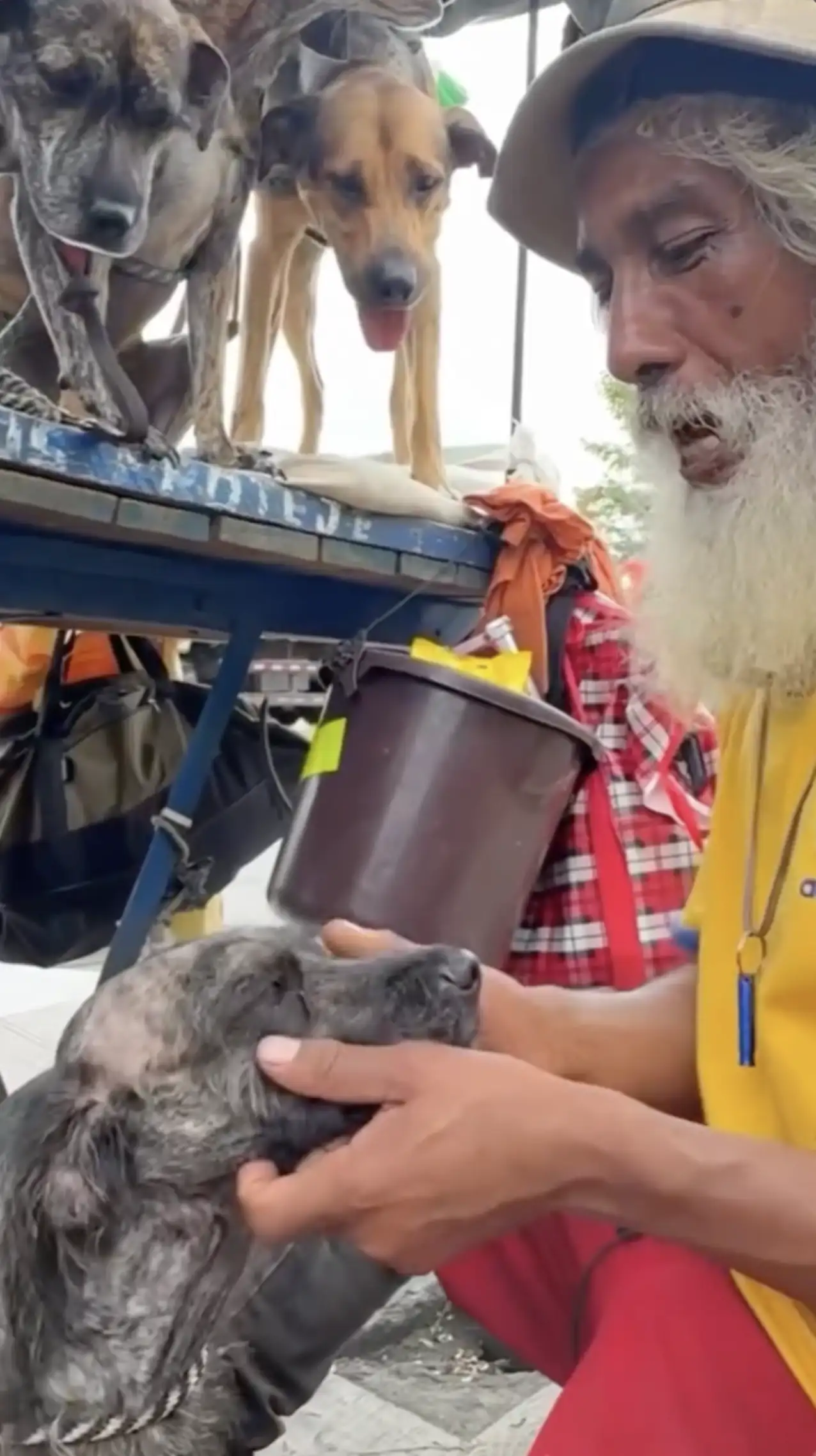
Despite not having a home of his own, Rubén, who goes by Noé, is dedicated to sharing his space and resources with every homeless dog in his Colombian city. Whether they’ve been left behind at a stop light or abandoned in an apartment, Noé believes in giving each dog he meets a second chance at love.

“They are living beings,” Noé said in an interview with IguanaTV. “They are everything to me.”

Noé’s pack is ever-growing, as he readily collects abandoned dogs of all ages and sizes. While it all started with just one dog, his furry family is now large enough to require a double-decker push cart.

Each dog has their own unique backstory, but they’re all loved by Noé just the same.

“This is Rocky. They left him tied up there at that traffic light,” Noé said. “These two girls are named Ears and Cheeks. I’ve had them since they were little. They were also abandoned.”

Rocky, Ears and Cheeks ride on the top level of the push cart with their siblings, a pit bull named Tyson and a German shepherd named Shakira. Below them, senior pups Tembleque, Parkinson and Morochito happily take in the world around them.

“These dogs down below are the oldest,” Noé said. “Little Morochito here was left for me while I was sleeping outside of [the store].”

The pups may have heartbreaking pasts, but their sadness has faded since being adopted by Noé. When they’re not actively traveling around the city with their beloved dad, the pack of dogs can usually be found enjoying a fresh meal made by Noé.

“I buy them milk, carrots and oats, and I combine them with ground meat and seeds,” Noé said. “I make them a hearty meal so that they eat well.”

Seeing the pups lap up their meals brings joy to Noé, even when he hasn’t eaten yet.

“They eat first,” Noé said. “My food is less important to me.”

Once the pups have finished eating, Noé usually snacks on an arepa and some coffee before heading off with his pack again. With his dogs by his side, Noé feels a sense of purpose and peace.

“The dogs keep me busy and give me a reason to wake up every day,” Noé said. “They don’t care if I’m bearded, toothless, dirty or clean. They only care that I’m by their side.”

This growing companionship is beyond fulfilling for Noé. Even on his most challenging days, Noé knows he can always lean on his beloved pack of rescued dogs for unconditional support.

“A dog’s love is the best there is,” Noé said.

ooOOoo

The two photographs are presented by INSTAGRAM/@IGUANATV. (And the article is published with the kind permission of The Dodo.)

One can’t do better than repeat that last sentence: “A dog’s love is the best there is,”.

Well said, Rubén!

Essentially, life is about play

We take our decision from watching the animal kingdom.

A recent post in The Conversation provides the article for today’s blog post.

ooOOoo

At its core, life is all about play − just look at the animal kingdom

David Toomey, UMass Amherst

At Cambridge University Library, along with all the books, maps and manuscripts, there’s a child’s drawing that curators have titled “The Battle of the Fruit and Vegetable Soldiers.”

The drawing depicts a turbaned cavalry soldier facing off against an English dragoon. It’s a bit trippy: The British soldier sits astride a carrot, and the turbaned soldier rides a grape. Both carrot and grape are fitted with horses’ heads and stick appendages.

A child's drawing of two soldiers ridind a grape and a carrot
‘The Battle of the Fruit and Vegetable Soldiers,’ a drawing on the back of a manuscript page from Charles Darwin’s ‘On the Origin of Species,’ attributed to Darwin’s young son Francis. Cambridge University Library, CC BY-ND

It’s thought to be the work of Francis Darwin, the seventh child of British naturalist Charles Darwin and his wife, Emma, and appears to have been made in 1857, when Frank would have been 10 or 11. And it’s drawn on the back of a page of a draft of “On the Origin of Species,” Darwin’s masterwork and the foundational text of evolutionary biology. The few sheets of the draft that survive are pages Darwin gave to his children to use for drawing paper.

Darwin’s biographers have long recognized that play was important in his personal and familial life. The Georgian manor in which he and Emma raised their 10 children was furnished with a rope swing hung over the first-floor landing and a portable wooden slide that could be laid over the main stairway. The gardens and surrounding countryside served as an open-air laboratory and playground.

Play also has a role in Darwin’s theory of natural selection. As I explain in my new book, “Kingdom of Play: What Ball-bouncing Octopuses, Belly-flopping Monkeys, and Mud-sliding Elephants Reveal about Life Itself,” there are many similarities – so many that if you could distill the processes of natural selection into a single behavior, that behavior would be play.

No goal, no direction

Natural selection is the process by which organisms that are best adapted to their environments are more likely to survive, and so able to pass on the characteristics that helped them thrive to their offspring. It is undirected: In Darwin’s words, it “includes no necessary and universal law of advancement or development.”

Through natural selection, the rock pocket mouse has evolved a coat color that hides it from predators in the desert Southwest.

In contrast to foraging and hunting – behaviors with clearly defined goals – play is likewise undirected. When a pony frolics in a field, a dog wrestles with a stick or chimpanzees chase each other, they act with no goal in mind.

Natural selection is utterly provisional: The evolution of any organism responds to whatever conditions are present at a given place and time. Likewise, animals at play are acting provisionally. They constantly adjust their movements in response to changes in circumstances. Playing squirrels, faced with obstacles such as falling branches or other squirrels, nimbly alter their tactics and routes.

Natural selection is open-ended. The forms of life are not fixed, but continually evolving. Play, too, is open-ended. Animals begin a play session with no plan of when to end it. Two dogs play-fighting, for instance, cease playing only when one is injured, exhausted or simply loses interest.

Natural selection also is wasteful, as Darwin acknowledged. “Many more individuals of each species are born than can possibly survive,” he wrote. But in the long term, he allowed, such profligacy could produce adaptations that enable an evolutionary line to become “more fit.”

Keepers noticed that Shanthi, a 36-year-old elephant at the Smithsonian national zoo, liked to make noise with objects, so they gave her horns, harmonicas and other noisemakers.

Play is likewise profligate. It requires an animal to expend time and energy that perhaps would be better devoted to behaviors such as foraging and hunting that could aid survival.

And that profligacy is also advantageous. Animals forage and hunt in specific ways that don’t typically change. But an animal at play is far more likely to innovate – and some of its innovations may in time be adapted into new ways to forage and hunt.

Competing and cooperating

As Darwin first framed it, the “struggle for existence” was by and large a competition. But in the 1860s, Russian naturalist Pyotr Kropotkin’s observations of birds and fallow deer led him to conclude that many species were “the most numerous and the most prosperous” because natural selection also selects for cooperation.

Scientists confirmed Kroptokin’s hypothesis in the 20th century, discovering all manner of cooperation, not only between members of the same species but between members of different species. For example, clown fish are immune to anemone stings; they nestle in anemone tentacles for protection and, in return, keep the anemones free of parasites, provide nutrients and drive away predators.

Play likewise utilizes both competition and cooperation. Two dogs play-fighting are certainly competing, yet to sustain their play, they must cooperate. They often reverse roles: A dog with the advantage of position might suddenly surrender that advantage and roll over on its back. If one bites harder than intended, it is likely to retreat and perform a play bow – saying, in effect, “My bad. I hope we can keep playing.”

River otters at the Oregon Zoo repeatedly separate and reunite while playing in a tub of ice.

Natural selection and play also may both employ deception. From butterflies colored to resemble toxic species to wild cats that squeal like distressed baby monkeys, many organisms use mimicry to deceive their prey, predators and rivals. Play – specifically, play-fighting – similarly offers animals opportunities to learn about and practice deception.

To live is to play

Darwin wrote that natural selection creates “endless forms most beautiful and most wonderful.” Play also creates beauty in countless ways, from the aerial acrobatics of birds of prey to the arcing, twisting leaps of dolphins.

In 1973, Ukrainian-American geneticist Theodosius Dobzhansky published an essay with the take-no-prisoners title “Nothing in Biology Makes Sense Except in the Light of Evolution.” Many biologists would agree. Perhaps the most satisfying definition of life attends not to what it is but to what it does – which is to say, life is what evolves by natural selection.

And since natural selection shares so many features with play, we may with some justification maintain that life, in a most fundamental sense, is playful.

David Toomey, Professor of English, UMass Amherst

This article is republished from The Conversation under a Creative Commons license. Read the original article.

ooOOoo

Prof. Toomey’s analysis is spot-on.

All of life involves some form of play.

A story about a small dog

A dog that begs workers to save her.

There is no shortage of glorious stories about dogs, and thank goodness for that! Recently I saw an article on The Dodo about a dog and I wanted to share it with you.

ooOOoo

Dog Dumped In Desert Finds Construction Site — Then Begs Workers To Save Her

“She wanted to be noticed, she wanted help …”

By Ashley Ortiz, Published on May 17, 2024

When Jeanean Gillespie clocked into work at a construction site earlier this month, she expected to see the usual handful of people around. Her office, located on an uninhabited stretch of desert, managed the new housing developments being built — and no one, other than her team of workers, was authorized to be there.

So when she saw two tiny eyes peering at her through her office doorway that morning, she jumped. The tiny pup had seemingly shown up out of nowhere, and she was desperate for someone to see her.

Suzette Hall

“She wanted to be noticed, she wanted help,” Suzette Hall, founder of Logan’s Legacy 29, wrote on Facebook. “Thank goodness my dear, dear friend, Jeanean Gillespie, worked there.”

Gillespie’s heart dropped when she realized the little dog, later named Sage, was all alone in the dangerous desert. With bobcats and coyotes lurking nearby, Gillespie knew time was of the essence to save Sage.

The compassionate worker tried repeatedly to capture Sage, but the scared pup ran away every time. After a few failed attempts, Gillespie called Hall for backup and placed food and water by the door for her in the meantime.

Suzette Hall

Sage was frightened by her new friends, but she still felt safe in their care. As they came up with a rescue plan, Sage figured out how to get as close as possible to them while still keeping her distance.

“She would sleep outside the office doors at night,” Hall wrote. “They all tried to help her, but she wouldn’t let anyone get close.”

Suzette Hall

Gillespie tried gaining Sage’s trust each day and eventually lured her inside the office. Hall arrived soon after, and the experienced rescuer recognized Sage’s demeanor instantly.

“When I got there, she was so scared, but she wanted to surrender so bad,” Hall said. “She was exhausted.”

Suzette Hall

Hall calmed the skittish dog and successfully scooped her up shortly after arriving. As scared as Sage was, she instantly felt comforted in Hall’s arms.

“[W]ithin minutes, she melted safely into my arms,” Hall wrote. “She knew she was safe from loneliness …”

Suzette Hall

Gillespie waved goodbye to the resilient pup as Hall loaded her into the car and drove off to Camino Pet Hospital. After days of surviving on her own in the desert, Sage got some much-needed rest.

“She fell fast asleep on the drive back,” Hall said. “She closed both eyes for the first time in days. She was rescued and she knew it.”

Suzette Hall

It’s been a couple of weeks since Sage’s rescue, and the survivor pup is still recovering from the ordeal. Aside from needing a growth removed, a dental cleaning and a spay, Sage is overall healthy. But her spirit is still broken.

“Poor Sage is not feeling well … her blood work came back normal, but she is just so sad,” Hall told The Dodo. “She needs love. She is just longing for it.”

Suzette Hall

Sage is scheduled for surgery soon, and Hall hopes to find her an amazing family once she’s feeling better. Until then, she’ll keep showering Sage with the love she’s always deserved.

“She’s such a sweet baby,” Hall said.

ooOOoo

I just love stories like this one. Sweet, sweet Sage!

Dogs in many ways are just like us humans. Scared of being alone and rejected but always deserving of love. Perfect!

More on our existence.

The Einstein-Freud Letters

I was born in London in November, 1944. Exactly six months before the Second World War ended in April, 1945.

Thus it was of great interest to me that yesterday Jean and I listened to a BBC Radio 4 programme about the letters that were exchanged between two great Jewish men: Einstein and Freud, in 1932. The programme was called Why War? The Einstein-Freud Letters.

The programme ends with offering the listener a fundamental choice, which I won’t spoil for you now. But to me it is an extension of my post (or Patrice’s post) that I published recently on March 19th.

I believe, and hope, you can listen to it by clicking on this link. Here also is the text that is at that link:

In 1932 the world-famous physicist Albert Einstein wrote a public letter to the founder of psychoanalysis, Sigmund Freud. Einstein, a keen advocate of the League of Nations and peace campaigner, asked Freud if he thought war and aggression was forever tied to human psychology and the course of international relations: could we ever secure a lasting world peace? 

Einstein’s letter is deeply prescient, as is Freud’s extraordinary response. The exchange was titled ‘Why War?’. The two thinkers explore the nature of war and peace in politics and in all human life; they think about human nature, the history of warfare and human aggression and the hope represented by the foundation of the League of Nations (precursor to the UN) and its promise of global security and a new architecture of international law. 

At the time of their exchange, Freud is in the last great phase of his career and has already introduced psychoanalysis into the field of politics and society. Einstein, the younger of the two, is using his huge international profile as a physicist for political and pacifist intervention.

For Einstein, future world security means a shared moral understanding across the global order – that humankind rise above the ‘state of nature’ never to devolve into total war again. He wrote to Freud, as ‘a citizen of the world…immune to nationalist bias…I greatly admire your passion to ascertain the truth. You have shown how the aggressive and destructive instincts are bound up in the human psyche with those of love and the lust for life. At the same time, you make manifest your devotion to the goal of liberation from the evils of war…’ Is it possible, Einstein asks Freud, to make us ‘proof against the psychoses of hate and destructiveness?’. Freud’s answer is fascinating and quite unexpected. 

The exchange of letters was sponsored by the International Institute of Intellectual Cooperation, an organisation promoting global security by using prominent thinkers, drawing on multiple fields of knowledge (from science to psychology, politics and law) to achieve a new language for international peace, following the lessons learned from the Great War of 1914-18. 

But even as Einstein wrote to Freud in the summer of 1932, the Nazi party became the largest political party in the German Reichstag. Both men felt a sense of apprehension about what was coming; both were pacifist, both Jewish, both would be driven into exile (both Einsteinian physics and Freudian psychoanalysis were denounced by the new regime). The letters were finally published in 1933 when Hitler came to power, suppressed in Germany, and as a result never achieved the circulation intended for them. 

Featuring readings from the Einstein–Freud letters and contributions from historians of warfare and psychoanalysis, war journalism and global security, this feature showcases the little-known exchange between two of the 20th century’s greatest thinkers, ‘Why War?’ – a question just as relevant in today’s world.

Contributors include historian of war and peace Margaret MacMillan, BBC chief international correspondent Lyse Doucet, defence and security expert Mark Galeotti, historian of international relations Patrick O Cohrs, author Lisa Appignanesi, who has written on Freud and the history of psychoanalysis, and Faisal Devji, historian of conflict and political violence in India and the Middle East. 

Readings are by Elliot Levey (Einstein) and Henry Goodman (Freud) 

Produced by Simon Hollis

A Brook Lapping production for BBC Radio 4

Albert Einstein

Portrait by Ferdinand Schmutzer, 1921

Sigmund Freud

Freud, 1921

Two very great men.