A closer look at the excellent work undertaken by Dr. Krista Varady.
Back on the 16th I wrote a post that was a follow-up to the previous day’s post about living a long life. My follow-up was called, hardly surprisingly, Postscript to Long Life post.
In that follow-up post, I wrote this,
Over on the Healthy Fellow blogsite, there’s an interview with Dr. Varady. The web link of that interview is here and crossing over and reading the full interview is much recommended. Here’s a taste, pardon the pun, of that interview:
JP: Can you help explain the distinctions between alternate day fasting and caloric restriction?
Dr. Varady: Caloric restriction is basically daily calorie restriction where an individual would restrict themselves by about 15% to 40% of their energy needs daily. So basically every single day you’re undergoing the same amount of restriction, whereas alternate day fasting involves a fast day wherein the individual would only eat 25% of their energy needs. So about 500 calories or so and that’s alternated with something called a “feed day” where the individual would eat ad libitum – so as much as they want. However in our studies we show that people end up losing weight because they can’t fully make up for the lack of food on the fast day on the feed day.
I’ve been in touch with JP wondering if I might have permission to republish the full interview. Unfortunately that wasn’t possible. However JP did say that republishing a couple of paragraphs would be fine and I’m going to be cheeky in adding a couple to the one I already published above!
Anyway, before inserting those paragraphs, let me set the scene. A very quick web search comes across the fact that Dr. Varady is an Assistant Professor at the UIC College of Applied Health Sciences. Her research work is described thus,
Research Interests
Dr. Varady, PhD
My research investigates the ability of novel dietary restriction strategies to facilitate weight loss and decrease cardiovascular risk in obese subjects. The most common dietary restriction protocol implemented is daily calorie restriction (CR), which involves reducing energy intake by 15 to 40% of needs daily. Another dietary restriction regimen employed, although far less commonly, is alternate day fasting (ADF). ADF regimens include a “feed day” where food is consumed ad-libitum over 24-h, alternated with a “fast day”, where food intake is partially or completely reduced for 24-h. ADF regimens were created to increase adherence to dietary restriction protocols since these regimens only require energy restriction every other day, rather than every day, as with CR. Recent findings from our lab demonstrate that ADF is an effective means of facilitating weight loss and improving several indicators of cardiovascular disease risk in overweight and obese subjects. Our findings also show that changes in adipose tissue physiology during weight loss may mediate these improvements in vascular health.
Current research activities
Developing novel diet and exercise regimens to facilitate weight loss and decrease cardiovascular disease risk in humans; Examining the intermediate role of adipose tissue in mediating the cardio-protective effects of diet and exercise; Investigating the behavioral factors that influence adherence to dietary restriction strategies.
So this is one lady that ought to understand the effects of what we shovel down our mouths. OK, on to that interview. From Part One, I selected this exchange,
JP: How long does it generally take for people to adapt to this new way of eating?
Dr. Varady: A lot of the subjects were saying that for the first two weeks it was pretty tough to basically change from a 3 meal a day eating pattern to just eating 1 meal a day and then 3 slightly bigger meals the next day. But they said that about after two weeks they totally got used to it and weren’t that hungry on the fast day anymore. They could undergo these really long periods of fasting without really feeling deprived. The other interesting thing that they were telling us was with regard to the feed day. The people didn’t binge. They only ate about 100% to 110% of their calorie needs.
Then from the second part of the interview, JP underlines an important point, “The truth of the matter is that research into ADF is still in its infancy and Dr. Varady is the first person to admit it. ” I then went on to select this exchange between JP and Dr. Varady,
JP: It seems as though ADF provides a very broad array of health benefits. Do you have a theory about why this is possible?
Dr. Varady: In the human data the main thing you see is weight loss. Even if it’s done in normal weight people. The minute you start losing weight you all of a sudden see an improvement in the majority of these factors. A lot of the effects of alternate day fasting are mediated through weight loss. Losing weight is so tightly correlated with your blood pressure, your cholesterol levels and heart rate, etc.
Fasting May Reduce Age-Related Disease Risk Factors
So this is not something of trivial interest, it’s serious research that could have a remarkable effect on the huge problems of obesity and poor diet that affect millions. Do yourself a favour and read the interview now. Part One and Part Two.
Finally, in that post on the 16th, I owned up to having got my weight down to 161.6 lbs (73.30 kgs). Now here we are having completed my third week of 5:2 fasting and last Saturday morning my weight was 159.0 lbs (72.12 kgs). The routine is very comfortable and as Dr. Varady mentioned, there is no sense of wanting to binge after the two days of fasting.
Remaining with the theme of love, love lost and new love.
John Hurlburt sent me the following last week and it is so perfect as a sequel to the writings of the last two days. That was John’s poetry last Saturday on Learning from Dogs, by the way.
oooOOOooo
Two lost souls
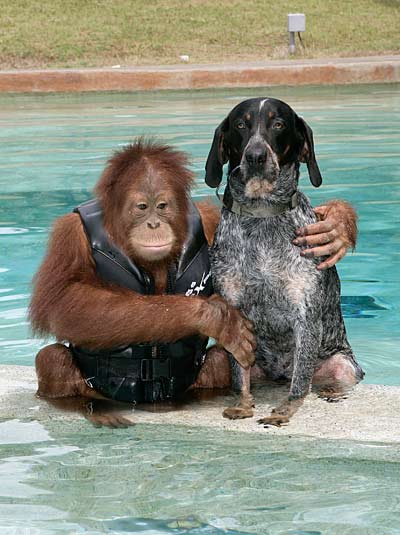
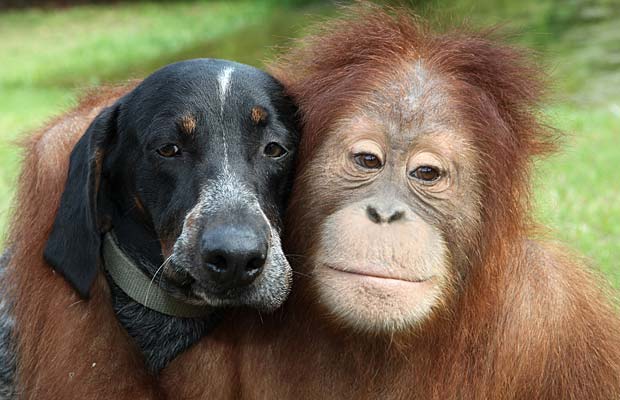
After losing his parents, this three year old orangutan was so depressed he wouldn’t eat and didn’t respond to any medical treatments. The veterinarians thought he would surely die from sadness.
The zoo keepers found an old sick dog on the grounds in the park at the zoo where the orangutan lived and took the dog to the animal treatment center. The dog arrived at the same time the orangutan was there being treated.
The two lost souls met and have been inseparable ever since. The orangutan found a new reason to live and each always tries his best to be a good companion to his new found friend. They are together 24 hours a day in all their activities.
They live in Northern California where swimming is their favorite past-time, although Roscoe (the orangutan) is a little afraid of the water and needs his friend’s help to swim.
Together they have discovered the joy and laughter in life and the value of friendship.
They have found more than a friendly shoulder to lean on.
Long Live Friendship!
I don’t know, but some say life is too short, others say it is too long, but I know that nothing that we do makes sense if we don’t touch the hearts of others. While it lasts!
May you always have love to share, health to spare, and friends who care…..even if they are a little hairy at times.
oooOOOooo
I must say that the generosity of so many of my readers in sending me these beautiful examples of what is really important in this world of ours touches me deeply. Thank you, John. Thank you, one and all.
A most beautiful conclusion to this reflection on animals and love.
Yesterday, I took a personal journey through the subject of love. I closed that post by saying, “So let me close this essay by asking you to come back here and read the guest post tomorrow from author Eleanore MacDonald, where Eleanore writes of the loss of their dog Djuna. You will read the most precious and heart-rending words about love.”
So an enormous thank-you for being granted permission to republish the tribute Eleanore MacDonald wrote upon the loss of their dear dog Djuna. I guarantee you will need a handkerchief or tissue close to hand!
oooOOOooo
one of the seven great dogs
“Until one has loved an animal, a part of one’s soul remains unawakened.” Anatole France
Djuna Cupcake, my heart of hearts, photo by Breelyn MacDonald
A great squall came upon us here on our farmlet a week ago. I saw it first from a distance, in that dawning of the morning when Djuna usually announced the coming day with his gentle, breathy ‘woooof’, his polite plea to join us on the bed. Mysteriously disturbing, it surely was a sign of things to come, but we didn’t know how dangerous it really was until it was upon us.
And when it was suddenly there, a Great Joy was sucked from our world and an overwhelming sadness took its place … a raging stillness, hot and stifling, no breath, no heartbeat.
My springs of Joy are dry … (a sentiment stolen in part from that great old song, Long Time Traveler)
Djuna Cupcake was one of the Seven Great Dogs. If you’ve seen the film ‘Dean Spanley’, you will know what I mean. If you have loved and been loved by a dog of pure heart … one who was a great teacher of presence, of patience, one who was the dispenser of unconditional love and the blessings of an incomparable joy … one who was a great listener, guardian, and the embodiment of Buddha, Coyote, the Goddesses Eleos and Kuan Yin all in one soft coated body … one who was your loving shadow because he or she felt that it was their job to see you safe at all times … you will know what I mean.
He died quite suddenly. Like that squall, his death came with no warning and for days after Paul and I were sucked deep into that great black hole of grief. The dread attacked us at every turn, where we would always see him but now only a glaring emptiness stood. I felt as though my heart and soul had a raw, oozing, gaping, searingly painful wound where he had been torn away from me. Stolen. We cried a lot.
Some people will never understand. I try to feel compassion for them, rather than issuing the big ‘EFF YOU”, but I am only human. What is this BS about a ‘three day’ rule? What? Because he was ‘just a dog’ we should be over it all in 3 days? Djuna was surely a better person than most Humans and I will never stop missing him. I feel so deeply sorry for those people who have overlooked having such grace and beauty bless their lives –– the companionship of a great dog (or cat or horse, or human person) –– so that, when the monumental end comes and they’ve come through the great fires of sorrow, and have been washed by the flush of a million tears, they come through to the other side where they are able to see the remarkable love, joys and lessons they’d been gifted by that companionship. I can only hope now to ‘be’ the person Djuna thought me to be.
3 days and 3 more and 3 million more and even then more just won’t do it.
Paul and I were with Djuna on our bedroom floor when he died. I lay with him next to my heart, whispering love, my arm draped over his neck … and as he was leaving us, I saw him standing just beyond Paul. Alert, ears akimbo, head cocked, eyes bright, a wad of socks in mouth, standing in his particularly great exuberance, as he did each morning when the time for chores presented itself – “Come on! It’s time to go! Get with it you silly humans! There’s work to be done, there’s a barn to clean and a day to sniff, there’s delight to be found!” And then he left.
My ‘joyometer’, my daily dispenser of mirth, and my constant reminder of the importance of presence, has gone missing – his lessons of ‘Be Here Now’ measured in doses of ’Oh, sense the beauty in the music of the wind!’, ‘Let’s just run in circles and laugh’, ‘I love, love, love you!’ … gone. It is wholly up to me now to remember to stay in each moment, to just be a nice person, cry whenever I must, to laugh as much as possible and dance for the sheer joy of it. And when the cacophony of the deafening silence has quieted and the colors of sorrow have muted and gone transparent and I’ve had some time to let the Aegean clean up those bloodied wounds in my heart and soul, there will be room again here for another one of the Seven Great Dogs. And the cycles will continue on.
Almost every evening Djuna and I took an evening stroll down our quiet lane. I loved watching him dance his great joy, nose to the ground scenting all of the news of the day or nose to the sky, sensing what was coming on the breeze. On our walks I watched the seasons change, the rising of the full moon, the greening of the new spring and the evening skies, like snowflakes, no one ever alike … I watched the Canadian geese come and go, the Red Tail hawks courting in the air above me, and let the build up of my day fall away as I tread softly with my gentle friend. It took me several days after Djuna’s death for me to realize that here was yet again another gift he had left for me in his wake, and one I should continue to enjoy. The sky was black to the West, we’d had heavy winds and rain all day, but when there was a break I set off on ‘our’ walk. Wrapped tightly in sadness and hardly breathing with the missing of him, I shuffled along about a 1/2 mile and turned for home before the rains started up and the chill wind began to blow, fierce again, from the south. That wind battered and bashed me until it freed the tears from my eyes, and the freezing rain lashed my face until I grew numb. As though suddenly realizing I was about to drown, I surfaced, taking in great gulps of air as though I’d not been breathing for several days, and began to climb free of the suffocating bonds of my sadness.
Part of our family
My Djuna, my Cupcake … My Heart of Hearts who knew my soul, my every thought; great lover of Paul and I, and of Breelyn; great lover of his mare and his pony, of socks and his furry toys and his GWBush chew doll; great lover of his evening walkies and of riding in the car, and feeding the birds; great lover of sofa naps and sleeping in late with us on the bed and chasing BALL and rolling on the grass and of eating horse poop; bountiful bestower of stealthy kisses; joyful jokester, Greek scholar (he knew about 15 words and understood several phrases spoken to him in Greek; something we did only after he’d begun to understand words and phrases *spelled out* in English! ‘Car’, ‘dinner?’, ‘play with the ball?’, ‘feed the birds’, water, pony, get the goat, etc!); Djuna, beloved Honorary Cat, our timekeeper, our guardian angel, our boss, our playfully dignified friend (thanks for that Marija) and family member, and one of the Seven Great Dogs – we will love and miss you forever.
But now – there’s work to be done, there’s a barn to clean and a new day to sniff, there’s delight to be found!
love – photo by Breelyn MacDonald
Copyright (c) 2012 Eleanore MacDonald
oooOOOooo
When I originally read this, I left a comment, “Achingly beautiful words. One of the most precious pieces of prose about a dog that I can ever remember reading.” Few will disagree!
As I replied in a recent email to Pat Shipman in response to Eleanore’s words above, “That really does endorse the proposition that, in a very real sense, our humanity is the product of our ancient relationship with animals.“
Dear Eleanore, thank you so much for allowing me to republish your beautiful thoughts.
How the relationship that we have with domesticated animals taught us the meaning of love.
This exploration into the most fundamental emotion of all, love, was stimulated by me just finishing Pat Shipman’s book The Animal Connection. Sturdy followers of Learning from Dogs (what a hardy lot you are!) will recall that about 5 weeks ago I wrote a post entitled The Woof at the Door which included an essay from Pat, republished with her permission, that set out how “Dogs may have been man’s best friend for thousands of years longer than we realized“.
The following day, I wrote a further piece introducing the book and then commenced reading it myself. Please go there and read about the praise that the book has received.
What I want to do is to take a personal journey through love. I should add immediately that I have no specialist or professional background with regard to ‘love’ just, like millions of others, a collection of experiences that have tapped me on the shoulder these last 67 years.
I would imagine that there are almost as many ideas about the meaning of love as there are people on this planet. Dictionary.com produces this in answer to the search on the word ‘love’.
love
[luhv] noun, verb, loved, lov·ing. noun
a profoundly tender, passionate affection for another person.
a feeling of warm personal attachment or deep affection, as for a parent, child, or friend.
sexual passion or desire.
a person toward whom love is felt; beloved person;sweetheart.
(used in direct address as a term of endearment, affection,or the like): Would you like to see a movie, love?
But, I don’t know about you, those definitions leave something missing for me. Here’s my take on what love is, and it’s only by having so many dogs in my life that I have found this clarity of thought.
Love is trust, love is pure openness, love is knowing that you offer yourself without any barriers. Think how you dream of giving yourself outwardly in the total surrender of love. Reflect on that surrender that you experience when deeply connecting, nay loving, with your dog.
Here’s how Pat Shipman expressed it in her book:
Clearly, part of the basis of our intimacy with tame or domesticated animals involves physical contact. People who work with animals touch them. It doesn’t matter if you are a horse breeder, a farmer raising pigs, a pet owner, a zoo keeper, or a veterinarian, we touch them, stroke them, hug them. Many of us kiss our animals and many allow them to sleep with us. We touch animals because this is a crucial aspect of the nonverbal communication that we have evolved over millennia. We touch animals because it raises our oxytocin levels – and the animal’s oxytocin levels. We touch animals because we and they enjoy it. (p.274)
Pat soon after writes,
From the first stone tool to the origin of language and the most recent living tools, our involvement with animals has directed our course.
Thus it is not beyond reason to presume that tens of thousands of years of physical and emotional closeness between humans and their animals have developed the emotion of love in us humans, so eloquently expressed in art and life.
There’s another aspect of what we may have learned from dogs. In Alexandra Horowitz’s book Inside of a Dog, she writes of the way that dogs look at us,
Having been folded into the world of humans, dogs no longer needed some of the skills that they would to survive on their own. As we’ll see, what dogs lack in physical skills, they make up for in people skills.
AND THEN OUR EYES MET ….
There is one final, seemingly minor difference between the two species. This one small behavioral variation between wolves and dogs has remarkable consequences. The difference is this: dogs look at our eyes.
Dogs make eye contact and look to us for information – about the location of food, about our emotions, about what is happening. Wolves avoid eye contact. In both species, eye contact can be a threat: to stare is to assert authority. So too is it with humans. In one of my undergraduate psychology classes, I have my students do a simple field experiment wherein they try to make and hold eye contact with everyone they pass on campus. Both they and those on the receiving end of their stares behave remarkably consistently: everyone can’t wait to break eye contact. It’s stressful for the students, a great number of whom suddenly claim to be shy: they report their hearts begin to race and they start sweating when simply holding someone’s gaze for a few seconds. They concoct elaborate stories on the spot to explain why someone looked away, or held their gaze for a half second longer. For the most part, their staring is met with deflected gazes from those they eyeball.
Then a few sentences later, Alexandra continues to write,
Dogs look, too. Though they have inherited some aversion to staring too long at eyes, dogs seem to be predisposed to inspect our faces for information, for reassurance, for guidance. Not only is this pleasing to us – there is a certain satisfaction in gazing deep into a dog’s eyes gazing back at you – it is also perfectly suited to getting along with humans. (pps 45-46)
No apologies for now inserting the photograph of Pharaoh that adorns the Welcome page of Learning from Dogs. Underlines what Alexandra wrote above in spades.
Now that is a gaze!
OK, time to start bringing this to a close.
The Toronto Star ran a great review of Pat Shipman’s book from which I will just take this snippet,
“But understanding animals and empathizing with them also triggered other changes in humanity’s evolution, Shipman said.
All those things allow people to live with people. Once people have domesticated animals, they start to live in stable groups. They have fields, crops and more permanent dwellings.”
In other words, we can see that living with animals took us from nomadic hunter-gatherers to living with other people in stable groups; the birth of farming. It is my contention that the evolution of communities and the resulting more stable relationships elevated love leading to love becoming a higher order emotion than just associated with the ‘grunt’ of reproduction.
I started by saying that it was Pat Shipman’s book that stimulated me to wander through my own consciousness and realise that when I bury my face in the side of one of the dogs, say on the bed, it resonates with the most ancient memories in my human consciousness. Indeed, I am of no doubt that my openness and emotional surrender to that dog enables me to be a better, as in more loving, person for Jean.
So let me close this essay by asking you to return here and read the guest post tomorrow from author Eleanore MacDonald, where Eleanore writes of the loss of their dog Djuna. You will read the most precious and heart-rending words about love. Thank you.
By one of those lovely patterns in life, John’s last contribution to Learning from Dogs was exactly a year ago, a Post that was called Definitions, questions and prayers.
Fascinating insight into our complex relationship with complex ideas!
There’s a powerful saying in the world of writing: If you can’t feel it you can’t write it!
But our feelings are so, so much a part of what it is to be human. That’s why I spent some time exploring how our resistance to change is so wrapped up in the emotions that change brings about in an article back on the 2nd August: Changing the person: Me.
So a post on the grist online magazine not so long ago really caught my eye. It was called Why climate change doesn’t spark moral outrage, and how it could, and was written by David Roberts. I would dearly love to have sought David’s permission to republish it in full; it’s so relevant to understanding how we humans have to approach turning back from our present course of making the Earth’s biosphere uninhabitable for we humans.
But in a couple of days time, I have a Post coming out that is republished with David’s written permission called Cutting CO2 emissions – who leads the world! It felt greedy to ask David for another full republication. So I’m going to dip into this one, hopefully to the point where you will go across to grist and read it for yourself.
David opens up as follows:
Perhaps the single biggest barrier to action on climate change is the fact that it doesn’t hit us in the gut. We can identify it as a great moral wrong, through a chain of evidence and reasoning, but we do not instinctively feel it as one. It does not trigger our primal moral intuitions or generate spontaneous outrage, anger, and passion. It’s got no emotional heat. (Ironic!)
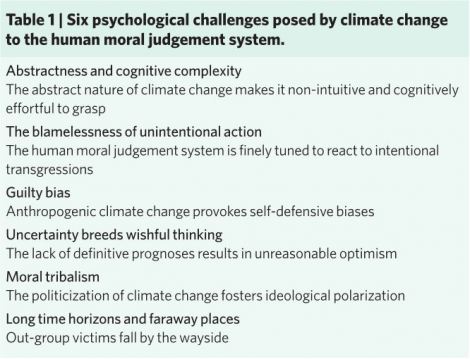
David’s article then goes on to refer to a recent paper published on the Nature.com website called Climate change and moral judgement by Ezra M. Markowitz & Azim F. Shariff. The abstract sets out that:
Converging evidence from the behavioural and brain sciences suggests that the human moral judgement system is not well equipped to identify climate change — a complex, large-scale and unintentionally caused phenomenon — as an important moral imperative. As climate change fails to generate strong moral intuitions, it does not motivate an urgent need for action in the way that other moral imperatives do. We review six reasons why climate change poses significant challenges to our moral judgement system and describe six strategies that communicators might use to confront these challenges. Enhancing moral intuitions about climate change may motivate greater support for ameliorative actions and policies.
M’mmm – not sure how that leaves me. (Which is my way of saying that I don’t really understand that!) Luckily David goes on to say that the authors “go on to identify six reasons why, “unlike financial fraud or terrorist attacks, climate change does not register, emotionally, as a wrong that demands to be righted.” and refers to an interesting table in the research paper.
Now go to the article on grist to better understand how those challenges are explained.
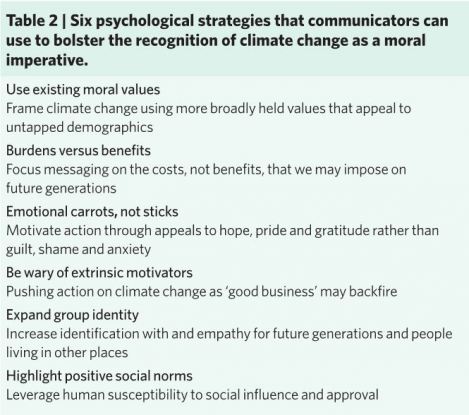
Then later on in the research paper, there is a second table, as below:
Again, these strategies are expanded upon in David’s article. What I will do is to copy his final few paragraphs:
6. Highlight positive social norms: This is, to me, the Big Kahuna. As I was reading about all the psychological barriers to climate action, I kept thinking, “one thing can overcome all these: peer pressure!” If people see others that they view as peers or leaders doing something, they will tend to do it too, and retrofit reasons for it after the fact. This is the essence of humans as social creatures.
The recommendation is twofold, though: not just to “highlight pro-environmental, prosocial injunctive norms such as prohibitions against being wasteful,” but also to “be careful not to inadvertently highlight negative, but existent, descriptive norms, which can actually encourage individuals to follow suit in the wrong direction.”
In other words, you want to emphasize that climate hawkery is good, socially desirable, admirable, and that all the cool kids are doing it. You don’t want to give people the impression that “everyone’s doing it” if it is bad. Even if you state clearly that it’s bad, the fact that others are doing it is, in and of itself, a powerful incentive to do it too. It’s the herd instinct. This is good reason not to whine on and on about how everyone drives too much or everyone wastes electricity. The subtext is, “it’s the social norm.”
—-
Aaaanyway, this is a lot of food for thought. But it’s the kind of stuff — not about science but about people — that far too many climate hawks ignore or disregard. Climate change is not only the economic and ecological crisis of our time, it’s also a moral crisis. What we are doing to our descendants is a moral crime. Finding ways to help people get that, feel it in their guts the way they would if someone threatened their own families, is a precondition for serious, sustained action.
Let me repeat David’s closing words, “Climate change is not only the economic and ecological crisis of our time, it’s also a moral crisis. What we are doing to our descendants is a moral crime.”
OK, so how strongly do you feel that? Great, so you do feel it – even feel it deep inside you.
Now that you do, let’s all get stuck into making a difference. It is all about doing. As someone of huge stature, and a wonderful person of action no less, said;
I have been impressed with the urgency of doing. Knowing is not enough; we must apply. Being willing is not enough, we must do. Leonardo da Vinci (1452-1519)
We must do! Start your own ‘doing’, don’t wait upon others, actively look for ideas (there are a few here) and together we can make a positive difference.
Normally my week-end posts are lighthearted. But I do hope you will forgive the departure for today.
Regular readers of Learning from Dogs will recall that on the 2nd August I published a piece under the title of Changing the person: Me. It offered several examples of how personal change or transition is tough but that the rewards that come from understanding the personal and emotional consequences of big life changes are immense. As I wrote then,
The most important thing to note, and this is why so many ‘change’ ambitions fail, is that change is deeply unsettling at first. When change happens for the majority of us, often ‘forced’ on us as a result of unplanned life events, we are left deeply unsettled; a strong feeling of being lost, of being in unfamiliar surroundings. Think divorce or, worse, the death of a partner or child, reflect on how many sign up for bereavement counselling in such circumstances. Big-time change is big-time tough (apologies for the grammar!).
Then I came across the story of how Eric Clapton coped when his four-year-old son fell from the window of the 53rd-floor window of his mother’s friend’s New York City apartment. Here’s an extract from the WikiPedia entry:
The years following 1990 were extremely turbulent for Clapton. In August 1990, his manager and two of his roadies (along with fellow musician Stevie Ray Vaughan) were killed in a helicopter accident. Seven months later, on March 20, 1991, Clapton’s four-year-old son Conor died after falling from the 53rd-floor window of his mother’s friend’s New York City apartment. He landed on the roof of an adjacent four-story building. After isolating himself for a period, Clapton began working again, writing music for a movie about drug addiction called Rush. Clapton dealt with the grief of his son’s death by co-writing “Tears in Heaven” with Will Jennings.
Here’s Tears in Heaven. Please stop whatever you are doing now and play this video. In under 5 minutes it demonstrates the power of the saying from Henry David Thoreau, the American author and poet – “Not until we are lost do we begin to understand ourselves”.
In an interview with Daphne Barak, Clapton stated, “I almost subconsciously used music for myself as a healing agent, and lo and behold, it worked… I have got a great deal of happiness and a great deal of healing from music“.
Eric Clapton
Let me close with another saying, this time from George Moore, the novelist, “A man travels the world over in search of what he needs and returns home to find it.”
Raise your eyes in wonder at the most wonderful annual show from space.
A Perseid meteor streaks across the sky in this Aug. 12, 2008 photo near Rogers Spring in the Lake Mead National Recreation Area in Nevada. (Ethan Miller/Getty Images)
As of August 8, 2012, the zenithal hourly rate (ZHR) of meteors visible in a dark sky has gone up to 21! That’s according to the International Meteor Organization. Clearly the Perseid meteor shower is rising to its peak, as it does every year at this time.
The peak mornings will be August 11, 12 and 13. August 12 might be the best morning. August 11 might be better than August 13. The moon is waning now. And many people are seeing meteors!
The Delta Aquarid and Perseid meteor showers combine in late July and August to create what most consider the best and most reliable meteor display for Northern Hemisphere observers. As always, after midnight is the best time for meteor-watching. The moon will be there, but getting thinner every morning. On the mornings (not the evenings) of August 11, 12 and 13, the moon will be a waning crescent, and the meteors should be flying at a rate closer to their peak of 50 or 60 meteors per hour. As an added treat – on August 11, 12 and 13 – the moon will be sweeping past the brightest planets Venus and Jupiter in the eastern predawn sky. You can’t ask for more!
Well you could ask for more and there is more on that very helpful website, ergo:
August 10/11, 11/12, and 12/13, 2012 Perseids
Meteors are typically best after midnight, but in 2012, with the moon rising into the predawn sky, you might want to watch for Perseid meteors in late evening as well. You can get moonrise times via this custom sunset calendar. As seen from around the world, the waning crescent moon will rise later on August 12 than on August 11, and, on the morning of August 13, although you’re slightly past the peak, the moon will rise later still.
On any of those mornings, moonlight shouldn’t be so overwhelming as to ruin the show. Plus the moon on those mornings will be near the bright planets Venus and Jupiter in the eastern predawn sky. It’ll be a beautiful early morning scene.
The Perseids are typically fast and bright meteors. They radiate from a point in the constellation Perseus the Hero. You don’t need to know Perseus to watch the shower because the meteors appear in all parts of the sky. The Perseids are considered by many people to be the year’s best shower, and often peak at 50 or more meteors per hour in a dark sky.
The Perseids tend to strengthen in number as late night deepens into midnight, and typically produce the most meteors in the wee hours before dawn. These meteors are often bright and frequently leave persistent trains.
Starting in late evening on the nights of August 10/11, 11/12 and 12/13, the Perseid meteors will streak across these short summer nights from late night until dawn, with only a little interference from the waning crescent moon. Plus the moon will be near the bright planets Venus and Jupiter in the eastern predawn sky.
Finally, here’s some fabulously helpful information on the NASA website:
NASA Chat: Stay ‘Up All Night’ to Watch the Perseids!
Escape the heat of the waning days of summer for an evening of sky watching. The Perseid meteor shower peaks on the night of August 11 through the morning of August 12. Perseid rates can get as high as 100 per hour, with many fireballs visible in the night sky. A waning crescent moon will interfere slightly with this year’s show, but viewing should definitely be worth a look!
On the night of Aug. 11-12, astronomer Bill Cooke and his team from the Meteoroid Environment Office at NASA’s Marshall Space Flight Center will answer your questions about the 2012 Perseid meteor shower via an “Up All Night” live chat. To join the chat, simply return to this page and log in. The chat experts will be available to answer questions between the hours of 11 p.m. – 3 a.m. EDT, beginning the evening of Aug. 11 and continuing into the morning of Aug. 12.
Watch the Perseids! Live Video/Audio Feed
On the night of Aug. 11, a live video/audio feed of the Perseid shower will be embedded below (go to here). The camera is mounted at NASA’s Marshall Space Flight Center in Huntsville, Ala. During daylight, you’ll see a dark gray box — the camera is light-activated and will turn on at dusk. At night you’ll see white points, or stars, on a black background.
About the Perseids
The Perseids have been observed for at least 2,000 years and are associated with the comet Swift-Tuttle, which orbits the sun once every 133 years. Each year in August, the Earth passes through a cloud of the comet’s debris. These bits of ice and dust — most over 1,000 years old — burn up in the Earth’s atmosphere to create one of the best meteor showers of the year. The Perseids can be seen all over the sky, but the best viewing opportunities will be across the northern hemisphere. Those with sharp eyes will see that the meteors radiate from the direction of the constellation Perseus.
Nature, once again, shows the value of loving contact during those crucial early years.
I’m writing this at 7.45am on the 30th. Coincidentally, Jean and I were chatting in bed about an hour ago about this ‘touchy – feely’ stuff. This was a bed having four dogs on it! One of those, Hazel, was laying alongside my left leg just sucking up me stroking her head and tummy. Jean and I were musing that for animals and humans, how we are touched by our parents, especially our mother, during those first few years of growing up has profound implications for how we as adults respond to being touched and hugged.
So then I opened up my mail box and there was this sent by Cynthia Gomez serving as a wonderful reminder of the power of touch. Thanks Cynthia, great timing!
oooOOOooo
Some pictures just don’t need captions.
There is nothing like Mom’s lap no matter who you are. This is precious !!!!
This is a newborn offspring of Taskin, a Gypsy Stallionowned by
Villa Vanners of Oregon ..
These pictures were taken immediately after his birth on April 6.
The mare laid down, and then he trotted around and
It is better to light a candle than curse the darkness. – Chinese Proverb
Yesterday, in a post that picked up on the deep implications of Bill McKibben’s chilling essay on where the world is heading if we don’t change, I set out my understanding of what holds us back from that change. I wrote, “ … the process of change cannot start until we truly want to change; a total emotional commitment. And the formation of those emotions, that realisation, requires a new understanding of the world around us, who we are and who we want to be.”
Previously on Learning from Dogs I have quoted Jon Lavin, “The best way to save the world is to work on our selves.” I remember decades ago when working as a humble office-products salesman for IBM UK the well-worn saying, “Selling is 90% me and 10% the customer.” Sort of reminds me of Woody Allen’s: “Eighty percent of success in life is showing up.”
OK, enough of these mental perambulations. Let’s get on with the task of looking at change. Because make no bones about it, if we rely on ‘them’, on others, to turn mankind back from where we are heading then it’s all over! It comes down to each and every one of us deciding to change.
Think this is all melodramatic nonsense? Go and read the first paragraph of Bill McKibben’s article where he states, “June broke or tied 3,215 high-temperature records across the United States. That followed the warmest May on record for the Northern Hemisphere – the 327th consecutive month in which the temperature of the entire globe exceeded the 20th-century average..”
Some poet invented the name “Arab Spring” as a label for the tsunami of public desperation that last year took down the governments of Tunisia, Egypt and Libya. Poets and Pollyannas saw the events as an upwelling of love for democracy. Realists related them to the spike in world food prices that threatened the survival of whole populations and made them desperate for change — any change. Now, thanks in large part to events unfolding in the American heartland, get ready for another, worse, spike.
We are running out of superlatives with which to describe the Mid- and Southwestern drought and its effect on this year’s corn and soybean crops. According to this week’s USDA crop update the situation during the previous seven days went from “critical” to, um, worse than that. The drought is the worst in half a century. Of the largest US acreage ever planted in corn (industrial agriculture was crowing about that just a couple of months ago), only one-quarter is still in good condition. (Modest rainfall in drought-stricken areas early this week provided mostly emotional relief; the drought is forecast to continue unabated through October.)
Change really does seem like a ‘no-brainer’!
Here’s a lovely cartoon that summarises the steps of change, the process of transition, for you and me.
That diagram is from John Fisher’s model of personal change, full details of which are here. It includes a link to the process of transition diagram, show above, here.
The most important thing to note, and this is why so many ‘change’ ambitions fail, is that change is deeply unsettling at first. When change happens for the majority of us, often ‘forced’ on us as a result of unplanned life events, we are left deeply unsettled; a strong feeling of being lost, of being in unfamiliar surroundings. Think divorce or, worse, the death of a partner or child, reflect on how many sign up for bereavement counselling in such circumstances. Big-time change is big-time tough (apologies for the grammar!).
Stay with me for a short while while I reinforce this from my own experiences.
My previous ex-wife announced in December, 2006 that she was leaving me for a younger model! It came as a complete surprise. Subsequently, I was invited to spend Christmas 2007 out in San Carlos, Mexico with Suzann and her husband, Don. Suzann is the sister of my dear, close friend of many years, Dan Gomez, hence the connection. There I met Jean, a long-term friend of Suzann living in San Carlos and, coincidentally as I am, another Londoner by birth. Jean and I fell deeply in love with each other and a year later I moved out from SW England with Pharaoh to Mexico.
Throughout 2008 I suffered from what was eventually diagnosed as vestibular migraine. It involved partial loss of vision, vertigo, headaches and significant short-term memory disturbances; let me tell you it was pretty frightening!
Eventually, in 2012 well after we moved from San Carlos up to Payson, Arizona, I got so worried that I went to see a neurologist, convinced that I was heading down the road of dementia. Dr. Goodell examined me thoroughly and said that there were no signs of dementia or early-onset Alzheimer’s disease. His conclusion: I was showing the normal signs of forgetfulness that any person of my age (now 67) would show having been through similar life changes. Dr. Goodell went on to explain that back in England 98% of my life was constant and familiar and therefore adjusting to a 2% change was unremarkable. However, on moving my life out to Mexico and then on to Arizona, it was all reversed: 2% of my life was constant and 98% was change and that was a huge psychological hill to climb with all the associated mental stresses that I had been experiencing.
Interestingly, that diagnosis rapidly set me on the path of feeling so much better!
So, apologies for that personal diversion but I hope it underlined that life-change is a big deal!
In my trawl across the Web looking for change references, I came across a software engineer by the name of Dave Cheong. Dave writes a blog. In Dave’s blog was a piece about change. Change as a result of a merger of his employer. This is what Dave wrote:
As a result of the merger, lots of change is happening. Some folks are questioning where things are headed, what management have planned, how their lives will change, etc. Most certainly, there will be job losses as the two companies consolidate things, in particular administrative positions.
With the chaos that’s been unfolding, I’ve thought a bit about “change” in general. What is it? Why do people resist it? Is it always a good thing? What should I do?
And later he writes after referring to the Satir Change Process model, named after Virginia Satir, an American author and psychotherapist:
The diagram depicts several stages of accepting change. The first stage is known as Status Quo (Gray Zone), a state where everyone is generally comfortable with the way things are. The second stage is a point in time a Foreign Element, trigger or change agent is introduced. What follows is a period of Resistance and Chaos (Red Zone), personified as a result of people being scared of the uncertainties the change has brought about and how their lives will be impacted.
The level of performance generally drops off and fluctuates more greatly between the Gray and Red Zones. There are various reasons for this – people may reject the change to protect the status quo; are confused with the change and are unsure of what to do; or simply become less competent with the new tools and processes introduced.
This describes why people by nature resist change. They don’t want to become less useful than they already are.
Just reflect on that. Dave calls it being ‘less useful’ but that downplays the emotional significance of partially losing one’s self-image, one’s self-identity, the undermining of who we think we are. As I wrote earlier, life-change is a big deal!
Here’s my final example of how dealing with change is all about the self. It’s from the Best Self Help website, and opens,
Self help, personal development and self-improvement are topics of considerable interest to pretty much everyone on the planet.
In 1975 my life was a total mess. I was depressed, unemployed and my 5 year marriage was ending.
I’m not going to quote it all but it really is worth a read. However, I do want to quote the conclusion,
Finally, I Got It!!!
In the Western world, we are educated to look outside ourselves for validation. We want more money to acquire “things” with the mistaken belief this is the source of happiness.
The true source of love, health, happiness and financial success cannot be found outside of ourselves – each of these is already within us. The key is learning how to access and activate that which we already possess.
“True wisdom comes to each of us when we realize how little we understand about life, ourselves, and the world around us.” ~Socrates~
So that’s enough for today. If you haven’t got the message about change coming from within, then not sure what else I can offer! However, if you do want to explore changing the way you impact this beautiful planet (and it applies equally to me) then drop in tomorrow.










 Learning from Dogs