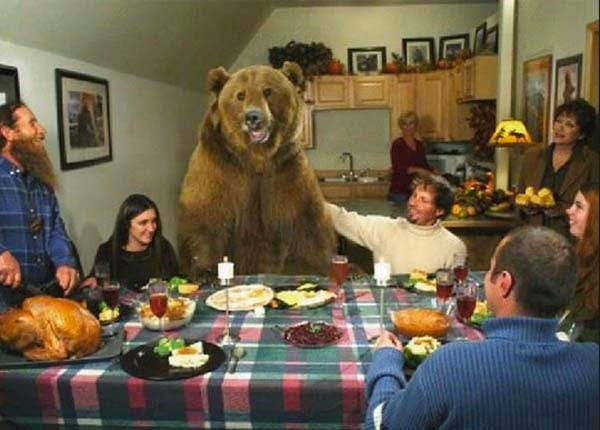
This is what happens when an animal trainer finds a bear cub.
(Today’s post has a number of very beautiful photographs. However, it is much better presented to you, dear reader, as a standalone post rather than under the umbrella of a Picture Parade.)
Thanks to Suzann for sending this on to me.
ooOOoo
A Man Found Two Bear Cubs Beside Their Dead Mother.
A naturalist named Casey Anderson stumbled across two grizzly bear cubs nestled beside their dead mother in the wild mountains of Alaska . Casey couldn’t just leave these little guys to die in the wilderness, so he made the brave decision to take them with him. He trains animals for a living, so he knew he would be able to give these cubs a real shot. That simple decision, borne out of grief, turned into one of the most unique and adorable rehabilitation stories we have ever laid eyes on.
This is Casey and the little cubs. Unfortunately, only one survived and Casey decided to adopt him.
He named him Brutus.
Brutus grew up as part of the family, albeit a very fuzzy part.
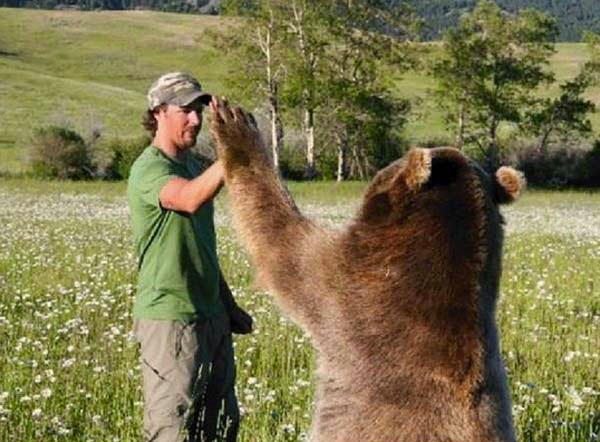
It was Casey’s job to train animals, so raising and training Brutus was normal for him.
oooo
Over the years, they became close friends and brothers.
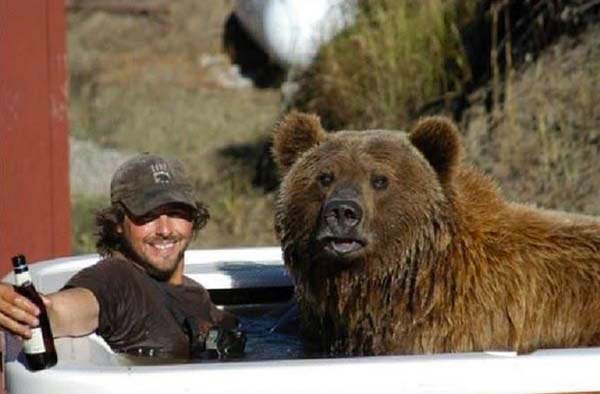
And Brutus got the run of the pool.
oooo
oooo
oooo
Brutus grew to be so close to Casey, he was even his best man (bear) at the wedding.
It may have made the bride a little nervous.
But she was probably glad Brutus wasn’t capable of taking him out to dinner (no thumbs).
Brutus also gets a place of honor at the Thanksgiving table.
Life is good for this not-so-average bear.
oooo
oooo
oooo
oooo
oooo
You’ll be hard pressed to find a situation cooler than being best friends with a killer grizzly bear. If Casey and Brutus made you smile, then you should probably spread the joy and share this.
This is a lovely story. Shame all humans aren’t this kind and understanding. Though many are and this is a lovely example of such a person.
At the end of 2013, I published a post under the title of We must rewild. The core of that post was an essay from Patrice Aymes called Rewilding Us. Here’s a small extract from that essay:
In Africa, there are about 500,000 elephants. 25,000 to 30,000 are killed, a year, to send the ivory to east Asia (China, Vietnam). So African elephants may disappear. This is beyond tragic, it’s irreplaceable. Elephants understand people’s gestures, without any learning (they apparently learn to use trunk gestures among themselves). One is talking about extremely intelligent animals here. (In contrast, chimpanzees have great difficulties understanding human gestures.)
My post also included this photograph of young Cleo, just five months old, showing that her innate skills of being in the wild were alive and well, despite thousands of years of dogs being domesticated animals. Ergo, humans could manage just as well.
Photograph taken 25th April, 2012.
Last Friday, George Monbiot published an essay in The Guardian newspaper that stays with the theme of loving the wild. It is republished here with Mr. Monbiot’s very kind permission.
ooOOoo
Falling in Love Again
17th July 2015
Rebuilding our relationship with the natural world can re-animate our own lives, as well as the ecosystem.
When the robin was voted the UK’s national bird last month, we chose to celebrate half of a broken relationship. The robin is to the wild boar what the oxpecker is to the Cape buffalo: it has evolved to catch the worms and insects exposed by their grubbing. But boar are mostly absent from the UK, so its survival often depends on finding the next best thing: human gardeners. This is why the robin is so tame in this country. As far as the bird is concerned, you and I are just fake pigs.
We are surrounded by such broken relationships, truncated natural processes, cauterised ecologies. In Britain we lack almost all large keystone species: ecological engineers that drive the fascinating dynamics which allow other lifeforms to flourish. Boar, beavers, lynx, wolves, whales, large sharks, pelicans, sturgeon: all used to be abundant here, all, but for a few small populations or rare visitors, are missing.
The living systems that conservationists seek to protect in some parts of this country are a parody of the natural world, kept, through intensive management, in suspended animation, like a collection in a museum. An ecosystem is not just a place. It is also a process.
I believe their diminished state also restricts the scope of human life. We head for the hills to escape the order and control that sometimes seem to crush the breath out of us. When we get there, we discover that the same forces prevail. Even our national parks are little better than wet deserts.
Our seas were once among the richest on earth. A few centuries ago, you could have watched fin whales and sperm whales hammering the herring within sight of the shore. Shoals of bluefin tuna thundered up the North Sea. Reefs of oysters and other sessile animals covered the seabed, over which giant cod, skate and halibut cruised. But today, industrial fishing rips up the living fabric of all but 0.01% of our territorial waters. To walk or dive in rich environments we must go abroad.
Though not, I hope, for long. On Wednesday, a new organisation, Rewilding Britain, was launched. (It was inspired by my book Feral and I helped to found it, but I don’t have a position there). Its aim is to try to catalyse the mass restoration of the living world, bring trees back to bare hills, allow reefs to form once more on the seabed and to return to these shores the magnificent, entrancing animals of which we have so long been deprived. Above all it seeks to enhance and enrich the lives of the people of this nation. I hope that it might help to change the face of Britain.
Already, local projects hint at what could be achieved. In the southern uplands of Scotland, the Borders Forest Trust has bought 3000 hectares of bare mountainside and planted hundreds of thousands of native trees. The community of Arran seabed trust in the Firth of Clyde managed, after 13 years of campaigning, to persuade the government to exclude trawlers and scallop dredgers from one square mile of seabed. The result, in this tiny reserve, is an explosion of lobsters, crabs, scallops and fish. It’s now trying to extend the project to a larger area.
In Sussex, the Knepp Castle estate gave up its unprofitable wheat farming, released a few cattle and pigs and let natural processes take over. Now it hosts some of Britain’s highest populations of nightingales, purple emperor butterflies and turtle doves. Partly through ecotourism and accommodation and selling high-grade meat, it has become profitable. In south London, the Wandle Trust has turned a mangled and polluted urban river back into a beautiful chalkstream, supporting kingfishers and wild trout. Wonderful as these projects are, until now they have lacked a national voice. Britain remains in a state of extreme depletion.
Some people argue that we should not seek to re-establish missing species until we’ve protected existing wildlife. But nothing better protects our ecosystems than keystone species. Beaver dams provide habitats for fish, invertebrates, amphibians and waterbirds. In Ireland, resurgent pine martens appear to have pushed back the grey squirrel, allowing red squirrels to recolonise. One study suggests that our woodland ecology cannot recover unless half the country’s deer are culled every year. Lynx could do it for nothing. Functional ecosystems, in which dynamic living processes prevail once more, are likely to be more resistant to climate change than stagnant collections in virtual glass cases.
Over the past two years, there has been a surge of enthusiasm for change. A poll in Scotland found that 60% support the reintroduction of beavers, with only 5% opposed. 91% of respondents to a survey by the Lynx UK Trust supported a trial reintroduction. Researchers at the University of Cumbria digitally altered photographs of Borrowdale in the Lake District, adding or subtracting trees. 69% of the people who saw them favoured the images with extra trees. A video extracted from my TED talk, about the relationship between wolves and other wildlife, has been watched 18 million times.
But the interests of local people must never be overruled. Rewilding must take place only with active consent. Already, landowners are coming forward, proposing to rewild their own property. Community groups, such as Cambrian Wildwood in mid-Wales, are seeking to buy and restore surrounding land. What rewilding offers is a new set of options in places where traditional industries can no longer keep communities alive, where schools and shops and chapels and pubs are closing and young people are leaving the land to find work elsewhere.
In the hills of southern Norway, the return of trees has been accompanied by a diversification and enrichment of the local economy. There, the small income from farming is supplemented with eco-tourism, forest products, rough hunting, fishing, outdoor education, skiing and hiking. The governments of Britain now claim to be willing to pay for the protection of soils and watersheds. These are likely to be more resilient sources of income than the current farm subsidy system upon which all hill farming in this country depends, whose gross injustice – transferring vast sums from the poor to the rich simply for owning land – is as unsustainable politically as it is ecologically.
Perhaps most importantly, rewilding offers hope. It offers the hope of recovery, of the enhancement of wonder and enchantment and delight in a world that often seems crushingly bleak. My involvement with rewilding, to my own amazement, has made me much happier and more optimistic than I was before. I feel an almost evangelical sense of excitement about the prospects for change. I want other people to be able to experience it too.
In 2009, the rewilding pioneers Trees for Life released some wild boar into an enclosure at Dundreggan, in the Scottish Highlands. Within twenty minutes, robins came down from the trees and started following them. Their ecological memory was intact. When I’ve accompanied children from deprived London boroughs to the woods and rockpools for the first time in their lives, I have seen something similar: an immediate, instinctive re-engagement, the restoration of a broken ecological relationship. Once we have richer wild places to explore, we won’t need much prompting to discover their enchantments.
In the copy of George Monbiot’s essay that was published on his blogsite there were 25 links to other materials. I feel very bad that I just didn’t have the time to copy across all those links so my strong recommendation is that if you enjoyed reading this here then you go across to the essay on his blogsite and check out all the additional material available to you. My only exception was to insert the link to the organisation Rewilding Britain that was referred to in the sixth paragraph.
As I explained yesterday, Jean and I are taking part in a local garage sale that isn’t leaving much time for the usual things each day.
I’m very embarrassed in not recalling if someone sent me the link to the following video or whether I saw it on one of the general blogs that I subscribe to.
Our neighbourhood watch garage sale has Jean and me fully occupied for these next two days.
Plus much of yesterday afternoon was spent getting our ‘site’ all set up ready for today.
I have taken the opportunity of showing you two videos, one today and one tomorrow.
This was sent to me by Suzann and will melt your heart in a very big way.
►If watching the flowering of love could inspire love, then “The Story Of The Weeping Camel” would forever alter the world…
►The Story of the Weeping Camel.
Mongolian: Ингэн нулимс, Ingen nulims, “Tears of the Camel” is a 2003 German docudrama released internationally in 2004.
►During Spring, a family of nomadic shepherds in the Gobi Desert, South Mongolia, assists the births of their camel herd. The last camel to calve this season has a protracted labor that persists for two days. With the assistance and intervention of the family, a rare white bactrian camel (Camelus bactrianus) calf is born.
This is the mother camel’s first calving. Despite the efforts of the shepherds, the mother rejects the newborn, refusing it her milk and failing to establish a care-bond with it. The family resolve to secure the services of an indigenous ‘violinist’ to play the music for a Mongolian ‘Hoos’ ritual.
When repeatedly intoned the calming sounds and beautiful melody of the violin, the mother camel starts to weep, tears visibly streaming from her eyes. Immediately after the rite the mother and calf are reconciled and the calf draws milk from her teat.
Very grateful to Chris Snuggs for sending this on to me. As seen on the BoredBug website:
ooOOoo
They Told This Little Boy His Dog Was Going To Be Put Down. His Response STUNNED Them.
On Belker’s last day, Shane seemed calm, petting the old dog as if he understood that he was saying a last “goodbye”. Within minutes, Belker slipped peacefully away. Shane seemed to accept Belker’s transition without any difficulty or confusion.
They all sat together after Belker’s death, wondering aloud how sad it is that animals lives are shorter than humans. Shane, who had been listening quietly, spoke ”I know why! People are born so that they can learn how to live a good life, like loving everybody all the time and being nice, right?” The six-year-old continued, ”Well, dogs already know how to do that, so they don’t have to stay as long.”
A story about a Pit Bull that will touch the soul.
The Pit Bull dog breed gets a very bad press thanks to the despicable way that these dogs were associated with dog fighting many years ago. But take away man’s disgraceful involvement and most times you will find a gorgeous, loving dog.
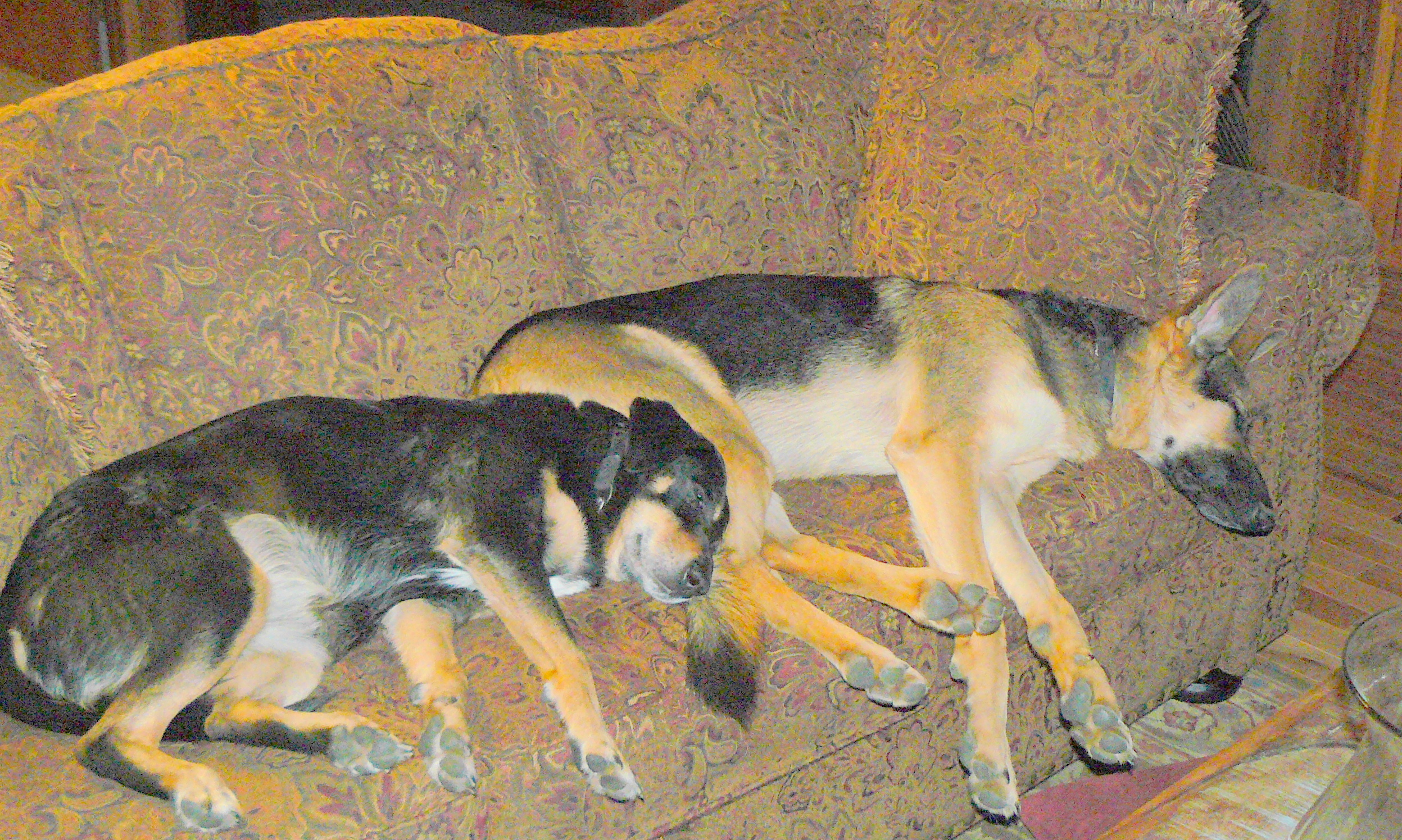
We have a Pit Bull mix here at home.
Casey, at home; picture taken January, 2014.
He is the most wonderful of dogs.
Now read this article, as seen on Mother Nature Network.
ooOOoo
Rescued pit bull helps autistic teen open his heart
The first time Joey Granados gave his mother a kiss on the cheek was when they adopted Roxy.
The best part about Roxy and Joey’s friendship? No judgments. Just love. (Photo: Amanda Granados/Instagram)
Pit bulls often get a bad rap. So do kids with autism.
Both are misunderstood. But what happens when you put the two of them together? Magic.
Just ask Amanda Granados of Los Angeles. Her son, Joey, has autism. From an early age, Joey turned away from his mom’s hugs and kisses. He would not let his mom hold his hand. He preferred to be alone. According to his mom, Joey had a really difficult time adjusting in social situations.
But Joey has recently met a new friend that has opened up his heart to his mom and others in his world. That friend is Roxy, a goofy, loving pit bull who knows how it feels to have people look at you and think you are something you are not.
Fourteen-year-old Joey had been asking his mom for a dog for some time to help him deal with the loneliness of his life with autism. Just after Thanksgiving, Amanda was perusing the website for the local animal shelter when she came across Roxy’s picture and just knew that this would be a good match.
As Joey tells it, when he and his mom went down to the shelter to look at Roxy, the dog walked right passed Amanda and jumped on Joey’s lap. The two have been best friends ever since. And Roxy has opened up Joey’s world to the love and affection of others.
“I get emotional thinking about it,” Amanda Granados recently told “Today.” “For all those years, he wouldn’t hold my hand, he wouldn’t hug me — it was all part of the autism — but this dog has taught him how to give and show affection. He holds my hand now! He hugs me! The first time I got a kiss on the cheek was when Roxy came home.”
Joey told “Today” that Roxy has made it easier for him to give and receive affection.
“I didn’t have too many friends growing up, but then we got Roxy and I’ve been able to make friends ever since,” Joey said. “At home, I’ve been able to hold my mom’s hand, kiss her, hug her and do a lot of things that I hadn’t been able to do growing up.
“She’s opened up my heart.”
According to Amanda, the best part about the bond between Roxy and Joey is that there are no judgments. Just true friendship. And lots and lots of love.
Want to see this adorable pair in action? Check it out:
When I first started writing Learning from Dogs, some six years ago this coming July 15th, I didn’t have a clue. Not a clue about how addictive it would become, how eventually it would motivate me to write a book of the same name as the blog (not yet published), and, above all, what a wonderful family feeling would develop. Not only between me and my followers but also, and just as importantly, from the many wonderful blogs that I follow in turn.
In a world that offers so many examples of everything that we don’t love, it’s a great pleasure to republish Val’s post, done so with her very kind permission. Thank you, Val.
ooOOoo
Love is the Bridge for Understanding – and Action
Posted on July 1, 2015 by Val Boyko
Diana over at Talk to Diana wrote a moving post today that has stayed with me. “He Deserves Better Than This” is about her father who has been in chronic back pain for years and has not received treatment to alleviate it. Diana decided that enough was enough and made several calls until she spoke to an administrator in the health service.
Diana’s intention was clear. “They know his medical history, but I wanted to tell them about the man who is my dad, who worked hard all his life, who deserves better than this; who deserves to live his last years with some enjoyment and quality of life.”
Wow.
Sometimes we let ourselves think that others have our best interests in mind… And we suffer in silence. It is up to us to ensure that they understand what our needs are and support us in getting them met. (Having a caring daughter as an advocate also helps!)
So, how do we make ourselves be seen, heard and understood?
Having a good argument doesn’t cut it. Bringing all the facts to the discussion won’t either. Getting angry could also backfire.
I believe that in Diana’s case, her passion and love for her father touched the goodness inside a fellow human being. The administrator wanted to help and she did. He gets treatment on Friday. Yeah!
Love is the bridge for understanding. It moves us from being “one of them” in the eyes of another to become “us” in our common humanity and caring.
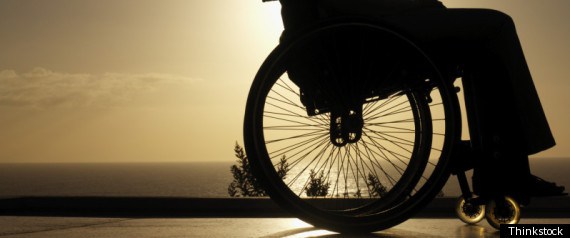
Here’s an other story that touched me deeply. Daniel Gottlieb is a family therapist, psychologist and award winning radio host. Thiry years ago he survived a traumatic car accident. He is paralyzed from the neck down and gets around in a special wheelchair.
In his book The Wisdom We’re Born With he shares a personal story. While staying at a hotel on business, the manager approached him and said “I hope you are enjoying your stay”. As it turned out there had been several hurdles that he had had to overcome in order to find a room that was easily accessible and comfortable. He asked to meet with the manager the next day to go on a guided tour with him. The manager seemed sincerely interested.
Gottlieb then asked the manager “Who do you love most in the world?” The manager quickly responded “My daughter.” Gottlieb then said “Okay, could you do this before we meet tomorrow morning? Imagine your daughter is visiting your hotel…. and she is in a wheelchair.”
They did meet the next morning but there really was no need, the manager had already seen the obstacles and hurdles. He was eager for more input from Gottlieb so that he could make it right.
When we reach out with love, we touch the innate love and compassion in others. We come together in our common humanity and caring. We hear each other and understand. We are all connected by love.
And then we know what is to be done.
ooOOoo
Revealing my age, what comes immediately to mind after having read Val’s post is this song:
A young Pharaoh already embracing contentment. September, 2003.
Sidney Bloch, who is Emeritus Professor in Psychiatry at the University of Melbourne, recently published an essay over on the blogsite The Conversation. (Greatly recommended, by the way.)
His essay was about happiness versus contentment and certainly touched a few spots in this old Englishman’s psyche, contented as I am in this rural part of Oregon. However, until now I had never stopped to think about the difference between being happy and being contented.
So, I think you are going to enjoy Professor Bloch’s views, that now follow. His essay is republished, with permission, just as it was presented on The Conversation.
ooOOoo
Happiness is an illusion, here’s why you should seek contentment instead.
June 29, 2015 4.07pm EDT
Feeling content means having a deep-seated, abiding acceptance of oneself and one’s worth, together with a sense of self-fulfilment, meaning and purpose. James Theophane/Flickr, CC BY-SA
I want to share a personal view of what it is to be happy and how it differs from feeling content. Let me begin with a clinical story.
They met at a party; it was love at first sight just like one reads about in romantic novels. They married following an exhilarating courtship, and since they shared an eagerness to raise a family, Jennifer soon announced the joyful news of her pregnancy. They called their baby Annie after Adam’s late mother.
They felt blessed; every moment since their first encounter had been nothing but pleasurable. Everyone who knew them concurred that their lives as a couple had been replete with happiness.
Tragically, it was not to endure. Their first setback occurred only days after Annie’s birth. She was sleeping fitfully and her colic stubbornly persisted. Jennifer felt utterly demoralised as a new mother. Her mounting sense of guilt and melancholy led to her admission to a psychiatric ward (her first ever encounter with psychiatry); the fear of her harming Annie or herself spread through the family and circle of friends.
And then, quite shockingly, despite the most diligent medical and nursing care, Jennifer met her death after jumping off a second floor balcony. Her family and friends plunged into deep grief; the medical professionals who had looked after her were similarly bereft.
An elusive goal
Having worked as a psychiatrist for over four decades and got to know dozens of men, women, and children of diverse backgrounds and with unique life stories, I have witnessed many a sad narrative, although suicide has mercifully been a rare event.
These experiences, in tandem with a lifelong fascination with what makes people tick, have led me most reluctantly to the judgement that while we may savour happiness episodically, it will invariably be disrupted by unwelcome negative feelings. Still, most of humankind will continue to harbour the expectation of living happily and remain oblivious that this wishful fantasy is an unconscious way of warding off the threat of psychic pain.
Rather than confront and demoralise those who have sought my help, I have gently but honestly responded to their plaintive yearning (“all I want is just to be happy”), by highlighting an inherent human sentiment. Namely that clinging to the fiction of being able to avoid suffering and enjoying a continuing state of pleasure is tantamount to self-deception.
I have offered them the hope – but not a guarantee – that they have the potential to lead a more fulfilling life than hitherto by participating in a challenging, and at times even distressing process of self-exploration whose purpose is to enhance self understanding and acceptance of the reality-bound emotional state I call contentment.
You may retort: “But you treat people who are miserable, pessimistic and self-deprecating, surely you must be hopelessly biased.” I would readily understand your reaction but suggest that all of us, not just those in treatment, crave happiness and are repeatedly frustrated by its elusiveness.
Most of humankind continues to harbour the expectation of living happily and remains oblivious that this wishful fantasy is an unconscious way of warding off the threat of psychic pain. Kate Ter Haar/Flickr, CC BY-SA
As the father of psychoanalysis Sigmund Freud emphasised in his 1930 essay, Civilization and Its Discontents, we are much more vulnerable to unhappiness than its opposite. That’s because we are constantly threatened by three forces: the fragility of our physical self, “doomed” by ageing and disease; the external world, with its potential to destroy us (through floods, fires, storms and earthquakes, for example); and our unpredictably complicated relationships with other people (regarded by Freud as the most painful source of unhappiness).
So, am I simply a misanthrope? I hope not but I am inclined to agree with Elbert Hubbard, the American artist and philosopher, who said, “Life is just one damn thing after another“.
We only have to think about the 50 million people who are currently displaced and unlikely to find a secure haven anytime soon, or the 2.2 billion people – including millions of children – who live on less than US$2 a day to appreciate the validity of that remark.
A better option
Given the formidable obstacles to chasing after happiness or promoting its sustainability if we are lucky enough to come by it, what options do human beings have? I have not come across any meaningful approach to this question, even from the unswervingly confident proponents of the contemporary school of positive psychology.
So, I espouse the following: given that we have the means to distinguish between happiness and contentment, we can examine how they differ and, in so doing, identify an alternative to the futile pursuit of happiness.
Happiness, derived from the Norse word hap, means luck or chance; the phrase happy-go-lucky illustrates the association. Many Indo-European languages similarly conflate the feeling of happiness and luck. Glück in German, for instance, can be translated as either happiness or chance, while eftihia, the Greek word for happiness, is derived from ef, meaning good, and tixi, luck or chance.
Thus, a mother may have the good fortune to feel ecstatic when responding to her infant’s playfulness, only to see it evaporate a couple of years later and be replaced by the initial features of autism. In the story we started this article with, Jennifer may have persevered had her baby slept peacefully and not been assailed by colicky pain in her first few weeks of life.
Contentment is derived from the Latin contentus and usually translated as satisfied. No multiple meanings here to confuse us. In my view, feeling content refers to a deep-seated, abiding acceptance of one’s self and one’s worth together with a sense of self-fulfilment, meaning and purpose.
And, most critically, these assets are valued and nurtured whatever the circumstances, or even especially when they are distressing or depressing.I have had the privilege of knowing men and women who suffered grievously as children in the ghettoes and concentration camps of Nazi Europe but emerged from their nightmare to face the challenge of seeking strengths, emotional and spiritual, within themselves. With the passage of time, many succeeded in achieving a sense of deep-seated contentment.
What these survivors have clearly demonstrated is that accepting and respecting oneself, coupled with determining what is personally meaningful, stand a greater chance of accomplishment, even if never completed, than a relentless and ultimately futile pursuit of happiness. What’s more, contentment has the potential to serve as a robust foundation upon which episodes of joy and pleasure can be experienced and cherished.
ooOOoo
I read the essay on The Conversation out aloud to Jeannie yesterday morning and we both found it a very wise and insightful reflection.
Seems to me that there’s another aspect of life that we could learn from our wonderful dogs!
Believers and non-believers alike owe Pope Francis a giant ‘thank you’.
As regular followers of this place will have heard before, one of the roles of the ‘alpha’ dog, or more accurately referred to these days as the Mentor dog, in other words the female dog that in the days before domestication was the leader of her pack, was to move her pack if she intuited that the pack’s home range was not sustaining them. (Her other role was pick of the male dogs!)
Thus the title of today’s post came to me as just possibly the metaphorical equivalent. That the global human ‘pack’ has been sharply reminded by one of the world’s key religious leaders that ‘more of the same’ isn’t going to work for much longer.
Quite rightly, there has been a huge amount of reporting and analysis of last week’s Papal Encyclical. But one of the most beautiful and profoundly eloquent came from the writer Jennifer Browdy. If you haven’t come across her before then do drop across to her website; you will love what she presents! I have been a subscriber to her blog posts for some time and that was how I came across her post called: And the Walls Came Tumbling Down: Pope Francis Shows Us the Way. Jennifer very kindly gave me permission to republish her post today.
ooOOoo
And the Walls Came Tumbling Down: Pope Francis Shows Us the Way
By Jennifer Browdy
The Encyclical on climate change and the environment released by Pope Francis this week has all the magic of the fall of the Berlin Wall in 1991. Back then, the antagonism between the U.S. and the U.S.S.R. seemed implacable and unresolvable, a fight to the death. And then suddenly the wall came down and the world walked through, marveling, into a new era.
Now we have another abrupt shift, this time of a religious order. The leaders of the Catholic Church can hardly be accused of being “radical tree-huggers.” And yet here is Pope Francis, solemnly exhorting his flock of a billion Catholics worldwide to be respectful to Mother Earth and all the living beings she supports. In the blink of an eye, the language of Native American spirituality has been taken up by the same Catholic Church that once tortured and executed indigenous peoples precisely because of their different religious beliefs.
I urge you to read the entire Encyclical for yourself. It is a truly remarkable document, worth serious study. Of many passages I’d like to underline, here are two:
228 Care for nature is part of a lifestyle which includes the capacity for living together and communion. Jesus reminded us that we have God as our common Father and that this makes us brothers and sisters. Fraternal love can only be gratuitous; it can never be a means of repaying others for what they have done or will do for us. That is why it is possible to love our enemies. This same gratuitousness inspires us to love and accept the wind, the sun and the clouds, even though we cannot control them. In this sense, we can speak of a “universal fraternity”.
229 We must regain the conviction that we need one another, that we have a shared responsibility for others and the world, and that being good and decent are worth it. We have had enough of immorality and the mockery of ethics, goodness, faith and honesty. It is time to acknowledge that light-hearted superficiality has done us no good. When the foundations of social life are corroded, what ensues are battles over conflicting interests, new forms of violence and brutality, and obstacles to the growth of a genuine culture of care for the environment.
Here we find spiritual ecology enshrined as Catholic doctrine. And one thing about the Catholic Church—it is big on obedience. For believers, to ignore the Pope is to risk hellfire and damnation. In this case, though, the hellfire and damnation will be earthly, if we do not listen to the wise advice of Pope Francis and curb the insanity of industrial growth that goes beyond the limits of the planet to support.
Scientists appeal to our sense of reason, presenting compelling evidence that if we continue on our present path of wasteful consumption of the Earth’s resources, we will destroy our own future as a flourishing species. Religious leaders appeal to human beings’ moral conscience in invoking the responsibility of current parents and grandparents to leave a livable world to our descendants. It is up to the politicians, though, to translate vision into practice.
For too long, Christian conservatives in the U.S. have played the role of the ideological wing of Big Business, using money, manipulation and scare tactics to buy politicians and votes. In the face of the new Papal Encyclical, can American Christians really continue in good conscience to support the worst of the planet’s polluters and plunderers? Can they continue to elect mercenary politicians who hold our country hostage to the highest bidder?
If all good people who love our Earth and its creatures were to translate our love into action, as Pope Francis has just done so forcefully, I have no doubt the seemingly invincible wall of the industrial growth society we’ve been living with these past 200 years would melt away, revealing the path into a green, prosperous future.
“Where there’s a will, there’s a way,” the saying goes. Pope Francis has just shown us the will, and the way. It is now the task of us ordinary citizens to break the stranglehold of Big Business on politics and insist that our politicians follow his lead.
I close with an excerpt from the Pope’s “Christian Prayer in Union with Creation,” a vision of ecological interdependence if ever there was one:
“Triune Lord, wondrous community of infinite love,
teach us to contemplate you
in the beauty of the universe,
for all things speak of you.
“Awaken our praise and thankfulness
for every being that you have made.
Give us the grace to feel profoundly joined to everything that is.
God of love, show us our place in this world
as channels of your love
for all the creatures of this earth,
for not one of them is forgotten in your sight.
Enlighten those who possess power and money
that they may avoid the sin of indifference,
that they may love the common good, advance the weak,
and care for this world in which we live.”
Amen.
And the meek shall inherit the Earth…. Photo by J. Browdy, 2015
ooOOoo
I am sure that, whatever your religious or spiritual persuasion, you will agree with me with regard to the beauty of Jennifer’s essay. I know there are millions and millions of people who will want to look back in a few years time and see how Pope Francis’ legacy literally saved our lives.


 oooo
oooo