Category: consciousness

Buddhism and Humanism

Reflections on a very interesting meeting of our local Freethinkers group.

Last Saturday was the regular monthly meeting of our local Rogue Valley Freethinkers and Humanists. Many know that Jean and I are secular humanists and go as often as we can to these meetings in Grants Pass, Oregon.

Saturday’s meeting was all about Buddhism or more accurately as Jerry Reed, the group’s administrator, put it in a recent email:

For Saturday, Aug 5: Brenda will be our presenter/discussion leader. She will introduce us to Secular Buddhism, including comments on basic principles of Buddhism, and how traditional and secular Buddhism compare with each other, as well as on overlapping philosophical views of Buddhism and Humanism.

This video link provides a discussion between a humanist, Scott Lohman, and a secular Buddhist, Ted Meissner, which may help to familiarize you with Brenda’s topic prior to our meeting. It is about 29 minutes long, all interesting, but if you are cramped for time, especially the segment from about 10:30 to 16:30 which discusses basic Buddhist principles that might also relate to humanism, and another segment from about 19:30 to 27:00 on advice to a beginner who might want to try meditation, and how Star Trek borrowed from Buddhism, and also about the similarity of ethical focus of Buddhism and Humanism.

What I would hope is that if any of you are interested in this subject, then do watch the interview with Ted Meisser conducted by Scott Lohman .
Here it is.

Here follow links to the organisations represented by Scott and Ted Meissner. For Scott the Humanists of Minnesota, and for Ted the Secular Buddhist Association.

If you do watch the video you will undoubtedly pick up on the science now discovering that meditation does change the brain … for the better!

More on that tomorrow!

Looking ahead!

The joys of installing new flooring!

In a number of the rooms here at home we still have down on the floor the carpeting that was in the house when we moved in 5 years ago. As you might imagine that carpet, being slept on daily by cats and dogs, is also home to a range of uninvited ‘guests’. That song title comes to mind: “The hills are alive ….”.

A while ago we replaced the carpet in our main living-room with oak flooring and now we are replacing just about all the rest of the carpet in our house with laminate boarding that is a very good match with the oak flooring.

One of the rooms that is affected is my office and although the installers will only be working for the three days of the 16th to the 18th August, the rooms will need to be emptied out of all furniture a few days before the 16th.

Ergo, I expect to be ‘off air’ for about a week. Probably from Sunday, 13th August through to Sunday, 20th August.

During those days I won’t be able to respond to your replies to posts. But I will put up posts for each of those days well ahead of the 13th.

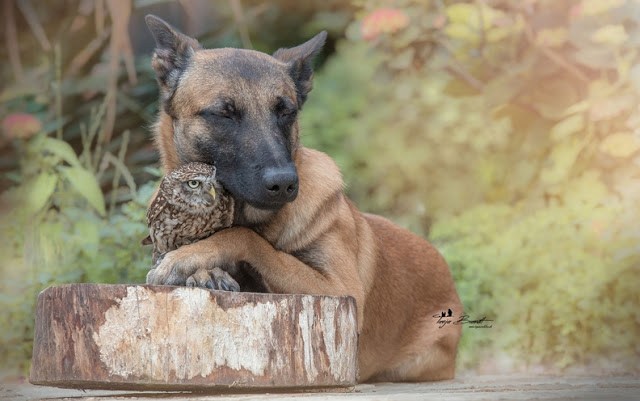
What I will post is something that Suzann emailed Jean the other day. It’s the wonderful story of a Belgian Shepherd dog befriending an owl. This is what was included in Suzann’s email:

ooOOoo

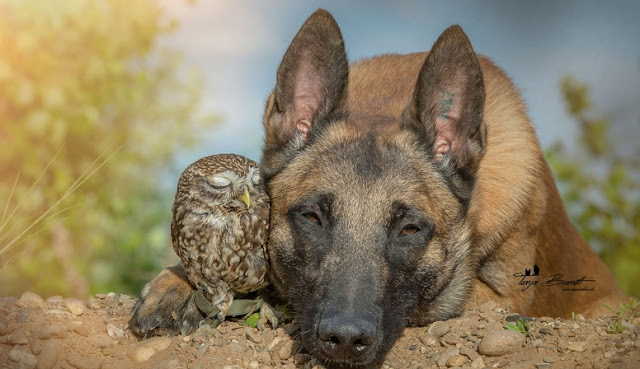
For years, photographer Tanja Brandt has made it her mission to capture magnificent photos of animals and wildlife. Recently, the German artist found a new challenge when she photographed the unique bond between two unlikely friends: Ingo, a Belgian shepherd, and Poldi (Napoleon), a one-year-old owlet.

The owlet and canine have a special “protector-protected” relationship and that their affection towards each other couldn’t be any more evident. Ingo lovingly guards Poldi, who apparently “doesn’t know how to live free.”
The owlet, hatched two days after his six brothers and sisters, therefore, has always been very vulnerable due to his small size. Comparatively, Ingo was raised by a family of strong, and oftentimes ruthless, police dogs.

“They respect each other and they can read each other,” says the photographer.

ooOOoo

There are many photographs of Ingo and Poldi and they will make up the posts for you all for that week of the 14th August.

We are of the stars!

I so relate to this item from EarthSky News!

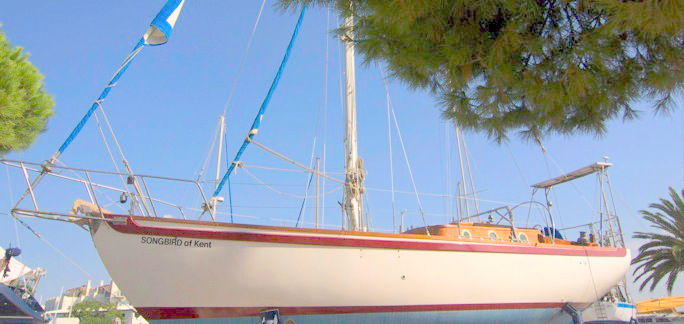
Long-term readers of this place will possibly recall that between April, 1989 and June, 1994 I lived on a Tradewind 33 sailing yacht Songbird of Kent. I have written before about those days.

Songbird of Kent. My home for five years.

When sailing at night when the sky is clear it is impossible not to feel deeply connected to the stars above one’s head.

My logbook for Songbird of Kent reports that at noon on Wednesday, 1st June, 1994, I departed the yacht harbour at Horta in The Azores bound for Plymouth, South-West England. Plymouth was 1,257 nautical miles (2,329km/1,447 statute miles) from Horta.

Horta on Faial Island of the Azores

The logbook has an entry for the 6th June.

0400 Lat. 43 deg 25 minutes North, Long 22 deg 3 minutes West. Engine Off. Still no wind but must sleep after 19 hours of helming. 840 miles to run. Wind 2 knots from SW. Baro 1027 mb, Viz Good.

The visibility was wonderful and seeing the stars up in the night sky all around me, as in all 360 degrees about me, practically down to the horizon on this moonless night is an image still etched in my mind.

That’s why I want to republish this article that appeared on the blog EarthSky News yesterday.

ooOOoo

We are galaxy stuff

A new study – based on supercomputer simulations – reveals that each one of us may be made in part from matter that passes from one galaxy to another.

This image shows M81 (bottom right) and M82 (upper left), a pair of nearby galaxies where intergalactic transfer – transfer of materials between galaxies – might be happening. Image via Fred Herrmann.

Sagan famously said that we are made of star stuff. He meant the carbon, nitrogen and oxygen atoms in our bodies, as well as atoms of all other heavy elements, were created inside stars. Yet Sagan’s expression of this idea, which quickly became a cornerstone of popular culture, might not take the concept far enough. According to astrophysicists at Northwestern University, our origins are much less local than previously thought. In fact, according to their analysis – which they say is the first of its kind – we’re not just star stuff. We’re galaxy stuff.

This study is being published on July 26, 2017 (July 27 in the U.K.) by the peer-reviewed journal Monthly Notices of the Royal Astronomical Society.

The Northwestern researchers found that up to half of the matter in our Milky Way galaxy may come from distant galaxies. As a result, each one of us may be made in part from extragalactic matter. That is, atoms of carbon, nitrogen, oxygen and so on in our bodies may be created not just by stars in our own Milky Way galaxy, but by stars in far-flung galaxies.

They arrived at this conclusion using supercomputer simulations. The study required the equivalent of several million hours of continuous computing.

The simulations show that supernova explosions eject great quantities of gas from galaxies, which causes the atoms made inside stars to be transported from one galaxy to another via powerful galactic winds. According to their statement, intergalactic transfer is a newly identified phenomenon, which, they say, requires supercomputer simulations in order to be understood. According to these astrophysicists, this understanding is critical for knowing how galaxies evolve … and hence for knowing our own place in the universe.

Animation of gas flows around a Milky Way-like galaxy, as seen by the team’s computer simulations.

Daniel Anglés-Alcázar is a postdoctoral fellow in Northwestern’s Center for Interdisciplinary Exploration and Research in Astrophysics (CIERA). He led the study, and he said:

It is likely that much of the Milky Way’s matter was in other galaxies before it was kicked out by a powerful wind, traveled across intergalactic space and eventually found its new home in the Milky Way.

Given how much of the matter out of which we formed may have come from other galaxies, we could consider ourselves space travelers or extragalactic immigrants.

Space is vast. Galaxies are located at almost inconceivable distances from each other. So, Alcázar and his team said, even though galactic winds propagate at several hundred kilometers per CIERA second, the process of intergalactic transfer occurs over billions of years.

As always, this new research built on earlier studies. Northwestern’s Claude-André Faucher-Giguère and his research group, along with a unique collaboration called Feedback In Realistic Environments (FIRE), had developed numerical simulations that produced realistic 3-D models of galaxies. These simulations followed a galaxy’s formation from just after the Big Bang to the present day.

Anglés-Alcázar then developed state-of-the-art algorithms to mine this wealth of data. In this way, he and his team were able to quantify how galaxies acquire matter from the universe.

The scientists say the prediction of intergalactic transfer can now be tested. The Northwestern team plans to collaborate with observational astronomers who are working with the Hubble Space Telescope and ground-based observatories to test the simulation predictions.

Simulated examples of intergalactic winds, shown as green string, in action around galaxies, shown as clusters of yellow dots. The galaxy at the center is ejecting the winds, blowing them toward potential the other galaxies.

Bottom line: Supercomputer simulations suggest that each one of us may be made in part from extragalactic matter. Hence, we are galaxy stuff.

ooOOoo

16th June, 1994

1945 Lat. 50 deg 21 minutes North, Long. 4 deg 10 minutes West. ARRIVED MAYFLOWER MARINA. Wind Nil. Baro 1023 Mb. Viz Good.

LOG CLOSED!

Mayflower Marina is at Plymouth.

Never taking democracy for granted!

Cold-water shower time again!

All you good people who stick with this blog know that the majority of the posts are to do with dogs or cats in one form or another.

Yet, I am cognizant of the fact that no one can completely hide, metaphorically speaking, in the warm fur of our favourite dog or cat and let the rest of the world go tits up. From time to time I read an article or an essay that touches on something fundamentally important to a civil society and am compelled to share same with you.

That was the case on July 5th when I published a post called The Implications of Inequality.

OK – moving on!

Regulars know that I am a great admirer of the writings of essayist George Monbiot. He is a very regular contributor to The Guardian newspaper. Just a few days ago, Mr. Monbiot published an essay that really does need to be read as widely as possible. It is called Missing Link and is republished here with George Monbiot’s very kind permission.

ooOOoo

Missing Link

21st July 2017
How a secretive network built around a Nobel prizewinner set out to curtail our freedoms

By George Monbiot, published in the Guardian 19th July 2017

It’s the missing chapter: a key to understanding the politics of the past half century. To read Nancy MacLean’s new book Democracy in Chains: the deep history of the radical right’s stealth plan for America is to see what was previously invisible.

The history professor’s work on the subject began by accident. In 2013 she stumbled across a deserted clapboard house on the campus of George Mason University in Virginia. It was stuffed with the unsorted archives of a man who had died that year, whose name is probably unfamiliar to you: James McGill Buchanan. She writes that the first thing she picked up was a stack of confidential letters concerning millions of dollars transferred to the university by the billionaire Charles Koch.

Her discoveries in that house of horrors reveal how Buchanan, in collaboration with business tycoons and the institutes they founded, developed a hidden programme for suppressing democracy on behalf of the very rich. The programme is now reshaping politics, and not just in the US.

Buchanan was strongly influenced by both the neoliberalism of Friedrich Hayek and Ludwig von Mises and the property supremacism of John C Calhoun, who argued, in the first half of the 19th century, that freedom consists of the absolute right to use your property – including your slaves – however you may wish. Any institution that impinges on this right is an agent of oppression, exploiting men of property on behalf of the undeserving masses.

James Buchanan brought these influences together to create what he called “public choice theory”. He argued that a society could not be considered free unless every citizen has the right to veto its decisions. What he meant by this was that no one should be taxed against their will. But the rich were being exploited by people who use their votes to demand money that others have earned, through involuntary taxes to support public spending and welfare. Allowing workers to form trade unions and imposing graduated income taxes are forms of “differential or discriminatory legislation” against the owners of capital.

Any clash between what he called “freedom” (allowing the rich to do as they wished) and democracy should be resolved in favour of freedom. In his book The Limits of Liberty, he noted that “despotism may be the only organisational alternative to the political structure that we observe.” Despotism in defence of freedom.

His prescription was what he called a “constitutional revolution”: creating irrevocable restraints to limit democratic choice. Sponsored throughout his working life by wealthy foundations, billionaires and corporations, he develop both a theoretical account of what this constitutional revolution would look like and a strategy for implementing it.

He explained how attempts to desegregate schooling in the American South could be frustrated by setting up a network of state-sponsored private schools. It was he who first proposed the privatisation of universities and the imposition of full tuition fees on students: his original purpose was to crush student activism. He urged the privatisation of Social Security and of many other functions of the state. He sought to break the links between people and government and demolish trust in public institutions. He aimed, in short, to save capitalism from democracy.

In 1980, he was able to put the programme into action. He was invited to Chile, where he helped the Pinochet dictatorship to write a new constitution, which, partly through the clever devices Buchanan proposed, has proved impossible to reverse in its entirety. Amid the torture and killings, he advised the government to extend its programmes of privatisation, austerity, monetary restraint, deregulation and the destruction of trade unions: a package that helped trigger economic collapse in 1982.

None of this troubled the Swedish Academy, that, through his devotee at Stockholm University, Assar Lindbeck, in 1986 awarded James Buchanan the Nobel Memorial Prize for economics. It is one of several decisions that have turned this prize toxic.

But his power really began to be felt when Charles Koch, currently the seventh richest man in the US, decided that Buchanan held the key to the transformation he sought. Koch saw even such ideologues as Milton Friedman and Alan Greenspan as “sellouts”, as they sought to improve the efficiency of government rather than destroying it altogether. But Buchanan took it all the way.

MacLean says that Charles Koch poured millions into Buchanan’s work at George Mason University, whose law and economics departments look as much like corporate-funded thinktanks as they do academic faculties. He employed the economist to select the revolutionary “cadre” that would implement his programme (Murray Rothbard, at the Cato Institute that Koch founded, had urged the billionaire to study Lenin’s techniques and apply them to the libertarian cause). Between them, they began to develop a programme for changing the rules.

The papers Nancy Maclean discovered show that Buchanan saw stealth as crucial. He told his collaborators that “conspiratorial secrecy is at all times essential.” Instead of revealing their ultimate destination, they would proceed by incremental steps. For example, in seeking to destroy the Social Security system, they would claim to be saving it, arguing that it would fail without a series of radical “reforms”. (The same argument is used by those attacking the NHS over here). Gradually they would build a “counter-intelligentsia”, allied to a “vast network of political power” that would eventually become the new establishment.

Through the network of thinktanks that Koch and other billionaires have sponsored, through their transformation of the Republican Party, and the hundreds of millions they have poured into state congressional and judicial races, through the mass colonisation of Trump’s administration by members of this network and lethally effective campaigns against everything from public health to action on climate change, it would be fair to say that Buchanan’s vision is maturing in the USA.

But not just there. Reading this book felt like a demisting of the window through which I see British politics. The bonfire of regulations highlighted by the Grenfell Tower disaster, the destruction of state architecture through austerity, the budgeting rules, the dismantling of public services, tuition fees and the control of schools: all these measures follow Buchanan’s programme to the letter. I wonder how many people are aware that David Cameron’s free schools project originated with an attempt to hamper racial desegregation in the American South.

In one respect, Buchanan was right: there is an inherent conflict between what he called “economic freedom” and political liberty. Complete freedom for billionaires means poverty, insecurity, pollution and collapsing public services for everyone else. Because we will not vote for this, it can be delivered only through deception and authoritarian control. The choice we face is between unfettered capitalism and democracy. You cannot have both.

Buchanan’s programme amounts to a prescription for totalitarian capitalism. And his disciples have only begun to implement it. But at least, thanks to Maclean’s discoveries, we can now apprehend the agenda. One of the first rules of politics is know your enemy. We’re getting there.

http://www.monbiot.com

ooOOoo

I found it very difficult to write these closing thoughts; as is obvious as you read this sentence!

Looking up quotations online under the headings of fairness or equality brought up many that could have worked here. Yet they seemed too trite, too obvious, too remote from the reality of what Mr. Monbiot describes here today.

So let me leave you with this: US income inequality is the highest it’s been since 1928. (Source: Pew Research.) But worse than that, US wealth inequality is even greater than income inequality. (Source: Pew Research.) (I’m certain that this is not exclusive to the USA.)

That is wrong! Plain and Simple!
This is the dog!

Precious!

Yesterday, Julie, Richard’s wife back in England, sent me a photograph of what some unknown dog lover has put on one of the walls of their home.

I can’t find the words to better what is written on that wall.

To increase the impact for you, dear reader, seeing this for the first time, it is presented with a ‘read more’ link.

In other words …..

Continue reading “This is the dog!”

Never give up!

Sharing and caring in abundance!

Please forgive the shortness of the introduction. It’s just that Jean and I were out all day and I didn’t sit down to present today’s post for all you good people until 4pm.

Frankly, this is such a wonderful account of caring for dogs that any intro from me would be superfluous!

ooOOoo

From Rags to Kisses: Abused Dogs Find Happy Homes in Colorado

By: Laura Burge July 1, 2017

About Laura Follow Laura at @literarylaura

In December 2014, Animal House Rescue and Grooming in Fort Collins, Colorado, found a very special delivery on its doorstep. Three dogs arrived from the Pine Ridge Reservation in South Dakota, an Oglala Lakota Native American reservation.

One of the poorest communities in the country, the reservation has an overabundance of unwanted pets facing the risk of disease, starvation, exposure to the elements and, unfortunately, violence.

After a five-hour drive, DeeDee, Prince and Maizy made the first step to finding new and happy lives.

DeeDee was originally discovered living in the trash dump on the Pine Ridge Reservation, where she made her home upon an old discarded sofa atop a pile of tires. A local rescuer, aware of her plight, spent a week slowly gaining DeeDee’s trust with food.

Once the understandably nervous dog allowed the rescuer to get close enough to her, she found herself on a leash and then in a car. Little did DeeDee know she was on her long way home.

DeeDee spent some time in foster care in South Dakota, recovering from mange and learning to trust again before she was transferred to Animal House to give her a better chance of finding her future family. It didn’t take long for them to find each other, with DeeDee’s charming and playful nature quickly winning over their hearts.

Prince, a 2-year-old shepherd mix, had been found covered in matted fur and burrs. He showed up at Animal House having been shaved, but full of affection.

When Prince arrived, they noticed that there was a problem with his back leg and quickly got him in for x-rays. The cause became quickly apparent, and horrible: Prince had been shot on the reservation. The bullet had travelled through his rear hip and shattered his femoral head.

Not knowing how long he had been suffering through the pain of his injury, the staff at Animal House was anxious for Prince to find relief as quickly as possible. He was sent to CSU Veterinary Teaching Hospital for a femoral head osteotomy, a surgery that alleviated his pain and allowed him to keep his rear leg.

Thankfully, his lovable nature showed through. Prince was able to recover in comfort and bask in newfound love, as he went to his new home shortly after surgery.

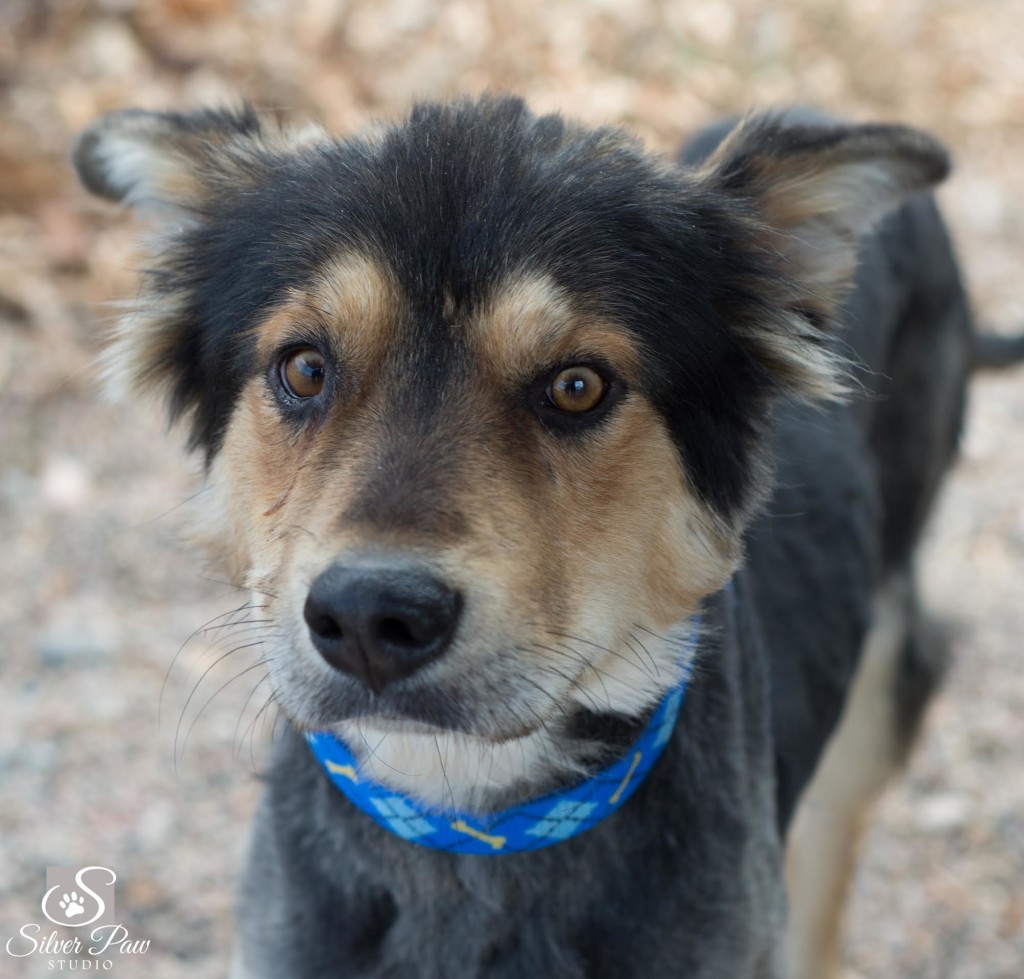
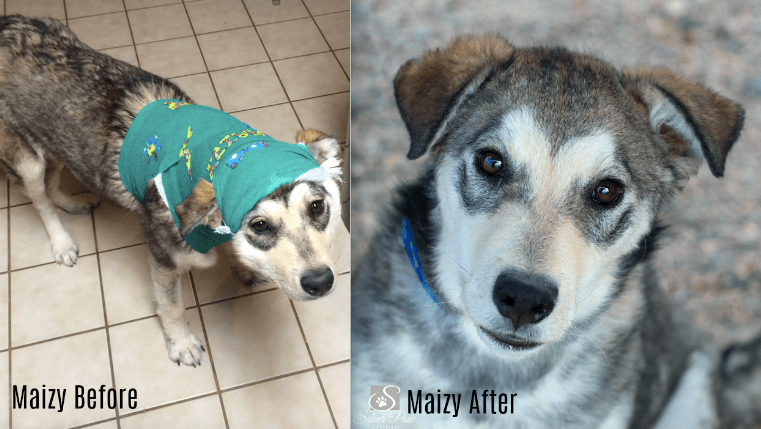
Maizy was a beautiful 8-month-old Husky mix puppy with eyes that melted hearts. Whatever happened to Maizy on the reservation, something that will remain a mystery, she came to Animal House in a lot of pain.

Maizy had several neurological symptoms and pain in her neck. After x-rays, the shelter soon found that the puppy had a fractured cervical vertebra, which was causing compression on her spinal cord. This could have been catastrophic for Maizy, but she’s a fighter.

Maizy’s foster family dedicated their time to bringing her to CSU Veterinary Teaching Hospital for regular bandaging and casting to keep her spine in place. Her beautiful face and wonderful personality through all of this ended up winning the heart of an Animal House volunteer. Having made a full recovery and a lifelong connection, Maizy now lives happily in her loving forever home.

Adoption Highlight: Special Needs Dogs

These adorable special needs dogs are still waiting to find their way to new homes.

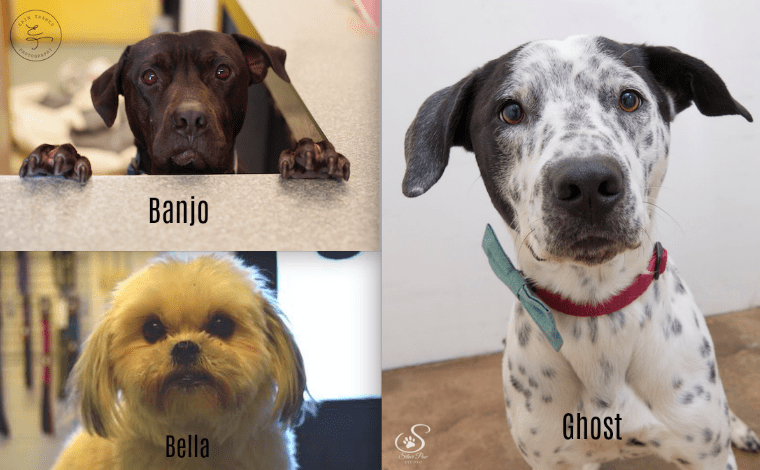
Banjo is a 6-year-old pit bull terrier mix who had a rough start to life, facing his many challenges with a great attitude. He arrived at Animal House with skin issues related to allergies, worn down teeth and scarring on his body, as well as kidney disease. Banjo gives the best hugs and thinks he is a lap dog, so he would make an excellent snuggle buddy.

Bella is a 2-year-old shih tzu mix who arrived at Animal House after her former sanctuary had to close its doors. Bella has a love for life and gets along well with other dogs and cats. She does struggle in some areas, though, specifically with constipation and some house-training. Bella is looking for a patient and kind forever home willing to help her live comfortably with her condition.

Ghost is a 2-year-old Australian Cattle Dog mix who is sensitive, intelligent, and inquisitive. He is nervous about new people and environments and needs a home that can build his confidence so that he can be happy and comfortable in a variety of situations. Ghost just wants some good old-fashioned love and patience!

You can find out more about these adoptable dogs here.

Photo credits: Animal House Rescue and Grooming, Colorado

ooOOoo

Whatever the state of the world, as long as there are organisations and people who will love and care for animals in need then I will be at peace.

Happy July 4th!

If you will allow this old Brit to recognise the 4th July!

Speaking of Brits, the following was sent to me by Neil, a close friend from my previous days living in South Devon, England.

Perfect!

Thanks Neil!

The day after.

Trying to cope.

This is a very personal, possibly rather mixed-up, set of reflections of how the day after Pharaoh died felt for me. Some of you may prefer not to read this or view the photos.

I sat down to write this, late morning Tuesday, as it was becoming too hot to stay outside. I felt inspired to be 100% honest about my feelings and the photographs are, in essence, copies of the pictures that are in my head.

I woke early yesterday, a little after 4am, and started listening to BBC Radio Four using ear-phones plugged into my tablet while Jeannie slept on.

But I couldn’t get the images of Monday out of my head. Such that it seemed unreal to think that less than thirty-six hours previously Pharaoh was sleeping quietly near his bed, albeit unable to walk on his own.

Then, in what seemed like the flick of a finger, Jeannie was offering Pharaoh my dinner plate Monday evening.

For every evening, unless we had eaten a very spicy meal, Pharaoh always licked my plate clean.

A routine that had gone on for years.

I lay there in bed as 1pm arrived in England (5am PDT) and BBC Radio 4 was broadcasting The World At One. Despite the gloomy headlines still focusing on that terrible fire at the Grenfell Tower in London (not three miles from where I was born in 1944), the images of Monday kept thundering into my consciousness.

How dear friend, Jim Goodbrod, and I had driven into Allen Creek Veterinary Hospital, where Jim is a visiting DVM each week, to collect the required amount of euthanasia drug (apparently just 1 c.c. for every 10 lbs of animal weight – looking at it in the syringe it seemed such a small amount of fluid to bring an end to Pharaoh’s life.)

Then over breakfast, as in Tuesday morning, Jean said how difficult it was watching Pharaoh yesterday (Monday) when Jim and I were away getting the meds because it seemed to her that Pharaoh sensed something was happening outside the run of a normal morning.

Continuing with Monday. When Jim returned, accompanied by his wife, Janet, and knelt down to examine Pharaoh his analysis was that the time was right. Pharaoh had lost massive amounts of muscle tissue from his rear legs and hips.

It was time. Jean and I settled down sitting on the floor alongside Pharaoh’s bed. Pharaoh shifted his body and placed his wonderful, furry head across my outstretched legs. It was time.

Jim injected Pharaoh with an anesthetic. Slowly, gently Pharaoh fell fast asleep. Jim shaved a patch of fur from Pharaoh’s front, right lower leg.  Janet pinched a vein in Pharaoh’s leg and moments later, Jim injected the euthanasia drug. Jean and I continued to stroke Pharaoh’s forehead but frequently looked down to where the rise and fall of Pharaoh’s lungs was visible.

Then at 11:57 PDT Monday, June 19th., there was no more breathing. Jim took out a stethoscope and confirmed that there was no heart-beat. Jim closed Pharaoh’s eyelids while Jean and I sat quietly just holding on to Pharaoh. A few minutes later, Jean and I had wriggled out from under Pharaoh and then Jim slipped a plastic sack over the rear half of Pharaoh’s still body.

Pharaoh had died without pain and in the most gentle way imaginable.

Back to Tuesday, as in yesterday, and now Jean and I were awake and I was reading every comment and response to the post Adieu, Mon Brave.

I must tell you that the love and compassion extended by every single one of you, including the numerous emails sent to me, is the most precious, special recognition of what Pharaoh meant to me, to my Jeannie, and to you all.

Thank you! Thank you so much!

Time then for a call into England and to let Sandra Tucker know that Pharaoh had died. For Pharaoh had been born at Jutone, the GSD breeding kennels run by Sandra Tucker, and Jim, in Hennock, Devon.

Pharaoh’s legacy will live on forever. What he stood for. What he represented. What I learned from Pharaoh. What he inspired in me. That inspiration that will live with me until it’s my turn to take my last breath.

Then it was time to get up and try and stay occupied. But I didn’t warrant for seeing Pharaoh’s empty bed as I walked out of the bedroom into the living-room.

It looked so empty, so lonely.

I burst into tears.

I turned on my heels and went out to feed the horses and the wild deer. As is done every morning.

Walking back to the house, I stepped up on to the rear deck and looked up at the line where the tops of the forest trees on the hills to the East meet the morning sky. It was a clear, cloudless sky.

The sun was within seconds of rising above that skyline. I took a photograph and then the sun had risen. It was 06:24 am. Fifteen hours to the minute before the exact moment of the Summer Solstice this evening (21:24 PDT).

I don’t know what it all means other than in some mysterious, natural fashion, everything is connected.

Dear, sweet, noble Pharaoh.

Adieu, Mon Brave.

Today is going to be a very sad day indeed!

Just sixteen days ago, on June 3rd., Pharaoh turned fourteen. He was born on June 3rd, 2003.

I didn’t mention in that birthday post that Pharaoh’s rear hips and legs were very weak indeed and it was clear that he was living out the last few weeks of his wonderful, glorious life.

Yesterday, Jean and I came to the sad conclusion that Pharaoh had deteriorated rapidly in these last couple of weeks and that it would be cruel to prolong what cannot now be pleasant for him.

We spoke to good friend and neighbour, Jim Goodbrod, who is a Doctor of Veterinary Medicine (DVM) and he agreed.

So this Monday morning, Oregon (PDT) time, I shall drive Jim to our local veterinary clinic on Lincoln Road and Jim will pick up the necessary drugs.

We will then return home and Jean and I will cradle Pharaoh until he takes his last breath. My guess is that will be around 11am PDT.

I spoke to my daughter, Maija, and son, Alex, yesterday as they have fond memories of Pharaoh from his very earliest days. Alex’s long-term partner, Lisa, then sent me the following email:

Dear Paul and Jean,

I was very sorry to hear about Pharaoh and understand how you are feeling. I had to say goodbye to my 19 year old cat Molly last month.

My parents have had German shepherds and when they had to have their last one put to sleep a friend of theirs sent them the following poem. It gave them a great deal of comfort and I thought it would be nice to type it out and send it to both of you. You may already know it.

I will be thinking of you all tomorrow,

Lots of love,

Lisa xx

Here is that poem.


When the time comes
If it should be that I grow frail and weak
And pain should keep me from my sleep,
Then will you do what must be done,
For this, the last battle, can’t be won.


You will be sad I understand,
But don’t let grief then stay your hand,
For on this day, more than the rest,
Your love and friendship must stand the test.


We have had so many happy years,
You wouldn’t want me to suffer so.
When the time comes, please let me go.


Take me to where my needs they’ll tend,
Only, stay with me till the end
And hold me firm and speak to me
Until my eyes no longer see.


I know in time you will agree
It is a kindness you do to me.
Although my tail its last has waved,
From pain and suffering I have been saved.


Don’t grieve that it must be you
Who had to decide this thing to do;
We’ve been so close, we two, these years,
Don’t let your heart hold any tears.

Dear friends of this blog, it means so much to share this sad news with you all and I know that your sadness for this day will be carried on the wings of countless thoughts across the air waves in Pharaoh’s direction.

You will understand if I close by saying that just now, this Sunday afternoon, Pharaoh’s last day with Jean and me and our furry family, I’m uncertain as to how I will approach writing posts for the next few days. I may go silent or I may share some treasured memories of my time with Pharaoh.

Taken on the 26th July, 2006 at Watchfield Aerodrome in Devon.

In memory of a wonderful companion.