A few days ago Jean and I listened to an episode from the BBC Radio 4 series The Art of Living. Or as the home page of the programme’s website explains, The Art of Living is a …
Documentary series revealing how engagement with art has transformed people’s lives.
Anyway, the episode that we listened to was a delightful 30-minute discussion between Marie-Louise Muir and the Belfast-born poet Frank Ormsby. The reason we selected this episode to listen to in particular is revealed by republishing how the BBC introduced the programme. (For Jean was diagnosed with Parkinson’s Disease in December, 2015.)
Frank Ormsby’s Parkinson’s
The Art of Living
When the poet Frank Ormsby was diagnosed with Parkinson’s Disease, his response was unexpected. He embarked on a newly fertile creative period, documenting his experiences and finding a voice in his poetry that he was beginning to lose in his daily communications.
His first act was to search Google – for jokes. “Which would you rather have, Parkinson’s or Alzheimer’s. Obviously Parkinson’s! I’d rather spill half my pint than forget where I left it.”
As he discusses with Marie-Louise Muir, the illness has changed him. It’s mellowed him. After a career as a school teacher, his daily life is now quieter and more solitary. There’s a poetry, almost, in his pauses and silences.
Frank belongs to the generation of Northern Irish writers that has followed in the footsteps of Seamus Heaney and Michael Longley. His medication, he believes, has aided his creativity. But it has also induced hallucinations. He finds himself sitting on his own in his study but surrounded by people, by the ghosts of his mother-in-law and unidentified visitors. And he’s also haunted by a fear that the earth will open up and swallow him.
But if you ask how he’s doing, he writes, “I’ll tell you the one about ‘parking zones disease’.
I’ll assure you that the pills seem to be working”.
Photo credit: Malachi O’Doherty, With readings by Frank himself and Ciaran McMenamin from The Darkness of Snow. Produced by Alan Hall. A Falling Tree production for BBC Radio 4.
That wonderful joke offered by Frank, this one: “Which would you rather have, Parkinson’s or Alzheimer’s. Obviously Parkinson’s! I’d rather spill half my pint than forget where I left it.” comes a little after the 5-minute point in the interview. I strongly encourage you to listen to the full interview. Here’s the link to the radio programme.
Jean and I were sitting up in bed a couple of mornings ago reflecting on how recent it has been since we ‘got it’ in terms of what becoming old really means. For me and Jean, for different reasons, it is only in the last twelve months that ageing, the process of becoming older, the decline in one’s faculties, and more and more, has been truly understood. Yes, before then of course one understood that we were getting old. But it was an intellectual understanding not the living it on a daily basis understanding we now experience.
Back to Frank Ormsby. Or rather to a feature in the Belfast Telegraph published in 2015.
Frank Ormsby: Life at Inst was very different from my upbringing
Leading Belfast poet and former Inst. Head of English Frank Ormsby on his tough Fermanagh upbringing, losing his father when he was 12 and how humour has helped him cope with a Parkinson’s diagnosis.
Write stuff: Frank Ormsby at his home in north Belfast
March 23, 2015
As Frank Ormsby sits in the study of his beautifully-appointed 1930s home in north Belfast there is no hint of his much more austere upbringing. As befits the workspace of a poet and long-time English teacher at one of Belfast’s leading schools, the bookcases that line the walls are crammed with a wide range of literature.
It could not be a more different environment from the rural home where he grew up just after the Second World War.
When Frank was born in 1947, his father Patrick was already in his 60s. “I remember him as an old, grey-haired man”.
It was Patrick’s second marriage. His first had produced 10-12 children. “I was never totally sure of the exact number”, Frank recalls.
“I never met them as they had dispersed to Scotland and other places by the time my father, by then a widower, had married my mother. As far as I know the last one of them died last year.”
Frank’s home was about a mile and half outside Irvinestown. His mother Anne had worked on a relative’s farm – “she could build hay or cut turf as well as any man” – and his father as a farm labourer who occasionally sought work in the factories in Scotland.
“The conditions in which we lived were lacking in luxury. We had no running water. We had to carry it in buckets from a well half a mile away. There was no electricity and it was a long time before we even had a radio, or wireless as it was called then,” Frank says.
Here’s one of Frank’s poems that was published by The New Yorker in March, 2013.
BOG COTTON
By Frank Ormsby
They have the look
of being born old.
Thinning elders among the heather,
trembling in every wind.
My father turns eighty
the spring before my thirteenth birthday.
When I feed him porridge he takes his cap off. His hair,
as it has been all my life, is white, pure white.
Maybe that’s how it is. Having the look of being born old!
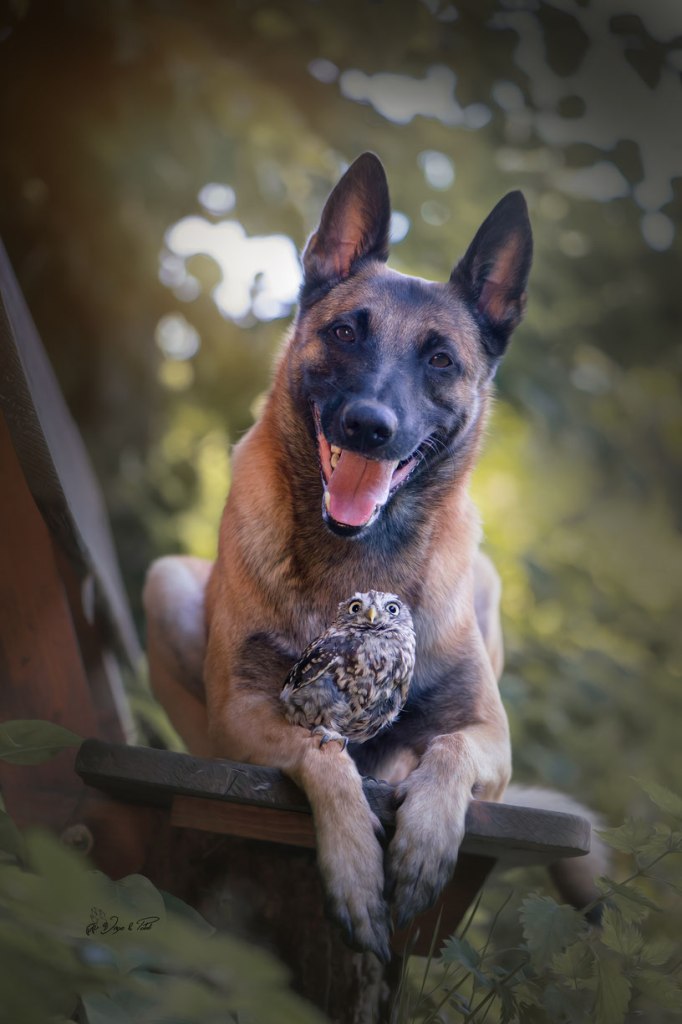
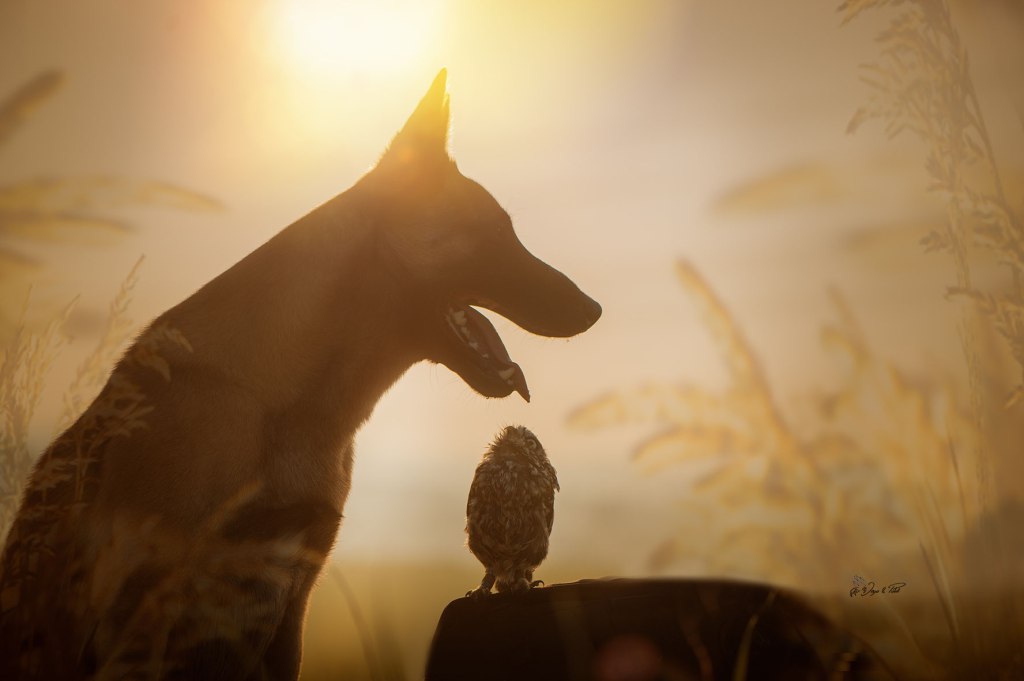
But there’s one thing that I treasure beyond gold itself. Having the fortune to be living out my final days, however many there are, in the company of my beautiful Jeannie and all the loving dogs around me.
And that last photograph seems so perfect a lead-in to my final two for today. Both taken at The Schoolhaus Brewhaus restaurant in Jacksonville, Oregon where we had our anniversary dinner on the 20th.
oooo
A beautiful lady looking down on very beautiful wife!
The reason I am posting this is simply because it might help someone else out there.
I go bike riding three times a week; weather permitting. Usually with a group from close by: Jim; Richie; Pam; Dordie; Ken.
Two days ago there was a break in the wet weather and Jim rang round seeing who was up for a ride. It turned out that four of us could go riding: Jim, Richie, Dordie and myself.
We decided to ride down Hugo Road, turn left onto the Merlin-Galice Road, follow that right to the end of Galice Road, very close to Junction 61 on Highway I-5, then turn left along Monument Drive, left again down past Grants Pass airport then back on to the Galice Road this time heading west back through Merlin to meet up with the foot of Hugo Road and then home.
All had gone very well for all four of us and it was a great ride and already we had some 14 miles under our belts.
Coming back into Merlin there is a railway track that crosses Galice Road. It has quite a wide shoulder to stop us cyclists having to mix it with the road traffic. But the tracks across that shoulder are not the smoothest of rides for a cyclist.
I did my best to cross the tracks square on but didn’t manage it. My front tyre slipped on the wet, metal rail and in that instant I lost my balance. Tried to recover but just a few yards later went down falling heavily on my left side and knocking myself out.
Luckily I was not riding on my own (Lesson Number One) and Jim and the others were quick to check me out. Jim said later that many drivers stopped including an off-duty medic who quickly summoned the ambulance.
But I was still out!
Dordie had the presence of mind to capture what was going on and it is her photographs that are in today’s post.
I continued being unconscious and later Jim said that I was out for eight minutes.
I was placed in a gurney with a neck brace because the medics were concerned that I might have damaged my neck.
Then carried across to the ambulance.
I only properly regained consciousness when the ambulance was speeding its way to Three Rivers Hospital in nearby Grants Pass.
The attendant caring for me in the ambulance remarked how lucky I was to have been wearing a safety helmet, for had I not been: “We wouldn’t be taking you to the accident ward!”
Plus, I realised that the other stroke of fortune is that I was riding with a group of friends. Had I been riding alone, something I have been doing, I might not have been helped in such a prompt and timely way.
So that’s my lesson for today! If you ride a bicycle don’t go out alone and never, ever ride without a safety helmet!
Oh, nearly forgot! Lesson Number Two: Don’t ride across wet railway tracks – Get off and walk!
UPDATE 14:20 Friday, 24th
In view of the many helpful ideas and suggestions I thought it would be good to present the follow information.
When I was discharged from the Emergency Department at our local Three Rivers Medical Center, I was given 4 pages of guidance and information. Page 3 of those notes included:
WHEN SHOULD I SEEK IMMEDIATE MEDICAL CARE?
You should get help right away if:
You have confusion or drowsiness.
You feel sick to your stomach (nauseous) or have continued, forceful vomiting.
You have dizziness or unsteadiness that is getting worse.
You have severe, continued headaches not relieved by medicine. Only take over-the-counter or prescription medicines for pain, fever, or discomfort as directed by your health care provider.
You do not have normal function of the arms or legs or are unable to walk.
You notice changes in the black spots in the center of the colored part of your enemy (pupil).
You have a clear or bloody fluid coming from your nose or ears.
You have a loss of vision.
Thought it might be useful including those.
Plus when I saw the pharmacist at our local RiteAid, he took a look at the wounds on my left knee and recommended a transparent dressing; namely a product called Tegaderm. It is a product made by 3M and more details may be read about it here.
That ‘we’ being all the animals, plants, insects and humans there are.
I’m not saying anything new and not making this plea for the first time in this place.
But just take a few minutes out of your busy day to reflect that for you, for me, for everyone wherever they are in the world, physically and culturally, doing nothing is not an option.
More of that in a minute.
First I want to share with you a few autumnal photographs of our home here in Oregon.
Below was taken at 9am on October 24th showing the mountain mist right down to the tops of our trees that mark the edge of our driveway from the house to our Hugo Road entrance.
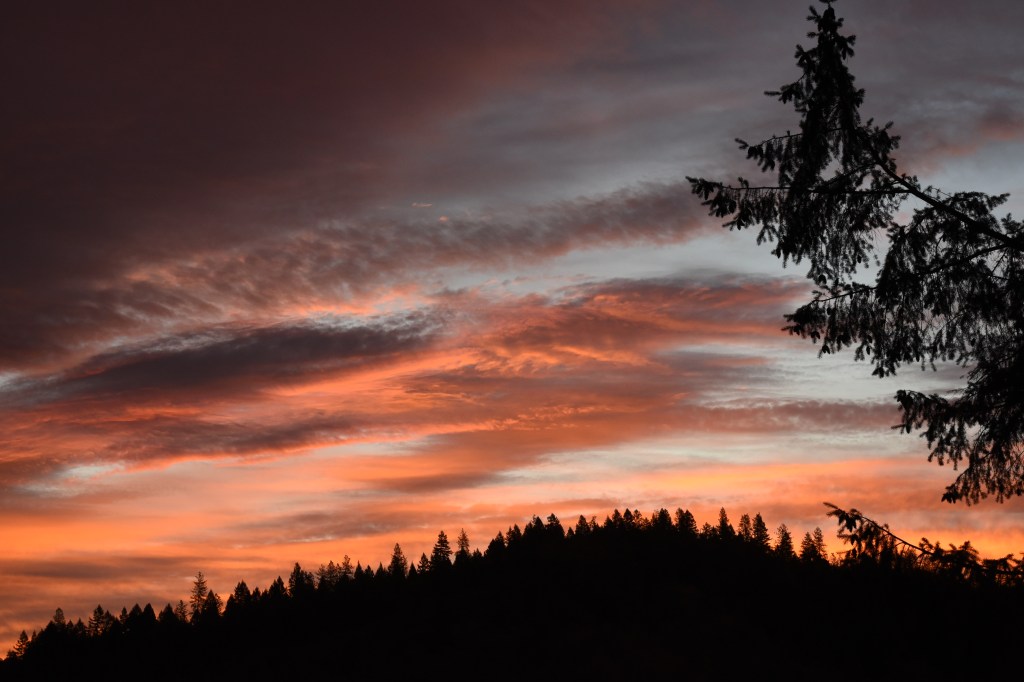
Next, a sunrise photograph with the camera pointing to the East. The tree line follows the ridge of some hills the other side of Hugo Road. The picture taken on the 19th October at 07:20. Now a close-up of the remains of a very old tree trunk with the trees that border Bummer Creek, that runs through our land, just showing through the morning mist. Taken on the 24th October at 09:05.
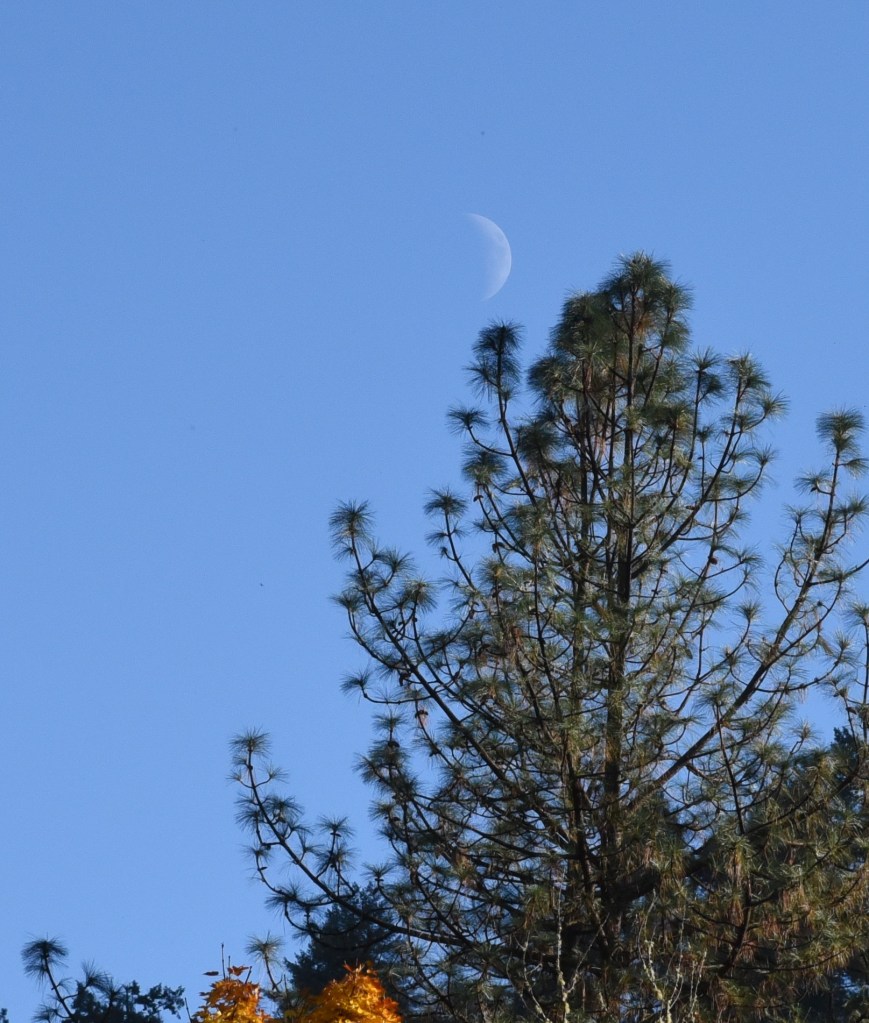
Final photograph I wanted to share with you is this beautiful sight of the moon taken from our property at 16:05 on the 25th. October.
Regular readers will know that Jean and I are not believers in any religion; we are atheists. But to my way of thinking that puts even more pressure on me and Jean to try to make a difference. We do all that we can but there’s no doubt that we can do more.
Yesterday, I referred to Bill Ripple, or to give him his full signature: William J. Ripple, Distinguished Professor of Ecology, Department of Forest Ecosystems and Society, Oregon State University, Corvallis, Oregon.
I sent Bill an email:
Dear Bill (and forgive the over familiarity if that offends),
I am a Brit, just turned 73, living with my beautiful wife, Jean, London-born as I was, down in Merlin, Oregon.
We live on 13 wonderful acres of rural property with 6 dogs (down from 12 when we moved here 5 years ago) and 4 horses, the majority of whom are ex-rescues.
I am the author of the blog Learning from Dogs and want to publish a post highlighting that viewpoint article. Because I believe with every neuron left in my ageing brain that the political changes that this world so urgently needs can only come when 99.9% of the public are screaming out “enough is enough”!
But there’s another saying that comes to mind, the one about being the change you want to see or something like that.
Is there information anywhere online that spells out, almost in words of one syllable, what lifestyle changes each of us can and need to commit to today? Changes that are as appropriate for elderly authors living in the country as young people seeking their first job or those up to their necks in working and raising families?
For that is what I want to publish on my blog!
If it would be easier for me to make an appointment to call you and take notes over the phone then I am just as happy to do that.
Sincerely,
Paul Handover
Hugo Road, Merlin,
Bill promptly replied:
Hi Paul, how long of a list of lifestyle changes do you want to make? Would three or four be enough? Bill
then followed that up with another email:
Paul, Consider suggesting that if people want to help, they could have fewer children, reduce energy consumption such as driving autos and flying, avoid meat and eat mostly plant-based foods and avoid wasting food. Below are quotes from our paper. Bill
“It is also time to re-examine and change our individual behaviors, including limiting our own reproduction (ideally to replacement level at most) and drastically diminishing our per capita consumption of fossil fuels, meat, and other resources ….
… reducing food waste through education and better infrastructure; promoting dietary shifts towards mostly plant-based foods
Now watch this video
I will close this post by listing out all the things that you and I can do now!
Set a target for reducing your car mileage next year compared to 2017,
If you are a regular aircraft passenger, then set a target for flying fewer hours in 2018 compared to 2017,
reduce or stop eating meat,
do not waste food,
reduce the use of heating and cooling in your home/s for next year,
commit to a dietary change away from meats and processed foods to a plant-based diet.
Then for younger couples who want a family around them, limit the number of children to a “replacement level” at most. Adopt??
Last October 11th, I published a guest post that had been sent in by Linley Achtenhagen. The published post was called Life with Luna and was incredibly well-received.
So here’s another guest post from Linley that I have no doubt will be equally well-received.
ooOOoo
Unconditional Love
by Linley Achtenhagen, October 29th, 2017.
Up until January 12, 2017, I had never lost a loved one. I grew up with three grandparents, one grandpa passing away shortly after I was born, so I was pretty lucky to grow up with three out of four grandparents. Sure, I had been to funerals for distant relatives I had met once or twice or my friend’s grandparents, and I grieved for them because they were hurting and I hate seeing people hurt. I, however, had no idea what that pain felt like until one of my best friends passed away in a tragic accident while she was on a family vacation in Mexico.
Abbey Connor, my sweetest, sassiest, most beautiful friend and fellow UW-Whitewater student, taken away far too soon. Getting the news that she was gone rocked me to the core. I had just celebrated New Year’s Eve with her a few short weeks ago, and now I was never going to see her again. How is that possible? Why would this happen to her? I had absolutely no idea how to handle this. Going from losing no one to losing one of my best friends so suddenly was something I was not prepared to deal with but is anyone? I cried and cried and cried and listened to people tell me it was going to be okay, but those words didn’t mean anything. Of course, I appreciated the support of my friends and family, but nothing made the pain in my chest go away when I thought of Abbey. I hurt so much for her family, if I felt this horrible, I couldn’t imagine how her family felt. The only thing that I found comfort in was the one thing that couldn’t tell me they were sorry and that it was going to be okay, Luna.
There is no doubt in my mind that Luna knew I was hurting. I am convinced that dogs have a 6th sense and are much more aware of our emotions than we give them credit. Luna would just lay with me while I cried and her presence alone eased that pain. My crazy and energetic dog would just sit and let me pet her for as long as I needed to.
Not even a month later, February 11th, our family dog, Will, passed away after a long battle with cancer. For fellow dog lovers, you know how hard it is to let your furry companions go. We had Will since he was a puppy, so he grew up with my siblings and me. He was my four-legged brother and letting him go ripped my healing heart wide open again. This time, my whole family was hurting, including Will’s sister, Grace. Will and Grace had never spent a day apart; they slept in their dog crate together, chased chipmunks together, protected my family together, and she just couldn’t understand where he went. We couldn’t explain to her that he wasn’t coming back and that made the pain that much worse. The one thing that brought a smile to everyone’s face in the days, weeks, and months to come was Luna. She would grab her squeaker toy and run up to everyone shaking and squeaking it just begging for someone to play tug with her. She would light up the room and bring a smile, even if only for a second, to our faces. She was helping us cope, and she didn’t realize it.
Two months later, April 13th, my grandma passed away. I couldn’t believe that I had to deal with another death. I was still grieving Abbey and Will’s passing, and now I had another death to try and cope with. My grandma lived in Florida for half of the year, so while we weren’t the closest, she was my grandma, my dad’s mother, and of course, I loved her. I hurt for my dad as he had to say goodbye to his mom. I hurt for all of my cousins, aunts, and uncles. I hurt for my mom and my siblings and I. We had never lost a grandparent, and now we had to deal with this while still grieving Will’s passing, I still grieving Abbey’s. It was such an overwhelming and stressful time, and once again the one thing that got me through each day was Luna. No matter how hard of a day it was, each night when I crawled into bed, Luna would lay right next to me, her head on my chest and just be there. I cannot put into words what that feeling is like.
John Grogan, author of Marley and Me, (if you haven’t seen the movie or read the book, add it to your list) wrote one of my favorite quotes. He said, “A dog doesn’t care if you’re rich or poor, educated or illiterate, clever or dull. Give him your heart, and he will give you his.” This quote is undeniably accurate and I saw this proof in the months to come after I lost all of these loved ones. Luna didn’t care if I didn’t have time to take her for a long walk, or I didn’t want to get out of bed, or I didn’t have the energy to play fetch with her that day, she was there for me and comforted me every moment. She knew I loved her, and that was enough. The most comforting part of all of this is that Luna didn’t even know she was doing it. If more people loved each other like dogs love their humans, this world would be a much better place.
ooOOoo
Linley’s closing sentence is perfect and requires nothing more from me to close today’s post than for me to repeat her words: “If more people loved each other like dogs love their humans, this world would be a much better place.“
Within today’s world, we are seeing many truths now being exposed, as those whom we are supposed to look up to, are now finding their own Lies, echoing back to find them out.
We all of us at times join in the gossip train, that travels out, gaining momentum and speed, stopping at various destinations, it gathers on board more passengers, who add their own little flourish to the journey.
I caught myself on this journey only the other week, which led me to stop my inner chatter, for our thoughts, like our words, are also powerful, and travel out, to create their vibration.. Which is why I wrote
Are you listening to your Inner Chatter?
What you are focused upon really matters
The power of your thoughts is what we create
Take a moment, to Pause, and Meditate.
I hope you pause, and take a moment to see what thoughts are being sent out.. For believe me.. They Echo right back to the source of their creation, it may not be straight away.. As the train timetables vary.. So Listen to the Echoes of your Heart.. I hope we have all made a start… Hold your vision for the World..
Science shows that animals, including dogs, do dream!
I wanted to republish a recent and serious article written by George Monbiot but couldn’t bear to push back against the wonderful video of yesterday. Those loving ripples are still spreading across my consciousness and, I’m sure, that’s the same for you.
Consciousness, sleep, and dreaming are fascinating states of the mind. Previously thought exclusively the states of human minds. But not so!
The electric eel exhibit at the New England Aquarium has a feature that makes it a favorite. Whenever the eel is hunting or stunning prey, the charge powers a voltmeter above his tank. It lights up when the eel is using his electricity, and allows you to see the invisible—like magic.
One day I saw another magical thing happen in the tank. Thanks to the voltmeter, I was able to watch the eel dream.
It happened when I was standing in front of the exhibit with Scott Dowd, the lead aquarist for the freshwater gallery, watching the eel resting motionless at the bottom of the tank. “I think he’s asleep,” I said to my companion.
“Yes, that eel is catching some serious z’s,” he agreed.
Being hard-core fish enthusiasts, we continued to watch transfixed while the electric eel slept. And that’s when it happened: A big flash shot across the voltmeter display—and another and another.
Electric eels hunt while swimming forward, wagging their heads to and fro, sending out electric signals that bounce back to them, sort of like a dolphin’s echolocation. But he was still motionless. So what was the flash for?
“I thought the eel was asleep!” I said to Dowd.
“He is asleep,” he replied.
We realized at once what we were almost surely witnessing. The electric eel was dreaming.
“It would appear that not only do men dream,” Aristotle wrote in History of Animals, “but horses also, and dogs, and oxen; aye, and sheep and goats. . . .”
It was obvious: Like most of us, Aristotle had watched sleeping dogs twitch their ears, paddle their paws, and bark in their sleep. Surely other animals dreamed as well.
But since Aristotle’s day, more “modern” thinkers denied that animals could dream. Complex and mysterious, dreams were considered the exclusive province of so-called higher minds.
As brain research advanced, however, researchers were forced to concede that Aristotle was right. Animals do dream.
And now we are even able to glimpse what they dream about.
Since the 1960s scientists have understood that our dreams happen during the rapid eye movement (REM) phase of the sleep cycle. During this time our muscles are normally paralyzed by the pons of the brain stem, so that we don’t act out our dreams. In 1965 researchers removed the pons from the brain stems of cats.* They discovered the cats would get up and walk around, move the head as if to follow prey, and pounce as if on invisible mice—all
while asleep.
By 2007 we would get an even more vivid picture of animals’ dreams. Massachusetts Institute of Technology scientists Matthew Wilson and graduate student Kenway Louie recorded the activity of rats’ brains while the animals were running a maze. Neurons fire in distinct patterns while a rat in a maze performs particular tasks. The researchers repeatedly saw the exact same patterns reproduced while the rats slept—and they saw this so clearly they could tell what point in the maze the rat was dreaming about and whether an individual rat was running or walking in his dreams.
The rats’ dreams arose from the hippocampus, the same area in the brain that seems to drive humans’ dreams. It’s an area known to record and store memories, and that supports the notion that one important function of dreams is to help us remember what we have learned. Of course, it’s important to a lab rat to remember the right way to run a maze.
So if rats dream of running mazes, what do birds dream about? Singing.
University of Chicago professor Daniel Margoliash conducted experiments on zebra finches. Like most birds, zebra finches aren’t born knowing their songs; they learn them, and young birds spend much of their days learning and rehearsing the song of their species. While awake, neurons in the forebrain known as the robustus archistrialis fire when the bird sings particular notes. The researcher was able to determine the individual notes based on the firing pattern of the neurons. While the birds were asleep, their neurons fired in the same order—as if they were singing in their dreams.
Much less work has been done on fish than on mammals and birds. No one has found REM sleep in fish—yet. But that does not mean they don’t dream. Interestingly, no one has discovered REM sleep in whales, either. But whales almost surely dream. They are long-lived, social animals with very big brains much like our own, and for whom long-term memory consolidation is crucial.
And if you were looking for rapid eye movement in sleeping owls, you’d never see it—because owls’ eyes are fixed in their sockets. That’s why they need to turn their heads around, Exorcist-style. Yet owls’ brain waves show they dream, too.
Fish do sleep, however—that much is well known. It’s been carefully documented that if zebra fish are deprived of sleep (because pesky researchers keep waking them up), they have trouble swimming the next day—just as a person would have trouble concentrating after a dreamless night.
What might an electric eel dream about? The voltmeter at the New England Aquarium showed us the answer: hunting and shocking prey.
*Care2 stands firmly against animal testing and believes it to be a cruel and unnecessary practice for which there are viable alternatives, such as computer modeling.
ooOOoo
A young Pharaoh asleep, and dreaming?? September, 2003.
I am far from certain but I have this notion in my head that ‘Common Land’ is an English thing. Here’s a Wikipedia extract:
Common land is land owned collectively by a number of persons, or by one person, but over which other people have certain traditional rights, such as to allow their livestock to graze upon it, to collect firewood, or to cut turf for fuel.[1]
A person who has a right in, or over, common land jointly with another or others is called a commoner.[2]
This article deals mainly with common land in England, Wales and Scotland. Although the extent is much reduced due to enclosure of common land from the millions of acres that existed until the 17th century, a considerable amount of common land still exists, particularly in upland areas, and there are over 7,000 registered commons in England alone.[3][4]
Despite the idea of common land having an English ‘ring’ to it common land is also found in the USA. Back to that Wikipedia reference:
Common land, an English development, was used in many former British colonies, for example in Ireland and the United States. The North American colonies adopted the English laws in establishing their own commons. A famous example is the New Haven Green in New Haven, Connecticut.
When I was living in Devon it was not unusual to take a walk with Pharaoh on some very famous open access land: Dartmoor.
Dartmoor: English countryside at its best.
So where the devil am I going with today’s post?
Last Thursday week, the 12th, I published my review of George Monbiot’s valuable book Out Of The Wreckage.
This book struck me as the most important book I have ever read in my lifetime. Why? Because it gets to the heart of what is happening today. But it offers even more than that. For instead of a shrug of the shoulders or eyes turned skywards from a friend when one mutters about the fact that we are living in ‘interesting times’, George Monbiot offers hope and guidance.
The day after I published my review George Monbiot published an article in The Guardian newspaper that threw more light on the commons philosophy and why, as in his book, he “offers hope and guidance”.
It is republished here with Mr. Monbiot’s generous permission. Yes, the focus is on British politics but GM’s core message applies equally to the USA and other countries.
ooOOoo
Labouratory
13th October 2017
We should use the political space being opened by the Labour resurgence to develop a new, participatory economy
By George Monbiot, published in the Guardian 11th October 2017
We are still living in the long 20th Century. We are stuck with its redundant technologies: the internal combustion engine; thermal power plants; factory farms. We are stuck with its redundant politics: unfair electoral systems; their capture by funders and lobbyists; the failure to temper representation with real participation.
And we are stuck with its redundant economics: neoliberalism, and the Keynesianism still proposed by its opponents. While the latter system worked very well for 30 years or more, it is hard to see how it can take us through this century, not least because the growth it seeks to sustain smacks headlong into the environmental crisis.
Sustained economic growth on a planet that is not growing means crashing through environmental limits: this is what we are witnessing, worldwide, today. A recent paper in Nature puts our current chances of keeping global heating to less than 1.5°C of at just 1%, and less than 2° at only 5%. Why? Because while the carbon intensity of economic activity is expected to decline by 1.9% a year, global per capita GDP is expected to grow by 1.8%. Almost all investment in renewables and efficiency is cancelled out. GDP, the index that was supposed to measure our prosperity, instead measures our progress towards ruin.
But the great rupture that began in 2008 offers a chance to change all this. The challenge now is to ensure that the new political movements threatening established power in Britain and elsewhere create the space not for old ideas (such as 20th Century Keynesianism) but for a new politics, built on new economic and social foundations.
There may be a case for one last hurrah for the old model: a technological shift that resembles the Second World War’s military Keynesianism. In 1941, the US turned the entire civilian economy around on a dime: within months, car manufacturers were producing planes, tanks and ammunition. A determined government could do something similar in response to climate breakdown: a sudden transformation, replacing our fossil economy. But having effected such a conversion, it should, I believe, then begin the switch to a different economic model.
The new approach could start with the idea of private sufficiency and public luxury. There is not enough physical or environmental space for everyone to enjoy private luxury: if everyone in London acquired a tennis court, a swimming pool, a garden and a private art collection, the city would cover England. Private luxury shuts down space, creating deprivation. But magnificent public amenities – wonderful parks and playgrounds, public sports centres and swimming pools, galleries, allotments and public transport networks – create more space for everyone, at a fraction of the cost.
Wherever possible, I believe such assets should be owned and managed by neither state nor market, but by communities, in the form of commons. A commons in its true form is a non-capitalist system, in which a resource is controlled in perpetuity by a community, for the shared and equal benefit of its members. A possible model is the commons transition plan commissioned by the Flemish city of Ghent.
Land value taxation also has transformative potential. It can keep the income currently siphoned out of our pockets in the form of rent – then out of the country and into tax havens – within our hands. It can reduce land values, bringing down house prices. While local and national government should use some of the money to fund public services, the residue can be returned to communities.
Couple this with a community right to buy, enabling communities to use this money to acquire their own land, with local commons trusts that possess powers to assemble building sites, and with a new right for prospective buyers and tenants to plan their own estates, and exciting things begin to happen. This could be a formula for meeting housing need, delivering public luxury and greatly enhancing the sense of community, self-reliance and taking back control. It helps to create what I call the Politics of Belonging.
But it doesn’t stop there. The rents accruing to commons trusts could be used to create a local version of the citizens’ wealth funds (modelled on the sovereign wealth funds in Alaska and Norway) proposed by Angela Cummine and Stewart Lansley. The gain from such funds could be distributed in the form of a local basic income.
And the money the government still invests? To the greatest extent possible, I believe it should be controlled by participatory budgeting. In the Brazilian city of Porto Allegre, the infrastructure budget is allocated by the people: around 50,000 citizens typically participate. The results – better water, sanitation, health, schools and nurseries – have been so spectacular that large numbers of people now lobby the city council to raise their taxes. When you control the budget, you can see the point of public investment.
In countries like the UK, we could not only adopt this model, but extend it beyond the local infrastructure budget to other forms of local and even national spending. The principle of subsidiarity – devolving powers to the smallest political unit that can reasonably discharge them – makes such wider democratic control more feasible.
All this would be framed within a system such as Kate Raworth’s doughnut economics which, instead of seeking to maximise growth, sets a lower bound of wellbeing below which no one should fall, and an upper bound of environmental limits, that economic life should not transgress. A participatory economics could be accompanied by participatory politics, involving radical devolution and a fine-grained democratic control over the decisions affecting our lives – but I will leave that for another column.
Who could lead this global shift? It could be the UK Labour Party. It is actively seeking new ideas. It knows that the bigger the change it offers, the greater the commitment of the volunteers on which its insurgency relies: the Big Organising model that transformed Labour’s fortunes at the last election requires a big political offer. (This is why Ed Miliband’s attempts to create a grassroots uprising failed).
Could Labour be the party that brings the long 20th Century to an end? I believe, despite its Keynesian heritage, it could. Now, more than at any other time in the past few decades, it has a chance to change the world.
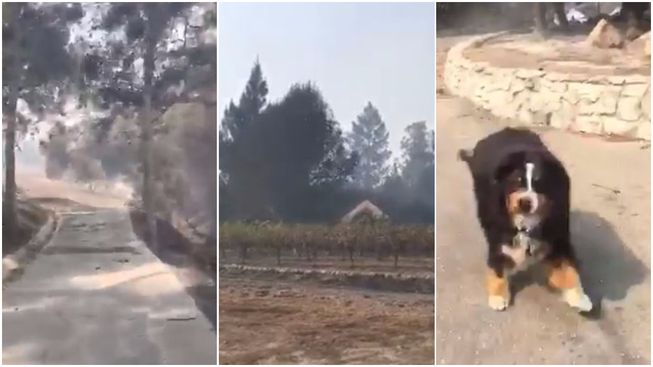
But sometime during that panicked retreat from the house on Wikiup Bridge Way, the family dog, Izzy, bolted away.
Trying to find her amid the chaos of fire proved too dangerous.
And so this family, like countless others in California’s wine country, left more than just their home behind. When they drove through sheer walls of flame and across an uncertain wooden bridge to get to safety — they left their hearts back on Wikiup Bridge Way.
It turned out, it was the one thing they couldn’t leave behind.
A day and a half later, while the area was still smoldering and roads were still closed, Jack Weaver and Patrick Widen made the nearly-three-mile trek back to the house.
“It was incredibly important,” Weaver, who grew up in that house, tells MNN. “My mother was a wreck for having gone through that. Nobody wanted us to go back because they were worried we would get injured.”
‘I can see …’
In a video of their return, posted on Facebook and shared below, you can hear the men laboring to catch their breath amid blackened trees and still-crackling ruins.
“Izzy!” Weaver is heard calling into the smoky veil. Over and over again.
They push farther and farther ahead. “Izzy!”
“Almost to the house,” Weaver says in the video. “I can see … the gate. The gate’s still standing.”
The Weaver family home was gone. (Photo: Jack Weaver)
A moment later, he adds, “I don’t see the house at all. F$#k.”
It had burned to the ground.
But someone was still standing.
“Izzy’s here!” Weaver calls, his voice choked with emotion. “Izzy!”
“Oh my God! Come here, baby!”
The giant dog bounces into view, her tail whirring like a helicopter.
Izzy had stood faithfully by the burnt-down family home. (Photo: Jack Weaver)
“When she same running around — you can probably hear it in my voice — we were shocked and ecstatic,” Weaver says later. “I wish I could have filmed longer, the happy reunion, but I was so happy I dropped my phone.”
Since the family posted the video, it’s been shared more than 4,000 times. Maybe it’s a testament to the need for all of us to find a happy ending amid heartache.
In any case, Izzy is where she belongs now — in the arms of her family — a testament to faith under fire.
“She didn’t have a burn on her,” Weaver says. “It definitely lifted my family’s spirits.”
Izzy is back where she belongs. (Photo: Beckyjean Widen)
ooOOoo
YouTube also carried a video:
Well done, Izzy, and Jean and I send you fondest hugs!






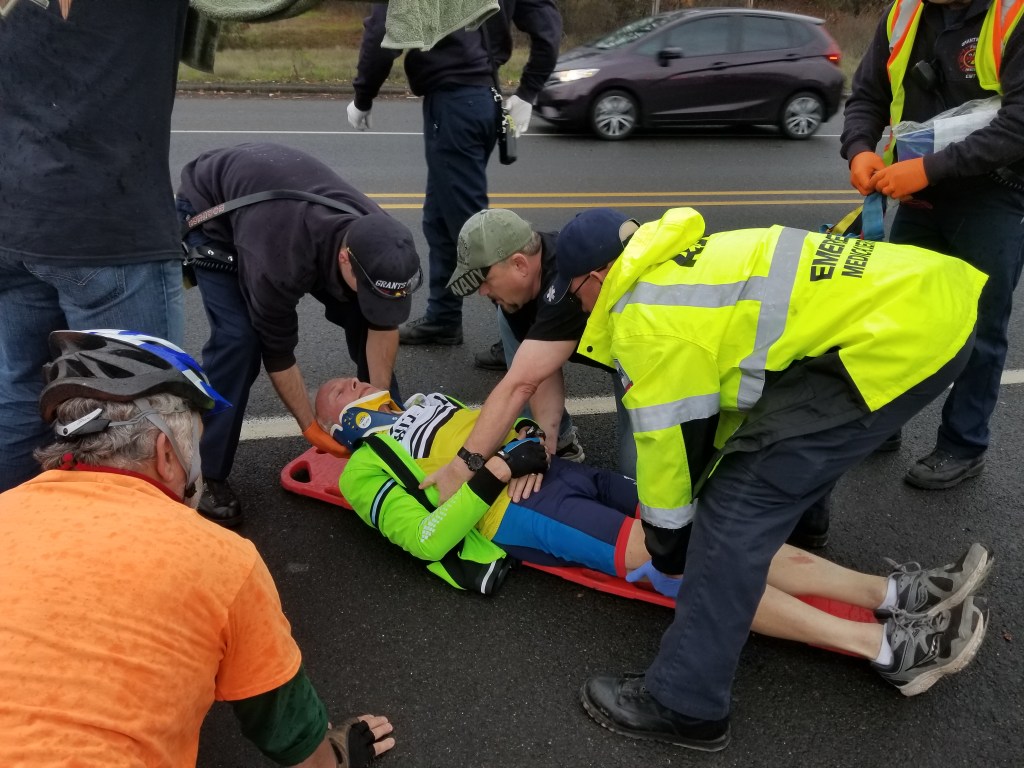 Then carried across to the ambulance.
 I only properly regained consciousness when the ambulance was speeding its way to Three Rivers Hospital in nearby Grants Pass.
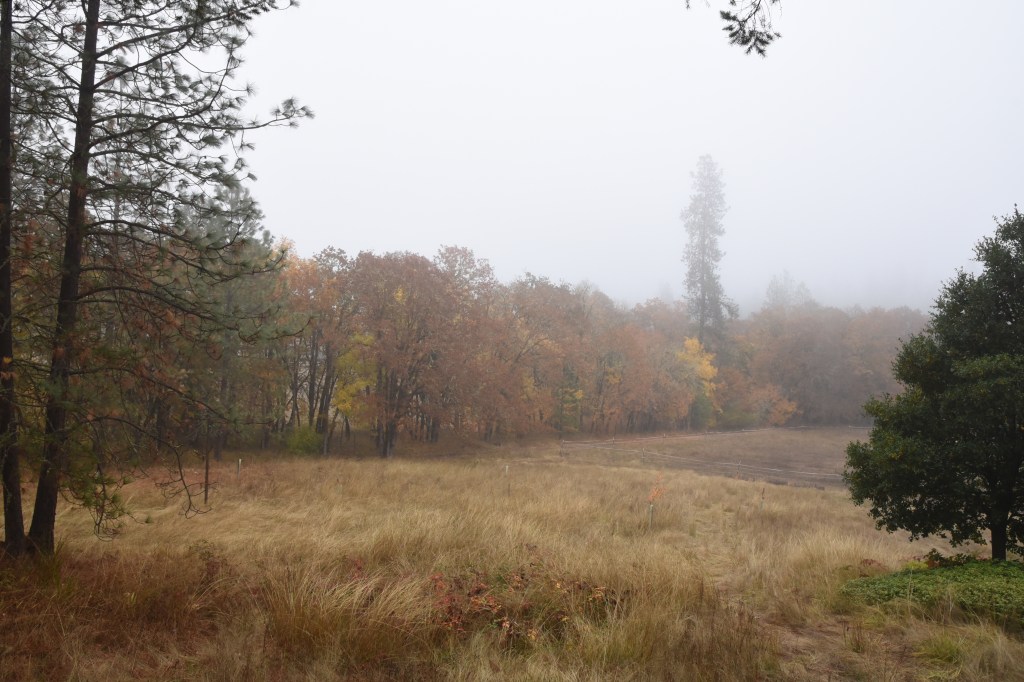 Next, a sunrise photograph with the camera pointing to the East. The tree line follows the ridge of some hills the other side of Hugo Road. The picture taken on the 19th October at 07:20.
 Now a close-up of the remains of a very old tree trunk with the trees that border Bummer Creek, that runs through our land, just showing through the morning mist. Taken on the 24th October at 09:05.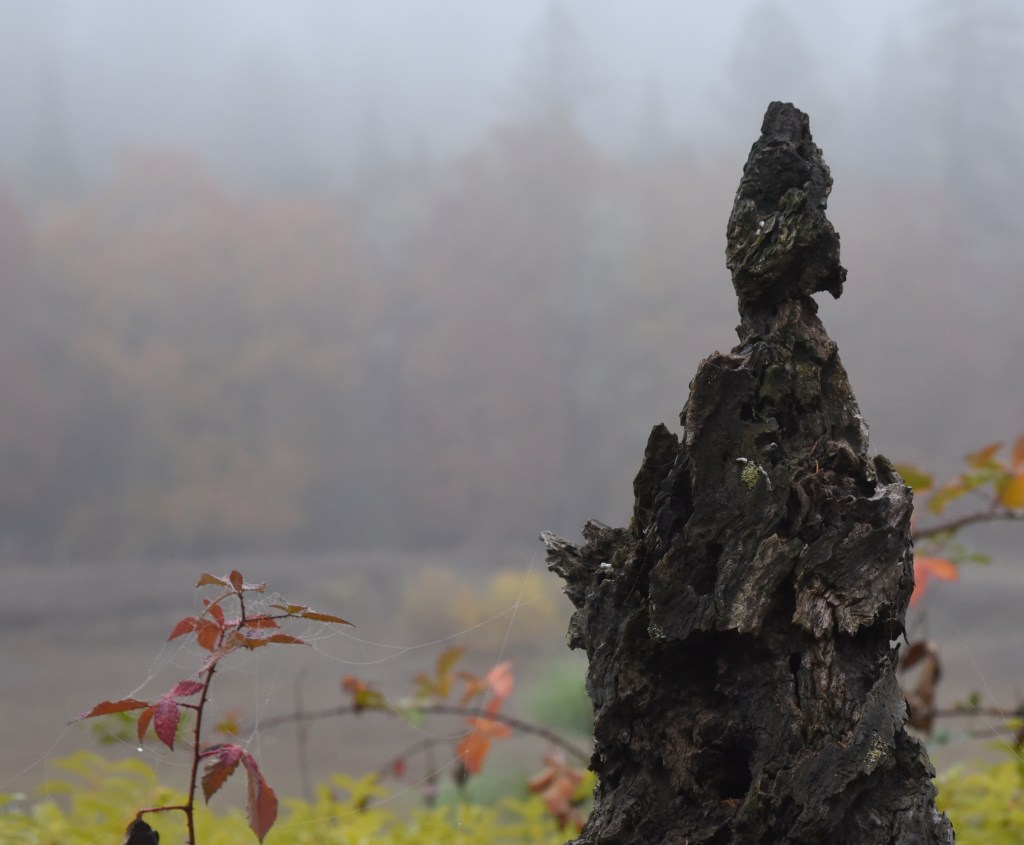
 Regular readers will know that Jean and I are not believers in any religion; we are atheists. But to my way of thinking that puts even more pressure on me and Jean to try to make a difference. We do all that we can but there’s no doubt that we can do more.