The 5-year-old, brown-and-white pup, named after the famed crooner, inexplicably turned up 1,200 miles from Canarsie around Nov. 6 and was taken in by the Verrill family.
They were able to hunt down Sinatra’s owner in Brooklyn, Lesmore Willis, who burst into tears when he heard his beloved family pet had been found.
On Sunday evening, friends of the Verrill family made their way from Florida to the Baltimore area to hand off Sinatra to a pal of Willis’, Glen O’Gilvie, who lives there. O’Gilvie will then drive the dog to New York, he told The Post on Monday.
CBS This Morning published a video of the event.
Just a lovely outcome, albeit one that doesn’t change the fact that dear, young Zion is never coming back!
Or rather letting Deinah Storm offer a guest post.
This is a guest post. It stays with the theme of loyalty. The loyalty of dogs towards their dead masters.
ooOOoo
8 Dogs Who Remained Loyal to Their Now-Gone Masters
By Deinah Storm, December 5th, 2108
A dog has always been a man’s best friend. Having a pet dog is always great. You have a partner to go with anywhere you want. Also, you won’t feel alone when you have a pet dog. Dogs are creatures that are filled with joy; no wonder fur parents from around the world try to give their best to show how they care for their pooch—be it to provide them the best dog food, regularly visit the vet, or keep dog house warm.
The love and affection that dogs give their owners are comparable to a mother’s love. It is unconditional and lasts a lifetime, and even beyond. Here is a list of eight dogs who remained loyal to their now-gone masters.
Hachiko
You may have heard of this name before already. Hachiko’s story has been all over the world. They even made movies about this loyal dog. He was originally owned by a Japanese professor at Tokyo University named Eizoburo Ueno. His students were the ones who nudged him to adopt this beautiful Akita dog. Every day that the professor goes to work, he goes to the train station to take the train. Hachiko always waited for him to return so they could go home together. After having been partners for only less than a year, Eizoburo Ueno died tragically while he was at work. So that day, Hachiko was waiting in vain for his master to return. But, he never did. Still, Hachiko waited every single day of his life for his now-gone to return to the train station. People were feeding Hachiko and giving him treats until he got old and died. A lot of people mourned over his death, and a statue was built for him.
Capitan
Capitan was a dog owned by an Argentinian man named Michael Guzman. He was bought by Michael for his son Damian as a gift. They always had a special bond and loved each other. When Mr. Guzman passed away after just a year, Capitan could not be found by the Guzman family. Eventually, they were able to locate him. He was beside his master’s grave. Capitan stayed there for six long years until he passed away.
Hawkeye Hawkeye was a labrador who was owned by a Navy SEAL who died in a helicopter crash in Afghanistan. A photo went viral during his funeral service. It was a picture of Hawkeye lying sadly in front of his master’s casket. He stayed there for the whole service. It is disheartening for dogs to lose their owners. Thankfully, the best friend of the deceased took Hawkeye and cared for him.
Ruswarp
Ruswarp was owned by Graham Nuttall. One day, they went on a walk along the mountains in Wales. But, they did not return. So, Graham’s friends alerted the police. A search was done. But after several weeks, they could not be found. Eventually, after eleven weeks of being missing, another person found Graham beside a stream together with Ruswarp. Ruswarp never left his master’s side even after several weeks. Ruswarp was so weak and ill when they were found. A statue of Ruswarp was unveiled at a train station which he and his owner helped save.
Fido
Fido was owned by a factory worker in Italy. His name literally translates to “faithful.” He always went with his master to the bus station and waited for him to come back every single day. One tragic day, his owner was killed in the factory due to a bombing attack. Fido waited all day for his owner to return. He eventually returned home, but every single day he waited by the train station for fourteen years until he died.
Shep
Shep was owned by a shepherd. One day, his shepherd was ill and was rushed to the hospital. Shep waited outside the hospital until his owner died. He followed his owner’s casket as it was loaded onto a train to be sent home. Shep waited by the train station for five years. Every single day, he checked each person who went off the train. He stayed there until Shep tragically died in the train station when he became deaf and went to the tracks where a train hit him.
Greyfriars Bobby
Bobby was owned by a police officer. When the officer died, Bobby never left his grave for fourteen years. When Bobby died, he was buried near his master. He had a gravestone which read “Greyfriars Bobby — died 14th January 1872 — aged 16 years — Let his loyalty and devotion be a lesson to us all.” He had a statue made for him across the place where they are buried.
Waghya
Waghya was owned by the King of the Maratha Empire. Traditionally, when a king dies, his remains are cremated. So, when the king died, Waghya never left his side until he was about to be incinerated. When the funeral pyre was lit, Waghya leaped into his death.
Dogs are forever loyal and loving
Dogs bring love and happiness to the world. They are there forever for humans. They will love you for all of eternity. So, love your dogs and care for them. They will never let you down.
It would be wrong of me to close without thanking Deinah. It’s a great guest post.
Finally, Deinah’s bio:
Author’s Bio: Deinah Storm is a pet lover from the US that’s had cats and dogs all her life. When she’s not walking the dogs with her family, she spends time writing informational and interesting blogs about pets to share with pet lover communities.
This story has been all over the news recently and rightly so; it’s a very touching report.
I have taken my story from the BBC News and wanted to share some of it with you.
ooOOoo
George HW Bush’s service dog Sully pays touching last tribute
3 December 2018
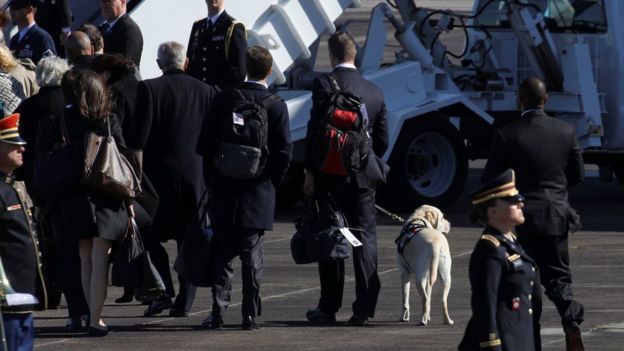
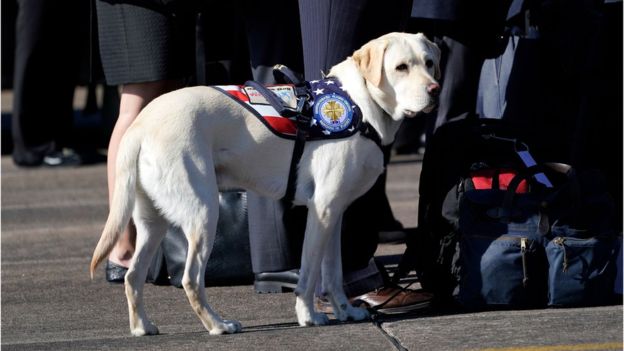
Sully the dog sleeps next to the casket of the late US President George HW Bush
The labrador who worked as a service dog for President George HW Bush has been pictured resting beside his coffin, in a moving tribute.
Mr Bush, who served as the 41st US president between 1989 and 1993, died late on Friday at the age of 94.
Sully the dog is travelling with the casket on the flight from Texas to Washington and back this week.
Mr Bush’s body is due to lie in state this week ahead of a day of national mourning.
The coffin is being flown from Texas to DC on board Air Force One – temporarily renamed Special Air Mission 41, in homage to the late president – and then back on Wednesday, with Sully accompanying the body throughout.
oooo
ooOOoo
Irrespective of what one accomplished in one’s life, 94 is a grand age!
A dog naps in the Ikea store in Catania, Italy. (Photo: rewintageboudoir/Instagram)
There’s something particularly homey about the living room vignettes and kitchen setups in the Ikea store in Catania, Italy. Sprawled on the occasional braided rug or curled up under the sleek dining tables are sleeping homeless dogs. They’ve been welcomed into the store by employees who offer them comfort when the temperatures drop.
Giovanna Pecorino says she takes a photo of the dogs each time she visits the store.
“I know those dogs well,” says Pecorino, who owns a vintage clothing shop in Catania. “You find them at the entrance sleeping between the racks, or at the exit between the tables of their restaurant, always with their sweet eyes. I love them. They give me a sense of peace.”
[There are two more photographs on Instagram that I am unable to copy into this post.]
Linda Chartier Scala, an American from Rhode Island who now lives in Noto, Italy, also photographed one of the dogs that made a temporary home in a makeshift Ikea living room. She is very familiar with the pups, who are mainstays in the store through the seasons.
“Dogs are there year-round,” says Chartier Scala. “They love the air conditioning during the summer. They are sterilized and looked after by an animal welfare group. Fat and happy, they don’t wander from there.”
Shoppers like Scala often post photos of the resting pets on social media, lauding the store and its employees for feeding the homeless dogs and offering them shelter.
“Yesterday, going to the Ikea of Catania I came across this sweet scene, a stray puppy had found shelter in one of the store’s exhibits, this image was wonderful!” wrote mannilvers. “Giving shelter to a stray dog and making it feel at home is simply amazing!”
According to reports on some posts, the dogs are well cared for and quite popular with visitors, who often stop by the store just to check on their favorite canines. And the dogs, who seem to be very respectful of their surroundings, enjoy the attention.
“This is the best story I’ve read in a long time. Human kindness at it’s best,” writes ihelpanimals12018. “THANK YOU.”
ooOOoo
“Human kindness at it’s best … ”
This is such a wonderful account of people being loving towards dogs that were homeless.
Last, but no means least, Happy Birthday to Jeannie!
The following article looks deeply into the dog’s life. Or rather the end of the dog’s life.
For the fact of the matter is that we all have this coming to us. Some turn to religion; some know that we are on our own. Every living creature shares the same fate as us humans.
Yet there is something very special about the dog. Something that sets the dog apart. Something that elevates the dog into more than an animal, despite how silly that is to write. But you know what I mean.
Enough from me. Let me turn to the following article that was published on The Conversation website and is republished within the terms of that site.
ooOOoo
Why losing a dog can be harder than losing a relative or friend
By Frank T. McAndrew Cornelia H. Dudley, Professor of Psychology, Knox College
March 9, 2017
Recently, my wife and I went through one of the more excruciating experiences of our lives – the euthanasia of our beloved dog, Murphy. I remember making eye contact with Murphy moments before she took her last breath – she flashed me a look that was an endearing blend of confusion and the reassurance that everyone was ok because we were both by her side.
When people who have never had a dog see their dog-owning friends mourn the loss of a pet, they probably think it’s all a bit of an overreaction; after all, it’s “just a dog.”
However, those who have loved a dog know the truth: Your own pet is never “just a dog.”
Many times, I’ve had friends guiltily confide to me that they grieved more over the loss of a dog than over the loss of friends or relatives. Research has confirmed that for most people, the loss of a dog is, in almost every way, comparable to the loss of a human loved one. Unfortunately, there’s little in our cultural playbook – no grief rituals, no obituary in the local newspaper, no religious service – to help us get through the loss of a pet, which can make us feel more than a bit embarrassed to show too much public grief over our dead dogs.
Perhaps if people realized just how strong and intense the bond is between people and their dogs, such grief would become more widely accepted. This would greatly help dog owners to integrate the death into their lives and help them move forward.
An interspecies bond like no other
What is it about dogs, exactly, that make humans bond so closely with them?
For starters, dogs have had to adapt to living with humans over the past 10,000 years. And they’ve done it very well: They’re the only animal to have evolved specifically to be our companions and friends. Anthropologist Brian Hare has developed the “Domestication Hypothesis” to explain how dogs morphed from their grey wolf ancestors into the socially skilled animals that we now interact with in very much the same way as we interact with other people.
Perhaps one reason our relationships with dogs can be even more satisfying than our human relationships is that dogs provide us with such unconditional, uncritical positive feedback. (As the old saying goes, “May I become the kind of person that my dog thinks I already am.”)
This is no accident. They have been selectively bred through generations to pay attention to people, and MRI scans show that dog brains respond to praise from their owners just as strongly as they do to food (and for some dogs, praise is an even more effective incentive than food). Dogs recognize people and can learn to interpret human emotional states from facial expression alone. Scientific studies also indicate that dogs can understand human intentions, try to help their owners and even avoid people who don’t cooperate with their owners or treat them well.
Our strong attachment to dogs was subtly revealed in a recent study of “misnaming.” Misnaming happens when you call someone by the wrong name, like when parents mistakenly calls one of their kids by a sibling’s name. It turns out that the name of the family dog also gets confused with human family members, indicating that the dog’s name is being pulled from the same cognitive pool that contains other members of the family. (Curiously, the same thing rarely happens with cat names.)
It’s no wonder dog owners miss them so much when they’re gone.
Psychologist Julie Axelrod has pointed out that the loss of a dog is so painful because owners aren’t just losing the pet. It could mean the loss of a source of unconditional love, a primary companion who provides security and comfort, and maybe even a protégé that’s been mentored like a child.
The loss of a dog can also seriously disrupt an owner’s daily routine more profoundly than the loss of most friends and relatives. For owners, their daily schedules – even their vacation plans – can revolve around the needs of their pets. Changes in lifestyle and routine are some of the primary sources of stress.
According to a recent survey, many bereaved pet owners will even mistakenly interpret ambiguous sights and sounds as the movements, pants and whimpers of the deceased pet. This is most likely to happen shortly after the death of the pet, especially among owners who had very high levels of attachment to their pets.
While the death of a dog is horrible, dog owners have become so accustomed to the reassuring and nonjudgmental presence of their canine companions that, more often than not, they’ll eventually get a new one.
So yes, I miss my dog. But I’m sure that I’ll be putting myself through this ordeal again in the years to come.
ooOOoo
I don’t want to think of losing any more of our family but it will surely happen. As night follows day!
I read this essay first thing in the morning last Wednesday while still in bed. It struck me with a whole range of feelings and emotions; not positive ones I should add. Then I read it aloud to Jeannie with the feeling that this speaks of what it is, what it’s going to be, and how little time we have to make the sorts of gigantic changes that we all need.
Sorry to be down-in-the-dumps about the following; published with George Monbiot’s kind permission.
ooOOoo
Hopeless Realism
No effective means of stopping climate breakdown is deemed “politically realistic”. So we must change political realities.
By George Monbiot, published in the Guardian 14th November 2018.
It was a moment of the kind that changes lives. At a press conference held by Extinction Rebellion last week, two of us journalists pressed the activists on whether their aims were realistic. They have called, for example, for carbon emissions in the UK to be reduced to net zero by 2025. Wouldn’t it be better, we asked, to pursue some intermediate aims?
A young woman called Lizia Woolf stepped forward. She hadn’t spoken before, and I hadn’t really noticed her, but the passion, grief and fury of her response was utterly compelling. “What is it that you are asking me as a 20-year-old to face and to accept about my future and my life? … this is an emergency – we are facing extinction. When you ask questions like that, what is it you want me to feel?”. We had no answer.
Softer aims might be politically realistic, but they are physically unrealistic. Only shifts commensurate with the scale of our existential crises have any prospect of averting them. Hopeless realism, tinkering at the edges of the problem, got us into this mess. It will not get us out.
Public figures talk and act as if environmental change will be linear and gradual. But the Earth’s systems are highly complex, and complex systems do not respond to pressure in linear ways. When these systems interact (because the world’s atmosphere, oceans, land surface and lifeforms do not sit placidly within the boxes that make study more convenient) their reactions to change become highly unpredictable. Small perturbations can ramify wildly. Tipping points are likely to remain invisible until we have passed them. We could see changes of state so abrupt and profound that no continuity can be safely assumed.
Only one of the many life support systems on which we depend – soils, aquifers, rainfall, ice, the pattern of winds and currents, pollinators, biological abundance and diversity – need fail for everything to slide. For example, when Arctic sea ice melts beyond a certain point, the positive feedbacks this triggers (such as darker water absorbing more heat, melting permafrost releasing methane, shifts in the polar vortex) could render runaway climate breakdown unstoppable. When the Younger Dryas period ended 11,600 years ago, Greenland ice cores reveal temperatures rising 10°C within a decade.
I don’t believe that such a collapse is yet inevitable, or that a commensurate response is either technically or economically impossible. When the US joined the Second World War in 1941, it replaced a civilian economy with a military economy within months. As Jack Doyle records in his book Taken for a Ride, “In one year, General Motors developed, tooled, and completely built from scratch 1000 Avenger and 1000 Wildcat aircraft … Barely a year after Pontiac received a Navy contract to build antishipping missiles, the company began delivering the completed product to carrier squadrons around the world.” And this was before advanced information technology made everything faster.
The problem is political. A fascinating analysis by the social science professor Kevin Mackay contends that oligarchy has been a more fundamental cause of the collapse of civilisations than social complexity or energy demand. Oligarchic control, he argues, thwarts rational decision-making, because the short-term interests of the elite are radically different to the long-term interests of society. This explains why past civilizations have collapsed “despite possessing the cultural and technological know-how needed to resolve their crises.” Economic elites, that benefit from social dysfunction, block the necessary solutions.
It is not just governments that have failed to respond, though they have failed spectacularly. Public sector broadcasters have deliberately and systematically shut down environmental coverage, while allowing the opaquely-funded lobbyists that masquerade as thinktanksto shape public discourse and deny what we face. Academics, afraid to upset their funders and colleagues, have bitten their lips. Even the bodies that claim to be addressing our predicament remain locked within destructive frameworks.
For example, last Wednesday I attended a meeting about environmental breakdown at the Institute for Public Policy Research. Many of the people in the room seemed to understand that continued economic growth is incompatible with sustaining the Earth’s systems. As the author Jason Hickel points out, a decoupling of rising GDP from global resource use has not happened and will not happen. While 50 billion tonnes of resources used per year is roughly the limit the Earth’s systems can tolerate, the world is already consuming 70 billion tonnes. Business as usual, at current rates of economic growth, will ensure that this rises to 180 billion tonnes by 2050. Maximum resource efficiency, coupled with massive carbon taxes and some pretty optimistic assumptions, would reduce this to 95 billion tonnes: still way beyond environmental limits. A study taking account of the rebound effect (efficiency leads to further resource use) raises the estimate to 132 billion tonnes. Green growth, as members of the Institute appear to accept, is physically impossible.
On the same day, the same Institute announced a major new economics prize for “ambitious proposals to achieve a step-change improvement in the growth rate.” It wants ideas that will enable economic growth rates in the UK at least to double. The announcement was accompanied by the usual blah about sustainability, but none of the judges of the prize has a discernible record of environmental interest.
Those to whom we look for solutions trundle on as if nothing has changed. They continue to behave as if the accumulating evidence has no purchase on their minds. Decades of institutional failure ensures that only “unrealistic” proposals – the repurposing of economic life, with immediate effect – now have a realistic chance of stopping the planetary death spiral. And only those who stand outside the failed institutions can lead this effort.
Two tasks need to be performed simultaneously: throwing ourselves at the possibility of averting collapse, as Extinction Rebellion is doing, slight though this possibility may appear. And preparing ourselves for the likely failure of these efforts, terrifying as this prospect is. Both tasks require a complete revision of our relationship with the living planet. Because we cannot save ourselves without contesting oligarchic control, the fight for democracy and justice and the fight against environmental breakdown are one and the same. Do not allow those who have caused this crisis to define the limits of political action. Do not allow those whose magical thinking got us into this mess to tell us what can and cannot be done.
I have a son and daughter who live in England. My daughter and her husband have a seven-year-old boy, my grandson, and I hope that I live long enough to have some decent conversations with him. Now whether or not those conversations will turn to his future and what fears he has only time will tell.
But that doesn’t stop me from worrying, worrying big time, just what world we are leaving for him and the thousands of others of his age as they grow up. I truly fear that it is going to be a very different planet than the one we have at present.
The challenge of how you think, and whether or not it is similar to how others think has long intrigued us.
Tam Hunt has written an article that now ponders on whether how we think, how we are conscious of the world around us, depends on how that ‘thing’ vibrates.
Over to Tam.
ooOOoo
Could consciousness all come down to the way things vibrate?
By Tam HuntAffiliate Guest in Psychology, University of California, Santa Barbara
Why is my awareness here, while yours is over there? Why is the universe split in two for each of us, into a subject and an infinity of objects? How is each of us our own center of experience, receiving information about the rest of the world out there? Why are some things conscious and others apparently not? Is a rat conscious? A gnat? A bacterium?
These questions are all aspects of the ancient “mind-body problem,” which asks, essentially: What is the relationship between mind and matter? It’s resisted a generally satisfying conclusion for thousands of years.
Chalmers thought the mind-body problem should be called “hard” in comparison to what, with tongue in cheek, he called the “easy” problems of neuroscience: How do neurons and the brain work at the physical level? Of course they’re not actually easy at all. But his point was that they’re relatively easy compared to the truly difficult problem of explaining how consciousness relates to matter.
Over the last decade, my colleague, University of California, Santa Barbara psychology professor Jonathan Schooler and I have developed what we call a “resonance theory of consciousness.” We suggest that resonance – another word for synchronized vibrations – is at the heart of not only human consciousness but also animal consciousness and of physical reality more generally. It sounds like something the hippies might have dreamed up – it’s all vibrations, man! – but stick with me.
How do things in nature – like flashing fireflies – spontaneously synchronize? Suzanne Tucker/Shutterstock.com
All about the vibrations
All things in our universe are constantly in motion, vibrating. Even objects that appear to be stationary are in fact vibrating, oscillating, resonating, at various frequencies. Resonance is a type of motion, characterized by oscillation between two states. And ultimately all matter is just vibrations of various underlying fields. As such, at every scale, all of nature vibrates.
Something interesting happens when different vibrating things come together: They will often start, after a little while, to vibrate together at the same frequency. They “sync up,” sometimes in ways that can seem mysterious. This is described as the phenomenon of spontaneous self-organization.
When fireflies of certain species come together in large gatherings, they start flashing in sync, in ways that can still seem a little mystifying.
Lasers are produced when photons of the same power and frequency sync up.
The moon’s rotation is exactly synced with its orbit around the Earth such that we always see the same face.
Examining resonance leads to potentially deep insights about the nature of consciousness and about the universe more generally.
External electrodes can record a brain’s activity. vasara/Shutterstock.com
Sync inside your skull
Neuroscientists have identified sync in their research, too. Large-scale neuron firing occurs in human brains at measurable frequencies, with mammalian consciousness thought to be commonly associated with various kinds of neuronal sync.
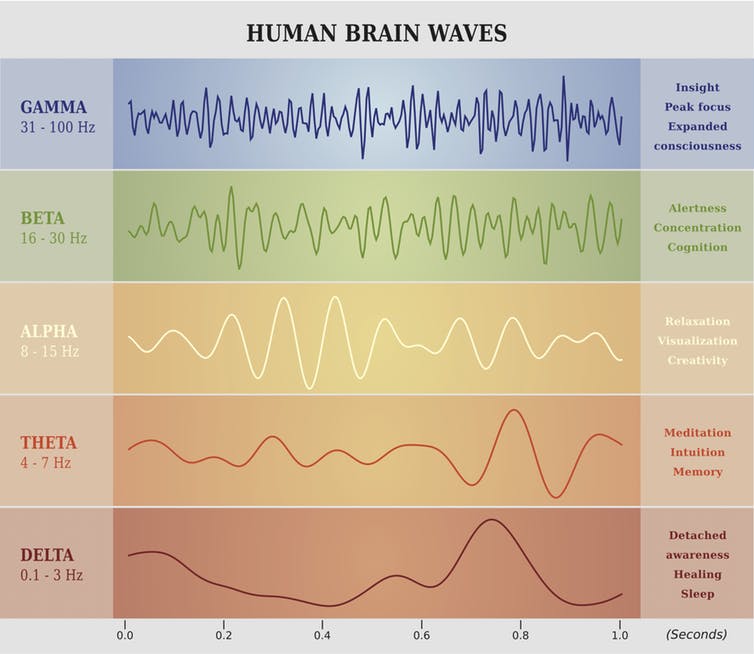
Fries focuses on gamma, beta and theta waves. These labels refer to the speed of electrical oscillations in the brain, measured by electrodes placed on the outside of the skull. Groups of neurons produce these oscillations as they use electrochemical impulses to communicate with each other. It’s the speed and voltage of these signals that, when averaged, produce EEG waves that can be measured at signature cycles per second.
Each type of synchronized activity is associated with certain types of brain function. artellia/Shutterstock.com
Gamma waves are associated with large-scale coordinated activities like perception, meditation or focused consciousness; beta with maximum brain activity or arousal; and theta with relaxation or daydreaming. These three wave types work together to produce, or at least facilitate, various types of human consciousness, according to Fries. But the exact relationship between electrical brain waves and consciousness is still very much up for debate.
Fries calls his concept “communication through coherence.” For him, it’s all about neuronal synchronization. Synchronization, in terms of shared electrical oscillation rates, allows for smooth communication between neurons and groups of neurons. Without this kind of synchronized coherence, inputs arrive at random phases of the neuron excitability cycle and are ineffective, or at least much less effective, in communication.
A resonance theory of consciousness
Our resonance theory builds upon the work of Fries and many others, with a broader approach that can help to explain not only human and mammalian consciousness, but also consciousness more broadly.
Based on the observed behavior of the entities that surround us, from electrons to atoms to molecules, to bacteria to mice, bats, rats, and on, we suggest that all things may be viewed as at least a little conscious. This sounds strange at first blush, but “panpsychism” – the view that all matter has some associated consciousness – is an increasingly accepted position with respect to the nature of consciousness.
The panpsychist argues that consciousness did not emerge at some point during evolution. Rather, it’s always associated with matter and vice versa – they’re two sides of the same coin. But the large majority of the mind associated with the various types of matter in our universe is extremely rudimentary. An electron or an atom, for example, enjoys just a tiny amount of consciousness. But as matter becomes more interconnected and rich, so does the mind, and vice versa, according to this way of thinking.
Biological organisms can quickly exchange information through various biophysical pathways, both electrical and electrochemical. Non-biological structures can only exchange information internally using heat/thermal pathways – much slower and far less rich in information in comparison. Living things leverage their speedier information flows into larger-scale consciousness than what would occur in similar-size things like boulders or piles of sand, for example. There’s much greater internal connection and thus far more “going on” in biological structures than in a boulder or a pile of sand.
Under our approach, boulders and piles of sand are “mere aggregates,” just collections of highly rudimentary conscious entities at the atomic or molecular level only. That’s in contrast to what happens in biological life forms where the combinations of these micro-conscious entities together create a higher level macro-conscious entity. For us, this combination process is the hallmark of biological life.
The central thesis of our approach is this: the particular linkages that allow for large-scale consciousness – like those humans and other mammals enjoy – result from a shared resonance among many smaller constituents. The speed of the resonant waves that are present is the limiting factor that determines the size of each conscious entity in each moment.
As a particular shared resonance expands to more and more constituents, the new conscious entity that results from this resonance and combination grows larger and more complex. So the shared resonance in a human brain that achieves gamma synchrony, for example, includes a far larger number of neurons and neuronal connections than is the case for beta or theta rhythms alone.
What about larger inter-organism resonance like the cloud of fireflies with their little lights flashing in sync? Researchers think their bioluminescent resonance arises due to internal biological oscillators that automatically result in each firefly syncing up with its neighbors.
Is this group of fireflies enjoying a higher level of group consciousness? Probably not, since we can explain the phenomenon without recourse to any intelligence or consciousness. But in biological structures with the right kind of information pathways and processing power, these tendencies toward self-organization can and often do produce larger-scale conscious entities.
Our resonance theory of consciousness attempts to provide a unified framework that includes neuroscience, as well as more fundamental questions of neurobiology and biophysics, and also the philosophy of mind. It gets to the heart of the differences that matter when it comes to consciousness and the evolution of physical systems.
It is all about vibrations, but it’s also about the type of vibrations and, most importantly, about shared vibrations.
ooOOoo
Well, I’m not sure of the relevance but I’m bound to say that I am going to the doctor once a week for Alpha-Sim resetting. The reason I mention it is the Alpha frequency in the above brain wave chart. I sit very quietly for about 90 minutes and it does seem to provide some benefit.
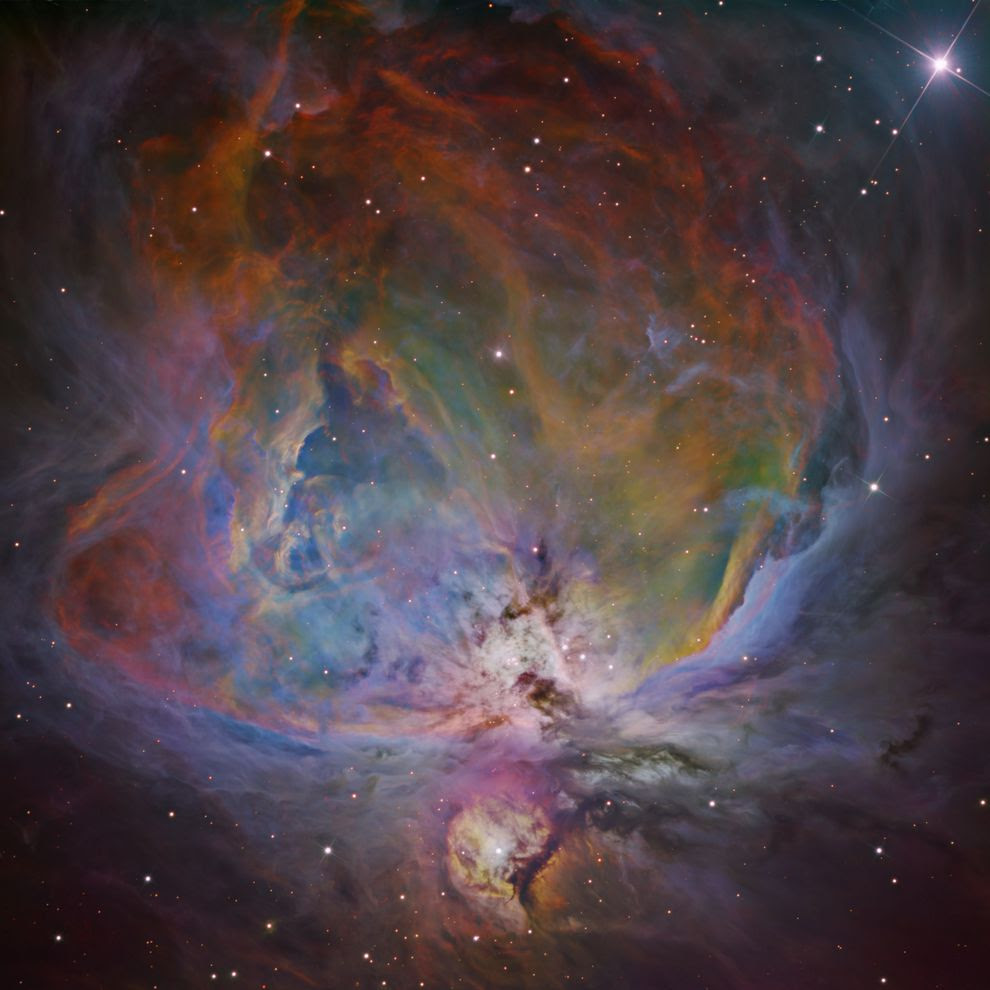
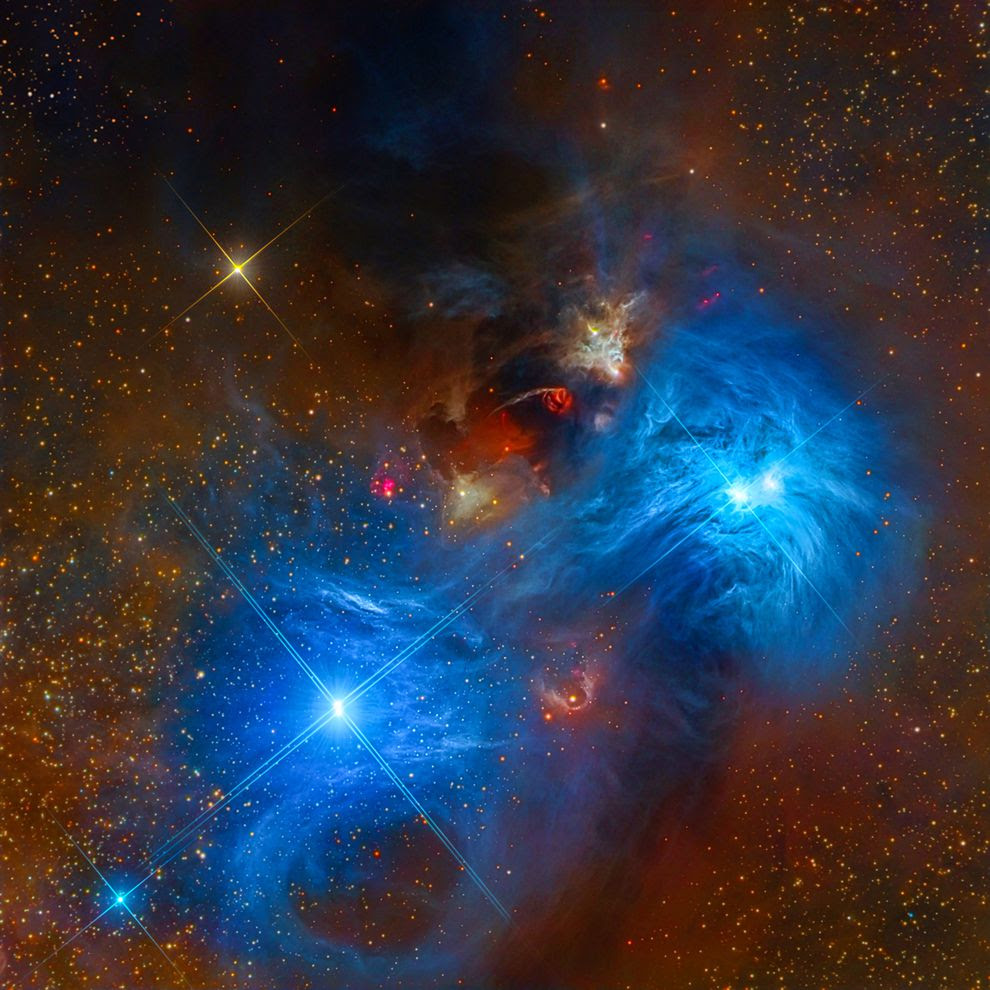
‘Rigel and the Witch Head Nebula’ (Photo: Mario Cogo)
An aurora borealis that lights up the night sky in Iceland. The Milky Way that illuminates in a remote area in Australia. Even nebulae that display dazzling colors. All these phenomena have delighted astronomy enthusiasts for years, and many people travel the globe to capture such events.
The Astronomy Photographer of the Year competition honors amateur astronomy photographers who capture stunning images of space. The organization released several dozens images out of the more than 4,200 entries it received ahead of its announcement this October of this year’s winners. The competition began in 2009 and is organized by the Royal Observatory Greenwich in the United Kingdom.
The photographers featured here are a mixture of amateurs and professionals, but their images are universally stunning.
The photo above entitled “Rigel and the Witch Head Nebula” was taken by Mario Cogo in Namibia. “The dark Namibian sky was the perfect location to capture the wonder of the Witch Head Nebula and Rigel,” said Cogo in his submission. “The Witch Head Nebula is a very faint molecular gas cloud which is illuminated by supergiant star Rigel, the seventh brightest star of the sky and the brightest star in the constellation of Orion.”
The caption listed below each photo was written by the photographer and provides additional context.
‘Thunderstorm under milky way’ (Photo: Tianyuan Xiao)
“A glorious Milky Way looms over a thunderstorm that lights up the Florida sky. The photographer wanted to show the great contrast between stable (Milky Way) and moving (thunderstorm) objects in the sky.” — Tianyuan Xiao
‘The Orion Nebula in 6-Filter Narrowband’ (Photo: Bernard Miller)
“One of the brightest nebulae, the M42 or the Orion Nebula, is located in the Milky Way south of Orion’s belt. It is an emission nebula about 1500 light years away in the constellation Orion. This image was produced by combining 36 hours of total exposure using six different filters; Ha, SII, OIII, Red, Green, and Blue. The central Trapezium cluster of the nebula is so bright that it is usually over exposed with the long exposures needed for the nebula. In this image a series of short 3-second exposures in each filter were blended with the long exposures to create a high dynamic range image that produces detail in the faint nebula and bright Trapezium.” — Bernard Miller
The neglected neighbour’ (Photo: Kfir Simon)
“Taken from Tivoli Southern Sky Guest Farm in Namibia, the great Horsehead nebula is overlooking the striking and often overlooked Nebula NGC 2023. At 4 light years in diameter it is one of the largest reflection nebulae ever discovered.” — Kfir Simon
‘The Hidden Galaxy’ (Photo: Tom O’Donoghue and Olly Penrice)
“Camelopardalis, also known as the Hidden Galaxy is one of the largest Galaxies visible from the Northern Hemisphere; however it is also obscured by foreground stars and dust, as it lies in the Milky Way plane. The photographer added a Ha filter to this LRGB image in order to enhance the emission nebula regions in the galaxy and after stacking single exposures (subs) the brilliant spiral arms at the core were revealed.” — Tom O’Donoghue and Olly Penrice
‘The Eagle nebula’ (Photo: Marcel Drechsler)
“The Eagle Nebula, also known as Messier 16, is a young open cluster of stars, surrounded by hot hydrogen gas in the constellation Serpens and lies at a distance of 7,000 light years from Earth. Taken at the Baerenstein Observatory in Germany, the photo is a RGB-Ha-OIII image and shows off the radiant red and blue colours of the nebula. In the centre you can spot the famous Pillars of Creation.” — Marcel Drechsler
‘Stars over Sacred Mongolian Ovoo’ (Photo: Qiqige Zhao)
“Taken during a summer night in Mingantu in Inner Mongolia, star trails are sweeping over the colourful and extraordinary sacred altars, called Ovoo, creating a spectacular painting.” — Qiqige Zhao
‘NGC 6726 and NGC 6727’ (Photo: Mark Hanson, Warren Keller, Steve Mazlin, Rex Parker, Tommy Tse, David Plesko, Pete Proulx)
“These spectacular reflection nebulae in the Corona Australis constellation depict the characteristic vivid blue color produced by the light of hot stars, reflected by silica-based cosmic dust. A rare high resolution view of the cores NGC 6726 and 6727 is captured on camera. The data was acquired by Star Shadows Remote Observatory at CTIO’s PROMPT2, using LRGB filters, stacked with CCDStack and post-processed in Photoshop and PixInsight.” — Mark Hanson, Warren Keller, Steve Mazlin, Rex Parker, Tommy Tse, David Plesko and Pete Proulx
‘Mosaic of the Great Orion & Running Man Nebula’ (Photo: Miguel Angel García Borrella and Lluis Romero Ventura)
“The Orion Nebula, also known as Messier 42, M42, or NGC 1976, is a diffuse nebula situated in the Milky Way, south of Orion’s Belt in the constellation of Orion. It is one of the brightest nebulae and is visible to the naked eye during a clear night sky. M42 is 1270 light years from our planet and is the closest region of massive star formation to Earth. It is estimated to be 24 light years across and it has a mass of about 2,000 times more than that of the Sun. This image is the result of the efforts of two astrophotographers using different equipment from their observatories. Located hundreds of kilometres away from each other, they chose the Orion Sword are as a common target to render. The software suites used in this image are Maxim DL, Pixinsight and Photoshop CC 2017.” — Miguel Angel García Borrella and Lluis Romero Ventura
‘Milky Way shining over Atashkooh’ (Photo: Masoud Ghadiri)
“The Milky Way stretches across the night sky between four columns in the ancient Atashkooh Fire Temple near Mahllat city in Iran. The camera was placed on the ground in the centre of the four columns, and with no use of any other equipment, the photographer managed to capture our magnificent galaxy using just one image.” — Masoud Ghadiri
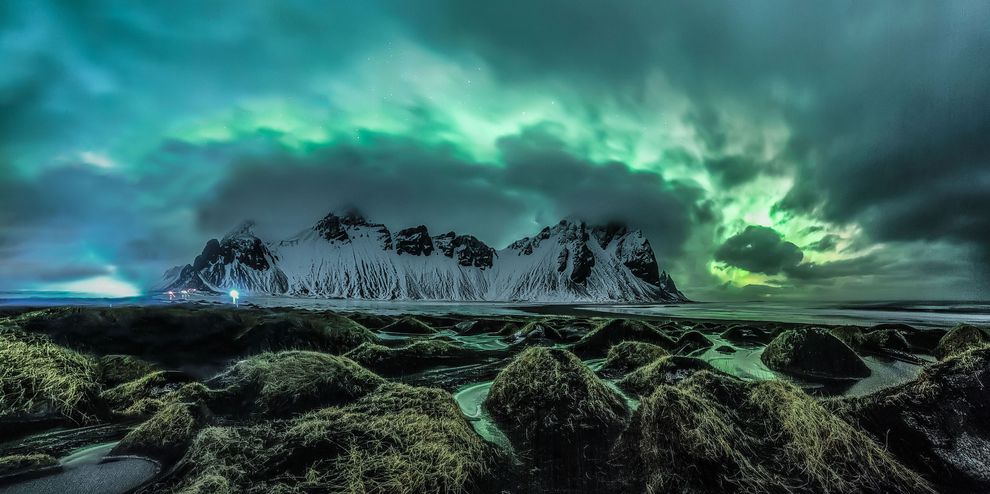
‘Magic’ (Photo: Jingyi Zhang)
“The magical Aurora Borealis explodes from the clouds and looms over the mountains in Stokknes on the south coast of Iceland. Snow has melted and created pools of water between the dunes, creating a perfect foreground for this image.” — Jingyi Zhang
‘Kynance cove by night’ (Photo: Ainsley Bennett)
“On a family trip to Cornwall after visiting Kynance Cove, on the Lizard Peninsula, the beautiful landscape seemed to be the ideal place for the photographer to capture the glimmering stars and the striking colours of the Milky Way illuminating the beautiful rocky coastline. This is a composition of two separate exposures, one for the sky and one for the foreground blended together post-processing to achieve the desired result, producing a more even exposure.” — Ainsley Bennett
‘Keeper of the Light’ (Photo: James Stone)
“The Milky Way rises above an isolated lighthouse in Tasmania. The photographer planned his position to shoot the perfect composition positioning the Milky Way in conjunction with the lighthouse and observing how to best light the tower for artistic effect. This image is part of a time-lapse sequence, allowing the photographer some time to climb the tower into the lantern room of the lighthouse and reflect on the hard and lonely, yet incredible life the former lighthouse keepers would have lived.” — James Stone
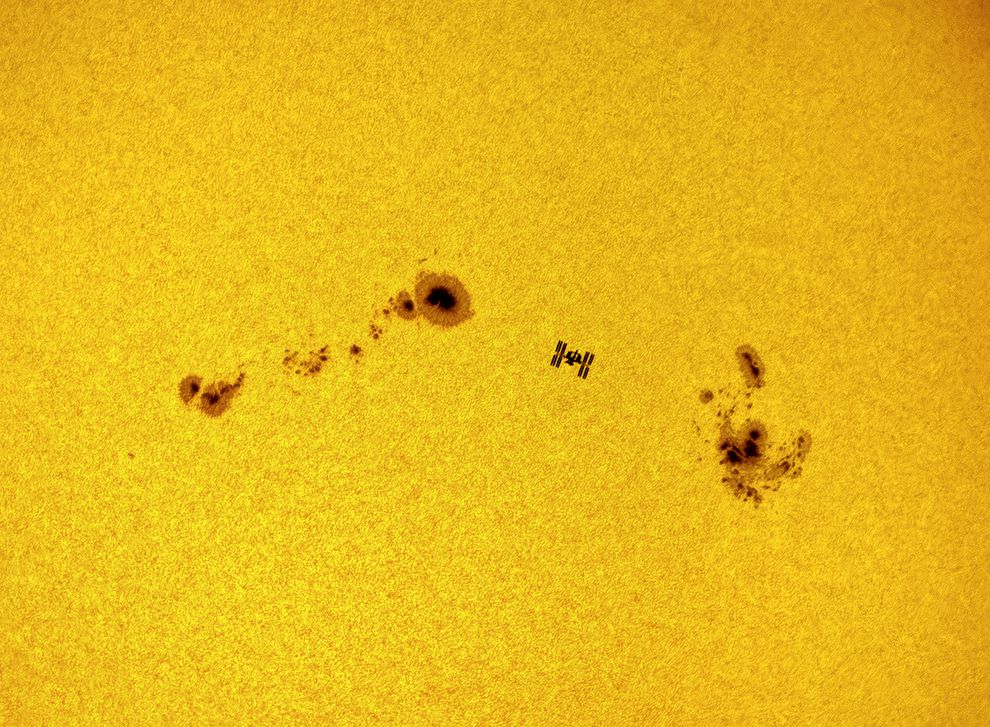
“The International Space Station (ISS) was captured between two massive sunspots, the AR 12674 and AR 12673, during its solar transit. The image was taken in Madrid and it took ISS less than a second to cross the solar disk.” — Dani Caxete
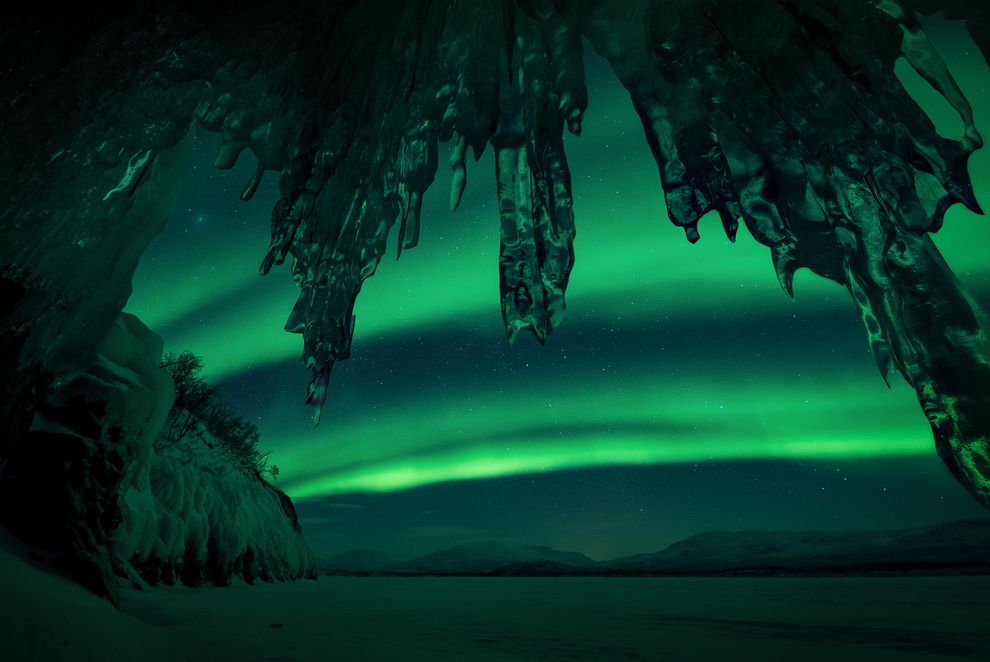
‘Ice Castle’ (Photo: Arild Heitmann)
“A remarkable display of the Northern Lights reflecting shades of green and yellow on the snow. Squeezed into a tiny cave on Lake Torneträsk, in Swedish Lapland, in minus 26 degrees with the camera lens just a few centimeters away from the icicles, it was a challenge well worth it for the photographer.” — Arild Heitmann
‘Holy Light II’ (Photo: Mikkel Beiter)
“The Black Church at Búðir in Iceland beneath the stripes of the Aurora Borealis and the bright stars in the night sky. Fighting the worst weather the photographer had ever encountered in Snæfellsnes Peninsula and with strong gale winds around 30 meters per second on the night the image was taken, his hard work paid off.” — Mikkel Beiter
‘Holding Due North’ (Photo: Jake Mosher)
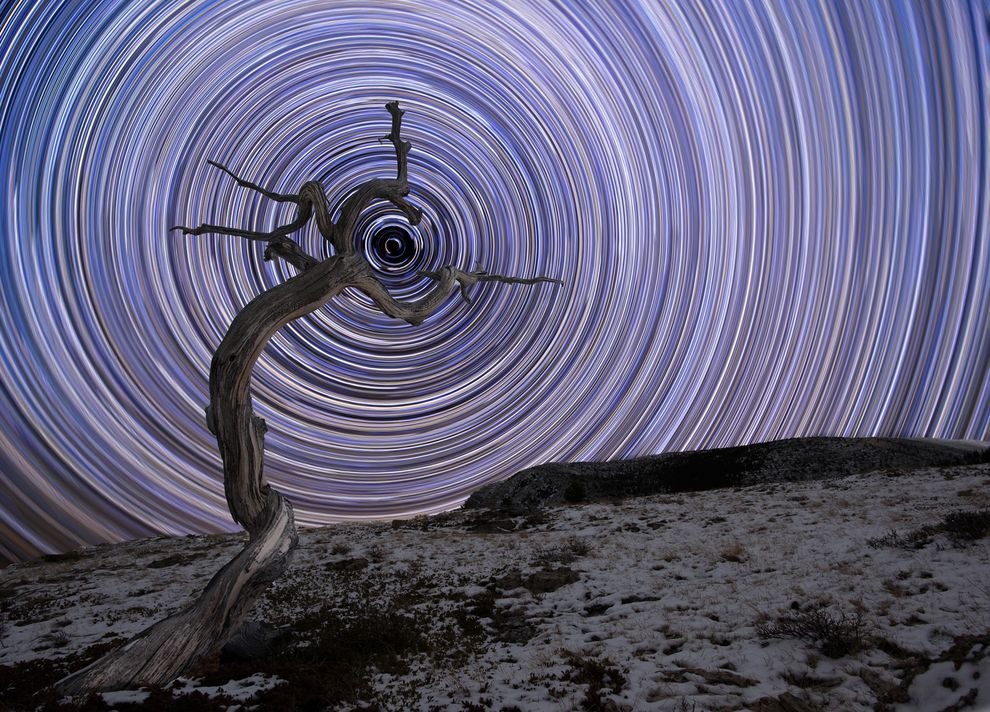
“A weathered juniper tree in Montana’s northern Rocky Mountains is filled with arced star trails and in the centre sits Polaris, the brightest star in the constellation of Ursa Minor. It took several test frames of long exposures to make sure that Polaris was in the right position, but eventually things lined up and the Moon provided enough light to the foreground, yet plenty of dark skies to allow a high enough ISO to capture lots of stars.” — Jake Mosher
‘Guarding the galaxy’ (Photo: Jez Hughes)
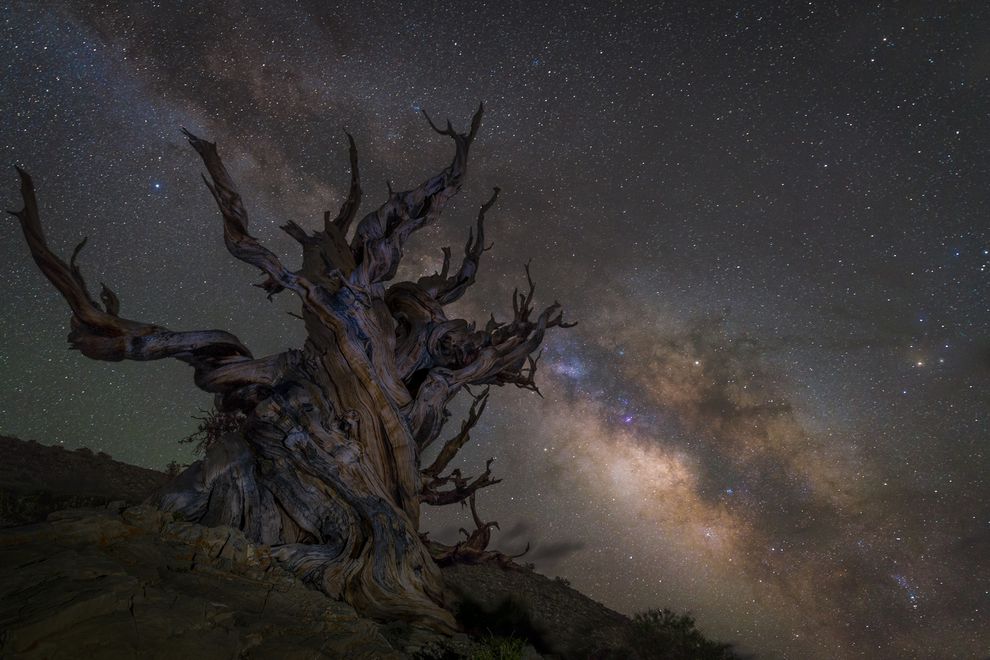
“The Milky Way rises over some of the oldest trees on Earth in the Ancient Bristlecone Pine Forest, set within the Inyo National Forest along the White Mountains in California. Growing at altitudes of over 10,000 feet, these trees can live for over 4,000 years. The high elevation also results in thin air and incredibly dark skies on display. This photograph was taken in between rolling thunderstorms which were passing through the Eastern Sierras, leaving time for only a few exposures.” — Jez Hughes
Guardian of Tre Cime’ (Photo: Carlos F. Turienzo)
“This panoramic image, composed out of eight photos, depicts the Milky Way emerging over the rocky Dolomites in Tre Crime on the left and on the right the lights from a house illuminating the beautiful terrain. The photographer noted that the image represents sharing unforgettable moment with the ones you love.” — Carlos F. Turienzo
‘First Impressions’ (Photo: Casper Kentish)
“After a few days of cloudy skies the photographer finally got the chance to use his birthday present, a new telescope. The clouds were moving fast so there was not much time to capture the Moon. With the help of his grandfather who kept moving the telescope and trying to keep an iPad at the right position, he managed to capture this wonderful and artistic image of his first viewing of our Moon.” — Casper Kentish
‘Expedition to Infinity’ (Photo: Jingpeng Liu)
“The photographer captured the splendor of our galaxy in Badlands National Park, in South Dakota and is a panoramic view of a 6-shot composite, three for the sky and three for the foreground, all of which were taken successively using the same gear and equivalent exposure settings, from the same location, within a short period. The raw files were initially processed in Lightroom for lens correction only, followed by merging to panorama in Photoshop. Final retouching was applied back in Lightroom, including WB correction, basic toning and local adjustments.” — Jingpeng Liu
‘Empyreal’ (Photo: Paul Wilson)
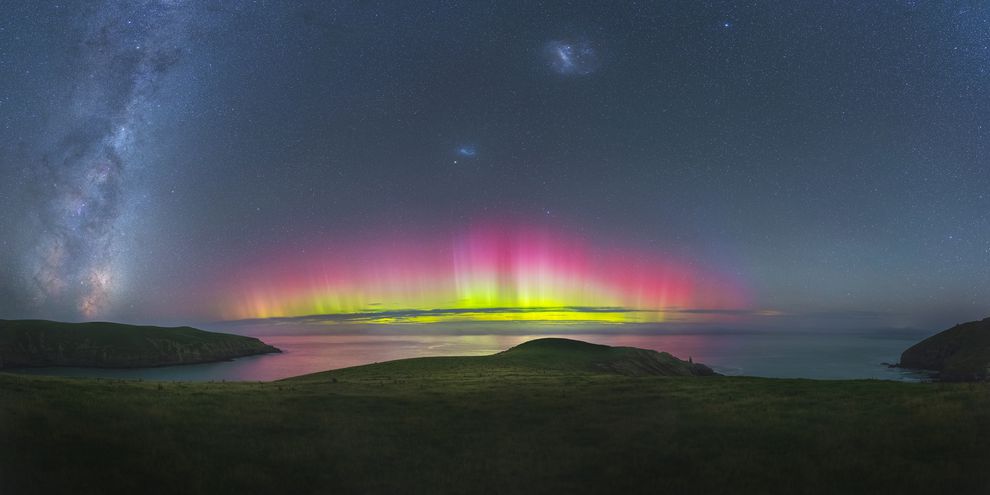
“A flared up Aurora reflects bright pink and yellow colours on the water at Southern Bays near Christchurch, New Zealand. The incredible combination of the radiant Aurora colours, the wide green fields and the dark blue, starry night sky paint a spectacular picture and accentuates the wonders of our galaxy.” — Paul Wilson
‘Earth Shine’ (Photo: Peter Ward)
“During a solar eclipse, the brightness of the solar corona hides the details of the moon. By layering 9 exposures ranging from 2 seconds to 1/2000th of a second and with Extreme High Dynamic Range photography or XHDR the image shows not just the radiant solar corona, but the newest possible of new moons, seen here illuminated by sunlight reflecting off the earth.” — Peter Ward
‘Deep Space’ (Photo: Dave Brosha)
“Exploring the remarkable underbelly of the Breiðamerkurjökull glacial tongue in Iceland. With this image the photographer wanted to pay tribute to the serenity and wonder he felt while he spent some time in this peaceful and magnificent place.” — Dave Brosha
‘Daytime Moon’ (Photo: Helen Schofield)
“Earth’s only natural satellite is situated above the horizon of our planet so it is visible during daytime and the waxing gibbous phase can clearly be seen in the sky. The photographer captured this imposing image in Malaga, Spain while vacationing with her children.” — Helen Schofield
Color-Full Moon’ (Photo: Nicolas Lefaudeux)
“A phenomenal image depicting the incredible colours and details of the surface of the Moon. The photographer applied a similar procedure he used for capturing the solar eclipse and noted that this lit up the full Moon like a Christmas tree ornament, with a great variety of hues and shades.” — Nicolas Lefaudeux
‘Cable Bay’ (Photo: Mark Gee)
“The magnificent Milky Way stretches across the night sky reflecting on the Cable Bay near Nelson, New Zealand. The photographer had to take the picture before the light washed out the sky. 42 individual images were stitched in to a large multi row panorama to create this image.” — Mark Gee
‘Aurorascape’ (Photo: Mikkel Beiter)
“The conditions the night the image was taken were not ideal because of the bright moon lighting up the sky. The photographer managed to overcome this obstacle and capture the incredible Aurora Borealis above the fjord at Haukland in the gorgeous Lofoten archipelago, Northern Norway. The small pool of water with rocks made the perfect foreground and a natural leading line into the frame.” — Mikkel Beiter
‘Aurora Borealis on the coast of the Barents sea’ (Photo: Michael Zav’yalov)
“From the city of Yaroslavl in Russia to the coast of the Barents Sea in the Arctic Circle, a party of three travelled 2000 kilometers to capture the magnificent Northern Lights. The photographer stayed in the village of Teriberka in the Murmansk Oblast district for five days. After four days of bad weather, with heavy snow and thick clouds the sky finally cleared on the last day and the Northern Lights appeared in all their glory.” — Michael Zav’yalov
‘AR 2665 and Quiescent Prominence’ (Photo: Łukasz Sujka)
“The sunspot AR2665 was one of the most active regions in 2017 on the right you can see a phenomenal quiescent prominence extending from our star, the Sun. This type of prominence lasts for a very long time and its structure is quite stable. The photo is a composition of two images: one of the magnificent prominence and one of the Sun’s surface. The surface is much brighter than the prominence so it is a negative to reveal details of Sun chromosphere (spicules and filaments).” — Łukasz Sujka
‘Andromeda Galaxy’ (Photo: Péter Feltóti)
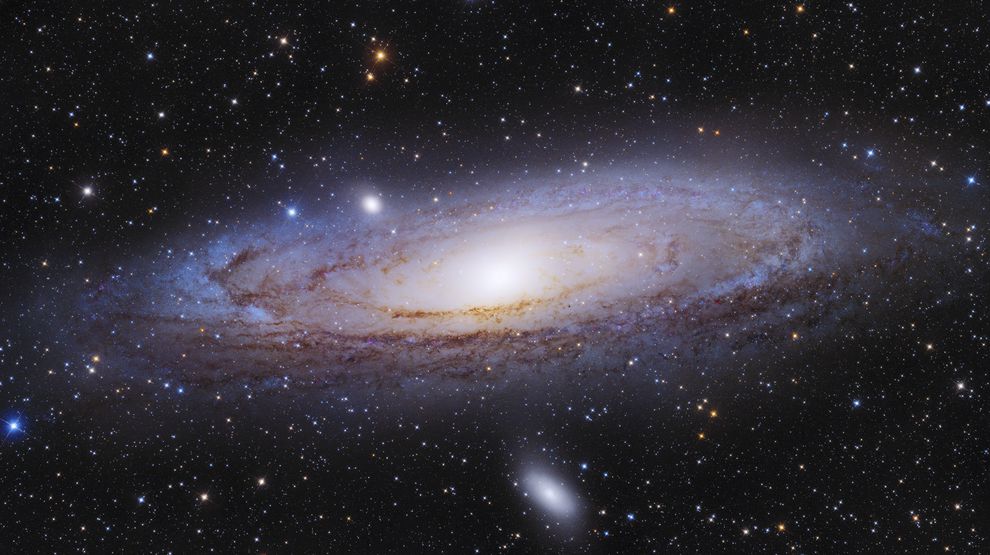
“Andromeda Galaxy has always amazed the photographer. The dust lanes and bright star clusters in its arms, the emblematic galaxy shape of it, and the magnificent look of this great star city make it one of his most desired objects to photograph. This image was taken using a 200mm mirror and creating a three panel mosaic.” — Péter Feltóti
‘A Magnificent Saturn’ (Photo: Avani Soares)
“In high resolution planetary photography having a good view of a planet is a key factor but also completely out of a photographer’s control. In this image the photographer was lucky to capture our second largest planet, Saturn, in all its glory. After stacking 4,000 out of 10,000 frames we can admire details such as the beautiful polar hexagon, the Encke Division and even the crepe ring.” — Avani Soares
ooOOoo
These are the most beautiful images of the cosmos that I have ever seen!
In fact it started on Thursday with a local owner not taking care of a couple of dogs. I’m not sure about whether or not the dogs are being cared for but there have been a number of cases suggesting that they were thin and also that they were running wild.
Then yesterday it took a turn for the worse shortly after 7am. I was on my way back to the house having fed the horses and then heard an animal calling out. I paused trying to identify this animal. It was located very close to our border on the Northern side.
Then the noise stopped and I thought nothing more of it.Later on I realised that it was animal in serious pain. Too late now to attempt to save it.
A little later I went across to the area where the calling had been coming from. There, just alongside our fence but on the other side of it, lay a young deer. It was dead but still warm.
Then about 10:30 yesterday when after I had called animal control I decided to revisit the location and take a couple of pictures.
oooo
It was tragic! The loss of a wild animal. In fairness, one that the dogs themselves are not responsible for. Dogs will be dogs.
Meantime, I pondered on what might have evolved differently had I intervened when I first heard the animal in pain.
The last in this recent series on me examining my navel!
Dear Mr. Cosmos,
Clearly, I have no idea how many letters you receive from us funny inhabitants on Planet Earth. Can’t imagine you get floods of them but then neither can I imagine that this is the first one you have ever received.
Why can I not imagine this is to be your first? Simply, because us funny folk on this incredible planet of yours have been around for quite a while. I mean that over in that country we folk call Israel there has been found evidence of “control of fire by humans nearly 790,000 years ago.”
Whoops!
Just realised that me saying “quite a while” and writing of “790,000 years ago” will be utterly meaningless, in terms of scale, to how you describe your past. Just as it is utterly meaningless for me to contemplate that in cosmological terms the ‘Big Bang”, generally recognised as the start of your Universe, was, give or take, some 13.8 billion years ago.
I wish I could really get an idea of what a million years feels like, let alone a billion years. Ah well!
Let me stay with this notion of stuff being meaningless.
My dear, long-time friend Dan Gomez sent me a link to an item that had been published on the Science Alert website. It was about how the NASA Hubble space telescope had recently embarked on a new mission. Or in the words of that article:
Hubble Just Revealed Thousands of Hidden Galaxies in This Jaw-Dropping Photo
By Michelle Starr, September 13th, 2018
Hubble has embarked on a new observation mission: to study the farthest reaches of the Universe, using some of the most massive objects in the Universe – galaxy clusters.
And this newly released picture shows how.
At the centre is Abell 370, a cluster of a few hundred galaxies located around 4 billion light-years from Earth. And arrayed around it, never seen before, are thousands of galaxies, out even farther in the depths of space.
The reason we can see them now is because of Abell 370. All those hundreds of galaxies, clustered so close together, and the associated dark matter, create an immense field of gravity.
When the light behind that field passes through it, the gravitational force is so strong that it bends the path of the light. This creates a magnifying effect called gravitational lensing, allowing us to see objects we usually can’t.
Abell 370 is the first of these clusters.
Here is one of those photographs,
(NASA, ESA, A. Koekemoer, M. Jauzac, C. Steinhardt, and the BUFFALO team)
And an explanation of what we are looking at:
In the image, you can see the galaxies in Abell 370. The brightest yellowish white ones are huge, containing hundreds of billions of stars. The bluer ones are smaller, spiral galaxies, like the Milky Way, with younger populations of stars. And the dimmer, yellower galaxies are older, with ageing star populations.
The galaxies behind Abell 370 appear as smeared lines of light. The most spectacular, to the lower left of the centre, is nicknamed the Dragon (possibly for its resemblance to a Chinese dragon), with its head to the left. It’s made up of five images of the same spiral galaxy, magnified and stretched by the gravitational lens.
Mr. Cosmos, you know a little earlier I was remarking about how it is impossible to comprehend the age of the Universe. Well, dear Sir, it’s just as impossible to comprehend your distances.
Take Abell 370 out there some 4 billion light years from Planet Earth! I really wanted to have a go at understanding that distance.
First, I looked up the distance in miles that is represented by one light-year. Answer: one light year is a tad under six trillion miles.
Just one, let alone some 4 billion of them!
Next, I looked up the distance of our very familiar Big Dipper constellation. You must have heard of it? This one!
The Big Dipper. Image Credit & Copyright: Jerry Lodriguss
Turns out that even this very familiar sight in our night sky ranges from 78 to 123 light years away. Average that as 100 light years and, bingo, you are looking at this familiar cluster of stars that is 590 trillion miles away!
So, dear Mr. Cosmos, that puts your Abell 370 constellation about a distance that is 10 million times more distant than our Big Dipper!
I wrote above that “I really wanted to understand that distance.” In reference to how far that Abell 370 constellation truly was. My conclusion is that I will never, ever understand that distance.
Anyone able to help?
Tomorrow, Mr. Cosmos, the closing page two of my letter to you.

 Deinah Storm is a pet lover from the US that’s had cats and dogs all her life. When she’s not walking the dogs with her family, she spends time writing informational and interesting blogs about pets to share with pet lover communities.


 ‘Rigel and the Witch Head Nebula’ (Photo: Mario Cogo)













 Learning from Dogs