Category: consciousness

A sailing memory, part two.

Again, this is for Pendantry.

I left yesterday’s post with the statement: “However, getting to Gibraltar was not without its challenge for we suffered a knockdown and this scared us both to the core.

This is the account of that knockdown.

ooOOoo

The knockdown

So this was it, the end of life. This is what that end felt like. A lifetime of experiences reduced to this stilled moment; all my hopes, dreams, pleasures, memories, everything shrunk to this tiny moment of now.

I knew, in some trance-like way, that if just one of those foaming, giant waves swept across us, so utterly over-whelmed as we were on our side, it would flood the cabin, and down Dave and I and the yacht would go.

Other sensations came to me. Feelings of quiet, of calm, even of peace. My world now reduced to close, intimate dimensions. To the yacht’s wheel, to which I so grimly hung. To the front edge of the port cockpit seat, now underneath me, against which I braced my feet. To the starboard guardrail, bizarrely above my head, and to those raging seas so very close that seemed to beckon, ‘Give up, give up now and slip away.’

Me and Dave, alone in this Mediterranean storm 10 days West of Cyprus, are going to drown, founder without trace in these vast waves and probably end up not being missed for many days. Our dream of sailing across the Atlantic snuffed out as easily as Songbird of Kent would sink the 5,000 feet down to the seabed. The futility of it all.

It was a strange, detached perspective that hardly registered the gusts coming at us like great padded hammers. This unimaginable gale that had Songbird of Kent, my floating home for the last 5 years, totally pressed down on her port side, even though the yacht offered nothing more to the winds than her bare mast and rigging.

From within the cabin, Dave could do no more than simply watch. Hunkered down outside, I could do no more than simply hang-on. Both of us transfixed in this stillness of life’s imminent ending. Dave would later say no words would ever properly describe what his eyes had seen.

My past life, rather ominously, started running before me. How one year, in the early 1950s, when I was 7 or 8 years old, my parents had rented a holiday villa in the French Atlantic coastal town of Arcachon. What a glorious summer holiday that had been.

Arcachon’s beautifully sheltered bay had enabled me to learn to swim. The buoyant sea-water helping me increase the number of strokes each day, until one afternoon I had swum out to a yacht anchored well off the beach. As I hung on to the anchor chain, panting hard, the owner looked over the guardrail. Next, me being rowed back to the beach in a dinghy and then everyone getting to know Englishman John Calvert, a solo sailor living aboard his yacht, Garrawog.

Next year we had holidayed again in Arcachon and found Garrawog moored in the small yacht harbour. I recalled fond memories of sitting in the cabin with my father and John Calvert, drinking lemonade, eating cream crackers and loving the cosiness of it all.

Then the amazing coincidence when the following year we had holidayed at the French Mediterranean town of Menton and Garrawog had sailed into the harbour. That had led to John taking us sailing along the coast, memories so vivid, all these years later, of helping to haul sails, steer Garrawog, even remembering the gentle nudge of the yacht into the waves.

I was clear how those memories had fuelled my romantic obsession with sailing. How as a young teenager growing up in London I had joined the Welsh Harp sailing club, based at a large lake, well a reservoir, just three miles from home, and learnt to sail a dinghy. All fuelling this fascination with the sea. Yet that romantic obsession didn’t revolve around idyllic meanderings along the Mediterranean coastline. No, my dreams involved ocean sailing. Not even as part of a crew, but sailing, single-handed, across the oceans.

I had devoured every book written by those sailors who, totally alone, had journeyed the vast oceans in a small yacht. Joshua Slocum, who wrote of his solo trip around the world in his yacht, Spray, way back in 1895. Master English navigator, Francis Chichester, who conceived the idea of a single-handed yacht race across the Atlantic ocean, later completing a round-the-world solo circumnavigation in his yacht, Gipsy Moth IV. Eric Tabarly, Chay Blyth, Robin Knox-Johnston and many more.

I reflected how that dream had remained with me for years. All through nearly 20 years as a salesman and entrepreneur to the point when, quite suddenly, on a Monday in the Spring of 1986, uncharacteristically I had nothing in my diary for that day, or for many days ahead. I had just sold my thriving company in Colchester and there was no longer a job to go to!

Then not so long after I had taken a holiday in Larnaca and in wandering around the marina I had seen Songbird of Kent for sale, and had bought it! I had previously read about Tradewind yachts and knew how many had made world circumnavigations. Thus by the end of 1986, my new address had become: Yacht ‘Songbird of Kent’, Larnaca Marina, Cyprus.

A shout from Dave jerked me back to the real world.

Hey, is it my imagination or is that wind easing?

I lifted my head and turned my face into the weather coming full at us. The seas were just as terrible but, yes, something was different, some subtle lowering of the tone of the wind.

Dave, you’re right, it has eased back a bit. We’re not so pressed down, are we?

Don’t think so. What do you reckon?

Not sure what to do, frankly these conditions scare the shit out of me!

In the subtlest way imaginable, Songbird provided the answer. The yacht now showed some response to the waves rather than previously being so overwhelmed. A tiny thought entered my mind, something I hardly dared acknowledge: Songbird is not going to founder.

Those 3 tons of lead at the bottom of Songbird’s keel were, at last, overcoming the wind pressure on her topsides and with seawater cascading down from the mast and rigging, the yacht slowly righted and bestowed on me and Dave the continuation of our lives. A miracle of miracles!

I quickly helmed the bow round to point us downwind, putting the full force of the gale directly aft. Within moments, a wave slowly started to overtake us but I couldn’t do anything other than keep my eyes on the mast-head wind-vane that, against all odds, had stayed intact during the knock-down. Watching the arrow head that absolutely had to keep pointing directly into the wind. We may be upright but one slip of steering, one moment’s loss of concentration and I knew we would slew broadsides to the seas and go over again.

I couldn’t believe the size of this wave that lifted us up and up, as if we were in giant, invisible hands. Up to the foaming crest from which was revealed, all around us, wild, angry, jagged waves, huge crests covered in white foam, an Alpine-like scene of raging hell as far as the eye can see. A vista of utter desolation.

Then the foaming crest moved ahead of us and Songbird slid down that vast lee of the wave, down towards the trough that lay behind us. Our bowsprit pointed directly into the dark green water ahead, water streaked with spume, as down and down we went until the inevitable arrival of the next wave started us up to another foaming crest.

We had survived what we could never have imagined. Hardly believing it, we intuitively knew that surviving that first wave increased the odds of us surviving the next few. Then the next few, and the next few until, against all expectations, we knew we stood a chance of living through it all.

I spotted something in the water and shouted, “Dave, look, look there in the water, just to our left. That bit of sail, surely not from our mainsail?

As we ran before the weather, a scrap of white sail had surged past our side, a piece of sail bearing the number 33 and two palm trees, the symbol of a Tradewind 33 yacht.

Dave laughed, “I can’t believe that, Paul. It’s from the mainsail that blew out when the gale first struck. How amazing! It must be from us, can’t be too many other Tradewind 33s out here!“.

Imagine that, Dave, after all that we have been through these past few hours, we’ve just sailed by a bit of our mainsail, close enough to have grabbed it.

That triggered my mind as to when this terrible experience started. How long ago was that? I didn’t have a clue, though surely it couldn’t have been much more than an hour or so ago. Indeed, I struggled to think what day it was, then realised it was Thursday, October 8th, 1992. Just 24 hours since we had left the dirty, commercial port of Algiers for the last leg of our trip from Larnaca in Cyprus to Gibraltar.

Dave, hand me the log, it’s at the back of the chart table.

I read,

Thursday, 8th October, 1992.

08:20 Sea state terrible.

I recalled how the dawn had revealed banks of low angry clouds, skidding across the tops of a nasty swell, made even worse by a vicious cross-swell. The next entry after that read,

09:00 Sky extremely threatening. Wind NE F4. Just 16 miles east of Greenwich meridian.

Then we had approximately 3 hours of sailing to go before we crossed Greenwich. On to the last entry,

12:00 Sea extremely ugly, Wind NNE F5. Longitude 2 minutes East of Greenwich.

Just 15 minutes from crossing that historical navigational line. I recalled how we had chatted about sharing a glass of something to celebrate ‘crossing the line’! Then how my words had been torn away when, in a seeming instant of time, this huge squall had come out of the North, heralding this vast, cauldron of a storm. The mainsail, even tripled-reefed, was way too much sail. But it was far too dangerous to leave the cockpit to drop the sail, too much to do anything other than hang on.

The mainsail failed, ripped into shreds as it tore away from the mast-track and disappeared into the storm. The sounds of the event obliterated by the screaming noise of a wind that I had guessed was now more than 50 knots. The rain and spray had stung my face so hard that I needed to turn my head away just to breathe. Clearly something had to give; I expected the mast to fail.

But it didn’t! Instead, as the wind force grew and grew, it steadily pressed us further and further over until Songbird ended up fully horizontal to the sea. It seemed a lifetime ago.

I looked at my watch: 5.30pm. To hell and back in so few hours!

Dave, what’s our position?

Dave ducked out of sight to read the GPS, came back out with a slip of paper on which he had written our position: Eight minutes of longitude west of the Greenwich meridian. We were now in the Western hemisphere!

Come on, Dave, you take the wheel. I’m going to fetch a couple of beers.

I reckon a double celebration, Paul, crossing the Meridian and living to tell the tale!

We drank our beers, chit-chatted about nothing much, both aware that we had literally stared into the abyss of a dark watery grave, and sailed on.

Just before 13:00 on Saturday, October 10th, Songbird rounded Gibraltar’s breakwater, briefly rolled in the cross-swell, and slipped into the calm waters of the inner harbour.

Soon we were safe and secure in a marina berth, a few minutes walk from good food and friendly bars. Our experiences rapidly migrated into the private worlds of our minds, as if discussing it openly might replay it all with a different, more tragic, outcome.

I struggled through those first nights of sleep. Again and again I awoke, panic across my chest, clinging to the sides of my bunk, trying to lay all the nightmares to rest. Slowly, those October days resting up in Gibraltar shone a light on this sailing obsession. How, with the sudden death of my father in 1956, those memories of idyllic times in and around Garrawog had buried themselves deep into my hidden emotional world. How dreams of sailing had more to do with keeping the memory of my father alive than with anything else.

That gale expunged the obsession. I never sailed on Songbird again or, for that matter, on any other sailing vessel. Paid crew eventually returned Songbird to England, where she was subsequently sold.

I would never forget the stillness I had experienced in the midst of all that chaos, but one knock-down in a lifetime was more than enough.

ooOOoo

This is absolutely a true account of what happened. Yes, an intimate, personal account of what happened but accurate down to the last detail.

I am so pleased I kept a written account of the knockdown all those years ago for if I was to recall it today then much of the detail would have been lost. Maybe lost as a result of old age or lost as a consequence of not wanting it in one’s mind. Who knows.

Finally, there are no photographs because we just had more important things to look after – keeping ourselves alive!
Memories of the past.

Angela Stockdale and Pharaoh came to mind!

In the last twenty-four hours I was in communication with a person in Essex, England about dog training (and hopefully there will be a guest post from him) and it caused me to think of Angela Stockdale.

I then did a search on my blog for posts where I had mentioned Angela and came across quite a few in the early days of blogging. Then I thought it would be nice to republish one of them; Four Years Old.

So here it is again.

ooOOoo

How time flies!

Four years ago this day, the first post was published on Learning from Dogs. Here it is again:

Parenting lessons from Dogs!

Much too late to make me realise the inadequacies of my own parenting skills, I learnt an important lesson when training my GSD (who is called Pharaoh, by the way). That is that putting more emphasis into praise and reward for getting it right ‘trains’ the dog much quicker than telling it off. The classic example is scolding a dog for running off when it should be lots of hugs and praise for returning home. The scolding simply teaches the dog that returning home isn’t pleasant whereas praise reinforces that home is the place to be. Like so many things in life, very obvious once understood!

Absolutely certain that it works with youngsters just the same way.

Despite being a very dominant dog, Pharaoh showed his teaching ability when working with other dogs. In the UK there is an amazing woman, Angela Stockdale, who has proved that dogs (and horses) learn most effectively when being taught by other dogs (and horses). Pharaoh was revealed to be a Beta Dog, (i.e. second in status below the Alpha Dog) and, therefore, was able to use his natural pack instinct to teach puppy dogs their social skills and to break up squabbles within a pack.

When you think about it, don’t kids learn much more (often to our chagrin!) from other kids than they do from their parents. Still focusing on giving more praise than punishment seems like a much more effective strategy.

As was read somewhere, Catch them in the act of doing Right!

By Paul Handover.

As it happens, it feels a little like ‘what goes around, comes around’. Why do I say that?

Because just last Saturday, I sent off a selection of pictures and videos to Angela Stockdale. Stay with me for a while as to the reason why.

Angela trades under the name of The Dog Partnership and, frankly, what she doesn’t know about the behaviour of dogs isn’t worth bothering about!

Just take a peek at the page on her website under the heading of Teaching Dogs. Here’s a little of what Angela writes:

I consider myself so lucky for dogs alone to have been my teachers. I learnt from watching how my own dogs responded to another dog’s body language and vice versa their language. Watching, learning and working with Teaching Dogs was the only way I knew.

I was and always will be in awe of a Teaching Dog’s dogs ability to consciously adapt their body language in accordance to how the other dog was feeling. The result being, they could relax nervous dogs but at the same time maintain control of a problem situation. Remember, dogs talk dog far better than we do.

It came as quite a shock to me when I learnt about other approaches. It seemed foreign for people to have so much input in resolving what were described as ‘ behavioural’ issues. For me, working with these dogs was far more than resolving a behavioural issue. It was about improving the quality of lives of dogs who were not coping with everyday life. If they found dogs or people worrying, sometimes this was shown in displays of aggression. It is important to understand, these dogs were not aggressive, they simply displayed aggressive behaviour.

Now, I would like to introduce you to the world of Teaching Dogs and how these special dogs change the lives of less fortunate dogs, who never had the opportunity to really understand how to communicate with their own species.

Do read the rest here.

Back to why those photographs and videos had been sent to Angela. A couple of weeks ago, we enjoyed an evening meal with friends of friends, so to speak. This other couple owned a beautiful-looking male German Shepherd dog: Duke. Duke was 4-years-old. Our hostess remarked that he was very boisterous and had nipped a couple of strangers who had called at the house. She added that he seemed difficult to control. Duke had been there for about a month and he was a rescue so they had little or no knowledge of past behaviour.

Well, I’m no expect with dogs, that’s Jean’s domain. But there was something about Duke that captivated me. Something in the way he looked at me, his eyes linking so directly with mine, allowing me to see a dog that offered an honest openness.

More or less on impulse I stood up, held my right arm up at 45 degrees, looked Duke in the face and said, “Duke! Sit!”

Duke held my gaze and sat back on his haunches.

I moved my arm in a complete circle, around to the right, and said, “Duke! Lie down!” Duke lay down.

H’mm, I thought. Fascinating. This dog has been professionally trained at some point in the past, using the same ‘command’ system of voice and arm signalling as I had learnt with Pharaoh way back in 2003/2004.

The food was now on the table. I grabbed a small piece of meat off my plate and returned to Duke who had, of course, resumed his pottering around the room. “Duke! Here boy!” Duke came over to me. “Duke! Lie down!” Duke did so. I placed the piece of meat on the wooden floor about three feet in front of him. Duke’s eyes were riveted on the meat. “Duke!” Duke’s eyes reluctantly engaged with mine. “Duke! Stay!” I repeated the Stay command a couple more times as I backed away about 6 or 8 feet.

“Go on, Boy. Take the meat!” Duke gleefully grabbed the piece of meat. Gracious, I thought, this dog is magnificent. I wonder ……..

I took another piece of meat, “Duke! Sit!” “Duke! Stay!” I then backed off that 8 feet again, got down on my knees and placed the piece of meat just between my lips. I knew this was potential madness with a dog I had only met some 30 minutes previously, but there wasn’t an ounce of doubt in my mind. I voiced in my throat for Duke to fetch the meat. Duke came straight over and confidently and carefully removed the meat from my lips.

What a truly fabulous dog! It was a wonderful evening and once home both Jean and I were eulogising about Duke.

Then two days later, our dinner hostess rang me. “You know, I have decided we can no longer keep Duke. He is too strong a dog, I can’t control him. Is there any chance of you finding a new home for Duke?”

Without question, Jean and I would have offered Duke a new home; in a heartbeat. The only thing stopping that was me wondering if this strong-willed, male German Shepherd might be a Beta dog, as Pharaoh was. Or just might be too dominant a male dog to fit in comfortably with our dogs, especially Pharaoh who was at the stage of life where the last thing that should happen is for his happiness and contentment to be disturbed.

I hadn’t a clue as to how to answer that question. But I knew someone who would know: Angela Stockdale.

I rang her, caught up on old times and then explained the background to Duke’s situation. Angela said to repeat the exercise that I had witnessed when I took Pharaoh to her all those years ago, when I wondered if Pharaoh was an aggressive dog. My uncertainty with regard to Pharaoh followed a number of times when walking him in a public area with other dogs and he had been very threatening, both in voice and posture, towards some of those other dogs.

This is what Angela arranged. I took Pharaoh up to her place at Wheddon Cross, near Minehead in Somerset. When we arrived, Angela was standing just by a gate into a fenced paddock, maybe a half-acre in size. In the far corner were two dogs.

Angela asked me to bring Pharaoh to the gate and let him off the leash. It was clear that Pharaoh was going to be let into the paddock. I cautioned that Pharaoh could be quite a handful with other dogs and, perhaps, it would be better that I walked him into the area still on his lead. Angela said that wouldn’t be necessary. So as she held the gate open sufficient for Pharaoh to enter the paddock, I slipped the lead off him and backed away, as requested.

Pharaoh had hardly taken 2 or 3 paces when Angela called out, “Paul, there’s nothing wrong with him!”

I was astounded and stammered, “But, er, er, how can you tell so quickly?” “Because my two dogs haven’t taken any notice!”, came the reply.

Later Angela explained that in the paddock were her female Alpha dog and her male Beta dog. Ergo, the two top dogs in terms of status so far as dogs see other dogs.

In fact, Pharaoh was utterly subservient to these dogs, in a way that I had never witnessed before. Later on, as Pharaoh relaxed and started playing, Angela said that she thought that Pharaoh was a Beta dog. Mixing some of her other dogs into the group was later able to confirm that.

So back now to present times and Duke.

Thus last Saturday, as Angela recommended, we selected two of our dogs, Cleo our female German Shepherd and the most socialable of dogs, and Casey, a strong but not aggressive male (he had some PitBull in him).

Duke arrived and was allowed freely to nose around the large grassed area some way from the fenced-off horse paddock that we were using for the ‘introduction’.

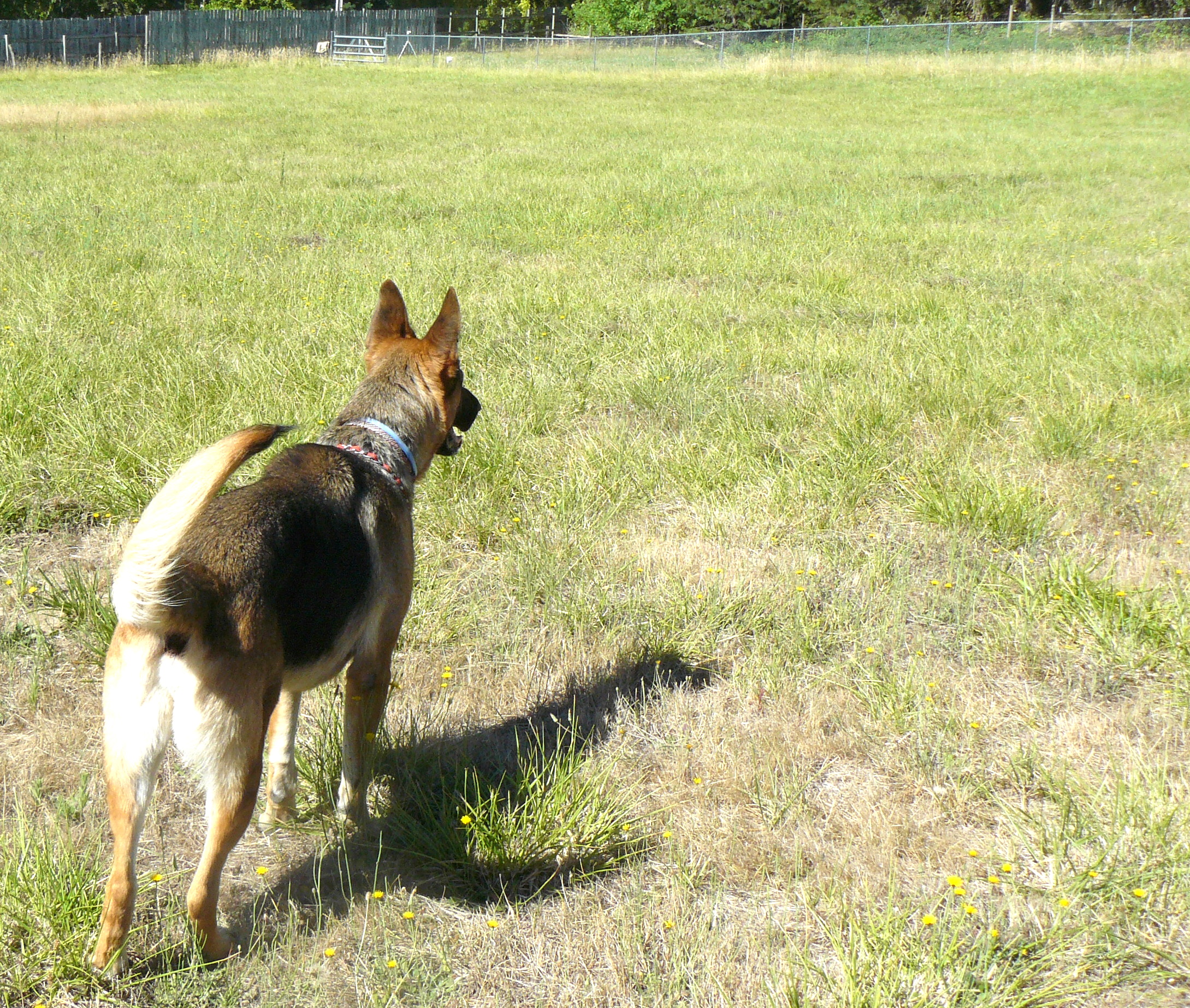
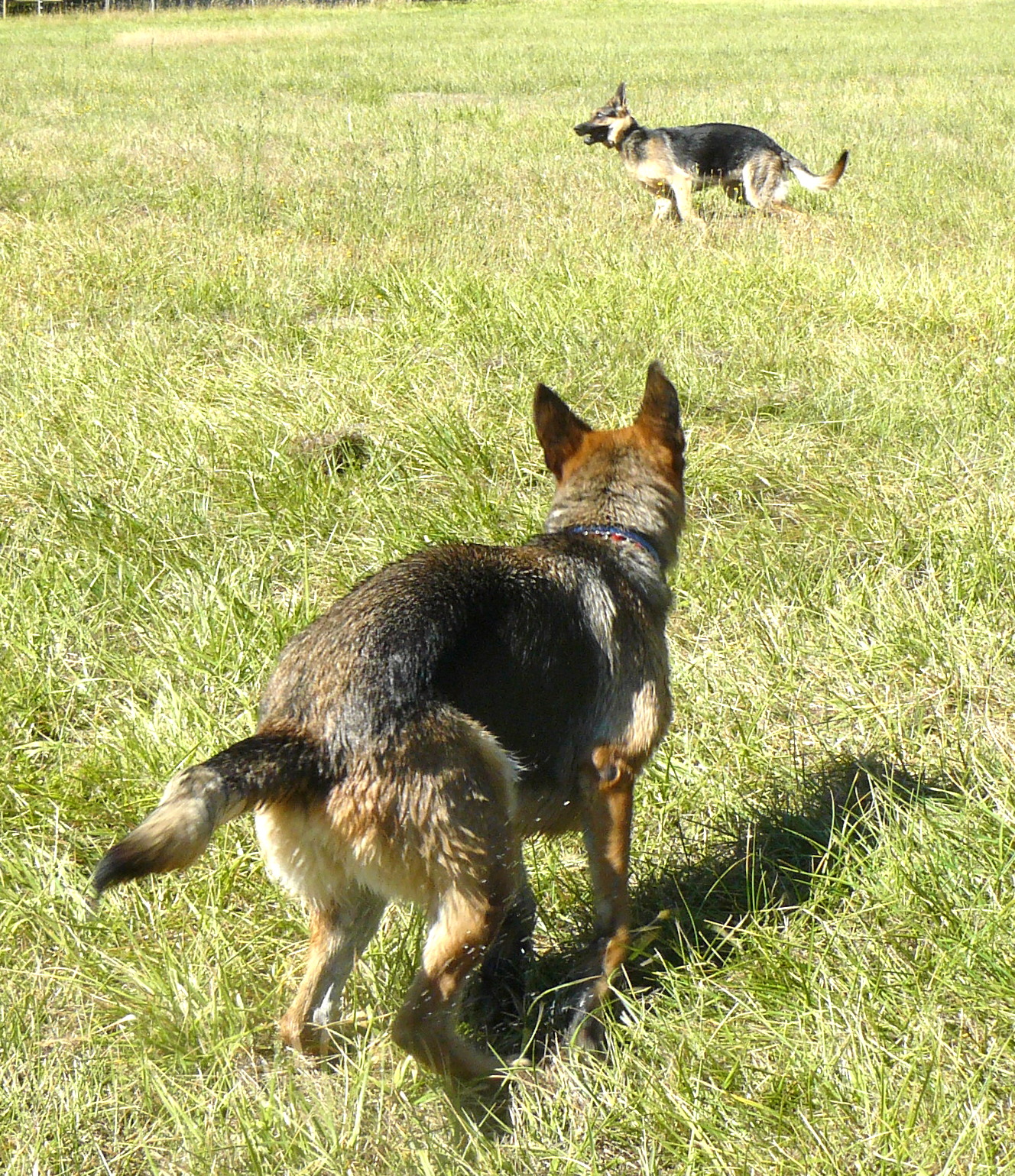
Duke pottered around and then caught sight of Cleo and Casey in the paddock.

First sighting of Cleo and Casey.

Then the meetings began!

Hello! My name is Duke. Do I smell OK? Mr. Casey?

And play didn’t seem to be too far off the agenda!

You lead, Cleo, I'll chase!
You lead, Cleo, I’ll chase!

So all the photographs and videos have been sent to Angela, and we will see what the conclusion is!

As Angela put it, “Remember, dogs talk dog far better than we do.”

ooOOoo

Yes there’s no question that dogs talk dog far better than we do!

Hubble into music.

Back to the space telescope!

I cannot stop engaging in Hubble stories and republishing them in this place.

The latest is an account, published here, of how scientists turned an image of a galaxy into music! Or rather added music to the video.

Here it is!

ooOOoo

Cool! A Hubble photo translated to music

Posted by in | May 10, 2020

There’s no sound in space. But – working with NASA – musicians and scientists turned a Hubble Space Telescope image of a galaxy cluster into music.

We stumbled on this video via a May 3, 2020, re-post at ScienceAlert. Matt Russo and Andrew Santaguida of System Sounds in Toronto – which calls itself “a sci-art outreach project” – created the video. It’s part of NASA’s Astrophysics Visualizations series. NASA explained the video this way:

Space becomes sonified in this visualization of a cluster of galaxies imaged by NASA’s Hubble Space Telescope. Time flows left to right, and the frequency of sound changes from bottom to top, ranging from 30 to 1,000 hertz. Objects near the bottom of the image produce lower notes, while those near the top produce higher ones. Most of the visible specks are galaxies housing countless stars. A few individual stars shine brightly in the foreground. Stars and compact galaxies create short, clear tones, while sprawling spiral galaxies emit longer notes that change pitch. The higher density of galaxies near the center of the image – the heart of this galaxy cluster, known as RXC J0142.9+4438 – results in a swell of mid-range tones halfway through the video. Hubble’s Advanced Camera for Surveys and Wide Field Camera 3 acquired this image on August 13, 2018.

Cool!

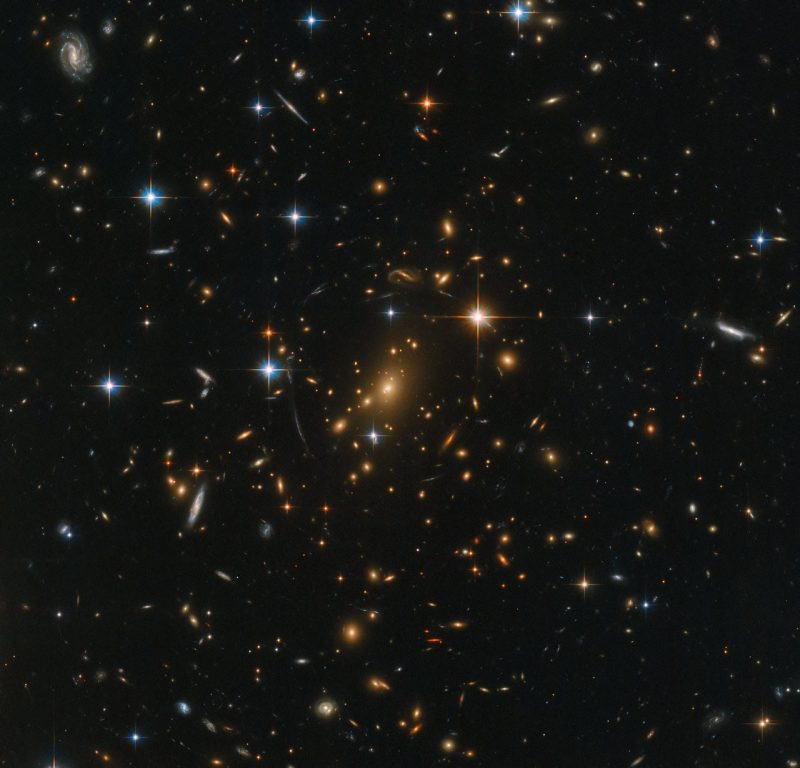
Here’s the original Hubble image of galaxy cluster RXC J0142.9+4438, later “sonified” by Russo and Santaguida. NASA wrote: “Galaxies abound in this spectacular Hubble image; spiral arms swirl in all colors and orientations, and fuzzy ellipticals can be seen speckled across the frame as softly glowing smudges on the sky. Each visible speck of a galaxy is home to countless stars. A few stars closer to home shine brightly in the foreground, while a massive galaxy cluster nestles at the very center of the image; an immense collection of maybe thousands of galaxies, all held together by the relentless force of gravity.” Read more about this image, which is via ESA/ Hubble & NASA, RELICS.

Here’s the original Hubble image of galaxy cluster RXC J0142.9+4438, later “sonified” by Russo and Santaguida. NASA wrote: “Galaxies abound in this spectacular Hubble image; spiral arms swirl in all colors and orientations, and fuzzy ellipticals can be seen speckled across the frame as softly glowing smudges on the sky. Each visible speck of a galaxy is home to countless stars. A few stars closer to home shine brightly in the foreground, while a massive galaxy cluster nestles at the very center of the image; an immense collection of maybe thousands of galaxies, all held together by the relentless force of gravity.” Read more about this image, which is via ESA/ Hubble & NASA, RELICS.

Bottom line: Musicians and scientists turned a Hubble Space Telescope image – of galaxy cluster RXC J0142.9+4438 – into music.

ooOOoo

That is so lovely.

It’s only just over half a minute long but is still precious!

And I learnt a new word: sonification!

Golden Brown

A musical classic!

We were listening to the radio early on Tuesday morning and the BBC News played a tribute to the recent death of Dave Greenfield. Here’s a little bit of that BBC News piece:

The Stranglers keyboard player Dave Greenfield has died at the age of 71 after testing positive for Covid-19.

Greenfield died on Sunday having contracted the virus after a prolonged stay in hospital for heart problems.

He penned the band’s biggest hit, Golden Brown, a song about heroin, which went to number two on the UK singles chart in 1982.

The Stranglers bass player Jean-Jacques “JJ” Burnel paid tribute to Greenfield as a “musical genius”.

He said: “On the evening of Sunday May 3rd, my great friend and longstanding colleague of 45 years, the musical genius that was Dave Greenfield, passed away as one of the victims of the Great Pandemic of 2020.

“All of us in the worldwide Stranglers’ family grieve and send our sincerest condolences to [Greenfield’s wife] Pam.”

Drummer Jet Black added: “We have just lost a dear friend and music genius, and so has the whole world.

“Dave was a complete natural in music. Together, we toured the globe endlessly and it was clear he was adored by millions. A huge talent, a great loss, he is dearly missed.”

There’s more to read but I wanted to republish one of the photographs taken:

(Left to right) Dave Greenfield, Jean-Jacques Burnel, Jet Black and Hugh Cornwell of The Stranglers in 1980

Then to close my tribute to Dave here’s a beautiful rendition of that most famous song – Golden Brown.

A classic, a real classic.

The loss of Dave Greenfield. A loss to us all!

Out of the mouths of young people!

A young man aged eight asks a very deep question.

Now the answer, that I am about to republish, is written to Tristan, aged 8. But frankly I have no doubt that the answer will be keenly read by persons of all ages. Certainly, this 75-year-old found the answer of great interest.

But to the question:

How can a Big Bang have been the start of the universe, since intense explosions destroy everything? – Tristan S., age 8, Newark, Delaware

And the answer:

ooOOoo

How could an explosive Big Bang be the birth of our universe?

April 30, 2020
By Michael Lam, Assistant Professor of Physics and Astronomy, Rochester Institute of Technology

Pretend you’re a perfectly flat chess piece in a game of chess on a perfectly flat and humongous chessboard. One day you look around and ask: How did I get here? How did the chessboard get here? How did it all start? You pull out your telescope and begin to explore your universe, the chessboard….

What do you find? Your universe, the chessboard, is getting bigger. And over more time, even bigger! The board is expanding in all directions that you can see. There’s nothing that seems to be causing this expansion as far as you can tell – it just seems to be the nature of the chessboard.

But wait a minute. If it’s getting bigger, and has been getting bigger and bigger, then that means in the past, it must have been smaller and smaller and smaller. At some time, long, long ago, at the very beginning, it must have been so small that it was infinitely small.

Let’s work forward from what happened then. At the beginning of your universe, the chessboard was infinitely tiny and then expanded, growing bigger and bigger until the day that you decided to make some observations about the nature of your chess universe. All the stuff in the universe – the little particles that make up you and everything else – started very close together and then spread farther apart as time went on.

Our universe works exactly the same way. When astronomers like me make observations of distant galaxies, we see that they are all moving apart. It seems our universe started very small and has been expanding ever since. In fact, scientists now know that not only is the universe expanding, but the speed at which it’s expanding is increasing. This mysterious effect is caused by something physicists call dark energy, though we know very little else about it.

A visualization of tiny energy fluctuations in the early universe. ESA, Planck Collaboration, CC BY

Astronomers also observe something called the Cosmic Microwave Background Radiation. It’s a very low level of energy that exists all throughout space. We know from those measurements that our universe is 13.8 billion years old – way, way older than people, and about three times older than the Earth.

If astronomers look back all the way to the event that started our universe, we call that the Big Bang.

Many people hear the name “Big Bang” and think about a giant explosion of stuff, like a bomb going off. But the Big Bang wasn’t an explosion that destroyed things. It was the beginning of our universe, the start of both space and time. Rather than an explosion, it was a very rapid expansion, the event that started the universe growing bigger and bigger.

This expansion is different than an explosion, which can be caused by things like chemical reactions or large impacts. Explosions result in energy going from one place to another, and usually a lot of it. Instead, during the Big Bang, energy moved along with space as it expanded, moving around wildly but becoming more spread out over time since space was growing over time.

Back in the chessboard universe, the “Big Bang” would be like the beginning of everything. It’s the start of the board getting bigger.

It’s important to realize that “before” the Big Bang, there was no space and there was no time. Coming back to the chessboard analogy, you can count the amount of time on the game clock after the start but there is no game time before the start – the clock wasn’t running. And, before the game had started, the chessboard universe hadn’t existed and there was no chessboard space either. You have to be careful when you say “before” in this context because time didn’t even exist until the Big Bang.

You also have wrap your mind around the idea that the universe isn’t expanding “into” anything, since as far as we know the Big Bang was the start of both space and time. Confusing, I know!

Astronomers aren’t sure what caused the Big Bang. We just look at observations and see that’s how the universe did start. We know it was extremely small and got bigger, and we know that kicked off 13.8 billion years ago.

What started our own game of chess? That’s one of the deepest questions anyone can ask.

ooOOoo

Before the Big Bang then there was “no space and there was no time.” Michael Lam says that is confusing. I think that’s a gigantic understatement.

There there’s Dark Energy!

I wonder if we humans will ever come to the point where it is all understood!

Time; beyond imagination!

I don’t know what is was that engaged me; to the point that I have written this blog post.

We rise around 4:30 am, thanks to the dogs, and after they have been out we retire to the bedroom and lay on the top of the bed and have a couple of cups of tea. Come 5am, week days, we listen to BBC Radio 4 and the World at One. Then immediately after the World at One, at the moment, is a fascinating series on A History Of The World in 100 objects.

A few days ago, after the end of the programme, I drifted off into some form of introspective gaze about the past. I mean the past big time!

The Universe

When and how did it all start? That seems to be the Big Bang. The Big Bang was an incredibly long time ago, some 14 billion years ago (rounding it up!).

Here’s an extract from Wikipedia:

The current measurement of the age of the universe is around 13.8 billion years (as of 2015[1]) – 13.799±0.021 billion years within the Lambda-CDM concordance model.[2] The uncertainty has been narrowed down to 20 million years, based on a number of studies which all gave extremely similar figures for the age.

That’s 13.8 times 10 to the power of 9!

Our solar system

Again, pretty old by human standards; 4.6 billions years ago.

Again, an extract from Wikipedia:

The Solar System formed 4.6 billion years ago from the gravitational collapse of a giant interstellar molecular cloud. The vast majority of the system’s mass is in the Sun, with the majority of the remaining mass contained in Jupiter. The four smaller inner planets, Mercury, Venus, Earth and Mars, are terrestrial planets, being primarily composed of rock and metal. The four outer planets are giant planets, being substantially more massive than the terrestrials. The two largest, Jupiter and Saturn, are gas giants, being composed mainly of hydrogen and helium; the two outermost planets, Uranus and Neptune, are ice giants, being composed mostly of substances with relatively high melting points compared with hydrogen and helium, called volatiles, such as water, ammonia and methane. All eight planets have almost circular orbits that lie within a nearly flat disc called the ecliptic.

So our solar system came along 9 billion years after the formation of the Universe.

Planet Earth

Our planet formed not long after our solar system. That’s pretty obvious if you ask me.

Thus Planet Earth formed 4.5 billion years ago. Again, thanks to Wikipedia.

Life on Planet Earth

Southampton University have published an extremely interesting chart of the timeline of the human condition. In it is revealed that the earliest atmospheric oxygen was 3.5 billion years ago, a necessary prerequisite to air-breathing life. But it took an extremely long time before monkeys appeared; some 36 million years ago. That’s 36 times 10 to the power of 6, or 383 times shorter than the start of the universe.

The earliest hominins (Australopithecus spp) among the hominids in Africa, bipedal, larger brain came along some 4.2 million years ago.

Among them were humans using stone tools, some 2.5 million years ago. Then 2 million years ago came the earliest direct ancestor of modern humans, Homo erectus (South Africa), co-habiting with Australopithecus and Paranthropus.

Then 40,000 years ago Neanderthals make flutes from bone, then 14,000 years ago the domestication of dogs in China, 7,000 years ago the world population passed 5 million souls, and 3,500 years ago the earliest alphabet (North Semitic, Palestine and Syria).

3,000 years ago the world population passed 50 million.

Come forward to just 195 years ago and the first public railway for steam locomotives (George Stephenson, UK, 1825) came into existence. In 1945, Alan Turing created the world’s first programmable calculator which lead directly to the first computer.

Then just 34 years ago the total population passed 5 billion souls (1986).

This and much more in the timeline which really is a fascinating read. Put together by C. Patrick Doncaster,  7 April 2020, one of the then 7,641,557,720 (rising by 148 per minute, 77 million per year).

But …

The discovery of quarks in 1968 caused us humans to think again about matter.

Wikipedia:

A quark (/kwɔːrk, kwɑːrk/) is a type of elementary particle and a fundamental constituent of matter. Quarks combine to form composite particles called hadrons, the most stable of which are protons and neutrons, the components of atomic nuclei.[1] Due to a phenomenon known as color confinement, quarks are never directly observed or found in isolation; they can be found only within hadrons, which include baryons (such as protons and neutrons) and mesons.[2][3] For this reason, much of what is known about quarks has been drawn from observations of hadrons.

Then there’s antimatter, now that’s really weird.

Again, an extract from Wikipedia:

There is strong evidence that the observable universe is composed almost entirely of ordinary matter, as opposed to an equal mixture of matter and antimatter.[4] This asymmetry of matter and antimatter in the visible universe is one of the great unsolved problems in physics.[5] The process by which this inequality between matter and antimatter particles developed is called baryogenesis.

So, to put it in layman’s terms, the fact that I am sitting here at a computer trying to make sense of it all and failing is just down to luck. The observable universe and my perception of it comes down to matter as opposed to antimatter!

I’ve got a headache!

N.B. It’s a little after 12:30 am (PDT) on the Saturday and I am going to leave this post up as the latest for tomorrow as well. There have been so many wonderful comments.

Start your day with music – a guest post!

More on mindfulness!

I opened my email box a couple of days ago and there was an email from Sarah.

It said:

Hi there!
I would be honored to be a guest writer for your blog and of course would reciprocate.  I hope you don’t mind that I shared your link in my last post.  I am not totally sure if blogging etiquette.  😀
Sarah Kinneavy
MyAmazing2ndChapter.com

Of course I said yes!

Sarah’s background is sociology and she has a degree in the subject. Just as important she owns a dog walking business. I will let her finish her background:

I believe in living life to the fullest.

My daughter is a Cancer survivor- and as a result of that journey- It put my life into perspective. I learned to never take anything for granted- you never know what’s around the next corner. I am continuing to work on becoming the best version of me, while making the most of each and everyday.

Frankly, I do not really know what it is like to have a daughter, or a son come to it, go down with cancer. The nearest I have come to the disease was when I had just turned 12 and my father died of lung cancer.

So here’s her guest post.

ooOOoo

Start your day with music- not the News! Surviving the Coronavirus with mindfulness Day 2

By Sarah Kinneavy, March 28th, 2020

As I continue to try to stay calm with mass panic happening across the globe 🌎 with this pandemic. As I mentioned in yesterday’s post:

https://myamazing2ndchapter.com/2020/03/27/surviving-the-coronavirus-with-mindfulness/

I am using mindfulness to train my brain in how it reacts to stress. The more we do these exercises the better we get at them.

Start your day with music rather than the news! Borrowed from https://musicoomph.com

Yesterday one of my friends posted on Facebook to start the day off with music – rather than the news! What a great idea!!! So, yesterday, as I got ready for a job interview and I waited until it was late enough in Hawaii to do my daily well check on my daughter there (she is in isolation in a dorm room – I am not sure if she has the dreaded virus or not). I used music as the focal point of this mindfulness exercise. This 15 minutes of focusing on the music- listening to the rhythm helped keep me present. I wasn’t worrying about getting the job or how my daughter was doing. I was just in that moment of getting ready with the accompaniment of music. It was honestly 15 minutes of pure happiness. What a great way to start my day! One thing I have to add – I try to not let myself think about what the words of the songs mean to me, or when I first heard the song. I just listen and enjoy. Okay- I may have danced around my apartment a bit too!

I can tell you – I did not feel anxious going to my interview like I normally would. I didn’t panic about my daughter’s health – I was able to wait until after my interview to check in on her. Mindfulness does not keep me from ever worrying about my kiddo or the world around me. No – I still worry – but It isn’t swallowing me up whole. And this is key!

Heading to my job interview.

I can’t wait to talk to you again tomorrow . How are you coping with all the stress and anxiety?

ooOOoo

That’s a lovely guest post!
And the message is clear and powerful: “No – I still worry – but It isn’t swallowing me up whole. And this is key!

There’s no escaping it!

Getting old is inevitable.

Becoming wiser as one ages less so!

I am minded to start today’s post with that reflection because quite simply it was the way to introduce my republication of Wibble’s post.

The article is about Dexter and is just lovely. It is called Older or wiser.

Enjoy!

ooOOoo

Older or wiser

By Dexter, February 19th, 2020

I’m sitting here and the rain is drizzling down the window. It’s February, its windy, we’ve had two winter storms in quick succession and they are digging up the road outside my house. Do they not know I am trying to sleep. Even more surprising but equally as joyous, Lenny isn’t trying to bite me. Now if you have read some of my recent blogs, you will know I have been somewhat contemplative. If you are hoping for shenanigans in this article, then I fear you will again be somewhat disappointed. Earlier today I was wondering to myself about becoming older and, apparently, wiser.

Being older is a bit obvious really. I have more grey hair, I eat my dinner more slowly and I don’t need to walk as far as I used to. I’ve even missed scenting rabbits and squirrels according to assorted parents I have been attached to when these alleged missed sightings have taken place. I can still play bitey face with Lenny, and give him what for, but I tend to duck out of said prolonged snout jousting after a short time. Being beagles we are docile chaps and even when we are in full cry with sofa covers flying around, furniture being rearranged and rugs being ruffled, we manage to stop for a breather on fairly regular occasions. Sometimes it takes a parent stepping in between us to remind the warring parties that its time for a break but, on the whole, we tend to cease and desist quite readily. I am then happy to retire to one of my six or so beds to snooze. However Lenny seems to have a little extra bounce in his paws although I think that is because he is around eighteen months old and I am, allegedly, going to be ten next birthday. No one truly knows how old I am due to me being a rescue but the wise money is on nearly ten now. I am happy for him to run around a little longer, chew what remains of one of my toys and then fall asleep on the sofa. Usually this is interspersed with trying to bite me but again, being docile, I try and fend him off without sending clear signals that I just want to rest.

Older?

As for being wiser, I don’t really know what that entails. If it means that I have seen things, been places and done stuff, then yes I am wiser. If it means that having done said activities, I have learned from the experiences, then not necessarily. For example I have been on the tube and train to London quite a few times, however I still want to investigate what those wonderful smells are down on the track. Thank goodness for a lead and attached human apparently. Another example, is that I have lived here for seven Christmases and, despite the jolly red faced man delivering me many wonderful things but nothing closely resembling a pizza tasting gift, it is wrapping paper I am still fascinated by. I can’t eat it, I know I can’t, but does it stop me from trying? Of course not. Many winters have I seen here, many dirty puddles have I walked through in a Moses style and many times have I been told “Dex, no, ugh good grief you look like the Creature from the Black Lagoon”. Does it stop me stomping through puddles in the most triumphal fashion? No, of course not. I have stopped chasing pigeons in the garden and that’s not because I am banned from the garden. Far from it, for I merely allow my protege to chase them for me. Young whipper-snapper legs are faster than these old bones of mine. I have stopped chewing my toys to a misshapen soggy jumble of fabric, with an accompanying scene of death and destruction wrought across the rugs. Again I leave the dental lobotomisation of toys to Lenny, as he seems to have picked up the baton fairly quickly and extremely proficiently.

Wiser?

If growing older and wiser means seeing things, going places, enjoying the view, smelling more flowers and generally knowing that I should take my time to appreciate and immerse myself in all the things I rushed to see previously, then I am older and wiser. I still have adventures, I still walk and pull on the lead, stick my head down rabbit holes and try to climb the banks along the lanes and byways I explore. I still look in awe at the beauty of the countryside I visit, gaze at the buildings and people in the city. But I let it sink in now, I actually look at what is in front of me and then usually fall asleep soon after, twitching and dreaming. I am trying to pass on my perceived wisdom to Lenny. He is often too busy bouncing around, trying to sniff everything, meet every fur and being a very lovable pest in as quick a time as possible. I see much in Lenny that I had in my youth and this gives me a warm feeling. I hope I can help him to understand that, at some point, he will sit and watch the world go by, with a peace and calmness that I seem to be achieving more often.

Who knows, maybe that is the secret to being older and wiser.

ooOOoo

Just read that last paragraph again. Especially the first sentence: “If growing older and wiser means seeing things, going places, enjoying the view, smelling more flowers and generally knowing that I should take my time to appreciate and immerse myself in all the things I rushed to see previously, then I am older and wiser.

In my opinion dogs do this so much better than we humans. Yet another lesson to be learned from dogs!

Because both for dogs and their human friends, it’s only a matter of time!

Yet another bonus of having dogs in our lives.

There really is no end to the sense of smell that a dog has.

I was browsing online The Smithsonian magazine and came across a long article that was all about the dog’s sense of smell in terms of sniffing out citrus greening disease.

There’s no end of articles about the dog’s sense of smell and I have written about it before. But first I’m going to reproduce the article on Animal Planet because it gets to the point.

Dogs rule. Or, at least, they do when it comes to their sense of smell, which crushes that of humans. According to the Alabama Cooperative Extension System (ACES), a dog’s sense of smell is about 1,000 times keener than that of their two-legged companions — and many dog experts claim it’s millions of times better — thanks to the construction of their often-slobbery, wet schnozzes. So what, exactly, is going on in there?

A dog sniffs at scents using his nose, of course, and also his mouth, which may open in a sort of grin. His nostrils, or nares, can move independently of one another, which helps him pinpoint where a particular smell is coming from. As a dog inhales a scent, it settles into his spacious nasal cavity, which is divided into two chambers and, ACES reports, is home to more than 220 million olfactory receptors (humans have a measly 5 million). Mucus traps the scent particles inside the nasal chambers while the olfactory receptors process them. Additional particles are trapped in the mucus on the exterior surface of his nose.

Sometimes, it takes more than one sniff for a dog to accumulate enough odor molecules to identify a smell. When the dog needs to exhale, air is forced out the side of his nostrils, allowing him to continue smelling the odors he’s currently sniffing.

Dogs possess another olfactory chamber called Jacobson’s organ, or, scientifically, the vomeronasal organ. Tucked at the bottom of the nasal cavity, it has two fluid-filled sacs that enable dogs to smell and taste simultaneously. Puppies use it to locate their mother’s milk, and even a favored teat. Adult dogs mainly use it when smelling animal pheromones in substances like urine, or those emitted when a female dog is in heat.

Top Sniffers

What all of this sniffing and processing really means is that a dog’s sense of smell is his primary form of communication. And it’s a phenomenal one, because dogs don’t just smell odors that we can’t. When a dog greets another dog through sniffing, for example, he’s learning an intricate tale: what the other dog’s sex is, what he ate that day, whom he interacted with, what he touched, what mood he’s in and — if it’s a female — if she’s pregnant or even if she’s had a false pregnancy. It’s no wonder, then, that while a dog’s brain is only one-tenth the size of a human brain, the portion controlling smell is 40 times larger than in humans.

So, who’s top dog when it comes to sniffing? While all canines have an incredible sense of smell, some breeds — such as bloodhounds, basset hounds and beagles — have more highly refined sniffers. This is a result of several factors. Dogs with longer snouts, for example, can smell better simply because their noses have more olfactory glands. Bloodhounds, members of the “scent hound” canine group, also have lots of skin folds around their faces, which help to trap scent particles. And their long ears, like those of Bassets, drag on the ground, collecting more smells that can be easily swept into their noses.

Of course, dogs are individuals as well, so it’s certainly possible to find a non-scent-hound who can outperform one. And as Dr. Sandi Sawchuk, a clinical instructor at the University of Wisconsin School of Veterinary Medicine, notes: “There are lots of breeds that can be trained to sniff out certain items — for example, cadaver-sniffing dogs, drug-sniffing dogs, etc.”

Now to that longer Smithsonian article.

ooOOoo

Can Disease-Sniffing Dogs Save the World’s Citrus?

Once trained, canines can detect citrus greening disease earlier and more accurately than current diagnostics

By Katherine J. Wu ,    smithsonianmag.com
Feb. 3, 2020

A detector dog named Szaboles, trained to sniff out the bacterial pathogen Candidatus Liberibacter asiaticus in a citrus orchard. (Courtesy of Tim R. Gottwald)

Tim Gottwald will never forget the sight: the mottled yellow leaves, the withered branches, the small, misshapen fruits, tinged with sickly green. These were the signs he’d learned to associate with huanglongbing, or citrus greening—a devastating and wildly infectious bacterial infection that slashed the United States’ orange juice yields by more than 70 percent in the span of a decade.

“It’s like a cancer,” says Gottwald, a plant pathologist with the United States Department of Agriculture. “One that’s metastasized, and can’t be eradicated or cured.”

Once they’ve begun to sport splotchy foliage and stunted fruit, trees can be diagnosed with a single glance. A symptomatic plant, Gottwald says, is a diseased one. Unfortunately, the converse isn’t true: Infected trees can appear normal for months, sometimes years, before visibly deteriorating, leaving researchers with few reliable ways to suss out sick citrus early on—and giving the deadly bacteria ample opportunity to spread unnoticed.

Now, Gottwald and his colleagues may have a creative new strategy to fill this diagnostic gap—one that relies not on vision, but smell. They’ve taught dogs to recognize the telltale scent of a huanglongbing infection—an odor that eludes the attention of humans, but consistently tickles the super-sensitive schnozz of a mutt. Once trained up, canines can nose out the disease within weeks of infection, trouncing all other available detection methods in both timing and accuracy, the researchers report today in Proceedings of the National Academy of Sciences.

“This is a major step in the development of what could be a really important early detection tool,” says Monique Rivera, an entomologist and citrus pest expert at the University of California, Riverside who wasn’t involved in the study. “It could give growers information about potential exposure … to the causative bacteria.”

First described in China in the early 1900s, huanglongbing has now crippled orchards in more than 50 countries around the globe. Fifteen years ago, the scourge took hold in Florida, where infected trees are now the norm; the state’s $9 billion citrus industry, once the second largest in the world, is now on the verge of collapse. From oranges to grapefruits to lemons, no variety of citrus is immune.

As the disease continues to creep into new regions, researchers worldwide are scrambling to contain it. But the task has proved difficult: No effective treatments, cures or vaccines exist for huanglongbing, the product of a bacterium called Candidatus Liberibacter asiaticus (or CLas, pronounced “sea lass”) that’s ferried from tree to tree by winged insects. Scientists have also found the microbes to be extraordinarily difficult to grow and study in the lab.

The 20 canines in the study trained to detect CLas-infected citrus trees. (Gottwald et al., PNAS, 2020)

Currently, the only surefire way to curb citrus greening’s spread is to extract and eliminate infected trees. This strategy depends entirely on early detection—“one of the biggest problems in the field right now,” says Carolyn Slupsky, a plant pathologist at the University of California, Davis who wasn’t involved in the study. Spotting an asymptomatic infection by eye is essentially impossible. And though genetic tests can sometimes pinpoint microbes in apparently healthy trees, their success rates are low and inconsistent, due in part to the patchiness with which CLas distributes itself in plant tissue.

In many ways, huanglongbing is “the perfect storm of a disease,” Slupsky says.

But canines may just be the perfect candidates to lend a helping paw. With a sense of smell that’s 10,000 to 100,000 times more powerful than a human’s, dogs are superstar sniffers, capable of nosing out everything from bombs to drugs. In recent years, they’ve even been deployed to detect pathogenic diseases like malaria. Infections, it turns out, stink—and dogs definitely take notice.

To see if pooches’ powers of perception might extend to huanglongbing, Gottwald and his team taught 20 dogs to pick up on the smell of citrus plants with known infections, rewarding the pups with toys when they identified the correct trees. After just a few weeks of training, the newly-minted citrus sniffers were picking out infected trees with about 99 percent accuracy. Put in pairs to corroborate each other’s results, the dogs got close-to-perfect scores.

Gottwald was floored. “I wasn’t surprised [the dogs] could do it,” he says. “But I was surprised by how well they could do it. It was pretty amazing.”

The team then pitted the pups against a common but expensive laboratory test that’s often used to verify the presence of CLas DNA in suspicious-looking citrus. After spiking the microbes into 30 trees, the researchers mixed the newly-infected plants into rows of healthy ones and allowed the dogs to inspect them on a weekly basis. Within a month, the canines had collectively homed in on every single CLas-positive plant.

The DNA test, on the other hand, had no such luck: Seventeen months into the infection, it was still failing to identify a third of the diseased trees.

If Gottwald’s team sees continued success, “this could be very exciting for [citrus] growers,” who could someday keep dogs around as a fast and relatively inexpensive way to survey their orchards, says Phuc Ha, a microbiologist at Washington State University who wasn’t involved in the study. For now, the most immediate applications lie in disease prevention. But, she adds, should researchers develop treatments for huanglongbing, canines could eventually play a role in curing the condition as well.

Gottwald and his team have already begun to send small teams of citrus-sniffer dogs to inspect vulnerable trees in California and Texas. In both locations, the canines have alerted the researchers to trees that have yet to test positive in the lab.

This, however, evokes the double-edged sword of early detection research: The dogs are so much faster at finding potentially diseased trees that their picks can’t actually be confirmed, Slupsky points out. Maybe they’re more sensitive than the molecular test, and the disease is more widespread than researchers feared. Or maybe the canine’s noses are leading them astray. “Specificity is always an issue,” Slupsky says, “because you’re comparing them to an imperfect test.”

Dogs also come with their own drawbacks. They can tire; they can be distracted. They’re not machines. And while they can make fast work of orchards where infections are rare, their performance will probably plummet in heavily afflicted groves. In an ideal world, Slupsky says, the dogs would serve strictly as a first line of defense, screening trees for further monitoring or testing in the lab. She and her colleagues are hard at work on one such diagnostic, built to detect the unique suite of chemicals infected leaves produce early on.

Many questions remain unanswered. Gottwald still isn’t sure what exactly the dogs are smelling on the plants, though a series of experiments indicate the scent is probably coming from the CLas bacteria themselves. That theory may be tough to test: Though researchers like Washington State’s Ha have now grown CLas in the presence of other microbes, no one has yet managed to isolate the strain in a pure culture, hampering efforts to understand its basic biology and develop precise treatments.

While exciting, the team’s dog-nostic developments ultimately underscore “just how distant we still are from understanding a lot of the mechanistic processes that are going on [with this disease],” Rivera says. But with more collaboration and multidisciplinary work, she adds, “I think we’ll keep heading toward solutions.”

ooOOoo

When one watches a dog closely it’s very clear that their nose is their primary sense. At least a thousand times better than our human sense of smell and some people put it much higher. That is impossible to understand. The best we can do is to wonder at the sort of world that dogs ‘see’ with their noses.

I will close with an old photograph of Pharaoh helping a prospector look for gold in our creek.

Pharaoh, instinctively, thought that a dog’s nose would raise the odds of a find.

This has nothing to do with dogs!

But everything to do with staying fit and healthy.

There are many things that I read first thing in the morning before I am dressed. Ninety-nine percent of them I don’t share with you.

But the following caused me to a) reflect on whether I was guilty of doing this, and b) how many others know of this.

One of the results of having 4,000 (bar 25) followers of this place is that I feel a certain obligation to share certain news.

It was published on The Conversation and is free to reproduce.

So here goes:

ooOOoo

The serious consequence of exercising too much, too fast

Exercising too much, too hard can lead not only to burnout but sometimes to a serious condition that can harm the kidneys.

By , Associate Professor of Exercise and Sports Science, Wayne State University, January 24th, 2020.

Every 365.25 days, when the Earth completes a full orbit around the Sun, we humans have the opportunity to hit the reset button and become fitter, finer versions of ourselves. As usual for January, social media is humming with advice on how to eat better, exercise regularly, lose weight and remain healthy. We feel particularly invincible at this time of year, armed with renewed vigor and motivation to purge ourselves from previous indulgences and our couch-potato ways.

The New Year is also the time when our overzealous, instant-gratification selves emerge, and we do too much exercise too soon to make up for lost time. Exhaustive muscular work, especially following a period of inactivity, can cause mechanical and chemical disruptions to muscle cell membranes which trigger the muscle cells to burst.

I am an exercise physiologist and sports medicine specialist who studies exercise-associated collapse. I am seeing and hearing of more incidents of skeletal muscle ruptures that are causing harm in other parts of the body.

This information is not designed to scare people back onto the couch. The key take-away from highlighting these cases is to remind athletes, coaches and mere mortals that the desired physiological response to a training stimulus requires both a gradual buildup period and period of recovery in between training sessions.

A cross-section of the human kidneys, which can be injured when muscle cells rupture and send toxic chemicals into the bloodstream. crystal light/Shutterstock.com

More than muscle injury

The medical term for skeletal muscle cell rupture is “rhabdomyolysis,” or “rhabdo” for short. When muscle cells rupture or explode, the intracellular contents are released into the bloodstream. These cellular contents include enzymes, such as creatine kinase; electrolytes, such as potassium; and proteins, such as myoglobin.

Myoglobin, in particular, is a big, red protein that can block the kidney filtration system, or renal tubules, that serve as kidney plumbing. It also can dissociate into toxic byproducts that injure kidneys. In rare cases, too much myoglobin in the bloodstream can stop kidney function altogether, as happened with a 27-year old marathon runner who died from kidney failure.

In a study we conducted on college swimmers, we saw a cluster of rhabdomyolysis, in which six out of 34 swimmers were hospitalized after participating in a 20-minute or so “arm competition” to see how many pull-ups, rows and bench presses they could complete. Cases of “symptomatic rhabdo,” or those needing medical treatment, appear to be increasing within collegiate sports teams at an alarming rate, with the characteristic appearance seen in football players returning to January practice after a season-ending holiday layoff.

To date, 17 cases of team rhabdo have occurred from doing “too much, too soon, too fast” and include a variety of sports such as football, swimming, lacrosse, soccer, track, basketball, softball, volleyball and golf.

Noncompetitive athletes affected too

So, what about us mere mortals trying to get back in shape? Any physical activity that is either new or excessive can cause symptomatic rhabdo. Excessive gardening, weightlifting, CrossFit type activities and even a routine Army physical fitness test have triggered symptomatic rhabdo with kidney injury.

Over 90 cases of rhabdo have been documented after spinning, while 119 high school students in Taiwan ended up in the emergency room after their teacher made them complete 120 push-ups within five minutes. Thus, harmful muscle cell rupture can occur after any degree five minutes to 36 hours of exuberant and/or unaccustomed physical activity.

In combination, gradual training and appropriate recovery allow beneficial muscular, cardiovascular and body composition adaptations to occur, such as building muscle, increasing fitness and losing body fat. Our research confirms that a two-week gradual introduction into training after a layoff is required for muscle cell membranes to fully adapt to training stress.

Subclinical rhabdo, or muscle breakdown without acute kidney injury or debilitating symptoms, is common and represents the typical response to training which does not require medical treatment. However, hard exercise, especially following a layoff, with the following signs or symptoms within one to two days requires an appropriate medical examination:

    • excruciating muscle pain that does not resolve over time
    • muscle swelling with limitations in movement
    • nausea or vomiting, or both
    • very dark (looks like Coca-Cola) or sparse urine.

There are risk factors which increase the likelihood of developing rhabdo following a workout. These risk factors include exercising in the heat, dehydration or overhydration, binge drinking, excessive coffee consumption, extreme dietary practices (vegetarian or high [protein] https://doi.org/10.1097/JSM.0000000000000310)) and possessing the sickle cell trait. Both men and women can develop symptomatic rhabdo, although we see more cases in men. Smaller arm muscles appear more susceptible to rupture after five to 30 minutes of exercise than bigger leg muscles for reasons that remain unclear.

Although symptomatic rhabdomyolysis is uncommon, this emergent complication of exercise should be on everyone’s radar since cases are on the rise. We coaches, trainers, scientists, practitioners and others encourage everyone to reap the joys and benefits of regular exercise training. However, we caution against exercising too much too soon. Self- (or coach-) inflicted skeletal muscle cell explosions are fully preventable with adherence to smart, physiologically sound approaches to training.

ooOOoo

Now there’s an element of me not really understanding this (and I haven’t yet watched the video) but that’s no reason not to share it with you.

What do you think? Wiser to share it or too much a case of worrying? Tamara Hew-Butler certainly knows all about this.