I have referred yesterday to the series on the BBC hosted by Professor Brian Cox called Wonders of the Universe. Well we managed to watch the last episode last night, entitled Messengers. Like the other three episodes, it was breath-taking.
In this last episode, Prof. Cox speaks of the universe still expanding with the outer edge, if edge is the appropriate word, being about 8.7 billion light years away. Thus the age of the Universe is about that; 8.7 billion light years. Note: NASA has a piece that suggests that this figure may not be confirmed. But let’s not worry too much about the precise value. But we will take a short detour to understand a little more about the ‘light year’.
So to measure really long distances, people use a unit called alight year. Light travels at 186,000 miles per second (300,000 kilometers per second). Therefore, a light second is 186,000 miles (300,000 kilometers). A light year is the distance that light can travel in a year, or:
A light year is 5,865,696,000,000 miles (9,460,800,000,000 kilometers). That’s a long way!
That is a single light-year. Now reflect on the outer edge of the universe being, say, 8,700,000,000 multiplied by 5,865,696,000,000 miles away. Don’t know about your mind, but my mind has no ‘feel’ for that distance whatsoever.
OK, next proposition put forward by Prof. Cox. That is that scientists believe that ‘The Big Bang’ was the instant that the universe erupted, if that’s an appropriate word, from a single point, smaller than the size of a grain of sand.
That has no rational meaning whatsoever. Now my mind just goes into la, la land! But at the level of magic, mysticism, the spiritual, then one does experience the deep meaning of the creation. Our creation. For we are part of the universe and the universe is part of us.
Just like the rose. Trying to describe it cuts nothing compared to closing one’s eyes and simply breathing in the perfume.
Here is that last episode, in four parts from YouTube. Watch and prepared to be transformed.
Life is without meaning. You bring the meaning to it.
The meaning of life is whatever you ascribe it to be.
Being alive is the meaning.
It would be so easy to stay with this theme for a very long time, perhaps to the end of one’s mortal days.
Anyway, my topic has taken sufficient shape for me to conclude with this article and then leave these ideas with you, or just out there in the universe. The ‘shape’ being that whether the facts about the way we treat Planet Earth depress you, or whether taking a mystic, spiritual view is more your scene, it’s up to you. Let’s recap.
The first article was to show that there are very strong and valid reasons to take an incredibly dim view of where it’s all heading. In fact, those that stay with Learning from Dogs over the weeks, you hardy lot!, will know that the premise that we, as in mankind, are well and truly in the midst of a massive transition, unlike anything ever experienced before, is an idea that crops up here every so often. This piece on the 22nd is just an example, and there are many more articles resonating around this theme on the Blog.
Then the second article was to show that a simple change of perspective can make all the difference to how we see the world. (Oh, and such a big thank-you to Sue Dreamwalker for that beautiful poem from her.)
OK, to the point of this article!
The BBC have been showing the most beautiful episodes in recent weeks from a massive production hosted by Professor Brian Cox- The Wonders of the Universe. Here’s the BBC trailer.
Did you pick up on that key sentence? “Ultimately, we are part of the universe.”
Here’s a recent piece from the British Guardian newspaper, I think written by Brian Cox, the presenter of the series.
The universe is amazing. You are amazing. I am amazing. For we are all one. Everything we are, everything that’s ever been and everything that will ever be was all forged in the same moment of creation 13.7bn years ago from an unimaginably hot and dense volume of matter less than the size of an atom. And that is amazing. [Understatement! Ed.] What happened before then in the Planck epoch is a matter of conjecture; we lack a theory of quantum gravity, though some believe the universe was formed from a collision of two pieces of space and time floating forever in an infinite space, but I feel I’m losing you at this point, which isn’t so amazing.
Read it in full here, but it concludes, almost poetically, as,
Time feels human, but we are only part of Cosmic Time and we can only ever measure its passing. As I stand in front of the great glacier that towers over Lake Argentino, time seems to almost stand still, yet as I explain the effects of entropy in the Namibian desert as sandcastles crumble around me, you can see that the transition from order to chaos can happen almost in the blink of an eye. One day, perhaps in 6bn years, our universe will stop expanding, the sun will cool and die, as all stars must, and everything will collapse in on itself, back into a black hole singularity. I leave you with this last thought: that we, too, will only really die when the universe dies, for everything within it is intrinsically the same.
Brian Cox takes an almost mystical perspective of the size of the universe and the almost unimaginable number of stars and planets it contains.
So, how many stars are out there? From here, I quote,
It’s a great big Universe out there, with a huge numbers of stars. But how many stars are there, exactly? How many stars are there in the Universe? Of course it’s a difficult question to answer, because the Universe is a vast place and our telescopes can’t reach every corner to count the number of stars. But we can make some rough estimates. Almost all the stars in the Universe are collected together into galaxies. They can be small dwarf galaxies, with just 10 million or so stars, or they can be monstrous irregular galaxies with 10 trillion stars or more. Our own Milky Way galaxy seems to contain about 200 billion stars; and we’re actually about average number of stars.
So an average galaxy contains between 1011 and 1012 stars. In other words, galaxies, on average have between 100 billion and 1 trillion numbers of stars.
Now, how many galaxies are there? Astronomers estimate that there are approximately 100 billion to 1 trillion galaxies in the Universe. So if you multiply those two numbers together, you get between 1022 and 1024 stars in the Universe. How many stars? There are between 10 sextillion and 1 septillion stars in the Universe. That’s a large number of stars.
Even if one writes down in longhand the number, 1022 , as in 10,000,000,000,000,000,000,000 it still has no real meaning whatsover. That, of course, does not even get close to estimating how many planets there are out there.
Let’s say, just as a muse, that each sun only had a single planet. Let us also continue this musing and say that only one in a billion planets had life on it. In other words, if we divide 1022 by a billion, we still get the eye-watering result of there being 1013 or, longhand, 10,000,000,000,000 planets with life forms. That’s 10 trillion, by the way!
OK, cut it down some more, and then some more, and even more.
But whichever way you cut it, the conclusion is inescapable, the universe must be teeming with life and much of that life intelligent and wise.
So let me leave you with this thought about the meaning of it all. It’s this.
It is said that the world reflects back what we think about most. As I hope to have shown, we can think our way into extinction, or we can think our way to more mystic and spiritual outcomes. The meaning of life is whatever you ascribe it to be.
In the end, if we screw up this planet as place for mankind to prosper and grow, it’s no big deal. There will be many other humankinds out there in the universe who have taken a different route.
Life is without meaning. You bring the meaning to it.
The meaning of life is whatever you ascribe it to be.
Being alive is the meaning.
Going back to yesterday’s Post, if you either watched in full or dipped into each segment of the film, Prophets of Doom – The American Collapse, it would have been impossible for you not to end up pretty despondent about where civilisation in general, and American civilisation, in particular, has got itself.
The film is probably factually well-based, despite the awful style of the presenter, so it would be a perfectly human response to worry about how close to the precipice we are getting.
Anyway, the following evening we watched a wonderful DVD lent to us by John H, Mythic Journeys. Here’s the official trailer. Watch it, but more importantly listen to the words of the soundtrack, they are inspiring.
If you go to the website, as highlighted, then you will read this about the movie.
Own the award-winning spiritual film that has captivated audiences across the country and has been hailed as a “Masterpiece”, “Profoundly Transformative”, and “Life-Changing”!
Mythic Journeys is not your typical documentary. Like a mythological story it is a multi-layered experience, rich and stimulating interviews with philosophers and spiritual leaders are interwoven with a gorgeous animated tale of a king, a sorcerer, and a mischievous corpse. The film takes the audience on a powerful spiritual journey.
But there’s more to it, as the next video clip underscores. It’s this. As Duncan Campbell explains in the video, change is deeply unsettling for humans.
There is no doubt that millions of people across the world sense that we are in an era of very great change. It deeply undermines our security in the future, whether having any real form of emotional reliance on the future makes any sense anyway. But if we let go of the future, as Terry Hershey so competently voiced when he was here in Payson, then we can pray and love each moment of each day.
Life is without meaning. You bring the meaning to it.
The meaning of life is whatever you ascribe it to be.
Being alive is the meaning.
This is a quote from Joseph Campbell and, as with so much of his writings, these few words have an import way beyond the face reading of the four sentences. Why am I called to this introduction? Let me explain.
The last few days have been unusually hectic, almost as though my senses have been deliberately targeted by a whole variety of messages. Not planned, you have to understand, just the way it’s been. However, when reflecting on the way these messages have moulded my emotions, it has been very clear that conflicting messages have produced conflicting emotions and that getting to the heart, as in the meaning of it all, requires quiet, contemplative time.
So what I am going to do over the next few days, not over the week-end, is to present each of these elements in the order that they were presented and then, at the end, offer what I hope is a more balanced perspective, i.e. the core meaning.
The first ‘message’ came from watching a 90 minute video highlighted on the web site, Top Documentary Films. The film explored the ways that six prominent Americans thought the ‘American Way’ was heading. Deeply gloomy except for the last 10 minutes or so.
Today’s world has troubles unique to its time in history, from the global financial crisis to technological meltdowns to full scale, computerized global war.
Observing the convergence of such events, contemporary prophets have begun to emerge from obscurity to suggest that these conditions might be signs of the demise of the modern world.
These men are historians as well, using all manner of information and patterns from the past to provide context for where we are going.
Their predictions interpret the current state of affairs in our world as evidence that the America we know may come to an end.
The men proposing these ideas are not crackpots living on the streets of New York; they are intelligent, learned men who come armed with the evidence to back up their claims.
I am now going to include the film, in all its parts, as found on YouTube. Don’t suggest you watch it all, unless you feel so inclined, but try and get a feel for the various aspects of American life that are portrayed as unsustainable.
Just as important, make a note of your emotions as you watch these excerpts (and commenting on this Blog even better!)
When we’re in love with God, the cosmos, our living garden planet and the steadily growing conscious interconnection between those who understand and serve, we live in awe and wonder and realize a peaceful natural serenity in the midst of our daily concerns and responsibilities.
As our world, our environment and our culture appear to be unraveling, it becomes increasingly necessary for human beings to slow down to re-energize. It’s clear that our species has recently lost spectacularly to natural forces in the Gulf of Mexico and Japan. It’s no coincidence that it’s our technology which continues to reveal the fundamental weakness of human ego. It’s more than a metaphor that our individual and species arrogance is our Achilles heel.
There are many people who fail to perceive, understand and appreciate parallel realities from a rational, sensory and unified perspective by learning to see through a mystical third eye. Mysticism may be misunderstood as simply thinking outside of the box. Forget about the box. Let go of self-centered fears. Become aware of being unaware. Nurture capabilities to perceive non-locally and act locally. What’s happening worldwide comes with the territory. We are each responsible for our collective destiny
Meditation reflects that imagination and creativity are necessary to invent and utilize tools. Creativity did not begin with humans and is not exclusive to humans. God’s nature precedes emerging technology. Morality derives from our common need for species unity.
The message is that God doesn’t care about money and the sky is no longer a human limit. The fact remains that except for occasional astronauts we all continue to live on the same planet. Those who understand need no explanation.
There is a need for productive use of intelligence and technology at our natural frontiers. We need to refuel world economies with clean energy visions that provide solutions for our present local planetary emergency.
We may choose to implement the changes necessary to avoid impending local ecosphere, cultural and technological meltdowns while preparing for a migration to the stars.
Unification is a common goal. Leaving the nest of our garden planet is a partial unifying solution for the problems of our exponentially expanding species. An alternative is that our obsession with the symbol of money will have the same dire consequences for those who are obsessed as for those whom are oppressed.
Please love God, maintain an even strain, follow your bliss, continue to learn, share and serve our common purpose under God, proceed as the way opens, cross the next bridge as we come to it, enjoy the journey and stay in touch.
Ice loss from Antarctica and Greenland has accelerated over the last 20 years, research shows, and will soon become the biggest driver of sea level rise.
From satellite data and climate models, scientists calculate that the two polar ice sheets are losing enough ice to raise sea levels by 1.3mm each year.
Overall, sea levels are rising by about 3mm (0.12 inches) per year.
2. Running on Oil
A recent email in my in-box from John Maudlin was all about Japan and oil. But there were some stark messages about our use of oil across the planet. Try this:
There are multiple sources for many of the metals Japan imports, so that if supplies stop flowing from one place it can get them from other places. The geography of oil is more limited. In order to access the amount of oil Japan needs, the only place to get it is the Persian Gulf. There are other places to get some of what Japan needs, but it cannot do without the Persian Gulf for its oil.
This past week, we saw that this was a potentially vulnerable source. The unrest that swept the western littoral of the Arabian Peninsula and the ongoing tension between the Saudis and Iranians, as well as the tension between Iran and the United States, raised the possibility of disruptions. The geography of the Persian Gulf is extraordinary. It is a narrow body of water opening into a narrow channel through the Strait of Hormuz. Any diminution of the flow from any source in the region, let alone the complete closure of the Strait of Hormuz, would have profound implications for the global economy. [My italics.]
3. Energy rethink
From Rob Dietz of CASSE, Centre for the Advancement of the Steady State Economy.
As if we really required more prompting, the unfolding nuclear accidents in Japan are confirming what we must do. When a disaster strikes, the most urgent response is to help those who are suffering, prevent further calamities, and clean up the messes—it’s a time to get busy. But the next critical step is to figure out what we might do differently—it’s a time to take a step back and contemplate how we got where we are and where we might go from here. With each passing day, it is becoming increasingly clear that we need to rethink where and how we get our energy supplies.
And later in this article:
A New York Timesarticle provides an astonishing description of what happened at the Fukushima nuclear power plant where the backup generators failed to cool the overheating reactor:
The central problem arises from a series of failures that began after the tsunami. It easily overcame the sea walls surrounding the Fukushima plant. It swamped the diesel generators, which were placed in a low-lying area, apparently because of misplaced confidence that the sea walls would protect them.
The key phrase in that description is “misplaced confidence.” Misplaced confidence sums up how we got to this point in history when it comes to selecting sources of energy to power our ever-expanding economy. Regardless of what smooth-talking P.R. professionals say, a nuclear power facility has been the site of a serious accident about every 10 years: witness Three Mile Island in the U.S. in 1979, Chernobyl in Ukraine in 1986, Tokaimura in Japan in 1999, and now Fukushima in 2011. “Safe nuclear power” is an offensive oxymoron.
Misplaced confidence also describes our failure to take big strides on phasing out fossil fuels. We have misplaced confidence that we’ll find a technological solution to climate destabilization, that the market will take care of the problem, and that Mother Nature will continue to warehouse the emissions from our economy with no consequences.
Maybe millions of us should be adopting the same query as Alice; “It would be so nice if something made sense for a change.” Because continuing as we are without understanding the urgent need to make ‘sense’, to take heed, of the living, conscious planet that is our only home is utter nonsense!
Back to Mr Rabbit, “Oh my ears and whiskers, how late it’s getting!”
Yet another reflection of the precious planet upon which all life depends.
Watch this!
It comes towards the end of the fascinating documentary about the life of John Trudell. If you would like to watch the complete documentary, then that is available on-line also. It is described by the site Top Documentary Films thus:
At its most basic level, Trudell is an eye-opening documentary that challenges belief systems. At its loftiest, Trudell will inspire you to reawaken your spirit.
In the telling of Trudell, Rae invested more than 12 years chronicling John Trudell’s travels, spoken word, and politics. (The making of the movie, a journey in itself, is as much a story as the finished product).
The film combines archival, convert, and interview footage in a lyrical and naturally stylized manner, with abstract imagery mirroring the coyote nature of Trudell.
Pockmarked with adversity, counterbalanced by preservance, Trudell begins in the late sixties when John Trudell and a community group, Indians of All Tribes, occupy Alcatraz Island for 21 months. This creates international recognition of the American Indian cause and gives birth to the contemporary Indian people’s movement.
Rae revisits Alcatraz, returning to what John refers to as his birth. From Alcatraz, we follow John’s political journey as the national spokesman of the American Indian Movement (AIM).
During this tumultuous period, his work makes him one of the most highly politicalsubversives of the 1970′s, earning him one of the longest FBI files in history (more than 17,000 pages).
As many of you know, I wrote a piece last Monday about how close the moon will be to the Earth on the 19th, and some ideas about whether there was a correlation between close full moons and natural disasters.
Well tomorrow is the 19th and I wanted to remind everyone to take time off, be outside and just admire this wondrous object in our night sky.
A reader, thanks Suzann, pointed me to the NASA Science website where there is some good factual information about how special this moon is. From that website, I quote:
Mark your calendar. On March 19th, a full Moon of rare size and beauty will rise in the east at sunset. It’s a super “perigee moon”–the biggest in almost 20 years.
“The last full Moon so big and close to Earth occurred in March of 1993,” says Geoff Chester of the US Naval Observatory in Washington DC. “I’d say it’s worth a look.”
Full Moons vary in size because of the oval shape of the Moon’s orbit. It is an ellipse with one side (perigee) about 50,000 km closer to Earth than the other (apogee): diagram. Nearby perigee moons are about 14% bigger and 30% brighter than lesser moons that occur on the apogee side of the Moon’s orbit.
“The full Moon of March 19th occurs less than one hour away from perigee–a near-perfect coincidence1that happens only 18 years or so,” adds Chester.
A perigee full Moon brings with it extra-high “perigean tides,” but this is nothing to worry about, according to NOAA. In most places, lunar gravity at perigee pulls tide waters only a few centimeters (an inch or so) higher than usual. Local geography can amplify the effect to about 15 centimeters (six inches)–not exactly a great flood.
(The Moon looks extra-big when it is beaming through foreground objects–a.k.a. “the Moon illusion.”)
Indeed, contrary to some reports circulating the Internet, perigee Moons do not trigger natural disasters. The “super moon” of March 1983, for instance, passed without incident. And an almost-super Moon in Dec. 2008 also proved harmless.
Okay, the Moon is 14% bigger than usual, but can you really tell the difference? It’s tricky. There are no rulers floating in the sky to measure lunar diameters. Hanging high overhead with no reference points to provide a sense of scale, one full Moon can seem much like any other.
The best time to look is when the Moon is near the horizon. That is when illusion mixes with reality to produce a truly stunning view. For reasons not fully understood by astronomers or psychologists, low-hanging Moons look unnaturally large when they beam through trees, buildings and other foreground objects. On March 19th, why not let the “Moon illusion” amplify a full Moon that’s extra-big to begin with? The swollen orb rising in the east at sunset may seem so nearby, you can almost reach out and touch it.
Don’t bother. Even a super perigee Moon is still 356,577 km away. That is, it turns out, a distance of rare beauty. Author: Dr. Tony Phillips | Credit: Science@NASA
Footnote: Less-perfect perigee moons occur more often. In 2008, for instance, there was a full Moon four hours from perigee. Many observers thought that one looked great, so the one-hour perigee moon of 2011 should be a real crowd pleaser.
“It is better to travel well than to arrive.” Buddhist quote.
Those of you who are regular readers of Learning from Dogs, and I am flattered at how many there are now, will recall that on March 8th I posted an announcement of the Rev. Terry Hershey coming to Payson to give a couple of seminars based around his best-selling book, Soul Gardening. Jean and I had the honour of having Terry stay with us for a couple of nights.
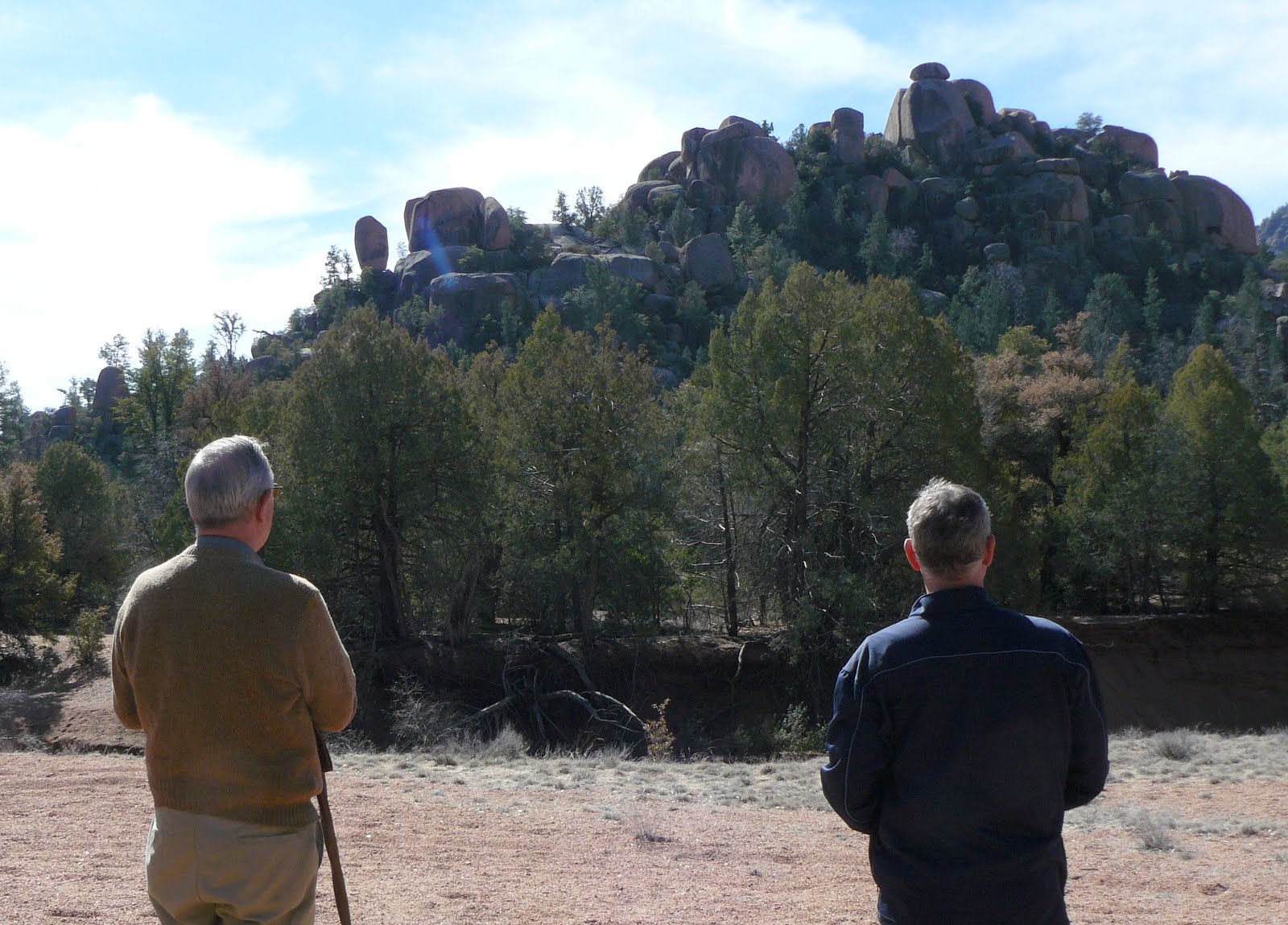
Anyway, on Monday morning, the day Terry was to give his talks, four of us took a couple of hours off in the morning to take a walk around the majestic granite boulders, a couple of miles on from our house. These great boulders give rise to the name of the road that we live on; Granite Dells Rd. Most afternoons, Jean and I take Pharaoh and his little pack of dogs for this three-mile walk so today was no different other than the walk being in the morning.
John H and Terry admiring the granite dells.
However, one of the benefits of having Terry with us on the walk was that he pointed out something really obvious that, so far, Jean and I had just taken for granted, i.e. missed!
It’s this. That dogs, when out for a walk off-leash, never travel the same journey, however many times they go on the same walk. All dog-owners will be aware of this.
Dogs are all over the place, scurrying here and there, following sweet scents, totally absorbed in the intimacy of their relationship with their immediate experience. There’s no ‘purpose’ to their behaviour, there’s no ‘clock’ running in their head as to what time it is and when they have to be somewhere else. It is the epitome of travelling well, as from the quote at the start of this article.
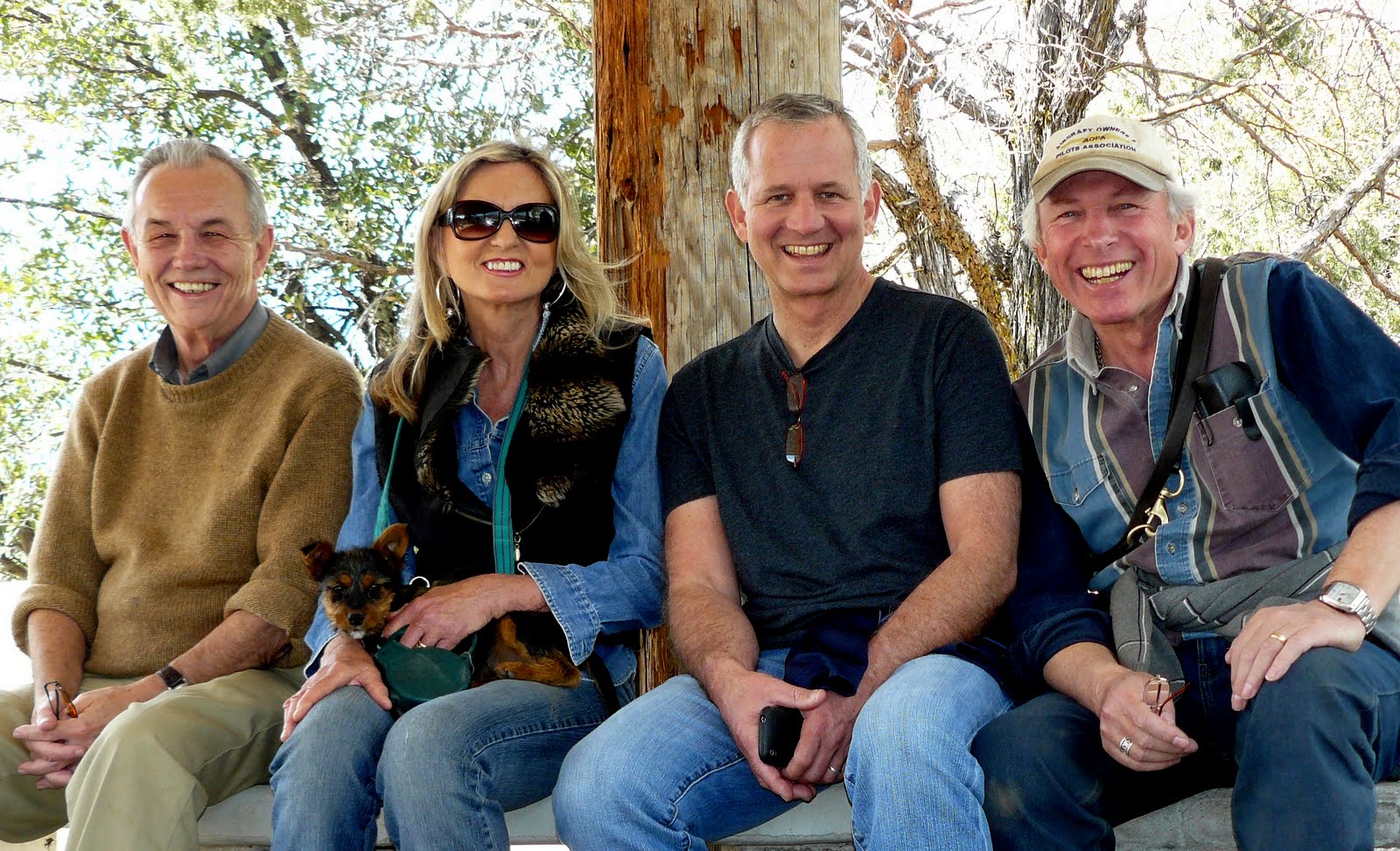
The metaphor of how dogs journey as a comparison to how so many of us humans travel with eyes closed, never stopping to smell the roses, was mentioned by Terry when we stopped for group photo towards the end of the walk. Terry also touched on the importance of living in the present, as dogs do so very, very well, many times during his later talks.
As soon as we make our happiness conditional on ‘getting’ somewhere in the future, our journey rather becomes pointless.
John, Jean, Terry, Paul - being happy in the moment.
When I posted my introductory piece on Joseph Campbell on the 14th February, I was tight on time. So it was pretty brief, as a piece.
But I was amazed at the number of people who read that Post; clearly this man Campbell has reached out to many across the world. Plus there was this comment from Michelle, better known as Dogkisses.
What a wonderful man! My hero. I cried when he passed on. He is the first person who reached me in my mid-twenties.
A friend of mine introduced me to “The Power of Myth,” and gave me a video series, which is so old now the VHS won’t play. Bill Moyers (I think I have that name right) interviewed him in the series.
The last book I had about him was, “Radio Interviews with Joseph Campbell.” I gave it to my teenage son. He loved it so much, but his girlfriend said reading that book made him act differently. I laughed and said thank goodness. He said the book disappeared. I wondered how. She said it made him not want to work full time. He was only barely seventeen, and I was trying to get him to take a different path in life.
The world would be a better place if everyone could appreciate what Joseph Campbell said and for the great work he did in his life.
Thank you. A very nice way to start a hectic Monday.
And in reply to me thanking DK for her comment and offering her the chance to guest post on Learning from Dogs, this further comment,
I certainly look forward to the future posts.
I’m having a hard time with my memory and mental fatigue lately. I would have to re-read myself to be able to write about what I learned from Joseph Campbell, which actually might help me and I know I would enjoy it.
I’ve been turning back for the past few months, looking back to when I stood on more solid ground spiritually. Hearing Joseph Campbell again would certainly help me remember that time in my life, because I was reading his work. I have daily quotes from him that come to my Google reader.
Thank you for the invitation and I am truly honored that you ask. I can do some reading and see if my brain gives me anything to share.


 Learning from Dogs
