I have written about Dr Rupert Sheldrake a few times on Learning from Dogs for pretty obvious reasons! You can do a search on the Blog under ‘sheldrake’ but here are a couple of links. Serious Learning from Dogs on January 10th, 2011 and Time for a rethink on the 14th April, 2011.
Anyway, I am now well towards the end of Sheldrake’s revised book, Dogs That Know When Their Owners Are Coming Home and it is more than fascinating. Bit short of time just now so please forgive me if I do no more than show this video which sets out some of the background to the book. Sheldrake’s website is here, by the way.
Further to the guest post from Patrice Ayme, an introduction to John Hurlburt.
I wrote on the 2nd May that an unintended consequence of my beautiful minds articles about Hugh Everett and Stephen Hawking was a recognition that the need for ‘beautiful’ thinking is more important than ever before. I wrote,
The French philosopher Voltaire was reputed to have said, “Think for yourselves and let others enjoy the privilege to do so, too.” In these days where ‘spin’ and ‘counter-spin’, to put it kindly, are so widely used, and millions live in a culture where our societies’ communication outlets compete for the maximum provocation (sorry audience!) it is challenging, to say the least, to think independently.
But of course as you, dear reader, will instantly acknowledge, these are just THE times when independent thinking is so, so important. Thus I want to acknowledge two completely different and totally disconnected people who set such wonderful examples of the power of a beautiful mind.
Unlike Patrice Ayme whom neither do I know nor have I met (Patrice Ayme is a pseudonym), today’s guest post is from someone that lives here in Payson and whom I have met on numerous occasions. What John writes about couldn’t be more different to Patrice’s article but that isn’t the point. Well, to be honest, that is the point! It goes towards underlining my proposition that these are times where we need a huge variety of thinkers who can be honest about their approach to life, and not hostage to any particular ‘group think’.
John’s essay is entitled, What’s for Dinner?
What’s for Dinner?
Ancient man had a legitimate fear about being gobbled up for dinner by a ravenous beast. The vestigial fear remains in spite of the reality that mankind has become a ravenous beast which is gobbling up nature for dinner. It’s interesting to note that although God and Nature can get along without earth or man, man and earth could not and would not exist without God and Nature. After all, God is Nature.
We get careless when we don’t stop to think about what we are, where we are and who we are. We don’t have to make a choice between God and money. We can invest in the business of God which includes education, formation, transformation and the well being of the earth which sustain us all.
Walking the way we talk means having the courage of our convictions. What can we do that is possible, plausible, practical and probable to protect ourselves and our descendents from the results of ravaging mother earth for personal profit?
Wisdom is neither an individual conclusion nor an opinion. We live in a world that is financially dominated by economic interests which are gambling with humanity’s future. It’s time to end the game. We grow best when we live and learn together in harmony with God, nature and each other. Saving the Earth from which we come and which sustains all planetary life is called conservation. That’s as conservative as life gets.
There is a fraction of our population which prefers fear, hate and ignorance to faith, love and our common well-being; both as a nation and as a world. What does this say about the United States of America? Well, for one thing, it says that we’re hell bent toward our own destruction and can’t get our act together because of the influences of money, power and tribalism.
The facts of nature can not be ignored indefinitely. While our nation becomes divided and we continue to face economic collapse four years after a journey to the brink of a world economic abyss, the environment which is our source, our natural birthright and our home continues to be stolen from us by those who seek personal gain and aggrandizement.
Let’s go back to the beginning and keep it simple. We hold these truths to be self evident.
1. The bible tells us the same thing as all sacred scriptures; love God and each other.
2. We are a country that is chartered as one nation under God. The powers of our government come from “We the people”.
3. Economics: a pump won’t work when the well runs dry.
These fundamental truths of faith, humanity, economics and the American vision transcend petty bickering and are ignored at our common peril. Considering recent world events, it would seem that we have a window of opportunity to refocus our priorities. We pray for God’s guidance.
An old lamplighter
Amen to that!
So two wonderful examples that illustrate the power of beautiful minds and how, in my opinion, we need the minds of Ayme, Hurlburt and countless others to pick our way out of this self-defeating mess that we are all in and lead us to a true long-term sustainable future for the Planet Earth and all of God’s creatures for whom this is the only home we will ever have.
I wrote on the 2nd May of the French philosopher Voltaire who was reputed to have said, “Think for yourselves and let others enjoy the privilege to do so, too.” Let me end with a quote from President Abraham Lincoln, “All my life I have tried to pluck a thistle and plant a flower wherever the flower would grow in thought and mind.”
Could Planet Earth really be avenging the disregard shown by man?
This is such a meaty subject that, frankly, all this article can do is to set the scene for further muses. The trigger for the theme was a piece written by Michael Klare that I read on the Tom Dispatch blogsite. But before going to that piece by Michael Klare, let’s step back for a moment.
Planet Earth from Apollo 8
The idea that the Planet is not a piece of rock covered in a thin layer of air, water and life but something much more deeply connected with all living organisms including the ‘higher order’ forms of life is not new. But it was Professor James Lovelock who catapulted the idea of the living, breathing planet into the psyche of modern man as in his Gaia hypothesis. Here’s a link to Lovelock’s original explanation of that idea. From which is quoted,
Most of us sense that the Earth is more than a sphere of rock with a thin layer of air, ocean and life covering the surface. We feel that we belong here as if this planet were indeed our home. Long ago the Greeks, thinking this way, gave to the Earth the name Gaia or, for short, Ge. In those days, science and theology were one and science, although less precise, had soul. As time passed this warm relationship faded and was replaced by the frigidity of the schoolmen. The life sciences, no longer concerned with life, fell to classifying dead things and even to vivisection. Ge was stolen from theology to become no more the root from which the disciplines of geography and geology were named. Now at last there are signs of a change. Science becomes holistic again and rediscovers soul, and theology, moved by ecumenical forces, begins to realise that Gaia is not to be subdivided for academic convenience and that Ge is much more than just a prefix.
That article concludes thus,
If we are “all creatures great and small,” from bacteria to whales, part of Gaia then we are all of us potentially important to her well being. We knew in our hearts that the destruction of a whole range of other species was wrong but now we know why. No longer can we merely regret the passing of one of the great whales, or the blue butterfly, nor even the smallpox virus. When we eliminate one of these from Earth, we may have destroyed a part of ourselves, for we also are a part of Gaia.
There are many possibilities for comfort as there are for dismay in contemplating the consequences of our membership in this great commonwealth of living things. It may be that one role we play is as the senses and nervous system for Gaia. Through our eyes she has for the first time seen her very fair face and in our minds become aware of herself. We do indeed belong here. The earth is more than just a home, it’s a living system and we are part of it.
Last Monday, Yukio Edano, chief cabinet secretary, defended the Japanese government’s response to the nuclear disaster at Fukushima, insisting that the plant complex is in “a stable situation,relatively speaking.” That’s somewhat like the official description of 11,500 tons of water purposely dumped into the ocean waters off Fukushima as “low-level radioactive” or “lightly radioactive.” It is, of course, only “lightly” so in comparison to the even more radioactive water being stored at the plant in its place. But that’s the thing with descriptive words: they can leave so much to the eye of the beholder — and the Japanese government hasn’t been significantly more eager than the Tokyo Electric Power Company (Tepco), which runs the complex, to behold all that much when it comes to Fukushima.
Engelhardt then sets the scene for the guest post by Michael Klare.
The Planet Strikes Back
Why We Underestimate the Earth and Overestimate Ourselves
By Michael T. Klare
In his 2010 book, Eaarth: Making a Life on a Tough New Planet, environmental scholar and activist Bill McKibben writes of a planet so devastated by global warming that it’s no longer recognizable as the Earth we once inhabited. This is a planet, he predicts, of “melting poles and dying forests and a heaving, corrosive sea, raked by winds, strafed by storms, scorched by heat.” Altered as it is from the world in which human civilization was born and thrived, it needs a new name — so he gave it that extra “a” in “Eaarth.”
It would be wrong to do more that selectively offer extracts but here’s how Klare sets the scene,
It’s not enough to think of Eaarth as an impotent casualty of humanity’s predations. It is also a complex organic system with many potent defenses against alien intervention — defenses it is already wielding to devastating effect when it comes to human societies. And keep this in mind: we are only at the beginning of this process.
To grasp our present situation, however, it’s necessary to distinguish between naturally recurring planetary disturbances and the planetary responses to human intervention. Both need a fresh look, so let’s start with what Earth has always been capable of before we turn to the responses of Eaarth, the avenger.
Michael Klare conclude thus,
Bill McKibben is right: we no longer live on the “cozy, taken-for-granted” planet formerly known as Earth. We inhabit a new place, already changed dramatically by the intervention of humankind. But we are not acting upon a passive, impotent entity unable to defend itself against human transgression. Sad to say, we will learn to our dismay of the immense powers available to Eaarth, the Avenger.
Michael T. Klare is a professor of peace and world security studies at Hampshire College, a TomDispatch regular, and the author, most recently, ofRising Powers, Shrinking Planet. A documentary movie version of his previous book, Blood and Oil, is available from the Media Education Foundation.
To close, here’s an interview of Michael Klare by Tom Engelhardt.
Regular followers of Learning from Dogs will recall that in March we had the pleasure of a visit to St Paul’s Episcopal Church, here in Payson, of the well-known Terry Hershey. He is a great inspirational speaker, based on deep and sound personal values. Terry’s website is here.
Well it seemed like a nice idea to offer some more of TH. Here is his presentation on World Communion Day, October 4th 2009, at the First Community Church, Columbus, Ohio. Letting the light that is in each one of us shine out.
Last Wednesday, I set out to explain why the blog is called Learning from Dogs. If you missed that then it is here. The focus was on the very special relationship between man and dog that goes back thousands of years. It has been a critically important relationship for both species.
But there is another aspect to this Blog, as follows: The relationship between dogs and man goes back thousands of years. The theory is that dogs were domesticated between 15,000 and 40,000 years ago although DNA evidence suggests dogs split away from the grey wolf around 100,000 years ago. Certainly, the dog was the first animal to be domesticated by man. In fact, some archaeologists speculate that man could not have been a successful ‘hunter-gatherer’ without his relationship with the dog and thus been able to progress to farming the earth for food.
The relationship between Planet Earth and man, as in H. sapiens, goes back around 200,000 years. There is little doubt that most people, even with a minimum of awareness about the world that we live in, are deeply worried. On so many fronts there are forbidding and scary views. It feels as though all the certainty of past times has gone; as if all the trusted models of society are now broken. Whether we are talking politics, economics, employment or the environment, nothing seems to be working.
Why is this? What’s the cause?
It would be easy to condemn man’s drive for progress and an insatiable self-centredness as root causes. But it’s not the case.
The root cause is clear. It is this. How mankind has developed is the result of mankind’s behaviours. All of us behave in many ways that are hugely damaging to the survival of our species. It is likely that these behaviours are little unchanged over thousands of years.
But 2000 years ago, the global population of man was just 300 million.
Twelve-hundred years later, in 1800, it was 1 billion. In 1927, just 127 years later, the two-billionth baby was born. In 1960, only 33 years on, the three-billionth baby. (Remember the moon landing in 1969? Well, of course you do! There were about three and a half billion people on the planet!)
Just 16 years on, in 1974, the four-billionth baby was born. In 1987, 13 years later, five billion. Around October 1999, the sixth-billionth baby was born!
It’s trending to a billion every decade. 100 million population growth every year, or about 270,000 every single day!
Combine man’s behaviours with this growth of population and we have the present situation. A totally unsustainable situation disconnected from the planet that supports us.
The only viable solution is to amend our behaviours. To tap into the powers of integrity, self-awareness and mindfulness and change our game.
We all have to work with the fundamental, primary relationships we have with each other and with the planet upon which we all depend. We need a level of consciousness with each other and with the living, breathing planet that will empower change. We need spiritual enlightenment on a grand scale.
That’s why we have so much to learn from dogs. They are man’s best friend. They are man’s oldest friend. They have a relationship with us that is very special; almost certainly telepathic. They can show us how we need to live our lives.
Man's oldest, and wisest, friend.
That’s the real reason why this Blog gets written. Phew! Glad that’s off my chest!
One side effect of the earthquake and tsunami that hit Northern Japan on the 11th March causing an explosion at the Fukushima nuclear power station is that the anniversary of the Chernobyl disaster is much more a news item than I suspect it might have been.
The nuclear accident at Chernobyl in Russia occurred on the 26th April, 1986, twenty-five years ago today. One major difference between the two disasters was, of course, how they were reported.
Here’s a small extract from a fuller article in The Financial Times published on the 19th April written by Tony Barber who was in Russia those 25 years ago.
Twenty-five years after the explosion at the Ukrainian facility, I vividly recall every detail of those terrible days of April 1986. I was a 26-year-old foreign correspondent working in Moscow for Reuters news agency. On Friday, April 25, I flew to Kiev to spend a couple of days with Rhona, an ebullient Scottish friend who was teaching at the city’s university under a British Council programme. I was the only western journalist in Kiev that weekend.
While we caroused the night away, extraordinary events were unfolding 130km to the north. Technicians were conducting experiments that involved the disabling of automatic shutdown mechanisms at the plant’s fourth reactor. After a tremendous power surge, the reactor blew up at 1.23am on Saturday, April 26.
Except for high-ranking Communist party officials, the KGB and a number of scientists, doctors and fire-fighters, no one in the Soviet Union, let alone the wider world, knew anything about this. Soviet habits of secrecy and deception kept millions of people in the dark even as radiation spread across Ukraine, Belarus, Russia and beyond.
Certainly the disaster in Japan was widely broadcast across the world without any delays or restraints. But the thrust of this Post today is to point out what, in the end, will have to be understood by the majority of the world’s peoples and their representatives in power. That is that our dependence, our love affair, with cheap carbon-based energy has to come to an end, and soon.
On the 26th March, The Economist published a briefing on nuclear power entitled, When the steam clears. As with so many of this newspaper’s essays, it was very well written [I am a subscriber to The Economist; have been for years.] Here’s a taste of the article,
When last year a volcano closed the skies over Europe and a blown-out oil-rig turned the Gulf of Mexico black, there was no widespread enthusiasm for giving up oil or air travel. But nuclear power is much less fundamental to the workings of the world than petrol or aeroplanes. Nuclear reactors generate only 14% of the world’s electricity, and with a median age of about 27 years (see chart) and a typical design life of 40 a lot are nearing retirement. Although the world is eager to fly and thirsts for oil, it has had little appetite for new nuclear power for the past quarter of a century.
And towards the end of the article, this,
Distressing though it is, the crisis at Fukushima Dai-ichi is not in itself a reason for the world to change energy policy. The public-health effects seem likely, in the long run, to be small. Coal, with its emissions of sulphur, mercury and soot, will continue to kill far more people per kilowatt hour than nuclear does. But as an opportunity to reflect it may be welcome. [my italics]
Power of hope
We need a continued growing awareness of the craziness of using coal and oil as primary sources of energy, and from that awareness a growing political pressure for change. Change that recognises that mankind’s present energy strategies of continuing to pump carbon-based gases into the atmosphere are insane; pure and simple.
Beautiful images that will make appreciate the majesty of wild animals.
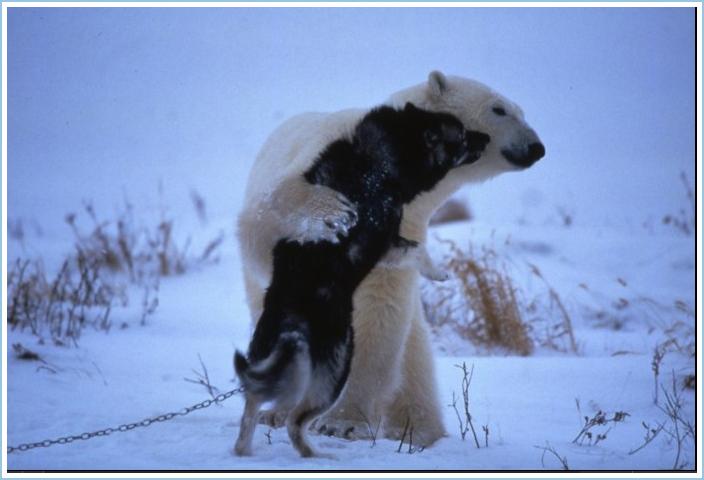
First a big thank you to Mary and Ed G. for passing me an email that contained fabulous photographs of the polar bear playing with a husky dog. From that email it was the matter of a few moments to find more on the Internet.
Let’s start with a YouTube video of a short talk by Stuart Brown called Animals at Play.
Then another YouTube video that is from FirstScience TV, which appears to be a defunct website.
These charming pictures were taken by renowned nature photographer Norbert Rosing, whose work has appeared inNational Geographic and other magazines, as well as several books including The World of the Polar Bear (Firefly Books, 1996), in which Rosing recounts the story of how these particular photographs came to be taken.
The location was a kennel outside Churchill, Manitoba owned by dog breeder Brian Ladoon, who kept some 40 Canadian Eskimo sled dogs there when Rosing visited in 1992. A large polar bear showed up one day and took an unexpected interest in one of Ladoon’s tethered dogs. The other dogs went crazy as the bear approached, Rosing says, but this one, named Hudson, “calmly stood his ground and began wagging his tail.” To Rosing and Ladoon’s surprise, the two “put aside their ancestral animus,” gently touching noses and apparently trying to make friends.
Just beautiful!
If you want to watch the whole sequence of photographs including background notes to each picture, click here.
John H, a good friend of us here in Payson, lent us the Leonardo DiCaprio film The 11th Hour. More information on the film’s website. Here’s the trailer,
The plot of the film, if plot is the right word, is as follows,
With contributions from over 50 politicians, scientists, and environmental activists, including former Soviet leader Mikhail Gorbachev, physicist Stephen Hawking, Nobel Prize winner Wangari Maathai, and journalist Paul Hawken, the film documents the grave problems facing the planet’s life systems. Global warming, deforestation, mass species extinction, and depletion of the oceans’ habitats are all addressed. The film’s premise is that the future of humanity is in jeopardy.
The film proposes potential solutions to these problems by calling for restorative action by the reshaping and rethinking of global human activity through technology, social responsibility and conservation.
Whether or not you watch the film, and I strongly suggest you do, the action website that supports making a difference is For the Love of Action. Drop in and make your own mind up.
Following on from that film is this apt reminder of the world we have created. I tend to write articles a few days ahead of the publish date, so it wasn’t possible to have this post come out on the 20th April, last Wednesday, which was Earth Day. Shame. Because as this email from the Alaska Wilderness League pointed out, it’s also a sad reminder of our love affair with oil.
Dear Paul,
The next Deepwater Horizon could be amid the broken sea ice and polar bear habitat of America’s Arctic: unless we prevent it now. Donate to the League.
It was one year ago today. I remember sitting in my living room after dinner when the news alert flashed across the screen:Deepwater Horizon oil rig explodes in the Gulf of Mexico; 11 workers dead or missing.
Huddled around the office television the next morning, there was no way we could anticipate the true magnitude of the disaster. Images of ruined lives and tarnished lands poured out of the Gulf formonths on end. As the oil industry’s feeble attempts to contain the destruction grew evermore cartoony – ‘top hat,’ ‘junk shot,’ ‘top kill’ – we learned just how little they had prepared for the eventual catastrophe of an oil spill.
Our government rubber-stamped the faulty plans for this oil rig. They had a chance to prevent this disaster, but didn’t. What’s worse: they continue to approve plans for America’s Arctic that are functionally identical to the plans that caused the Gulf disaster. America’s Arctic could be our next Deepwater Horizon tragedy. The effects of deadly crude oil spilling into the broken sea ice and polar bear habitat of America’s Arctic would be disastrous: unless we stop it.
When Deepwater Horizon exploded in the Gulf, the League had just completed a campaign to highlight the incredible annual migration of Arctic birds that begins in the Arctic Refuge and extends through each U.S. state. Some of these birds fly as far as the southern tip of Argentina! Many of them rely on critical nesting grounds around the Gulf of Mexico.
The League moved quickly to save these birds, distributing ‘Arctic Garden Kits’ to help donors across the country to provide sustenance and shelter to Arctic birds in their own backyards. Proceeds from the fundraiser helped us fight faulty plans from moving forward in America’s Arctic for the last two summers.
Shell Oil, the biggest threat for Arctic drilling, remains undaunted by our success. Their drilling plans for 2012 have ballooned from one drill rig to six. This is their big move – their cards are on the table. We need your help and support to go over the top to stop their escalating plans.
The way in which the League responded to the Gulf disaster – stemming the damage to wildlife and preventing the next disaster – was one of the most inspiring experiences of my life. You have a chance to be a part of this continuing work. Help us save America’s Arctic before it suffers the fate of another Deepwater Horizon.
Finally, let me close rather pointedly, perhaps, by this video of the fires in Texas which are burning out of control and have already scorched 1.6 million acres.; long-term drought being part of the cause.
It struck me recently that many of you readers that come to Learning from Dogs on a regular basis, say, over the last 18 months, may not be clear as to why it’s called what it is, and the deeper issues behind the name.
First, the name. Quite a few years ago I was sitting chatting with Jon Lavin, the co-founder of the Blog, in his home in South-West England. My German Shepherd, Pharaoh (that’s him on the home page) was sleeping on the floor while Jon and I were nattering about the works of Dr David Hawkins of Veritas Publishing. Jon mentioned that David Hawkins had measured the consciousness of dogs and that they came out about 205. In other words they were integrous creatures and firmly on the truthful side of the boundary between truth and falsehood.
I was fascinated by that idea. Later, back at my home, less than an hour away from Jon’s house, I was idly looking at domain names that were available, and imagine my glee when I discovered that learningfromdogs (dot) com was free. It was rapidly grabbed.
A rather chaotic period of my life descended upon me but the notion that we have much to learn from dogs stayed with me. Much later, when I was happily settled with Jean, the vision and purpose of the Blog got me under way. The first post was published on 15th July, 2009.
The ideas behind the theme that dogs have an extraordinary relationship with man is contained in a very early piece written for the Blog back in July 19th, 2009. That article is called Dogs and integrity. But nothings stays still. In that piece, I wrote,
Because of this closeness between dogs and man, we (as in man!) have the ability to observe the way they live. Now I’m sure that scientists would cringe with the idea that the way that a dog lives his life sets an example for us humans, well cringe in the scientific sense.
However, on Sunday evening we watched a video from PBS that showed that scientists are now taking a very close interest in dogs and why they have such a special relationship with man, perhaps even a critical part in enabling man to prosper as hunter-gatherers. Here’s a preview of that video programme.
Unfortunately, the video is not freely available from PBS. However, it was based on the BBC Horizon programme, The Secret Life of the Dog, which I wrote about back in the 25th January, 2011. (The YouTube link on that post appears to have been curtailed.)
Luckily there are a couple of options to watch this fascinating and very revealing documentary. You can either watch it in sections from YouTube, the first 10 minutes is below, or you can watch it in full, if you don’t mind some Chinese translations here. Your choice.
That’s enough for today, I shall return to this theme next week.