Category: consciousness

And more on consciousness!

Two recent videos highlight the mystery and fascination of determining what, exactly, is consciousness.

Before I get started, it crossed my mind that some readers on Learning from Dogs might struggle finding any link between the the title of the Blog and such esoteric topics as consciousness.  Let me try and explain.  On the home page of this Blog is written,

But 10,000 years of farming the planet’s plant and mineral resources have brought mankind to the edge of extinction, literally as well as metaphorically.

Dogs know better!  Time again for man to learn from dogs!

Here’s a recent comment I made to an article on Naked Capitalism,

In a much broader sense, it feels to me as though we have been partying on the edge of a global volcano for years and years. Greece is surely a metaphor for the craziness of so many countries.

Continuing that broader sense, the period that we are in, from political, economical, societal, environmental and ethical perspectives, seems bust. Good will eventually come out of this transition, of that I have no doubt, but what a fascinating period in which to be alive!

I firmly believe that the period we are presently living through is a transition between the last, say 30 years (in a sense, many more decades than that) and a more aware, sensitive period where mankind embraces a deeper, sustainable, relationship with the planet that is home and life to all of us.  Frankly, there is no choice!

Thus the nature of consciousness, our awareness of self, is a crucial element of the future.  The greater our self-awareness, the greater our self-understanding and from that better self-understanding comes all hope of recognising our attitudes and knowing that it is our attitudes that drive our behaviours.

So here follow two videos.  Settle back and be entranced!

The first is the last episode in a brilliant BBC series broadcast in 2007, probably one of the best TV series on psychology and neuroscience ever produced.  The full series is on Top Documentary Films but the last episode called The Final Mystery is all about consciousness.  Beware you are going to never see the world in quite the same way!

Here it is, The Final Mystery presented by neuroscientist Susan Greenfield.

The second video is from Season Two of the Through the Wormhole series.  It is called Is there Life after Death? and also explores the deeper aspects of consciousness.  As the introduction to the video says,

In the premiere episode of the second season of Through the Wormhole, Morgan Freeman dives deep into this provocative question that has mystified humans since the beginning of time.

Modern physics and neuroscience are venturing into this once hallowed ground, and radically changing our ideas of life after death.

Freeman serves as host to this polarized debate, where scientists and spiritualist attempt to define what is consciousness, while cutting edge quantum mechanics could provide the answer to what happens when we die.

Here’s the film; same health warning applies!  You are going to see the world differently after watching this!

Finally, do you have a dog at home?  If you do, ponder on how their conscious world engages them.  If science can’t explain human consciousness then all we have is our own intuition with regard to animals.  Not sure about you but when one is feeling a little low and a dog comes up and lays a head across you I feel a very strong conscious connection.

The Power of the Dog

An incredible moving account of man’s special relationship with the dog.

(Reproduced in full with the very kind written permission of the author, Laban T. where it was first published on UK Commentators.)

The Power of the Dog

Ross’s dog is gravely ill.

 I suppose if you don’t have a dog it is hard to understand why anyone would be so upset (that isn’t an insult or a judgement just a statement of fact) and if you do there isn’t much need to explain.

 As so often he’s spot-on. I remember in my teens a girlfriend walking through the door one Saturday morning and bursting into floods of tears – and it wasn’t the state of my room.

What’s the matter ?

They’ve taken her to the vet to be put down!” – ‘her’ being the companion of her childhood, a thousand walks and a hundred days out in the country with parents. But I didn’t think like that at the time – I was properly sympathetic and held her till my shoulders were soaked in tears – but it was only a dog, a nice enough dog, but still a dog. At this distance memory fails, but I probably assumed it was just a girl thing, what with being more emotionally open and all that.

The same blindness afflicted me with regard to the effect of children, although I think I wasn’t alone in this. Our single lives were so endlessly fascinating, what friends were doing, who was with whom, the places to go, the people, the parties, that we looked on people who’d got children slightly pityingly, as if they’d been afflicted with a crippling disease (and it IS crippling to a wild social life, although I know a few exceptional people and couples who have just carried on – I’m just not exceptional) which not only curtailed their social life but made them talk about children an awful lot – as if that topic was of any interest at all compared to the important things.

You live and learn. Hopefully. Now I feel more that becoming a parent is gaining access to the secret heart of life and the long chain of familial links down the generations. Not that it doesn’t have its many, many drawbacks. Susan and I looked at each other one day after #2 had arrived and said “whatever did we do with all that time we had?”.

I digress. So I finally learned about why parents are interested in kids, but still didn’t get the dog thing. Our neighbours were childless but treated their dogs like their children – they slept upstairs and their doings were part of our everyday chats. Most odd, we thought.

Dog lovers …

I’d taken my firstborn up to visit his grandpa, and grandpa and I were out walking with grandpa’s dog and the pushchair plus baby. I loved that new dad bit, with bonny boy getting cooed over by all and sundry … the checkout queue turning into a little love fest … and he WAS a beautiful baby – he’s 21 now and six foot.

Lady approaching on the pavement, breaks into happy smile :

Oh, what a beautiful …

(Dad smiles modestly… he’s getting used to this …)

Dog!”

(Smile vanishes instantly)

Then our youngest went off to Big School, and it left a bit of a gap in Susan’s life. Suddenly there were no babies to care for – and she likes caring for things. One day she went off and returned with this chap (and promptly had him snipped, to my horror). Apparently Labradors were very even tempered, good with children and an all round ideal first dog for a family with no dog-owning history on either side, at least since our great-grandparents were on the farm. What’s impressive is that AFAIK, apparently all dogs are descended from domesticated wolves. Just shows what breeding will do.

The dog.

The kids were thrilled, promised to walk him etc., etc., – didn’t last and soon Mum and Dad were doing most of the walks. But the exercise is great – he and we usually get about three miles a day in – it’s good for an ageing chap with a desk job. I’ve learned most of the footpaths and circular routes round the house.

Labradors seem to eat anything – three week old bird carcases, stones, deer poo, sheep poo, horse poo – and they roll in fox poo, which is not a nice smell and means an hour shampooing him in the garden (then a shower and complete change of clothes). On the good side they love apples, blackberries, plums, the farmer’s turnips – healthy eaters.

He once found a rotting, rank dead rabbit inside a plastic bag, scoffed it, then sat in his crate in the kitchen and disgorged the lot some hours later. Not a nice clean-up job – the smell at close quarters was truly evil.

They’re meant to have more acid in their stomachs than humans to enable digestion of bad food – but ours pushes that way beyond the limits. The Muslims are right enough when they consider dogs unclean. They’re filthy, dirty creatures.

But they have a way of wrapping themselves round the heart. Always pleased to have human company, playful, cheery.  All the family quickly grew to love him – even grandma, very much a non-dog person, has a soft spot.

October last year, grandma is round for Sunday tea/dinner, I’m just out in the garden using the last of the light at ten to six.

Can he stay out here with you? ”

OK

The call for tea. I call him – he’s not anywhere in the garden. Round the house – no sign.

Has he come in?”

No

He’s not in the garden

Poor grandma. She was left alone in the house while everyone emptied into the darkening garden, calling, then after a quick conference and grabbing of mobiles, two cars head slowly in opposite directions, and the boys are in the local wood with torches. Daughter and I take the car across rough farm tracks, along the routes of his favourite walks, stopping, scanning the gloomy fields, calling him, on again, repeat.

Forty minutes later it’s pitch black and the cars are back. The boys have been right through the woods to the fields on the other side, which we’ve also scanned from the cars as best we could, then back again. Up and down the village – again – half expecting to see a limp form in the headlights. Not a sight or sound.

Tea at seven in almost total silence. The only thing I can compare it with was the first family Christmas without my grandmother.

Eight o’clock. He’s been gone two hours. We’ve been out in the garden and around the house again. Nothing. The feeling that he’s gone for good starts to solidify.

Nine o’clock. My daughter’s standing at the back door, calling his name. Nothing. I feel she’s wasting her time, but in solidarity I go to the side door to call. Open it – he’s standing on the step.

God knows where he’d been. One moment of tremendous pleasure – calling my daughter into the kitchen, without telling her who was there, then watching the ecstatic reunion – the boys hearing the noise and tumbling in, happy uproar. “For he was lost, and is found“.

Once again Mr Kipling has the words :

There is sorrow enough in the natural way
From men and women to fill our day;
And when we are certain of sorrow in store,
Why do we always arrange for more?
Brothers and sisters, I bid you beware
Of giving your heart to a dog to tear.

Buy a pup and your money will buy
Love unflinching that cannot lie
Perfect passion and worship fed
By a kick in the ribs or a pat on the head.
Nevertheless it is hardly fair
To risk your heart to a dog to tear.

When the fourteen years which Nature permits
Are closing in asthma, or tumour, or fits,
And the vet’s unspoken prescription runs
To lethal chambers or loaded guns,
Then you will find – it’s your own affair
But … you’ve given your heart to a dog to tear.

When the body that lived at your single will,
With its whimper of welcome, is stilled (how still!)
When the spirit that answered your every mood
Is gone – wherever it goes – for good,
You will discover how much you care,
And will give your heart to a dog to tear.

We’ve sorrow enough in the natural way,
When it comes to burying Christian clay.
Our loves are not given, but only lent,
At compound interest of cent per cent.
Though it is not always the case, I believe,
That the longer we’ve kept ’em, the more do we grieve:
For, when debts are payable, right or wrong,
A short-term loan is as bad as a long
So why in Heaven (before we are there)
Should we give our hearts to a dog to tear?

Day of rest!

Apologies to all the readers of Learning from Dogs but it’s been a busy week since returning from the UK and it feels right to take the day off!

As Ralph Waldo Emerson said, “Let us be silent, that we may hear the whispers of the gods.”

Ralph Waldo Emerson

And spend a few moments watching this 

Lying is OK, that’s official! Duh!

I find this utterly unacceptable – here’s the story

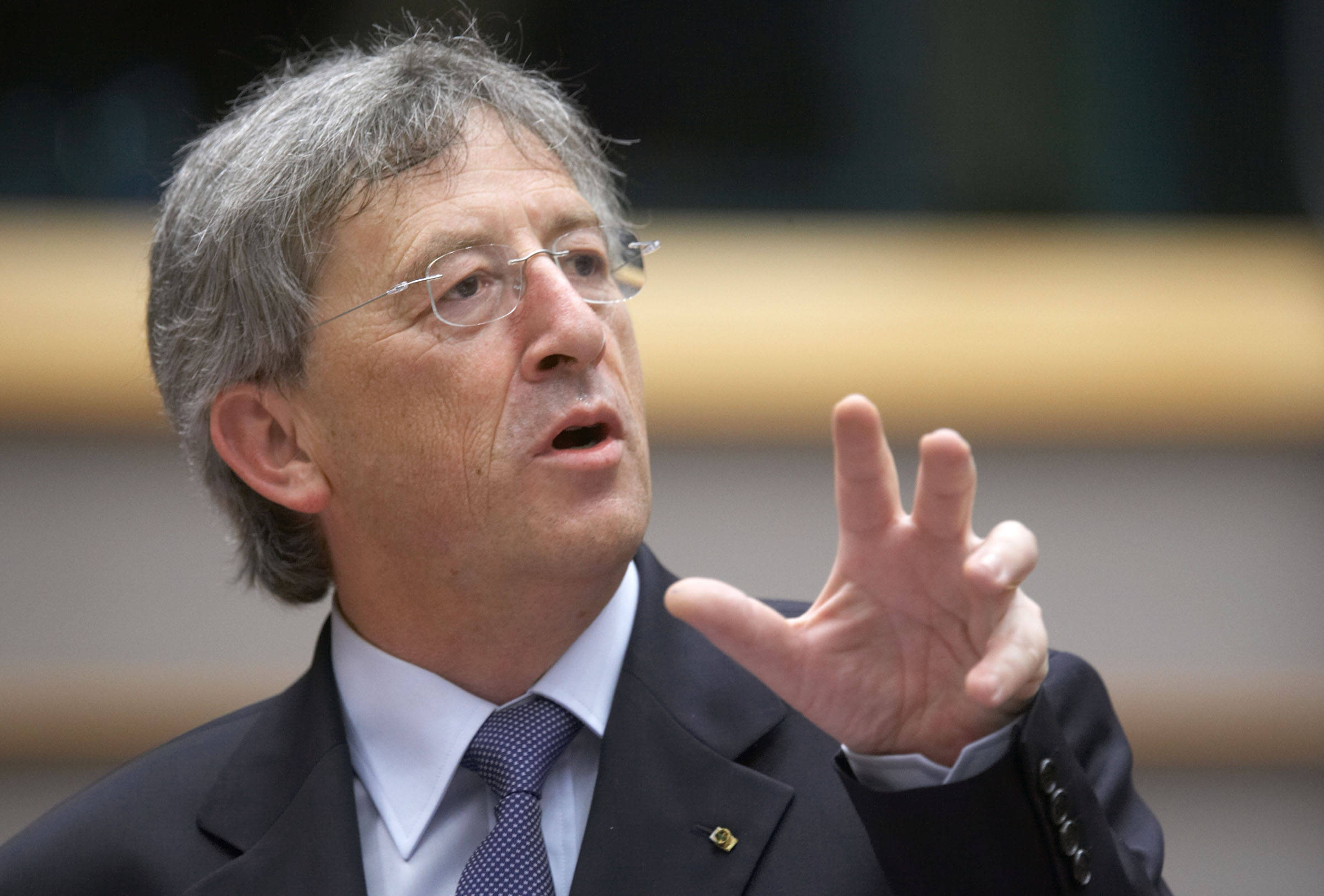
Jean Claude Juncker, lying for Europe!

I was talking to someone in the UK just a couple of days ago, Martin J., about investment matters and we were generally ‘slagging’ off the quality, or rather the lack of quality, of the statements of leading political persons in many fields of government.  Martin then made the statement that Jean Claude Juncker, the Prime Minister of Luxembourg, and the head of the Eurogroup council of eurozone finance ministers had recently stated that “When it becomes serious, you have to lie,”  I was staggered to hear this and asked Martin to supply the details.  Here they are.

Mr. Juncker’s remark had been widely reported and I have chosen the Wall Street Journal’s report to quote from in Learning from Dogs.

MAY 9, 2011, 10:54 AM ET

Luxembourg Lies on Secret Meeting

By Charles Forelle

Is lying considered an appropriate mode of communication for euro-zone leaders?

We have to wonder after a strange episode on Friday evening. Here’s what happened:

Just before 6 p.m., German news magazine Spiegel Online distributed a report saying that euro-zone finance ministers were convening a secret, emergency meeting in Luxembourg that evening to discuss a Greek demand to quit the euro zone.

Calls from reporters flooded in to Guy Schuller, the spokesman for Luxembourg Prime Minister Jean-Claude Juncker, the man who is the head of the Eurogroup council of euro-zone finance ministers.

In a phone call and text messages with two reporters for Dow Jones and the Wall Street Journal, Mr. Schuller repeatedly said no meeting would be held. He apparently said the same to other news outlets; at least one more moved his denials on financial newswires.

Of course, there was a meeting–although not, apparently, to talk about Greece quitting the currency, which would be an extreme step to say the least. Mr. Juncker even said a few words to reporters who had hustled to Luxembourg to stake out the gathering.

Anyway, do read the article in full here.

In that article there is a YouTube video in which Mr. Juncker says “When it becomes serious, you have to lie.”  You can hear it yourself, about 20 seconds into the video despite the sound level being a tad low.

So that’s official then!  Politicians have to lie!  Grand job.  Talking about jobs, don’t suppose Mr. Juncker will lose his.  Or that he will show that, deep down, he is an integrous man and resign his post.

Yes, of course we all understand that what high-profile people say can affect markets and that, at times, one must be careful in terms of what is said.  But lying?  Sorry, for me that will never, ever be acceptable!

What has this to do with dogs?  Simply, dogs don’t lie.

More on the unconditional love of dogs

Another example of the astounding bond between dog and man.

Regular supporters of Learning from Dogs will be aware that yesterday I wrote, under the heading of Paws of Love, about two examples of the most amazing bond that develops between the dog and man, one of them a very personal account.

Moving on.

We subscribe to the website, Top Documentary Films, and the other night we watched a 48-minute program about The Grim Reaper Dog.  The link to the TDF programme is here.  (It includes three separate films.)

Scamp

The Grim Reaper Dog is about Scamp, a little Schnauzer who resides at The Pine nursing home in Canton, Ohio. Like many live-in pets at nursing homes, Scamp brings companionship to the residents but he also does more than that. Scamp seems to have a gift that tells him when the end is near for one of the residents and he loyally stays with them during their final hours.

So if you want to watch the film in full within the TDF website, then go here.

If you want to watch it directly from YouTube then the three parts of the film are below – prepared to be amazed!  Or perhaps those of you who live emotionally close to a dog will just find the film as confirmation of what you already know!

and then here’s part 2

and concluding part

The inadequacy of words

Alice and Mabel

Think you have had a bad day/week/month/year/life?  Want to see your life in perspective? Go here and reflect.  This is one very brave and incredibly inspiring young woman.

Those of you who see this and are in the UK, do read Alice’s Bucket List and help if you are at all able.  If not, just hold Alice and all her family, and Mabel, in your prayers.

Consciousness, science or God?

More of Peter Russell’s insightful ideas.

It was back in March, the 8th to be precise, when I first wrote about Peter Russell.  Well just over a week ago, I came across another article by Russell from the Huffington Post.  It was then a moment’s work to find it on Peter Russell’s own website.  (This links to various essays on the topic.)

Here’s a ‘taste’ from the first essay.

The Anomaly of Consciousness

Excerpted from book From Science to God

Science has had remarkable success in explaining the structure and functioning of the material world, but when it comes to the inner world of the mind science falls curiously silent. There is nothing in physics, chemistry, biology, or any other science that can account for our having an interior world. In a strange way, scientists would be much happier if there were no such thing as consciousness.

David Chalmers, professor of philosophy at the University of Arizona, calls this the “hard problem” of consciousness. The so-called “easy problems” are those concerned with brain function and its correlation with mental phenomena: how, for example, we discriminate, categorize, and react to stimuli; how incoming sensory data are integrated with past experience; how we focus our attention; and what distinguishes wakefulness from sleep.

It would be wrong to publish anything more so if you are interested in more, then go here and pick away or better still buy the book!

If you have a quiet 30 minutes, settle down and watch these videos

Part One

Part Two

Part Three

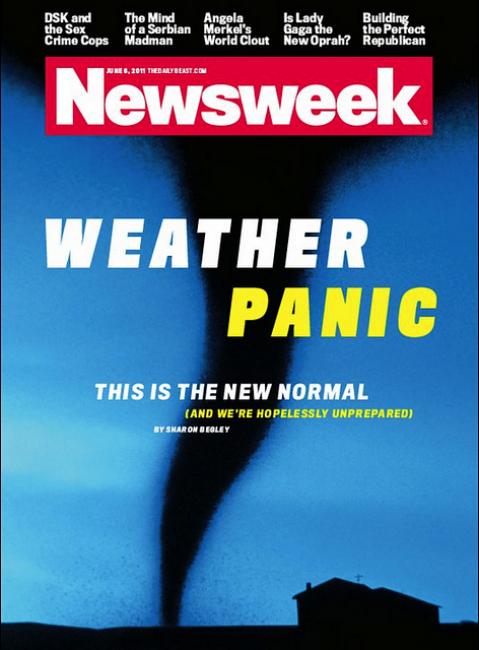
“Weather panic” courtesy Newsweek

Is it me or does there seem to be a shift in overall awareness of our ‘new world’?

On the 30th May, I mentioned the concept of a new Anthropocene era for the second time, based on The Economist of the 28th May having it as a lead story.  (The first mention was on the 16th May.)

Then a couple of days later, friend John H. here in Payson, drops off his copy of Newsweek for June 6th.  Here’s the cover page.

Newsweek, June 6, 2011

This is how the article runs, written by Sharon Begley,

Are You Ready for More?

In a world of climate change, freak storms are the new normal. Why we’re unprepared for the harrowing future.

Joplin, Mo., was prepared. The tornado warning system gave residents 24 minutes’ notice that a twister was bearing down on them. Doctors and nurses at St. John’s Regional Medical Center, who had practiced tornado drills for years, moved fast, getting patients away from windows, closing blinds, and activating emergency generators. And yet more than 130 people died in Joplin, including four people at St. John’s, where the tornado sucked up the roof and left the building in ruins, like much of the shattered city.

Then just a couple of paragraphs later, this pretty blunt summary,

From these and other extreme-weather events, one lesson is sinking in with terrifying certainty. The stable climate of the last 12,000 years is gone. Which means you haven’t seen anything yet. And we are not prepared.

Just read that again very carefully, “The stable climate of the last 12,000 years is gone.”  Do take a few moments off and go here and read the full article.  The last paragraph of which reads,

So what lies behind America’s resistance to action? Economist Sachs points to the lobbying power of industries that resist acknowledgment of climate change’s impact. “The country is two decades behind in taking action because both parties are in thrall to Big Oil and Big Coal,” says Sachs. “The airwaves are filled with corporate-financed climate misinformation.” But the vanguard of action isn’t waiting any longer. This week, representatives from an estimated 100 cities are meeting in Bonn, Germany, for the 2nd World Congress on Cities and Adaptation to Climate Change. The theme is “Resilient Cities.” As Joplin, Mo., learned in the most tragic way possible, against some impacts of climate change, man’s puny efforts are futile. But time is getting short, and the stakes are high. Says Daniel Sarewitz, a professor of science and society at Arizona State University: “Not to adapt is to consign millions of people to death and disruption.”

It’s a powerful article that can be read in full on the Newsweek website.

So, perhaps one might say at last, the notion that mankind’s impact on the Planet is real and capable of affecting practically all of us living on this beautiful Planet is becoming a ‘mainstream’ accepted idea.

More musings about this next Tuesday, 14th.

Thomas’s smile

What even a lovely boy, just one year old, can offer the world.

I’m writing this around 5pm UK time on the 8th June.  A little over 4 hours ago, at 1230 give or take, I witnessed a tiny event, something that for many of us wouldn’t have been seen as anything but trivial, albeit lovely.

Here’s what happened.

I had been to an introductory meeting with Richard White of The Accidental Salesman fame.  We met in Pall Mall, just by Trafalgar Square, at the offices of The Institute of Directors.

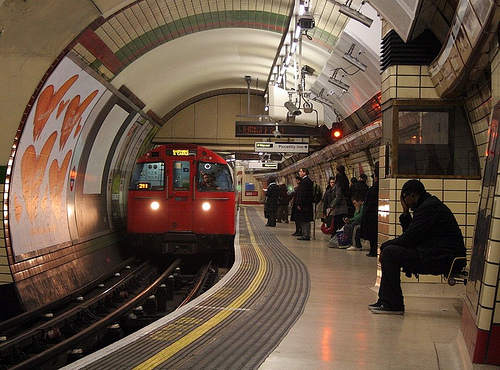
Shortly before 1230, after Richard and I had said our goodbyes, I jumped on a Bakerloo train at the London Underground station at Piccadilly Circus heading north for Baker Street.

Bakerloo line train at Piccadilly Circus station

I think it was one stop later that into my carriage entered parents with their small son.  They sat down and the father, who had been carrying the young lad, was clearly beautifully bonded (not my favourite word, can’t think of a better one just now) with the small boy.  The love and joy of the parents and their child just poured out into the ‘ether’ of the carriage. Result?

One man, middle-aged, sitting opposite to one side of the family beamed smiles in the direction of the young boy.  You could sense that his emotional outlook had been transformed by the unencumbered joy flowing across the carriage.  He really smiled more or less non-stop until I and this family got off at Baker Street station.

Another man, my guess upper middle-aged, was formally dressed in the business suit, tie and polished black shoes.  He was reading a newspaper.  But the boy’s joyful infectiousness touched him.  He put the paper to one side and discretely looked across at the child bouncing on his father’s lap and a private smile crossed his face.

I was standing observing all of this and, of course, seeing the truth of something so core to the needs of humans.  That is, the power of living beautifully in the present and how it demonstrates what my colleague Jon Lavin so often says, “The world reflects back what we think about most”.

Why do I write ‘of course’?  Because what was so natural for this boy at the tender age of one is so natural for dogs throughout all their lives; wonderfully enjoying the present.

In a most un-English manner, I briefly caught up with the parents and established that the young boy’s name was Thomas.

Well done, Thomas, and may that joy in you be with you and all those around you for ever and ever.

Present perfect!

Probably the best lesson dogs offer their human companions.

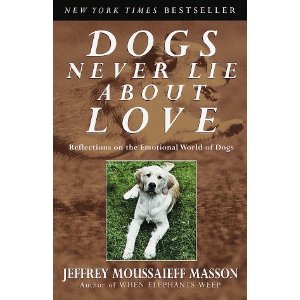
Having surfaced recently from being completely immersed in the writings of Dr. Rupert Sheldrake’s book, Dogs That Know When Their Owners Are Coming Home (start here and work backwards if you missed my musings on Sheldrake) I used the recent flight across to London to start into the book by Jeffrey Moussaieff Masson Dogs Never Lie About Love.

Masson's book

While I might disagree with some minor aspects of the way that dogs relate to humans, the essential premise of the book is very powerful.

Indeed, the very last sentence of Chapter 2, Why We Cherish Dogs reads as follows:

Questers of the truth, that’s who dogs are; seekers after the invisible scent of another’s authentic core.

For me, any attempt to seek our own ‘authentic core’ can only come from understanding the power of remaining in the present.  Dogs do this so naturally and instinctively.  As Masson writes a little earlier in the above chapter,

A dog does not tremble at the thought of his own mortality; I doubt if a dog ever thinks about a time when he will no longer be alive.  So when we are with a dog, we, too, enter a kind of timeless realm, where the future becomes irrelevant.

One could almost imagine this being the ancient wisdom of the teachings of Buddha!

Anyway, in a rather serendipitous manner, just before starting this essay, I read my weekly News and Notes from Terry Hershey.  This is what he wrote about being in the present.

Did you see Mr. Holland’s Opus? About Glenn Holland’s lifetime of teaching music to a high school band. In one scene he is giving a private lesson to Gertrude. She is playing clarinet, making noises that can only be described as other-worldly. He is clearly frustrated. As is she. Finally Mr. Holland says, “Let me ask you a question. When you look in the mirror what do you like best about yourself?”

“My hair,” says Gertrude.

“Why?”

“Well, my father always says that it reminds him of the sunset.”

After a pause, Mr. Holland says, “Okay.  Close your eyes this time. And play the sunset.”

And from her clarinet? Music. Sweet music.

Sometime today, I invite you to set aside the manual, or the list, or the prescription.

Take a Sabbath moment. . . close your eyes and play the sunset.

Mary Oliver describes such a moment this way, “. . .a seizure of happiness. Time seemed to vanish. Urgency vanished.”

Because, in such a moment, we are in, quite literally, a State of Grace.  In other words, what we experience here is not as a means to anything else.

If I am to focused on evaluating, I cannot bask in the moment.

If I am measuring and weighing, I cannot marvel at little miracles.

If I am anticipating a payoff, I cannot give thanks for simple pleasures.

If I am feeling guilty about not hearing or living the music, I cannot luxuriate in the wonders of the day.

Living in the present is not specifically mentioned but how else could one interpret these beautiful concepts.