That saying comes to mind when one reads about an attack on a dog in Queensland, Australia reported on the BBC News.
Here’s that item.
ooOOoo
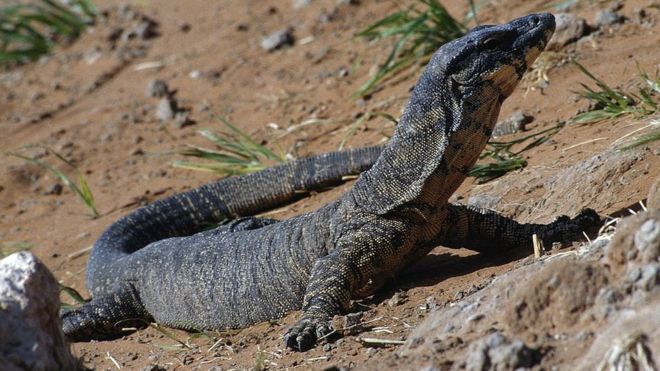
Australia couple injured in ‘freak’ goanna attack on their dog
Goannas can grow up to two metres (6.5ft) in length
An elderly couple has been attacked in Australia by a goanna (a large lizard), as they tried to stop it from savaging their dog, emergency officials say.
The man, in his 70s, was said to have sustained significant injuries and was airlifted to hospital after the incident in north-eastern Queensland.
The woman, in her 60s, was also taken to hospital with an injury to her foot.
The couple’s dog, a long-haired Jack Russell cross, was seriously injured.
Goannas can grow up to 2m (6.5ft) in length, though most varieties are under 1m, and rarely attack humans.
The rescue service described the attack which took place in Flametree near Airlie Beach, as “a horrific and freak ordeal”.
“The man suffered a very serious laceration and possible fracture of his right forearm as well as severe bleeding from his leg wound. He was in considerable pain,” ABC News quotes an ambulance worker as saying.
“The patients are quite lucky not to have been more seriously injured given that goannas can be quite savage,” another ambulance worker told ABC, adding: “It doesn’t happen every day, that’s for sure.”
The dog was earlier reported to have died, but ABC later reported that it had survived the attack.
ooOOoo
Now I wasn’t sure what a goanna was but thanks to Wikipedia (and not the only source), we find:
Goanna refers to some species of the genus Varanus found in Australia and Southeast Asia.
Being predatory lizards, goannas are often quite large, or at least bulky, with sharp teeth and claws. The largest is the perentie (V. giganteus), which can grow over 2.5 m (8.2 ft) in length.
Not all goannas are gargantuan. Pygmy goannas may be smaller than the arm of an adult human. The smallest of these, the short-tailed monitor (Varanus brevicuda) reaches only 20 cm (8 inches) in length. They survive on smaller prey, such as insects and mice.
Goannas combine predatory and scavenging behaviours. A goanna will prey on any animal it can catch and is small enough to eat whole. Goannas have been blamed for the death of sheep by farmers, though most likely erroneously, as goannas are also eaters of carrion and are attracted to rotting meat.
Most goannas are dark-coloured, with greys, browns, blacks and greens featuring prominently; however, white is also common. Many desert-dwelling species also feature yellow-red tones. Camouflageranges from bands and stripes to splotches, speckles, and circles, and can change as the creature matures, with juveniles sometimes being brighter than adults.
Like most lizards, goannas lay eggs. Most lay eggs in a nest or burrow, but some species lay their eggs inside termite mounds. This offers protection and incubation; additionally, the termites may provide a meal for the young as they hatch. Unlike some other species of lizards, goannas do not have the ability to regrow limbs or tails.
Texas Tripe Recalls Pet Food Due to Salmonella and Listeria
August 14, 2019 — The U.S. Food and Drug Administration is warning dog owners not to feed certain lots of Texas Tripe raw pet food after samples tested positive for Salmonella and/or Listeria monocytogenes.
The FDA is issuing this alert because these lots of Texas Tripe Inc. raw pet food represent a serious threat to human and animal health.
Because these products are sold and stored frozen, FDA is concerned that people may still have them in their possession.
What’s Being Recalled?
The recalled products are sold frozen in 20-pound and 40-pound cases.
Each case contains multiple plastic pouches.
Lot codes to help identify recalled product are printed on the outside of the cases. But the lot codes are not printed on the individual sealed plastic pouches, also known as chubs.
So, if the case has been discarded, there are no unique identification numbers on the individual chubs that allow customers to determine that they possess the recalled products.
These products are manufactured by Texas Tripe Inc. and were sold direct to consumers online and by phone.
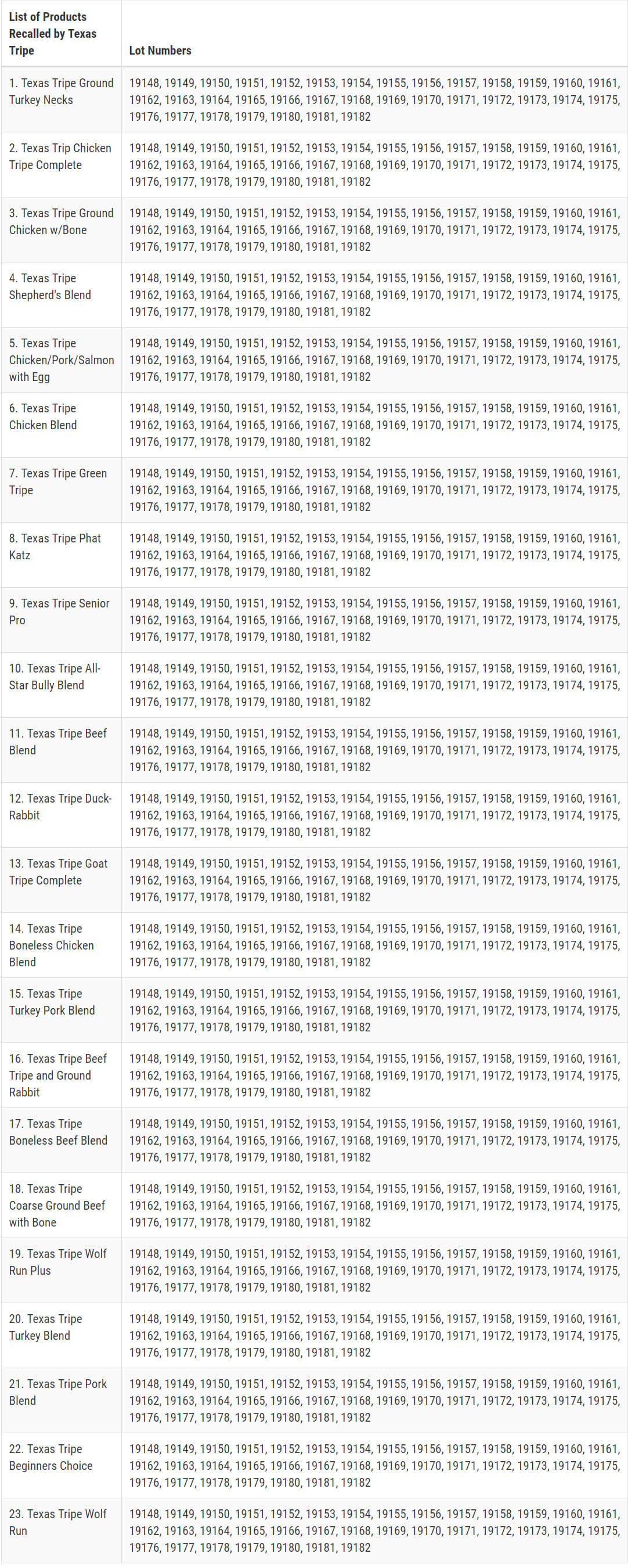
The chart below lists the recalled products and lot numbers provided by the firm to FDA on 8/6/2019. These include 35 lots for each of the following 23 product varieties.
The FDA-sampled products below tested positive for Salmonella and/or Listeria monocytogenes (as of 8/13/19) but have not been recalled.
Texas Tripe Chicken Blend: Lot 19196-6
Texas Tripe Pork Blend: Lot 19190-09
Texas Tripe Beef Blend: Lot 19191-05
Where Were the Products Sold?
According to the company, recalled products have been sold directly to consumers in the following states:
Alabama
Arizona
Arkansas
California
Colorado
Florida
Georgia
Illinois
Kansas
Kentucky
Louisiana
Michigan
Mississippi
Missouri
New Jersey
New Mexico
New York
North Carolina
Ohio
Oklahoma
Pennsylvania
Tennessee
Texas
Virginia
What Caused the Recall?
The Office of the Texas State Chemist (OTSC) collected 23 finished product samples at Texas Tripe Inc. Of the 23 samples, 16 tested positive for Listeria and/or Salmonella.
The FDA followed up these findings with an inspection and collected and analyzed samples of unopened finished product, after the firm performed corrective actions, from additional lots of some of the same products tested by OTSC.
FDA testing showed some of the samples contained Salmonella and/or L. mono.
FDA and OSTC shared their test results with Texas Tripe Inc. The firm initiated a recall on July 3, 2019 by directly notifying some of its customers via email.
Why FDA Is Concerned
Pet foods and treats contaminated with Salmonella and L. mono are of particular public health importance because they can affect both human and animal health.
Pets can get sick from these pathogens and may also be carriers of the bacteria and pass it on to their human companions without appearing to be ill.
People can get sick from handling contaminated pet foods and treats or touching surfaces that have had contact with the contaminated pet foods and treats.
Additionally, if a person gets Salmonella or L. mono on their hands, they can spread the bacteria to other people, objects, and surfaces.
The FDA is aware of recent cases in which humans and/or animals have gotten sick from exposure to Salmonella-contaminated pet foods (Salmonella-human cases, Salmonella-kitten, Salmonella-kitten and dog).
Although FDA is not aware of a documented case of a person acquiring L. mono infection from a pet food, once Salmonella or L. mono get established in the pet’s gastrointestinal tract, the animal can shed the bacteria in the feces when it has a bowel movement, and the contamination may continue to spread.
Because animals can shed the bacteria in the feces when they have bowel movements, it’s particularly important to clean up the animal’s feces in yards or parks where people or other animals may become exposed, in addition to cleaning items in the home.
The Federal Food, Drug, and Cosmetic Act requires that all animal food, like human food, be safe to eat, produced under sanitary conditions, contain no harmful substances, and be truthfully labeled.
Without an effective control for pathogens, such as cooking, animal food is more likely to contain pathogens such as Salmonella and L. mono.
Refrigeration or freezing does not kill the bacteria.
About Salmonella
Salmonella is a bacterium that can cause illness and death in humans and animals, especially those who are very young, very old, or have weak immune systems.
According to the CDC, people infected with Salmonella can develop diarrhea, fever and abdominal cramps.
Most people recover without treatment, but in some people, the diarrhea may be so severe that they need to be hospitalized.
In some patients, the Salmonella infection may spread from the intestines to the blood stream and then to other body sites unless the person is treated promptly with antibiotics.
Consult your health care provider if you have symptoms of Salmonella infection.
Pets do not always display symptoms when infected with Salmonella, but signs can include vomiting, diarrhea (which may be bloody), fever, loss of appetite and/or decreased activity level.
If your pet has these symptoms, consult a veterinarian promptly.
You should also be aware that infected pets can shed the bacteria in their feces and saliva without showing signs of being sick, further contaminating the household environment.
About Listeria
Listeria monocytogenes (L. mono) is a bacterium that can cause illness and death in humans and animals, especially those who are pregnant, very young, very old, or have weak immune systems.
According to CDC, listeriosis in humans can cause a variety of symptoms, depending on the person and the part of the body affected.
Symptoms can include headache, stiff neck, confusion, loss of balance, and convulsions in addition to fever and muscle aches.
Pregnant women typically experience only fever and other flu-like symptoms, such as fatigue and muscle aches.
However, infections during pregnancy can lead to miscarriage, stillbirth, premature delivery, or life-threatening infection of the newborn.
Pregnant women and their newborns, adults age 65 and older, and people with weakened immune systems are more likely to get sick with listeriosis.
Anyone with symptoms of listeriosis should contact a health care provider.
L. mono infections are uncommon in pets, but they are possible.
Symptoms may include mild to severe diarrhea, anorexia, fever, nervousness, muscular and respiratory signs, abortion, depression, shock and death.
Pets do not need to display symptoms to be able to pass L. mono on to their human companions.
Once L. mono gets established in the pet’s gastrointestinal tract, the animal can shed the bacteria in the feces when it has a bowel movement…
And the contamination may continue to spread, further contaminating the household environment.
What to Do?
If you have any recalled product, stop feeding it to your pets and throw it away in a secure container where other animals, including wildlife, cannot access it.
Consumers who have had this product in their homes should clean refrigerators/freezers where the product was stored and clean and disinfect all bowls, utensils, food prep surfaces, pet bedding, toys, floors, and any other surfaces that the food or pet may have had contact with.
Clean up the pet’s feces in yards or parks where people or other animals may become exposed.
Consumers should thoroughly wash their hands after handling the recalled product or cleaning up potentially contaminated items and surfaces.
If you believe you have symptoms of Salmonella and L. mono, consult your health care provider.
People who think their pets have become ill after consuming contaminated pet food should first contact their veterinarians.
Veterinarians who wish to have pets tested for Salmonella may do so through the Veterinary Laboratory Investigation and Response Network (Vet-LIRN Network) if the pet is from a household with a person infected with Salmonella.
U.S. citizens can report complaints about FDA-regulated pet food products by calling the consumer complaint coordinator in your area.
The Best Friends website has a useful article under their 2025 Goal aim.
It follows nicely yesterday’s post.
ooOOoo
2025 Goal
No-Kill for Cats and Dogs in America’s Shelters
You believe that animals deserve compassion and good quality of life. You also love your community and want to take action for the pets and people in it. Here’s how.
Last year, about 733,000 dogs and cats were killed in our nation’s animal shelters, simply because they didn’t have safe places to call home. Together, we can change that and achieve no-kill for dogs and cats nationwide by 2025.
Is your community no-kill?
Explore lifesaving nationwide using the interactive tool below and see which shelters in your community need your support. When every shelter in a community achieves a 90% save rate for all cats and dogs, that community is designated as no-kill. This provides a simple, effective benchmark for our lifesaving progress.
This dashboard presents a dynamic data set that is being updated regularly with the most current information available. We welcome your feedback to help ensure that our data is the latest and most accurate information.
Common elements of a no-kill community
All no-kill communities embrace and promote:
Collective responsibility: We hold ourselves accountable for the welfare of pets in our animal shelters and communities.
Individual community members are willing to participate in lifesaving programs.
State and local government are poised to support those programs.
A transparent shelter staff is working with their community to save more lives.
Progressive lifesaving: We value compassionate and responsible actions to save animals.
Decision-making is data-driven and anchored by best practices in the field.
Quality care is provided to every pet and quality of life is a priority.
Programs are designed to save the animals most at risk of being killed.
Programs are designed to tackle the root of the problem rather than the symptoms.
True euthanasia: We recognize that, for some animals, euthanasia is the most compassionate choice. This is why the no-kill benchmark for save rate is 90% and not 100%. In some cases, shelters may not meet the 90% benchmark, but do meet the philosophical principles of no-kill, which are:
Ending the life of an animal only to end irremediable suffering.
Ending the life of an animal when the animal is too dangerous to rehabilitate and place in the community safely.
End-of-life decisions are made by animal welfare professionals engaging in best practices and protocols.
These community maps are the first of their kind in animal welfare. They represent an enormous undertaking on the part of compassionate organizations and individuals throughout the country and a commitment to collaboration and transparency from more than 3,200 shelters across the country.
I just happened to click on the ‘signature’ of a follower that took me to a blog where I was truly enthralled. It was called Who Will Let the Dogs Out? and I was fascinated by what was being written.
Now I already follow this blog but had been very reluctant to go across to their place and read the posts. Shame on me! I have no idea why!
How about this post, that I am taking the liberty of republishing.
Ian and I are still processing what we saw and what we learned in Tennessee, each in our own way.
He is taking a break and feels he can’t look at the pictures for a bit. His pictures capture the emotion of the dogs caught in our human failure, and that is hard to look at. I know eventually he will be ready to edit them and to hopefully share more here on the blog. He took thousands of pictures. My big son has a very big heart, and it truly broke in Tennessee.
For me, seeing the conditions in western Tennessee made me furious. This should not be happening. We should not be leaving the responsibility for lost and surrendered animals to a handful of citizens who are quite literally standing in the gap left by a government that neglects its duties and an unaware public.
I cannot look away. So, I am doing what I do– writing and talking and making a nuisance of myself. I’m working on articles, blog posts (like this one), and even a book. I am in the midst of signing a publishing contract for 100 Dogs and Counting, a follow up to Another Good Dog: One Family and Fifty Foster Dogs that will recount more of our fostering adventures, and then take the reader south to discover where these dogs come from and what they can do about it.
I am also planning another trip in September– this time back to Tennessee, and then on to Alabama. Ian will be in school, but I will bring along another talented photographer and excellent co-pilot, Nancy Slattery.
One of the people I am excited to see on this next trip is a rescue hero of mine — Aubrie Kavanaugh. I’m excited to introduce you to her today in the following interview. Aubrie is not only an expert in the fight for a No-Kill nation, but a talented writer, a wickedly smart and funny person, and a dog-hearted woman relentlessly and methodically committed to changing the situation.
Enjoy!
The biggest first – the question everyone asks me – Why are there so many unwanted dogs in the south?
I honestly try to avoid the word “unwanted” because it implies that no one wants the animals when that is not necessarily true. Having said that, we have so many in need of homes for a host of reasons, some of which I’ll explain.
In many locations, there is a complete disconnect between animal control agencies/animal shelters which have animals needing new homes and the general public who could provide those homes. The shelters presume no one wants the animals and the public presumes the animals all find homes. The chasm between the agencies and the public is wide and leads to animals who otherwise may be saved being destroyed.
We have issues with most municipalities who manage animal shelters continuing to use the outdated “catch and kill” method of sheltering because they have not learned about or embraced No Kill programs and philosophies which could both reduce shelter intake and increase shelter output. Rather than educate themselves on how to keep animals alive which still ensure public safety, they hold firm to the status quo with the mindset of, “its’ not broken, so don’t fix it.” But the shelter system is broken and it does need to be fixed.
Many people are quick to ascribe what has been called “The Bubba Factor” to the south which essentially means that people here are too woefully stupid or callous to care about what happens to animals in need. We do have cultural differences regarding the value of animals in our lives (“it’s just a dog”) or where animals live (inside v. outside) and there are some people who could care less about animal welfare. Most people, however, do care at most about the welfare of animals and at least about how their tax dollars are spent. People can be informed not only about how their tax dollars can be best used, but also about how they can make better personal choices which affect how shelters operate (like the value of spay/neuter, how to keep pets contained, how to rehome pets in the event of their death or some life crisis, etc.). Many see themselves as stewards of the species we have domesticated and for them this is an issue of ethics, but they need to be informed of the need to address the need.
In many parts of the south, there is also very limited access to spay/neuter at all, let alone at a reasonable cost. This means that in some places, pet populations are not contained and just continue to grow over time. The more animals there are in any particular community, the more animals are apt to end up in animal control systems.
Define what ‘no-kill’ means to you.
No kill means we don’t kill healthy and treatable shelter animals using our tax dollars or donations.
Some try to portray the phrase as controversial or complicated when it really is not. When we use the intended meanings of words like “euthanasia” and “kill,” the phrase makes more sense.
If you have ever made The Terrible Decision to euthanize a beloved pet who is suffering, you know exactly what euthanasia means. It is an act of mercy to end or alleviate suffering. If a shelter ends the life of a healthy dog, that is not euthanasia no matter how many times we call it that. If someone outside an animal shelter setting were to end the lives of healthy animals, we would not say those animals were euthanized. We would say they were killed. We should not alter the meaning of words based on the location where the act takes place.
There will always be animals in shelters who are suffering and for whom euthanasia is the only responsible action as an act of mercy. There will also always be a very small number of dogs who are so broken as to be genuinely dangerous (as opposed to scared, traumatized or undersocialized) and who cannot be adopted out because they present a public safety risk and those dogs must, unfortunately, be euthanized. No Kill does not mean animals do not die. It means we keep the healthy and treatable animals alive because that’s what the public expects and because it is possible using a progressive business model.
We had our 16-year old German Sheppard mix euthanized on Earth Day of 2006. We knew for years that the day was coming, but it was heart-wrenching. I found I was not coping well in the wake of our loss. I began donating to the animal shelter in the city where I work in her honor and to help me cope with the loss by doing something positive.
I was on the shelter website a few months later when I came across a promotional video which began harmlessly but then transitioned to footage of an outwardly healthy dog being taken from his kennel to be killed. It shocked me. I had no real clue prior to that that the shelter was destroying healthy and treatable animals. When I later asked if the dog in the video had actually died, I was told five words that changed my life: “nobody wants Beagles these days.”
I got upset, then I got angry and then I began educating myself about why this was happening not just in my area, but all over the country. I wanted to do all I could to make it stop. I now consider myself an unapologetic No Kill advocate. For me, this is an issue about free speech and municipal accountability. I see my advocacy as a moral imperative. Shelters operate using tax dollars and it is up to us to hold those places accountable for how they spent our money and in our name (while sometimes blaming us for the process). As a country, we are better than this.
Is no-kill truly possible and if so, what will it take?
I absolutely believe that any community can become a No Kill Community and that as more places take this step, we move closer to a time when the killing of healthy and treatable animals will become part of our shameful past. Change can come in one of two ways. Municipalities can get ahead of this issue by adopting progressive programs. If they will not do so, the burden passes to citizens to educate themselves and then speak out to demand better of elected and appointed officials. If elected officials will not listen to the will of the people, they need to be replaced.
I support and promote the No Kill Equation which is a one-size-fits-all DIY solution for any community which was first published by Nathan Winograd in 2007. It is an all-in series of programs which work in concert with each other to reduce shelter intake and then move animals who are in the shelter through the system as quickly as possible. I group them into “keep them out” and “get them out” programs. Anyone can learn about the No Kill Equation by reading Nathan’s book, “Redemption: The Myth of Pet Overpopulation and the No Kill Revolution in America.” They can also read about the equation on numerous websites including those for the No Kill Advocacy Center, No Kill Movement, No Kill Learning, my Paws4Change website or our No Kill Huntsville website. I also go into a lot of detail about the Equation in my book and explain a bit about how each of the programs works.
What can someone who is not in the rural south do to help?
Every area can improve. If you live outside the south, find out how your local shelter is functioning using your tax dollars. Many shelters claim to have high release rates when, in fact, they are playing a numbers game or are using words in different ways than they are used by the public to condone or excuse killing. If you don’t like what you learn, speak out and ask for better. Only when more places across our country change will those changes ultimately become infectious everywhere, including in the south.
Even if your local area is doing a great job, you can connect with people you know in the south and encourage them to educate themselves and perhaps become politically active about their local shelter. It often falls to the public to speak out and demand better. Only those who live in the area can speak out for better use of their tax dollars in ways which are consistent with their values.
If you don’t know anyone in the south, you can help rescue and advocacy organizations in the south which are doing some of the heavy lifting to keep animals alive. If that is the help you choose to provide, please also encourage the rescue group or advocates with whom you engage to speak out to seek better. While I have the utmost respect for people “in the trenches,” who are keeping animals alive, they are doomed to provide that role indefinitely unless the system is forced to change through public demand. I have a section in my book called “For Rescuers,” which addresses this need to go beyond saving X dog and Y cat to becoming a catalyst for change so there are fewer animals in need of rescue or help. As simple as it sounds, nothing will change unless something changes to alter the process.
I love the title of your book because that’s what I’ve concluded, too – It’s not Rocket Science. Tell me a little about why you wrote the book and what you hope people take from it.
I formed an advocacy group called No Kill Huntsville in 2012 to speak with one voice to persuade the City of Huntsville, Alabama, to stop destroying healthy and treatable animals using tax dollars. The live release rate at the shelter at the time was about 34% and my individual efforts going back to 2008 to bring about change had failed. Fast forward a few years and things have changed remarkably. The live release rate at the shelter has been above 90% for more than four years and while there is still work to be done, the culture at our shelter has changed. It was an incredible struggle for a long time. It got ugly with some strong opposition from some unlikely sources. But we’re proud of what we did working together as a coalition.
One day last fall after a city council meeting which set some new guidelines for the shelter, I was thinking back to all the times people have contacted us asking for help or asking what we recommend. People contact us from the south, from other regions and even from other countries. I decided to write the book to help others learn from our path. We didn’t get everything we wanted and our work is not over, but the worst is behind us and I think people may learn something from our methods and from our mistakes. I think the content in the book about the opposition we faced is almost as important as the No Kill Equation we promoted and still promote. If advocates are not prepared to counter opposition, their arguments in support of animal shelter reform may fall short.
Anything else you’d like to add?
The phrase No Kill is on the public radar and is not going away. We do better to educate people on what it means and to help people learn how to promote change than to try to sugarcoat what is happening in our shelters using our money. We should be respectful in our advocacy, but there truly is no polite way to say, “please stop killing healthy and treatable animals using our money.” No Kill advocates are not the enemy of shelters any more than the public is the enemy. I always encourage people to focus not on the messenger, but the fact that the message is necessary in the first place.
There are some who use the phrase No Kill and do so in ways which are inconsistent with our social movement. Some of these people engage in criminal acts for which they should be prosecuted. We should absolutely call out those bad actors when we find them. Those people who co-opt the phrase No Kill for illegal or unethical purposes are no more representative of our social movement than unethical breeders of animals represent all breeders. If an organization calls itself No Kill and destroys a lot of animals, keeps them for years, or does not provide for their care, they are using the words without the actions to support them. My book covers this topic and I touch on it in the No Kill Movement blog.
I believe a time will come when all shelters in America will be No Kill shelters. How long that takes is up to all of us. We must educate ourselves on what his happening in our own communities so we can decide if our money is being spent in ways of which we approve. When it is not, it is up to us to ask for better and, when necessary, be advocates for change. The lives of animals depend on it.
Aubrie Kavanaugh is an Army veteran who has worked for decades as a litigation paralegal doing defense work; her clients are mostly municipalities and law enforcement officials.
Aubrie became an animal welfare advocate in 2006 after learning about the deaths of animals at her local animal shelter. She manages the Paws4Change educational website, blogs on animal welfare issues, creates video productions and public service announcements for animal shelters and nonprofit organizations across the country, and is involved in advancing animal welfare legislation on the local and state level. She also leads an advocacy group called No Kill Huntsville. She lives in northern Alabama with her husband, their dog, and the enduring inspiration of their dogs to whom they have said farewell for now.
America is an animal friendly society. Approximately sixty-eight percent of U.S. households own a pet – about 85 million families. Most of us consider our companion animals family members. We recognize that they enrich our lives in countless ways, improve our physical and mental health, and make us better people. We value the fact that they don’t care what we look like, where we live, what we do for a living or how much money we make; their love for us is unconditional. And we agonize over our decisions when the time comes to say farewell to them due to advanced age or disease.
But there is a dark side to our relationship with companion animals which is our collective shame. We destroy millions of healthy and treatable animals in our tax-funded animal shelters every year. Many people simply do not know about what happens at their local animal shelter using their money and in their name. Some who know about this tragedy believe there is no other way to function. There is.
“Not Rocket Science” is a story of no kill animal shelter advocacy in Huntsville, Alabama, which explains how a group of animal welfare advocates joined forces to speak with one voice to save the lives of healthy and treatable animals in the municipal animal shelter. This advocacy helped change the shelter from one which destroyed more than half of the animals entrusted to its care to a shelter which saves the lives of all healthy and treatable animals instead.
Any community can be a no kill community. Sometimes it just takes the courage to try something new. And sometimes it just takes a group of people willing to band together and speak out with one voice to say “enough. We are better than this.”
The book is priced at $5.52. I have ordered a copy!
A deeply fascinating essay from an individual at the University of Oxford.
I have long read the daily output from The Conversation. It’s a very useful way of keeping one’s brain cells functioning in some sort of fashion.
Yesterday morning I read an essay put out by Thomas Moynihan, a PhD Candidate at the University of Oxford.
It was fascinating and I am republishing it here.
Now it’s not for everyone. It is also long and it also has a number of videos to watch. And there’s not a dog mentioned!
But if you are interested in where we, as in human beings, are ‘going’, so to speak, then this is for you.
And I’m ready to admit that it may be an age thing; something that is of much interest to me because I shall be 75 in November and one naturally wonders about the end of life. Both individually and of society!
ooOOoo
The end of the world: a history of how a silent cosmos led humans to fear the worst.
It is 1950 and a group of scientists are walking to lunch against the majestic backdrop of the Rocky Mountains. They are about to have a conversation that will become scientific legend. The scientists are at the Los Alamos Ranch School, the site for the Manhattan Project, where each of the group has lately played their part in ushering in the atomic age.
They are laughing about a recent cartoon in the New Yorker offering an unlikely explanation for a slew of missing public trash cans across New York City. The cartoon had depicted “little green men” (complete with antenna and guileless smiles) having stolen the bins, assiduously unloading them from their flying saucer.
By the time the party of nuclear scientists sits down to lunch, within the mess hall of a grand log cabin, one of their number turns the conversation to matters more serious. “Where, then, is everybody?”, he asks. They all know that he is talking – sincerely – about extraterrestrials.
The question, which was posed by Enrico Fermi and is now known as Fermi’s Paradox, has chilling implications.
Bin-stealing UFOs notwithstanding, humanity still hasn’t found any evidence of intelligent activity among the stars. Not a single feat of “astro-engineering”, no visible superstructures, not one space-faring empire, not even a radio transmission. It has beenargued that the eerie silence from the sky above may well tell us something ominous about the future course of our own civilisation.
Such fears are ramping up. Last year, the astrophysicist Adam Frank implored an audience at Google that we see climate change – and the newly baptised geological age of the Anthropocene – against this cosmological backdrop. The Anthropocene refers to the effects of humanity’s energy-intensive activities upon Earth. Could it be that we do not see evidence of space-faring galactic civilisations because, due to resource exhaustion and subsequent climate collapse, none of them ever get that far? If so, why should we be any different?
A few months after Frank’s talk, in October 2018, the Intergovernmental Panel on Climate Change’s update on global warming caused a stir. It predicted a sombre future if we do not decarbonise. And in May, amid Extinction Rebellion’s protests, a new climate report upped the ante, warning: “Human life on earth may be on the way to extinction.”
Meanwhile, NASA has been publishing press releases about an asteroid set to hit New York within a month. This is, of course, a dress rehearsal: part of a “stress test” designed to simulate responses to such a catastrophe. NASA is obviously fairly worried by the prospect of such a disaster event – such simulations are costly.
Space tech Elon Musk has also been relaying his fears about artificial intelligence to YouTube audiences of tens of millions. He and others worry that the ability for AI systems to rewrite and self-improve themselves may trigger a sudden runaway process, or “intelligence explosion”, that will leave us far behind – an artificial superintelligence need not even be intentionally malicious in order to accidentally wipe us out.
In 2015, Musk donated to Oxford’s Future of Humanity Institute, headed up by transhumanist Nick Bostrom. Nestled within the university’s medieval spires, Bostrom’s institute scrutinises the long-term fate of humanity and the perils we face at a truly cosmic scale, examining the risks of things such as climate, asteroids and AI. It also looks into less well-publicised issues. Universe destroying physics experiments, gamma-ray bursts, planet-consuming nanotechnology and exploding supernovae have all come under its gaze.
So it would seem that humanity is becoming more and more concerned with portents of human extinction. As a global community, we are increasingly conversant with increasingly severe futures. Something is in the air.
But this tendency is not actually exclusive to the post-atomic age: our growing concern about extinction has a history. We have been becoming more and more worried for our future for quite some time now. My PhD research tells the story of how this began. No one has yet told this story, yet I feel it is an important one for our present moment.
I wanted to find out how current projects, such as the Future of Humanity Institute, emerge as offshoots and continuations of an ongoing project of “enlightenment” that we first set ourselves over two centuries ago. Recalling how we first came to care for our future helps reaffirm why we should continue to care today.
Extinction, 200 years ago
In 1816, something was also in the air. It was a 100-megaton sulfate aerosol layer. Girdling the planet, it was made up of material thrown into the stratosphere by the eruption of Mount Tambora, in Indonesia, the previous year. It was one of the biggest volcanic eruptions since civilisation emerged during the Holocene.
Mount Tambora’s crater. Wikimedia Commons/NASA
Almost blotting out the sun, Tambora’s fallout caused a global cascade of harvest collapse, mass famine, cholera outbreak and geopolitical instability. And it also provoked the first popular fictional depictions of human extinction. These came from a troupe of writers including Lord Byron, Mary Shelley and Percy Shelley.
The group had been holidaying together in Switzerland when titanic thunderstorms, caused by Tambora’s climate perturbations, trapped them inside their villa. Here they discussed humanity’s long-term prospects.
Clearly inspired by these conversations and by 1816’s hellish weather, Byron immediately set to work on a poem entitled “Darkness”. It imagines what would happen if our sun died:
I had a dream, which was not all a dream
The bright sun was extinguish’d, and the stars
Did wander darkling in the eternal space
Rayless, and pathless, and the icy earth
Swung blind and blackening in the moonless air
Detailing the ensuing sterilisation of our biosphere, it caused a stir. And almost 150 years later, against the backdrop of escalating Cold War tensions, the Bulletin for Atomic Scientists again called upon Byron’s poem to illustrate the severity of nuclear winter.
Two years later, Mary Shelley’s Frankenstein (perhaps the first book on synthetic biology) refers to the potential for the lab-born monster to outbreed and exterminate Homo sapiens as a competing species. By 1826, Mary went on to publish The Last Man. This was the first full-length novel on human extinction, depicted here at the hands of pandemic pathogen.
Boris Karloff plays Frankenstein’s monster, 1935. Wikimedia Commons
Beyond these speculative fictions, other writers and thinkers had already discussed such threats. Samuel Taylor Coleridge, in 1811, daydreamed in his private notebooks about our planet being “scorched by a close comet and still rolling on – cities men-less, channels riverless, five mile deep”. In 1798, Mary Shelley’s father, the political thinker William Godwin, queried whether our species would “continue forever”?
While just a few years earlier, Immanuel Kant had pessimistically proclaimed that global peace may be achieved “only in the vast graveyard of the human race”. He would, soon after, worry about a descendent offshoot of humanity becoming more intelligent and pushing us aside.
Earlier still, in 1754, philosopher David Hume had declared that “man, equally with every animal and vegetable, will partake” in extinction. Godwin noted that “some of the profoundest enquirers” had lately become concerned with “the extinction of our species”.
In 1816, against the backdrop of Tambora’s glowering skies, a newspaper article drew attention to this growing murmur. It listed numerous extinction threats. From global refrigeration to rising oceans to planetary conflagration, it spotlighted the new scientific concern for human extinction. The “probability of such a disaster is daily increasing”, the article glibly noted. Not without chagrin, it closed by stating: “Here, then, is a very rational end of the world!”
So if people first started worrying about human extinction in the 18th century, where was the notion beforehand? There is enough apocalypse in scripture to last until judgement day, surely. But extinction has nothing to do with apocalypse. The two ideas are utterly different, even contradictory.
For a start, apocalyptic prophecies are designed to reveal the ultimate moral meaning of things. It’s in the name: apocalypse means revelation. Extinction, by direct contrast, reveals precisely nothing and this is because it instead predicts the end of meaning and morality itself – if there are no humans, there is nothing humanly meaningful left.
And this is precisely why extinction matters. Judgement day allows us to feel comfortable knowing that, in the end, the universe is ultimately in tune with what we call “justice”. Nothing was ever truly at stake. On the other hand, extinction alerts us to the fact that everything we hold dear has always been in jeopardy. In other words, everything is at stake.
Extinction was not much discussed before 1700 due to a background assumption, widespread prior to the Enlightenment, that it is the nature of the cosmos to be as full as moral value and worth as is possible. This, in turn, led people to assume that all other planets are populated with “living and thinking beings” exactly like us.
Although it only became a truly widely accepted fact after Copernicus and Kepler in the 16th and 17th centuries, the idea of plural worlds certainly dates back to antiquity, with intellectuals from Epicurus to Nicholas of Cusa proposing them to be inhabited with lifeforms similar to our own. And, in a cosmos that is infinitely populated with humanoid beings, such beings – and their values – can never fully go extinct.
Star cluster Messier 13 in Hercules, 1877. Wikimedia Commons
In the 1660s, Galileo confidently declared that an entirely uninhabited or unpopulated world is “naturally impossible” on account of it being “morally unjustifiable”. Gottfried Leibniz later pronounced that there simply cannot be anything entirely “fallow, sterile, or dead in the universe”.
Along the same lines, the trailblazing scientist Edmond Halley (after whom the famous comet is named) reasoned in 1753 that the interior of our planet must likewise be “inhabited”. It would be “unjust” for any part of nature to be left “unoccupied” by moral beings, he argued.
Around the same time Halley provided the first theory on a “mass extinction event”. He speculated that comets had previously wiped out entire “worlds” of species. Nonetheless, he also maintained that, after each previous cataclysm “human civilisation had reliably re-emerged”. And it would do so again. Only this, he said could make such an event morally justifiable.
Later, in the 1760s, the philosopher Denis Diderot was attending a dinner party when he was asked whether humans would go extinct. He answered “yes”, but immediately qualified this by saying that after several millions of years the “biped animal who carries the name man” would inevitably re-evolve.
This is what the contemporary planetary scientist Charles Lineweaver identifies as the “Planet of the Apes Hypothesis”. This refers to the misguided presumption that “human-like intelligence” is a recurrent feature of cosmic evolution: that alien biospheres will reliably produce beings like us. This is what is behind the wrong-headed assumption that, should we be wiped out today, something like us will inevitably return tomorrow.
Back in Diderot’s time, this assumption was pretty much the only game in town. It was why one British astronomer wrote, in 1750, that the destruction of our planet would matter as little as “Birth-Days or Mortalities” do down on Earth.
This was typical thinking at the time. Within the prevailing worldview of eternally returning humanoids throughout an infinitely populated universe, there was simply no pressure or need to care for the future. Human extinction simply couldn’t matter. It was trivialised to the point of being unthinkable.
For the same reasons, the idea of the “future” was also missing. People simply didn’t care about it in the way we do now. Without the urgency of a future riddled with risk, there was no motivation to be interested in it, let alone attempt to predict and preempt it.
It was the dismantling of such dogmas, beginning in the 1700s and ramping up in the 1800s, that set the stage for the enunciation of Fermi’s Paradox in the 1900s and leads to our growing appreciation for our cosmic precariousness today.
But then we realised the skies are silent
In order to truly care about our mutable position down here, we first had to notice that the cosmic skies above us are crushingly silent. Slowly at first, though soon after gaining momentum, this realisation began to take hold around the same time that Diderot had his dinner party.
One of the first examples of a different mode of thinking I’ve found is from 1750, when the French polymath Claude-Nicholas Le Cat wrote a history of the earth. Like Halley, he posited the now familiar cycles of “ruin and renovation”. Unlike Halley, he was conspicuously unclear as to whether humans would return after the next cataclysm. A shocked reviewer picked up on this, demanding to know whether “Earth shall be re-peopled with new inhabitants”. In reply, the author facetiously asserted that our fossil remains would “gratify the curiosity of the new inhabitants of the new world, if there be any”. The cycle of eternally returning humanoids was unwinding.
In line with this, the French encyclopaedist Baron d’Holbach ridiculed the “conjecture that other planets, like our own, are inhabited by beings resembling ourselves”. He noted that precisely this dogma – and the related belief that the cosmos is inherently full of moral value – had long obstructed appreciation that the human species could permanently “disappear” from existence. By 1830, the German philosopher F W J Schelling declared it utterly naive to go on presuming “that humanoid beings are found everywhere and are the ultimate end”.
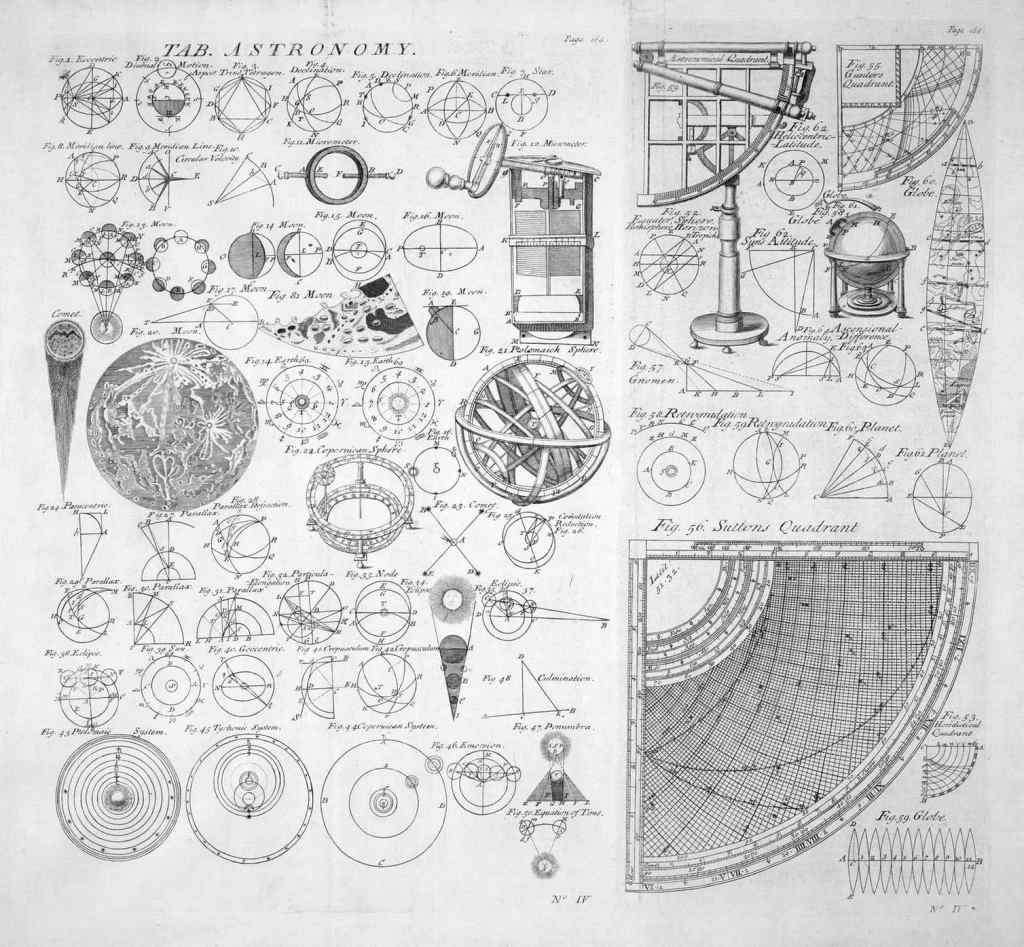
Figures illustrating articles on astronomy, from the 1728 Cyclopaedia. Wikimedia Commons
And so, where Galileo had once spurned the idea of a dead world, the German astronomer Wilhelm Olbers proposed in 1802 that the Mars-Jupiter asteroid belt in fact constitutes the ruins of a shattered planet. Troubled by this, Godwin noted that this would mean that the creator had allowed part of “his creation” to become irremediably “unoccupied”. But scientists were soon computing the precise explosive force needed to crack a planet – assigning cold numbers where moral intuitions once prevailed. Olbers calculated a precise timeframe within which to expect such an event befalling Earth. Poets began writing of “bursten worlds”.
The cosmic fragility of life was becoming undeniable. If Earth happened to drift away from the sun, one 1780s Parisian diarist imagined that interstellar coldness would “annihilate the human race, and the earth rambling in the void space, would exhibit a barren, depopulated aspect”. Soon after, the Italian pessimist Giacomo Leopardi envisioned the same scenario. He said that, shorn of the sun’s radiance, humanity would “all die in the dark, frozen like pieces of rock crystal”.
Galileo’s inorganic world was now a chilling possibility. Life, finally, had become cosmically delicate. Ironically, this appreciation came not from scouring the skies above but from probing the ground below. Early geologists, during the later 1700s, realised that Earth has its own history and that organic life has not always been part of it. Biology hasn’t even been a permanent fixture down here on Earth – why should it be one elsewhere? Coupled with growing scientific proof that many species had previously become extinct, this slowly transformed our view of the cosmological position of life as the 19th century dawned.
Copper engraving of a pterodactyl fossil discovered by the Italian scientist Cosimo Alessandro Collini in 1784. Wikimedia Commons
Seeing death in the stars
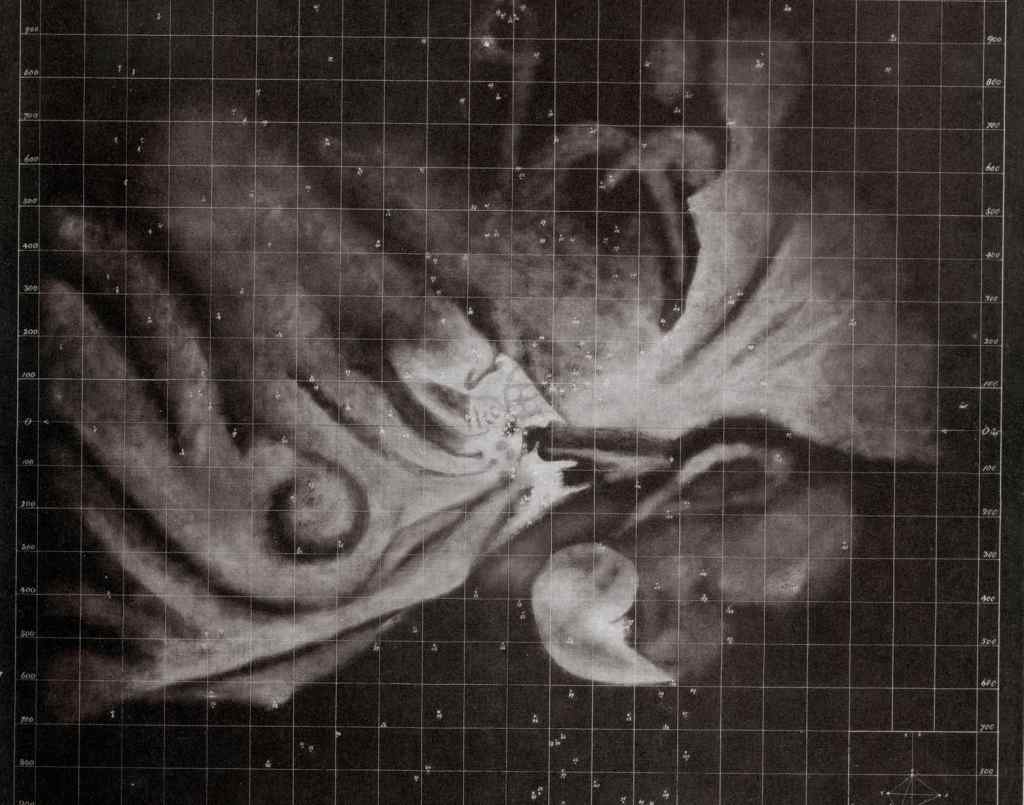
And so, where people like Diderot looked up into the cosmos in the 1750s and saw a teeming petri dish of humanoids, writers such as Thomas de Quincey were, by 1854, gazing upon the Orion nebula and reporting that they saw only a gigantic inorganic “skull” and its lightyear-long rictus grin.
The astronomer William Herschel had, already in 1814, realised that looking out into the galaxy one is looking into a “kind of chronometer”. Fermi would spell it out a century after de Quincey, but people were already intuiting the basic notion: looking out into dead space, we may just be looking into our own future.
People were becoming aware that the appearance of intelligent activity on Earth should not be taken for granted. They began to see that it is something distinct – something that stands out against the silent depths of space. Only through realising that what we consider valuable is not the cosmological baseline did we come to grasp that such values are not necessarily part of the natural world. Realising this was also realising that they are entirely our own responsibility. And this, in turn, summoned us to the modern projects of prediction, preemption and strategising. It is how we came to care about our future.
As soon as people first started discussing human extinction, possible preventative measures were suggested. Bostrom now refers to this as “macrostrategy”. However, as early as the 1720s, the French diplomat Benoît de Maillet was suggesting gigantic feats of geoengineering that could be leveraged to buffer against climate collapse. The notion of humanity as a geological force has been around ever since we started thinking about the long-term – it is only recently that scientists have accepted this and given it a name: “Anthropocene”.
Will technology save us?
It wasn’t long before authors began conjuring up highly technologically advanced futures aimed at protecting against existential threat. The eccentric Russian futurologist Vladimir Odoevskii, writing in the 1830s and 1840s, imagined humanity engineering the global climate and installing gigantic machines to “repulse” comets and other threats, for example. Yet Odoevskii was also keenly aware that with self-responsibility comes risk: the risk of abortive failure. Accordingly, he was also the very first author to propose the possibility that humanity might destroy itself with its own technology.
Acknowledgement of this plausibility, however, is not necessarily an invitation to despair. And it remains so. It simply demonstrates appreciation of the fact that, ever since we realised that the universe is not teeming with humans, we have come to appreciate that the fate of humanity lies in our hands. We may yet prove unfit for this task, but – then as now – we cannot rest assured believing that humans, or something like us, will inevitably reappear – here or elsewhere.
Beginning in the late 1700s, appreciation of this has snowballed into our ongoing tendency to be swept up by concern for the deep future. Current initiatives, such as Bostrom’s Future of Humanity Institute, can be seen as emerging from this broad and edifying historical sweep. From ongoing demands for climate justice to dreams of space colonisation, all are continuations and offshoots of a tenacious task that we first began to set for ourselves two centuries ago during the Enlightenment when we first realised that, in an otherwise silent universe, we are responsible for the entire fate of human value.
It may be solemn, but becoming concerned for humanity’s extinction is nothing other than realising one’s obligation to strive for unceasing self-betterment. Indeed, ever since the Enlightenment, we have progressively realised that we must think and act ever better because, should we not, we may never think or act again. And that seems – to me at least – like a very rational end of the world.
ooOOoo
I hope you have read it all. There’s much to engage one. And the message to me is very clear: We have to regard this race, correction: our race, as unique. As is put in the penultimate paragraph:
“Enlightenment when we first realised that, in an otherwise silent universe, we are responsible for the entire fate of human value.”
Now there’s a thought for an atheist on a Saturday morning!
There is a blog site, primarily for all those interested in photography. It is called Ugly Hedgehog! Seriously! But UHH, as it is known, also has room for general non-photographic chat so it really does cater for all.
I have been a member since July, 2017, and have been amazed at how quickly the time has gone.
Anyway, the home page of Ugly Hedgehog is here, it’s free, and if you have any interest in photography I strongly recommend it.
This item came in a couple of weeks ago and I’m taking the liberty of sharing it with you.
ooOOoo
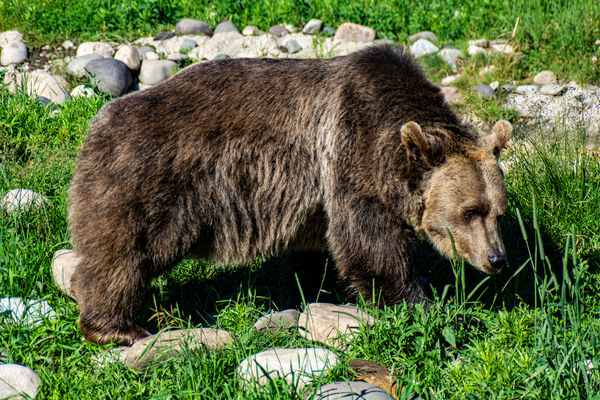
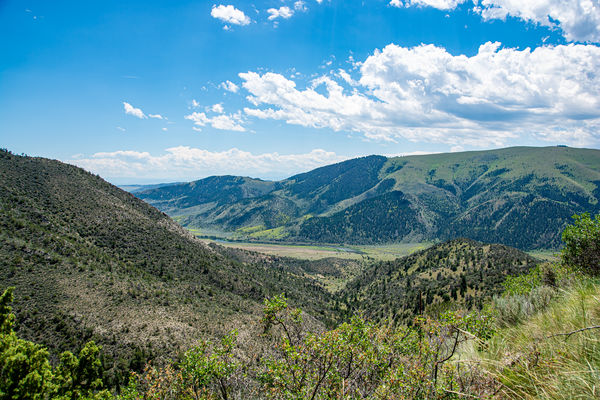
Spent a few days in Bozeman Montana visiting my youngest son and daughter in law before heading out to Southern California. A couple of images from my trip to Montana…
I must admit that I hadn’t heard of Margaret Heffernan before.
But in browsing TED Talks one evening recently we came across a TED Talk by her. And it was riveting!
Here’s how it was introduced:
The more we rely on technology to make us efficient, the fewer skills we have to confront the unexpected, says writer and entrepreneur Margaret Heffernan. She shares why we need less tech and more messy human skills — imagination, humility, bravery — to solve problems in business, government and life in an unpredictable age. “We are brave enough to invent things we’ve never seen before,” she says. “We can make any future we choose.”
Later on it explains: “The former CEO of five businesses, Margaret Heffernan explores the all-too-human thought patterns that lead organizations and managers astray.”
In doing more research I came upon this:
Margaret Heffernan was born in Texas, grew up in the Netherlands and was educated at Cambridge University. She produced drama and documentary programs for the BBC for 13 years, then moved back to the US where she became a serial entrepreneur and CEO in the early days of the internet.
All of Heffernan’s work challenges accepted wisdom about good lives and good work. Willful Blindness: Why We Ignore the Obvious at Our Peril, named one of the most important business books of the decade by the Financial Times, looked at how our most cherished beliefs, behaviors and rules blind us to what matters most.
In 2015, she was awarded the Transmission Prize for A Bigger Prize: How We Can Do Better than the Competition, a book that upended the idea that competition forces the best to the top, arguing that it mostly proves wasteful and destructive where collaboration is more sustainable and creative.
Her forthcoming book, Uncharted: How to Map the Future will be published in February 2020 in the UK and May 2020 in the US. It addresses the fundamental unpredictability of life, challenges technological determinism and asks how we can find in ourselves the freedom and imagination to create the futures we want. An early reader called it “Karl Popper for the 21st century.”
As lead faculty for the Forward Institute’s Responsible Leadership Programme, Heffernan mentors CEOs and senior executives of major global organizations.
Humans have the ability of selective hearing, enabling us to tune in to one person speaking, for instance, even in the middle of a noisy room. This phenomenon, dubbed the cocktail party effect, is not unique to humans, however.
Research published in the journal Animal Cognition revealed that not only can dogs recognize their names in noisy conditions, they may do so better than human infants in a similar situation.1 It’s a finding that could be particularly useful for handlers of working or service dogs, who may find themselves needing to attract their dog’s attention in a chaotic environment.
It’s been suggested that hand signals may be best for this, but a vocal command may be preferable, especially since dog’s may miss hand signals as they pay attention to what’s going on in their environment.2
Dogs pick up their names even in noisy environments
For the study, researchers from the University of Maryland used a variety of dog breeds, including pets, service dogs and search-and-rescue dogs, and their owners. The dogs were placed in a booth with their owner, where background noise was played at increasingly loud levels.
Amidst the background noise, a loudspeaker played recordings of a woman speaking the dog’s name or another dog’s similar-sounding name. The dogs listened more intently to the speaker playing their own name and were able to recognize it at varying levels of background noise, up until the noise became louder than the recording of their names.3
“This surpasses the performance of 1-year-old infants,” the researchers noted. Comparatively, adult humans can pick their names out even when background noise is louder than their name. Perhaps not surprisingly, in the study the working dogs performed better at the name recognition than pet dogs.
“I suspect one of the reasons working dogs do better is because people use their names more consistently,” study co-author Rochelle Newman, Ph.D., told National Geographic. “We often end up using nicknames so much.”4 In addition, the researchers concluded:5
“Overall, we find better performance at name recognition in dogs that were trained to do tasks for humans, like service dogs, search-and-rescue dogs, and explosives detection dogs. These dogs were of several different breeds, and their tasks were widely different from one another.
This suggests that their superior performance may be due to generally more training and better attention. In summary, these results demonstrate that dogs can recognize their name even in relatively difficult levels of multitalker babble, and that dogs who work with humans are especially adept at name recognition in comparison with companion dogs.”
Dogs also cue in on other dog and human emotions
Dogs are very in tune with their environments, including the actions and emotions of those around them — both dogs and people. For instance, dogs have been found to display rapid mimicry of the other dogs’ body movements, particularly a play bow and facial expression (a relaxed, open mouth).6
When dogs mimicked each other, their play sessions lasted longer, which suggests it increased the dogs’ motivation to play and possibly strengthened the dogs’ relationship. Given that dogs mimic the emotional states of other dogs, dogs may also be able to mimic their owners’ facial expressions, especially if they’re closely bonded.
“Emotional contagion is a basic form of empathy that makes individuals able to experience others’ emotions. In human and non-human primates, emotional contagion can be linked to facial mimicry, an automatic and fast response (less than 1 second]) in which individuals involuntary mimic others’ expressions,” researchers wrote in Royal Society Open Science. “… All these findings concur in supporting the idea that a possible linkage between rapid mimicry and emotional contagion (a building-block of empathy) exists in dogs.”
The fact that dogs may mimic their owner’s facial expressions and are capable of selective hearing to pick their name out of a host of background noise adds even more understanding of why dogs and humans share such strong bonds.
Dogs associate words with objects
In dog and human communication, it remains a bit of a mystery whether dogs are responding to humans’ words, tone of voice, gestures or other cues — or all of the above.
The featured study suggests dogs do, indeed, respond to their names when spoken verbally, and past research has also shown dogs associate certain words with objects and seem able to form mental pictures that correspond to words they’ve been taught.7 Dogs also tune in to the tone of your voice,8 and may have a heightened response to praise delivered in an upbeat tone. There’s still some debate, though, over whether dogs really understand what you’re saying.
“Some of the old guard say the name is just a bit of noise that is made by the handler, and the dog is familiar with the handler’s voice, so anything the handler says is going to get their attention,” Stanley Coren, Ph.D., professor emeritus of psychology at the University of British Columbia, told National Geographic.9
Yet in the featured study, the dogs responded even though a stranger’s voice said their names, adding more evidence that dogs may understand more than we give them credit for. And, for anyone wondering, there’s evidence that cats also know their names, much like dogs and even when spoken by someone other than their owner.
ooOOoo
That dogs, perhaps not all dogs, understand far more than we give them credit is no real surprise. For a creature that bonds so close to humans and has done for a long time we still don’t really know how they function. Well certainly in the head department!
But that doesn’t reduce by one iota our love for them. They are a very special animal.
You’re getting this alert because you signed up on our website and asked to be notified. If you no longer wish to receive these emails, please click the “unsubscribe” link at the bottom of this message.
After posting 2 recalls in 4 weeks, the U.S. Food and Drug Administration is now warning consumers to avoid buying or feeding ALL pig ears pet treats.
The outbreak of human Salmonella caused by exposure to the contaminated treats has now spread to 33 states.
Please be sure to share the news of this alert with other pet owners.
Mike Sagman, Editor
The Dog Food Advisor
Saving Good Dogs from Bad Dog Food
Do really note that link from the FDA about not feeding any pig ears pet treats.
Please note that not all of the data for each dry dog food can be brought across. I recommend that any products of deep interest are researched online and the information is primary and this page is secondary.
oooooh
On to the August 2019 list of best dry dog foods.
Best Dry Dog Foods 2019
The best dry dog foods listed below have been selected by The Dog Food Advisor because of their exceptional ingredient quality, nutritious design, and the superior safety practices of their manufacturers.
In addition, the labels of these products reveal…
Above-average meat content
Safe fat-to-protein ratio
Moderate carb levels
No high-risk ingredients
No anonymous meat
Tip: Please don’t overlook our 4-star selections. Many are made by some of the best companies in the industry. They also offer exceptional value for those on a budget.
The Best Dry Dog Foods
August 2019
Here are The Dog Food Advisor’s top 20 best dry dog foods for August 2019.
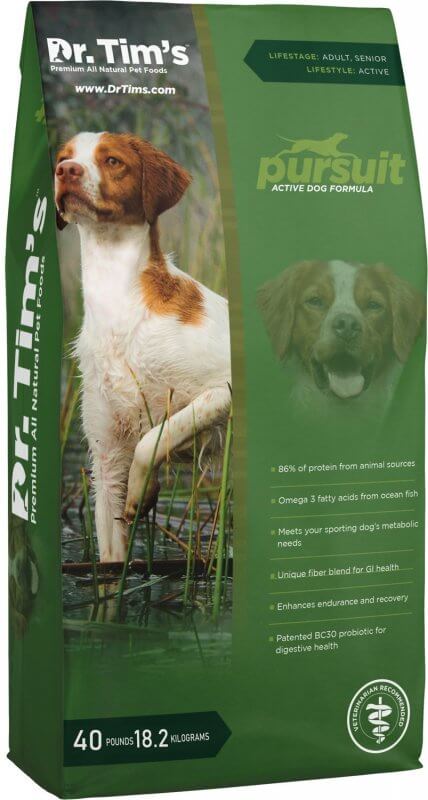
Dr. Tim’s Pursuit Active Dog Formula derives the bulk of its animal protein from chicken meal. Our dry matter label analysis reveals the recipe contains 33% protein, 22% fat and 36% estimated carbs… creating a fat-to-protein ratio of about 67%.
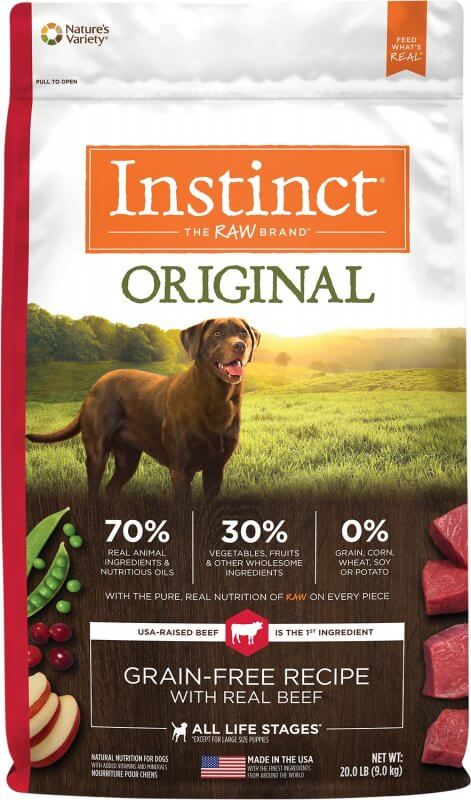
Instinct Original with Real Beef derives most of its animal protein from beef, chicken meal and fish meal. Our dry matter label analysis reveals the recipe contains 40% protein, 21% fat and 31% estimated carbs… producing a fat-to-protein ratio of about 53%.
Victor Hi-Pro Plus derives the majority of its animal protein from beef meal. Our dry matter label analysis reveals the recipe contains 33% protein, 22% fat and 37% estimated carbs… which results in a fat-to-protein ratio of about 67%.
Annamaet Ultra derives most of its animal protein from chicken meal. Our dry matter label analysis reveals the recipe contains 36% protein, 22% fat and 34% estimated carbs… yielding a fat-to-protein ratio of about 63%.
Canidae Pure Real Salmon and Sweet Potato derives the bulk of its animal protein from salmon. Our dry matter label analysis reveals the recipe contains 36% protein, 20% fat and 36% estimated carbs… resulting in a fat-to-protein ratio of about 56%.
Wellness Complete Health Adult derives most of its animal protein from chicken. Our dry matter label analysis reveals the recipe contains 27% protein, 13% fat and 52% estimated carbs… which yields a fat-to-protein ratio of about 50%.
Orijen Original derives the majority of its animal protein from deboned poultry and Atlantic fish. Our dry matter label analysis reveals the recipe contains 43% protein, 21% fat and 28% estimated carbs… which produces a fat-to-protein ratio of about 47%.
Diamond Naturals Extreme Athlete derives the bulk of its animal protein from chicken. Our dry matter label analysis reveals the recipe contains 36% protein, 28% fat and 29% estimated carbs… resulting in a fat-to-protein ratio of about 78%.
Nature’s Logic Canine Chicken Meal Feast derives most of its animal protein from chicken meal. Our dry matter label analysis reveals the recipe contains 40% protein, 17% fat and 36% estimated carbs… which creates a fat-to-protein ratio of about 42%.
Nulo Freestyle Turkey and Sweet Potato derives the bulk of its animal protein from poultry meal and salmon meal. Our dry matter label analysis reveals the recipe contains 37% protein, 20% fat and 35% estimated carbs… creating a fat-to-protein ratio of about 55%.
Nutro Ultra Adult derives most of its animal protein from chicken and chicken meal. Our dry matter label analysis reveals the recipe contains 28% protein, 16% fat and 49% estimated carbs… producing a fat-to-protein ratio of about 56%.
Go! Solutions Carnivore Chicken, Turkey and Duck derives the majority of its animal protein from poultry meal, salmon meal and deboned poultry. Our dry matter label analysis reveals the recipe contains 38% protein, 18% fat and 36% estimated carbs… yielding a fat-to-protein ratio of about 47%.
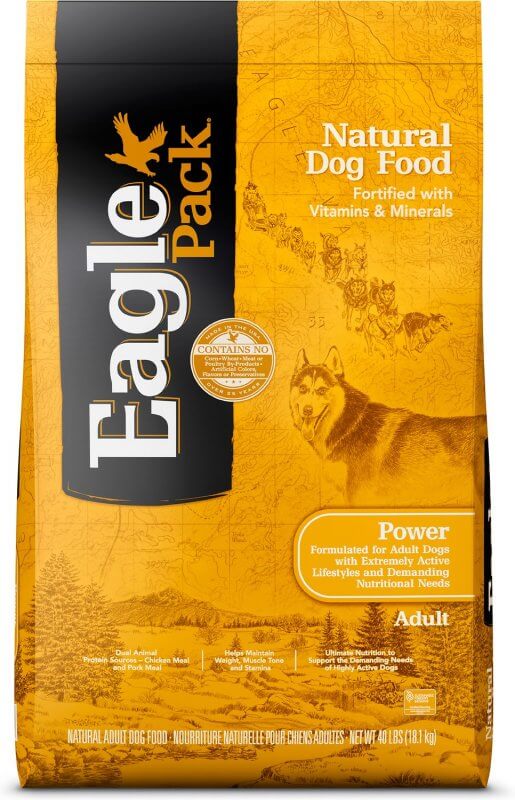
Eagle Pack Power Adult derives most of its animal protein from chicken meal and pork meal. Our dry matter label analysis reveals the recipe contains 33% protein, 21% fat and 38% estimated carbs… resulting in a fat-to-protein ratio of about 63%.
Wellness Core Original derives the bulk of its animal protein from chicken. Our dry matter label analysis reveals the recipe contains 38% protein, 18% fat and 36% estimated carbs… which produces a fat-to-protein ratio of about 47%.
Whole Earth Farms Adult Recipe derives the majority of its animal protein from poultry meal. Our dry matter label analysis reveals the recipe contains 29% protein, 15% fat and 48% estimated carbs… resulting in a fat-to-protein ratio of about 50%.
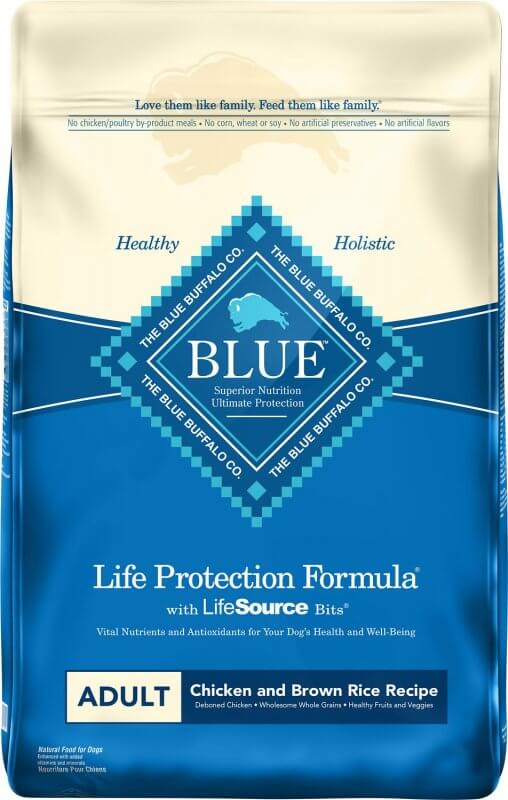
Blue Buffalo Life Protection Chicken and Brown Rice derives the majority of its animal protein from deboned chicken and chicken meal. Our dry matter label analysis reveals the recipe contains 27% protein, 16% fat and 50% estimated carbs… which creates a fat-to-protein ratio of about 58%.
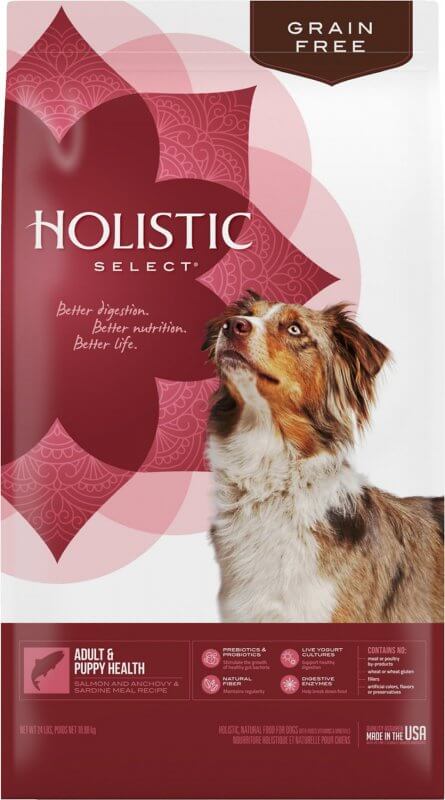
Holistic Select Grain-Free Adult and Puppy Health derives most of its animal protein from salmon and fish meal. Our dry matter label analysis reveals the recipe contains 32% protein, 16% fat and 44% estimated carbs… producing a fat-to-protein ratio of about 48%.
Blackwood 3000 All Life Stages Everyday Diet derives the majority of its animal protein from lamb meal. Our dry matter label analysis reveals the recipe contains 27% protein, 16% fat and 50% estimated carbs… creating a fat-to-protein ratio of about 58%.
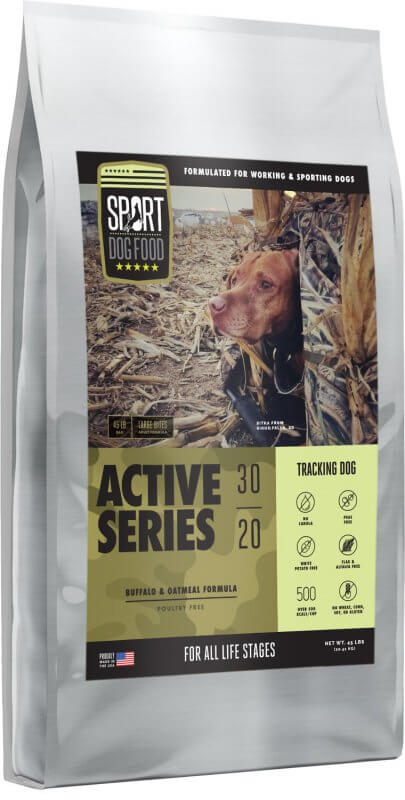
Sport Dog Active Series Tracking Dog derives most of its animal protein from buffalo meal. Our dry matter label analysis reveals the recipe contains 33% protein, 22% fat and 37% estimated carbs… yielding a fat-to-protein ratio of about 67%.
First 5 ingredients: Chicken, chicken meal, brown rice, chicken fat, dried beet pulp,
Type: Grain-inclusive
Profile: Maintenance
Best For:Adults only (not for puppies)
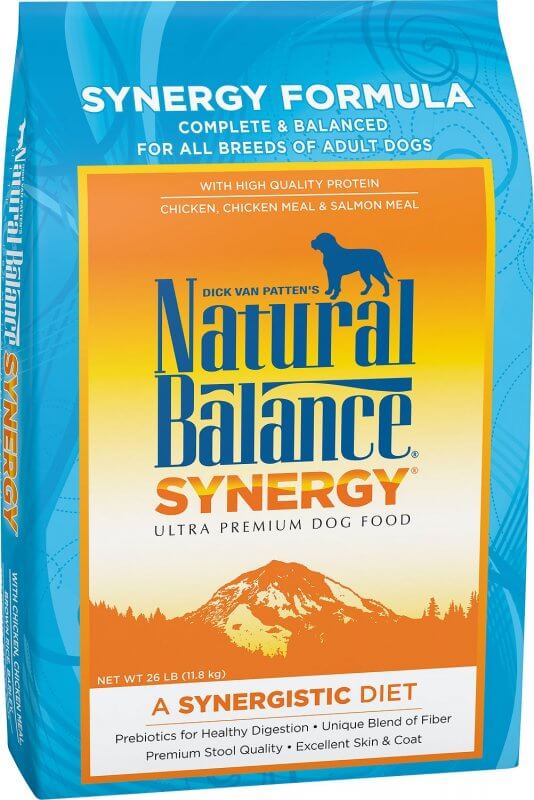
Natural Balance Synergy derives the bulk of its animal protein from chicken and chicken meal. Our dry matter label analysis reveals the recipe contains 31% protein, 18% fat and 43% estimated carbs… which results in a fat-to-protein ratio of about 57%.








 defense work; her clients are mostly municipalities and law enforcement officials.