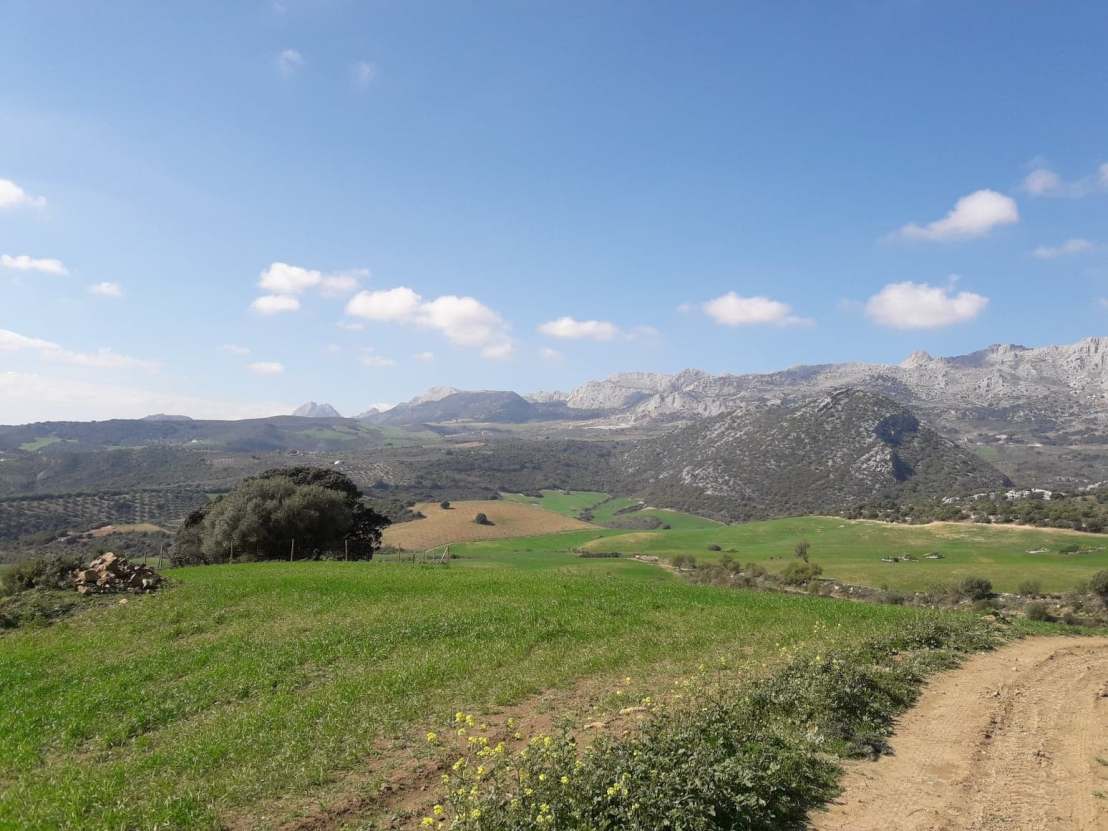
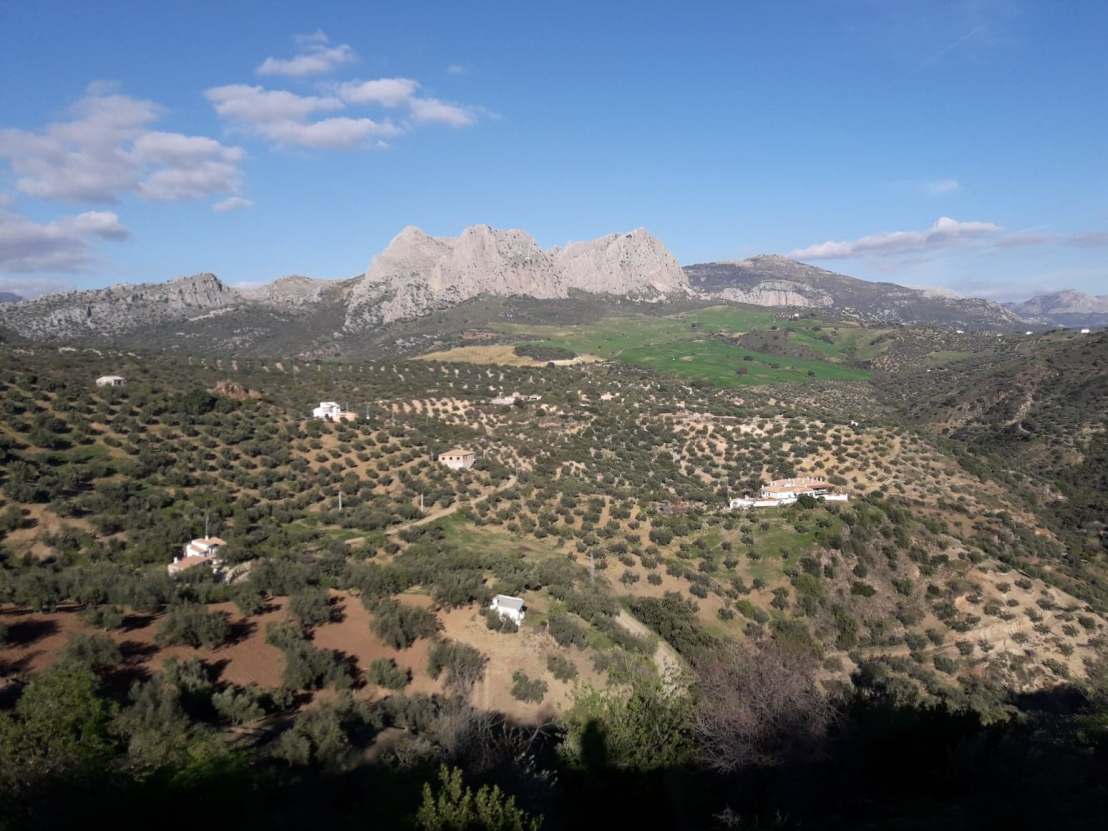
My grandson, Morten, who had his birthday yesterday, he is now nine, took some photographs recently. They are fabulous and are republished here with Morten’s permission. Completely untouched by yours truly!
oooo
oooo
oooo
oooo
oooo
oooo
oooo
I think these are fabulous. Morten used the following camera.
During the political campaign season, Americans are deciding who has the characteristics, skills and temperament to be president. As a dog psychologist and founder of the Canine Science Collaboratory at Arizona State University, I spend my time studying the relationship between dogs and their people. I’d certainly be happy if a candidate’s attitude toward dogs could offer a simple way to evaluate a leader’s personality, cutting to the essence of a person’s character and clinching my vote without needing a detailed assessment of their policy proposals.
Is it enough just to follow the leash to choose a leader? There must be good people with bad dogs, or no dog at all, and some notoriously bad people who were loved by their dogs, no? But I want to believe that canine companionship can still shed lightonhumancharacter and help us pick a candidate.
Dogless in the White House
For the past three years, the pup-parazzi have been speculating on President Donald Trump’s dogless existence at the White House. It’s certainly most common for the president to have a dog – perhaps because, as someone reputedly said, “If you want a friend in Washington, get a dog.”
The only dog he has expressed any enthusiasm for while in office was the Belgian Malinois involved in the raid that resulted in the death of Islamic State group leader Abu Bakr al-Baghdadi. As for al-Baghdadi, Trump said he “died like a dog.”
Dog friends
Among the Democratic front-runners, Joe Biden shares his life with a German shepherd, Major. This may be a good move for the uniformed vote: German shepherds are a favored breed of military and police forces. Biden has always preferred German shepherds, but, for his latest – acquired in November 2018 – he softened the image by adopting a puppy that had been exposed to toxic chemicals and was being cared for by the Delaware Humane Society.
Biden might want to be careful of the historical baggage that comes with this popular large breed. The most famous German shepherd in politics must surely have been Blondi, the dog Adolf Hitler himself said was the only being that loved him.
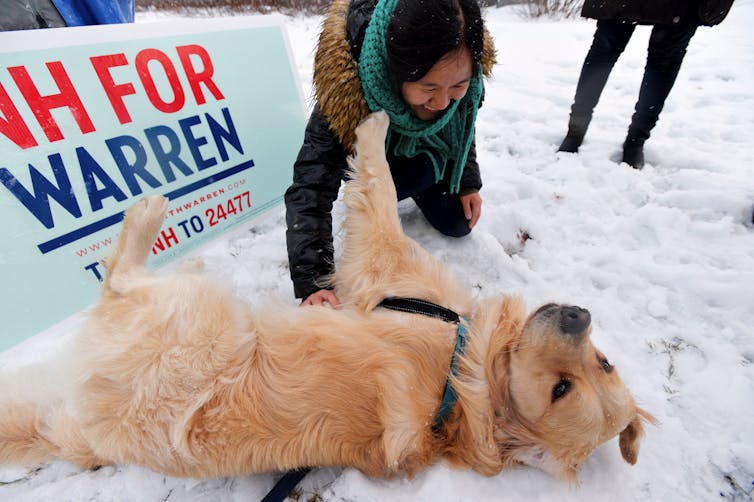
Elizabeth Warren’s dog, Bailey, gets a belly rub from a supporter. Joseph Prezioso/AFP via Getty Images
Elizabeth Warren has a dog with a gentler association. Warren’s stereotypically family-friendly golden retriever, Bailey, is named for George Bailey from the movie “It’s a Wonderful Life.” Warren said she named her dog for “a guy who was decent, determined and saw the best in people.” Warren’s Bailey is front and center in all her campaign activities.
Bailey features so prominently in his owner’s social media feeds that Warren might want to be careful not to be upstaged by her pooch. George H.W. Bush’s dog, Millie, published a memoir that outsold President Ronald Reagan’s contemporaneous “An American Life.”
Pete Buttigieg has suspended his campaign, effectively dropping out of the race. He and his husband Chasten already had a shelter mutt, Truman, when they added another – Buddy – to their household in December 2018. Marie Claire magazine considers Buddy and Truman “the cutest fur babies in all of politics.” Buddy is the ultimate underdog: rescued from a shelter, of no particular heritage. With only one eye, he peeks out from Instagram voicing droll commentary on the goings-on.
Dog-detached?
Other candidates either have no dog or are happy to keep their canine enthusiasms to themselves.
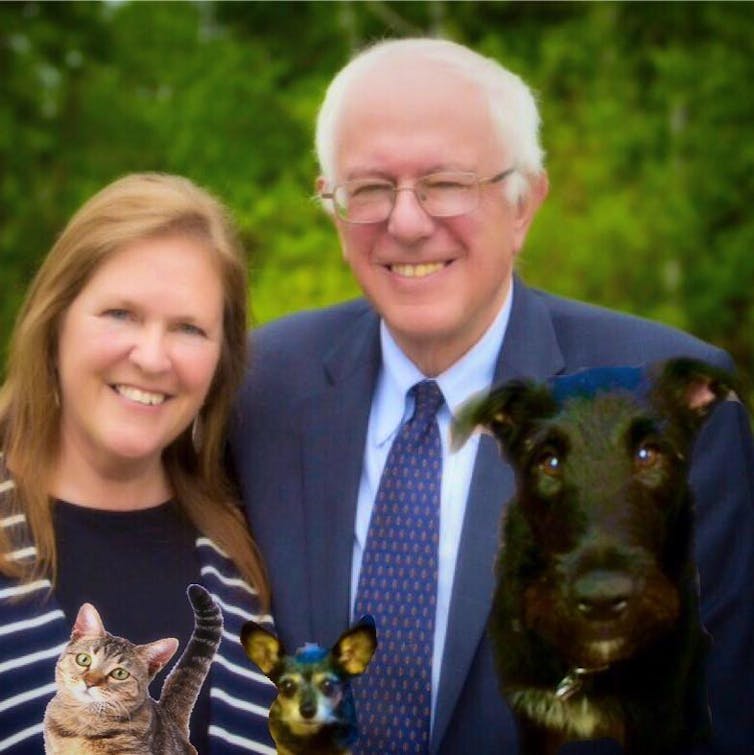
The Facebook group “Pet Lovers for Bernie Sanders” had to photo-edit dogs into an image of Sanders and his wife, who have no dog.
These pets do not actually belong to Bernie Sanders. Pet Lovers for Bernie Sanders Facebook group
Michael Bloomberg was in the “apparently dogless” camp until just the other week when he got into a spot of dog difficulty by shaking a pooch by its snout rather than engaging in one of the more customary forms of interspecies greeting. The dog looked unperturbed, but pet lovers on social media roasted Bloomberg for his maladroitness.
The billionaire’s campaign quickly stitched together a 30-second ad spot of dogs voiced to endorse their candidate – ending with a cute white Lab who “says,” “I’m Mike Bloomberg’s dog, and I approve this message.”
Canine character references
Of course, dogless people get elected all the time – they can always pick up a pooch later. The Obama family did not acquire their dog, Bo, until three months after the inauguration. Having originally indicated an interest in rescuing a shelter mutt, they ended up with a pedigree Portuguese water dog because of their daughter Malia’s allergies. Though often known as the “Big Dog,” Bill Clinton did not acquire a dog of his own, a chocolate Labrador retriever, until his second term.
On Trump’s doglessness, the memoirs of his ex-wife, Ivana, are often quoted: “Donald was not a dog fan. When I told him I was bringing Chappy with me to New York, he said, ‘No.’ ‘It’s me and Chappy or no one!’ I insisted, and that was that.” But two sentences farther on – and far less frequently cited – Ivana adds, “Donald never objected to Chappy’s sleeping on my side of the bed.”
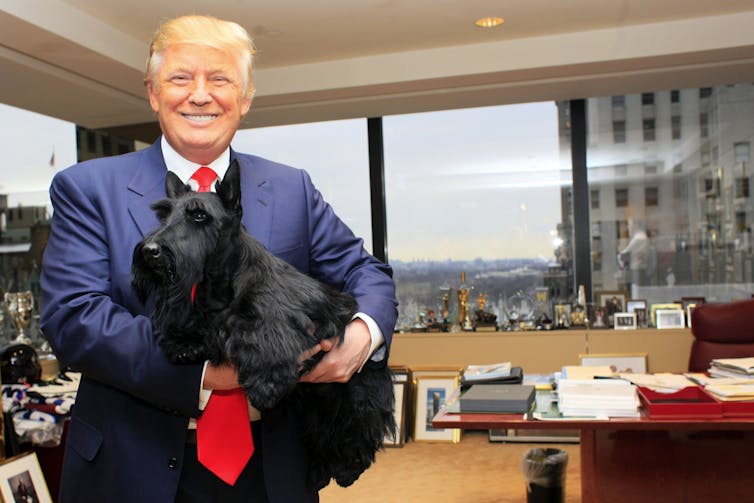
In fact, from 2010 to 2015, the Westminster Kennel Club had a tradition of sending the winner of its annual show to be photographed with Trump at his eponymous New York tower. Images fromthattime show Trump happily hugging the pooches.
Donald Trump poses with the winner of the Westminster Kennel Club Dog Show in 2010. AP Photo/Mary Altaffer
Witness accounts from these meetings, quoted by Snopes.com in an assessment of the claim that Trump hates dogs, recall Trump thoroughly enjoying himself cuddling the prize-winning canines. Snopes concluded that claims Trump considers dogs “disgusting” were just plain false.
Asked at a press conference in April 1947 what had become of the pup, Truman responded: “To what?” On receiving clarification, he lied, “Oh, he’s around.” In fact, Truman had already given Feller away to his physician, Brig. Gen. Wallace Graham.
Much as we might like dogs to tell us whom to vote for, the truth is, dogs are such forgiving assessors of human character that their appraisals need to be taken with more than a pinch of salt. We may just have to do the hard yards and learn about the candidate’s policies. It isn’t easy. Maybe not having to participate in a democracy is what keeps our dogs so happy.
ooOOoo
This is both a lovely and intelligent article. Professor Clive Wynne raises some important points but concludes that we shouldn’t take it too seriously. I, for one, would not trust a person who doesn’t like dogs!
Gilliwolfe has changed very slightly the appearance of the post. But it’s just as good!
ooOOoo
Day 19: Riogrande to Alfarnatejo 16k
By Tom and Chica, 16th February, 2020
Written by Tom’s wife
This morning’s doze was interrupted at 6:30 by a digger starting up and then at 7:15 by lights of a 4 X 4 as fella turns up for work. Hey-ho! So up and into town for double rations of bacon bocadillos with coffee and on the road at 11am. Passing out of town, two ground workers and the digger driver wanted to know if it was cold in the tent so I put them right; good sleeping bag and doggie hot water bottle. After a bit more building site banter (to make me feel at home, but without the rain) I stopped at the fuentes on the outskirts of the town, had a quick wash and filled the water bottles.
A hard uphill slog followed and this pack isn’t getting any lighter, I’m going to have to be more ruthless in selecting items next time! But it was a great day’s hiking and I was delighted to find Restaurante Gerado by the Rio Sabar where I scoffed an early supper of ham, egg and chips with two beers for €8. Bargain! Sated we trotted off into the hills for 45 mins and found a lovely camping place in the olive terraces – pictures tomorrow.
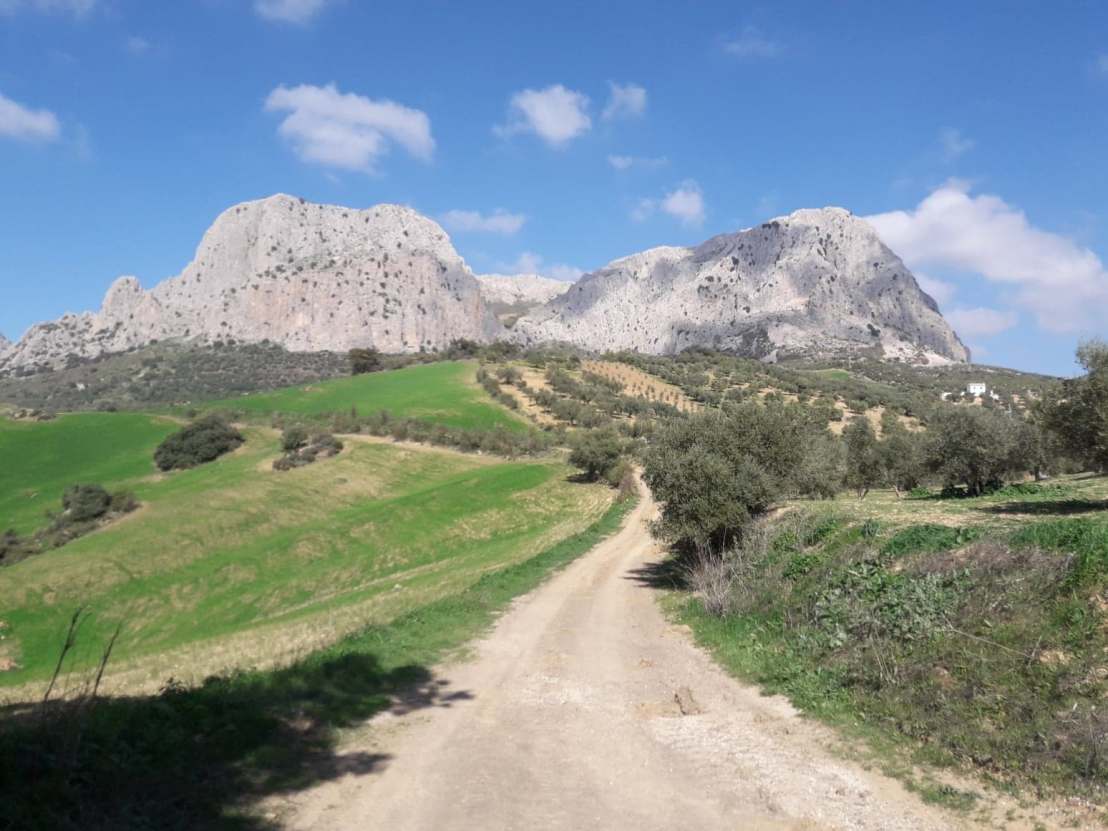
Leaving RiograndeHmmm, nice pad!Cooling off!Essential water purifier.Good walking surface!Easy to miss but welcome confirmation that we’re on the right track!Looking back the pointy peak in the distance marks where we started this stretch. Satisfying!Restaurante Gerado – highly recommended!
ooOOoo
It’s an amazing walk and that doesn’t really give full justice to what Tom and his two dogs are doing.
It’s a very real pleasure to be given the permission to republish these episodes.
After good night’s sleep under the crag, we woke to find ourselves in thick cloud so didn’t rush to get going.
To save water, I brewed a small coffee, gave Chica her quota and had a muesli bar for breakfast. I packed up between bouts of light rain and we set off at 10am with almost a spring in our step, down to the road and heading east.
We passed a strange group of buildings which turned out to be a circus school, complete with mini castle. Which was slightly surreal!
Beautiful scenery as we were walking on the northern edge of El Torcal nature park. We have visited here before and the small park has an amazing and unique karst limestone landscape straight out of a cowboy movie. If you find yourself near Antequera, it’s well worth a visit. Lobo Park is nearby too, where they are trying to preserve the last of the almost extinct wolves in Spain. You can go on a ‘howl night’ which Chica thought sounded fun.
After a short break for Chica to catch some rays, a very long stretch of road walking followed and it was getting hot. I started to get a bit concerned about the shortage of water. I intended to knock on a door and ask but all the gates were padlocked and there was no sign of life. I began to feel really anxious – we were both thirsty and the route was about to leave the road and head across county where there would be much less chance of getting water. Then I saw a chap and his dog at the bottom of his driveway. He saw me and waited to speak to us. After mumbling in my extremely basic Spanish, it turned out he was Belgian and spoke excellent English. He fetched water for us and a very welcome apple for me.
Newly energised and very relieved, we left the road and headed steadily downhill enjoying the great views all round. Chica met lots of friendly mutts including a very snivelly Welsh border collie.
Eventually, we made it to Riogordo at around 5:45, There were a lot of workman and road reconstruction going on. Despite the diversions to avoid newly-laid concrete, the farmer on his mule drove his sheep and goats straight over it.
Exploring the town, I bought sardines for Cheeks and chocolate for me. It seemed very pleasant and I looked out for sneaky camp spots but I got diverted into Bar Molina for Iberian steak and chips, goats ice cream and honey, and quantities of beer.
At 9:30 we headed off in the dark and made camp on a piece of waste ground. This turned out to be slightly sloping so I had to use Chica as a wedge to stop me slipping down it. She appeared to rather like it. What a good girl! But maybe it’s best to suss out the camping place before the beer in future.
Up at sparrow’s fart and actually managed to catch the 7.28am train. Yet again, no problem taking a dog on the train but, unlike Merlin, Chica really didn’t like it. She sat on my lap and trembled for over an hour. Only just before we got off, did she settle. Then we encountered our first refusal. The train stops short of Antequera and the last 18k is on the bus. Even when the lovely train guard tried to persuade the driver to take us, he was unmoved. So a rather expensive taxi ride was needed to do the last section.
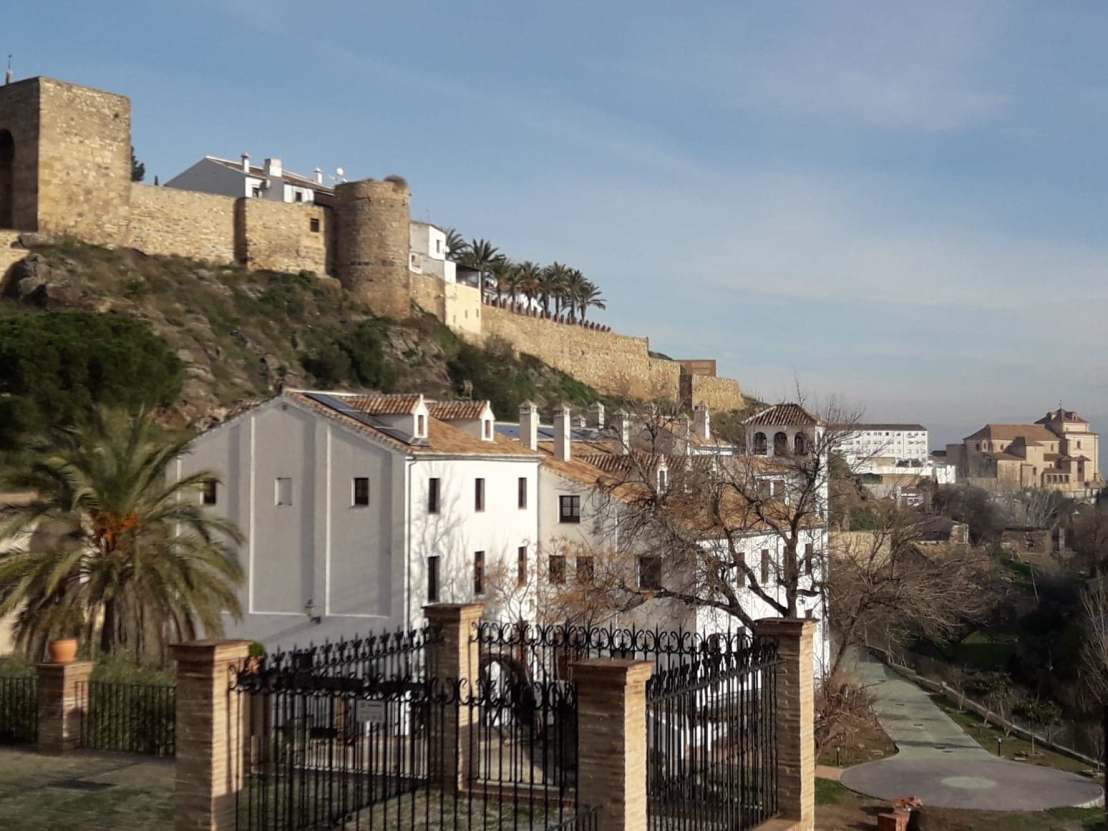
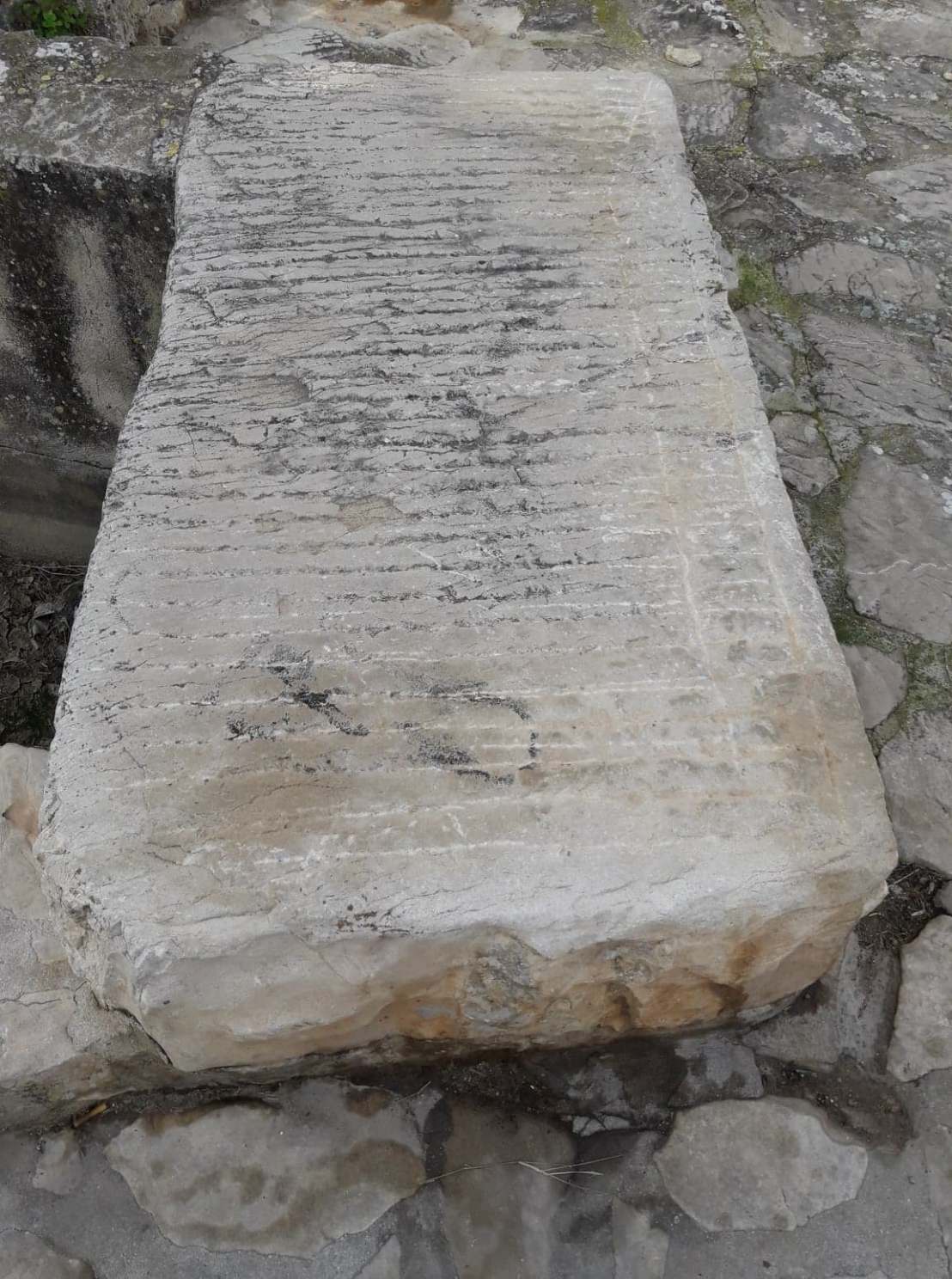
We have visited Antequera before – the old town is interesting, once a centre for fabric-making and our trail took us along the river and past where all the laundry was once done. There was an old stone ‘washboard’. It must have been very hard work.
An easy well-defined track today through open countryside. The weekend’s cold had left me with a ferocious sinus headache but it was clearing nicely and we both enjoyed the sunshine.
After a few days off, the pack felt heavy and I was glad to reach Villanueva. The small town is used in film sets apparently, but there was nothing here today so I found a suitable camping place under a rockface showing signs of recently climbing activity. But maybe not tonight….
ooOOoo
Today, and the next two days are devoted to republishing this fascinating walk.
Tom must be so immersed in this walking trip that he is probably starting to think that he has been walking forever.
Anyway, here we are up to Day Fifteen and Sixteen.
ooOOoo
Day 15 & 16: East of Ardeles to Valle de Abdajalis 28k
By Tom and Chica, February 8th, 2020
Written by Tom’s wife.
Day 15
After a good night’s kip, we were up at 8am as it started getting light. A strong breeze had all the turbines on the surrounding hills earning their keep. Merlin is now getting into the camping vibe and suggested the walk should be temporarily renamed Merlin’s Mission!
Eventually, after taking time over breakfast to enjoy the surroundings, we set off down a pleasant track through mixed woodland. And then it started to climb, and went on climbing for several k until we reached a short stretch of hairpin highway with splendid views in both directions.
We then turned into dense woodland and the path followed the foot of dam at the end of the reservoir high above the village of El Chorro. As the route continued around the reservoir, incredible views opened up to the river below.
Merlin led the steep descent into El Chorro (which appeared to be closed for the day). Here you could see the recently-refurbished Caminito del Rey – an artificial high-level walkway and bridge that traverses the gorge.
We had a pitstop at a fuente to refill bottles and have a quick cooling wash. A car pulled up and an English family came to fill their large containers. A quick conversation established that they were, in fact, the owners of the excellent nearby Olive Branch campsite. How fortuitous! We were soon setting up camp and a very sociable evening followed with other hikers and climbers.
Olive Branch campsite, El Chorro
Day 16
A murky, horrible morning, not improved by a sore head from the previous night’s cider intake, meant we just stayed in bed. Merlin was no more anxious to move than I was. We finally emerged at about 10am to find we had missed the full English. Disaster! However, the continental version was considerably better than expected and did the job admirably.
We finally got going, heading uphill along a gravel track beneath the 1200m La Huma rockface. I was able to watch the many climbers enjoying this world-famous rock-climbing playground. The visibility was too poor for many pictures but a brief ray of sun just caught some almond blossom, cheering things up a bit. I did, however, meet the first other person doing the GR7. She was from the Czech Republic and we spent a little while comparing notes, before Merlin and I carried on to the town of Valle de Abdajalis and found a suitable place to pitch camp a couple of k beyond. We were both very grateful for an early night.
ooOOoo
This walk is incredible. The dogs are incredible. The photographs are to die for!
Dear people, I cannot really add anything to these beautiful posts that, as always, are republished from here.
ooOOoo
Days 13 and 14: Cuevas del Becerro to east of Ardeles* 32k
By Tom and Chica, 5th February, 2020
Written by Tom’s wife.
Authors note: As Tom is now having to send me the details of his walk, it seems better to write in his voice – so that is what I have done here.
Considerable pondering this morning over whether I should take Chica or Merlin. Chica seemed fine but this was going to be a four or five day stint with no chance of a change-over. In the end, decided best to let Merlin do this one. The next stretch would be much longer so best that Chica is in top form.
From the last drop off location, we all walked the first stretch through scrubby terrain with holme oaks and some abandoned road works. Here Gill, Arfy and Chica turned back, Chica looked pretty miffed. Me and Merlin carried on over a rise and down into the next valley.
A long walk along the valley followed, heading east and steadily climbing past a goat farm and some derelict buildings. The temperature was climbing too and we stopped for water and a rest. Hearing a low buzzing, I spotted hundreds of bee hives hidden in valley below.
The rough track was now very exposed with more goats and olive groves. We were both very hot and I was getting worried; we were short of water and Merlin was looking a bit weary. Eventually we found a hole dug to pump water to crops so he was able to drink.
The village of Serrato had no bars or shops but we found a wrought iron bench in the shade by a fuente (fountain). I brewed up coffee whilst Merlin drank and ate treats and was quickly revived and happy again. A local farmer turned up to fill his water flagon and told me how good the water was, knocking some back to prove it. After a halting conversation in Spanish he walked off, but then came back to give me directions for the GR7. What a gent!
Rehydrated, we hiked out of village then up and up into the hills to a wonderful camp site above the tree line with great views in every direction. Merlin was very alert and on guard. Bolognese noodles for my supper, and chicken and treats for Merls. Absolutely knackered, everything aches!
Day 14
Made coffee at 8am then went back to the tent to do physio exercises, listen to my audio book and luxuriate in the quiet. Merlin also very chilled. Set off at 11 feeling fairly fit and strong as we climbed steadily.
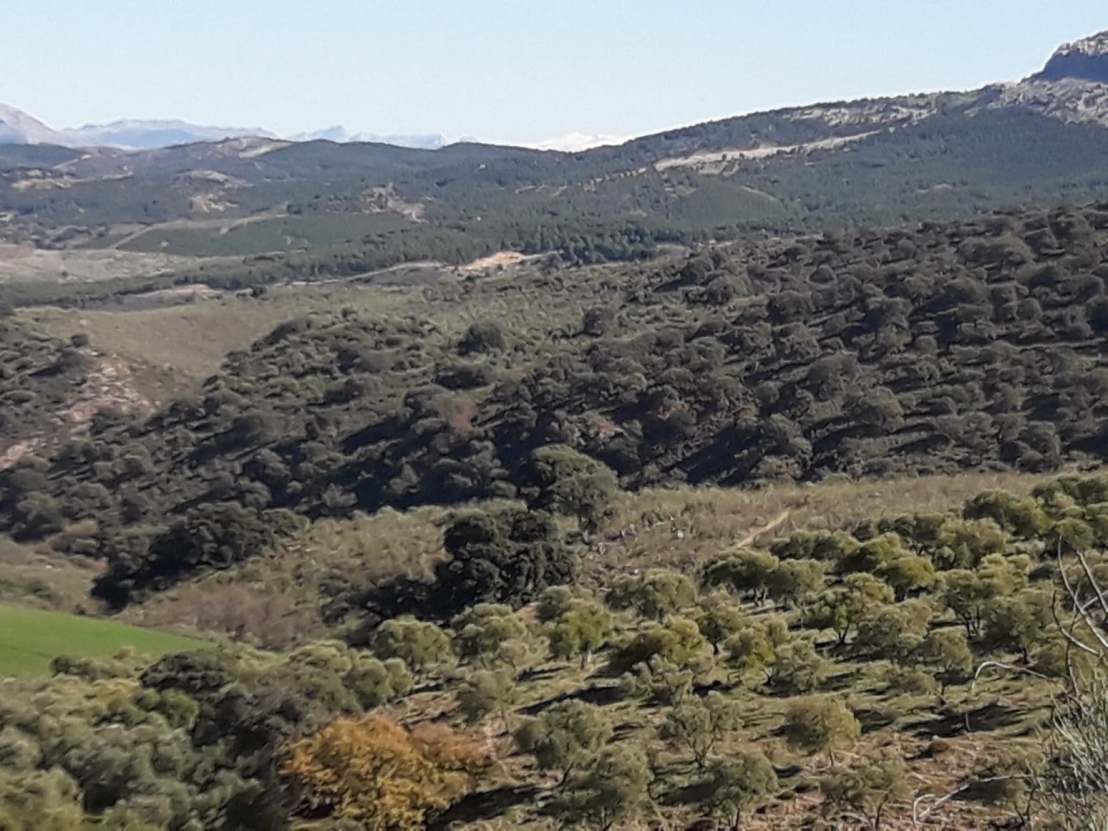
The Sierra Nevada came into view as we followed the washed out track. It then turned downhill out of pine trees towards open farmland, passing farms with more goats, free range and intensive chicken buildings and cultivated land.
There were fields of regimented rows of olives and blossoming almonds, and the sound of chain saws at work trimming and thinning the olives. It was now very hot and exposed, and water was at premium again. We were very grateful to reach the outskirts of Ardales and a welcome water tap by a shady stone seat.
Some friendly locals asked what I was doing and then directed me to a bar for food. Unfortunately, it was closed but we continued out of town to Hotel el Cruce for lunch. It was 3pm and 28deg.
Beer, olives, bread, fish and chips, coffee and cookie for €13.50. The lovely waitress filled my water bottles and it was with some reluctance that we went on our way at around 4pm. Another 1k on the road then upwards again on tracks for two hours to find an excellent camping spot with views in all directions. Merlin is getting into this camping lark! El Chorro tomorrow!
The two photographs of Merlin are terrific. As Gilliwolfe writes:
Merlin is a tough little Patterdale and is loving being on the trail. He is getting on for nine years old so we didn’t really think he’d manage. But looks like we were wrong.
I know I am repeating myself but so what: The photographs are stunning!
Once again, it is my pleasure to republish this and, as usual, it is taken from here.
ooOOoo
Day 12: Arriate to Cuevas del Becerro 10k
By Tom and Chica, 31st January, 2020
Written by Tom’s wife.
Day 12 saw a late start as Tom headed for the station with Chica for the 12.50 train. Again, no problem boarding with a dog. The guard even ruffled her ears as he collected the fare.
After a quick coffee in Arriate, the trail headed out into the countryside past large chicken sheds, piggeries and posh houses, one still apparently celebrating Navidad!
They reached the railway station at Parchit, all of which remains is the platform. The station house and bar were gone and a new road was in the process of construction. Nosing around here, Tom spotted a very grand entrance to a vineyard. Oddly here, gates are one extreme or another; either grandiose like this one or an old bedstead wired to a pole or even more rustic, a couple of strands of wire held up by small branches. You very rarely see a common-or-garden functional gate.
The route turned into a delightful country lane and with Chica breaking trail, still heading north-easterly, they continued through mostly holm oak and olive trees. Eventually meeting the main road they found the path ran alongside so they chose to keep to one a bit further away. Here stonemason Tom was happy to see a beautifully constructed dry stone wall, not unlike those seen at home on the Mendip Hills.
As the sun was going down, around 6pm, Tom texted to say they were somewhere on the A367. Fortunately, the What Three Words location (built.orangey.juicy) was more accurate and I was there shortly afterwards. Home before dark.
ooOOoo
It hardly seems relevant for me to add some words at the end. The description of the walk stands up on its own.
But what I will say is that there is another episode tomorrow!













 Learning from Dogs