I am speaking of a recent BBC Radio 4 program, but …
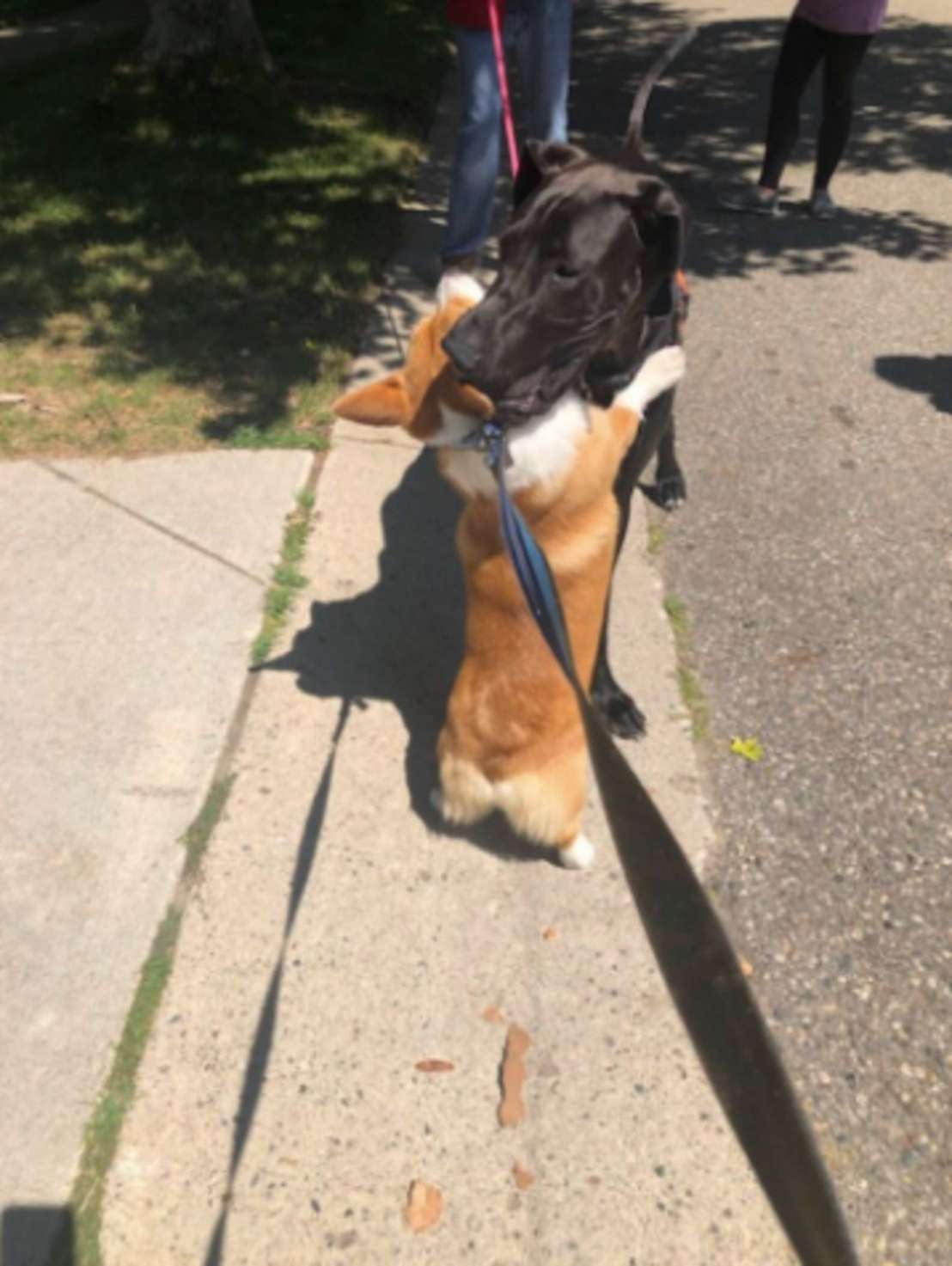
… this loving Corgi seems to have got the message.
There has been a series on BBC Radio 4 about the Anatomy of Touch. This is a small extract from the website that accompanied the program.
Touch is a crucial part of our lives. The right kind of touch can reduce pain, soothe our stress and convey emotion faster than words. It’s a sense that you can’t turn off and we should not underestimate its power.
It’s also a sense that has taken on a new resonance during the pandemic, now that we have to keep our distance and haven’t hugged friends or family we don’t live with for more than half a year.
“He’s the biggest sweetheart” ❤️️
By Lily Feinn
Published on 10/1/2020
Wallace understands that times are tough, and the loving corgi knows how to make things better — with a big hug. Well, as big as his little arms can go.
When Noah Raminick is walking Wallace, he can expect to stop every time Wallace spots another pup. The year-old corgi loves to play and won’t let another dog walk by without giving him an embrace.
INSTAGRAM/IAMWALLACETHECORGI
“He’s the biggest sweetheart,” Raminick, Wallace’s brother, told The Dodo. “He’s always very happy to be around people and other dogs. He loves to give face kisses to people and when he sees another dog, he’s always the one to initiate a play session.”
INSTAGRAM/IAMWALLACETHECORGI
When it comes to large dogs, the low-bodied pup shows no fear and will stand on his hind legs to get the best possible angle for his hug. Wallace’s best friend Daisy is a Great Dane, but the corgi knows that size doesn’t matter.
“They always hug when they see each other,” Raminick said. “And one of her paws weighs as much as Wallace’s entire body.”
INSTAGRAM/IAMWALLACETHECORGI
With smaller dogs, Wallace makes sure to play gently, so he doesn’t spook his new friend. Wallace won’t go in for the hug until he sniffs out whether the other dog is OK with it first.
“The thing I find interesting with his hugging is that he wasn’t trained to do that at all,” Raminick said. “I think it comes down to him being really excited about playing with another dog.”
INSTAGRAM/IAMWALLACETHECORGI
Wallace makes sure to spread the love when he’s with his human family, too. “His favorite things are morning and evening cuddles, playing fetch and me chasing him around the house,” Raminick said. “I don’t think Wallace has any dislikes.”
Wallace’s family is happy for their pup to continue spreading the love to the dogs and people in his neighborhood, adding a little more joy to everyone’s day.
ooOOoo
Back to that Touch website to close:
The three most common words used to describe touch are: “comforting”, “warm” and “love”
People from 112 different countries took part in the Touch Test and it’s striking that “comforting” and “warm” were among the three most common words that people used in every region of the world.
Once again, something that should be taken notice of.
This was recently notified to all concerned in Dog Food Advisor.
ooOOoo
Deadly Salmonella Outbreak Linked to Pig Ears Dog Treats
Pig Ears Dog Treats Stock Image
October 1, 2020 — The Public Health Agency of Canada is alerting consumers it is investigating a deadly outbreak of Salmonella infections occurring in British Columbia, Alberta, and Yukon.
Based on investigation findings to date, exposure to pig ear dog treats has been identified as a likely source of the outbreak.
Some of the individuals who became sick reported feeding their dog Paws Up!and Western Family brands of pig ear dog treats before their illnesses occurred.
These brands are sold at Canadian Tire and Save-On-Foods.
The outbreak investigation is ongoing and it is possible that additional products may be identified.
On September 29, 2020, the supplying company, Masters Best Friend, voluntarily issued a Notice of Stop Sale for Paws Up! and Western Family brands of pig ear dog treats.
These products were sold nationwide in Canada.
Investigation Summary
As of September 29, 2020, there are eight confirmed cases of Salmonella typhimurium illness in the following provinces: British Columbia (5), Alberta (2), and Yukon (1).
Individuals became sick between late February and early August 2020. Three individuals have been hospitalized. In addition, one individual has died.
Individuals who became ill are between 7 and 95 years of age. The illnesses are distributed equally among men (50%) and women (50%).
It is possible that more recent illnesses may be reported in the outbreak because there is a period of time between when a person becomes ill and when the illness is reported to public health officials.
For this outbreak, the illness reporting period is between four and seven weeks.
What to Do?
Given this, do not feed your dog any Paws Up! or Western Family brand pig ear dog treats.
Always wash your hands right after handling dog treats, and ensure that all areas the treats have come in contact with are properly cleaned and sanitized.
This outbreak is a reminder of the importance of safely handling all pet treats, including pig ears and pet food.
These products can be contaminated with bacteria that can make you and others sick if proper handling and cleaning practices are not followed. If contaminated, pet treats and pet food can also make your pets sick. Ill pets can spread bacteria, like Salmonella, to individuals they are in contact with even if they do not show any signs of illness.
For more information on the affected products, please contact Masters Best Friend.
Although products are no longer available for purchase in stores, they may still be in consumer homes.
U.S. citizens can report complaints about FDA-regulated pet food products by calling the consumer complaint coordinator in your area.
This is a wonderful, innovative way to look after dogs.
It’s not that often that something comes along that is wonderfully refreshing, both as an idea and in practice. I am speaking of a way of housing shelter dogs.
It’s the work of Austin Pets Alive and I’m not surprised in the slightest to read from their website:
Austin Pets Alive! is not your average animal shelter. We pioneer innovative lifesaving programs designed to save the animals most at risk of euthanasia.
They are in Texas.
But back to the article which appeared on the Treehugger website.
ooOOoo
This Rescue is Building Tiny Homes for Shelter Dogs
They offer a calm alternative to the chaos of shelter life.
By Mary Jo DiLonardo, October 1st, 2020
The shelter is building two tiny homes for rescue dogs. Austin Pets Alive!
The shelter environment can be incredibly overwhelming for any dog. There are strange sights, smells, and sounds, and the presence of unfamiliar animals and people can be constantly changing. Some pets adapt more quickly than others, while some struggle with the frenetic surroundings.
One animal shelter in Texas is building tiny houses as a solution for those anxious dogs that need a calmer place to stay. The non-profit rescue is creating two small cabins on their shelter grounds complete with heating and air conditioning, dog-friendly furniture, and their own private yards. The cabins will also provide workspaces for staff and volunteers.
The tiny homes should be ready for their first guests later this month.
“The idea is to provide more of a home-like environment for the unique population of dogs Austin Pets Alive! cares for as the safety net for shelter animals who need us most — a place for decompression, training, and quality-of-life purposes,” Director of Operations Stephanie Bilbro tells Treehugger. “It seemed like the best opportunity for the investment, and also has the benefit of being a project that can be repeated as many times as we want!”
Having tiny homes for some of the shelter’s canine residents was a long-time dream of the rescue’s executive director, veterinarian Ellen Jefferson. The rescue put together a committee of staff and volunteers in 2019 to assess the facility and see what improvement could be made.
They decided to build the tiny homes “as a way to provide a better quality of life for some of our longest-stay or most behaviorally challenged dogs”, Bilbro says.
The cabins will house one dog at a time and they will remain there for the rest of their stay until they find a foster or adoptive home. The cabins will primarily be used for dogs who are overstimulated by the standard kennel environment.
Some dogs are scared and overwhelmed by the shelter environment. Austin Pets Alive!
“Overstimulation can lead not only to higher stress in the animal, but can actually be dangerous for a handler, or other animals, if you have a dog who expresses stress by showing impulsive or aggressive behaviors,” Bilbro says.
“Overstimulation is also a big barrier to successful training or behavior modification, so it can be difficult to make progress with dogs like this in a kennel or shelter environment. The cabins will ideally provide a quiet and low-stimulation place for the dogs to decompress and relax in a way that will help our staff and volunteers get through to them easier.”
The rescue is relying on donations to keep saving lives and trying out innovations like these, Bilbro says. When the pandemic first started, the rescue increased its intakes so smaller and more rural shelters that were temporarily closing wouldn’t have to euthanize animals.
The first dogs should be moving into their tiny houses soon. And maybe they won’t be staying long.
“We also hope that the ‘home-like’ environment of the cabins will help us learn a little more about how a dog would act in a home, which could tell us more about what kind of foster or adopter they need for our matchmakers to match them with their forever families,” Bilbro says.
“Would they be calm or anxious, would they be destructive or tidy, are they possibly housetrained, will they let people come into their space without conflict? These are things we would hope to learn from a foster home but without needing to find a foster who is willing to take on a challenging dog, or a dog we don’t know a lot about.”
ooOOoo
I have nothing to do with neither Treehugger nor Austin Pets Alive.
However, I was so impressed with the way they operated that we made a very small donation. So, if there’s anybody else out there who can afford some money then this is the link to donate.
I just donated to Austin Pets Alive!, an organization that serves the animals most at-risk through innovative programs that address the animals’ needs. I’m proud to support a mission that believes that animal shelters should do just that – provide every animal the chance to find their forever home!
“Provide every animal the chance to find their forever home.“
It doesn’t get any better for our lovely dogs than that.
Some may think that there are too many such dog food recalls but I would say thank goodness there is a system for reporting them.
ooOOoo
Real Pet Food Company Recalls Billy + Margot Dog Food
September 22, 2020 — Real Pet Food Company of Phoenix, Arizona, is voluntarily recalling Billy+Margot Wild Kangaroo and Superfoods Recipe because it may be contaminated with Salmonella bacteria.
What’s Being Recalled?
The following product has been recalled:
Billy + Margot Wild Kangaroo and Superfoods Recipe
Package: 4-pound bag
Lot code: V 07 Feb 2022
This recall does not affect any other Billy + Margot products or those sold outside of the USA.
What Caused the Recall?
The recall is a result of a routine sampling program by state officials which revealed that the finished products contained the bacteria.
The company has ceased the production and distribution of the product.
The FDA and the company will continue their investigation as to what caused the problem.
About Salmonella
Salmonella can affect animals eating the products… and there is risk to humans from handling contaminated pet products.
While no illnesses have been reported, healthy people infected with Salmonella should monitor themselves for some or all of the following symptoms: nausea, vomiting, diarrhea or bloody diarrhea, abdominal cramping and fever.
Rarely, Salmonella can result in more serious ailments, including arterial infections, endocarditis, arthritis, muscle pain, eye irritation, and urinary tract symptoms.
Owners exhibiting any signs after having contact with this product should contact their healthcare provider.
Pets with Salmonella infections may be lethargic and have diarrhea, fever, vomiting and or abdominal pain.
Infected but otherwise healthy pets can be carriers and infect other animals or humans.
If your pet has consumed the recalled product and has these symptoms, please contact your veterinarian.
What to Do?
Retailers who have received product from the affected lot code have been asked to remove this product from shelves immediately and dispose of the product with care.
If you have purchased Billy + Margot Wild Kangaroo and Superfoods Recipe in a 4 lb bag, with lot code V 07 Feb 2022 from any retail store nationally, please stop feeding the product to your dogs, dispose of this product immediately, wash your hands accordingly, and sanitize affected surfaces.
Consumers who have purchased the recalled products may call Real Pet Food between 8 am and 10 pm EST immediately for a refund or for additional information at : 1-800-467-5494.
Consumers with questions may contact the company at 800-467-5494 during the above times.
U.S. citizens can report complaints about FDA-regulated pet food products by calling the consumer complaint coordinator in your area.
We humans love to be loved and, especially, by our dogs.
I am certain that all of the people who read Learning from Dogs on a regular basis are dog lovers and, just as important, your love for your dogs means that they in turn love you.
But unfortunately not everyone thinks of dogs in such a beautiful manner. For example, not far from here on Hugo Rd are a group of dogs, 4 or 5 I think, that I cycle past, and they live in outside kennels.
If you are an uncertain owner or a new owner you may want to understand more about your dog’s behaviour, or more accurately, whether your dog loves you. This article on The Dodo explains this very well.
ooOOoo
Does My Dog Love Me?
How to tell what those happy wiggles really mean ❤️️
Humans loveeee love. Which means we want the people — or animals — we love to show us they love us back.
But it’s sometimes hard for us to tell whether or not our dogs truly, deeply, madly love us — especially if you’re a new pet owner.
Who doesn’t want to feel all warm, fuzzy and loved by our pets?
To help you get that confirmation you’re looking for, The Dodo turned to Dr. Vanessa Spano, a veterinarian at Behavior Vets in New York City, to understand how dogs show their love.
“It is so important to understand your pets’ body language, as that is their way of communicating with us,” Dr. Spano said.
Here are some of the most common ways to tell that your dog, in fact, abso-freakin’-lutely loves you.
Your dog has a relaxed, wiggly body
“When interacting with your dog, body language signs to look out for that may indicate comfort and positivity include a relaxed body (or wiggly body during times of excitement, like play or you coming home), soft, forward ears and soft, rounded eyes,” Dr. Spano said.
He wiggles his eyebrows at you
You read that right! Doggos in love are known to raise their eyebrows when they see their owner. In fact, a 2013 Japanese study used a high-speed camera to record dogs’ faces when their humans walked into the room. It found that dogs raised their eyebrows when they saw their owners, but not when strangers walked in. *happy cry*
He wants your attention
“It is also a good sign if your dog is soliciting attention from you, such as with a play bow,” Dr. Spano said.
This can also be seen when he brings you one of his favorite toys.
He leans against you
A dog will lean on humans for a few different reasons — sometimes it’s because he’s anxious or he wants you to do something — but it’s also a sign of affection. And regardless — even if your dog is leaning against you because he’s nervous — it still indicates that he thinks of you as someone who can protect him and keep him safe.
Confusing body language to look out for
According to Dr. Spano, there are some things dogs do that humans typically consider to be signs of affection, but aren’t always.
“Confusing signs include wagging tails and exposed bellies,” Dr. Spano said. “A dog wagging his tail simply means he is aroused by the situation. This can be a good thing, but not necessarily; it depends on the context of the situation.”
This means that it’s good to notice the situations that cause each of your dog’s behaviors and begin to build an understanding of your individual dog’s moods.
For example, maybe you notice your dog always wags her tail when you walk into a room — you can equate that situation with her being happy in those moments. On the other hand, maybe you’ve also noticed she wags her tail just a bit stiffer when she sees a strange dog, and it’s almost always followed by raising her hair and growling. While she is wagging her tail in both of these situations, it’s not the same kind of tail wag.
“Similarly, a dog showing his belly may be asking for belly rubs, but it can also indicate fear,” Dr. Spano said. “Dogs do have the capability of trusting and loving you, but depending on their own fears, stress level and past experiences, it may take some time.”
So in general, look for those relaxed and wiggly bodies to know how happy your dog is to see you. Other behaviors you’ll learn over time — and it’ll just help your bond grow even stronger since you’ll be the only one who can truly detect your dog’s moods and emotions.
ooOOoo
Yes, it certainly takes time to really get to know a dog. Although one might think that having a number of dogs in the household makes it easier, and generally that is the case, even in a largish group one can have tensions that exist between a couple of the dogs. Knowing both dogs as well as you can enables one to adjust things so that the tension no longer exists or it becomes a very rare event.
But it is rare and, luckily, loving dogs is the normal!
I will close with a photograph of dear Oliver who is one of the most loving dogs I have come across.
I am referring to the smoke and fires in this part of the Western edge of the USA.
For a while it seemed as though evacuation was becoming closer but now, I hope, that we are nearing a change in the weather including some rain later on this week.
So time for another post.
This one about speech processing in the dog’s brain.
The article that I want to republish is in The National Geographic magazine but I do not have permission to reproduce it in full.
Luckily the video that is in the article is also available on YouTube.
So first some extracts of the article.
Dogs understand praise the same way we do. Here’s why that matters.
Dogs can’t speak, but their brains respond to spoken words, suggesting human language has deep evolutionary roots
By VIRGINIA MORELL, Published August 6th, 2020
Every dog owner knows that saying Good dog! in a happy, high-pitched voice will evoke a flurry of joyful tail wagging in their pet.
That made scientists curious: What exactly happens in your dog’s brain when it hears praise, and is it similar to the hierarchical way our own brain processes such acoustic information?
When a person gets a compliment, the more primitive, subcortical auditory regions first reacts to the intonation—the emotional force of spoken words. Next, the brain taps the more recently evolved auditory cortex to figure out the meaning of the words, which is learned.
When the scientists studied scans of the brains of pet dogs, they found that theirs, like ours, process the sounds of spoken words in a hierarchical manner—analyzing first the emotional component with the older region of the brain, the subcortical regions, and then the words’ meaning with the newer part, the cortex. (Read how dogs are more like us than we thought.)
It’s much longer than I have presented so I do urge you to go to the article and read it fully; it’s fascinating.
And to close this post I insert the video that is in the article.
This is a post about dogs being of comfort to the Californian firefighters. A post presented on The Dodo that I am republishing.
But yesterday afternoon came news that here in Oregon we have a blaze. As the Washington Post reported it, in part:
An unusually expansive outbreak of large and fast-moving wildfires threatens communities in three states Wednesday, with the greatest risks focused on Medford, Ore., and Oroville, Calif., as large fires advance in those areas.
In Oregon on Wednesday afternoon, Gov. Kate Brown (D) announced that four towns have experienced significant damage, and she warned residents to expect news of fatalities.
“Oregon has experienced unprecedented fire with significant damage and devastating consequences for the entire state,” she said. Brown said the communities of Detroit, Blue River, Vida, Phoenix and Talent are “substantially destroyed.”
But back to those Californian firefighters.
ooOOoo
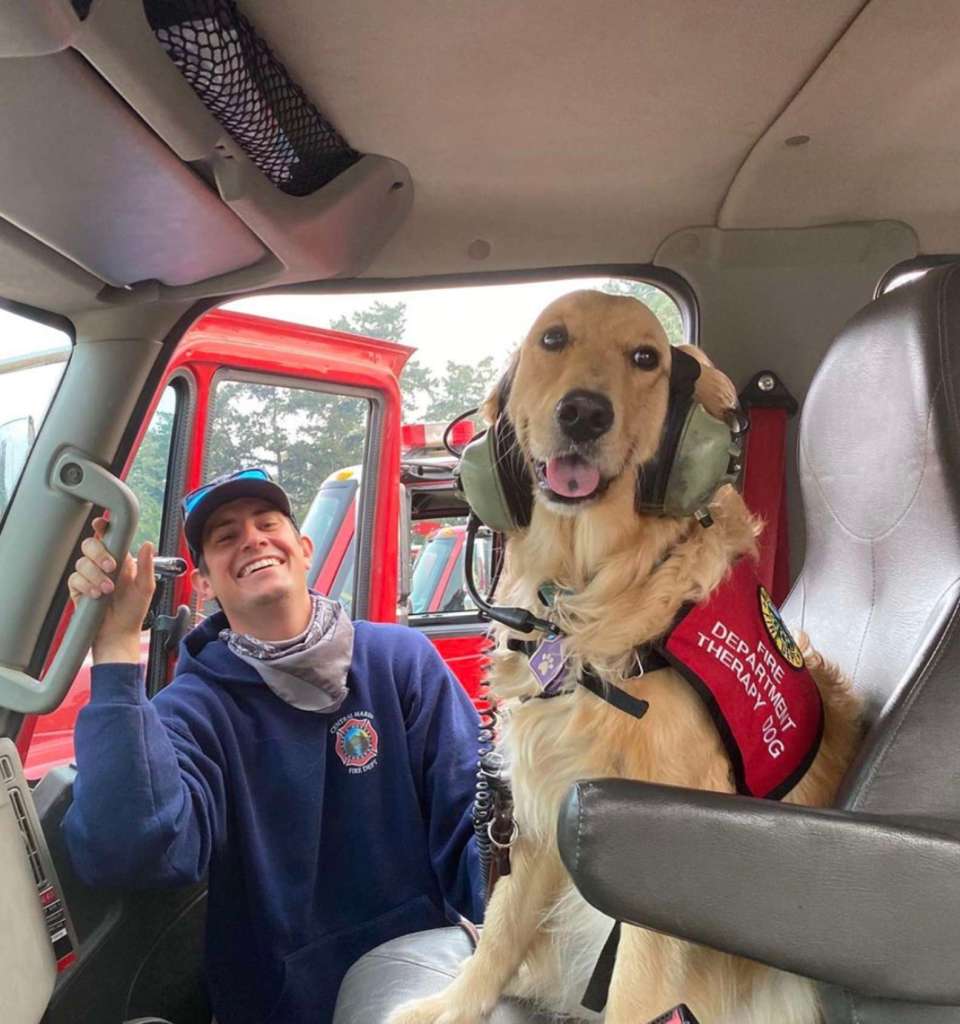
Dog Helps Comfort Firefighters Fighting The California Wildfires
Ever since she was a puppy, Kerith has been the bubbliest, most joyful dog, and her mom always knew that she was born to help people.
HEIDI CARMAN
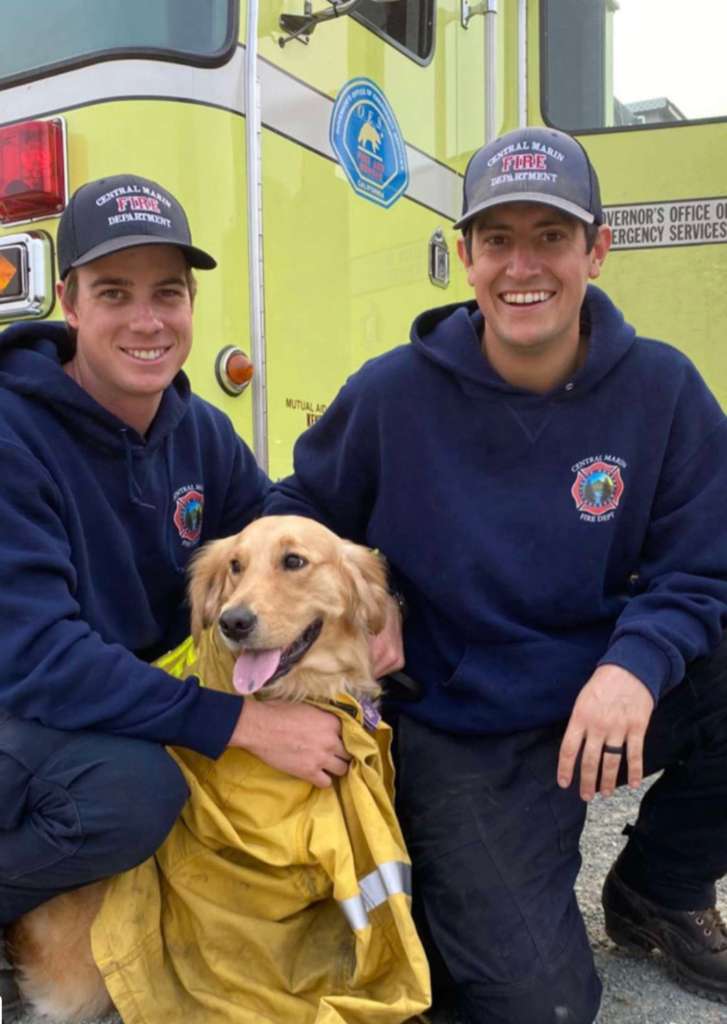
Kerith was originally being trained to be a guide dog for individuals who are blind, but ended up changing career paths to become a therapy dog instead. For the past year she’s been working with local firefighters, providing them comfort in times of need — and with the recent wildfires spreading across California, they need her now more than ever.
HEIDI CARMAN
“Kerith has been going to base camps where the crews start their day before they roll out to fight one of the many wildfires in CA,” Carman said. “She lightens the mood first thing in the morning. We walk around to visit all the crews while they are getting ready for their day of fighting fires. Everyone wants to see her to get some love.”
HEIDI CARMAN
As the fires rage across California, the firefighters’ jobs become more and more stressful as they work hard every moment of the day to save homes and lives. Kerith provides them a moment of relief and joy from the realities of their job — and when many of them see her, they can’t help but envelop her in a huge hug.
HEIDI CARMAN
Kerith loves all her firefighter friends so much, and is more than happy to let them hug her close. She seems to know that what she’s doing is important, and that the hugs she’s getting are more than just hugs. She’s helping to bring comfort when the firefighters need it most.
“Kerith clearly loves what she is doing,” Carman said. “When she sees a fire engine she gets so excited because she knows she is going to see her firefighter friends.”
HEIDI CARMAN
Hopefully the wildfires will be under control soon, but until then, Kerith will continue to give her firefighter friends as many hugs as they need.
ooOOoo
I find it amazing that there are dogs such as Kerith who love to be loved. Now plenty of dogs fall into that category but Kerith is part of a team; the rest of the team are human and working their backsides off fighting fires.
I will leave you for today with a random photograph I found from the ABC News website of one of those fires in California.
Roll on the rain!
And a photograph taken at 11am PDT today of the hills to the East. It includes our own property.
It shows the extent of the smoke; the nearest run of trees across the photograph are on our property.
The instinct of dogs to come to the aid of us humans, friends and strangers alike, never fails to impress.
Here’s a recent story on The Dodo that endorses that in spades!
ooOOoo
Stray Dog Interrupts Performance To Comfort Actor Pretending To Be Injured
“I was very touched. He was like an angel who wanted to help me.”
By Stephen Messenger
Published on 9/3/2020
During a recent theatrical performance in Turkey, the script called for actor Numan Ertuğrul Uzunsoy’s character to get hurt — but, of course, it was all pretend.
The adorable reaction of one furry audience member that day, however, was not.
İZMIT BELEDIYESI
“The character I played was injured and in great pain,” Uzunsoy told The Dodo. “He’d fallen off a horse, and was breathing hard.”
As Uzunsoy lay on the ground, his pretend suffering didn’t go unnoticed. From the wings, a concerned stray dog made his entrance — interrupting the play to offer the “injured” stranger comfort.
Uzunsoy didn’t see it coming.
“I felt warmth on my face. First, I thought my costar was approaching me,” Uzunsoy said. He was wrong.
Realizing the truth, Uzunsoy couldn’t help but break character. His face gave way to a smile.
“I was very happy when I felt the dog’s kisses,” Uzunsoy said. “I was very touched. He was like an angel who wanted to help me. It was a very emotional moment for me. I was not expecting it.”
No one seemed to mind that pause in the action. Rather, the reaction to the pup’s interruption was quite the opposite.
“My castmates loved the dog, and the audience was very happy,” Uzunsoy said. “Everyone cheered.”
İZMIT BELEDIYESI
A crew member eventually escorted the sweet dog offstage, where he remained awhile before strolling away. Uzunsoy, however, hopes their meeting that day is just the first of many acts to come.
He wants to reunite with the pup and help him find a home — returning the favor for the kindness he’d shown Uzunsoy.
“The next day I went to the same place, looking for him. People told me he usually hangs out there. I went again today,” Uzunsoy said. “I’ll look for him until I find him. I’ve always loved animals.”
ooOOoo
Here’s a video of the incident (but unless you understand Turkish it will be eyes only).
Still continuing with another dog-free day because this is a supremely important topic: Dementia.
I’m well into my 75th year and have poor recall. I do everything to fight the loss of memory. We are vegan, or technically pescatarian, we both go to the nearby Club Northwest twice a week and I ride my bike every other day.
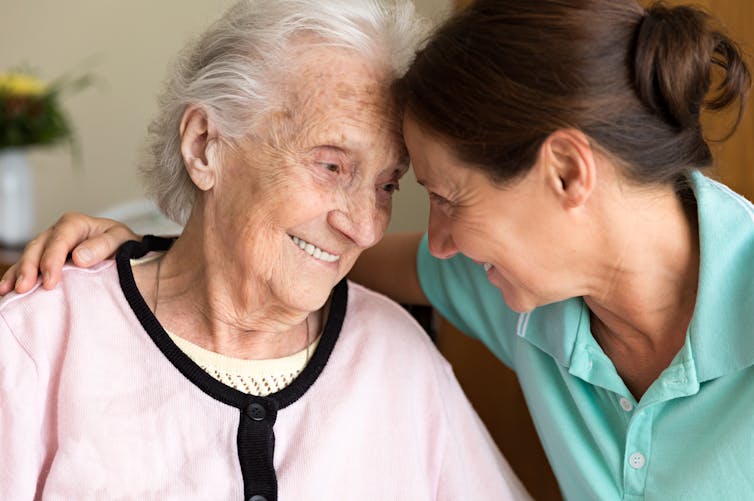
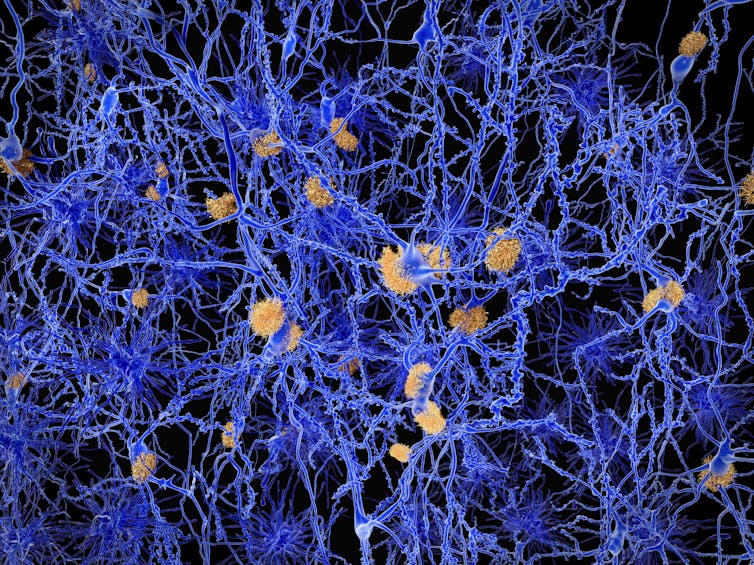
The number of cases of dementia in the U.S. is rising as baby boomers age, raising questions for boomers themselves and also for their families, caregivers and society. Dementia, which is not technically a disease but a term for impaired ability to think, remember or make decisions, is one of the most feared impairments of old age.
Incidence increases dramatically as people move into their 90s. About 5% of those age 71 to 79 have dementia, and about 37% of those about 90 years old live with it.
Older people may worry about their own loss of function as well as the cost and toll of caregiving for someone with dementia. A 2018 study estimated that the lifetime cost of care for a person with Alzheimer’s, the most common form of dementia, to be US$329,360. That figure, too, will no doubt rise, putting even more burdens on family, Medicare and Medicaid.
There’s also been a good deal of talk and reporting about dementia in recent months because of the U.S. presidential election. Some voters have asked whether one or both candidates might have dementia. But, is this even a fair question to ask? When these types of questions are posed – adding further stigma to people with dementia – it can unfairly further isolate them and those caring for them. We need to understand dementia and the impact it has on more than 5 million people in the U.S. who now live with dementia and their caregivers. That number is expected to triple by 2060.
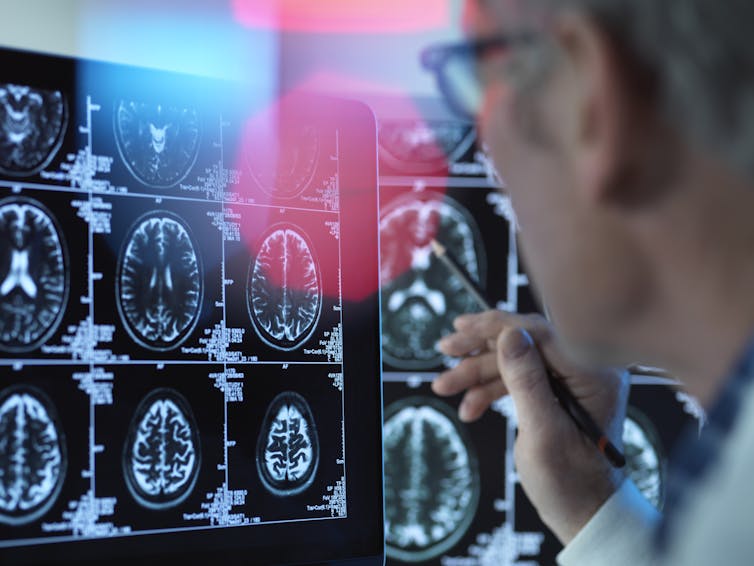
First, it is important to know that dementia cannot be diagnosed from afar or by someone who is not a doctor. A person needs a detailed doctor’s exam for a diagnosis. Sometimes, brain imaging is required. And, forgetting an occasional word – or even where you put your keys – does not mean a person has dementia. There are different types of memory loss and they can have different causes, such as other medical conditions, falls or even medication, including herbals, supplements and anything over-the-counter.
Older people wonder and worry about so-called senior moments and the memory loss they perceive in themselves and others. I see patients like this every week in my geriatric clinic, where they tell me their stories. They forget a word, get lost in a story, lose keys or can’t remember a name. Details vary, but the underlying concern is the same: Is this dementia?
As we age, we experience many physical and cognitive changes. Older people often have a decrease in recall memory. This is normal. Ever have trouble fetching a fact from the deep back part of your “mind’s Rolodex”? Suppose you spot someone at the grocery store you haven’t seen in years. Maybe you recognize the face, but don’t remember their name until later that night. This is normal, part of the expected changes with aging.
What’s more of a potential problem is forgetting the name of someone you see every day; forgetting how to get to a place you visit frequently; or having problems with your activities of daily living, like eating, dressing and hygiene.
When you have troubles with memory – but they don’t interfere with your daily activities – this is called mild cognitive impairment. Your primary care doctor can diagnose it. But sometimes it gets worse, so your doctor should follow you closely if you have mild cognitive impairment.
You want to note the timing of any impairment. Was there a gradual decline? Or did it happen all of a sudden? This too you should discuss with your doctor, who might recommend the MoCA, or Montreal Cognitive Assessment test, which screens for memory problems and helps determine if more evaluation is needed.
Also, the Centers for Disease Control and Prevention lists problems in these areas as possible signs of dementia:
Memory
Attention
Communication
Reasoning, judgment and problem solving
Visual perception beyond typical age-related changes in vision
When memory loss interferes with daily activities, see your doctor about what to do and how to make sure you’re safe at home.
There are numerous types of severe memory loss. Dementia tends to be a slow-moving progression that occurs over months or years. Delirium is more sudden and can occur over hours or days, usually when you have an acute illness. Depression can also cause memory changes, particularly as we get older.
Alzheimer’s dementia is the most common type of dementia, followed by vascular dementia. They have similar symptoms: confusion, getting lost, forgetting close friends or family, or an inability to do calculations like balance the checkbook. Certain medical conditions – thyroid disorders, syphilis – can lead to dementia symptoms, and less common types of dementia can have different kinds of symptoms. Alzheimer’s has a distinct set of symptoms often associated with certain changes in the brain.
Focusing on safety and appropriate supervision, particularly in the home, is critical for all people with dementia. Your doctor or a social worker can help you find support.
It’s also important to be aware of two other things that can lead to decreased mental functioning – delirium and depression.
Delirium, a rapid change in cognition or mental functioning, can occur in people with an acute medical illness, like pneumonia or even COVID-19 infection. Delirium can occur in patients in the hospital or at home. Risk for delirium increases with age or previous brain injuries; symptoms include decreased attention span and memory issues.
Depression can happen at any time, but it’s more common with aging. How can you tell if you’re depressed? Here’s one simple definition: when your mood remains low and you’ve lost interest or joy in activities you once loved.
Sometimes people have recurring episodes of depression; sometimes, it’s prolonged grieving that becomes depression. Symptoms include anxiety, hopelessness, low energy and problems with memory. If you notice signs of depression in yourself or a loved one, see your doctor. If you have any thoughts of harming yourself, call 911 to get help instantly.
Any of these conditions can be frightening. But even more frightening is unrecognized or unacknowledged dementia. You must, openly and honestly, discuss changes you notice in your memory or thinking with your doctor. It’s the first step toward figuring out what is happening and making sure your health is the best it can be.
And, as with any disease or disease group, dementia is not a “character flaw,” and the term should not be used to criticize a person. Dementia is a serious medical diagnosis – ask those who have it, the loved ones who care for them or any of us who treat them. Having dementia is challenging. Learn what you can do to support those with dementia in your own community.
Please, if you are of the age where this is more than an academic interest then read the article carefully and especially that piece of advice towards the end:
But even more frightening is unrecognized or unacknowledged dementia. You must, openly and honestly, discuss changes you notice in your memory or thinking with your doctor. It’s the first step toward figuring out what is happening and making sure your health is the best it can be.
As is said growing old is not for cissies.
None of us can put off the fateful day when we will die and in our case we do not believe in any form of afterlife, in other words we are confirmed atheists, so all we can do is to live out our remaining years as healthily as possible and loving each other and our precious animals.
But having said that I know that all of us want to live out our lives with healthy, active brains and it’s clear that we can’t leave it to chance.
In closing, I recently purchased the book Outsmart Your Brain written by Dr. Ginger Schechter (and others). It was just $9.99 and contains much advice regarding the best foods and exercise for a healthy brain. I recommend it!

















 Learning from Dogs