“At that moment I must have lost my presence of mind.”
November’s cause!
A couple of years ago, in a fit of ‘all mouth and no trousers‘ I signed up to NaNoWriMo. For the uninitiated that stands for National November Writing Month.
Why do I write ‘all mouth and no trousers‘? Because in both the previous two Novembers I didn’t even think about writing a single word, let alone actually write a word. OK, a year ago we were in the middle of settling down into our home here in Merlin. But still ….
So this November, I have committed to have a go. Or as the NaNoWriMo blog post explains:
NaNoWriMo 2013: Want to Write a Novel?
It’s just a few days until November, and you know what that means: National Novel Writing Month, better known ’round these parts as NaNoWriMo, is near.
Have you always wanted to write a novel?
We know some of you have been waiting all year for this month! For those of you who are new to this project, here’s the gist:
Who: You — whether you’re a seasoned novelist, novice writer, wannabe author, or a blogger up for a challenge.
What: A project in which you work toward a goal of writing a 50,000-word novel.
Where: On your laptop. At your desk. In your favorite café. Wherever inspiration strikes.
When: Kicking off this Friday, November 1, and ending at 11:59 pm on November 30.
Why: You’re creative and passionate about words. You’ve got a story to tell. You want to participate in a fun, rewarding project and push others to stretch their imaginations, too.
How: Sign up at NaNoWriMo.org, where you can plan your novel, track your progress, and join a community that offers support, encouragement, and advice — online and off.
So that means that for the month of November I shall have my head down for quite a fews hours each day in the self-imposed challenge of seeing if I can actually write a 50,000 word novel in one month! To put that into perspective, it’s the equivalent of 1,670 words every single day, seven days a week, for the thirty days of the month!
Ergo, the time for writing posts for Learning from Dogs is going to be very severely restricted!
In fact, it’s worse than that! I’m going to be sharing my scribblings with you.
As the NaNoWriMo site goes on to suggest:
While the NaNoWriMo website is where you’ll capture the magic, we hope you’ll use your blog to post updates, test your material, and share tips:
Connect with other participants on WordPress.com. Be sure to follow NaNoWriMo in your Reader to read what others all over the world are writing and saying throughout the month.
Test material on your readers. While diving into a novel is a solitary journey, know that you’ve got a support network in your readership — they know your voice, so consider trying out material on your blog. Not sure if a scene is working? Post an excerpt.
Reflect on your writing process. If you don’t want to share your novel-in-progress or get too specific with your readers, that’s fine. But consider taking time in between your sessions to reflect on your process: roadblocks you’ve hit, questions about your craft, and advice for other participants.
“Share the lessons you learn about your writing — and yourself — through your NaNo journey,” says Kristi. Then, tag these posts with NaNoWriMo so others can find them. There’s already chatter in the Reader, so dive in: you’ll find resourceful and inspirational posts by bloggers like Kristen Lamb, Rachel Peterson, Cristian Mihai, and E.E. Blake.
My idea is to post completed chapters here on Learning from Dogs every couple of days or so. Aiming for the foreword In the beginning to be posted here next Monday, the 4th. Then Chapter One, Chapter Two, and, just possibly, Chapter Three by the end of next week. Tomorrow, November 1st, I will share my synopsis for my novel!
NaMoWriMo stress the importance of writing; writing; writing and not losing the impetus of getting those words out by dilly-dallying in constant editing; something that I am rather prone to do over what is now more than 1,850 posts since July, 2009!
Thus the writings posted on Learning from Dogs will have many obvious errors. So what would be truly fantastic is to have your feedback, both good and bad, also highlighting crap writing and obvious mistakes, plus any ideas as to how the story might evolve. Because at this moment in time, I don’t have much of an idea. Mind you, I bet I’m not alone. The NaNoWriMo website shows there are 186,437 Novelists up for it this November!
During the intervening days, in other words non-sharing days, I’ll try and find something quick or humorous to post or, perhaps, repost something that has previously been published in this place.
So if all this doesn’t ‘rock your boat’, I’ll see you on December 1st! Assuming there is some level of creative sanity left in me!
“Before we change the world, we need to change the way we think.”
That quote comes from the sub-heading of an article in the magazine The New Statesman, Britain’s current affairs magazine. In fact, written by Russell Brand from the week that he is guest editor for the magazine. Hence it following on from yesterday.
Guest editor for a week.
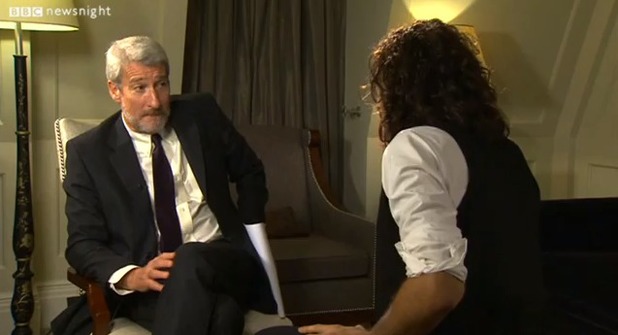
To remind readers, my post yesterday A powerful brand of truth centred around the interview on BBC Newsnight of Russell Brand by Jeremy Paxman.
Thus for today I wanted to offer some further thoughts from Russell Brand together with the film made by Dr Nafeez Ahmed. You will possibly recall that Dr. Ahmed was the author of the Guardian article that I quoted from yesterday.
Russell Brand’s New Statesman article spoke powerfully and eloquently of the issues that he covered in his BBC Newsnight interview. With The New Statesman’s permission let me offer a few extracts:
First from where Brand is speaking about “young people, poor people, not-rich people”.
They see no difference between Cameron, Clegg, Boris, either of the Milibands or anyone else. To them these names are as obsolete as Lord Palmerston or Denis Healey. The London riots in 2011, which were condemned as nihilistic and materialistic by Boris and Cameron (when they eventually returned from their holidays), were by that very definition political. These young people have been accidentally marketed to their whole lives without the economic means to participate in the carnival. After some draconian sentences were issued, measures that the white-collar criminals who capsized our economy with their greed a few years earlier avoided, and not one hoodie was hugged, the compliance resumed. Apathy reigned.
There’s little point bemoaning this apathy. Apathy is a rational reaction to a system that no longer represents, hears or addresses the vast majority of people. A system that is apathetic, in fact, to the needs of the people it was designed to serve.
Russell Brand is also no slouch when it comes to offering solutions, as in:
These problems that threaten to bring on global destruction are the result of legitimate human instincts gone awry, exploited by a dead ideology derived from dead desert myths. Fear and desire are the twin engines of human survival but with most of our basic needs met these instincts are being engaged to imprison us in an obsolete fragment of our consciousness. Our materialistic consumer culture relentlessly stimulates our desire. Our media ceaselessly engages our fear, our government triangulates and administrates, ensuring there are no obstacles to the agendas of these slow-thighed beasts, slouching towards Bethlehem.
For me the solution has to be primarily spiritual and secondarily political. This, too, is difficult terrain when the natural tribal leaders of the left are atheists, when Marxism is inveterately Godless. When the lumbering monotheistic faiths have given us millennia of grief for a handful of prayers and some sparkly rituals.
By spiritual I mean the acknowledgement that our connection to one another and the planet must be prioritised. Buckminster Fuller outlines what ought be our collective objectives succinctly: “to make the world work for 100 per cent of humanity in the shortest possible time through spontaneous co-operation without ecological offence or the disadvantage of anyone”. This maxim is the very essence of “easier said than done” as it implies the dismantling of our entire socio-economic machinery. By teatime.
Towards the end of the article, or manifesto as Brand calls it, he speaks about the change that is required:
We are still led by blithering chimps, in razor-sharp suits, with razor-sharp lines, pimped and crimped by spin doctors and speech-writers. Well-groomed ape-men, superficially altered by post-Clintonian trends.
We are mammals on a planet, who now face a struggle for survival if our species is to avoid expiry. We can’t be led by people who have never struggled, who are a dusty oak-brown echo of a system dreamed up by Whigs and old Dutch racists.
We now must live in reality, inner and outer. Consciousness itself must change. My optimism comes entirely from the knowledge that this total social shift is actually the shared responsibility of six billion individuals who ultimately have the same interests. Self-preservation and the survival of the planet. This is a better idea than the sustenance of an elite. The Indian teacher Yogananda said: “It doesn’t matter if a cave has been in darkness for 10,000 years or half an hour, once you light a match it is illuminated.”
Then shortly thereafter:
The only systems we can afford to employ are those that rationally serve the planet first, then all humanity. Not out of some woolly, bullshit tree-hugging piffle but because we live on it, currently without alternatives. This is why I believe we need a unifying and in – clusive spiritual ideology: atheism and materialism atomise us and anchor us to one frequency of consciousness and inhibit necessary co-operation.
With the article/manifesto concluding:
But we are far from apathetic, we are far from impotent. I take great courage from the groaning effort required to keep us down, the institutions that have to be fastidiously kept in place to maintain this duplicitous order. Propaganda, police, media, lies. Now is the time to continue the great legacy of the left, in harmony with its implicit spiritual principles. Time may only be a human concept and therefore ultimately unreal, but what is irrefutably real is that this is the time for us to wake up.
The revolution of consciousness is a decision, decisions take a moment. In my mind the revolution has already begun.
It’s a powerful and very personal response to the issues facing all of humanity now and I can’t recommend too strongly reading the article in full.
So on to another powerful and personal analysis of the issues facing humanity. This time in a film made by Dr Nafeez Ahmed. The film is called The Crisis of Civilization and shows, oh so clearly, the interconnectedness of the many issues we are facing these days. It’s nearly an hour-and-a-half long but eminently watchable.
Author and international security analyst Dr Nafeez Mosaddeq Ahmed on The Crisis of Civilization. Dr Ahmed is author of A User’s Guide to the Crisis of Civilization: And How to Save It, and co-producer of The Crisis of Civilization.
It often seems that different crises are competing to devastate civilization. The Crisis of Civilization argues that financial meltdown, environmental degradation, dwindling oil reserves, terrorism and food shortages need to be considered as part of the same ailing system.
Most accounts of our contemporary global crises focus on one area, or another, to the exclusion of others. The Crisis of Civilization suggests that the unwillingness of experts to look outside their own fields explains why there is so much disagreement and misunderstanding about the nature of the global threats we face. The Crisis of Civilization attempts to investigate all of these problem areas, not as isolated events, but as trends and processes that belong to a single global system. We are therefore not dealing with a ‘clash of civilizations’ as Samuel Huntington argued. Nor have we witnessed ‘the end of history’ that Francis Fukuyama prematurely declared. Rather, we are dealing with the end of the industrial age, a fundamental crisis of civilization itself.
oooOOOooo
OK, that’s the end of the serious stuff for this week. Things are going to be very different here on Learning from Dogs for the month of November.
Yesterday’s post here on Learning from Dogs looked at the utter insanity, the greed, the short-sightedness of extracting oil in greater and more varied ways; as if the future for all of life on this planet just didn’t matter. I guess the truth is that for those who stand to benefit from this wealth, the future of the planet just doesn’t matter.
Revealing the obvious!
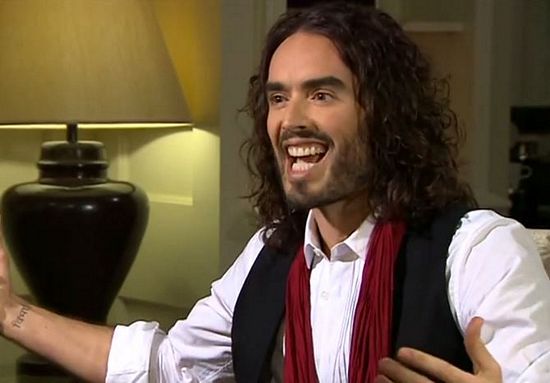
The recent interview on BBC Newsnight by Jeremy Paxman of British comedian Russell Brand has gone viral. At the time of writing this post, YouTube report 7,661,280 viewings! It’s not surprising because what Russell Brand is saying is obvious to millions of people all around the world. What Brand is expressing is as clear as a lone, lighted beacon at midnight on the darkest Winter night one could imagine.
During his Wednesday night interview with Jeremy Paxman on BBC Newsnight, comedian and actor Russell Brand said what no politician or pundit would ever dare say: that without dramatic, fundamental change, the prevailing political and economic system is broken, and hell-bent on planetary-level destruction:
With Dr Ahmed, the author of that Guardian article, concluding:
And in doing so, we might begin to realise that it is precisely the lack of a single, top-down manifesto that is our greatest strength – because, unlike the old, dying, fossil fuel dependent paradigm of endless growth for its own sake for the corporate few, the new, emerging post-carbon paradigm will be co-created by people themselves from the ground up.
That is why Brand’s answer for the way forward is so compelling:
“We shouldn’t destroy the planet. We shouldn’t create massive economic disparity. We shouldn’t ignore the needs of the people.”
If we want our children to inherit a habitable planet, rather than bashing Brand for not having a more coherent solution, we need to start being part of it.
You know what! The incredible response to that Paxman-Brand interview shows the millions of us who are already “part of it.” Yes, it really does feel that the time is now. That time that so very many of us, in a myriad of different ways, are fighting for our beautiful planet from the ground up.
Finally, if you want to read that interview between Paxman and Brand in detail, then over on Corrente there is a full transcript of the exchange between them.
Long may this run!
Passion for speaking the truth about our present times!
Just over a week ago, Dan Gomez sent me a link to an item on StumbleUpon. It was a feature called Don’t Believe Your Eyes featuring the work of Matthew Albanese.
I am not going to reproduce all the images despite them all being on that StumbleUpon webpage simply because I haven’t had time to ask Matthew’s permission. I will just offer a few of them so you may be wowed as I was.
oooOOOooo
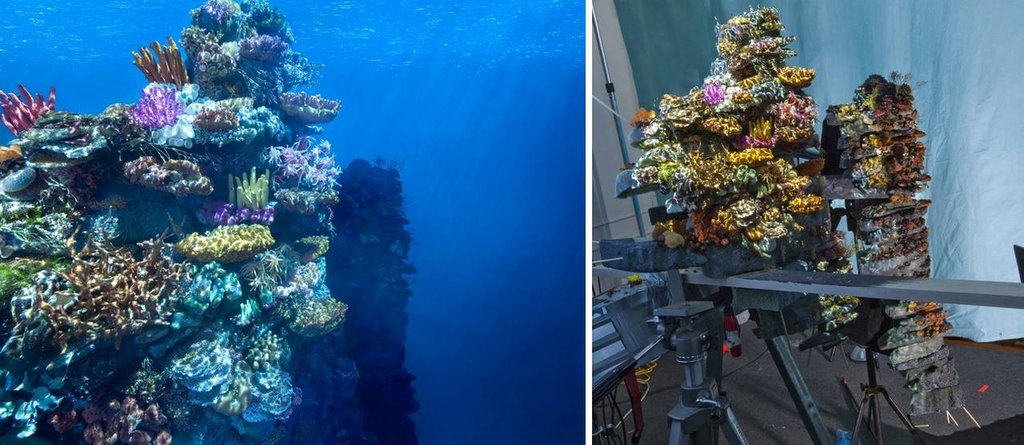
Matthew Albanese is an artist who fascinates with special effects and magic. Matthew owns a stunning artwork collection of photographs that will blow your mind with their realistic presence. On the left side in the gallery you can see the final image and on the right you will be able to see how image was created using his special effects. Scroll down and enjoy today’s gallery of 15 beautiful artworks.
BOX OF LIGHTNING
Diorama for Box of Lightning.. Backlit etching in plexiglass painted black.
HOW TO BREATHE UNDERWATER
Diorama made out of walnuts, poured and cast candle wax, wire, glitter, peanut shells, flock, plaster, wire, dyed starfish, compressed moss,
Diorama made using painted parchment paper, thread, hand dyed ostrich feathers, carved chocolate, wire, raffia, masking tape, coffee, synthetic potting moss and cotton.
oooo
OK, if you want to see the whole set you will have to go Matthew’s website.
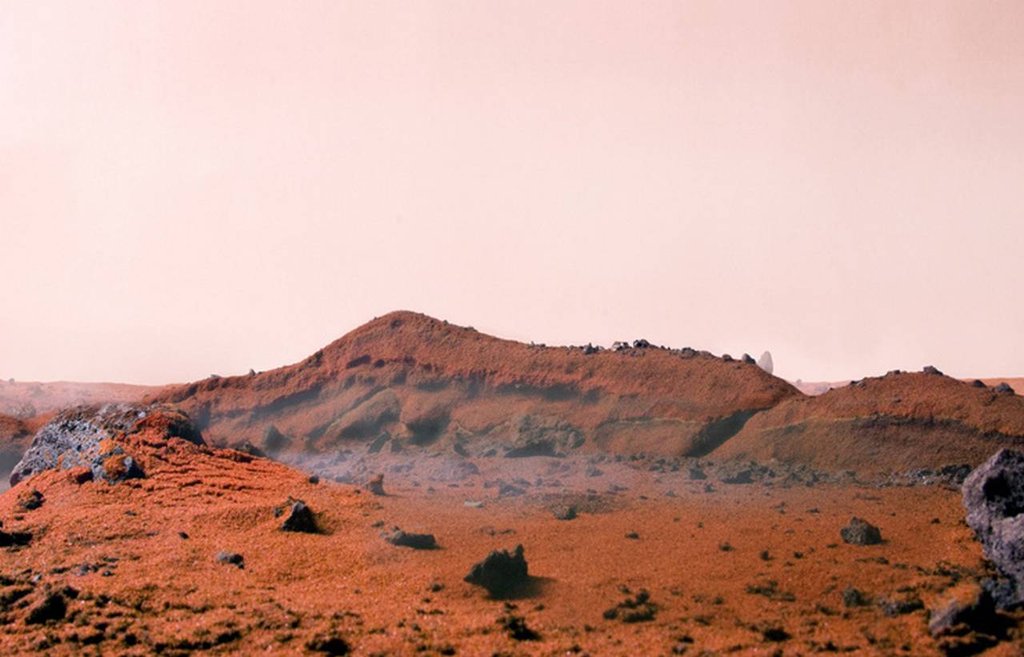
But I will just sneak in the last one from that series of fifteen.
Paprika Mars. Made out of 12 pounds paprika, cinnamon, nutmeg, chili powder and charcoal
oooo
Matthew Albanese’s fascination with film, special effects and movie magic—and the mechanics behind these illusions—began early. Born in northern New Jersey in 1983, Albanese spent a peripatetic childhood moving between New Jersey and upstate New York. An only child, Albanese enjoyed imaginative, solitary play. He loved miniatures and created scenarios intricately set with household objects and his extensive collection of action figures. After earning a Bachelor of Fine Arts degree in Photography at the State University of New York, Purchase, Albanese worked as a fashion photographer, training his lens on bags, designer shoes and accessories—this small-object specialization is known in the retail trade as “table top photography.” Albanese’s creative eye soon turned to tabletop sets of a more wildly eclectic nature. In 2008, a spilled canister of paprika inspired him to create his first mini Mars landscape. More minute dioramas—made of spices, food and found objects—followed. In 2011, Albanese was invited to show at the Museum of Art and Design of New York. His work has also been exhibited at the Virginia Museum of Contemporary Art, Winkleman Gallery, and Muba, Tourcoing France. Matthew is represented at Bonni Benrubi Gallery in New York
ALL IMAGES, TITLES, DESCRIPTION AND BIO ARE COPYRIGHT AND IN OWNERSHIP OF MATTHEW ALBANESE WEBSITE
Somewhere in my aged brain cells is the memory of having heard that humans are great lovers of patterns. In other words, patterns are deemed to be very important for the progress and evolution of homo sapiens. Of course, it is not just humans who learn from patterns; I’m sure most of the animals who live around us are great pattern matchers. To support that proposition, anyone who has owned a dog or cat will have spotted how quickly they learn patterns. (As an aside, some months ago our puppy German Shepherd, Cleo, work me at around 4am because she needed to go outside for a ‘call of nature’. I now get woken every single night variously between 2am and 5am for Cleo’s benefit!)
The British mathematician G. H. Hardy who lived from the last quarter of the 19th Century well into the 20th Century, reputedly said (and I cheated and looked it up!):
A mathematician, like a painter or poet, is a maker of patterns. If his patterns are more permanent than theirs, it is because they are made with ideas.
So why has this post opened with the theme of patterns? Because, call it coincidence or what, within the last couple of weeks there have been three articles, each from very a different source, predicting that the present levels of inequality in society are both unsustainable and the beginning of the end.
Global wealth inequality: top 1% own 41%; top 10% own 86%; bottom half own just 1%
—–
Just 8.4% of all the 5bn adults in the world own 83.4% of all household wealth (that’s property and financial assets, like stocks, shares and cash in the bank). About 393 million people have net worth (that’s wealth after all debt is accounted for) of over $100,000, that’s 10% own 86% of all household wealth! But $100,000 may not seem that much, if you own a house in any G7 country without any mortgage. So many millions in the UK or the US are in the top 10% of global wealth holders. This shows just how little two-thirds of adults in the world have – under $10,000 of net wealth each and billions have nothing at all.
This is not annual income but just wealth – in other words, 3.2bn adults own virtually nothing at all. At the other end of the spectrum, just 32m people own $98trn in wealth or 41% of all household wealth or more than $1m each. And just 98,700 people with ‘ultra-high net worth’ have more than $50 million each and of these 33,900 are worth over $100 million each. Half of these super-rich live in the US.
Michael Robert’s essay closes:
All class societies have generated extremes of inequality in wealth and income. That is the point of a rich elite (whether feudal landlords, Asiatic warlords, Incan and Egyptian religious castes, Roman slave owners, etc) usurping control of the surplus produced by labour. But past class societies considered that normal and ‘god-given’. Capitalism on the other hand talks about free markets, equal exchange and equality of opportunity. But the reality is no different from previous class societies.
The uprisings in the Middle East, the unrest that is tearing apart nations such as the Ivory Coast, the bubbling discontent in Greece, Ireland and Britain and the labor disputes in states such as Wisconsin and Ohio presage the collapse of globalization. They presage a world where vital resources, including food and water, jobs and security, are becoming scarcer and harder to obtain. They presage growing misery for hundreds of millions of people who find themselves trapped in failed states, suffering escalating violence and crippling poverty. They presage increasingly draconian controls and force—take a look at what is being done to Pfc. Bradley Manning—used to protect the corporate elite who are orchestrating our demise.
We must embrace, and embrace rapidly, a radical new ethic of simplicity and rigorous protection of our ecosystem—especially the climate—or we will all be holding on to life by our fingertips. We must rebuild radical socialist movements that demand that the resources of the state and the nation provide for the welfare of all citizens and the heavy hand of state power be employed to prohibit the plunder by the corporate power elite. We must view the corporate capitalists who have seized control of our money, our food, our energy, our education, our press, our health care system and our governance as mortal enemies to be vanquished.
The PRI editor’s preamble to the Chris Hedges essay included a couple of videos that he recommended watching. One was a talk by Robert Reich: How Unequal Can America Get Before We Snap?
The other one was a recent TED Talk by Richard Wilkinson (his profile is here).
Mr. Wilkinson explains that for the majority of people there is an instinctive feeling that societies with huge income gaps and corresponding high levels of social inequality are somehow going wrong. He charts the hard data on such economic inequality and shows what gets worse when rich and poor are too far apart: ergo, the very real effects on health, lifespan, and even such basic values as trust.
Just 16 minutes long, it’s a very revealing talk. Do watch it.
oooo
The final, third piece of the pattern was me coming across an essay on the blog DeflationLand, not a blog I had come across before, on the same day that I saw the PRI article. This essay, published just two days before the PRI article, was about patterns; the patterns of the centuries. More specifically, how the characteristics of a century generally evolve to a new culture within the first 10 to 15 years of the following century. It was a most interesting proposition and, to my delight, I was given permission to republish that essay here on Learning from Dogs. So here it is.
oooOOOooo
Why I stopped worrying and learned to love the currency collapse
For the past 300 years, the historical pattern has been for the era marked by a century to continue into the following century by fourteen or fifteen years. Let me explain. Everyone knows that the 19th Century, its uprightness, its optimism and sense of purpose, the halcyon days of British Empire, came to an end with World War I, starting in 1914 and building to a nasty crescendo by 1916. The 20th Century had arrived, and it had some real horrors in store for us.
Germans before Kraftwerk
But if we return back another hundred years, we notice that the 18th Century ends in 1815 with the final defeat of Napoleon, that final project of the Enlightenment and of the French Revolution. With the Congress of Vienna in 1814-1815, we have a new Europe along the lines of Metternich’s plan, and the 19th Century at last is here.
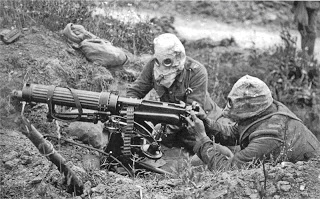
“Sorry, guys. My bad.”
In 1713 and 1714, we have the Treaties of Utrecht, Baden, and Rastatt, bringing an end to the era of Spain as a major power, and the rise of the Habsburgs. Louis XIV dies in 1715, after reigning for 72 years. The Baroque period is over, and we are now firmly in the 18th Century.
War of Spanish Succession
We still live in the 20th Century. Nothing much significant has changed in our lives in the past twenty years. Symptoms of a deeper rot are appearing here and there, foreshadowing a larger crisis, but the crisis itself has not arrived yet. We still live in an era of Pax Americana, the old republic very much a strained and tired Empire now, with the U.S. Dollar as the world’s reserve currency.
That is going to change.
The next task for History is to dismantle the untenable structures and institutions put in place by late Modernity, which have been extended now as far as they can go. Our debt-based monetary system will collapse, our unbacked fiats will be worthless. The debts and unmeetable obligations will all default.
There are ironies and great contradictions as the former home and hope of Liberty becomes viciously unfree and increasingly despotic. Our leaders no longer govern, but try instead to rule us — they are less legitimate with each passing day, their laws corrupt or worse. They are nearly finished, and will be swept away with the tide.
Just as in 1914, the internationalist system will break down, dashing the hopes of the would-be first-world nations. We will probably have a pretty good war as well, or many local ones worldwide. These transitions tend to involve war.
Deflation first — it clears the way for the complete loss of faith and hyperinflation that will follow. The next big wave down in the financial markets is the battering ram. The U.S. national debt is about faith, so is quantitative easing, and so is the very idea of magical coins that could ever be “worth” a trillion dollars. When this faith breaks, in concert with loss of faith in perpetual growth and unlimited cheap energy, then things will move very, very quickly.
There is nothing any of us can do at this point, except navigate the rapids as well as possible, and to stay out of the way of a dying empire, which is still very dangerous in its death throes. We are actually very privileged to be alive and witnessing this next transition, to what we do not know just yet. But what an honor to live at this time, not in ignorance but with an existential resolve to come out of it alive and much the wiser.
Ass Americana.
oooOOOooo
** Chris Hedges is a Pulitzer Prize–winning author and former international correspondent for the New York Times. His latest book is The World As It Is: Dispatches on the Myth of Human Progress.
I am neither a scientist nor a historian; just someone who has lived in and observed the world for coming on for 60 years.
So you have to understand that my prediction is hardly worth the ‘paper I write upon’ (which certainly dates me!). But, undaunted, here are my predictions for the 21st Century:
That the power of internet communications will allow more people, more quickly, to find their soul-mates wherever they are on this planet.
That the realisation of how dysfunctional many Governments are, of how truly poorly they serve the majorities of their citizens, will lead to mass rejections of these so-called Governments’ policies. Such rejections predominantly peaceful, as in taking the horse to water but being unable to make it drink.
That there will be a new form of localism. At two levels. Literally, people geographically close to each other creating 21st C. versions of local communities. Virtually, those local communities linking to other like-minded communities right across the world resulting in highly effective and innovative learning, accelerated common-sense, (call it wisdom if you wish), and extraordinarily efficient and sustainable ways of living on this planet.
The ride of Paul Revere is a famous poem by Longfellow, as in Henry Wadsworth Longfellow. It commemorates the American patriot Paul Revere who on the 18th April, 1775 rode furiously across Middlesex County, Massachusetts spreading the alarm that the British were approaching.
Spreading the alarm throughout Middlesex County, Massachusetts.
In 1774 and the Spring of 1775 Paul Revere was employed by the Boston Committee of Correspondence and the Massachusetts Committee of Safety as an express rider to carry news, messages, and copies of resolutions as far away as New York and Philadelphia.
On the evening of April 18, 1775, Paul Revere was sent for by Dr. Joseph Warren and instructed to ride to Lexington, Massachusetts, to warn Samuel Adams and John Hancock that British troops were marching to arrest them. After being rowed across the Charles River to Charlestown by two associates, Paul Revere borrowed a horse from his friend Deacon John Larkin. While in Charlestown, he verified that the local “Sons of Liberty” committee had seen his pre-arranged signals. (Two lanterns had been hung briefly in the bell-tower of Christ Church in Boston, indicating that troops would row “by sea” across the Charles River to Cambridge, rather than marching “by land” out Boston Neck. Revere had arranged for these signals the previous weekend, as he was afraid that he might be prevented from leaving Boston).
On the way to Lexington, Revere “alarmed” the country-side, stopping at each house, and arrived in Lexington about midnight. As he approached the house where Adams and Hancock were staying, a sentry asked that he not make so much noise. “Noise!” cried Revere, “You’ll have noise enough before long. The regulars are coming out!” After delivering his message, Revere was joined by a second rider, William Dawes, who had been sent on the same errand by a different route. Deciding on their own to continue on to Concord, Massachusetts, where weapons and supplies were hidden, Revere and Dawes were joined by a third rider, Dr. Samuel Prescott. Soon after, all three were arrested by a British patrol. Prescott escaped almost immediately, and Dawes soon after. Revere was held for some time and then released. Left without a horse, Revere returned to Lexington in time to witness part of the battle on the Lexington Green.
I mention all this simply because when John Hurlburt recently sent me a guest post his email opened with these words: “Thanks for the call. Hopefully, we are beginning to turn a global corner. Here’s a slightly modified version of “the Midnight Ride of Paul Revere”.”
So with no further ado, here is John’s essay.
oooOOOooo
Random Thoughts
The United States is a two hundred-year-old modern experiment in Democracy. Democracy is an inclusive government by a majority of equal citizens. Oligarchy and plutocracy are forms of government by the few rich people. Both have historically ended in chaos. Our hearts and our souls are deeply saddened by the ignorance and lack of compassion of a technologically enhanced corporate struggle against the earth and humanity.
Dualism is divisive. We’re butting heads over false equivalencies which have very little if anything to do with the true nature of a global environmental, cultural and economic melt-down. People who believe that money makes the world go round either don’t know much or don’t care at all about the realities of physics.
Sooner or later, fundamentalism self-destructs as a result of a failure to adapt to change. The longer we continue to push Nature’s envelope, the longer it’s going to take the earth to recover. Our hope is that we won’t destroy human culture and the sustaining crust of mother earth in the process of regaining our balance.
Most animals live primarily by instinct. Humans have added discernment. Today is the tomorrow we dreamed of yesterday. Who knows if we’ll get another opportunity to do what we are still capable of doing as a species today? Unfortunately, the last thing that many Americans truly cared about was when the “Twinkie” factories temporarily shut down.
It is far better to live into solutions then it is to live with problems.The spiritual energy of life is as warm and welcoming as the sun. The first step is to accept that Nature requires life to adapt. We need to see the integral vision beyond ourselves and live into that vision.
What we can’t accomplish alone we can accomplish together.
Ne cede malis!
an old lamplighter
oooOOOooo
Fabulous words, as I’m sure you’ll agree. Oh, and if you like me didn’t understand that Latin expression ‘Ne cede malis’, it means yield not to misfortunes.
Let me close with that Longfellow poem.
Paul Revere’s Ride
Henry Wadsworth Longfellow
Listen my children and you shall hear
Of the midnight ride of Paul Revere,
On the eighteenth of April, in Seventy-five;
Hardly a man is now alive
Who remembers that famous day and year.
He said to his friend, “If the British march
By land or sea from the town to-night,
Hang a lantern aloft in the belfry arch
Of the North Church tower as a signal light,–
One if by land, and two if by sea;
And I on the opposite shore will be,
Ready to ride and spread the alarm
Through every Middlesex village and farm,
For the country folk to be up and to arm.”
Then he said “Good-night!” and with muffled oar
Silently rowed to the Charlestown shore,
Just as the moon rose over the bay,
Where swinging wide at her moorings lay
The Somerset, British man-of-war;
A phantom ship, with each mast and spar
Across the moon like a prison bar,
And a huge black hulk, that was magnified
By its own reflection in the tide.
Meanwhile, his friend through alley and street
Wanders and watches, with eager ears,
Till in the silence around him he hears
The muster of men at the barrack door,
The sound of arms, and the tramp of feet,
And the measured tread of the grenadiers,
Marching down to their boats on the shore.
Then he climbed the tower of the Old North Church,
By the wooden stairs, with stealthy tread,
To the belfry chamber overhead,
And startled the pigeons from their perch
On the sombre rafters, that round him made
Masses and moving shapes of shade,–
By the trembling ladder, steep and tall,
To the highest window in the wall,
Where he paused to listen and look down
A moment on the roofs of the town
And the moonlight flowing over all.
Beneath, in the churchyard, lay the dead,
In their night encampment on the hill,
Wrapped in silence so deep and still
That he could hear, like a sentinel’s tread,
The watchful night-wind, as it went
Creeping along from tent to tent,
And seeming to whisper, “All is well!”
A moment only he feels the spell
Of the place and the hour, and the secret dread
Of the lonely belfry and the dead;
For suddenly all his thoughts are bent
On a shadowy something far away,
Where the river widens to meet the bay,–
A line of black that bends and floats
On the rising tide like a bridge of boats.
Meanwhile, impatient to mount and ride,
Booted and spurred, with a heavy stride
On the opposite shore walked Paul Revere.
Now he patted his horse’s side,
Now he gazed at the landscape far and near,
Then, impetuous, stamped the earth,
And turned and tightened his saddle girth;
But mostly he watched with eager search
The belfry tower of the Old North Church,
As it rose above the graves on the hill,
Lonely and spectral and sombre and still.
And lo! as he looks, on the belfry’s height
A glimmer, and then a gleam of light!
He springs to the saddle, the bridle he turns,
But lingers and gazes, till full on his sight
A second lamp in the belfry burns.
A hurry of hoofs in a village street,
A shape in the moonlight, a bulk in the dark,
And beneath, from the pebbles, in passing, a spark
Struck out by a steed flying fearless and fleet;
That was all! And yet, through the gloom and the light,
The fate of a nation was riding that night;
And the spark struck out by that steed, in his flight,
Kindled the land into flame with its heat.
He has left the village and mounted the steep,
And beneath him, tranquil and broad and deep,
Is the Mystic, meeting the ocean tides;
And under the alders that skirt its edge,
Now soft on the sand, now loud on the ledge,
Is heard the tramp of his steed as he rides.
It was twelve by the village clock
When he crossed the bridge into Medford town.
He heard the crowing of the cock,
And the barking of the farmer’s dog,
And felt the damp of the river fog,
That rises after the sun goes down.
It was one by the village clock,
When he galloped into Lexington.
He saw the gilded weathercock
Swim in the moonlight as he passed,
And the meeting-house windows, black and bare,
Gaze at him with a spectral glare,
As if they already stood aghast
At the bloody work they would look upon.
It was two by the village clock,
When he came to the bridge in Concord town.
He heard the bleating of the flock,
And the twitter of birds among the trees,
And felt the breath of the morning breeze
Blowing over the meadow brown.
And one was safe and asleep in his bed
Who at the bridge would be first to fall,
Who that day would be lying dead,
Pierced by a British musket ball.
You know the rest. In the books you have read
How the British Regulars fired and fled,—
How the farmers gave them ball for ball,
From behind each fence and farmyard wall,
Chasing the redcoats down the lane,
Then crossing the fields to emerge again
Under the trees at the turn of the road,
And only pausing to fire and load.
So through the night rode Paul Revere;
And so through the night went his cry of alarm
To every Middlesex village and farm,—
A cry of defiance, and not of fear,
A voice in the darkness, a knock at the door,
And a word that shall echo for evermore!
For, borne on the night-wind of the Past,
Through all our history, to the last,
In the hour of darkness and peril and need,
The people will waken and listen to hear
The hurrying hoof-beats of that steed,
And the midnight message of Paul Revere.
A warning of the dangers of cell phones and the like!
Yesterday, I simply ran out of time to write to write a more personal post for today. So I looked at some of the news items that I had collected recently and two jumped out as being both deeply connected and worthy of posting.
The first was an item that was seen on Natural News a little more than a couple of months ago. It had the title of EMF exposures destroy health and well-being, claims panel of top international scientists. The link to that article is here. It opens, thus:
(NaturalNews) Nearly 8 million people worldwide die from cancer on an annual basis. Cardiovascular disease is the number one cause of death, killing almost 17 million people in 2011; both of these statistics are spiraling out of control. Now three top scientists, Dr. Panagopoulos of the University of Athens , Associate Prof. Johansson of the Karolinska Institute, and Dr. Carlo of the Science and Public Policy Institute, are sounding the alarm bell.
Leaders in their respective fields, Panagopoulos, Johansson, and Carlo, claim electromagnetic field (EMF) exposures significantly below international safety levels exposures are destroying the public’s health and well-being.
Recent study findings
This latest study concluded the present standard of measuring EMFs, Specific Absorption Rate (SAR), to be totally inappropriate. SAR measures the heating effect of EMF based technologies like microwave ovens, cell phones, cordless phones, Wi-Fi and the like. But countless studies have brought to light adverse biological effects at radiation levels significantly below levels where a thermal effect is detected.
Please do go here and read the full article. Because as one reads from the closing advice, as below, whom these days isn’t being affected?
Basic EMF protection
Reducing personal exposure to EMFs is a fairly easy endeavor. Basic EMF protection can be achieved by:
• Texting instead of talking with cell phones
• Setting cell phones on airplane mode when not in use
• Clearing the bedroom of electrical devices
• Replacing Wi-Fi with a hard-wired connection
Taking these simple steps is well worth the effort; the power to reduce EMF exposure and the adverse health effects that stem from them are truly right there at your fingertips.
Multifocal Breast Cancer in Young Women with Prolonged Contact between Their Breasts and Their Cellular Phones
Abstract
Breast cancer occurring in women under the age of 40 is uncommon in the absence of family history or genetic predisposition, and prompts the exploration of other possible exposures or environmental risks. We report a case series of four young women—ages from 21 to 39—with multifocal invasive breast cancer that raises the concern of a possible association with nonionizing radiation of electromagnetic field exposures from cellular phones. All patients regularly carried their smartphones directly against their breasts in their brassieres for up to 10 hours a day, for several years, and developed tumors in areas of their breasts immediately underlying the phones. All patients had no family history of breast cancer, tested negative for BRCA1 and BRCA2, and had no other known breast cancer risks. Their breast imaging is reviewed, showing clustering of multiple tumor foci in the breast directly under the area of phone contact. Pathology of all four cases shows striking similarity; all tumors are hormone-positive, low-intermediate grade, having an extensive intraductal component, and all tumors have near identical morphology. These cases raise awareness to the lack of safety data of prolonged direct contact with cellular phones.
















 Learning from Dogs