There were a total of twenty-four of these wonderful photographs sent to me by Su. Thus I am inclined to present them to you, dear reader, in a further two batches of eight over the next two weekends.
I can’t recall why it was many months ago that I came across the website of Frontiers in Science. But I did and, in particular, I came across a fundamental difference between the two species. In an article entitled: A simple reason for a big difference: wolves do not look back at humans, but dogs do.I’m going to take a chance, as in not having formal permission to republish it, in reposting it in full here. Because it means so much to me and other dog lovers!
ooOOoo
A simple reason for a big difference: wolves do not look back at humans, but dogs do.
Adám Miklósi, Enikö Kubinyi, József Topál, Márta Gácsi, Zsófia Virányi and Vilmos Csányi
Department of Ethology, Eötvös University, Budapest, Pázmány P. 1c, 1117, Hungary. miklosa@ludens.elte.hu
The present investigations were undertaken to compare interspecific communicative abilities of dogs and wolves, which were socialized to humans at comparable levels. The first study demonstrated that socialized wolves were able to locate the place of hidden food indicated by the touching and, to some extent, pointing cues provided by the familiar human experimenter, but their performance remained inferior to that of dogs. In the second study, we have found that, after undergoing training to solve a simple manipulation task, dogs that are faced with an insoluble version of the same problem look/gaze at the human, while socialized wolves do not. Based on these observations, we suggest that the key difference between dog and wolf behavior is the dogs’ ability to look at the human’s face. Since looking behavior has an important function in initializing and maintaining communicative interaction in human communication systems, we suppose that by positive feedback processes (both evolutionary and ontogenetically) the readiness of dogs to look at the human face has lead to complex forms of dog-human communication that cannot be achieved in wolves even after extended socialization.
ooOOoo
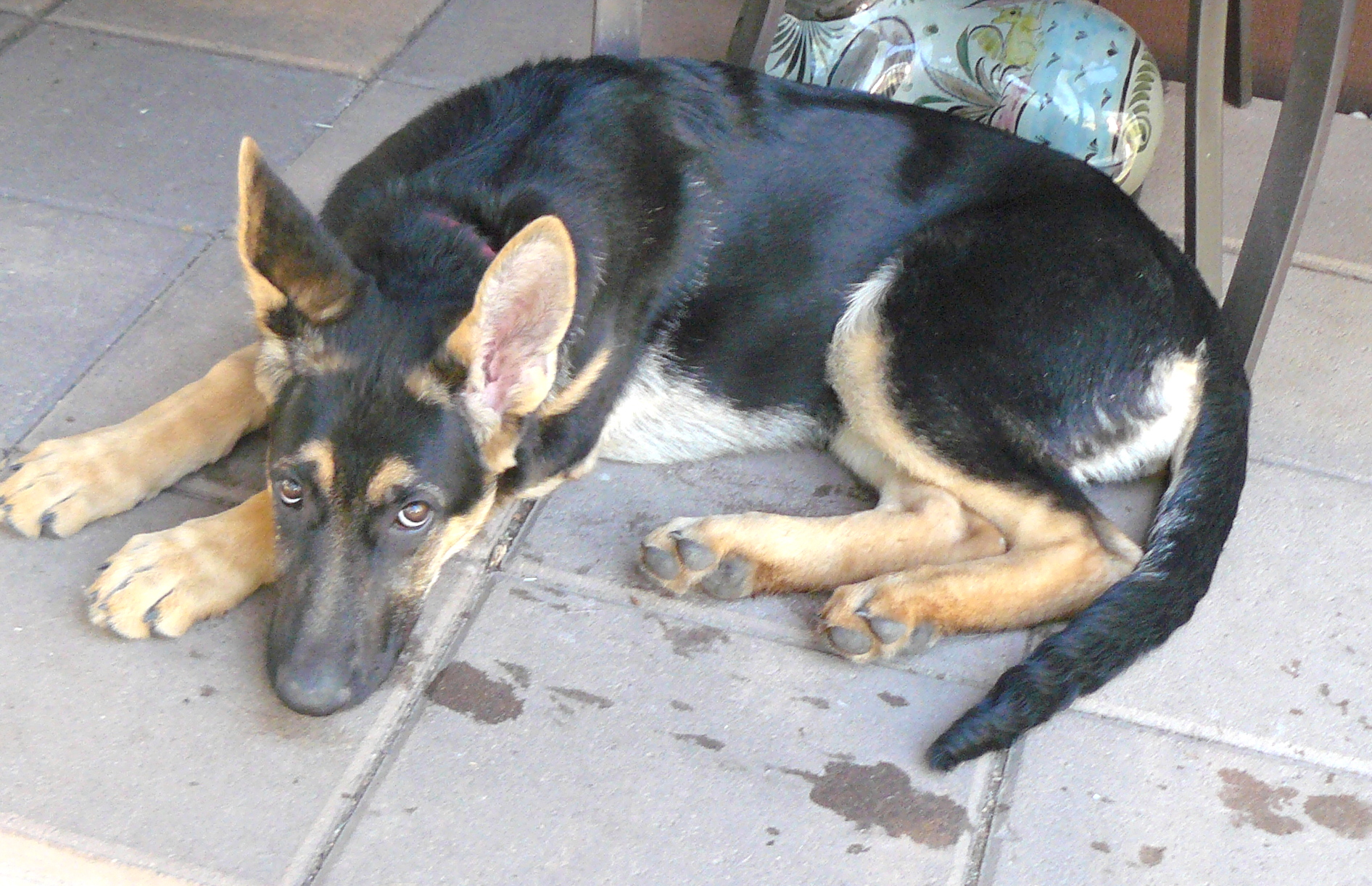
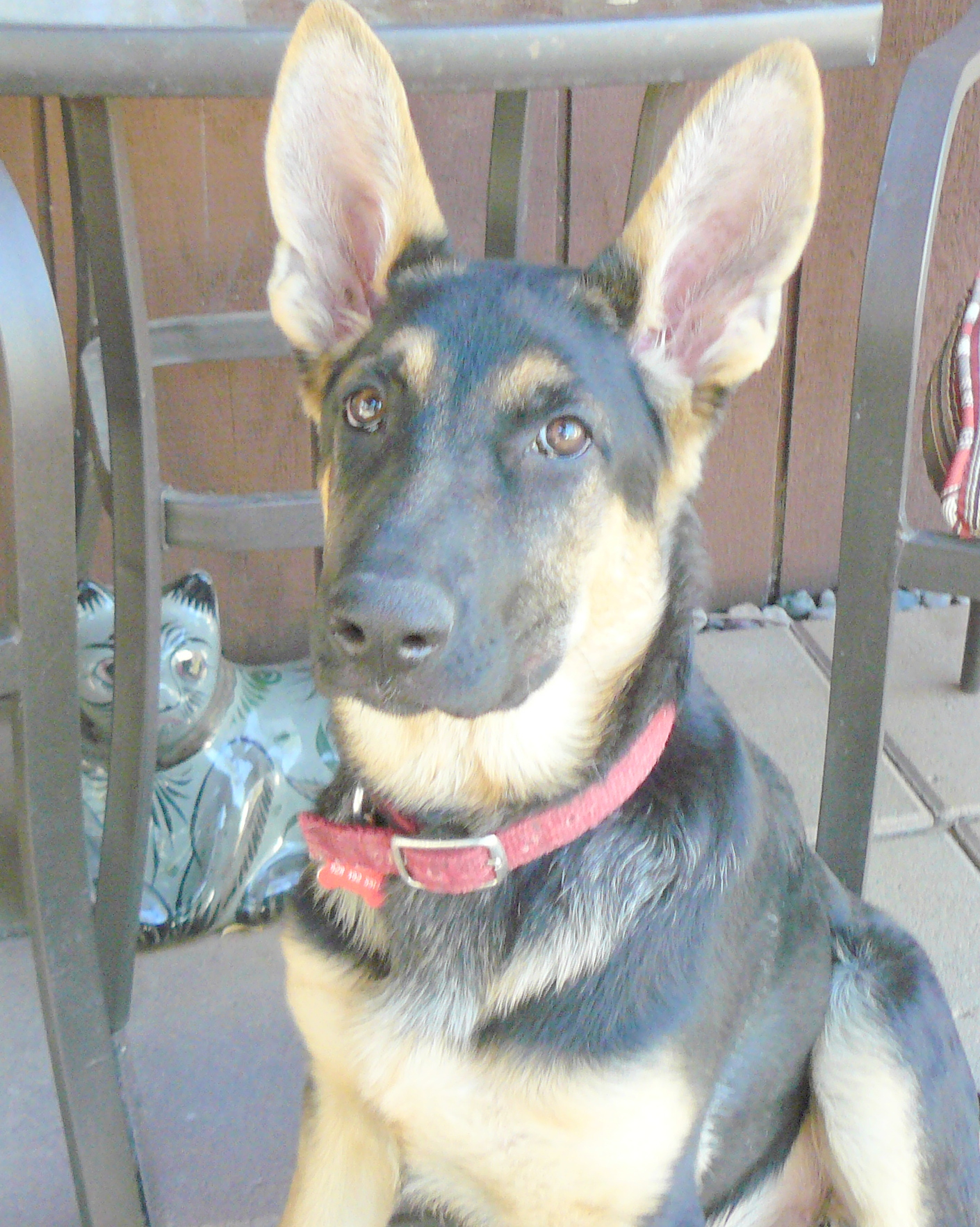
Actually, that article from the Department of Ethology at Eötvös University in Budapest is just an excuse for me to post three photographs confirming the good scientists results!
Young Cleo, May 12th, 2012.
oooo
Mr Pharaoh’s look from June, 2007.
oooo
The second Cleo look from May, 2012.
oooo
There’s no question in my mind that millions of dog lovers across the world know the intimacy that is conveyed in a dog’s eyes!
There was a recent TED Talk that really made me sit up and think. Before I introduce the talk, let me offer a personal view. I’m speaking about the changing nature of the Earth’s climate.
On balance I believe that the climate of our planet is changing and, again on balance, I believe that mankind’s activities especially with regard to CO2 emissions are the primary cause.
But here’s the rub! I’m not a scientist.
So when scientist Gavin Schmidt, a climate scientist no less, recently gave a twelve-minute TED Talk about the complexity of Planet Earth’s climate I found it compelling.
Here is is.
Published on May 1, 2014
You can’t understand climate change in pieces, says climate scientist Gavin Schmidt. It’s the whole, or it’s nothing. In this illuminating talk, he explains how he studies the big picture of climate change with mesmerizing models that illustrate the endlessly complex interactions of small-scale environmental events.
Then just two days later, on May 3rd, Alex Jones, he of the blog The Liberated Way, posted Unpredictable nature, that I have the pleasure in republishing in full. Read it and then reflect on Alex’s post and the talk given by Gavin Schmidt.
ooOOoo
Unpredictable nature
Posted on May 3, 2014 Nature is always full of surprises.
Amber the fox reflects the unpredictable face of nature showing up in my garden by surprise on random days.
I went camping and woke to frost on the ground. I wrote yesterday that summer had arrived in Britain. A pool of water from recent rains had frozen over.
One thing you quickly learn about nature is its unpredictability. Everything in nature has its own free will, and will determine its own unpredictable path regardless of what humanity thinks. Those that are able to let go of control enjoy a nature full of surprises.
ooOOoo
Thanks to the modern-day internet, it takes only a moment to find a relevant quotation to close today’s post.
“It is always wise to look ahead, but difficult to look further than you can see.” Sir Winston Churchill.
In a post published last Monday under the title of Having yourself as your best friend, I presented a poem from Kimberly that was published on her blog: Words4jp’s Blog. As regular readers will recall that poem was an expression of personal sadness.
Then two days later, there was a further poem from Kimberly that just bowled me over with its beauty. Kimberly generously allowed me to share it with you.
Regular visitors to this blog probably now don’t notice my home page where I state, in part:
Dogs live in the present – they just are! Dogs make the best of each moment uncluttered by the sorts of complex fears and feelings that we humans have. They don’t judge, they simply take the world around them at face value. Yet they have been part of man’s world for an unimaginable time, at least 30,000 years.
Just as likely, I expect, readers do not go across to my sideline Dogs and integrity that includes, in part:
Dogs are part of the Canidae, a family including wolves, coyotes and foxes, thought to have evolved 60 million years ago. There is no hard evidence about when dogs and man came together but dogs were certainly around when man developed speech and set out from Africa, about 50,000 years ago. See an interesting article by Dr. George Johnson.
Recently Patrice Ayme published a post under the title of Neanderthal Superiority. In that post he set out very convincing arguments about the origins of the Neanderthals and I do recommend you read it in full.
However, what I would like to republish is the part of Patrice’s essay that explains the origins of the domesticated dog, as it is very different to what I have been presenting on Learning from Dogs. Here it is:
Previously unknown Neanderthal technologies are found every year. Neanderthals invented needle and thread, way back (80,000 years ago, at least; probably much older). Necessity was the mother of invention: Europeans (aka Neanderthals) needed clothing more than Africans did, as the latter wore none. Moreover, appropriate fibers are more easily found in the temperate zone (everything rots quickly in the very warm, wet tropics, including DNA).
NEANDERTHALS INVENTED DOGS, COAL BURNING, SHELL FISH DINING:
Some of the arguments against Neanderthals have been outright ridiculous: not only we were told, without any evidence, that they could not talk, but that the superiority of Africans came from eating shell fish, about 70,000 years ago (along the East Coast of Africa).
Neanderthals also used coal, as long ago as 73,000 years. Once again, making a fire in present day France, then suffering from a pretty bad glaciation, made more sense than trying to stay warm in the Congo.
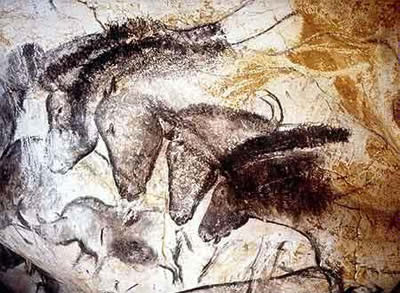
Earlier and earlier prehistoric art has been found. It’s getting ever harder to claim that Neanderthals had nothing to do with it. This is from the enormous Chauvet cave in France, at least 32,000 years old:
If Not Neanderthal, Probably Mostly Neanderthal
(42,000 year old art was also found in Spain.)
Neanderthals also domesticated, and genetically engineered dogs, from European wolves. That’s very clear.
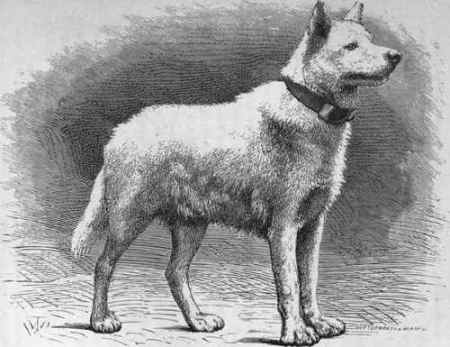
How do I know this? Simple. The Goyet dog, pictured below was dated around 32,000 years. In 2010, an even older dog was found in the Altai mountains. Both dogs were derived from Canis Lupus Familiaris, the European wolf, but were quite distant from it, genetically, they had been evolved probably on a time scale of more than 10,000 years, thus well before any arrival of Sapiens Sapiens from Africa.
Those dogs were completely compatible with people, just as contemporary dogs are. Proof? Ancient, 26,000-year-old footprints made by a child and a dog deep in the Chauvet Cave, France. (OK, by then Neanderthals had been deemed “extinct” by some… However, these are still the same dogs Neanderthals invented.)
It Took Many Thousands Years To Breed Such Large Dogs From European Wolves.
It is perplexing that other human groups did not domesticate the local canids. There are (still!) wolves in Africa and India. And also Lycaons (“African Wild Dogs”). Those are supremely intelligent, and sort of domesticate readily in the wild (I tried this myself as a child).
The argument that Africans would have moved to Europe to domesticate European wolves, when they had a similar fauna, including wolves, to domesticate in Africa, is simply extravagant.
In the next few days I will amend those static pages to incorporate this fascinating update to my knowledge. I shall also seek permission to republish the articles linked to by Patrice as they are full of detailed knowledge about the oldest man-animal relationship; by far!
Nature imposes herself on us humans in absolute terms.
I do not believe in any form of life after death. Jean is uncertain. Many good people do believe in some form of spiritual afterlife.
However, one thing is sure. Our living mind and body will die.
These few words are an introduction to the first essay under the broad title of The Natural order. On the 23rd April I introduced the idea of writing a regular essay “about the past, present and future of man’s relationship with Nature.”
Thus it did seem entirely appropriate to ‘kick off’ the essays with reflections about life and death.
Posted on April 27, 2014 | Nature reminds me life and death is a circle.
The circle of life and death.
I visit a house, the noise of hungry little birds emanating from a nest hidden in the roof, busy parents flying in and out feeding their brood. Less than a week before summer (1st May) I encounter life all about me, like a vast fountain of creativity, as plant and animal erupt into growth and creation. I feel a sense of joy at the life all about me, like dipping my feet in crystal clear spring waters.
Amongst this carnival of life a reminder that with life there is also death. Helix our cat is an effective hunter, a blue tit is found dead upon the ground. I feel no sadness for the death, it is a natural part of the cycle of nature, my animistic viewpoint is of a small spirit returning to the source, and from then renewing. No anger for Helix, since this is the nature of cats, despite being fed, a cat must follow the primal instinct of its nature to hunt. I carry the dead blue tit to an overgrown spot of trees and grass, here I place the blue tit to decay and thus become part of the life of plant and animal of that place, such is the circle of life and death.
ooOOoo
There can’t be a single person on this planet who does not understand that our human life is finite.
Life span of early man: Until fairly recently, little information existed about how long prehistoric people lived. Too few fossilized human remains made it tough for historians to estimate the demographics of any population. Anthropology professors Rachel Caspari and Sang-Hee Lee chose instead to analyze the relative ages of skeletons found in archeological digs in eastern and southern Africa, Europe, and elsewhere. Comparing the proportion of those who died young, with those who died at an older age, the team concluded that longevity only began to significantly increase (that is, past the age of 30 or so) about 30,000 years ago – quite late in the span of human evolution.
In an article published in 2011 in Scientific American, Caspari calls the shift the “evolution of grandparents”, as it marks the first time in human history that three generations might have co-existed. ( Source: Longevity Throughout History.)
Thus given that living much past the age of thirty years is a relatively recent experience, it baffles me beyond comprehension that we, as in mankind, have become so short-sighted about reinvesting in the one and only natural planet that sustains us.
Beautifully expressed in another wonderful essay from John Hurlburt.
ooOOoo
Notes on the Human Dilemma
The metanexus of Faith, Nature and Science form an integral vision of the reality in which we exist. We are components of Creation living in an emerging universe. As consciously aware life forms we are each and all responsible to the Nature of God in a steadily emerging universe. Change is both constant and inevitable. Species that don’t adapt, do not survive.
Our human problems are obvious.
The essential growth of human conscious awareness remains questionable.
There is a blatant disregard for Nature. The rate of Natural disasters is increasing everywhere on Earth
Civil unrest is bordering on a second Civil War and is already in that state in many other nations of the world.
Imminent economic collapse remains probable as long our world economy is based on a foundation that has been leveraged at least twenty-five times above any realistic material foundation on Earth.
Are we a moral species?
A steady increase in natural disasters worldwide is inevitable until we change in response to Nature’s warnings or become extinct. The collapse of morality threatens the existence of global civilization.
The virtual extinction of the human race in its present state is all but assured within the next century unless we adapt to the Reality we presently blithely ignore or chose to vilify.
We still have a choice.
Our alternative to what has been euphemistically referred to as “new reality” is the process of education, reformation and transformation on a personal level. The objectives are an obvious need to adapt to constant natural change and create a species renaissance in harmony with the reality of God, Nature and Science.
There is clearly a need for a global economy that is based on our primal need for clean air, clean water, clean food and clean energy. We need to maintain our balance through gratitude for the blessings of the life we share and equal justice for all. We need to remember that we are not in charge of anything except our responsibilities to God, Nature and each other.
Under these simple guidelines, a healthy, growing future remains possible as we prepare to migrate from our home planet and relieve the consumptive consequences of an exponentially growing and ravenous demographic ruled by the artificial symbol of Money.
Sound impossible? Au contraire…
The world is being forced to re-evaluate its economic premises. Here are a few proven solutions to help create a naturally invigorated economy.
We can cut air pollution dramatically overnight by converting commercial diesel engines to far more cost-effective bio-fuels without a single change to the diesel mechanisms.
Bio-diesel distillation plants can filter and recycle the clean water we need to live.
We are capable of growing our own food with recycled organic fertilizers.
We have begun the process of harnessing the limitless clean renewable energy provided by the sun, the wind and hydraulic power.
Electric cars that may be fueled by solar energy are winning world class races.
The list of what we are capable of doing is only limited by our imaginations.
The questions to ask ourselves are:
Are we at the beginning of a new world or at the end of an old world?
“Are we a part of the problem or part of a realistic solution?”
The latest IPCC report is more than dry science; it’s our future!
Regular readers of Learning from Dogs will be aware that yesterday I published a post called A bedtime story for Jimmy. It was prompted by learning of an eight-year-old who was offered the opportunity of shooting a wild turkey early last Saturday morning. The penultimate paragraph read as follows:
If we care for nature then we care for the health of our lands, for our forests and for our seas. We are careful with how we live our lives. If we care for nature then as we live our lives we do our best to leave things better for those that come after us.
Little did I know when writing my post that on the same day of publication would be a chilling post from Patrice Ayme; a post that Patrice has generously given me permission to republish in full.
Indeed, little did I know that when I composed my preface to Jimmy’s story and included these words:
However, this eight-year-old lad is facing a future that demands that he and all his generation accept that embracing nature, totally and whole-heartedly, is their only hope of not being the last generation of humans on this beautiful planet.
That less than twenty-four hours later Patrice’s perspective on the latest IPCC report made that sentence of mine far from hyperbole! Here is that essay from Patrice.
ooOOoo
Terminal Greenhouse Crisis.
A CRASH TECH PROGRAM IS NEEDED, & HAS TO INVOLVE HYDROGEN.
At the present rate of greenhouse gases emissions, within nine years, massively lethal climate and oceanic changes are guaranteed.
Such is the conclusion one can draw from the Inter Governmental Panel On Climate Change of the UN (the IPCC, with its top 300 climate scientists from all over the world). About 78% of the emissions have to do with heating, cooking, and basic, necessary industrial activities, such as making cement.
They are not elective.
As Bad As An Asteroid?
Notes:CO2 FOLU = CO2 emissions from Forestry and Other Land Use. F-gases = Fluorinated gases covered under the Kyoto Protocol. At the right side of the figure: Emissions of each greenhouse gas with associated error bars (90% confidence interval).
Only a crash program of construction of several hundreds of new technology nuclear fission plants, an all-out renewable energy program, with massive solar plants all over the American South and the (similar latitude) Sahara desert, plus a massive hydrogen economy to store the wind and solar energy could allow us to mitigate the massive lethal change incoming.
In other words, it is already too late to avoid the massive lethal change.
What’s the problem? Simple mathematics. It’s evaluated that human activities in the last century or so released 515 billion tons of greenhouse gases. The IPCC and the best experts believe that 800 to 1,000 billion tons of such gases would bring a rise of global temperatures of two degrees Celsius.
At the present rate, that’s nine years to reach the upper reaches: one trillion tons of GHG.
Most of the temperature rise will be in the polar regions, melting those, and inducing worldwide climate catastrophe, especially if emissions of polar methane turn apocalyptic. The polar regions are the Achilles heel of the Earth’s present biosphere. By striking there mostly, enormous changes can be brought to bear, as they would destroy the Earth’s air conditioning and oceanic circulation.
In 2014, trade winds in the Pacific had four times the energy they usually have, creating abnormally intense ocean upwelling off the west coast of North America, thus a high pressure ridge (thus a drought there), causing a world wide oscillation of the jet stream that dragged cold polar air down the east coast of the USA, before rebounding as continual storms and rain on the west coast of Europe, and so forth.
Nobody can say the weather was normal: precipitation in England beat all records, dating 250 years, whereas most of California experienced extreme drought.
At this point, warm water is piling down to 500 meters depth in the western Pacific in what looks like a preparation for a massive El Nino, similar to the one in 1997-98. If this happens, global temperature records will be smashed next year.
Massively lethal means death to the world as we know it, by a thousand cuts. It means cuts to democracy, privacy, life span, food intake. Some of these are already in plain sight: the Ukraine war is already a war about gas, no less an authority as dictator Putin says so.
Tom Friedman in “Go Ahead, Vladimir, Make My Day.” takes the situation lightly. “SO the latest news is that President Vladimir Putin of Russia has threatened to turn off gas supplies to Ukraine if Kiev doesn’t pay its overdue bill, and, by the way, Ukraine’s pipelines are the transit route for 15 percent of gas consumption for Europe. If I’m actually rooting for Putin to go ahead and shut off the gas, does that make me a bad guy?
Because that is what I’m rooting for, and I’d be happy to subsidize Ukraine through the pain. Because such an oil shock, though disruptive in the short run, could have the same long-term impact as the 1973 Arab oil embargo — only more so. That 1973 embargo led to the first auto mileage standards in America and propelled the solar, wind and energy efficiency industries. A Putin embargo today would be even more valuable because it would happen at a time when the solar, wind, natural gas and energy efficiency industries are all poised to take off and scale. So Vladimir, do us all a favor, get crazy, shut off the oil and gas to Ukraine and, even better, to all of Europe. Embargo! You’ll have a great day, and the rest of the planet will have a great century.”
It’s not so simple. The investments needed are massive, and all the massive investments so far have to do with fracking… Which is, ecologically speaking, a disaster. 3% methane leakage makes fracking worse than burning coal. And this leakage is apparently happening.
Unbelievably, some of the countries with coal beds got the bright idea to burn the coal underground. Australia, about the worst emitter of CO2 per capita, experimented with that. It had to be stopped, because some particularly toxic gases (such as toluene) were coming out, not just the CH4 and CO the apprentice sorcerers were looking for.
Carbon Capture and Storage does not exist (but for very special cases in half a dozen special locations, worldwide, not the thousands of locales needed). And CSS will not exist (profitably).
What technology exist that could be developed (but is not yet)? Not just Thorium reactors. The hydrogen economy is a low key, and indispensable economy. Water can be broken by electricity from wind and sun, and then energy can be stored, under the form of hydrogen. Nothing else can do it: batteries are unable to store energy efficiently (and there is not enough Lithium to make trillions of Lithium batteries).
The hydrogen technology pretty much exist, including for efficient storage under safe form (one thick plate of a material that cannot be set aflame can store 600 liters of hydrogen).
Another advantage of storing hydrogen is that oxygen would be released. Although it may seem absurd to worry about this, too much acidity in the ocean (from absorption of CO2) could lead to phytoplankton die-off, and the removal of half of oxygen production.
In this increasingly weird world, that’s where we are at.
Oh, by the way, how to stop Putin? Europe should tell the dictator he can keep his gaz. Now. As good an occasion to start defending the planet, and not just against fascism.
Patrice Aymé
ooOOoo
I can’t add anything at a scientific level to what Patrice has written. But I can offer this. Each and every one of us needs to make sure the message is spread as far and wide as possible (you are free to share and republish this post) and then do something, however small it may seem, to make a difference. And do it now!
For the sake of all the Jimmys in the world – and all the turkeys!
Inspired by hearing a young boy shoot a wild turkey early on Saturday morning.
Preface
Because we have horses, friends living close to us called to warn that early on Saturday morning, a young lad, accompanied by his father, would be experiencing what it was like to shoot a wild turkey at close range. The turkeys are easy targets; almost pets.
So it was that around 6:30am last Saturday morning that a single shot rang out and we knew that a turkey had been killed. Now in fairness to American history it’s not that long ago that the early settlers relied on hunting to survive. The first permanent European settlement in Oregon wasn’t until 1811. Thus hunting may be something close to the American’s heart; so to speak. However, this eight-year-old lad is facing a future that demands that he and all his generation accept that embracing nature, totally and whole-heartedly, is their only hope of not being the last generation of humans on this beautiful planet.
Jean and I thought the following was an appropriate way of expressing our feelings.
ooOOoo
Dear Jimmy,
What was it like to point your gun at that turkey and pull the trigger? What did you feel as you saw the bullet hit and the turkey fall to the ground?
Now I wasn’t there with you, of course, but I could imagine the thrill and excitement that you would have felt. Not many young lads of your age get to handle a gun and shoot a turkey.
But Jimmy, what we feel as an eight-year-old is a very poor indicator for what we feel when we are much older. Possibly the only exception is love, which is a golden feeling at any age.
So, if you will forgive this sixty-nine-year old from reading an eight-year-old a very short bedtime story, I will get started.
The world, this enormous world, must seem infinitely huge to you. Even if you stand on the shoulders of your Dad, your eyes ten feet above the ground, the horizon is just four miles away. You could run to that horizon in less than an hour. However, to run all the way around the world at that same speed would take you, dear Jimmy, nearly two hundred and sixty days of running; running twenty-four hours a day! It’s a very big planet!
Look at this wonderful picture of our planet. Have you ever seen anything more beautiful!
It must seem to you that there is nothing an eight-year-old could do to harm this planet we all live on.
That’s true! There is nothing you could do to harm the planet.
However, when you get older and reach the point where you have a job, drive a car, fly to places on an aeroplane, heat your house and a million other things that we grown-ups do, then all of us together, all the millions of people living on this green planet can hurt it.
Indeed, Jimmy, you may have already heard of things like climate change and global warming being spoken about on the television. All of the people living on this planet are hurting it. And the people who are really going to see how we humans are hurting the planet, and how the planet is changing, are all the people who, like you Jimmy, are not yet even finished school.
So what does shooting a wild turkey have to do with caring for your planet throughout the many years ahead for you?
If we care for nature then we care for the health of our lands, for our forests and for our seas. We are careful with how we live our lives. If we care for nature then as we live our lives we do our best to leave things better for those that come after us.
Jimmy, sleep well my young man. Wake knowing the death of that turkey was not in vain. Wake with love in your heart. Love for every living creature.
Only love for all creatures will offer all creatures a future.









 Learning from Dogs