Today, I have an appointment with a urologist surgeon at the Rogue Regional Medical Centre in Medford, about an hour south of where we live in Merlin. All being well I should be out the same day but will need to take it easy for a couple of days thereafter. I’m curious about the experience of having a general anaesthetic; the first one I have had.
Also this week I need to get my head down and commit to another month of writing under the NaNoWriMo banner.
Last November, participating in the National Novel Writing Month was critical in me completing a draft start of 56,000 words of my book Learning from Dogs. Despite it not being a novel and despite me wanting to continue the draft rather that start another writing project, NaNoWriMo have accepted me for a second time. I’m very grateful because, fingers crossed, by the end of this coming November I should be within reach of my target of 120,000 words for a non-fiction book.
November also brings along a ’70’ birthday for me, a birthday for Jean later on in the month and our wedding anniversary in the middle of the month.
So you know where this is leading, don’t you!
Creative blog writing is going to be a little thin on the ground for the next four weeks – (What was that you said? Something about creative writing frequently being thin on the ground?!)
There will be a post every day but if I get squeezed for time I will repost something previously published in this place. I will also republish items of general interest that catch my eye on the broader front of the big-wide-web!
Going to close today by sharing a photograph of the recent solar eclipse. There have been many published but this one seemed especially beautiful. It was part of a set over on the EarthSky blogsite.
Sunset partial solar eclipse, with sea birds, from the beach in Englewood, Florida, overlooking the Gulf of Mexico. Photo by K. King.
Yesterday, the central theme of my post was the essay from Tom Engelhardt where he interviews Laura Poitras on the back of the recent release of her film Citizenfour. You will recall that I closed the post as follows:
On first reading the TomGram I found myself nodding vigorously, metaphorically speaking, with the whole thrust of the essay.
Then what appeared to be small uncertainties started appearing in my mind.
Those will be the subject of tomorrow’s post.
To set the background to what follows, you need to know a little about my own military experiences; which is not saying very much!
I was born in London six months to the day before WWII ended; at least the European side of things. When I got to the age of being vulnerable to a call-up if circumstances so dictated, I thought I would influence things by volunteering to join the United Kingdom’s Royal Naval Reserve or the RNR. The world in the early 60’s especially in Europe was far from stable. Thus, I signed up with London Division, RNR that was headquartered on HMS President, moored on the River Thames in the centre of London.
HMS President.
I served as a Radio Operator in the RNR from 1963 to 1968. Inevitably, as a radio operator I was security cleared and, in time, as I was promoted up the ranks, allowed to handle traffic up to but not including “Top Secret: Captain’s Eyes Only”.
In 1968 I decided to emigrate to Australia and resigned from the RNR. The parting advice was that the knowledge I had acquired prevented me, for my own safety, from entering any country hostile to NATO for a period of a further 5 years. Including the Soviet Union; naturally.
At the end of 1970, living and working in Sydney, I was planning to attend Expo70 in Japan and then travel on to Helsinki, Finland. One look at the atlas made it clear that a wonderful way of travelling westwards was via the Russian Trans-Siberian express.
So off I trotted to the British Embassy in Sydney to seek advice about entering Russia in this fashion. One of the military guys, on hearing about my concerns, laughed his head off and said, “The Russians will know more about you than we do!” Then, becoming more serious, he added: “My friend, if you ever find yourself in a difficult corner anywhere in a country hostile to the West, just find a way of transmitting your RNR Service Number to us and we’ll take care of things”. To this day, well over 40 years later, I still remember my service number.
Returning to the subject of the American security ‘apparatus’, Laura Poitras answered a question from Tom Engelhardt that seems very pertinent.
TE: To ask the same question another way, what would the world be like without Edward Snowden? After all, it seems to me that, in some sense, we are now in the Snowden era.
LP: I agree that Snowden has presented us with choices on how we want to move forward into the future. We’re at a crossroads and we still don’t quite know which path we’re going to take. Without Snowden, just about everyone would still be in the dark about the amount of information the government is collecting. I think that Snowden has changed consciousness about the dangers of surveillance. We see lawyers who take their phones out of meetings now. People are starting to understand that the devices we carry with us reveal our location, who we’re talking to, and all kinds of other information. So you have a genuine shift of consciousness post the Snowden revelations.
What struck me was the point about a changed consciousness. That is healthy. Without doubt.
The technology available to the governments of countries with regard to the gathering of all sorts of data represents a place where we haven’t been before. Inevitably, learning how best to govern that data, with both a small ‘g’ and a large ‘G’, is going to be a traveled road where some wrong turnings are made from time to time.
If the Edward Snowden affair has accelerated that learning process, then that seems nothing but good.
If all I knew about Edward Snowden were his portrait in Laura Poitras’ documentary, Citizenfour, I’d probably regard him as a conscientious, brave young man, maybe an American hero. But Poitras, a very talented filmmaker who flipped from journalist to collaborator in this story long ago, has chosen to leave a lot out.
Snowden’s claim as a whistleblower, exposing the National Security Agency’s violations of civil liberties, rests on some of the documents that he leaked, which reveal that the NSA’s domestic surveillance was far more extensive than anyone had imagined—and, in a few instances, conducted in defiance of orders from the Foreign Intelligence Surveillance Court.
However, many other documents—which he downloaded at the NSA facility in Hawaii and turned over to Poitras and the Guardian’s Glenn Greenwald in Hong Kong—go far beyond exposures of spying on Americans.
Judging from Snowden-derived stories in the Guardian and the Washington Post, some of these documents also detail NSA intercepts of email and cellphone conversations by Taliban fighters in Pakistan; assessments of CIA assets in several foreign countries; and surveillance of cellphone calls “worldwide” that (in the Post’s words) allows the NSA “to look for unknown associates of known intelligence targets by tracking people whose movements intersect.” In Snowden’s first interview abroad, with the South China Morning Post, he disclosed that the NSA routinely hacks into hundreds of computers in Hong Kong and China. Just last week a story co-authored by Poitras in Greenwald’s new publication, the Intercept, revealed—again, based on Snowden-supplied documents—that the NSA has undercover operatives in Germany and China.
Whatever you think about foreign intelligence operations, the NSA’s core mission is to intercept communications of foreign governments and agents. If Snowden and company wanted to take down an intelligence agency, they should say so. But that has nothing to do with whistleblowing or constitutional rights.
The National Security Agency/Central Security Service (NSA/CSS) leads the U.S. Government in cryptology that encompasses both Signals Intelligence (SIGINT) and Information Assurance (IA) products and services, and enables Computer Network Operations (CNO) in order to gain a decision advantage for the Nation and our allies under all circumstances.
The Information Assurance mission confronts the formidable challenge of preventing foreign adversaries from gaining access to sensitive or classified national security information. The Signals Intelligence mission collects, processes, and disseminates intelligence information from foreign signals for intelligence and counterintelligence purposes and to support military operations. This Agency also enables Network Warfare operations to defeat terrorists and their organizations at home and abroad, consistent with U.S. laws and the protection of privacy and civil liberties.
I read, “to gain a decision advantage for the Nation and our allies under all circumstances” as meaning maintaining a positive security for the Nation. My home nation as it happens.
While the scale may be beyond comparison, the principle of maintaining a secure nation or home strikes me as no different as locking the doors of our house when we go off somewhere. And that’s even with nine dogs in the house!
Given that what any ex-head of GCHQ might say, the recent words from Sir Iain Lobban, as reported by the BBC, were not extreme; far from it.
Sir Iain Lobban.
A dimly lit bunker beneath Whitehall – perhaps a suitable venue for a man to say farewell to a 31-year career in what had been one of the most secret parts of the British state.
Sir Iain Lobban was joined by an assortment of spies and securocrats including former heads of GCHQ and the current chief of MI6. It was a venue not chosen by chance.
As he leaves his position as director of GCHQ, Sir Iain used his speech to try to connect the work of today’s GCHQ with its predecessor at Bletchley Park which supplied vital information to Sir Winston Churchill who, from the same bunker, directed Britain’s wartime efforts.
Then, the mission was intercepting and breaking the Enigma code used by the German military to communicate. Dealing with today’s threats, Sir Iain argued, involved going online.
“Those who would do us harm don’t want to be found. They choose certain routers or applications to hide in the darkest places of the internet. We have to enter that labyrinth to find them. We work to crack their defences,” he told the audience.
Sir Iain took aim at those who saw spy agencies polluting a free internet. “We all now know that the beautiful dream of the internet as a totally ungoverned space was just that – a beautiful dream.
“Like all utopian visions, it was flawed because it failed to account for the persistence of the worst aspects of human nature.
“Alongside the blessings – the comprehensive information, the communities of interest, the commercial opportunities and efficiencies – there are the plotters, the proliferators and the paedophiles.”
Being reported later on as saying:
“The people who work at GCHQ would sooner walk out the door than be involved in anything remotely resembling ‘mass surveillance’.” he asserted.
“Secret does not have to equal sinister,” he went on to say, blaming the idea partly on the portrayal of intelligence in popular culture.
Poitras hopes the documentary will allow audiences to reach their own conclusions about Snowden, who is wanted in the United States on charges brought under the Espionage Act and is viewed as either a traitor or a hero.
Only time will tell if the USA is overdoing the ‘mass’ aspect of surveillance, or if it’s right for this age in the affairs of man.
That nothing can be constructed perfectly the first time around is a truism for life at all scales. Thank goodness I’m living in a country where I feel able to offer these thoughts.
Maybe an open debate is the most important aspect of this important topic – the one about national security.
I am frequently a republisher of essays that are presented over on TomDispatch, as regulars of this place know well. As the TD ‘About’ page explains, in part and my emphasis,:
In December 2002, it gained its name, became a project of The Nation Institute, and went online as “a regular antidote to the mainstream media.“
No bad thing as the ‘media’ is a vast machine and it’s long been difficult, nay impossible, to separate fact from fiction. Perhaps, better expressed as impossible to separate fact from agenda!
TD’s ‘About’ page goes on to add, and again my emphasis:
Tomdispatch is intended to introduce readers to voices and perspectives from elsewhere (even when the elsewhere is here). Its mission is to connect some of the global dots regularly left unconnected by the mainstream media and to offer a clearer sense of how this imperial globe of ours actually works.
Stay with that last thought, the one about having a clearer sense of how this imperial globe works, and I am assuming Tom Engelhardt has in mind the USA when he uses the word “imperial”, for both today and tomorrow. Why? Because in this particular instance I’m not sure that I have ended up with a clearer sense about how the security apparatus works across the USA and much of the rest of the ‘Western world’. I want to explore this very important topic over two days.
Back to TomDispatch.
On the 19th October, Tom published a joint essay, or TomGram as he calls it, with Laura Poitras about her film Citizenfour. This film is about Edward Snowden. The TomGram was called: Laura Poitras and Tom Engelhardt, The Snowden Reboot.
Here is the trailer to the film.
Next to the TomGram. But first a note about hyperlinks. There are many links in the TomGram, many of which offer great insight into the background to the essay. However, there are too many to carry across to my republication so, please, do go across to TomDispatch if you wish to pursue a link or two.
Finally, a thank you to both Tom and Laura for giving me permission to republish.
ooOOoo
Tomgram: Laura Poitras and Tom Engelhardt, The Snowden Reboot
[Note for TomDispatch Readers: Call me moved. I recently went to the premiere of Citizenfour, Laura Poitras’s engrossing new film on Edward Snowden, at the New York Film Festival. The breaking news at film’s end: as speculation had it this summer, there is indeed at least one new, post-Snowden whistleblower who has come forward from somewhere inside the U.S. intelligence world with information about a watchlist (that includes Poitras) with “more than 1.2 million names” on it and on the American drone assassination program.
Here’s what moved me, however. My new book, Shadow Government: Surveillance, Secret Wars, and a Global Security State in a Single-Superpower World, ends with a “Letter to an Unknown Whistleblower,” whose first lines are: “I don’t know who you are or what you do or how old you may be. I just know that you exist somewhere in our future as surely as does tomorrow or next year… And how exactly do I know this? Because despite our striking inability to predict the future, it’s a no-brainer that the national security state is already building you into its labyrinthine systems.” And now, of course, such a whistleblower is officially here and no matter how fiercely the government may set out after whistleblowers, there will be more. It’s unstoppable, in part thanks to figures like Poitras, who is the subject of today’s TomDispatch interview. Tom]
Edward Snowden and the Golden Age of Spying
A TomDispatch Interview With Laura Poitras
Here’s a Ripley’s Believe It or Not! stat from our new age of national security. How many Americans have security clearances? The answer: 5.1 million, a figure that reflects the explosive growth of the national security state in the post-9/11 era. Imagine the kind of system needed just to vet that many people for access to our secret world (to the tune of billions of dollars). We’re talking here about the total population of Norway and significantly more people than you can find in Costa Rica, Ireland, or New Zealand. And yet it’s only about 1.6% of the American population, while on ever more matters, the unvetted 98.4% of us are meant to be left in the dark.
For our own safety, of course. That goes without saying.
All of this offers a new definition of democracy in which we, the people, are to know only what the national security state cares to tell us. Under this system, ignorance is the necessary, legally enforced prerequisite for feeling protected. In this sense, it is telling that the only crime for which those inside the national security state can be held accountable in post-9/11 Washington is not potential perjury before Congress, or the destruction of evidence of a crime, or torture, or kidnapping, or assassination, or the deaths of prisoners in an extralegal prison system, but whistleblowing; that is, telling the American people something about what their government is actually doing. And that crime, and only that crime, has been prosecuted to the full extent of the law (and beyond) with a vigor unmatched in American history. To offer a single example, the only American to go to jail for the CIA’s Bush-era torture program was John Kiriakou, a CIA whistleblower who revealed the name of an agent involved in the program to a reporter.
In these years, as power drained from Congress, an increasingly imperial White House has launched various wars (redefined by its lawyers as anything but), as well as a global assassination campaign in which the White House has its own “kill list” and the president himself decides on global hits. Then, without regard for national sovereignty or the fact that someone is an American citizen (and upon the secret invocation of legal mumbo-jumbo), the drones are sent off to do the necessary killing.
And yet that doesn’t mean that we, the people, know nothing. Against increasing odds, there has been some fine reporting in the mainstream media by the likes of James Risen and Barton Gellman on the security state’s post-legal activities and above all, despite the Obama administration’s regular use of the World War I era Espionage Act, whistleblowers have stepped forward from within the government to offer us sometimes staggering amounts of information about the system that has been set up in our name but without our knowledge.
Among them, one young man, whose name is now known worldwide, stands out. In June of last year, thanks to journalist Glenn Greenwald and filmmaker Laura Poitras, Edward Snowden, a contractor for the NSA and previously the CIA, stepped into our lives from a hotel room in Hong Kong. With a treasure trove of documents that are still being released, he changed the way just about all of us view our world. He has been charged under the Espionage Act. If indeed he was a “spy,” then the spying he did was for us, for the American people and for the world. What he revealed to a stunned planet was a global surveillance state whose reach and ambitions were unique, a system based on a single premise: that privacy was no more and that no one was, in theory (and to a remarkable extent in practice), unsurveillable.
Its builders imagined only one exemption: themselves. This was undoubtedly at least part of the reason why, when Snowden let us peek in on them, they reacted with such over-the-top venom. Whatever they felt at a policy level, it’s clear that they also felt violated, something that, as far as we can tell, left them with no empathy whatsoever for the rest of us. One thing that Snowden proved, however, was that the system they built was ready-made for blowback.
Sixteen months after his NSA documents began to be released by the Guardian and the Washington Post, I think it may be possible to speak of the Snowden Era. And now, a remarkable new film, Citizenfour, which had its premiere at the New York Film Festival on October 10th and will open in select theaters nationwide on October 24th, offers us a window into just how it all happened. It is already being mentioned as a possible Oscar winner.
Director Laura Poitras, like reporter Glenn Greenwald, is now known almost as widely as Snowden himself, for helping facilitate his entry into the world. Her new film, the last in a trilogy she’s completed (the previous two being My Country, My Country on the Iraq War and The Oath on Guantanamo), takes you back to June 2013 and locks you in that Hong Kong hotel room with Snowden, Greenwald, Ewen MacAskill of the Guardian, and Poitras herself for eight days that changed the world. It’s a riveting, surprisingly unclaustrophic, and unforgettable experience.
Before that moment, we were quite literally in the dark. After it, we have a better sense, at least, of the nature of the darkness that envelops us. Having seen her film in a packed house at the New York Film Festival, I sat down with Poitras in a tiny conference room at the Loews Regency Hotel in New York City to discuss just how our world has changed and her part in it.
Tom Engelhardt: Could you start by laying out briefly what you think we’ve learned from Edward Snowden about how our world really works?
Laura Poitras: The most striking thing Snowden has revealed is the depth of what the NSA and the Five Eyes countries [Australia, Canada, New Zealand, Great Britain, and the U.S.] are doing, their hunger for all data, for total bulk dragnet surveillance where they try to collect all communications and do it all sorts of different ways. Their ethos is “collect it all.” I worked on a story with Jim Risen of the New York Times about a document — a four-year plan for signals intelligence — in which they describe the era as being “the golden age of signals intelligence.” For them, that’s what the Internet is: the basis for a golden age to spy on everyone.
This focus on bulk, dragnet, suspicionless surveillance of the planet is certainly what’s most staggering. There were many programs that did that. In addition, you have both the NSA and the GCHQ [British intelligence] doing things like targeting engineers at telecoms. There was an article published at The Intercept that cited an NSA document Snowden provided, part of which was titled “I Hunt Sysadmins” [systems administrators]. They try to find the custodians of information, the people who are the gateway to customer data, and target them. So there’s this passive collection of everything, and then things that they can’t get that way, they go after in other ways.
I think one of the most shocking things is how little our elected officials knew about what the NSA was doing. Congress is learning from the reporting and that’s staggering. Snowden and [former NSA employee] William Binney, who’s also in the film as a whistleblower from a different generation, are technical people who understand the dangers. We laypeople may have some understanding of these technologies, but they really grasp the dangers of how they can be used. One of the most frightening things, I think, is the capacity for retroactive searching, so you can go back in time and trace who someone is in contact with and where they’ve been. Certainly, when it comes to my profession as a journalist, that allows the government to trace what you’re reporting, who you’re talking to, and where you’ve been. So no matter whether or not I have a commitment to protect my sources, the government may still have information that might allow them to identify whom I’m talking to.
TE: To ask the same question another way, what would the world be like without Edward Snowden? After all, it seems to me that, in some sense, we are now in the Snowden era.
LP: I agree that Snowden has presented us with choices on how we want to move forward into the future. We’re at a crossroads and we still don’t quite know which path we’re going to take. Without Snowden, just about everyone would still be in the dark about the amount of information the government is collecting. I think that Snowden has changed consciousness about the dangers of surveillance. We see lawyers who take their phones out of meetings now. People are starting to understand that the devices we carry with us reveal our location, who we’re talking to, and all kinds of other information. So you have a genuine shift of consciousness post the Snowden revelations.
TE: There’s clearly been no evidence of a shift in governmental consciousness, though.
LP: Those who are experts in the fields of surveillance, privacy, and technology say that there need to be two tracks: a policy track and a technology track. The technology track is encryption. It works and if you want privacy, then you should use it. We’ve already seen shifts happening in some of the big companies — Google, Apple — that now understand how vulnerable their customer data is, and that if it’s vulnerable, then their business is, too, and so you see a beefing up of encryption technologies. At the same time, no programs have been dismantled at the governmental level, despite international pressure.
TE: In Citizenfour, we spend what must be an hour essentially locked in a room in a Hong Kong hotel with Snowden, Glenn Greenwald, Ewan MacAskill, and you, and it’s riveting. Snowden is almost preternaturally prepossessing and self-possessed. I think of a novelist whose dream character just walks into his or her head. It must have been like that with you and Snowden. But what if he’d been a graying guy with the same documents and far less intelligent things to say about them? In other words, how exactly did who he was make your movie and remake our world?
LP: Those are two questions. One is: What was my initial experience? The other: How do I think it impacted the movie? We’ve been editing it and showing it to small groups, and I had no doubt that he’s articulate and genuine on screen. But to see him in a full room [at the New York Film Festival premiere on the night of October 10th], I’m like, wow! He really commands the screen! And I experienced the film in a new way with a packed house.
TE: But how did you experience him the first time yourself? I mean you didn’t know who you were going to meet, right?
LP: So I was in correspondence with an anonymous source for about five months and in the process of developing a dialogue you build ideas, of course, about who that person might be. My idea was that he was in his late forties, early fifties. I figured he must be Internet generation because he was super tech-savvy, but I thought that, given the level of access and information he was able to discuss, he had to be older. And so my first experience was that I had to do a reboot of my expectations. Like fantastic, great, he’s young and charismatic and I was like wow, this is so disorienting, I have to reboot. In retrospect, I can see that it’s really powerful that somebody so smart, so young, and with so much to lose risked so much.
He was so at peace with the choice he had made and knowing that the consequences could mean the end of his life and that this was still the right decision. He believed in it, and whatever the consequences, he was willing to accept them. To meet somebody who has made those kinds of decisions is extraordinary. And to be able to document that and also how Glenn [Greenwald] stepped in and pushed for this reporting to happen in an aggressive way changed the narrative. Because Glenn and I come at it from an outsider’s perspective, the narrative unfolded in a way that nobody quite knew how to respond to. That’s why I think the government was initially on its heels. You know, it’s not everyday that a whistleblower is actually willing to be identified.
TE: My guess is that Snowden has given us the feeling that we now grasp the nature of the global surveillance state that is watching us, but I always think to myself, well, he was just one guy coming out of one of 17 interlocked intelligence outfits. Given the remarkable way your film ends — the punch line, you might say — with another source or sources coming forward from somewhere inside that world to reveal, among other things, information about the enormous watchlist that you yourself are on, I’m curious: What do you think is still to be known? I suspect that if whistleblowers were to emerge from the top five or six agencies, the CIA, the DIA, the National Geospatial Intelligence Agency, and so on, with similar documentation to Snowden’s, we would simply be staggered by the system that’s been created in our name.
LP: I can’t speculate on what we don’t know, but I think you’re right in terms of the scale and scope of things and the need for that information to be made public. I mean, just consider the CIA and its effort to suppress the Senate’s review of its torture program. Take in the fact that we live in a country that a) legalized torture and b) where no one was ever held to account for it, and now the government’s internal look at what happened is being suppressed by the CIA. That’s a frightening landscape to be in.
In terms of sources coming forward, I really reject this idea of talking about one, two, three sources. There are many sources that have informed the reporting we’ve done and I think that Americans owe them a debt of gratitude for taking the risk they do. From a personal perspective, because I’m on a watchlist and went through years of trying to find out why, of having the government refuse to confirm or deny the very existence of such a list, it’s so meaningful to have its existence brought into the open so that the public knows there is a watchlist, and so that the courts can now address the legality of it. I mean, the person who revealed this has done a huge public service and I’m personally thankful.
TE: You’re referring to the unknown leaker who’s mentioned visually and elliptically at the end of your movie and who revealed that the major watchlist you’re on has more than 1.2 million names on it. In that context, what’s it like to travel as Laura Poitras today? How do you embody the new national security state?
LP: In 2012, I was ready to edit and I chose to leave the U.S. because I didn’t feel I could protect my source footage when I crossed the U.S. border. The decision was based on six years of being stopped and questioned every time I returned to the United States. And I just did the math and realized that the risks were too high to edit in the U.S., so I started working in Berlin in 2012. And then, in January 2013, I got the first email from Snowden.
TE: So you were protecting…
LP: …other footage. I had been filming with NSA whistleblower William Binney, with Julian Assange, with Jacob Appelbaum of the Tor Project, people who have also been targeted by the U.S., and I felt that this material I had was not safe. I was put on a watchlist in 2006. I was detained and questioned at the border returning to the U.S. probably around 40 times. If I counted domestic stops and every time I was stopped at European transit points, you’re probably getting closer to 80 to 100 times. It became a regular thing, being asked where I’d been and who I’d met with. I found myself caught up in a system you can’t ever seem to get out of, this Kafkaesque watchlist that the U.S. doesn’t even acknowledge.
TE: Were you stopped this time coming in?
LP: I was not. The detentions stopped in 2012 after a pretty extraordinary incident.
I was coming back in through Newark Airport and I was stopped. I took out my notebook because I always take notes on what time I’m stopped and who the agents are and stuff like that. This time, they threatened to handcuff me for taking notes. They said, “Put the pen down!” They claimed my pen could be a weapon and hurt someone.
“Put the pen down! The pen is dangerous!” And I’m like, you’re not… you’ve got to be crazy. Several people yelled at me every time I moved my pen down to take notes as if it were a knife. After that, I decided this has gotten crazy, I’d better do something and I called Glenn. He wrote a piece about my experiences. In response to his article, they actually backed off.
TE: Snowden has told us a lot about the global surveillance structure that’s been built. We know a lot less about what they are doing with all this information. I’m struck at how poorly they’ve been able to use such information in, for example, their war on terror. I mean, they always seem to be a step behind in the Middle East — not just behind events but behind what I think someone using purely open source information could tell them. This I find startling. What sense do you have of what they’re doing with the reams, the yottabytes, of data they’re pulling in?
LP: Snowden and many other people, including Bill Binney, have said that this mentality — of trying to suck up everything they can — has left them drowning in information and so they miss what would be considered more obvious leads. In the end, the system they’ve created doesn’t lead to what they describe as their goal, which is security, because they have too much information to process.
I don’t quite know how to fully understand it. I think about this a lot because I made a film about the Iraq War and one about Guantanamo. From my perspective, in response to the 9/11 attacks, the U.S. took a small, very radical group of terrorists and engaged in activities that have created two generations of anti-American sentiment motivated by things like Guantanamo and Abu Ghraib. Instead of figuring out a way to respond to a small group of people, we’ve created generations of people who are really angry and hate us. And then I think, if the goal is security, how do these two things align, because there are more people who hate the United States right now, more people intent on doing us harm? So either the goal that they proclaim is not the goal or they’re just unable to come to terms with the fact that we’ve made huge mistakes in how we’ve responded.
TE: I’m struck by the fact that failure has, in its own way, been a launching pad for success. I mean, the building of an unparallelled intelligence apparatus and the greatest explosion of intelligence gathering in history came out of the 9/11 failure. Nobody was held accountable, nobody was punished, nobody was demoted or anything, and every similar failure, including the one on the White House lawn recently, simply leads to the bolstering of the system.
LP: So how do you understand that?
TE: I don’t think that these are people who are thinking: we need to fail to succeed. I’m not conspiratorial in that way, but I do think that, strangely, failure has built the system and I find that odd. More than that I don’t know.
LP: I don’t disagree. The fact that the CIA knew that two of the 9/11 hijackers were entering the United States and didn’t notify the FBI and that nobody lost their job is shocking. Instead, we occupied Iraq, which had nothing to do with 9/11. I mean, how did those choices get made?
Laura Poitras is a documentary filmmaker, journalist, and artist. She has just finished Citizenfour, the third in a trilogy of films about post-9/11 America that includes My Country, My Country, nominated for an Academy Award, and The Oath, which received two Emmy nominations. In June 2013, she traveled to Hong Kong with Glenn Greenwald to interview Edward Snowden and made history. She has reported on Snowden’s disclosures about the NSA for a variety of news outlets, including the Guardian, Der Spiegel, and the New York Times. Her NSA reporting received a George Polk award for National Security Reporting and the Henri Nannen Prize for Services to Press Freedom.
Tom Engelhardt is a co-founder of the American Empire Project and the author of The United States of Fear as well as a history of the Cold War, The End of Victory Culture. He runs the Nation Institute’s TomDispatch.com. His new book, Shadow Government: Surveillance, Secret Wars, and a Global Security State in a Single-Superpower World (Haymarket Books), has just been published.
Follow TomDispatch on Twitter and join us on Facebook. Check out the newest Dispatch Book, Rebecca Solnit’s Men Explain Things to Me.
Copyright 2014 Laura Poitras and Tom Engelhardt.
ooOOoo
On first reading the TomGram I found myself nodding vigorously, metaphorically speaking, with the whole thrust of the essay.
Then what appeared to be small uncertainties started appearing in my mind.
I didn’t intend this to be a theme for the week but sometimes one gives in to the forces of fate!
For after Monday’s post about making that inner journey to better know oneself, itself prompted by Rick Hanson’s Power of Stillness, came yesterday’s post on the power of love between a dog and his elderly owner.
So I was wondering what to write for today and wandering around the web looking for inspiration and, serendipitously, came across the blogsite The Commoner Princess. I had never heard of it before but there on the home page was a post published on the 21st October: Unlocking inner peace: forgiveness.
Here’s a flavour of that post.
Unlocking inner peace: forgiveness
POSTED ON 21 OCTOBER 2014
What hurts the most in life? Trying to make everybody happy. I think this is one of the ultimate life lessons. I remember having a specific unease when someone close to me wasn’t happy for some reason. Things got even more dramatic when I knew I was the cause in one way or another. Time taught me that this perspective wasn’t exactly the healthier approach to life. It is more than normal to care for the wellbeing of your loved ones, to stand by them in need or to try to have a zen relationship with them at all times. But oh boy, this is one of the hardest things to achieve. Detachment is hard enough when you are not directly involved, but when there are emotional ties, becoming the observer takes a lot of mindfulness, awareness, compassion and most importantly, a loooooot of restraint.
Even better, the post concluded like this:
Here is a beautiful meditation to send love and peace to the entire world. Sit in easy pose or any comfortable position of your choosing. Place your arms against your ribs, forearms in horizontal position, palms facing upwards. Start by taking long deep breaths. Breath in through the nose, exhale through your mouth. You can try the 5-5-5 technique as I call in. 5 seconds breathing in, 5 seconds holding, 5 seconds breathing out. Keep this cycle of breath for as long as you feel comfortable with it or until the end of the meditation.Thank you gabbyb.tv for your teachings.
May this be of service to you all!
Then closed with this video that you have to play in the background as you just think of stillness.
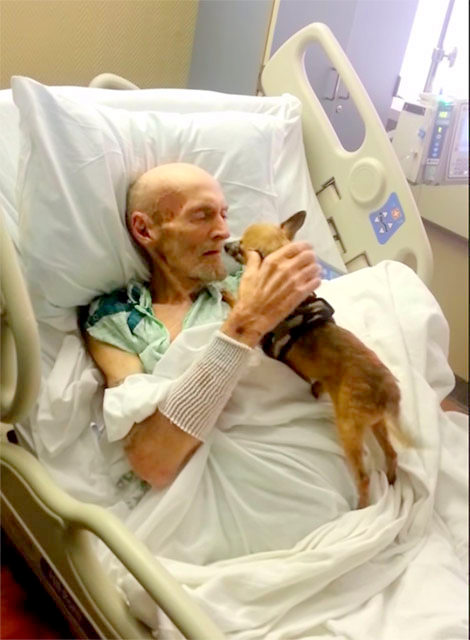
The pensioner was so ill he could barely speak and had stopped eating.
However, all that changed when he managed to whisper to nurses that he was missing his one-eyed Chihuahua Bubba.
His revelation sparked a desperate search for the beloved dog, which was being kept at the Knox-Whitely Animal Shelter.
Pets are banned at the hospital, but nurses managed to sneak Bubba in and then filmed the emotional reunion.
“There wasn’t a dry eye in the room,” the hospital’s chief nursing officer Kimberly Probus told WKTV. In a further twist, Mary-Ann Smyth, from the animal shelter, said the dog had also stopped eating when the pair were separated.
“They didn’t think James was going to make it,” she told NBC. “He [Mr Wathen] has done a complete turnaround. He’s speaking, he’s sitting up, he’s eating.
He doesn’t look like the same guy, and the dog is eating and doing better now, too.”
The hospital has allowed Bubba to visit his owner several times since, with staff saying they have both made a “tremendous recovery”.
It’s what this blog is all about. There is no limit to what our dogs offer us; love being at the top of the list.
Last Friday I offered a post under the title of The power of stillness. It was founded on a recent essay seen in the newsletter called Just One Thing published, freely, by Dr. Rick Hanson. Here’s the closing paragraph of that essay:
Wherever you find it, enjoy stillness and let it feed you. It’s a relief from the noise and bustle, a source of clarity and peace. Give yourself the space, the permission, to be still – at least in your mind – amidst those who are busy. To use a traditional saying:
May that which is still be that in which your mind delights.
There’s a very strong correlation between finding that stillness within and having the self-awareness and peace that comes from knowing who one is. Seems such an easy ‘walk in the park’ to know ourselves but most times it is far from that. Many are the ways that we hide who we really are! 😉
However the rewards are everything. Knowing and liking oneself offers the richest scenery of any journey.
All of which constitutes my way of introducing a truly wonderful poem from Sue Dreamwalker, a great friend of this blog.
ooOOoo
Vicar’s Water. A Sanctuary for wild life.
Journey Within..
Come with me on a journey it starts inside my head
Create a place to dwell from all the Fear and dread
Close your eyes and behind them create a perfect vision
Build a garden full of beauty get ready for your transition
~
Sit upon the grass as sky lark sings above
Hold out your hand to feed the many cooing Doves
See the babbling stream as the young fawn drinks her fill
And listen to the Woodpecker’s distant woodland drill
~
Watch the tiny fishes as the light glistens from their scales
You’re now adrift in the ocean, as you watch the Humpback Whales
You listen to their song a lament as old as time
Each breath takes you deeper as your Spirit begins to climb
~
Now you are on a mountain its top all crisp and white
You fly among the Eagles suspended in effortless flight
Thermals take you higher as you travel within its ring
Higher yet you travel, more peace to feel and bring
~
Through the clouds you break into outer-space you speed
Looking back at a Blue Planet which provided all your needs
Weightless and suspended no longer feeling Form
You fly around the heavens exploring each star born.
~
Filled up now with knowledge no mortal Words could speak
You return back to your garden upon your grassy seat
A new sense of Peace surrounds you as you open up your eyes
You can return in an instant, just open up your mind.
We can travel anywhere we wish when we just close our eyes and allow our mind to relax in a meditation.. Breathe deep and create your perfect space…. The above poem I wrote last week as I recollected part of a meditation.. The view I have included is one taken on a regular walk we often take..Have a fabulous week.
Thank you for Reading
Sue
ooOOoo
What can one say? All that comes to mind is stay on your own journey and never stop enjoying the views.
I stuck this in my drafts folder and then promptly forgot about it!
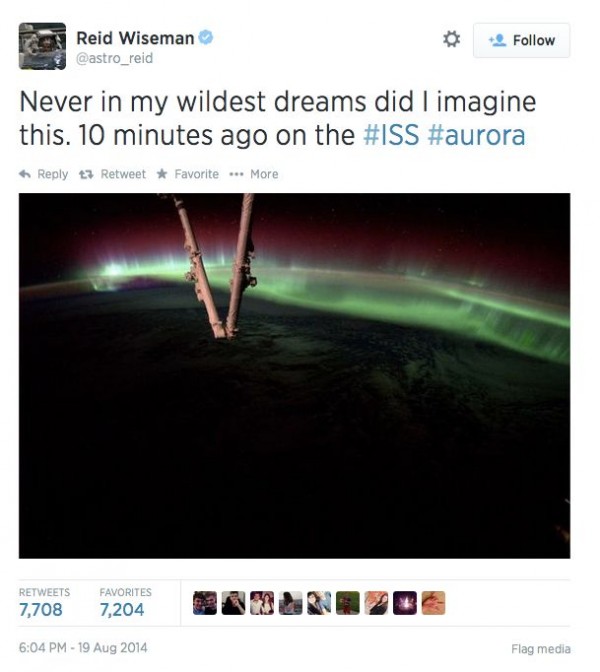
But despite the aurora taking place nearly two months ago, the pictures are stunning and I wanted still to share them with you. They came to my attention thanks to the EarthSky blogsite.
One of the first auroras of the 2014 autumn season appeared last night at northerly latitudes. Astronaut Reid Wiseman caught it from space. Photographer Göran Strand caught it from Sweden.
oooo
Astronaut Reid Wiseman captured these images from the window of the International Space Station last night (August 19, 2014). SpaceWeather.com says:
A moderate (G2-class) geomagnetic storm that erupted following a CME strike on August 19th is subsiding now. At its peak, the storm sparked auroras around both poles visible from the ground and from space.
Last night I got to see my first Aurora for the season, two days earlier than last year but five days later than my personal record from 2011 (August 14th).
It was a faint aurora that lasted for several hours and as you can see it was quite cloudy. The orange/yellow clouds to the right are clouds that are lit up by the street lights from the city of Östersund and Frösön.
Finally the dark nights are here so we can enjoy the auroras ahead and let us hope that there will be lots of them during the coming season.
Don’t you think Göran Strand’s photograph is just wonderful!
Like many who read yesterday’s post about this possibly being an age of loneliness I was struck by a terrible sense of sadness in George Monbiot’s words. Take these sentences:
Three months ago we read that loneliness has become an epidemic among young adults. Now we learn that it is just as great an affliction of older people. A study by Independent Age shows that severe loneliness in England blights the lives of 700,000 men and 1.1m women over 50, and is rising with astonishing speed.
Ebola is unlikely ever to kill as many people as this disease strikes down. Social isolation is as potent a cause of early death as smoking 15 cigarettes a day; loneliness, research suggests, is twice as deadly as obesity. Dementia, high blood pressure, alcoholism and accidents – all these, like depression, paranoia, anxiety and suicide, become more prevalent when connections are cut. We cannot cope alone.
It’s my proposition that not being able to cope with being alone derives from being unable to be fully at peace with oneself.
Yet, as dogs remind us so incredibly well, the ability to be on one’s own, to allow the brain to quieten down, to meditate in other words, is essential to our mental well-being. It is an essential part of the journey to find and like oneself. (I hasten to add that I write this without the benefit of any relevant professional knowledge!)
I am a neuropsychologist and have written and taught about the essential inner skills of personal well-being, psychological growth, and contemplative practice – as well as about relationships, family life, and raising children.Probably like you, there’s been a lot of to-ing and fro-ing in my life these days. Change can be interesting, exciting, and fun – but after awhile you start to long for something quieter, more stable.
A couple of weeks ago, the Just One Thing newsletter was all about stillness. It is republished below.
ooOOoo
Just One Thing (JOT) is the free newsletter that suggests a simple practice each week for more joy, more fulfilling relationships, and more peace of mind.
A small thing repeated routinely adds up over time to produce big results.
Things keep changing. The clock ticks, the day unfolds, trees grow, leaves turn brown, hair turns gray, children grow up and leave home, attention skitters from this to that, the cookie is delicious but then it’s all gone, you’re mad about something for awhile and then get over it, consciousness streams on and on and on.
Many changes are certainly good. Most people are glad to put middle school behind them. I’m still happy about shifting thirty years ago from single to married. Painkillers, flush toilets, and the internet seem like pretty good ideas. It’s lovely to watch grass waving in the wind or a river passing. Fundamentally, if there were no change, nothing could happen, reality would be frozen forever. I once asked my friend Tom what he thought God was and he said “possibility.”
On the other hand, many changes are uncomfortable, even awful. The body gets creaky, and worse. We lose those we love and eventually lose life itself. Families drift apart, companies fail, dictators tighten their grip, nations go to war. The planet warms at human hands, as each day we pour nearly a billion tons of carbon into the atmosphere. Countless species go extinct. As William Yeats wrote: “Things fall apart; the centre cannot hold.”
And change itself is often – maybe innately – stressful. When you really open to the fact always in front of our noses that each moment of now decays and disappears in the instant it arises – it can feel rather alarming. Life and time sweep us along. As soon as something pleasant occurs in the mind’s flow we reach for it but whoosh it passes away right through our fingers leaving disappointment behind. Inherently, anything that changes is not a reliable basis for enduring contentment and fulfillment.
Yet it is also true that some things remain always the same. In their stillness you can find a refuge, an island in the stream of changes, a place to stand for perspective and wisdom about events and your reactions to them, a respite from the race, quiet amidst the noise. Perhaps even find a sense of something transcendental, outside the frame of passing phenomena.
How?
Stillness, a sense of the unchanging, is all around, and at different levels. Look for it, explore its effects on you, and let it sink in.
For example, it’s not the ultimate stillness, but there is that lovely feeling when the house is quiet and you’re sitting in peace, the dishes are done and the kids are fine (or the equivalent), and you can really let down and let go. In your character, you have enduring strengths and virtues and values; situations change, but your good intentions persist. In relationships, love abides – even for people who drive you crazy!
More subtly, there is the moment at the very top of a tossed ball’s trajectory when it’s neither rising nor falling, the pause before the first stroke of the brush, that space between exhalation and inhalation, the silence in which sounds occur, or the discernible gap between thoughts when your mind is quiet.
In your mind there is always an underlying calm and well-being that contains emotional reactions, like a riverbed that is still even as the flood rushes over it (if you’re not aware of this, truly, with practice you can find and stabilize a sense of it). There is also the unchanging field of awareness, itself never altered by the thoughts passing through it.
More abstractly, 2+2=4 forever; the area of a circle will always be pi times the radius squared; etc. The fact that something has occurred will never change. The people who have loved you will always have loved you; they will always have found you lovable. Whatever is fundamentally true – including, ironically, the truth of impermanence – has an unchanging stillness at its heart. Things change, but the nature of things – emergent, interdependent, transient – does not.
Moving toward ultimate matters, and where language fails, you may have a sense of something unchangingly transcendental, divine. Or, perhaps related, an intuition of that which is unconditioned always just prior to the emergence of conditioned phenomena.
Wherever you find it, enjoy stillness and let it feed you. It’s a relief from the noise and bustle, a source of clarity and peace. Give yourself the space, the permission, to be still – at least in your mind – amidst those who are busy. To use a traditional saying:
May that which is still be that in which your mind delights.
Much as I respect Mr. Monbiot’s views, I hope he is wrong in this respect.
I have long admired the writings of George Monbiot and, as often as not, have republished his essays in this place.
But an essay by George that was published in the UK Guardian newspaper yesterday portrays a frightening picture of modern-day Britain. It was called Falling Apart and is republished, with George’s permission, today.
I want to offer a personal response to the essay, that immediately follows George’s piece.
ooOOoo
Falling Apart
October 14, 2014
Competition and individualism are forcing us into a devastating Age of Loneliness
By George Monbiot, published in the Guardian 15th October 2014
What do we call this time? It’s not the information age: the collapse of popular education movements left a void now filled by marketing and conspiracy theories(1). Like the stone age, iron age and space age, the digital age says plenty about our artefacts but little about society. The anthropocene, in which humans exert a major impact on the biosphere, fails to distinguish this century from the previous twenty. What clear social change marks out our time from those that precede it? To me it’s obvious. This is the Age of Loneliness.
When Thomas Hobbes claimed that in the state of nature, before authority arose to keep us in check, we were engaged in a war “of every man against every man”(2), he could not have been more wrong. We were social creatures from the start, mammalian bees, who depended entirely on each other. The hominims of East Africa could not have survived one night alone. We are shaped, to a greater extent than almost any other species, by contact with others. The age we are entering, in which we exist apart, is unlike any that has gone before.
Three months ago we read that loneliness has become an epidemic among young adults(3). Now we learn that it is just as great an affliction of older people. A study by Independent Age shows that severe loneliness in England blights the lives of 700,000 men and 1.1m women over 50(4), and is rising with astonishing speed.
Ebola is unlikely ever to kill as many people as this disease strikes down. Social isolation is as potent a cause of early death as smoking 15 cigarettes a day(5); loneliness, research suggests, is twice as deadly as obesity(6). Dementia, high blood pressure, alcoholism and accidents – all these, like depression, paranoia, anxiety and suicide, become more prevalent when connections are cut(7,8). We cannot cope alone.
Yes, factories have closed, people travel by car instead of buses, use YouTube rather than the cinema. But these shifts alone fail to explain the speed of our social collapse. These structural changes have been accompanied by a life-denying ideology, which enforces and celebrates our social isolation. The war of every man against every man – competition and individualism in other words – is the religion of our time, justified by a mythology of lone rangers, sole traders, self-starters, self-made men and women, going it alone. For the most social of creatures, who cannot prosper without love, there is now no such thing as society, only heroic individualism. What counts is to win. The rest is collateral damage.
British children no longer aspire to be train drivers or nurses, more than a fifth now say they “just want to be rich”: wealth and fame are the sole ambitions of 40% of those surveyed(9). A government study in June revealed that Britain is the loneliness capital of Europe(10). We are less likely than other Europeans to have close friends or to know our neighbours. Who can be surprised, when everywhere we are urged to fight like stray dogs over a dustbin?
We have changed our language to reflect this shift. Our most cutting insult is loser. We no longer talk about people. Now we call them individuals. So pervasive has this alienating, atomising term become that even the charities fighting loneliness use it to describe the bipedal entities formerly known as human beings(11). We can scarcely complete a sentence without getting personal. Personally speaking (to distinguish myself from a ventriloquist’s dummy), I prefer personal friends to the impersonal variety and personal belongings to the kind that don’t belong to me. Though that’s just my personal preference, otherwise known as my preference.
One of the tragic outcomes of loneliness is that people turn to their televisions for consolation: two-fifths of older people now report that the one-eyed god is their principal company(12). This self-medication enhances the disease. Research by economists at the University of Milan suggests that television helps to drive competitive aspiration(13). It strongly reinforces the income-happiness paradox: the fact that, as national incomes rise, happiness does not rise with them.
Aspiration, which increases with income, ensures that the point of arrival, of sustained satisfaction, retreats before us. The researchers found that those who watch a lot of television derive less satisfaction from a given level of income than those who watch only a little. Television speeds up the hedonic treadmill, forcing us to strive even harder to sustain the same level of satisfaction. You have only to think of the wall-to-wall auctions on daytime TV, Dragon’s Den, the Apprentice and the myriad forms of career-making competition the medium celebrates, the generalised obsession with fame and wealth, the pervasive sense, in watching it, that life is somewhere other than where you are, to see why this might be.
So what’s the point? What do we gain from this war of all against all? Competition drives growth, but growth no longer makes us wealthier. Figures published this week show that while the income of company directors has risen by more than a fifth, wages for the workforce as a whole have fallen in real terms over the past year (14). The bosses now earn – sorry, I mean take – 120 times more than the average full-time worker. (In 2000, it was 47 times). And even if competition did make us richer, it would make us no happier, as the satisfaction derived from a rise in income would be undermined by the aspirational impacts of competition.
The top 1% now own 48% of global wealth(15), but even they aren’t happy. A survey by Boston College of people with an average net worth of $78m found that they too are assailed by anxiety, dissatisfaction and loneliness(16). Many of them reported feeling financially insecure: to reach safe ground, they believed, they would need, on average, about 25% more money. (And if they got it? They’d doubtless need another 25%). One respondent said he wouldn’t get there until he had $1 billion in the bank.
For this we have ripped the natural world apart, degraded our conditions of life, surrendered our freedoms and prospects of contentment to a compulsive, atomising, joyless hedonism, in which, having consumed all else, we start to prey upon ourselves. For this we have destroyed the essence of humanity: our connectedness.
Yes, there are palliatives, clever and delightful schemes like Men in Sheds and Walking Football developed by charities for isolated older people(17). But if we are to break this cycle and come together once more, we must confront the world-eating, flesh-eating system into which we have been forced.
Hobbes’s pre-social condition was a myth. But we are now entering a post-social condition our ancestors would have believed impossible. Our lives are becoming nasty, brutish and long.
As closing sentences go, that’s about as tough as it gets.
Nevertheless, I’m going to offer a perspective, something that George doesn’t mention. That is the importance of community.
Back in 2008 BBC Timewatch screened a programme about the revelations that came from the latest archaeological dig at Stonehenge, near Amesbury in Wiltshire in England. I wrote about the programme over four years ago: Stonehenge – a place of healing.
Stonehenge is one of Britain’s most famous historical sites, deservedly so because Stonehenge was one of the most important places in ancient Europe.
Stonehenge
But evidence from a dig that was authorised in 2008 has shown that not only is Stonehenge a much older site of human habitation but that it’s purpose is altogether different to what has been assumed. It was, indeed, a healing place, possibly the most important in Europe.
Professors Tim Darvill and Geoff Wainwright are the world-renowned archaeologists who believe they have cracked the conundrum of Stonehenge’s original purpose.
If you would like to watch that Timewatch episode, and it is highly recommended, then someone has neatly uploaded it to YouTube.
The programme clearly offers evidence from the carbon-dating of seeds buried under the famous blue stones that dates this settlement to some 9,000 years BP. The detailed examination of ancient humans buried nearby indicates they came to Stonehenge with a range of diseases, many terminal in nature.
So back to George Monbiot’s essay and the element that screams out at me.
We have lost sight of the huge healing benefits that come from old-fashioned, shoulder-to-shoulder communities.
Not to mention the healing properties of a loving dog or two in one’s life!















 Learning from Dogs