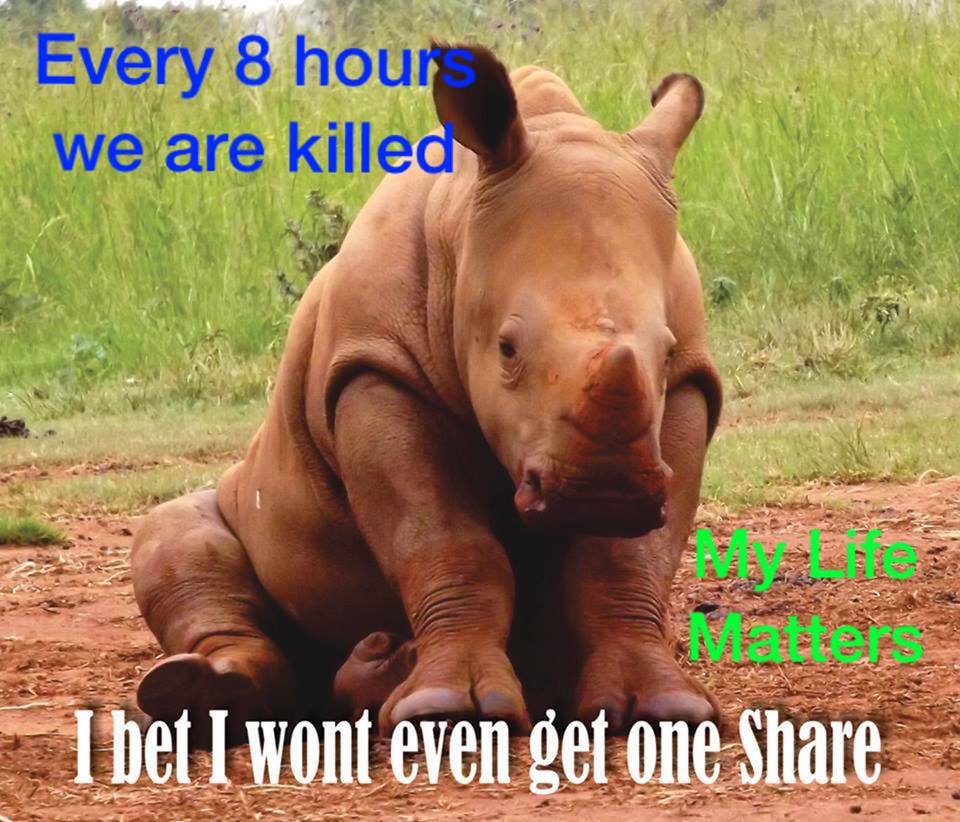
Chris Snuggs, friend from my English days, linked to an item on his Facebook page about the appalling loss of elephants and rhinos. The item included this picture:
The reason I am writing about this today is to give readers notice that on Saturday, October 3 from 10:30am – 3:00pm there is a march, a global march, for Elephants and Rhinos. The item on Facebook details the location as Jefferson Square, 1101 Eddy St, San Francisco, California 94109.
If we lived closer to San Francisco we would most definitely attend.
Back to Chris’ Facebook entry where he subsequently wrote:
I am flattered! I thought it was just my usual bilious rant! Actually, the killing of rhinos, tigers, elephants and so on is so surreally-pointless and evil as to be almost beyond belief. You might like this photo of a rhino I saw in Senegal from about 20 metres away! Magnificent and totally innocent creatures, unlike Homo Sapiens I fear.
Jean and I feel the same way about the hunting of any animals for any purpose other than feeding oneself.
The interconnectedness of everything – even beyond our wildest imagination.
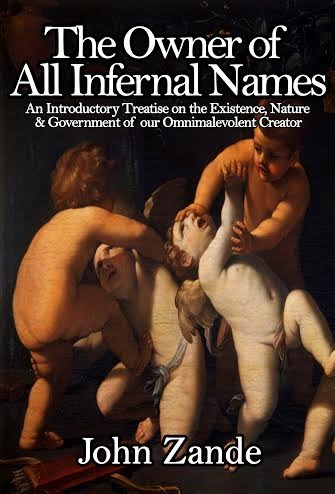
A while ago John Zande signed up to follow Learning from Dogs. Naturally, I went across to John’s blog to thank him. There I discovered that John is an animal lover and an author. For he states, referring to his book, that, “BUY IT. ALL PROCEEDS GO TO ANIMAL RESCUE AND SHELTER IN BRAZIL”. Fabulous!
(I did buy the book, am about 20% through it and finding it very stimulating, – if you would like to buy it then click the image of the book on John’s home page.)
Anyway, a few days later we watched the BBC Horizon programme on multiple universes. Here’s how the BBC introduced the programme:
Which Universe Are We In?
Horizon, 2014-2015 Episode 17 of 19
Imagine a world where dinosaurs still walk the earth. A world where the Germans won World War II and you are president of the United States. Imagine a world where the laws of physics no longer apply and where infinite copies of you are playing out every storyline of your life.
It sounds like a plot stolen straight from Hollywood, but far from it. This is the multiverse.
Until very recently the whole idea of the multiverse was dismissed as a fantasy, but now this strangest of ideas is at the cutting edge of science.
And for a growing number of scientists, the multiverse is the only way we will ever truly make sense of the world we are in.
Horizon asks the question: Do multiple universes exist? And if so, which one are we actually in?
Horizon is always great to watch but this episode was incredibly stimulating and interesting. Later, in a exchange of comments to one of John’s posts, where I referred to that programme, John wrote:
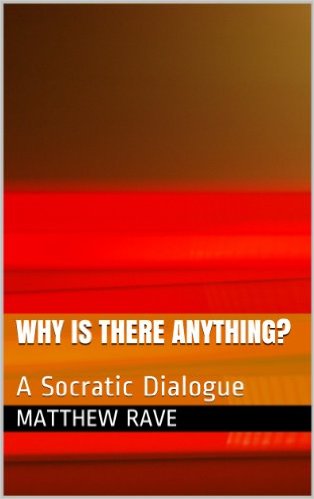
The mulitverse is actually the more reasonable explanation for why there is something, and although I don’t understand the maths, the people who do say its simplistically beautiful. Matt Rave is an associate professor of physics and comments here regularly. He has a great book on it all, Why is There Anything?
That lead me to purchasing Matthew Rave’s book that, likewise, is a most fascinating and unusual approach to this topic. His Amazon author’s page reveals that, “Dr. Matthew Rave is an assistant professor of physics at Western Carolina University, in the mountains of North Carolina. His research interests include interpretations of quantum mechanics, the geometric phase, solid state physics, and physics education.” Matthew Rave’s blogsite is here.
Matthew Rave’s book further illustrates the paradox, to my mind, that comes from thinking about why are we here, are we here and, if so, how do we know we are here?
So if that isn’t enough for you and me, then very recently The Conversation blogsite published the following from Geraint Lewis who is Professor of Astrophysics at the University of Sydney. It is republished here within the terms of The Conversation. Did I mention paradoxes and headaches!
To a human, the universe might seem like a very inhospitable place. In the vacuum of space, you would rapidly suffocate, while on the surface of a star you would be burnt to a crisp. As far as we know, all life is confined to a sliver of an atmosphere surrounding the rocky planet we inhabit.
But while the origin of life on Earth remains mysterious, there are bigger questions to answer. Namely: why do the laws of physics permit any life at all?
Hang on, the laws of physics? Surely they are a universal given and life just gets on with it?
But remember that the universe is built of fundamental pieces, particles and forces, which are the building blocks of everything we see around us. And we simply don’t know why these pieces have the properties they do.
There are many observational facts about our universe, such as electrons weighing almost nothing, while some of their quark cousins are thousands of times more massive. And gravity being incredibly weak compared to the immense forces that hold atomic nuclei together.
Why is our universe built this way? We just don’t know.
But what if…?
This means we can ask “what if” questions. What if the electron was massive and quarks were fleeting? What if electromagnetism was stronger than the nuclear strong force? If so, what would that universe be like?
Let’s consider carbon, an element forged in the hearts of massive stars, and an element essential to life as we know it.
Initial calculations of such stellar furnaces showed that they were apparently inefficient in making carbon. Then the British astronomer Fred Hoyle realised the carbon nucleus possesses a special property, a resonance, that enhanced the efficiency.
But if the strength of the strong nuclear force was only fractionally different, it would wipe out this property and leave the universe relatively devoid of carbon – and, thus, life.
The story doesn’t end there. Once carbon is made, it is ripe to be transmuted into heavier elements, particularly oxygen. It turns out that oxygen, due to the strength of the strong nuclear force, lacks the particular resonance properties that enhanced the efficiency of carbon creation.
This prevents all of the carbon being quickly consumed. The specific strength of the strong force has thus resulted in a universe with an almost equal mix of carbon and oxygen, a bonus for life on Earth.
Death of a universe
This is but a single example. We can play “what if” games with the properties of all of the fundamental bits of the universe. With each change we can ask, “What would the universe be like?”
The answers are quite stark. Straying just a little from the convivial conditions that we experience in our universe typically leads to a sterile cosmos.
This might be a bland universe, without the complexity required to store and process the information central to life. Or a universe that expands too quickly for matter to condense into stars, galaxies and planets. Or one that completely re-collapses again in a matter of moments after being born. Any complex life would be impossible!
The questions do not end there. In our universe, we live with the comfort of a certain mix of space and time, and a seemingly understandable mathematical framework that underpins science as we know it. Why is the universe so predictable and understandable? Would we be able to ask such a question if it wasn’t?
Our universe appears to balance on a knife-edge of stability. But why?
We appear to be very lucky to live in a universe that accommodates life. Zdenko Zivkovic/Flickr, CC BY
One of a multiverse
To some, science will simply fix it all. Perhaps, if we discover the “Theory of Everything”, uniting quantum mechanics with Einstein’s relativity, all of the relative masses and strengths of the fundamental pieces will be absolutely defined, with no mysteries remaining. To others, this is little more than wishful thinking.
Some seek solace in a creator, an omnipotent being that finely-tuned the properties of the universe to allow us to be here. But the move from the scientific into the supernatural leaves many uncomfortable.
There is, however, another possible solution, one guided by the murky and confused musings at the edge of science. Super-strings or M-theory (or whatever these will evolve into) suggest that the fundamental properties of the universe are not unique, but are somehow chosen by some cosmic roll of the dice when it was born.
This gives us a possible explanation of the seemingly special properties of the universe in which we live.
We are not the only universe, but just one in a semi-infinite sea of universes, each with their own peculiar set of physical properties, laws and particles, lifetimes and ultimately mathematical frameworks. As we have seen, the vast majority of these other universes in the overall multiverse are dead and sterile.
They only way we can exist to ask the question “why are we here?” is that we happen to find ourselves in a universe conducive to our very existence. In any other universe, we simply wouldn’t be around to wonder why we didn’t exist.
If the multiverse picture is correct, we have to accept that the fundamental properties of the universe were ultimately dished out in a game of cosmic roulette, a spin of the wheel that we appear to have won.
A smart partnership introduces hard-to-home dogs to high-energy humans.
Note to Readers
Last week I completed the final edit of my book of the same name as this blog, Learning from Dogs. I am learning the truth of what one experienced author said to this new author and that was that writing the book is the easy part! For the next stage is the professional editing of the manuscript. I was previously referred to Joni Wilson and I am so pleased that she is undertaking the task. Well, I think I am pleased! 😉 That last sentence comes from me utterly misjudging just how much work is being created for me as I start to go through hundreds, literally, of ‘recommendations’ from Joni. Dear readers, we are talking hours of revisions that I need, and want, to make.
All of which is my way of saying that if my posts over the next couple of weeks more strongly lean on the republishing of other material then you will understand why. In all cases I will endeavour to republish articles that are likely to interest you, of course!
So with those words in mind, here is another article from Mother Nature Network that stays with yesterday’s theme of adopting those dogs that are not necessarily the easiest to so do.
ooOOoo
Outdoorsy dogs find their perfect matches
A smart partnership introduces hard-to-home dogs to high-energy humans.
By: Jaymi Heimbuch, September 11, 2015
Anniston is on her way to her new home, thanks to a brilliant campaign to match high-energy dogs with high-energy humans. (Photo: Ruffwear)
A couple weeks ago, Outdoor Retailer held an adoption event for shelter dogs. But it wasn’t just any event — this was specifically for high-energy, adventure-loving dogs seeking high-energy, adventure-loving humans. This matchup can be tough to find at a rescue or shelter, but what if the adoption event takes place where outdoorsy folks shop? Wouldn’t the potential for love at first wag be higher? It turns out that’s exactly what happens.
Ruffwear and Best Friends Animal Society created the Ruff Adventure Dog Adoption Program to place usually hard-to-home dogs — dogs that need a lot of exercise and outdoor activity and require a home with someone who wants a companion for trail runs, hiking, camping and other fun activities. They put the program to the test at Outdoor Retailer.
Among those who found a home are:
Jennifer finds Krone
Jennifer and Krone bond after meeting at an Outdoor Retailer event. (Photo: Ruffwear)
Huck finds Gerald
It’s a match made in outdoor-loving heaven for Huck the dog and Gerald, his new owner. (Photo: Ruffwear)
Niko finds his future parents
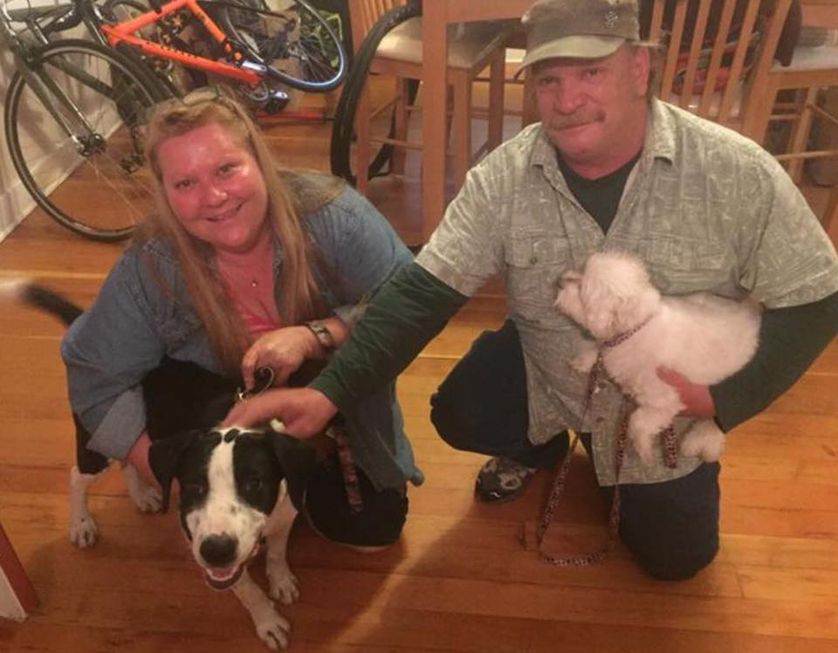
A future of happy tail-wagging adventure awaits for Niko, the black and white dog pictured at left. (Photo: Ruffwear)
“Over the course of two days, Best Friends’ Salt Lake City partner, Rescue Rovers, brought in eight fresh air-seeking, adventure-ready dogs to the Salt Palace. [I]t wasn’t long before people stopped by the Ruffwear booth to hand in their adoption requests. Of the eight dogs who attended, six were adopted,” says the press release from Ruffwear.
“People expect us to have dogs at the booth, and they’re always a draw. But we had no idea how receptive show attendees would be to actually adopting these dogs. Rescue Rovers did a great job bringing dogs that would pair well with our active, outdoorsy crowd. I think the first application came in just hours after the dogs arrived and by the end of the first day, nearly all dogs present had applications pending; it was amazing,” said Greg Freyberg, Ruffwear’s Brand Manager.
The happy tale doesn’t end with this event. Ruffwear and Best Friends continue to match these trail-loving dogs with their perfect humans. Since the program launched in May, 13 dogs have been matched, with Ruffwear covering the cost of adoption fees as well as airfare to get the dogs to their new homes.
Check out this super feel-good video explaining the adoption partnership and the wonderful service it provides to high-energy dogs:
ooOOoo
Once again, remember: Don’t Shop: Adopt!
Now where was I an hour ago???
“they” is plural, but in the previous sentence you have “dog” which is singular, so I changed this to be singular.
—
The word “over” usually has to do with physical properties—the cow jumped over the Moon, or standing over something.
—
Fast forward without a hyphen is a noun, while the hyphen makes it a verb
Ernest Hemingway apparently stated, “There is nothing to writing. All you do is sit down at a typewriter and bleed.” Well, Mr. Hemingway is correct in that while the apparatus of typing has changed out of all recognition since his days, the bleeding has not!
We have always adopted dogs on the basis of their need, never letting age come into it. In the years before I knew Jean she was rescuing dogs off the streets of Mexico, again without regard to breed, age, condition or temperament.
So this recent article on Mother Nature Network struck me as important. Please share it.
ooOOoo
Don’t be afraid to adopt an older dog, says photographer
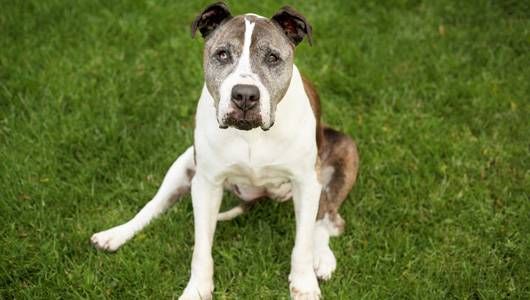
An abandoned dog named Sunny made Lori Fusaro realize that ‘no dog should die alone’ and inspired her to start a photography project to benefit senior pets.
By: Laura Moss, July 22, 2013
Photo: Lori Fusaro
The hardest part of loving a pet is having to say goodbye. That’s why the idea of adopting an older animal made dog lover Lori Fusaro so uneasy.
“I thought it would just be too sad and painful,” Fusaro told Today.com, “I didn’t think my heart could take it, so I wasn’t willing to open myself up.”
But that all changed in June 2012 when Fusaro met Shady while she was photographing dogs at the South Los Angeles Animal Shelter. Shady was 16 years old with infected eyes and a large cancerous tumor on her leg.
“She was so sad and depressed. She wouldn’t even lift her head for a treat. I didn’t think I could adopt her and I left the shelter without her. But her face never left my mind. She kept popping into my thoughts.”
As she contemplated adoption, Fusaro sought out more information on the dog.
“I thought Shady was a stray that found her way into the shelter,” she wrote on her blog. “Turns out I was wrong. Living her entire life with a family and then dumped because she was too old. With this new information, her face haunts me even more.”
Fusaro couldn’t stand the idea of the gentle dog dying alone, so she took her home and changed her name to Sunny.
“I always come back to the idea that no dog should have to die alone. Even if she got just two months of joyous, happy life, it’s worth it for my heartbreak,” she said.
Watching Sunny transform from an anxious shelter dog into the happy family member she is today inspired Fusaro to start Silver Hearts, a photography project that showcases senior pets and the joy they bring to people’s lives.
“When I realized that there were probably hundreds of Sunnys languishing in shelters, I knew I had to do something about it. Silver Hearts became a way that I could use my photography to show these dogs as loving, happy souls that have a zest for living and deserve to spend their golden years in a loving home.”
Fusaro visited families across the United States to photograph their dogs and share their compelling stories. Many of the dogs were taken to shelters because they got sick or old or because the families could no longer afford to care for them.
Although older dogs are often calmer — and already house-trained — they’re typically the highest-risk animals in a shelter. Fusaro hopes her photographs can help change that.
She launched a Kickstarter campaign to try to raise money to self-publish the book, but failed to make the fundraising goal. Fusaro is now considering other methods of publication.
“When I look back at my unwillingness to adopt an older dog, it was more about my own selfishness — about not wanting to feel that pain, not wanting to make hard decisions,” Fusaro said. “But every dog is important. Every dog deserves a home. I finally just boiled it down to love. That’s the most important thing.”
Lori explains why she photographs senior dogs in the video below.
ooOOoo
Abandoned and homeless dogs so desperately need the love of caring owners.
Yesterday was the moment when Queen Elizabeth II became the longest-reigning UK monarch. As the BBC reported (in part) yesterday:
Queen Elizabeth II becomes longest-reigning UK monarch
The Queen has thanked well-wishers at home and overseas for their “touching messages of kindness” as she becomes Britain’s longest-reigning monarch.
Speaking in the Scottish Borders, the 89-year-old monarch said the title was “not one to which I have ever aspired”.
At 17:30 BST she had reigned for 23,226 days, 16 hours and approximately 30 minutes – surpassing the reign of her great-great-grandmother Queen Victoria.
David Cameron said the service the Queen had given was “truly humbling”.
Dressed in turquoise with her trusty black handbag at her side, the Queen spoke briefly to the gathered crowds earlier.
“Inevitably a long life can pass by many milestones – my own is no exception – but I thank you all and the many others at home and overseas for your touching messages of great kindness,” she said.
Newly released official photographs show the Queen with her official red box, containing the day’s policy papers, cabinet documents, Foreign Office papers and other letters.
Here’s a video that is worth viewing:
So that was the ‘good’ news.
Now here is the ‘ugly’ news; the latest essay by George Monbiot republished here with Mr. Monbiot’s kind permission.
ooOOoo
Britain’s Mafia State
8th September 2015
Where does legitimate business end and organised crime begin?
By George Monbiot, published in the Guardian 9th September 2015
Be reasonable in response to the unreasonable: this is what voters in the Labour election are told. Accommodate, moderate, triangulate, for the alternative is to isolate yourself from reality. You might be inclined to agree. If so, please take a look at the reality to which you must submit.
To an extent unknown since before the First World War, economic relations in this country are becoming set in stone. It’s not just that the very rich no longer fall while the very poor no longer rise. It’s that the system itself is protected from risk. Through bail-outs, quantitative easing and delays in interest rate rises, speculative investment has been so well cushioned that, as Larry Elliott puts it, financial markets are “one of the last bastions of socialism left on earth.”
Public services, infrastructure, the very fabric of the nation: these too are being converted into risk-free investments. Social cleansing is transforming inner London into an exclusive economic zone for property speculation. From a dozen directions, government policy converges on this objective. The benefits cap and the bedroom tax drive the poor out of their homes. The forced sale of high-value council houses creates a new asset pool. An uncapped and scarcely regulated private rental market turns these assets into gold. The freeze on council tax banding since 1991, the lifting of the inheritance tax threshold and £14 billion a year in breaks for private landlords all help to guarantee stupendous returns.
And for those who wish simply to sit on their assets, the government can help here too, by ensuring that there are no penalties for leaving buildings empty. As a result, great tracts of housing are removed from occupation. Agricultural land has proved an even better punt for City money: with the help of capital gains, inheritance and income tax exemptions, as well as farm subsidies, its price has quadrupled in 12 years.
Property in this country is a haven for the proceeds of international crime. The head of the National Crime Agency, Donald Toon, notes that “the London property market has been skewed by laundered money. Prices are being artificially driven up by overseas criminals who want to sequester their assets here in the UK.”
It’s hardly surprising, given the degree of oversight. Private Eye has produced a map of British land owned by companies registered in offshore tax havens. The holdings amount to 1.2 million acres, including much of our prime real estate. Among those it names as beneficiaries are a cast of Russian oligarchs, oil sheikhs, British aristocrats and newspaper proprietors. These are the people for whom government policy works, and the less regulated the system that enriches them, the happier they are.
The speculative property market is just one current in the great flow of cash that sluices through Britain while scarcely touching the sides. The financial sector exploits an astonishing political privilege: the City of London is the only jurisdiction in the UK not fully subject to the authority of parliament. In fact, the relationship seems to work the other way. Behind the Speaker’s chair in the House of Commons sits the Remembrancer, whose job is to ensure that the interests of the City of London are recognised by the elected members. (A campaign to rescind this privilege – Don’t Forget the Remembrancer – will be launched very soon). The City has one foot in the water: it is a semi-offshore state, a bit like the UK’s Crown dependencies and overseas territories, tax havens legitimised by the Privy Council. Britain’s financial secrecy undermines the tax base while providing a conduit into the legal economy for gangsters, kleptocrats and drug barons.
Even the more orthodox financial institutions deploy a long succession of scandalous practices: pension mis-selling, endowment mortgage fraud, the payment protection insurance con, Libor rigging. A former minister in the last government, Lord Green, ran HSBC while it engaged in money laundering for drugs gangs, systematic tax evasion and the provision of services to Saudi and Bangladeshi banks linked to the financing of terrorists. Sometimes the UK looks to me like an ever-so-civilised mafia state.
At next month’s Conservative party conference, corporate executives will pay £2,500 to sit with a minister. Doubtless, because we are assured that there is no link between funding and policy, they will spend the day discussing the weather and the films they have seen. If we noticed such arrangements overseas, we might be inclined to regard them as corruption. But that can’t be the case here, not least because the invitation explains that “fees associated with business day & dinner are considered a commercial transaction and therefore do not constitute a political donation.”
The government also insists that there is no link between political donations and seats in the House of Lords. But a study by researchers at Oxford University found that the probability of so many major donors arriving there by chance is 1.36 x 10-38: roughly “equivalent to entering the National Lottery and winning the jackpot 5 times in a row”. Why does the Lords remain unreformed? Because it permits plutocratic power to override democracy. Both rich and poor are kept in their place.
Governed either by or on behalf of the people who fleece us, we cannot be surprised to discover that all public services are being re-engineered for the benefit of private capital. Nor should we be surprised when governments help to negotiate, without public consent, treaties such as TTIP and CETA (the Comprehensive Economic and Trade Agreement), which undermine the sovereignty of both parliament and the law. Aesop’s observation that “we hang the petty thieves and appoint the great ones to public office” remains true in spirit, though hanging has been replaced by community payback.
Wherever you sniff in British public life, something stinks: I could fill this newspaper with examples. But, while every pore oozes corruption, our task, we are told, is merely to trim the nails of the body politic.
To fail to confront this system is to collaborate with it. Who on the left would wish to stand on the sidelines as this carve-up continues? Who would vote for anything but sweeping change?
Ma’am’s best friend: The Queen has owned corgis for more than 60 years. Picture seen in the UK’s Daily Mail newspaper.
Taking the two stories together, all that comes to mind is that we could do much better if the United Kingdom, and other countries, were governed by dogs!
I have long been an admirer of The Guardian newspaper way back before I became a US resident. Thus an article that appeared on the website of The Guardian US newspaper seemed perfect for a mention in this place. It was an article entitled Cadaver dogs: attending camp with the canines trained to smell death and written by Liz Lucking. Here’s a tiny extract from the article:
A dog’s sense of smell is estimated to be somewhere between 100 and 1,000 times greater than a human’s, depending on the breed. But despite their formidable noses, these dogs still need assistance, direction and training to reach their full potential.
The Penn Vet Working Dog Center does exactly that. Founded in 2007 and part of the University of Pennsylvania, the training centre and research program is dedicated to helping advance the success of working dogs.
I then went across to the Penn Vet Working Dog Centre website that was full of interesting information, including details of their Internships, Externships & Fellowships. So if that strikes a chord with a reader then that’s great.
That Guardian article also mentioned the American Rescue Dog Association and their website is full of fabulous information, as this extract from their welcome page endorses:
The American Rescue Dog Association® (ARDA®) is comprised of highly skilled volunteer search and rescue units across the United States that operate in conjunction with local law enforcement or other applicable emergency services agencies to assist in the location of missing persons. ARDA units provide specially trained dogs to locate missing persons in wilderness, disaster, human remains and water search and rescue/recovery missions. Each member unit is required to adhere to the Association’s rigid standards and undergo a rigorous two-day field evaluation every three years to ensure these standards are being maintained.
Units are available 24-hours a day to respond to requests for services from applicable local, state or federal responsible agencies.
Our search and rescue canine teams deploy in many circumstances, at several levels, at no cost to Federal and Local departments. ARDA resources operate solely as volunteers, and rely on donations for our continued operations.
Finally, searching YouTube for ARDA produced the following.
Another day: Another example of what our fabulous dogs provide to humans.
So said Sir Winston Churchill. It applies equally to the price of power.
There was an essay recently written and published by Hariod Brawn over on her blog Contentedness.net that was incredibly thought-provoking and very beautiful besides. Hariod has given me permission to republish it and it follows shortly.
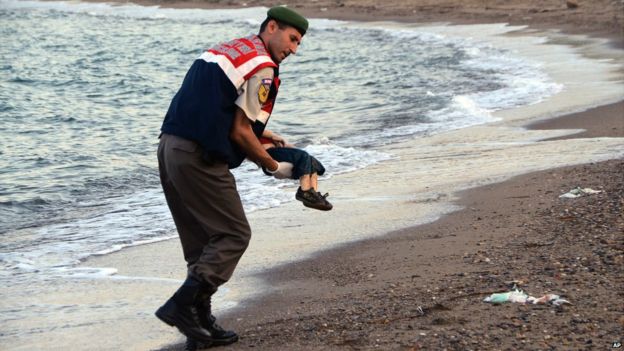
I have no doubt that Hariod’s essay was, in part, inspired by that terrible photograph that has been circulated and commented upon by thousands around the world.
In the words of the BBC, “The pictured boy is reported to be three-year-old Aylan, who drowned along with his five-year-old brother Galip and their mother, Rihan. Their father, Abdullah Kurdi, survived.”
The emotions created by this and other tragic photographs are disturbing, and I am no exception to having those same emotions. But as friend, Chris Snuggs, mentioned in a telephone call between us yesterday morning, what has been happening in Syria is no less terrible, perhaps even more so when one looks at the blood that is, metaphorically, on the hands of a number of western governments. The old saying of reaping what we sow comes to mind.
None of which takes away the intense beauty of Hariod’s essay: Empathetic apes.
ooOOoo
Empathic apes
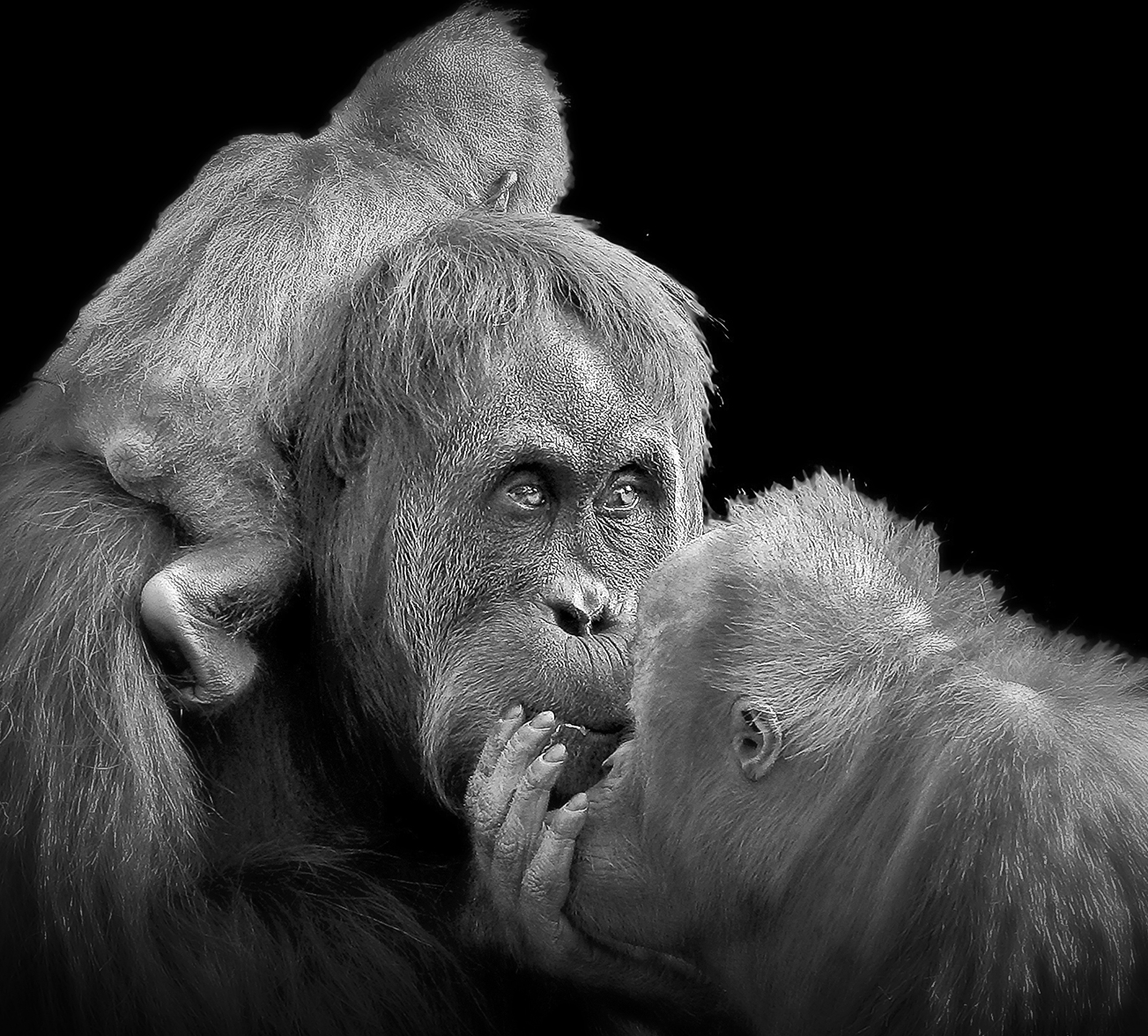
Orangutan mother and kids. By Patrick Bouquet, Chantilly.
The year is 1955, and far from the nearest village, somewhere within the Northwestern jungle region of Thailand, a 48 year-old Englishman and ordainee to the Buddhist monkhood sits quietly in studious attention. A few feet away, a female ape sits, arms carefully wrapped around some precious possession. The monk first chanced upon her the previous day, and due to the curiosity roused in observing her melancholic countenance, has remained respectfully nearby to her. A trust has developed, the ape sensing the monk’s gentle disposition and harmlessness. He really ought to be making his way to the village for alms, yet somehow senses that he should stay. A silent, palpable communication has developed between the two, and slowly, carefully and deliberately, the ape, her sadness still etched upon her face, finally unfolds her arms and offers a first sight of what she has been protecting. The monk slowly approaches to within a pace or two, sensing the invitation, only to catch sight of her lifeless and terribly deformed baby.
Two empathic apes, ancestrally and psychologically speaking, separated by little more in this moment than a distant, lineage-splitting, speciation event. Opposable thumbs, one hers and one his, in turn chase away a monk’s tear and a delicately mottled butterfly as it alights from the baby’s forehead, though cannot do the same for their conjoined feelings. Eyes meet, evincing as they do a deepening rush of sadness. Nothing can be done – is this what she is thinking in her way? In his unknowing, the saffron-robed wanderer radiates compassion, yet knows he has nothing to do with it; an offering from wisdom, not from the self. All that need be known arrives in the fullest of measures. What use now the venerable elder’s sagacity, his knowledge of emptiness, renunciation, equanimity, the void? She inhabits the void, is the void, her bleak knowing piercing its veils. Without turning, the monk slowly retreats, still reverently holding her gaze alongside a shared understanding. A slight suggestion of a bowing head betokens what passes between them.
It is the ability to empathise which in part distinguishes the psychopathic mind from its otherwise healthy state, and the primary orbit of empathy is that of feeling, not the mere gyrations of intellect. This is why many species of sentience can empathise, and we human animals are but one of them. We may erroneously presume that an ability to reflect upon others’ situations facilitates human empathic capacity; yet the state of those others and their situations need not be known as verbally abstracted objects in the mind – little stories packaged in words. We may just as well occupy others’ frames of reference by intuited means; and vitality, morbidity, distress and joy may all be recognised across species in differing ways; one need not indulge any anthropomorphisation, for clear evidence abounds. What is intuited here, or instinctively known, is the nature of the other’s felt emotional condition; and in this way, 60 years ago, the grieving mother ape and mendicant monk shared that intense experience – a wordless world of deep, primate feeling.
Engraving of Orangutan. By Willem Piso (1611-1678). Courtesy Wellcome Trust
Was the mother ape empathic? Well, she came to appreciate the monk’s amity; she felt able to extend trust; she intuited the monk’s concern for her as well as his desire for understanding as to the reasons for, and significance of, her sadness; and finally, she recognised that the monk would feel something of that sadness in revealing its causes to him. This is all to say that she significantly placed herself within the monk’s frame of reference and innately understood that emotions can be matched in shared experience – the personal does not expire at the boundary of the body. Her empathic appreciation was sophisticated, certainly moreso than any psychopathic human ape. Now, one way to cheat the system is to mimic expressions and gestures, which results in a like proprioceptive sense. This means our feelings echo the other’s, so affecting an emotional contagion of sorts, whether volitionally induced or not. Yet neither jungle dweller did so, their empathic link being forged in mind purely intuitively, and silently.
Empathy subsists in knowledge; it is in part to know the mind of the other, and whilst its currency is both cognitive (knowing) and emotional (feeling) in nature, it is the latter that strengthens the connective link to altruistic and prosocial leanings, as well as ameliorating aggressive traits. Primates’ mirror-neuron systems help forge innate empathic leanings, with research suggesting that empathy evolved in part as a survival mechanism. Right now, tens of thousands of refugees are fleeing war-torn regions of Africa and the Middle East so as to seek sanctuary, and survival, in Europe. A few hours ago, a three year-old Syrian boy, Aylan Kurdi, drowned and was washed up on the shores of the Greek island of Kos. Equally tragically, his five year-old brother met a similar fate. Whilst Europe’s politicians exhibit an ongoing empathy gap, innocent children are dying. We live, not literally, though metaphorically, in a jungle, sharing the empathic faculties of the monk and bereaved mother ape. Are we wise enough to nurture the same?
ooOOoo
We need leaders who understand the integrity that is required from them. We need leaders that accept and understand the responsibilities that they have embraced, indivisible from the power that society has lent to them. We need leaders that understand a different aspect of their power, the power of those unanticipated consequences from their actions.
Until we the people understand that electing leaders who do not embrace integrity then Aylan Kurdi and thousands of others in those ‘hot spots’ around the world will continue dying in vain.
Integrity equates to being truthful, to being honest. It doesn’t mean being right all the time, of course not, but integrity does mean accepting responsibility for all our actions, for feeling remorse and apologising when we make mistakes. Integrity means learning, being reliable, being a builder rather than a destroyer. It means being authentic. That authenticity is precisely and exactly what we see in our dogs.
The starting point for what we must learn from our dogs is integrity.
A few days ago I received a friendly email from Alex in Sydney, Australia.
My name is Alex and I work for Spoilt Rotten Dogs, a boutique dog care centre in Sydney.
In an effort to improve community awareness and knowledge about dog care, we are looking at contributing to high profile blogs like Learning From Dogs by sharing tips and information provided by professional carers, vets, and groomers. I’ve learned from your site that you are looking for guest contributors.
I’ve recently written a post that I think fits pretty well with your site especially that you are based in Australia. It’s about the best places in Sydney to walk your dog. I’m sure your readers will find it really helpful.
I politely replied to Alex pointing out that Learning from Dogs was based in Southern Oregon and not Australia and thus a guest essay on walking one’s dog in Sydney was unlikely to have huge reader appeal! 😉
Unperturbed, Alex then replied with a guest essay that seemed much more pertinent to dog lovers right across the world. It now follows but not before I declare that there is no connection between this blog and Alex’s dog care centre. The following image is taken from the home page of the website for Spoilt Rotten Dogs.
ooOOoo
5 Tips to Dog Proof Your Backyard
Regardless of the fact that you really love your dogs, you cannot keep your eyes on them and supervise their activities all the time. However, this doesn’t set you free from the responsibilities that you have towards your pets either.
In order to ensure that they are living in a safe, secure, and hygienic environment, it is necessary to observe some basic safety precautions. These safety measures will not only ensure that your pets are far away from all types of risks and dangers but will also put an end to the complaints that you have been receiving for their ill behaviour when they start barking when someone passes by or stands near the backyard fence.
For your assistance, here we present you 5 useful tips to dog proof your backyard.
Fencing the Yard
Creating a boundary around your backyard is the first and foremost step to ensuring your pets’ safety. It keeps your dog inside your property and safe from other animals roaming around the neighbourhood. It is suggested that you choose the material of the fence, depending on the temperament of your dog. If your dog gets excited or furious when it sees someone around the yard, use opaque fences. You can opt for reed fencing that is neat, cheap, and also helps in maintaining privacy. On the other hand, if your dog has a calm nature, you can use regular wooden fences to surround your yard.
Sheltering for All Weathers
It has been observed that dogs are very sensitive to climatic changes. Whether it’s the scorching heat of the summers or chilly winds of the winter, your dogs need an appropriate home to maintain their body temperature. Instead of considering the entire open yard as their home, you should place a small yet spacious doghouse for them to live in.
Internal Dangers
It’s not just external dangers or outsiders that can cause harm to your dog, as there are several things inside your backyard that can put your pet into trouble. Wondering about those? Sharp and pointed tools, pest traps and pest treating chemicals, as well as pools, toxic plants, and so on; can all cause harm to your beloved dogs. Therefore, keep all such items and areas, out of your dogs’ reach.
Additional Airlocks
Airlocks are not very common around homes but you must have seen them in dog parks. These are additional fences that are set in front of the gates to ensure that even if the main gates are not closed properly, dogs cannot leave the premises and are thus, kept inside.
Maximum Supervision
Last but certainly the most essential tip is to supervise your dog as much as possible. You cannot expect them to maintain discipline and follow your set of rules. Instead, you can spend more time with them and train them to keep themselves safe from such troubles.
So, check on your pets timely to ensure they are away from all types of dangers and take the measures necessary to safeguard their well being.
Rain after 11pm. Areas of smoke before 11pm. Low around 60. West wind around 6 mph. Chance of precipitation is 90%. New precipitation amounts between a tenth and quarter of an inch possible. Saturday
Rain likely before 11am, then a slight chance of showers after 11am. Partly sunny, with a high near 76. West wind 11 to 14 mph, with gusts as high as 21 mph. Chance of precipitation is 60%. New precipitation amounts of less than a tenth of an inch possible.
If that rain arrives it will break a spell of fifty days since we last had rain. So fingers, and toes, very tightly crossed.
The second reason to be joyful is demonstrated in the following video sent to me by Chris Snuggs.
Enjoy, and wherever you are have a wonderful wet weekend!











 Learning from Dogs