Wonderful clips of my favourite dog breed: German Shepherds.
You all have a very peaceful weekend.
Dogs are animals of integrity. We have much to learn from them.
Category: Communication
Wonderful clips of my favourite dog breed: German Shepherds.
You all have a very peaceful weekend.
Yet another one!
Note: If readers find these food recall alerts a waste of time, then do let me know – I’m aware that for many there are already too many emails in the ‘in-box’.
Dear Fellow Dog Lover,
On September 30, 2015, Salix Animal Health of Deerfield, Florida announced the recall of one lot of its Good ‘n’ Fun Beefhide Chicken Sticks because the product has the potential to be contaminated with Salmonella.
Salmonella is a bacteria that can affect the health of both pets and humans.
To learn which products are affected, please visit the following link: Good ‘n’ Fun Beefhide Chicken Sticks Dog Chews Recall
Please be sure to share the news of this alert with other pet owners.
Mike Sagman, Editor
The Dog Food Advisor
If you click on that link above, you will see pictures of the packets and also read this:
What’s Being Recalled?
The recalled product is packaged in a 2.8 ounce bag stamped on the back side with:
Lot # AO15010
Expiration date of 03/2018
UPC code 0 91093 82247 1No other product is affected at this time.
Where Was It Sold?
The recalled “Good ‘n’ Fun Beefhide Chicken Sticks” was distributed nationwide by Salix Animal Health at the following retail stores:
Dollar General Stores
Dollar Tree Stores
It really is about good people refusing to let evil dominate our world.
The response to yesterday’s post was incredible and very gratifying.
For I was conscious that many would simply reject the proposition that I saw in John Zande’s book, namely that, “there was an evil origin to the universe and, more directly, that the deep, and growing, suffering of the pinnacle of evolution, us humans, can be traced back to that evil origin.”
The emotional challenge, of which I am acutely aware, is recognising that core proposition, that as we humans evolve so too does the capacity for human suffering, yet not wanting to give up on my personal core belief that better times ahead are possible, given sufficient people sharing that power of hope. Echoing what Sue wrote as a response to yesterday’s post that motivated me to reply, in part, thus:
If there was one sentence of yours that struck me as spot on, it was your declaration that what we think is what we create. Or as I often reflect, we are what we think.
Jean and I last night watched the latest BBC Panorama report about the migrant/refugee crisis in Europe. It was profoundly upsetting for reasons that many will understand.
George Monbiot’s essay that follows shortly is also profoundly upsetting.
But if hope is to be translated into a determination to make a difference, then it demands that we don’t ignore the pain but use our anger to fuel our passion to behave appropriately: We are what we think! Or in the much more eloquent words of Albert Einstein:
Learn from yesterday, live for today, hope for tomorrow. The important thing is not to stop questioning.
George Monbiot is to be saluted for his commitment to questioning and I am privileged to have his permission to republish the following.
ooOOoo
29th September 2015
There may be water on Mars. But is there intelligent life on Earth?
By George Monbiot, published in the Guardian 30th September 2015
Evidence for flowing water on Mars – this opens up the possibility of life; of wonders we cannot begin to imagine. Its discovery is an astonishing achievement. Meanwhile, Martian scientists continue their search for intelligent life on Earth.
We might be captivated by the thought of organisms on another planet, but we seem to have lost interest in our own. The Oxford Junior Dictionary has been excising the waymarks of the living world. Adders, blackberries, bluebells, conkers, holly, magpies, minnows, otters, primroses, thrushes, weasels and wrens are now surplus to requirements.
In the past four decades, the world has lost 50% of its vertebrate wildlife. But across the latter half of this period, there has been a steep decline in coverage. In 2014, according to a study at Cardiff University, there were as many news stories broadcast by the BBC and ITV about Madeline McCann (who went missing in 2007) as there were about the entire range of environmental issues.
Think of what would change if we valued terrestrial water as much as we value the possibility of water on Mars. Only three percent of the water on this planet is fresh, and of that two-thirds is frozen. Yet we lay waste to the accessible portion. Sixty percent of the water used in farming is needlessly piddled away by careless irrigation. Rivers, lakes and aquifers are sucked dry, while what remains is often so contaminated that it threatens the lives of those who drink it. In the UK, domestic demand is such that the upper reaches of many rivers disappear during the summer. Yet still we install clunky old toilets and showers that gush like waterfalls.
As for salty water of the kind that enthralls us when apparently detected on Mars, on Earth we express our appreciation with a frenzy of destruction. A new report suggests that fish numbers have halved since 1970. Pacific bluefin tuna, that once roamed the seas in untold millions, have been reduced to an estimated 40,000, yet still they are pursued. Coral reefs are under such pressure that most could be gone by 2050. And in our own deep space, our desire for exotic fish rips through a world scarcely better known to us than the red planet’s surface. Trawlers are now working at depths of 2000 metres. We can only guess at what they might be destroying.
A few hours before the Martian discovery was announced, Shell terminated its Arctic oil prospecting in the Chukchi Sea. For the company’s shareholders, it’s a minor disaster: the loss of $4 billion. For those who love the planet and the life it sustains, it is a stroke of great fortune: it happened only because the company failed to find sufficient reserves. Had Shell succeeded, it would have exposed one of the most vulnerable places on Earth to spills that are almost inevitable, where containment is almost impossible. Are we to leave such matters to chance?
At the beginning of September, two weeks after he granted Shell permission to drill in the Chukchi Sea, Barack Obama travelled to Alaska to warn Americans about the devastating effects that climate change, caused by the burning of fossil fuels, might catalyse in the Arctic. “It’s not enough just to talk the talk”, he told them. “We’ve got to walk the walk.” We should “embrace the human ingenuity that can do something about it.” Human ingenuity is on abundant display at Nasa, which released those astounding images. But when it comes to policy, the search for intelligent life goes on.
Let the market decide: this is the way in which governments seek to resolve planetary destruction. Leave it to the conscience of consumers, while that conscience is muted and confused by advertising and corporate lies. In a near-vacuum of information, we are each left to decide what we should take from other species and other people; what we should allocate to ourselves or leave to succeeding generations. Surely there are some resources and some places – such as the Arctic and the deep sea – whose exploitation should simply stop?
All this drilling and digging and trawling and dumping and poisoning – what is it for anyway? Does it enrich human experience, or stifle it? A couple of weeks ago, I launched the hashtag #extremecivilisation, and invited suggestions. They have flooded in. Here are just a few of the products my correspondents have found. All of them, as far as I can tell, are real.
An egg tray for your fridge, that syncs with your phone to let you know how many eggs are left. A gadget for scrambling them – inside the shell. Wigs for babies, to allow “baby girls with little or no hair at all the opportunity to have a beautifully realistic hair style”. The iPotty, that permits toddlers to keep playing on their iPads while toilet training. A £2000 spider-proof shed. A snow sauna, on sale in the United Arab Emirates, in which you can create a winter wonderland with the flick of a switch. A refrigerated watermelon case on wheels: indispensable for picnics. Or perhaps not, as it weighs more than the melon. Anal bleaching cream, for … to be honest, I don’t want to know. An “automatic watch rotator” that saves you the bother of winding your luxury wrist candy. A smart phone for dogs, with which they can take pictures of themselves. Pre-peeled bananas, in polystyrene trays covered in clingfilm. Just peel back the packaging …
Every year, clever new ways of wasting stuff are devised, and every year we become more inured to the pointless consumption of the world’s precious resources. With each subtle intensification, the baseline of normality shifts. It should not be surprising to discover that the richer a country becomes, the less its people care about their impacts on the living planet.
Our alienation from the world of wonders with which we evolved has only intensified since David Bowie described a girl stumbling through a “sunken dream”, on her way to be “hooked to the silver screen”, where a long series of distractions diverts her from life’s great questions. The song, of course, was Life on Mars.
ooOOoo
David Bowie’s track Life on Mars from the album Hunky Dory was released in 1971. Courtesy of YouTube, here it is again:
a whole new way of looking at you and me, and the rest of humanity.
Back on September 16th, I published the post Of paradoxes, and headaches! It included the fact that I was about 20% of the way through John Zande’s book The Owner of All Infernal Names.

On Tuesday evening of this week, I finished the book and, without doubt, I shall be publishing a review on Amazon books by the end of the week. First, I wanted to share a longer reflection of Zande’s book with all of you dear readers.
ooOOoo
One of the many five-star reviews of this book that has been published on the relevant Amazon page opens simply: “This is a beautifully written, terribly uncomfortable book to read.” I couldn’t better that summary. This is, indeed, a beautifully written book. Yet it is also a book that will forever change the way you think about species: Homo sapiens.
Zande offers a powerful argument that, “Following then the Principle of Sufficient Reason, the observer concludes with a level of argued certainty that a Creator must exist.” Then sets out to demonstrate that this Creator, far from being an expression of universal love, is fundamentally an expression of universal suffering. Reminding the reader that, “This world was never good. It was never peaceful, and never without suffering.”
For the first time in my life, Zande’s words had cause for me to reflect on something that, hitherto, had never dawned on me. That if there is a God, why have I, and countless others, assumed that this God be necessarily benevolent. The evidence presented in Zande’s book is comprehensive: that there was an evil origin to the universe and, more directly, that the deep, and growing, suffering of the pinnacle of evolution, us humans, can be traced back to that evil origin. Better than that, frequently the book is almost scientific. And in the best of scientific traditions, Zande adopts the position of a neutral witness.
Whether or not you are relaxed about that previous paragraph, and I suspect many readers will not, it is impossible not to be in awe of the beauty, the power, and the eloquence of Zande’s words. Take this opening paragraph of Zande’s chapter titled A SIGHTLESS CREATION.
It is a basal vagary, a question that screams for attention and if left unresolved – if left problematic – could invalidate all practicalities of a functioning Creation lorded by a maximally wicked Creator: Would sentient, attentive, self-respecting life choose to live in a world underwritten by evil? Could self-aware life endure a thoroughly hopeless reality?
Whether one is a believer in a religious god or not, it will also be impossible not to have one’s deepest emotions and beliefs about the nature of humankind stirred very deeply around. No-one who reads this book will be left unchanged.
If you have ever pondered about the way the world is heading, or more accurately put, about the way that we humans are managing our existence on Planet Earth, then you need to read this book. Period!
ooOOoo
Reinforcing what I have just written is the latest essay from George Monbiot, that will be published on Learning from Dogs on Friday.
Reminds me of London buses: You wait for hours and then two arrive almost one behind the other!
(Previous alert was just two days ago.)
Dear Fellow Dog Lover,
Because you signed up on our website and asked to be notified, I’m sending you this special recall alert.
On September 23, 2015, The U.S. Food and Drug Administration announced the recall of certain lots of Dingo brand dog chews because the product has the potential to contain amantadine.
Amantadine is a human antiviral drug not approved for use in animal food.
To learn which products are affected, please visit the following link: Dingo Chip Twists Dog Chew Treats Recall of September 2015
Please be sure to share the news of this alert with other pet owners.
Mike Sagman, Editor
The Dog Food Advisor
P.S. Not already on our dog food recall notification list yet? Sign up to get critical dog food recall alerts sent to you by email. There’s no cost for this service.
Why we have to learn integrity from our dogs, and soon!
After yesterday’s post about the ice dagger poised to fall on the heads of humanity, I was hoping to offer something more cheerful for today. Indeed, I had a guest post ready for publication but then ran into a small technical hitch that stopped it being scheduled for today.
So I turned to this recent article that appeared on The Conversation blogsite that is, unfortunately, another reminder of these mad times. It is republished within the terms of articles that appear on The Conversation.
ooOOoo
Author: Edward L Queen, Director of Ethics and Servant Leadership Program, Emory University.

That far too much of the world’s corporate leadership is driven by moral midgets who have been educated far beyond their capacities for good judgment should be obvious after observing the events of the past week.
The financial industry-led economic collapse of 2008 should have taught us this lesson, but the specificity and clarity of it was brought home by news of price-gouging in the pharmaceutical industry and, even more blatantly, by the announcement that Volkswagen intentionally programmed thousands of its diesel automobiles to cheat emissions testing.
We should be outraged by such behavior and demand appropriate punishments and sanctions as well as restitution and correction. But we should not be shocked. As an ethicist who has looked at the behavior of individuals in business and corporations, I can point to a number of troubling trends that help explain these transgressions.
For the past five to six decades, epigones of Milton Friedman have been emphasizing that the only duty of a corporation is return on investment (regularly ignoring his caveat of doing so within the law and social norms).
This lesson, drilled into generations of business school graduates, now drives tsunamis of corporate malfeasance. Data regularly demonstrate that business school students are more likely to cheat on examinations and assignments than their peers, although – and this is of interest for the Volkswagen case – they are closely followed by engineering students.

Additionally, some evidence suggests that not only are business students more impaired in their moral judgments in a broader sense than are those in other majors and professional schools, but that business schools themselves may be responsible.
More disturbing, observational and anecdotal evidence suggests that business students are not only impaired in their moral judgments but that significant percentages of them have severely impaired moral imaginations. By this I mean not only do they make bad ethical decisions, but they actually are incapable of identifying an ethical situation when they are presented with one.
Numerous interviews with business ethics faculty I have had over the past decade suggest that when business students are presented with an ethics case, that is a case where they have been told that there is an ethical problem, 20% to 30% of the students cannot find or identify the ethical issue. This has been borne out by my personal experience when teaching business students.
With regards to the Volkswagen scandal, let us be clear about the nature of the company’s activities. This was not a mistake, an error, an ethical lapse or poor judgment. This was an intentionally designed and executed violation of the law in both its letter and its spirit. It also was an ethical violation of the highest level.
Volkswagen intentionally deceived those to whom it owed a duty of honesty. It fraudulently misrepresented its automobiles to be other than what they were. Most significantly, it intentionally chose to do so and went out of its way to commit the wrong.
This last fact may make it far more difficult for VW to recover from the reputational hit than it perhaps has been for GM or Toyota. Even though the latter’s product defects cost people their lives, they did not intentionally produce such parts.
The sheer brazenness and conniving that went into Volkswagen’s actions are probably what shocked people the most. This was a highly technical and sophisticated operation that basically taught the emissions system how to distinguish between road travel, typical idling and idling while undergoing an emissions test.
No spin can mitigate that fact. There is and can be no claims of confusion or misunderstanding, no failures to communicate. This will erode people’s trust in Volkswagen as a company to a degree that the failures of other companies may not have experienced. In the Volkswagen scandal, just like the story about price gouging in pharmaceuticals that broke the same week, consumers are confronted with the stark reality of corporate malfeasance.
In both instances, the wrongdoing was exacerbated by the responses of the companies’ CEOs. The now former CEO of Volkswagen, Martin Winterkorn, basically acknowledged his incompetence and failure of leadership by claiming that he was unaware of the actions taken by his employees. Martin Shkreli, the CEO of Turing Pharmaceuticals, in a series of tweets responding to criticisms of its pricing of the drug Daraprim demonstrated a level of knowledge of moral and social norms that can only be described as clueless.
These events – and others – make clear that there is a need to look at the broader cultural realities that drive unethical decisions in business, particularly the perception that the only way of determining value and worth is money.
This situation is not new – as early as 1906 William James wrote in a letter to H G Wells, “The moral flabbiness born of the exclusive worship of the bitch-goddess SUCCESS. That – with the squalid cash interpretation put on the word success — is our national disease.”
When a person’s worth is determined only by money, only by success as it is and can be monetized, when one has no sense of being without the BMW, the Rolex, the Armani suits, the yacht, etc, the moral flabbiness emerges. Indeed, it engulfs entire organizations and perhaps even entire societies.
ooOOoo
Those last two sentences of that essay need repeating over and over again. This may just be a blog about learning from our beloved dog companions but as my home page spells out, this is not some silly romantic notion:
As man’s companion, protector and helper, history suggests that dogs were critically important in man achieving success as a hunter-gatherer. Dogs ‘teaching’ man to be so successful a hunter enabled evolution, some 20,000 years later, to farming, thence the long journey to modern man. But in the last, say 100 years, that farming spirit has become corrupted to the point where we see the planet’s plant and mineral resources as infinite. Mankind is close to the edge of extinction, literally and spiritually.
Dogs know better, much better! Time again for man to learn from dogs!
So there!
Republished for the wider promotion of this alert.
Dear Fellow Dog Lover,
Because you signed up on our website and asked to be notified, I’m sending you this special recall alert.
On September 25, OC Raw Dog of Rancho Santa Margarita, CA, announced it is recalling its OC Raw Chicken, Fish and Produce Raw Frozen Canine Formulation because it has the potential to be contaminated with Salmonella.
To learn which products are affected, please visit the following link:
OC Raw Dog Food Recall of September 2015
Please be sure to share the news of this alert with other pet owners.
Mike Sagman, Editor
The Dog Food Advisor
P.S. Not already on our dog food recall notification list yet? Sign up to get critical dog food recall alerts sent to you by email. There’s no cost for this service.
The openness of dogs, and cats, to new ways of living.
Today’s picture parade needs a short introduction.
When Jean and I moved from San Carlos in Mexico to Payson, Arizona, we came with twelve dogs and seven cats of which all but one (Pharaoh) were rescues from the Mexican streets over the years; many from before Jean and I met each other.
That was five years ago and, inevitably, some of the dogs and cats have died of old age.
Since we arrived here in Merlin, Oregon, three years ago this October, the five cats we came with have been living in our largish double garage that, as you can imagine, is pretty cold during the winter. One cat died last year and Jean and I were thinking how nice it would be to bring the remaining four cats into the house.
Thus, just over a week ago, we brought two of the cats, George and Mitts, across to the house and the following pictures reveal a little of how that has gone.
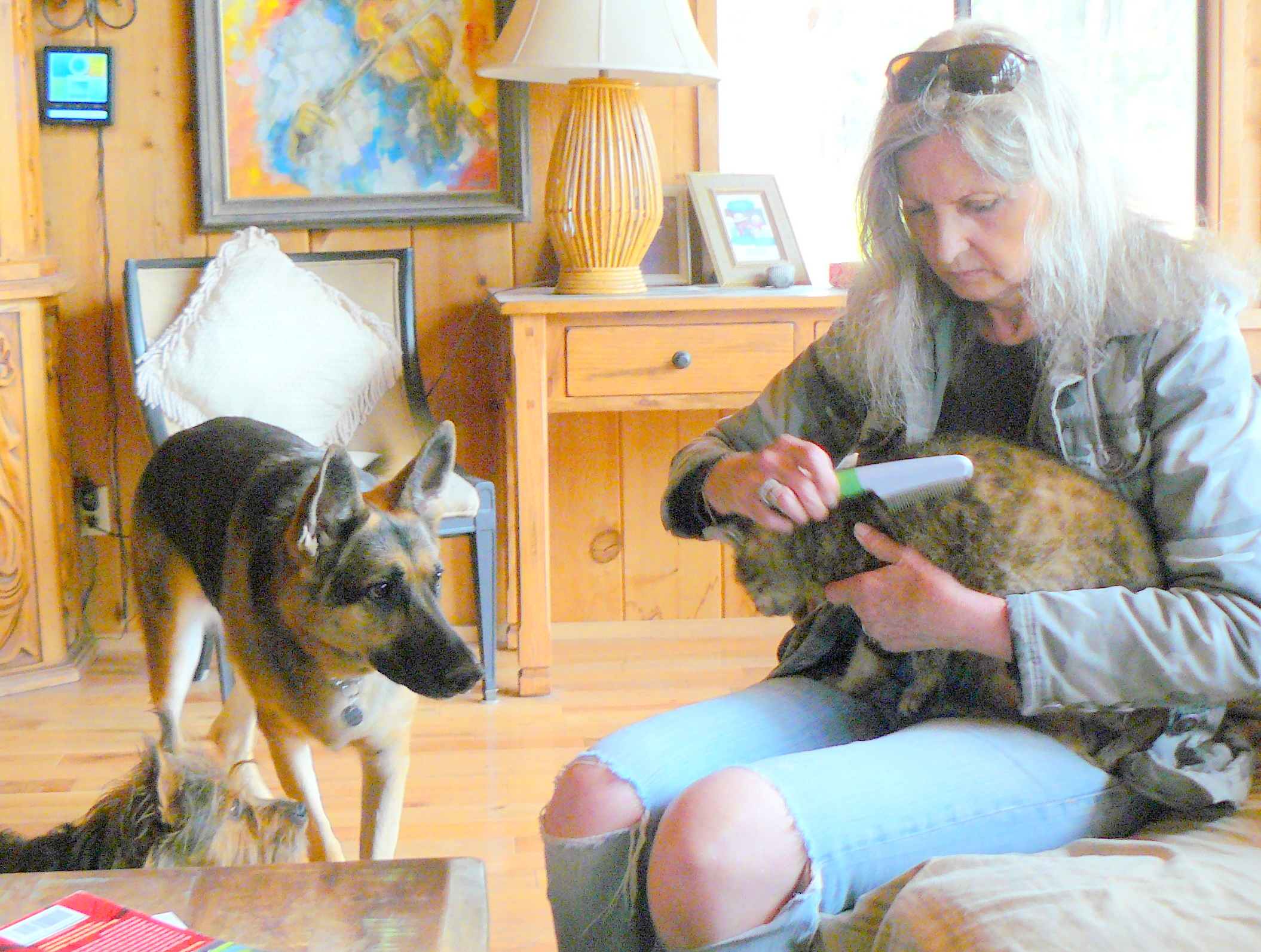
oooo

oooo

oooo

oooo

oooo

oooo

oooo

oooo

oooo
I hope to update you with the news of how the final two cats make the transition into the house in two or three weeks time.
Like all dogs, they are beautiful animals.
Previously, I have mentioned the authors’ group AIM, that meets monthly in Grants Pass.
One of the authors is Frank Morin and he and I have a monthly chit-chat lunch together. Not so long ago, Frank posted a link on his Facebook page to the following video that shows the truth about Pit Bull dogs.
We have a Pit Bull here at home. His name is Casey and he is the perfect gentleman. You would never know that he was in a care centre for over a year because no one would give him a home, for there is not an emotional scar on him!

Please ensure you and your dogs have a great weekend.
A postscript to yesterday’s post.
There was a comment left on yesterday’s post that seemed a delightful reason to stay with the topic; more or less! This was the comment left by Tony.
“at the age of 70, I am already noticing the creeping onset of reduced verbal IQ, cognitive decline, and worry about the onset of dementia….”
Paul, I am 75 and lost an aunt to Alzheimer’s and a mother to dementia. I consider myself to also be at risk. There seems no defense, yet, against Alzheimer’s, but cardiovascular exercise is absolutely one against dementia. Cardio sends oxygen molecules to the brain which actually create new neurotransmitters. Check out my Page – Important Facts About Your Brain (and Exercise Benefits).
Nine days ago, dear friend Bob Derham from my UK days, emailed me the following (in turn, it had been sent on to Bob):
ooOOoo
This test will keep that dreaded disease that effects your memory at bay!
1) How long did the Hundred Years’ War last?
2) Which country makes Panama hats?
3) From which animal do we get cat gut?
4) In which month do Russians celebrate the October Revolution?
5) What is a camel’s hair brush made of?
6) The Canary Islands in the Pacific are named after what animal?
7) What was King George VI’s first name?
8) What color is a purple finch?
9) Where are Chinese gooseberries from?
10) What is the color of the black box in a commercial airplane?
Remember, you need only 4 correct answers to pass.
Check your answers below ….
 Learning from Dogs