Category: Communication

Buddhism and Humanism

Reflections on a very interesting meeting of our local Freethinkers group.

Last Saturday was the regular monthly meeting of our local Rogue Valley Freethinkers and Humanists. Many know that Jean and I are secular humanists and go as often as we can to these meetings in Grants Pass, Oregon.

Saturday’s meeting was all about Buddhism or more accurately as Jerry Reed, the group’s administrator, put it in a recent email:

For Saturday, Aug 5: Brenda will be our presenter/discussion leader. She will introduce us to Secular Buddhism, including comments on basic principles of Buddhism, and how traditional and secular Buddhism compare with each other, as well as on overlapping philosophical views of Buddhism and Humanism.

This video link provides a discussion between a humanist, Scott Lohman, and a secular Buddhist, Ted Meissner, which may help to familiarize you with Brenda’s topic prior to our meeting. It is about 29 minutes long, all interesting, but if you are cramped for time, especially the segment from about 10:30 to 16:30 which discusses basic Buddhist principles that might also relate to humanism, and another segment from about 19:30 to 27:00 on advice to a beginner who might want to try meditation, and how Star Trek borrowed from Buddhism, and also about the similarity of ethical focus of Buddhism and Humanism.

What I would hope is that if any of you are interested in this subject, then do watch the interview with Ted Meisser conducted by Scott Lohman .
Here it is.

Here follow links to the organisations represented by Scott and Ted Meissner. For Scott the Humanists of Minnesota, and for Ted the Secular Buddhist Association.

If you do watch the video you will undoubtedly pick up on the science now discovering that meditation does change the brain … for the better!

More on that tomorrow!

Picture Parade Two Hundred and Seven

Those precious dogs saved from the meat trade.

On the 26th July I posted an item about the work of The Humane Society in saving dogs. I included a very moving photograph and promised to include the rest of the photographs in a Picture Parade. Well, here they are including the one I republished.

oooo

oooo

oooo

oooo

oooo

oooo

Wonderful!

Annie’s Second Chance.

My very great pleasure to publish today’s guest post.

Regulars of this place know that I am always open to any one of you sending in a guest post. Indeed, any involvement that comes to mind is welcome.

A couple of days ago in came an email from Kristin. She blogs about her shared life with very large dogs. Kristin’s email was an offer of a guest post for you dear readers. Of course, I said ‘yes’.

In reply to me asking for some background information, Kristin responded with the following:

I don’t really have a preference about what to say about me. Basically, as my kids get older and more independent I keep bringing in another dog!

Newfoundlands are my breed of choice, I love their sweet dispositions, the way they look, the bonds they form and the way they love to work.  I’ve learned a lot about rescue as well as ethical breeding practices since I adopted Annie and my greatest wish is to see all puppy mills shut down. I started writing Annie’s story, which led to the blog, and at some point would love to work with someone to make it better and figure out how to make it a fundraising tool for rescue organizations.

I’m not a trained writer, I just write from the heart. I write about anything that happens to be going on with me and the dogs which covers a lot of subjects. I just try to keep the focus on the dogs and my relationship with them.

Forget about Kristin not being “a trained writer” and just immerse yourself in this beautiful guest post.

ooOOoo

Oh happy day!

August 1, 2017

Annie and I had a big day today.  A day that changes everything! It was time for her rabies shot so our big date was a trip to the vet.  Annie and I have made many of these trips over the last year-and-a-half, but this time was very different.

When Annie was surrendered to rescue, the only document that came with her was her 2014 rabies certificate.  By the time she came home with us a year later, the rabies tag was long gone and the certificate we received was in pretty rough shape but the story it told was clear to me.

It’s a copy of a fax and is crooked and faded. On multiple occasions I’ve had to pull it out of her file when asked to show proof of vaccination.  Each time I pull it out, the anger bubbles up because it is a reminder in black and white of her life before us.

The owner’s name and address belongs to the man that operated the kennel/puppy mill.  It’s easy for me to say that even though I’ve never met him, I hate him.  Her name is listed as Anne, but “Paris” is written next to it. Why does she have two names? I don’t know.  Her age is listed as 7, although she had just had a birthday and was actually 8. Her weight is listed as 00. Record keeping was obviously not a priority with these dogs.  There are other notes that are hard to read, but are the vaccinations that she received after she was rescued. At the top are the words Annie Paris, blaze and orange collar.  The final glaring bit of information is the list of vaccinations done which only includes 2 things, the one she received that day and another rabies shot she received May 23, 2008!

(Names and addresses have been edited)

These are all broad strokes that paint a picture of neglect. After 6 years, what compelled him to seek out a vet to administer a 3 year rabies vaccination? Who knows, but what really bothers me concerns the veterinarian. There is no way he could have examined her and thought that she or any of the other dogs from that kennel were receiving proper care. The conditions they were forced to live in were unsanitary and disgusting. Knowing Annie as I do, they would have had to drag her to him, with her trembling and cowering.

So now, here’s the good news. Annie came to us with a broken spirit on the mend thanks to her rescuers and now she is a completely different dog. She’s happy and loving, she has a spring in her step and a twinkle in her eye. She regularly approaches me and nudges my hand for a scratch behind the ear. She walks on leash beautifully and loves our neighborhood patrols. She comes running when she hears the scoop in the dog food or the word “treat”. She doesn’t hide in her crate anymore but instead sprawls out all over the house, moving around, finding a comfy spot on the cool tile or under my feet or on the rug in the next room. She’s quick to come when I’m having training time with Winn and she will do her two tricks, sit and down, with precision so she can also get treats. She joins me in the kitchen when I’m cooking, confident that she will get a nibble now and then. At the end of every day, we climb the stairs together, I give her her eye drops and then she collapses on her Big Barker bed and lets out a sigh of contentment.

So this time going to the vet was different. Yes, she trembled as we were waiting, it took a lot of gentle coaxing to get her into the room and she wasn’t overly enthused about the attention she was getting but we both eagerly left with a treasure in my hands. I now have a proper certificate with both of our names in print. It is signed by a Dr. who lovingly cares for her and is genuinely invested in her well-being. The final reminder of her previous life can go in the trash. We belong to each other, and we have no reason to ever look back again!

ooOOoo

I’m not going to take anything away from Kristin’s most beautiful story. All I will do is to repeat her last sentence: “We belong to each other, and we have no reason to ever look back again!

That is perfect! Thank you, Kristin and Annie!

Looking ahead!

The joys of installing new flooring!

In a number of the rooms here at home we still have down on the floor the carpeting that was in the house when we moved in 5 years ago. As you might imagine that carpet, being slept on daily by cats and dogs, is also home to a range of uninvited ‘guests’. That song title comes to mind: “The hills are alive ….”.

A while ago we replaced the carpet in our main living-room with oak flooring and now we are replacing just about all the rest of the carpet in our house with laminate boarding that is a very good match with the oak flooring.

One of the rooms that is affected is my office and although the installers will only be working for the three days of the 16th to the 18th August, the rooms will need to be emptied out of all furniture a few days before the 16th.

Ergo, I expect to be ‘off air’ for about a week. Probably from Sunday, 13th August through to Sunday, 20th August.

During those days I won’t be able to respond to your replies to posts. But I will put up posts for each of those days well ahead of the 13th.

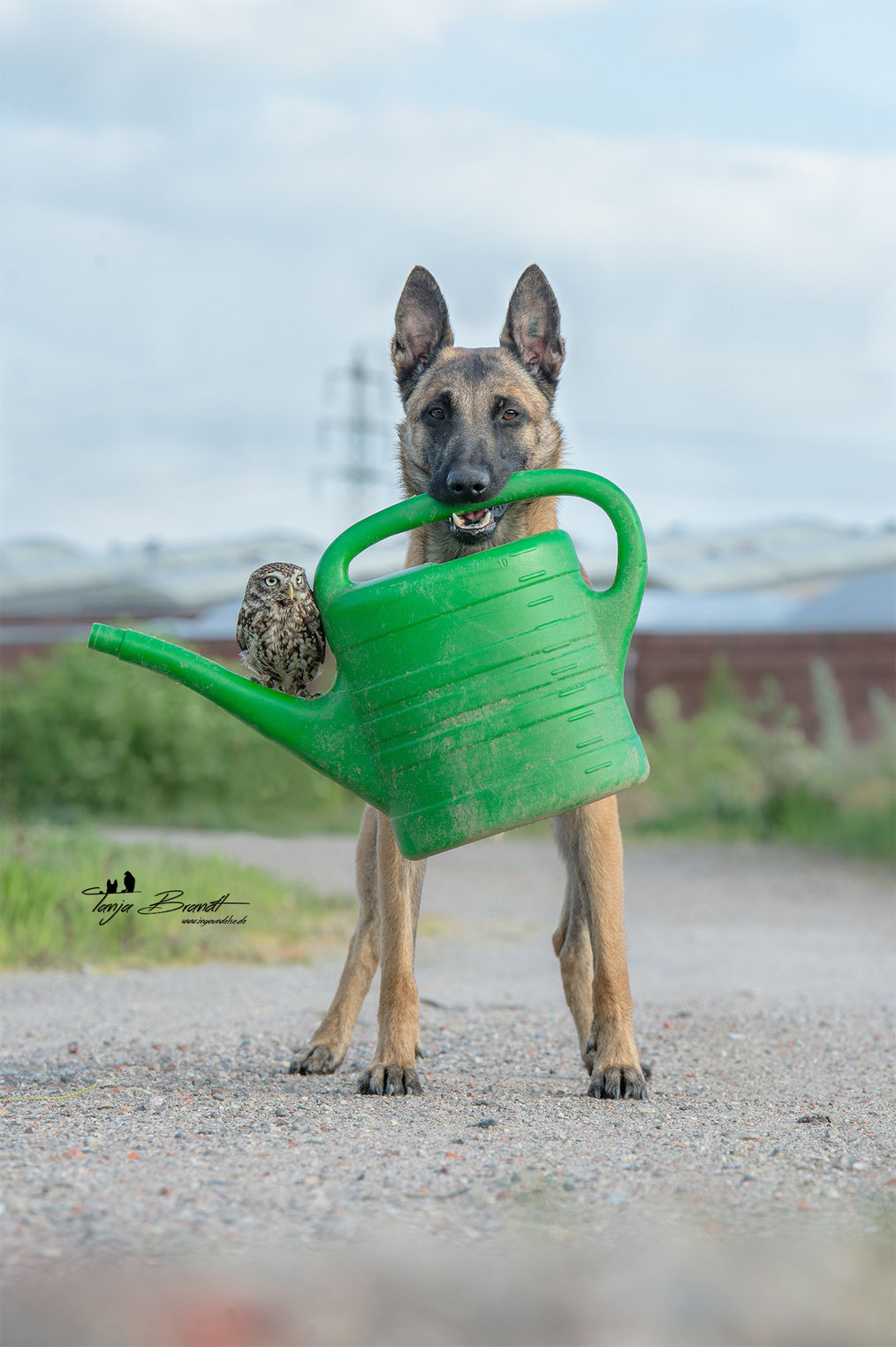
What I will post is something that Suzann emailed Jean the other day. It’s the wonderful story of a Belgian Shepherd dog befriending an owl. This is what was included in Suzann’s email:

ooOOoo

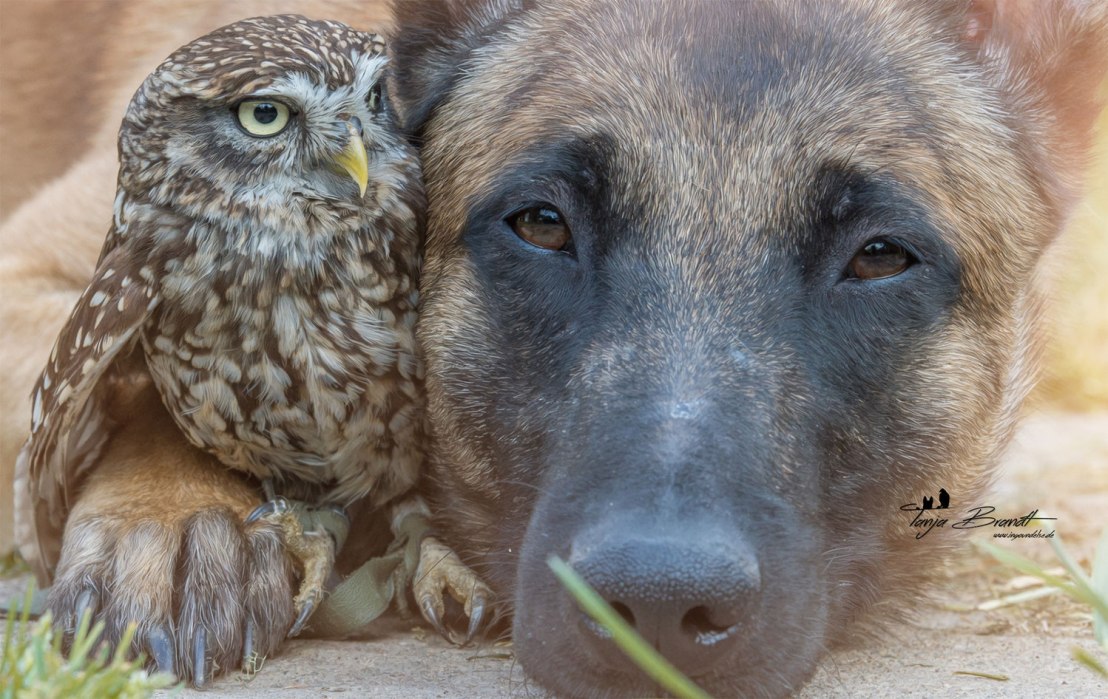
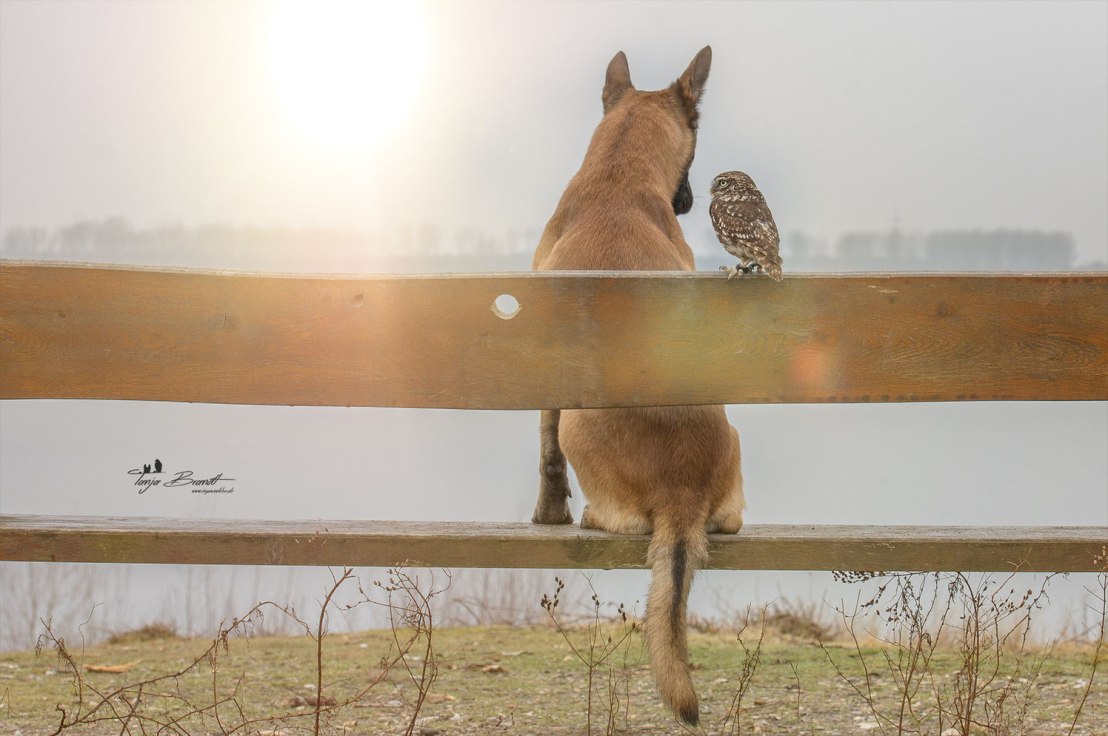
For years, photographer Tanja Brandt has made it her mission to capture magnificent photos of animals and wildlife. Recently, the German artist found a new challenge when she photographed the unique bond between two unlikely friends: Ingo, a Belgian shepherd, and Poldi (Napoleon), a one-year-old owlet.

The owlet and canine have a special “protector-protected” relationship and that their affection towards each other couldn’t be any more evident. Ingo lovingly guards Poldi, who apparently “doesn’t know how to live free.”
The owlet, hatched two days after his six brothers and sisters, therefore, has always been very vulnerable due to his small size. Comparatively, Ingo was raised by a family of strong, and oftentimes ruthless, police dogs.

“They respect each other and they can read each other,” says the photographer.

ooOOoo

There are many photographs of Ingo and Poldi and they will make up the posts for you all for that week of the 14th August.

We are of the stars!

I so relate to this item from EarthSky News!

Long-term readers of this place will possibly recall that between April, 1989 and June, 1994 I lived on a Tradewind 33 sailing yacht Songbird of Kent. I have written before about those days.

Songbird of Kent. My home for five years.

When sailing at night when the sky is clear it is impossible not to feel deeply connected to the stars above one’s head.

My logbook for Songbird of Kent reports that at noon on Wednesday, 1st June, 1994, I departed the yacht harbour at Horta in The Azores bound for Plymouth, South-West England. Plymouth was 1,257 nautical miles (2,329km/1,447 statute miles) from Horta.

Horta on Faial Island of the Azores

The logbook has an entry for the 6th June.

0400 Lat. 43 deg 25 minutes North, Long 22 deg 3 minutes West. Engine Off. Still no wind but must sleep after 19 hours of helming. 840 miles to run. Wind 2 knots from SW. Baro 1027 mb, Viz Good.

The visibility was wonderful and seeing the stars up in the night sky all around me, as in all 360 degrees about me, practically down to the horizon on this moonless night is an image still etched in my mind.

That’s why I want to republish this article that appeared on the blog EarthSky News yesterday.

ooOOoo

We are galaxy stuff

A new study – based on supercomputer simulations – reveals that each one of us may be made in part from matter that passes from one galaxy to another.

This image shows M81 (bottom right) and M82 (upper left), a pair of nearby galaxies where intergalactic transfer – transfer of materials between galaxies – might be happening. Image via Fred Herrmann.

Sagan famously said that we are made of star stuff. He meant the carbon, nitrogen and oxygen atoms in our bodies, as well as atoms of all other heavy elements, were created inside stars. Yet Sagan’s expression of this idea, which quickly became a cornerstone of popular culture, might not take the concept far enough. According to astrophysicists at Northwestern University, our origins are much less local than previously thought. In fact, according to their analysis – which they say is the first of its kind – we’re not just star stuff. We’re galaxy stuff.

This study is being published on July 26, 2017 (July 27 in the U.K.) by the peer-reviewed journal Monthly Notices of the Royal Astronomical Society.

The Northwestern researchers found that up to half of the matter in our Milky Way galaxy may come from distant galaxies. As a result, each one of us may be made in part from extragalactic matter. That is, atoms of carbon, nitrogen, oxygen and so on in our bodies may be created not just by stars in our own Milky Way galaxy, but by stars in far-flung galaxies.

They arrived at this conclusion using supercomputer simulations. The study required the equivalent of several million hours of continuous computing.

The simulations show that supernova explosions eject great quantities of gas from galaxies, which causes the atoms made inside stars to be transported from one galaxy to another via powerful galactic winds. According to their statement, intergalactic transfer is a newly identified phenomenon, which, they say, requires supercomputer simulations in order to be understood. According to these astrophysicists, this understanding is critical for knowing how galaxies evolve … and hence for knowing our own place in the universe.

Animation of gas flows around a Milky Way-like galaxy, as seen by the team’s computer simulations.

Daniel Anglés-Alcázar is a postdoctoral fellow in Northwestern’s Center for Interdisciplinary Exploration and Research in Astrophysics (CIERA). He led the study, and he said:

It is likely that much of the Milky Way’s matter was in other galaxies before it was kicked out by a powerful wind, traveled across intergalactic space and eventually found its new home in the Milky Way.

Given how much of the matter out of which we formed may have come from other galaxies, we could consider ourselves space travelers or extragalactic immigrants.

Space is vast. Galaxies are located at almost inconceivable distances from each other. So, Alcázar and his team said, even though galactic winds propagate at several hundred kilometers per CIERA second, the process of intergalactic transfer occurs over billions of years.

As always, this new research built on earlier studies. Northwestern’s Claude-André Faucher-Giguère and his research group, along with a unique collaboration called Feedback In Realistic Environments (FIRE), had developed numerical simulations that produced realistic 3-D models of galaxies. These simulations followed a galaxy’s formation from just after the Big Bang to the present day.

Anglés-Alcázar then developed state-of-the-art algorithms to mine this wealth of data. In this way, he and his team were able to quantify how galaxies acquire matter from the universe.

The scientists say the prediction of intergalactic transfer can now be tested. The Northwestern team plans to collaborate with observational astronomers who are working with the Hubble Space Telescope and ground-based observatories to test the simulation predictions.

Simulated examples of intergalactic winds, shown as green string, in action around galaxies, shown as clusters of yellow dots. The galaxy at the center is ejecting the winds, blowing them toward potential the other galaxies.

Bottom line: Supercomputer simulations suggest that each one of us may be made in part from extragalactic matter. Hence, we are galaxy stuff.

ooOOoo

16th June, 1994

1945 Lat. 50 deg 21 minutes North, Long. 4 deg 10 minutes West. ARRIVED MAYFLOWER MARINA. Wind Nil. Baro 1023 Mb. Viz Good.

LOG CLOSED!

Mayflower Marina is at Plymouth.

Visiting the Vet – Hyperthyroidism

Lady Jessica isn’t feeling too well.

09:50 July 13th, 2017.

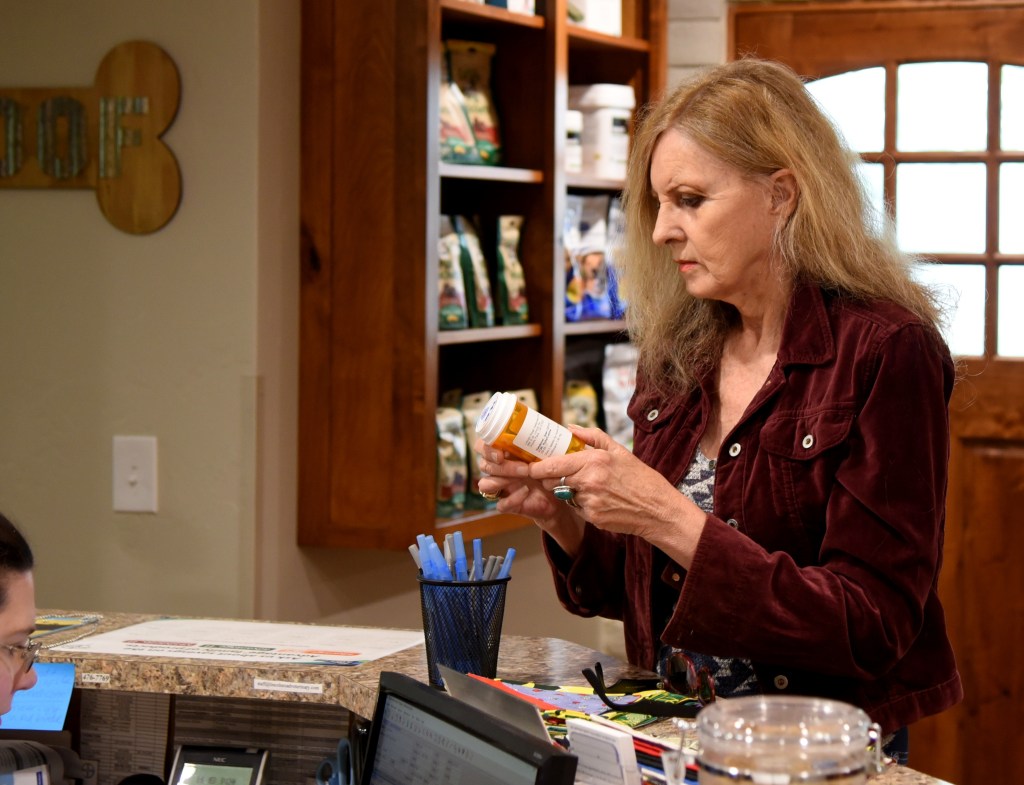
Jessica Louise is a 14-year-old cat that normally lives happily outside. But in recent times ‘Jessie’ has become very thin despite constantly eating and has now preferred to be inside the home even accounting for the fact of there being dogs in the house.

Jim’s pretty certain that he is looking at a cat with a hyperthyroid thyroid gland. No question that a blood test is needed and the blood sample is taken without delay.

The results are soon back and confirm that Jessie’s T4 readings of >8.00 mg/dL are very high, indeed beyond the upper limit of their testing equipment. Jim explains that the normal range for T4 is between 0.80 – 4.70 mg/dL.

The puzzled look on my face is seen by Jim and he takes a few minutes out to explain what a blood test accomplishes.

There are three parts to the blood test:

  1. The Complete Blood Count (CBC), that is the cellular part of the test.
  2. The chemistry of the blood, measuring the condition of the kidneys, liver, electrolytes, diabetic status as in blood glucose level, and more.
  3. The optional Part, a test for T4 Total Thyroxine level.

A very quick web search found this from which one reads:

Your dog or cat’s T4 (Total T4) is a useful screening test to detect an under-active thyroid gland (hypothyroidism) in dogs or an over-active one (hyperthyroidism) in cats. But total T4 levels are a considerably more accurate way to diagnose an overly active thyroid gland in your cat than an under-active thyroid gland in your dog.

Jim prescribes Methimazole. Once again, back at my desk a quick web search for Methimazole For Cats finds:

What is Methimazole?

Methimazole is used to treat hyperthyroidism in cats. It has largely replaced propylthiouracil in this treatment process since it has a lower incidence of adverse side effects. Methimazole requires a prescription from your veterinarian, and is sold per tablet.

(This is only one of many products found online!)

Jim weighs Jessie and finds that she is 4lbs 12 oz. Her weight should be in excess of 8 lbs.

The clinic protocol is that Jessie should not be seen until at least 45 days has elapsed. But Dr. Jim underlines that Jessie should be brought back in to the clinic before then if there is no weight gain soon or, especially, if Jessie continues to lose weight.

10:05 All done.

To be continued:

(Please note: These observations are mine alone and because of the busy environment it must be assumed that my interpretation of what was taking place might not be totally accurate. Nothing in this blog post should be used by a reader to make any medical judgment about an animal. If you have any concern about an animal do make an appointment to see a properly qualified veterinarian doctor.)

ooooo

Good people, may I ask for your assistance.

Best explained by sharing part of a recent email sent to Yvonne D. who has offered her help with my book project. In past times, Yvonne was a Veterinary Technician.

Dear Yvonne,

My Visiting the Vet theme on Learning from Dogs has awakened within me the interest and passion to write my second book. Or, to put it more accurately, to switch away from the present theme that I have been struggling to get stuck into for months.

I spoke with Russel Codd at the clinic and he is really keen to support me.

The overall idea that is forming in my mind is to write a book that alternates, chapter by chapter, between observing the medical and clinical goings-on at a number of vet clinics in town, including specialist processes, surgery, cardiac, etc., and chapters that look deeply into the many different relationships that individuals have with their pets; primarily with dogs and cats.

I want to get into the ‘mindset’ of people who have pets in their lives across the whole range of feelings of those said people. From those who love their pets practically without any limit, to the homeless people (almost 100% men) whom one sees with a dog or two in tow alongside the highway. But also exploring those who seem so hateful. E.g. our pet sitter knows a man who threw his elderly dog away in some local woods. What causes someone to be like this? I want to find out!!

The book will be called: Of Pets, and Of People.

With very kind wishes,

Paul

Copyright (c) 2017 Paul Handover

Any feedback at all would be fabulous! What would you like to see in such a book? What would you most definitely not want to read?

Saturday smile time!

Cute beyond words!

Published on Jul 13, 2017

5-month-old Angus the Golden Retriever loves his local beach on Port Phillip Bay in Seaford, Melbourne. After seeing crabs run through the shallows he chases straight for them, frantically trying to catch what he spotted. Awesome!

Have a great weekend!

New ideas about our relationship with dogs.

What a delight to read this latest scientific news.

There’s so much ‘doom and gloom’ to be seen on the news services across the world that a genuine discovery that enlarges the mind is always a treat. Now make that a discovery about our dogs. Better still, let the BBC do it for you.

ooOOoo

How did dogs become our best friends? New evidence

19 July 2017

Dogs most probably evolved from wolves at a single location about 20,000 to 40,000 years ago, a study suggests.

Previously, it had been thought that dogs were tamed from two populations of wolves living thousands of miles apart.

Researchers studied DNA from three dogs found at archaeological sites in Germany and Ireland that were between 4,700 and 7,000 years old.

The ancient canines share ancestry with modern European dogs.

By looking at the rates of change to the DNA from the oldest specimen, scientists were able to place the timing of the domestication of dogs to between 20,000 and 40,000 years ago.

Krishna Veeramah of Stony Brook University in New York is a researcher on the study.

He said the process of dog domestication began when a population of wolves moved to the outskirts of hunter-gatherer camps to scavenge for leftovers.

”Those wolves that were tamer and less aggressive would have been more successful at this,” he explained.

“While the humans did not initially gain any kind of benefit from this process, over time they would have developed some kind of symbiotic relationship with these animals, eventually evolving into the dogs we see today.”

DNA was obtained from the skull of an ancient dog.

The story of how dogs came to be tamed from wolves is complex and hotly debated.

Scientists believe dogs started moving around the world, perhaps with their human companions, about 20,000 years ago.

By 7,000 years ago, they were pretty much everywhere, although they were not the kind of dogs that we would consider pets.

”They would likely have resembled dogs we today call village dogs, which are free-breeding that did not live in specific people’s houses and have a similar look to them across the world,” said Dr Veeramah.

The dogs were later bred for their skills as hunters, herders or gundogs, eventually creating hundreds of modern breeds.

The research, published in Nature Communications, suggests even the dog breeds and village dogs found in the Americas and Pacific Islands are almost completely derived from recent European dog stock.

This is probably due to prolific dog breeding in Victorian times.

The dog skull inside an ancient burial chamber.

”In this regard, it appears therefore that our 7,000-year, Neolithic-old dog from Europe is virtually an ancestor to most modern breed dogs found throughout the world,” said Dr Veeramah.

”This ancestral relationship may even stretch back to the oldest dog fossil we know of, which is approximately 14,000 years old from Germany.”

Previous evidence suggested that the first domestic dogs appeared on opposite sides of the Eurasian continent more than 12,000 years ago.

Later, the eastern dogs moved with migrating humans and bred with those from the west, according to this theory.

Dr Greger Larson of the University of Oxford said it was great to see more ancient dog genomes being published.

“There is a fascinating story here and we’re only just scraping the surface,” he said.

“The more we get the more we might have a shot at finally unravelling the story of how we became such good friends over such a long time.”

Follow Helen on Twitter.

ooOOoo

Once read, it was but a moment to do a web search for Dr Veeramah and bring up the news of his research on the Stony Brook Newsroom.

ooOOoo

Study Reveals Origin of Modern Dog Has a Single Geographic Origin

Reported in Nature Communications, the finding counters previous research that suggested two domestication events led to the modern dog

Stony Brook, NY; Stony Brook University: Department of Ecology and Evolution Assistant Professor Krishna Veeramah. His research will be published in Nature and his study reveals origin of modern dog has a single geographic origin.

STONY BROOK, N.Y., July 18, 2017 – By analyzing the DNA of two prehistoric dogs from Germany, an international research team led by Krishna R. Veeramah, PhD, Assistant Professor of Ecology & Evolution in the College of Arts & Sciences at Stony Brook University, has determined that their genomes were the probable ancestors of modern European dogs. The finding, to be published in Nature Communications, suggests a single domestication event of modern dogs from a population of gray wolves that occurred between 20,000 and 40,000 years ago.

Dogs were the first animal to be domesticated by humans. The oldest dog fossils that can be clearly distinguished from wolves are from the region of what is now Germany from around 15,000 years ago. However, the archeological record is ambiguous, with claims of ancient domesticated dog bones as far east as Siberia. Recent analysis of genetic data from modern dogs adds to mystery, with some scientists suggesting many areas of Europe, Central Asia, South Asia and the Middle East as possible origins of dog domestication.

(L to R) Shyamalika Gopalan, PhD Candidate, Dean Bobo, Bioinformatics Scientist, and Krishna Veermah, Assistant Professor of Ecology & Evolution. (F) Four-legged friend, Joci

In 2016, research by scientists using emerging paleogenomics techniques proved effective for sequencing the genome of a 5,000-year-old ancient dog from Ireland. The results of the study led the research team to suggest dogs were domesticated not once but twice. The team from Oxford University also hypothesized that an indigenous dog population domesticated in Europe was replaced by incoming migrants domesticated independently in East Asia sometime during the Neolithic era.

“Contrary to the results of this previous analysis, we found that our ancient dogs from the same time period were very similar to modern European dogs, including the majority of breed dogs people keep as pets,” explained Dr. Veeramah. “This suggests that there was no mass Neolithic replacement that occurred on the continent and that there was likely only a single domestication event for the dogs observed in the fossil record from the Stone Age and that we also see and live with today.”

In the paper, titled “Ancient European dog genomes reveal continuity since the Early Neolithic,” Veeramah and colleagues used the older 7,000 year old dog to narrow the timing of dog domestication to the 20,000 to 40,000 years ago range.

They also found evidence of the younger 5,000 year old dog to be a mixture of European dogs and something that resembles current central Asian/Indian dogs. This finding may reflect that people moving into Europe from the Asian Steppes at the beginning of the Bronze Age brought their own dogs with them.

“We also reanalyzed the ancient Irish dog genome alongside our German dog genomes and believe we found a number of technical errors in the previous analysis that likely led those scientists to incorrectly make the conclusion of a dual domestication event,” added Veeramah.

Overall, he emphasized, their new genomic analysis of ancient dogs will help scientists better understand the process of dog evolution, even if the exact geographic origin of domestication remains a mystery. He expects further sequencing of the ancient genomes from Eurasia will help to eventually solve the issue.

The study and findings are a collaboration between scientists at Stony Brook University; the University of Michigan, Johannes Gutenberg-University, Germany; University of Bamberg, Germany; Trinity College, Ireland; and the Department of Monumental Heritage in Germany.

The research was supported in part by the National Institutes of Health.

###

 About Stony Brook University
Stony Brook University is going beyond the expectations of what today’s public universities can accomplish. Since its founding in 1957, this young university has grown to become one of only four University Center campuses in the State University of New York (SUNY) system with more than 25,700 students, 2,500 faculty members, and 18 NCAA Division I athletic programs. Our faculty have earned numerous prestigious awards, including the Nobel Prize, Pulitzer Prize, Indianapolis Prize for animal conservation, Abel Prize and the inaugural Breakthrough Prize in Mathematics. The University offers students an elite education with an outstanding return on investment: U.S. News & World Report ranks Stony Brook among the top 40 public universities in the nation. Its membership in the Association of American Universities (AAU) places Stony Brook among the top 62 research institutions in North America. As part of the management team of Brookhaven National Laboratory, the University joins a prestigious group of universities that have a role in running federal R&D labs. Stony Brook University is a driving force in the region’s economy, generating nearly 60,000 jobs and an annual economic impact of $4.65 billion. Our state, country and world demand ambitious ideas, imaginative solutions and exceptional leadership to forge a better future for all. The students, alumni, researchers and faculty of Stony Brook University are prepared to meet this challenge.

ooOOoo

Even better than the University providing the link to the above, it also gave me the good Doctor’s email address. I shall reach out to him and see if there is more that I can share with you!

There’s big, and then there’s really big!

There’s something about big dogs!

I’m not saying that I have a preference for big dogs just that there’s a difference in my mind as to how larger dogs interact with one.

Jean and Brandy at our local yard sale last weekend. (June 29th, 2016)

All of which elegantly leads into an item that was presented on Mother Nature News the other day and is shared with you all today.

ooOOoo

Removed because of copyright infringement.

ooOOoo

Here’s another wonderful photograph to close off today’s post.

Aren’t our dogs such wonderful, special friends!

One very lucky dog!

Don’t try this yourself!

(NB: For much of the next three days I am going to have my attention diverted elsewhere. So, apologies in advance if I am not as attentive as I try to be.)

This was seen on the BBC News website last Sunday.

ooOOoo

Dog survives after chasing stone off 150ft cliff

A cocker spaniel has survived a 150ft (46m) fall from a cliff in Somerset.

The dog, called Indy, plunged off Hurlstone Point, near Porlock, while chasing a stone during a walk with her owners.

Minehead’s lifeboat crew was scrambled to rescue her and found her among boulders at the foot of the cliff.

A spokesman said: “She had a few scratches and bumps and was very shaken up, but it could have been much worse.” (Ed: Understatement of the year!)

http://www.youtube.com/watch?v=Y7JGGsDnPv8

ooOOoo

A quick search brought up this item on Wikipedia:

Hurlstone point (grid referenceSS898492) is a promontory of land between Porlock Weir and Minehead in the Exmoor National Park on the coast of Somerset, England.

Hurlstone Point marks the boundary between Porlock Bay and Blue Anchor Bay in the Bristol Channel and is on the South West Coast Path.[1] There is a coastguard lookout shelter on the point.[2]

The rocks, including a large slab known as “coastguard wall” are popular with climbers.[3]

In 2007 a cyclist was rescued after falling 40 feet (12 m) down the cliff.[4]

References

  1. “Bossington to Selworthy”. Official Guide to the South West Coast Path. Natural England. Retrieved 24 March 2010.
  2. “Coastguard’s lookout at Hurlstone Point, Selworthy, Somerset”. Viewfinder National Monuments Record. English Heritage. Archived from the original on 6 June 2011. Retrieved 24 March 2010.
  3. “Hurlstone point”. UK Climbing.com. Retrieved 2008-08-09.
  4. “Cyclist rescued after cliff fall”. BBC News. BBC. 2007-05-03. Retrieved 2008-08-09.

Plus this photograph that only underlines how very lucky was Indy.