It has seemed like ages and ages but I am back in business.
To get us going here is another guest post from Indiana.
ooOOoo
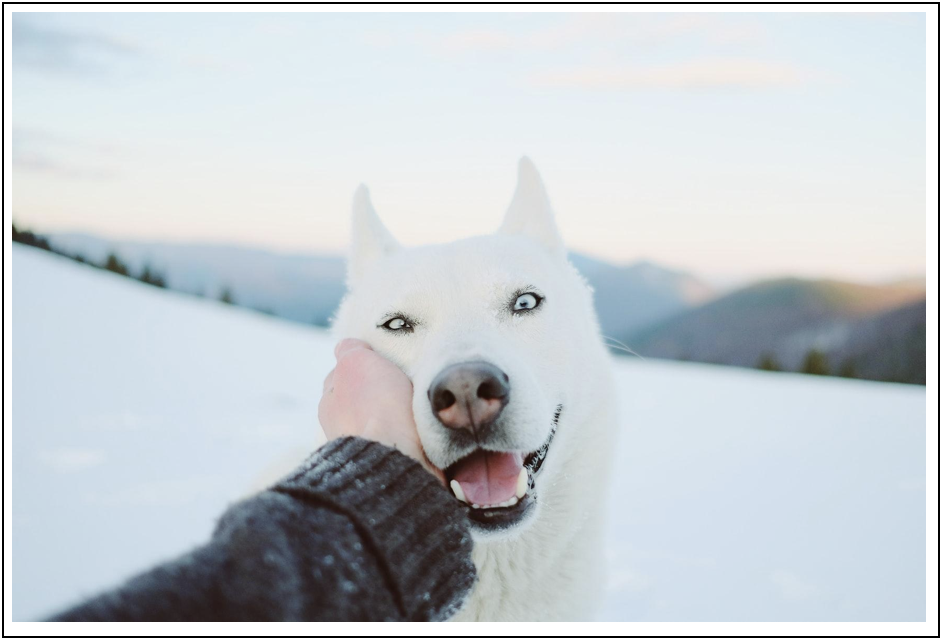
Image from Unsplash
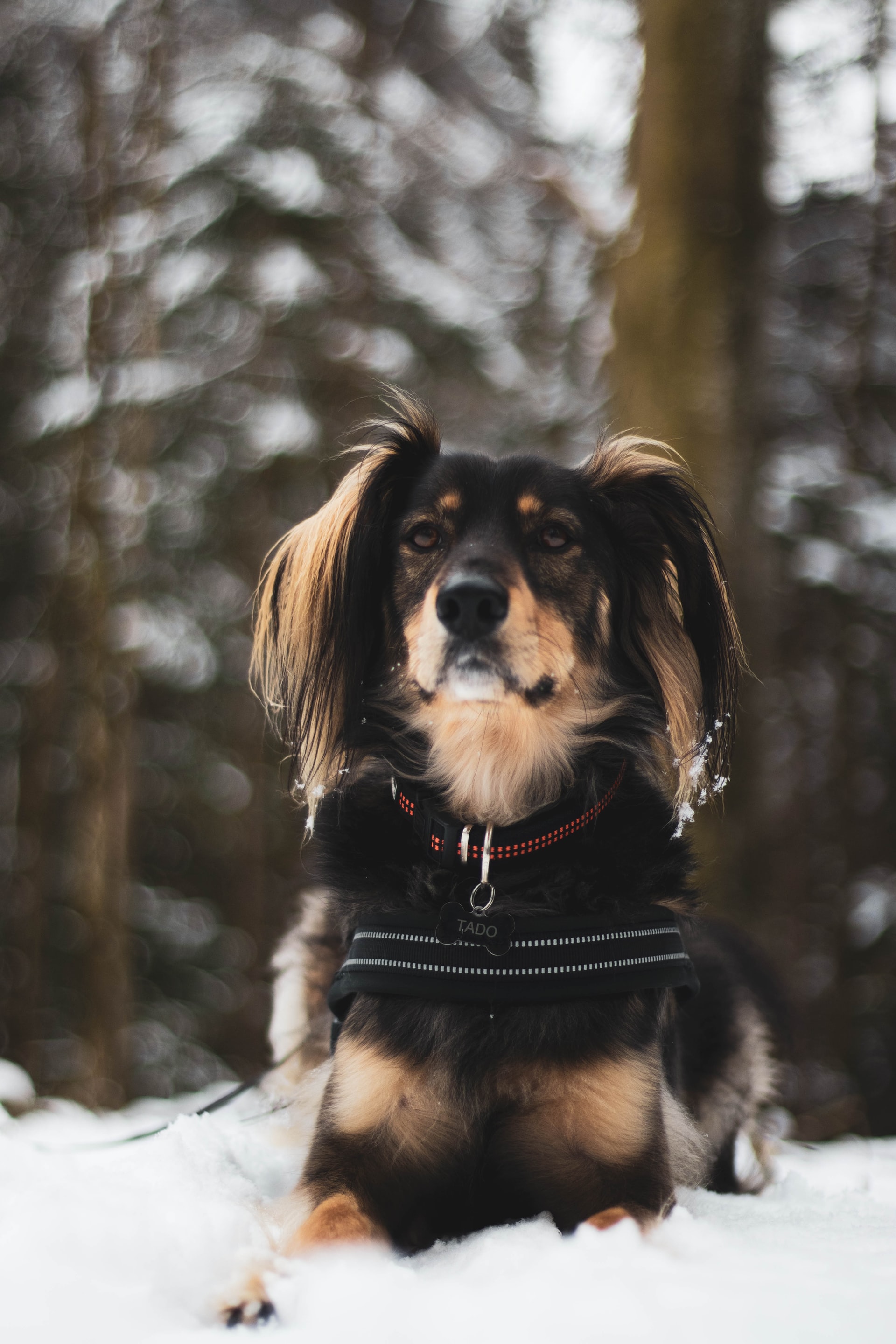
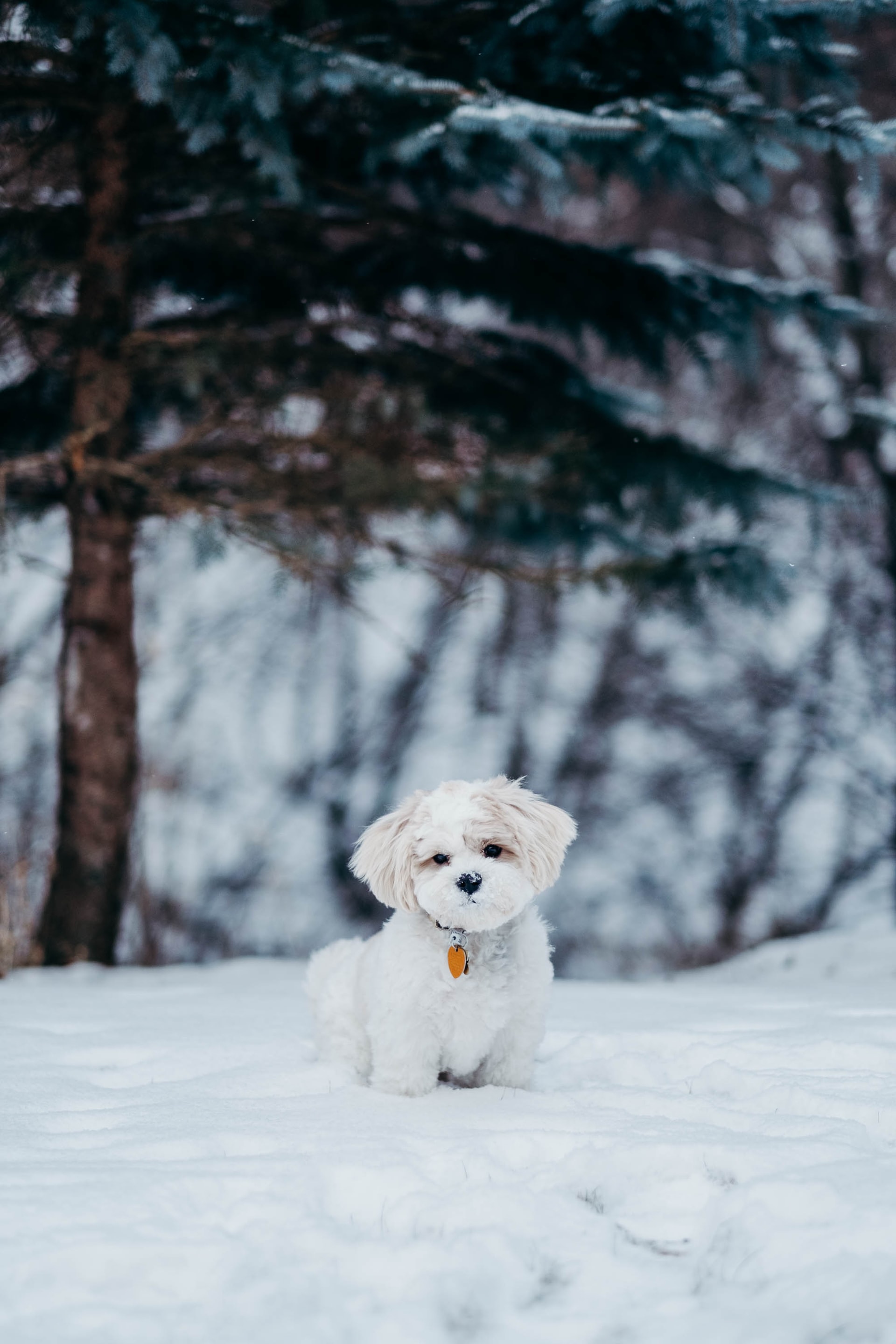
Winter Travel Considerations for You and Your Pup
When you’re traveling in the winter, it’s always important to take some extra precautions. If you live in a location that experiences a lot of snow, ice, or cold temperatures, keeping yourself safe should be your top priority.
But, when you’re traveling with your four-legged friend, making sure you’re even more prepared is crucial. Extra considerations should always be taken when you’re on the road with your dog. While no one wants to think about getting stranded or getting into an accident, things like that can (and do) happen. Being prepared, even if you’re only taking a short trip, will make all the difference when it comes to your own health and wellness as well as your pup’s well-being.
Winter travel can be dangerous depending on weather and road conditions. Planning should always be the first thing you do before heading out with your dog. Check your local forecast as well as what the weather is like where you’ll be traveling. If possible, avoid going anywhere when the road conditions are icy or snowy.
If you have to travel or you pick a clear day, it’s still important to make sure your drive is as safe as possible. Always adapt to the conditions you’re going through, and remember to drive slowly and cautiously on icy roads.
You should always have a few extra supplies in your car for your pup, but in the winter it’s even more crucial for their safety – as well as yours. Some of the basic items you should have packed include:
A first aid kit
An extra blanket
Extra clothes/gloves
Handwarmers
Extra food/water
A compact snow shovel
For your canine companion, having an additional blanket, plenty of water for them, and a toy or treat to keep them occupied will make a big difference.
If you get “stranded” anywhere for a while, don’t leave your dog in the car while you go look for help. While most pet owners understand the risks of leaving a dog in a hot car, leaving them in a cold vehicle can cause frostbite or hypothermia in a very short time. Stay with them until help arrives. Having your car stocked with the right items will keep you both safe and warm.
Make the Most of Your Travels
Traveling with your pup is a great way to break away from the potential “winter blues” that many people face. Whether you want to head somewhere warm or just embrace the season as is, getting out can actually improve your overall health and well-being. Spending time outdoors can reduce your stress levels, give you more energy, improve your mood, and even boost your testosterone levels. You don’t even have to chop down a tree to get that last benefit, so it’s really a win-win.
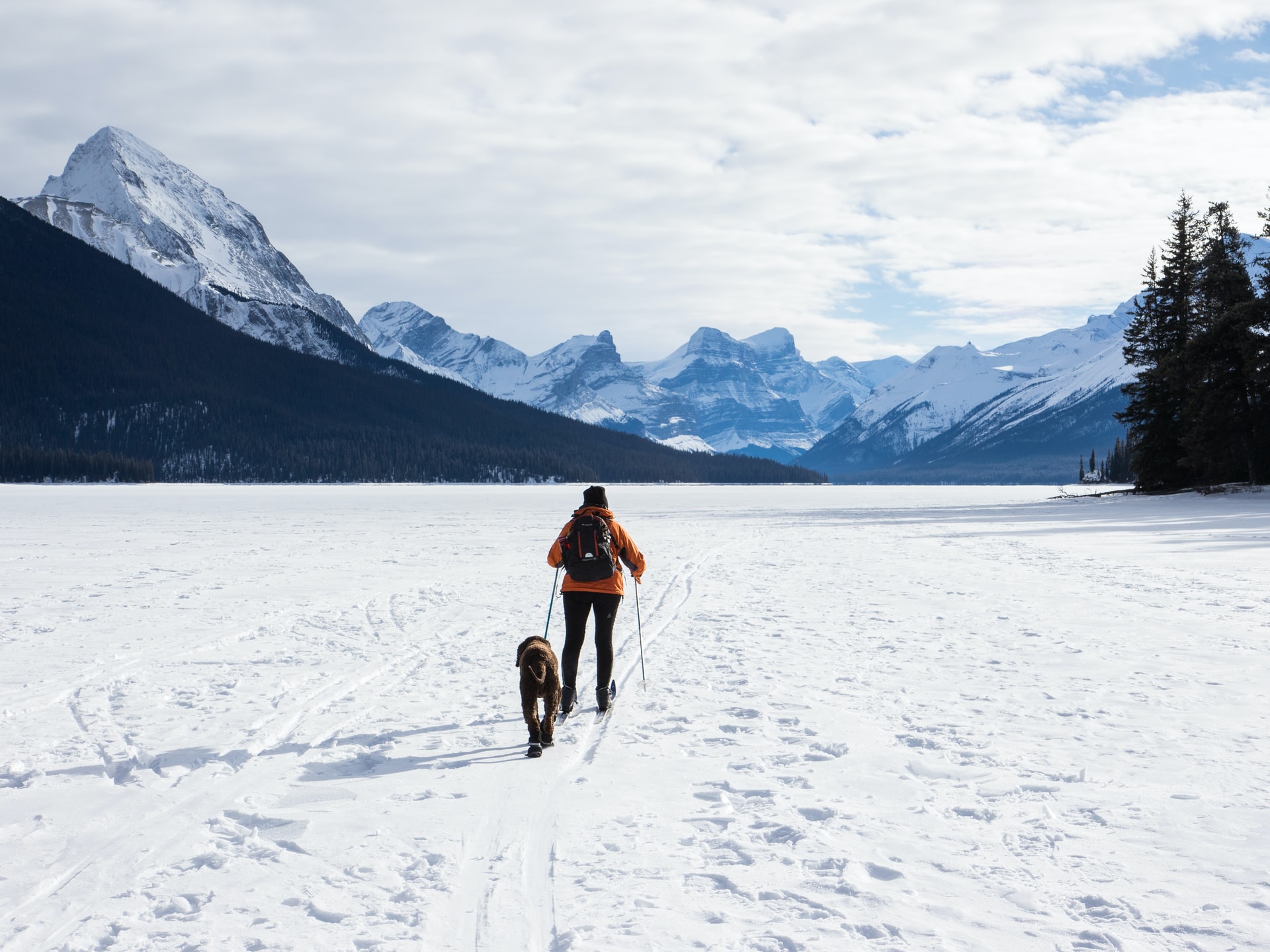
No matter where you’re going, make the most of your travels by sticking to your health and wellness goals. Dogs need exercise just as much as people, so bring your furry friend with you on snowy hikes, or take them cold-weather camping to enjoy nights beneath the stars together. Just make sure to stay hydrated, dress appropriately, and moisturize your skin if you’re spending a lot of time outdoors. Dry, cracked skin can be painful and unsightly. Don’t forget your pup’s paw pads, too!
With a bit of planning, preparing, and packing, you and your dog can enjoy plenty of travels together this winter. They’ll love being able to spend that extra time with you, and you’ll both be able to get as much out of the season as possible.
ooOOoo
That is a very good and relevant post to start me up again. Here in Merlin we have had very cold temperatures at night, -5 deg C (23 deg F.) during the night of the 22nd and predicted to be even colder tonight (the 23rd).
So going out with your dog for a winter trip does seem like an excellent idea!
When you’re traveling in the winter, it’s always important to take some extra precautions. If you live in a location that experiences a lot of snow, ice, or cold temperatures, keeping yourself safe should be your top priority.
But, when you’re traveling with your four-legged friend, making sure you’re even more prepared is crucial. Extra considerations should always be taken when you’re on the road with your dog. While no one wants to think about getting stranded or getting into an accident, things like that can (and do) happen. Being prepared, even if you’re only taking a short trip, will make all the difference when it comes to your own health and wellness as well as your pup’s well-being.
Winter travel can be dangerous depending on weather and road conditions. Planning should always be the first thing you do before heading out with your dog. Check your local forecast as well as what the weather is like where you’ll be traveling. If possible, avoid going anywhere when the road conditions are icy or snowy.
If you have to travel or you pick a clear day, it’s still important to make sure your drive is as safe as possible. Always adapt to the conditions you’re going through, and remember to drive slowly and cautiously on icy roads.
You should always have a few extra supplies in your car for your pup, but in the winter it’s even more crucial for their safety – as well as yours. Some of the basic items you should have packed include:
A first aid kit
An extra blanket
Extra clothes/gloves
Handwarmers
Extra food/water
A compact snow shovel
For your canine companion, having an additional blanket, plenty of water for them, and a toy or treat to keep them occupied will make a big difference.
If you get “stranded” anywhere for a while, don’t leave your dog in the car while you go look for help. While most pet owners understand the risks of leaving a dog in a hot car, leaving them in a cold vehicle can cause frostbite or hypothermia in a very short time. Stay with them until help arrives. Having your car stocked with the right items will keep you both safe and warm.
Make the Most of Your Travels
Traveling with your pup is a great way to break away from the potential “winter blues” that many people face. Whether you want to head somewhere warm or just embrace the season as is, getting out can actually improve your overall health and well-being. Spending time outdoors can reduce your stress levels, give you more energy, improve your mood, and even boost your testosterone levels. You don’t even have to chop down a tree to get that last benefit, so it’s really a win-win.
No matter where you’re going, make the most of your travels by sticking to your health and wellness goals. Dogs need exercise just as much as people, so bring your furry friend with you on snowy hikes, or take them cold-weather camping to enjoy nights beneath the stars together. Just make sure to stay hydrated, dress appropriately, and moisturize your skin if you’re spending a lot of time outdoors. Dry, cracked skin can be painful and unsightly. Don’t forget your pup’s paw pads, too!
With a bit of planning, preparing, and packing, you and your dog can enjoy plenty of travels together this winter. They’ll love being able to spend that extra time with you, and you’ll both be able to get as much out of the season as possible.
ooOOoo
I hope some of you are experiencing decent snowfalls. Here in Southern Oregon we had some snow but as soon as it was on the ground the next day it had gone. The outlook for the next ten days is cold and dry!
The article from George Monbiot came into my mailbox quite recently. Now of course Mr. Monbiot has a living to make and him publishing articles in the Guardian newspaper is normal. But I sensed that in this particular post he was worried. Worried about the situation regarding the planet and, by implication, all those who live on it.
I read yesterday on the UK Met Office blog about HILL events.
HILL events go beyond traditional weather extremes, potentially taking the climate system into uncharted territories. For example, much of the UK’s climate is predicated on two large elements of the climate system: the North Atlantic jet stream, a core of strong winds five to seven miles above the Earth’s surface, and the Atlantic Meridional Overturning Circulation (AMOC), a system of ocean currents which transports warm water northwards in the Atlantic.
Later on in that Met Office article it was said:
Prof Richard Betts MBE is the Head of Climate Impacts Research in the Met Office Hadley Centre and a Professor at the University of Exeter. Prof Betts, who led the team which prepared the Technical Report for the UK’s 3rd Climate Change Risk Assessment (CCRA3), is calling for a monitoring, attribution and prediction system that can provide early warning of HILLs. Professor Betts said: “With rising global temperatures, we are edging closer to the thresholds for more and more HILL events. Greater research into these events will help scientists advise policy makers on their thresholds and impacts.”
A week ago I wrote with real pride about the achievements of the James Webb Space Telescope (JWST). Later on I felt some shame that the focus on the real issue, that of climate change, was too low a priority for the US, let alone the world! Then I looked up the US expenditure on the military. Here’s a small quote from WikiPedia: “In May 2021, the President’s defense budget request for fiscal year 2022 (FY2022) is $715 billion, up $10 billion, from FY2021’s $705 billion.”[1] That puts the JWST into perspective. JWST cost ten billion dollars.
Expand one’s mind and just think of the global cost of war!
Here’s George Monbiot. Republished with his permission.
ooOOoo
Losing It
10th January, 2022
Faced with the gathering collapse of the biosphere, and governments’ refusal to take the necessary action, how do we stop ourselves from falling apart?
By George Monbiot, published in the Guardian 4th January 2022
No wonder journalists have slated it. They’ve produced a hundred excuses not to watch the climate breakdown satire Don’t Look Up: it’s “blunt”, it’s “shrill”, it’s “smug”. But they will not name the real problem: it’s about them. The movie is, in my view, a powerful demolition of the grotesque failures of public life. And the sector whose failures are most brutally exposed is the media.
While the film is fast and funny, for me, as for many environmental activists and climate scientists, it seemed all too real. I felt as if I were watching my adult life flash past me. As the scientists in the film, trying to draw attention to the approach of a planet-killing comet, bashed their heads against the Great Wall of Denial erected by the media and sought to reach politicians with 10-second attention spans, all the anger and frustration and desperation I’ve felt over the years boiled over.
Above all, when the scientist who had discovered the comet was pushed to the bottom of the schedule by fatuous celebrity gossip on a morning TV show and erupted in fury, I was reminded of my own mortifying loss of control on Good Morning Britain in November. It was soon after the Cop26 climate conference in Glasgow, where we had seen the least serious of all governments (the UK was hosting the talks) failing to rise to the most serious of all issues. I tried, for the thousandth time, to explain what we are facing, and suddenly couldn’t hold it in any longer. I burst into tears on live TV.
I still feel deeply embarrassed about it. The response on social media, like the response to the scientist in the film, was vituperative and vicious. I was faking. I was hysterical. I was mentally ill. But, knowing where we are and what we face, seeing the indifference of those who wield power, seeing how our existential crisis has been marginalised in favour of trivia and frivolity, I now realise that there would be something wrong with me if I hadn’t lost it.
In fighting any great harm, in any age, we find ourselves confronting the same forces: distraction, denial and delusion. Those seeking to sound the alarm about the gathering collapse of our life-support systems soon hit the barrier that stands between us and the people we are trying to reach, a barrier called the media. With a few notable exceptions, the sector that should facilitate communication thwarts it.
It’s not just its individual stupidities that have become inexcusable, such as the platforms repeatedly given to climate deniers. It is the structural stupidity to which the media are committed. It’s the anti-intellectualism, the hostility to new ideas and aversion to complexity. It’s the absence of moral seriousness. It’s the vacuous gossip about celebrities and consumables that takes precedence over the survival of life on Earth. It’s the obsession with generating noise, regardless of signal. It’s the reflexive alignment with the status quo, whatever it may be. It’s the endless promotion of the views of the most selfish, odious and antisocial people, and the exclusion of those who are trying to defend us from catastrophe, on the grounds that they are “worthy”, “extreme” or “mad” (I hear from friends in the BBC that these terms are still used there to describe environmental activists).
Even when these merchants of distraction do address the issue, they tend to shut out the experts and interview actors, singers and other celebs instead. The media’s obsession with actors vindicates Guy Debord’s predictions in his book The Society of the Spectacle, published in 1967. Substance is replaced by semblance, as even the most serious issues must now be articulated by people whose work involves adopting someone else’s persona and speaking someone else’s words. Then the same media, having turned them into spokespeople, attack these actors as hypocrites for leading a profligate lifestyle.
Similarly, it’s not just the individual failures by governments at Glasgow and elsewhere that have become inexcusable, but the entire framework of negotiations. As crucial Earth systems might be approaching their tipping point, governments still propose to address the issue with tiny increments of action, across decades. It’s as if, in 2008, when Lehman Brothers collapsed and the global financial system began to sway, governments had announced that they would bail out the banks at the rate of a few million pounds a day between then and 2050. The system would have collapsed 40 years before their programme was complete. Our central, civilisational question, I believe, is this: why do nations scramble to rescue the banks but not the planet?
So, as we race towards Earth system collapse, trying to raise the alarm feels like being trapped behind a thick plate of glass. People can see our mouths opening and closing, but they struggle to hear what we are saying. As we frantically bang the glass, we look ever crazier. And feel it. The situation is genuinely maddening. I’ve been working on these issues since I was 22, and full of confidence and hope. I’m about to turn 59, and the confidence is turning to cold fear, the hope to horror. As manufactured indifference ensures that we remain unheard, it becomes ever harder to know how to hold it together. I cry most days now.
Now there is very little that we folk can do. We can do our best but it all comes to nought. The real change is for governments, especially the governments of the US, China, Russia, the UK, and Europe, to make a difference soon.
Apart from being at the Club Northwest from midday for a couple of hours, yesterday morning was taken up by me making a sensor pole and installing it. Then when we returned from the Club it was a case of mounting the sensor, aligning it to the north, and making sure it was level and all in working order.
I had chosen a system from Ambient Weather, the WS-2902C, that we have high hopes for. My previous weather station, from Accurite, was windows compatible only and I have an iMac.
What is happening to Earth’s climate needs attention NOW!
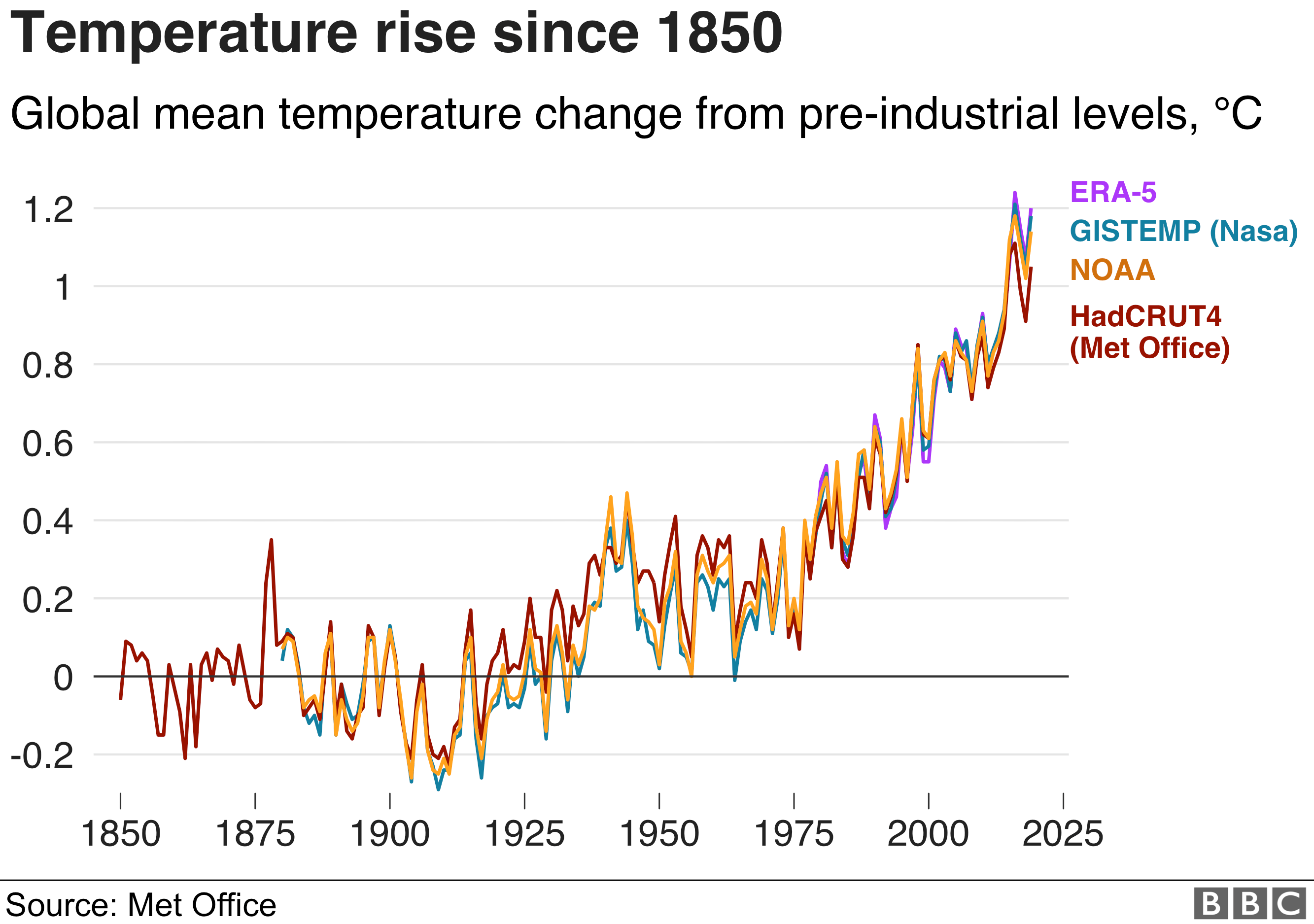
Two charts recently from the BBC News.
The 10 years to the end of 2019 have been confirmed as the warmest decade on record by three global agencies.
According to Nasa, Noaa and the UK Met Office, last year was the second warmest in a record dating back to 1850. The past five years were the hottest in the 170-year series, with the average of each one more than 1C warmer than pre-industrial.
The Met Office says that 2020 is likely to continue this warming trend.2016 remains the warmest year on record, when temperatures were boosted by the El Niño weather phenomenon.
This is the reality.
It affects every part of the world and it affects everyone. BUT! We, as in you and me, and everyone else, still haven’t got it.
The recent COP26 was progress and, especially, the next convention being held in a year’s time is important. But it is a long way from where we need to be. A very long way.
Patrice Ayme is someone that I follow and there have been times when I have gladly republished his posts. With his permission I should add.
Recently he published a post called Cataclysmic Seven Degree Centigrade Rise and I wanted to share it with you. Here is is:
ooOOoo
CATACLYSMIC SEVEN DEGREES CENTIGRADE RISE
Abstract: Expected rise of temperature in mountains correspond to a seven degree C rise. This informs global heating: in the long run, it will also be 7C. Large systems (Antarctica, Greenland) have greater thermal inertia, so their temperatures rise slower… But they will rise as much. In other words the so-called “forcing” by man-made greenhouse gases (which corresponds to 600 ppm of CO2) is universal, but the smaller the system, the faster the temperature rise…
****
Geographical systems with little thermal inertia (mountain glaciers) show an accelerated rate of heating of these parts which is only compatible with a seven (7) degrees rise in Celsius by 2100… A rise the IPCC of the UN considers impossible… But INERTIA says that it IS happening. The first thing this implies is that most forests will burn… worldwide. Then the ice shelves in Antarctica will follow.
TEMPS RISING ULTRA FAST IN MOUNTAINS
Anybody familiar with mountains worldwide know that temperatures are rising extremely fast: large glaciers I used to know have completely disappeared.. As in Chacaltaya, Bolivia. Or Portage, Alaska. The closest glacier to an Alpine village I went to as a child has been replaced by a larch forest (melezes)… One reason for this is that mountains are smaller in frozen mass than immense ensembles like Greenland and Antarctica. Moreover, the mountains’ permafrost is not as cold.
From 1984 to 2017, the upper reaches of the fires in the Sierra Nevada of California rose more than 1,400 feet. Now the temperature in the lower atmosphere decreases by 7C every 1,000 meters. There are many potential factors to explain why fires go higher (although some contradict each other). To avoid paralysis by analysis, I will assume the rise in fires is all due to temperature rise. So what we have here is a 2.5C rise in 33 years.
….FROM SMALLER THERMAL INERTIA:
Mountain thermal capacity is accordingly reduced relative to those of Greenland and Antarctica. The proportionality factors are gigantic. Say the permafrost of a mountain range is of the order of 10^4 square kilometers, at a depth of one kilometer (typical of the Sierra Nevada of California or the Alps at a temp of -3C. By comparison, Antarctica is 14x 10^6 sq km at a depth of 4 kilometers of permafrost at a temp of -30C. Thinking in greater depth reveals the proportions to be even greater: individual mountains are of the order of square kilometers. This means that (using massively simplified lower bounds), Antarctica has a mass of cold which is at least 4 orders of magnitude higher than a mountain range: to bring Antarctica to seriously melt, as mountain ranges are right now, would require at least 10,000, ten thousand times, as much heat (or maybe even a million, or more, when considering individual mountains).
As it is, mountains are exposed to a heat bath which makes their permafrost unsustainable. From their small thermal inertia, mountains warm up quickly. Greenland and Antarctica, overall, are exposed to the same bath, the same “forcing”, but because they are gigantic and gigantically cold, they resist more: they warm up, but much slower (moreover as warmer air carries more snow, it snows more while Antarctica warms up).
I have looked, in details at glaciologists records, from the US to Europe… Everywhere glaciologists say the same thing: expect a rise of the permafrost line of 1,000 meters… That corresponds to a SEVEN DEGREE CENTIGRADE RISE. Basically, while glaciers were found down to 2,500 meters in the Alps (some can still be seen in caves)… Expect that, in a few decades, none will occur below 3,500 meters… Thus speak the specialists, the glaciologists…
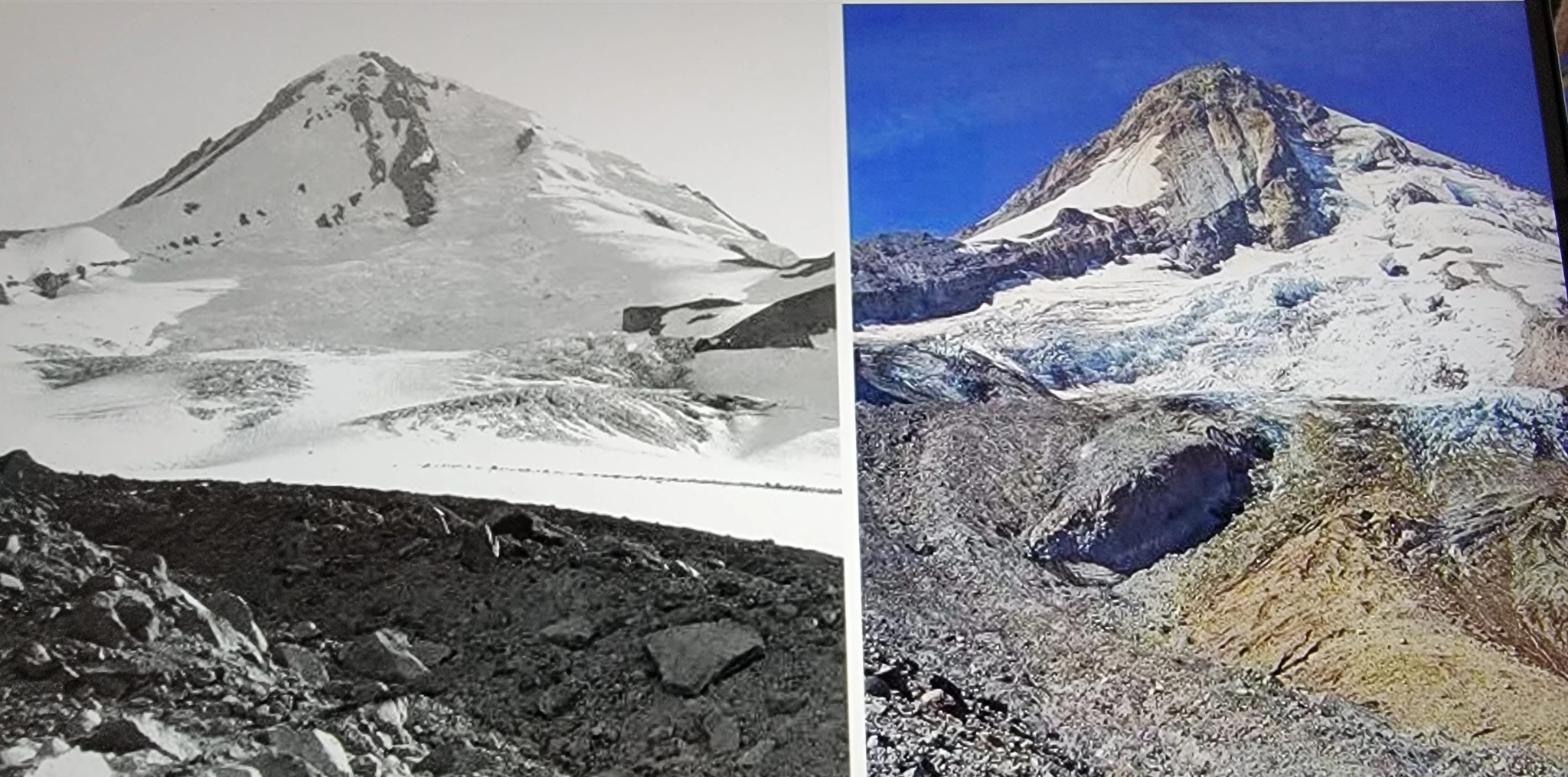
Mount Hood, Oregon, in August 1901 on the left, and August 2015, on the right. The Eliot glacier, front and center, which used to sprawl for miles, is in the process of disappearing completely.
What is happening then, when most climate scientists speak of holding the 1.5 C line (obviously completely impossible, even if humanity stopped emitting CO2 immediately)???… Or when they admit that we are on a 2.7C future in 2100? Well, those scientists have been captured by the establishment… They say what ensure their prosperous careers… At a global rise of 2.7 C, we get a migration of the permafrost line of around 500 kilometers towards the poles… Catastrophic, yes, but still, Antarctica will not obviously start to melt, big time.
If it came to light that a seven degree centigrade rise is a real possibility, authorities would turn around and really do some things, which may destabilize the worldwide plutocratic establishment: carbon tariffs are an obvious example. Carbon tariffs could be imposed next week… and they would have a big impact of the CO2 production. So why are carbon tariffs not imposed? Carbon tariffs would destabilize the deindustrialization gravy train: by employing who are basically slaves in poor countries, plutocrats make themselves ever wealthier, while making sure there would be no insurrection at home… A trick already used in imperial Rome, by the Senatorial aristocracy/plutocracy. That would be highly effective… By the way, without saying so, of course, and maybe even unwittingly, this is basically what Trump had started to do…
The devil has these ways which the commons do not possess…
That would stop the crafty, dissembling nonsense that countries such as France are at 4.6 tons per capita of CO2 emissions per year… That’s only true when all the CO2 emitted to produce the goods the French need is NOT counted.. including deforestation in Brazil to grow soybean. With them counted, one gets to 11 tons or so, more than double… The wonderful graph of CO2 emissions collapsing in Europe is the same graph as collapsing industrial production…
The devil has these ways the commons have not even detected…
Carbon tariffs would be a way to solve two wrongs in one shot: the wrong of deindustrialization, of corrupt pseudo-leaders not putting the most advanced countries, their own countries, first… And the wrong of producing too much CO2.
Little fixes will go a long way, as long as they incorporate hefty financing fundamentally researching new energy (it does not really matter which type, as long as it is fundamental…)
Patrice Ayme
ooOOoo
Now this isn’t some academic treatise that doesn’t affect the likes of you and me. This is, as I have said, the harsh reality of NOW!
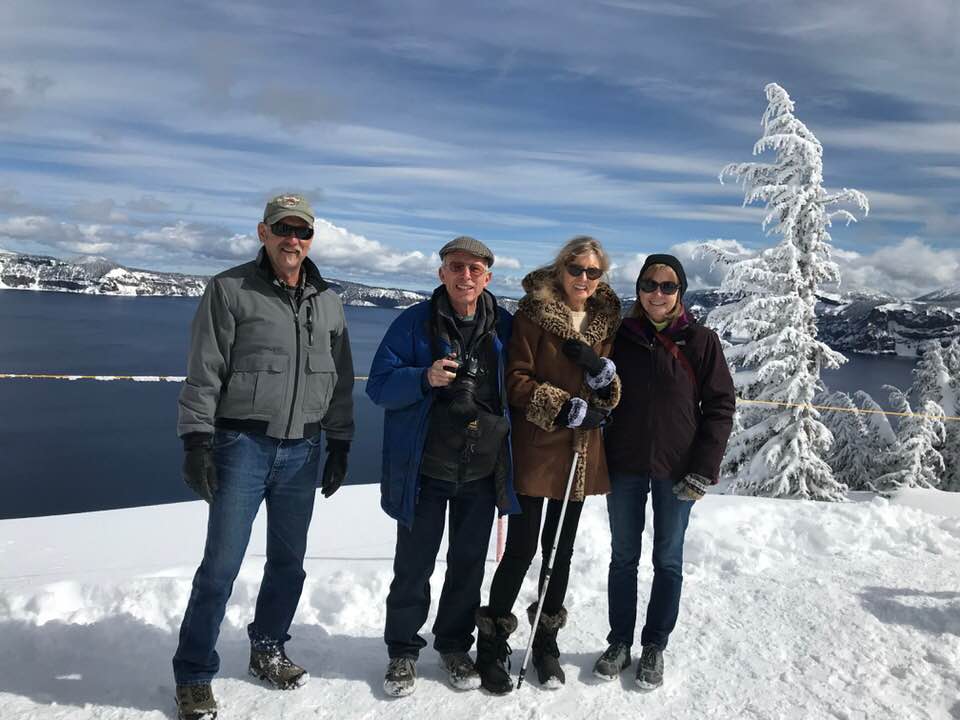
Here’s a photo of me and Jeannie together with Andy and Trish taken in March, 2018. On the edge of Crater Lake.
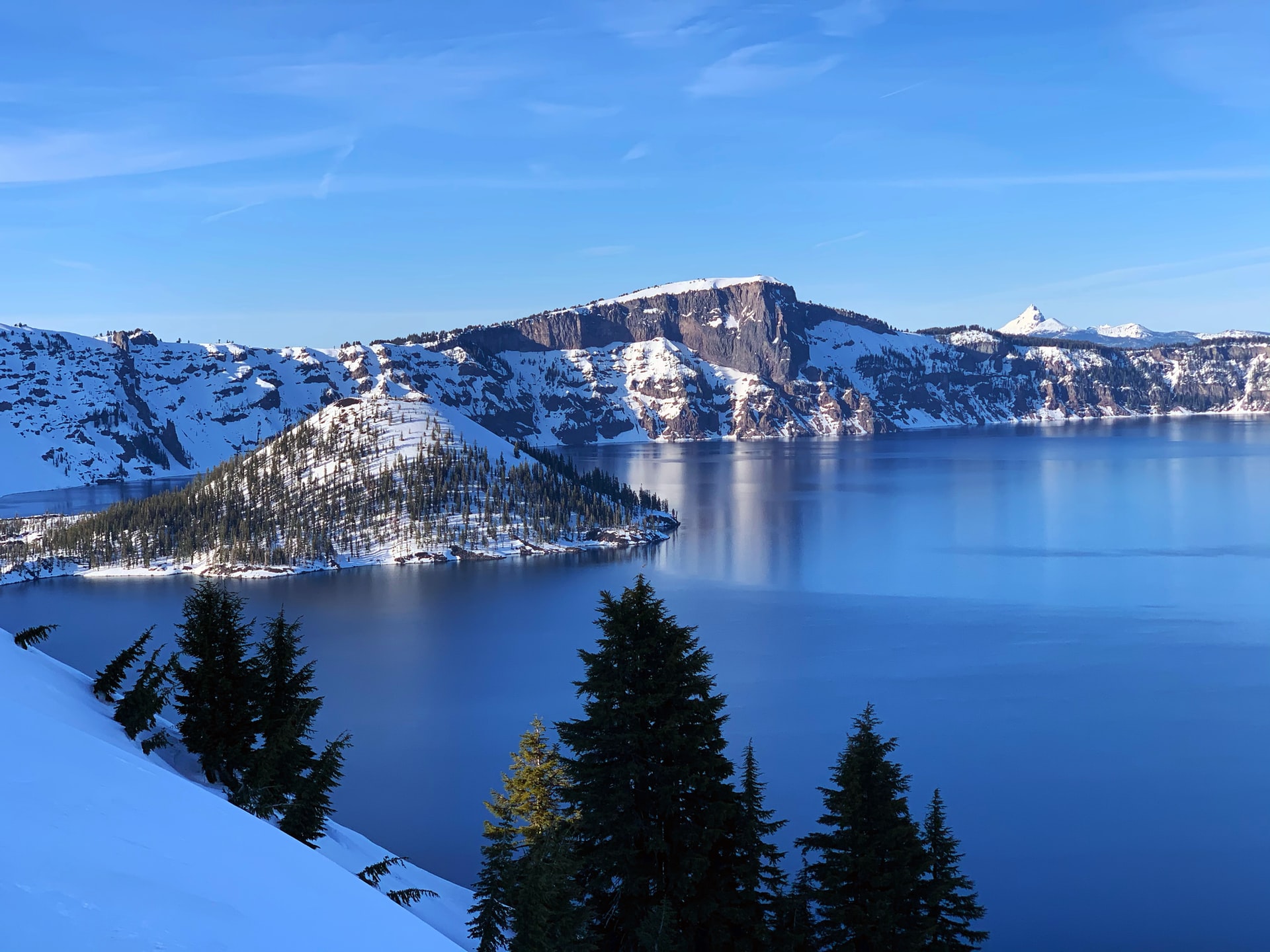
Then this is a stock photograph of Crater Lake taken in March, 2020.
Taken by Valerie Little
Not a great deal of difference but the trees in the photo above aren’t encased in snow as is the tree in the 2018 photo.
Now there is important news to bring you from COP 26. On Sunday Boris Johnson said:
Scientists say this would limit the worst impacts of climate change.
During a Downing Street news conference, Mr Johnson said:
“We can lobby, we can cajole, we can encourage, but we cannot force sovereign nations to do what they do not wish to do”
“For all our disagreements, the world is undeniably heading in the right direction”
The “tipping point has been reached in people’s attitudes” – with leaders “galvanised and propelled by their electorates”
But “the fatal mistake now would be to think that we in any way cracked this thing”
Mr Johnson said that despite the achievements of the summit, his reaction was “tinged with disappointment”.
He said there had been a high level of ambition – especially from countries where climate change was already “a matter of life and death”.
And “while many of us were willing to go there, that wasn’t true of everybody”, he admitted.But he added the UK could not compel nations to act. “It’s ultimately their decision to make and they must stand by it.”
That point about attitudes is interesting. Who would have thought, say, five years ago, that attitudes had changed so dramatically by late-2021.
One hopes that we will come to our collective senses but I can’t see the CO2 index being returned to its normal range without machines taking the excessive CO2 out of the atmosphere. Because, as was quoted on The Conversation nearly a year ago:
On Wednesday this week, the concentration of carbon dioxide in the atmosphere was measured at at 415 parts per million (ppm). The level is the highest in human history, and is growing each year.
Finally, my daughter, Maija, and my son-in-law, Marius, had a child some ten years ago. He is my grandson and I left England before he was born. He is Morten and he is a bright young spark.
Morten
Morten and all the hundreds of thousands of young persons like him are going to have to deal with the world as they find it!
I have long followed George Monbiot and was delighted to find that he is the narrator on this video. The film was shot by Sustainable Human, an organisation that I hadn’t come across before. But I will look more closely at their website.
It is not long but it is full of surprises.
When wolves were reintroduced to Yellowstone National Park in the United States after being absent nearly 70 years, the most remarkable “trophic cascade” occurred. What is a trophic cascade and how exactly do wolves change rivers? George Monbiot explains.
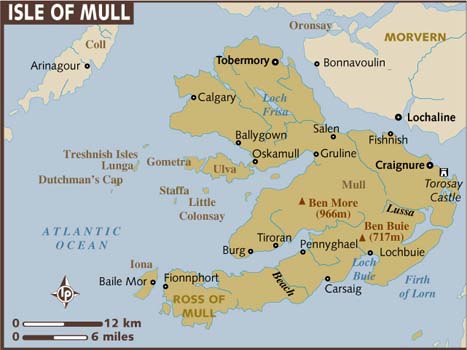
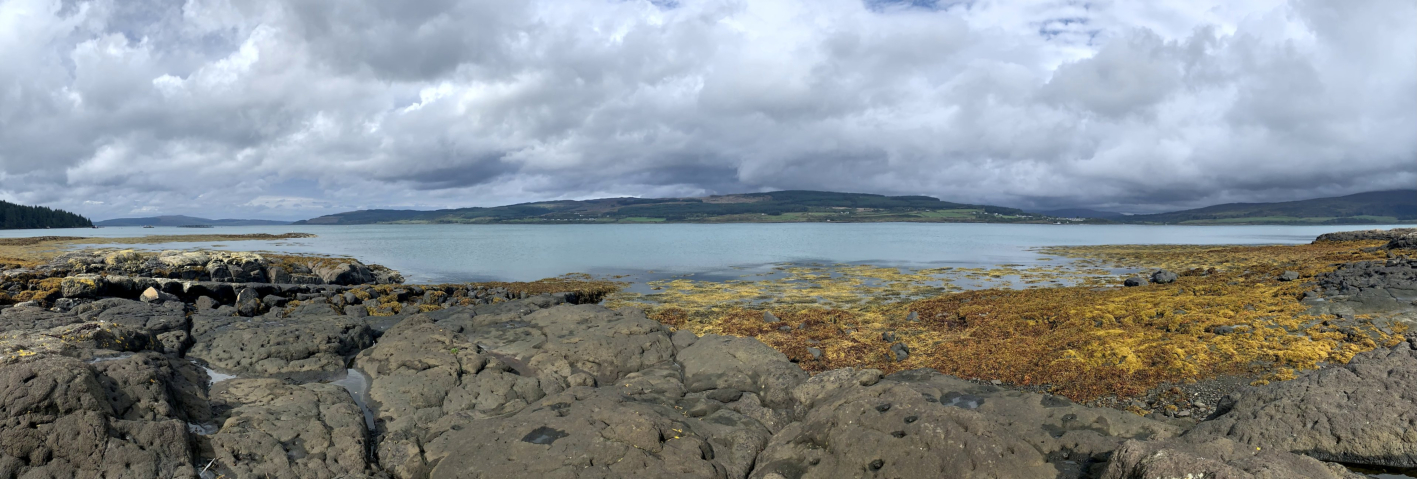
With a difference in that the guest author is my son, Alex. Recently Alex and his partner, Lisa, went on a trip to the Isle of Mull. But I will let Alex continue in his own words after I have explained a little more about the island. And where better to start than with the opening paragraphs of an article on the Isle of Mull from Wikipedia.
The island’s 2020 population was estimated at 3,000.[7] In the 2011 census, the usual resident population was 2,800.[2] In 2001, it was 2,667.[8] (In the summer, these numbers are augmented by an influx of many tourists.) Much of the year-round population lives in colourful Tobermory, the island’s capital, and, until 1973, its only burgh.
There are two distilleries on the island: the Tobermory distillery (formerly called Ledaig), which is Mull’s only producer of single malt Scotch whisky;[9] and another one located in the vicinity of Tiroran, which produces Whitetail Gin (having opened in 2019, it was the island’s first new distillery in 220 years). The isle is host to numerous sports competitions, notably the annual Highland Games competition, which is held in July. It also has at least four castles, including the towering keep of Moy Castle. A much older stone circle lies beside Lochbuie, on the south coast.
ooOOoo
This is now from Alex:
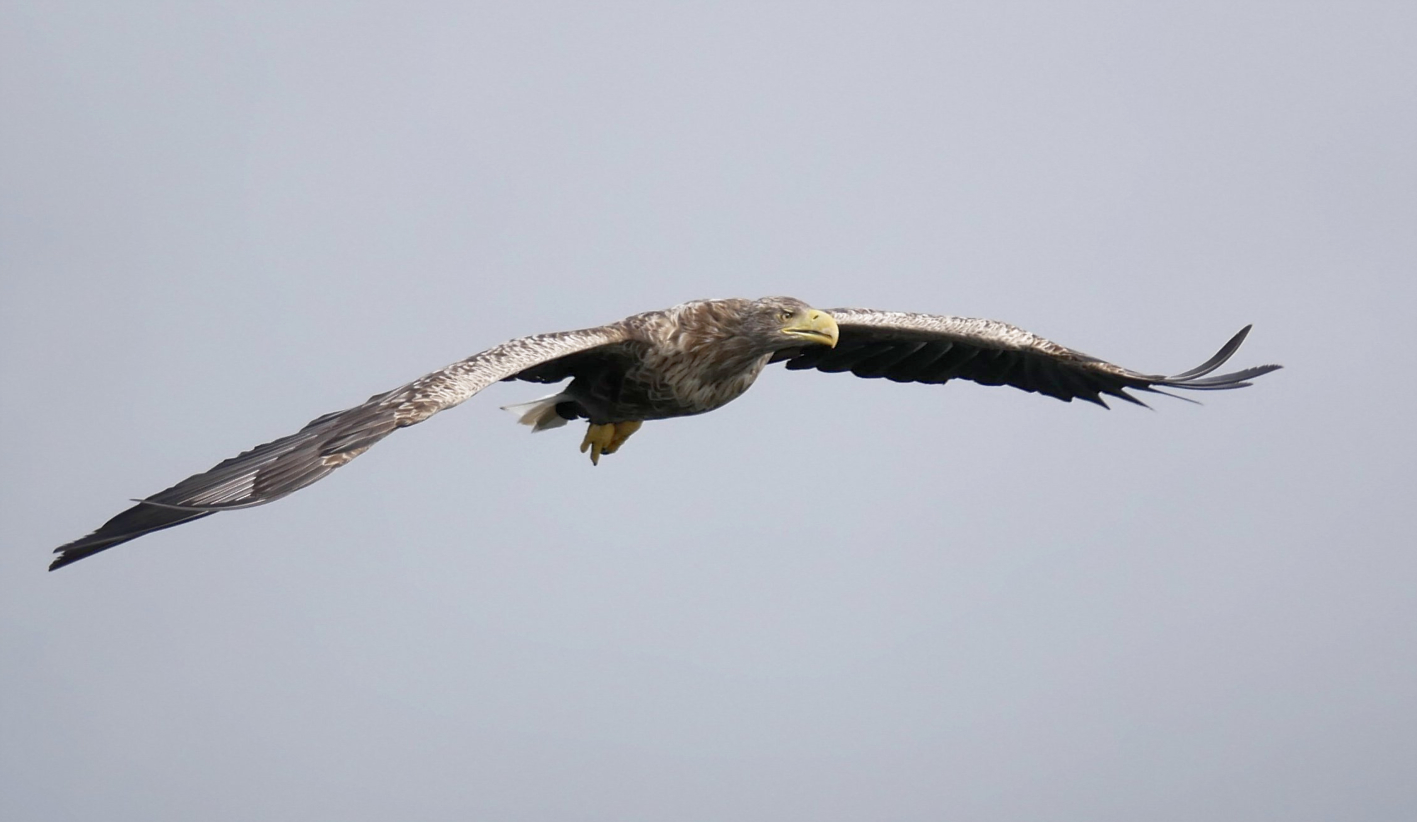
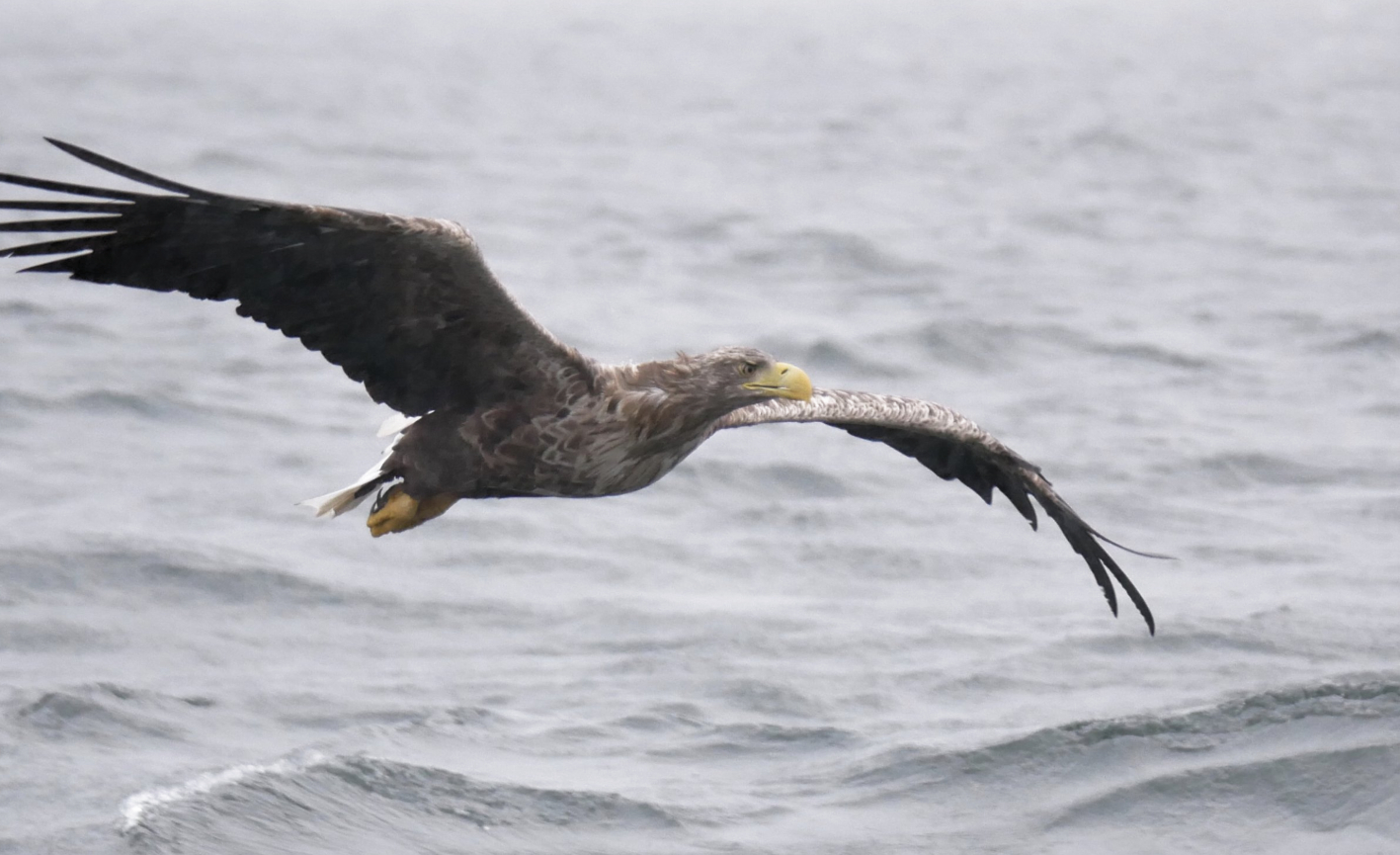
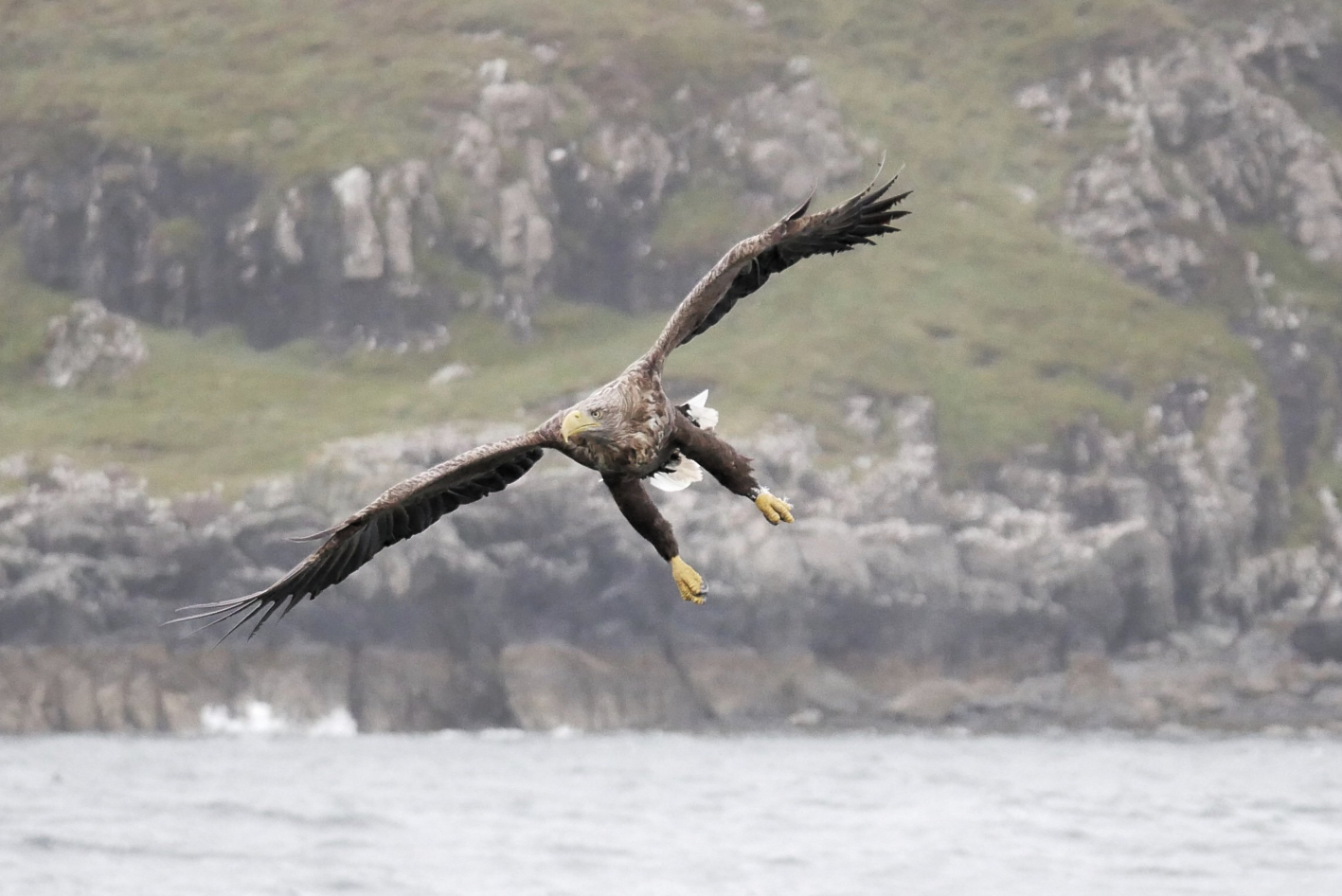
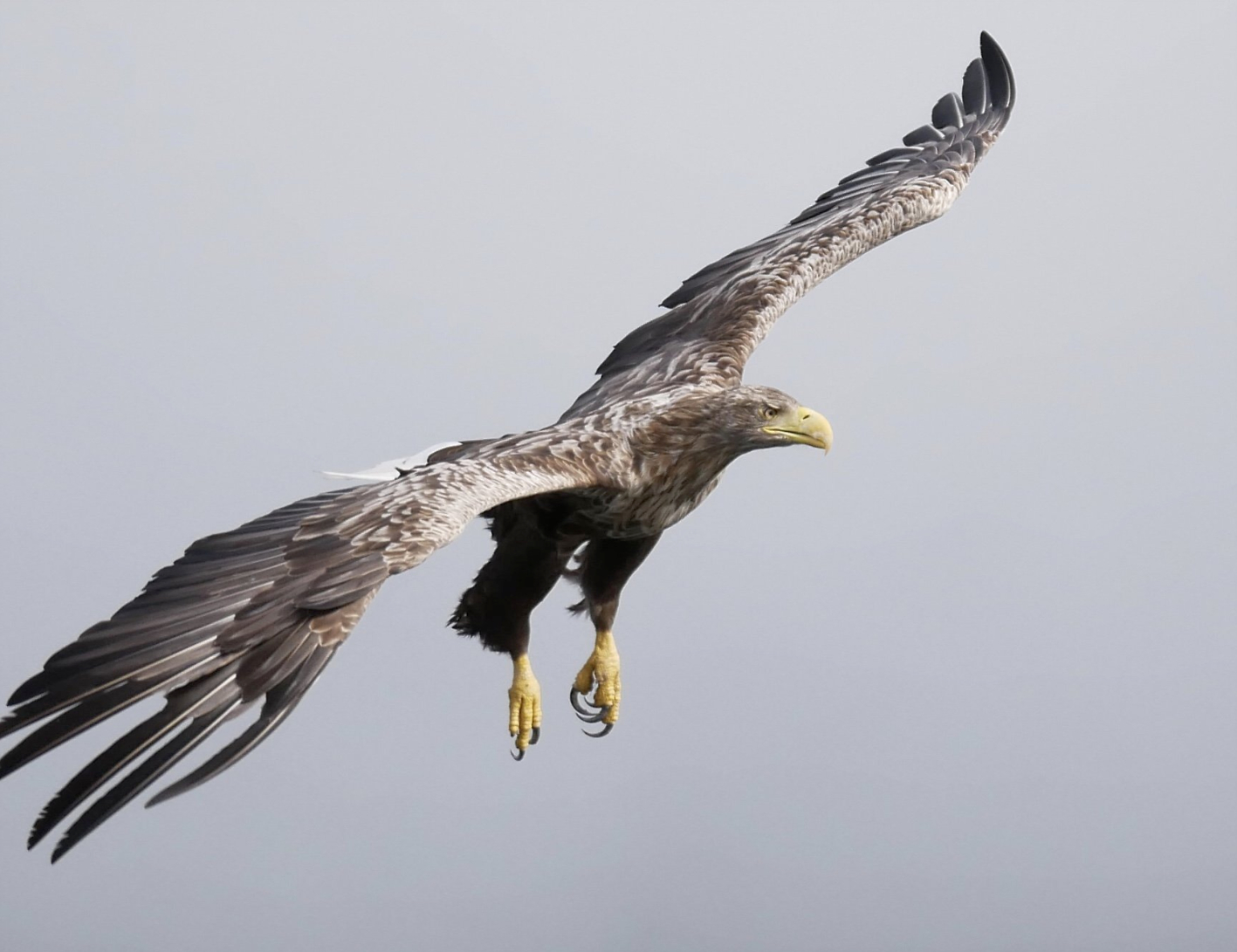
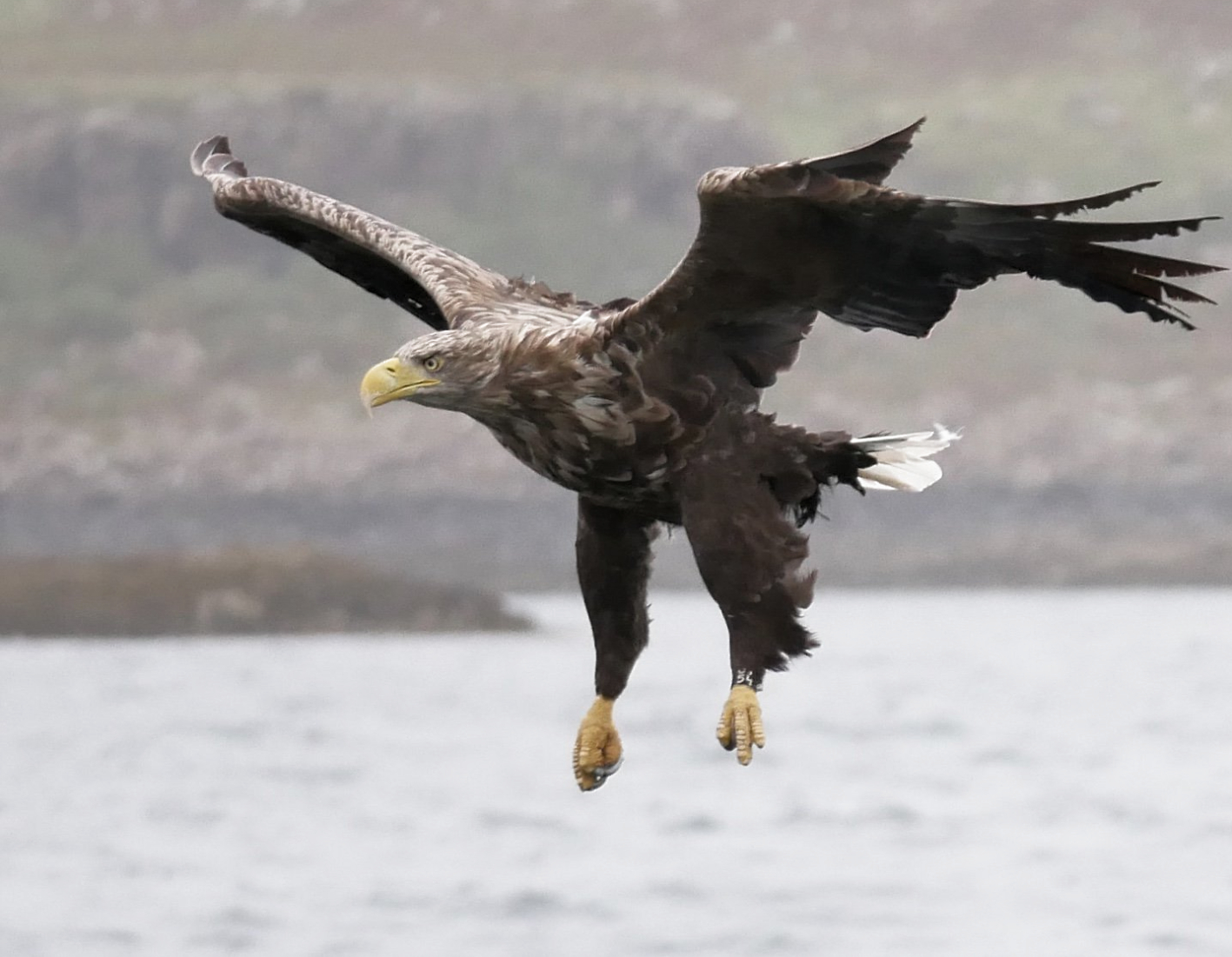
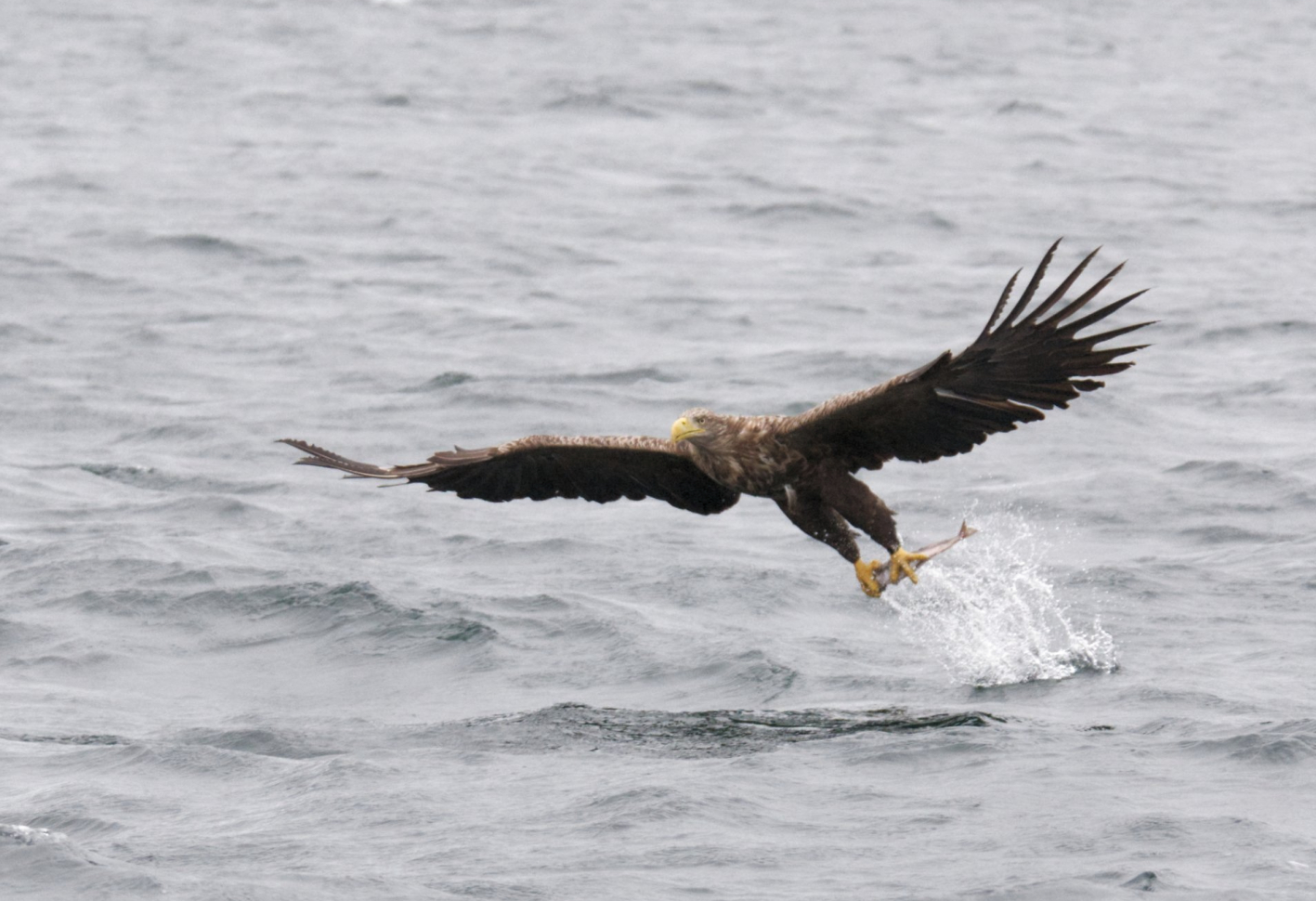
We decided to go to the Isle of Mull after reading about the amazing wildlife it has to offer. It’s famous for its white tailed eagles, which are the largest eagle in the U.K. and fourth largest in the world, with an average wingspan of 7-8ft and a perched height of 1m. After securing a place on a Mullcharters.com eagle photography boat trip, we waited with excitement as the boat left the small harbour at Ulva ferry in force 5 winds and intermittent rain showers, cruising out of the harbour, we where very lucky to spot an Otter swimming along.
On reaching Loch Na Keal, we where told to keep an eye out for an eagle approaching, they apparently recognise the boat from around 1-2 miles away and know that it offers them an opportunity to get some free fish! It wasn’t long before looming out of the distance, a white tailed eagle appeared and started circling the boat, one of the boats crew told us he was going to throw a fish out and exactly where he was throwing it, so we could aim our cameras in that direction, we where treated to the amazing spectacle of an adult white tailed eagle swooping down to collect its fish, which was about 20-30ft away. This enabled us to get some excellent pictures of the eagle picking up its fish on numerous occasions, we saw at least six different birds on the trip and at one point had two pairs of eagles overhead the boat. Even with the challenging conditions, we all managed to get some excellent photos, it’s just a shame we didn’t get any sun to really show the eagles colours off.
oooo
oooo
oooo
oooo
oooo
oooo
oooo
oooo
oooo
To round off these wonderful photographs, here are two of an otter. They are notoriously difficult to photograph.
oooo
ooOOoo
What a wonderful journey for Alex and Lisa. The camera was a Panasonic Lumix G85 with Leica 100-400 lens.
I heard yesterday from Erik Hoffner who is responsible for the Mongabay website that Bill McKibben is stepping up to the mark in wanting to take action regarding climate change.
I very quickly signed up and received the following email:
Dear Friend,
Many thanks for signing up to be a part—and we hope a big part—of Third Act.
My name is Bill McKibben, and I’m one of the volunteers helping to launch this effort for Americans 60 and older who want to build a fairer and more sustainable nation and planet.
We’re very much in the early days of this, and we need your help—especially if you’re good at the behind-the-scenes tasks like administration, development, and project management. If you’ve got some time to donate right now, write to us at info@thirdact.org.
And we will be back in touch as autumn rolls on, with some early campaigns focused on climate action and on ending voter suppression. As you can tell, we’re making this up as we go along. So it should be interesting, and also a little bumpy!
If you can assemble a sizable group of people, I’ll do my best to join you for a virtual talk to explain more about this idea. (And when the pandemic ends, we’ll try to do it in person!).
And if you can donate some small sum of money to help with the launch, here’s the place.
Thank you. This is our time to make some powerful change—we’ve got the skills, the resources, and the desire. So let’s try.
We’re over 60—the Baby Boomers and the Silent Generation. We have skills, we have resources, we have time—and many of us have kids and grandkids. We also have a history. In our early years we saw remarkable shifts in politics and society; now, in our latter years, we want to see those changes made real and lasting.
We were there for the first Earth Day, and we’ve been glad to see cleaner air and water—but now we know that the climate crisis presents an unparalleled threat. The heat is on and we must act quickly to turn it down.
We watched or participated in the civil rights movement—and now we know that its gains were not enough, and that gaps in wealth have only widened in our lifetimes. We’ve got to repair divisions instead of making them worse. We saw democracy expand—and now we’re seeing it contract, as voter suppression and gerrymandering threaten the core of the American experiment. We know that real change can only come if we all get to participate.
You are the key to this work. Maybe you’ve asked yourself: how can I give back on a scale that matters? The answer is, by working with others to build movements strong enough to matter. That’s why we hope you’ll join us.
Clearly I have signed up and I hope an enormous number of other people will do as well.
Because the time left is not very long and even me at the age of 76 fear for the near future if nothing is done urgently.








 Learning from Dogs