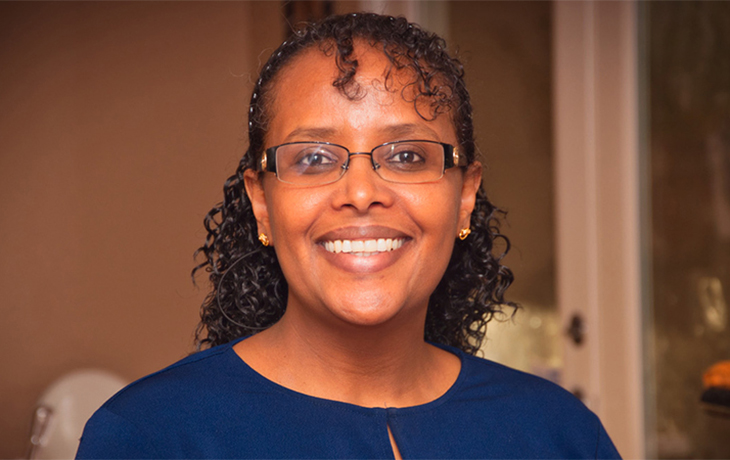
There have been so many disastrous activities on climate change, and I am not belittling them, but it was amazing to come across a TED Talk last Saturday that I watched. But first the speaker, Asmeret Asefaw Berhe, who was born in Asmara, Eritrea. Her bio (in part):
From WikiPedia:
ooOOoo
Asmeret Asefaw Berhe is a soil biogeochemist and political ecologist who is the current Director of the Office of Science at the US Department of Energy. She was previously the Professor of Soil Biogeochemistry and the Ted and Jan Falasco Chair in Earth Sciences and Geology in the Department of Life and Environmental Sciences; University of California, Merced.[1] Her research group worked to understand how soil helps regulate the Earth’s climate.
Advocacy and global impact work
Berhe’s work at the intersection of soil, climate change, and political ecology lends itself well to a number of global issues. During her graduate career, she was a member of the working group that produced the Millennium Ecosystem Assessment, which was called for by the United Nations Secretary Kofi Annan to assess the impact of humans on the environment. She was one of the lead authors on the 2005 report’s chapter on “Drivers of Change in Ecosystem Condition and Services.”[19] The Assessment received the Zayed International Prize for the Environment in 2005.[20]
In 2018, Berhe was selected as part of the inaugural National Academies of Sciences, Engineering, and Medicine New Voices in Sciences, Engineering, and Medicine cohort, as an early career leader working to advance the conversation around key emerging global issues and communicate the evidence base around those challenges.[21]
An advocate for women in science, Berhe is currently a co-Principal Investigator of ADVANCEGeo, which is working to transform the workplace climate of the geosciences to increase retention of women in the field and develop a sustainable model that can be transferred to other scientific domains. Currently, the Earth Science Women’s Network (ESWN), the Association for Women Geoscientists, and the American Geophysical Union (AGU) have partnered to address the issue of sexual harassment in the earth, space and environmental sciences.[22] The program led by Erika Marín-Spiotta and is run with support from a four-year $1.1 million grant from the National Science Foundation.[23]
She currently serves as an advisory board member of 500 Women Scientists, a grassroots organization working to make science open, inclusive, and accessible, and is on the leadership board of the Earth Science Women’s Network.
Earth’s soil can store vast amounts of carbon. Biogeochemist Asmeret Asefaw Berhe says soil could be a powerful tool for fighting climate change – if only we stopped treating it like dirt.
About Asmeret Asefaw Berhe
Asmeret Asefaw Berhe is a soil biogeochemist and President Biden’s nominee to lead the Department of Energy Office of Science. She is a professor of soil biogeochemistry at University of California, Merced. Her research group works to understand how soil helps regulate the earth’s climate.
Berhe’s work exists at the intersection of soil, climate change, and political ecology. During her graduate career, she was a member of the working group that produced the Millennium Ecosystem Assessment, which was called for by the United Nations to assess the impact of humans on the environment.
Berhe received a B.Sc. in Soil and Water Conservation at the University of Asmara in Eritrea. She has an M.Sc. in Political Ecology from Michigan State University and a Ph.D. in Biogeochemistry from University of California, Berkeley.
This segment of the TED Radio Hour was produced by Matthew Cloutier and Sylvie Douglis and edited by Rachel Faulkner and Katie Simon. You can follow us on Facebook @TEDRadioHour and email us at TEDRadioHour@npr.org.
Now that positive TED Talk:
We wish Asmeret the very best of fortune in bringing about these changes.
In our case our (remaining) dogs, Oliver and Cleopatra, are able to go outside but still remain on our land. But plenty of dog owners are not in such a privileged position and need to take their dogs on public pavements and the like.
Thus for all you dog owners in that position then Erik’s advice is for you.
ooOOoo
Dog care below freezing − how to keep your pet warm and safe from cold weather, road salt and more this winter
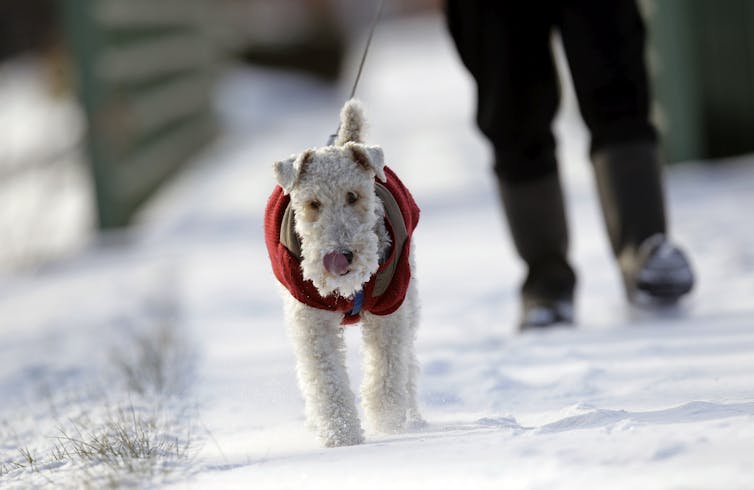
Dogs get cold in the winter too, but there are things pet owners can do to help them feel comfortable. AP Photo/David Duprey
Time outside with your dog in the spring, summer and fall can be lovely. Visiting your favorite downtown café on a cool spring morning, going to a favorite dog park on a clear summer evening or going on walks along a river when the leaves are changing color are all wonderful when the weather is favorable. But in much of the country, when winter rolls around, previously hospitable conditions can quickly turn chilly and dangerous for people and pups alike.
Winter brings some unique challenges for dog owners, since dogs still need activity and socialization during colder seasons. Studies have shown that dog owners are almost 50% less likely to walk their dogs when the weather gets cold. Knowing the basics of winter safety is critical to maintaining a healthy lifestyle for your dog.
I am an assistant professor at the University of California Davis School of Veterinary Medicine who weathered polar vortexes with my dog while living in Michigan early in my career. While I’ve since moved to sunny California, I’ve seen how quickly frigid temperatures can turn dangerous for pets.
Breed and age differences
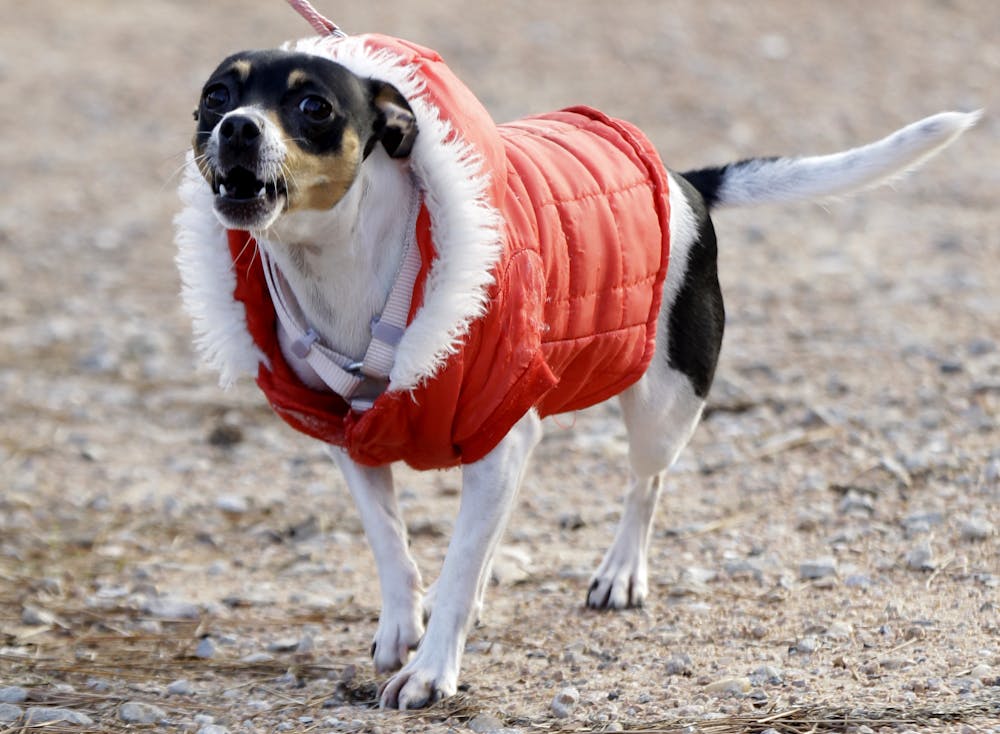
Not all dogs have the same abilities to deal with cold weather. A short-coated dog like a Chihuahua is much more susceptible to the dangers of cold weather than a thick-coated husky. When the weather dips below 40 degrees Fahrenheit (4 degrees Celsius), the well-acclimated husky may be comfortable, whereas the Chihuahua would shiver and be at risk of hypothermia.
Additionally, if your dog is used to warm weather, but you decide to move to a colder region, the dog will need time to acclimate to that colder weather, even if they have a thick coat.
Age also affects cold-weather resilience. Puppies and elderly dogs can’t withstand the chill as well as other dogs, but every dog is unique – each may have individual health conditions or physical attributes that make them more or less resilient to cold weather.
Pet owners should be able to recognize the symptoms of a dog that is getting too cold. Dogs will shiver, and some may vocalize or whine. Dogs may resist putting their feet down on the cold ground, or burrow, or try to find warmth in their environment when they are uncomfortable.
Just like people, dogs can get frostbite. And just like people, the signs can take days to appear, making it hard to assess them in the moment. The most common sites for frostbite in dogs are their ears and the tips of their tails. Some of the initial signs of frostbite are skin discoloring, turning paler than normal, or purple, gray or even black; red, blistered skin; swelling; pain at the site; or ulceration.
Other serious signs of hypothermia include sluggishness or lethargy, and if you observe them, please visit your veterinarian immediately. A good rule to live by is if it is too cold for you, it is too cold for your dog.
Getting your dog a sweater or jacket and paw covers can provide them with protection from the elements and keep them comfortable. Veterinarians also recommend closely monitoring your dog and limiting their time outside when the temperature nears the freezing point or drops below it.
Road salt dangers
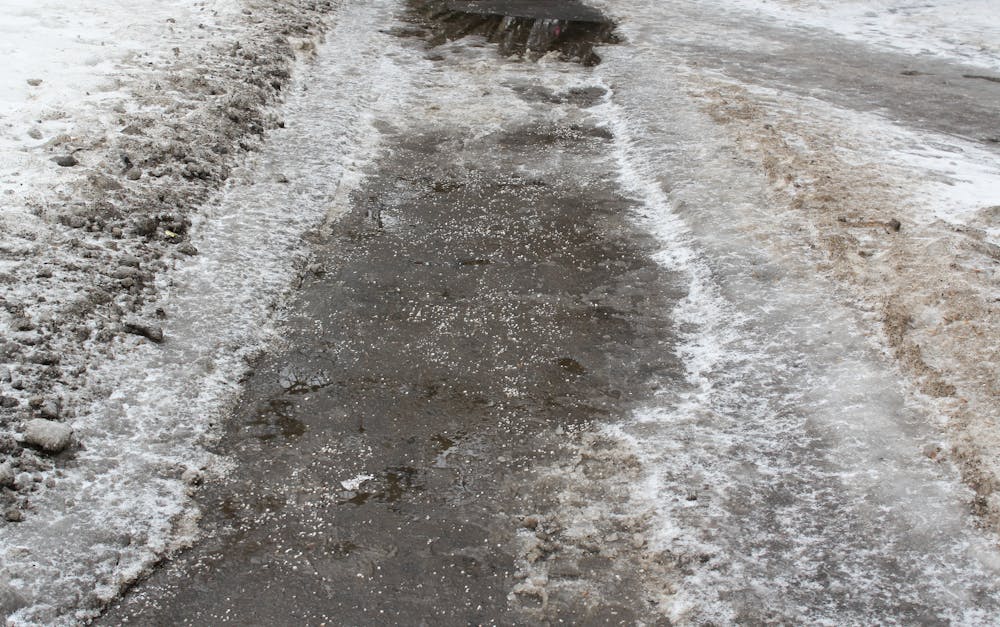
Road salt that treats ice on streets and sidewalks can also harm dogs. When dogs walk on the salt, the sharp, rough edges of the salt crystals can irritate the sensitive skin on their paws.
Paw covers for dogs can keep their feet warm and protected from road salt. AP Photo/Jim Cole
Dogs will often lick their feet when they’re dirty, wet or irritated, and if they ingest any salt doing that, they may face GI upset, dehydration, kidney failure, seizures or even death. Even small amounts of pure salt can disrupt critical body functions in dogs.
Some companies make pet-safe salt, but in public it can be hard to tell what type of salt is on the ground. After walking your dog, wash off their feet or boots. You can also keep their paw fur trimmed to prevent snow from balling up or salt collecting in the fur. Applying a thin layer of petroleum jelly or paw pad balm to the skin of the paw pads can also help protect your pet’s paws from irritation.
Antifreeze, or ethylene glycol, is in most vehicles to prevent the fluids from freezing when it gets cold out. Some people pour antifreeze into their toilets when away from their home to prevent the water in the toilet from freezing.
Antifreeze is an exceptionally dangerous chemical to dogs and cats, as it tastes sweet but can be deadly when ingested. If a pet ingests even a small amount of antifreeze, the substance causes a chemical cascade in their body that results in severe kidney damage. If left untreated, the pet may have permanent kidney damage or die.
There are safer antifreeze options on the market that use ingredients other than ethylene glycol. If your dog ingests antifreeze, please see your veterinarian immediately for treatment.
When temperatures dip below freezing, the best thing pet owners can do is keep the time spent outside as minimal as possible. Try some indoor activities, like hide-and-seek with low-calorie treats, fetch or even an interactive obstacle course. Food puzzles can also keep your dog mentally engaged during indoor time.
Although winter presents some unique challenges, it can still be an enjoyable and healthy time for you and your canine companion.
Erik’s comments about ethylene glycol (EG), or antifreeze as it more commonly known, and the incredible dangers to dogs EG possesses are vital to understand.
Please, please keep your dogs very safe in Winter! If Erik’s advice helps save even a single dog then me republishing this will have been worthwhile.
The challenge with writing posts, albeit not so often, about the global environment, especially when I am a non-scientist, is that one relies entirely on the words of others. In the case of a recent article, published by The Conversation, the authors are claimed to be specialists, and I do not doubt their credentials.
The three authors are René van Westen who is a Postdoctoral Researcher in Climate Physics, at Utrecht University, Henk A. Dijkstra who is a Professor of Physics, also at Utrecht University, and Michael Kliphuis, a Climate Model Specialist, again at Utrecht University.
So, here is their article:
ooOOoo
Atlantic Ocean is headed for a tipping point − once melting glaciers shut down the Gulf Stream, we would see extreme climate change within decades, study shows
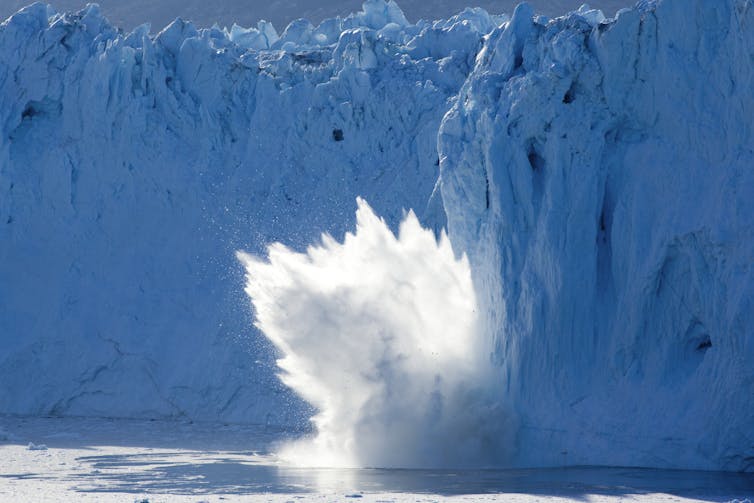
Superstorms, abrupt climate shifts and New York City frozen in ice. That’s how the blockbuster Hollywood movie “The Day After Tomorrow” depicted an abrupt shutdown of the Atlantic Ocean’s circulation and the catastrophic consequences.
While Hollywood’s vision was over the top, the 2004 movie raised a serious question: If global warming shuts down the Atlantic Meridional Overturning Circulation, which is crucial for carrying heat from the tropics to the northern latitudes, how abrupt and severe would the climate changes be?
In a new study using the latest generation of Earth’s climate models, we simulated the flow of fresh water until the ocean circulation reached that tipping point.
The results showed that the circulation could fully shut down within a century of hitting the tipping point, and that it’s headed in that direction. If that happened, average temperatures would drop by several degrees in North America, parts of Asia and Europe, and people would see severe and cascading consequences around the world.
We also discovered a physics-based early warning signal that can alert the world when the Atlantic Ocean circulation is nearing its tipping point.
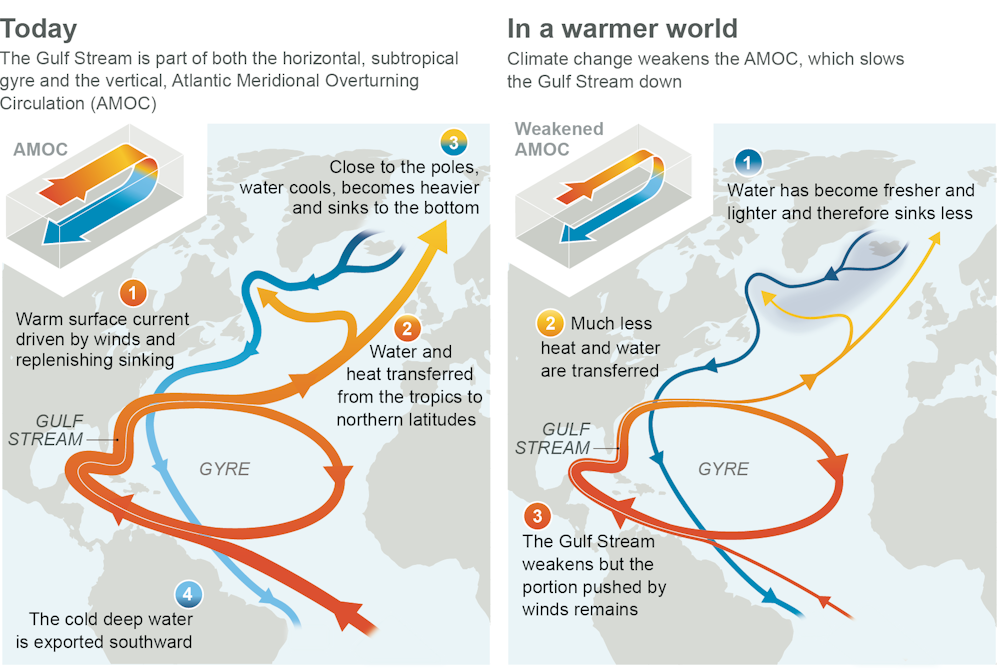
In the Atlantic Ocean circulation, the relatively warm and salty surface water near the equator flows toward Greenland. During its journey it crosses the Caribbean Sea, loops up into the Gulf of Mexico, and then flows along the U.S. East Coast before crossing the Atlantic.
This current, also known as the Gulf Stream, brings heat to Europe. As it flows northward and cools, the water mass becomes heavier. By the time it reaches Greenland, it starts to sink and flow southward. The sinking of water near Greenland pulls water from elsewhere in the Atlantic Ocean and the cycle repeats, like a conveyor belt.
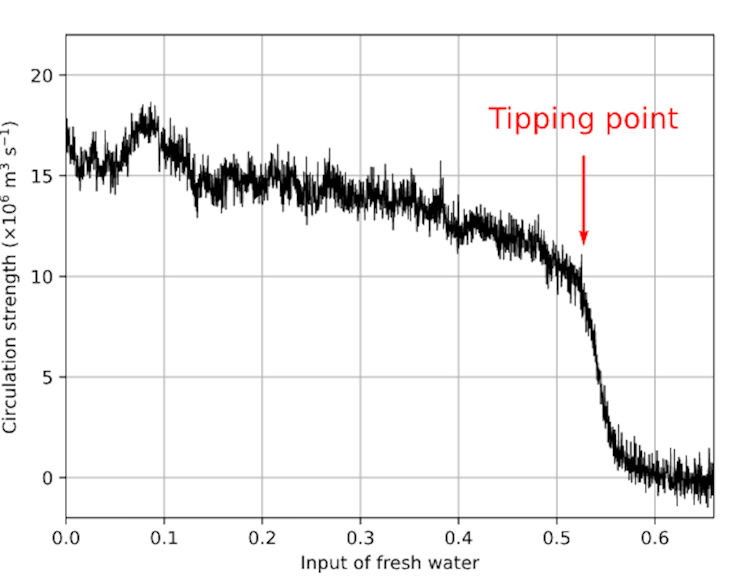
This is where our study comes in. We performed an experiment with a detailed climate model to find the tipping point for an abrupt shutdown by slowly increasing the input of fresh water.
We found that once it reaches the tipping point, the conveyor belt shuts down within 100 years. The heat transport toward the north is strongly reduced, leading to abrupt climate shifts.
The result: Dangerous cold in the North
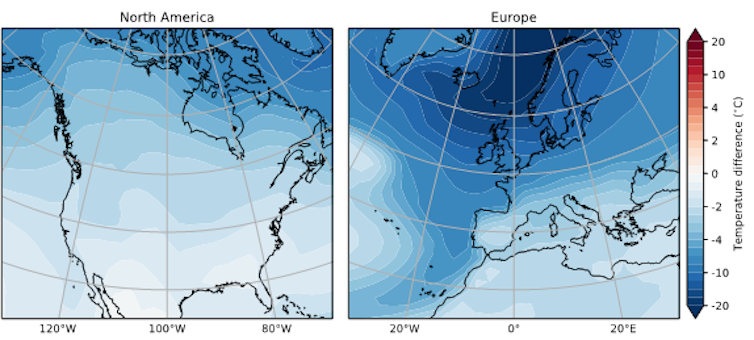
Regions that are influenced by the Gulf Stream receive substantially less heat when the circulation stops. This cools the North American and European continents by a few degrees.
The European climate is much more influenced by the Gulf Stream than other regions. In our experiment, that meant parts of the continent changed at more than 5 degrees Fahrenheit (3 degrees Celsius) per decade – far faster than today’s global warming of about 0.36 F (0.2 C) per decade. We found that parts of Norway would experience temperature drops of more than 36 F (20 C). On the other hand, regions in the Southern Hemisphere would warm by a few degrees.
The annual mean temperature changes after the conveyor belt stops reflect an extreme temperature drop in northern Europe in particular. René M. van Westen
These temperature changes develop over about 100 years. That might seem like a long time, but on typical climate time scales, it is abrupt.
The conveyor belt shutting down would also affect sea level and precipitation patterns, which can push other ecosystems closer to their tipping points. For example, the Amazon rainforest is vulnerable to declining precipitation. If its forest ecosystem turned to grassland, the transition would release carbon to the atmosphere and result in the loss of a valuable carbon sink, further accelerating climate change.
The Atlantic circulation has slowed significantly in the distant past. During glacial periods when ice sheets that covered large parts of the planet were melting, the influx of fresh water slowed the Atlantic circulation, triggering huge climate fluctuations.
So, when will we see this tipping point?
The big question – when will the Atlantic circulation reach a tipping point – remains unanswered. Observations don’t go back far enough to provide a clear result. While a recent study suggested that the conveyor belt is rapidly approaching its tipping point, possibly within a few years, these statistical analyses made several assumptions that give rise to uncertainty.
Instead, we were able to develop a physics-based and observable early warning signal involving the salinity transport at the southern boundary of the Atlantic Ocean. Once a threshold is reached, the tipping point is likely to follow in one to four decades.
A climate model experiment shows how quickly the AMOC slows once it reaches a tipping point with a threshold of fresh water entering the ocean. How soon that will happen remains an open question. René M. van Westen
The climate impacts from our study underline the severity of such an abrupt conveyor belt collapse. The temperature, sea level and precipitation changes will severely affect society, and the climate shifts are unstoppable on human time scales.
It might seem counterintuitive to worry about extreme cold as the planet warms, but if the main Atlantic Ocean circulation shuts down from too much meltwater pouring in, that’s the risk ahead.
This article was updated to Feb. 11, 2024, to fix a typo: The experiment found temperatures in parts of Europe changed by more than 5 F per decade.
I am 79! I like to think that whatever is coming down the wires, so to speak, will be after my death. But that is a cop out for a) I have a son and a daughter who are in their early fifties, b) I have a grandson, my daughter and son-in-law’s young man, who is a teenager, with his birthday next month, and c) I could possibly live for another twenty years.
The challenge is how to bring this imminent catastrophic global change in temperature to the fore. We need a global solution now enforced by a globally respected group of scientists and leaders, and, frankly, I do not see that happening.
All one can do is to hope. Hope that the global community will eschew the present-day extremes of warring behaviour and see the need for change. That is NOW!
So that the Hollywood movie, The Day After Tomorrow, remains a fictional story. And for those that have forgotten the film or who have never seen it, here is a small slice of a Wikipedia report:
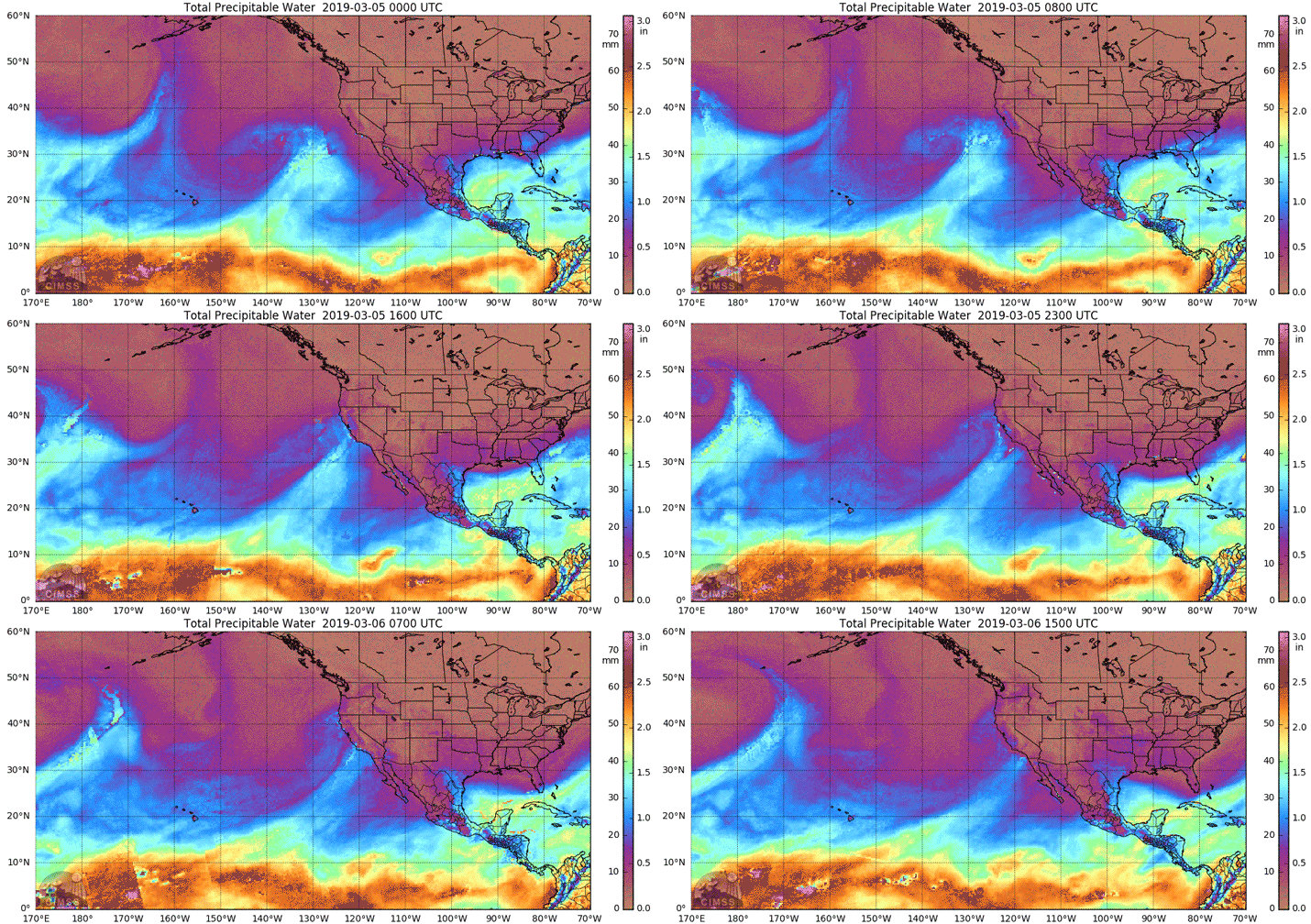
The atmospheric river in California is reaching up to Southern Oregon
After we had the thick end of twelve inches of rain in January, February has kept up the downpours; as of yesterday morning we had had 0.52 inches (1.32 cm) for the month and it was still raining. (And 0.8 in at 08:00 this morning.)
Here’s an item from yesterday about the situation in California.
Plus the BBC News had an item on the California flood.
So it seemed opportune to present this article on atmospheric rivers.
ooOOoo
What is an atmospheric river? A hydrologist explains the good and bad of these flood-prone storms and how they’re changing
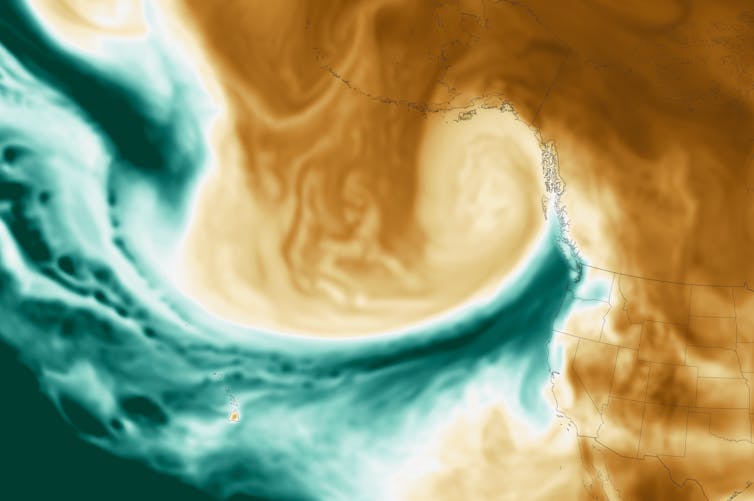
A satellite image shows a powerful atmospheric river hitting the Pacific Northwest in December 2023. Darker greens are more water vapor. Lauren Dauphin/NASA Earth Observatory
A series of atmospheric rivers is bringing the threat of heavy downpours, flooding, mudslides and avalanches to the Pacific Northwest and California this week. While these storms are dreaded for the damage they can cause, they are also essential to the region’s water supply, particularly in California, as Qian Cao, a hydrologist at the University of California, San Diego, explains.
What are atmospheric rivers?
An atmospheric river is a narrow corridor or filament of concentrated water vapor transported in the atmosphere. It’s like a river in the sky that can be 1,000 miles long. On average, atmospheric rivers have about twice the regular flow of the Amazon River.
When atmospheric rivers run up against mountains or run into local atmospheric dynamics and are forced to ascend, the moisture they carry cools and condenses, so they can produce intense rainfall or snowfall. https://www.youtube.com/embed/w3rtYM0HtIM?wmode=transparent&start=0 A satellite view of atmospheric rivers.
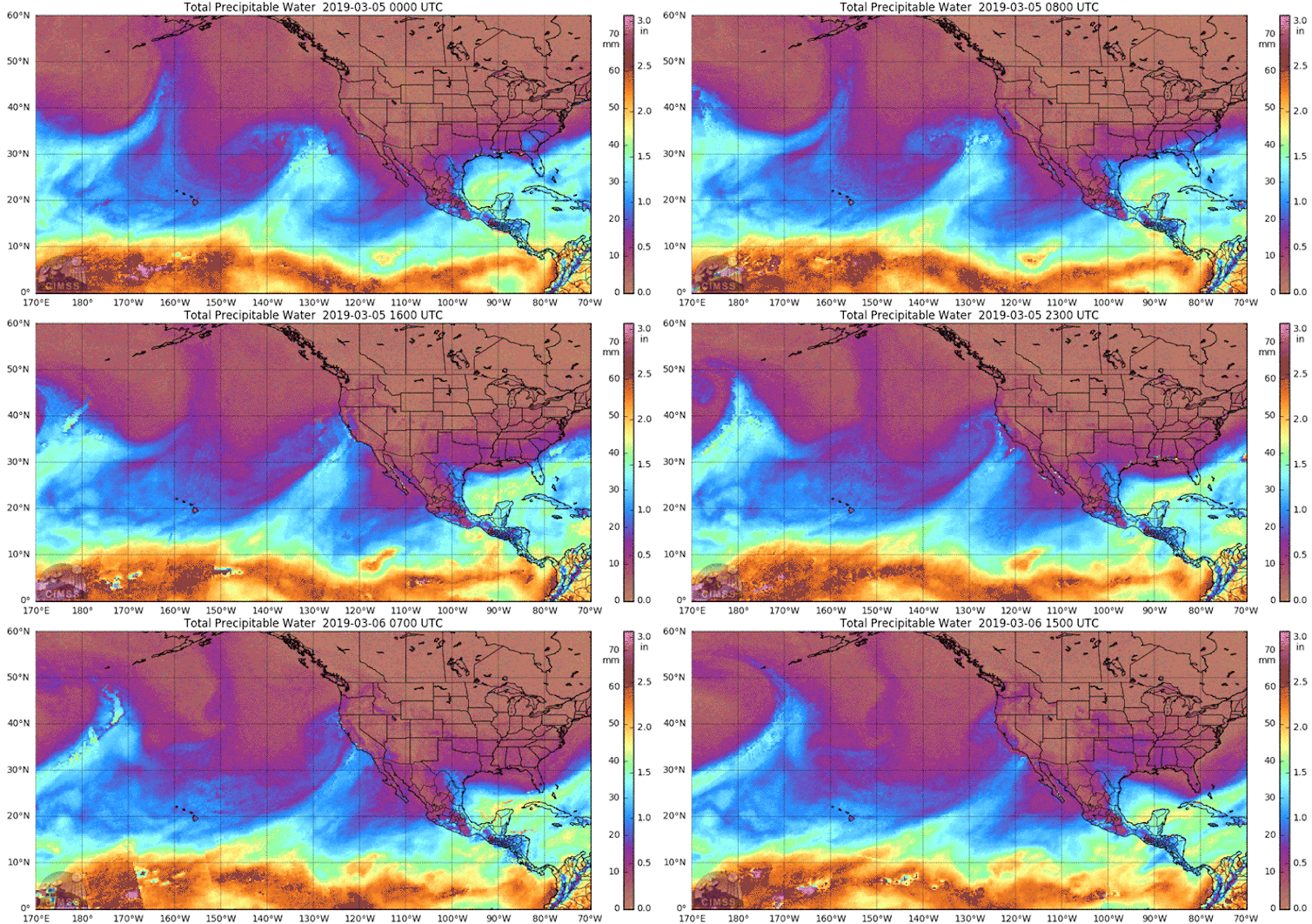
Atmospheric rivers occur all over the world, most commonly in the mid-latitudes. They form when large-scale weather patterns align to create narrow channels, or filaments, of intense moisture transport. These start over warm water, typically tropical oceans, and are guided toward the coast by low-level jet streams ahead of cold fronts of extratropical cyclones.
Along the U.S. West Coast, the Pacific Ocean serves as the reservoir of moisture for the storm, and the mountain ranges act as barriers, which is why the western sides of the coastal ranges and Sierra Nevada see so much rain and snow.
Why are back-to-back atmospheric rivers a high flood risk?
The first heavy downpours saturate the ground. As consecutive storms arrive, their precipitation falls on soil that can’t absorb more water. That contributes to more runoff. Rivers and streams fill up. In the meantime, there may be snowmelt due to warm temperatures, further adding to the runoff and flood risk.
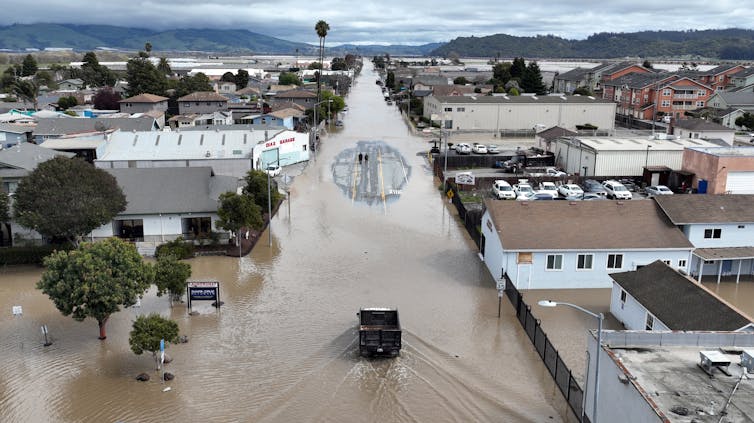
California experienced a historic run of nine consecutive atmospheric rivers in the span of three weeks in December 2022 and January 2023. The storms helped bring most reservoirs back to historical averages in 2023 after several drought years, but they also produced damaging floods and debris flows.
Atmospheric rivers forming over the tropical Pacific Ocean head for the U.S. West Coast. NOAA
The cause of AR families is an active area of research. Compared with single atmospheric river events, AR families tend to be associated with lower atmospheric pressure heights across the North Pacific, higher pressure heights over the subtropics, a stronger and more zonally elongated jet stream and warmer tropical air temperatures.
Large-scale weather patterns and climate phenomena such as the Madden-Julian Oscillation, or MJO, also play an important role in the generation of AR families. An active MJO shift occurred during the early 2023 events, tilting the odds toward increased atmospheric river activity over California.
An aerial view shows a flooded neighborhood in the community of Pajaro in central California on March 11, 2023, after a series of atmospheric rivers. Josh Edelson/AFP via Getty Images
A recent study by scientists at Stanford and the University of Florida found that storms within AR families cause three to four times more economic damage when the storms arrive back to back than they would have caused by themselves.
How important are atmospheric rivers to the West Coast’s water supply?
I’m a research hydrologist, so I focus on hydrological impacts of atmospheric rivers. Although they can lead to flood hazards, atmospheric rivers are also essential to the Western water supply. Atmospheric rivers have been responsible for ending more than a third of the region’s major droughts, including the severe California drought of 2012-16.
They also contribute to the snowpack, which provides a significant portion of California’s year-round water supply.
In an average year, one to two extreme atmospheric rivers with snow will be the dominant contributors to the snowpack in the Sierra Nevada. Together, atmospheric rivers will contribute about 30% to 40% of an average season’s total snow accumulation there.
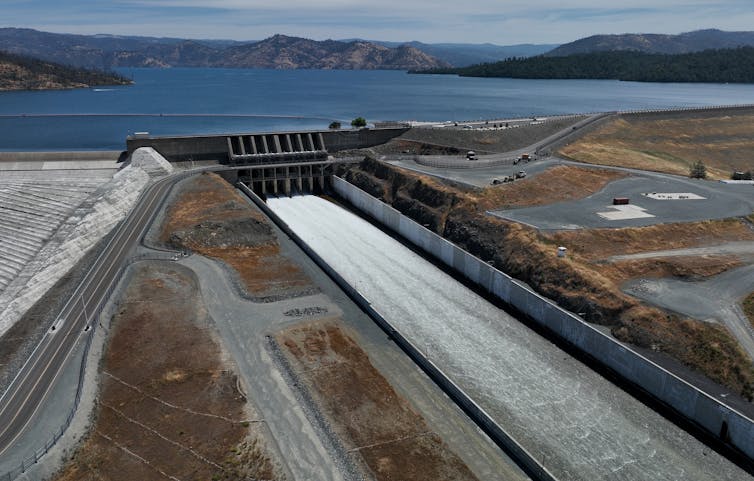
After several winter storms brought record snowfall to California’s Sierra Nevada in early 2023, Lake Oroville, California’s second-largest reservoir, was at 100% capacity. The previous year, much of the state had faced water restrictions. Justin Sullivan/Getty Images
That’s why my colleagues at the Center for Western Weather and Water Extremes at the Scripps Institution of Oceanography, part of the University of California, San Diego, work on improving atmospheric river forecasts and predictions. Water managers need to be able to regulate reservoirs and figure out how much water they can save for the dry season while still leaving room in the reservoirs to manage flood risk from future storms.
How is global warming affecting atmospheric rivers?
My research also shows that more atmospheric rivers are likely to occur concurrently during already wet conditions. So, the chance of extreme flooding also increases. Another study, by scientists from the University of Washington, suggests that there will be a seasonal shift to more atmospheric rivers earlier in the rainy season.
There will likely also be more year-to-year variability in the total annual precipitation, particularly in California, as a study by my colleagues at the Center for Western Weather and Water Extremes projects.
I was born in London before the end of World War II and to a great extent my upbringing was in the times of yesterday. But the world has moved on in many, many ways. It is too easy to say that we live in very strange times.
Thus it was enlightening to come across this talk, under the TED Talks banner, quite recently. I have great pleasure in sharing it with you. Plus, Hannah’s website is here. (From which I have taken the following words!)
(P.S. The YouTube video is just over thirteen minutes long. It automatically runs into the next video so you will have to stop it yourself.)
ooOOoo
The word “sustainability” gets thrown around a lot these days. But what does it actually mean for humanity to be sustainable? Environmental data scientist Hannah Ritchie digs into the numbers behind human progress across centuries, unpacking why the conventional understanding of sustainability is misleading and showing how we can be the first generation of humans to actually achieve it.
Why you should listen
Hannah Ritchie is deputy editor and research lead at Our World in Data, an online publication making data and research on the world’s largest problems accessible and understandable for non-experts. She is a senior researcher at the University of Oxford, where she studies how environmental issues intersect with others like poverty, global health and education. She has also done extensive research into the question of how to feed everyone in the world a nutritious diet without wrecking the planet. Her work has appeared in The New York Times, The Washington Post, Vox, Wired, BBC, Al Jazeera, The Economist and New Scientist.
In 2022, Ritchie was named Scotland’s Youth Climate Champion. She is also an honorary fellow at the University of Edinburgh and Edinburgh Centre for Carbon Innovation, and a fellow at the Energy for Growth Hub, focused on ending global energy poverty. Her forthcoming book,The First Generation, makes an evidence-based case for why we have a meaningful chance to solve global environmental problems for the first time in human history.
We take it for granted! Of that I am sure. But the question of how oxygen first came to be built up in our atmosphere is fascinating. There was a recent article written by Elizabeth Swanner, who is Associate Professor of Geology, Iowa State University that was published in The Conversation. It makes for a very interesting read.
ooOOoo
A layered lake is a little like Earth’s early oceans − and lets researchers explore how oxygen built up in our atmosphere billions of years ago
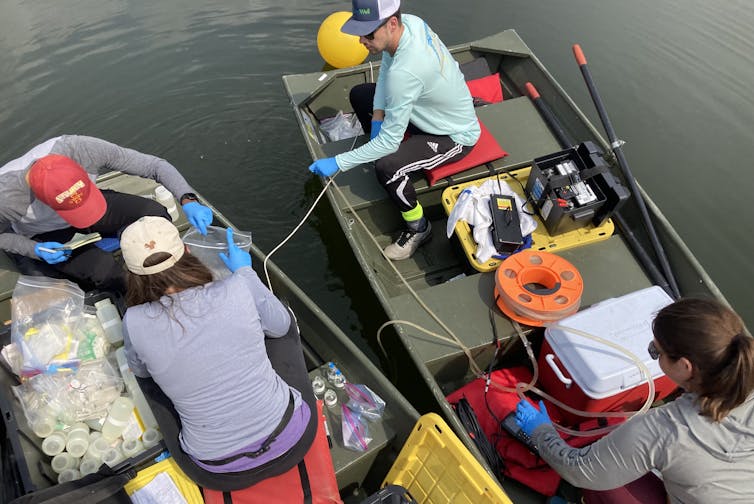
Researchers sample water from various layers to analyze back in the lab. Elizabeth Swanner, CC BY-ND
Little Deming Lake doesn’t get much notice from visitors to Itasca State Park in Minnesota. There’s better boating on nearby Lake Itasca, the headwaters of the Mississippi River. My colleagues and I need to maneuver hundreds of pounds of equipment down a hidden path made narrow by late-summer poison ivy to launch our rowboats.
But modest Deming Lake offers more than meets the eye for me, a geochemist interested in how oxygen built up in the atmosphere 2.4 billion years ago. The absence of oxygen in the deep layers of Deming Lake is something this small body of water has in common with early Earth’s oceans.
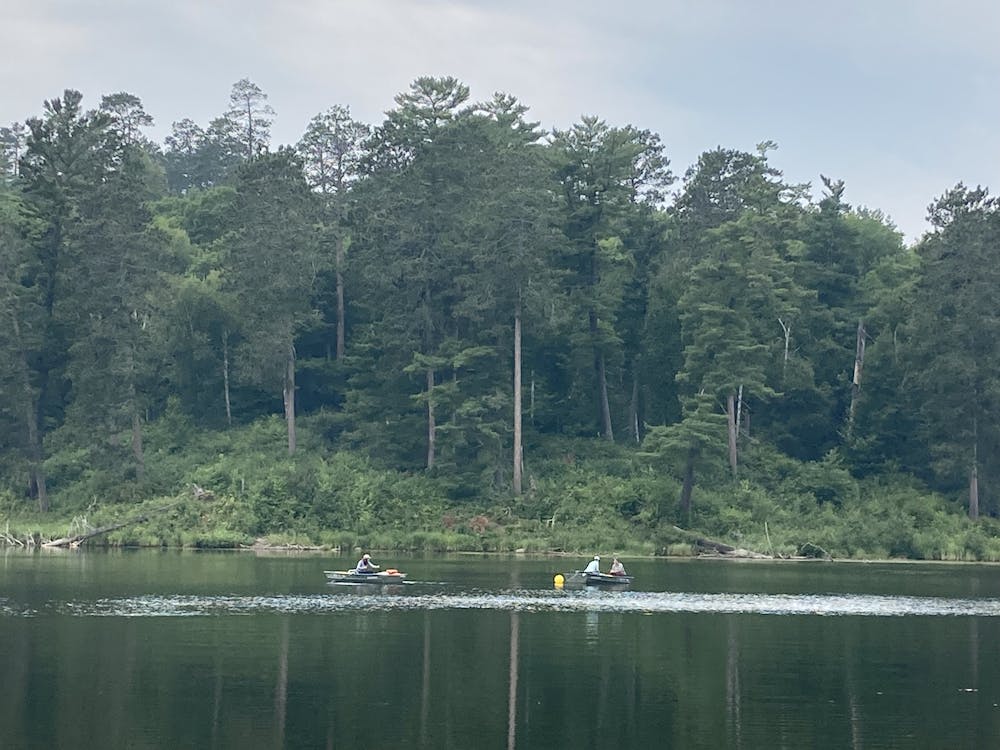
On each of our several expeditions here each year, we row our boats out into the deepest part of the lake – over 60 feet (18 meters), despite the lake’s surface area being only 13 acres. We drop an anchor and connect our boats in a flotilla, readying ourselves for the work ahead.
Researchers’ boats on Deming Lake. Elizabeth Swanner, CC BY-ND
Deming Lake is meromictic, a term from Greek that means only partially mixing. In most lakes, at least once a year, the water at the top sinks while the water at the bottom rises because of wind and seasonal temperature changes that affect water’s density. But the deepest waters of Deming Lake never reach the surface. This prevents oxygen in its top layer of water from ever mixing into its deep layer.
Less than 1% of lakes are meromictic, and most that are have dense, salty bottom waters. Deming Lake’s deep waters are not very salty, but of the salts in its bottom waters, iron is one of the most abundant. This makes Deming Lake one of the rarest types of meromictic lakes.
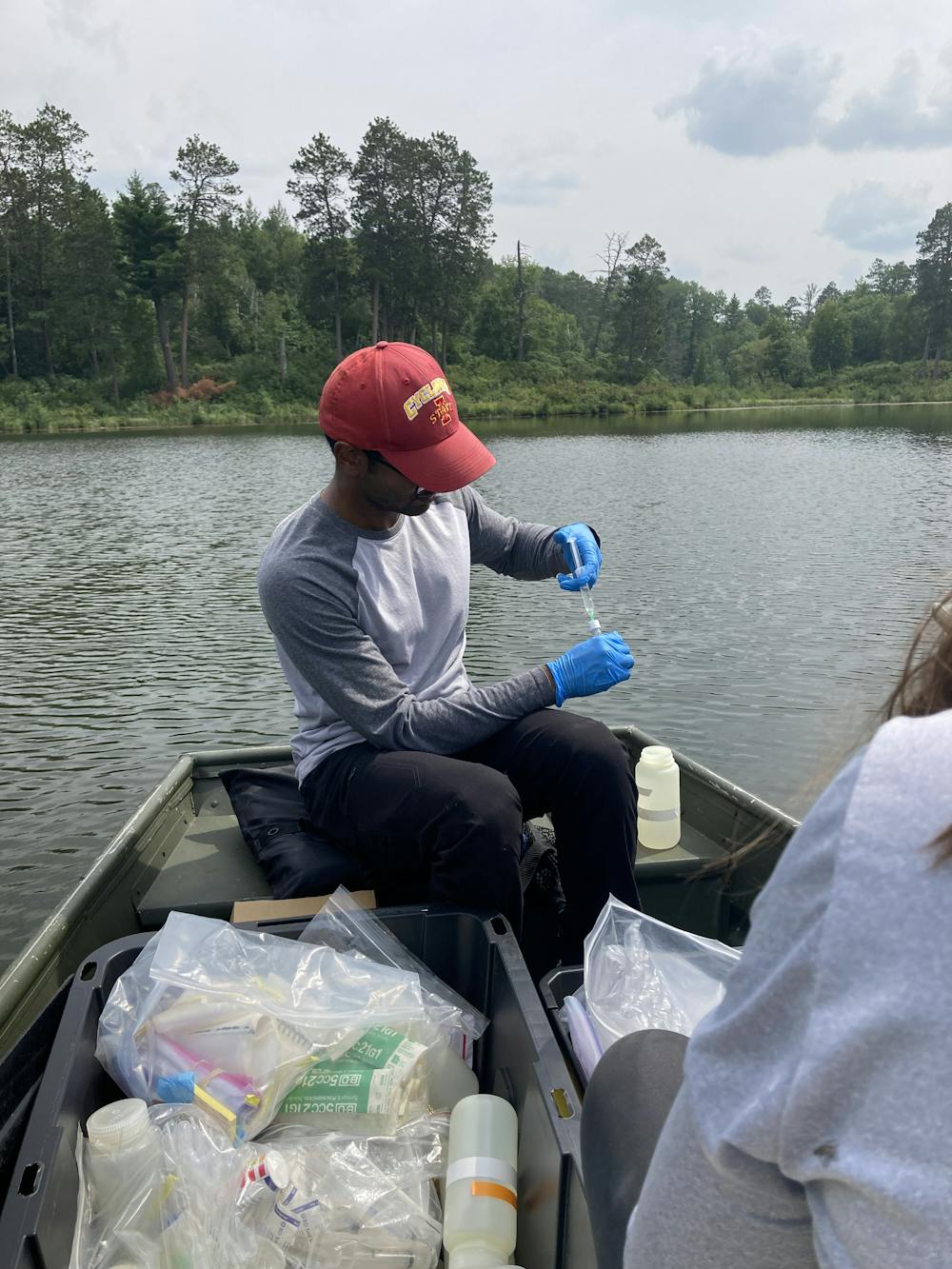
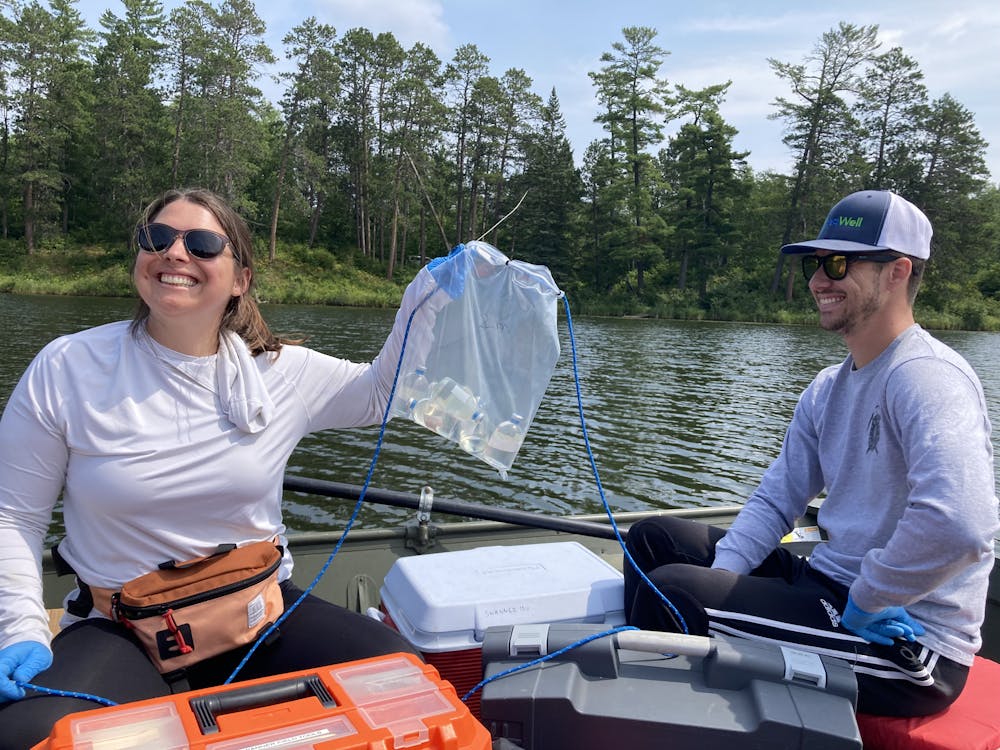
Postdoc researcher Sajjad Akam collects a water sample for chemical analysis back in the lab. Elizabeth Swanner, CC BY-ND
The lake surface is calm, and the still air is glorious on this cool, cloudless August morning. We lower a 2-foot-long water pump zip-tied to a cable attached to four sensors. The sensors measure the temperature, amount of oxygen, pH and amount of chlorophyll in the water at each layer we encounter. We pump water from the most intriguing layers up to the boat and fill a myriad of bottles and tubes, each destined for a different chemical or biological analysis.
My colleagues and I have homed in on Deming Lake to explore questions about how microbial life adapted to and changed the environmental conditions on early Earth. Our planet was inhabited only by microbes for most of its history. The atmosphere and the oceans’ depths didn’t have much oxygen, but they did have a lot of iron, just like Deming Lake does. By investigating what Deming Lake’s microbes are doing, we can better understand how billions of years ago they helped to transform the Earth’s atmosphere and oceans into what they’re like now.
Chlorophyll colors water from the lake slightly green. Elizabeth Swanner, CC BY-ND
At Deming Lake, my colleagues and I pay special attention to the water layer where the chlorophyll readings jump. Chlorophyll is the pigment that makes plants green. It harnesses sunlight energy to turn water and carbon dioxide into oxygen and sugars. Nearly 20 feet (6 meters) below Deming’s surface, the chlorophyll is in cyanobacteria and photosynthetic algae, not plants.
But the curious thing about this layer is that we don’t detect oxygen, despite the abundance of these oxygen-producing organisms. This is the depth where iron concentrations start to climb to the high levels present at the lake’s bottom.
This high-chlorophyll, high-iron and low-oxygen layer is of special interest to us because it might help us understand where cyanobacteria lived in the ancient ocean, how well they were growing and how much oxygen they produced.
We suspect the reason cyanobacteria gather at this depth in Deming Lake is that there is more iron there than at the top of the lake. Just like humans need iron for red blood cells, cyanobacteria need lots of iron to help catalyze the reactions of photosynthesis.
A likely reason we can’t measure any oxygen in this layer is that in addition to cyanobacteria, there are a lot of other bacteria here. After a good long life of a few days, the cyanobacteria die, and the other bacteria feed on their remains. These bacteria rapidly use up any oxygen produced by still photosynthesizing cyanobacteria the way a fire does as it burns through wood.
We know there are lots of bacteria here based on how cloudy the water is, and we see them when we inspect a drop of this water under a microscope. But we need another way to measure photosynthesis besides measuring oxygen levels.
Long-running lakeside laboratory
The other important function of photosynthesis is converting carbon dioxide into sugars, which eventually are used to make more cells. We need a way to track whether new sugars are being made, and if they are, whether it’s by photosynthetic cyanobacteria. So we fill glass bottles with samples of water from this lake layer and seal them tight with rubber stoppers.
We drive the 3 miles back to the Itasca Biological Station and Laboratories where we will set up our experiments. The station opened in 1909 and is home base for us this week, providing comfy cabins, warm meals and this laboratory space.
In the lab, we inject our glass bottle with carbon dioxide that carries an isotopic tracer. If cyanobacteria grow, their cells will incorporate this isotopic marker.
We had a little help to formulate our questions and experiments. University of Minnesota students attending summer field courses collected decades worth of data in Itasca State Park. A diligent university librarian digitized thousands of those students’ final papers.
My students and I pored over the papers concerning Deming Lake, many of which tried to determine whether the cyanobacteria in the chlorophyll-rich layer are doing photosynthesis. While most indicated yes, those students were measuring only oxygen and got ambiguous results. Our use of the isotopic tracer is trickier to implement but will give clearer results.
Graduate students Michelle Chamberlain and Zackry Stevenson about to sink the bottles for incubation in Deming Lake. Elizabeth Swanner, CC BY-ND
That afternoon, we’re back on the lake. We toss an anchor; attached to its rope is a clear plastic bag holding the sealed bottles of lake water now amended with the isotopic tracer. They’ll spend the night in the chlorophyll-rich layer, and we’ll retrieve them after 24 hours. Any longer than that and the isotopic label might end up in the bacteria that eat the dying cyanobacteria instead of the cyanobacteria themselves. We tie off the rope to a floating buoy and head back to the station’s dining hall for our evening meal.
Iron, chlorophyll, oxygen
The next morning, as we wait for the bottles to finish their incubation, we collect water from the different layers of the lake and add some chemicals that kill the cells but preserve their bodies. We’ll look at these samples under the microscope to figure out how many cyanobacteria are in the water, and we’ll measure how much iron is inside the cyanobacteria.
That’s easier said than done, because we have to first separate all the “needles” (cyanobacteria) from the “hay” (other cells) and then clean any iron off the outside of the cyanobacteria. Back at Iowa State University, we’ll shoot the individual cells one by one into a flame that incinerates them, which liberates all the iron they contain so we can measure it.
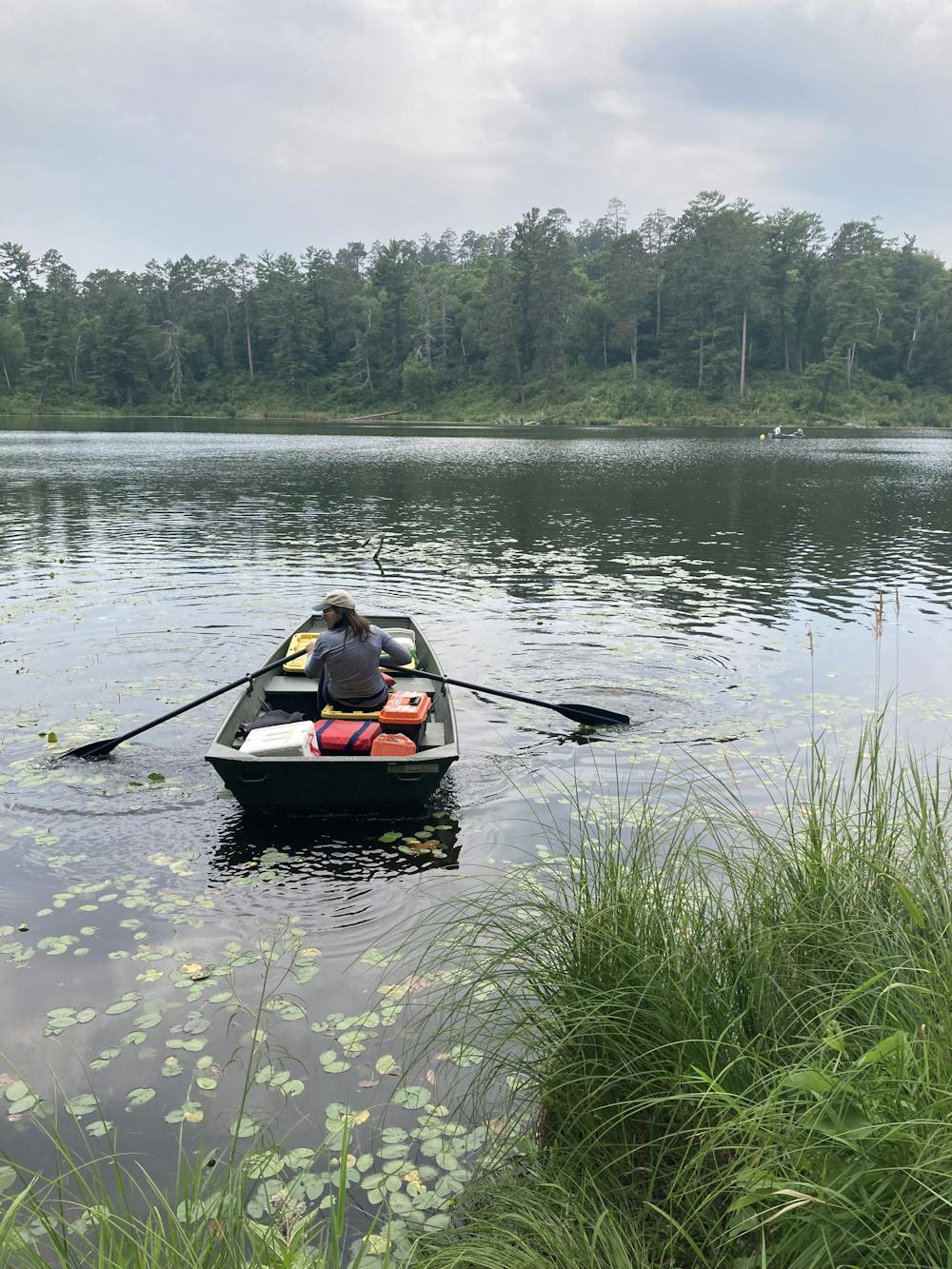
Biogeochemist Katy Sparrow rows a research vessel to shore. Elizabeth Swanner, CC BY-ND
Our scientific hunch, or hypothesis, is that the cyanobacteria that live in the chlorophyll- and iron-rich layer will contain more iron than cyanobacteria that live in the top lake layer. If they do, it will help us establish that greater access to iron is a motive for living in that deeper and dimmer layer.
These experiments won’t tell the whole story of why it took so long for Earth to build up oxygen, but they will help us to understand a piece of it – where oxygen might have been produced and why, and what happened to oxygen in that environment.
Deming Lake is quickly becoming its own attraction for those with a curiosity about what goes on beneath its tranquil surface – and what that might be able to tell us about how new forms of life took hold long ago on Earth.
I thought it very worthwhile to repeat this, plus a real treat at the end of the post!
Scamming in all its forms has only got worse in the last couple of years, since I parted with $9,000 in 2021!
As a direct result of that error, I changed my bank, installed a VPN at home (Proton), changed my email account to ProtonMail, and also changed my calendar (also to Proton).
But I still do not take it as important as it is. I guess because it is not my first thought whenever I come across an unfamiliar email.
ooOOoo
Please read this; and do not make the same mistake as me!
The Story of a Scam
(or how I lost the thick end of $10,000.)
On Friday, 6th August, 2021 at 05:51 in came the following email:
Norton Customer ,
User name:paulhandover
*we like to confim you that the NortonDesk re-newal. has been done on your request*
It is very easy to unsubscribe it,
and related to your any query, reach us at +1-(860) – (852) – (6259).
Product-Name : NortonDesk
……………………………………………………………………………………………………..
Price : $475.04
……………………………………………………………………………………………………..
Subscription ID : 8837-77942826-947192-8126
……………………………………………………………………………………………………..
Expiration Date : 3 Year from the Date of Purchase
………………………………………………………………………………………………
* If you wish to Cancel this Membership then please feel free to Contact our Billing department as soon as Possible*
……………………………………………………………………………………………………..
*Please do not write to this mail address, that will not help*
Reach us on +1 – (860) – (852) – (6259)
……………………………………………………………………………………………………..
Regards,
Billing department
Contact: +1 – (860) – (852) – (6259)
693 Amwell Rd, Hillsborough, NJ
My first mistake was not to check the incoming email address. It was mahaliashomakerxhv928@gmail.com
I telephoned the number given and told the person that I wanted to cancel this membership. Indeed that I had never subscribed for this membership in the first place.
I spoke with ‘Adam’. I was then asked to go to a webpage where I filled in a Refund Application Order form. I filled in my details including the refund amount and my bank details: Sort Code & Account Number.
I then submitted the form and imagine my surprise when a few minutes later I was informed that I had received the sum of $10,000. I quickly checked our bank account online and there was the $10,000 credit in our checking account.
My second mistake was me not examining the total in our accounts. I have the facility to show the total funds in our accounts. Why I didn’t do that I can not explain.
Then it was back on the telephone and Adam also was surprised (later I realised that this was a feigned surprise and all part of the scam) and said could I go to the bank and fill in an International Wire Transfer for the amount of $9,500. Adam also said that he would give me the details of the person in Thailand that was to receive the funds, and could I say this was for a medical operation because it would save ‘Norton’ the taxation.
My third mistake was not to discuss this with Jeannie and to assume that it was just a harmless error.
The details came through and I went to our bank in Grants Pass. I got to the bank a little after 09:00. I saw a staff member of the bank and explained what I needed to do. The bank member queried this and said that it sounded like a scam. I lied and said I knew the woman in Thailand and wanted to go ahead. That was what I had been instructed to say.
My fourth mistake was not listening to the woman at the bank. (And I still thought that the ‘Norton’ funds were in my account.)
The International Wire Transfer was completed and I signed it. I also asked the balances on our two accounts. It was about $10,000 less than I expected and I queried it but was told that there had been a transfer from my savings account to my checking account of $10,000 for Norton. I thought that this was still a little low but that I could check it carefully once I got home. I had a thirty-minute window to change my mind.
Mistake number five, a huge mistake, was while at the bank not to ask them carefully to go through all my transactions that day because that would have revealed that the receipt of $10,000 that I had seen online had mysteriously disappeared. Indeed had never been received. That would have enabled me to stop the wire transfer within the thirty-minute window.
I returned home and found out the truth. I had been scammed out of $9,500.
The strange thing was that ‘Adam’ of the billing department of so-called Norton kept ringing me throughout the day to say that the funds would be sent back to me and gave me the details of three wires and that the funds would be back in my bank account on Monday, 9th August!
Later that morning I rang Kevin Dick who manages our investments and told him the tale. He said that there was a huge amount of scamming about and that I should make three phone calls: to the bank and report the fraud; to the Sheriff’s office and report the fraud; and to my insurance company. The first two were done straight away. Kevin also told me to close my bank accounts and amend my email address. Alex, my son, said to use my Proton mail account and straight away I started to make the change.
A person from the humanists group that we belong to said also to inform The Daily Courier.
On Monday morning Ryan of ‘Norton’ called me at 07:15 and said that Adam Prescott was no longer with the firm. Ryan said that their General Manager, Ron Cooper, would call me shortly. Ron did indeed call me and said that they would return the money but that the minimum cheque they could write was $30,000. I was then told that in advance of me receiving the money I would have to pay a small amount to them. At this point I put the phone down for it was clearly a second attempt to steal more funds from me.
Finally we went back to the bank on Monday morning. We were informed that there was never a credit of $10,000 but that a clever switch of the money from one account to another made it look as though the money had been credited. The event had been reported to the bank’s fraud department.
On Tuesday morning, the 10th August, the bank said that as well as our two accounts being locked out from us and that only cheques and cash withdrawals would be honoured for the time being, the fraud department had made the decision to issue us with a ten-day notice to terminate our accounts. In other words, within ten days the bank would no longer want us as customers. Since then I have done much research and found out via the Forbes website that this was more to do with the bank being ultra conservative than anything else. Indeed Kevin said that he had spoken with his IT department and they thought that it was strange that my ex-bank had terminated us so quickly. The IT department thought that the teller at the bank realised that she had been partly culpable.
However the bank did recommend another bank to go to in Grants Pass.
I have since reset my iMac and changed my email address.
It is a most humiliating affair. I have beaten myself up several times over and have at last understood the frame of mind that I had gotten myself into.
To explain that, first of all I thought that I needed to stop the billing urgently and because it was early on a Friday morning thought that the best thing to do was to call immediately.
Secondly, during the call that scammers spoke to me in friendly tones and quietly complimented me on my integrity. I am sure that this ‘spoke’ to my psychological fear of rejection that I have had since I my father died in 1956.
Then in the morning of the 11th August I received a call from a regular contact at the English company who manage my UK SIPP. He wanted to check if I had tried to log on at 09:00 UK time and I replied that there was no way that was me for that UK time was 01:00 Pacific time. There were apparently three attempts to log on. Unsuccessfully as it turned out and my SIPP account is temporarily closed as a result.
The scammers are very thorough in their crooked craft!
Now as of Thursday, the 12th August, we are pretty much out of the grim shadow of this event. We have new accounts at The People’s Bank here in Grants Pass. I have changed my email address and yesterday afternoon I decided that the only safe way of protecting myself was to get another iMac. I was speaking to the sales department of Apple and mentioned the scam and the woman immediately said I should speak with their Technical Support and transferred me. Then I was helped via screen sharing to go through many pages deleting unnecessary files and other stuff. And the helpful woman found another item of malware that was deleted and removed. She spent 54 minutes getting me properly cleaned out and then forwarded an email with all the links for me to do the same process at a later date. It was a superb experience.
So that is it.
Now watch these two YouTube videos. The first is just 5 minutes long and is important to all who use computers and want to be protected against scammers. (NB: This first video is now not included.)
and then watch this slightly longer video from Jim
Be safe! Please!
An addendum dated Saturday, 14th August, at 7am Pacific Time.
Only to say that I also posted my scamming report on Ugly HedgeHog under their General Chit Chat forum. Of the many responses that came in I wanted to post here two of them.
The first from ‘Stanikon’:
Sorry you had to go through this. Your first clue should have been the grammar and phrasing of the original email. That would have given it away. Legitimate companies go to great lengths to make sure their grammar, phrasing and language are correct. I have avoided several scams by paying attention to that so there is some value in being slightly OCD.
and the second from ‘Red6’:
The safest thing to do in these situations is simply not to open the email. I receive on a daily basis, emails telling me that the items I ordered are being shipped, my subscription to something has been renewed etc, etc. 99.9% of these are scams and nothing bad will happen if you just delete them. Older working people often have the fear that there’s a bill out there that has not been paid and they are afraid of getting a bad credit report. So they aggressively try to send someone money for something they cannot even recognize. If it is a true debt, you will be reminded of it several times before any reports are made.
I follow several simple rules in preventing scams. There are many more but this will take care of most of them.
1. Examine the sender’s email address, if you do not recognize it then DO NOT OPEN and DELETE immediately. Most of these scammer’s email addresses will not have the company name in the email address OR it will be combined with other names. Most will not have the .com, .org, etc but will be gmail, Hotmail, or other generic URL. Many of these scammers “broadcast” their emails to everyone on a purchased email list not knowing whether some or valid or not. If you open or reply to these it verifies your email as valid and active and worthy of more attention. Also, if it is an unknown email address, it could be a carrier of a virus or some other bad computer/software infection.
2. If you do get involved with something that does not feel right and you take it to the bank – TRUST THE BANK if they tell you it is suspicious. They see these things every day and develop a feel for them. I received a cashier’s check for something I sold on craigslist. I took it to the bank to deposit and the bank rep immediately recognized the cashier’s check as a fake. She even called the bank the check was supposed to be drawn on and they checked the records and told her that it was counterfeit. You trust your bankers, credit union, etc with your money every day so trust them when they tell you something does not seem right.
3. Scammers know that many older people do NOT like to use credit cards. So a lot of their dealings involve checks, bank transfers, and other forms of older less secure payment methods that older citizens are comfortable with. I NEVER, NEVER send money for something I purchase or order online unless it is through a credit card. In fact, I rarely buy ANYTHING anymore that does not go on the credit card. They are safer, quicker, and easier. If somehow you do get something on your bill that you did not authorize, the credit card company will investigate and go after the person or company that charged you. This is one more safety step that protects the consumer. This does not always apply to debit cards. Debit cards are issued by individual banks or credit unions and some have policies in the fine print that they do NOT have the same policies as the big credit card companies and may not forgive or relieve the user for bad charges made to their debit card.
4. Just do not believe anyone or any company that says they sent you a huge refund or overpayment or some amount of money by mistake. That rarely happens. It is even rarer if they also tell you to return the money to some foreign address, email, or wire transfer. When in doubt, wait for a week or so before you do ANYTHING. If they sent you the check, transfer etc, wait to see if it clears or is valid. We are conditioned by TV and movies that we need to act immediately in situations such as this. This is rarely the case. Take time to see what happens. During this cooling-off period check them out, research the internet to see if others have experienced this scam. It is almost a sure thing that if you are being scammed, others have been also and it has been reported somewhere with law enforcement agencies or on websites on the internet. Check them out before acting. Or better yet, do nothing for a while and most likely they will just go away. Much like the telephone scammers, they make their money on volume, calling as many as possible in the least amount of time. Scammers will not waste time working on you for days, they have thousands of other emails, accounts to call. Remember, they are after the fastest, easiest targets – the low-hanging fruit.
If it is a true mistake or debt you owe then most likely you will receive some official correspondence in regards to the debt. A good example is the IRS and Social Security phone scams in the past couple of years. You get a call from the IRS or Social Security informing you that you may have committed fraud and law enforcement is on their way to arrest you. But if you arrange repayment with their representative, an arrest can be avoided. The IRS and Social Security NEVER take action without first sending several official US Postal letters to you. If you are still inclined to send money to someone in a foreign country then discuss it with your bank and listen.
Hope this helps.
ooOOoo
All very sound advice and as relevant today as it was when first published.
Finally, for something completely different; have a look at the recent Hunter’s Moon as featured on YouTube.
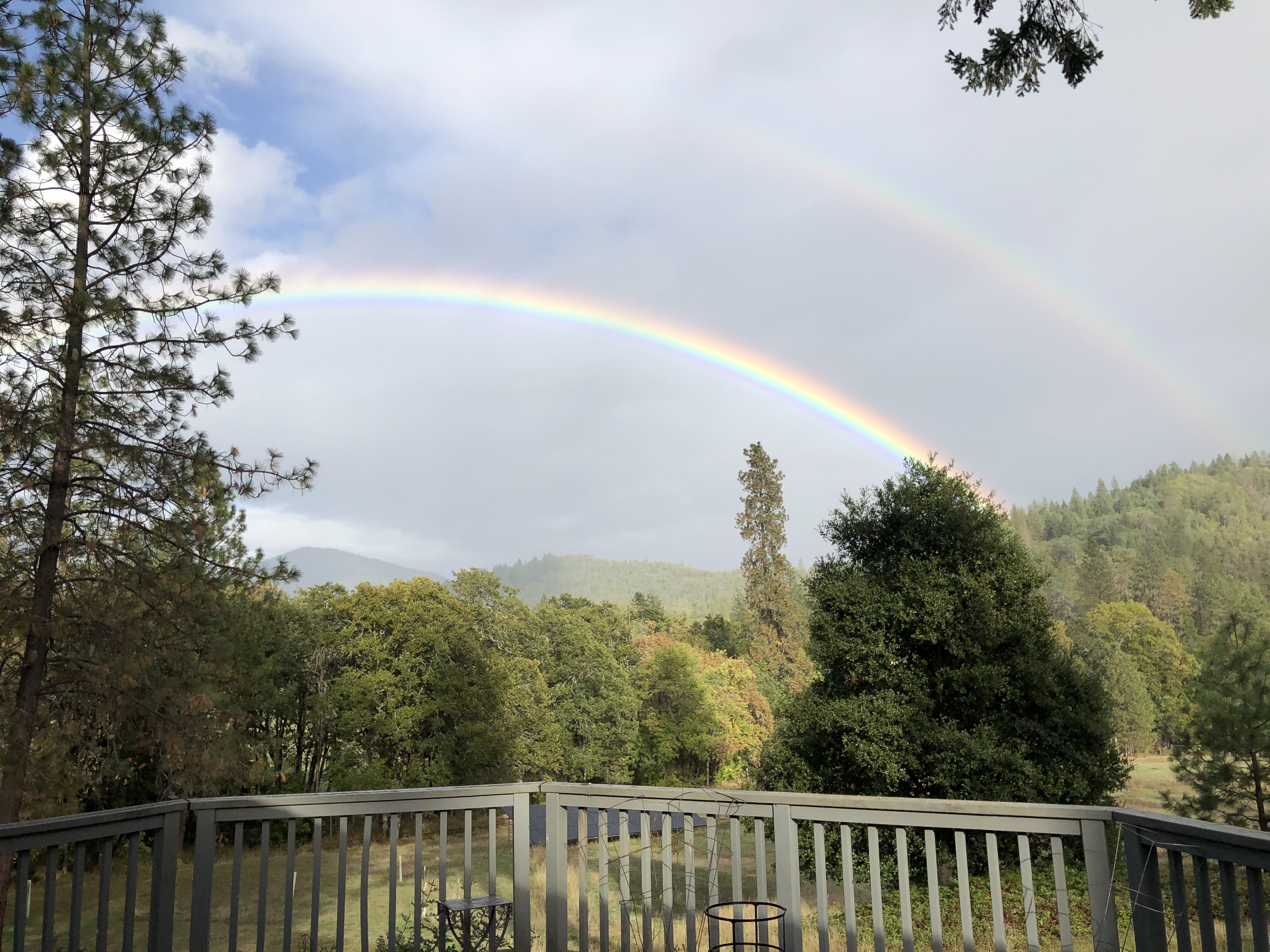
I just ran out of time yesterday to publish a proper blog post so I am sharing this photograph with you. It shows Mount Sexton in the distance, just to the right of the fir tree, and two rainbows, it being a rainy afternoon. The camera is facing North-East and the picture was taken at the north end of our rear deck.
Republishing a recent article published by The Conversation.
Before I go to this article I want to talk briefly about the book the Myth of Normal or as the subtitle explains TRAUMA, ILLNESS & HEALING IN A TOXIC CULTURE.
Let me pick this closing paragraph of Chapter 20, on page 296:
Disconnection in all its guises – alienation, loneliness, loss of meaning and dislocation – is becoming our culture’s most plentiful product. No wonder we are more addicted, chronically ill, and mentally disordered than ever before, enfeebled as we are by such malnourishment of mind, body, and soul.
the Myth of Normal, Dr Gabor Maté with Daniel Maté
It is a very powerful book albeit not the easiest read in the world but still highly recommended.
Plus there is a YouTube video of Dr. Maté being interviewed in July, 2023 by Tara Westover (also a long video!).
Now to the main purpose of today’s post.
ooOOoo
Keeping your cool in a warming world: 8 steps to help manage eco-anxiety
But amid doom-and-gloom predictions, there is hope. As a therapist and clinical social work professor, I have seen firsthand how paralyzing eco-anxiety can be, and I’m dedicated to finding solutions. Here are a few evidence-based tips to tackle your climate woes.
Caring about the world you live in does not make you a “crazy” alarmist. In fact, growing numbers of people across the globe feel the same way, with two-thirds of Americans reporting being at least somewhat worried about climate change in recent polls.
It makes sense that people would feel nervous when basic needs like safety and shelter are threatened. Give yourself grace, because beating yourself up for these very valid feelings will only make you feel worse.
Participate in the solution
It can be hard to feel empowered when environmental harms are taking a toll on your mental health, but the escalating global crisis still demands urgent attention. Instead of burying your head in the sand, use that mental discomfort as a catalyst for action.
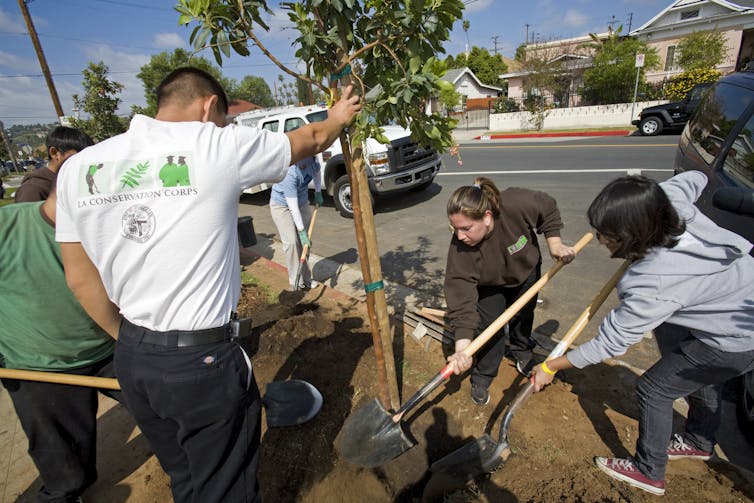
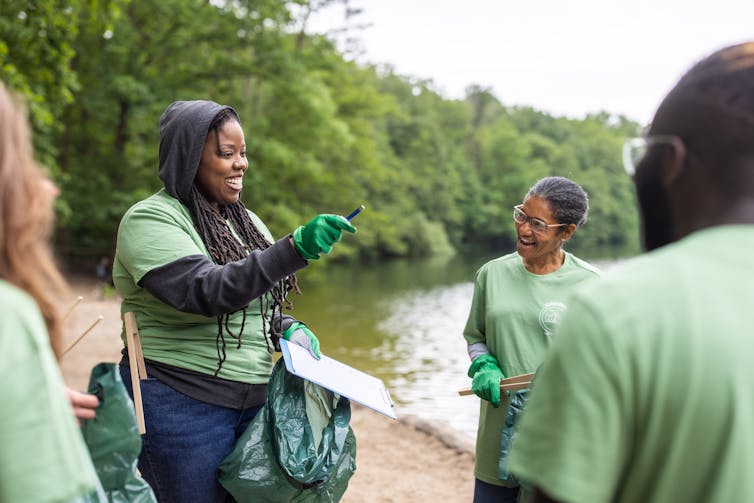
Individual efforts to reduce your carbon footprint matter. Joining larger movements has the potential for even move significant impacts, as well as the potential to buffer anxiety, research shows. Volunteer your own unique passions, talents and skills to advocate for systemic changes that will benefit the planet and humanity.
When you feel anxious, use that energy as fuel for the fight. Harnessing eco-anxiety in this way can reduce your sense of powerlessness.
As a therapist, I often help clients identify and reframe unhelpful thinking patterns. For example, while it is true that there are many environmental problems to grapple with, there is also positive news, so don’t discount it. Recognize and celebrate victories big and small.
Trauma: Process it so you can heal
The climate crisis has been conceptualized as a collective trauma, and many individuals are struggling with eco-grief from climate impacts that have already happened. Processing past trauma from events like weather disasters is a crucial step in enhancing your ability to cope with new experiences.
Even people who have not yet experienced significant climate impacts directly may have signs of pre-traumatic stress, a clinical term for the distress experienced in anticipation of a high-stress situation. A licensed mental health professional can help you process these emotions.
Reduce isolation
It’s no secret that having a strong social support network is a key ingredient for happiness. Surrounding yourself with compassionate, like-minded friends is also key to sustained efforts in doing your part to make a difference.
Consider joining or starting a Climate Cafe or similar group to talk about climate concerns. Visit a 10-step climate grief meeting. Join a local environmental organization. Or simply call up a friend when you need a listening ear.
Go for a quiet walk in the woods and observe nature all around you – it’s a Japanese practice for relaxation known as forest bathing. Spend time gardening. Exercise outdoors or otherwise spend time outdoors in a place that is relaxing and restorative for you.
Self-care is paramount when it comes to managing the emotional toll of eco-anxiety.
Engaging in self-care practices, such as getting adequate sleep, eating healthy and having fun, helps us maintain a sense of balance in the face of overwhelming environmental concerns.
Remember what they teach you on airplanes – you should always put on your own oxygen mask before helping other passengers. Likewise, when we come from a place of wellness, we are better equipped to handle the stresses of eco-anxiety and make a difference in this area.
Mindfulness
Because eco-grief is focused on the past and eco-anxiety is future-oriented, reconnecting to the present moment is a powerful way to combat both.
By cultivating mindfulness – a nonjudgmental awareness of the present moment – people can become more attuned to their thoughts, feelings and bodily sensations in response to eco-anxiety triggers. This heightened self-awareness helps people to acknowledge worries without becoming consumed by them.
In the face of eco-anxiety, these strategies can build resilience, reminding everyone that they have the power to shape a more sustainable and hopeful future.
There’s a powerful reminder that we have the power to stay in the present, or to put it another way by cultivating mindfulness. There are quite a few websites on Mindfulness including this description of what Mindfulness is on the Mayo Clinic website.
Mindfulness is a type of meditation in which you focus on being intensely aware of what you’re sensing and feeling in the moment, without interpretation or judgment. Practicing mindfulness involves breathing methods, guided imagery, and other practices to relax the body and mind and help reduce stress.
Mayo Clinic
Now that is something I should really focus on as I am terrible at being in the moment and nowhere else.
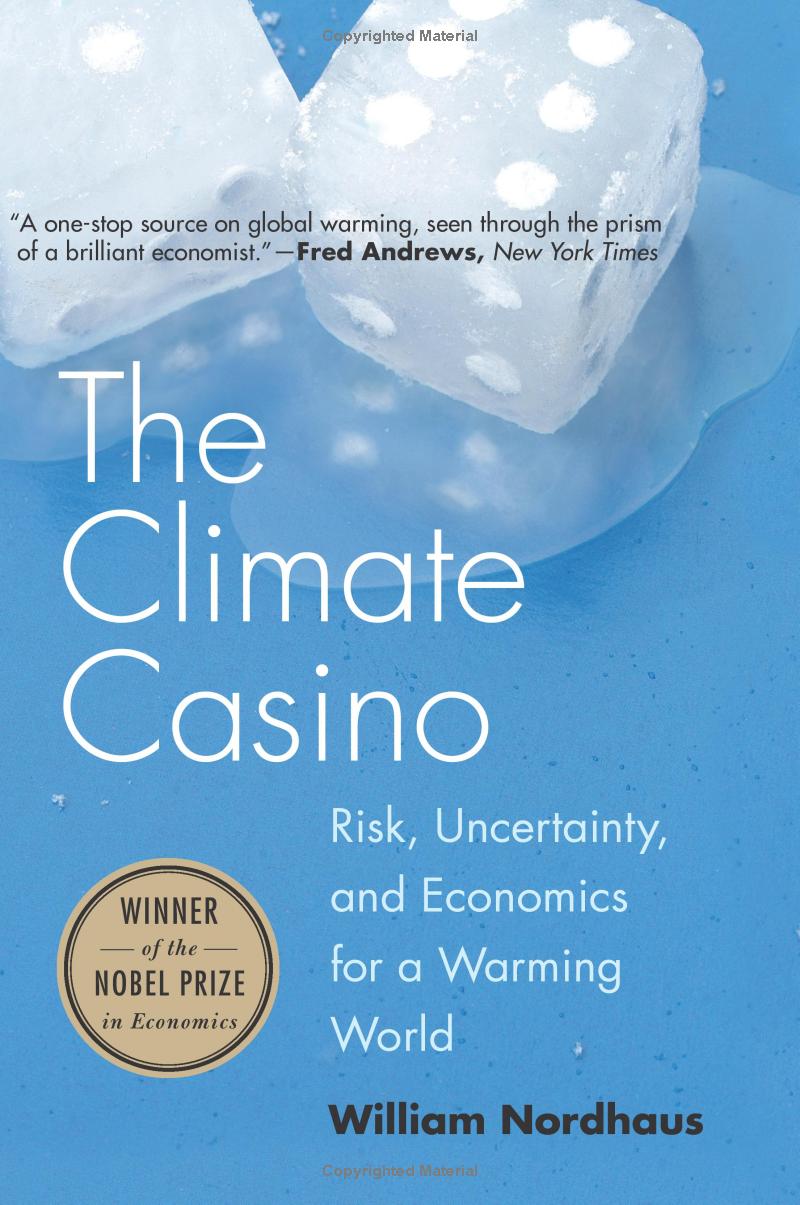
I bought this book from Thriftbooks and was so fired up that I sat down and started reading it almost immediately. For as the back cover explains:
Climate change is profoundly altering our world in ways that pose major risks to human societies and natural systems. We have entered the Climate Casino and are rolling the global-warming dice, warns William Nordhaus. But there is still time to turn around and walk back out of the casino, and in this book the author explains how.
William Nordhaus
William Nordhaus is a brilliant economist as Fred Andrews describes above. Indeed he is the Sterling Professor of Economics at Yale University and he has his website here.
Now I am going straight to two videos.
The first is William Nordhaus receiving the Nobel Prize in 2018.
And the second is that lecture given at the same venue in 2018.


 Learning from Dogs