On the 21st., I published a post Be in peace this day! It was noting this year’s International Peace Day. One of the comments left by Patrice Ayme, in response to an earlier comment from Alex Jones, was this:
Alex: I read your message, and I approve it. Very well put. As Lord Keynes said: ”In the end, we are all dead.” Death seems pretty violent to me. Yet, one can live with it, and embrace it, because, as there is no choice, we may as well.
War is not anymore a problem than peace is. What matters most is the harmony of the society with the environment, not strife within. Plutocrats have unbalanced the environment, so they should be reduced, and that means war, because peace certainly will not reduce them.
Force is the truth of man. Everything else is delusion, even the vegetarian style.
To which I replied:
Patrice, as much as I deeply respect your intellect, I fundamentally am at odds with the sentiments you express. But rather than hide behind a short reply that few will read and even fewer take notice of, I’m going to write a post exploring my reactions in detail. As always, your comments are welcomed.
This, then, is that post.
But where oh where to start? Perhaps by me setting out this general premise.
Wherever one looks, it seems there are examples of madness bordering on the criminally insane.
In so many ways and at so many levels we are running the very real risk that by 2050 the end of this present era of human civilisation by the end of the century will be unavoidable. Ergo: Born after 1980? Then brace yourself for the end times.
The only solution is to adopt the core values of humanity. Very soon!
So on to a few examples of the present madness (and I would be the first to admit that I am, perhaps prejudicially, inclined to see the darkness of our present times).
First: Climate Change
The recent IPCC report made it clear that climate change is most likely a result of man’s activities on this planet. As the summary for policy makers says (selected extracts):
Warming of the climate system is unequivocal, and since the 1950s, many of the observed changes are unprecedented over decades to millennia. The atmosphere and ocean have warmed, the amounts of snow and ice have diminished, sea level has risen, and the concentrations of greenhouse gases have increased.
and
Human influence on the climate system is clear. This is evident from the increasing greenhouse gas concentrations in the atmosphere, positive radiative forcing, observed warming, and understanding of the climate system.
and [my emboldening]
Human influence has been detected in warming of the atmosphere and the ocean, in changes in the global water cycle, in reductions in snow and ice, in global mean sea level rise, and in changes in some climate extremes (Figure SPM.6 and Table SPM.1). This evidence for human influence has grown since AR4. It is extremely likely that human influence has been the dominant cause of the observed warming since the mid-20th century.
But denial is only part of the problem. More significant is the behaviour of powerful people who claim to accept the evidence. This week the former Irish president Mary Robinson added her voice to a call that some of us have been making for years: the only effective means of preventing climate breakdown is to leave fossil fuels in the ground. Press any minister on this matter in private and, in one way or another, they will concede the point. Yet no government will act on it.
As if to mark the publication of the new report, the Department for Business, Innovation and Skills has now plastered a giant poster across its ground-floor windows: “UK oil and gas: Energising Britain. £13.5bn is being invested in recovering UK oil and gas this year, more than any other industrial sector.”
The message couldn’t have been clearer if it had said “up yours”. It is an example of the way in which all governments collaborate in the disaster they publicly bemoan. They sagely agree with the need to do something to avert the catastrophe the panel foresees, while promoting the industries that cause it.
It doesn’t matter how many windmills or solar panels or nuclear plants you build if you are not simultaneously retiring fossil fuel production. We need a global programme whose purpose is to leave most coal and oil and gas reserves in the ground, while developing new sources of power and reducing the amazing amount of energy we waste.
But, far from doing so, governments everywhere are still seeking to squeeze every drop out of their own reserves, while trying to secure access to other people’s. As more accessible reservoirs are emptied, energy companies exploit the remotest parts of the planet, bribing and bullying governments to allow them to break open unexploited places: from the deep ocean to the melting Arctic.
And the governments who let them do it weep sticky black tears over the state of the planet.
Kevin Anderson, professor of energy and climate change at the University of Manchester
What has changed significantly since the last report is that we have pumped an additional 200 billion tonnes of CO2 into the atmosphere. Annual emissions are now 60% higher than at the time of the first report in 1990 and atmospheric CO2 levels are the highest they have been for over two million years.
So what are we doing in the UK to help reverse this reckless growth in emissions? Record levels of investment in North Sea oil, tax breaks for shale gas, investment in oil from tar sands and companies preparing to drill beneath the Arctic.
Against this backdrop, the UK Treasury is pushing for over 30 new gas power stations, whilst the government supports further airport expansion and has dropped its 2030 decarbonisation target – all this alongside beleaguered plans for a few wind farms and weak energy efficiency measures. Governments, businesses and high-emitting individuals around the world now face a stark choice: to reduce emissions in line with the clear message of the IPCC report, or continue with their carbon-profligate behaviour at the expense of both climate-vulnerable communities and future generations.
OK, let’s move to another example of our collective madness.
Second: The way we treat the natural wildlife.
Last Thursday, the New York Times published an item about a recent report confirming the terrible cost to our wildlife of fragmenting their habitat. Here are the opening paragraphs, including the leading photograph in that NYT piece.
In Fragmented Forests, Rapid Mammal Extinctions
An isolated forest in the Chiew Larn reservoir. A Thai government project to supply hydroelectric power to the area transformed 150 forested hilltops into islands. ANTONY LYNAM
By CARL ZIMMER
September 26, 2013
In 1987, the government of Thailand launched a huge, unplanned experiment. They built a dam across the Khlong Saeng river, creating a 60-square-mile reservoir. As the Chiew Larn reservoir rose, it drowned the river valley, transforming 150 forested hilltops into islands, each with its own isolated menagerie of wildlife.
Conservation biologists have long known that fragmenting wilderness can put species at risk of extinction. But it’s been hard to gauge how long it takes for those species to disappear. Chiew Larn has given biologists the opportunity to measure the speed of mammal extinctions. “It’s a rare thing to come by in ecological studies,” said Luke Gibson, a biologist at the National University of Singapore.
Over two decades, Dr. Gibson and his colleagues have tracked the diversity of mammals on the islands. In Friday’s issue of the journal Science, they report that the extinctions have turned out to be distressingly fast.
“Our results should be a warning,” said Dr. Gibson. “This is the trend that the world is going in.”
On a similar theme, many will recall my post back on the 19th, Pity the bees; pity us when I drew attention to the drastic reduction in the numbers of wild bees, including the quote “the vanishing honeybee could be the herald of a permanently diminished planet.“
Guard their future – and ours!
Third: Money and power.
Again from The New York Times but this time an essay by Paul Krugman.
Robert Benmosche, the chief executive of the American International Group, said something stupid the other day. And we should be glad, because his comments help highlight an important but rarely discussed cost of extreme income inequality — namely, the rise of a small but powerful group of what can only be called sociopaths.
For those who don’t recall, A.I.G. is a giant insurance company that played a crucial role in creating the global economic crisis, exploiting loopholes in financial regulation to sell vast numbers of debt guarantees that it had no way to honor. Five years ago, U.S. authorities, fearing that A.I.G.’s collapse might destabilize the whole financial system, stepped in with a huge bailout. But even the policy makers felt ill used — for example, Ben Bernanke, the chairman of the Federal Reserve, later testified that no other episode in the crisis made him so angry.
And it got worse. For a time, A.I.G. was essentially a ward of the federal government, which owned the bulk of its stock, yet it continued paying large executive bonuses. There was, understandably, much public furor.
So here’s what Mr. Benmosche did in an interview with The Wall Street Journal: He compared the uproar over bonuses to lynchings in the Deep South — the real kind, involving murder — and declared that the bonus backlash was “just as bad and just as wrong.”
OK, that’s enough ‘copying’ from me so please go and read more about the plight of those poor billionaires. But if the NYT and Paul Krugman will forgive me, here’s the paragraph towards the end of the Krugman essay that makes me sick [my emboldening]:
The thing is, by and large, the wealthy have gotten their wish. Wall Street was bailed out, while workers and homeowners weren’t. Our so-called recovery has done nothing much for ordinary workers, but incomes at the top have soared, with almost all the gains from 2009 to 2012 going to the top 1 percent, and almost a third going to the top 0.01 percent — that is, people with incomes over $10 million.
Staying with the struggles of our billionaires for a moment longer, try the recent report on Bloomberg about the recent Monaco Yacht Show that included this:
As the yacht size has stretched — this year saw the launch of a record-holding 590-footer called the Azzam — so has the list of distractions onboard. Soaking in a jacuzzi, shooting hoops on a floating court or playing a baby grand Steinway piano no longer cut it.
“There is a change in attitude of super-yacht owners,” said Bert Houtman, founder and chairman of the Netherlands-based U-Boat Worx, surveying two of his submarine models on display quai-side in Monaco. “They’re fed up with drinking white wine and riding jet skis so they’re looking for another thrill.”
later including:
“A lot of guys who are billionaires have profound financial accomplishments and are now concerned about their legacy,” said Deppe. (Marc Deppe, Triton Subs vice-president of sales and marketing.)
It’s enough to make one weep!
Fourth: Politicians and governments not serving their peoples.
Making this my last example. Simply because a recent item published on Naked Capitalism had so much detail on what is wrong with our leaders; in this particular case regarding the American Affordable Care Act (ACA). This is how the article opens:
Many people, and especially Obama supporters, characterize the ACA (ObamaCare) as “just starting” or a “work in progress” and then go on to urge that the program will have “glitches,” needs to be “tweaked,” isn’t yet “fully implemented,” and so forth. We think it’s a mistake to see the ACA as just starting. We also think it’s a mistake not to weigh the costs of ObamaCare’s stately three-year progress toward partial coverage for the the American people, and just as important to weigh the opportunity costs.
The ACA was passed in March 2010, incorporating many features designed to meet Republican objections to the Bill. Yet, in the end, Democrats never put Medicare for All on the table, abandoned the public option and many other features, and did not get a single Republican vote in either chamber.
The Democrats even saw to it that the bill was fiscally neutral over a 10 year projection at a time when the tanked economy needed more deficit spending and the jobs that would have brought. And to do that, they postponed implementation of most of the bill for more than three years, until now, allowing people to go without care, to die, to divorce, and to lose their homes or go bankrupt due to medical bills, just so they could argue that the bill was fiscally neutral. In gauging the record of the bill, these 3 to 3.5 years of waiting for its implementation and their real costs to the people of the United States must be taken into account.
It also must be taken into account that in the year before the ACA was passed there were some 45 million Americans uninsured, and they were dying at the rate of 1,000 more for every million than in the general population. That is, lack of insurance was causing more than 45,000 fatalities per year. (The cost of those deaths in money terms: $1.38 trillion).
That’s what we’ve lost by not trying to pass HR 676 and by trying instead to take a bipartisan insurance company conciliation approach to passing the ACA. This post, gives the total for the anticipated opportunity cost by comparing Romney’s 2012 alternative to the ACA, the baseline of no reform at all, the ACA, and Medicare for All over the period 2010 – 2022. Bottom line: the ACA is projected to cost 286,500 lives through 2022, assuming no change. That’s a lot better than the baseline and a lot better than Romney’s 2012 alternative. But it’s still terrible compared to what we might have had if we had a President who really represented people rather than Wall Street.
What if an effort to pass HR 676 had failed in 2009 because too many Democrats in the Senate defected to pass it? Well, I think this would have been very unlikely with the very large Democratic majority and the popularity of the president at its height, but even if it would have failed, then the Democrats could still have compromised with members of their party to pass enhanced Medicare for All for everyone under 26 and over 45, or under 26 and over 50, or whatever compromise would have moved those wayward Democrats up to the 50 vote mark. Such a compromise bill would still have lowered the fatalities substantially by providing insurance for those who needed it most and by enhancing the Medicare program for seniors (full coverage and no co-pays). It would also have been something Democrats could have run on and built upon in each successive election year, rather than having to defend the sorry ACA with its package of inadequate goodies, silly mandate, IRS enforcement, high cost for lousy coverage, and Rube Goldberg eligibility determination. Again there would have been no Tea Party, because Tea Partiers like Medicare, and there would have been no Republican nationwide sweep in 2010, no gerrymandering, no voter suppression, no anti-woman bills, and none of all the rest of the nonsense we’ve seen because the Democrats did what they did.
Earlier in the post I offered a general premise that included, “Wherever one seems to look there are examples of madness bordering on the criminally insane.”
To my mind, these examples support that premise. Trust me, there are countless more examples.
So what to do? Because I am fundamentally at odds with the sentiment expressed by Patrice Ayme; “Force is the truth of man. Everything else is delusion, even the vegetarian style.”
The answer takes us to tomorrow’s post, A return to integrity.
And, yes, it does mention dogs! Rather a lot as it happens!
This was a guest post sent to me by regular contributor, Chris Snuggs, back in May. It somehow slipped between the cracks, so to speak, and only came to light when I was trawling through a pile of draft posts.
Despite, or even because of, Madam Merkel’s re-election it still seemed a valuable post to publish. Chris lives in Germany and has a very good perspective on things.
It may also serve as an interesting reflection on the IPCC’s report when it is published later this week.
Over to Chris.
oooOOOooo
“Angela Merkel would seem to want it both ways.” (“Der Spiegel”)
The above comment caught my eye as I browsed through “Der Spiegel” this morning. Frau Merkel is delaying difficult decisions on energy production and “carbon backloading” until after the September elections in Germany.
Nothing earth-shattering in itself, of course. It is human nature to want it both ways, and examples do not lack.
One does somehow feel, however, that it has got worse in recent years. Kids want a highly-paid job without working their way up through the company hierarchy. Spain et al want to enjoy German prosperity by using EU “structural funds” without actually doing the boring hard work over decades. And politicians of course want growth and prosperity and a vast state apparatus plus a voter-bribing welfare system but without debt – or indeed troublesome whinging from the voters. However, as the proverb goes: “You can’t have your cake AND eat it.”
However, this article quoted is about something more serious than mere short-term greed, which is not exactly new in the history of Mankind. No, we are now applying the illusion that we can have it both ways in an area that threatens life on the planet – Global Warming of course.
As a concerned member of the “We don’t want to die from Global Warming Brigade”, I am more worried than ever about what is going on, and Germany is a symbol. Whatever the Germans do, they tend to do thoroughly and efficiently. They have a fairly large Green Party, a large investment in solar power and until recently seemed to be setting an example to Europe and the world. However, …..
• Germany will this year start up more coal-fired power stations than at any time in the past 20 years as the country advances a plan to exit nuclear energy by 2022. Two coal-fired plants opened in 2012 and six more will open this year, adding up to 7 percent of Germany’s capacity. A dozen more are on track to open before 2020. Greenhouse gas emissions in Germany, Europe’s biggest economy, rose 1.6 percent last year as more coal was burned to generate power, the Environment Ministry said two days ago.
• With the current carbon price, utility companies that have invested in low-carbon electricity generation such as wind and nuclear are losing market share to companies that produce energy using coal. Some companies are already acting on the low price of carbon in Europe. E.ON, for example, one of Germany’s largest utilities, announced recently that clean-energy investments will be cut to less than €1 billion in 2015 from €1.79 billion last year.
The thing is, if serious and efficient Germany is backsliding on emissions what are the chances for the rest of the world, with standards of living far below Germany and desperate to catch up?
An understanding of the problem of CO2 emissions is hardly new, yet it seems to me true to say that nothing serious is being done about it. There is lots of talk, noble efforts by Al Gore et al, international conferences, carbon-trading schemes and so on, but all the time CO2 emissions are increasing. Last week we learned that atmospheric CO2 has now reached 400 parts per million, a level not seen for 4 million years.
Despite this (and the consequences predicted seem to range from merely uncomfortable to threatening to life on Earth), the search for, exploitation and use of fossil fuels are all increasing. A student of logic would surely say that this is irrational; we are lowering ourselves to the level of lemmings, except that they can’t help it but we could.
We are completely hooked on fossil fuels; that is the problem. We have one minister ranting on about “saving the planet” and another proudly announcing new oil-wells, new areas earmarked for shale-fracking, developing countries opening new coal-fired power-stations. Industry in the west is making some efforts to clean up its act but these are being predictably swamped by growth in the developing economies.
It would be funny if it weren’t so serious. A few years ago “experts” talked about the end of oil as resources ran out but as we get cleverer at extracting it from more and more difficult places the availability of fossil fuels is actually going up! On top of this the melting poles (and Greenland) are opening up new areas for exploitation by the oil companies.
“Oil companies”. Yes, the Big, Bad and Ugly Culprits … and yet the last time I checked oil companies do not actually run the country they are based in. (Conspiracy and “Plutocrats run the World” theorists will certainly disagree with this, but that is another story!)
No, governments rule their countries, and while some are dictatorships and plenty of others are totally corrupt, there are a good number of democracies involved in this headlong rush to disaster. Worse, we are in a massive generalised recession and yet emissions are still creeping up. What will happen once “growth” takes off once more – as it will, these things going in cycles.
Living in Germany, I have personally been horrified by the decision to phase-out nuclear power. The Green movement is politically significant here and the government reacted rapidly and negatively to the Fukushima incident. This was indeed terrible, but does not change the facts:
– Nuclear is totally free of CO2 emissions.
– There has never been a serious accident in Western Europe.
– France still today derives over 70% of its electricity from nuclear.
– Nuclear designs are far safer than they were years ago.
– Nobody in their right mind would build a nuclear power station in an earthquake zone as the Japanese did – though if they want nuclear (and they have few natural resources) they don’t have a lot of choice
– Europe of course is an earthquake-free zone, except for Southern Italy.
– Nobody either would build one where the cooling pumps could be flooded by a tsunami – as the Japanese (usually so clever) ALSO did.
There are nonetheless dangers in nuclear of course, but:
– ONLY nuclear can currently provide enough power to satisfy our needs without CO2 emissions. Solar and wind are feeble pinpricks in comparison.
– There is no sign of a Deux ex Machina on the horizon that will solve the emission problems associated with fossil fuels.
My personal conclusion is that without nuclear we are doomed, since we seem totally incapable of reducing CO2 without it. On the contrary, now that shale-fracking has come on stream the emissions seem likely to rocket, with a presumable corresponding increase in Global Warming. And as far as that is concerned, it does seem to me – as a layman, like most of us – that we are involved in a vicious circle: the more the poles and Greenland melt, the more radiation is absorbed by the oceans and the more CO2 is released. People have talked about a “tipping point”, but it could just as easily be an “explosion point” – after which a geometrically increasing temperature in an unstoppable feedback cycle takes us to a Venusian scenario.
Not wishing to be to gloomy, but Frau Merkel’s procrastination is worrying. Politicians do things with such short-term considerations. She seems to be waiting till after the elections, but excuse me Frau Merkel, saving the planet can’t be put on hold.
Yes, whatever Europe does is pointless if India, China and South America are going to steam ahead, but someone has to set an example, and at the moment, Germany is burning much more coal AND opening new coal-fired power stations just as we should be cuttting back.
What is the solution? Nobody seems to know. If they do, they aren’t acting up on it. It is rather depressing. All Europe’s politicians are talking about at the moment is increasing growth = burning more fossil fuels. Even France is cutting back on nuclear ….
WHO WILL SAVE US?????
Finally, a few facts about emissions:
• The world emitted 31.8bn tonnes of carbon dioxide from the consumption of energy in 2010 – up 6.7% on the year before.
• The world emits 48% more carbon dioxide from the consumption of energy now than it did in 1992 when the first Rio summit took place.
• China and India together are building four new coal-fired power stations per week
• China – which only went into first place in 2006 – is racing ahead of the US, too. It emitted 8.3bn tonnes of CO2 in 2010 – up 240% on 1992, 15.5% on the previous year.
• China now emits 48% more CO2 than the USA – and is responsible for a quarter of the world’s emissions. Chinese per capita emissions, however, are still around 60% lower than in the USA (now involved in extensive shale-fracking)
• Global coal consumption grew by over 5% in 2010; gas by over 2%.
• Renewable energy accounted for only 2.2% of global energy output in 2011, despite all the fanfare over wind turbines and solar panels.
I tried to get a handle on some of these statistics. 31.8 billion tons of CO2! I went into the garden yesterday and tried to imagine the volume of gas that would weigh one ton. Impossible of course, so I looked it up: it is apparently 556.2m3 or a cube with sides of 8.3m.
A further reminder of the power of positive thinking!
So much for fine ambitions! I’m recalling a post I published just one week ago; yes 7 tiny days past! That was the post that I named ‘Staying positive – the test.‘ Where I opened it, as follows:
Where hope and inspiration meets the cold world of reality!
Yesterday’s post Don’t frighten the horses was all about reminding me that fear is a very bad motivator. I promoted the Transition message, ”If we can’t imagine a positive future we won’t be able to create it.”
This small chastisement comes on the back of yesterday’s post where I had a ‘big dump’ of feelings about some of the madder aspects of our so-called modern life.
Then later on in the day, I just happened to come across a flurry of positive stories that I wanted to share.
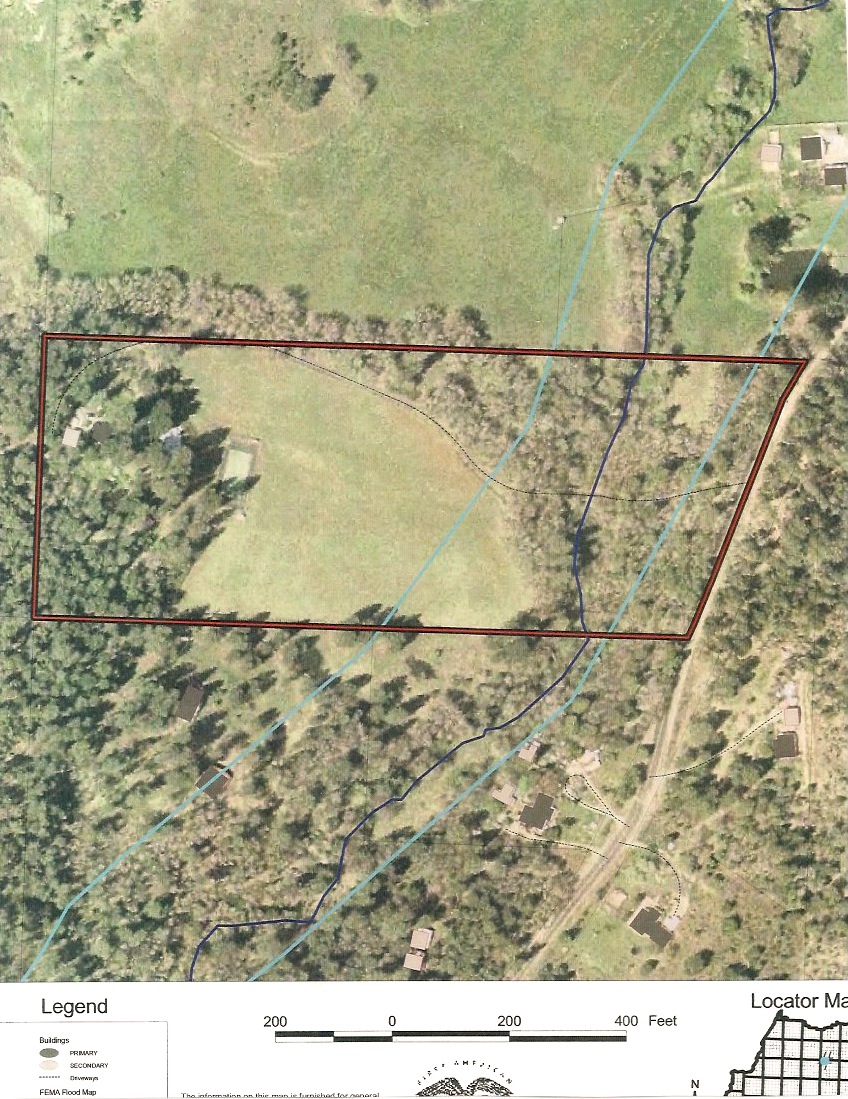
First, here’s a scan of the assessors map of our property, near Merlin, OR.
A little over 13 acres, orientated West-East.
NB: The blue line is the course of Bummer Creek, that historically has had a year-round flow, albeit a low flow during Summer months. The rectangular green area to the West of the open land was a tennis court, now removed. The main house is 200 feet West of that tennis court area, completely hidden by surrounding trees. It is a beautiful place for us and all our animals!
The first positive story was as a result of watching that TED Talk by Marla Spivak. Jean and I thought that as we have well over 4 acres of open grassland, let’s see what we can do to attract and assist our local bees.
Jean and I are supporters of Oregon Wild and a quick call to them about assisting local bees elicited this:
Hi Paul,
Nice speaking with you this morning. For your inquiries on how best to attract bees to your acreage, I would recommend the Xerces Society, a local Oregon group with a Pollinator Campaign. They have a lot of great info on their website, and you could also give them a call at 855.232.6639.
Also, Representative Earl Blumenauer here in Portland has been a big advocate for bee conservation and recently introduced the Save America’s Pollinators Act if you’re interested in bee conservation activism.
Hope this helps!
Cheers,
It was then an easy step to contact the Xerces Society, that very helpfully produced the following advice:
Hello Paul-
Thank you for calling the Xerces Society with your questions today. We have many resources available to landowners who wish to conserve pollinators and create habitat on their land. Here are links to several of our resources:
Attracting Native Pollinators
Pollinator Habitat Installation Guides
Regional guidance on site prep, planting, and management for pollinator habitat. We have guidelines for creating pollinator meadows and flowering hedgerows. Each guideline has an appendix with regionally appropriate bee magnet plants.
Conclusive evidence that mankind is part of nature!
Subtext = There are times when our arrogance and mindlessness beggars belief.
Sorry, if you pick up on a degree of emotion in today’s post. It’s impossible to hide!
Here’s what has fed that.
A few days ago, I came across some stunning images of bees, over on the Flickr website. Particularly, I was here and offer below a small sample of what was seen:
Chrysidid Wasp, U, Side, UT, Utah Co_2013-08-07-17.51.41 ZS PMax
Much more may be learned about bees by going to the USGS Bee Inventory and Monitoring Lab (BIML). The BIML website is here.
Then coincidentally (seems to be happening much of this week!) Jean and I watched the latest TED Talk by Marla Spivak. It was called: Why bees are disappearing.
Marla’s talk is just 15-minutes long, and I beg of you to watch it because the ramifications for all of warm-blooded life on this planet are frightening if we don’t amend our ways – and amend them pretty damn soon!
Honeybees have thrived for 50 million years, each colony 40 to 50,000 individuals coordinated in amazing harmony. So why, seven years ago, did colonies start dying en masse? Marla Spivak reveals four reasons which are interacting with tragic consequences. This is not simply a problem because bees pollinate a third of the world’s crops. Could this incredible species be holding up a mirror for us?
Marla Spivak researches bees’ behavior and biology in an effort to preserve this threatened, but ecologically essential, insect. Full bio »
You may also want to go across to the University of Minnesota‘s Bee Lab website, where there is much more from Marla about our bees.
Washington — The Centers for Disease Control on Monday confirmed a link between routine use of antibiotics in livestock and growing bacterial resistance that is killing at least 23,000 people a year.
The report is the first by the government to estimate how many people die annually of infections that no longer respond to antibiotics because of overuse in people and animals.
CDC Director Thomas Frieden called for urgent steps to scale back and monitor use, or risk reverting to an era when common bacterial infections of the urinary tract, bloodstream, respiratory system and skin routinely killed and maimed.
“We will soon be in a post-antibiotic era if we’re not careful,” Frieden said. “For some patients and some microbes, we are already there.”
The SFC report later goes on to say:
At least 70 percent of all antibiotics in the United States are used to speed growth of farm animals or to prevent diseases among animals raised in feedlots. Routine low doses administered to large numbers of animals provide ideal conditions for microbes to develop resistance.
“Widespread use of antibiotics in agriculture has resulted in increased resistance in infections in humans,” Frieden said.
It concludes, thus:
Legislation goes nowhere
Organic certification prohibits antibiotic use, but raising such animals is costly, he said.
Rep. Henry Waxman, D-Los Angeles, first introduced legislation in 1980 to restrict antibiotic use in livestock. For the past decade, Rep. Louise Slaughter, D-N.Y., has introduced similar bills, joined in recent years by Sens. Dianne Feinstein, D-Calif., and Kirsten Gillibrand, D-N.Y., but the measures have gone nowhere.
“We constantly hear from the pharmaceutical and livestock industry that antibiotic use in livestock is not a problem and we should focus on human use,” said Avinash Kar, a staff attorney at the San Francisco office of the Natural Resources Defense Council, an environmental group that has sued the FDA to force it to ban using antibiotics to promote growth in livestock. The case is now pending before the 2nd U.S. Circuit Court of Appeals.
Americans Are 110 Times More Likely to Die from Contaminated Food Than Terrorism
September 17, 2013 – This article first appeared on Truth-Out.org.
One of the most important revelations from the international drama over Edward Snowden’s NSA leaks in May is the exposure of a nearly lunatic disproportion in threat assessment and spending by the US government. This disproportion has been spawned by a fear-based politics of terror that mandates unlimited money and media attention for even the most tendentious terrorism threats, while lethal domestic risks such as contaminated food from our industrialized agribusiness system are all but ignored. A comparison of federal spending on food safety intelligence versus antiterrorism intelligence brings the irrationality of the threat assessment process into stark relief.
In 2011, the year of Osama bin Laden’s death, the State Department reported that 17 Americans were killed in all terrorist incidents worldwide. The same year, a single outbreak of listeriosis from tainted cantaloupe killed 33 people in the United States. Foodborne pathogens also sickened 48.7 million, hospitalized 127,839 and caused a total of 3,037 deaths. This is a typical year, not an aberration.
See what I mean about our mindlessness! That article continues:
We have more to fear from contaminated cantaloupe than from al-Qaeda, yet the United States spends $75 billion per year spread across 15 intelligence agencies in a scattershot attempt to prevent terrorism, illegally spying on its own citizens in the process. By comparison, the Food and Drug Administration (FDA) is struggling to secure $1.1 billion in the 2014 federal budget for its food inspection program, while tougher food processing and inspection regulations passed in 2011 are held up by agribusiness lobbying in Congress. The situation is so dire that Jensen Farms, the company that produced the toxic cantaloupe that killed 33 people in 2011, had never been inspected by the FDA.
I can’t stomach any more (whoops, pardon the pun!) so if you want to read to the end, it’s here.
OK, sufficient for today! Need to find a dog to curl up with.
As is the way of things, my post yesterday, The growth of empathy, unwittingly set the scene for today’s post. Here’s why!
In yesterday’s post I mentioned Fukushima and the power of blogging in connecting so many all across the world. Maurice Barry, who writes his own blog, left a comment:
Regarding Fukashima I’m still left wondering whether the real problem is the lack of social conscience in the top level leaders or the apathy of ordinary people like you and I who let them carry out their plans.
To which I replied, “Maybe just the power of 20:20 hindsight?”
So to today’s post.
One of the items in yesterday’s Naked Capitalism Links was the headline: Is there a media blackout on the fracking flood disaster in Colorado?That caught my eye and in a moment I had gone across to the blogsite: Bluedaze Drilling Reform.
This is what I read:
Is there a media blackout on the fracking flood disaster in Colorado?
I will update this post as residents send me pictures and video.
We need the national news stations to go cover the environmental disaster that’s happening in Colorado right now.
This picture taken by a resident is from yesterday.
From an email.
I see you’ve noticed the underwater wells in Weld County, Colorado. Amazing; we’ve emailed the Denver TV stations, other media, and state and local politicians. We’ve sent pictures that our members have taken. It’s like the media and politicians have been TOLD not to say anything about it. There has been no mention of the gas wells on the Denver newscasts either last night or this evening although all stations have had extensive and extended flood coverage. You can see underwater wells in the background of some of the newscast videos, and yet the reporters say absolutely nothing.
Here’s a picture one of our members took yesterday in Weld County, Colorado. We’ve got tons more on our website. Check it out. The tanks are tipping and, in some cases, have fallen over. They have to be leaking toxins into the flood waters. There have to be hundreds if not thousands of underwater well pads in Weld County as a result of the flooding.
Please publicize this in Texas since our media people and politicians have gone silent!
The reason I called today’s post ‘Questions without answers’ was because there are so many complex issues today. So many issues that cannot be understood in simple ‘question and answer’ ways. But one hope of finding answers to the complex questions of these times is through the sharing, caring ways of communicating that so many can access. No more passionately demonstrated than by TXSharon in her About section of her blog.
Finally, I shall leave you with another great dog picture from Chris Snuggs. So beautifully appropriate to the complex world we live in.
Can’t recall how, but recently I came across a wonderful collection of photographs of waterfalls presented by MNN – Mother Nature Network. There are 16 photographs; I took the liberty of sharing just a few of them with you today.
Dettifoss
Located in Northeast Iceland, the massive Dettifoss is generally recognized as the largest and most powerful waterfall in Europe. It is protected within the Vatnajökull National Park and remains untapped as an energy source. Plans to build a hydroelectric plant at the site have proven to be an engineering risk.
Gocta Cataracts
Well-known to locals for centuries, this towering waterfall remained a secret from the rest of the world until as recently as 2005, when German explorer Stefan Ziemendorff became the first outsider to witness it. Located in a remote Amazonian province in Peru, the Gocta Cataracts is one of the world’s tallest waterfalls. Though accurate measurements of its height have yet to be taken, an initial estimate placed it as the third highest in the world.
Locals kept the location secret because they feared that revealing its whereabouts would release the curse of a beautiful blond mermaid who is rumored to live in the waters.
Havasu Falls
Plunging over majestic red rocks and pooling into milky, turquoise water, it’s easy to see why Havasu Falls is one of the most photographed waterfalls in the world. It helps that the location is deep within breathtaking Grand Canyon National Park, where the waters eventually converge with the mighty Colorado River.
Kaieteur Falls
Located in Guyana’s Kaieteur National Park, this waterfall is reputed to pour more water over a great height than any other waterfall in the world. According to the World Waterfalls Database, Kaieteur Falls is the world’s 123rd tallest (single and multi-drop waterfall) and the 19th largest waterfall in terms of volume. In other words, this site has a rare combination of height and water volume, which helps to quantify its spectacular beauty.
Niagara Falls
The most powerful and most famous waterfall in North America, Niagara Falls pours more than 6 million cubic feet of water over its crest line every minute during high flow. Located on the border between the state of New York and the province of Ontario, Canada, the falls are an important source of hydroelectric power for both countries. The site has inspired its share of daredevils who have attempted to plummet over the falls in barrels, or who have tiptoed over them on a high wire.
Nature’s Power
Few natural wonders encapsulate the sublime power and impermanence of the wild better than roaring waterfalls. The force of a waterfall can carve a valley out of mountains, shape the world’s grandest canyons and even power our electrical grids.
Here are two photographs taken on Friday when a mother deer and her young fawn overcame shyness of Jean in order to feed on some grains that Jean had placed near her car.
Trust between deer and Jean.
Later the young fawn was nibbling the grass in front of the tractor, allowing the following picture to be taken.
Magical moment.
We sincerely hope we can set up some regular pattern of feeding the deer, especially during the coming Winter.
I have long been a fan of George Monbiot as evidenced by a number of posts on Learning from Dogs from the said gentleman. The last one was The Great Unmentionable, and before that DDT all over again?
George Monbiot is a man of passion about the planet we all live on and securing a sustainable future for us all.
So settle down comfortably for 15 minutes and listen to him. You will understand both his passion and the vital message he offers us.
Published on Sep 9, 2013
Wolves were once native to the US’ Yellowstone National Park — until hunting wiped them out. But when, in 1995, the wolves began to come back (thanks to an aggressive management program), something interesting happened: the rest of the park began to find a new, more healthful balance. In a bold thought experiment, George Monbiot imagines a wilder world in which humans work to restore the complex, lost natural food chains that once surrounded us.
If you would like more of Mr. Monbiot’s writings, then here’s his website.
Where hope and inspiration meets the cold world of reality!
Yesterday’s post Don’t frighten the horses was all about reminding me that fear is a very bad motivator. I promoted the Transition message, “If we can’t imagine a positive future we won’t be able to create it.”
Easy to say, easy to write, less easy to put into practice in the face of really chilling predictions.
My way of introducing today’s guest post, a recent post from TomDispatch. This was an essay by Michael Klare that has been widely shared and commented upon. For good reason. It challenges to the core the terrible consequences of not changing, of not having that image of the positive future we all so badly need.
So with the gracious permission of Tom Engelhardt, here is that essay.
If you’re an oil exec, the world is a rosy place — and I’m not talking about the pink haze of heat that’s been rising from the burning American West all summer. I’m talking about energy consumption where the news just couldn’t be cheerier. Despite declines in North America and Europe, according to a new study by the U.S. Energy Information Administration (EIA), world consumption of petroleum products in 2012 rose to record heights, a staggering 88.9 million barrels a day. Increases in Asia in particular were impressive, as a snazzy little animated graphic of soaring global oil use, 1980-2012, at the EIA’s website makes clear.
And speaking of upbeat news, there was another rosy record set in 2012 (at least, if you’re an oil exec who could care less about the fate of the planet): carbon dioxide emissions leaped into the atmosphere in record quantities, 31.6 billion tons of CO2, even as U.S. greenhouse gas emissions dropped, in part because utilities were switching from coal to natural gas. Of course, significant amounts of the coal not used in this country get shipped off to places like China where it no longer counts as U.S. emissions when it heads skyward.
Anyway, put the two together and you can practically see the heat haze of an eternal summer rising on the eastern horizon. In fact, these days even the worst news for the rest of us can be good news for the energy industry. For example, the possibility of an American intervention in Syria, a spreading conflict in the region, and chaos in Middle Eastern oil markets has already helped raise the price of a barrel of crude oil above $115. An American air assault on Syrian military facilities in Damascus could send that price over $120 and cause pain at the pump in the U.S. as well. So you and I won’t be happy, but oil execs will be toasting their good fortune.
In the coming years, there’s likely to be no end to this sort of good news, as Michael Klare,TomDispatch energy expert and author of The Race for What’s Left, makes clear today. If you thought fossil fuel consumption and greenhouse gas emissions were at unbeatable levels, just wait until he introduces you to Earth 2040. If, by then, you’re the CEO of a big energy company, you’ll truly be in the pink. As for the rest of us, if you’ll excuse the expression, we’ll be in the red. Tom
Our Fossil-Fueled Future World Energy in 2040
By Michael T. Klare
What sort of fabulous new energy systems will the world possess in 2040? Which fuels will supply the bulk of our energy needs? And how will that change the global energy equation, international politics, and the planet’s health? If the experts at the U.S. Department of Energy are right, the startling “new” fuels of 2040 will be oil, coal, and natural gas — and we will find ourselves on a baking, painfully uncomfortable planet.
It’s true, of course, that any predictions about the fuel situation almost three decades from now aren’t likely to be reliable. All sorts of unexpected upheavals and disasters in the years ahead make long-range predictions inherently difficult. This has not, however, deterred the Department of Energy from producing a comprehensive portrait of the world’s future energy system. Known as the International Energy Outlook (IEO), the assessment incorporates detailed projections of future energy production and consumption. Although dense with statistical data and filled with technical jargon, the 2013 report provides a unique and disturbing picture of our planetary future.
Many of us would like to believe that, by 2040, the world will be far along the path toward a green industrial future with wind, solar, and renewable fuels providing the bulk of our energy supplies. The IEO assumes otherwise. It anticipates a world in which coal — the most carbon-intense of all major fuels — still supplies more of our energy than renewables, nuclear, and hydropower combined.
The world it foresees is also one in which oil remains a preeminent source of energy, while hydro-fracking and other drilling techniques for extracting unconventional fossil fuels are far more widely employed than today. Wind and solar energy will also play a bigger role in 2040, but — as the IEO sees it — will still represent only a small fraction of the global energy mix.
Admittedly, International Energy Outlook is a government product of this moment with all the limitations that implies. It envisions the future by extrapolating from current developments. It is not visionary. Its authors can’t imagine energy breakthroughs that have yet to happen, or changes in world attitudes that may affect how energy is dealt with, or events like wars, environmental disasters, and global economic recessions or depressions that could alter the world’s energy situation. Nonetheless, because it assesses current endeavors that are sure to have long-lasting repercussions, like the present massive worldwide investments in shale oil and shale gas extraction, it provides an extraordinary resource for imagining the energy crisis in our future.
Among its major findings are three fundamental developments:
* Global energy use will continue to rise rapidly, with total world consumption jumping from 524 quadrillion British thermal units (BTUs) in 2010 to an estimated 820 quadrillion in 2040, a net increase of 56%. (A BTU is the amount of energy needed to heat one pound of water by one degree Fahrenheit.)
* An increasing share of world energy demand will be generated by developing countries, especially those in Asia. Of the nearly 300 quadrillion BTUs in added energy needed to meet global requirements between now and 2040, some 250 quadrillion, or 85%, will be used to satisfy rising demand in the developing world.
* China, which only recently overtook the United States as the world’s leading energy consumer, will account for the largest share — 40% — of the growth in global consumption over the next 30 years.
These projections may not in themselves be surprising, but if accurate, the consequences for the global economy, world politics, and the health and well-being of the planetary environment will be staggering. To meet constantly expanding world requirements, energy producers will be compelled to ramp up production of every kind of fossil fuel at a time of growing concern about the paramount role those fuels play in fostering runaway climate change. Meanwhile, the shift in the center of gravity of energy consumption from the older industrial powers to the developing world will lead to intense competition for access to available supplies.
To fully appreciate the significance of the IEO’s findings, it is necessary to consider four critical trends: the surprising resilience of fossil fuels, the degree to which the world’s energy will be being provided by unconventional fossil fuels, the seemingly relentless global increase in emissions of carbon dioxide, and significant shifts in the geopolitics of energy.
The Continuing Predominance of Fossil Fuels
Anyone searching for evidence that we are transitioning to a system based on renewable sources of energy will be sorely disappointed by the projections in the 2013 International Energy Outlook. Although the share of world energy provided by fossil fuels is expected to decline from 84% in 2010 to 78% in 2040, it will still tower over all other forms of energy. In fact, in 2040 the projected share of global energy consumption provided by each of the fossil fuels (28% for oil, 27% for coal, and 23% for gas) will exceed that of renewables, nuclear, and hydropower combined (21%).
Oil and coal continue to dominate the fossil-fuel category despite all the talk of a massive increase in natural gas supplies — the so-called shale gas revolution — made possible by hydro-fracking. Oil’s continued supremacy can be attributed, in part, to the endless growth in demand for cars, vans, and trucks in China, India, and other rising states in Asia. The prominence of coal, however, is on the face of it less expectable. Given the degree to which utilities in the United States and Western Europe are shunning coal in favor of natural gas, the prominence the IEO gives it in 2040 is startling. But for each reduction in coal use in older industrialized nations, we are seeing a huge increase in the developing world, where the demand for affordable electricity trumps concern about greenhouse gas emissions.
The continuing dominance of fossil fuels in the world’s energy mix will not only ensure the continued dominance of the great fossil-fuel companies — both private and state-owned — in the energy economy, but also bolster their political clout when it comes to decisions about new energy investment and climate policy. Above all, however, soaring fossil-fuel consumption will result in a substantial boost in greenhouse gas emissions, and all the disastrous effects that come with it.
The Rise of the “Unconventionals”
At present, most of our oil, coal, and natural gas still comes from “conventional” sources — deposits close to the surface, close to shore, and within easy reach of transportation and processing facilities. But these reservoirs are being depleted at a rapid pace and by 2040 — or so the Department of Energy’s report tells us — will be unable to supply more than a fraction of our needs. Increasingly, fossil fuel supplies will be of an “unconventional” character — materials hard to refine and/or acquired from deposits deep underground, far from shore, or in relatively inaccessible locations. These include Canadian tar sands, Venezuelan extra-heavy crude, shale gas, deep-offshore oil, and Arctic energy.
Until recently, unconventional oil and gas constituted only a tiny share of the world’s energy supply, but that is changing fast. Shale gas, for example, provided a negligible share of the U.S. natural gas supply in 2000; by 2010, it had risen to 23%; in 2040, it is expected to exceed 50%. Comparable increases are expected in Canadian tar sands, Venezuelan extra-heavy crude, and U.S. shale oil (also called “tight oil”).
By definition, unconventional fuels are harder to produce, refine, and transport than conventional ones. In most cases, this means that more energy is consumed in their extraction than in the exploitation of conventional fuels, with more carbon dioxide being emitted per unit of energy produced. As is especially the case with fracking, the extraction of unconventional fuels normally requires significant infusions of water, raising the possibility of competition and conflict among major water consumers over access to supplies that, by 2040, will be severely threatened by climate change.
Relentless Growth in Carbon Emissions
By 2040, humanity will be burning far more fossil fuels than today: 673 quadrillion BTUs, compared to 440 quadrillion in 2010. The continued dominance of fossil fuels, rising coal demand, and a growing reliance on unconventional sources of supply can only have one outcome, as the IEO makes clear: a huge jump in carbon dioxide and other greenhouse gas emissions.
Carbon dioxide is the most prominent of the anthropogenic greenhouse gases being pumped into the atmosphere, and the combustion of fossil fuels is the primary source of that CO2; hence, the IEO’s projections on energy-related carbon emissions constitute an important measure of humankind’s ongoing role in heating the planet.
And here’s the bad news: as a result of the continued reliance on fossil fuels, global carbon emissions from energy are projected to increase by a stunning 46% between 2010 and 2040, jumping from 31.2 billion to 45.5 billion metric tons. No more ominous sign could be found of the kind of runaway global warming likely to be experienced in the decades to come than this grim figure.
In the IEO projections, all fossil fuels and all of the major consuming regions contribute to this nightmarish future, but coal is the greatest culprit. Of the extra 14.3 billion metric tons of CO2 to be added to global emissions over the next 30 years, 6.8 billion, or 48%, will be generated by the combustion of coal. Because most of the increase in coal consumption is occurring in China and India, these two countries will have a major responsibility for accelerating the pace of global warming. China alone is expected to contribute half of the added CO2 in these decades; India, 11%.
New Geopolitical Tensions
Finally, the 2013 edition of International Energy Outlook is rife with hints of possible new geopolitical tensions generated by these developments. Of particular interest to its authors are the international implications of humanity’s growing reliance on unconventional sources of energy. While the know-how to extract conventional energy resources is by now widely available, the specialized technology needed to exploit shale gas, tar sands, and other such materials is far less so, giving a clear economic advantage in the IEO’s projected energy future to countries which possess these capabilities.
One consequence, already evident, is the dramatic turnaround in America’s energy status. Just a few years ago, many analysts were bemoaning the growing reliance of the United States on energy imports from Africa and the Middle East, with an attendant vulnerability to overseas chaos and conflict. Now, thanks to American leadership in the development of shale and other unconventional resources, the U.S. is becoming less dependent on imported energy and so finds itself in a stronger position to dominate the global energy marketplace.
In one of many celebratory passages on these developments, the IEO affirms that a key to “increasing natural gas production has been advances in the application of horizontal drilling and hydraulic fracturing technologies, which made it possible to develop the country’s vast shale gas resources and contributed to a near doubling of total U.S. technically recoverable natural gas resource estimates over the past decade.”
At the same time, the report asserts that energy-producing countries that fail to gain mastery over these new technologies will be at a significant disadvantage in the energy marketplace of 2040. Russia is particularly vulnerable in this regard: heavily dependent on oil and gas revenues to finance government operations, it faces a significant decline in output from its conventional reserves and so must turn to unconventional supplies; its ability to acquire the needed technologies will, however, be hindered by its historically poor treatment of foreign companies.
China is also said to face significant challenges in the new energy environment. Simply to meet the country’s growing need for energy is likely to prove an immense challenge for its leaders, given the magnitude of its requirements and the limits to China’s domestic supplies. As the world’s fastest growing consumer of oil and gas, an increasing share of its energy supplies must be imported, posing the same sort of dependency problems that until recently plagued American leaders. The country does possess substantial reserves of shale gas, but lacking the skills needed to exploit them, is unlikely to become a significant producer for years to come.
The IEO does not discuss the political implications of all this. However, top U.S. leaders, from the president on down, have been asserting that America’s mastery of new energy technologies is contributing to the nation’s economic vitality, and so enhancing its overseas influence. “America’s new energy posture allows us to engage from a position of greater strength,” said National Security Advisor Tom Donilon in an April speech at Columbia University. “Increasing U.S. energy supplies act as a cushion that helps reduce our vulnerability to global supply disruptions and price shocks. It also affords us a stronger hand in pursuing and implementing our international security goals.”
The Department of Energy’s report avoids such explicit language, but no one reading it could doubt that its authors are thinking along similar lines. Indeed, the whole report can be viewed as providing ammunition for the pundits and politicians who argue that the emerging global energy equation is unusually propitious for the United States (so long, of course, as everyone ignores the effects of climate change) — an assessment that can only energize advocates of a more assertive U.S. stance abroad.
The World of 2040
The 2013 International Energy Outlook offers us a revealing peek into the thinking of U.S. government experts — and their assessment of the world of 2040 should depress us all. But make no mistake, none of this can be said to constitute a reliable picture of what the world will actually look like at that time.
Many of the projected trends are likely to be altered, possibly unrecognizably, thanks to unforeseen developments of every sort, especially in the climate realm. Nonetheless, the massive investments now being made in conventional and unconventional oil and gas operations will ensure that these fuels play a significant role in the energy mix for a long time to come — and this, in turn, means that international efforts to slow the pace of planetary warming are likely to be frustrated. Similarly, Washington’s determination to maintain U.S. dominance in the exploitation of unconventional fuel resources, combined with the desires of Chinese and Russian leaders to cut into the American lead in this field, is guaranteed to provoke friction and distrust in the decades to come.
If the trends identified in the Department of Energy report prove enduring, then the world of 2040 will be one of ever-rising temperatures and sea levels, ever more catastrophic storms, ever fiercer wildfires, ever more devastating droughts. Can there, in fact, be a sadder conclusion when it comes to our future than the IEO’s insistence that, among all the resource shortages humanity may face in the decades to come, fossil fuels will be spared? Thanks to the exploitation of advanced technologies to extract “tough energy” globally, they will remain relatively abundant for decades to come.
So just how reliable is the IEO assessment? Personally, I suspect that its scenarios will prove a good deal less than accurate for an obvious enough reason. As the severity and destructiveness of climate change becomes increasingly evident in our lives, ever more people will be pressing governments around the world to undertake radical changes in global energy behavior and rein in the power of the giant energy companies. This, in turn, will lead to a substantially greater emphasis on investment in the development of alternative energy systems plus significantly less reliance on fossil fuels than the IEO anticipates.
Make no mistake about it, though: the major fossil fuel producers — the world’s giant oil, gas, and coal corporations — are hardly going to acquiesce to this shift without a fight. Given their staggering profits and their determination to perpetuate the fossil-fuel era for as a long as possible, they will employ every means at their command to postpone the age of renewables. Eventually, however, the destructive effects of climate change will prove so severe and inescapable that the pressure to embrace changes in energy behavior will undoubtedly overpower the energy industry’s resistance.
Unfortunately, none of us can actually see into the future and so no one can know when such a shift will take place. But here’s a simple reality: it had better happen before 2040 or, as the saying goes, our goose is cooked.
Michael Klare is a professor of peace and world security studies at Hampshire College, a TomDispatch regular, and the author, most recently, of The Race for What’s Left, just published in paperback by Picador. A documentary movie based on his book Blood and Oil can be previewed and ordered at http://www.bloodandoilmovie.com. You can follow Klare on Facebook by clicking here.
[Note to readers: As most of this text is based on a single document, International Energy Outlook 2013, there are fewer hyperlinks to source material than is usual in my pieces. The report itself can be viewed by clicking here.]
John Hurlburt is a frequent contributor to Learning from Dogs, as a quick search through the blog will reveal.
A few days ago, John sent Jean and me a film to watch. It was the documentary Surviving Progress. We watched it on Monday evening. Here’s more on the film and related information.
Here’s the trailer.
Published on Apr 6, 2012
Surviving Progress Trailer (Documentary 2012).
Directed by Mathieu Roy, Surviving Progress documentary film is based on the best selling book A Short History of Progress. From Executive Producer Martin Scorsese, this provocative documentary explores the concept of progress in our modern world, guiding us through a sweeping but detailed survey of the major “progress traps” facing our civilization in the arenas of technology, economics, consumption, and the environment….
“Every time history repeats itself the price goes up.”
Surviving Progress presents the story of human advancement as awe-inspiring and double-edged. It reveals the grave risk of running the 21st century’s software — our know-how — on the ancient hardware of our primate brain which hasn’t been upgraded in 50,000 years. With rich imagery and immersive soundtrack, filmmakers Mathieu Roy and Harold Crooks launch us on a journey to contemplate our evolution from cave-dwellers to space explorers.
Ronald Wright, whose best-seller, “A Short History Of Progress” inspired this film, reveals how civilizations are repeatedly destroyed by “progress traps” — alluring technologies serve immediate needs, but ransom the future. With intersecting stories from a Chinese car-driving club, a Wall Street insider who exposes an out-of-control, environmentally rapacious financial elite, and eco-cops defending a scorched Amazon, the film lays stark evidence before us. In the past, we could use up a region’s resources and move on. But if today’s global civilization collapses from over-consumption, that’s it. We have no back-up planet.
Surviving Progress brings us thinkers who have probed our primate past, our brains, and our societies. Some amplify Wright’s urgent warning, while others have faith that the very progress which has put us in jeopardy is also the key to our salvation. Cosmologist Stephen Hawking looks to homes on other planets. Biologist Craig Venter, whose team decoded the human genome, designs synthetic organisms he hopes will create artificial food and fuel for all.
Distinguished Professor of Environment Vaclav Smil counters that five billion “have-nots” aspire to our affluent lifestyle and, without limits on the energy and resource-consumption of the “haves”, we face certain catastrophe. Others — including primatologist Jane Goodall, author Margaret Atwood, and activists from the Congo, Canada, and USA — place their hope in our ingenuity and moral evolution.
Surviving Progress leaves us with a challenge: To prove that making apes smarter was not an evolutionary dead-end.
To say that it was compelling watching is both correct and, yet, emotionally disconnected.
The blunt truth is that the film is scary beyond belief. Like watching a giant wave about to engulf you, or a snake about to strike; nothing to do but be transfixed; to be mesmerized by these last few moments of your life.
Because a reasonable conclusion to the weight of evidence put forward by the film is that the time left to pull back from the certainty of the end of life on Planet Earth is minuscule. By that I mean we are speaking of a decade, perhaps two at most. Ninety-nine percent of the people reading this, living in your neighborhood, or your region, or your country will suffer the terrible consequences of the impending end of this planet as a home for life.
Unless?
Unless there is most incredible awakening of global consciousness in the next two or three years. Unless the free world, from the highest in those lands to the vast masses of decent, working people, say, “Enough is enough.”
Unless every level of society, from local and national Governments, from Universities, from Churches, from employers both large and small, recognize that this time it’s different. This is about to become a global crisis.
I taken the following from the Amazon page for Ronald Wright’s book A Short History of Progress, that inspired the film:
From Neanderthal man to the Sumerians to the Roman Empire, A Short History of Progress dissects the cyclical nature of humanity’s development and demise, the 10,000-year old experiment that we’ve unleashed but have yet to control. It is Wright’s contention that only by understanding and ultimately breaking from the patterns of progress and disaster that humanity has repeated around the world since the Stone Age can we avoid the onset of a new Dark Age.
“the 10,000-year old experiment that we’ve unleashed but have yet to control.”
Our world is increasingly spiritually, morally, mentally, physically and economically bankrupt. Many people would like to change the world one way or another. Most don’t really know why. Some folks simply don’t care. The idea is to leave life a bit better than we found it when we were born.
The fact is we’re all intrinsically sacred in a universe we didn’t create. We tend to prioritize illusion and delusion above reality. Playing God is a precursor of evil. A supreme faith in Money is self contradictory and ultimately fatal. Arrogance compounds the problem.
We connect in unified awareness through serene meditation. We experience harmony within an emerging celestial symphony. Answers flow from the inside out as we surrender to the eternal energy flow.
Be still and know…
an old lamplighter
I was going to close with a quotation from that most famous of Brits, Winston Churchill. The one that goes: “To improve is to change; to be perfect is to change often.”
But after I had put the post ‘to bed’, so to speak, I started to read the Transition Primer from Transition US. It was such a positive message that I decided to write about Transition tomorrow. Then there was a quote in the Primer that just had to be the one to close today’s post.
“Never doubt that a small group of thoughtful, committed citizens can change the world. Indeed, it is the only thing that ever has.”
Margaret Mead.
Ever noticed how quickly a dog returns to wagging its tail!
The immensity of the universe and what it means for Planet Earth.
Jean and I have been watching the astounding BBC Series Wonders of Life presented by Professor Brian Cox. Here’s the BBC trailer:
and there are more clips from the programmes on the relevant part of the BBC website. There is so much about the series that is breath-taking. So much that reminds one of what a beautiful and fragile planet we live on. Quite rightly, the series received great reviews. Here, for example, is a little of what the UK Daily Telegraph newspaper wrote:
Wonders of Life, BBC Two, review
Sarah Crompton reviews the first episode of Brian Cox’s latest series, Wonders of Life (BBC Two).
When it comes to presenting styles, Professor Brian Cox is hard to keep still. There isn’t a beach he won’t feel compelled to stroll on, a mountain he won’t climb, or a river he won’t jump into. And what does he carry in that bag?
Once you got beyond these irritating stylistic tropes, however, Wonders of Life (BBC Two) was Cox at his absolute best, using his natural enthusiasm to communicate complicated ideas in very simple ways. He decided, for example, to show us his own DNA by spitting in a test tube – and missed.
“A physicist doing an experiment,” he giggled, with unforced charm. But when he actually succeeded, those little strands of white that you suddenly see brought everything he subsequently said to life.
He was brilliant at explaining his thesis, which was actually about the second law of thermodynamics, so not that much of a doddle to grasp. If I’ve got it right, what Cox thinks is that life itself may have been the inevitable consequence of the laws of physics and can be explained in the same terms as we explain “the falling of the rain and the shining of the stars”.
Sarah rounds off her review, thus:
The programme’s sophisticated use of graphics, and Cox’s patient repetition of his conclusions, all added to the sensation that this is a series that is actually going to tell you something. For the BBC to unveil both this and The Story of Music over a single weekend reveals a pretty impressive commitment to public service broadcasting. Long may it last.
One of the clear messages that comes from the program is the fact that our universe and the formation of life are intimately connected. That the ‘big bang’ some 3.2 billion years ago, the huge interstellar gas clouds, the formation of the carbon atom and the subsequent long-chained molecules, the collapse of those gas clouds to form suns and planets, the start of life, evolution through natural selection to ever more complex life forms, and on and on and on were and are inevitable. The science is clear. There is nothing mystical about it.
Yes, of course, anyone with half-an-ounce of sensitivity will be in awe of it all; the power and beauty of nature and of the natural world.
But here’s the rub.
As another BBC television programme explained, the universe is bigger than beyond imagination. That was from the BBC Horizon broadcast of August, 2012: How Big is the Universe? Here’s the trailer for that programme.
Stay with me a little longer! Just look at the following image.
The Andromeda galaxy.
This image of the Andromeda galaxy, taken in infrared and X-ray, consists of over a trillion stars.
The detailed Spitzer Space Telescope view above features infrared light from dust (red) and old stars (blue) in Andromeda, a massive spiral galaxy a mere 2.5 million light-years away. In fact, with over twice the diameter of our own Milky Way, Andromeda is the largest nearby galaxy. Andromeda’s population of bright young stars define its sweeping spiral arms in visible light images, but here the infrared view clearly follows the lumpy dust lanes heated by the young stars as they wind even closer to the galaxy’s core. Constructed to explore Andromeda’s infrared brightness and stellar populations, the full mosaic image is composed of about 3,000 individual frames. Two smaller companion galaxies, NGC 205 (below) and M32 (above) are also included in the combined fields. The data confirm that Andromeda (aka M31) houses around 1 trillion stars, compared to 4 hundred billion for the Milky Way.
Please stay with me for a few more minutes. Keeping the Andromeda galaxy in mind, now read this:
ESA astronomers say that for every ten far galaxies observed, a hundred go undetected.
Astronomers estimate that there are between 100 billion and 200 billion galaxies in the known universe. A single galaxy such as the Milky Way contain upwards of 200 billion normal stars. About 75 percent of all stars in the Milky Way are less than half as massive as our Sun. In the universe at large, the majority of galaxies are classified as dwarfs, each with less than a few hundred million stars. The image above is a computer simulation of a colliding dwarf galaxy triggering the formation of the Milky Ways spiral arms.
The largest project ever undertaken to map out the Universe in three dimensions using ESO telescopes has reached the halfway stage. An international team of astronomers has used the VIMOS instrument on the ESO Very Large Telescope to measure the distances to 55,000 galaxies as part of the VIPERS survey (VIMOS Public Extragalactic Redshift Survey). This has already allowed them to create a remarkable three-dimensional view of how galaxies were distributed in space in the younger Universe.This reveals the complex web of the large-scale structure of the Universe in great detail. The light of each galaxy is spread out into its component colours within VIMOS. Follow up analysis then allows astronomers to work out how fast the galaxy appears to move away from us — its redshift. This in turn reveals its distance and, when combined with its position on the sky, its location in the Universe.
Wow!
Millions of galaxies, trillions of suns, inconceivable numbers of planets.
Please pause and let the numbers sink in.
Now back to that Wonders of Life BBC series, during which Professor Brian Cox, said, “that it is inconceivable that there isn’t life elsewhere, that life is not present on countless other planets circling countless other suns …“.
In other words, if mankind is so intent on ‘fouling our nest’ on this most beautiful of planets, so what!
In the bigger scheme of things, it matters not. Find that tough? Then go and hug a dog and enjoy the moment. For tomorrow may never come.