Category: Climate

The most beautiful dagger of them all!

This is the wake-up call that we humans simply can’t afford to sleep through.

img_9627-1024x768

This stunningly beautiful image is of an Antarctic iceberg, with a cavity. It belies the power of ice to destroy the world that we currently experience, and that “we” is not just humans but vast tracts of nature and, of course, our dogs.

So what has got “my knickers in a twist“? Answer: A reminder that the potential melting of the Antarctic ice sheet is a real and tangible threat; something that mankind has understand within the next few years.

First, let me share some of the material from the website of Antarctic Glaciers.

Ice shelves, icebergs and sea ice

Ice shelves

An ice shelf is a floating extension of land ice. The Antarctic continent is surrounded by ice shelves. They cover >1.561 million km2 (an area the size of Greenland)[1], fringing 75% of Antarctica’s coastline, covering 11% of its total area and receiving 20% of its snow.

The difference between sea ice and ice shelves is that sea ice is free-floating; the sea freezes and unfreezes each year, whereas ice shelves are firmly attached to the land. Sea ice contains icebergs, thin sea ice and thicker multi-year sea ice (frozen sea water that has survived several summer melt seasons, getting thicker as more ice is added each winter).

You can see the flat, floating ice shelf is almost featureless.
You can see this flat, floating ice shelf is almost featureless.

With this in mind, let me turn now to a recent post from Patrice Ayme in which he spells out very clearly the metaphorical dagger hanging above all our heads.

ooOOoo

Ice Sheets Melt: Academics Waking Up; New York Times In Denial

There has never been a more important moral, philosophical, military, civilizational, psychological, sociological and economic issue than the concerted holocaust of the biosphere by Homo Sapiens, presently passing one tipping point after another. Thus I will not present excuses for keeping abreast of any advance in understanding in the field. Even if it is just to confirm what I have long said.

The first scientific paper including computerized models of ice sheets melt predicts the obvious: if we burn all PROVEN fossil fuels reserves, ice will completely melt, all over Earth. Yet it is a big surprise to most scientists

This is humanity as a geologic force,” said Ken Caldeira, a researcher at the Carnegie Institution for Science in Stanford, California, an author of the paper. “We’re not a subtle influence on the climate system – we are really hitting it with a hammer.”

Nice to read. Nietzsche was doing philosophy with a hammer, we went further: we are doing climate with a hammer. Hopefully, it will crack soon: nothing like a great catastrophe to bring further fascism. Nihilism is bad thing, naivety, even worse. To please the powers that be, and thus to be taken seriously, serious climate scientists have made unwarranted, profoundly unscientific, over-optimistic declarations about the ice sheets. Now their time is up. In truth the GreenHouse emissions are completely out of control, and still increasing… At a geological scale, every year:

global_greenhouse_gas_emissions
50 Gigatons Per Year: This GreenHouse Is Bigger Than CO2 Alone.

I didn’t expect it would go so fast,” Dr. Caldeira said. “To melt all of Antarctica, I thought it would take something like 10,000 years.” Didn’t they all. Why? Because only then would one be invited at the White House. Thinking correctly means, first, to think in a way that pleases those with power.

“Combustion of available fossil fuel resources sufficient to eliminate the Antarctic Ice Sheet” [Ricarda Winkelmann, Anders Levermann, Andy Ridgwell,, Ken Caldeira]:

“The Antarctic Ice Sheet stores water equivalent to 58 meters in global sea-level rise. We show in simulations using the Parallel Ice Sheet Model that burning the currently attainable fossil fuel resources is sufficient to eliminate the ice sheet. With cumulative fossil fuel emissions of 10,000 gigatonnes of carbon (GtC), Antarctica is projected to become almost ice-free with an average contribution to sea-level rise exceeding 3 m per century during the first millennium. Consistent with recent observations and simulations, the West Antarctic Ice Sheet becomes unstable with 600 to 800 GtC of additional carbon emissions. Beyond this additional carbon release, the destabilization of ice basins in both West and East Antarctica results in a threshold increase in global sea level. Unabated carbon emissions thus threaten the Antarctic Ice Sheet in its entirety with associated sea-level rise that far exceeds that of all other possible sources.”

The famous Doctor Hansen and his collaborators upset the establishment two months ago by predicting a rise of three meters within 85 years (they use the reasoning I have used before, namely that paleontological data show sea level rise of 5 to 9 meters, with a rise of just one degree Celsius; actually the reasoning was obvious since 2009, when I pointed out that “2C Is Too Much“). The new paper potentially confirms Hansen’s findings. As I said, the new paper tries to NOT upset the powers that be (differently from yours truly, who view most individuals and institutions in power more than suspiciously, and it shows). Thus, one has to read between the lines to deduce that, from the paper itself, interpreting it optimistically is completely unwarranted.

The paper says: “Consistent with recent observations and simulations, the West Antarctic Ice Sheet becomes unstable with 600 to 800 GtC of additional carbon emissions.” Hmm… Let’s see, how long would that take, at the present increasing rate? Now emissions of CO2 itself are around 35 Gt, per year. That’s a number often brandished, but, left at that, it’s disinformation. With other GreenHouse Gases, we are at 50 Gigatons of CO2 equivalent emission, per year. Sorry for taxing the mathematical capabilities of our great leaders: 12 x 50 = 600. This fits perfectly my “Ten Years To Catastrophe” essay. Thus, the West and EAST Antarctic Ice Sheet becomes unstable in TWELVE YEARS (according to this paper; I obtained the same rough estimate with a paleoclimate approach).

The United Nations has said that the rise of the sea would not likely exceed three feet in this century. Some island nations will be wiped out (oops). Yet experts officially hope that major cities could be protected from it, in the richest countries that is (re-oops), though at a cost in the trillions of dollars (contemplate the enormous works to protect London or Venice).

The New York Times mentioned the paper above, which say the ice sheets will start melting irreversibly within a decade, to argue, in Politically Correct fashion, that ice sheets respond slowly enough to changes in the climate that it simply takes longer than a century for large-scale melting to begin. As if that notion was in the paper. It is not. Far from it. As I have argued before, that notion is ridiculous.

Indeed, warm water will rush below the ice sheets in West Antarctica, and East Antarctica’s immense Wilkes and Aurora subglacial basins.

antarctica-subglacial-basins
Subglacial Basins Are The Achilles’ Heel Of The Biosphere.

{WAIS = West Antarctica Ice Shelf; WB = Wilkes Basin; AB = Aurora Basin.]

Yet from that (tipping) point on, the paper found that thereafter, the sea would rise at the rate at a foot per decade, ten times faster than now, the New York Times admitted.

However the real text is much more alarming. Here is an extract:

The Antarctic Ice Sheet is severely affected by high carbon emissions through both the marine ice-sheet instability and surface elevation feedbacks. On the time scale of millennia, large parts of the ice sheet melt or drain into the ocean, raising global sea level by several tens of meters. Most of the ice loss occurs within the first millennium, leading to high rates of sea-level rise during this period (Fig. 3; for more details, see also fig. S6). Our simulations show that cumulative emissions of 500 GtC commit us to long-term sea-level rise from Antarctica of 1.15 m within the next millenium, which is consistent with the sensitivity of 1.2 m/°C derived with a different ice-sheet model (33, 34). Paleo data suggest that similar rates of sea-level rise have occurred during past warm periods (35). If the 2°C target, corresponding to about 600 GtC of additional carbon release compared to year 2010, were attained, the millennial sea-level rise from Antarctica could likely be restricted to 2 m. In our simulations, this would keep the ice sheet below the threshold for the collapse of the Wilkes Basin. However, if that threshold is crossed, the Antarctic ice cover is significantly reduced in thickness and area (Fig. 4). If we were to release all currently attainable fossil fuel resources, Antarctica would become almost ice-free. It is unclear whether this dynamic discharge would be reversible and, if so, on which time scales.”

As I already said, since 2010, we have added another 230 Gigatons. So we are within eight year of the Wilkes ice sheet, the largest in the world, to become unstable. The paper admitted that about half the Antarctic ice sheet would melt or fall into the sea in the first thousand years.”

The New York Times’ interpretation that it will take nearly a century for dramatic melting to start was obviously tainted. It is just driven by political Machiavellianism: let’s admit there is climate “change” just as there is sea level “change”, and misinform about the unfolding catastrophe (although Main Stream Media had to recently admit the snow pack in California last April was the lowest in at least 500 years). How do I know this? The scientific paper used computerized models of the huge ice sheets covering Antarctica and Greenland. It is the first paper to do so. Yet, according to the biased New York Times, it would have found exactly what the UN found, during this century… Although the UN did not incorporate the ice sheet melt models.

Once the ice sheet melting is incorporated, faster melting ought to have been predicted, for THIS century. However that grim prediction would have upset the powers that be. We don’t want that to happen. Now that they have the drone habit, killing throngs of people they know nothing about, who knows what’s coming next if one disparages them? Beheading and crucifixion at the most esteemed Saudi plutocracy?

For plutocrats, the Saudis are a model of Human Rights: thus they elected them to head the UN panel on Human Rights. And ice sheet melting is perfect: all great catastrophes call onto what Obama calls “leaders” (our masters). If a bit of engineered inflation could bring Hitler, imagine what an inflating ocean can bring! A great future for the few who rule us, tax free.

Patrice Ayme’

ooOOoo

Let me close with two pictures:

sea-ice
That is a very great deal of water locked up in that ice!

and this one that shows how at least one would have a wonderful view of the sea from your room at the Boston Harbour Hotel!

The dagger has fallen!

 Interesting times!

Never stop fighting for a better world.

Protecting our right to breathe good, clean air.

robertgreeningersoll118442

Fundamentally, today’s post is not about dogs. But it is about the qualities that we can see in our dogs: trust, honesty, openness, and the core quality that inspires my writings about dogs: integrity.

I’m speaking of the disgusting news that has been headlined in the world’s media in recent days, no better summarised than by this extract from a current (1pm PDT yesterday)) BBC news report:

Volkswagen chief executive Martin Winterkorn has resigned following the revelation that the firm manipulated US diesel car emissions tests.

Mr Winterkorn said he was “shocked” by recent events and that the firm needed a “fresh start”.

He added that he was “not aware of any wrongdoing on my part” but was acting in the interest of the company.

VW has already said that it is setting aside €6.5bn (£4.7bn) to cover the costs of the scandal.

The world’s biggest carmaker admitted last week that it deceived US regulators in exhaust emissions tests by installing a device to give more positive results.

The company said later that it affected 11 million vehicles worldwide.

As ever, the voice of George Monbiot speaks a little clearer than most, and I am referring to his recent essay published both on his blog and in The Guardian newspaper.  I am very pleased to have Monbiot’s permission to republish his essay here on Learning from Dogs.

ooOOoo

Smoke and Mirrors

22nd September 2015

Pollution, as scandals on both sides of the Atlantic show, is a physical manifestation of corruption.
By George Monbiot, published in the Guardian 23 September 2015

In London, the latest figures suggest, it now kills more people than smoking. Worldwide, a new study estimates, it causes more deaths than malaria and HIV-Aids together. I’m talking about the neglected health crisis of this age, that we seldom discuss or even acknowledge. Air pollution.

Heart attacks, strokes, asthma, lung and bladder cancers, low birth weight, low verbal IQ, poor memory and attention among children, faster cognitive decline in older people and – recent studies suggest – a link with the earlier onset of dementia: all these are among the impacts of a problem that, many still believe, we solved decades ago. The smokestacks may have moved to China, but other sources, whose fumes are less visible, have taken their place. Among the worst are diesel engines, sold, even today, as the eco-friendly option, on the grounds that their greenhouse gas emissions tend to be lower than those of petrol engines. You begin to wonder whether any such claims can still be trusted.

Volkswagen’s rigging of its pollution tests is an assault on our lungs, our hearts, our brains. It is a classic example of externalisation: the dumping of costs that businesses should carry onto other people. The air that should have been filtered by its engines is filtered by our lungs instead. We have become the scrubbing devices it failed to install.

Who knows how many people have paid for this crime already, with their health or with their lives? In the USA, 200,000 deaths a year are attributed to air pollution. For how many of those might Volkswagen be responsible? Where else was the fraud perpetrated? Of what proportion of our health budgets has this company robbed us?

The fraud involves the detection of nitrogen oxides (NOx), of which diesel engines are the major source in many places. This month, for the first time in our history, the UK government estimated the impact of NOx emissions on public health, and discovered that they are likely almost to double the number of deaths from air pollution, adding 23,000 to the 29,000 attributed to particulates (tiny particles of soot).

The government released this discovery, alongside its useless proposals for dealing with the problem, on Saturday 12 September, a few minutes before Jeremy Corbyn’s election as Labour leader was announced. How many government press releases are published on a Saturday? How many are published on a Saturday during an event on which everyone is focused? In other words, as a Labour press officer once notoriously advised, this was “a good day to bury bad news”. Not only was the number of deaths buried by this means, but so was the government’s consultation on its feeble plans for reducing this pollution: a consultation to which it evidently wanted as few respondents as possible. Liz Truss, the environment secretary, has some explaining to do.

She has her reasons for keeping us in the dark. In April, the Supreme Court ruled that the UK is in breach of the European air quality directive, and insisted that the government draw up a plan for compliance by the end of this year. Instead, Truss produced a plan to shed responsibility. Local authorities, her consultation suggests, should create clean air zones in at least eight cities, in which diesel engines are restricted or banned. But she has given them neither new money nor new powers. Nor has she offered an explanation of how this non-plan is going to address the issue in the rest of the country, as the ruling demands.

Already, the UK has missed the European deadline by six years. Under Truss’s proposals, some places are likely still to be in breach by 2025: 16 years after the original deadline. I urge you to respond to the consultation she wanted you to miss, which closes on November 6.

The only concrete plan the government has produced so far is to intensify the problem, through a new programme of airport expansion. This means more nitrous oxides, more particulates, more greenhouse gas emissions.

Paradoxically, the Volkswagen scandal may succeed where all else has failed, by obliging the government to take the only action that will make a difference: legislating for a great reduction in the use of diesel engines. By the time this article is published, we might know whether the company’s scam has been perpetrated in Europe as well as North America: new revelations are dripping by the hour. But whether or not this particular deception was deployed here, plenty of others have been.

Last week the Guardian reported that nine out of ten new diesel cars break European limits on nitrous oxides – not by a little but by an average of sevenfold. Every manufacturer whose emissions were tested had cars in breach of the legal limit. They used a number of tricks to hotwire the tests: “stripping components from the car to reduce weight, using special lubricants, over-inflating tyres and using super-smooth test tracks.” In other words, the emissions scandal is not confined to Volkswagen, not confined to a single algorithm and not confined to North America: it looks, in all its clever variants, like a compound global swindle.

There are echoes here of the ploys used by the tobacco industry: grand deceptions smuggled past the public with the help of sophisticated marketing. Volkswagen sites advertising the virtues of “clean diesel” have been dropping offline all day. In 2009, the year in which its scam began, the TDI engine at the centre of the scandal won the Volkswagen Jetta 2.0 the green car of the year award. In 2010, it did the same for the Audi A3.

There’s plenty that’s wrong with corporate regulation in the United States, but at least the fines, when they occur, are big enough to make a corporation pause, and there’s a possibility of guilty executives ending up in prison. Here, where corruption, like pollution, is both omnipresent and invisible, major corporations can commit almost any white-collar crime and get away with it. Schemes of the kind that have scandalised America are, in this country, both commonplace and unremarked. How can such governments be trusted to defend our health?

www.monbiot.com

ooOOoo

I found myself having two emotional reactions to Monbiot’s essay. The first was that for many years, when I was living and working in England, I drove diesel-powered cars on the (now false) belief that they were better for the environment.

My second reaction was to Monbiot listing the likely impacts from air pollution,”Heart attacks, strokes, asthma, lung and bladder cancers, low birth weight, low verbal IQ, poor memory and attention among children, faster cognitive decline in older people and – recent studies suggest – a link with the earlier onset of dementia. . . “, for the reason that at the age of 70, I am already noticing the creeping onset of reduced verbal IQ, cognitive decline, and worry about the onset of dementia. To think that my earlier decisions about what cars to drive might be a factor in this is disturbing.

I am going to close this post by highlighting how fighting for what we want is important, critically so. By republishing an item that was posted on AmericaBlog just over a year ago, that fortuitously is a reward for living in the State of Oregon.

ooOOoo

Climate win: Appeals court in Oregon rules state court must decide if atmosphere is a “public trust”

6/16/14 10:00am by Gaius Publius

Two teenagers from Eugene, Ore. filed suit against Governor Kitzhaber and the State of Oregon for failing to protect the “atmosphere, state waters, and coast lines, as required under the public trust doctrine.”

They lost the first round, where the state court said that climate relief was not a judicial matter. But they won on appeal. The case goes back to the original court, which now has orders to decide the case on its merits and not defer to the executive or legislature.

The gist of the appeals court decision:

Their lawsuit asked the State to take action in restoring the atmosphere to 350 ppm of CO2 by the end of the century. The Oregon Court of Appeals rejected the defenses raised by the State, finding that the youth could obtain meaningful judicial relief in this case.

That’s quite a nice victory. Here’s the full story, from the Western Environmental Law Center (my emphasis throughout):

Keeling-curve_CO2_ppm_Mauna_Loa_Carbon_Dioxide_Apr2013.svg_-300x201

In a nationally significant decision in the case Chernaik v. Kitzhaber, the Oregon Court of Appeals ruled a trial court must decide whether the atmosphere is a public trust resource that the state of Oregon, as a trustee, has a duty to protect. Two youth plaintiffs were initially told they could not bring the case by the Lane County Circuit Court. The trial court had ruled that climate change should be left only to the legislative and executive branches. Today, the Oregon Court of Appeals overturned that decision.

Two teenagers from Eugene, Kelsey Juliana and Olivia Chernaik, filed the climate change lawsuit against Governor Kitzhaber and the State of Oregon for failing to protect essential natural resources, including the atmosphere, state waters, and coast lines, as required under the public trust doctrine. Their lawsuit asked the State to take action in restoring the atmosphere to 350 ppm of CO2 by the end of the century. The Oregon Court of Appeals rejected the defenses raised by the State, finding that the youth could obtain meaningful judicial relief in this case. …

In reversing the Lane County trial court, the Oregon Court of Appeals remanded the case ordering the trial court to make the judicial declaration it previously refused to make as to whether the State, as trustee, has a fiduciary obligation to protect the youth from the impacts of climate change, and if so, what the State must do to protect the atmosphere and other public trust resources.

The implications of this are broad, and similar cases are pending in other states, as the article describes.

Make no mistake; decisions like this matter. It places the court squarely in the mix as a power player in the climate war, the fight for “intergenerational justice” as James Hansen puts it — or the war against intergenerational betrayal, as I put it.

This is a cornerstone decision from the Oregon Court of Appeals in climate change jurisprudence. The court definitively ruled that the question of whether government has an obligation to protect the atmosphere from degradation leading to climate change is a question for the judiciary, and not for the legislative or executive branches. The Court did not opine as to how that question should be answered, only that it should be answered by the judiciary.

We can win this; it’s not over. If we reach 450 ppm and we’re still not stopping with the CO2, then it’s over and I become a novelist full-time. But we’re not there yet, and please don’t surrender as if we were.

The courts are now a powerful tool, as is divestment. James Hansen has a way to restore the atmosphere to 350 ppm CO2 in time to stop slow feedbacks from kicking in. It’s a doable plan, but we’ll need to use force. Using the courts, as with using divestment campaigns, counts as force. Stay tuned.

(Want to use force at the national level? Find a way to challenge Obama publicly to stop leasing federal land to coal companies. He’s a hypocrite until he stops federal coal from being mined and sold abroad. A simple and obvious challenge for him. You too can be the activist.)

GP

Twitter: @Gaius_Publius
Facebook: Gaius Publi

(Facebook note: To get the most from a Facebook recommendation, be sure to Share what you also Like. Thanks.)

ooOOoo

 Never forget that you, me and every other good-minded person on this planet can make a positive difference. Need inspiration? Gain it from our dogs! Let’s use the liberty we enjoy to make a difference.

Playing in the rain

Two reasons to be joyful!

Our local weather reporting site is saying this:

[Friday] Tonight

Rain after 11pm. Areas of smoke before 11pm. Low around 60. West wind around 6 mph. Chance of precipitation is 90%. New precipitation amounts between a tenth and quarter of an inch possible.
Saturday

Rain likely before 11am, then a slight chance of showers after 11am. Partly sunny, with a high near 76. West wind 11 to 14 mph, with gusts as high as 21 mph. Chance of precipitation is 60%. New precipitation amounts of less than a tenth of an inch possible.

If that rain arrives it will break a spell of fifty days since we last had rain. So fingers, and toes, very tightly crossed.

The second reason to be joyful is demonstrated in the following video sent to me by Chris Snuggs.

Enjoy, and wherever you are have a wonderful wet weekend!

Wild Dogs and Englishmen …

… go out in the mid-day sun!

Say the word ‘dog’ to me and my immediate thought would be of the domesticated animal, as I’m sure would be the first thought of thousands of others.

But our wonderful doggie companions came from the wild and in some countries wild dogs still are widely found. There was an article on the Mokolodi Nature Reserve blogsite in November, 2009 specifically about wild dogs, that included the following picture:

Wild hunting dogs drinking.

All of which is a wonderful reminder that wilderness is a critical and essential element in the overall health of our planet, and by extension, of ourselves.

The academic blogsite The Conversation yesterday published an article by William Lynn who is a Research Scientist in Ethics and Public Policy at Clark University. It proposes a wonderful way of keeping our populations of wild animals healthy and vibrant through rewilding.  It is republished here within the terms of The Conversation.

ooOOoo

Setting aside half the Earth for ‘rewilding’: the ethical dimension

August 26, 2015 5.50am EDT

image-20150821-31391-7a173d
Wildlife corridors: four proposals to ‘rewild’ portions of North America. Smithsonian Institute, CC BY-NC

A much-anticipated book in conservation and natural science circles is EO Wilson’s Half-Earth: Our Planet’s Fight for Life, which is due early next year. It builds on his proposal to set aside half the Earth for the preservation of biodiversity.

The famous biologist and naturalist would do this by establishing huge biodiversity parks to protect, restore and connect habitats at a continental scale. Local people would be integrated into these parks as environmental educators, managers and rangers – a model drawn from existing large-scale conservation projects such as Area de Conservación Guanacaste (ACG) in northwestern Costa Rica.

The backdrop for this discussion is that we are in the sixth great extinction event in earth’s history. More species are being lost today than at any time since the end of the dinosaurs. There is no mystery as to why this is happening: it is a direct result of human depredations, habitat destruction, overpopulation, resource depletion, urban sprawl and climate change.

Wilson is one of the world’s premier natural scientists – an expert on ants, the father of island biogeography, apostle of the notion that humans share a bond with other species (biophilia) and a herald about the danger posed by extinction. On these and other matters he is also an eloquent writer, having written numerous books on biodiversity, science, and society. So when Wilson started to talk about half-Earth several years ago, people started to listen.

As a scholar of ethics and public policy with an interest in animals and the environment, I have been following the discussion of half-Earth for some time. I like the idea and think it is feasible. Yet it suffers from a major blind spot: a human-centric view on the value of life. Wilson’s entry into this debate, and his seeming evolution on matters of ethics, is an invitation to explore how people ought to live with each other, other animals and the natural world, particularly if vast tracts are set aside for wildlife.

The ethics of Wilson’s volte-face

I heard Wilson speak for the first time in Washington, DC in the early 2000s. At that talk, Wilson was resigned to the inevitable loss of much of the world’s biodiversity. So he advocated a global biodiversity survey that would sample and store the world’s biotic heritage. In this way, we might still benefit from biodiversity’s genetic information in terms of biomedical research, and perhaps, someday, revive an extinct species or two.

Not a bad idea in and of itself. Still, it was a drearily fatalistic speech, and one entirely devoid of any sense of moral responsibility to the world of nonhuman animals and nature.

What is striking about Wilson’s argument for half-Earth is not the apparent about-face from cataloging biodiversity to restoring it. It is the moral dimension he attaches to it. In several interviews, he references the need for humanity to develop an ethic that cares about planetary life, and does not place the wants and needs of a single species (Homo sapiens sapiens) above the well-being of all other species.

people to consider the role of humans in nature. jene/flickr, CC BY-NC-ND
The half-earth proposal prompts people to consider the role of humans in nature. jene/flickr, CC BY-NC-ND

To my ear, this sounds great, but I am not exactly sure how far it goes. In the past, Wilson’s discussions of conservation ethics appear to me clearly anthropocentric. They espouse the notion that we are exceptional creatures at the apex of evolution, the sole species that has intrinsic value in and of ourselves, and thus we are to be privileged above all other species.

In this view, we care about nature and biodiversity only because we care about ourselves. Nature is useful for us in the sense of resources and ecological services, but it has no value in and of itself. In ethics talk, people have intrinsic value while nature’s only value is what it can do for people – extrinsic value.

For example, in his 1993 book The Biophilia Hypothesis, Wilson argues for “the necessity of a robust and richly textured anthropocentric ethics apart from the issues of rights [for other animals or ecosystems] – one based on the hereditary needs of our own species. In addition to the well-documented utilitarian potential of wild species, the diversity of life has immense aesthetic and spiritual value.”

The passage indicates Wilson’s long-held view that biodiversity is important because of what it does for humanity, including the resources, beauty and spirituality people find in nature. It sidesteps questions of whether animals and the rest of nature have intrinsic value apart from human use.

His evolving position, as reflected in the half-Earth proposal, seems much more in tune with what ethicist call non-anthropocentrism – that humanity is simply one marvelous but no more special outcome of evolution; that other beings, species and/or ecosystems also have intrinsic value; and that there is no reason to automatically privilege us over the rest of life.

Consider this recent statement by Wilson:

What kind of a species are we that we treat the rest of life so cheaply? There are those who think that’s the destiny of Earth: we arrived, we’re humanizing the Earth, and it will be the destiny of Earth for us to wipe humans out and most of the rest of biodiversity. But I think the great majority of thoughtful people consider that a morally wrong position to take, and a very dangerous one.

The non-anthropocentric view does not deny that biodiversity and nature provide material, aesthetic and spiritual “resources.” Rather, it holds there is something more – that the community of life has value independent of the resources it provides humanity. Non-anthropocentric ethics requires, therefore, a more caring approach to people’s impact on the planet. Whether Wilson is really leaving anthropocentrism behind, time will tell. But for my part, I at least welcome his opening up possibilities to discuss less prejudicial views of animals and the rest of nature.

The 50% solution

It is interesting to note that half-Earth is not a new idea. In North America, the half-Earth concept first arose in the 1990s as a discussion about wilderness in the deep ecology movement. Various nonprofits that arose out of that movement continued to develop the idea, in particular the Wildlands Network, the Rewilding Institute and the Wild Foundation.

These organizations use a mix of conservation science, education and public policy initiatives to promote protecting and restoring continental-scale habitats and corridors, all with an eye to preserving the native flora and fauna of North America. One example is ongoing work to connect the Yellowstone to Yukon ecosystems along the spine of the Rocky Mountains.

Take it up a notch? The British Columbia Ministry of Transportation recently started to add signs warning motorists when they are likely to encounter wildlife. British Columbia Ministry of Transportation, CC BY-NC-ND

When I was a graduate student, the term half-Earth had not yet been used, but the idea was in the air. My classmates and I referred to it as the “50% solution.” We chose this term because of the work of Reed Noss and Allen Cooperrider’s 1994 book, Savings Nature’s Legacy. Amongst other things, the book documents that, depending on the species and ecosystems in question, approximately 30% to 70% of the original habitats of the Earth would be necessary to sustain our planet’s biodiversity. So splitting the difference, we discussed the 50% solution to describe this need.

This leads directly into my third point. The engagement of Wilson and others with the idea of half-Earth and rewilding presupposes but does not fully articulate the need for an urban vision, one where cities are ecological, sustainable and resilient. Indeed, Wilson has yet to spell out what we do with the people and infrastructure that are not devoted to maintaining and teaching about his proposed biodiversity parks. This is not a criticism, but an urgent question for ongoing and creative thinking.

Humans are urbanizing like never before. Today, the majority of people live in cities, and by the end of the 21st century, over 90% of people will live in a metropolitan area. If we are to meet the compelling needs of human beings, we have to remake cities into sustainable and resilient “humanitats” that produce a good life.

Such a good life is not to be measured in simple gross domestic product or consumption, but rather in well-being – freedom, true equality, housing, health, education, recreation, meaningful work, community, sustainable energy, urban farming, green infrastructure, open space in the form of parks and refuges, contact with companion and wild animals, and a culture that values and respects the natural world.

To do all this in the context of saving half the Earth for its own sake is a tall order. Yet it is a challenge that we are up to if we have the will and ethical vision to value and coexist in a more-than-human world.

ooOOoo

I am sure many will agree that this is a very interesting idea and one that I hope is eventually adopted. For the sake of all our wild animals, including our dogs.

Life without water.

“Thousands have lived without love, not one without water.”

That sub-heading is a quotation from W. H. Auden and while directed at man it applies to all animal life including our beloved dogs.

The drought that California is experiencing is world-wide news but, possibly, the fact that this drought extends to much of the Pacific West Coast on the United States is not as widely known.

Here in Merlin, Southern Oregon, our own ‘all-year’ creek, Bummer Creek, that flows through our property has been dry for about two weeks. Our grass fields are parched brown and many of the trees are signalling a shortage of water.  And let’s not even think about the underground aquifer that supplies our drinking water.

BummerCk
Bummer Creek as of yesterday afternoon.

From drought comes the risk of fire. The Oregonian newspaper runs an interactive real-time fires map that shows just how much of Oregon, California and Washington is burning, something over a million acres according to the Northwest Interagency Coordination Center.

All of which makes a sombre introduction to a recent essay over on TomDispatch, republished here with the very kind permission of Tom Engelhardt. (But see my note at the end of the essay.)

ooOOoo

Tomgram: William deBuys, Entering the Mega-Drought Era in America

Posted by William deBuys at 4:17pm, August 16, 2015.

The other day here in New England it was chilly, rainy, and stormy and I complained. Where was the sun? The warmth? The summer? I happened to be with someone I know from California and he shook his head and said, “It’s fine with me. I like it rainy. I haven’t seen much rain in a while.” It was a little reminder of how insular we can be. California, after all, is in the fourth year of a fearsome drought that has turned much of the North American West, from Alaska and Canada to the Mexican border, into a tinderbox. Reservoirs are low, rivers quite literally drying up, and the West is burning. In rural northern California, where the fires seem to be least under control, the Rocky Fire has already burned 109 square miles and destroyed 43 homes, while the Jerusalem Fire, which recently broke out nearby, quickly ate up almost 19 square miles while doubling in size and sent local residents fleeing, some for the second time in recent weeks.

Fires have doubled in these drought years in California. The fire season, once mainly an autumnal affair, now seems to be just about any day of the year. (This isn’t, by the way, just a California phenomenon. The latest study indicates that fire season is extending globally, with a growth spurt of 18.7% in the last few decades.) In fact, fire stats for the U.S. generally and the West in particular are worsening in the twenty-first century, and this year looks to be quite a blazing affair, with six million acres already burned across the region and part of the summer still to go. And here’s the thing: though “I’m not a scientist,” it’s pretty hard at this point not to notice — though most Republican candidates for president seem unfazed — that this planet is heating up, that today’s droughts, bad as they are, will be put in the shade by the predicted mega-droughts of tomorrow, and that the problem of water in the American West is only going to deepen — or do I mean grow shallower? TomDispatch regular William deBuys, an expert on water in that region and author of A Great Aridness: Climate Change and the Future of the American Southwest, has already written dramatically of a future “exodus from Phoenix.” For clues to what we will all experience sooner or later, he now turns to California, that bellwether state in which, as he writes, the future always seems to play itself out first. Tom

California First

As Both Climate Victim and Responder, the National Style-Setter Leads the Way
By William deBuys

Long ago, I lived in a cheap flat in San Francisco and worked as the lone straight man in a gay construction company. Strangely enough, the drought now strangling California brings back memories of those days. It was the 1970s. Our company specialized in restoring the Victorian “gingerbread” to the facades of the city’s townhouses, and I got pretty good at installing cornices, gable brackets, and window hoods, working high above the street.

What I remember most, though, is the way my co-workers delighted in scandalizing me on Monday mornings with accounts of their weekend exploits.

We were all so innocent back then. We had no idea of the suffering that lay ahead or of the grievous epidemic already latent in the bodies of legions of gay men like my friends, an epidemic that would afflict so many outside the gay community but was especially terrible within it.

It’s unlikely that many of those guys are alive today. HIV was already in the population, although AIDS had yet to be detected or named, and no one had heard of “safe sex,” let alone practiced it. When the epidemic broke out, it was nowhere worse than in trendsetting San Francisco.

By then I had returned to New Mexico, having traded my hammer for a typewriter. When I announced my intention to leave California, the guys all said the same thing. “Don’t go back there,” they protested. “You’ll just have to go through all of this again!”

All of this required no translation. It meant the particular newness of life in that state, which was always sure to spread eastward, as Californian styles, attitudes, problems, tastes, and fads had been spreading to the rest of the country almost since the days of the Gold Rush.

Hippies, flower power, bikers, and cults. The movies we see and the music we listen to. The slang we pick up (I mean like, what a bummer, dude). Wine bars and fern bars, hot tubs and tanning booths, liposuction and boob jobs. The theft of rivers (Forget it, Jake. It’s Chinatown) and the theft of baseball teams (Brooklyn still mourns). Gay rights, car culture, and the Reagan Revolution. Scientology, mega-churches, Buddhist chic, and exercise videos. If they didn’t actually start in California, they got big and came to national attention there. Without the innovations of Silicon Valley, would you recognize your mobile phone or computer? Would you recognize yourself?

It’s the same with climate change. California in the Great Drought is once again Exhibit A, a living diorama of how the future is going to look for a lot of us.

And the present moment — right now in 2015 — reminds me of San Francisco as the AIDS epidemic broke out. Back then we had no idea how bad things were going to get, and that is likely to be true now, as well. As usual, California is giving us a preview of our world to come.

The Arrival of the Bone-Dry New Normal

On the U.S. Drought Monitor’s current map, a large purple bruise spreads across the core of California, covering almost half the state. Purple indicates “exceptional drought,” the direst category, the one that tops both “severe” and “extreme.” If you combine all three, 95% of the state is covered. In other words, California is hurting.

Admittedly, conditions are better than at this time last year when 100% of the state was at least “severe.” Recent summer rains have somewhat dulled the edge of the drought, now in its fourth year. Full recovery, however, would require about a foot of rain statewide between now and January, a veritable deluge for places like Fresno, which in good times only get that much rain in a full year.

lastunicorn

To be clear, the current drought may not have been caused by climate change. After all, California has a long history of periodic fierce droughts that arise from entirely natural causes, some of them lasting a decade or more. Even so, at a minimum climate change remains a potent factor in the present disaster. The fundamental difference between California’s current desiccation and its historical antecedents is that present conditions are hotter thanks to climate change, and hotter means drier since evaporation increases with temperature. Moreover, the relationship between the two is non-linear: as temperature creeps up, evaporation gallops. Bottom line: the droughts of the future will be much more brutal — and destructive — than those of the past.

California is already on average about 1.7° Fahrenheit hotter than a century ago, and its rate of warming is expected to triple in the century ahead. The evaporative response to this increase will powerfully amplify future droughts in unprecedented ways, no matter their causes.

Throughout the state, draconian cutbacks in water use remain in force. Some agricultural districts are receiving 0% of the federally controlled irrigation water they received in past years, while state water deliveries are running at about 15% of normal.

Meanwhile, a staggering 5,200 wildfires have burned in the state’s forests and chaparral country this year, although timely rains everywhere but in the northern parts of California and the rapid responses of a beefed-up army of firefighters limited the burning to less acreage than last year — at least until recently. The blow-up of the Rocky Fire, north of San Francisco, in the early days of August — it burned through 20,000 acres in just a few hours — may change that mildly promising statistic. And the fire season still has months to go.

So how is this a trendsetter, a harbinger for lands to the east? California’s drought is deep and long — we don’t yet know how long — and the very long-term forecast for an immense portion of western North America, stretching from California to Texas and north to South Dakota, is for a future of the same, only worse. Here is the unvarnished version of that future (on which an impressive number of climate models appear to agree) as expressed in a paper that appeared in Science Advances last February: “The mean state of drought in the late 21st century over the Central Plains and Southwest will likely exceed even the most severe mega-drought periods of the Medieval era in both high and moderate emissions scenarios, representing an unprecedented fundamental shift with respect to the last millennium.”

Let’s unpack that a little bit: principal author Benjamin Cook of NASA and his colleagues from Columbia and Cornell universities are saying that climate change will bring to the continent a “new normal” more brutally dry than even the multiple-decades-long droughts that caused the Native American societies of Chaco Canyon and Mesa Verde to collapse. This, they add, is now expected to happen even if greenhouse gas emissions are significantly lowered in the decades to come. The impact of such droughts, they conclude, will exceed the bounds of anything known in the history of the continent or in its scientifically reconstructed pre-history.

In other words, the California drought of recent years offers only a foretaste of what is to come. Incidentally, Cook, et al. are by no means outliers in the literature of climate prediction. Other important studies with similar forecasts support a steadily broadening consensus on the subject.

And North American droughts will have to compete for attention with countless other climate change impacts, especially the hundreds of millions of refugees worldwide who will be put into motion by rising sea levels and other forces that will render their present homes unlivable.

A User’s Guide to Climate Change

If California points the way to dry times ahead, it also gives us an early glimpse of how a responsible society will try to live with and adjust to a warmer future. The state has imposed stringent new limits on water use and is actively enforcing them, and in general, individual consumers have responded positively to the new requirements, in some cases even exceeding mandated conservation goals.

In a similar spirit, the state has augmented its wildland fire-fighting capacity to good effect, even as the fire danger has approached levels never before seen.

Perhaps most impressively the state has adopted its own pioneering cap-and-trade program aimed at rolling back total greenhouse gas emissions to 1990 levels. Under cap-and-trade, carbon polluters have to obtain permits to continue their emissions, and only a finite number of such permits are made available. A coal-burning power plant or a refinery has to buy its permit from the state or from another company that already has one. This way, a ceiling is established for total greenhouse gases emitted by the most energy-intensive sectors of the economy.

Although the jury may still be out on how well the program meets its goals, there is no debating its positive impact on the state treasury. In the fiscal year just begun, the auction of permits under California’s cap-and-trade program will net approximately $2.2 billion, a windfall that will be spent on mass transit, affordable housing, and a range of climate-adaptation programs. And by the way, the warnings of nay-sayers and climate deniers that cap-and-trade would prove a drag on the economy have proved groundless.

In a manner similar to the U.N.’s prestigious Intergovernmental Panel on Climate Change, California now publishes an assessment every three years of both its vulnerability to climate change and the steps it plans to take to mitigate or adapt to its effects. The report is a model of its kind and draws on copious California-specific scientific research, some of which is funded by the state.

You might think California’s neighbors would follow suit, and eventually, as with most things Californian, they undoubtedly will. If President Obama’s just-announced “Clean Power Plan” withstands the expected court challenges, it will prove a powerful spur in that direction as it mandates state-by-state reductions in power plant carbon emissions that will, in the end, drive them 32% below 2005 levels. Many states will undoubtedly have to adopt cap-and-trade systems in order to comply. As they set about devising their own programs, where do you think they will look for a workable example? You guessed it: California.

An “Island” Again, or Nearly So

In the seventeenth century, Spanish cartographers thought California was an island separated from the rest of North America by the legendary Straits of Anian. In some ways, nothing has changed. In late July, while California Governor Jerry Brown was at the Vatican joining Pope Francis in calling for urgent global action to combat climate change, his opposite numbers across the putative straits continued to assume the posture of startled ostriches.

Doug Ducey, the Republican governor of Arizona, admits that the climate may indeed be changing but doubts that humans play a causal role in it. Susana Martinez of New Mexico, also a Republican, continues to insist that climate science is inconclusive, while former governor of Texas and current presidential candidate Rick Perry adamantly remains “not a scientist,” although he knew enough to inform us in his 2012 campaign screed Fed Up that climate change science is “a contrived phony mess.”

In general, when it comes to climate change, the leadership of statehouses across the country remains as troglodytic as the House of Representatives. Only in Hawaii, Oregon and Washington on the West Coast, Minnesota in the Midwest, and a handful of Northeastern states will governors even acknowledge the importance of acting to curb climate change as well as adapt to it.

This year, the deniers may get a boost from an unlikely source. Warm surface waters seem to be brewing something special in the Pacific Ocean. Says one researcher, “The El Niño event currently ongoing in the eastern and central Pacific is strengthening. The only question is whether it will be just a significant event, or a huge one.”

El Niño draws the winter Pacific storm track southward, bringing precipitation to southern California, Arizona, and points eastward. If the southern tier of states has a wet winter, the Republican rain-dancers will feel confirmed in their official doubt and denialism, much as a broken clock is right at least twice a day.

Occasional El Niños, however, will not avert the long-term new normal for California and much of the West. As that state is showing, adaptation will soften some of the blows, and possibly, if we act soon enough and strongly enough, we may manage to cap the overall changes at some still livable level. The jury will be out on that for quite some time.

Meanwhile, as in pre-AIDS San Francisco, we are all still in a state of at least semi-innocence. Maybe we can imagine in an intellectual way what it might be like to lose the forests across half of the continent, but can any of us conjure the feeling of how that would be?

After many missteps and halting starts, the medical and public health establishments finally came to the assistance of the victims of AIDS. As difficult as that was, it was easy compared to the remedies climate change will demand. And for much of the damage there will be no remedy. Get ready.

William deBuys, a TomDispatch regular, is the author of eight books, the most recent of which is The Last Unicorn: A Search for One of Earth’s Rarest Creatures. He has written extensively on water, drought, and climate in the West, including A Great Aridness: Climate Change and the Future of the American Southwest.

Follow TomDispatch on Twitter and join us on Facebook. Check out the newest Dispatch Book, Nick Turse’s Tomorrow’s Battlefield: U.S. Proxy Wars and Secret Ops in Africa, and Tom Engelhardt’s latest book, Shadow Government: Surveillance, Secret Wars, and a Global Security State in a Single-Superpower World.

Copyright 2015 William deBuys

ooOOoo

Again, there are far too many links for me to bring across to this republication but I do recommend that if you have an extra special interest in William deBuys essay that you check through all the links in the original version to be read here.

The winds of time.

Time from two very different perspectives.

solstice

I started writing this post approaching midnight (UTC) on the afternoon of Tuesday, 26th May, 2015.  In other words, approaching 00:00 UTC 26/05/15 (or in American ‘speak’ 05/26/15 – a little thing that is taking me years to become accustomed to.)

At that time, it was fewer than four weeks to the June solstice. Now it was over a week ago and Christmas is just around the corner! (OK, I’ll admit a slight exaggeration!)

However, I thought the TomDispatch essay was just as valid on June 29th as it was on May 26th. So I will continue.

The planet Earth has been in orbit around the sun for a very long time!  Time beyond imagination. By comparison, in a very short time one species alone, namely homo sapiens, has altered the biosphere of Planet Earth. It’s almost beyond comprehension!

To expand on that shortage of time, let me republish an essay from TomDispatch from last September.  Republished with the kind permission of Tom Engelhardt.

ooOOoo

What to Do When You’re Running Out of Time

Posted by Rebecca Solnit at 8:09am, September 18, 2014.
Follow TomDispatch on Twitter @TomDispatch.

Just when no one needed more lousy news, the U.N.’s weather outfit, the World Meteorological Organization (WMO), issued its annual Greenhouse Gas Bulletin. It offered a shocking climate-change update: the concentrations of long-lasting greenhouse gases in the Earth’s atmosphere (carbon dioxide, methane, and nitrous oxide) rose at a “record-shattering pace” from 2012 to 2013, including the largest increase in CO2 in 30 years — and there was a nasty twist to this news that made it even grimmer.

While such increases reflected the fact that we continue to extract and burn fossil fuels at staggering rates, something else seems to be happening as well. Both the oceans and terrestrial plant life act as carbon sinks; that is, they absorb significant amounts of the carbon dioxide we release and store it away. Unfortunately, both may be reaching limits of some sort and seem to be absorbing less. This is genuinely bad news if you’re thinking about the future warming of the planet. (As it happens, in the same period, according to the Yale Project on Climate Change Communication, parts of the American public stopped absorbing information in no less striking fashion: the number of those who believe that global warming isn’t happening rose 7% to 23%.)

So consider this a propitious moment for a major climate-change demonstration, possibly the largest in history, in New York City this Sunday. [Ed: it turned out to be the largest climate march in history.] As the WMO’s Secretary-General Michel Jarraud pointed out, there is still time to make a difference. “We have the knowledge and we have the tools,” he said, “for action to try to keep temperature increases within 2°C to give our planet a chance and to give our children and grandchildren a future. Pleading ignorance can no longer be an excuse for not acting.” As TomDispatch regular Rebecca Solnit, author of the indie bestseller Men Explain Things to Me, points out, the pressure of mass movements can sometimes turn history upside down. Of course, the only way to find out if climate change is a candidate for this treatment is to get out in the streets. So, for those of you anywhere near New York, see you this Sunday! Tom

The Wheel Turns, the Boat Rocks, the Sea Rises

Change in a Time of Climate Change 
By Rebecca Solnit

There have undoubtedly been stable periods in human history, but you and your parents, grandparents, and great-grandparents never lived through one, and neither will any children or grandchildren you may have or come to have. Everything has been changing continuously, profoundly — from the role of women to the nature of agriculture. For the past couple of hundred years, change has been accelerating in both magnificent and nightmarish ways.

Yet when we argue for change, notably changing our ways in response to climate change, we’re arguing against people who claim we’re disrupting a stable system. They insist that we’re rocking the boat unnecessarily.

I say: rock that boat. It’s a lifeboat; maybe the people in it will wake up and start rowing. Those who think they’re hanging onto a stable order are actually clinging to the wreckage of the old order, a ship already sinking, that we need to leave behind.

As you probably know, the actual oceans are rising — almost eight inches since 1880, and that’s only going to accelerate. They’re also acidifying, because they’re absorbing significant amounts of the carbon we continue to pump into the atmosphere at record levels. The ice that covers the polar seas is shrinking, while the ice shields that cover Antarctica and Greenland are melting. The water locked up in all the polar ice, as it’s unlocked by heat, is going to raise sea levels staggeringly, possibly by as much as 200 feet at some point in the future, how distant we do not know. In the temperate latitudes, warming seas breed fiercer hurricanes.

The oceans are changing fast, and for the worse. Fish stocks are dying off, as are shellfish. In many acidified oceanic regions, their shells are actually dissolving or failing to form, which is one of the scariest, most nightmarish things I’ve ever heard. So don’t tell me that we’re rocking a stable boat on calm seas. The glorious 10,000-year period of stable climate in which humanity flourished and then exploded to overrun the Earth and all its ecosystems is over.

But responding to these current cataclysmic changes means taking on people who believe, or at least assert, that those of us who want to react and act are gratuitously disrupting a stable system that’s working fine. It isn’t stable. It is working fine — in the short term and the most limited sense — for oil companies and the people who profit from them and for some of us in the particularly cushy parts of the world who haven’t been impacted yet by weather events like, say, the recent torrential floods in Japan or southern Nevada and Arizona, or the monsoon versions of the same that have devastated parts of India and Pakistan, or the drought that has mummified my beloved California, or the wildfires of Australia.

The problem, of course, is that the people who most benefit from the current arrangements have effectively purchased a lot of politicians, and that a great many of the rest of them are either hopelessly dim or amazingly timid. Most of the Democrats recognize the reality of climate change but not the urgency of doing something about it. Many of the Republicans used to — John McCain has done an amazing about-face from being a sane voice on climate to a shrill denier — and they present a horrific obstacle to any international treaties.

Put it this way: in one country, one party holding 45 out of 100 seats in one legislative house, while serving a minority of the very rich, can basically block what quite a lot of the other seven billion people on Earth want and need, because a two-thirds majority in the Senate must consent to any international treaty the U.S. signs. Which is not to say much for the president, whose drill-baby-drill administration only looks good compared to the petroleum servants he faces, when he bothers to face them and isn’t just one of them. History will despise them all and much of the world does now, but as my mother would have said, they know which side their bread is buttered on.

As it happens, the butter is melting and the bread is getting more expensive. Global grain production is already down several percent thanks to climate change, says a terrifying new United Nations report. Declining crops cause food shortages and rising food prices, creating hunger and even famine for the poorest on Earth, and also sometimes cause massive unrest. Rising bread prices were one factor that helped spark the Arab Spring in 2011. Anyone who argues that doing something about global warming will be too expensive is dodging just how expensive unmitigated climate change is already proving to be.

It’s only a question of whether the very wealthy or the very poor will pay. Putting it that way, however, devalues all the nonmonetary things at stake, from the survival of myriad species to our confidence in the future. And yeah, climate change is here, now. We’ve already lost a lot and we’re going to lose more, but there’s a difference between terrible and apocalyptic. We still have some control over how extreme it gets. That’s not a great choice, but it’s the choice we have. There’s still a window open for action, but it’s closing. As the Secretary-General of the World Meteorological Society, Michel Jarraud, bluntly put it recently, “We are running out of time.”

New and Renewable Energies

The future is not yet written. Look at the world we’re in at this very moment. The Keystone XL tar sands pipeline was supposed to be built years ago, but activists catalyzed by the rural and indigenous communities across whose land it would go have stopped it so far, and made what was supposed to be a done deal a contentious issue. Activists changed the outcome.

Fracking has been challenged on the state level, and banned in townships and counties from upstate New York to central California. (It has also been banned in two Canadian provinces, France, and Bulgaria.) The fossil-fuel divestment movement has achieved a number of remarkable victories in its few bare years of existence and more are on the way. The actual divestments and commitments to divest fossil fuel stocks by various institutions ranging from the city of Seattle to the British Medical Association are striking. But the real power of the movement lies in the way it has called into question the wisdom of investing in fossil fuel corporations. Even mainstream voices like the British Parliament’s Environmental Audit Committee and publications like Forbes are now beginning to question whether they are safe places to put money. That’s a sea change.

Renewable energy has become more efficient, technologically sophisticated, and cheaper — the price of solar power in relation to the energy it generates has plummeted astonishingly over the past three decades and wind technology keeps getting better. While Americans overall are not yet curtailing their fossil-fuel habits, many individuals and communities are choosing other options, and those options are becoming increasingly viable. A Stanford University scientist has proposed a plan to allow each of the 50 states to run on 100% renewable energy by 2050.

Since, according to the latest report of the U.N.’s Intergovernmental Panel on Climate Change, fossil fuel reserves still in the ground are “at least four times larger than could safely be burned if global warming is to be kept to a tolerable level,” it couldn’t be more important to reach global agreements to do things differently on a planetary scale. Notably, most of those carbon reserves must be left untapped and the modest steps already taken locally and ad hoc show that such changes are indeed possible and that an encouraging number of us want to pursue them.

ooOOoo

In case you are wondering why this TomDispatch essay has been published some ten months after it first appeared, it is simply because I made a note to leave it for a few months to see if the benefit of some hindsight put the essay into context.

Here’s the context.

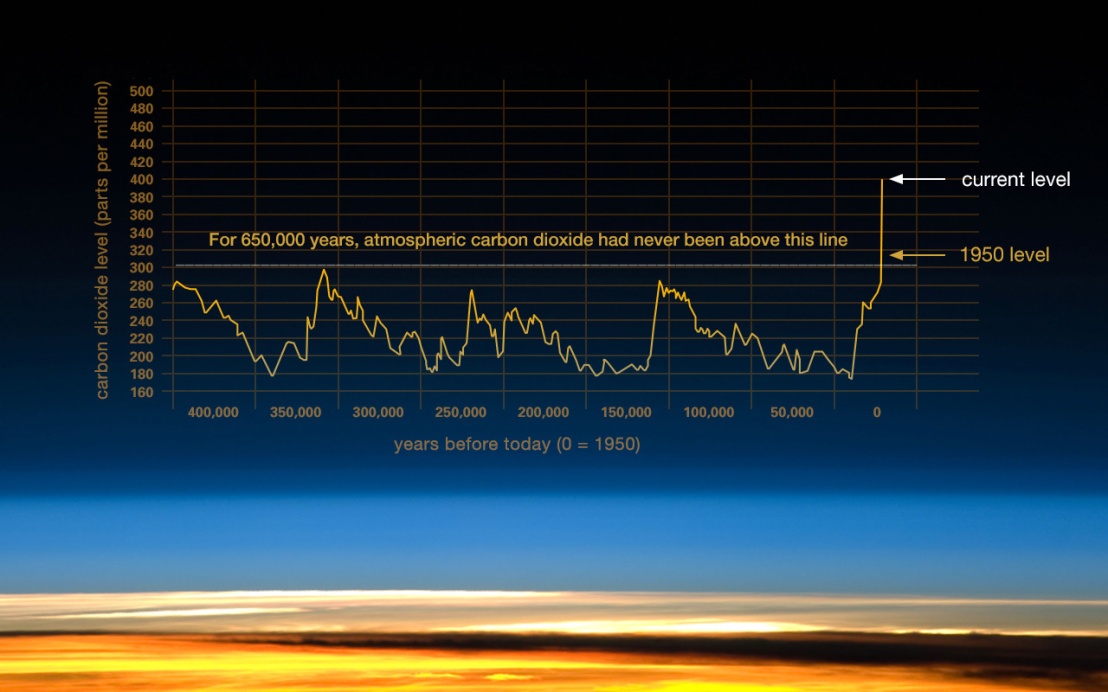
In the month of September, 2014, when this essay was published over on TomDispatch, the Atmospheric CO2 monthly average was 395.26 ppm. In April, 2015 it was 403.26 ppm. I can’t spell it out any better than what is written on the home page of CO2Now.org:

What the world needs to watch

Global warming is mainly the result of CO2 levels rising in the Earth’s atmosphere. Both atmospheric CO2 and climate change are accelerating. Climate scientists say we have years, not decades, to stabilize CO2 and other greenhouse gases.

To help the world succeed, CO2Now.org makes it easy to see the most current CO2 level and what it means. So, use this site and keep an eye on CO2. Invite others to do the same. Then we can do more to send CO2 in the right direction.

What an interesting period in man’s history to be alive.

Has the human ‘pack’ moved on!

Believers and non-believers alike owe Pope Francis a giant ‘thank you’.

As regular followers of this place will have heard before, one of the roles of the ‘alpha’ dog, or more accurately referred to these days as the Mentor dog, in other words the female dog that in the days before domestication was the leader of her pack, was to move her pack if she intuited that the pack’s home range was not sustaining them. (Her other role was pick of the male dogs!)

Thus the title of today’s post came to me as just possibly the metaphorical equivalent. That the global human ‘pack’ has been sharply reminded by one of the world’s key religious leaders that ‘more of the same’ isn’t going to work for much longer.

Quite rightly, there has been a huge amount of reporting and analysis of last week’s Papal Encyclical. But one of the most beautiful and profoundly eloquent came from the writer Jennifer Browdy. If you haven’t come across her before then do drop across to her website; you will love what she presents!  I have been a subscriber to her blog posts for some time and that was how I came across her post called: And the Walls Came Tumbling Down: Pope Francis Shows Us the Way. Jennifer very kindly gave me permission to republish her post today.

ooOOoo

And the Walls Came Tumbling Down: Pope Francis Shows Us the Way

By Jennifer Browdy

The Encyclical on climate change and the environment released by Pope Francis this week has all the magic of the fall of the Berlin Wall in 1991. Back then, the antagonism between the U.S. and the U.S.S.R. seemed implacable and unresolvable, a fight to the death. And then suddenly the wall came down and the world walked through, marveling, into a new era.

Now we have another abrupt shift, this time of a religious order. The leaders of the Catholic Church can hardly be accused of being “radical tree-huggers.” And yet here is Pope Francis, solemnly exhorting his flock of a billion Catholics worldwide to be respectful to Mother Earth and all the living beings she supports. In the blink of an eye, the language of Native American spirituality has been taken up by the same Catholic Church that once tortured and executed indigenous peoples precisely because of their different religious beliefs.

I urge you to read the entire Encyclical for yourself. It is a truly remarkable document, worth serious study. Of many passages I’d like to underline, here are two:

228 Care for nature is part of a lifestyle which includes the capacity for living together and communion. Jesus reminded us that we have God as our common Father and that this makes us brothers and sisters. Fraternal love can only be gratuitous; it can never be a means of repaying others for what they have done or will do for us. That is why it is possible to love our enemies. This same gratuitousness inspires us to love and accept the wind, the sun and the clouds, even though we cannot control them. In this sense, we can speak of a “universal fraternity”.

229 We must regain the conviction that we need one another, that we have a shared responsibility for others and the world, and that being good and decent are worth it. We have had enough of immorality and the mockery of ethics, goodness, faith and honesty. It is time to acknowledge that light-hearted superficiality has done us no good. When the foundations of social life are corroded, what ensues are battles over conflicting interests, new forms of violence and brutality, and obstacles to the growth of a genuine culture of care for the environment.

Here we find spiritual ecology enshrined as Catholic doctrine. And one thing about the Catholic Church—it is big on obedience. For believers, to ignore the Pope is to risk hellfire and damnation. In this case, though, the hellfire and damnation will be earthly, if we do not listen to the wise advice of Pope Francis and curb the insanity of industrial growth that goes beyond the limits of the planet to support.

Scientists appeal to our sense of reason, presenting compelling evidence that if we continue on our present path of wasteful consumption of the Earth’s resources, we will destroy our own future as a flourishing species. Religious leaders appeal to human beings’ moral conscience in invoking the responsibility of current parents and grandparents to leave a livable world to our descendants. It is up to the politicians, though, to translate vision into practice.

For too long, Christian conservatives in the U.S. have played the role of the ideological wing of Big Business, using money, manipulation and scare tactics to buy politicians and votes. In the face of the new Papal Encyclical, can American Christians really continue in good conscience to support the worst of the planet’s polluters and plunderers? Can they continue to elect mercenary politicians who hold our country hostage to the highest bidder?

If all good people who love our Earth and its creatures were to translate our love into action, as Pope Francis has just done so forcefully, I have no doubt the seemingly invincible wall of the industrial growth society we’ve been living with these past 200 years would melt away, revealing the path into a green, prosperous future.

“Where there’s a will, there’s a way,” the saying goes. Pope Francis has just shown us the will, and the way. It is now the task of us ordinary citizens to break the stranglehold of Big Business on politics and insist that our politicians follow his lead.

I close with an excerpt from the Pope’s “Christian Prayer in Union with Creation,” a vision of ecological interdependence if ever there was one:

“Triune Lord, wondrous community of infinite love,

teach us to contemplate you

in the beauty of the universe,

for all things speak of you.

“Awaken our praise and thankfulness

for every being that you have made.

Give us the grace to feel profoundly joined to everything that is.

God of love, show us our place in this world

as channels of your love

for all the creatures of this earth,

for not one of them is forgotten in your sight.

Enlighten those who possess power and money

that they may avoid the sin of indifference,

that they may love the common good, advance the weak,

and care for this world in which we live.”

Amen.

Browdy
And the meek shall inherit the Earth…. Photo by J. Browdy, 2015

ooOOoo

I am sure that, whatever your religious or spiritual persuasion, you will agree with me with regard to the beauty of Jennifer’s essay. I know there are millions and millions of people who will want to look back in a few years time and see how Pope Francis’ legacy literally saved our lives.

Our love for the natural ways of the world.

“In defending the natural world, we should be honest about our motivations – it’s love that drives us, not money.”

Not my words but the opening line from a brilliant essay published yesterday by George Monbiot.

I can add very little to the power of Mr. Monbiot’s essay other than to ‘top and tail’ his words with a couple of photographs taken here at home. Plus not forgetting to add that the essay is republished with George Monbiot’s very kind permission.

A view of our property looking out to the North-East. Our boundary is the other side of the line of trees. (Photo taken July, 2012)

ooOOoo

Channelling the Joy

17th June 2015

In defending the natural world, we should be honest about our motivations – it’s love that drives us, not money.

By George Monbiot, published in the Guardian 17th June 2015

Who wants to see the living world destroyed? Who wants an end to birdsong, bees and coral reefs, the falcon’s stoop, the salmon’s leap? Who wants to see the soil stripped from the land, the sea rimed with rubbish?

No one. And yet it happens. Seven billion of us allow fossil fuel companies to push shut the narrow atmospheric door through which humanity stepped. We permit industrial farming to tear away the soil, banish trees from the hills, engineer another silent spring. We let the owners of grouse moors, 1% of the 1%, shoot and poison hen harriers, peregrines and eagles. We watch mutely as a small fleet of monster fishing ships trashes the oceans.

Why are the defenders of the living world so ineffective? It is partly, of course, that everyone is complicit; we have all been swept off our feet by the tide of hyperconsumption, our natural greed excited, corporate propaganda chiming with a will to believe that there is no cost. But perhaps environmentalism is also afflicted by a deeper failure: arising possibly from embarrassment or fear, a failure of emotional honesty.

I have asked meetings of green-minded people to raise their hands if they became defenders of nature because they were worried about the state of their bank accounts. Never has a hand appeared. Yet I see the same people base their appeal to others on the argument that they will lose money if we don’t protect the natural world.

Such claims are factual, but they are also dishonest: we pretend that this is what animates us, when in most cases it does not. The reality is that we care because we love. Nature appealed to our hearts, when we were children, long before it appealed to our heads, let alone our pockets. Yet we seem to believe we can persuade people to change their lives through the cold, mechanical power of reason, supported by statistics.

I see the encyclical by Pope Francis, which will be published on Thursday, as a potential turning point. He will argue that not only the physical survival of the poor, but also our spiritual welfare depends on the protection of the natural world; and in both respects he is right.

I don’t mean to suggest that a belief in God is the answer to our environmental crisis. Among Pope Francis’s opponents is the evangelical Cornwall Alliance for the Stewardship of Creation, which has written to him arguing that we have a holy duty to keep burning fossil fuel, as “the heavens declare the glory of God; and the firmament proclaims his handiwork”. It also insists that exercising the dominion granted to humankind in Genesis means tilling “the whole Earth”, transforming it “from wilderness to garden and ultimately to garden city”.

There are similar tendencies within the Vatican. Cardinal George Pell, its head of finance, currently immersed in a scandal involving paedophile priests in Australia, is a prominent climate change denier. His lecture to the Global Warming Policy Foundation was the usual catalogue of zombie myths (discredited claims that keep resurfacing), nonsequiturs and outright garbage, championing, for example, the groundless claim that undersea volcanoes could be responsible for global warming. There are plenty of senior Catholics seeking to undermine the Pope’s defence of the living world; which could explain why his encyclical was leaked.

What I mean is that Pope Francis, a man with whom I disagree profoundly on matters such as equal marriage and contraceptives, reminds us that the living world provides not only material goods and tangible services, but is also essential to other aspects of our well-being. And you don’t have to believe in God to endorse that view.

In his beautiful book The Moth Snowstorm, Michael McCarthy suggests that a capacity to love the natural world, rather than merely to exist within it, might be a uniquely human trait. When we are close to nature, we sometimes find ourselves, as Christians put it, surprised by joy: “a happiness with an overtone of something more, which we might term an elevated or, indeed, a spiritual quality.”

He believes we are wired to develop a rich emotional relationship with nature. A large body of research suggests that contact with the living world remains essential to our psychological and physiological well-being. (A paper published this week, for example, claims that green spaces around city schools improve children’s mental performance).

This does not mean that all people love nature; what it means, McCarthy proposes, is that there’s a universal propensity to love it, which may be drowned out by the noise that assails our minds. As I’ve found while volunteering with the outdoor education charity Wide Horizons, this love can be provoked almost immediately, even among children who have never visited the countryside before. Nature, McCarthy argues, remains our home, “the true haven for our psyches”, and retains an astonishing capacity to bring peace to troubled minds. Acknowledging our love for the living world does something that a library full of papers on sustainable development and ecosystem services cannot: it engages the imagination as well as the intellect. It inspires belief; and this is essential to the lasting success of any movement.

Is this a version of the religious conviction from which Pope Francis speaks? Or could his religion be a version of a much deeper and older love? Could a belief in God be a way of explaining and channelling the joy, the burst of love that nature sometimes provokes in us? Conversely, could the hyperconsumption that both religious and secular environmentalists lament be a response to ecological boredom: the void that a loss of contact with the natural world leaves in our psyches?

Of course, this doesn’t answer the whole problem. If the acknowledgement of love becomes the means by which we inspire environmentalism in others, how do we translate it into political change? But I believe it’s a better grounding for action than pretending that what really matters to us is the state of the economy. By being honest about our motivation we can inspire in others the passions that inspired us.

www.monbiot.com

ooOOoo

Will close this thoughtful essay from Mr. Monbiot with another photograph.

Same view but this time on a foggy Autumn day in 2013.

It truly is love that drives our relationship with nature.

The Joy of Caring.

Things prosper when cared for and loved.

This is a repost of what appeared over on Alex Jones’ blog Liberated Way last Thursday. It resonated so wonderfully with all the young plants and trees around us here at home in Merlin, and the numerous oak saplings making their way into the world! Republished with Alex’s kind permission.

ooOOoo

Things prosper when cared for!

The joy of caring for something.

These oak saplings prosper because of care.

Today, I moved my eight oak saplings into the full sun, added a new layer of quality compost to their pots, and watered them. In their second year of life these oak saplings prosper because of care.

Caring for something means one must pay attention to the small details. For instance, I remove the caterpillars from the oak leaves, and the weeds that grow in the pots. If I did not concentrate on the small details, the little problems could grow into larger problems, the caterpillars destroying the oak saplings, the weeds stealing their nutrients in the pots.

Also, the individual spends time on the thing cared about, establishing regular activities, such as in my case, watering the oak saplings every few days. The individual looks for ways that the cared for thing might benefit, just as I moved my oak saplings into the full sun, added new compost to them, and infected them with a type of symbiotic fungus that aids oak sapling growth.

The thing cared for becomes special, for instance there are millions of oak trees in Britain, but only eight of those, my saplings, are special to me. In such a caring relationship, both sides come to depend upon the other. My oak saplings need my care and attention to survive, I need my oak saplings to feel good about myself when life is hard.

If the individual has nothing to care for, their life becomes empty and meaningless. I love the book by Antoine De Saint-Exupery called The Little Prince, which explores ideas around friendship and caring for things. In The Little Prince is the following beautiful quote:

You are beautiful, but you are empty. One could not die for you. To be sure, an ordinary passerby would think that my rose looked just like you — the rose that belongs to me. But in herself alone she is more important than all the hundreds of you other roses: because it is she that I have watered; because it is she that I have put under the glass globe; because it is she that I have sheltered behind the screen; because it is for her that I have killed the caterpillars; because it is she that I have listened to, when she grumbled, or boasted, or even sometimes when she said nothing. Because she is my rose.”

ooOOoo

Can’t recommend too highly you dropping in on Alex’s blog Liberated Way – even signing up as a ‘follower’!

Reintroducing ourselves to the wolf

A guest essay from Karla Powell.

A couple of weeks ago, an email arrived in my ‘in-box’, as follows:

Hi Karla and Paul,

I hope this email finds you both well. I recently met Karla on an Oregon Wild hike last weekend in the Gorge. Karla is a longtime Oregon Wild supporter, passionate wildlife advocate and published author. She recently wrote a really lovely article on the human connection to wolves that I found quite inspiring.

I wanted you two to connect as Paul is also a wildlife advocate, now living in southern Oregon with his wonderful partner Jean. Paul, I thought you might be able to recommend a place, online or otherwise, Karla might be able to submit this article. I think you’ll quite enjoy it.

Thank you both for supporting our work for so many years,
Bridget

Clearly, I was able to recommend a place where Karla could submit her article! Here on Learning from Dogs!

Karla and I made contact and, bingo!, here is her remarkable essay.

ooOOoo

Reintroducing Ourselves to the Wolf

Karla Powell

Is it possible that by reconciling our troubled relationship with the North American wolf, we may come to better know our own nature as well as theirs? In the realm of natural history, wolves have long been left to myth and superstition. “Well into the 20th century, even science lagged behind in its knowledge of wolves and retained certain biases,” says award-winning nature writer, Barry Lopez, in his definitive book Of Wolves and Men. Even in the 21st century, science still can be skewed towards special interests. Yet the relative merits of facts notwithstanding, it is opinions about wolves that hold sway, points out Lopez.

As a lifelong urban creature, I had neither opinions nor knowledge when it came to the existence of wolves. Then in mid-life I found myself living alone in a cabin in rural Oregon and running a Junior Rangers program for the local state park. I also oversaw the weekend evening family programs. One such program featured hybrid wolves who’d found shelter in a nearby sanctuary and were presented for educational purposes. It was the closest I’d ever come to the real thing. So the next day I incorporated the theme of wolves into my Jr. Ranger activity.

I began by encouraging my young charges to howl along with me. I’d been practicing in the car on the way and it felt great! (I can see why they say wolves may howl at times for sheer pleasure.) My Jr. Rangers eagerly entered the fray, and every dog in the campground soon followed. Contrast this youthful exuberance to the dispiriting recollection of Joseph Marshall, author of The Wolf: A Native American Symbol. Marshall’s tale is recounted in the book War Against Wolf. “As a seven-year-old, I knew that there were no wolves left in my world, and I knew why. One day my grandfather… told me that the spirits of all the dead wolves … would wait until the time was right for them to return and walk again on the earth.”

Marshall, a Sicangu Lakota, believed that the 1995 reintroduction of wolves in Yellowstone heralded that this day had arrived. Yet we’re still a far cry from the sustainable recovery of a species we nearly annihilated. Reintroduction efforts in several western states contend with tired old beliefs. This vocal minority seem to me not far removed from those distant ancestors whose hysteria about the animal went so far as to conjure human “werewolves,” who were hunted and burned alive.

The folklore that led to such extremes was ultimately carried to our shores. In the book Vicious: Wolves and Men in America, the author tells of “Euro-American colonists who captured live wolves and tortured them for fun, ignoring the animals’ cowering for clemency.” Yet canines at home could display similar signals, which their masters sympathetically interpreted.

None other than John James Audubon casually recorded the maniacal torture and vicious killing of a pack of wolves by an Ohio farmer in 1814. Audubon and other observers, including trappers, sometimes noted the meek submittal of wolves to human aggression. Yet even a naturalist at that time couldn’t extrapolate this to meaningful analysis of wolves’ socialization, which includes “signaling” postures as a plea for mercy.

“This is not predator control,” says Lopez in his chapter on the gruesome excesses of “wolf fever” in the settling of our continent. “It is the violent expression of a terrible assumption: that men have the right to kill other creatures not for what they do, but for what we fear they may do.” Lopez then goes on to discuss “theriophobia” or “fear of the beast as an irrational, violent, insatiable creature.” The author continues: “At the heart of theriophobia is the fear of one’s own nature.”

Some 200 years before Christ, the Roman dramatist Plautus pithily depicted the beast we humans carry within by saying, “Man is wolf to man.” A glance at today’s headlines reveals that man’s dual nature is far from reconciled. Our legacy with the wolf is equally dualistic. In conquest, labels of savagery or demonization of the “other” are commonly projected by the oppressor onto those whom they, in turn, savagely treat. Wilderness and wildlife also are targets of such dominating impulses.

The most basic familiarity with human psychology recognizes that if we repress or deny our own capacity for shadowy motives, we invariably project such motives onto scapegoats. In America’s nation-building, the 19th century campaign to exterminate the wolf indicates we were far more guilty of depradation upon them than they upon us.

The ever-popular Saint Francis of Assisi also lived in a time of conquest run amok. An allegory about a wolf in Gubbio, Italy, has Francis and this village interloper come to an amical agreement that restored harmony for all. A contemporary visionary can be found in environmental activist George Monbiot. His 2013 TEDGlobal talk addresses the trophic cascade that resulted from the reintroduction of wolves into Yellowstone.

This phenomenon begins at the top of the food chain and tumbles down, says Monbiot. The return of wolves to Yellowstone has restored the entire ecosystem to a more healthful balance, recalling the “complex, lost, natural food chains that once prevailed,” explains Monbiot. This trophic cascade brought about by wolves simply being wolves has regenerated entire valleys and even changed the behavior of a river, he points out.

Just as St. Francis struck a deal with the wolf of Gubbio by promising he’d be fed by the villagers, we moderns too might benefit from a more cooperative pact. The wolf was a source of fascination to Homo sapiens when they also existed as communal hunters. Some theorize that prehistoric man’s social structure was modeled on how effectively wolves assured their packs’ common good.

The advent of an agrarian society disrupted this complex food chain that formerly prevailed. An agrarian society also emphasized the notion of property. The most common argument against wolves in agricultural communities is they kill animals that are human property. Yet since we’ve eradicated the natural habitat and prey of our indigenous wolf, their only guilt is they must eat to survive. This is no sin, as St. Francis demonstrated at Gubbio.

Top predators such as wolves needed time to adapt to such “quirky and aggressive killers {as man},” says Vicious author Jon T. Coleman. “The short supply of energy at the top of the food pyramid denied them this time. Euro-American colonists attacked animals in a vulnerable niche, creatures stuck with few options in a thermodynamic dead end.”

Consider that the very term “civilizing forces” is an oxymoron. Judging from how we have in some ways devolved into morbid obesity and epidemic diet-related diseases (many of them induced by altering food’s integrity), is it not possible for us to restore more wonder into our world by “rewilding” somewhat, as Monbiot and others propose? Not a return to the Stone Age. But perhaps a truly evolutionary step. One that restores us to a future that can reimagine coexistence as an effective survival strategy.

As an archetype in differing cultures, the wolf has been both revered and demonized. Yet whether seen as good or evil, it is still being objectified. Can we not instead view it as a living being worthy of both reason and regard? Despite more data about wolves than ever before, reason still lags behind, Lopez notes in the afterword to his original book. “Some folklore is so deeply entrenched that its adherents completely shut out emerging insights … In their rigid stances, they are impervious even to reason.”

As for regard, I suggest some discernment that takes us beyond even the necessary rational analysis. No less than Kepler, Darwin and Einstein have said that intuition is key to the scientific process, Lopez points out. He then suggests that we remind ourselves, “There could be more, there could be things we don’t understand.” Such a reminder may be our only hope for the wolf— as well as for us.

ooOOoo

I have no doubt that everyone who reads Karla’s wonderful essay will be enthralled by the beautiful messages.

Only one way to close today’s post.

The long-awaited return of the Yellowstone wolf!