Category: Capitalism

Sir David Attenborough.

There are not many who achieve so much, but Sir David most definately has!

This is our planet. It is the only one we have (stating the obvious!).

This beautiful photograph taken from the Apollo 11 mission says it all. That Commander Neil Armstrong and lunar module pilot Buzz Aldrin landed the Apollo Lunar Module Eagle on July 20, 1969 changed everything.

But one thing that was not on anyone’s mind then; the state of the planet!

This view of Earth rising over the Moon’s horizon was taken from the Apollo 11 spacecraft. The lunar terrain pictured is in the area of Smyth’s Sea on the nearside. Coordinates of the center of the terrain are 85 degrees east longitude and 3 degrees north latitude.
While astronaut Neil A. Armstrong, commander; and Edwin E. Aldrin Jr., lunar module pilot, descended in the Lunar Module (LM) “Eagle” to explore the Sea of Tranquility region of the moon, astronaut Michael Collins remained with the Command and Service Modules (CSM) “Columbia” in lunar orbit.
Image Credit: NASA

How that has changed since 1969.

David Attenborough is a giant of a man, and I say this out of humility and respect for what he has done in his long life, he was born in May, 1926, and he is still fighting hard to get us humans to wake up to the crisis that is upon us.

Wikipedia has an entry that lists all the television shows, and more, that David Attenborough has made. As is quoted: “Attenborough’s name has become synonymous with the natural history programmes produced by the BBC Natural History Unit.”

Please take 45 minutes and watch this film. It is so important.

But before you do please read this extract taken from this site about the film:

For decades David Attenborough delighted millions of people with tales of life on Earth, exploring wild places and documenting the living world in all its variety and wonder. Now, for the first time he reflects upon both the defining moments of his lifetime as a naturalist and the devastating changes he has seen.

Honest, revealing and urgent, the film serves as a witness statement for the natural world – a first-hand account of humanity’s impact on nature, from Australia’s Great Barrier Reef to the jungles of central Africa, the North Pole and Antarctica. It also aims to provide a message of hope for future generations.

“I’ve had a most extraordinary life. It’s only now I appreciate how extraordinary,” Sir David says in the film’s trailer, in which he also promises to tell audiences how we can “work with nature rather than against it”.

The film retraces Sir David’s career, his life stages and natural history films, within the context of human population growth and the loss of wilderness areas. “I don’t think that the theoretical basis for the reason why biodiversity is important is a widely understood one,” he told the Guardian in September.

This autumn, a series of publications warned that “humanity is at a crossroads” in its relationship with nature, culminating in a UN report that the world has failed to meet a single target to stop the destruction of nature in the past decade.

Sir David has been vocal about the threat of climate change in recent years, calling on politicians to take their “last chance” to act rather than continue to “neglect long-term problems”.

We need to learn how to work with nature, rather than against it”, according to Sir David. In the film, he is going to tell us how.

Now watch the film. Please!

As you can see, in the film Sir David states that the only way out of this mess is a massive focus on rewilding.

Coincidentally, Patrice Ayme last Sunday wrote about rewilding: California Grizzly: Rewilding Is A Moral Duty. In the latter half of that essay, he wrote: “One should strive to reintroduce American megafauna, starting with the more innocuous species (and that includes the grizzly). By the way, I have run and hiked in grizzly country (Alaska), with a huge bear pepper spray cannister at the ready. I nearly used the cannister on a charging moose (with her calf which was as big as a horse). The calf slipped off, and I eluded the mom through a thicket of very closely spaced tough trees. But I had my finger on the trigger, safety off. Moose attack more humans than grizzlies and wolves combined (although a bear attack is more dangerous). In any case, in the US, stinging insects kill around 100, deer around 200 (mostly through car collisions), and lightning around three dozen people, per year.

As it is, I run and hike a lot in California wilderness, out of rescue range. I generally try to stay aware of where and when I could come across bears, lions and rattlers. My last close call with a large rattlesnake, up a mountain slope, was partly due to hubris and not realizing I was moving in dangerous terrain. Fortunately I heard the slithering just in time. Dangerous animals make us aware of nature in its full glory, and the real nature of the human condition. They keep us more honest with what is real, what humanity is all about.

And that should be the primordial sense.

I will close by offering you this photograph. May it inspire you to rewild, in small ways and also, if you can, in bigger ways. All of us must be involved. Otherwise…

Photo by Cosmic Timetraveler on Unsplash

…otherwise… (sentence left unfinished).

What a difference a week makes!

It all makes sense now.

Photo by Salmen Bejaoui

Do what you can, with what you have, where you are.” “Believe you can and you’re halfway there. It is hard to fail, but it is worse never to have tried to succeed.

“It is not the critic who counts; not the man who points out how the strong man stumbles, or where the doer of deeds could have done them better.”

This famous quotation by Teddy Roosevelt (1858-1919), the 26th President of the USA, seems apt for today’s post.

Exactly one week ago I published a post called Musings from a 77 year old! I wrote that the future was uncertain. Summed up at one point by me writing: “I have no idea of the global changes that are afoot and how they will affect us in Merlin. Indeed, I have no idea how long I have to live.

Margaret (from Tasmania) was one of the many people who responded. She included a video interview of Meg Wheatley by Michael Shaw. It is an hour long. Last Friday afternoon Jean and I watched it in full and it was incredibly interesting. Thank you very much, dear Margaret.

But before I present Meg’s video again I want to show you another video. It is a talk by Richard Grannon about the collapse of our civilisation. Now Richard Grannon is an author, YouTuber and life coach so one needs to remain impartial to his views, certainly before one does further research. But in the 46-minute talk I think there is much sense in what he says. See for yourself:

Moving on! The interview of Meg Wheatley is very good indeed. It’s a broad look at the issues and problems governing society but done in such a way that the people who watch her will also take away a number of tools for avoiding depression and anxiety. Meg places great store on the Hopi Native American Indians: “The Hopi maintain a complex religious and mythological tradition stretching back over centuries.

Meg quotes one of the more famous Hopi prophecies, that is reproduced below:

This could be a good time! There is a river flowing now very fast. It is so great and swift that there are those who will be afraid. They will try to hold on to the shore. They will feel they are being torn apart and will suffer greatly. Know the river has its destination. The elders say we must let go of the shore, push off into the middle of the river, keep our eyes open, and our heads above the water.

And I say, see who is in there with you and celebrate. At this time in history, we are to take nothing personally, least of all ourselves. For the moment that we do, our spiritual growth and journey come to a halt.

The time of the lone wolf is over. Gather yourselves! Banish the word ’struggle’ from your attitude and your vocabulary. All that we do now must be done in a sacred manner and in celebration.

We are the ones we’ve been waiting for.

Photo by Lucas Ludwig 

Here is that Meg Wheatley interview. (It is an hour long but very interesting; please watch it!)

I want to pick up the topic that was at the end of her interview; that of societal collapse. How would one define it? I chose Wikipedia for a reference.

Societal collapse (also known as civilizational collapse) is the fall of a complex human society characterized by the loss of cultural identity and of socioeconomic complexity, the downfall of government, and the rise of violence.[1]Possible causes of a societal collapse include natural catastrophe, war, pestilence, famine,  economic collapse,  population decline, and mass migration. A collapsed society may revert to a more primitive state, be absorbed into a stronger society, or completely disappear.

Virtually all civilizations have suffered such a fate, regardless of their size or complexity, but some of them later revived and transformed, such as China, India, and Egypt. However, others never recovered, such as the Western and Eastern Roman Empires, the Maya civilization, and the Easter Island civilization.[1] Societal collapse is generally quick[1] but rarely abrupt.[2] However, some cases involve not a collapse but only a gradual fading away, such as the British Empire since 1918.[3]

Anthropologists, (quantitative) historians, and sociologists have proposed a variety of explanations for the collapse of civilizations involving causative factors such as environmental change, depletion of resources, unsustainable complexity, invasion, disease, decay of social cohesion, rising inequality, secular decline of cognitive abilities, loss of creativity, and misfortune.[1][4] However, complete extinction of a culture is not inevitable, and in some cases, the new societies that arise from the ashes of the old one are evidently its offspring, despite a dramatic reduction in sophistication.[4] Moreover, the influence of a collapsed society, such as the Western Roman Empire, may linger on long after its death.[5]

The study of societal collapse, collapsology, is a topic for specialists of historyanthropologysociology, and political science. More recently, they are joined by experts in cliodynamics and study of complex systems.[6][4]

The article is much more extensive than I have quoted above and for anyone deeply interested then I do recommend you going to the article and reading it extensively.

Now Meg is of the opinion that it is too late to turn back but next Tuesday I want to talk to you about Sir David Attenborough’s film A Life on our Planet. That he believes there is a chance to undo the harm we are causing to the planet; through rewilding.

Until then!

Starting your own pet business.

Another guest post from Penny Martin.

Well I am preparing this post on Saturday, the 14th. The operation for the hernia on the 10th went smoothly enough but I did not reckon on the discomfort that would follow. Indeed, I was talking to a good friend on Thursday and he said that the pain would more or less last for two weeks. My son gave me the good advice to take regular doses of an over-the-shelf painkiller rather than the stronger tablets the hospital gave me because those prohibited driving! I returned to a small amount of driving last Friday.

Now on with the show!

Penny Martin first wrote a guest post for me in February, Fostering or adopting a dog, and I am delighted to present her second post. Over to her!

ooOOoo

Why Now Is a Great Time for a Pet Business and How to Start Your Own

By Penny Martin.

If you are an animal lover who wants to spend your days scrolling through cute dog pictures and surrounded by furry clients, now is a great time to consider starting your own pet business. Here, you can learn more about which relevant business areas experiencing growth and tips to get started on the right foot. 

Reasons Why It’s a Great Time for Pet Businesses

A growing number of families include animals. According to the American Veterinary Medical Association data, more than half of American households have a pet. That number appears to be growing, too, representing an increased need for care services. 

Pets are not just more abundant; they are also becoming full-fledged family members. As a result, spending on them is also increasing. Despite rapid growth in many care service areas, there are not enough providers to meet this increased demand. 

Animal-Related Businesses That Are Thriving

If you are curious about what type of business to start, look no further than pet care providers. There are several types of jobs you can get involved in:

  • Training and behavioral services: Training isn’t just for puppies. Dogs of all ages can benefit from learning household rules and appropriate behaviors when they are out and about. 
  • Dog walking and pet sitting: This is usually based out of the client’s home, where you pick them up for a walk or provide companionship for short periods.
  • Boarding: This is an excellent option for individuals who would rather welcome dogs and cats to their own home or care facility. Many boarding companies also provide daycare services. 
  • Grooming: You will need to learn how to groom different types of pets to master the skills for a successful grooming career. However, if you enjoy helping dogs look their best, this is an excellent high-demand field. 

Business Strategies to Help You Succeed

Economic conditions are excellent for small pet-focused companies to thrive. However, as an entrepreneur, you need to follow some basic business principles to succeed.

Start by choosing an appropriate legal structure. Research the most popular setup for businesses like yours to find one that fits your needs. Then, file with the appropriate offices to make it official. Next, take time to develop a comprehensive business plan. This document will do more than get you up and running; it will also serve as a reference as you continue to grow. Be sure to conduct market research to identify your target customers.  

Implement a structured invoicing process to set clear payment terms for clients and ensure you get paid on time, especially if you send invoices immediately after performing a service. Accepting several forms of payment is also helpful for clients. Use an invoice maker, free online usually, to streamline the process. Simply add your logo and business information, and you are ready to go. 

Use bookkeeping software to track your income and expenses and gain insight into your cash flow. This is a great way to organize and store receipts, ensuring compliance with regulatory agencies. It also makes tax filing easier at the end of the year and helps you find the most deductions.

A growing number of households with pets and increased spending make now a great time to start an animal-related business. Care and service providers are excellent fields to consider, with high demand for groomers, trainers, and dog walkers. However, no matter what type of company you start, sound business strategies can keep it running smoothly.

Image via Pixels

oOOoo

Excellent!

As an ex-entrepreneur, who fundamentally was a salesman, I can also add the following to that post.

It starts and ends with the customer. A business plan is vital and so too is market research. But unless you have a clear vision of how you are to sell your services and what’s the difference that makes the difference you must not proceed. Selling is all about: Need; Feature; Benefit.

  • Open-ended questions to establish the need. (Those are questions that cannot be answered with a yes or a no.)
  • Keep on asking, and establishing a relationship, until you and the potential customer are clear that there is a need.
  • Then speak about the features of what you are selling that matches the need/s. Do not progress until the prospective customer understands and agrees.
  • For every agreed feature be clear what the benefit is for the customer; of that particular feature.
  • Try closing the deal. If there is hesitation then understand why. Resolve it. Try closing the deal again.

The very best of luck to those that want to run with this.

Transformation

A more positive view as to how the future will pan out.

I tend to be rather pessimistic about the future. Maybe it is my age, I don’t know. But a week ago I posted an article by Ophelia Benson called Cruising over the Edge.

For this week I am republishing another climate change article but one that has a positive outlook on where we are going.

Have a read and let me know your thoughts.

ooOOoo

Climate change will transform how we live, but these tech and policy experts see reason for optimism

Authors

  1. Robert Lempert Professor of Policy Analysis, Pardee RAND Graduate School
  2. Elisabeth Gilmore Associate Professor of Climate Change, Technology and Policy, Carleton University

Published April 18th, 2022

It’s easy to feel pessimistic when scientists around the world are warning that climate change has advanced so far, it’s now inevitable that societies will either transform themselves or be transformed. But as two of the authors of a recent international climate report, we also see reason for optimism.

The latest reports from the Intergovernmental Panel on Climate Change discuss changes ahead, but they also describe how existing solutions can reduce greenhouse gas emissions and help people adjust to impacts of climate change that can’t be avoided.

The problem is that these solutions aren’t being deployed fast enough. In addition to push-back from industries, people’s fear of change has helped maintain the status quo. 

To slow climate change and adapt to the damage already underway, the world will have to shift how it generates and uses energy, transports people and goods, designs buildings and grows food. That starts with embracing innovation and change.

Fear of change can lead to worsening change

From the industrial revolution to the rise of social media, societies have undergone fundamental changes in how people live and understand their place in the world.

Some transformations are widely regarded as bad, including many of those connected to climate change. For example, about half the world’s coral reef ecosystems have died because of increasing heat and acidity in the oceans. Island nations like Kiribati and coastal communities, including in Louisiana and Alaska, are losing land into rising seas.

Other transformations have had both good and bad effects. The industrial revolution vastly raised standards of living for many people, but it spawned inequality, social disruption and environmental destruction.

People often resist transformation because their fear of losing what they have is more powerful than knowing they might gain something better. Wanting to retain things as they are – known as status quo bias – explains all sorts of individual decisions, from sticking with incumbent politicians to not enrolling in retirement or health plans even when the alternatives may be rationally better. 

This effect may be even more pronounced for larger changes. In the past, delaying inevitable change has led to transformations that are unnecessarily harsh, such as the collapse of some 13th-century civilizations in what is now the U.S. Southwest. As more people experience the harms of climate change firsthand, they may begin to realize that transformation is inevitable and embrace new solutions. 

A mix of good and bad

The IPCC reports make clear that the future inevitably involves more and larger climate-related transformations. The question is what the mix of good and bad will be in those transformations.

If countries allow greenhouse gas emissions to continue at a high rate and communities adapt only incrementally to the resulting climate change, the transformations will be mostly forced and mostly bad

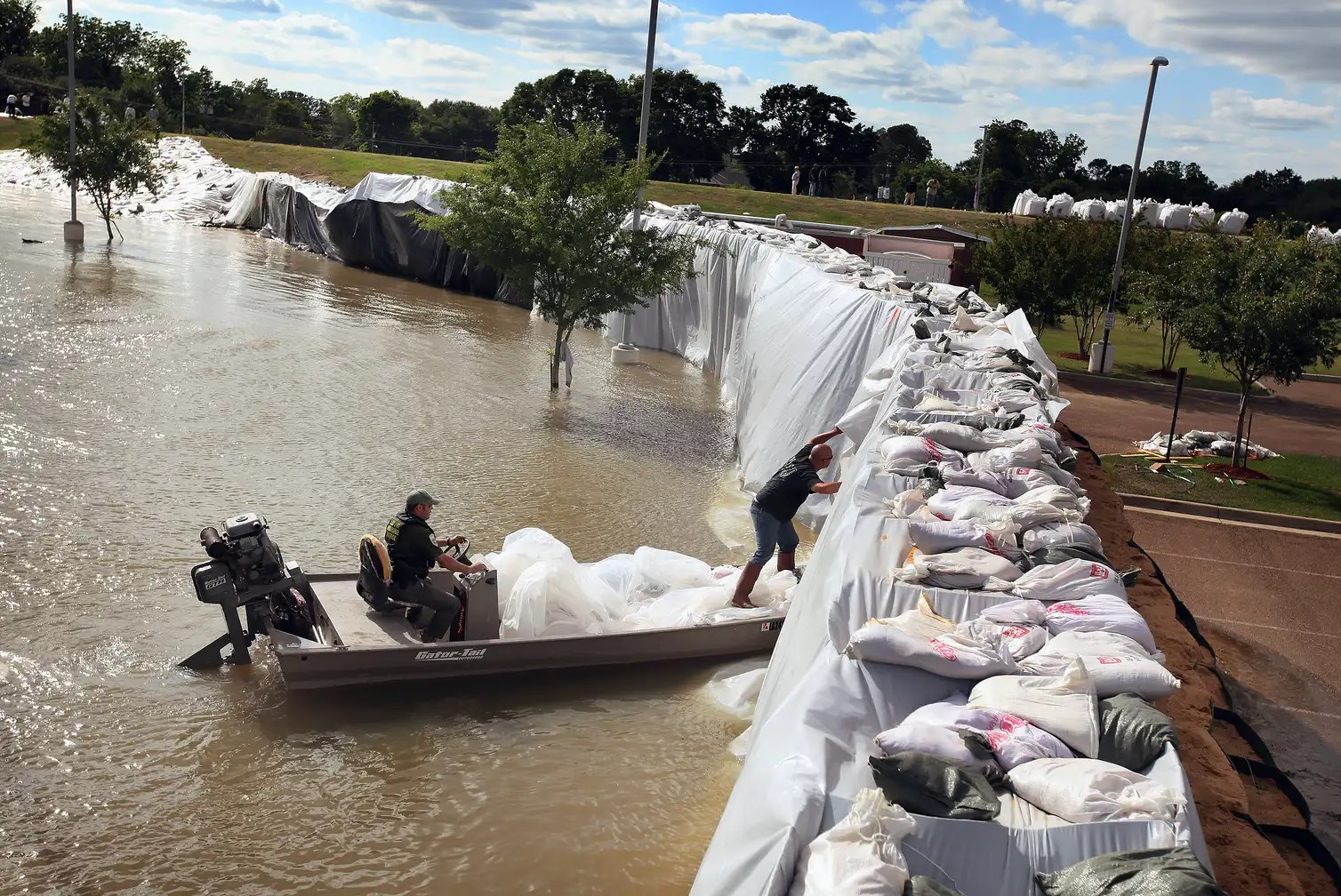
For example, a riverside town might raise its levees as spring flooding worsens. At some point, as the scale of flooding increases, such adaptation hits its limits. The levees necessary to hold back the water may become too expensive or so intrusive that they undermine any benefit of living near the river. The community may wither away.

Riverside communities often scramble to raise levees during floods, like this one in Louisiana. Scott Olson/Getty Images

The riverside community could also take a more deliberate and anticipatory approach to transformation. It might shift to higher ground, turn its riverfront into parkland while developing affordable housing for people who are displaced by the project, and collaborate with upstream communities to expand landscapes that capture floodwaters. Simultaneously, the community can shift to renewable energy and electrified transportation to help slow global warming.

Optimism resides in deliberate action

The IPCC reports include numerous examples that can help steer such positive transformation.

For example, renewable energy is now generally less expensive than fossil fuels, so a shift to clean energy can often save money. Communities can also be redesigned to better survive natural hazards through steps such as maintaining natural wildfire breaks and building homes to be less susceptible to burning.

Costs are falling for key forms of renewable energy and electric vehicle batteries. IPCC Sixth Assessment Report

Land use and the design of infrastructure, such as roads and bridges, can be based on forward-looking climate information. Insurance pricing and corporate climate risk disclosures can help the public recognize hazards in the products they buy and companies they support as investors.

No one group can enact these changes alone. Everyone must be involved, including governments that can mandate and incentivize changes, businesses that often control decisions about greenhouse gas emissions, and citizens who can turn up the pressure on both.

Transformation is inevitable

Efforts to both adapt to and mitigate climate change have advanced substantially in the last five years, but not fast enough to prevent the transformations already underway.

Doing more to disrupt the status quo with proven solutions can help smooth these transformations and create a better future in the process.

Disclosure statement

Robert Lempert receives funding from the National Science Foundation, U.S. Department of Transportation and Culver City Forward. He was coordinating lead author of the IPCC WGII Sixth Assessment Report, Chapter 1, and is affiliated with RAND Corp.; Harvard; SCoPEx (Stratospheric Controlled Perturbation Experiment) Independent Advisory Committee; National Renewable Energy Laboratory; Decision Science and Analysis Technical Advisory Committee (TAC); Council on Foreign Relations; Evolving Logic; and the City of Santa Monica Commission on Environmental, Sustainability, and Environmental Justice.

Elisabeth Gilmore receives funding from Minerva Research Initiative administered by the Office of Basic Research and the Office of Policy at the U.S. Department of Defense and the National Science Foundation. She is affiliated with Carleton University, Rutgers University, the Peace Research Institute Oslo (PRIO), and was a lead author on the IPCC WGII Sixth Assessment Report.

ooOOoo

The article makes the proposition that fear gets in the way of change. I think this is true because I tend to be a person that goes around saying ‘what can be done’ or ‘it is down to governments to set the changes required’ but not taking action personally.

So this is wakeup call for me and many others to be more positive and to support those changes that are beneficial, and to undertake them ourselves if at all possible.

A heart-rending plea from George Monbiot

It is about global warming.

The article from George Monbiot came into my mailbox quite recently. Now of course Mr. Monbiot has a living to make and him publishing articles in the Guardian newspaper is normal. But I sensed that in this particular post he was worried. Worried about the situation regarding the planet and, by implication, all those who live on it.

I read yesterday on the UK Met Office blog about HILL events.

HILL events go beyond traditional weather extremes, potentially taking the climate system into uncharted territories. For example, much of the UK’s climate is predicated on two large elements of the climate system: the North Atlantic jet stream, a core of strong winds five to seven miles above the Earth’s surface, and the Atlantic Meridional Overturning Circulation (AMOC), a system of ocean currents which transports warm water northwards in the Atlantic.

Later on in that Met Office article it was said:

Prof Richard Betts MBE is the Head of Climate Impacts Research in the Met Office Hadley Centre and a Professor at the University of Exeter. Prof Betts, who led the team which prepared the Technical Report for the UK’s 3rd Climate Change Risk Assessment (CCRA3), is calling for a monitoring, attribution and prediction system that can provide early warning of HILLs. Professor Betts said: “With rising global temperatures, we are edging closer to the thresholds for more and more HILL events. Greater research into these events will help scientists advise policy makers on their thresholds and impacts.”

A week ago I wrote with real pride about the achievements of the James Webb Space Telescope (JWST). Later on I felt some shame that the focus on the real issue, that of climate change, was too low a priority for the US, let alone the world! Then I looked up the US expenditure on the military. Here’s a small quote from WikiPedia: “In May 2021, the President’s defense budget request for fiscal year 2022 (FY2022) is $715 billion, up $10 billion, from FY2021’s $705 billion.”[1] That puts the JWST into perspective. JWST cost ten billion dollars.

Expand one’s mind and just think of the global cost of war!

Here’s George Monbiot. Republished with his permission.

ooOOoo

Losing It

10th January, 2022

Faced with the gathering collapse of the biosphere, and governments’ refusal to take the necessary action, how do we stop ourselves from falling apart?

By George Monbiot, published in the Guardian 4th January 2022

No wonder journalists have slated it. They’ve produced a hundred excuses not to watch the climate breakdown satire Don’t Look Up: it’s “blunt”, it’s “shrill”, it’s “smug”. But they will not name the real problem: it’s about them. The movie is, in my view, a powerful demolition of the grotesque failures of public life. And the sector whose failures are most brutally exposed is the media.

While the film is fast and funny, for me, as for many environmental activists and climate scientists, it seemed all too real. I felt as if I were watching my adult life flash past me. As the scientists in the film, trying to draw attention to the approach of a planet-killing comet, bashed their heads against the Great Wall of Denial erected by the media and sought to reach politicians with 10-second attention spans, all the anger and frustration and desperation I’ve felt over the years boiled over.

Above all, when the scientist who had discovered the comet was pushed to the bottom of the schedule by fatuous celebrity gossip on a morning TV show and erupted in fury, I was reminded of my own mortifying loss of control on Good Morning Britain in November. It was soon after the Cop26 climate conference in Glasgow, where we had seen the least serious of all governments (the UK was hosting the talks) failing to rise to the most serious of all issues. I tried, for the thousandth time, to explain what we are facing, and suddenly couldn’t hold it in any longer. I burst into tears on live TV.

I still feel deeply embarrassed about it. The response on social media, like the response to the scientist in the film, was vituperative and vicious. I was faking. I was hysterical. I was mentally ill. But, knowing where we are and what we face, seeing the indifference of those who wield power, seeing how our existential crisis has been marginalised in favour of trivia and frivolity, I now realise that there would be something wrong with me if I hadn’t lost it.

In fighting any great harm, in any age, we find ourselves confronting the same forces: distraction, denial and delusion. Those seeking to sound the alarm about the gathering collapse of our life-support systems soon hit the barrier that stands between us and the people we are trying to reach, a barrier called the media. With a few notable exceptions, the sector that should facilitate communication thwarts it.

It’s not just its individual stupidities that have become inexcusable, such as the platforms repeatedly given to climate deniers. It is the structural stupidity to which the media are committed. It’s the anti-intellectualism, the hostility to new ideas and aversion to complexity. It’s the absence of moral seriousness. It’s the vacuous gossip about celebrities and consumables that takes precedence over the survival of life on Earth. It’s the obsession with generating noise, regardless of signal. It’s the reflexive alignment with the status quo, whatever it may be. It’s the endless promotion of the views of the most selfish, odious and antisocial people, and the exclusion of those who are trying to defend us from catastrophe, on the grounds that they are “worthy”, “extreme” or “mad” (I hear from friends in the BBC that these terms are still used there to describe environmental activists).

Even when these merchants of distraction do address the issue, they tend to shut out the experts and interview actors, singers and other celebs instead. The media’s obsession with actors vindicates Guy Debord’s predictions in his book The Society of the Spectacle, published in 1967. Substance is replaced by semblance, as even the most serious issues must now be articulated by people whose work involves adopting someone else’s persona and speaking someone else’s words. Then the same media, having turned them into spokespeople, attack these actors as hypocrites for leading a profligate lifestyle.

Similarly, it’s not just the individual failures by governments at Glasgow and elsewhere that have become inexcusable, but the entire framework of negotiations. As crucial Earth systems might be approaching their tipping point, governments still propose to address the issue with tiny increments of action, across decades. It’s as if, in 2008, when Lehman Brothers collapsed and the global financial system began to sway, governments had announced that they would bail out the banks at the rate of a few million pounds a day between then and 2050. The system would have collapsed 40 years before their programme was complete. Our central, civilisational question, I believe, is this: why do nations scramble to rescue the banks but not the planet?

So, as we race towards Earth system collapse, trying to raise the alarm feels like being trapped behind a thick plate of glass. People can see our mouths opening and closing, but they struggle to hear what we are saying. As we frantically bang the glass, we look ever crazier. And feel it. The situation is genuinely maddening. I’ve been working on these issues since I was 22, and full of confidence and hope. I’m about to turn 59, and the confidence is turning to cold fear, the hope to horror. As manufactured indifference ensures that we remain unheard, it becomes ever harder to know how to hold it together. I cry most days now.

http://www.monbiot.com

ooOOoo

Now there is very little that we folk can do. We can do our best but it all comes to nought. The real change is for governments, especially the governments of the US, China, Russia, the UK, and Europe, to make a difference soon.

Don’t hold your breath!

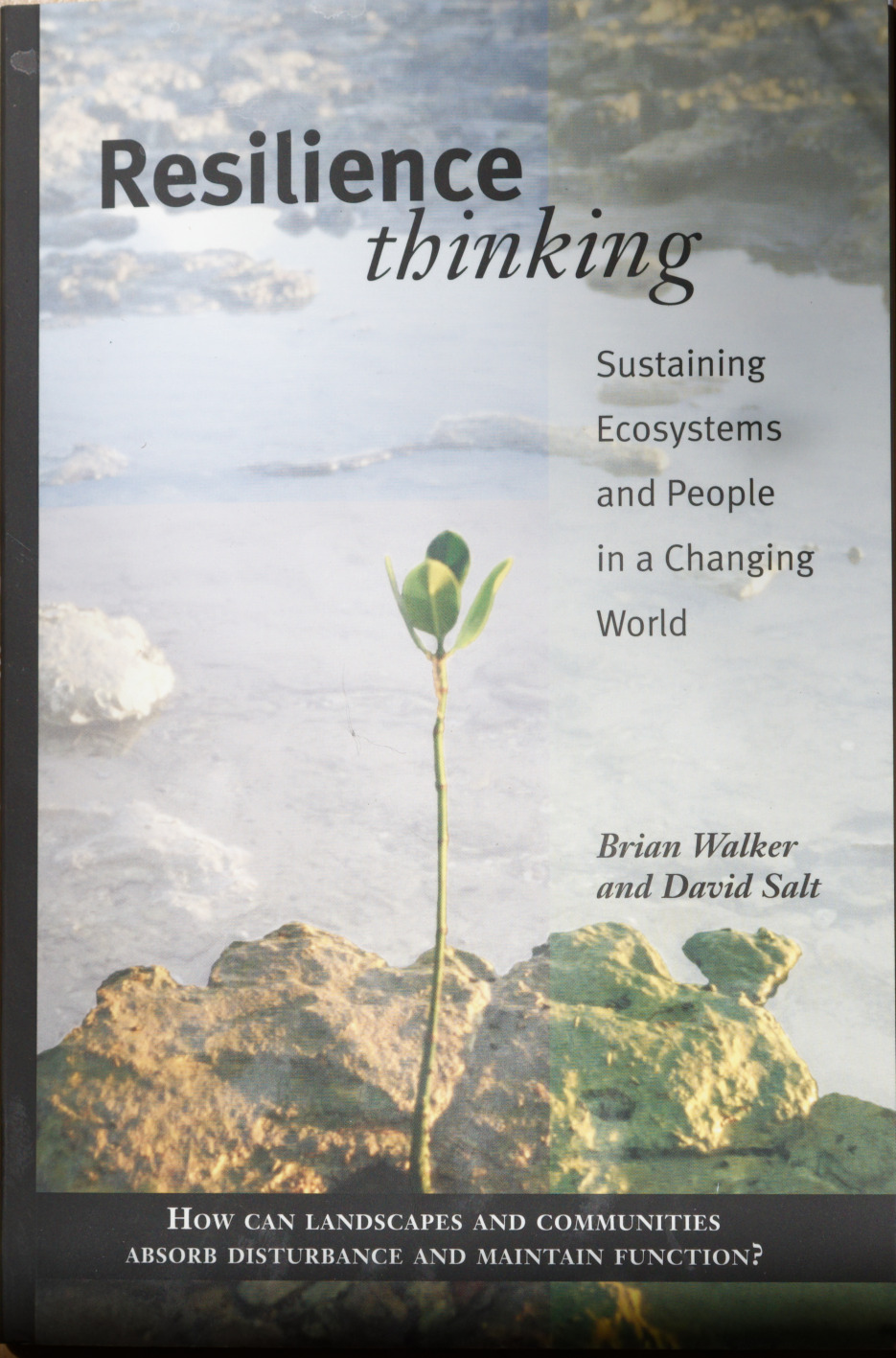
Resilience Thinking – a review

A book to make one think anew.

Let me make myself absolutely clear about this book, indeed I can do no better than to publish part of an email that I sent to the authors last Saturday:

To say that I was inspired by what you wrote is an understatement. More accurately it has changed my whole understanding of this planet, of the natural order of things, of the politics of the Western world, of vast numbers of us humans, and how precarious is our world just now. It has opened my eyes radically, and I thought before that I was fairly in touch with things.

Resilience is a simple idea but in its application has proved to be anything such. On page 2 the authors set out as they saw it The Drivers of Unsustainable Development. Here’s how that section develops:

Our world is facing a broad range of serious and growing resource issues. Human-induced soil degradation has been getting worse since the 1950s. About 85 percent of agriculture land contains areas degraded by erosion, rising salt, soil compaction, and various other factors. It has been estimated (Wood et al. 2000) that soil degradation has already reduced global agricultural productivity by around 15 percent in the last fifty years. In the last three hundred years, topsoil has been lost at a rate of 200 million tons per year; in the last fifty years it has more than doubled to 760 million tons per year.

As we move deeper into the twenty-first century we cannot afford to lose more of our resource base. The global population is now expanding by about 75 million people each year. Population growth rates are declining, but the world’s population will still be expanding by almost 60 million per year in 2030. The United Nations projections put the global population at nearly 8 billion in 2025. In addition, if current water consumption patterns continue unabated, half the world’s population will live in water-stressed river basins by 2025.

The Food and Agriculture Organization of the United Nations (FAO) 2004 Annual Hunger Report estimates that over 850 million people suffer from chronic hunger. Hunger kills 5 million children every year.

It goes on ….!

Now I want to quote from the end of the book, from their section on Resilience Thinking.

In our opening chapter we observed that there were many pathways into resilience thinking and suggested readers not worry too much if the finer details of a resilience framework are a bit obscure. We emphasized that what is of much more importance is an appreciation of the broader themes that underpin such a framework. Those broader themes revolve around humans existing within linked social and ecological systems. These are complex adaptive systems, and attempts to control or optimize parts of such systems without consideration of the responses that this creates in the broader system are fraught with risk. Much of this book has been spent on attempting to explore the consequences of such an approach.

In the broadest sense, optimizing and controlling components of a system in isolation of the broader system results in a decline in resilience, a reduction in options, and the shrinkage of the space in which we can safely operate. Resilience thinking moves us the other way.

It is our hope that readers who are persuaded of this basic premise will be encouraged to explore the inevitable consequences of such thinking. Even if you are not completely clear on the basins of attractions, thresholds, and adaptive cycles, if the concepts of ecological resilience and dynamic social-ecological systems have any resonance then you are in a better position to appreciate what is happening to the world around you.

The phrase complex adaptive system was new to me but intuitively I got what the authors meant. As they state on page 35: The three requirements for a complex adaptive system are:

  • That it has components that are independent and interacting,
  • There is some selection process at work on those components (and on the results of local interactions),
  • Variation and novelty are constantly being added to the system (through components changing over time or new ones coming in),

This was my eye-opener. It was now obvious that many processes, especially in nature, that I had hitherto regarded as constant were changing albeit usually on a timescale of many decades sometimes centuries.

And the other conclusion that was inescapable was that we humans were largely responsible for those changes because we couldn’t see the longterm consequences of what we were doing.

As I remarked in a previous post :

David writes that firstly carbon dioxide is not like other pollutants, for example like air particulants.  Then later goes on to say:

The second difference is that climate change is irreversible.

As Joe Romm notes in a recent post, New York Times columnist Joe Nocera slipped up in his latest column and referred to technology that would “help reverse climate change.” I don’t know whether that reflects Nocera’s ignorance or just a slip of the pen, but I do think it captures the way many people subconsciously think about climate change. If we heat the planet up too much, we’ll just fix it! We’ll turn the temperature back down. We’ll get around to it once the market has delivered economically ideal solutions.

But as this 2009 paper in Nature (among many others) makes clear, it doesn’t work that way:

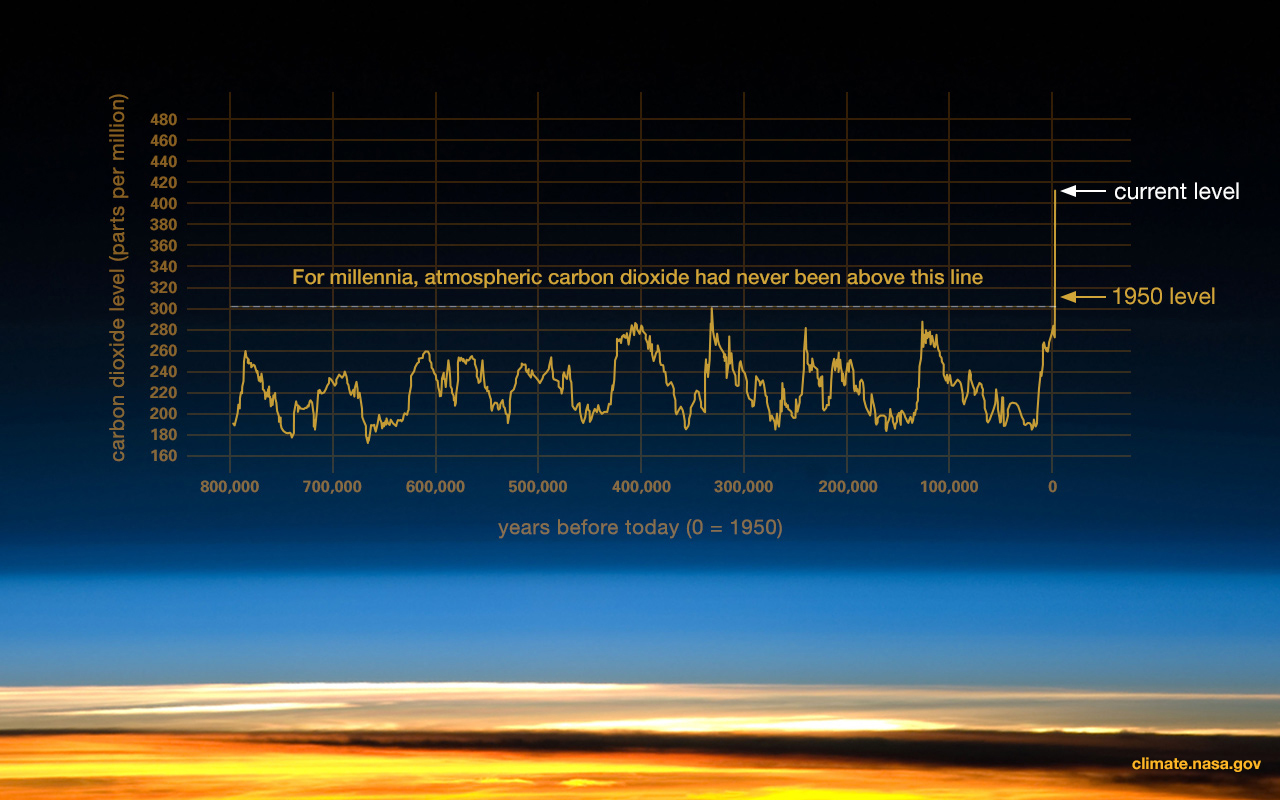
This paper shows that the climate change that takes place due to increases in carbon dioxide concentration is largely irreversible for 1,000 years after emissions stop. Following cessation of emissions, removal of atmospheric carbon dioxide decreases radiative forcing, but is largely compensated by slower loss of heat to the ocean, so that atmospheric temperatures do not drop significantly for at least 1,000 years. [my emphasis]

My last piece in this review is to republish a graph that is shown on the NASA Global Climate Change website:

For all our sakes, dogs and humans and many other species, let us all please change our behaviours! Soon!

Back to the book: It is a remarkable book!

I will close with quoting one of the praises shown on the back cover. This one by Thomas Homer-Dixon, professor of political science, University of Toronto, and director of the Trudeau Centre for Peace and Conflict Studies.

Resilience Thinking is an essential guidebook to a powerful new way of understanding our world – and of living resiliently with it – developed in recent decades by an international team of ecologists. With five clear and compelling case studies drawn from regions as diverse as Florida, Sweden, and Australia, this book shows how all highly adaptive systems – from ecologies to economics – go through regular cycles of growth, reorganization, and renewal and how our failures to understand the basic principles of resilience have often led to disaster. Resilience Thinking gives us the conceptual tools to help us cope with the bewildering surprises and challenges of our new century.

Please, if you can, think about reading it.

The Elephant in the Room

This is one of the most important posts since I started blogging!

I was born in 1944 and that makes me 76. I am reasonably engaged in the issues facing us but, in a sense, protected from the realities of the modern world because I have a loving wife, two loving young people, as in my son Alex and my daughter Maija, and a special grandson, Morten.

We are also very lucky in that my wife, Jean, and I are both retired and we live on 13 rural acres in a beautiful part of Southern Oregon and enjoy immensely our six dogs, two horses, two parakeets and feeding the wild birds and deer.

But it can’t stay that way because of the encroaching elephant in the room.

I am speaking of climate change that if not dealt with in the near future, say in the next 10 years, will lead to an unimaginable state of affairs.

Now one could argue that you come to Learning from Dogs to get away from climate change and the like. But this is too important and, also, involves all of us including our gorgeous dogs.

First, I want to include an extract from a recent Scientists Warning newsletter (and please read this extract carefully).

Recently, one article on the climate emergency above all others has cut through – with over ONE MILLION views, “Climate scientists: concept of net zero is a dangerous trap”  published in The Conversation is being talked about by many thousands, and led Greta Thunberg to tweet:  “This is one of the most important and informative texts I have ever read on the climate- and ecological crises.” 
So why is this article so very important?

In our latest interview, I talk with two of the authors – Dr.  James Dyke, global systems scientist at the University of Exeter and Dr. Wolfgang Knorr, climate scientist at Lund University. And the conversation does not make for comfortable viewing.  We discuss what led James, Wolfgang and Professor Bob Watson to write an article that they have described as being one of the hardest they have ever written. The article is *not* an attack on net zero, nor does it advocate a fatalistic position. Instead, as you will hear, the interview reveals the heartfelt concerns of two scientists who are profoundly worried about the failure of a climate policy system that suppresses the  voice of science and is fundamentally flawed. A climate policy system that year after year has failed.

But  it is not just the climate policy system that has failed. Academia has failed too, and continues to fail Greta and young people like her. And this *must* stop. Young people have become the adults in the room. We cannot place this burden on their shoulders. They have shown their courage and bravery. Now it’s time for academia to step up to the challenge and to critically examine why we are failing. 

Secondly, I want to share that interview with you. This is a 36-minute interview. Please, please watch it. If it is not a convenient time just now then bookmark the post and watch it when you can sit down and be fully engaged. You will understand then and agree with me that this is one of the most important videos ever!

Lastly, I would like you to read the article published in The Conversation. I have included a link to it but I am also going to republish it on Friday.

Because we have to listen to the scientists without delay and press for change now.

Thank goodness for our younger generation. Because these young people are coming together to fight for change. May they have universal encouragement from those of us who will never see our younger days again!

men's white and blue gingham dress shirt
Photograph by Zach Lucero

The Dog Food Advisor.

A good summary of all that matters.

The Dog and Cat Food update was announced two days ago.

In the covering email they said:

Dear Fellow Dog Lover,

You’re getting this email because you signed up on our website and asked to be notified. If you no longer wish to receive these emails, please click the “unsubscribe” link at the bottom of this message.

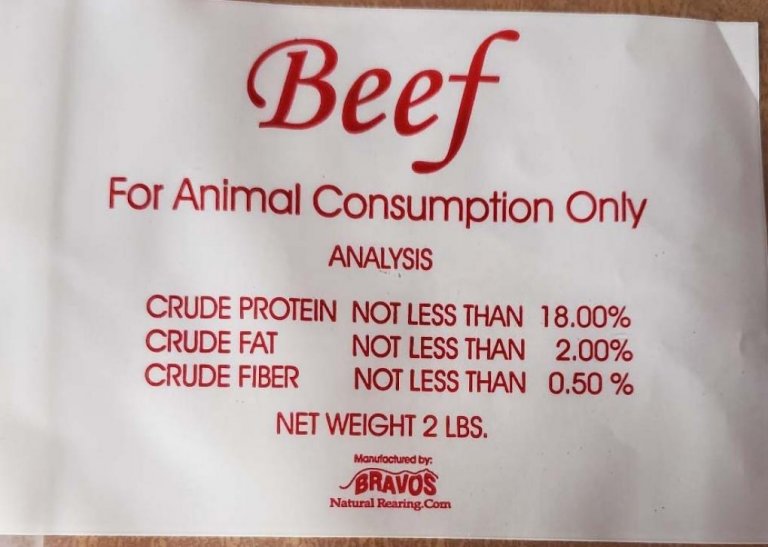
Bravo Packing of Carney’s Point, NJ, is expanding its recall to now include multiple dog and cat food products due to possible contamination with Salmonella and Listeria bacteria.

For full details, please visit the following link: Bravo Packing Expands Dog and Cat Food Recall

Best Dog Food for March 2021

The Dog Food Advisor has recently updated the following best dog food pages:

  • Best Dry Dog Foods
  • Best Puppy Foods
  • Best Large Breed Puppy Foods
  • Best Dog Foods for Small Dogs
  • Best Dog Food for Allergies
  • Best Grain-Free Dog Foods
  • Best Dog Foods Made with Grain
  • Best Budget-Friendly Dog Foods
  • Best Dog Food for Specific Breeds
  • Best Senior Dog Foods

Click here to see our Best Dog Foods for March 2021

Please be sure to share this news with other dog and cat owners.

Mike Sagman, Editor
The Dog Food Advisor
Saving Good Dogs From Bad Dog Food

Now onto the Bravo Packing recall.

ooOOoo

Bravo Packing Expands Dog and Cat Food Recall

March 16, 2021 — Bravo Packing, Inc., of Carneys Point, New Jersey, is expandingits previously announced voluntary recall of two pet food products to now include all pet food and bones in all package sizes… because they may be contaminated with disease-causing bacteria.

During an FDA inspection, samples collected tested positive for Salmonella and Listeria monocytogenes and resulted in a recall due to the potential health risks to humans and pets.

See The Dog Food Advisor’s previous announcement here.

What’s Recalled?

Bravo Packing, Inc. is expanding the recall due to potential cross contamination of the following dog and cat food products.

Label Images of Recalled Products

The following label images are included in the FDA bulletin. No other photographs were provided by the company.

About Salmonella

Salmonella can cause illness in pets eating the products, as well as people who handle contaminated pet food products, especially if they have not thoroughly washed their hands after having contact with the products, infected pets, or any surfaces exposed to these products.

People infected with Salmonella should monitor themselves for some or all of the following symptoms: nausea, vomiting, diarrhea or bloody diarrhea, abdominal cramping, and fever.

Rarely, Salmonella can result in more serious ailments, including arterial infections, endocarditis (an infection of the heart muscle), arthritis, muscle pain, eye irritation, and urinary tract symptoms.

People who have these symptoms after having contact with the products identified in this recall or with a pet that has eaten these products should contact their healthcare providers.

A pet with a Salmonella infection may be lethargic and have diarrhea or bloody diarrhea, fever, and vomiting.

Some pets will have decreased appetite, fever, and abdominal pain.

If your pet has consumed the recalled products and has these symptoms, please contact your veterinarian.

Pets exposed to contaminated food can be infected without showing symptoms.

Infected pets, including those without symptoms, can also shed Salmonella through their feces and saliva, spreading pathogens into the home environment and to humans and other animals nearby.

Listeria monocytogenes is an organism which can cause serious and sometimes fatal infections in young children, frail or elderly people, and others with weakened immune systems.

Although healthy individuals may suffer only short-term symptoms such as high fever, severe headache, stiffness, nausea, abdominal pain, and diarrhea, Listeria monocytogenes infection can cause miscarriages and stillbirths among pregnant women.

No human or animal illnesses related to the identified products have been reported to date.

Where Were the Products Sold?

Bravo Packing Inc. generally works with distributors that fill orders to retail storesand to consumers directly nationwide.

What to Do?

Consumers with any of the affected products should handle them with caution, discard products in a secure container, and wash hands and surfaces properly.

Consumers with questions should contact Bravo Packing, Inc. at 856-299-1044 (Monday through Friday, 9:00 am to 2:00 pm, ET).

U.S. citizens can report complaints about FDA-regulated pet food products by calling the consumer complaint coordinator in your area.

Or go to the FDA’s “Report a Pet Food Complaint” page.

Canadians can report any health or safety incidents related to the use of this product by filling out the Consumer Product Incident Report Form.

Get Lifesaving Recall Alerts by Email

Get free dog food recall alerts sent to you by email. Subscribe to The Dog Food Advisor’s emergency recall notification system.
There’s no cost. No spam ever. Cancel any time.

ooOOoo

As always, please share this around as much as you can.

Because even just one dog owner being informed of this Dog Food Recall makes it all worthwhile.

The most common human infrastructure.

Is the fence!

I saw this article yesterday on The Conversation and thought it was very significant and, as a result, worthy of sharing with you.

But first a picture of the Australian dingo.

By Henry Whitehead – Original photograph, CC BY-SA 3.0,

Taken from an article on WikiPedia.

Here is that article from The Conversation.

ooOOoo

Fences have big effects on land and wildlife around the world that are rarely measured

November 30, 2020

By , Postdoctoral Researcher, University of California Santa Barbara,

and

, Ph.D. Candidate in Environmental Science, Policy and Management, University of California, Berkeley,

and

, PhD Candidate in Environmental Science, Policy and Management, University of California, Berkeley.

What is the most common form of human infrastructure in the world? It may well be the fence. Recent estimates suggest that the total length of all fencing around the globe is 10 times greater than the total length of roads. If our planet’s fences were stretched end to end, they would likely bridge the distance from Earth to the Sun multiple times.

On every continent, from cities to rural areas and from ancient to modern times, humans have built fences. But we know almost nothing about their ecological effects. Border fences are often in the news, but other fences are so ubiquitous that they disappear into the landscape, becoming scenery rather than subject.

In a recently published study, our team sought to change this situation by offering a set of findings, frameworks and questions that can form the basis of a new discipline: fence ecology. By compiling studies from ecosystems around the world, our research shows that fences produce a complex range of ecological effects.

Some of them influence small-scale processes like the building of spider webs. Others have much broader effects, such as hastening the collapse of Kenya’s Mara ecosystem. Our findings reveal a world that has been utterly reorganized by a rapidly growing latticework of fences.

Connecting the dots

If fences seem like an odd thing for ecologists to study, consider that until recently no one thought much about how roads affected the places around them. Then, in a burst of research in the 1990s, scientists showed that roads – which also have been part of human civilization for millennia – had narrow footprints but produced enormous environmental effects.

For example, roads can destroy or fragment habitats that wild species rely on to survive. They also can promote air and water pollution and vehicle collisions with wildlife. This work generated a new scientific discipline, road ecology, that offers unique insights into the startling extent of humanity’s reach.

Our research team became interested in fences by watching animals. In California, Kenya, China and Mongolia, we had all observed animals behaving oddly around fences – gazelles taking long detours around them, for example, or predators following “highways” along fence lines.

We reviewed a large body of academic literature looking for explanations. There were many studies of individual species, but each of them told us only a little on its own. Research had not yet connected the dots between many disparate findings. By linking all these studies together, we uncovered important new discoveries about our fenced world.

Early advertisement for barbed wire fencing, 1880-1889. The advent of barbed wire dramatically changed ranching and land use in the American West by ending the open range system. Kansas Historical Society, CC BY-ND

Remaking ecosystems

Perhaps the most striking pattern we found was that fences rarely are unambiguously good or bad for an ecosystem. Instead, they have myriad ecological effects that produce winners and losers, helping to dictate the rules of the ecosystems where they occur.

Even “good” fences that are designed to protect threatened species or restore sensitive habitats can still fragment and isolate ecosystems. For example, fences constructed in Botswana to prevent disease transmission between wildlife and livestock have stopped migrating wildebeests in their tracks, producing haunting images of injured and dead animals strewn along fencelines.

Enclosing an area to protect one species may injure or kill others, or create entry pathways for invasive species.

One finding that we believe is critical is that for every winner, fences typically produce multiple losers. As a result, they can create ecological “no man’s lands” where only species and ecosystems with a narrow range of traits can survive and thrive.

Altering regions and continents

Examples from around the world demonstrate fences’ powerful and often unintended consequences. The U.S.-Mexico border wall – most of which fits our definition of a fence – has genetically isolated populations of large mammals such as bighorn sheep, leading to population declines and genetic isolation. It has even had surprising effects on birds, like ferruginous pygmy owls, that fly low to the ground.

Australia’s dingo fences, built to protect livestock from the nation’s iconic canines, are among the world’s longest man-made structures, stretching thousands of kilometers each. These fences have started ecological chain reactions called trophic cascades that have affected an entire continent’s ecology.

The absence of dingoes, a top predator, from one side of the fence means that populations of prey species like kangaroos can explode, causing categorical shifts in plant composition and even depleting the soil of nutrients. On either side of the fence there now are two distinct “ecological universes.”

Our review shows that fences affect ecosystems at every scale, leading to cascades of change that may, in the worst cases, culminate in what some conservation biologists have described as total “ecological meltdown.” But this peril often is overlooked.

The authors assembled a conservative data set of potential fence lines across the U.S. West. They calculated the nearest distance to any given fence to be less than 31 miles (50 kilometers), with a mean of about 2 miles (3.1 kilometers). McInturff et al,. 2020, CC BY-ND

To demonstrate this point, we looked more closely at the western U.S., which is known for huge open spaces but also is the homeland of barbed wire fencing. Our analysis shows that vast areas viewed by researchers as relatively untrodden by the human footprint are silently entangled in dense networks of fences.

Do less harm

Fences clearly are here to stay. As fence ecology develops into a discipline, its practitioners should consider the complex roles fences play in human social, economic and political systems. Even now, however, there is enough evidence to identify actions that could reduce their harmful impacts.

There are many ways to change fence design and construction without affecting their functionality. For example, in Wyoming and Montana, federal land managers have experimented with wildlife-friendly designs that allow species like pronghorn antelope to pass through fences with fewer obstacles and injuries. This kind of modification shows great promise for wildlife and may produce broader ecological benefits.

Another option is aligning fences along natural ecological boundaries, like watercourses or topographical features. This approach can help minimize their effects on ecosystems at low cost. And land agencies or nonprofit organizations could offer incentives for land owners to remove fences that are derelict and no longer serve a purpose.

Nonetheless, once a fence is built its effects are long lasting. Even after removal, “ghost fences” can live on, with species continuing to behave as if a fence were still present for generations.

Knowing this, we believe that policymakers and landowners should be more cautious about installing fences in the first place. Instead of considering only a fence’s short-term purpose and the landscape nearby, we would like to see people view a new fence as yet another permanent link in a chain encircling the planet many times over.

ooOOoo

This is something that I hadn’t hitherto thought about. I suspect that I am not alone.

There are many aspects of the fence that warrant more careful thought. I will close by repeating what was said just a few paragraphs above:

There are many ways to change fence design and construction without affecting their functionality. For example, in Wyoming and Montana, federal land managers have experimented with wildlife-friendly designs that allow species like pronghorn antelope to pass through fences with fewer obstacles and injuries. This kind of modification shows great promise for wildlife and may produce broader ecological benefits.

Another option is aligning fences along natural ecological boundaries, like watercourses or topographical features. This approach can help minimize their effects on ecosystems at low cost. And land agencies or nonprofit organizations could offer incentives for land owners to remove fences that are derelict and no longer serve a purpose.

We are never too old to learn!


It’s all too much, or it could be!

This year, 2020, has been unlike any other year.

I am not saying anything new but just reiterating what has been said before: 2020 is going to go down as the year from hell! And I don’t think that is too strong a word!

Part of it are the news stories that sweep the world: Covid-19; Brexit; Climate change; up until yesterday what was President Trump going to do in his last few weeks; etc; etc.

Also part of it is the way that news and more news and, yes, more news is flashed around the globe. Most of it bad news as we all know that bad news sells!

Finally, part of it is the new world of social media especially messaging on a smartphone. President Trump isn’t the only one to communicate greatly via Twitter.

Now, speaking personally, I couldn’t have got through this year without Jeannie and our dogs.

Pure bliss!

But, nevertheless, something has changed and Mark Satta has written an article that tries to explain things.

ooOOoo

Three reasons for information exhaustion – and what to do about it

By Mark Satta, Assistant Professor of Philosophy, Wayne State University.

November 18th, 2020

An endless flow of information is coming at us constantly: It might be an article a friend shared on Facebook with a sensational headline or wrong information about the spread of the coronavirus. It could even be a call from a relative wanting to talk about a political issue.

All this information may leave many of us feeling as though we have no energy to engage.

As a philosopher who studies knowledge-sharing practices, I call this experience “epistemic exhaustion.” The term “epistemic” comes from the Greek word episteme, often translated as “knowledge.” So epistemic exhaustion is more of a knowledge-related exhaustion.

It is not knowledge itself that tires out many of us. Rather, it is the process of trying to gain or share knowledge under challenging circumstances.

Currently, there are at least three common sources that, from my perspective, are leading to such exhaustion. But there are also ways to deal with them.

1. Uncertainty

For many, this year has been full of uncertainty. In particular, the coronavirus pandemic has generated uncertainty about health, about best practices and about the future.

At the same time, Americans have faced uncertainty about the U.S. presidential election: first due to delayed results and now over questions about a peaceful transition of power.

Experiencing uncertainty can stress most of us out. People tend to prefer the planned and the predictable. Figures from 17th-century French philosopher René Descartes to 20th-century Austrian philosopher Ludwig Wittgenstein have recognized the significance of having certainty in our lives.

With information so readily available, people may be checking news sites or social media in hopes of finding answers. But often, people are instead greeted with more reminders of uncertainty.

As Trump supporters denounce the 2020 election results, feelings of uncertainty can come up for others. Karla Ann Cote/NurPhoto via Getty Images

2. Polarization

Political polarization is stressing many Americans out.

As political scientist Lilliana Mason notes in her book, “Uncivil Disagreement: How Politics Became Our Identity,” Americans have been increasingly dividing politically “into two partisan teams.”

Many writers have discussed the negative effects of polarization, such as how it can damage democracy. But discussions about the harms of polarization often overlook the toll polarization takes on our ability to gain and share knowledge.

That can happen in at least two ways.

First, as philosopher Kevin Vallier has argued, there is a “causal feedback loop” between polarization and distrust. In other words, polarization and distrust fuel one another. Such a cycle can leave people feeling unsure whom to trust or what to believe.

Second, polarization can lead to competing narratives because in a deeply polarized society, as studies show, we can lose common ground and tend to have less agreement.

For those inclined to take the views of others seriously, this can create additional cognitive work. And when the issues are heated or sensitive, this can create additional stress and emotional burdens, such as sadness over damaged friendships or anger over partisan rhetoric.

3. Misinformation

Viral misinformation is everywhere. This includes political propaganda in the United States and around the world.

People are also inundated with advertising and misleading messaging from private corporations, what philosophers Cailin O’Connor and James Owen Weatherall have called “industrial propaganda.” And in 2020, the public is also dealing with misinformation about COVID-19.

As chess grandmaster Garry Kasparov put it: “The point of modern propaganda isn’t only to misinform or push an agenda. It is to exhaust your critical thinking, to annihilate truth.”

Misinformation is often exhausting by design. For example, a video that went viral,Plandemic,” featured a large number of false claims about COVID-19 in rapid succession. This flooding of misinformation in rapid succession, a tactic known as a Gish gallop, makes it challenging and time-consuming for fact checkers to refute the many falsehoods following one after another.

What to do?

With all this uncertainty, polarization and misinformation, feeling tired is understandable. But there are things one can do.

The American Psychological Association suggests coping with uncertainty through activities like limiting news consumption and focusing on things in one’s control. Another option is to work on becoming more comfortable with uncertainty through practices such as meditation and the cultivation of mindfulness.

To deal with polarization, consider communicating with the goal of creating empathetic understanding rather than “winning.” Philosopher Michael Hannon describes empathetic understanding as “the ability to take up another person’s perspective.”

[Deep knowledge, daily. Sign up for The Conversation’s newsletter.]

As for limiting the spread of misinformation: Share only those news stories that you’ve read and verified. And you can prioritize outlets that meet high ethical journalistic or fact-checking standards.

These solutions are limited and imperfect, but that’s all right. Part of resisting epistemic exhaustion is learning to live with the limited and imperfect. No one has time to vet all the headlines, correct all the misinformation or gain all the relevant knowledge. To deny this is to set oneself up for exhaustion.

ooOOoo

That last section, What to do?, is full of really sensible advice. In fact, the American Psychological Association has an article at the moment that appears to be freely available called Healing the political divide.

I intend to read it.

It finishes up saying:

Scientists must strive to share their research as broadly as possible. And they don’t have to do it alone. Organizations like More in Common work to conduct research and communicate findings to audiences where it can have the greatest impact.

Advocacy is essential as well. Other countries that have made strides in addressing the political divide relied heavily on government-led reconciliation efforts. The Truth and Reconciliation Commission, for example, in South Africa, has been fundamental in addressing disparities and conflict around Apartheid.

Were the United States to consider similar, government-backed efforts, psychologists must be part of the call to do so. And the behavioral expertise of the field would be central to success.

“The collective mental health of the nation is at risk,” says Moghaddam. “Just as we should rely on epidemiological science to tell us when there is a vaccine ready for mass use, we have to rely on psychological science to guide us through these mental health issues.”

And following an election that, for many, has felt like the most polarized of a lifetime, this piece seems critical. “ This is what our profession is all about,” says Moghaddam.

Good advice especially if you can take time off just losing oneself in nature.

Dawn behind nearby Mt. Sexton. Taken from our deck on the 21st August, 2019.

Enough said!