Category: Business

Unemployment, Part Three

How much is “too much” Unemployment?

How much unemployment “should” our economy have?  How much unemployment is too much, and how much is just right?  How high does the unemployment rate have to go before significant changes are made in government policy and approaches?

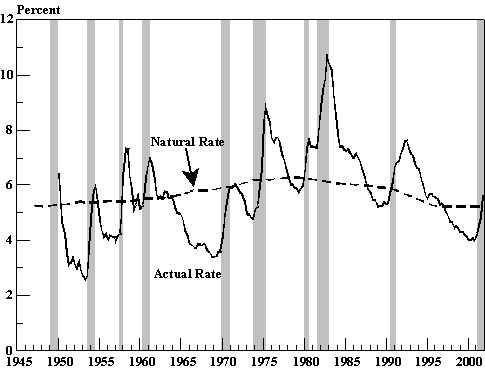
The question of the optimal level of unemployment has generally been answered by reference to the so-called “natural rate” of unemployment.  The natural rate of unemployment is measured as the long-run average rate of actual unemployment in an economy over time; it is a “trend line,” as seen in this graph below:

unemployment3

Read more of this Essay

More on that ‘passion’ word!

Passion may be the key to many, many areas of success.

Following John’s Post on Sunday about passion, two other items passed my virtual desk that seemed to resonate with the theme.

The first was my regular Sunday ‘newsletter’ from Philip Humbert.  Sometime it comes across as a bit too good to be true but that may be a little bit of cultural mismatch from an Englishman’s eyes. Philip describes himself as a “Personal Success Coach!” and offers a free weekly newsletter that is worth trying out.

Anyway, to the point of this Post.

Read more about Passion

Understanding unemployment, Part Two

Examining unemployment in more depth.

In an earlier post, I explained how the reported U.S. unemployment rate, which was 9.6% in August of 2009, is unemployedmeasured. This post will explore the reported unemployment rate in more depth, distinguishing between the short-term, temporary sources of unemployment and the long-term, more structural, and troubling aspects of the unemployment rate.

The 9.6% U.S. unemployment rate remains the same next month if no one changes their employment status.  But the rate also remains unchanged if the same number of people hired get fired.  In truth, the U.S. unemployment rate nets out enormous flows of people into and out of the labor force and, for those in the labor force, between being employed and unemployed.

A representative month in the unemployment statistic tells the story.

Read more about unemployment

Sunday smile … and passion in business

First impressions, reliable or not?

This joke that I received recently might amuse you:

Light travels faster than sound. This is why some people appear bright until you hear them speak.

That happens! In some cases, you might have preferred to retain the first impression and wish that they had never spoken!

But sometimes, this “don’t judge a book by its cover” effect can work in the opposite direction; as a result, I nearly missed out on enjoying a passionate presentation.
Read more about passion!

Unfamiliar territory for stockmarkets

Stockmarkets in very foreign territory

On August 6th, a Post was published on this Blog with the title of This is going to end in tears!

It was prompted by an article by Karl Denninger and a footnote piece from Dave Rosenberg of Gluskin Sheff.

Also included were the US and UK prices for 4th August (about 7am MT) more for my own curiosity than anything else.  They were:

Dow Jones 9295, S&P 500 1,001, NASDAQ 2002, FTSE 100 (now closed) 4671.

By comparison, here are the figures for these markets (all closed at time of writing) for the 18th September.

Dow Jones 9820, S&P 500 1,068, NASDAQ 2133, FTSE 100 5173.

Well another fascinating muse from Mr Rosenberg was in this morning’s inbox and important extracts are below:

Read Rosenberg’s comments

What not to say

John Lewis joins Learning from Dogs

On September 3rd, a Post was published about John.  Anyone who read that Post will understand the pleasure that both John and I got from being re-connected.  Subsequent chats since that Post have shown that there are many parallels in the way that we think, see the world, and speculate as to what, really, is going on!  It was inevitable that I would ask John to join Learning from Dogs and, when I did, John’s immediate ‘yes’ was proof indeed that this was the right thing for us.  A strong desire to do something is always important.

John’s first Post shows that he will be welcomed by all who read this Blog.

Paul

Read John’s first Post

Lehman Brothers – whoops!

Wonderful article in the Financial Times about the importance of IT documentation!

Unwinding derivatives is a complex task at the best of times. In the case of Lehman, one of the biggest dealers in some of the most complex derivatives markets, this has been even more so. Lehman’s global derivatives book included contracts with a notional face value of $39,000bn and deals with 8,000 different counterparties when it went bust. The derivatives business was actually split into multiple strands, backed up by between 20 and 30 different systems.

Once it went bankrupt, the staff who supported these systems “evaporated”, according to Steven O’Hanlon, president of Numerix, a pricing and valuation company which is working with Lehman Brothers Holding Inc to unwind the derivatives portfolio.

Say no more! Full article is here.

By Paul Handover

Lehman – 1 year on.

Exactly a year ago, Lehman Brothers filed for bankruptcy.

I shall avoid the temptation of pontificating on the subject as many, many others, far better qualified, will be doing so!Leyman

But two published articles seem to me to be worth visiting, one from October of 2008 from The Economist, and one from The New York Times.

Lastly, a personal comment from friend Dan that shows powerfully how the last year has affected him.

Read more of this Post

Now you see it, now you don’t!

Bermeja (Mexican Gulf) – anyone seen my island?

There’s a wonderful story in last week-end’s The Sunday Times, a British newspaper, written by Matthew Campbell concerning the loss of an important island that has been used previously to define the limits of Mexico’s maritime

Old map with Bermeja

border (read oil!).  Here’s an extract:

The mystery has come to haunt Mexico as unrelentingly as one of its beloved soap operas: where is Bermeja, an island off the Yucatan coast that appears to have vanished without trace?

The disappearance of Bermeja is no laughing matter – it would allow Mexico to extend its maritime border some 55 miles further north, helping it to fight off what it sees as American encroachment on its claims to potentially vast oil reserves in the Mexican Gulf.

Read more of this Post

Johnathan Wilson Lewis – another thinker.

Fourier approaches to the theory of volume holography.

Anyone who takes a doctorate with the above subject title has to have a well-functioning brain.  I know John.  He does.

John Lewis, as I have always known him until reading his Blog, and I met a good many years ago when we both were members of a private flying group that operated a Socata (French) TB20, G BPAS.

TB20 G-BPAS
TB20 G-BPAS

It was based at Exeter in Devon, SW England.  Both of us were/are private pilots.

We flew together on many an occasion and it was clear from the start that John approached everything in life from, well in his own words, “…. motivated by an interest in what things are, how they work and how they are used.”  Say no more!

Well, as luck would have it, the joys of social networking brought us back in touch recently and we had a jolly good chin-wag.  With a bonus.

Read more about John Lewis