Category: Business

Shoulder to the wheel.

Today’s post is devoted entirely to a recent email received from Bill McKibben of 350.org

oooOOOooo

Dear friends,

Once a year or so, I write a piece that I really want people to read.

Last year it was an article called “The Terrifying New Math of Global Warming,” which helped fuel the divestment campaign that is now blanketing the country and even spreading overseas. Now I have a new long piece, also in Rolling Stone, called “The Fossil Fuel Resistance” that I was hoping you would read.

Here’s a quick summary from the article:

After decades of scant organized response to climate change, a truly powerful movement is quickly emerging, around the country and around the world. It has no great charismatic leader, and no central organization; it battles on a thousand fronts, many of them very local and small. But taken together, it’s now big enough to matter, and it’s growing fast.

So you could call it by many names. But for me it’s the Fossil Fuel Resistance.

I hope you’ll spread it around, because I think it will help people understand a few things about the climate movement.

First, it shows that we’re in a much bigger struggle than the fight against Keystone, crucial as that is. Across the country and around the world people are taking on the fossil fuel industry in remarkable ways that are starting to add up.

Second, it’s shows that we’re becoming a much broader movement tactically and organizationally than we’re used to thinking about.

The old-line environmental groups are playing their part, but powerful leadership is coming from all kinds of communities. There are a bunch of profiles that accompany the piece, and they focus on heroes from Indigenous nations, environmental justice organizations, and the clean tech industry, each of people doing amazing work.

What I hoped to do with this article is move past restating the problem, which I think most people understand, and show how we are working together towards solutions.

Those solutions take many forms, and I hope you’ll read about them and share the article around so that we can start to bring more people into this resistance movement.

It’s not all good news, of course. We’re still losing this fight, as the temperature rises. But I want everyone to know that it is going to be a real fight. This piece, I hope will help spread the word, and build our movement even bigger. Click here to read and share: 350.org/Resistance

We can’t outspend the fossil fuel barons, but we can out organize them, if we get to work.

Bill McKibben

P.S. Just a heads up that we’re planning a big push on sending comments to the State Dept. over the next few days. I wanted to make sure you knew that was coming, after these emails about new articles and films.

Only outcomes matter!

The Resilience Imperative and Civil Disobedience

Introduction

I have long been a subscriber to CASSE, The Center for the Advancement of the Steady State Economy.  As Casse’s home page sets out, “Perpetual economic growth is neither possible nor desirable. Growth, especially in wealthy nations, is already causing more problems than it solves.  Recession isn’t sustainable or healthy either. The positive, sustainable alternative is a steady state economy.”  Do take a minute to see the sense and power of this fundamentally and obvious position by reading a little more here.

But as the title of today’s post sets out, all the ideas and actions and commitments come to naught if the outcomes aren’t delivered.  This recent essay by Michael Lewis on the CASSE website explores the issue of outcomes and I am very grateful for being granted permission to republish it here on Learning from Dogs.

oooOOOooo

The Resilience Imperative and Civil Disobedience

by Michael Lewis

As I was making a speech in Alberta, Canada, to a business audience, mainly from the finance and energy industries, a fully engaged participant in the front row caught my eye. He was the first to approach me after the question period and the first to get my autograph on The Resilience Imperative: Cooperative Transitions to a Steady-State Economy, the book that I co-authored with Pat Conaty.

During my talk, I had argued that economic growth and a casino-like financial system were taking us to the edge of a deadly precipice. I made the case that societies urgently need to navigate the turn to a steady-state economy, based on local and regional trade. I also offered suggestions on how we might accomplish this. The thesis has a bit of an edge to it, especially in a business crowd accustomed to globalization and growth, so I was anxious to learn more about the front-row enthusiast.

He turned out to be a warm, charming, and open senior manager at Cenovus Energy, a large player in the Athabasca Tar Sands. The corporation seems to be respected in Alberta and Saskatchewan because of its health and safety, community, and environmental initiatives. He rapidly brought the discussion to the issue of “social license,” a condition he acknowledged was a big problem for the tar sands operators. But his view, after many years around boardroom tables, is that the industry is becoming more transparent and responsible, and its performance is improving.

I believe this to be true; certainly Cenovus has been doing a lot of things right. However, I argued that he was missing the point; social license in this industry could only be understood in a global context, and it is not going to be forthcoming for two simple reasons: (1) economic growth produces carbon and (2) carbon is going to kill a lot of us and thousands of other creatures.

If the oil and gas sector wants to explore the potential for broadening its social license, it would have to stand shoulder to shoulder with scientists, governments, businesses, and civil society and argue for a stiff tax on carbon. Only by taking such responsibility can Cenovus and its fellow corporations expand their social license. At the same time they would be helping to set the stage for the transition to a steady-state economy.

“Nothing less would do,” I proclaimed.

“Well you know, Mike,” he replied, “I have not seen much evidence of such a move afoot.”

Why am I not surprised? “I know,” I said. “Shareholder interests are framed by the ideology of growth and profit maximization, and even when these interests are complemented by an ethic of corporate social responsibility, the ideology does not exactly encourage this vital and necessary conversation.”

A few days later I attended the launch conference of the New Economics Institute at Bard College in Upstate New York. It was a remarkable convergence of practitioners, researchers, and activists engaged in debates about economics, analysis of mindboggling challenges (both local and planetary in scale), and exploration of hopeful transformational pathways.

Bill McKibben delivered a Friday evening keynote speech to a packed audience. His laser focus on greenhouse gas emissions was at once absorbing, terrifying, and hopeful, precisely the kind of dynamic that is motivating more and more people to step up to the front lines of civil disobedience, including many scientists and even a few economists. Mark Jaccard, a well-known energy economist in Vancouver, is hardly considered to be a radical, but he joined the front-line battle as part of a 350.org action. He was arrested in May of this year [Ed: 2012] for blocking a coal train headed north to Vancouver’s coal port.

McKibben and Jaccard are picking up on the analysis of James Hansen et al. that oil and gas are a problem, but we do not have enough of it left to take us over 450 parts per million of carbon dioxide in the atmosphere. Coal is the real threat. Unless we phase out coal completely by 2050, we will blast beyond this concentration, and that’s an event that many climate scientists believe will trigger catastrophic consequences. What are we to do?

McKibben and Jaccard are showing us part of the answer. But to make real progress, we need to pay much more attention to Herman Daly, the outstanding chronicler of our economic and ecological lunacy. He concluded one recent essay with this strident statement befitting of our circumstances:

Even though the benefits of further growth are now less than the costs, our decision-making elites have figured out how to keep the dwindling extra benefits for themselves, while “sharing” the exploding extra costs with the poor, the future, and other species. The elite-owned media, the corporate-funded think tanks, the kept economists of high academia, and the World Bank — not to mention Gold Sacks and Wall Street — all sing hymns to growth in perfect unison, and bamboozle average citizens.

Dr. Daly has clarified and expanded the arguments for a steady-state economy that go back to John Stuart Mill, John Ruskin, Frederick Soddy, Kenneth Boulding, and Ghandi. In the same essay referenced above, Daly also noted that in spite of all the evidence of the growing crisis, “our economists, bankers, and politicians still have unrealistic expectations about growth. Like the losing gambler they try to get even by betting double or nothing on more growth.”

Well then, perhaps we need to follow the leads of McKibben, Jaccard, and Hansen, and go get arrested. Perhaps we need to breathe deeply and act courageously to make hope more concrete and despair less convincing. Perhaps those of us in the 50 to 90-year-old set need to commit to civil disobedience to honor our children, grandchildren and our hopes for their survival. The time has arrived for all of us, but especially the post-war “growth generation” to break out of our too-comfortable zones. Stopping carbon emissions is a pre-condition, but nothing will change unless we are prepared to put ourselves on the line.

Of course, this is not enough. We have many questions to answer. How are we going to meet basic needs for energy, food, and shelter? How are we going to finance the economic transition? How do we restructure property rights to overcome the pervasive me-first culture? How do we achieve more local and democratic ownership of the means of production? How do we share jobs and income in a transition that will require less stuff and thus less making of stuff?

These are the questions we concentrate on in The Resilience Imperative. Pat Conaty and I put 42 months of serious forehead pressing into the book, and the early results are gratifying. People as divergent as John Fullerton, former managing director of JP Morgan whose focus is now on resilience and transition (good-bye Wall Street), and Robin Murray from the London School of Economics have endorsed it — they believe we have presented hopeful ideas for getting the transition going.

After presenting numerous positive examples of how people are changing the economy today, we end the book on this note:

The tasks of transition are many. The challenges are daunting. The outcomes are uncertain. Our courage remains untested. But we are a resilient species. We are not alone; there is “blessed unrest” all about. If we but open our eyes, we will SEE change is possible. If we act in ways that recognize we are interdependent, we will continue to innovate co-operative transitions to a steady-state economy.

There is one key question we need to ask ourselves. What stories will we be able to tell our loved ones about what we did to advance the Great Transition?

oooOOOooo

One sentence really jumped out at me from Michael’s essay and it was this one, “Perhaps we need to breathe deeply and act courageously to make hope more concrete and despair less convincing.”  Reminds me of the quotation ascribed to Napoleon Bonaparte:

Courage isn’t having the strength to go on, it is going on when you don’t have strength.

It is all about outcomes.

The ‘food’ we eat!

Food miles: Another tragic aspect of modern life.

Last week I had to travel from Merlin in Southern Oregon up to Portland, a round-trip distance of 480 miles.  The vast majority of the journey was along Highway I5, most of which is a 2-lane highway, significantly harder driving than a 3 or more laned highway.

It was the first time I had driven North along I5 since Jean and I moved to Merlin last October.  What staggered me were the huge number of trucks on the highway, many of them food trucks from California and beyond.  Also noticed at regular intervals were very large industrial buildings that were described as food distribution centres.

Kingsolverbook

Another connection to today’s reflections is that I am about 50 pages into Barbara Kingsolver’s book Animal, Vegetable, Miracle.  The book is the account of Barbara’s family spending a year deliberately eating home-grown and local food. The book’s subtitle is ‘A Year of Food Life‘ and, inevitably, the book has a website here.

So the book and the journey to Portland got me thinking about food miles and the huge transport distances of so much of what we eat today.

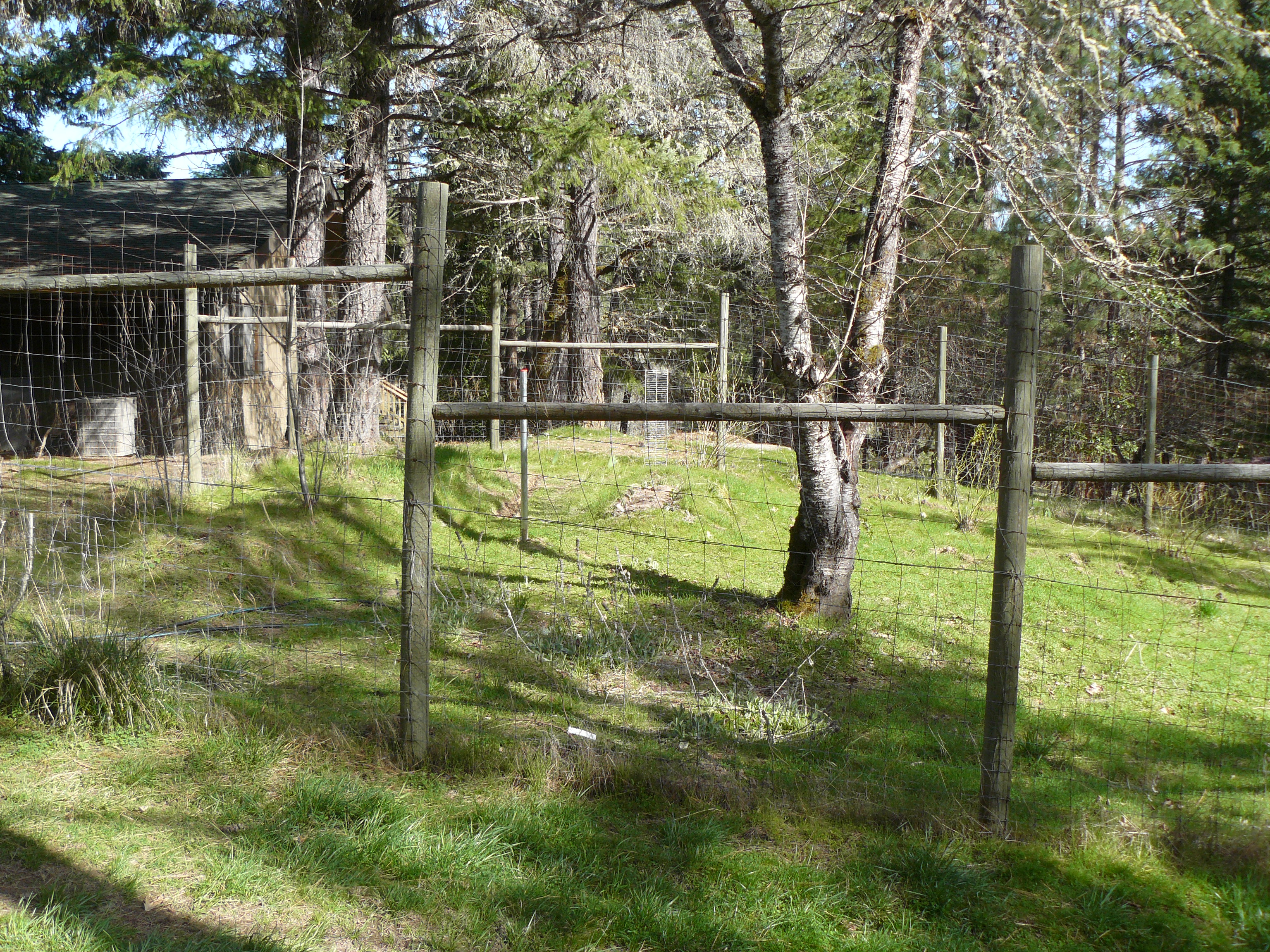
Jean and I were incredibly lucky when we bought this property last year to discover that it had a mature vegetable garden surrounded by a deer-proof fence, as the following photograph partially shows.

P1120667


So even before considering the food miles we are saving from ‘grow-your-own’, we were enthusiastically planting a whole variety of vegetables.  Here’s a rhubarb plant that went in last Saturday.

P1120665


Anyway, I’m rather meandering along – anyone still awake!

The whole point of this long introduction is to highlight a fabulous film that we have watched over the weekend.  Called Edible City: Grow The Revolution we came across it on Top Documentary Films, great source of films by the way if you don’t know it.

Luckily it is on YouTube as well.

Here’s the full film:

It’s an inspiring account of what it means for a community to take control of their food, ergo a strong recommendation to watch it in full.

If you want a taste of the film (pardon the pun!), here are two trailers.

and

plus much more information from the film’s website.

So why don’t you join the millions of people already buying from their local Farmers’ Market.  For the USA you can find your nearest market using this website and for the United Kingdom try the Local Foods website.

Not only will it give you access to much healthier food, it is a very practical way of reducing our use of energy.

In search of intelligent life!

One does have to wonder at times!

The title of today’s post comes from that silly anecdote as to why Planet Earth has never been visited by a species of intergalactic explorers from a far, distant world?

Answer: Because as they passed by and looked down upon our planet they saw no signs of intelligent life!

So what triggered all this?

Well last Wednesday, Christine over at 350 or bust published a review of the recently released film Greedy Lying Bastards.  Christine offered an insightful review of the film but more importantly went on to reveal a whole raft of issues that deserve to be widely promoted.  She has been generous in allowing me to republish her post on Learning from Dogs.

What has this to do with dogs?  On the face of it, very little.  But then again, everything.  Because if humans reverted to the standards of trust, loyalty and openness that we see every day in our dogs then we wouldn’t be in the mess that we are in!

oooOOOooo

Greedy Lying Bastards: Exposing The Fossil Fools Who Put Profit Before Human Lives

GreedyLyingBastards.com

*

One of the few-and-far-between perks of being a climate blogger is that occasionally I get access to books and movies before the general public does. This past weekend I got to watch “Greedy Lying Bastards” before it hit movie screens across the U.S. on Monday. Sunday night I, along with some fellow Citizens Climate Lobby volunteers, got together to watch this 90 minute documentary. This movie exposes the American fossil fuel interests that have been blocking action on climate change for decades, taking a page – and some of the same PR firms and lobbyists – right out of the tobacco companies’ playbook.  Like the tobacco lobby, these fossil fools have opposed government action on the science showing their product is harmful and have actively disseminated lies about the science.

After the movie, I surveyed group members for their responses; we all gave it 10 out of 10 for its topic, but for actual delivery the movie was rated between 6 to 8 out of 10.

Some of the comments were:

“I really appreciated the whistle-blowing, the naming of names. I also really appreciated first-hand accounts of people in the U.S. who are already suffering the consequences of climate change.”

“I haven’t watched a documentary about this topic before, and really appreciated the great graphics. They made the connections for me.”

Two viewers had recently watched “The Age of Stupid” and felt that it spelled out the greed and petro-corruption as well as the consequences of inaction on climate change more clearly than did GLB.

I enjoyed the movie. Of course as a climate hawk I’m thrilled that this corruption and interference in democracy is receiving more attention at this critical juncture in the planet’s history, and for that I want to give a big shout-out to writer and director Scott Rosebraugh and producer Darryl Hannah. Compared to “Age of Stupid” which totally overwhelmed and depressed me and my companion, GLB left me riled up and ready to fight back at these soulless corporate monsters. One critique I have is that the movie ended with a whimper. Rosebraugh offers – in 60 seconds – four actions for people to take in response to the information they’ve just heard (possibly for the first time). It’s not that the actions mentioned (boycotting Exxon & Koch products, asking your Congressional representatives to take action to curb greenhouse gases, “joining the campaign” to stop fossil fuel subsidies and campaigning to overturn Citizens United) aren’t important, they are but to spend 89 minutes of the movie focused on the fossil fools who are destroying U.S. democracy as well as our children’s future without giving viewers more information on taking action may well foster more futility and despair. And, frankly, just signing a petition or writing a letter to your congressperson isn’t going to cut it at this point. The movie doesn’t give enough specifics on responses; the shocking amount of fossil fuel subsidies companies are given every year ($4 Billion in the United States, $775 Billion globally) isn’t even mentioned even while people are encouraged to get active on this issue. To move people from outrage to action, more information and empowerment is necessary. For example, viewers should know that there are governments (Australia, and the Canadian province of British Columbia) who have enacted a tax on carbon pollution, one of the first actions that governments can take to counter the fossil fuel stranglehold on our democracies and our economies.There are groups like 350.org and Citizens Climate Lobby (to name the ones I’m most familiar with) who are working to mobilize people at the grassroots; these important resources are not mentioned in the movie or on the movie’s “take action” website. This silo mentality is one of the biggest stumbling blocks to climate action, so I would beg the fine people involved in GLB and its website to expand their resources and “take action” focus. For that reason I would give the movie a ranking of 7.5 out of 10. Having said that, get out and watch the movie if it’s showing in a theatre near you, and take some friends with you.

For my part as a Canadian, I’d like to add a few more GLBs to the rogues’ gallery compiled by Rosebraugh:

Tim Ball worked as a professor of geography at the University of Winnipeg for eight years between 1988 and 1996. I am personally offended by Mr. Ball because not only did he work at my alma mater, and employed a family member for several years as his research assistant, he has been quoted back to me by acquaintances of mine from rural Manitoba where he’s gone on paid lecturing junkets. I hear that he can be very persuasive, and he’s told these good people that climate change is nothing to worry about (“the climate has always changed”), and so they don’t worry, even while this inaction puts their children’s future at risk. He even lies about his credentials – in this 2007 movie that purports to debunk climate science, you can see he’s identified as being from a department that never existed, in the university that he left 11 years earlier. Now that’s what I call a GLB!

SwindleTimBall

And this Canadian GLB gallery wouldn’t be complete without a portrait of our current prime minister, Stephen Harper, son (spawn? LOL) of an Imperial Oil employee who went on to work for the oil company himself. Harper and his party’s ties to Big Oil are well-documented and are clearly playing themselves out in the current federal government’s policy decisions (see Murray Dobbin’s “Stephen Harper and the Big Oil Party of Canada, or DesmogBlog’s new series, Blame Canada).

406305_339945026024087_278550055496918_1365624_697749516_n

*

More links:

Dr. Jeff Masters’ WunderBlog: Greedy Lying Bastards: A Movie Review

Washington Post: Greedy Lying Bastards: Movie Review

GreedyLyingBastards.com

ExposeTheBastards.com: Take Action

Change is never easy ….

… but change is also the one constant in life.

For every one of us there is no escaping change.  It’s always been been that way; always will be.

Today, however, there’s an additional unsettling element.  I’m speaking of the growing realisation that humanity could be facing the perfect storm.  The ultimate storm of runaway climate change and the collapse of our global economy.

Therefore, when one comes across the wind of common-sense it needs to be promoted.  My reason for promoting the opening speech by Jennifer Granholm at the TED2013 conference.

Because if we are to find a way of avoiding this storm, we have to do it through innovative ways of thinking and behaving.  Each and every one of us deciding to work for a better future. (And see my P.S.)

P.S.

Back in the days of dogs living as coherent packs, one of the key roles of the alpha dog was to decide a change of territory.  Then she, because the alpha dog was always a female, would lead the pack to a better place.

So we should learn from our ancient furry friends and take personal responsibility to find a ‘better’ place for ourselves and all our loved ones.

This year of separation.

Ultimately, a message of hope.

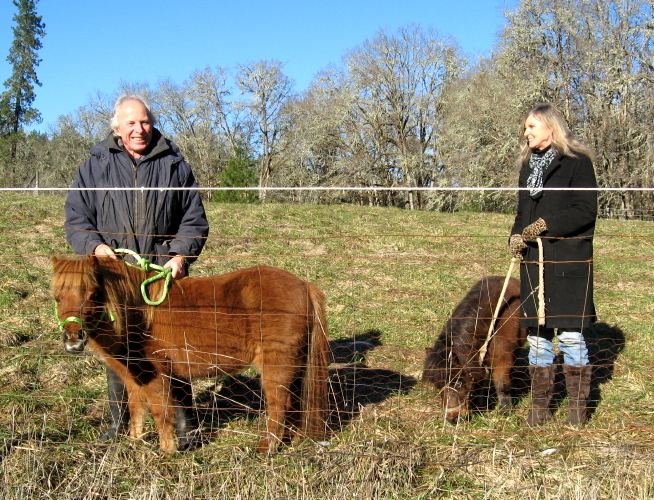
Today’s title came from a recent chat ‘across the garden fence’ with our neighbours, Dordie and Bill.  At their request we had walked our two horses over to the fence-line between our two properties so Dordie and Bill could meet and fondle them.  The warm afternoon sunshine was beautiful and while the horses munched the newly-found grass, we grown-ups talked about this and that and generally tried to put the world to rights!

Paul with Dancer; Jean with Grace.

We talked about the strangeness of present times.  Not just in the USA but across the world. Bill thought 2013 would be the year of separation.  I queried what he meant by that.

Bill replied, “I sense that by the end of the year, the vast majority of people will have decided if climate change is or is not a significant issue.”  There would be few who remained neither unconcerned nor undecided.

That resonated with me and neatly put the framework to today’s post.  Stay with me while I journey to the destination that this year will be the year of hope.

I am one of many who subscribe to the online magazine Grist.  They describe themselves, thus:

Laugh now — or the planet gets it.

You know how some people make lemonade out of lemons? At Grist, we’re making lemonade out of looming climate apocalypse.

It’s more fun than it sounds, trust us!

Grist has been dishing out environmental news and commentary with a wry twist since 1999 — which, to be frank, was way before most people cared about such things. Now that green is in every headline and on every store shelf (bamboo hair gel, anyone?), Grist is the one site you can count on to help you make sense of it all.

The weekly Grist digest that arrived in my in-box that same day as when we were chatting with Dordie and Bill included a number of key stories.

Here’s one that smacked me in the eye.

The 32 most alarming charts from the government’s climate change report

By Philip Bump

Just reading about the government’s massive new report outlining what climate change has in store for the U.S. is sobering. In brief: temperature spikes, drought, flooding, less snow, less permafrost. But if you really want to freak out, you should check out the graphs, charts, and maps.

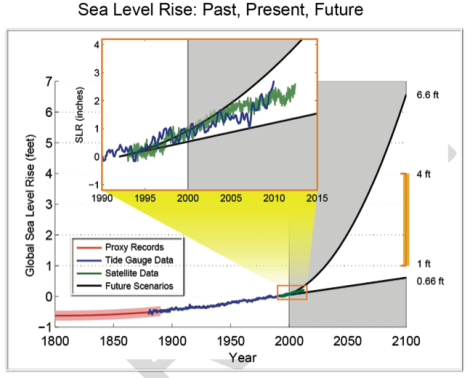
Now I’m not going to republish all 32 charts but will include just these two, because the message is clear.

It’s possible that sea levels could only rise eight inches. It is also possible that they could rise over six-and-a-half feet.

sea-level-range

—-

7-sea-rises

Sea-level rise will affect different areas to different degrees — but note the map at lower right. On the Georgia coast, “hundred year” floods could happen annually.

OK, that first chart takes a while to absorb the full implications. The second one doesn’t!

The full range of charts is chilling.  While they refer to the USA, the messages apply to the whole world.

Then in that same Grist weekly summary was this story.

If you aren’t alarmed about climate, you aren’t paying attention

By David Roberts

There was recently another one of those (numbingly familiar) internet tizzies wherein someone trolls environmentalists for being “alarmist” and environmentalists get mad and the troll says “why are you being so defensive?” and everybody clicks, clicks, clicks.

I have no desire to dance that dismal do-si-do again. But it is worth noting that I find the notion of “alarmism” in regard to climate change almost surreal. I barely know what to make of it. So in the name of getting our bearings, let’s review a few things we know.

We know we’ve raised global average temperatures around 0.8 degrees C so far. We know that 2 degrees C is where most scientists predict catastrophic and irreversible impacts. And we know that we are currently on a trajectory that will push temperatures up 4 degrees or more by the end of the century.

David then works his way through those ‘things we know’ in a powerful manner.  Do read the full article, please!  This is his conclusion:

All this will add up to “large-scale displacement of populations and have adverse consequences for human security and economic and trade systems.” Given the uncertainties and long-tail risks involved, “there is no certainty that adaptation to a 4°C world is possible.” There’s a small but non-trivial chance of advanced civilization breaking down entirely.

Now ponder the fact that some scenarios show us going up to 6degrees by the end of the century, a level of devastation we have not studied and barely know how to conceive. Ponder the fact that somewhere along the line, though we don’t know exactly where, enough self-reinforcing feedback loops will be running to make climate change unstoppable and irreversible for centuries to come. That would mean handing our grandchildren and their grandchildren not only a burned, chaotic, denuded world, but a world that is inexorably more inhospitable with every passing decade.

Take all that in, sit with it for a while, and then tell me what it could mean to be an “alarmist” in this context. What level of alarm is adequate?

So am I stark staring mad for having hope in my mind?  Stay with me for just a little longer.  Then form your own judgment.

Recall the post that I published on Tuesday hitting out at the British newspaper The Daily Mail.  Towards the end of that post, in discussing the recently released American National Climate Assessment, I wrote this:

That’s why this report is to be encouraged, nay embraced.  Of all the nations in the world, the one that should be setting the lead is the United States of America.  As the banner on that globalchange.gov website proclaims: Thirteen Agencies, One Vision: Empower the Nation with Global Change Science

So go and read the report.  For your sake and all our sakes.

Because the more informed you and I are, the better the chances of real political leadership taking place in this fine nation.

Now with that in mind let’s go to the final Grist article.

A new grand strategy for the U.S., built around sustainability

By David Roberts

Let’s just accept it: America’s current political and economic systems are incapable of responding adequately to climate change. As things stand, reducing carbon emissions — or more broadly, shifting to sustainability — is a kind of add-on, a second-tier consideration, bolted onto systems and institutions that were built for other purposes.

A little later, David writes:

So what would a new U.S. grand strategy built around sustainability look like? That’s the question tackled by “A New U.S. Grand Strategy,” a piece in Foreign Policy by Patrick Doherty, director of the Smart Strategy Initiative at the New America Foundation.

It’s a hugely ambitious and wide-ranging piece, far too much to even summarize adequately here. Bookmark it. Instapaper it. Pinterest it to your iCloud, or whatever kids do these days. But let’s take a quick look.

Doherty identifies four central challenges facing the U.S.:

  • Economic inclusion: People are swarming out of poverty around the world (especially in China). Over the next 20 years, the global middle class will welcome around 3 billion new members. That’s going to put intense stress on natural, economic, and political systems that are already showing signs of strain.
  • Ecosystem depletion: Pretty sure Grist readers are familiar with this one.
  • Contained depression: Rather than a recession, the U.S. faces a “constrained depression,” with the full effects of low aggregate demand and high debt being masked by policy. No amount of fiscal or economic stimulus will revive a system that has exhausted itself.
  • Resilience deficit: Our industrial supply lines and value chains are efficient, but lack redundancy; they are brittle. Our infrastructure is old and crumbling, $2.2 trillion in the hole, and that’s just for the aging Cold War stuff, never mind building water, power, and transportation systems suited to an era of climate disruption.

“These four challenges,” Doherty says, “are the four horsemen of the coming decades.” And they are inter-dependent. They must be solved together. It’s a rough situation.

With these in mind, Doherty proposes a new grand strategic concept: “The United States must lead the global transition to sustainability.

What a vision for the United States of America.  That this Nation will be the most wonderful example of how man can learn, adapt and change.  David Roberts concludes:

Here are Doherty’s main suggestions for how to realign the U.S. economic engine:

  • Walkable communities: More and more Americans want to live in dense, walkable areas; get rid of regulations that hamper them and start building them.
  • Regenerative agriculture: Farmers can produce “up to three times the profits per acre and 30 percent higher yields during drought” with agricultural techniques that also clean water and restore soils. America must “adopt modern methods that will bring more land into cultivation, keep families on the land, and build regional food systems that keep more money circulating in local economies.”
  • Resource productivity: “Energy and resource intensity per person will have to drop dramatically.” That imperative can drive “innovation in material sciences, engineering, advanced manufacturing, and energy production, distribution, and consumption.”
  • Excess liquidity: Channel all the corporate cash that’s sitting around in funds into long-term investments in America by taxing waste and creating regional growth strategies.
  • Stranded hydrocarbon assets: Figure out how to devalue the immense amount of carbon that’s still sitting underneath the ground without unduly traumatizing the economy.

Obviously the devil is in the details on this stuff, but at a broad level, this is about as eloquent and forward-thinking as it gets. I love the idea of using sustainability in a muscular way, to revive regional economies and nurture the middle class. I recommend reading the whole thing.

I, too, recommend reading “A New U.S. Grand Strategy – Why walkable communities, sustainable economics, and multilateral diplomacy are the future of American power.” (NB: You will have to register with Foreign Policy before access to the report is possible, but it’s free.)

So, the wall-to-wall stream of information that is shouting out how quickly the planet is changing is the fuel that is going to feed the fires of hope.

Let me leave you with the most beautiful words of an ancient philosopher – Aristotle.

Hope is a waking dream.

The unacceptable face of The Daily Mail

The shocking distortions made by The Daily Mail newspaper.

On the 9th January, 2013 The Daily Mail published this item:

The crazy climate change obsession that’s made the Met Office a menace

  • The £200 million-a-year official weather forecaster often gets it wrong
  • This week it has admitted there is no evidence that ‘global warming’ is happening
  • The Met Office quietly readjusted its temperature projections on its website on Christmas Eve

By JAMES DELINGPOLE

PUBLISHED: 19:45 EST, 9 January 2013 | UPDATED: 02:56 EST, 10 January 2013

Was there ever a government quango quite so useless as the Met Office?

From its infamous ‘barbecue summer’ washout of 2009 to the snowbound winter it failed to predict in 2010 and the recent forecast-defying floods, our £200 million-a-year official weather forecaster has become a national joke.

But of all its recent embarrassments, none come close to matching the Met Office’s latest one.

Without fanfare — apparently in the desperate hope no one would notice — it has finally conceded what other scientists have known for ages: there is no evidence that ‘global warming’ is happening.

If you want to read the full article, it’s here.

Needless to say the UK Met Office published a detailed rebuttal.  One of the comments that I spotted following that rebuttal was this lovely one from MD Dalgleish:

The Daily Mail does not let the facts get in the way of a story! Nothing new there, they’ve been doing that since before the war. What baffles me is why so many people buy this paper.

Quite so!

It would all be a bit of a laugh if it were not for what follows.

Last Friday, Naked Capitalism, the fabulous blog run by Yves Smith published in her set of links this item, “Climate change set to make America hotter, drier and more disaster-prone.”  Newly living here in Southern Oregon, that obviously caught my eye!

The item referred to a detailed account in the British Guardian newspaper by Suzanne Goldenberg, the newspaper’s US Environment Correspondent.

Climate change set to make America hotter, drier and more disaster-prone

Draft report from NCA makes clear link between climate change and extreme weather as groups urge Obama to take action

The report says steps taken by Obama to reduce emissions are 'not close to sufficient' to prevent the most severe consequences of climate change. Photo: Saul Loeb/AFP
The report says steps taken by Obama to reduce emissions are ‘not close to sufficient’ to prevent the most severe consequences of climate change. Photo: Saul Loeb/AFP

Future generations of Americans can expect to spend 25 days a year sweltering in temperatures above 100F (38C), with climate change on course to turn the country into a hotter, drier, and more disaster-prone place.

The National Climate Assessment, released in draft form on Friday , provided the fullest picture to date of the real-time effects of climate change on US life, and the most likely consequences for the future.

The 1,000-page report, the work of the more than 300 government scientists and outside experts, was unequivocal on the human causes of climate change, and on the links between climate change and extreme weather.

“Climate change is already affecting the American people,” the draft report said. “Certain types of weather events have become more frequent and/or intense including heat waves, heavy downpours and in some regions floods and drought. Sea level is rising, oceans are becoming more acidic, and glaciers and Arctic sea ice are melting.”

Here’s a pithy question for Mr. James Delingpole of The Daily Mail, “Which part of this sentence are you having trouble with – The 1,000-page report, the work of the more than 300 government scientists and outside experts, was unequivocal on the human causes of climate change, and on the links between climate change and extreme weather.?” [my emphasis]

Suzanne goes on to say:

The report will be open for public comment on Monday.

Environmental groups said they hoped the report would provide Barack Obama with the scientific evidence to push for measures that would slow or halt the rate of climate change – sparing the country some of the worst effects.

The report states clearly that the steps taken by Obama so far to reduce emissions are “not close to sufficient” to prevent the most severe consequences of climate change.

“As climate change and its impacts are becoming more prevalent, Americans face choices,” the report said. “Beyond the next few decades, the amount of climate change will still largely be determined by the choices society makes about emissions. Lower emissions mean less future warming and less severe impacts. Higher emissions would mean more warming and more severe impacts.”

As the report made clear: no place in America had gone untouched by climate change. Nowhere would be entirely immune from the effects of future climate change.

One might argue that it won’t be very long before no sane person on this planet would swallow that crap from The Daily Mail.  But when we get to that stage of every person being aware of the forces at work upon our fair planet it will be a tad too late.

The only home we have.

That’s why this report is to be encouraged, nay embraced.  Of all the nations in the world, the one that should be setting the lead is the United States of America.  As the banner on that globalchange.gov website proclaims: Thirteen Agencies, One Vision: Empower the Nation with Global Change Science

So go and read the report.  For your sake and all our sakes.

Because the more informed you and I are, the better the chances of real political leadership taking place in this fine nation.

Download Chapters of the NCADAC DraftClimate Assessment Report!   
Download the Full Report (warning, 147Mb. Very large file)Between chapters, there are some page numbers that are not used. This is intentional and does not reflect missing pages.or download each chapter separately:

Cover page

Introduction: Letter to the American People

1. Executive Summary

2. Our Changing Climate

Introduction to Sectors

3. Water Resources

4. Energy Supply and Use

5. Transportation

6. Agriculture

7. Forestry

8. Ecosystems, Biodiversity, and Ecosystem Services

9. Human Health

10. Water, Energy, and Land Use

11. Urban Systems, Infrastructure, and Vulnerability

12. Impacts of Climate Change on Tribal, Indigenous, and Native Lands and Resources

13. Land Use and Land Cover Change

14. Rural Communities

15. Interactions of Climate Change and Biogeochemical Cycles

Introduction to Regions

16. Northeast

17. Southeast and Caribbean

18. Midwest

19. Great Plains

20. Southwest

21. Northwest

22. Alaska and the Arctic

23. Hawaii and the U.S. Affiliated Pacific Islands

24. Oceans and Marine Resources

25. Coastal Zone Development and Ecosystems

Introduction to Response Strategies

26. Decision Support: Supporting Policy, Planning, and Resource Management Decisions in a Climate Change Context

27. Mitigation

28. Adaptation

29. Research Agenda for Climate Change Science

30. The NCA Long-Term Process: Vision and Future Development

Appendix I: NCA Climate Science – Addressing Commonly Asked Questions from A to Z

Appendix II: The Science of Climate Change

Will the New Year be a profound ‘wake-up’ call?

2013 may be the year that ends any uncertainty about what we are doing to our planet.

Introduction

Regular readers of Learning from Dogs will be familiar with the occasional posts that are presented here, courtesy of Tom Engelhardt of Tom Dispatch.  I am so grateful to Tom’s blanket permission to republish essays from a Tom Dispatch author.  So it is that today sees the republishing of a recent essay on Tom Dispatch by Rebecca Solnit.  It articulates beautifully what 2013 might represent.  So without further ado, here’s Rebecca’s essay prefaced by Tom’s introduction.

oooOOOooo

Tomgram: Rebecca Solnit, 2013 as Year Zero for Us — and Our Planet

[Note for TomDispatch Readers:  It’s that time again.  Another year-ending moment for this website, which began as a no-name listserv in October 2001 and went online as TomDispatch in December 2002, thanks to Ham Fish of the Nation Institute.  It’s been plugging away ever since as a “regular antidote to the mainstream media,” doing its best to connect the unconnected dots in our world.  (Click here to check out a little piece I wrote for the Moyers & Company website this week about what I call “isolation journalism” in the mainstream media where connections are seldom made.) 

With today’s post, we’re closing down for 2012, but expect us back on January 3rd renewed and ready for a new year full of surprises.  In the meantime, profuse thanks are due to the stalwart crew who keep TD going: Managing Editor Nick Turse, who will continue to follow the U.S. military as it garrisons the planet in 2013 and will have a remarkable new book on the Vietnam War published as well; Associate Editor Andy Kroll, who will again be on the economic beat for us; Dimitri Siavelis and Joe Duax, who keep the site miraculously shipshape and ready to roll; Christopher Holmes, proofer-extraordinaire who holds error eternally at bay (or at least to a surprising minimum) in our dispatches; and Erika Eichelberger, our maestro of social media, who has brought TD Facebook page and Twitter feed alive this year.  (Check us out there if you haven’t yet!)  Special thanks are due as well to Andy Breslau, Taya Kitman, and the rest of the staff of the Nation Institute, who continue to stick with us through thick and thin, and finally to Lannan Foundation, which may be last in this list but is certainly first in what it’s done for TomDispatch.  Surrounded by such a crowd, life couldn’t be better. 

Finally, of course, my deepest thanks to TomDispatch readers all over this country and around the world, whose readership and support make all the difference. Your emails to this site offer tips, catch errors, offer criticism, and reveal unknown worlds to me.  They are always read (even when, hard as I try, I’m too busy to answer).  What more could I ask? Have a good holiday. See you all in 2013! Tom]

In weather terms, 2012 in New York City began for me with crocuses.  On an early February day in a week in which the temperature hit 60 degrees, I spotted their green shoots pushing up through the bare ground of a local park on a morning walk — just as if it were spring.  The year was ending last weekend as I wandered with a friend past a communal garden in the same park and noticed that, in a December week in which the temperatures were in the mid-50s, the last few roses were still in bloom.

In between, in that park on a dark night in late October I watched a white-capped Hudson River roiling like some enraged beast, preparing for a storm surge that would flood lower Manhattan, plunging it into darkness and so turning it into “little North Korea,” briefly making true islanders out of New Yorkers and flooding out whole communities.  That, of course, was Hurricane Sandy, the Frankenstorm surprise of New York’s year (though anything but a worst case scenario).  And then, there was the American 2012 in which heat eternally set records and we experienced something close to an “endless summer.”

If climate change had a personality in this year of so many grim records — wildfiresdroughtheatcarbon dioxide emissions — it would definitely be saying: “I’m not the thing your grandchildren will have to deal with, I’m yours!”

In such a new world of upheaval, tradition matters.  And there is one inviolable tradition at TomDispatch: Rebecca Solnit has the last word — as she has for years, peering into the future, sizing up the past, weighing alternatives to what is, and last year considering a season of being Occupied.  Now, for the first time in a long while, weather and climate change are a growing American preoccupation.  Of course, climate change is an area long occupied by the giant energy companies whose compassion extends no further than their bottom lines (which, like the heat, continue to set historical records).  Solnit in her year-ending, TomDispatch-closing piece suggests that it’s time for us to occupy the topic ourselves, and do our best to ensure that this planet, 2013 and beyond, remains a habitable place for us, our children, and our grandchildren.  There could be no more powerful New Year’s wish. Tom

The Sky’s the Limit 
The Demanding Gifts of 2012
By Rebecca Solnit

As this wild year comes to an end, we return to the season of gifts. Here’s the gift you’re not going to get soon: any conventional version of Paradise. You know, the place where nothing much happens and nothing is demanded of you. The gifts you’ve already been given in 2012 include a struggle over the fate of the Earth. This is probably not exactly what you asked for, and I wish it were otherwise — but to do good work, to be necessary, to have something to give: these are the true gifts. And at least there’s still a struggle ahead of us, not just doom and despair.

Think of 2013 as the Year Zero in the battle over climate change, one in which we are going to have to win big, or lose bigger.  This is a terrible thing to say, but not as terrible as the reality that you can see in footage of glaciers vanishing, images of the entire surface of the Greenland Ice Shield melting this summer, maps of Europe’s future in which just being in southern Europe when the heat hits will be catastrophic, let alone in more equatorial realms.

For millions of years, this world has been a great gift to nearly everything living on it, a planet whose atmosphere, temperature, air, water, seasons, and weather were precisely calibrated to allow us — the big us, including forests and oceans, species large and small — to flourish. (Or rather, it was we who were calibrated to its generous, even bounteous, terms.) And that gift is now being destroyed for the benefit of a few members of a single species.

The Earth we evolved to inhabit is turning into something more turbulent and unreliable at a pace too fast for most living things to adapt to. This means we are losing crucial aspects of our most irreplaceable, sublime gift, and some of us are suffering the loss now — from sea snails whose shells are dissolving in acidified oceans to Hurricane Sandy survivors facing black mold and bad bureaucracy to horses starving nationwide because a devastating drought has pushed the cost of hay so high to Bolivian farmers failing because the glaciers that watered their valleys have largely melted.

This is not just an issue for environmentalists who love rare species and remote places: if you care about childrenhealthpovertyfarmersfoodhunger, or the economy, you really have no choice but to care about climate change.

The reasons for acting may be somber, but the fight is a gift and an honor. What it will give you in return is meaning, purpose, hope, your best self, some really good company, and the satisfaction of being part of victories also to come.  But what victory means needs to be imagined on a whole new scale as the news worsens.

Unwrapping the Victories

“Unhappy is the land that needs a hero,” Galileo famously says in Bertold Brecht’s play about that renegade scientist, but at least, the hero has the possibility of doing something about that unhappiness, as, for instance, the Sierra Club has. It’s led the fight against big coal, helping prevent 168 coal-powered plants from opening and retiring 125 dirty coal plants.  The aim of its Beyond Coal campaign is to retire all 522 such plants in the United States, which would be a colossal triumph.

Its’ victories also capture what a lot of our greenest gifts look like: nothing. The regions that weren’t fracked, the coal plants that didn’t open, the mountaintops that weren’t blasted by mining corporations, the children who didn’t get asthma or mercury poisoning from coal emissions, the carbon that stayed in the Earth and never made it into the atmosphere.  The Keystone XL tar sands pipeline bringing the dirtiest of dirty energy from Canada to the Gulf Coast might have already opened without the activists who ringed the White House and committed themselves across the continent.

In eastern Texas, for instance, extraordinary acts of civil disobedience have been going on continuously since August, including three blockaders who this month crawled inside a length of the three-foot-in-diameter pipeline and refused to leave. People have been using their bodies, getting in the way of heavy equipment, and going to jail in an effort to prevent the pipeline from being built. A lot of them are the same kind of robust young people who kept the Occupy encampments going earlier in 2012, but great-grandmothers, old men, and middle-aged people like me have been crucial players, too.

Meanwhile in British Columbia, where pipeline profiteers were looking into alternate routes to transport their climate-destroying products abroad, members of the Wet’suwet’en nation evicted surveyors and politely declared war on them. In Ohio and New York, the fight against fracking is going strong. Across the Atlantic, France has banned fracking, while Germany has made astounding progress toward using carbon-neutral energy sources. If solar works there, we have no excuse. And as Ellen Cantarow wrote at TomDispatch of the anti-fracking movement in New York State, “Caroline, a small hamlet in Tompkins County (population 3,282), is the second town in the state to get 100% of its electricity through wind power and one of the most recent to pass a fracking ban.”

Everywhere people are at work to build a better world in which we — and some of the beauty of this world — will be guaranteed to survive. Everywhere they are at war with the forces threatening us and the planet. I usually avoid war metaphors, but this time it’s barely a metaphor. Our side isn’t violent, but it is engaged in a battle, and people are putting their bodies on the line and their lives behind the cause. The other side is intent on maximizing its profit at the cost of nearly everything.

My father, a high-school student during the Second World War, followed the campaigns closely with pins on a wall map to represent troops and battles. You could map North America that way now and see, when you added up the struggles against drilling in the Arctic, fracking, mountaintop removal, and the various other depredations of big coal and big oil, that remarkable things are already being done. In this war, resistance has been going on for a long time, so overlooked by the mainstream media it might as well be as underground as the French Resistance back then.

A lot of it is on a small scale, but if you connect the pieces you get a big picture of the possible, the hopeful, and the powerful. Think of each of those small acts of defending the Earth as a gift to you. And think of your own power, a gift always latent within you that demands you give back.

If you’re reading this, you’re already in the conversation. No matter who you are, or where, there is something for you to do: educate yourself and others, write letters, organize or join local groups, participate in blockades and demonstrations, work on divestment from oil corporations (if you’re connected to a university), and make this issue central to the conversations and politics of our time.

I’ve started working directly on various projects with 350.org, whose global impact and reinvention of activist tactics I’ve long admired.  Its creator Bill McKibben has evolved from a merely great writer to a pivotal climate organizer and a gift to all of us.

The world you live in is not a given; much of what is best in it has been built through the struggles of passionate activists over the last centuries.  They won us many freedoms and protected many beauties. Count those gifts among your growing heap.

Drawing the Line

Here’s another gift you’ve already received: the lines in the battle to come are being ever more clearly drawn. Clarity is a huge asset. It helps when you know where you stand, who stands with you — and who against you.

We have returned to class war in conflicts around the world — including the Chicago Teacher’s Strike of 2012 and the Walmart protests in this country (which led to 1,197 actions nationwide in support of that company’s underpaid workers on Black Friday), as well as the great student uprisings in Quebec and Mexico City.

There has, of course, been a war against working people and the poor for decades, only we didn’t call it “class war” when just the rich were fighting hard. We called it corporate globalization, the race to the bottom, tax cuts and social-service cuts, privatization, neoliberalism, and a hundred other things.  Now that the poor are fighting back, we can call it by its old name. Perhaps what the conservatives have forgotten is that if you return us to the grim divides and dire poverty of the nineteenth century, you might also be returning us to the revolutionary spirit of that century.

This time, though, it’s not only about work and money.  The twenty-first century class war is engulfing the natural world on which everything rests. We can see how clearly the great environmental battle of our time is about money, about who benefits from climate destruction (the very few) and who loses (everyone else for all time to come and nearly every living thing). This year, Hurricane Sandy and a crop-destroying, Mississippi-River-withering drought that had more than 60% of the nation in its grip made it clear that climate change is here and it’s now and it hurts.

In 2012, many have come to see that climate change is an economic issue, and that economics is a moral and ecological issue.  Why so little has been done about the state of the climate in the past three decades has everything to do with who profits. Not long ago, too many Americans were on the fence, swayed by the oil company propaganda war about whether climate change even exists.

However, this month, according to the Associated Press, “Four out of every five Americans said climate change will be a serious problem for the United States if nothing is done about it.” That widespread belief suggests that potentially broad support now exists and may be growing for a movement that makes climate change — the broiling of the Earth — central, urgent, and everybody’s business.

Ten years ago too, many people thought the issue could be addressed, if at all, through renunciatory personal virtue in private life: buying Priuses, compact fluorescents, and the like. Now most people who care at all know that the necessary changes won’t happen through consumer choice alone.  What’s required are pitched battles against the most powerful (and profitable) entities on Earth, the oil and energy companies and the politicians who serve them instead of us.

That clarity matters and those conflicts are already underway but need to grow.  That’s our world right now, clear as a cold winter day, sharp as broken glass.

Putting Aside Paradise

When I remember the world I grew up in, I see the parts of it that were Paradise — and I also see all the little hells. I was a kid in California when it had the best public education system in the world and universities were nearly free and the economy was not so hard on people and the rich paid a lot of taxes. The weather was predictable and we weren’t thinking about it changing any time before the next ice age.

That was, however, the same California where domestic violence was not something the law took an interest in, where gays and lesbians were openly discriminated against, where almost all elected officials were white men, where people hadn’t even learned to ask questions about exclusion and racism.

Which is to say, paradises are always partial and, when you look backward, it’s worth trying to see the whole picture. The rights gained over the past 35 years were fought for, hard, while so much of what was neglected — including public education, tuition, wages, banking regulation, corporate power, and working hours — slid into hell.

When you fight, you sometimes win; when you don’t, you always lose.

Here’s another gift we have right now: the young. There are quite a lot of heroes among them, including the Dreamers or Dream Act activists standing up for immigrants; the occupiers who challenged Wall Street in its home and elsewhere around the country, became the unofficial first responders who aided the victims of Hurricane Sandy, and have camped out on the doorstep of Goldman Sachs’s CEO these last few months; the young who blockaded that tar-sands pipeline, supplied the tremendous vitality of 350.org globally, and have just begun to organize to pressure universities to divest from fossil fuel companies on 192 campuses across the country.

In 2012, they rose up from Egypt and Russia to Canada and Chile. They are fighting for themselves and their future, but for us, too. They have remarkably few delusions about how little our world is prepared to offer most of them. They know that the only gifts they’ll get are the ones they can wrestle free from the powers that be.

Paradise is overrated. We dream of the cessation of misery, but who really wants a world without difficulty? We learn through mistakes and suffering. These are the minerals that harden our bones and the milestones on the roads we travel. And we are made to travel, not to sit still.

Take pleasure in the route. There is terrible suffering of many kinds in many places, but solidarity consists of doing something about it, not being miserable. In this heroic age, survival is also going to require seeing what fragments of paradise are still around us, what still blooms, what’s still unimaginably beautiful about rivers, oceans, and evening skies, what exhilaration there is in witnessing the stubbornness of small children and their discovery of a world we think we know. All these are gifts as well.

Ice Breaking Up

As you gear up for 2013, don’t forget that 2012 has been an extraordinary year. Who ever thought we’d see Aung San Suu Kyi elected to office in her native Burma and free to travel after so many years of house arrest? Who expected that the United Nations would suddenly vote to give Palestine observer state status? Who foresaw that the silly misinterpretations of Mayan prophesy would be overtaken by the Mayan Zapatistas, who rose once again last Friday? (Meanwhile, Canada’s Native people started a dynamic movement around indigenous rights and the environment that has led to everything from flash-mob dances in an Edmonton Mall to demonstrations in Ottawa.)

Who thought that Occupy Wall Street, roundly dismissed by the mainstream on its one-year anniversary, would spawn two superhero projects, Occupy Sandy and Strike Debt? (Who among the police officers clubbing and tear-gassing the young Occupiers in 2011 thought that a year later these would be the people with the power and the generosity to come to their aid when a climate-fed storm wrecked their homes?) Keep it in mind: the future is not predictable.  Sometimes, the world changes suddenly and in profound ways. Sometimes we make it do so.

Steven Spielberg’s new film Lincoln is a reminder about what it means to fight for what matters most. Permanently freeing five million slaves and abolishing slavery forever meant renouncing a cheap power source in use for more than 200 years. Doing so was initially inconceivable and then a matter of indifference except to the slaves themselves and small groups of abolitionists.  Next, it was daringly radical, then partisan, with the whole nation taking sides, the fuel for a terrible war.  Finally, it was the law of the land. Today, we need to give up on, or at least radically reduce our reliance on, another set of power sources: oil, coal, and natural gas.

This is, among other things, a war of the imagination: the carbon profiteers and their politicians are hoping you don’t connect the dots, or imagine the various futures we could make or they could destroy, or grasp the remarkably beautiful and complex ways the natural world has worked to our benefit and is now being sabotaged, or discover your conscience and voice, or ever picture how different it could all be, how different it will need to be.

They are already at war against the wellbeing of our Earth. Their greed has no limits, their imagination nothing but limits. Fight back. You have the power. It’s one of your gifts.

Rebecca Solnit has seen salmon migrate and polar bears nap, and she’s seen blockaders defend foreclosed homes and shut down oil refineries: all of it was beautiful. She is the author of A Paradise Built in Hell, among many other works. She has been writing TomDispatch’s year-end essays since 2004 and she hopes to see you in the streets in 2013 and at the White House on February 17th.

Follow TomDispatch on Twitter @TomDispatch and join us on Facebook.  Check out the newest Dispatch book, Nick Turse’s The Changing Face of Empire: Special Ops, Drones, Proxy Fighters, Secret Bases, and Cyberwarfare.

Copyright 2012 Rebecca Solnit

oooOOOooo

A fascinating look at the coming New Year.  What interesting times we live in.

Lighting the future

A really clever and innovative idea – the gravity light.

Saw this item on the Australian Permaculture Research website on the 18th.

Lighting in much of the ‘developing’ world is provided via expensive and polluting kerosene. Kerosene lamps are dangerous, require constant replenishment, and come with significant negative health impacts.

So, for the potential benefit of millions of people, London based designers, Martin Riddiford and Jim Reeves, have spent four years working on an inexpensive, safe and health-neutral alternative — a gravity powered LED light! It’s clever, and well intentioned. Nice!

Martin and Jim initially looked at creating a light that would be powered by solar, as would most of us. But the idea of utilising gravity took hold of them — where the end user can do away with the need for expensive solar panels and batteries, which use a lot of resources in their manufacture — and the gravity light was born. The gravity light will work whether it’s day or night, sunny or cloudy.

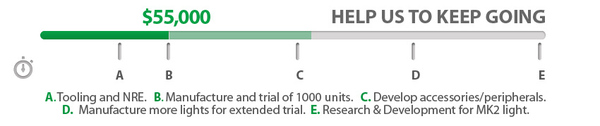
At time of writing, Martin and Jim’s Indiegogo campaign to raise funds has already surpassed its basic goal of $55,000, but if you wish to donate it’ll help them further their goal of refining the design to make it even more useful, efficient and inexpensive.

Then it was only a moment to track down the project on a website called Indiegogo, from which one reads,

20121214100413-fill_bar2

GravityLight is a revolutionary new approach to storing energy and creating illumination. It takes only 3 seconds to lift the weight which powers GravityLight, creating 30 minutes of light on its descent. For free.

Following the initial inspiration of using gravity, and years of perspiration, we have refined the design and it is now ready for production. We need your help to fund the tooling, manufacture and distribution of at least 1000 gravity powered lights. We will gift them to villagers in both Africa and India to use regularly. The follow-up research will tell us how well the lights met their needs, and enable us to refine the design for a more efficient MK2 version. Once we have proved the design, we will be looking to link with NGOs and partners to distribute it as widely as possible. When mass produced the target cost for this light is less than $5.

Why GravityLight?

Did you know that there are currently over 1.5 billion people in the World who have no reliable access to mains electricity? These people rely, instead, on biomass fuels (mostly kerosene) for lighting once the sun goes down.

Go here and read the information in full and admire the photographs.  But I will include this from the end of the item.

Credentials

We are Martin Riddiford and Jim Reeves, London based designers who have spent 4 years developing GravityLight as an off-line project. We work for therefore.com, which has over 20 years of experience in designing and developing hand held computing and communication products for a host of pioneers including Psion, Toshiba, NEC, TomTom, Inmarsat, ICO, Sepura, Racal Acoustics, Voller Energy, FreePlay and SolarAid.

We’re using a tried and tested manufacturer who has the right expertise to make GravityLight. We have some links to partner organisations in Africa and need to do the same for India. If you’re part of an organisation and would like to get involved then please contact us. We are particularly looking for contacts in South America.

Visit our skunk-works website here www.deciwatt.org.

Our movie soundtrack kindly created by Belinda from the bush the tree and me.

Check out John Keane’s great Solar For Africa blog.

I am sure all who read this will wish Martin and Jim the very best of luck.


Forty ways of using the can.

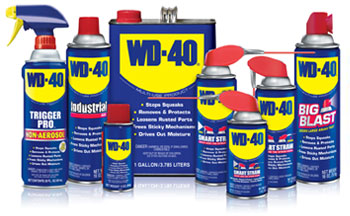
Ah, maybe that’s why it’s called WD40!

Grateful to Neil Kelly back in Devon, SW England, for sending me this list of 40 things you can do with WD40.

wd40

1. Protects silver from tarnishing

2. Removes road tar and grime from cars

3. Cleans and lubricates guitar strings

4. Gives floors that ‘just-waxed’ sheen without making them Slippery

5. Keeps flies off cows

6. Restores and cleans chalkboards

7. Removes lipstick stains

8. Loosens stubborn zippers

9. Untangles jewellery chains

10. Removes stains from stainless steel sinks

11. Removes dirt and grime from the barbecue grill

12. Keeps ceramic/terra-cotta garden pots from oxidizing

13. Removes tomato stains from clothing

14. Keeps glass (and plastic)shower doors free of water spots

15. Camouflages scratches in ceramic and marble floors

16. Keeps scissors working smoothly

17. Lubricates noisy door hinges on vehicles and doors in homes

18. It removes black scuff marks from the kitchen floor! Use WD-40 for
Those nasty tar and scuff marks on flooring. It doesn’t seem to harm the
Finish and you won’t have to scrub nearly as hard to get them off. Just
Remember to open some windows if you have a lot of marks

19. Bug guts will eat away the finish on your car if not removed quickly!
Use WD-40!

20. Gives a children’s playground slide a shine for a super fast slide

21.Lubricates gear shift and mower deck lever for ease of handling on
Riding mowers

22. Rids kids rocking chairs and swings of squeaky noises

23. Lubricates tracks in sticking home windows and makes them easier to open

24. Spraying an umbrella stem makes it easier to open and close

25. Restores and cleans padded leather dashboards in vehicles, as well as
Vinyl bumpers

26. Restores and cleans roof racks on vehicles

27. Lubricates and stops squeaks in electric fans

28. Lubricates wheel sprockets on tricycles, wagons, and bicycles for easy
Handling

29. Lubricates fan belts on washers and dryers and keeps them running
Smoothly

30. Keeps rust from forming on saws and saw blades, and other tools

31. Removes splattered grease on stove

32. Keeps bathroom mirror from fogging

33. Lubricates prosthetic limbs

34. Keeps pigeons off the balcony (they hate the smell)

35. WD-40 attracts fish. Spray a little on live bait or lures and you
Will be catching the big one in no time. Also, it’s a lot cheaper than
The chemical attractants that are made for just that purpose. Keep in
Mind though, using some chemical laced baits or lures for fishing are not
Allowed in some states

36. Removes all traces of duct tape

37. Folks even spray it on their arms, hands, and knees to relieve
Arthritis pain

38. Florida ‘s favorite use is: ‘cleans and removes love bugs from grills
And bumpers

39. The favorite use in the state of New York , WD-40 protects the Statue
of Liberty from the elements

40. Use it for fire ant bites. It takes the sting away immediately and
stops the itch

There you are.  You always wanted to know that, didn’t you!