Category: Business

Closing my Windows.

A big move on in my computing. 

Warning! Today’s post has almost nothing to do with dogs plus if you are not into computing then you may want to come back tomorrow! 😉

A little over a week ago I ordered an Apple Mac computer.

So what, I hear you say.

Well one way or another, I have been associated with personal computing for too many years and with the Microsoft Windows operating system equally for a long time.

Here’s that history and, be warned, I do go on a tad!

In 1970 I joined the Office Products (OP) Division of IBM in the United Kingdom.  I joined as an office products salesman and after my initial training was based at IBM OP’s London North branch in Whetstone in the London Borough of Barnet.  I loved both the job (remember the Selectric ‘Golfball’ typewriter?) and the company and conspired to win the prize of top UK salesman for the year 1977.  By that time, IBM was selling dedicated word-processing (WP) machines.  They offered powerful benefits for companies of many sizes and, as an experienced WP salesman, I was enjoying the fruits of that success.  Thus it was that in 1978 I attended IBM’s Golden Circle celebrations for 1977 country winners from all around the world.  The Golden Circle celebrations were held in Hawaii!

I returned from Hawaii with the clear idea in my mind that this was the time to move on; my ego didn’t like the idea of not being number one again!  So within a couple of days of returning to my sales branch, I announced to my manager, David Halley, that I wished to give three months notice.  I can still recall David’s rather shocked response with him saying, “But I always thought Golden Circle was an incentive event!

In those days New Scientist magazine was a regular read for me.  During my time of working out my notice I read in the magazine about this new personal computer from Commodore Business Machines that had been launched in the UK.  It was called the Commodore PET (Personal Electronic Transactor) and had been unveiled in 1977 at the US West Coast Computer Faire.  I was captivated by what I had read.

pet2001-black

I had casually mentioned it to Richard Maugham; a good friend and fellow office-products salesman working for Olivetti UK.  Richard said that coincidentally a close friend of many years had just been appointed sales manager for CBM UK Ltd.  That friend was Keith Hall and on making contact with Keith, I was invited to go and meet him and learn more about this funny device.  What I hadn’t bargained for was that Keith was yet another smart salesman; Keith and Richard had met when they were both salesmen working for Olivetti.

When I asked Keith the retail price of the ‘PET”, his immediate reply was, “Well why don’t you become a dealer and I can sell you one for 30% less!”  Like most salesmen, I was always a sucker to a good sales pitch! I signed the necessary paperwork. (It is very sad to say that Keith died a few years ago, at far too young an age.)

So it was that towards the end of 1978, I became the sixth Commodore computer dealer in the UK, opening my small store in what had once been a Barber’s shop in Church Street, off Head Street in the centre of Colchester, Essex.  I called my business Dataview Limited.

Frankly, I hadn’t a clue as to what I was doing!  If it hadn’t been for a gigantic stroke of luck I would not have lasted long!

That piece of luck was meeting someone who was a programmer for a large, traditional computing company, ICL, who had bought himself a Commodore PET and, just out of fun, was writing a word-processing program. Now if I didn’t know about computers, personal or otherwise, I certainly knew about word-processing.  When I looked at what Peter D. had written I practically wet myself.  Because, I was looking at a program that even incomplete already offered three-quarters, give or take, of the functionality of a £20,000 IBM Word Processor.

I offered to guide Peter in refining and honing his software which he graciously accepted.  Then a few weeks later Peter casually asked me if I would like to sell the software.  I jumped at the opportunity and in due course Wordcraft was launched under the Dataview umbrella.  (And do see my footnote!)

But back to my Windows journey.

In 1981 IBM announced the release of their own personal computer.

IBM PC
IBM PC

With my love affair with IBM not even dimmed, becoming an IBM PC dealer was a must.  An IBM PC version of Wordcraft was developed by Peter and now things were really rocking and rolling.  Then in 1983 Microsoft announced the development of Windows, a graphical user interface (GUI) for the operating system MS-DOS.  MS-DOS was the existing operating system on the IBM PC.

By the time I sold Dataview in 1986, Windows was well on its way to evolving into a full personal computer operating system and ever since that time my own PCs have been Windows based.  (Difficult to imagine now how in those early years Windows didn’t achieve any popularity!)

OK, fast forward 27 years to my present machine running Windows 7, Google Chrome web browser and all the fancy ‘cloud’-based applications of today.

Much of my time spent writing and blogging relies on me being online.  Like so many others, as soon as I turn on my computer it becomes an online PC.  On average, I am working in front of my PC for about 3 to 4 hours per day.  However, slowly but surely over the past few months I have become aware of a number of strange occurrences, the most annoying of which is the regular ‘hanging’ of my Chrome browser.  This was happening at least on a daily basis and required the complete rebooting of my PC – a right pain in the posterior!

Muttering about this to friends who know a lot more about computing than I, raised my awareness that the privacy and security of one’s computer was no longer to be assumed.  Then just recently, I read online,

A Special Surveillance Chip

According to leaked internal documents from the German Federal Office for Security in Information Technology (BSI) that Die Zeit obtained, IT experts figured out that Windows 8, the touch-screen enabled, super-duper, but sales-challenged Microsoft operating system is outright dangerous for data security. It allows Microsoft to control the computer remotely through a built-in backdoor. Keys to that backdoor are likely accessible to the NSA – and in an unintended ironic twist, perhaps even to the Chinese.

The backdoor is called “Trusted Computing,” developed and promoted by the Trusted Computing Group, founded a decade ago by the all-American tech companies AMD, Cisco, Hewlett-Packard, IBM, Intel, Microsoft, and Wave Systems. Its core element is a chip, the Trusted Platform Module (TPM), and an operating system designed for it, such as Windows 8. Trusted Computing Group has developed the specifications of how the chip and operating systems work together.

Its purpose is Digital Rights Management and computer security. The system decides what software had been legally obtained and would be allowed to run on the computer, and what software, such as illegal copies or viruses and Trojans, should be disabled. The whole process would be governed by Windows, and through remote access, by Microsoft.

Then a few paragraphs later:

It would be easy for Microsoft or chip manufacturers to pass the backdoor keys to the NSA and allow it to control those computers. NO, Microsoft would never do that, we protest. Alas, Microsoft, as we have learned from the constant flow of revelations, informs the US government of security holes in its products well before it issues fixes so that government agencies can take advantage of the holes and get what they’re looking for.

Now I’m using Windows 7 so imagine my angst when I then read:

Another document claims that Windows 8 with TPM 2.0 is “already” no longer usable. But Windows 7 can “be operated safely until 2020.” After that other solutions would have to be found for the IT systems of the Administration.

That did it for me – time to move on from Windows.

Many Apple-user friends said that I should switch to the Apple Mac; that it was the only logical way to go.  I checked that all my important software applications that I used under Windows were compatible with the Apple Mac Operating System and thankfully they were.  I was speaking of Open Office, WordPress, Scrivener, Picasa, Skype.  Then I started to browse the Apple website.  I was clear about wanting a desktop machine, an iMac, and pretty soon realised that my change of personal computing was going to cost me around $1,500, perhaps a little more.

Then Dan Gomez, both long-time friend and Apple user, in browsing the web came across the Mac mini.  He called me and I took a look.  For well under half the price of an iMac, I could get a great alternative to my Windows PC and use many of my existing peripherals.

A quick conversation with Zachary of the Apple Mac mini sales team and the deed was done!  So all that remained was the great transition!

The box arrived last Wednesday.

Surely too small for a full-blooded personal computer?

I resisted opening the box until last Friday when I had some decent spare time.

This is a long, long way from the Commodore PET!

Plugging it all together was easier than I feared.

Just screen and keyboard/mouse and we are good to go!

Then the acid test. Could I even understand how to operate it?  I put that off until Saturday!

The new Mac mini system  on the right, all ready for me to play with!
The new Mac mini system on the right, all ready for me to play with!

I have to say that first impressions, especially of the elegance of the display and the icons, were great.

But this had to be a fully functional machine for me.  Where to start?  By downloading and installing the most critical of my software needs: Scrivener, my writing software.

Imagine my great pleasure and huge relief when less than a couple of hours later, not only had I downloaded and installed Scrivener for Apple Mac OS but had passed the latest backup file across from my Windows PC and accessed it on the Apple.
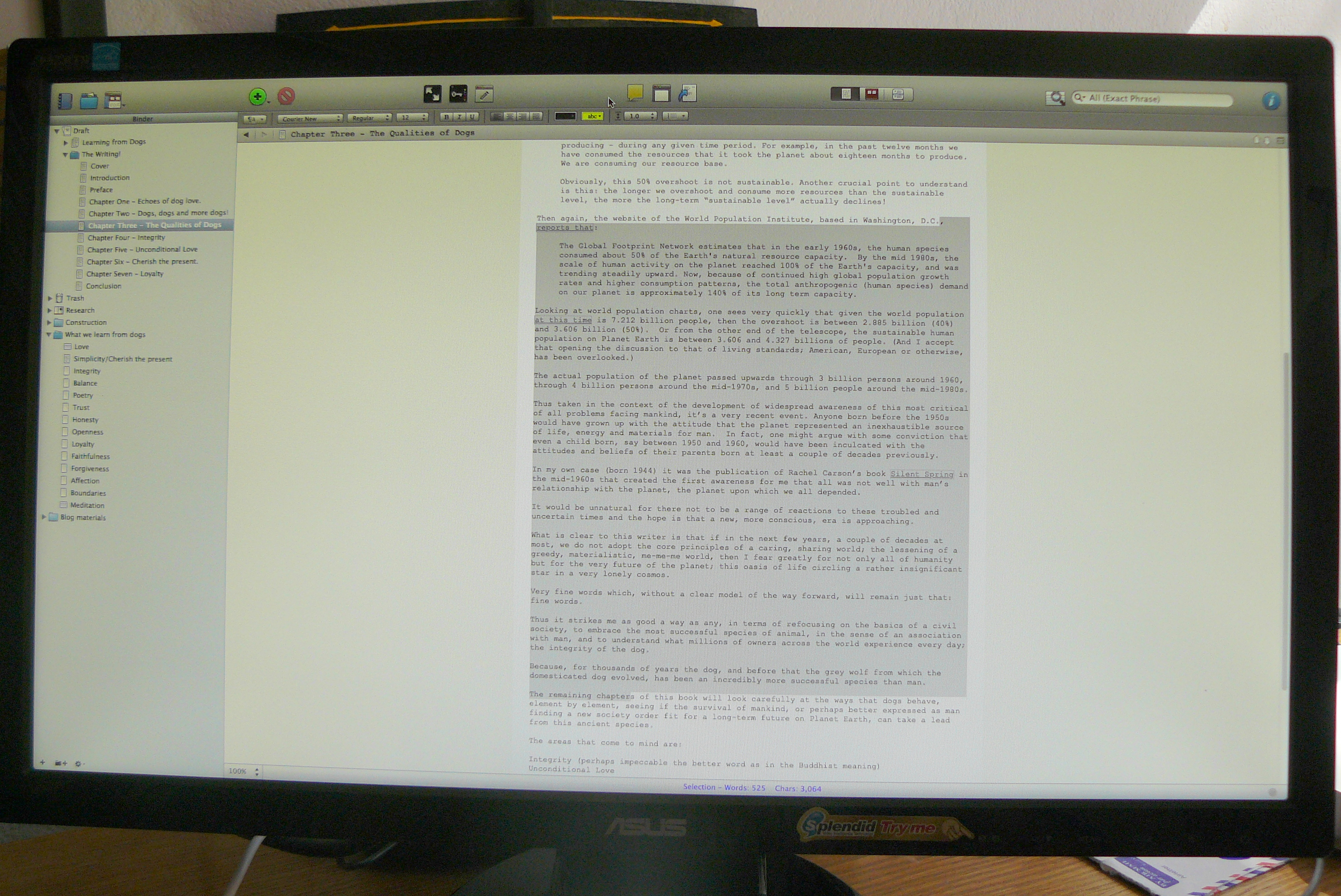
My (very) draft book file installed and running on the Mac mini!

So, all in all, despite this being very early days, it’s starting to look like a great change.

However, I mustn’t close without thanking a few people:

Dan Gomez and John Hurlburt, friends and Apple users, and in John’s case experienced on both Windows and Apple systems. Guys, I couldn’t have made the decision to change without your kind, generous and supportive advice.

Zachary Brown of Apple sales, Mac mini team. Zach, I know it’s your job but nonetheless you did and said all the right things. (And the new screen is much better than my existing one!)

Last but not least, my dearest wife Jean, who just let me get on with things and even though I knew she didn’t have a clue as to what I kept muttering on about, never let on.

Footnote:

Earlier on I wrote about launching Wordcraft, the word-processing software for personal computers. That was in early 1979 and later that year I was invited to present Wordcraft at an international gathering of Commodore dealers held in Boston, Mass.

During my presentation, I used the word ‘fortnight’ unaware that Americans don’t know this common English word.  Immediately, someone about 10 rows back in the audience called out, “Hey, Handover! What’s a fortnight?”

It released the presenter’s tension in me and I really hammed my response in saying, “Don’t be so silly, everybody knows the word fortnight.” Seem to remember asking the audience at large who else didn’t know the word.  Of course, most raised their arms!

Now on a bit of a roll, I deliberately started using as many bizarre and archaic English words that came to me.  Afterwards, the owner of the voice came introduced himself.  He was Dan Gomez, a Californian based in Costa Mesa near Los Angeles and also involved in developing software for the Commodore.

Dan became my US West Coast distributor for Wordcraft and was very successful. When Dataview was sold, Dan and I continued to see each other regularly and I count him now as one of my dear friends.  Through knowing Dan I got to know Dan’s sister Suzann and her husband Don.  It was Su that invited me to spend Christmas 2007 with her and Don at their home in San Carlos, Mexico.  Jean also lived in San Carlos and was close friends with Su. Together they had spent many years rescuing feral dogs from the streets of San Carlos and finding new homes for them.

Thus it was that I met Jean.  Both Jean and I were born 20 miles apart in London!

So from ‘Hey, what’s a fortnight’ to living as happily as I have ever been in the rural countryside of Oregon.  Funny old world!
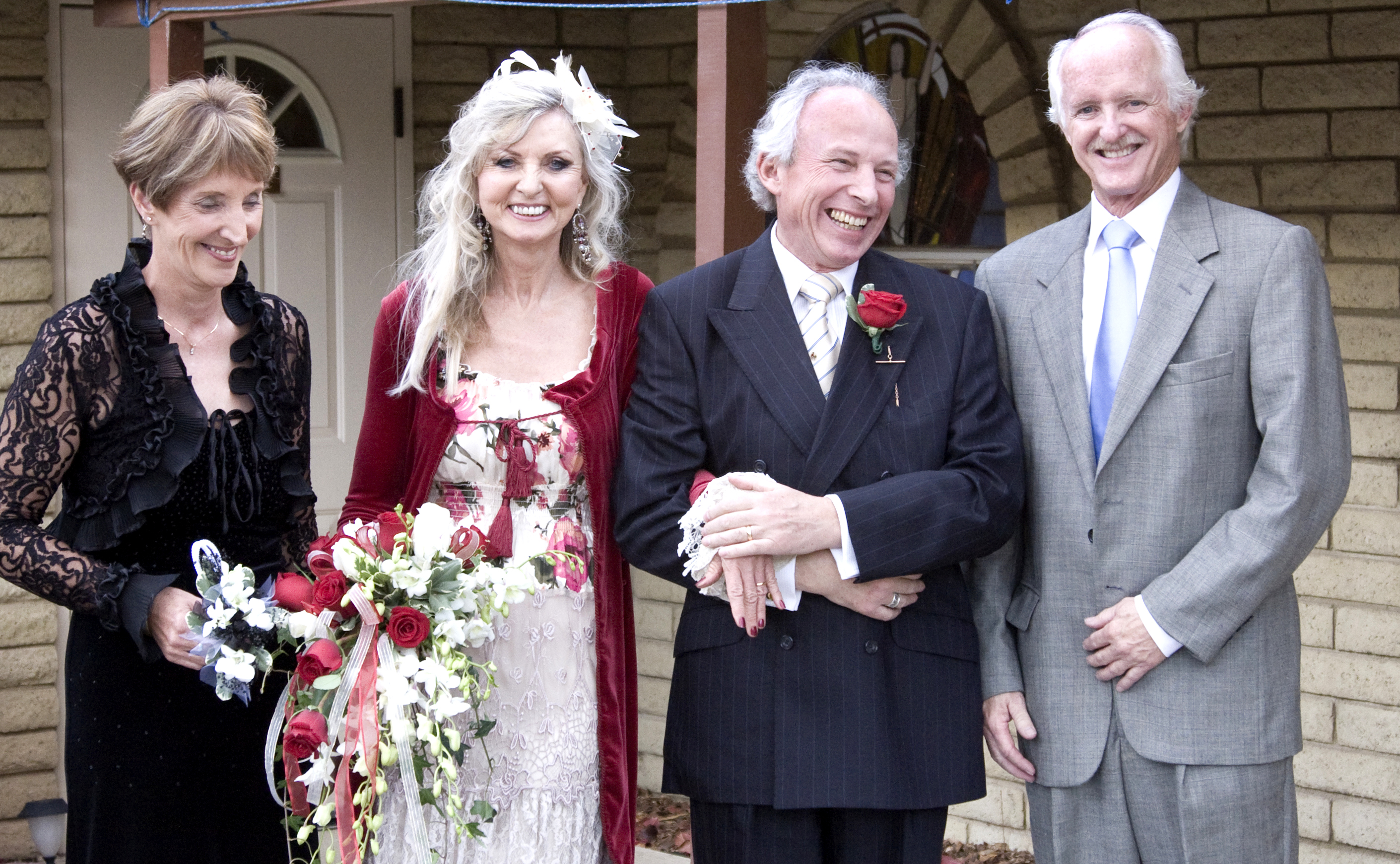
The marriage of Jean and Paul wonderfully supported by Diane, maid of honour, and best man, Dan Gomez.
The ‘voice’ Dan Gomez – Best Man at the marriage of Jean and me, November 20th 2010.

Dichlorodiphenyltrichloroethane (DDT) all over again?

The terribly worrying bee crisis.

Yesterday, I wrote about the growing awareness of a major crisis affecting bees in a number of countries.  Coincidentally, when researching the various articles for that post, into my email ‘inbox’ came the latest essay from George Monbiot published both in the UK Guardian newspaper and on his own blog.  The title was DDT 2.0.  I emailed Mr. Monbiot requesting permission to republish his essay in full on Learning from Dogs and promptly received his approval to so do.

But for those who for whatever reason, don’t recall clearly the history of DDT, here’s some background.

Wikipedia’s entry opens, thus:

DDT (dichlorodiphenyltrichloroethane) is an organochlorineinsecticide which is a colorless, crystalline solid, tasteless and almost odorless chemical compound. Technical DDT has been formulated in almost every conceivable form including solutions in xylene or petroleum distillates, emulsifiable concentrates, water-wettable powders, granules, aerosols, smoke candles, and charges for vaporisers and lotions.[2]

First synthesized in 1874, DDT’s insecticidal properties were not discovered until 1939, and it was used with great success in the second half of World War II to control malaria and typhus among civilians and troops. The Swiss chemist Paul Hermann Müller was awarded the Nobel Prize in Physiology or Medicine in 1948 “for his discovery of the high efficiency of DDT as a contact poison against several arthropods.”[3] After the war, DDT was made available for use as an agricultural insecticide, and soon its production and use skyrocketed.[4]

Then goes on to mention Rachel Carson (1907 – 1964) and her mind-boggling expose of DDT in the famous book Silent Spring.

The legacy of Rachel Carson.

The Natural Resources Defense Council (NRDC) website explains:

The Story of Silent Spring

How a courageous woman took on the chemical industry and raised important questions about humankind’s impact on nature.

Although their role will probably always be less celebrated than wars, marches, riots or stormy political campaigns, it is books that have at times most powerfully influenced social change in American life. Thomas Paine’s Common Sense galvanized radical sentiment in the early days of the American revolution; Uncle Tom’s Cabin by Harriet Beecher Stowe roused Northern antipathy to slavery in the decade leading up to the Civil War; and Rachel Carson’s Silent Spring, which in 1962 exposed the hazards of the pesticide DDT, eloquently questioned humanity’s faith in technological progress and helped set the stage for the environmental movement.

Carson, a renowned nature author and a former marine biologist with the U.S. Fish and Wildlife Service, was uniquely equipped to create so startling and inflammatory a book. A native of rural Pennsylvania, she had grown up with an enthusiasm for nature matched only by her love of writing and poetry. The educational brochures she wrote for the Fish and Wildlife Service, as well as her published books and magazine articles, were characterized by meticulous research and a poetic evocation of her subject.

You can read the rest of that NRDC article here.

So with all that in mind, here’s the essay from George Monbiot.

oooOOOooo

DDT 2.0

August 13, 2013

We’re just beginning to understand the wider impacts of neonicotinoids.

By George Monbiot, published on the Guardian’s website, 5th August 2013

It’s the new DDT: a class of poisons licensed for widespread use before they had been properly tested, which are now ripping the natural world apart. And it’s another demonstration of the old truth that those who do not learn from history are destined to repeat it.

It is only now, when neonicotinoids are already the world’s most widely deployed insecticides, that we are beginning to understand how extensive their impacts are. Just as the manufacturers did for DDT, the corporations which make these toxins claimed that they were harmless to species other than the pests they targeted. Just as they did for DDT, they have threatened people who have raised concerns, published misleading claims and done all they can to bamboozle the public. And, as if to ensure that the story sticks to the old script, some governments have collaborated in this effort. Among the most culpable is the government of the United Kingdom.

As Professor Dave Goulson shows in his review of the impacts of these pesticides, we still know almost nothing about how most lifeforms are affected. But as the evidence has begun to accumulate, scientists have started discovering impacts across a vast range of wildlife.

Most people who read this newspaper will be aware by now of the evidence fingering neonicotinoids as a major cause of the decline of bees and other pollinators. These pesticides can be applied to the seeds of crops, and they remain in the plant as it grows, killing the insects which eat it. The quantities required to destroy insect life are astonishingly small: by volume these poisons are 10,000 times as powerful as DDT. When honeybees are exposed to just 5 nanogrammes of neonicotinoids, half of them will die. As bees, hoverflies, butterflies, moths, beetles and other pollinators feed from the flowers of treated crops, they are, it seems, able to absorb enough of the pesticide to compromise their survival.

But only a tiny proportion of the neonicotinoids that farmers use enter the pollen or nectar of the flower. Studies conducted so far suggest that only between 1.6 and 20% of the pesticide used for dressing seeds is actually absorbed by the crop: a far lower rate even than when toxins are sprayed onto leaves. Some of the residue blows off as dust, which is likely to wreak havoc among the populations of many species of insects in hedgerows and surrounding habitats. But the great majority – Goulson says “typically more than 90%” – of the pesticide applied to the seeds enters the soil.

In other words, the reality is a world apart from the impression created by the manufacturers, which keep describing the dressing of seeds with pesticides as “precise” and “targeted”.

Neonicotinoids are highly persistent chemicals, lasting (according to the few studies published so far) for up to 19 years in the soil. Because they are persistent, they are likely to accumulate: with every year of application the soil will become more toxic.

What these pesticides do once they are in the soil, no one knows, as sufficient research has not been conducted. But – deadly to all insects and possibly other species at tiny concentrations – they are likely to wipe out a high proportion of the soil fauna. Does this include earthworms? Or the birds and mammals that eat earthworms? Or for that matter, the birds and mammals that eat insects or treated seeds? We don’t yet know enough to say.

This is the story you’ll keep hearing about these pesticides: we have gone into it blind. Our governments have approved their use without the faintest idea of what the consequences are likely to be.

You might have had the impression that neonicotinoids have been banned by the European Union. They have not. The use of a few of these pesticides has been suspended for two years, but only for certain purposes. Listening to the legislators, you could be forgiven for believing that the only animals which might be affected are honeybees, and the only way in which they can be killed is through the flowers of plants whose seeds were dressed.

But neonicotinoids are also sprayed onto the leaves of a wide variety of crop plants. They are also spread over pastures and parks in granules, in order to kill insects that live in the soil and eat the roots of the grass. These applications, and many others, remain legal in the European Union, even though we don’t know how severe the wider impacts are. We do, however, know enough to conclude that they are likely to be  bad.

Of course, not all the neonicotinoids entering the soil stay there indefinitely. You’ll be relieved to hear that some of them are washed out, whereupon … ah yes, they end up in groundwater or in the rivers. What happens there? Who knows? Neonicotinoids are not even listed among the substances that must be monitored under the EU’s water framework directive, so we have no clear picture of what their concentrations are in the water that we and many other species use.

But a study conducted in the Netherlands shows that some of the water leaving horticultural areas is so heavily contaminated with these pesticides that it could be used to treat lice. The same study shows that even at much lower concentrations – no greater than the limits set by the European Union – the neonicotinoids entering river systems wipe out half the invertebrate species you would expect to find in the water. That’s another way of saying erasing much of the foodweb.

I was prompted to write this article by the horrible news from the River Kennet in southern England: a highly protected ecosystem that is listed among the few dozen true chalk streams on earth. Last month someone – farmer or householder, no one yet knows – flushed another kind of pesticide, chlorpyrifos, down their sink. The amount was equivalent – in pure form – to two teaspoonsful. It passed through Marlborough sewage works and wiped out most of the invertebrates in fifteen miles of the river.

The news hit me like a bereavement. The best job I ever had was working, during a summer vacation from university, as temporary waterkeeper on the section of the Kennet owned by the Sutton estate. The incumbent had died suddenly. It was a difficult job and, for the most part, I made a mess of it. But I came to know and love that stretch of river, and to marvel at the astonishing profusion of life the clear water contained. Up to my chest in it for much of the day, I immersed myself in the ecology, and spent far more time than I should have done watching watervoles and kingfishers; giant chub fanning their fins in the shade of the trees; great spotted trout so loyal to their posts that they had brushed white the gravel of the river bed beneath their tails; native crayfish; dragonflies; mayflies; caddis larvae; freshwater shrimps and all the other teeming creatures of the benthos.

In the evenings, wanting company and fascinated in equal measure by the protest and the remarkable people it attracted, I would stop at the peace camp outside the gates of the Greenham Common nuclear base. I’ve told the strange story that unfolded during my visits in another post.

Campaigners seeking to protect the river have described how, after the contamination,the river stank from the carcases of the decaying insects and shrimps. Without insects and shrimps to feed on, the fish, birds and amphibians that use the river are likely to fade away and die.

After absorbing this news, I remembered the Dutch study, and it struck me that neonicotinoid pesticides are likely, in many places, to be reducing the life of the rivers they enter to a similar extent: not once, but for as long as they are deployed on the surrounding land.

Richard Benyon, the minister supposed to be in charge of protecting wildlife and biodiversity, who happens to own the fishing rights on part of the River Kennet, and to represent a constituency through which it passes, expressed his “anger” about the chlorpyrifos poisoning. Should he not also be expressing his anger at the routine poisoning of rivers by neonicotinoids?

Were he to do so, he would find himself in serious trouble with his boss. Just as they are systematically poisoning our ecosystems, neonicotinoids have also poisoned the policies (admittedly pretty toxic already) of the department supposed to be regulating them. In April, Damian Carrington, writing in the Observer, exposed a letter sent by the ministerin charge of the Department for Environment, Food and Rural Affairs (Defra), Owen Paterson, to Syngenta, which manufactures some of these pesticides. Paterson promised the company that his efforts to prevent its products from being banned “will continue and intensify in the coming days”.

And sure enough, the UK refused to support the temporary bans proposed by the commission both in April and last month, despite the massive petitions and the 80,000 emails on the subject that Paterson received. When Paterson and Deathra were faced with a choice between the survival of natural world and the profits of the pesticides companies, there was not much doubt about how they would jump. Fortunately they failed.

Their attempt to justify their votes led to one of the most disgraceful episodes in the sorry record of this government. The government’s new chief scientist, Sir Mark Walport, championed a “study” Deathra had commissioned, which purported to show that neonicotinoids do not kill bees. It was not published in a peer-reviewed journal, nor could it be, as as any self-respecting scientist, let alone the government’s chief scientist, should have been able to see in a moment that it was complete junk. Among many other problems, the controls were hopelessly contaminated with the pesticide whose impacts the trial was supposed to be testing. The “study” was later ripped apart by the European Food Safety Authority.

But Walport did still worse, making wildly misleading statements about the science, and using scare tactics and emotional blackmail to try to prevent the pesticides from being banned, on behalf of his new masters.

It is hard to emphasise sufficiently the importance of this moment or the dangers it contains: the total failure of the government’s primary source of scientific advice, right at the beginning of his tenure. The chief scientist is not meant to be a toadying boot-licker, but someone who stands up for the facts and the principles of science against political pressure. Walport disgraced his post, betrayed the scientific community and sold the natural world down the river, apparently to please his employers.

Last week, as if to remind us of the extent of the capture of this government by the corporations it is supposed to be regulating, the scientist who led the worthless trials that Walport and Paterson cited as their excuse left the government to take up a new post at … Syngenta. It seems to me that she was, in effect, working for them already.

So here we have a department staggering around like a drunkard with a loaded machine gun, assuring us that it’sh perfectly shafe. The people who should be defending the natural world have conspired with the manufacturers of broad-spectrum biocides to permit levels of destruction at which we can only guess. In doing so they appear to be engineering another silent spring.

oooOOOooo

Frankly, there are more and more occasions when I think that if homo sapiens becomes virtually extinct there will be no queries as to why it happened.  Then again, a much more positive muse would be to see the ever-increasing madness going on in today’s world as the crumbling death throws of a materialistic and consumptionist era that is past its time.

How normal is it to be normal!

But first off this is not going to be a normal couple of weeks!

My daughter, Maija, son-in-law, Marius, and grandson, Morten, aged two, are staying with us over the next couple of weeks, arriving tomorrow.

So being able to offer a daily fresh post on Learning from Dogs will be a challenge.  As indeed, it should be: Family should always be the top priority.

However, rather than leaving you with blank pages, I shall be regurgitating some earlier posts, starting tomorrow.  In wandering through rather a large number of posts (1,775 as of today!), I was reminded that at the start one of my fellow authors was Jon Lavin.  He wrote a number of posts before deciding that his ‘day job’ was too demanding of him and something had to go.  It wasn’t just writing for Learning from Dogs that Jon had to let go, even his own website, The People Workshop, is a tad out-of-date!

But even so, there’s an article on Jon’s website that I wanted to share with you and, with Jon’s permission, here it is.

oooOOOooo

Normal!

10 AUGUST 2011 BY 

Constant.
Constant.

Normal – it’s not a particularly challenging word; or is it?

The fact is that for most people their ‘normal’ business day is far from being effective.

What I do, indeed my passion, is to work with people and allow them to see the huge benefits that come from bringing ‘mindfulness’ into their everyday working environments. What do we mean by mindfulness?

Generally, anything that brings us into a state of mind where we are making decisions, interacting with people, communicating in the here and now, not away somewhere where we are controlled by what happened in the past and our fears of what might happen in the future.

Bringing change into business requires many qualities and if ever there was a time for displaying the qualities of integrity and compassion, it is now.

I believe we are on the cusp of an enormous change that will affect us all – it already is, we’re just hoping that it will go away and we’ll be able to carry on as before after this unpleasant recession is over. It’s more likely we are living through a core change in society.

I’ve realised that I can no longer rely on ‘out there’ for support, instead, it has to come from within.

By knowing myself and having a different relationship with myself, I encourage a balance in my life and recognise what ‘resources’ I need. Being out in the fresh air, in the woods and fields ‘resources’ me.

So when I work with my troubled clients who may be reeling from the latest batch of redundancies, I am able to be in a state of calm rather than the anxiety which is such a familiar friend.

Have you ever noticed how people are attracted to calm people when insecurity and uncertainty are around? From calmness and balance, options in the here and now present themselves to us. We are aware that we are connected together and working together in an atmosphere of integrity and trust to do the best for all.

My clients use me when they are dealing with circumstances that demand the very best from their employees, and when those employees demand the very best from my client company.

I would be interested to hear your comments!

oooOOOooo

Do please offer your thoughts to Jon’s essay; I will pass them back to him without delay.

What Jon underlines is the power of relaxation, of taking time off at regular intervals during the day, the dangers of overload; as I recently highlighted in this recent post.

Thus proving, once again, that old adage – less is more!

Be more dog!

You are going to love this!

Sent to me by dear friend, Neil, from my Devon days.

Yes, it’s an advert but so what – it’s just a gorgeous short film.

Plus you are going to love this!

Sent to me by dear Cynthia, wife of Dan Gomez.

Opens up a whole range of potential names!


AGW – summing up.

“If there’s any doubt, there’s no doubt!”

I opened the first post on Monday with the sub-heading: “Certainty is perfect knowledge secure from error or doubt.” going on to write that, “Whatever your views on the effect of man’s behaviours on our planet’s climate, it’s a long way from the logical idea of ‘2 + 2‘!”

Within that very strict definition, I remain unmoved.  The argument that mankind is the cause of the present change in the climate of Planet Earth is not certain!

However, if only life was that simple! The change in our planet’s atmosphere is possibly the most emotionally-laden topic of all time.  For some reason that quotation attributed to Hiram Johnson comes to mind, “The first casualty when war comes is truth.” because the supporters and deniers of AGW are engaged in what amounts to a verbal war.

Each side can draw on much information.

For example, a very recent article in The New York Times by their Justin Gillis offered this:

The rise in the surface temperature of earth has been markedly slower over the last 15 years than in the 20 years before that. And that lull in warming has occurred even as greenhouse gases have accumulated in the atmosphere at a record pace.

The slowdown is a bit of a mystery to climate scientists. True, the basic theory that predicts a warming of the planet in response to human emissions does not suggest that warming should be smooth and continuous. To the contrary, in a climate system still dominated by natural variability, there is every reason to think the warming will proceed in fits and starts.

But given how much is riding on the scientific forecast, the practitioners of climate science would like to understand exactly what is going on. They admit that they do not, even though some potential mechanisms of the slowdown have been suggested. The situation highlights important gaps in our knowledge of the climate system, some of which cannot be closed until we get better measurements from high in space and from deep in the ocean.

As you might imagine, those dismissive of climate-change concerns have made much of this warming plateau. They typically argue that “global warming stopped 15 years ago” or some similar statement, and then assert that this disproves the whole notion that greenhouse gases are causing warming.

Rarely do they mention that most of the warmest years in the historical record have occurred recently. Moreover, their claim depends on careful selection of the starting and ending points. The starting point is almost always 1998, a particularly warm year because of a strong El Niño weather pattern.

Dan Gomez, a long-time friend of over 40 years and a regular contributor to items on Learning from Dogs, wrote in a recent email,

I’m not sure what is meant by “believer”, Paul.  The Universe unfolds as it should.  Because many have been led to “believe” that AGW is inevitable and that all the facts are the ‘Truth”, we’ve created a religious substitute, almost a new “industry” with significant “tithing” obligations, etc. (e.g. Cap and Trade). Presumptions and facts are being manipulated to fulfill the prophecy.

Interesting to note in our daily lives, that weather prediction is very good 24-36 hrs out.  This drops precipitously just a few days out.  More than 7-10 days is nearly impossible. Even though both Europe and the USA have decreased CO2 levels by multiple percentage points over the last 20 years, the rest of the world does not care and the impact is very problematic.  Recently, CO2 gas has increased overall but heat has not. In the past, warming has occurred followed by CO2 levels increasing. Global politics and redistribution of wealth schemes continue to interfere with common sense.

Let’s just deal with the facts as Science reveals its secrets. New information is discovered every day about the interaction of the  Earth/Sun/Atmosphere/Lithosphere/Hydrosphere. New information is learned every day about the Universe.  These are not closed subjects. Climatology, meteorology, geology and solar system dynamics will continue to shape the Earth’s future for millennia to come whether Man is involved or not.

There is much in what Dan writes that has me nodding my head; stimulates my recollection of what Luther Haave and Derek Alker wrote in 2009:

With the explosion of knowledge, particularly in the past 100 years, each of us has found it a requirement for being successful, and to being able to earn a living, to concentrate our knowledge in an ever increasingly narrow field. Just as we have come to expect others to defer to our expertise in our narrow area, we have come to assume that we need to defer to others who have a deeper comprehension of seemingly complex topics such as the science related to climate change. [Apologies, can’t find the web link for this.]

However, if we broaden the perspective from that tight definition of certainty to an analysis of probabilities, then it all changes for me and I can embrace the views so strongly put forward by Martin Lack.

For example, Martin left a comment on Monday, “ACD is not a matter of opinion or belief; it is a matter of probability. As such, all that matters now is the extremely high probability that the scientific consensus is real, reasonable and reliable.”  That comment included a link to a discussion on the website Skeptical Science, Is the science settled? Let me quote from that:

Some aspects of the science of AGW are known with near 100% certainty. The greenhouse effect itself is as established a phenomenon as any: it was discovered in the 1820s and the basic physics was essentially understood by the 1950s. There is no reasonable doubt that the global climate is warming. And there is also a clear trail of evidence leading to the conclusion that it’s caused by our greenhouse gas emissions. Some aspects are less certain; for example, the net effect of aerosol pollution is known to be negative, but the exact value needs to be better constrained.

What about the remaining uncertainties? Shouldn’t we wait for 100% certainty before taking action? Outside of logic and mathematics, we do not live in a world of certainties. Science comes to tentative conclusions based on the balance of evidence. The more independent lines of evidence are found to support a scientific theory, the closer it is likely to be to the truth. Just because some details are still not well understood should not cast into doubt our understanding of the big picture: humans are causing global warming.

In most aspects of our lives, we think it rational to make decisions based on incomplete information. We will take out insurance when there is even a slight probability that we will need it. Why should our planet’s climate be any different?

That, ultimately, delivers for me what truly counts.

I am not a scientist; just a Brit living in Southern Oregon trying to make sense of the world while I still have a functioning head and body – time is not on my side! 😉  The powerful common-sense in the sentence, “Outside of logic and mathematics, we do not live in a world of certainties.” is beyond argument.

In the year 2012, the total number of passengers carried by US Airlines and other carriers in and out of the USA was a staggering 815 million people. 815,000,000 people!

Remember the sub-heading from the start of this post!  “If there’s any doubt, there’s no doubt!” Years ago I heard that from Bob Derham, a long-time friend and a commercial airline Captain since the time God was a boy!  It’s that cautious, safety-focused attitude that has made airline transport such an amazing mode of transport for all those millions of passengers.

Should we not travel with the same cautious, safety-focused attitude on the ‘vehicle’ that carries every man, woman and child; every animal, plant and living thing: Planet Earth!

The answer is obvious – more than obvious!

A new world order.

Two very different essays that, nonetheless, do sing to a common tune.

I sit here with a heavy heart. Why, you may ask?

Because I really wish I wasn’t setting the scene to a couple of disturbing essays.  The first from Patrice Ayme.  His essay is called Plutocracy: New World Order with the subtitle of The New World Thinking. The New World Emoting. The second essay is from Mattea Kramer and Jo Comerford under the TomDispatch umbrella.  Their title is How America Became a Third World Country.

That heaviness comes from an emotional conflict.  The conflict between never having been more contented in our beautiful Oregonian home and the tiny voice in my head that says that I shouldn’t throwing darts at the country that has been generous in welcoming me as a resident.

But I justify publishing these two essays in this manner.  Just as Pharaoh leads the barking whenever the dogs sense something threatening their ‘territory’, then too should citizens (I use the term in the broadest sense) start barking when they sense something threatening the integrity of their country.

So today the Patrice Ayme essay and tomorrow the TomDispatch essay.  I’m very grateful to both Patrice and Tom for their permission to republish their essays.

oooOOOooo

PLUTOCRACY: NEW WORLD ORDER

Obama just  nominated Commerce Secretary the billionaire heiress who discovered him, and introduced him to the Rubin-Summers-Goldman-Sachs-Citigroup conspiracy. Penny Priztker was condemned to pay a 460 million dollar fine by the Federal government in 2001, for financial malfeasance. 460 million, that’s more than Mitt Romney’s fortune, that made small rank and file democrats huff and puff, in indignation, a few months ago, just like their mighty masters told them to do.

Now, if the 460 million dollars fine felon becomes chief, that’s fine, as long as the masters of the people don’t ask the People to huff and puff about the fine. The finer the fine, the finer the master, say the little People, and they bleat, satisfied. As Obama put it:”Priztker is one of the most eminent personalities of our country“. When Pluto reigns, down is up.

When Common Decency Is A Hindrance

Plutocracy is the New World Order. The New World Thinking. The New World Emoting.

To get some perspective on this, it’s good to have a retrospective look at the greatest plutocratic realms of the past, and ponder why extremely wealthy fascism rose, increasingly, in the Orient, while clever democracy rose, occasionally, in the West. And sometimes fell, disastrously, for reasons related.

It turns out that, when Rome became fascist and plutocratic, it turned to Oriental despotism, and criminals, indeed, came to command and control.

***

PERSIA REIGNED WITH ALL CRAFTS; YET NOT SMART ENOUGH:

Establishing  giant, metastatic empires in the Orient is nothing new: the Hittites tried it, they proceeded to invade Lebanon and the rich valleys behind, Egyptian territory. However young Pharaoh Ramses II, defeated them at Qadesh, next to present day Damascus. Through courageous combat in that battle which defined his long rule, Ramses rescued victory from the jaws of defeat, somewhat miraculously.

Ramses lost ground, though, and later made a loving peace with his enemies. Then, the Hittites having been destroyed by the mysterious coalition of the Peoples of the Sea, the Assyrians tried to impose their own giant metastatic empire, using the harshest methods. That brought them so many enemies that they got invaded from all quarters, annihilated as a nation first, and an army, later.

Then the union of Medes and Persians, thanks to three remarkable leaders, established a giant fascist empire, from Ethiopia to Central Asia, Libya to India. The third emperor, Darius, besides being excellent at sword-play in the dark, and a great general, proved capable of using a free market economy, switching to so called Keynesianism, and then a command and control economy, as needed. Darius established a giant “Royal” road network (ancestral to the one the Romans would build, four centuries later).

A Persian Pony Express, with posts every five miles, would bring news from distant corners of the empire in a week. Darius went on to invade the Scythians, land of the Amazons, present day Ukraine.

Darius’ Persia was the greatest empire, so far, larger than the present day continental USA. It became so, thanks to a great variety of methods of socio-economic governance. Some of these methods would later be used by the West, massively. Not just the communication network, the free market, the command and control, but also a crafty diplomacy of seduction, cooptation and local autonomy (that’s how the Ionian Greeks and Phoenicians became collaborators of Persia; whereas Alexander would annihilate Tyr).

However, unbelievably, tiny Athens broke the Persian empire, inaugurating the next great event, still on-going, the rise of the West. Again and again, minuscule Greek armies routed the juggernauts of professional giant armies. Again and again, small democracies proved superior to large fascist foes. I claimed that mental superiority entailed military superiority.

***

FREE IN THE WEST, SLAVES IN THE EAST

Herodotus explained the Greeks’ military superiority: free men are more motivated in battle, as they fight for themselves, he said. But it’s not clear that elite Persian soldiers did not feel free.

So I hold something slightly different: free men are, living in an “open society” are not just more motivated, but, simply, more intelligent. Yes, intelligent.

Yet how come that the free men tended to be in the West, and the subjugated ones, in the East? And this for 4,000 years, defining the “West” as anything west of Mount Lebanon. Why did so much of the Mediterranean turn out propitious to freedom and individual initiative? What of the enormous Celto-German forests, from Spain to the Baltics?

Two factors played a role:

1) Trade, with the big man, the leader being the ship owner-captain (Tyr, Phoenicia, Crete, Athens, Carthage, etc.). This required to excel at technology and adaptative intelligence, confronting nature.

2) Small owner-peasants. The West’s agricultural system did better thanks to small, free owner-peasants.  The owner peasant was captain of his own plot of land, and found himself in a situation roughly similar to the ship captain. Such people worked hard, and thought hard about outwitting nature. All of Germany was this way, until the military encroachment of Rome in the beginning of its plutocratic phase, brought, by reaction, a militarization of German society (this is what archeology shows).

A demographic core of owner-peasants was the core of the success of the Roman republic, and its successors, the Imperium Francorum, and France, or anything working along French lines (most of Europe). When enjoying this basic culture, of free, independent peasants, the West did very well. Why so? Because thinking by oneself, for oneself, makes one more intelligent.

***

WHY THE ORIENT IS DUMBER:

The Orient did better when the peasants could cultivate. That meant, when they had water. That was not obvious in the increasingly parched lands, from the Maghreb to India. First, there, one needed to bring water to agricultural lands. Whereas in the West, both water and arable land were in the same place, not so in the East. In the East water was on rocky mountains, arable lands in parts of plains at the bottom of said mountains. To bring the former to the latter, one needed great hydraulic works. Underground canalizations, sometimes fifty feet deep, could extend dozens of miles.

Such extensive works meant armies of workers and maintenance people. And also standing armies to establish and protect the necessary order. Plus a field army to roam around the empire, and keep the static defenses obedient.

In other words, food on the carpet in the parched, basin and range Orient meant a large fascist system to make it possible, and everybody enslaved to it, in a military organization (Christianity and Islam, both oriental religions, kept much of this essential psychological character: fascist god on top, giving absolute, even capricious  orders to its slaves below).

***

ALL TOGETHER NOW, DOWN THE ROMAN ROAD TO HELL?

What consequences today? Western countries do not depend upon small owner-peasants anymore, but upon giant farms, or agribusinesses, for food procurement. Even trade has become unbalanced: production on one end of the Earth, increasing unemployment, at the other end.

Giant agribusinesses, and unbalanced trade became facts of empire in Rome, and lasted centuries. It was a deliberate plot of Roman plutocracy. At some point, six senatorial families owned most of North Africa. Seneca, Nero’s tutor, the plutocratic philosopher of note, used to boast that he had no idea how many giant properties he owned on the various continents.

That delocalization and globalization made Rome, and Italy into an empty shell of its former self. As those who had the power, the senatorial families, wished. What they feared first, was a proud, potent, empowered People.

(Part of) Italy would resurrect as independent republics, more than a millennium later.

What’s the morality of the story? Men have a strong instinct for doing things right. In a plutocratic system, though, men who do things wrong get rewarded, and this goes on, until the situation exponentiates and breaks down. Thus plutocratic systems are intrinsically pathological: they reward criminals. Not just criminal according to the laws of men, but criminals according to the laws of nature.

In the Orient, life is harder, less natural, militarization exploits part of the Dark Side, because human beings, by living there, live in a less optimal situation. In the West, the rise of plutocracy did not have these excuses.

The Romans knew this well. The Roman republic was the product of a revolution against Tarquinus Superbus, the king of Rome, of Etruscan origin. So the founding act of five centuries of Roman republic was an anti-plutocratic revolt. Same for Athens (several times, during the same centuries).

The Romans passed a strong anti-plutocratic law. That law limited, by force the size of a family’s fortune; it fixed an upper bound on how much one could own. The Second Punic war saw the death, on the battlefield, of too many of the best leading Romans. Meanwhile the conspirators of wealth, back behind the walls of the fortified cities, as Hannibal was roaming the countryside, established a New World order of rents.

When Carthage got defeated, those men of greed kept on pushing, and tried to grab control of the state. After several wars of distraction against Macedonia, Carthage, Numantia, Corinth, etc. it became clear that was what was going on to thousands of the best Romans, led by top nobles (in mind and ancestry), the Gracchi.

The Gracchis mostly tried to impose the wealth limitation law. They also succeeded to impose a land redistribution (an unthinkable socialist measure in the post Thatcher-Reagan world!). Yet, the Gracchi and their supporters lost a civil war. All got killed, by the private armies of the plutocrats. By 100 BCE, when Caesar was born, the dice had long been thrown. Only extreme measures could address the situation (extreme measures that Caesar and Cicero, on the good side, would try).

Now what? Losing democracy, means, ultimately, that we will lose not just freedom, but intelligence itself. It is difficult to imagine how the Americans will pull out of their present death spiral into furthering the wealth of the .1%. When bandits are called “philanthropists”, all values have been inverted in a country: gangsters are in control, the mafia has got metastatic. It will go on, all inverted, until it explodes, or get trampled over. The commerce chief will be a certified felon.

The situation in Europe is not as desperate: conditions for a revolt exist. Although Goldman Sachs has its servants in place all over, the Italians threw out one of them, a Goldman Sachs partner, Mario Monti, at the first chance they got.

Some may sneer, as they notice that, once again I used “Orient” and “Occident” according to old Greco-Roman semantics. What of the true Orient, the far-out East, China and company? Well, I will hide behind my usual observation: it’s Western culture that conquered the world. Present day China’s ideology has very little that is specifically Chinese, besides what the West and China had in common, such as the more or less free market. The idea of “People” (Populus) and “Republic” (Respublica) are Roman. So the very title of China, the “People Republic of China” is, well, (Greco-)Roman.

The dangers threatening China, accordingly, like those threatening us, are those that devastated the Roman republic. For the reasons exposed above, the development in the West, of a more advanced civilization was first, thus why everybody adopted it later.  Rome was first to rise as high as it did. But, the greater the rise, the greater the fall. By 700 CE, the fall of Rome had been so great, that China had risen higher, on many indicators. The West, invaded by hordes of savages for more than six hundred years (beyond even 400 CE to 1000 CE) was fighting for survival.

Plutocracy as a New World Order is not just the end of many things. In the fullness of time, plutocracy is the end of everything.

Even the Will to Power. Slave masters are not so masterful. After all, they are enslaved to their slaves.

When Rome went down, Roman plutocrats whined that the “world was getting old“. By this they meant that resources were being exhausted, and that, in its stupidity plutocratic civilization could not find a technology out.

Right now, the world is not getting old, it’s getting killed. And that’s worst.

***

Patrice Ayme

The power in these words.

Day three of recognising the passing of 400 ppm atmospheric CO2.

In nearly four years of writing for Learning from Dogs, I can’t recall devoting three days of posts to a single subject. To put that into context, today’s post is number 1,683 since the first one was published on July 15th, 2009; not all of them from the brain of yours truly by any means you understand!

Today, I’m going to feature a recent essay written by George Monbiot finishing up three days of ‘reporting’ on the deeply disturbing, but fully anticipated, news that the planet’s atmosphere has reached a concentration of 400 ppm CO2.

Last Monday, I published What legacy do we wish to leave for others?

Then yesterday, a post under the title of 400 ppm, as the BBC reported it.  I closed with a reference to a remark made by Professor Sir Brian Hoskins, director of the Grantham Institute for Climate Change at Imperial College London; the remark being “A greater sense of urgency was needed.

I wrote that those wishy-washy words were pathetic.  That we needed the sort of words that George Monbiot penned a few days ago in the Guardian newspaper.  There it was entitled “Climate milestone is a moment of symbolic significance on road of idiocy“.

But I think the title that Mr. Monbiot chose to use on his own blog was far more apt: Via Dolorosa.  (Note that I haven’t formally requested permission to republish the essay but trust that the following is acceptable to both Mr. Monbiot and the Guardian newspaper.)

Here’s how it opened:

Via Dolorosa

May 10, 2013

Corruption and short-termism are pushing us along the path of sorrows.

By George Monbiot, published on the Guardian’s website, 10th May 2013

The records go back 800,000 years: that’s the age of the oldest fossil air bubbles extracted from Dome C, an ice-bound summit in the high Antarctic. And throughout that time there has been nothing like this. At no point in the pre-industrial record have concentrations of carbon dioxide in the air risen above 300 parts per million. 400 is a figure that belongs to a different era.

The difference between 399 and 400ppm is small, in terms of its impacts on the world’s living systems. But this is a moment of symbolic significance, a station on the Via Dolorosa of environmental destruction. It is symbolic of our collective failure to put the long term prospects of the natural world and the people it supports above immediate self-interest.

The symbolic significance of the planet’s atmospheric concentrations of CO2 passing 400ppm  is that, I hope, with all the hope that my heart can summon up, it will bring us back from the brink.  Then one ponders about this possibility as Monbiot’s next paragraph unfolds:

The only way forward now is back: to retrace our steps along this road and to seek to return atmospheric concentrations to around 350 parts per million, as the 350.org campaign demands. That requires, above all, that we leave the majority of the fossil fuels which have already been identified in the ground. There is not a government or an energy company which has yet agreed to do so.

“not a government or an energy company … has yet agreed to do so.”

I’m going to repeat that again, with emboldening; “not a government or an energy company … has yet agreed to do so.

In fact, one could reasonable argue that having any hope for a turning back is utterly naive. Look what the essay goes on to say:

Just before the 400-mark was reached, Shell announced that it will go ahead with its plans to drill deeper than any offshore oil operation has gone before: almost three kilometres below the Gulf of Mexico.

A few hours later, Oxford University opened a new laboratory in its department of earth sciences. The lab is funded by Shell. Oxford says that the partnership “is designed to support more effective development of natural resources to meet fast-growing global demand for energy.” Which translates as finding and extracting even more fossil fuel.

The European Emissions Trading Scheme, which was supposed to have capped our consumption, is now, for practical purposes, dead. International climate talks have stalled; governments such as ours now seem quietly to be unpicking their domestic commitments. Practical measures to prevent the growth of global emissions are, by comparison to the scale of the challenge, almost non-existent.

As an example of the scale of the hypocrisy in which we are all immersed, last week’s The Economist magazine carried a full-age advertisement from Chevron on page 5 under the banner of ‘Protecting The Planet Is Everyone’s Job – We agree‘ and going on to explain:

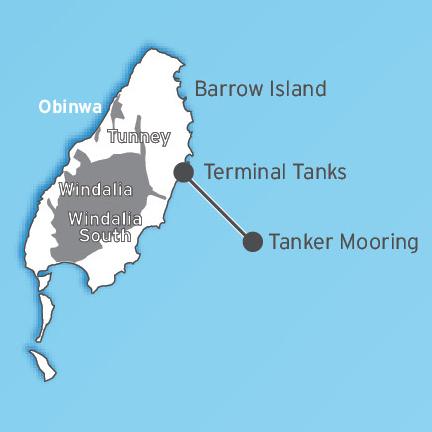
We go to extraordinary lengths to protect the integrity of the places where we operate.  Places all over the world, like Australia’s Barrow Island.  It’s home to hundreds of native species of wildlife, including wallabies, ospreys, and perenties.

We’ve been producing energy on the island for more than 40 years, and it remains a Class A Nature Reserve.

Didn’t take me two moments to find this image:

Barrow Island, Australia.  Taken from the Chevron Australia website.
Barrow Island, Australia. Taken from the Chevron Australia website.

To my mind this advertisement completely misses the point; deliberately or otherwise.  Chevron and all other oil producing companies in the world are endangering the future of the entire planet by continuing to ‘produce energy’, aka oil.  Period. Full stop.

Or to put it in the words of George Monbiot’s essay:

The problem is simply stated: the power of the fossil fuel companies is too great. Among those who seek and obtain high office are people characterised by a complete absence of empathy or scruples, who will take money or instructions from any corporation or billionaire who offers them, and then defend those interests against the current and future prospects of humanity. This new mark reflects a profound failure of politics, worldwide, in which democracy has quietly been supplanted by plutocracy. Without a widespread reform of campaign finance, lobbying and influence-peddling and the systematic corruption they promote, our chances of preventing climate breakdown are close to zero.

Thus the final sentence in GM’s essay carries a deep sadness.

So here we stand at a waystation along the road of idiocy, apparently determined only to complete our journey.

http://www.monbiot.com

Why are we not seeing, hearing and reading words of a similar weight and power from just about every ‘opinion maker’ in the world?

Why not?  Why not?

More on those poor rhinos

Awareness is the only way to go.

Two days ago, I published a post under the title of Reflections on pain and peace. The pain aspect was as a result of a shocking photograph of a rhino that had been slaughtered for its horn.

Subsequent to that piece coming out there has been more information that I wanted to cover.

I had an email from Avaaz that needed circulating:

Thanks for joining the campaign to protect the world’s rhinos. To win this campaign, we urgently need to build a massive outcry — every voice who joins us makes a difference!

Help spread the word by sending the email below to friends and family, and post this link on your Facebook wall.

http://www.avaaz.org/en/save_rhinos/?tta

Thanks again for your help,

The Avaaz team

——–

Dear friends,

The rhino is being hunted into extinction and could disappear forever unless we act now. Shocking new statistics show 440 rhinos were brutally killed last year in South Africa alone — a massive increase on five years ago when just 13 had their horns hacked off. European nations could lead the world to a new plan to save these amazing creatures but they need to hear from us first!

Fueling this devastation is a huge spike in demand for rhino horns, used for bogus cancer cures, hangover remedies and good luck charms in China and Vietnam. Protests from South Africa have so far been ignored by the authorities, but Europe has the power to change this by calling for a ban on all rhino trade — from anywhere, to anywhere — when countries meet at the next crucial international wildlife trade summit in July.

The situation is so dire that the threat has even spread into British zoos who are on red-alert for rhino killing gangs! Let’s raise a giant outcry and urge Europe to push for new protections to save rhinos from extinction. When we reach 100,000 signers, our call will be delivered in Brussels, the decision-making heart of Europe, with a crash of cardboard rhinos. Every 50,000 signatures will add a rhino to the crash — bringing the size of our movement right to the door of EU delegates as they decide their position. Sign the petition below then forward this email widely:

http://www.avaaz.org/en/save_rhinos/?tta

So far this year one rhino has been killed every day in South Africa, home to at least 80% of the world’s remaining wild rhinos. Horns now have a street value of over $65,000 a kilo — more expensive than gold or platinum. The South African Environment Minister has pledged to take action by putting 150 extra wardens and even an electric fence along the Mozambique border to try and stem the attacks — but the scale of the threat is so severe that global action is required.

Unless we act today we may lose this magnificent and ancient animal species permanently. Some Chinese are loudly lobbying for the trade in horn to be relaxed, but banning the trade in all rhinos will silence them. With the EU’s leadership, we can bring these international gangsters to justice, put the poachers in prison, and push for public awareness programmes in key Asian countries — and end this horn horror show for good.

In the next few weeks, the EU will be setting its agenda for the next big global meeting in just a few months — our best chance of turning the tide against the slaughter. We know that rhinos will be on their agenda, but only our pressure can ensure they challenge the problem at its source. Let’s build a giant outcry and deliver it in a spectacular fashion — sign now and together we can stop the slaughter across Africa:

http://www.avaaz.org/en/save_rhinos/?tta

In 2010, Avaaz’s actions helped to stop the elephant ivory trade from exploding. In 2012, we can do the same for the rhino. When we speak out together, we can change the world — last year was the worst year ever for the rhino, but this can be the year when we win.

With hope,

Iain, Sam, Maria Paz, Emma, Ricken and the whole Avaaz team

More Information:

Few Rhinos Survive Outside Protected Areas (WWF)
ttp://www.worldwildlife.org/species/finder/rhinoceros/rhinos.html

South Africa record for rhino poaching deaths (BBC)
http://www.bbc.co.uk/news/world-africa-15571678

‘Cure for cancer’ rumour killed off Vietnam’s rhinos (The Guardian)
http://www.guardian.co.uk/environment/2011/nov/25/cure-cancer-rhino-horn-vietnam

British Zoos on Alert as Rhino Poaching Hits the UK (International Business Times)
http://www.ibtimes.co.uk/articles/289792/20120130/british-zoos-uk-alert-rhino-poaching-hits.htm

—————–

Then as a reminder that sitting on our hands and doing nothing must be resisted, Chris sent me this link to a recent item in the British Telegraph newspaper, from which I include these portions:

Last rhinos in Mozambique killed by poachers

The last known rhinoceroses in Mozambique have been wiped out by poachers apparently working in cahoots with the game rangers responsible for protecting them, it has emerged

7:46PM BST 30 Apr 2013

The 15 threatened animals were shot dead for their horns last month in the Mozambican part of Great Limpopo Transfrontier Park, which also covers South Africa and Zimbabwe.

They were thought to be the last of an estimated 300 that roamed through the special conservation area when it was established as “the world’s greatest animal kingdom” in a treaty signed by the three countries’ then presidents in 2002.

Aislinn Laing finishes off her report, by writing:

Dr Jo Shaw, from the World Wide Fund for Nature, said the rhinoceroses had probably crossed into Mozambique from Kruger.

Whereas killing a rhino in South Africa can attract stricter punishments than killing a person, in Mozambique offenders generally escape with a fine if they are prosecuted at all.

“Rhinos being killed in Kruger are mostly by Mozambican poachers who then move the horns out through their airports and seaports,” she said. “With huge governance and corruption issues in Mozambique, it’s a huge challenge.”

Boy, do we have so much to learn from dogs!

A day of rest.

Yesterday and Monday saw a team from Caveman Heating in Grants Pass installing a new heating and air-conditioning system in the house.  That resulted in me not turning my computer on until 6pm.  So apologies for lacking the creative spirit.

Will just leave you with a picture of Pharaoh, Hazel and Dhalia helping a couple of the crew eat their lunch yesterday! 😉

Lunch-break for the workers and their 'assistants'.
Lunch-break for the workers and their ‘assistants’.

Can’t close without saying that the entire Caveman team were just wonderful with all the dogs, who will surely miss the innumerable strokes and head rubs.

Thanks guys!

The fate of Europe!

A less than reverent view of the Euro.

This was sent to me by Richard Maugham from England.  Richard and I go back the thick end of 40 years or more.  He and I met when I was a salesman for IBM UK (Office Products Division) and Richard was a salesman for Olivetti UK.  Thus we were selling competitive products!

But that didn’t stop us from becoming great friends and remaining so ever since.  Indeed, Richard and Julie are out to see us in Oregon in just over 3 weeks time.

One of the bonds between Richard and me is a love for silliness and quirky humour.  Hence Richard sending me the following that, in turn, had been sent to him.

For those that are not familiar with the Blackadder comedy series on the BBC, more background provided later on.  Anyway, this is what I received from Richard.

oooOOOooo

The Euro according to Blackadder

blackadd

Baldrick: “What I want to know, Sir, is before there was a Euro there were lots of different types of money that different people used. And now there’s only one type of money that the foreign people use. And what I want to know is, how did we get from one state of affairs to the other state of affairs?”

Blackadder: “Baldrick. Do you mean, how did the Euro start?”

Baldrick: “Yes Sir”.

Blackadder: “Well, you see Baldrick, back in the 1980s there were many different countries all running their own finances and using different types of money. On one side you had the major economies of France, Belgium, Holland and Germany, and on the other, the weaker nations of Spain, Greece, Ireland, Italy and Portugal. They got together and decided that it would be much easier for everyone if they could all use the same money, have one Central Bank, and belong to one large club where everyone would be happy. This meant that there could never be a situation whereby financial meltdown would lead to social unrest, wars and crises”.

Baldrick: “But, Sir, isn’t this a sort of a crisis?”

Blackadder: “That’s right Baldrick. You see, there was only one slight flaw with the plan”.

Baldrick: “What was that then, Sir?”

Blackadder: “It was bollocks”.

oooOOOooo

blackadder
More about the Blackadder series can be read here, from which I republish:

Blackadder is the name that encompassed four series of a BBC 1 period British sitcom, along with several one-off instalments. All television programme episodes starred Rowan Atkinson as anti-hero Edmund Blackadder and Tony Robinson as Blackadder’s dogsbody, Baldrick. Each series was set in a different historical period with the two protagonists accompanied by different characters, though several reappear in one series or another, for example Melchett and Lord Flashheart.

The first series titled The Black Adder was written by Richard Curtis and Rowan Atkinson, while subsequent episodes were written by Curtis and Ben Elton. The shows were produced by John Lloyd. In 2000 the fourth series, Blackadder Goes Forth, ranked at 16 in the “100 Greatest British Television Programmes”, a list created by the British Film Institute. Also in the 2004 TV poll to find “Britain’s Best Sitcom”, Blackadder was voted the second-best British sitcom of all time, topped by Only Fools and Horses. It was also ranked as the 20th-best TV show of all time by Empire magazine.

Although each series is set in a different era, all follow the “misfortunes” of Edmund Blackadder (played by Atkinson), who in each is a member of a British family dynasty present at many significant periods and places in British history. It is implied in each series that the Blackadder character is a descendant of the previous one, although it is never mentioned how any of the Blackadders manage to father children.

There are many videos on YouTube of Blackadder sketches and it was a hard choosing what to include in today’s post.

See what you make of this:

Captain Blackadder is court-martialled for killing a pigeon and George provides counsel for the defence.