A reflection on intelligence, learning and knowledge.
Today’s essay has been prompted by a fascinating exchange of views and comments on a post recently published by Patrice Ayme. More of that tomorrow.
Before getting to the heart of things, I feel compelled to offer a little background on my own educational journey. It is presented today as a preamble to tomorrow’s main essay.
By rights, I should have enjoyed a stunning academic journey as a young man. My mother holds a double degree in French and German from Cambridge University. My father was both a Chartered Architect and Chartered Surveyor and worked for Barclay Perkins & Co at their Anchor Brewery in Southwark, London all his working life. My uncle, Christian Schiller, took up a mathematics scholarship at Sidney Sussex college at Cambridge University and ended up HM Inspector of Schools in the United Kingdom. Notably, he was a promoter of progressive ideas in primary education.
But it was not to be so.
My father died suddenly and with very little warning five days before Christmas in 1956. I had turned 12-years-old some six weeks previously and just completed my first term at Preston Manor County Grammar School. My secure, comfortable young life was thrown into emotional turmoil with one of the consequences being that instead of passing a clutch of GCE ‘O-Level’ exams, I barely managed to pass two subjects and was unable to continue on with a higher level of studying and the consequent sitting of GCE ‘A-Level’ exams, a pre-requisit for university.
Somehow, I then managed to win a place as a student at the Faraday House of Electrical Engineering, in those days based at Southampton Row, London. It was to study for a Diploma in Electrical Engineering. The requirement was that by the end of my first year at Faraday House I should pass two A-level examinations.
I was very happy as a college student. That first year was spent entirely learning about engineering with much time ‘hands-on’ in the engineering workshop. Then came time for me to sit those two A-level exams. I failed both of them! There was no choice but for me to leave the college.
So that’s enough to demonstrate that academic prowess was not my speciality.
However, being unable to jump through the hoops needed for a degree or equivalent didn’t mean that I was a poor learner; far from it.
After my father’s death, my mother remarried and my ‘new’ Dad was very supportive. He had a background in communications and quickly encouraged me to become a radio amateur. I joined the nearby Radio Society of Harrow (still in existence!) and their encouragement enabled me to pass the full set of exams necessary to become a licensed radio amateur and a full member of the Radio Society of Great Britain. My amateur call sign was (and still is) G3PUK. I was 17.
I can still whistle the alphabet in morse code, from A to Z, and the numbers 0 to 9!
Later on, when I was an apprentice at the British Aircraft Corporation’s site in Stevenage, Hertfordshire, one of the commercial staff, Jim Jenner, spent many hours preparing me for the Institute of Advanced Motorists examination. I passed that exam and became a full member of the IAM in May, 1966.
So there’s my background that, hopefully, will set the scene to a wonderful exchange of views and ideas that flowed from Patrice’s blog. Ideas that will be explored tomorrow.
For the reason, the powerful reason, that the intelligence and wisdom of humanity has always been important. But now, in this time of the affairs of man, our collective intelligence and wisdom has never been more important.
I sense the levels of inequity in today’s world reaching crisis levels!
This is the next essay in my irregular series of The Natural order. The last one, on life and death, was published a couple of weeks ago.
Now it would be tempting to rant on at great length about the ‘haves’ and the ‘have-nots’ but there’s a sense of caution about so doing. Because, to be blunt about it, the lifestyle that Jean and I enjoy here on our rural retreat in Southern Oregon is, compared to millions, a blissful luxury.
So all I will do is to refer to some recent articles and essays that seem, to me anyway, to speak volumes about the terrible and growing levels of inequity between the majority of citizens and ‘the 1%‘!
Patrice Ayme of the blog Patrice Ayme’s Thoughts has long written about inequality. I recommend you browse his many essays on the subject of plutocracy but this one, USA: Rich Plutos, Poor People, comes to mind fairly quickly; from which I quote:
Plutocracy is a redistribution of wealth, power, income, from We The People to a small minority of controlling parasites. Plutocracy paralyzes the minds with a warped case of inverted decency. Plutocracy is neither optimal for the society, nor the economy.
Plutocracy affects the USA more than Europe, and the minds, even more than the stomachs. The fact that average Americans feel that they are much better off than in the rest of the world reinforces the plutocratization of the USA. Including astounding tolerance for the amazingly corrupt so-called Supreme Court (Supremely plutocratic!).
I’m “Black”, Mom Was White, & Thus We’re In The Black.
Turning back to this place, not so long ago I published a two-part essay on the loss of democracy. In the first part, I wrote:
But if you think this is an American problem, let me take you back a couple of days to my post that reflected the feeling that it was all getting too much: I just want to throw up! Reason? Because in that post I referred to a recent essay by George Monbiot called The Shooting Party. Here are the opening chapters (and you will have to go here to read the numbered references):
As the food queues lengthen, the government is giving our money to the super-rich.
By George Monbiot, published in the Guardian 29th April 2014
So now you might have to buy your own crutches, but you’ll get your shotgun subsidised by the state. A few days after False Economy revealed that an NHS group is considering charging patients for the crutches, walking sticks and neck braces it issues (1), we discovered that David Cameron has intervened to keep the cost of gun licences frozen at £50: a price which hasn’t changed since 2001 (2).
The police are furious: it costs them £196 to conduct the background checks required to ensure that shotguns are issued only to the kind of dangerous lunatics who use them for mowing down pheasants, rather than to the common or garden variety. As a result they – sorry we – lose £17m a year, by subsidizing the pursuits of the exceedingly rich (3). The Country Land and Business Association – the armed wing of the Conservative party – complains that it’s simply not fair to pass on the full cost of the licence to the owners of shotguns (4); unlike, say, the owners of passports or driving licences, who are charged on the basis of full cost recovery.
Three days later – on Friday – the government announced that it will raise the subsidy it provides for grouse moors from £30 per hectare to £56 (5). Yes, you read that right: the British government subsidises grouse moors, which are owned by 1% of the 1% and used by people who are scarcely less rich. While the poor are being forced out of their homes through government cuts, it is raising the payments – across hundreds of thousands of hectares – that some owners use to burn and cut the land (helping to cause floods downstream), shoot or poison hen harriers and other predators, and scar the hills with roads and shooting butts (6). While the rest of us can go to the devil, the interests of the very rich are ringfenced.
Shortly, I’m going to refer to another Monbiot essay recently published that underscores, once again, the corruption of fairness that is happening in the United Kingdom.
Before that, let me remind all you great readers the lesson we should, and must, learn from Nature. Again, using something recently posted:
OK, I opened today’s post with the sub-heading “Probably just now the most important lesson to be learnt from dogs!” Let me expand on that.
Dogs, like many other ‘pack’ animals, have a relatively flat hierarchy across their group. Typically, a wild dog pack numbered upwards of 30 animals although in modern times we have only the African Wild dog left to study. Nevertheless, the African Wild dog offers mankind the key lesson about cooperation and social equality. Here’s an extract from a National Geographic article [my emphasis]:
African Wild Dog Lycaon pictus
Known as African wild, painted, or Cape hunting dogs, these endangered canines closely resemble wolves in their pack-oriented social structure. Photograph by Chris Johns
The African wild dog, also called Cape hunting dog or painted dog, typically roams the open plains and sparse woodlands of sub-Saharan Africa.
These long-legged canines have only four toes per foot, unlike other dogs, which have five toes on their forefeet. The dog’s Latin name means “painted wolf,” referring to the animal’s irregular, mottled coat, which features patches of red, black, brown, white, and yellow fur. Each animal has its own unique coat pattern, and all have big, rounded ears.
African wild dogs live in packs that are usually dominated by a monogamous breeding pair. The female has a litter of 2 to 20 pups, which are cared for by the entire pack. These dogs are very social, and packs have been known to share food and to assist weak or ill members. Social interactions are common, and the dogs communicate by touch, actions, and vocalizations.
African wild dogs hunt in formidable, cooperative packs of 6 to 20 (or more) animals. Larger packs were more common before the dogs became endangered.
So back to the domesticated dog. There are just three ‘roles’ to be found: the female alpha dog, the male beta dog and the omega dog that can be of either gender. Even though in a group of dogs (we have eight here at home) the alpha and beta dogs are dominant and will eat first, there is no question of denying the other dogs in the group access to food, water and love from us humans.
The lesson we must learn from dogs is obvious and there’s no need for me to spell it out!
This, then, is the power of the natural order as it applies to animal ‘communities’.
Nature, one way or another, will show us that the natural order is the only ruling order on this natural planet.
So with those tones of mine hopefully ringing in your ears, have a read of this recent Monbiot essay republished with Mr. Monbiot’s kind permission.
ooOOoo
Land of Impunity
May 5, 2014
Politicians and government contractors now seem to be able to get away with almost anything.
By George Monbiot, published in the Guardian 6th May 2014.
What do you have to do to fall out of favour with this government? Last month, the security company G4S was quietly rehabilitated (1). It had been banned in August 2013 from bidding for government contracts (2), after charging the state for tagging 3,000 phantom criminals (3). Those who had died before it started monitoring them presented a particularly low escape risk. G4S was obliged to pay £109m back to the government.
Eight months later, and before an investigation by the Serious Fraud Office has concluded, back it bounces, seeking more government business. Never mind that it almost scuppered the Olympics (4). Never mind Jimmy Mubenga, an asylum seeker who died in 2010 after being “restrained” by G4S guards(5), or Gareth Myatt, a 15-year-old who died while being held down at a secure training centre in 2004(6). Never mind the scandals and crises at Oakwood, the giant prison it runs(7). G4S, recently described by MPs as one of a handful of “privately-owned public monopolies”(8), is crucial to the government’s attempts to outsource almost everything. So it cannot be allowed to fail.
Was it ever banned at all? Six days after the moratorium was lifted, G4S won a new contract to run services for Her Majesty’s Revenue and Customs(9). A fortnight later, it was chosen as one of the companies that will run the government’s Help to Work scheme(10). How did it win these contracts if, in the preceding months, it wasn’t allowed to bid?
When I first worked in Brazil, in the late 1980s, the country was widely described as o pais de impunidade: the land of impunity. What this meant was that there were no political consequences. Politicians, officials and contractors could be exposed for the most flagrant corruption, but they remained in post. The worst that happened was early retirement with a fat pension and the proceeds of their villainy safely stashed offshore. It’s beginning to look a bit like that here.
This is not to suggest that the people or companies I name in this article are crooked or corrupt. It’s to suggest that the political class no longer seems to care about failure.
The failure works both ways of course. As Polly Toynbee has shown, the pilot projects for the Help to Work scheme which G4S will run reveal that it’s a complete waste of time and money(11). Yet the government has decided to go ahead anyway, subjecting the jobless to yet more humiliation and pointlessness. Contrast the boundless forgiveness of G4S to the endless castigation for being unemployed.
A record of failure reflects the environment in which such companies are hired: one in which ministers launch improbable schemes then look the other way when they go wrong. G4S had to pay back so much money for the phantom criminals it wasn’t monitoring because it had been doing it for eight years, and no one in government had bothered to check(12). There is no such thing as failure any more, just lessons to be learnt.
Accountability has always been weak in this country, but under this government you must make spectacular efforts to lose your post. At the Leveson inquiry in April 2012, the relationship between the then culture secretary Jeremy Hunt and the Murdoch empire that he was supposed to be regulating was exposed in gory detail(13,14). Though he was meant to be deciding impartially whether or not to allow the empire to take over the broadcaster BSkyB, he was secretly exchanging gleeful messages with James Murdoch and his staff(15).
We all knew what it meant. The emails, the Guardian observed, were likely to “sever the slim thread connecting Hunt to his cabinet job.”(16) “After this he’s toast … it’s over for Hunt,” wrote Tom Watson MP(17). “He cannot stay in his post,” said Ed Miliband. “And if he refuses to resign, the prime minister must show some leadership and fire him.”(18) We waited. Hunt remained culture secretary for another four months, then he was promoted to secretary of state for health.
On 2 September 2012, the Guardian revealed that the housing minister, Grant Shapps, had founded a business which “creates web pages by spinning and scraping content from other sites to attract advertising”: a process that looks to me like automated plagiarism(19). He had been promoting the business under the name of Michael Green, who claimed to be an internet marketing guru. Again it looked fatal. Two days later, in the same reshuffle that elevated Hunt, he was promoted to Conservative party chairman.
A real Mr Green – Stephen this time – was ennobled by David Cameron and appointed, democratically of course, as minister for trade and investment. In July 2012, a US Senate committee reported that while Lord Green was chief executive and chairman of HSBC, the bank’s compliance culture was “pervasively polluted”(20). Its branches had “actively circumvented US safeguards … designed to block transactions involving terrorists, drug lords, and rogue regimes.” Billions of dollars from Mexican drug barons, from Iran and from “obviously suspicious” travellers’ cheques “benefiting Russians who claimed to be in the used car business” sluiced through its tills(21). Out went dollars and financial services to banks in Saudi Arabia and Bangladesh linked to the financing of terrorists. The Guardian reported that HSBC “continued to operate hundreds of accounts with suspected links to Mexican drug cartels, even after Green and fellow executives were told by regulators that HSBC was one of the worst banks for money laundering.”(22)
Green refused to answer questions and sat tight(23). He remained in post for another 17 months, until he gracefully retired in December 2013.
After it had become obvious to almost everyone that it was impossible for them to remain in the Cabinet, David Cameron refused to sack either Liam Fox or Maria Miller. Forgiveness and redemption, by all means. But they are not unconditional: without contrition or even acknowledgement that wrong has been done, there’s no difference between giving people a second chance and engaging in an almighty cover-up.
There has seldom, in the democratic era, been a better time to thrive by appeasing wealth and power, or to fail by sticking to your principles. Politicians who twist and turn on behalf of business are immune to attack. Those who resist are excoriated.
Here’s where a culture of impossible schemes and feeble accountability leads: to cases like that of Mark Wood, a highly vulnerable man who had his benefits cut after being wrongly assessed by the outsourcing company Atos Healthcare as fit for work, and starved to death(24) – while those who run such companies retire with millions. Impunity for the rich; misery for the poor.
Normally, there’s always a selection of bits and pieces in my LfD Blog folder from which to construct a new post.
But yesterday afternoon as I trawled a number of articles and blog sites I ended up feeling sick to the back teeth. Disgusted about the inequalities and injustices that seem to be in the news just now. (I use the word ‘news’ liberally!)
It started with me reading, even before I was out of bed, the latest essay from George Monbiot entitled The Shooting Party.
As the food queues lengthen, the government is giving our money to the super-rich.
Then I went back to re-read an essay from Patrice Ayme that came out on the 22nd called USA: Rich Plutos, Poor People. Here’s a snippet from there:
Plutocracy is a redistribution of wealth, power, income, from We The People to a small minority of controlling parasites. Plutocracy paralyzes the minds with a warped case of inverted decency. Plutocracy is neither optimal for the society, nor the economy.
Plutocracy affects the USA more than Europe, and the minds, even more than the stomachs. The fact that average Americans feel that they are much better off than in the rest of the world reinforces the plutocratization of the USA. Including astounding tolerance for the amazingly corrupt so called Supreme Court (Supremely plutocratic!).
On to another of Patrice’s essays. Or more specifically to a comment left by Eugen to a post from Patrice published yesterday.
I would like to share with you my thought about the major defaults of the economic system called “Market economy” or “Capitalism”, or in the language of this blog, the moral deficiency of the system run by Plutocracy.
The major problem of the contemporary economic system on the macro level is that it enabled on one hand to pour into the economy too much financial liquidity at times of boom and overheated economy, by investing too much money in wrong and too expensive assets, and on the other hand at times of bust, when the economy needs liquidity to sustain employment, the system is rather greedy with helping investments in the same assets for even very reduced price. This system a-priory has to cause bust and boom, situations.
The economist since the great depression of 1929-1933 which had disastrous consequences learned from the lesson, and since then the governments and the central banks took as their major task in economy (and be the price whatever it takes), to act as anti bust and boom instrument. This is why they made the economic stimulus of trillions that saved the banks and financial system from total collapse (luckily the collapse came during the time of republican presidency and they couldn’t resist this decision), and the quantitative easing that poured liquidity of government money into the economy as alternative to the private money from banks who stopped to borrow.
So if it is so easy to solve the economic crisis situations, what is the problem? Let the economy run on the waves of bust and boom, and whenever the bust comes the government interferes, and at the times of booms let the boys play and enjoy themselves. If economics would be only about mathematical formulas, probably it could work, but the truth is all the economic decisions have their moral-political aspects. [Ed. My emphasis] And here lies the problem.
Because it is morally and politically very hard to neglect the principle of punish those who do wrong and give tribute to those who has done good. And this is actually what happens when the government comes to rescue the “credit boomers”, the bankers who created a distorted financial system, that channeled the financial and material resources to wrong places to invest in wrong assets, and when the D day came, they did not have to pay the price for their wrong doings. The same happened to those who took the loans, without to ask themselves if and when are they going to pay them back.
These Financiers and their creditors, who get loans of other peoples’ money enjoy free lunch twice. Once when they give and get these loans with knowledge that it will never be repaid, and second time when they enjoy the debt reduction, when the governments come to rescue them.
On the other hand those who use the wealth generated at times of boom to accumulate reserves for the bad times have to pay twice. First time when they restrain their activities during the times of prosperity and reduce by it their profits, second time at times of bust, when still they have to fulfill all their obligations, and get no praise for their responsible behavior in the times of boom.
Of course this system of Boom and Bust causes with each wave a major shift of wealth from one sector to the other, and generally from the decent and responsible entrepreneurs to the irresponsible gamblers, who happen to make bid on other people’s money.
This is one of the reasons why the pension systems are all in deficit, the wages stagnate while the profits and mainly the rewards of corporate managers of publicly traded companies surge.
Plutocrats have a certain grudging respect for one another. Naturally, they would like to put each other out of business unless it impacted their own business adversely. So I conclude that Obama’s sanctions are an attempt to isolate Putin from his plutocratic supporters (although perhaps supporters is too strong a word; Putin keeps his plutocrats on a pretty tight leash, just ask Mikhail Khodorkovsky).
But what if under the table the West is inviting Putin’s plutocrats to join them, where the grass is greener and you don’t have old Vlad busting your chops. We’re not going to mention that we’re going to give you a haircut on the way, but are you really ready for the rebirth of the Soviet Union? The London bankers must certainly be for it.
On the other hand, you have the Chinese promising big business… but China’s biggest real estate investor is unloading everything as China replicates the Western real estate bubble and collapse….
It’s tough being a Russian plutocrat these days. It’s tough being a plutocrat anywhere, really, with all this talk that plutocrats are *too* wealthy (and are actually mass murdering their fellow humans with their insatiable greed by hording wealth and depriving others of health care, education and jobs).
Come to America! Come to the UK! Plutocrats rule! This is the subtext of what the Russian plutocrats are hearing.
Finally, an essay published on Naked Capitalism had me reaching for the bowl. It was by Rob Johnson on the Breakdown of Democracy. Read it. It included this video.
Published on Apr 26, 2014
Rob Johnson: The influx of additional campaign finance dollars and central bank policies have contributed to the destruction of democratic institutions
That was enough for me.
Couldn’t take any more. Certainly wasn’t feeling inspired and creative. Just wanted to go out and find a horse to kiss.
Sanity is a warm, loving horse!
Sorry! Hopefully back to being more positively creative tomorrow!
Years ago I recall hearing the retort, “What part of the word no are you having trouble with!”
It made me laugh out loud.
It comes to mind again, and this is why.
The accumulation of evidence mounts almost on a daily basis that mankind is critically affecting the viability of Planet Earth. Not only threatening a sustainable home for tens of thousands of species but, most importantly, for homo sapiens.
Yesterday, I included a report that suggested we may be on the verge of one of the largest El Ninos in history. The presumption being that the extra heat energy in the atmosphere is transferring to the Pacific waters.
Today, I want to stay with the theme that it is nature, not mankind, that is dictating our future; that our leaders, are way ‘behind the drag curve’ to use an aviation expression.
But let me offer yet another lesson from dogs. Learnt from understanding the role of the ‘alpha’ dog; the leader.
When dogs lived in the wild the size of their pack, or community, was around fifty animals. The most senior in status was the alpha dog. The alpha dog was a female who had two important roles on behalf of the pack. First, the alpha dog had the pick of the male dogs to ensure the optimum genetic health of the entire group.
Second, it was alpha dog that, in the rare circumstances of their pack’s territory becoming unsustainable, made the decision for her pack to find a new territory.
Humans are on the verge of understanding that our ‘territory’ is rapidly becoming unsustainable. Just a great shame we don’t have any ‘alpha leaders’ to find ‘a new territory’. Clearly in a metaphorical sense. Because the last time I looked a ‘backup’ to Planet Earth wasn’t anywhere close!
No better illustrated than by a recent essay from George Monbiot that I am republishing in full within his blanket permission to so do. The essay is called Loss Adjustment and was published in the Guardian newspaper on the 1st April 2014.
ooOOoo
Loss Adjustment
When people say we should adapt to climate change, do they have any idea what that means?
By George Monbiot
To understand what is happening to the living planet, the great conservationist Aldo Leopold remarked, is to live “in a world of wounds … An ecologist must either harden his shell and make believe that the consequences of science are none of his business, or he must be the doctor who sees the marks of death in a community that believes itself well and does not want to be told otherwise.” (1)
The metaphor suggests that he might have seen Henrik Ibsen’s play An Enemy of the People (2). Thomas Stockmann is a doctor in a small Norwegian town, and medical officer at the public baths whose construction has been overseen by his brother, the mayor. The baths, the mayor boasts, “will become the focus of our municipal life! … Houses and landed property are rising in value every day.”
But Dr Stockmann discovers that the pipes were built in the wrong place, and the water feeding the baths is contaminated. “The source is poisoned …We are making our living by retailing filth and corruption! The whole of our flourishing municipal life derives its sustenance from a lie!” People bathing in the water to improve their health are instead falling ill.
Dr Stockmann expects to be treated as a hero for exposing this deadly threat. After the mayor discovers that re-laying the pipes would cost a fortune and probably sink the whole project, he decides that his brother’s report “has not convinced me that the condition of the water at the baths is as bad as you represent it to be.” He proposes to ignore the problem, make some cosmetic adjustments and carry on as before. After all, “the matter in hand is not simply a scientific one. It is a complicated matter, and has its economic as well as its technical side.” The local paper, the baths committee and the business people side with the mayor against the doctor’s “unreliable and exaggerated accounts”.
Astonished and enraged, Dr Stockmann lashes out madly at everyone. He attacks the town as a nest of imbeciles, and finds himself, in turn, denounced as an enemy of the people. His windows are broken, his clothes are torn, he’s evicted and ruined.
Yesterday’s editorial in the Daily Telegraph, which was by no means the worst of the recent commentary on this issue, follows the first three acts of the play (3). Marking the new assessment by the Intergovernmental Panel on Climate Change, the paper sides with the mayor. First it suggests that the panel cannot be trusted, partly because its accounts are unreliable and exaggerated and partly because it uses “model-driven assumptions” to forecast future trends. (What would the Telegraph prefer? Tea leaves? Entrails?). Then it suggests that trying to stop manmade climate change would be too expensive. Then it proposes making some cosmetic adjustments and carrying on as before. (“Perhaps instead of continued doom-mongering, however, greater thought needs to be given to how mankind might adapt to the climatic realities.”)
But at least the Telegraph accepted that the issue deserved some prominence. On the Daily Mail’s website, climate breakdown was scarcely a footnote to the real issues of the day: “Kim Kardashian looks more confident than ever as she shows off her toned curves” and “Little George is the spitting image of Kate”.
Beneath these indispensable reports was a story celebrating the discovery of “vast deposits of coal lying under the North Sea, which could provide enough energy to power Britain for centuries.” (4) No connection with the release of the new climate report was made. Like royal babies, Kim’s curves and Ibsen’s municipal baths, coal is good for business. Global warming, like Dr Stockmann’s contaminants, is the spectre at the feast.
Everywhere we’re told that it’s easier to adapt to global warming than to stop causing it. This suggests that it’s not only the Stern review on the economics of climate change (showing that it’s much cheaper to avert climate breakdown than to try to live with it (5)) that has been forgotten, but also the floods which have so recently abated. If a small, rich, well-organised nation cannot protect its people from a winter of exceptional rainfall – which might have been caused by less than one degree of global warming – what hope do other nations have, when faced with four degrees or more?
When our environment secretary, Owen Paterson, assures us that climate change “is something we can adapt to over time” (6) or Simon Jenkins, in the Guardian yesterday, says that we should move towards “thinking intelligently about how the world should adapt to what is already happening” (7), what do they envisage? Cities relocated to higher ground? Roads and railways shifted inland? Rivers diverted? Arable land abandoned? Regions depopulated? Have they any clue about what this would cost? Of what the impacts would be for the people breezily being told to live with it?
My guess is that they don’t envisage anything: they have no idea what they mean when they say adaptation. If they’ve thought about it at all, they probably picture a steady rise in temperatures, followed by a steady rise in impacts, to which we steadily adjust. But that, as we should know from our own recent experience, is not how it happens. Climate breakdown proceeds in fits and starts, sudden changes of state against which, as we discovered on a small scale in January, preparations cannot easily be made.
Insurers working out their liability when a disaster has occurred use a process they call loss adjustment. It could describe what all of us who love this world are going through, as we begin to recognise that governments, the media and most businesses have no intention of seeking to avert the coming tragedies. We are being told to accept the world of wounds; to live with the disappearance, envisaged in the new climate report, of coral reefs and summer sea ice, of most glaciers and perhaps some rainforests, of rivers and wetlands and the species which, like many people, will be unable to adapt (8).
As the scale of the loss to which we must adjust becomes clearer, grief and anger are sometimes overwhelming. You find yourself, as I have done in this column, lashing out at the entire town.
Published on Apr 6, 2014
Hollywood celebrities and respected journalists span the globe to explore the issues of climate change and cover intimate stories of human triumph and tragedy. Watch new episodes Sundays at 10PM ET/PT, only on SHOWTIME.
It’s the biggest story of our time. Hollywood’s brightest stars and today’s most respected journalists explore the issues of climate change and bring you intimate accounts of triumph and tragedy. YEARS OF LIVING DANGEROUSLY takes you directly to the heart of the matter in this awe-inspiring and cinematic documentary series event from Executive Producers James Cameron, Jerry Weintraub and Arnold Schwarzenegger.
But being careful about what our dogs eat is another story!
This is not the first time that I have used this title for a blog post. The previous time was almost eighteen months ago when I highlighted a fascinating talk about the green revolution by Raj Patel, the award-winning writer, activist, and academic.
However, today is a first in that it looks at what our dogs eat. It was inspired by a recent article by Brady Dennis in the Washington Post. Here’s how that article opened:
Mystery of pet deaths related to jerky treats made in China continues to stump FDA
By Brady Dennis, Published: March 28
Andy lost his appetite. Then came the vomiting, the unquenchable thirst, the constant need to urinate. Over several days last year, the spunky 4-year-old West Highland white terrier grew lethargic and lost more than 10 percent of his weight.
“It got bad,” said Andy’s owner, Alfredo Gude, a retiree in Cape Coral, Fla. “I knew that he was in trouble.”
Gude and his wife rushed Andy to their veterinarian, who referred him to a clinic 15 miles away. Doctors there sent a urine sample to a specialized metabolic lab at the University of Pennsylvania. Days later, test results confirmed the diagnosis: Fanconi syndrome, a rare, often fatal illness that affects the kidneys. The suspected cause: chicken jerky pet treats manufactured in China.
The incident is part of a troubling mystery lasting more than seven years, with reports of at least 600 dogs dying and thousands of others sickened. It has outraged unsuspecting pet owners, confounded the Food and Drug Administration and put the pet food industry’s manufacturing practices under a microscope.
A little later on in the article, Brady Dennis writes:
Bernadette Dunham, director of the FDA’s Center for Veterinary Medicine, has called it “one of the most elusive and mysterious outbreaks we’ve encountered,” a sentiment echoed by others at the agency.
“We are frustrated,” said Martine Hartogensis, who oversees the FDA’s ongoing investigation. “It’s been a long, winding, twisting road . . . [But] we haven’t given up.”
The FDA says it has tested more than 1,200 jerky treats in recent years, looking for salmonella, mold, pesticides, toxic metals, outlawed antibiotics, nephrotoxins and other contaminants. Federal officials have inspected factories in China that manufacture chicken jerky products for U.S. companies and sought input from academics, state and university research labs, foreign governments and the pet food industry. The agency even made its own jerky treats to try to duplicate the commercial process.
This is not some minor issue reinforced by the huge increase in dog food imports into the USA from China. Back to Brady:
The long-running investigation has paralleled a striking increase in the amount of pet food China exports to the United States. That volume increased from barely 1 million pounds in 2003 to an estimated 86 million pounds by 2011, according to the FDA.
Pet treats, including the jerky treats at the heart of the current investigation, have made up a fast-growing sliver of the pet food market. Part of the reason many U.S. companies have looked to China to produce chicken jerky treats, industry officials say, is that unlike in America, people in China overwhelmingly prefer dark meat. That leaves a larger supply of the white meat used in pet treats available for exporting.
Then a few paragraphs later, he adds:
“It’s maddening that it has gone on this long,” said Susan Thixton, who runs the Web site TruthAboutPetFood.com, which has repeatedly demanded that the agency do more. “If this were humans dying, and they couldn’t figure out a cause for seven years, members of Congress would be screaming at them.”
The home page of her site displays a clock tracking how long jerky treats from China have been killing and sickening pets. It asks: “When will FDA make this clock stop?” As of Friday, the count stood at 2,643 days.
“My job is to point out that they aren’t doing their job,” Thixton said. “I have a lot of respect for what they have to accomplish. They have huge responsibilities, but this is one of them.”
When I read out the article to Jean what then jumped ‘off the page’ was this paragraph [my emphasis]:
Angry pet owners also have heaped criticism on U.S. companies that continue to manufacture jerky treats with ingredients from China. The backlash includes everything from skepticism over the industry’s assurances that the treats have never posed health risks to lawsuits alleging harm.
As Susan Thixton was reported earlier: “If this were humans dying, and they couldn’t figure out a cause for seven years, members of Congress would be screaming at them.” Quite so!
Luckily, owners are responding as Brady highlights in these paragraphs:
Nina Leigh Krueger, head of the Waggin’ Train brand, said most retailers and customers have welcomed the treats back. “Thousands of consumers have been calling and asking us for Waggin’ Train treats to be back on the market,” she said.
Terry Safranek is not one of them.
“It’s a kick in the gut to see them back on the shelf,” said Safranek, whose 9-year-old fox terrier, Sampson, who had eaten jerky treats, died of kidney failure in 2012. Since then, Safranek has become a plaintiff in a class-action lawsuit against Nestlé Purina and retailers including Target and Wal-Mart. She helped create Animal Parents Against Pet Treats and Food Made in China, a group that has petitioned the FDA to do better in alerting people about the potential dangers of jerky treats produced in Chinese factories.
The link in the last paragraph takes the reader to the Facebook page for that group. Do go there and ‘Like’ the page.
I will close by recommending you read the Washington Post article in full and then spend some time perusing the website Truth about Pet Food. This is not just about ‘Made in America’ but fighting to ensure that animal treats made in the USA are also using ingredients from the USA!
Remember how Brady opened his article? With Alfredo Gude learning that their dog, Andy, had been diagnosed with Fanconi syndrome, a rare and often fatal illness that affects the kidneys of dogs.
Well last words left with Brady Dennis:
For now, on Florida’s west coast, Andy the terrier has returned to normal after months of treatments — about $3,500 worth — to restore his kidney function. “We feel very lucky,” said Gude, who has taken the advice of many vets around the country to steer clear of pet jerky treats altogether. “It could have gone another way.”
Our dogs (and cats) have a right to be fed to the same standards as us humans!
An essay from George Monbiot that highlights a world most would rather not think about.
It was past 4pm when I realised that I didn’t have a post for tomorrow (today!). I went through my email folder that I devote for potential blog posts and came across this recent essay from George Monbiot. Some time ago George gave me a general permission to republish his essays here on Learning from Dogs.
The Monsanto/Cargill model of industrial agribusiness is heading toward its Waterloo. As oil and gas deplete, we will be left with sterile soils and farming organized at an unworkable scale. Many lives will depend on our ability to fix this. Farming will soon return much closer to the center of American economic life. It will necessarily have to be done more locally, at a smaller-and-finer scale, and will require more human labor. The value-added activities associated with farming — e.g. making products like cheese, wine, oils — will also have to be done much more locally. This situation presents excellent business and vocational opportunities for America’s young people (if they can unplug their iPods long enough to pay attention). It also presents huge problems in land-use reform. Not to mention the fact that the knowledge and skill for doing these things has to be painstakingly retrieved from the dumpster of history. Get busy.
When I read the full piece it made me feel angry that those in power both sides of ‘The Pond’ display no focus or interest in the future of modern societies over the next 25-years; well none that I can pick up! Yet when you speak to friends, neighbours and people one meets when out-and-about, almost without exception people are nervous about just where it’s all heading – and that’s even before Russia and the Ukraine comes up!
Read George’s essay and see what comes to your mind. Oh, and do leave a comment!
Follow the smoke trails!
ooOOoo
How the media gives Big Tobacco everything it wants.
By George Monbiot, published in the Guardian 18th March 2014
Almost everything is fake. The brave proverbs with which we were brought up – the truth will out, cheats never prosper, virtue will triumph – turn out to be unfounded. For the most part, our lives are run and our views are formed by chancers, cheats and charlatans. [Ed. my emphasis!]
They construct a labyrinth of falsehoods from which it is almost impossible to emerge without the help of people who devote their lives to navigating it. This is the role of the media. But the media drags us deeper into the labyrinth.
There are two kinds of corporate lobbyists in the UK. There are those who admit they are lobbyists but operate behind closed doors, and there are those who operate openly but deny they are lobbyists. Because David Cameron has broken his promise to shine “the light of transparency on lobbying in our country and … come clean about who is buying power and influence” we still “don’t know who is meeting whom. We don’t know whether any favours are being exchanged. We don’t know which outside interests are wielding unhealthy influence. … Commercial interests – not to mention government contracts – worth hundreds of billions of pounds are potentially at stake.” (All that was Cameron in 2010 by the way)(1). At the same time, the media is bustling with people working for thinktanks which refuse to say who is paying them, making arguments which favour big business and billionaires.
Perhaps the most prominent is the Institute of Economic Affairs. Like most groups of this kind, it refuses to disclose its funding. But there’s a trail of smoke. We now know that it has been taking substantial sums from British American Tobacco (BAT), Japan Tobacco International, Imperial Tobacco and Philip Morris International(2,3). BAT has funded the institute since 1963(4). By pure coincidence, the IEA has fiercely defended the tobacco companies from efforts to regulate their products.
In their indispensable new book A Quiet Word, Tamasin Cave and Andy Rowell explain why corporations want other people to front their campaigns. “The third party has the credibility of looking independent; seems to be motivated by something other than self-interest and profit; and therefore has a much greater chance of being believed. Credibility, authenticity and the impression of independence are key. It is about separating the message from the self-interested source.”(5) While many controversial companies use this tactic, it is particularly important for tobacco firms; first because no one trusts them; secondly because they are banned from seeking to influence public health policy, under the Convention on Tobacco Control, which the UK has ratified(6).
Last year a presentation made in 2012 by Philip Morris International (which sells Marlboro and other brands) was leaked(7). It explained how the company intended to fight the proposed plain packaging rules in the UK. Plain packaging is a misnomer: the packs show only horrible photographs of medical conditions caused by smoking. The evidence suggests that they’re a powerful deterrent(8). Philip Morris listed the arguments that should be made in the media to try to prevent the government from introducing plain packaging, identified the BBC as a key outlet, and named the Institute of Economic Affairs and the Tax Payers’ Alliance as potential “media messengers”(9).
So you might imagine that the media – and the BBC in particular – would exercise a certain amount of caution when interviewing think tanks funded by tobacco companies about the regulation of tobacco. Such as disclosing that they are, er, funded by tobacco companies. You would of course be wrong.
At the end of last year the BBC’s Today programme interviewed Mark Littlewood, the head of the Institute of Economic Affairs, about plain packaging(10). It failed to inform listeners that the IEA has received funding from tobacco companies. Mark Littlewood used two of the arguments recommended by Philip Morris in that leaked document: there’s no evidence that plain packaging affects the number of people who smoke, and it stimulates a black market in cigarettes.
I encouraged readers to complain, on the grounds that the BBC’s failure to disclose his interests in the issue he was discussing flatly contravenes three of its editorial guidelines. The BBC’s responses astonished me. First it claimed that it was not “appropriate or necessary” to include this information, on the grounds that the IEA doesn’t publish it(11). In other words, if you’re not candid about who funds you, you’re off the hook. Then, as the complaints continued, it maintained that “all we have to go on are newspaper reports. In the absence of any independent verification therefore, it remains an allegation”(12).
When the BBC was told that tobacco companies have admitted funding the IEA, the reasoning changed again. Now it argues that it would be wrong to assume “that an organisation adopts a particular position on an issue because it receives funding from an interested party”: it might have formed the position first and received the money as a consequence(13). That’s true, though it’s hard to see what difference it makes: if think tanks survive and prosper because their position just happens consistently to align with the grimmest of corporate interests, the politics of the relationship don’t change very much. In either case, surely listeners should be allowed to make up their own minds. Who would not wish to be told that an organisation whose spokesperson is defending Big Tobacco on the Today programme receives money from Big Tobacco? What kind of broadcaster does not see that as relevant information?
Since then, the IEA’s staff have been interviewed by the BBC about tobacco eight more times(14). In none of the interviews I have listened to are their interests declared. It’s all about to blow up again, as the government’s review of plain packaging reports at the end of this month, and the thinktanks will be trundling all over the media(15). The petition I published on change.org, calling on the BBC to disclose its contributors’ financial interests, has 11,000 signatures so far(16). If they reach 20,000, I’ll present it.
Stories like this remind me that much of life is a struggle against disappointment. Perhaps I’m an idiot, but I expected a world that was so much better. I still believe it’s possible. But getting there requires a daily struggle against those who would mislead us.
8. Crawford Moodie et al, no date give. Plain Tobacco Packaging: A Systematic Review. Report for the Department of Health by the Centre for Tobacco Control Research, University of Stirling. http://phrc.lshtm.ac.uk/papers/PHRC_006_Final_Report.pdf.
Won’t be the first time, nor the last time, that I mention the need, the critical need, for human society to learn the value of integrity: the quality that we see coming from our animals day-in; day-out!
A powerful reminder of ethical business practices.
First the background to today’s post. (You may want to settle down with a glass of something; it’s a bit of a ramble!)
In 1968, I emigrated to Sydney, Australia. In those days, one could get a sponsored one-way flight ticket to Australia for 10 GBP if one intended to make Australia your new home. Once there, I obtained a sales clerking job with the Australian division of the famous British company, ICI (Imperial Chemical Industries). I had previously been working for a UK part of ICI Plastics, British Visqueen Ltd, in Stevenage, Hertfordshire.
Going to Australia came about because in the UK, I had been dating a Finnish woman who, together with her parents and sisters, was living in Sydney. So when Britta returned to Sydney I thought ‘what the hell’ for a ‘tenner’ I can follow her out there. (We subsequently married and Britta is the mother of my son, Alex, and daughter, Maija.)
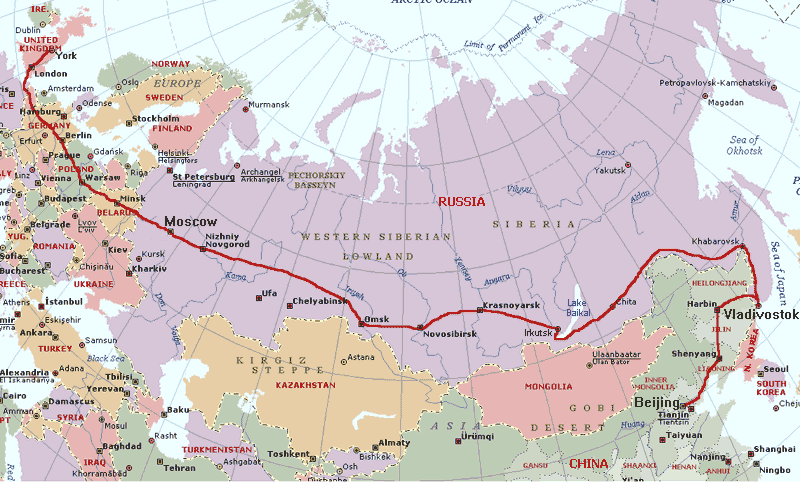
Via very circuitous circumstances, I ended up as a freelance journalist working for a Finnish magazine KotiPosti. Britta and I spent many months in 1969-1970 driving 30,000 miles all around around Australia finding Finns in the most amazing places doing the most incredible things, and me writing about them. Then I was invited to travel to Helsinki and in 1970, Britta and I decided to go to Finland via the Trans-Siberian Railway, all the way from Nakhodka in Eastern Russia, on the Sea of Japan, to Moscow, thence on to Helsinki. The route being via Vladivostok, Irkutsk (where we took 24 hours out to visit Lake Baikal), Novosibirsk, Moscow, St. Petersburg (Leningrad) and the short hop to Helsinki.
What on earth does this have to do with IBM? Hang on in there! 😉
We initially travelled from Australia to Japan because in 1970, Expo 70 was being held in Japan, and KotiPosti had asked me to write about the event. One of the most impressive stands at Expo 70 was the IBM stand. Frankly, it blew me away.
So now fast-forward to Britta and me having completed our stuff in Helsinki and on our way home to Sydney, via London of course, because I still had family in England. A couple of evenings after we had arrived at Preston Road, Wembley, where my mother’s house was, I read an advertisement in the daily evening newspaper, The London Evening Standard, (still going strong) that IBM UK Ltd, their office products division, were looking for salesmen. I had been so impressed with IBM at Expo 70 that I seemed unable to resist applying for the job. To my amazement, I won a place in IBM’s sales team and was with IBM for 8 years – we never returned to Australia.
Fast forward all the way to present times.
A while ago, I signed up to the Current and Ex-IBM Employee Group (Unofficial) on Linked-In. Yesterday, a member of that group published, The Original IBM Basic Beliefs for those that have never seen them. They really are worth sharing because how much better would our corporate world be if all businesses subscribed to these beliefs. Here they are:
ooOOoo
The Original IBM Basic Beliefs for those that have never seen them.
Respect for the Individual
===================
Our basic belief is respect for the individual, for his rights and dignity. It follows from this principle that IBM should:
1. Help each employee to develop his potential and make the best use of his abilities
2. Pay and promote on merit
3. Maintain two-way communications between manager and employee, with opportunity for a fair hearing and equitable settlement of disagreements.
Service to the Customer
===================
We are dedicated to giving our customers the best possible service. Our products and services bring profits only to the degree that they serve the customer and satisfy his needs. This demands that we:
1. Know our customers’ needs, and help them anticipate future needs
2. Help customers use our products and services in the best possible way.
3. Provide superior equipment maintenance and supporting services
Excellence Must Be a Way of Life
==========================
We want IBM to be known for its excellence. Therefore, we believe that every task, in every part of the business, should be performed in a superior manner and to the best of our ability. Nothing should be left to chance in our pursuit of excellence. For example, we must:
1. Lead in new developments
2. Be aware of advanced made by others, better them where we can, or be willing to adopt them whenever they fit our needs.
3. Produce quality products of the most advanced design and at the lowest possible cost
Managers Must Lead Effectively
=========================
Our success depends on intelligent and aggressive management which is sensitive to the need for making an enthusiastic partner of every individual in the organization. This requires that managers:
1. Provide the kind of leadership that will motivate employees to do their jobs in a superior way.
2. Meet frequently with all their people.
3. Have the courage to question decisions and policies; have the vision to see the needs of the Company as well as the division and department
4. Plan for the future by keeping an open mind to new ideas, whatever the source
Obligations to stockholders
=====================
IBM has obligations to its stockholders whose capital has created our jobs. These require us to:
1. Take care of the property our stockholders have entrusted to us.
2. Provide an attractive return on invested capital
3. Exploit opportunities for continuing profitable growth
Fair Deal for the Supplier
====================
We want to deal fairly and impartially with suppliers of goods and services. We should:
Select suppliers and according to the quality of their products or services, their general reliability and competitiveness of price.
1. Recognize the legitimate interests of both supplier and IBM when negotiating a contract; administer such contracts in good faith
2. Avoid suppliers becoming unduly dependent on IBM
IBM should be a Good Corporate Citizen
================================
We accept our responsibilities as a corporate citizen in community, national and world affairs; we serve our interest best when we serve the public interest. We believe that the immediate and long-term public interest is best served by a system of competing enterprises. Therefore, we believe we should compete vigorously, but in a spirit of fair play, with respect for our competitors, and with respect for the law. In communities where IBM facilities are located, we do our utmost to help create an environment in which people want to work and live. We acknowledge our obligation as a business institution to help improve the quality of the society we are part of. We want to be in the forefront of those companies which are working to make our world a better place.
Thomas J. Watson, Jr.
April 1969
ooOOoo
1969! Coming up to 45-years ago. Sometimes one wonders if society has learnt anything in the last five decades!
It’s fair to say that today’s guest author writes about a topic as far removed from yesterday’s eloquent post as one could imagine. Readers will recall that yesterday’s post from Georgiana was on the subject of Man’s best Friend. It was called Just love.
Today’s guest post is all about dog fences! As I said very different from Georgiana’s essay. Yet there is a link. Both guest posts are about dogs.
About a month ago, I received an email from a Rohit Agarwal offering to write “a well written and resourceful article on topic related to dogs.” When I discovered that the article was about underground fences, I was sceptical about the value of such an essay. Then when I read the essay it struck me as a very sensible topic; the one of keeping dogs safely within their own property.
I had no foreknowledge of Rohit, who described himself thus:
Author Bio: Rohit is a dog lover and pet enthusiast; he owns two adorable and wonderful dogs that include a German shepherd and a Labrador retriever. As work keeps him away from home, concerns arise about the safety and comfort of his pet friends, which made him try out various products that facilitate the same. Recently he was worried about leaving his dogs in the yard of his house and tried the underground fence for dogs, which worked great.
Rohit also made clear that he is a contributor to Petstek.com, the company behind the link in the last sentence of his bio. So here is the article.
ooOOoo
Five Reasons Why an Underground Fence is Right for Your Dog.
Most of us love the company of a cuddly and playful dog, as dogs are the considered to be the best pets since their very existence. While it’s great to keep the friendly and loyal canines in your house, one often needs to take care of the dog and protect them from their surroundings while still making sure that the dog gets adequate freedom within your house’s boundaries without it feeling like it has been incarcerated in a concrete prison. We all have tried using leashes, chains and cages, but we know that those methods to contain are not only old fashioned but also to a certain degree, inhuman, especially for the dog that is so friendly and loyal to you. Modern technology today has brought forth a new revolutionary technology called in-ground or underground fence for dogs.
The underground dog fence is a virtual fence which is installed using a special wire that is buried according to the perimeter you want to set for your pet. The wire is coded with signals, and a special collar is worn by the dog, as soon as the dog approaches the buried wire, the collar around its neck makes a warning signal, and as soon as the dog gets too close to the virtual fence, it receives a minor electric shock via the collar which is technically harmless to the pet. Let’s discuss the advantages of installing this system.
1. Freedom To The Dog
Well, we like to have our pets without leashes or chain bound, and we’re sure that no one gets a dog to keep it chained all the time, the underground fence not only provides the dogs adequate freedom of movement but also is more effective and ‘humane’ than chains and leashes. It’s a great solution for the busy pet owners who get a little less time to take their dogs for a walk, but one cannot keep the dog on a leash or in a cage all the time, making it an effective solution.
2. Cost Effective As Compared To Real Fencing
The underground fence for dogs is certainly more cost effective than installing a real fence, which in turn requires really expensive maintenance. Not to mention its increase in cost depending on the material you choose and the installation cost is just a cherry on top of the icing that can totally topple your budget into smithereens. To make sure your pocket doesn’t come between the relationship that you share with your dog, the underground fence is a great option to save you from the regret of ever adopting a pet.
3. A Perfect Solution For Zoning Laws
In many cities or townships there are zoning laws that prohibit you from building fences around your house. If not the laws, then many a times your beloved neighbour might not like you building huge fences around your house and is often backed by the neighbourhood associations. An underground fence for dogs is a great option to keep your loyal guard away from them nosey neighbours.
4. Protection For The Dog And The Environment
It not only keeps your dog protected from straying into places you wouldn’t want it to go, but also is a great solution to keep certain areas of the house such as pools and your wife’s kitchen garden protected and out of reach of the ever curious dogs. Especially from that trash can you don’t want your dog snooping around and creating a litter you might have to clean up. It’s also a great way to keep your neighbours who often complain about the dog strolling and littering their yard.
5. Well Hidden To Maintain The Look Of Your House
While fences might work great for some, most of the time they look ugly, especially when none of the houses in your neighbourhood have fences. The underground fence is a great solution to such a problem. It works as a virtual barrier to not only keep your pet protected from straying in the hostile outside world, but also maintain that great look of your beloved abode.
The underground pet fence with the aforementioned advantages is a great option to keep your pet safe and well contained while giving it freedom of movement which is entirely unhindered and free from any leashes, cages or visible boundaries as we all know that ‘happy pets make happy owners’.






 Learning from Dogs