Over the days of the 13th to 15th May, in other words roughly a week-and-a-half ago, a number of pet adoption charities in Northern California and Southern Oregon came together courtesy of PetSmart in Medford, Oregon to find new homes for unadopted dogs and cats.
I came to hear about this from an email sent to me by Tammy Moore of the organisation Shelter Friends. Tammy also c.c.’d her email to Tana Mason who is Fundraising Coordinator for the charity. Tammy’s email was an invite for me, and Jean, to attend the event on the Saturday as the author of my book.
(I would have written about the event before now but many of you will recall that was the weekend when my internet connection was down for a number of days.)
Anyway, that Saturday started off rather damp and grey but all the pet charities had previously been set up for the Friday.
But soon Jean and I had our own stand all ready for the opening time for the event and we were very grateful for being offered a table position just inside the main entrance door.
People soon started arriving and all were very friendly.
I shall continue with the photographs of the day over the next two picture parades.
But let me leave you with the results of all the fine people involved, both volunteers and the great staff at PetSmart.
In the words of Tana in answer to my question of how many animals were found homes:
I have the total for all three days, Friday, Saturday and Sunday: 9 puppies, 9 dogs and 14 cats!
I am not sure if this is a complete list of all the shelters that attended but certainly the following wonderful charities did:
Shelter Friends, Grants Pass, OR
Friends of Animals, Brookings, OR
Goliath Mountain Rescue, Yreka, CA
Rescue Ranch, Yreka, CA
Curry County Animal Shelter, Gold Beach, OR
It is not the first time that I have written on the theme of the importance of relationships. However, I am inspired by a number of separate and discrete outcomes in the last couple of days that compell me to return to this most important principle of all: We are what we think about most.
The first outcome was a lovely reply left by Hariod Brawn to yesterday’s post. This is what she wrote:
My GSD had hip dysplasia too, Paul – if that’s what you’re alluding to with Pharaoh. He still was able to die a natural death though, as his rear quarters became paralysed with the dysplasia and he felt no pain. There were plenty of other problems resulting from his immobility, but I wouldn’t have traded those difficulties and the incredible communication we shared as a result of them, for anything – his last few weeks were some of the most powerful and precious of my entire life.
Then after my response, Hariod went on to say:
It was a deeply profound time for me, and I honestly wouldn’t have believed anyone had they told me what I experienced, but experience it I did. It was not the product of fanciful imagination, much as it might sound so in words. The communication between the two of us was quite incredible, and which really was empathic in nature, in the deepest sense of the word. We always had great communication and understanding, which all dog lovers do with their charges, of course, but this was another level altogether. Some might call it ‘psychic’, as if that meant something mystical and woo-like, but it just means ‘of the mind’. The question is, does the mind have the psychical power to share in understanding across physical borders? You will doubtless know of J. Allen Boone:
I will return to that mention of J. Allen Boone at the end of the post.
Then later on there was a further reply to the post from Barb of Passionate About Pets :
Thanks for re-publishing Gina’s post here, I found it interesting because Poppy, my little shih-tzu is an old dame now – she will be 17 in two months time. She has developed serious separation anxiety in the last year and if I am working in the garden, she barks for me to get back inside even though my husband is inside with her – she wants us BOTH with her. She is weak in her back legs so her walks are shorter. All these signs of old age make me so sad. Just like you and Pharoah, old age is creeping up on us all.
A special thank you to Hariod for including that video clip of J. Allen Boone’s dog Strongheart and the very special connection they had; he was so wise about Strongheart’s qualities – they never die. It really resonated with me.
Thank you for a wonderful post.
You can see why I entitled today’s post Relationships!
Then earlier on in my day I had a call with Jon Lavin, a friend from my days when I lived in Devon, South-West England. Jon and I still speak on a regular basis and yesterday I was complimenting Jon on a wonderful post he had written on his own business blog The People Workshop.
Jon’s post was about relationships in the workplace, his area of professional experience, and I was struck by how far the messages were relevant to all of us, in all areas of our lives. But just as key it was another reminder of the importance of all of us who express themselves on blogs; both as authors and as commentators. Because those expressions make, build and maintain great relationships.
Jon’s post is republished here with his full permission.
When you look at how much of our lives we spend at work it’s really quite attention-grabbing. I did a very rough calculation based on 40 years and 40 hours a week – and I took out holidays and weekends. It works out approximately at 4900 hours. That’s a lot of hours, especially if you do lots of overtime and weekends. All of that time, you’re probably going to be mixing with people – usually, quite a large number of people.
We are ‘relationship seeking’, says Eric Berne, originator of Transactional Analysis. So for all of that time, we’re moving in and out of relationships with other people. So here, I’m categorising any interaction with another as ‘relationship’.
Then there’s what happens when we go home, another set of relationships, and where we came from – our parents and families.
So how we are in relationship with others is very important and has a major impact on the results we get generally and particularly in the context of this article, at work.
I hear a lot of talk about ’employee engagement’ at the moment. I believe that for employees to be ‘engaged’, so actively involved in what they’re doing, thinking about it, in the ‘here and now’, they’ve got to be in relationship with their manager and probably, the team they’re part of, at least, if the job is being done properly.
I see it as the role of the manager or team leader that they have the skills and ability to develop these relationships with as many team members as possible, any exclusions being the exception. This requires a lot of self-awareness and confidence, plus the ability to build high levels of trust with a wide range of character types. I think it also requires the ability to see the world from the view point of the other person – ‘putting yourself in somebody else’s shoes’, we say. That’s quite difficult to do in my experience. However, we can donate the time to get to know the people in our team and so increase the likelihood of all of us coming from the same angle.
I think this is about the ability to value the uniqueness of others in all the different forms and approaches that manifests in, and finding ways of harnessing those skills and abilities.
These are not easy things and I am aware of the relatively few, good people managers I come across in my work but it is possible to develop these skills. You need to have the intention to want the best from ALL relationships. Also, to be prepared to use the feedback we all get, especially when things don’t go to plan in a relationship, and be continually revisiting and adjusting your approach so that you get more of what works. This way, you automatically get less of what doesn’t work.
Never under estimate the power of intention.
Stormy seas
ooOOoo
I am now going to close today’s post with those words of J. Allen Boone that Hariod had in her second reply:
To echo Jon’s closing message, let us never cease our intention of having wonderful relationships; with our dogs, with others and, not least of all, with ourselves.
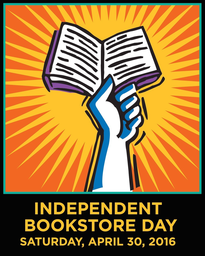
Advance notice of a book event this coming Saturday.
Oregon Books & Games, our local independent bookstore in Grants Pass, are having a book event this Saturday. In their own words:
Saturday, April 30th, 11AM – 2PM
A day to celebrate the independent bookstores that continue to improve communities around the nation, and our day to celebrate YOU, our wonderful customers. In the same strain as last year, we will be inviting dozens of local authors to sign books and meet with their fans, raffling off TONS of prizes, barbecuing, and having a lot of FUN!
I’m sure that the vast majority of you dear readers that read the title to today’s post would have nodded in agreement with the statement: You can’t beat a good book!
But how many of you were equally cogniscent of the importance of buying from an independent book store, such as Oregon Books & Games? I would be the first to put my hand up in admitting that I had no idea of the damage that online booksellers, such as Amazon, were causing these same independent stores.
Here are some eye-opening statements kindly supplied by Oregon Books but that originally came from the organisation IndieBound.
What is IndieBound?
A product of ongoing collaborations between the independent bookstore members of the American Booksellers Association, IndieBound is all about independent bookstores and the power of “local first” shopping. Locally owned independent businesses pump money back into the their communities by way of taxes, payrolls and purchases. That means more money for sound schools, green parks, strong police and fire departments, and smooth roads, all in your neighborhood.
Independent bookstores have always occupied a special place in communities. Through IndieBound—and the Indie Next List flyers and Indie Bestseller Lists—readers find trusted bookseller curated reading options, newly discovered writers, and a real choice for buying.
IndieBound allows indie booksellers to communicate this vital role they play in their local economies and communities. It allows authors to show their dedication to indies nationwide, easily done through linking to thousands of indie bookstores through IndieBound.org. And it allows consumers to feel that their actions are a part of a larger picture—to know that their choices make a difference and that others are working toward the same goals.
Here’s the effect of buying from your local independent book store.
Here’s What You Just Did
You kept dollars in our economy. For every $100 you spend at one of our local businesses, $52 will stay in the community.
You embraced what makes us unique. You wouldn’t want your house to look like everyone else’s in the U.S. So why would you want your community to look that way?
You created local jobs. Local businesses are better at creating higher-paying jobs for our neighbors.
You helped the environment. Buying from local business conserves energy and resources in the form of less fuel for transportation, less packaging, and products that you know are safe and well made, because we stand behind them.
You nurtured community. We know you, and you know us. Studies have shown that local businesses donate to community causes at more than twice the rate of chains and online retailers.
You conserved your tax dollars. Shopping in a local business district means less infrastructure, less maintenance, and more money available to beautify our community. Also, spending locally instead of online ensures that your sales taxes are reinvested where they belong—right here in your community!
You created more choice. We pick the items we sell based on what we know you like and want. Local businesses carry a wider array of unique products because we buy for our own individual market.
You took advantage of our expertise. You are our friends and neighbors, and we have a vested interest in knowing how to serve you. We’re passionate about what we do. Why not take advantage of it?
You invested in entrepreneurship. Creativity and entrepreneurship are what the American economy is founded upon. Nurturing local business ensures a strong community.
You made us a destination. The more interesting and unique we are as a community, the more we will attract new neighbors, visitors and guests. This benefits everyone!
And turning to Amazon?
Here’s What Amazon Just Did
In 2014, Amazon avoided paying $625 million in much-needed local and state tax revenue in 23 states and Washington, D.C., all while selling $44.1 billion worth of retail goods nationwide.
In 2014, Amazon’s retail sales displaced the equivalent of more than 30,000 storefronts and 107 million square feet of commercial space, estimated to be worth $420 million in property taxes for local and state governments.
In 2014, by avoiding sales tax, and quashing the viability of local bricks-and-mortar retail, Amazon deprived thousands of communities of tax revenue necessary for schools, roads, and police and fire safety, as well as of vibrant downtowns and main streets.
In 2014, Amazon operated 65 million square feet of distribution space, employing both full-time workers and part-time and seasonal workers, yet still, Amazon’s dominance produced a net loss of 135,973 retail jobs nationwide.
In 2014, Amazon’s sales and operations accounted for a loss of more than $1 billion in revenue to state and local governments.
Amazon received the benefits of local grants, tax breaks, road improvements, and other government considerations to build its distribution centers, notwithstanding the net loss in jobs, property taxes, and downtown vitality.
Amazon achieved dominance over the book industry equivalent to Standard Oil’s share of the refined oil market just before it was broken up in 1911.*
Amazon has cheapened the value of both printed and electronic publishing, and dampened opportunities for new authors and diverse ideas, by discounting books to lower than wholesale price and bullying publishers and its marketplace sellers.
In our state, Amazon accounts for a sale tax gap of $3.1 million and the displacement 1,200,000 square feet, which is the equivalent of 348 retail storefronts, and 3,029 jobs.
In 2015, Amazon’s total sales and operations revenue increased by 20%, meaning the above 2014 figures are likely to be grossly understated.
So back to the event.
If you are within reach of Grants Pass this coming Saturday then do come along and meet many local authors, including yours truly, and help support the wonderful job that our independents are doing for authors.
Saturday, April 30th, 11AM – 2PM
Oregon Books & Games
150 N.E. E St., Corner of 7th and E St.
Grants Pass, OR 97526
A few weeks ago I was speaking to Larry, one of our lovely neighbours who, as with me, is the wrong side of 65 (as with me, by quite a lump) and he was bemoaning how more quickly time seems to pass by the older one gets. It had never previously crossed my mind but in that instant I knew exactly what Larry meant.
For today I have been a Permanent Resident (aka Green Card holder) for precisely five years. And in seven months time I will be 72 years old. Where did it all go!
As you know, exercise is essential for your heart and overall health. Now, a new study published in the journal Medicine & Science in Sports & Exercise has quantified the powerful impact exercise can have on the length of your life.
For this study, researchers looked at data collected in the National Health and Nutrition Examination Study which included 3,000 participants ages 50-79. All of the study participants wore highly sensitive activity trackers, called accelerometers, for seven days. Then, they compared the participants’ activity levels with recorded deaths during the following eight years. What they found is that the participants who had the lowest level of activity were five times more likely to have died during the follow-up period than those participants who had the highest activity level. Those with the lowest level of activity were also three times more likely to have died than those who had moderate activity levels.
There’s no question that inactivity is a prominent risk factor for many health problems, and even minimal amounts of regular activity can have immediate benefits. Plus, for seniors the benefits of exercise go far beyond good cardiovascular health, increasing strength and flexibility so you can stay independent in your senior years.
What Type of Exercise Should You Do?
My answer is always the one that you will enjoy and stick with for the long-term—whether it’s walking, tennis, dancing, swimming or another activity you enjoy. My personal favorites are pilates and yoga, which are good for range of motion, flexibility, and strength.
But regardless of the type of activity you choose, here are some tips to get you started:
If you haven’t exercised in a long time and you have a medical condition such as osteoarthritis or cardiovascular disease, talk to your doctor about what kind of limits you may need to abide by. You don’t want to take on more than your body can handle. Also, consider having your feet checked for irregularities that require shoe inserts.
Start slowly and pace yourself. Should you experience shortness of breath or pain in your chest or arms, see your doctor as soon as possible. If you feel ill, stop. If symptoms persist after 3–5 minutes of rest, seek medical attention immediately. Symptoms may occur up to an hour after exercising, so be mindful of how you feel as you cool down and resume your regular activities.
The joints, ligaments, tendons, and muscles aren’t as forgiving as they were when we were younger, and they require an appropriate level of training. If you train with weights—even light ones—you must use correct form to avoid microtrauma and aggravation to joints. A personal trainer who is experienced in working with middle-agers and seniors can help with this. Long term, strengthening the muscles around ailing joints can help reduce pain.
Warning signs that you may be doing too much exercise include light-headedness or dizziness, palpitations, jaw pain, tingling or numbness in the arms, a tight feeling in the lungs, and shortness of breath (being unable to carry on a conversation).
And to close this post with nothing at all to do with exercise but everything to do with loving a dog, here’s a picture of Brandy taken on Tuesday morning.
Smallbatch Pets has announced it is voluntarily recalling a select lot of its Duckbatch Sliders frozen dog food because it may be contaminated with Salmonella and Listeria.
Smallbatch Pets Dog Food Recall of March 2016
March 26, 2016 — Smallbatch Pets Inc. is voluntarily recalling one lot of frozen dog Duckbatch Sliders due to their potential to be contaminated with Salmonella and Listeria monocytogenes.
The following image was copied in good faith by The Dog Food Advisor from Smallbatch Pets’ website and may not be a true representation of the recalled product.
What’s Recalled?
The affected products are sold frozen in 3 pound bags and can be identified with the following manufacturing codes:
Lot #: CO27
Best By Date: 01/27/2017
UPC: 713757339001
The “Best By” date is located on the back of the package below the seal.
Where Was the Product Sold?
Eighty cases of the affected lot of dog Duckbatch Sliders were sold between the dates of February 23, 2016 and March 10, 2016.
They were distributed to retail pet food stores in the following states:
California
Colorado
Oregon
Washington
About Salmonella and Listeria
Salmonella and Listeria can affect animals eating the products and there is risk to humans from handling contaminated pet products, especially if they have not thoroughly washed their hands after having contact with the products or any surfaces exposed to these products.
Healthy people infected with Salmonella and Listeria monocytogenes should monitor themselves for some or all of the following symptoms: nausea, vomiting, diarrhea or bloody diarrhea, abdominal cramping and fever.
Rarely, Salmonella and Listeria monocytogenes can result in more serious ailments, including arterial infections, endocarditis, arthritis, muscle pain, eye irritation, and urinary tract symptoms.
Consumers exhibiting these signs after having contact with this product should contact their healthcare providers.
Pets with Salmonella and Listeria monocytogenes infections may be lethargic and have diarrhea or bloody diarrhea, fever, and vomiting.
Some pets will have only decreased appetite, fever and abdominal pain.
Infected but otherwise healthy pets can be carriers and infect other animals or humans.
If your pet has consumed the recalled product and has these symptoms, please contact your veterinarian.
No pet or consumer illnesses from this product have been reported to date.
However, because of their commitment to safety and quality, Smallbatch Pets is conducting a voluntary recall of this product.
Consumers should also follow the Simple Handling Tips published on the Smallbatch Pets package, when disposing of the affected product.
What Caused the Recall?
This recall was initiated after routine testing by the Food and Drug Administration of a 3 pound bag of dog Duckbatch Sliders that was collected at a distributor revealed the presence of Salmonella and Listeria monocytogenes.
This recall is being made with the knowledge of the U.S. Food and Drug Administration.
What to Do?
Consumers who have purchased the above lots of dog duck sliders are urged to stop feeding them and return product to place of purchase for a full refund or dispose of them immediately.
Those with questions may call Smallbatch Pets at 888-507-2712, Monday through Friday, 9:00 AM to 4:00 PM PT. Or email the company at info@smallbatchpets.com
U.S. citizens can report complaints about FDA-regulated pet food products by calling the consumer complaint coordinator in your area.
The analogy with planting trees is very apt. For any clown can plant the tree but parenting that young tree into a mature forty-foot high beauty takes professional management.
That post had been inspired by a recent essay over at Patrice Ayme’s Thoughts regarding the observation by Andy Grove, the founder of Intel, that promoting start-ups without the commensurate focus on growing those start-ups into viable commercial concerns was strategically and politically incorrect. Back to that essay for a further extract:
However, American-based manufacturing is not on the agenda of Silicon Valley or the political agenda of the United States. Venture capitalists actually told me it was obsolete (before stepping in their private jets). That omission, according to Mr. Grove, is a result of another “unquestioned truism”: “that the free market is the best of all economic systems — the freer the better.” To Mr. Grove, or Mr. Trump, or yours truly, that belief is flawed.
Andy Grove: “Scaling used to work well in Silicon Valley. Entrepreneurs came up with an invention. Investors gave them money to build their business. If the founders and their investors were lucky, the company grew and had an initial public offering, which brought in money that financed further growth.”
The triumph of free-market principles over planned economies in the 20th century, Mr. Grove said, did not make those principles infallible or immutable. There was room for improvement, he argued, for what he called “job-centric” economics and politics. In a job-centric system, job creation would be the nation’s No. 1 objective, with the government setting priorities and arraying the forces necessary to achieve the goal, and with businesses operating not only in their immediate profit interest but also in the interests of “employees, and employees yet to be hired.”
As even the New York Times now admits, the situation has degenerated since 2010. Although the employment rate halved, in a slave state, everybody is employed. But neither the economy, nor the society, let alone progress and civilization are doing better.
“Insecure, low-paying, part-time and dead-end jobs are prevalent. On the campaign trail, large groups of Americans are motivated and manipulated on the basis of real and perceived social and economic inequities.
Conditions have worsened in other ways. In 2010, one of the arguments against Mr. Grove’s critique was that exporting jobs did not matter as long as much of the corporate profits stayed in the United States. But just as American companies have bolstered their profits by exporting jobs,many now do so byshifting profits overseas throughtax-avoidance maneuvers.
The result is a high-profit, low-prosperity nation. “All of us in business,” Mr. Grove wrote, “have a responsibility to maintain the industrial base on which we depend and the society whose adaptability — and stability — we may have taken for granted.” Silicon Valley and much of corporate America have yet to live up to that principle.”
If we return to that analogy of the tree, think how long and how much attention must be put into the conditions that will promote not only sustained growth of that young tree but growth to the point where it can propogate its own saplings.
As it is for young companies. The skills that company managers require to nurture that company to the point of self-sustaining maturity are many and varied. But they are underpinned by the need to be truthful and trustworthy, to be devoted to the employees of the company and to instill in all who work, and finance, that company to “love the customer”. Not just those customers that are the big spenders but also, and especially so, the many, many smaller clients that can make or break a company’s reputation.
So with that in mind let’s take a peek at USA LLC and UK Ltd.
Here are the closing paragraphs from Patrice’s essay:
Our corruption is not just an economic and social problem, a political problem, and a civilizational problem, as it was under Aristotle. It is a problem for the entire planet.
“We empowered a demagogue“, laments Mr. Kristof. His true calling, and that of the Main Stream Media, was to empower plutocrats, and their obsequious servants. How sad they are.
I like being outside the fray of party politics. I wasn’t born with a sufficient capacity for compromise to believe that any political party has all the answers to all questions. And yet, equally, I can admire those who can make the sacrifice to take part in this process. It is, for better or worse, at the heart of democratic politics.
That demands that it be done well. This requirement is predicated on three things. The first is a willingness to pretend you have the answer to all things. The second is a leadership that knows this is not true and which as a result respects its opponents. The third is an acute appreciation of the fact that compromise in pursuit of a higher goal, whilst saving face, is the ultimate political aim: nothing really happens without the accommodation of others.
He then closes his post:
Passion, dogma and steadfastness, come what may, are not what makes party politics.
Conviction based on wisdom, understanding and compassion does.
But these qualities remain in far too short supply, even if they’re not quite out of stock, yet.
And that’s the party political problem.
Many people both ‘sides of the pond’ would nod heads in agreement with that.
My final peek is into an essay that was recently published by the quarterly journal The Baffler. The essay was from David Graeber under the heading of Despair Fatigue. Opening:
Is it possible to become bored with hopelessness?
There is reason to believe something like that is beginning to happen in Great Britain. Call it despair fatigue.
For nearly half a century, British culture, particularly on the left, has made an art out of despair. This is the land where “No Future for You” became the motto of a generation, and then another generation, and then another. From the crumbling of its empire, to the crumbling of its industrial cities, to the current crumbling of its welfare state, the country seemed to be exploring every possible permutation of despair: despair as rage, despair as resignation, despair as humor, despair as pride or secret pleasure. It’s almost as if it’s finally run out.
and closing, thus:
Twenty-first century problems are likely to be entirely different: How, in a world of potentially skyrocketing productivity and decreasing demand for labor, will it be possible to maintain equitable distribution without at the same time destroying the earth? Might the United Kingdom become a pioneer for such a new economic dispensation? The new Labour leadership is making the initial moves: calling for new economic models (“socialism with an iPad”) and seeking potential allies in high-tech industry. If we really are moving toward a future of decentralized, small, high-tech, robotized production, it’s quite possible that the United Kingdom’s peculiar traditions of small-scale enterprise and amateur science—which never made it particularly amenable to the giant bureaucratized conglomerates that did so well in the United States and Germany, in either their capitalist or socialist manifestations—might prove unusually apt. It’s all a colossal gamble. But then, that’s what historical change is like.
In other words, it’s this!
One of the age-old maxims from professional company managers is:
It’s always a case of putting people before profits!
Putting people before profits should be in the front of the minds of all our leaders and masters; both sides of the ‘pond’.
Or in tree language investing in this:
An American Red Maple sapling.
to achieve this:
A mature American Red Maple tree.
Come on good people, we really do need healthy, mature trees in our 21st C. societies.
As regular followers of this place know (and a huge thank-you to you all) much of last Friday was spent planting trees in a grassy meadow just to the East of our house.
A part view of the area where the trees were planted: Kentucky Coffeetrees; Northern Catalpas; a Red Maple, Eastern Redcedars.
An hour before I sat down to write this post (now 13:30 PST yesterday) I didn’t have a clue as to what to write. Then I read Patrice Ayme’s latest essay and, wow, it punched me in the face. For it resonated so strongly with a few other recent readings.
“We empowered a demagogue” laments the New York Times ostensibly bleeding heart liberal, the kind Mr. Kristof, in his false “Mea Culpa” editorial, “My Shared Shame: How The Media Made Trump”. By this, Mr. Kristof means that Mr. Trump is a bad person. However, Mr. Kristof’s choice of the word “demagogue” is revealing. (Actually it’s not really his choice: “demagogue” is not Mr. Kristof’s invention: he just repeats like a parrot the most prominent slogan of the worldwide campaign of insults against Trump).
Trump a demagogue? Is Mr. Sanders a “demagogue”, too? (As much of the financial and right-wing press has it: for The Economist and the Financial Times, Trump and Sanders are both “demagogues” and that’s their main flaw.)
To understand fully the word “demagogue” one has to understand a bit of Greek, and a bigger bit of Greek history.
Then later on in that essay, Patrice goes on to quote Andy Grove:
A hard day may be coming for global plutocrats ruling as they do thanks to their globalization tricks. And I am not exactly naive. Andy Grove, founder of Intel, shared the general opinion that much of globalization was just theft & destitution fostering an ominous future (the Hungarian immigrant to the USA who was one of the founders of Intel). He pointed out, an essay he wrote in 2010 that Silicon Valley was squandering its competitive edge in innovation by neglecting strong job growth in the United States.
Mr. Grove observed that: …”it was cheaper and thus more profitable for companies to hire workers and build factories in Asia than in the United States. But… lower Asian costs masked the high price of offshoring as measured by lost jobs and lost expertise. Silicon Valley misjudged the severity of those losses, he wrote, because of a “misplaced faith in the power of start-ups to create U.S. jobs.”
Silicon Valley makes its money from start-ups. However, that phase of a business is different from the scale-up phase, when technology goes from prototypes to mass production. Both phases are important. Only scale-up is an engine for mass job growth — and scale-up is vanishing in the United States (especially with jobs connected to Silicon Valley). “Without scaling,” Mr. Grove wrote, “we don’t just lose jobs — we lose our hold on new technologies” and “ultimately damage our capacity to innovate…
The underlying problem isn’t simply lower Asian costs. It’s our own misplaced faith in the power of startups to create U.S. jobs. Americans love the idea of the guys in the garage inventing something that changes the world. New York Times columnist Thomas L. Friedman recently encapsulated this view in a piece called “Start-Ups, Not Bailouts.” His argument: Let tired old companies that do commodity manufacturing die if they have to. If Washington really wants to create jobs, he wrote, it should back startups.
Friedman is wrong. Startups are a wonderful thing, but they cannot by themselves increase tech employment.”
Spot on! For in my previous life I was the founder of two businesses. First up was Dataview Ltd, based in Colchester, that was formed in the late 1970s and soon became the global distributor of the word processing software Wordcraft, written by Englishman Pete Dowson. Dataview also initiated the ‘dongle’, a software/hardware security device to protect Wordcraft.
The Wordcraft dongle.
The second company founded by me was Aviation Briefing Ltd ‘AvBrief’ that is still going today, albeit with me no longer involved!
So I can reinforce, with hundreds of hours of lost sleep and tears, that growing a company and increasing employment, especially the employment of great technical people, is a very different matter to the start-up phase.
Frankly, regarding Dataview, it was only the luck of meeting Sid Newman that saved my bacon. For within 12 months of starting trading I was already sinking under the load of trying to be the number one salesman (that I was good at) and being the company general manager (that I was total crap at). Sid had years of experience at general management and very quickly let me get on with what I really loved – opening up Wordcraft distributorships all over the world.
The analogy with planting trees is very apt. For any clown can plant the tree but parenting that young tree into a mature forty-foot high beauty takes professional management.
Clown work! (This is a Red Maple, by the way!)
Tomorrow I will return and offer a viewpoint as to how we, as in society, are currently bereft of professional managers.
March 18, 2016 — Fromm Family Foods of Mequon, Wisconsin, has announced it is voluntarily recalling three of its canned dog foods because they may contain elevated levels of vitamin D.
What’s Being Recalled?
The company is recalling all lots of the following three Fromm Gold canned dog foods:
Fromm Gold Chicken Pate Dog Food
12 ounce cans
Can case code: #11893
Individual can UPC: 72705 11892
Fromm Gold Chicken & Duck
Can case code: #11895
Individual can UPC: 72705 11894
Fromm Gold Salmon & Chicken Pate
Can case code: #11891
Individual UPC: 72705 11890
The affected products were shipped to distributors between December 2015 and February 2016.
About the Recall
Fromm has discovered through its own analysis that the affected canned dog foods do not contain recommended levels of vitamins and minerals.
These products may contain elevated levels of Vitamin D.
According to the company…
The recall is being implemented in an abundance of caution as symptoms should only be noted in situations where dogs have eaten the affected products as their only meal for an extended period of time and leading to depression of appetite.
While there have been no reports of any health problems, Fromm is recommending the affected products not be fed.
The company has notified the FDA and has also invited distributors as well as The Dog Food Advisor to share the details of this event with consumers.
What to Do?
Recalled product may be returned to authorized Fromm retailers for a full refund.
Consumers with questions may call Fromm Customer Service at 800-325-6331. The company has added additional hours to assist dog owners during the recall.
U.S. citizens can report complaints about FDA-regulated pet food products by calling the consumer complaint coordinator in your area.
That last one was on December 3rd and concerned a recall for Dave’s Pet Food.
Well two days ago Purina announced a recall but it was only alerted by Dog Food Recall yesterday. Here are the details that you can also read here.
ooOOoo
March 10, 2016 — Nestle Purina has announced it is voluntarily recalling select lots of its Beneful and Purina Pro Plan wet dog foods because they may not contain the recommended level of vitamins and minerals.
Purina discovered through its own testing that the affected dog foods did not contain the recommended level of vitamins and minerals and voluntarily recalled the product.
What’s Being Recalled?
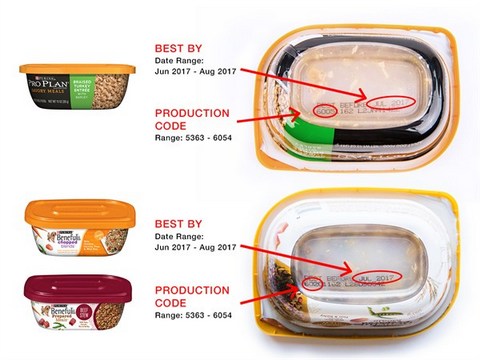
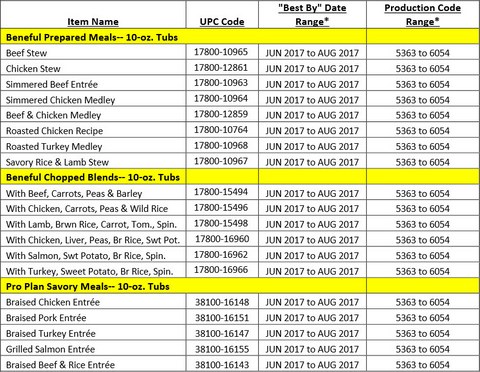
The recall includes select lots of wet dog food 10-oz. tubs under the Beneful Prepared Meals, Beneful Chopped Blends and Pro Plan Savory Meals brands.
No other Purina products or sizes are affected.
Lot Information
A complete list of included products by “Best Before” date and production code ranges are listed below:
What to Do?
Purina is conducting this voluntary recall as a precaution for those dogs who may have eaten the affected product as their only meal for more than several weeks.
If you have questions about your pet’s health, the company suggests that you contact your veterinarian.
Although most of the recalled product contains all of the vitamins and minerals your dog needs, Purina recommends that you discard any of the affected product you may have.
For more information or to request a refund, please call the company at 800-877-7919.
U.S. citizens can report complaints about FDA-regulated pet food products by calling the consumer complaint coordinator in your area.
To be honest, at a personal level I just don’t know the answer to that question. It seems to depend on the mood that Jean and I are in at any particular time. All I can fall back on is that well-used saying from me: “Never underestimate the power of unintended consequences”.
In other words, we shouldn’t underestimate the strength of millions of good people when their demands start reaching out to those in power. (And whatever your reaction to this post, please don’t miss watching the inspirational Al Gore speech towards the end of this post.)
Recently over on the Grist site there was an article about the critical changes that each and every one of us should be making. I want to share it with you in full.
ooOOoo
Want to fight climate change? Here are the 7 critical life changes you should make
A few months ago, the U.S. and 195 other countries signed this thing in Paris in which all parties involved kind of sort of agreed to stop messing with the world’s climate. It was very exciting.
So what if we, as Americans, were going to join in as individuals in order to help the U.S. meet its emissions goals? What would we do differently? Two researchers at the University of Michigan’s Transportation Research Institute, Michael Sivak and Brandon Schoettle, recently set out to answer those questions. (Here is the abstract of their report.) Their conclusion: The largest single source of greenhouse gas emissions is making things (industry, clocking in at 29 percent of greenhouse gas emissions). After that, there’s moving people and things around (transportation, 27 percent), then the energy we use at home (17 percent) followed by the energy used by non-industrial businesses (17 percent) and the energy used in agriculture (10 percent).
Most of this energy is stuff that you don’t have any control over: If you are looking at a row of lawn chairs at the store, you don’t have any way of knowing how much energy it took to produce each one. You cannot, on a personal level, decide to have your contact-lens solution delivered to your local pharmacy by cargo bicycle instead of long-haul trucker.
So, given the imperfections of this world, what is a lone wolf such as yourself to do? Here are some conclusions gleaned from this study:
1. Buy the most fuel-efficient car you can afford, then drive it as little as possible
You might notice that Sivak and Schoettle don’t even consider the option of going without a car — even though their own graph suggests that, if having an efficient car is good, having none at all is even better:
To be sure, many people live in cities and work at jobs where living without a car is virtually impossible — and these are the people who this report is written for.
Currently, the average car on the road gets about 21.4 miles per gallon. If that went up to just 31 mpg, Sivak and Schoettle claim that the amount of carbon that the U.S. emits would drop by 5 percent — as long as we didn’t go crazy and drive a lot more. If the average fuel economy rose to 56 mpg, total U.S. emissions would be reduced by 10 percent.
That said, I would like to see Sivak and Schoettle have a conversation with my (very nice) Motor City-born mom about why she should get the most fuel-efficient car she can afford when she loves her damn Jeep and gas right now is less than $2 a gallon. Since they both live in Michigan, maybe they have already.
2. Drive your fuel-efficient car until it’s so old that it turns into dust — actually, use everything you own for so long that it turns into dust
The average age of a car on the road right now is 11.5 years. The average 3,000-pound car takes the equivalent of 260 gallons of gasoline to make. It’s not like you can compare among different manufacturers to see which one is the most energy-efficient carmaker any more than you can compare lawn-chair makers or cellphone manufacturers.
But unless you’re trading it in for something that is significantly more energy efficient than what you have already, keep the old stuff around. That goes for cars, clothes, shoes, remodeling your kitchen, and so on and so forth. There is no law requiring you to buy a new cellphone every two years, and though that’s what we do in the U.S., in other countries people keep them much longer.
3. Drive your fuel-efficient car like it is a leaf on the breeze
According to Sivak and Schoettle, frequent hard stops and rapid acceleration have a dramatic effect on fuel efficiency. They assume that the average driver can reduce overall fuel consumption by 5 percent by chilling out a little while driving. Also: Since engines don’t use gasoline efficiently past a certain speed, a hypothetical driver could reduce emissions even more by never driving faster than 61 mph.
I will also say that, based on my experience growing up with a dad whose default driving speed was about 60, driving at that speed on many U.S. highways and backcountry roads is going to piss a lot of people off. They will honk, tailgate, flash their brights at you, and jokingly and not-so-jokingly pretend like they’re about to run you off the road when they do pass you. It’s a little harder to maintain zen composure under those circumstances, but that will just make those times that you do accomplish it even more impressive.
4. Fly coach
Or, well, don’t fly at all. But when taking a train from SF to NY takes four days, and flying takes about six hours, it’s not hard to see why a lot of people fly. In some cases, flying can produce less emissions than driving (if you drive alone — not if you take a train or the bus).
There’s also some information out there about which airlines are the most fuel efficient. (Spoiler: This more or less correlates precisely with which carriers pack flyers in like sardines and make them pay extra to check their bags.)
5. Fly nonstop
Planes use a disproportionate amount of fuel during takeoff, so minimizing the number of takeoffs is relatively easy (if more expensive). If you need to take a connecting flight, choose the option that gives you the least number of miles traveled.
6. Turn down the thermostat
Right. And put on a sweater. While people who use air conditioning inspire all those summer energy conservation think pieces, according to Sivak and Schoettle’s stats, it’s heating the air and water around us to a temperature that we like that is the greater problem.
7. Eat low on the food chain
Sivak and Schoettle cite stats (published in Climatic Change in 2014) suggesting that the average vegetarian diet produces 32 percent lower emissions than the average omnivore diet. Are there ways around this? Sivak and Schoettle don’t get into this, but yeah, it gets complicated. Some processed vegetarian food has a pretty hefty carbon footprint, and if you live somewhere with an abundant white-tailed deer or squirrel population, you’ve got some low-carbon meat nearby. Still, this is about averages, not your Hunger Games lifestyle.
Sivak and Schoettle also suggest that we all try reducing our collective caloric input by 1 percent, eating 25 fewer calories a day (if we’re men) or 20 fewer a day (for women) — about a tablespoon of hummus, or a single egg white, if you even think measuring things in calories makes sense (I don’t). Their excuse? “Given that 69 percent of American adults are overweight (CDC, 2015), most of us could safely lose some weight.” Dudes. Really. The low-carbon agricultural revolution will not come any faster because you fat-shamed America.
So: I have read a lot of reports like this one before. This one is particularly weird, though, because it focuses so much on personal choice, and ease of that choice. And because its definition of “ease” makes no sense.
As Sivak and Schoettle put it:
This study did not exhaustively examine all possible actions that an individual can take to reduce greenhouse gas emissions. The emphasis was on selected actions that do not require substantial effort and time, do not require much in the way of changing one’s lifestyle, and are relatively easy to quantify in terms of their effects. Examples of actions not considered are increasing home insulation (takes both substantial effort and time), eliminating the use of drive-through banks and restaurants, and thus eliminating the associated idling (requires a change, albeit small, in one’s lifestyle), and buying locally sourced products (effects are not easy to generalize because they vary from product to product).
I’m not quite sure what to make of the fact that the study’s authors have somehow decided that going vegetarian, or figuring out how to consistently eat a tablespoon less of hummus than you usually do, is less arduous than parking your car, getting out of it, and going into a building to order food.
Let’s take this study at face value. What can a hypothetical person do to cut emissions easily, when they are not trying very hard to do anything? The answer to that question is, by far and away, this one: Buy a more fuel-efficient car.
But here’s the thing. The only reason we have fuel-efficient cars to buy is because of political pressure, rather than individual choice — the first Corporate Average Fuel Economy (CAFE) standards were created by Congress in 1975. The newest CAFE standards, which are intended to get the average mpg up to 54.5 mpg by 2025, were the result of hard bargaining — and an auto industry that had been weakened by the recession. At the time that the standards were finalized in 2005, only two cars (the Chevy Volt and a thing called a Ford Focus BEV FWD) met that standard — even the much-hyped Toyota Prius didn’t qualify. Now there are a handful that get nearly double that — but the average mpg of cars sold actually fell slightly between 2014 and 2015, probably because of lower gas prices.
Meanwhile, for way too long, the low-income people with long commutes who would have the most practical incentive to drive a fuel-efficient car have been locked out of the market for one, even as the current housing status quo pushes them farther out into the suburbs. Individual choice only goes so far: Sometimes you need the whammy of regulation to change the available options before you can get to the point where you have a choice.
On paper, it’s totally possible for the U.S. to transition to lower carbon emissions and still have a strong economy. But looking at the numbers alone leaves out the huge political and social obstacles — angry oil barons, stick-in-the-mud utilities, car companies that would rather roll out old models than develop new tech — that have to be overcome to make that happen. You can’t buy fuel-efficient vehicles until companies are under pressure to actually make them — and to make them affordable. You can’t reduce the amount of time you spend driving unless your city or suburb actually has the infrastructure (sidewalks, transit, zoning that allows jobs and housing and shopping to coexist) that makes such changes possible.
Climate change is not something that we can conserve our way out of individually or easily. As Maggie Koerth-Baker put it in her excellent book Before the Lights Go Out, if we Americans were going to conserve our collective way out of climate change, we would have to reduce our emissions to less than one ton per person. While one ton seems like a big number, getting to it is much harder than it sounds:
One ton of greenhouse gas emissions buys a year’s worth of heat for one average home in the United States … That’s not including electricity, clothes, food, or transportation. Do you travel a lot for business? Maybe you could spend your one ton of emissions on airline flights instead. On that yearly budget, you can afford to fly 10 thousand miles in coach. Of course, again, that leaves you with no food to eat, no clothes to wear, and no house to come home to.
Getting to less than a ton per person — in the U.S., anyway — would involve a level of change that hasn’t been seen since WWII. Back then, tires, automobiles, typewriters, bicycles, gasoline, sugar, coffee, meat, cheese, butter, firewood, and coal were all rationed. Factories stopped making consumer products and concentrated on the war effort.
The national speed limit was set to 35 mph to conserve fuel. All forms of automobile racing were banned. Driving for “sightseeing” was banned. Special courts were set up to deal with those who broke the law — people who were found to be driving “for pleasure” had their gasoline rations taken away.
I’m not suggesting we go full WWII on climate change. (For one thing: We had more trains then. For another thing: We could get a lot done with just a Cold War approach.) What I am saying is that, yes, we can change our individual ways — and we should. But with a problem as big as climate change, we shouldn’t pretend that we can go it alone.
For example, that half of all urban water consumption is spent on landscaping seems to have sunk in, as has a greater appreciation for the hardiness of lawn grass. In Northern California at least, lawns that went brown in the summer and fall are now green — following the natural cycle of the foothills.
“It is hard to kill grass,” Marcus said. “And while I don’t think in the long run it’s realistic to think people are going to keep their lawns brown forever, I do think folks have learned they don’t need as much water as they have been dumping on them.… So that is a real ‘aha’ for people.” [Ed: Marcus refers to Felicia Marcus, chair of the state water board.]
Also demonstrated through eight months of mandatory cutbacks is that reducing consumption by nearly 25% is doable — a mark Marcus feared would be unattainable when the order went out.
Marcus grows most animated when discussing a movement underway at many local agencies up and down the state — one aimed toward integrating traditional water delivery with enhanced recycling, storm-water capture, underground storage and the like.
To conclude my proposition that only an optimistic attitude is going to sort this out for our heirs let me close with this recent TED Talk given by Al Gore. Mr. Gore supplies all the power we need to be optimistic about the future.
Al Gore has three questions about climate change and our future. First: Do we have to change? Each day, global-warming pollution traps as much heat energy as would be released by 400,000 Hiroshima-class atomic bombs. This trapped heat is leading to stronger storms and more extreme floods, he says: “Every night on the TV news now is like a nature hike through the Book of Revelation.” Second question: Can we change? We’ve already started. So then, the big question: Will we change? In this challenging, inspiring talk, Gore says yes. “When any great moral challenge is ultimately resolved into a binary choice between what is right and what is wrong, the outcome is foreordained because of who we are as human beings,” he says. “That is why we’re going to win this.”
Do drop across and consider joining. Because by so doing you will become, “… part of a growing community of millions of people worldwide who have come together in support of taking urgent steps to halt the growing climate crisis.”
Let this be the time of all of our lives where we say, “Enough is enough”, and vote and act, both individually and collectively, for positive change!
 I came to hear about this from an email sent to me by Tammy Moore of the organisation Shelter Friends. Tammy also c.c.’d her email to Tana Mason who is Fundraising Coordinator for the charity. Tammy’s email was an invite for me, and Jean, to attend the event on the Saturday as the author of my book.
 But soon Jean and I had our own stand all ready for the opening time for the event and we were very grateful for being offered a table position just inside the main entrance door.
 People soon started arriving and all were very friendly.






 To be sure, many people live in cities and work at jobs where living without a car is virtually impossible — and these are the people who this report is written for.
 Sivak and Schoettle also suggest that we all try reducing our collective caloric input by 1 percent, eating 25 fewer calories a day (if we’re men) or 20 fewer a day (for women) — about
  Learning from Dogs