Category: Art

To the Sea of Cortez.

Journey to the Sea of Cortez.

John Steinbeck
John Steinbeck

I feel very guilty as I didn’t make a note of where I came across this film.  Whoever highlighted the film, thank you!  It’s truly beautiful.  So, please, settle yourself down and be enthralled.

In March 1940, the author John Steinbeck and his friend, marine biologist Ed Ricketts, sailed down the coast of California and Mexico to the Sea of Cortez. “The abundance of life here gives one an exuberance,” they wrote, “a feeling of fullness and richness.

Their stated purpose was to document the creatures that inhabit shallow waters and tide pools on the margins of the Sea of Cortez. But it became much more. In these mysterious, phosphorescent waters they sought an understanding of mankind’s relationship to the natural world and a wellspring of hope for a world headed toward war.

Looking beyond the events of the day, the two friends foresaw our rising impact on the oceans and the devastating impact that over fishing would have on this rich sea. And yet, in their journey, they encountered a periodic cooling of the eastern Pacific Ocean known as La Niña that can still set off an explosion of life.

Can the story of their journey inspire new efforts to preserve the Sea of Cortez? Down along the shores of western Mexico, the wind blows hot and dry. Beyond these barren landscapes, cold currents rush up from the deep and the ocean literally boils with life.

Following their journey down to the Sea of Cortez in March of 1940, John Steinbeck and Ed Ricketts searched for a way to describe what they saw. “Trying to remember this place,” they wrote, “is like trying to re-create a dream. It is fierce and hostile and sullen. The stone mountains pile up to the sky and there is little fresh water. But we know we must go back if we live, and we don’t know why.

The Sea of Cortez is one of the most diverse marine ecosystems on the planet. It’s shaped by the cool waters of the California Current flowing into the warm tropics and by a complex undersea terrain that rises up along a chain of islands and sea mounts. It was the shorelines, between the desert and the deep, that drew John Steinbeck, the author, and Ed Ricketts, a marine biologist and expert on coastal ecosystems.

Ricketts’ book, “Between Pacific Tides,” is a classic study of the inter-tidal zones of the California coastline and the myriad creatures that live in shallow pools, clinging to rocks to sift the rich nutrients carried in by the tides. Steinbeck and Ricketts sought to extend this work to the Sea of Cortez and to explore ideas at the core of their friendship. They shared a belief that man’s fate, like that of the animals they saw, is linked to the health of the natural world. [Ed. my emphasis]

Ricketts is said to have inspired some of Steinbeck’s most memorable characters, including Doc in Cannery Row, and the preacher Jim Casy in The Grapes of Wrath, published a year before their voyage. Set against the backdrop of drought and economic depression, the book describes the dustbowl conditions that gripped the American heartland in the 1930’s. “Now the wind grew strong and hard and it worked at the rain crust in the corn fields. Little by little the sky was darkened by the mixing dust, and carried away. The wind grew stronger. The rain crust broke and the dust lifted up out of the fields and drove gray plumes into the air like sluggish smoke.

In most years, southerly winds carry moisture into the midsection of the country from the Gulf of Mexico. In the 1930’s, according to a recent NASA study, those winds were diverted by a build up of warm water in the Western Atlantic and by a periodic cooling of the Eastern Pacific known as La Niña. This combination robbed the region of rain.

By the time Steinbeck and Ricketts began their journey, the historic backdrop had shifted to war. Fighting had engulfed Europe and was spreading to the western Pacific. While the United States was still officially neutral, American companies had begun supplying arms to the allied effort. In early 1940, John Steinbeck used money he earned from “The Grapes of Wrath” to hire a sardine boat called the Western Flyer. From Monterrey, California, he, his wife Carol, Ed Ricketts and a four-man crew headed south, charting a course along the Mexican coastline.

By all accounts, the journey was filled with adventure, camaraderie, and a sense of wonder at the diversity of living things they encountered. Over a six-week period, the two friends wrote journal entries, took notes on conversations, and catalogued specimens they collected on the way. They compiled these writings into a book: “Sea of Cortez, A Leisurely Journal of Travel and Research,” later changed to “The Log From the Sea of Cortez.”

The work amounts to a search for a way to understand nature, and humanity at large, in a world steadily coming apart at the seams.

Ed Ricketts
Ed Ricketts

The film was released last Feb 28, 2013. Directed by Thomas Lucas, the Producers were John Friday, Thomas Lucas and Adam Ravetch.

oooOOOooo

Will end with a couple of personal reflections.  First is that when I was invited out to Mexico for Christmas 2007 by Suzann and Don, I travelled to San Carlos, Mexico on the Eastern shores of the Sea of Cortez.  San Carlos is a little under 300 miles south of the Arizonan border with Mexico and was where Jean had been living for many years.  Meeting Jean changed my life forever!  Here’s a picture of the Sea of Cortez through the rear door of Jean’s house in San Carlos.

Not the longest walk in the world to the beach!

Second reflection is about dogs. Jean had spent many years rescuing Mexican feral dogs and finding homes for them; hundreds of them over her time in San Carlos.  We brought 13 of those dogs with us when we moved to Arizona and 9 came to Oregon.  Below is Hazel, one of the five remaining Mexican ‘rescue’ dogs that are still with us in Oregon.
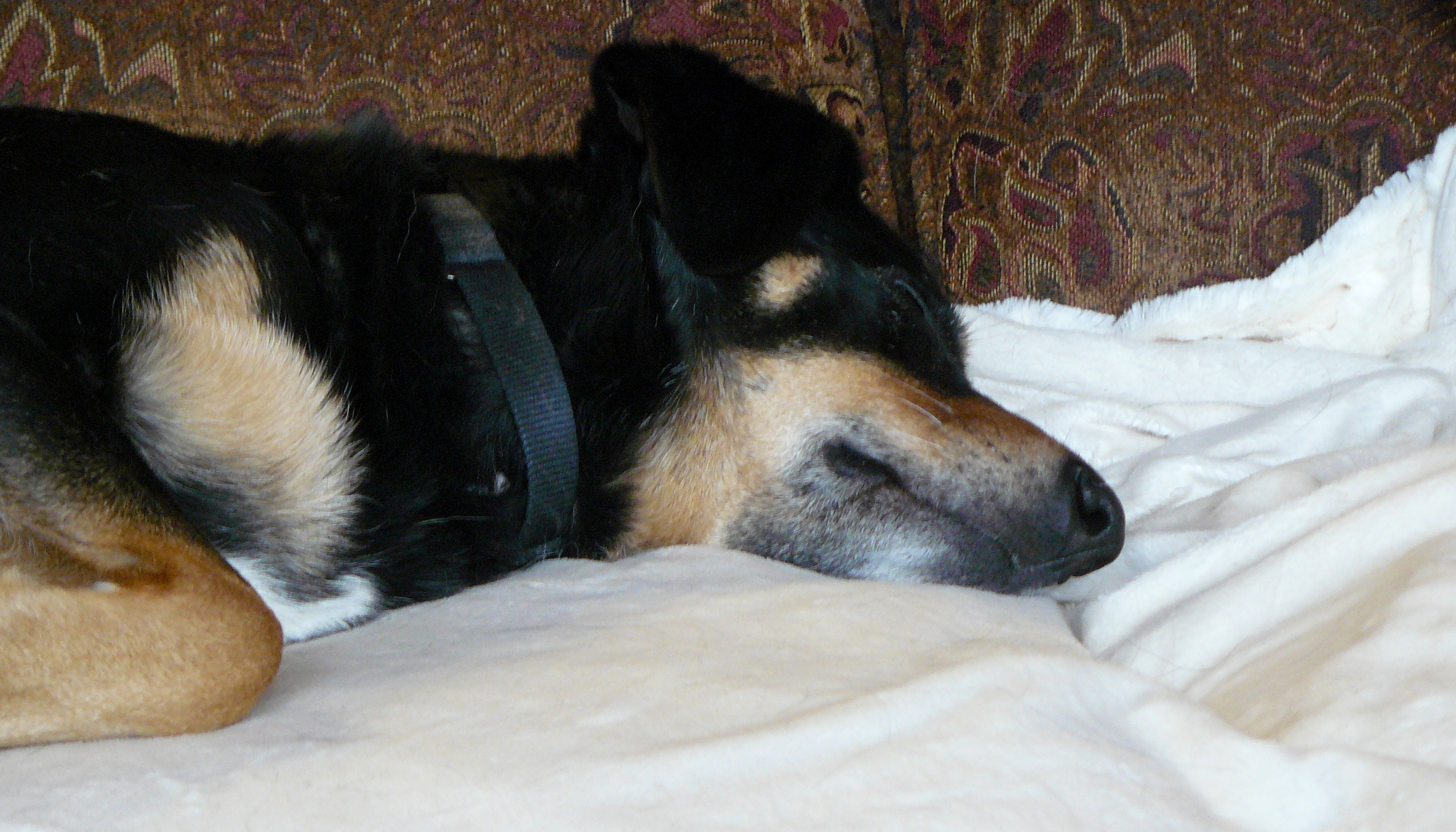
Hazel doing what she does so well - sleeping.
Hazel doing what she does so well – sleeping.

Fancy lending a hand?

A new animated short film from Lucas Martell, the creator of Pigeon: Impossible.

Back on the 4th December, 2011 I published a post under the title of Pigeon: Impossible.  Here’s some of what I wrote:

A truly remarkable example of the level of film animation being produced.

The second item that came to me from Bob D. (yesterday’s is here) has clearly done the rounds; the YouTube video has been watched nearly 7 million times!  But if you haven’t seen this short film, just over 6 minutes long, then do watch it.  It shows just how close to reality film animation has become!  The story behind the film is from here, reproduced below.

Pigeon: Impossible is the tale of Walter, a rookie secret agent faced with a problem seldom covered in basic training: what to do when a curious pigeon gets trapped inside your multi-million dollar, government-issued nuclear briefcase.

The film took nearly 5 years to complete and is the first attempt at animation by writer/director Lucas Martell: “When the project started, it was mostly an excuse to learn 3D animation, but by the end of the project I had spent so much time reworking and polishing the story that I just wanted people to laugh.

The end-result is a hilarious 6-minute romp through the streets of Washington D.C. as our hero fights to save himself, and the world from the chaos reigned down by a hungry pigeon. Breathtaking visuals and a sweeping soundtrack showcase the work of nearly one-hundred talented artists and musicians, and the film stands as a testament to what can be accomplished by a team of dedicated volunteers working for the love of their craft.

Personally, I think that last sentence is still an understatement.  Just watch this – and be amazed.

If you haven’t seen the film then you can watch it here.

Anyway, yesterday Lucas Martell left a comment to that post, as follows:

Lucas Martell
Lucas Martell

Hi, I’m the creator of Pigeon: Impossible and am so glad you enjoyed the film! We’re trying to finish our next animated short, and would love it if you could check it out and help us spread the word.

Thanks!

It seemed a worthwhile thing to do just that.  That next animated short is called The OceanMaker. Enjoy 4 minutes of it:

This is the website associated with the venture that explains more and also gives details of the way you can financially support the project, starting from as little as $10.  The website is great fun! (I couldn’t resist republishing the following)

oooOOOooo

About the Film

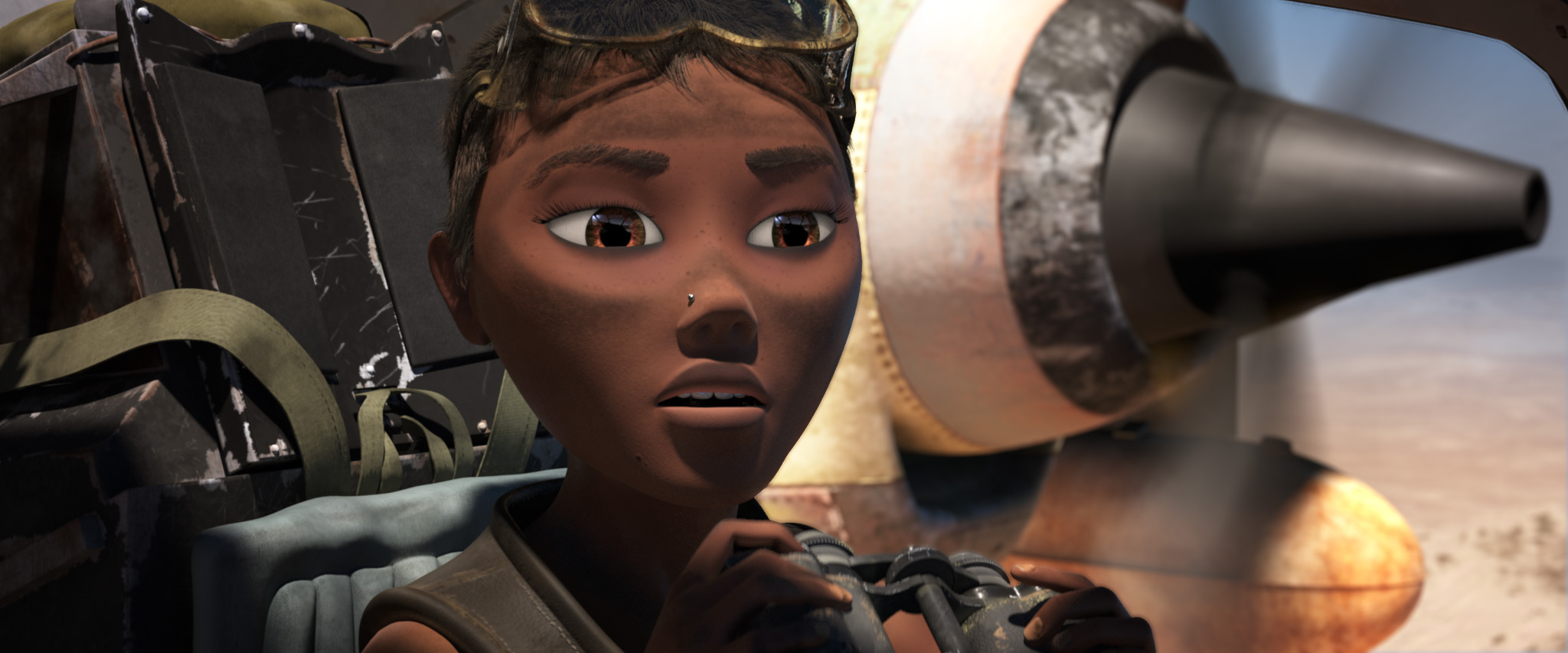
The OceanMaker is a 9-minute animated short film that takes place after Earth’s oceans have disappeared. It tells the tale of one courageous pilot who fights against vicious sky pirates for control of the last remaining source of water: the clouds.

OceanMaker1

From a visual standpoint, we’re steering away from the air pirates often found in steampunk and going straight-up “Mad Max” in the sky. The film is packed with old, beat-up planes that have been cobbled together from spare parts found in airplane graveyards.

OceanMaker2

Tonally, The OceanMaker is filled with exciting action, but the ending is emotional and powerful in a way that even feature-length films rarely achieve. The film also contains no dialogue, which means that the visuals and soundtrack need to be top notch in order to tell this story properly.

Finally, this film is unique in that it’s a complete story which stands on its own as a self-contained short film, but it’s also part of a even larger, more epic tale. Contributing to this project means a double dose of good karma, as you’re not only helping us complete the short, you’re getting us one step closer to making the feature! Our sights are set high and it’s going to be an amazing ride. We hope you’ll come along and share the adventure with us!

Goals

  • $10,000 – We can finish the models! – At the moment we have our hero models finished, but the story requires several other assets in order to set up the world and show how the loss of the oceans has affected life on earth. At $10,000, we’ll be able to bring on two model/texture artists to finish these assets.
  • $20,000 – We can finish the animation! – Animation is about 70% completed, but the remaining shots are the most challenging ones in the film. We’ll need two animators to bring these awesome shots to life!
  • $30,000 – We can finish the lighting! – Lighting and rendering are what make things pretty. It’s also a very technically challenging process, with each frame taking about an hour to render. At 24 frames per second, that’s just under 13,000 frames!
  • $40,000 – We can finish the film! – The last major step is the effects. In a word: clouds. They’re very tough to do right, and they’re pretty important for this whole story to work. Plus, these aren’t just static clouds in the background. We’re flying through them, scooping them up and making them grow!
  • $50,000 – Post Production! – This first stretch goal would allow us to hire a professional sound designer, as well as doing the final mix, color correction and output in a proper studio. This is crucial in order to submit the film to festivals and put it up on the big screen. If we reach this stretch goal, then all donors will also recieve a PDF copy of the script!
  • $60,000 – Live orchestra! – With this stretch goal, we could record Chris Reyman’s amazing score with a real live orchestra. This would be HUGE, as the film is extremely reliant on music, and the production value will increase dramatically. All donors at every level would receive a DRM-free copy of the score.
  • $70,000 – Expanded cast! – One thing that will make the film even better, is a second character. We already have a temporary version of that character in our animatic, but she’s very difficult to create and quite expensive for the few shots she’s in. However, that small addition would take the emotion and complexity of the story to a whole new level.
  • $80,000 – $100,000 The OceanMaker extended universe – As you can imagine, the OceanMaker is a really BIG story… too big to fit entirely within a short, but we’ve done an excellent job capturing the essence of it in a way that feels complete and stands on its own. However, if we hit $80,000, we can start to explore this broader story. This would be in the form of a graphic novel that delves deeper into the world both before and after the short film. The higher into this range we get, the longer this graphic novel could be and the more of the expanded story we could tell. Donors at every level would get a free digital copy of the graphic novel.
  • $100,000 and up – Feature!!! – OK, I realize we’re really reaching for the stars here, but you don’t do something like this without being a dreamer. If we somehow manage to reach the 100k mark, we’ll be able to start working on the feature film! It would be based in part on the content from the extended universe. The first step would be a treatment, then a script, then visual development and finally an animatic. Should we be able to complete any of these stages with money raised from this campaign, all donors will receive a digital copy of the completed work. You can take a sneak peek or remain unspoiled, but its the least we can do if your hard-earned dollars end up funding development of the feature.

oooOOOooo

So I hope you can contribute whatever you can afford.

Oh, and I should make it clear that neither Jean nor I have any financial or commercial connection with the project.

Golden moments!

A beautiful photograph found on Facebook

Very grateful to Chris Snuggs for forwarding this to me.

dog reading

As Chris pointed out in his email, “I have to say that the dog doesn’t look too excited, but is nonetheless paying polite attention ….

May all our days have golden moments of peace and love.

It really is a very simple message!

Repeat after me: We are of this planet!  It’s really very simple!

There are times when I look back at my writings on Learning from Dogs, now well over 1,500 posts (1,633 as of today, to be anal about it!) and ponder if the fundamental message behind the name of the blog often gets overlooked.  The Welcome page states:

As man’s companion, protector and helper, history suggests that dogs were critically important in man achieving success as a hunter-gatherer. Dogs ‘teaching’ man to be so successful a hunter enabled evolution, some 20,000 years later, to farming, thence the long journey to modern man. But in the last, say 100 years, that farming spirit has become corrupted to the point where we see the planet’s plant and mineral resources as infinite. Mankind is close to the edge of extinction, literally and spiritually.

Dogs know better, much better! Time again for man to learn from dogs!

Elsewhere on the blog, I underpin that proposition by listing the attributes of dogs:

Dogs:

  • are integrous ( a score of 210) according to Dr David Hawkins
  • don’t cheat or lie
  • don’t have hidden agendas
  • are loyal and faithful
  • forgive
  • love unconditionally
  • value and cherish the ‘present’ in a way that humans can only dream of achieving
  • are, by eons of time, a more successful species than man.

Now this is all fine and dandy but of what relevance is this to the mess that homo sapiens now finds itself in? Two parts to that answer come to mind.

The first part is that watching a dog out in the open countryside quickly brings home the fact that these animals are part of nature and, if push comes to shove, can live in the wild and fend for themselves.  Not saying that a domestic dog would enjoy the experience but that their wild dog and grey wolf roots still rest somewhere in a dog’s consciousness.

The second part of the answer is that all animals instinctively live in harmony, in balance, with their surroundings; with their environment.

For the incredibly obvious reason that dogs, as with all other animal species, are an evolutionary consequence of the natural history of Planet Earth.  That evolutionary journey from the Grey Wolf (Canis lupus) part of the Canidae family, a family including wolves, coyotes and foxes, thought to have evolved 60 million years ago.  That journey all the way to the domestic dog (Canis lupus familiaris).

That ancient journey where the African wild dog (Lycaon pictuspainted dog) came together with early man. No one knows when but the African wild dog was certainly around when man developed speech and set out from Africa, about 50,000 years ago!

Two vastly different natural species, dog and man, evolving compatibly with each other for so many thousands of years.

Back to the attributes of dogs, in particular a dog’s ability to cherish the present.  Earlier this week I was chatting with Kevin Dick, friend from Payson, AZ days, about the ‘interesting’ times we are living in.  Kevin thought there was a significant difference between the generations born in the 1940’s and 1950’s and those born in later times.  Most people over the age of, say 55, were brought up to save for ‘a rainy day’ and, possibly, be able to leave a legacy to their offspring.  Kevin then went on to reflect that more recent generations exhibit a ‘buy today, don’t delay’ mentality.

A by-product of this materialistic instant gratification approach is that the whole damn consumer machine has created a total disconnect with the fact that we humans are of this planet.

The earth is the mother of all people..

(Chief Joseph 1840 – 1904, leader of the Wallowa band, a Native American tribe

indigenous to the Wallowa Valley in northeastern Oregon)

Humans today fail to comprehend this fundamental fact: Our ability to harm the planet and think that it won’t affect our species is complete madness!  If only we could learn how to cherish the present in the way that our dogs do!

I’m now going to offer an essay from John Hurlburt.  I knew John had written this essay but didn’t get round to reading it properly until I had finished the introduction above.  I’m blown away by the resonance between the two but, as always, John’s words are so much more eloquent.

Inside Out

Climate change, religion, economics, government, politics and social issues are topics which create strong personal opinions and cultural divisions. We have difficulty accepting ideas which may conflict with our personal understandings. As usual, it’s an ego thing. The arrogance of our species is inclusive. We all suffer the consequences.

To counter our ego, we know that everything fits together. We exist in a unified cosmos with fluctuations and diversities that emerge around and through us.

Our present transformative state is as a biological form of energy and matter which possesses a conscious awareness of the natural order. We choose to ignore or deny the essential nature of our being at our own peril. Do we live only for the moment or do we live to insure our species future? That’s our fundamental choice.

Seek the truth and identify the common good.” Zoroaster [also known as Zarathustra, Ed.]

We are a consciously aware component of a living world in an isolated corner of a remote galaxy. Everything within and on the earth has an extraterrestrial origin. We live on an incubator we call the earth. We rarely truly communicate with or fully understand the energy of nature in our lives. Our critical thinking ability has become enveloped by an electronic cloud.

We generally agree that the actions of many religions and most politics are based upon short term human interests rather than upon the long term well being of our planet and its disappearing life forms. The fact is that we only began to emerge as a species about 100,000 years ago. Hubble telescope observations have dated our universal origin to roughly 13,002,000,000 years ago.

Could it be that we only imagine ourselves as independent beings? Could it be that beyond the mind games we play there is a vast reality greater that we can understand with our limited sensory apparatus and our finite minds?

Life is a transformative experience. All species, tribes, races and genders are united by the nature of life. We pass through a period of being selfish and ambitious during our journey. Many of us choose to move into these familiar ruts and furnish them. We do not always walk the way we talk.

Nature favors species which adapt to constant change in an emerging universe.

If we agree that our intelligence is judged by choices we make, there is some question about intelligent human life on earth. A recent Harvard University study of species in relation to change estimates that the life span of the human species is approximately 100,000 years. Sound familiar?

The wisdom of our brief human history tells us that we are on a careless and needless path to self destruction. All that’s necessary to verify this assertion is to turn on the news of the day. The systemic paradigm that has been imprinted on our psyches is in constant flux. As we live and learn, we realize that our purpose is to leave life better than we found it.

A delicate balance is necessary to maintain an even strain of faith in the natural process rather than dwelling upon our self centered fears of losing something we imagine we own or not attaining something we believe we want. The earth heals itself from the inside out. We can do the same as a species. Today is the tomorrow we dreamed of yesterday. What have we done to fulfill the true purpose of our lives?

an old lamplighter

So, yes, we have much to learn from dogs.

I will close as I started. We are of this planet!  It’s really very simple!

Can you give a dog a home?

Please take two minutes to read this now.

Back over two years ago, when Jean and I were living in Payson, Arizona, I wrote a post called Tara’s Babies.  Here’s a flavour of that post:

oooOOOooo

Many who follow this Blog will know that my beautiful wife, Jean, is totally devoted to dogs, especially rescue dogs.  Over the years that she and her previous husband Ben lived in Mexico, Jean must have rescued at least 70 dogs.  Even today, we have 11 ex-rescue dogs enjoying a fabulous life in our mountain home here in Payson, Arizona.

So it was a big surprise to come across a dog rescue organisation called Tara’s Babies and find that their sanctuary is in our neighbourhood.

Photo by Wib Middleton

Here’s a description of the organisation taken from the local newspaper from September 9th, 2009.

By Alan R. Hudson
Gazette/Connection Correspondent
It has been nearly five years since Tara’s Babies Animal Welfare began rescuing animals displaced by Hurricane Katrina. Tara’s Babies operates a no-kill animal rescue and sanctuary “off the grid” at the Ellinwood Ranch, near Young.

oooOOOooo

Anyway, Alan Hudson left a comment a few minutes ago to the effect that Tara’s Babies is closing.  Confirmed by going to their website.

The reason why this post is being published straightaway is because of the urgent need to find homes for 24 dogs.  Take a look at those dogs; please!

I’m republishing what you can read on the Tara’s Babies website – please share this news as far and wide as you can.  These dogs need good homes.

oooOOOooo

Tara’s Babies Animal Welfare

No Kill Animal Rescue and Sanctuary

Practice kindness, save a life…change the world

Tara’s Babies began in 2005 as a desperate cry from New Orleans after Hurricane Katrina left thousands of dogs and cats, homeless and suffering. Our founder sent a crew of volunteers to search the flooded buildings for animals in need. We rescued 17 dogs and a kitten. and thus began Tara’s Babies Animal Welfare (TBAW).

While down there, we paired with Best Friends and arranged an airlift to bring 150 dogs and cats from Tylertown, MS to Phoenix, AZ. Waiting at the airport when we arrived was a cattle transporter, volunteers and SUV’s to take the animals to Dakini Valley, AZ.

Our sanctuary at Dakini Valley is located on 157 acres in the remote Hell’s Gate Wilderness. Here the dogs and cats were cared for with love and attention three full-time volunteers until every one of the Katrina dogs were re-homed or found forever homes, with the exception of 15 dogs who were non-adoptable needing lifetime sanctuary. As the original Katrina animals were placed, we found our true mission evolve into saving animals from death row.

Since then we have worked tirelessly networking with other rescues, shelters, and sanctuaries to continuously save dogs from death row. Connections were made as far as Taiwan! Pipi, a Taiwanese dog, was brought to our sanctuary through this connection.

We have had as many as 71 dogs at once at the sanctuary. Even those dogs considered non-adoptable, who are human or dog aggressive, have benefited from the peaceful surroundings of the land and our love. These dogs have demonstrated good behavior with their caretakers and some have even been paired with a companion dog.

Due to unforeseen medical and other issues we lost our director and several volunteers bringing the number of volunteers down to only one. Out of concern for the safety of the dogs coupled with ongoing financial difficulties, the Tara’s Babie’s board made the difficult and heartbreaking decision to close our doors.

We will continue to lovingly care for each of the dogs until ALL are placed.

Please help the remaining dogs at the sanctuary. Click HERE to see them!. If you can help us with adoptions or placement in another sanctuary please contact us at  wggnrclr@yahoo.com or call 928-301-1392. You can also visit our Facebook page for photos and stories.

oooOOOooo

(Tara’s Babies sanctuary is located outside Payson, Arizona. Most administrative and support operations are in Sedona Arizona. The telephone number is 928-301-1392. Leave a message.)

Once again, if there is anything you can do, please be in direct contact with Tara’s Babies.  Feel free to leave any comments or news here.

Thank you so much.

Love in the Present Tense

And now for something completely different!

Sweeny playing in our creek.

Jean and I were looking for something to watch on Wednesday evening and, as is our want, took a browse through the latest films on Top Documentary Films.

There was an intriguing title under the recently added list – People in Motion.

This was how the film was described.

We were hunters and foragers. The frontier was everywhere. We were bounded only by the earth, the ocean and the sky.

Today we go about our business, unencumbered by the frontier. Society guides us, it gives us permission to drive on roads, to stop at red lights, and go on green.

But something is not right.

It often feels as if something is missing. As if the life society has allowed isn’t quite enough.  We spend so much time planning for the future it seems we’re forgetting how to live in the moment. How to feel deep and profound satisfaction with life.

It was this feeling that led us to watch people in cities, trying to understand what drives them. They typically did the same three things: walk, sit and shop.

People in Motion is a film showcasing the potential people have to move through time and space. The film is shot in true slow motion edited using a composite technique which illustrates stretches of time in an instant.

Now before you watch the film, and I really hope you do, just reflect on our closest animal companion; dogs.  As is stated on the home page of Learning from Dogs,

Dogs live in the present – they just are!  Dogs make the best of each moment uncluttered by the sorts of complex fears and feelings that we humans have.

One of the many wonderful ways that dogs enjoy the present is through play.

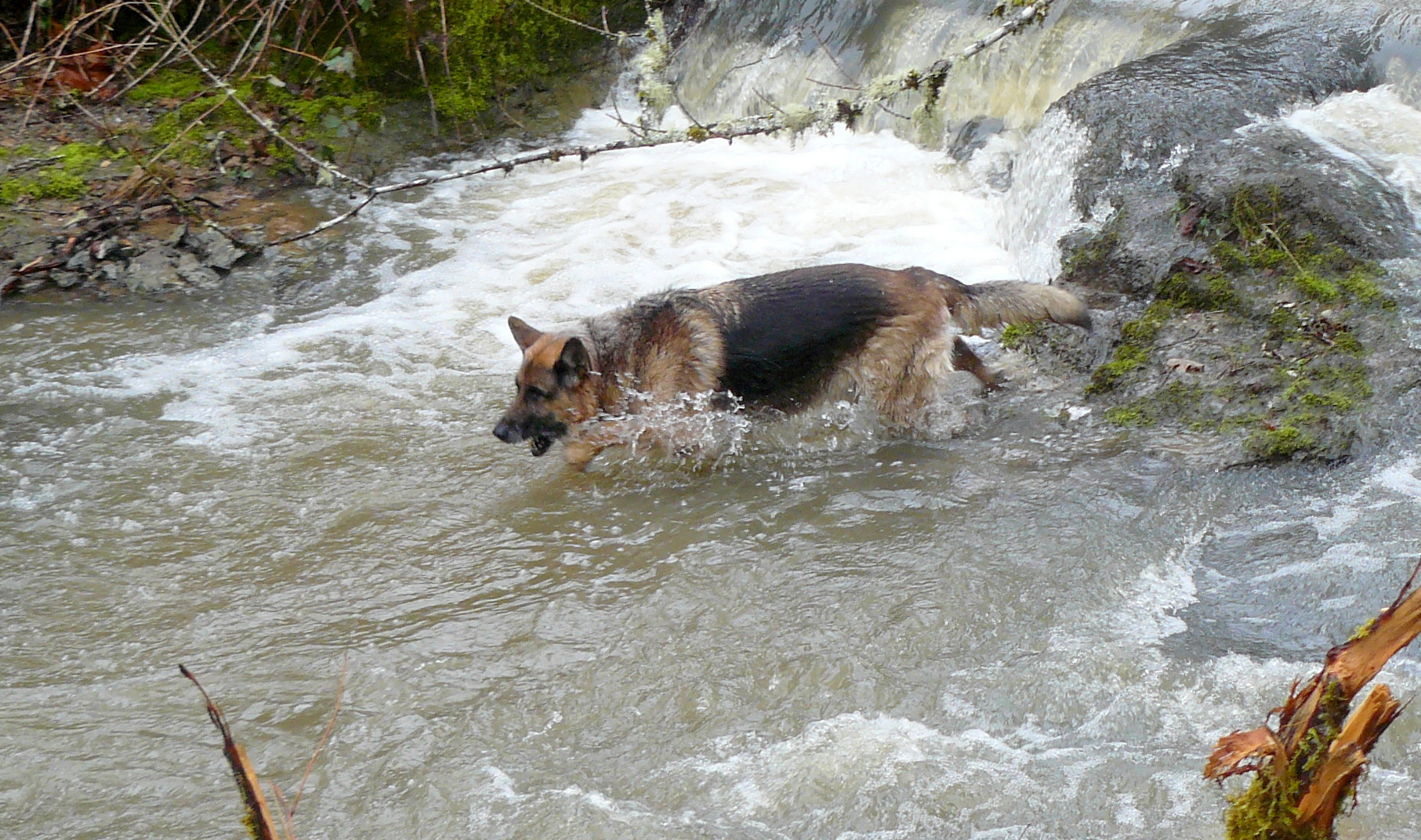
Rain had raised the flow of water in our creek and earlier on that Wednesday we had given the dogs a run in the rain.  Of course, they went immediately to the creek to play in the rushing waters.  The top picture shows Sweeny doing just that, Pharaoh equally having fun as below.

The simple joy of playing in the water.

Play is so important for humans as well as dogs.

Now watch the film and be amazed – the music is pretty cool as well.

Published on Dec 31, 2012

Music by…
* Lindsey Stirling:
** songs: Crystallize, Transcendence

* Niklas Aman:
** songs: Stirred Up, Momentum, Up A Storm

* Michael Marantz:
** song: Earth – The Pale Blue Dot

Directed by: Cedric Dahl
Produced by: Bennett Hoffman
Staring: Paul Whitecotton, Brian Orosco, David Agajanian, Lonnie Tisdale, Jacob Siel

Finally, after you have watched the film you will enjoy this interview with film director Cedric Dahl.  But watch the film first!!

Making sense of life?

“I accept chaos, I’m not sure whether it accepts me.”  Bob Dylan.

Lost and Confused Signpost

Started this week with an essay from John Hurlburt. Likewise, finishing with these thoughts from John.

Are We Confused?

Egotistically, the objective is self.
Financially, the objective is profit.
Corporately, the objective is control.

Biologically, the objective is growth.
Physically, the objective is change.
Morally, the objective is equality.

Psychologically, the objective is integrity.
Philosophically, the objective is truth.
Scientifically, the objective is fact.

Intellectually, the objective is reason.
Emotionally, the objective is balance.
Spiritually, the objective is Unity.

an old lamplighter

Carl Sagan

How very precious, vulnerable and fragile is this precious place we call home.

Today’s consciousness perambulation is the fault of Mr. P., as I like to call him. I refer to Pendantry as he is on his blog, Wibble.

You see on Sunday he added a comment to my post Just a small, white dot! that included the beautiful and awe-inspiring film made by the late Carl Sagan called Pale Blue Dot.

carl-sagan

Like millions of others, I came to admire Carl Sagan through watching the fabulous, the truly fabulous, television series Cosmos: A Personal Voyage. (NB. All the episodes are on YouTube, Episode One is at the end of this Post, Ed.)  Here’s how WikiPedia opens their reference to Carl.

Carl Edward Sagan (November 9, 1934 – December 20, 1996) was an American astronomer, astrophysicist, cosmologist, author, science popularizer and science communicator in astronomy and natural sciences. He spent most of his career as a professor of astronomy at Cornell University where he directed the Laboratory for Planetary Studies.

He published more than 600 scientific papers and articles and was author, co-author or editor of more than 20 books. He advocated scientifically skeptical inquiry and the scientific method, pioneered exobiology and promoted the Search for Extra-Terrestrial Intelligence (SETI).

Sagan is known for his popular science books and for the award-winning 1980 television series Cosmos: A Personal Voyage, which he narrated and co-wrote.  The book Cosmos was published to accompany the series. Sagan wrote the novel Contact, the basis for a 1997 film of the same name.

He died far too young and was a tragic loss to humanity.  The Carl Sagan web portal is here.

That 3:30 minute video Pale Blue Dot has, likewise, been seen by millions.  If you or someone you know hasn’t seen it, then you must pause now …

It’s practically impossible to watch that video and not embrace the central message from Mr. Sagan.  Here’s the transcript:

Our home from 6 billion kilometres. A very tiny dot against the vastness of space.

From this distant vantage point, the Earth might not seem of any particular interest. But for us, it’s different.

Consider again that dot. That’s here. That’s home. That’s us.

On it everyone you love, everyone you know, everyone you ever heard of, every human being who ever was, lived out their lives.

The aggregate of our joy and suffering, thousands of confident religions, ideologies, and economic doctrines, every hunter and forager, every hero and coward, every creator and destroyer of civilization, every king and peasant, every young couple in love, every mother and father, hopeful child, inventor and explorer, every teacher of morals, every corrupt politician, every “superstar,” every “supreme leader,” every saint and sinner in the history of our species lived there – on a mote of dust suspended in a sunbeam.

The Earth is a very small stage in a vast cosmic arena.

Think of the rivers of blood spilled by all those generals and emperors so that in glory and triumph they could become the momentary masters of a fraction of a dot.

Think of the endless cruelties visited by the inhabitants of one corner of this pixel on the scarcely distinguishable inhabitants of some other corner. How frequent their misunderstandings, how eager they are to kill one another, how fervent their hatreds.

Our posturings, our imagined self-importance, the delusion that we have some privileged position in the universe, are challenged by this point of pale light. Our planet is a lonely speck in the great enveloping cosmic dark. In our obscurity – in all this vastness – there is no hint that help will come from elsewhere to save us from ourselves.

The Earth is the only world known, so far, to harbor life. There is nowhere else, at least in the near future, to which our species could migrate. Visit, yes. Settle, not yet. Like it or not, for the moment, the Earth is where we make our stand.

It has been said that astronomy is a humbling and character-building experience. There is perhaps no better demonstration of the folly of human conceits than this distant image of our tiny world. To me, it underscores our responsibility to deal more kindly with one another and to preserve and cherish the pale blue dot, the only home we’ve ever known.

Tomorrow, I will stay with the theme of our beautiful planet. Hope you can join me.

Now spoil yourself and watch Episode One of Cosmos.

Oregon and the wolf

Sharing a beautiful aspect of this new home State of ours.

Let’s face it, Jean and I know as much about Oregon as we know about Timbuktu! A house and property requiring much love and care and 10 dogs, 5 cats and 2 miniature horses does rather cramp one’s style!  Actually, let me be honest.  We just adore the grounds that surround the house.  Almost every single walk around the property with or without a few dogs brings some new discovery.  Thus we are not lusting to get out.

Just by way of example, yesterday we discovered that the dam built across our creek, just upstream of the bridge, was used in days long ago for creating flood irrigation.  That’s the dam in the picture below.  The old plank and steel work are still in the undergrowth alongside the creek; to the right of the picture.

Irrigation dam on Bummer Ck.

OK, to the point of this post.

Shortly after we arrived here in Merlin, Oregon we joined Oregon Wild.  Their Mission Statement says: Oregon Wild works to protect and restore Oregon’s wildlands, wildlife and waters as an enduring legacy for all Oregonians.  Can’t argue with that!

Last December a press release was issued about Bringing Wolves Back Home to Oregon.  Here’s part of that release.

Wolves in Oregon:

Gray wolves (Canis lupus) were once common in Oregon, occupying most of the state. However, a deliberate effort to eradicate the species was successful by the late 1940s.

Trouble for wolves began before Oregon even became a state. In 1843 the first wolf bounty was established and Oregon’s first legislative session was called in part to address the “problem of marauding wolves”. By 1913, people could collect a $5 state bounty and an Oregon State Game Commission bounty of $20. The last recorded wolf bounty was paid out in 1947.

After an absence of over half a century, wolves began to take their first tentative steps towards recovery. Having dispersed from Idaho, the native species is once again trying to make a home in Oregon. One of the first sightings came in 1999 when a lone wolf was captured near the middle fork of the John Day River, put in a crate and quickly returned to Idaho. In 2000, two wolves were found dead – one killed by a car, the other illegally shot.

In 2006, a flurry of sightings led state wildlife biologists to believe that a number of wild wolves were living in Northeast Oregon near the Wallowa Mountains and the Eagle Cap Wilderness. In May of 2007 a wolf was found shot to death near La Grande, OR.

As I explain on this blog, there is a deep connection between dogs and wolves:

Dogs are part of the Canidae, a family including wolves, coyotes and foxes, thought to have evolved 60 million years ago.  There is no hard evidence about when dogs and man came together but dogs were certainly around when man developed speech and set out from Africa, about 50,000 years ago.  See an interesting article by Dr. George Johnson.

Back to Oregon Wild.  Just three weeks ago came this update.

State Announces Wolf Recovery Numbers

With the state’s wolf killing program on hold, conservationists celebrate recent success, express concern for the future.

SALEM, OR Jan 16, 2013

Today the Oregon Department of Fish and Wildlife (ODFW) announced the state’s wolf population has risen to at least 53 animals and as many as five breeding pairs. Though still mostly confined to the Northeastern corner of the state, the news was welcomed by conservationists.

The confirmation of wolf numbers comes on the heels of a number of announcements of new wolf pups, interbreeding between packs, and new science demonstrating the important and irreplaceable role wolves and other native hunters play on the landscape.

The announcement also comes on the heels of the one-year anniversary of another great wolf recovery story. On December 28, 2011, a wolf known as Journey (OR-7) crossed the Oregon border to become the first wolf in California in nearly a century. The story was celebrated around the world.

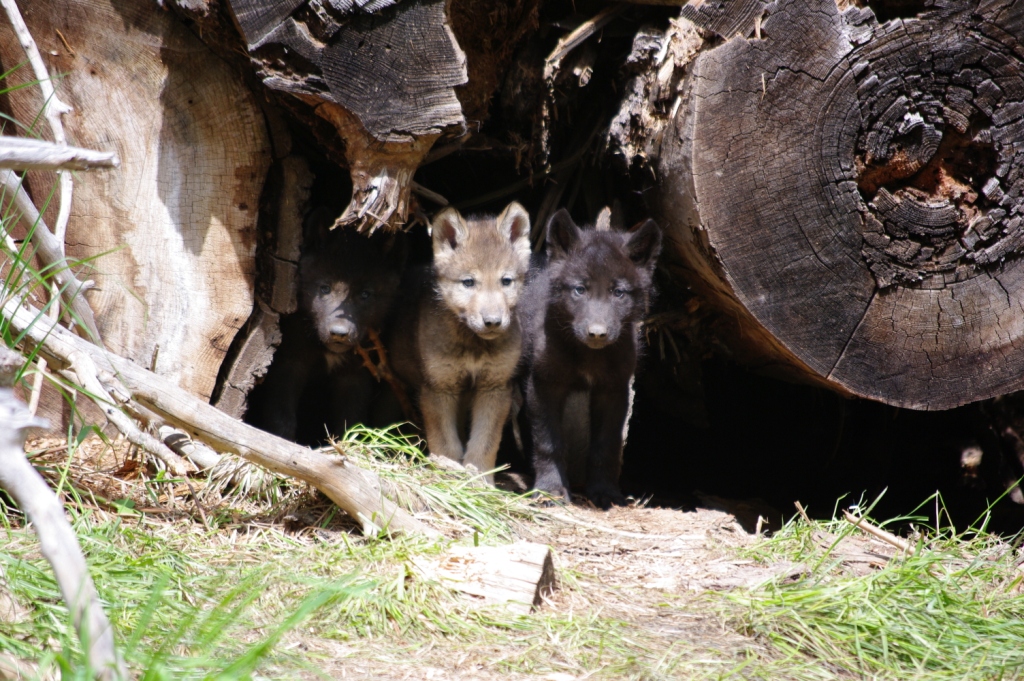
Read the rest of this good news story here.  But I couldn’t resist showing you this photograph that appeared in that story.

These wolf pups born to the Wenaha Pack in 2012 helped get recovery back on track. But their future remains tenuous (photo courtesy ODFW)

Let me close with these two videos.

Imnaha alpha female wolf, July 2011

Snake River Wolf Pack howling

Published on Aug 1, 2012

On July 25, 2012, an ODFW wolf biologist on a survey for wolf pups took this video of a Snake River wolf pack pup howling. The video was taken in the Summit Ridge area within the Snake River Wildlife Management Unit, in Wallowa County.

In the video, the pup howls three times. A low returning howl is heard and the pup gets up. Then, other members of the wolf pack (not seen in the video) return the pup’s howls.

Wolves are highly social animals and howling is a common behavior that help packs communicate and stay together. Wolf howls can be heard from several miles away.

More information on wolves in Oregon can be found at http://www.dfw.state.or.us/wolves.

What is this thing called love?

The discovery of love.

love

Through the wonderful world of web connections, I came to this topic by first reading Jeremy Nathan Mark’s blog The Sand County. Highly recommended.

Jeremy had written a post under the intriguing title of Blogging as Virtual Love-Making, And the Science Behind It.  Blogging; Love-Making; have I really just read those words!  In fact, Jeremy had reposted an article written by Deborah J. on her blog Living on the Edge of the Wild; another great find out there in this virtual world.  So with Deborah’s kind permission here it is reposted on Learning from Dogs.

oooOOOooo

Blogging as Virtual Love-Making, And the Science Behind It

dj1Often when I leave comments on a blog post that moved me, I write “I love this post” or “I love the way you do [this]” or “I love that quotation.” Lately I’ve been wondering if I’m overusing the word “love”.

Am I really feeling this strong emotional attachment, or am I just being lazy, unwilling to take the time to precisely articulate what strikes me about a particular piece?

After reading a recent article in The Atlantic  on the science behind love, I’m inclined to believe that, more often than not, I use the word “love” because that’s what I’m actually feeling– a “micro-moment of positivity resonance.”   That’s how Barbara Fredrickson defines love in her new book Love 2.0: How Our Supreme Emotion Affects Everything We Feel, Think, Do.

In The Atlantic article “There’s No Such Thing as Everlasting Love (According to Science), author Emily Esfahani Smith writes:

Fredrickson, a leading researcher of positive emotions at the University of North Carolina at Chapel Hill, presents scientific evidence to argue that love is not what we think it is. It is not a long-lasting, continually present emotion that sustains a marriage; it is not the yearning and passion that characterizes young love; and it is not the blood-tie of kinship.

Rather, it is what she calls a “micro-moment of positivity resonance.” She means that love is a connection, characterized by a flood of positive emotions, which you share with another person—any other person—whom you happen to connect with in the course of your day. You can experience these micro-moments with your romantic partner, child, or close friend. But you can also fall in love, however momentarily, with less likely candidates, like a stranger on the street, a colleague at work, or an attendant at a grocery store. Louis Armstrong put it best in “It’s a Wonderful World” when he sang, “I see friends shaking hands, sayin ’how do you do?’ / They’re really sayin’, ‘I love you.”

PenguinsSo when I say I “love” Louis Armstrong’s song, now I know why—because I feel such a strong positive connection to what he’s saying, as well as with how he says it, and the music he says it with, that I experience a triple love-whammy!

What I feel when reading things by fellow bloggers, or see the images they’ve created, is similar—a deeply-felt resonating connection, often on several levels.

Smith writes:

When you experience love, your brain mirrors the person’s you are connecting with in a special way,” and then she goes on to explain how “[t]he mutual understanding and shared emotions” between a story-teller and a listener “generated a micro-moment of love, which ‘is a single act, performed by two brains,’ as Fredrickson writes in her book.

Flower in Vase Pa-ta San-JenThis can happen between a writer and reader as well, or between an artist and viewer. In his book “Tao and Creativity” Chang Chung-yuan describes this connection between poet and reader as a “spiritual rhythm.”  It is the means by which the reader participates in the inner experience of the poet. He writes:

In other words, the reader is carried into the rhythmic flux and is brought to the depth of original indeterminacy from which the poetic pattern emerges.  The reader is directly confronted with the objective reality which the poet originally faced. The subjectivity of the reader and the objective reality of the poem interfuse . . . .

This is very interesting because Fredrickson discovers a similar phenomenon when she compares the brainwaves of a storyteller and listeners. Smith describes this in her article:

What they found was remarkable. In some cases, the brain patterns of the listener mirrored those of the storyteller after a short time gap. The listener needed time to process the story after all. In other cases, the brain activity was almost perfectly synchronized; there was no time lag at all between the speaker and the listener. But in some rare cases, if the listener was particularly tuned in to the story—if he was hanging on to every word of the story and really got it—his brain activity actually anticipated the story-teller’s in some cortical areas.

The mutual understanding and shared emotions, especially in that third category of listener, generated a micro-moment of love, which ‘is a single act, performed by two brains,’ as Fredrickson writes in her book.

Big Sur and Mothers Day picnic 111Fredrickson also discovered that the capacity to experience these daily love connections in our lives can be increased through simple loving-kindness meditations, where, as Smith describes, “you sit in silence for a period of time and cultivate feelings of tenderness, warmth, and compassion for another person by repeating a series of phrases to yourself wishing them love, peace, strength, and general well-being.”

“Fredrickson likes to call love a nutrient,” Smith writes.  “If you are getting enough of the nutrient, then the health benefits of love can dramatically alter your biochemistry in ways that perpetuate more micro-moments of love in your life, and which ultimately contribute to your health, well-being, and longevity.”

public domain beeSo remember, fellow readers, as you go meandering from one blog site to another like busy little bees, making those “micro-moment” connections with people whose work you admire, that you are engaged in a kind of virtual love-making.  You are distributing a pollen-like “nutrient” that nurtures others, as well as yourself.

As Louis says, “what a wonderful world” we live in!

oooOOOooo

Deborah concludes with Louis Armstrong singing ‘What a Wonderful World’.

However, for me the song that really resonates with this fascinating article is Ella Fitzgerald’s rendition of What Is This Thing Called Love.  Take it away Ella.

A big thank you to Jeremy and Deborah.  Finally, to all those that enjoyed (loved?) this post, do go and read The Atlantic article in full; it’s fascinating.