Category: Art

The book! Part Four: The Brahma Viharas

Time to reflect on the previous five chapters: Of change; Hope; Self-compassion; Goodness; Finding Happiness.

However, it wouldn’t be surprising if my opening sentence didn’t raise the odd question or two. Such as why a chapter that wants to round off the messages of change in thoughts and deeds is entitled The Brahma Viharas? What are the Brahma Viharas?

Let me offer my answers.

Long before I started into this book, I drew up a document that I called a Statement of Purpose (SoP). Writing such a document was prompted by an experienced author who made a link with me when I wrote the draft first half of this book, Part One: Man and Dog, under the umbrella of NaNoWriMo 2013. Or to give the organisation its full name: The National Novel Writing Month. I should explain for those unfamiliar with NaNoWriMo that each November, NaNoWriMo offers budding authors a compelling reason to sit down and write 50,000 words in one month. I should hasten to add that the word Novel is flexible and that non-fiction attempts are equally encouraged. Guess that’s pretty self-evident!

Back to my SoP. The purpose behind such a document is to provide a framework of what it is that you wish to say before plunging headlong in to the writing. My SoP included an Introduction, my intended Reading Audience, the themes of the five Sections and intended chapter headings.

Once I had that documented, I showed it to some close friends seeking reactions and recommendations. I included Jon Lavin. It was Jon who suggested that I include the Brahma Viharas.

As I researched the topic, I was moved by how relevant it was to what I was trying to say. This is what I discovered.

Firstly, from the website of the Brahma Viharas organisation I read this explanation:

The four brahma-viharas represent the most beautiful and hopeful aspects of our human nature. They are mindfulness practices that protect the mind from falling into habitual patterns of reactivity which belie our best intentions.

Also referred to as mind liberating practices, they awaken powerful healing energies which brighten and lift the mind to increasing levels of clarity. As a result, the boundless states of loving-kindness, compassion, appreciative joy and equanimity manifest as forces of purification transforming the turbulent heart into a refuge of calm, focused awareness.

Those two short paragraphs are laden with wonderful ideas, all of which resonated with the theme of Part Four of this book. However, I still was looking for something that spelt out just exactly what are the four brahma-viharas. A further web search brought me to a site described as The Dhamma Encyclopedia and thence to Page Four from where I read: “The four Brahma Viharas are considered by Buddhism to be the four highest emotions. The word brahma literally means ‘highest’ or ‘superior.’

A few sentences later, reading:

The Brahma Viharas are also known as the Four Divine Emotions or The Four Divine Abodes. They are the meditative states, thoughts, and actions to be cultivated in Buddhist meditation. They are the positive emotions and states that are productive and helpful to anyone of any religion or even to the one with no religion. The result will be a very nice and good person, free from hate and ill-will. Those who cultivate the brahma viharas are guaranteed to happiness. Those who further cultivate equanimity, may reach insightful states and wisdom of enlightenment experiences.

The Four Divine Emotions

1. Metta (Loving-kindness)
2. Karuna (Compassion)
3. Mudita (Joy with others)
4. Upekkha (Equanimity)
(from Anguttara Nikaya 3.65)

Loving-kindness, Compassion, Joy with others and Equanimity. A pathway to freedom from hate and ill-will. Who wouldn’t want to journey along such a pathway!

Yet it still didn’t envelope me in the way that I was expecting, so I continued with the research, and came across an essay by a Derek Beres under the title of The Trauma of Everyday Life. The essay had been published on The Big Think website and the opening lines tickled my interest; very much so. But first to find out a little more about the author: Derek Beres.

Derek Beres, a Los Angeles-based journalist and yoga instructor, looks at a range of issues affecting the world’s various spiritual communities in an attempt to sift through hyperbole and find truly universal solutions to prevalent issues facing humanity in the 21st century.

The opening lines of the essay answered an immediate question that was in my mind: “Like all major religions, there exists numerous ideas of what Buddhism is and how to practice it. Perhaps the hardest part about explaining Buddhism is that it’s nowhere near being a religion in the first place.”

Then me immediately warming to: “Rather it is a way of engaging and grappling with yourself and the world you live in, sans metaphysics and dogma.”

The essay then described much of the Buddha’s early days and his quest for a deep, inner meaning to life.

In Derek Beres’ words: “And so the Buddha set off, studying yoga and practicing extreme forms of asceticism, including nearly starving himself in hopes of transcending his body.” This eventually leading him to recognise, “ … trauma as a means of enlightenment, not a hindrance on the spiritual path. Awakening does not mean an end to difficulty; it means a change in the way those difficulties are met.

… a change in the way those difficulties are met.” What better way than that to round off this theme of change in thoughts and deeds. Me wanting to say straightaway that these chapters have been a wonderful pathway of exploration for me and, so too, I hope they have been for you. There can be no doubt in my mind, and I know this is shared by countless others, that the future for mankind, if we continue on the same ways of recent times, is clear and obvious: massive levels of extinction of man and many other higher species.

This is the time for change. Not tomorrow; not some day; but now.

1016 words Copyright 2014: Paul Handover

The book! Part Four: Finding happiness.

Aristotle is reputed to have said, “Happiness depends on ourselves.

For someone born nearly 2,400 years ago, at the time of penning this book, Aristotle’s (384 to 322 BCE) words of wisdom resonate very much with these modern times. Even granting the fact that Aristotle was a Greek philosopher and a scientist, it still has me in awe of the man. Consider, when one thinks about Aristotle’s reflections on mankind so long ago and finds, some 2,400 years later, that in a sense, in a very real sense, nothing much about the aspect of our happiness is new. Certainly when it comes to the behaviours of homo sapiens!

To underpin that last observation, that seeking happiness still fascinates us, just a few days ago (November 2104) I read an item on the BBC website reporting that a Google engineer, Chade-Meng Tan, “claims he has the secret to a contented, stress-free life.” The BBC reporter, David G Allan, author of the article, went on to write, “Deep inside the global tech behemoth Google sits an engineer with an unusual job description: to make people happier and the world more peaceful.

From Aristotle to Google – Talk about plus ça change, plus c’est la même chose!

Nevertheless, if the source of our happiness is something that has been known for thousands of years, why do we have the sense that happiness is elusive, (I use the word ‘we’ in the broad sense.), why the reason that happiness seems as far away from the common, everyday experience as the white, snowy peak of a magnificent mountain shining out from a dark, blue sky?

How can we understand more about happiness; whether or not it is, indeed, elusive?

Well there’s only one place to start looking for the answer to that question in these modern times and that’s a Google search! Wow! No shortage of places to go looking: that search for the word ‘happiness’ produced the response – About 50,000,000 results (0.15 seconds)! And a bonus: I laughed out aloud when I saw that figure.

50 million results! Happiness doesn’t appears to be that elusive after all!

Let’s come at the question of happiness from a different angle. What about happiness from the perspective of good mental health?

The leading mental health charity in the UK is the organisation MIND. Their website, not surprisingly, poses the question: What do we mean by good mental health? Then offers the response: “Good mental health isn’t something you have, but something you do. To be mentally healthy you must value and accept yourself.

See there’s the prescience of Aristotle again!

MIND continues the response to the question by underlining how we should “… care about yourself and you care for yourself. …. love yourself, not hate yourself. …. look after your physical health”, reminding us all to “eat well, sleep well, exercise and enjoy yourself.”

Gretchen Rubin, an expert on the topic of happiness and the author of several books on this aspect of us humans, has researched happiness for many years. Her conclusions are the following: that happiness is found in the enjoyment of ordinary things, in the everyday and in cherishing the small things in our lives.

There’s a distinct theme appearing here. All the way from Aristotle: That whether or not I am happy comes down to one person and one person alone: me! Happiness is about my response to my world; my world around me.

It doesn’t take much to see the incredible importance of being good to oneself. That finding happiness is firmly on the same page as self-compassion.

That is reinforced by Ruth Nina Welsh, a freelance writer specialising in lifestyle, wellbeing and self-help, and a former counsellor and coach (and, notwithstanding, an erstwhile musician). Ruth, on her website Be Your Own Counsellor and Coach, reminds us to, “see yourself as being a valuable person in your own right.” Then later, adding: “If you value yourself, you don’t expect people to reject you. You aren’t frightened of other people. You can be open, and so you enjoy good relationships.

Conclusion: It is totally clear that how we see ourselves is central to every decision we make. People who value and accept themselves, the essence of self-happiness, cope with life in ways that are just not available to people who are not happy with who they are.

That strikes me that being happy with ourself should be the first thing we should say to ourselves in the morning, and the last thing we should think about as we drop off to sleep.

Thus having spent a few paragraphs looking at happiness in its own right, how do we bring happiness into the central proposition of this section of the book: Of change in thoughts and deeds? How can happiness be a positive tool for change?

To put into context the need for change in our thoughts and deeds, let’s look back over our shoulders at the past fifty years or more and realise that despite the relentless growth in incomes, across the vast majority of countries, we are no happier than we were those five decades ago. Indeed, some might argue that we are much less happy. Certainly, in this same period of fifty years, we have seen an increase in wider social issues, including a very worrying rise in anxiety and depression in our young people.

If the premise that change is essential, that there is a growing motivation to turn away from where we, as in mankind, seem to be heading, and seek more peaceful and harmonious times, then finding happiness, as with faith in goodness, is an important ingredient but on its own does not deliver change.

For more years than I care to remember, BBC Radio 4 has been broadcasting a ten-minute programme: A Point of View; usually on a Friday evening if my memory serves me well. Back in 2013, writer and broadcaster, Al Kennedy, presented A Point of View on the theme of Why embracing change is the key to happiness. The ideas behind that programme were also published on the BBC News Magazine website: A Point of View: Why embracing change is the key to happiness. Al Kennedy proposing that, “Human happiness may rely on our ability to conquer a natural fear of upsetting the status quo.

Al Kennedy touched on a familiar aspect of change, “If you’re like me, you won’t want to change. Even if things aren’t wonderful, but are familiar, I would rather stay with what I know. Why meddle with something for which there is a Latin, and therefore authoritative, term: the status quo.

Thus, Al reminds us, that seeing happiness as a key to change, may be putting it in the wrong order. We have to welcome change, have it as a fundamental part of who we are and trust that this is the path to happiness. Back to Al Kennedy: “And every analysis of what makes lucky and happy people lucky and happy demonstrates they adapt fast and well to new situations and people, and so are defended by complex social circles and acclimatised to change.

That BBC article concludes, again with Al Kennedy’s words: “Approaching the changing reality of reality with sensible flexibility is the best strategy for happiness. I don’t believe it, but it’s true. And if I can change my mind, I can change anything else I need to.

Notions of Rome not being built in a single day come to mind. Or that other one about even the longest journey starting out with a single step.

Silly old me! Still looking for more sayings to crystallise the essence of happiness and the best one is right under my nose. The one that opened this chapter. From the wise Aristotle: “Happiness depends on ourselves.

1296 words Copyright 2014: Paul Handover

The photography of Patrick Smith.

Would make some fabulous Christmas presents.

In my trawling around Learning from Dogs looking for articles that could provide material for ‘the book’, I came across a post from August 2009, that is republished today.

oooo

The sharing spirit

(Originally published here on the 29th August, 2009.)

This virtual world has so much to share.

The photography of Patrick Smith is breathtaking.  So much so, it seemed important to promote his talents to the widest possible audience.

He has been very generous in giving Learning from Dogs written permission to reproduce his pictures.  Thus from time to time, we will do just that.

Thank you, Patrick.

Portal of the Sun - Big Sur, California
Portal of the Sun – Big Sur, California

Published with the written permission of Patrick Smith Photography.

Copyright (c) 2009, all rights reserved.  Please do not use this picture without permission.

By Paul Handover

oooo

Well Patrick continues to present breathtakingly beautiful photographs, such as this one:

I was out to shoot the sunset at McClures Beach in Point Reyes, just north of San Francisco, but the fog became too thick. I knew about this row of trees on the way to the Point Reyes Lighthouse so I headed over there. I have been waiting for about 3 years for a misty foggy sort of day where I could capture this scene with some extra depth and light that you don't see without fog. Notice how the trees graduallt receed into the mist?  ... If you try this, walk the entire length of the path looking for the best composition. This was halfway down.
I was out to shoot the sunset at McClures Beach in Point Reyes, just north of San Francisco, but the fog became too thick. I knew about this row of trees on the way to the Point Reyes Lighthouse so I headed over there. I have been waiting for about 3 years for a misty foggy sort of day where I could capture this scene with some extra depth and light that you don’t see without fog. Notice how the trees graduallt receed into the mist? … If you try this, walk the entire length of the path looking for the best composition. This was halfway down.

Published with the written permission of Patrick Smith Photography.

Copyright (c) 2013, 2014: all rights reserved. Please do not use this picture without permission.

So it seemed a great idea to promote his pictures just in case you were looking for that special present, being that time of the year.  Patrick’s portfolio and prices may be viewed here, and his contact details are at the top of his home page.

(Let me quickly add that I have no business or financial connection with Patrick Smith.)

The book! Part Four: Faith in goodness.

The roots of all goodness lie in the soil of appreciation for goodness.” So said the Dalai Lama.

In the previous chapter, Compassion for self, I quoted Professor Neff saying that in her view self-compassion consisted of three elements: self-kindness, recognition of our common humanity and mindfulness.

That second element, the recognition of our common humanity, provides a wonderful link from that chapter across to this one. For one very simple reason: The reason being that people are generally good. Now I’m not going to throw statistics around, even if I had them to hand, to support my proposition; that there are more good people in the world than not. For the very straightforward reason that I have enjoyed a wide range of wonderful experiences from many; friends and strangers alike. Backed up from my experience of having been around for a while (I’m way the wrong side of 50!), from having travelled extensively in the last forty years, from having lived in four countries over those same forty years, and from having very, very few letdowns from others over that time.

But there’s more. From those many friends and acquaintances over those forty years, again in many parts of the world, I have found it extremely rare to hear of someone speak of knowing another person who they believed was intrinsically nasty.

So, reflecting that this chapter is called faith in goodness, that my experiences support and affirm a faith in the widespread goodness of people, that us human beings are fundamentally loving and good, and will help and care for each other when given the chance, it is easy to see this faith under the banner of another word: trust. Trust in human beings being fundamentally good! (And to make it clear as to where I am coming from, I use the word faith not with any religious or spiritual connotations.)

Now it is time to be firm with myself and remember that this is a chapter in a section of the book about change: change in thoughts and deeds. It is not a chapter about goodness in and of itself, however commendable such a chapter might be.

What is the link, therefore, between goodness and change? Put better, what is the power of goodness in bringing about change?

I guess one way of answering that question is to remind ourselves that whatever we believe about the local circumstances, our local world in which we live, becomes a self-fulfilling prophecy. If we trust that those around us are fundamentally good and we offer goodness out to those around us then we all create a local zone of peace.

Ergo, by extension, if we really want to create a global world of peace, and who would eschew that dream, we truly have to believe that it is possible. Not only possible, we have to believe in the certainty that simply by impacting another person’s life in a positive way, thence, just one person at a time, that one other person becomes a stone of change spreading ripples of peace across the waters of the world.

Margaret Wheatley, the author of a number of books on the human condition, offers in an essay Relying on Human Goodness, this pertinent view: “Noticing our beliefs about human goodness is not a philosophical inquiry. Our beliefs are critical influences for what we do in the world. They lead us either to action or retreat.

In other words, what we believe, how we see ourselves, holds real power of change. Those critical influences in Margaret Wheatley’s words. Such is the importance of our faith in goodness as being an agent of change.

The other fundamental message that comes out from Margaret Wheatley’s essay is that, “Oppression never occurs between equals. Tyranny always arises from the belief that some people are more human than others. There is no other way to justify inhumane treatment, except to assume that the pain inflicted on the oppressed is not the same as ours.

The old saying of only treating others as you would wish yourself to be treated sums it up: perfectly!

So why oh why does the reality of the human condition, almost as far back as one can look, seem so ghastly at times? Maybe, just maybe, because we only get to hear of all the things that are wrong and that this has been a weakness of mankind since time immemorial.

For one core reason, one ancient truth, one very significant challenge to seeing goodness in all directions. I am referring to the fact that bad news sells! As in spreads like wildfire!

It’s common knowledge that since the days of early man, our survival has depended on great sensitivity to danger. We instinctively pick up on danger, on any danger, on anything that we interpret, often half-consciously, as threatening to us and our loved ones. And these are times when we seem to be faced with a plethora of ‘threats’ to us and our loved ones and our immediate community.

The news media; TV, newspapers, radio and, now the internet, offer us on an almost hourly basis torrents of evidence of the harm, the great harm, that some people seem so easily to do to other people. So many examples of anger, distrust, deceit, greed, ethnic hatred, frequent genocide, terrorism and violence, apparently committed daily in the world. Of the 196 independent countries  (The figure varies depending on the reference source being used, but the number is within the range of 189 to 196) or so in the world, sixty-four are at war. Nearly a third of all the countries on this planet are at war (and don’t even start to think of the hundreds of militias, guerrillas and separatist groups involved in fighting!).

Thus it would be so easy to despair, to turn inwards and metaphorically hug oneself in a dark corner, to allow oneself to become more withdrawn and distrustful than ever, to let our worst natures prevail, but a strong, resolute faith in goodness prevents that. Indeed, the more we see examples, primarily from the world’s media, of the worst in mankind, the more essential it is to believe, to have trust, to have faith, in the goodness of people.

To hold in one’s heart, like a glowing beacon of hope, all those wonderful aspects of our fellow humans. The creativity, the caring, the generosity, the open-heartedness and the love; yes the love. Behaviours that are exhibited on a daily basis. Just look around at your friends and neighbours, notice the people you come across in your daily lives, often complete strangers, and you will see so many who, just like you, are offering goodness, being friendly, trying to be useful to others; metaphorically, leaving a clean wake.

So spread the word. For your faith in goodness will bring about the change all of humanity needs.

1130 words Copyright © 2014 Paul Handover

The book! Part Four: Compassion for self.

That one can not truly love another until you love yourself is a truism that is well-known.

If only it was that simple!

As an earlier chapter, The process of change, illustrated, albeit in a anecdotal manner, loving who one is rests fundamentally on knowing who one is and that, for a sizeable chunk of people, I don’t doubt, is a significant journey of self-awareness.

Stepping lightly over that last sentence, for this section is about change in thoughts and deeds, and focussing on the title to this specific chapter, compassion for self, leads one to pause and ask two questions: exactly what do we mean by self-compassion, and how is self-compassion different to self-esteem?

To be perfectly honest, until I started thinking about the answers to those questions, the differences between self-esteem and self-compassion had previously never occurred to me in the many (too many) years of my life. Yet another surprise that has been visited upon me as a result of writing this book!

But, of course, as soon as one thinks about it, there is a difference between self-esteem and self-compassion! Almost as though the former is an outward-looking perspective of oneself and the latter is the diametric opposite; an inward-looking perspective

Or as Kristin Neff, an associate professor in human development and culture at the University of Texas, Austin, puts it in an article published online by the The Greater Good Science Center, University of California:

Most of us are incredibly hard on ourselves when we finally admit some flaw or shortcoming: “I’m not good enough. I’m worthless.”

And of course, the goalposts for what counts as “good enough” seem always to remain out of reach. No matter how well we do, someone else always seems to be doing it better. The result of this line of thinking is sobering: Millions of people need to take pharmaceuticals every day just to cope with daily life. Insecurity, anxiety, and depression are incredibly common in our society, and much of this is due to self-judgment, to beating ourselves up when we feel we aren’t winning in the game of life.

So if self-esteem is the judgement or evaluation of oneself, self-judgment in other words, and may only be measured, by definition, through comparing oneself to others, then what is self-compassion?

An article published in February, 2011 by Tara Parker-Pope of The New York Times offers an insight that isn’t immediately obvious to one. It opens:

Do you treat yourself as well as you treat your friends and family?

That simple question is the basis for a burgeoning new area of psychological research called self-compassion — how kindly people view themselves. People who find it easy to be supportive and understanding to others, it turns out, often score surprisingly low on self-compassion tests, berating themselves for perceived failures like being overweight or not exercising.

Tara Parker-Pope then refers to Professor Kristin Neff; as follows:

But Kristin Neff, a pioneer in the field, says self-compassion is not to be confused with self-indulgence or lower standards.
I found in my research that the biggest reason people aren’t more self-compassionate is that they are afraid they’ll become self-indulgent,” said Dr. Neff, an associate professor of human development at the University of Texas at Austin. “They believe self-criticism is what keeps them in line. Most people have gotten it wrong because our culture says being hard on yourself is the way to be.

Fear of becoming self-indulgent restrains people from being more self-compassionate! I find that counter-intuitive but readily admit that it had never crossed my mind. The article then continues:

Imagine your reaction to a child struggling in school or eating too much junk food. Many parents would offer support, like tutoring or making an effort to find healthful foods the child will enjoy. But when adults find themselves in a similar situation — struggling at work, or overeating and gaining weight — many fall into a cycle of self-criticism and negativity. That leaves them feeling even less motivated to change.

Self-compassion is really conducive to motivation,” Dr. Neff said. “The reason you don’t let your children eat five big tubs of ice cream is because you care about them. With self-compassion, if you care about yourself, you do what’s healthy for you rather than what’s harmful to you.

Now that started to make sense to me. Still, if at this point in my learning journey I had been challenged to define precisely what I understood by self-compassion, I would have been bound to display some lingering uncertainties.

Therefore, how does one understand self-compassion in a clear and easily understood manner? Thank goodness for more guidance from the good Professor Neff. Back to that article published by the University of California.

As I’ve defined it, self-compassion entails three core components. First, it requires self-kindness, that we be gentle and understanding with ourselves rather than harshly critical and judgmental. Second, it requires recognition of our common humanity, feeling connected with others in the experience of life rather than feeling isolated and alienated by our suffering. Third, it requires mindfulness — that we hold our experience in balanced awareness, rather than ignoring our pain or exaggerating it. We must achieve and combine these three essential elements in order to be truly self-compassionate.

Self-kindness, recognition of our common humanity and mindfulness. Wow! What a trio of wonderful components.

I took a writing break at this point and went across to our living-room where some of our dogs were larking around. To my eyes, the group of five dogs, from old man Pharaoh, he of the front cover, down to young Oliver of less than a year old, were displaying kindness for themselves, an obvious recognition of their common doggyness and what seemed to me as mindfulness!

Then when I returned to ‘the book’, I couldn’t resist Kristin Neff’s concluding words from the above-mentioned article:

An island of calm

Taken together, this research suggests that self-compassion provides an island of calm, a refuge from the stormy seas of endless positive and negative self-judgment, so that we can finally stop asking, “Am I as good as they are? Am I good enough?” By tapping into our inner wellsprings of kindness, acknowledging the shared nature of our imperfect human condition, we can start to feel more secure, accepted, and alive.

It does take work to break the self-criticizing habits of a lifetime, but at the end of the day, you are only being asked to relax, allow life to be as it is, and open your heart to yourself. It’s easier than you might think, and it could change your life.

Relax, allow life to be as it is, and open your heart to yourself.

Those words should be framed and hung on the walls of every house in the land.

For they provide passionate reasons for changing how we think and, inevitably, how we act.

1,185 words. Copyright © 2014 Paul Handover

The beauty of flight.

Not, perhaps, in quite the way you might be anticipating!

A couple of weeks ago, I forwarded an item to my son, an airline Captain for some years now, that I read on the Big Think website. It was an item called The Accidental Beauty of Flight Paths.

The Accidental Beauty of Flight Paths
by FRANK JACOBS NOVEMBER 5, 2014

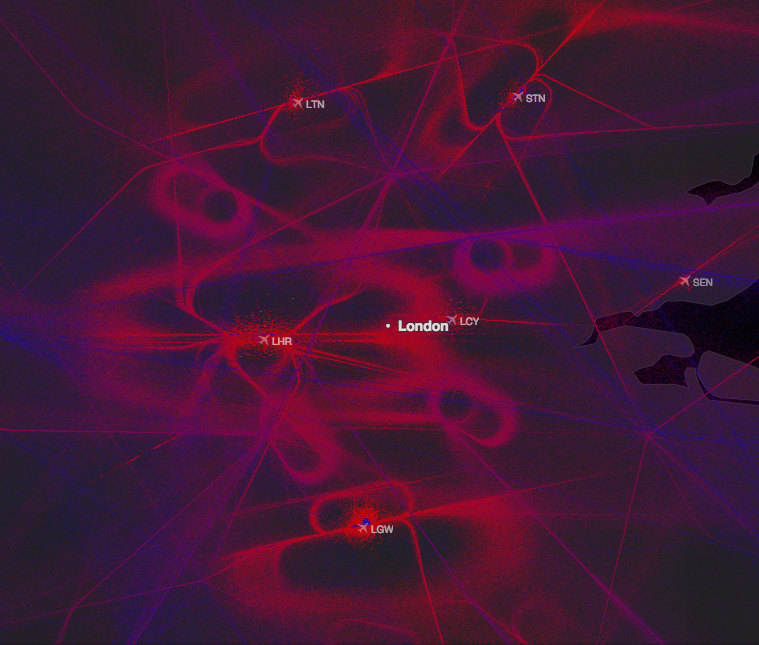
There is more between heaven and earth than bird migrations and weather fronts. These maps capture the poetic beauty of something utterly mundane and usually invisible: the flight patterns of the planes that bring us from airport A to airport B.

We live in the age of mass air travel. At any given moment, there are about 10,000 commercial planes airborne, carrying an estimated half a million passengers across the skies. We also live in the era of Big Data. Which means that the movements of those thousands of planes can be followed in real time on websites such as Plane Finder and Flightradar24.

London and the pretty holding patterns around its airports: Heathrow (LHR), Gatwick (LGW), City (LCY), Luton (LTN), Stansted (STN) and Southend-on-Sea (SEN).

You can read the full article here.

Alex, my son, then replied with a link to this item on the UK NATS website: Take a guided tour around UK airspace.

The skies above the UK have been brought to life like never before in a video showing a day of air traffic in less than three minutes.

Created from actual radar data showing over 7,000 flights, the video graphically illustrates the daily task facing air traffic controllers and the airspace features that help make it all work.


It finishes with an overview of the structure of UK airspace, highlighting the major air routes and showing how this ‘invisible infrastructure’ helps underpin the entire operation.

Matt Mills, NATS Head of Digital Communications, said: “We’ve made data visualisations in the past, but we wanted to now take people on a deeper journey into what makes UK airspace work and some of its important features.

Airspace might be the invisible infrastructure, but it is every bit as important as the airports and runways on the ground.

Created by air traffic management company, NATS, the video takes viewers on a unique tour of some of the key features of UK airspace – from the four holding stacks over London and the military training zones above Wales, to the helicopters delivering people and vital supplies to the North Sea oil and gas rigs.

It is a fascinating video.

The book! Part Three: Short-termism

Our modern madness!

We live in an era that is addicted to short-termism. Largely, I’m bound to say, brought on by the financial services industry. Yet the influence of that same industry is enormous and percolates its way through most levels of most societies in most cultures and, without question, through the societies of most European and North American countries. One only needs to reflect on the critical importance of gaining and maintaining financial solvency for individuals. From having the creditworthiness to finance, and eventually pay off, a mortgage on a private dwelling, to accumulating a pension to provide some level of comfort in the ‘senior’ years and along the way managing to bring up children, have the odd vacation or two, and enjoy a small luxury or impulse purchase. So for the great majority of us it is practically impossible to live a life that doesn’t interact with banks, savings plans, building societies, pension providers, and often many other financial and investment companies.

Thus the financial services industry is an intimate part of the majority of the lives of private citizens in the ‘Western world’. Yet, ironically, my sense is that the majority of those same private individuals run their lives quite differently. I have in mind what might be called planning horizons.

Clearly buying a home is the most obvious example of long-term planning. But there’s a myriad of other involvements that we sign up to that require, nay demand, a long-term perspective. Having a family, studying for a degree or a post-graduate academic qualification, becoming an apprentice, driver’s licence, heavy goods vehicle (HGV) licence, saving for a pension, for a vacation, working in a company, or similar, with an eye on longer-term promotion and career advancement. I’ll stop there for I’m sure my point is clear!

In my trawl across the internet looking for supportive examples, I came across a paper published by the Aspen Institute called “Short-termism and US Capital Markets”. This institute declares on their website (in part) that “The Aspen Institute is an educational and policy studies organization based in Washington, DC. Its mission is to foster leadership based on enduring values and to provide a nonpartisan venue for dealing with critical issues.

This US-based institute published the paper on short-termism in view of “the serious consequences they see for both investors and society at large.” The report refers to research by JP Morgan that is highly critical of the present-day love affair with short-term results: “[the research] indicating that a focus on quarterly earnings in US companies in order to show short-term profits is leading public companies to defer spending on marketing research, product design and prototype development and this reduction in investment is causing problems.”

If there’s one relatively recent event (I use the word “recent” in relation to the period when writing this book) that shows, dramatically shows, the madness of short-termism then it has to be the financial crisis of 2008. (As an aside, the term financial crisis seems an inadequate phrase when one considers the full range of negative consequences that blasted into the faces of millions of people in 2008.)

The Boston College Law School held a symposium in 2011 that led to a paper being published by Kent Greenfield, Professor and Law School Research Fund Scholar at Boston. That paper is available to read online. It carries the title: The Puzzle of Short-Termism. I think a few quotations from that paper will underline the madness that came to light post-2008 and that appears to still be with us. The paper opens, thus:

INTRODUCTION

When pondering the question of the “sustainable corporation,” as we did in this symposium, one of the intractable problems is the nature of the corporation to produce externalities. By noting this characteristic, I am not making a moral point but an economic one. The nature of the firm is to create financial wealth by producing goods and services for profit; without regulatory or contractual limits, the firm has every incentive to externalize costs onto those whose interests are not included in the firm’s current financial calculus.

Not much further on, Prof. Greenfield writes:

The more difficult kind of externality to address—especially if our focus is on the sustainability of the corporation—is the future externality. What I mean here is the kind of cost that a corporation’s management can externalize to the future. From management’s perspective, the future is a much more attractive place to push off costs. Stakeholders who must bear such future costs will be less aware of those costs than current costs, and even if they do learn of such future costs, they will be less able to gain the attention of regulators.

Then he offers this stark analysis:

If one is worried about the sustainability of corporations from an environmental, social, or political perspective, the problem of “short-termism” has to be a central worry. This is because, at least according to many who have thought seriously about the topic, in the long run the interests of corporations conflate with those of society as a whole. (For the sake of this Essay I will assume this to be the case, though I have stated some disagreement elsewhere.) Short-termism is a problem whether we focus our attention on the sustainability of the corporation or the ethics of its management.

Short-termism is also costly economically, since the economy as a whole benefits when companies have a long-term strategy. The economy is a summation of the fortunes of the millions of companies and individuals that make it up; if most companies make decisions that prioritize the short-term at the expense of the long-term, we all suffer. A nation’s wealth grows more over time when companies invest for the future and maintain their viability as a going concern.

Just one more extract from the paper, that without the preceding extracts would not have carried the weight and gravity that struck me, and I hope strikes you, dear reader when you read the following:

The financial crisis of 2008 brought into sharp relief the economic costs of short-term management. Among the competing theories on the cause of the financial collapse—the over-dependence on derivatives, the overuse of leverage, the culture of greed and entitlement in the finance industry, just to name a few—a focus on the short term is an omnipresent narrative thread. If managers and financiers had taken a more long-term view of the health of their own companies and the fortunes of their investors, we might not have seen the myriad other problems come to such a head. The addiction to leverage, derivatives, and greed that caused the market to become a casino would only have been possible in a business culture where short-term gains are prioritized over long-term costs. What might have been assumed to be costs that would be suffered some time in the distant future are being absorbed now. John Maynard Keynes was wrong on this point: in the long run, we are not all dead.

So despite some naysayers, the problem of short-termism is very real. Shareholders hold their stocks, on average, for less than a year, and even less for small companies. Institutional investors have been said to be particularly bad on this front, acting “more as traders, seeking short-term gain.” Managers admit that they make decisions that harm the company in the long-term in order to meet short-term earnings expectations. In 2006, both the Conference Board and the Business Roundtable, two of the nation’s most prominent business organizations, issued reports “decrying the short-term focus of the stock market and its dominance over American business behavior.” And, let’s remember, that was two years before the collapse.

The paper really needs to be read in full, especially for any individual trying to understand the pros and cons of a wide range of personal investment decisions. If only, to use Prof. Greenfield’s words, “This is because, at least according to many who have thought seriously about the topic, in the long run the interests of corporations conflate with those of society as a whole.

I sense readers might be on the verge of giving up with this book because it ain’t nothing to do with dogs! There was a large part of me that agonised over what to include and what to leave out, not only with this chapter but with all the chapters in this section. Perhaps I might be forgiven for making another ‘sales pitch’ for this whole section! That is that if good, honest folk aren’t as fully aware of the major characteristics of this new century, as this author wasn’t before the research, we cannot develop the passion and zeal for saying and promoting, as far and wide as we can, that ‘enough is enough’!

One more quotation to round off the chapter.

The Guardian newspaper published an article in October 2013 written by Larry Elliott, the newspaper’s economics editor. It was entitled: Saving the planet from short-termism will take man-on-the-moon commitment.

We choose to go to the moon. So said John F Kennedy in September 1962 as he pledged a manned lunar landing by the end of the decade.

The US president knew that his country’s space programme would be expensive. He knew it would have its critics, but he took the long-term view. Warming to his theme in Houston that day, JFK went on: “We choose to go to the moon in this decade and do the other things, not because they are easy but because they are hard, because that goal will serve to organise and measure the best of our energies and skills, because that challenge is one that we are willing to accept, one we are unwilling to postpone, and one which we intend to win, and the others too.”

That was the world’s richest country at the apogee of its power in an age where both Democrats and Republicans were prepared to invest in the future. Kennedy’s predecessor, Dwight Eisenhower, took a plan for a system of interstate highways and made sure it happened.

Contrast that with today’s America, which looks less like the leader of the free world than a banana republic with a reserve currency. Planning for the long term now involves last-ditch deals on Capitol Hill to ensure the federal government can remain open until January and debts can be paid at least until February.

The US is not the only country with advanced short-termism. It merely provides the most egregious example of the disease. This is a world of fast food and short attention spans, of politicians so dominated by a 24/7 news agenda that they have lost the habit of planning for the long term.

Tough stuff!

That doesn’t get any easier to read and take in as one continues.

Politics, technology and human nature all militate in favour of kicking the can down the road. The most severe financial and economic crisis in more than half a century has further discouraged policymakers from raising their eyes from the present to the distant horizon.

Clearly, though, the world faces long-term challenges that will only become more acute through prevarication. These include coping with a bigger and ageing global population, ensuring growth is sustainable and equitable, providing resources to pay for modern transport and energy infrastructure, and reshaping international institutions so they represent the world as it is in the early 21st century rather than as it was in 1945.

Or possibly for society to really grasp? Larry Elliot’s closing words:

Another conclave of the global great and good is looking at what should be done in the much trickier area of climate change. The premise of the Global Commission on the Economy and Climate is that nothing will be done unless finance ministers are convinced of the need for action, especially given the damage caused by a deep recession and sluggish recovery.

Instead of preaching to the choir the plan is to show how to achieve key economic objectives – growth, investment, secure public finances, fairer distribution of income – while at the same time protecting the planet. The pitch to finance ministers will be that tackling climate change will require plenty of upfront investment that will boost growth rather than harm it.

Will this approach work? Well, maybe. But it will require business to see the long-term benefits of greening the economy as well as the short-term costs, because that would lead to the burst of technological innovation needed to accelerate progress. And it will require the same sort of commitment it took to win a world war or put a man on the moon.

Despite Mr. Elliot’s powerful plea, there might be a school of opinion, a growing school of opinion, that would argue fundamentally with the words of that plea. I’m referring to: “… the plan is to show how to achieve key economic objectives – growth, investment, secure public finances, fairer distribution of income – while at the same time protecting the planet.

The next chapter on Materialism explains why “key economic objectives” may be the last type of measurement our world now demands.

2,217 words. Copyright © 2014 Paul Handover

Studs Terkel second essay.

NaNoWriMo sucked up my whole day!

I’m loving the writing that I’m doing just now.  I am, of course, referring to ‘the book’!

What is so delicious is taking a series of topics that, at heart, I know very little about in terms of any depth, and finding how internet web searches can unearth a trillion answers (OK, I exaggerated to make a point!) and allow one to learn the topic in some detail.  Specifically, I am authoring chapters on The Power of Negativity, Selfishness, Power and corruption, Short-termism, Materialism, Poverty and Greed. The drafts are being presented here on Learning from Dogs. (P.S. the chapters in most cases continue to be worked on after they have appeared in this place!)

Unfortunately, time is very short in terms of my own creative writings in this place. So, today, it is going to be the second essay from Studs Terkel.  The first one, in case any of you missed it, was yesterday. Me rapidly adding that the two essays were originally published as a TomGram: Studs Terkel on Death and Forgiveness in America.

ooOOoo

“You Got Into My Heart Violently, But You’re There”

Trauma, Death, and Forgiveness on the Front Lines of American Life
By Studs Terkel

[The following is excerpted from the new paperback edition of Studs Terkel’s oral history of death, Will The Circle Be Unbroken?: Reflections on Death, Rebirth, and Hunger for a Faith, with special thanks to his publisher, the New Press.]

“ER”
Dr. John Barrett

He is Chief of the Trauma Unit at Cook County Hospital, Chicago. He still has an Irish brogue.

“In 1966, the Trauma Unit here was actually the first of its kind in the nation. It’s dedicated to people who, more than being sick, are injured — patients who have been subjected to what we call intentional injury, violence. It’s gunshot wounds, stabbings, personal assaults. Other trauma centers see patients who predominantly are victims of unintentional injury: automotive wrecks and falls. Our experience here has been inner-urban, lower-socioeconomic groupings; predominantly young, predominantly male, and predominantly penetrating trauma: gunshot wounds and stabbings.”

I am the third of four sons. My father was a mail carrier, my mother was a dressmaker in Cork. The family really struggled to make sure that all of the sons went to university. My two elder brothers did science — chemistry and physics. I wanted to do something that was scientific in nature but more people-oriented. There was really no family tradition of medicine, but medicine seemed to fill my criteria. I can recall my eldest brother, Frank, saying, “This is a terrible waste of time — you don’t have to be intelligent to be a doctor.”

It’s not as if it’s rocket science. There’s nothing terribly difficult to understand in medicine, there’s just an awful lot of it that you have to remember. I always wanted to be a general practitioner. In my final year of medical school, I did a rotation with the then-professor of surgery, and I loved it. At the end of the rotation he said, “Well, Barrett, what are you going to do?” I said, “Well, Mr. Kiley, sir, I’m going to be a general practitioner.” He looked at me and said, “Barrett, there’s the makings of a great surgeon lost in you.” So that’s why I decided to do surgery. I realized that what I really, really enjoyed was the injured patient. It’s such an acute event: the patient is perfectly healthy, then something traumatic happens, and within a matter of seconds they are injured. They’re a great surgical challenge because they’re bleeding, they generally need surgical intervention. The epitome of those patients is the gunshot wound. Despite all the terrible things you hear about Northern Ireland and all the violence, where I was in the South we saw no gunshot wounds. I actually had to come to this country to see gunshot wounds.

I have found that surgeons have a certain personality. They tend to be very action-driven, very egocentric, frequently overconfident — especially trauma surgeons who will act very quickly with a minimal amount of information. That may not be the person you want to be your lawyer or your priest, but that’s the person you want to be your trauma surgeon. They tend to be supremely confident in themselves, and that’s why many people don’t like them. They tend to demean other people. It goes with the territory because you have to be damn confident in yourself if your job is to start cutting people open at the drop of a hat. People, when they hear that you’re a surgeon, they immediately look at your hands because they imagine there’s something unique about the surgeon’s technical ability. That’s not true at all. People have said you can teach educated apes how to operate — I’m not sure if that’s true — but it’s the decision-making process, not the technical stuff.

If you ask me to talk about life and death, the first thing I would think of is my patient. You begin to realize there’s not a sharp distinction between life and death. When is a person alive and when is a person dead? We have, for instance, patients who come in who are clinically dead: their heart has stopped beating, they are not breathing, their pupils are fixed and dilated. But we have them. The Chicago Fire Department paramedics are excellent — they get them in here fast. They’ve been without vital signs for a short period of time. You can still resuscitate some of them, you can bring them back…

Was it two weeks ago? — we had a man who was stabbed in the heart, came in clinically dead. We immediately opened his chest, released the pressure from his heart, sewed up his heart, and he actually recovered. He can’t have been dead because we got him back, but he was clinically dead. It’s not a very firm line; there’s a gradual blending from where you’re alive to where you’re dead. The people I see who are dead are in general young people who have suffered a calamitous event — they’ve been shot. You try your best. They’re either dead when they arrive or generally die fairly quickly after they’ve arrived. You can’t resuscitate them. The first thing that strikes me about it is, it seems such a waste… You’re looking at a human body, and as a surgeon you know its intimate details: the anatomy and the sinews and the arteries and the veins, and they’re now dead. This wonderful perfect machine is now no more. It’s frequently the smallest thing that has killed them. A stab wound to the heart will kill one person and it won’t kill the next. It seems to be such a capricious thing. What I really think a lot about is when children die. When adults die from trauma, you feel they have some degree of responsibility insofar as they chose to be in that place at that time. When a child dies, you think: Why did that happen? Five minutes’ difference would have changed the entire course of events. And parents ask you the same thing: “Why did it happen, doctor?” You try to explain: “He was shot, we did the best we can.” That’s not the answer they want. They want to know why this person who was awake, alive, and healthy this morning is now dead. You don’t have that explanation as a surgeon.

The first thing I feel, I feel angry, angry that they died, that I haven’t been able to save them. To me it’s almost like a personal defeat. I know in a logical sense that’s not true. I didn’t shoot them. It wasn’t my fault that there were guns on the street.

studsunbrokenRemember how I characterized the surgeon? The surgeon is supremely self-confident. We whip them back from the jaws of death, we have the scalpel, we have the decision, we have the technology, and we have a system in this hospital that’s supposed to save them. But you can’t save them all. We don’t lose a lot, but we do lose them. So initially I feel angry. That passes fairly quickly because I then say to myself: What could we have done that we didn’t do? Actually, we talk about it as a group: Could we have acted quicker, recognized this quicker? Because even though this particular patient is dead, we may be able to improve care for the next patient. Then I think: What a waste! A total, absolute waste. Especially now. I’m fifty-five years old. It makes you think about your own mortality. We really don’t realize what a precious gift life is. We take it for granted. I’ve always taken it for granted. My children are growing up, my daughter is going to college this year, I’m growing older, and I’m surrounded by people who are brought in, some of whom die. It is a very, very fragile thing we have that can disappear. The stuff that you worry about… Are you going to get the house painted? The basement floods occasionally. My God, the car keeps breaking down… It’s all so trivial… We should really realize that the greatest gift we have is time, and that means you’re alive.

When the patient comes in, you might see someone who’s covered in blood. I don’t see someone covered in blood, I see somebody who has technical challenges. A gunshot wound to the chest with hemothorax, we need to get a chest tube in, determine the rate of bleeding, and make effective interventions. So right then and there, I’m not thinking great philosophical thoughts — I’m in a mechanical, operative mode. You just go boom, boom, boom… It’s like a very organized, choreographed dance. But then at the end, he dies. Then you say, “Let’s look back at the dance. Did we do something wrong, could we have done something better?” You do tend to become a little philosophical as you grow older. I’m convinced that the solution to all this violence is not surgeons. We need to somehow prevent it.

I come from Ireland, a country that has national health insurance. Every resident is insured. I’m an American citizen and I love being one, but I can’t understand why we can’t ensure that every resident of the country actually gets adequate health care. I’m so happy to work here at the County Hospital, because that’s part of our mission statement: We will not turn you away. People refer to us as the hospital of last resort. I think that that’s a very noble thing.

People say, “Why did you stay?” It’s so perfectly logical to me. Here’s what I wanted: I wanted to be a surgeon who dealt with patients who required surgical intervention. Those are gunshot wounds. I also want to be able to teach people. I think it’s important that you pass on your skills. And to even do a little research, to maybe improve the care of the patients. Patient care, education, and the research, all three things I’m doing here. The money isn’t the greatest, and there are frustrations working in the public sector — but compared to what I’ve gotten out of it, I am one of the most fortunate people that you’ll ever meet. I would actually pay money to do this job. They pay me to do what I love to do.

When you lose a patient… I think every doctor has their own way. It’s not something they teach you in medical school, and they really, really should. Physicians and health-care people in general need to have a far greater degree of sympathy toward their patients, toward the patients’ family. No one ever taught me how to talk to a family and tell them that their loved one was dead, especially in a trauma situation. It’s one thing if a patient has, say, cancer and they become ill and then they die — it tends to be a process. You get to know your doctor, you finally realize the end is inevitable, you may have time to talk to your loved one.

Trauma is different. What happens in trauma is this eighteen-year-old leaves the house in the morning, perfectly healthy. Then the mother gets a call at two o’clock, it’s the Trauma Unit at Cook County Hospital: “Your son’s been shot. Please come in.” When she walks in, she’ll see me. She doesn’t know me, she’s never met me before, and I am now going to tell her that her son is dead. So how do I do it? The first thing that I do is I try to put myself into their situation. What they want to know is, is he alive or is he dead? I think you need to tell them that. Some people start telling them about he was shot and he came in and we did this and we did that. They’re really trying to impress the family with the work that they did to save him. That’s not what the family wants to know: they want to hear if he’s alive or if he’s dead. That’s what I tell them. I say: “You don’t know me, I’m Dr. Barrett, I’m the senior surgeon here tonight.” They won’t even remember my name. Sit them down. Sit down with them. Look into their eyes. If you can, hold on to them and say, “It’s bad news.” And they’ll say, “Is he dead?” Or they just look at you. You have to use the word, you have to say it: “He’s dead.” If you say he’s “expired,” he’s “passed away,” they don’t hear that. You have to say he’s dead. Then, then they react. They generally go into disbelief: “No, no, it’s not true — I can’t believe it… How could it happen…” Or they say, “It can’t be him. Are you sure? ” All you do then is you just let them grieve. I think it’s actually helpful for them to come and see the body. I think that’s important. He’s all covered in blood, there’s tubes in him. That doesn’t matter. They want to see that person, they want to see that face. I say to them, “It’s OK to hold him, if you want to kiss him, if you want to talk to him.” I think it’s important to do that because, afterwards, they’ll go through that scene in their mind over and over and over again. “I remember the night they called me from the County and I came in and this is what happened, and that is what happened…” It’s very important to put yourself into their shoes, but you’ve got to say the word “dead.” You’ve got to give them the finality of it.

I ask residents, “How would you do it?” They’re trying to explain to the family what they did: “He came in, we intubated him, we did this, we gave him blood, we gave him CPR.” The family isn’t even listening to that! They’re not listening to it. After you’ve said he’s dead, they won’t listen to anything for a long time. Once they’ve calmed down, it’s important to tell them the absolute truth. “I don’t know what the circumstances surrounding the shooting were, but as far as I can tell, he was unconscious very rapidly after he was shot. He never regained consciousness. I don’t think he suffered.” Just tell them the truth, it’s always the best thing.

When you die, you die. Your body rots. Everyone knows that. There’s no argument about that. But there is a spirituality to us. If you want to call it a soul, you can call it a soul. I think of it more as the thing that allows us to choose to do good or evil. You kind of fall on one side or the other. You tend to be on the side of the good or the side of the evil. You can personify this as being God and the Devil. You can call this spirituality your soul, or not your soul, but whatever it is, I do believe it continues after your body is dead. I’m not sure that thing that’s going to exist after I’m dead would say to itself, “I am John Anthony Patrick Barrett and I remember everything about John Anthony Patrick Barrett” — I don’t think it’s that simple. I do believe in an afterlife, but I don’t believe that it’s up there in the clouds somewhere with angels flying around beating their wings, and God is an old geezer with a long beard.

Let me try it a different way. You do things that live on after you. Each of us, as we pass through life, influences others. You leave behind you a legacy of things you did and people you influenced. So even if you don’t believe in a life after death, you’ve had an influence. And people say, “I haven’t had any influence. What did I do? I worked in a steel mill all my life, I didn’t actually do anything. Got married, had a few kids…” Well, you did — you had an effect as you went through life, and it was either a good effect or an indifferent effect or a bad effect. That effect continues on. I have two children, and they’re going to have influences on people and they’re going to do things. I’m also a teacher: I’ve taught lots of people, hundreds, perhaps even a thousand people that I have influenced in a very fundamental fashion. Many of them are now surgeons themselves. There’s little pieces of me that exist in all of that. So even though you’re dead, you’re not gone.

If you said, “What do I think makes me different from other surgeons?” the short answer is I don’t know… But I will tell you I think it’s a word called “empathy.” I have the ability to think and feel like the other person. I don’t know where I got that, but it’s something almost instinctive. Maybe that’s what doctors need to have. If doctors are supposed to comfort, you’ve got to understand that the person is suffering; you’ve got to kind of live in your patient’s shoes. I don’t care if you’re a Hindu or a Jew or an atheist, it’s all fine to me. I certainly don’t believe that there’s only one true religion and one true God and only one way of getting to Heaven. If you believe in your particular belief, I respect that. You’re gonna get to Heaven every bit as fast as I am, and in fact even faster probably.

I remember the first dead person I ever saw — my mother’s father. I would have been probably four or five years old. I remember a big commotion in the house, getting dressed up and washed and cleaned and being on my best behavior. He was laid out in a morgue. I recall the body. He was in the casket. It was an open casket, and he didn’t look like granddad. It was this pale waxen look — it wasn’t him. The second one I ever saw dead was in Ireland. I think I was probably eighteen or nineteen years of age, and I was out on my bicycle. There was a guy who had crashed his motorcycle into a car. As I arrived at the scene they were getting the body out — and he was dead. And they were getting him out and I remember he was covered in blood. I haven’t thought about this in a million years. I remember, as they took him out, he had his watch on. I remember the second hand of his watch was still ticking. Why do I remember that? I think it was the thing that I talked about before. He was fine, and now he’s dead… but his watch is still going on.

If you had been born a hundred years ago, Studs, you wouldn’t have lived this long. Yet you’re still living a very productive and fruitful life. There comes a time when we really do have to balance that, though. Now, how do you make those decisions? These are actually not decisions that your doctor alone can or should make. Especially those of us who are technologically driven. If you were dying from something that I think I can cure by operating on you, I am going to try and convince you to have the operation. You may have a totally different perspective on life. I think medicine needs to acknowledge that. Sometimes it’s not the patient, it’s the patient’s family who say, “I want everything done.” How much of that is driven by them because they want to be able to say afterwards, “Well, we did everything”? It makes them feel comfortable…

It isn’t a huge problem in trauma because we really do try to do everything, because the patients are young. But if I am at the stage where I’m absolutely convinced that the patient is going to die but I can keep the patient alive longer, I think what you need to say to the family is not, “What do you want me to do?” What I say to them is, “If the patient in the bed could talk to us, what would he say, do you think? You know him, he’s been your son or your husband. You know his approach to life. What do you think he’d say?” Then they begin to think: What would he say? They’re surrogates. I don’t want to know what they want to do because they’re filled with guilt and anguish, and half of them want to do this and half of them want to do that. I want them to tell me what they think he would do.

Then there’s the question about physician-assisted suicide. I can understand the sort of logic that says the patient is in absolute agony, the patient wants to die, and they want me to help them to die, but I don’t subscribe to that. I think there’s a huge difference between pushing someone into a river and having them drown, and seeing someone in the river drowning and doing nothing, letting them drown. If you look at the cases of physician-assisted suicide, man, you’d better be damn sure that you’re doing the right thing. You need to be damn sure. I mean, surer than capital punishment. You need to be sure that whatever it is the patient has is totally incurable and cannot be relieved. You’re dying because you’re in intractable pain? We can take care of it, I mean, we really can. This feeling that they’re turning to say, “Kill me, doctor…” They’re not depressed? There’s nothing we can do to help that depression? I don’t think I ever personally would feel so confident that I would do that.

I actually believe in capital punishment. It’s rare for a doctor to say that, because doctors are trained in the preservation of human life. And it’s probably even rarer for a professed Catholic doctor to say that. But I believe that there are some people who should be killed. There are justifications for taking human life — predominantly self-protection. If somebody is going to kill you and the only way you can save yourself is by killing them, then you are justified to kill them. That can be extrapolated into a just war, if there ever is such a thing. Now, let’s go to the individual. I don’t think we should execute people as a deterrent, although it is the ultimate deterrent for the person you’ve executed. I think there are some people in this world who are evil: they murder other people. So I would need to have a person who has committed heinous crimes, and I would include in those heinous crimes, rapes.

I also am very concerned about people who kill police officers, or even politicians, because they’re protecting us. I would also need to know that there is no way to rehabilitate him. So that might mean that he has committed the crime many times. I would need to know that he continues to be a risk. People say, “Well, why don’t you lock them up for the rest of their lives?” I’ve seen these people. They will try to kill other inmates. They will try to kill their custodians. They will try to kill the guards. They are intrinsically evil. They cannot be rehabilitated, and they continue to pose a risk to their captors. They deserve to die because they are a threat to us, not because we’re trying to frighten other people from committing the crime. They would have to be guilty much more than beyond a reasonable doubt. They exist — I’ve seen them. There are people like that in the world.

When I’m dead, there will be this thing that is left like the body of my grandfather. That I don’t care what you do with it. It’s like when I go to the barber, he cuts my hair. Do I worry about the hair? I don’t give a damn what he does with it. You want to burn me? I don’t care. Actually, whoever is left who’s going to be responsible for my dead body, they need a ritual to bury me. So, sure, I’m sure there’ll be a little ceremony and they’ll be singing songs and ringing bells and lighting candles and smoking incense. I don’t care what they do. Because that thing in that coffin, that is not me. Now that I’m fifty-five, I actually think about dying. I didn’t think about it when I was twenty, or thirty, or forty. But I’ll soon be sixty. And there’s a whole bunch of stuff I intend to do yet. I’ve got big plans. My mother, she’s alive and she’s ninety years old; my father lived until he was eighty-six. I hope that I’ll live a long time. But I can grapple with it now: I can see myself dying. I think the process would be messy, the actual dying, death. But I don’t think I would be particularly bothered by the fact that death is inevitable. I’m not embracing death, but I’m not afraid of it. There are also the things you’ve done during the time you’ve spent on this earth that are going to remain behind, in some way, shape, or form, forever. If I’m dead and people come to my graveside and look at my tombstone, do you know what they’re going to say? They’re going to say, “Who was he?” You want to know who I am? If I wanted to have anything written on my tombstone, I would have, “Ask my children or ask my students.” I actually never thought of it quite that way. That wouldn’t be a bad epitaph.

Studs Terkel (1912-2008) was an award-winning author and radio broadcaster. His books included: Division Street: America; Talking to Myself: A Memoir of My Times; “The Good War”: An Oral History of World War II; Working: People Talk About What They Do All Day and How They Feel About What They Do; and Hard Times: An Oral History of the Great Depression; all published by the New Press. He was a recipient of a Presidential National Humanities Medal, a George Polk Career Award, and the National Book Critics Circle 2003 Ivan Sandrof Lifetime Achievement Award. These two oral histories were excerpted from the new paperback edition of his oral history of death, Will The Circle Be Unbroken?: Reflections on Death, Rebirth, and Hunger for a Faith, also published by the New Press.

Follow TomDispatch on Twitter and join us on Facebook. Check out the newest Dispatch Book, Rebecca Solnit’s Men Explain Things to Me, and Tom Engelhardt’s just published book, Shadow Government: Surveillance, Secret Wars, and a Global Security State in a Single-Superpower World.

Copyright © 2001 by Studs Terkel. This excerpt originally appeared in Will the Circle Be Unbroken? published by The New Press. Reprinted here with permission.

ooOOoo

There were a number of links in Tom’s original post that were too awkward to carry across to here. Primarily the links were in the last chapters speaking of Studs Merkel. Please go here if you wish to follow those links.

Finally, if you wish to purchase the book then please use this link to Amazon so that Tom doesn’t miss out! Thanks!

Studs Terkel

Gobsmackingly powerful writing!

Back on the 28th October, Tom Engelhardt published over on TomDispatch: Tomgram: Studs Terkel on Death and Forgiveness in America.  I read the essay early on that morning and was blown away by it; to use the modern venacular.  I checked with Tom that it was alright for me to republish here but decided to delay that for a couple of weeks.

The Tomgram included two essays by Studs Terkel, an author I hadn’t come across, and a terrible omission for this amateur author. His website provides this biographical overview:

Studs Terkel, prize-winning author and radio broadcast personality was born Louis Terkel in New York on May 16, 1912. His father, Samuel, was a tailor and his mother, Anna (Finkel) was a seamstress. He had three brothers. The family moved to Chicago in 1922 and opened a Studs biorooming house at Ashland and Flournoy on the near West side. From 1926 to 1936 they ran another rooming house, the Wells-Grand Hotel at Wells Street and Grand Avenue. Terkel credited his knowledge of the world to the tenants who gathered in the lobby of the hotel and the people who congregated in nearby Bughouse Square, a meeting place for workers, labor organizers, dissidents, the unemployed, and religious fanatics of many persuasions. In 1939 he married Ida Goldberg and had one son.

Terkel attended University of Chicago and received a law degree in 1934. He chose not to pursue a career in law. After a brief stint with the civil service in Washington D.C., he returned to Chicago and worked with the WPA Writers Project in the radio division. One day he was asked to read a script and soon found himself in radio soap operas, in other stage performances, and on a WAIT news show. After a year in the Air Force, he returned to writing radio shows and ads. He was on a sports show on WBBM and then, in 1944, he landed his own show on WENR. This was called the Wax Museum show that allowed him to express his own personality and play recordings he liked from folk music, opera, jazz, or blues. A year later he had his own television show called Stud’s Place and started asking people the kind of questions that marked his later work as an interviewer.

In 1952 Terkel began working for WFMT, first with the “Studs Terkel Almanac” and the “Studs Terkel Show,” primarily to play music. The interviewing came along by accident. This later became the award-winning, “The Studs Terkel Program.” His first book, Giants of Jazz, was published in 1956. Ten years later his first book of oral history interviews, Division Street: America, came out. It was followed by a succession of oral history books on the 1930s Depression, World War Two, race relations, working, the American dream, and aging. His last oral history book, Will the Circle Be Unbroken: Reflections on Death, Rebirth, and Hunger for a Faith, was published in 2001.

Late into his life Terkel continued to interview people, work on his books, and make public appearances. He was the first Distinguished Scholar-in-Residence at the Chicago Historical Society. His last book, P.S.: Further Thoughts from a Lifetime of Listening was released in November 2008. Terkel died on October 31, 2008 at the age of 96.

Although the TomGram includes two essays from Stud, I’m going to split it and republish the first essay, together with Tom’s introduction.

Prepare to be very moved!

ooOOoo

Tomgram: Studs Terkel on Death and Forgiveness in America

Posted by Studs Terkel at 8:00am, October 28, 2014.
Follow TomDispatch on Twitter @TomDispatch.

Studs Terkel, who put oral history on the American map with one spectacular book after another, was a small man who had a knack for making everyone around him feel larger than life. He taught me the first significant lesson I learned as a book editor — and he didn’t even know it. I stumbled into Pantheon Books in the summer of 1976, hired (on the basis of remarkably little) by André Schiffrin, who ran that pioneering publishing outfit. I had only the most minimal idea of what a book editor was or did, but on one thing I was clear: I was going to put new voices between covers. (I would later start calling them “voices from elsewhere, even when the elsewhere is here.”) I couldn’t have been less interested in well known or famous writers. I was, that is, something of a reverse snob.

Nonetheless, one day that first fall André came into my office with the manuscript of Stud Terkel’s memoir, Talking to Myself, which was to be published the following spring. He asked me to read it because Studs — he claimed — wanted my reaction. A longtime Chicago radio personality, who had even hosted an early, unscripted TV show, “Studs’ Place,” set in a fictional bar (the “Cheers” of its era), he was well known indeed. The first book he and André had done together, Division Street: America, had broken into bestsellerdom and neither of them had ever looked back.

Studs didn’t know me from a hole in the wall, so I didn’t take the request seriously until André returned a few days later to ask whether I had read the manuscript. I hadn’t. He said, “Please do. Studs is waiting anxiously.” Anxiously? That was hard to imagine, but when your boss insists… so I went home, read it, and two days later let him know what I thought. (What could you think, given that Studs was fantastic at what he did?) Soon after, he put me on the phone with Studs to tell him just how good it was and make a few modest, last-minute suggestions.

So many years later, I still remember that unforgettable voice (possibly the last on Earth out of which a cigar emerged) saying something like, “Do you really mean it, Tom?” What I’ll specifically never forget was the quaver in it, the shiver that seemed like a caricature of fear. After all, he was the best-known author I’d ever talked to and, as a young man with enough doubts of my own, it had never crossed my mind that a successful writer might feel vulnerable when it came to his latest work or give a damn about the opinion of a total nobody. In a way, that moment taught me everything I needed to know about the essential vulnerability of the writer and, thanks to Studs, I never looked back.

For years, André, who was his editor, would call me in to take a final look at his oral histories. (It was like sending in the second team.) Only after I left Pantheon did I became Studs’ primary editor. It was the experience of a lifetime. Just to give you a little taste of the man, I’m including excerpts from the only letter of his I still have, typed by hand, filled with X’d out words, and further hand-corrected in pen. It came with the first batch of rough interviews for the final book we worked on together, an oral history of political activism aptly titled Hope Dies Last. By that time, Studs was in his early nineties and still a human dynamo. Maxwell Perkins, whom he mentions, was a famed editor who joined the venerable firm of Scribner’s wanting to publish vibrant young voices and ended up working with, among others, F. Scott Fitzgerald, Ernest Hemingway, and most famously the novelist Thomas Wolfe who simply couldn’t stop writing, which meant that his books involved marathon bouts of editing. Here, then, are the first two paragraphs of that letter in his telegraphese.

“Post-election day,” Studs began. “A hell of a time to write about hope… The ton of stuff — good and less than good. Since what you have is the raw stuff — I have already tossed aside about 20 [interviews] — I shall, of course, begin my cuts shortly after you receive this messy letter.

“You’ll be my Maxwell Perkins, though you don’t wear a hat, and I’m your Thomas Wolfe, though a foot and a half shorter than he was…”

And here’s how he ended: “I’m eagerly looking forward to your reactions when you get this bundle. Horrified [though] you may be by its bulk, remember you’re my Maxwell Perkins. If it works out, I’ll buy you a hat.”

What a guy (even if I never got that hat)! I always considered it appropriately Studsian that the book preceding Hope Dies Last was his oral history of death, Will the Circle Be Unbroken?: Reflections on Death, Rebirth, and Hunger for a Faith. Studs himself died in 2008. Circle has just been reissued in paperback with a new Jane Gross introduction by the New Press, the publishing house that André, who died last December, set up after he was forced out of Pantheon by Sy Newhouse, the right-wing owner of its parent company, Random House.

Given the grim panorama of death these days — from beheadings to pandemics — and the hysteria accompanying it all, I thought it might be both a relief and a change of pace at TomDispatch to turn back to Studs’ oral history of death, which as its editor I can testify is moving and uncannily uplifting. That, of course, is not as odd as it sounds from the man who was the troubadour for the extraordinary ordinary American. Thanks to the kindness of his publisher, the New Press, I’ve chosen two interviews from that book which stayed in my mind these last 13 years: the first focuses on an impulse that may be among the hardest to understand and yet most moving to encounter, forgiveness; and the second, from this country’s medical front lines, centers on a subject that, unfortunately, is still all too timely: the trauma deaths of young Americans from gunshot wounds. This is the only book I ever remember editing while, in some cases, crying. Tom

“You Got Into My Heart Violently, But You’re There”

Trauma, Death, and Forgiveness on the Front Lines of American Life
By Studs Terkel

[The following is excerpted from the new paperback edition of Studs Terkel’s oral history of death, Will The Circle Be Unbroken?: Reflections on Death, Rebirth, and Hunger for a Faith, with special thanks to his publisher, the New Press.]

“The Other Son”
Maurine Young

In contrast to her husband’s introspective nature, she is outgoing, a large-boned woman, overflowing with gusto and ebullience. She frequently laughs out loud.

I’m a forty-six-year-old woman of Jewish-Gentile descent — my father’s a Jew, my mother’s a Gentile. My parents divorced when I was young, and I was raised by my stepfather — raised Catholic. He was a truck driver. My younger brother, Mark, became a truck driver. I went to public school. But I went to the Catholic catechism every Wednesday. I did the confirmation and all that kind of stuff. I got close to age twelve, thirteen, and I began to see what I was saved from. I was saved from Hell. But what Catholicism wasn’t teaching me was what I was saved to. They didn’t tell me how to live with God and experience a taste of Heaven on Earth, now. So I began to pull away from the Church. It just didn’t meet my needs.

If I read my Bible I saw that it said very clearly to worship God, then why were people worshiping statues? To me that looked like idolatry. So, as a young teenager, I started asking questions. Then I began to wonder what is this all about? I know that there’s a God, and I know that He loves me, but what else is there? How do you live now? I lived in a very difficult, alcoholic home, and early in my teens began to experiment with drugs — do whatever I felt like doing. In the one sense, I had the Ten Commandments ingrained in me, so I knew what was right and wrong — but I didn’t really care about the consequences. I didn’t really understand the value of a God who loves me, and that because He loves me, I should act loving towards him, which means act loving towards everybody else. I was very, very selfish.

I had been working part-time jobs since I was fourteen. A couple of weeks after I graduated from high school, my dad said, “Get out of the backyard, sitting in your bikini, and get your butt downtown and find a job.” So I went downtown and found a secretarial position. I was seventeen. And then I moved out when I was eighteen, to live with my boyfriend. That didn’t work out. Moved back home and met Steve not that long afterwards, in March of 1975. We moved up here to Rogers Park and had a family. We had twins in May of 1977, Andrew Needham and Samuel Richard, born on different days — May 7 and May 8. And then in 1982, in August, we had Philip; and then in 1987, December, we had Clinton. I was working as a floral designer, part-time, in Skokie. Steve was tuning pianos.

Andrew went out to cash a check with his brother and didn’t come back. He was shot by a young man who had easy access to a handgun and who had graduated from high school the day before and was looking to move up in the gang that he was in, the Latin Kings. He shot Andrew, probably because Andrew didn’t back down with his mouth. He knew that gang members were idiots and didn’t mind telling them what he thought of them when they made signs at him. He was in our car.

When I got to the hospital and found out that he was gone, and I asked the boys what happened and they told me, I said, “Well, you know what? There’ll be no retaliation for this. I just want to make that clear.” Men usually want revenge; women, too, but men usually much quicker. Women will stew for a while. I knew that revenge was wrong, but I also knew that I hated what these kids had done and knew that they deserved to be punished. I pulled out some old journals from that time. These notebooks. Here’s an entry that I wrote July 13th of 1996. Andrew was murdered June 10th of 1996. It reads: “It’s been sixty days since Andrew left us. Forced out of his body by Mario and Roberto. Please, Lord, let justice be served. Plus, punish them. Let them not have a free life.” That’s how I felt. I did not want them to be free, and I was real glad that the police had seen what had happened.

I’m going to backtrack a tiny bit. My twins were three months old. I was sitting on the beach with them. Somebody came up to me and said, “Could we talk to you about Jesus?” And I said, “It’s a public park, it’s a free country, you can sit down.” So they started talking to me about Jesus. This lady turns to me and she says, “So how’s your life?” And her words shot into my chest like a sword. I’m thinking, Oh my God, what does she know? I had just had the twins. I was not coping. I was smoking massive amounts of marijuana. I was up twenty-four hours a day, not knowing how to keep these little babies on a schedule. I was fantasizing throwing one of them out the window. I was having what now I understand to be severe post-partum psychosis. I didn’t have any help. I was really just trying to hold on… So I began to tell this lady and her friends how poorly I was doing. She said, “Would you like to commit your life to Christ again?” And I said, “I really would. Because I realize I’m not doing very well by myself. Something is missing.” So I did that and I prayed that day. Since that day, I’ve been learning how to parent, and to let God love me, and to love and forgive others.

Nineteen years later, when this happened with Andrew being murdered, I said, “OK, I know who I’m following.” What would Jesus do? It was pretty clear. He says: Love your enemies — I consider these little guys my enemies that killed my son. Pray for those who use you, forgive as God has forgiven you. So I thought, OK, what does that mean? Looking back at another journal… this is from January of 1997. I wrote: “What are the obstacles to forgiveness? How can forgiveness free us? How can it free me? Well, first I needed to know that I must face my own pain and grieve. And not keep anger on, sort of as a suit of armor. Admit the wrong that was done to me and experience the rage. But be honest with God about my pain and why. Releasing my anger to him and pardoning the offender makes me feel vulnerable, even out of control. But what’s my choice? If I hold my anger, it will destroy me.” And then I also wrote, “It’s OK to be afraid of being hurt again.” So, obviously, the whole idea of forgiveness was there in the back of my mind the whole time, and I kept thinking: I want to kill them, I want to see them fry. But God says forgive… And I kept going back and forth thinking, How do you do this? Scratching my head. Then I realized I could make the choice and trust that the power to do it would be there. Because I know that my faith, which is just my yes, is the glue that holds God’s power to his promises. And He’s promised that He would do what I ask, He would do the right thing in my life. I’m going to have the faith and forgive and trust that He’s going to take care of it all. So I finally did that about July of 1997, about six months after what I just read to you. I forgave and wrote Mario in prison a letter. He was eighteen, my son was nineteen. I told him about my life. I just wanted him to know how I was raised, and that I had done plenty of things that needed forgiving and God forgave me. So how could I withhold forgiveness from him? I couldn’t. That I love him and God loves him and I forgave him.

I didn’t know that at the same time, he was writing me a letter. As I remember, he was begging forgiveness, saying how sorry he was, how he wished he could bring Andrew back, even trade places. And I believed his letter was sincere. But his letter was unnecessary for my forgiveness. I had been asking to see him.

It’s one thing to write to someone and say you forgive them — it’s another to physically touch them and say you forgive them. It would help me in my healing and him in his, I knew. I felt compelled to do it. I had been asking through his priest when was a good time. Mario kept saying, “I’m not ready. Mrs. Young is pushing too much. I’m not ready.” He was terrified. He thought I might hit him or something. He was not ready to face me. That was July of 1997. I didn’t get to see him until December 17th of 1998. So it took more than a year and a half before he was ready. And I waited. We did correspond. And then I went to visit him with Father Oldershaw, and a retired schoolteacher by the name of Arlene Bozack. She had been visiting him.

When we first got there, the assistant warden, who was Hispanic, was crying. He said, “Mrs. Young, why are you here?” I said, “Well, I’m here to offer forgiveness to the young man who killed my son.” And he said, “Why?” And I said, “Because I care about him, I love him. It’s the right thing to do. I want to do it in person.” He said, “In all my years, this is the first time I’ve ever seen this happen. I really commend what you’re doing.” He was this big, tough-looking Hispanic warden.

I see Mario for the first time. He couldn’t look at me. He had his head hanging down. They sat us around a small round table with four attached seats, told us where to sit. Everybody kept looking at me very suspiciously, like I was going to just jump on this kid and beat the hell out of him. Mario’s got his head hanging down, and all of a sudden he kind of looks, and he can’t make eye contact. I saw that his whole body was starting to shake. All four of us prayed. It was me, Father Oldershaw on my right, Mario was across from me, and Arlene Bozack was to his right.

I grabbed both Mario’s hands from across the table, and I looked at him in the eye, and I said, “I just want you to know that I’m glad to be here.” I knew I had to go first. He just shook his head. Slowly, but surely, the conversation started. Little chitchat, we all took turns talking. I wanted to know about his family and how they were doing. Because the shame that he brought on them — especially being an Hispanic family — that’s so important. And then the conversation changed a bit because I felt like, OK, it’s time for this little guy to hear what he’s done to us. The consequences of his actions. I began to tell him the difficulties that each of our family members was having. As I went through, person by person, saying, one young man’s suicidal, the other one can’t focus, or whatever the problems were for each of us, he listened. He held Arlene’s hand and he trembled and he wept, but he listened.

At some point in the conversation I said, “I love you like you’re my son, like you’re one of mine.” And I was like, “I can’t figure out how this happened!” [Laughs] I thought I was nuts. I didn’t tell him that. I was thinking, I gotta be crazy. So I said, “I love you like you’re my own son. You got into my heart violently, but you’re there. So this has to be a miracle. God did this. Because I didn’t do this. But, as a son, you have responsibilities to know what’s going on and to pray for us, to communicate with us regularly. You’re part of the family now.” Then he pulled out his Bible. I said, “Mario, there’s a Scripture that meant a lot to me and helped me take this step. I wanted to tell you what it is. It’s in Romans, in the twelfth chapter. It says, ‘Never pay back evil for evil to anyone. Respect what is right in the sight of all men. If possible, so far as it depends on you, be at peace with all men.’” I said, “My reaching out and extending and forgiving was my responsibility, and it didn’t depend on whether or not you accepted that forgiveness. I had to do that.” It also says, “Never take your own revenge, but leave room for the wrath of God.” Then I said what was really important was when I got to verse 21. It says, “Do not be overcome by evil, but overcome evil with good.” I said, “Mario, that really meant a lot to me. Because I wanted to win. I did not want this evil thing that you and Roberto did to us to win. I wanted good to win. So that’s why I forgave you and that’s why I love you.”

He was speechless. He looked at me like I had two heads. [She roars with laughter.] He stared at me like: I don’t know what she’s talking about — she’s from another planet. It wasn’t quite sinking in. But he was listening. I heard later that he was confused and didn’t understand it, but it was beginning to make sense. He was actually holding his Bible open to this spot, looking at it over and over and over again. We talked, and then I got to hold him. That was really, really special. Here’s another reason I thought I was crazy: I’m sitting across this little table from him, and it’s all I can do to stay in my seat. I’m thinking: What’s wrong with me? Am I having a nervous breakdown? Everything in me wanted to leap over the table, grab hold of this kid, and rock him like a baby, just hold him. The urge was so overwhelming. The compulsion was so overwhelming, I was afraid that if I couldn’t keep control, I’d be in really big trouble with the guards and the warden. So I resisted that urge the whole time.

On the way back home, I was thinking about it, and then I talked to Arlene and Father Oldershaw. I said, “I’ve got it! I know what was happening. I was getting a taste in my body of how much God loves us. He loves us so much that He wants to leap over the table, grab hold of us, and just rock us because we’re his children.” That love, that forgiveness — I got a taste of what it must have been like for Jesus when he was here and walked the Earth among people that he loved so desperately, so wonderfully. I got a taste of it!

As time went on and we kept corresponding, I did go see him again there, and it was good. I really began to see him maturing, through his letters and through visiting him. I was training him, I was mentoring him — to help him to grow up, to help him in his spiritual walk. His letters changed. They became clearer, he became more willing to take total responsibility. I saw no excuses anymore, I saw a person that was squarely saying: This is where I am and this is where I should be, and God’s changing me right here, and probably being here saved my life. He’s working as a chaplain’s assistant now… [Sighs]… I’m convinced that if I did not forgive and I held on to my anger, that I probably would have become mentally ill. Maybe killed myself, maybe hurt someone else. I felt like God’s hand was on me and he was squashing me into a pancake: You gotta do this — this is the right thing.

I knew that there were great things ahead, although they terrified me, the thought of going out into new territory. Because, I’ll tell ya, I was not a very forgiving person most of my life. I used to hold things against whoever did what to me. It really took the murder of my son and the forgiving of his killer to teach me how to forgive everybody around me. I began to realize: My husband’s not going to be Mr. Perfect. My parents haven’t been perfect parents. My children are not perfect children. My friends are going to let me down. That’s a given. Because they’re human, like I am. There is one perfect, that is God, and He loves me. And that’s good enough for me. So, by forgiving them, like I did Mario, it freed me to really love. My love was, like, stopped up in a bottle or something. It came out in little bits. But for the most part, it was stopped up until I forgave this kid. And then it was like whoosh — this is what I’ve been missing my whole life. [Belly laugh]

I saw Mario just this last month. I’ve met his mom and his dad. They don’t speak any English, but usually one of his sisters is there to interpret. Most of the time, all his mother can do is hold on to me and cry. She’s a very sweet person.

ooOOoo

Did warn you about being very moved!

The book! Part Three: Selfishness

Selfish is a plain word that is easily understood. Well one would easily think so! Thus, one might grant, so too would the word selfishness be easily understood.

Let’s start with the dictionary.

Selfishness: n stinginess resulting from a concern for your own welfare and a disregard of others.
Selfish: adj concerned chiefly or only with yourself and your advantage to the exclusion of others

The dictionary entry for Selfish goes on to explain:

Someone who is selfish cares only about themselves and doesn’t consider others. If a ship is sinking and you refuse to let anyone else into your 4-person lifeboat, you’re extremely selfish.

Selfish combines the pronoun self-, meaning to or for yourself, with the suffix-ish, for “having the character of.” So if your actions are selfish, they all have to do with getting something for yourself, like attention, or candy, or power. Selfish is usually meant to be an insult; someone selfish goes beyond just taking care of themselves, and actively takes from others. The opposite of selfish is self-sacrificing, which means, “giving everything to others and sacrificing your own needs.”

All well and good.

Where it starts to be less than ‘black and white’ is when the issue of boundaries is embraced. In other words, the boundary between what is absolutely selfish, what is moderately selfish, what is moderately self-sacrificing and what is absolutely self-sacrificing. Underlining the subjective nature of the words selfish and selfishness. That’s even before considering that one man’s selfishness is another’s normal behaviour!

There’s a blogsite called Psychology of Selfishness authored by Ifat Glassman, a painter living in Redmond, Washington, USA. I have no knowledge of whether or not she has an academic background in psychology but a post on that blogsite back in February, 2010 certainly offers some intriguing ideas.

Thursday, February 18, 2010
What is Selfishness?
Before I get into what selfishness is I want to briefly answer – why is it important to know what is selfishness and what is not?
The reason is that selfishness is a fundamental principle – whom are you live for – for yourself or for others, and what does it even mean to live for yourself? The answer to these questions can determine the course of your life, the kind of actions you take and the emotional reward you ultimately receive from your life.
Secondly, selfishness is an ethical issue. If one misidentifies what selfishness is, one can experience unearned guilt or live a life which is not as good as one could have.

Ms. Glassman is spot on, in my humble opinion, in regarding selfishness as both an issue of ethics and a fundamental principle of life.

However, she goes on to say, after quoting “one of Ayn Rand greatest achievements was her identification of the true meaning of “selfishness”, to say:

The person who kills and steals and the person who produces and earns are considered as having the same moral quality, since they both do it to promote their own ends.
Is it any wonder, then, that people condemn selfishness – and is it any wonder that so many people feel guilty for any kind of happiness or enjoyment they pursue for themselves, not for others?
The fault here is in the basic understanding of what selfishness is, and in replacing “lack of value for human life” with “selfishness”.

I have a significant problem with the idea that a murderer can have the same moral quality as one who produces and earns and I don’t doubt I am alone with that opinion.

As do I have a problem with a sentence towards the end of her essay, “Selfishness, is actually demanding. Because happiness is demanding.” Clearly a need to turn to Ayn Rand herself for greater clarification.

But before so doing, you and I need to understand what is meant by Objectivism.

The website of The Atlas Society explains:

Objectivism is the philosophy of rational individualism founded by Ayn Rand (1905-1982).

Objectivism holds that there is no greater moral goal than achieving happiness. But one cannot achieve happiness by wish or whim. Fundamentally, it requires rational respect for the facts of reality, including the facts about our human nature and needs. Happiness requires that one live by objective principles, including moral integrity and respect for the rights of others. Politically, Objectivists advocate laissez-faire capitalism. Under capitalism, a strictly limited government protects each person’s rights to life, liberty, and property and forbids that anyone initiate force against anyone else. The heroes of Objectivism are achievers who build businesses, invent technologies, and create art and ideas, depending on their own talents and on trade with other independent people to reach their goals.

Objectivism is optimistic, holding that the universe is open to human achievement and happiness and that each person has within him the ability to live a rich, fulfilling, independent life.

In the introduction to her book, The Virtue of Selfishness, Ayn Rand proposes:

The Objectivist ethics proudly advocates and upholds rational selfishness—which means: the values required for man’s survival qua man—which means: the values required for human survival—not the values produced by the desires, the emotions, the “aspirations,” the feelings, the whims or the needs of irrational brutes, who have never outgrown the primordial practice of human sacrifices, have never discovered an industrial society and can conceive of no self-interest but that of grabbing the loot of the moment.

The Objectivist ethics holds that human good does not require human sacrifices and cannot be achieved by the sacrifice of anyone to anyone. It holds that the rational interests of men do not clash—that there is no conflict of interests among men who do not desire the unearned, who do not make sacrifices nor accept them, who deal with one another as traders, giving value for value.
The meaning ascribed in popular usage to the word “selfishness” is not merely wrong: it represents a devastating intellectual “package-deal,” which is responsible, more than any other single factor, for the arrested moral development of mankind.

In popular usage, the word “selfishness” is a synonym of evil; the image it conjures is of a murderous brute who tramples over piles of corpses to achieve his own ends, who cares for no living being and pursues nothing but the gratification of the mindless whims of any immediate moment.

Yet the exact meaning and dictionary definition of the word “selfishness” is: concern with one’s own interests.

This concept does not include a moral evaluation; it does not tell us whether concern with one’s own interests is good or evil; nor does it tell us what constitutes man’s actual interests. It is the task of ethics to answer such questions.

When Ayn Rand goes on to write about those differences between the murderer and the worker, it shows to me that Ms. Glassman misinterpreted Rand’s proposition. Again, from Ayn Rand’s book:

There is a fundamental moral difference between a man who sees his self-interest in production and a man who sees it in robbery. The evil of a robber does not lie in the fact that he pursues his own interests, but in what he regards as to his own interest; not in the fact that he pursues his values, but in what he chose to value; not in the fact that he wants to live, but in the fact that he wants to live on a subhuman level (see Ayn Rand’s book, “The Objectivist Ethics”).

That’s clearer to me; much more so. Yet it only goes to reinforce the maze within which one can easily become lost when exploring these ideas of selfishness.

Let me offer a little more from Ayn Rand:

If it is true that what I mean by “selfishness” is not what is meant conventionally, then this is one of the worst indictments of altruism: it means that altruism permits no concept of a self-respecting, self-supporting man — a man who supports his life by his own effort and neither sacrifices himself nor others. It means that altruism permits no view of men except as sacrificial animals and profiteers-on-sacrifice, as victims and parasites—that it permits no concept of a benevolent co-existence among men—that it permits no concept of justice.
To redeem both man and morality, it is the concept of “selfishness” that one has to redeem.

The first step is to assert man’s right to a moral existence — that is: to recognize his need of a moral code to guide the course and the fulfillment of his own life . . . .

The reasons why man needs a moral code will tell you that the purpose of morality is to define man’s proper values and interests, that concern with his own interests is the essence of a moral existence, and that man must be the beneficiary of his own moral actions.

Since all values have to be gained and/or kept by men’s actions, any breach between actor and beneficiary necessitates an injustice: the sacrifice of some men to others, of the actors to the nonactors, of the moral to the immoral. Nothing could ever justify such a breach, and no one ever has.

Ayn Rand then closes her Introduction by offering this proposition:

Just as man cannot survive by any random means, but must discover and practice the principles which his survival requires, so man’s self-interest cannot be determined by blind desires or random whims, but must be discovered and achieved by the guidance of rational principles. This is why the Objectivist ethics is a morality of rational self-interest—or of rational selfishness.

Since selfishness is “concern with one’s own interests,” the Objectivist ethics uses that concept in its exact and purest sense. It is not a concept that one can surrender to man’s enemies, nor to the unthinking misconceptions, distortions, prejudices and fears of the ignorant and the irrational. The attack on “selfishness” is an attack on man’s self-esteem; to surrender one, is to surrender the other.

How to summarise all of this with respect to the central theme of this section of the book? Back to that definition of Objectivism from The Atlas Society that was included earlier on. Back to these sentences:

Objectivism holds that there is no greater moral goal than achieving happiness. But one cannot achieve happiness by wish or whim. Fundamentally, it requires rational respect for the facts of reality, including the facts about our human nature and needs. Happiness requires that one live by objective principles, including moral integrity and respect for the rights of others.

Back to one single sentence: “Fundamentally, it requires rational respect for the facts of reality, including the facts about our human nature and needs.

I am drawn to Ernest Hemmingway’s classic novel, For Whom The Bell Tolls. Simply for the reason that the phrase seems so apt for mankind in this 21st century. The bell tolls for all of mankind and will not cease its tolling until we embrace a rational respect for the facts about our human nature and our needs.

1,849 words Copyright © 2014 Paul Handover