Who knows whether it was a smell, or a sound, or what…
This is a story from England. From a town called Tow Law, a few miles to the south-west of Newcastle. As wikipedia explains: Tow Law is a town and civil parish in County Durham, England. It is situated a few miles to the south of Consett and 5 miles to the north west of Crook.
Anyway, the story was published by The Dodo and is reproduced below.
ooOOoo
Dog Out On A Walk Finds Someone Very Stuck In A Stone Wall
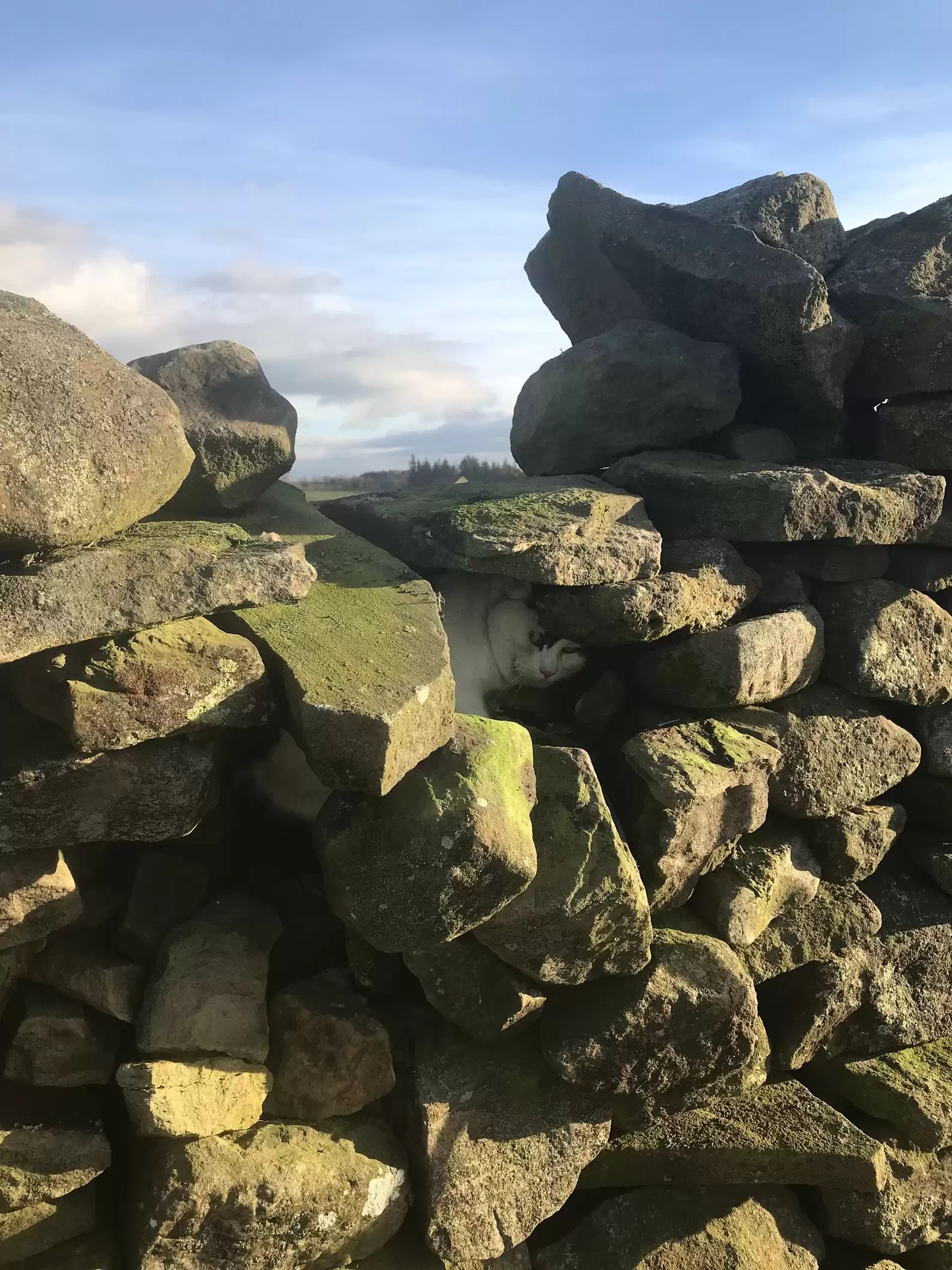
A guy and his dog were out on a walk one day through a field in Tow Law, England, when the dog suddenly became very interested in a nearby stone wall. After looking a little closer, the pair found a cat — who had somehow gotten himself completely stuck in the wall.
The RSPCA was called and Inspector Ruth Thomas-Coxon drove over to try and help. She was hoping that it would be as easy as just gently pulling the cat, later named Freddy, out of the wall, but she quickly discovered that he was much more stuck than that.
“Initially it looked as though he’d chosen to tuck himself inside the gap, but he didn’t try to run away when we got closer,” Thomas-Coxon said in a press release.
Thomas-Coxon weighed all her options and decided the best way to free Freddy would be to take apart the stone wall.
“The owner of the paddocks and wall came out and, between us, we removed some of the stones to dismantle the top part of the wall and free the cat,” Thomas-Coxon said. “He made a dash for it and jumped into another part of the wall, where we were able to catch him.”
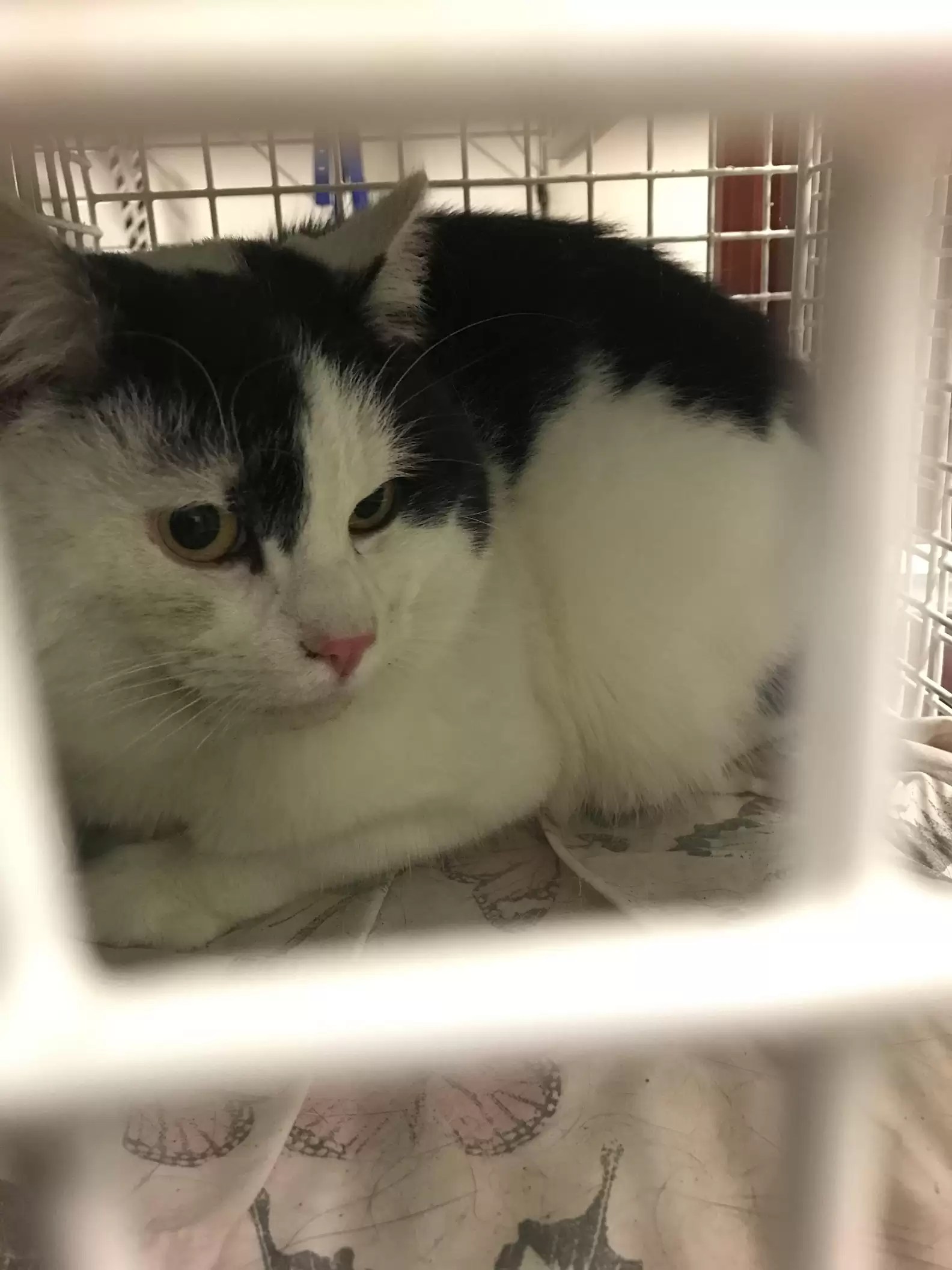
Even though Freddy was definitely stuck and needed help, he was also not super pleased about being rescued by strangers. Once he realized he was safe, though, he calmed down, and Thomas-Coxon took him to the vet to get him checked out.
“Vets found he was in fairly good health, although he had some mats in his coat, which they removed,” Thomas-Coxon said. “He was a sweet, friendly cat, so I wondered if he was a missing pet, but he was not microchipped. I made some inquiries nearby, put up a poster where we rescued him and also put his profile on PetsLocated, but, unfortunately, he’s not yet been claimed.”
Freddy is settling into the shelter well, and if no one comes forward to claim him, he’ll be put up for adoption. From being stuck in a stone wall to a potential forever home — Freddy’s come a long way.
ooOOoo
It’s a strange story in the sense that the cat was not claimed so who knows where he had come from. But his future is much better, thanks to the RSPCA, and if he is adopted it will be to a good, caring home.
Ukrainian soldiers were inspecting abandoned homes on the frontline near Kyiv, in an area that has been reclaimed from the Russians. The troops came across a lonely dog in an apartment and after finding identification documents, they discovered her name was Bavaria. A volunteer has taken the dog in and hopes to reunite it with its owner.
There was a short film also and I am delighted to find this video on YouTube.
With so much disruption and cruelty going on in Ukraine it is a real delight that compassion and love are still very much alive.
In a comment to a recent post on this blog, John said: “Just sent you an email.“
I went to that email and read:
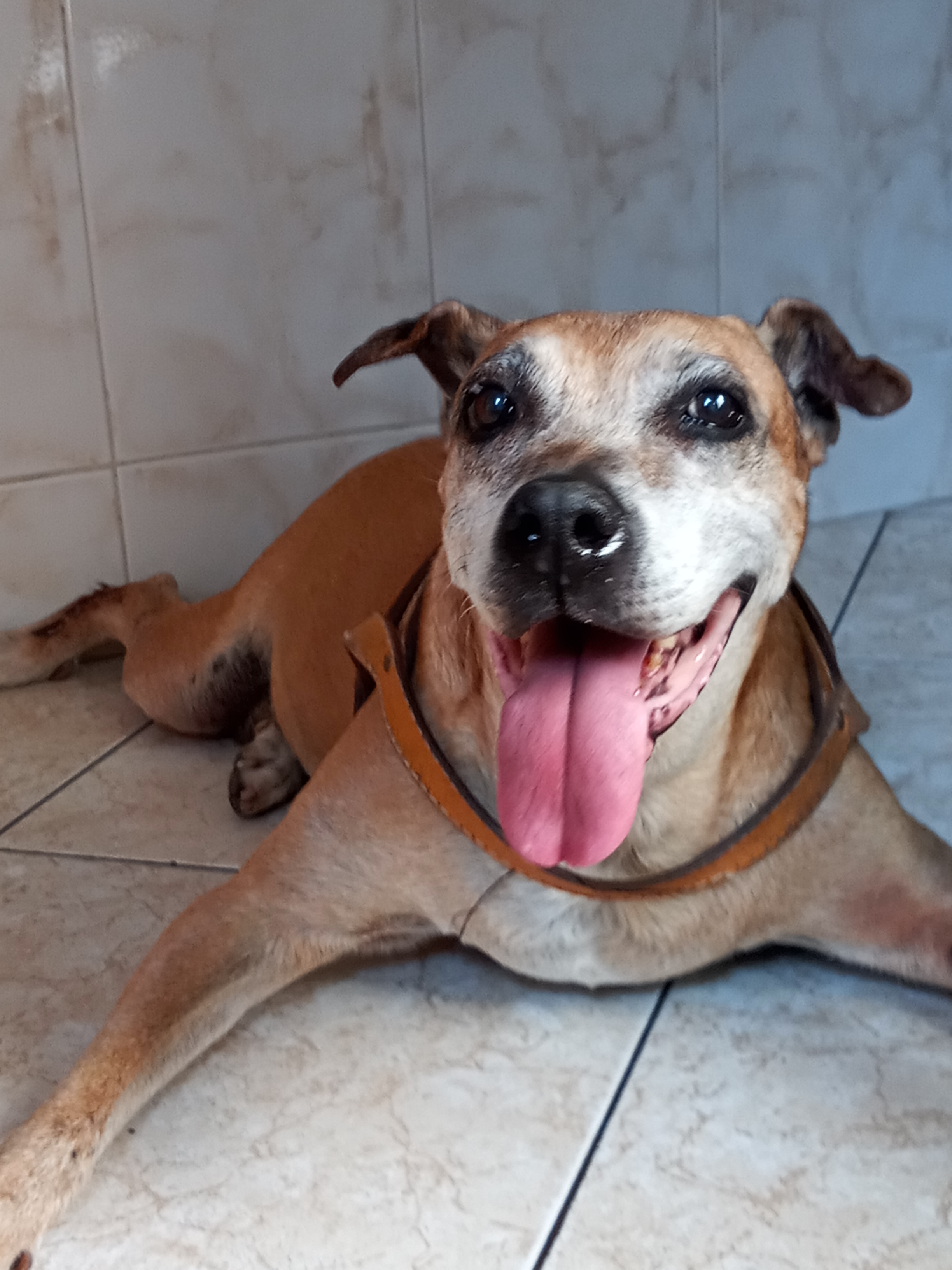
Hi Paul — just a personal note to let you know Bela died yesterday at 3.30pm. Her old beaten up body couldn’t do it any longer. A week after the last of her two operations she started going downhill. Her walks were more laboured. Last Tuesday I stopped walking her because (although she wanted to keep going) she was failing. She deteriorated over the weekend… Monday was spent racing her between vets, diagnostic clinics, and finally to the emergency care hospital. She made it through the night. She made it to us going there to see her. She was in a terrible state, her kidneys dissolving, her heart giving up. She was thankfully without pain, and although barely conscious (she was on heavy, heavy opioids), she managed to lift her head one last time. The vet there later said it was like she was waiting for you to say goodbye. She died thirty minutes later. Her heart gave out, and they could not revive her.
John subsequently emailed me the details of when he found Bela.
I caught sight of something out of the corner of my eye driving home one day. I *thought* it looked like a dog. I turned around, and that’s how we found her… skin and bones, leg broken, paw smashed. And as we’d later discover, megaesophagus. We scooped her up and raced her to the vet. First time in my life after a rescue I actually asked the vet that day if we should just end her misery right then and there. Four years is what she gave us, and our lives are richer for it. Four short years.
Since then Bela has had four or five major operations, the last two to remove cancers were in January and March of this year. As John puts it: “In my mind we were setting her up for many more years of health.“
Finally, here is a video of Bela. It is rather poor quality because the original is far too large. But it doesn’t matter at all because it just shows Bela alive and well!
There are so many stories about humans going beyond the call of duty in giving dogs love and attention. In my own case, complete chance meant that I met Jean down in San Carlos, Mexico, rescuing street dogs and giving them love and support before finding homes for as many as she could in America, mainly Arizona. Jean had upwards of 20 dogs around her beach-front home and all the dogs were incredible, as in attentive and friendly and well-behaved.
The following article was seen in The Dodo and I wanted to share it because it says so much about the relationship that can be achieved between a human and dogs.
ooOOoo
Woman Walks In On Her Dad Napping With All The Neighbor Dogs
“They come running when they see his car and follow him inside.”
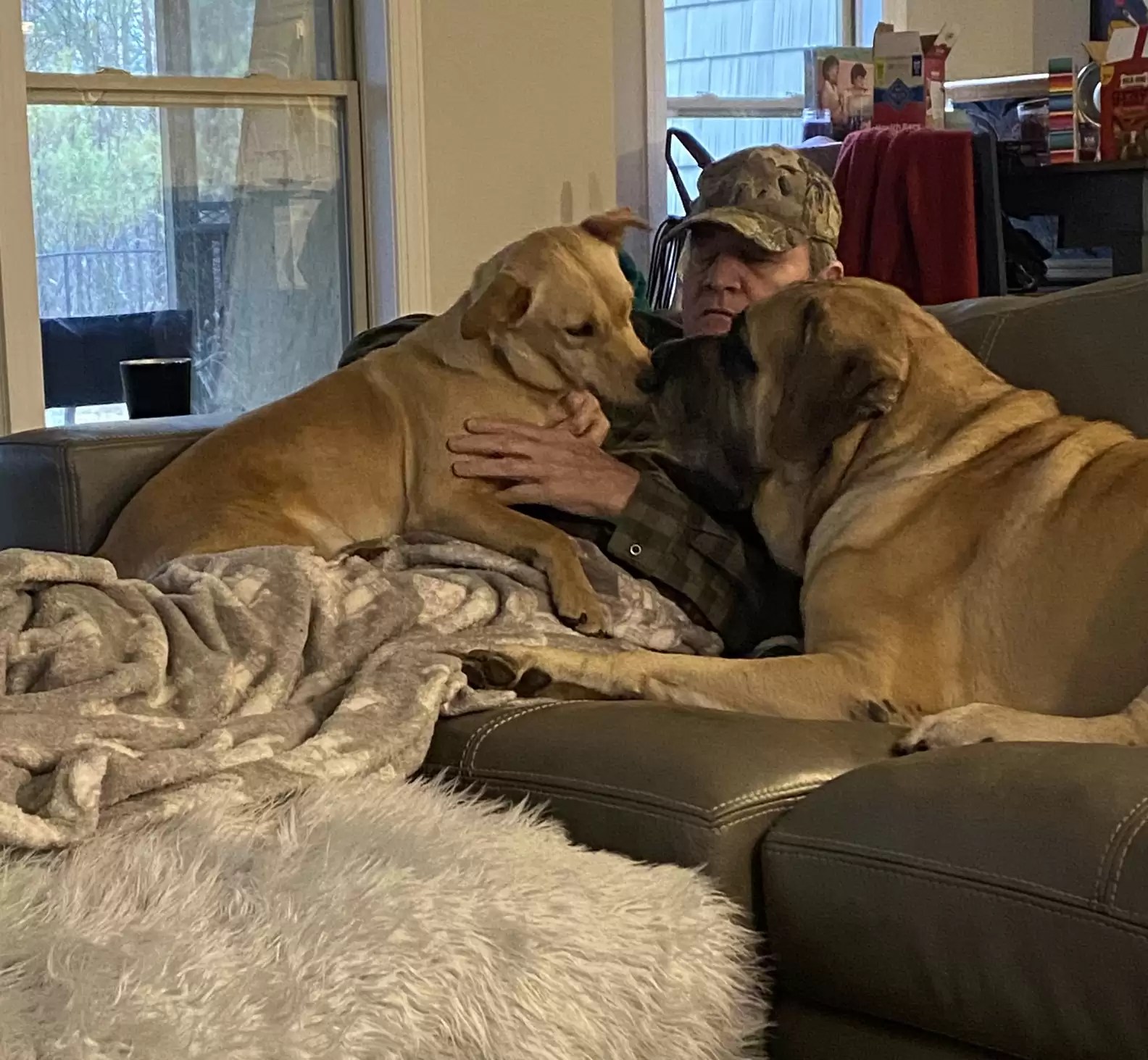
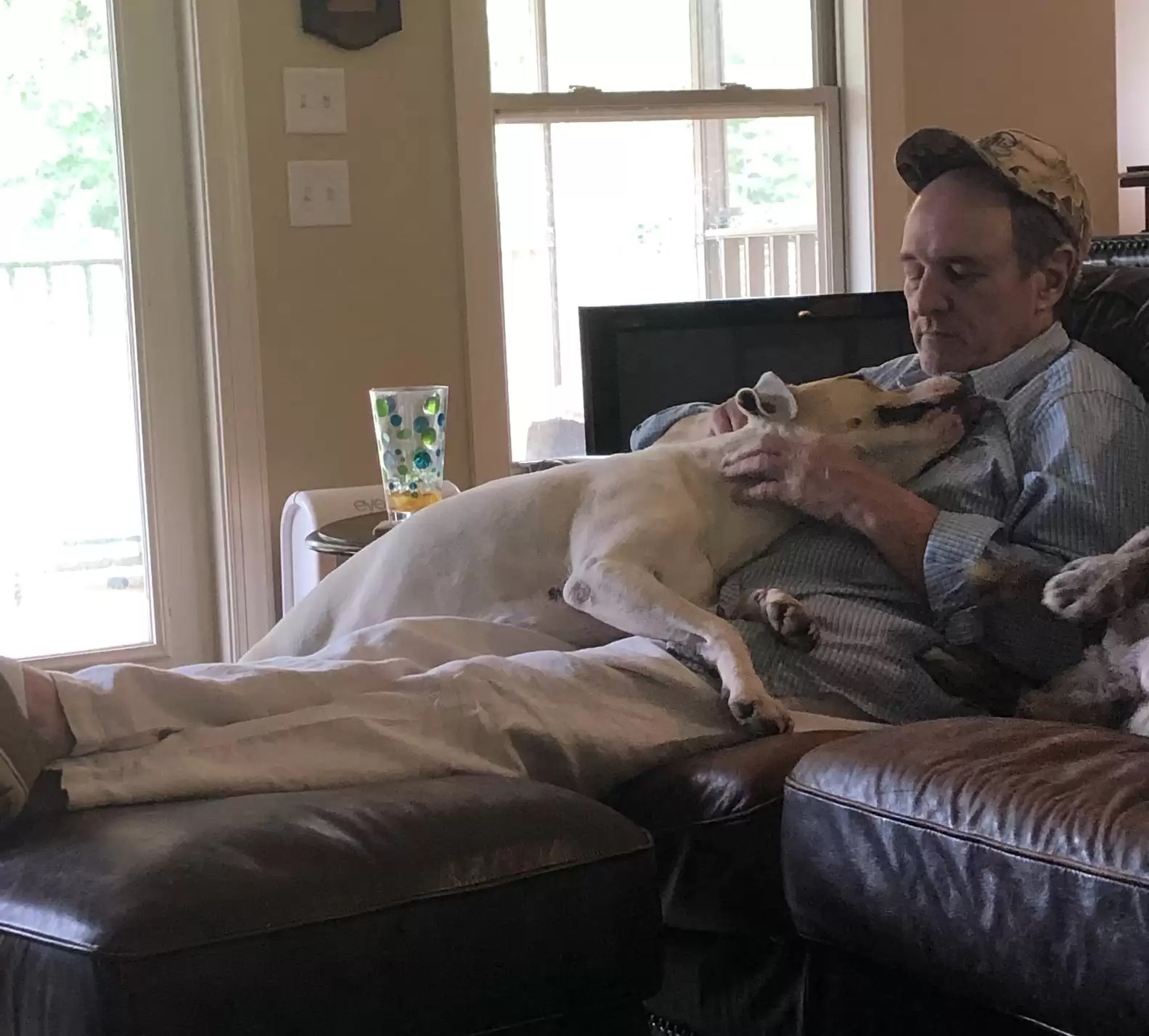
When Catey Hall checks in on her dad, it’s not unusual to find him napping on the couch. But Hall’s dad never sleeps alone — dogs from around the neighborhood join him to make one big comfy pile.
“Dad sees, plays with and naps with one or more of these dogs on a daily basis,” Hall told The Dodo. “They come running when they see his car and follow him inside.”
Catey Hall
Hall’s dad, Lon Watson, has always loved dogs and works with the local rescue Pound on the Hill to make sure every animal gets the help they need.
“For as long as I can remember, my dad has rescued stray dogs,” Hall said. “Growing up, we always had a dog. But there was always room for a stray in need. Now that he lives alone with his wife, there’s room for several. They work with rescues in the area to find homes for the dogs in need; however, not all of them are re-homed, and they stay with dad forever.”
Catey Hall
Watson has four resident dogs at home, all of whom he and his wife have rescued and rehabilitated.
But he receives daily visits from Hooch, Fluffer-Nutter and Rosie — all of whom live nearby and have a special connection with Watson.
Catey Hall
The neighborhood dogs are happy to wait all day just for some brief one-on-one time with Watson.
Catey Hall
“The neighborhood is an unincorporated section of semi-rural Alabama. The houses are set far back from the street, so the dogs can bounce from house to house safely,” Hall said. “The dogs can usually hear my dad’s truck coming, and they will meet him in the driveway.”
Catey Hall
Luckily, Watson’s human neighbors don’t seem to mind that their dogs spend most of their time with Watson — and would never get in the way of their special naptime.
Watson just seems to have a way with every dog he meets. Even Hall’s two dogs try to get in on the action. “As a matter of fact, they try to leave with Dad when he’s here visiting,” Hall said.
ooOOoo
Hall’s dad is a very fine person, in my book. If one clicks the link to go to the Pound on the Hill Animal Rescue, almost the first thing that one sees is a piece written by Dana Derby. I am taking the liberty of finishing off today’s post by quoting Dana’s words.
oooo
I am a wiggly butt, adorable puppy. Who wouldn’t want ME? I am cuddly and warm. I look at you as my hero… and you are my hero… you saved me! I want to be with you; I feel safe in your arms. And you know I love you unconditionally. It matters not what you wear, your age, your weight or if your roots are showing… I love you just for you!
What I need to know is will you still love me? I will make mistakes. I may piddle on your best rug. If I am lonesome, I may chew on your favorite shoe… because it smells like you.
Will you still love me? I will grow into a dog. Though I will be cute, I won’t be the tiny baby you held in your arms. I may be rowdy until I learn my manners. It could be trying, at times. My tail might knock things over when I am so happy to see you it won’t stop wagging! I may run in circles, jump and bark simply because I am happy to love you so very much.
Will you still love me? As years pass, I will slow down. We age just like humans… only at a faster rate. This is because I cannot live without you. My face may become white with age, my legs not work so well, and my eyesight could deteriorate.
Will you still love me? And when my time comes to go to the Rainbow Bridge… I will want you by my side as I say goodbye. Not so much for me, but for you. I will want to be with you during this difficult time, just as we have shared the joy and sorrow of life together for years. I am your companion and will be with you forever… and I will still love you as I live patiently in your heart.. until we meet again.
This story shows how we are connected to our dogs!
Jesse Lee, the dog, shows how one elderly man somehow connected with her. More later but first the story from The Dodo.
ooOOoo
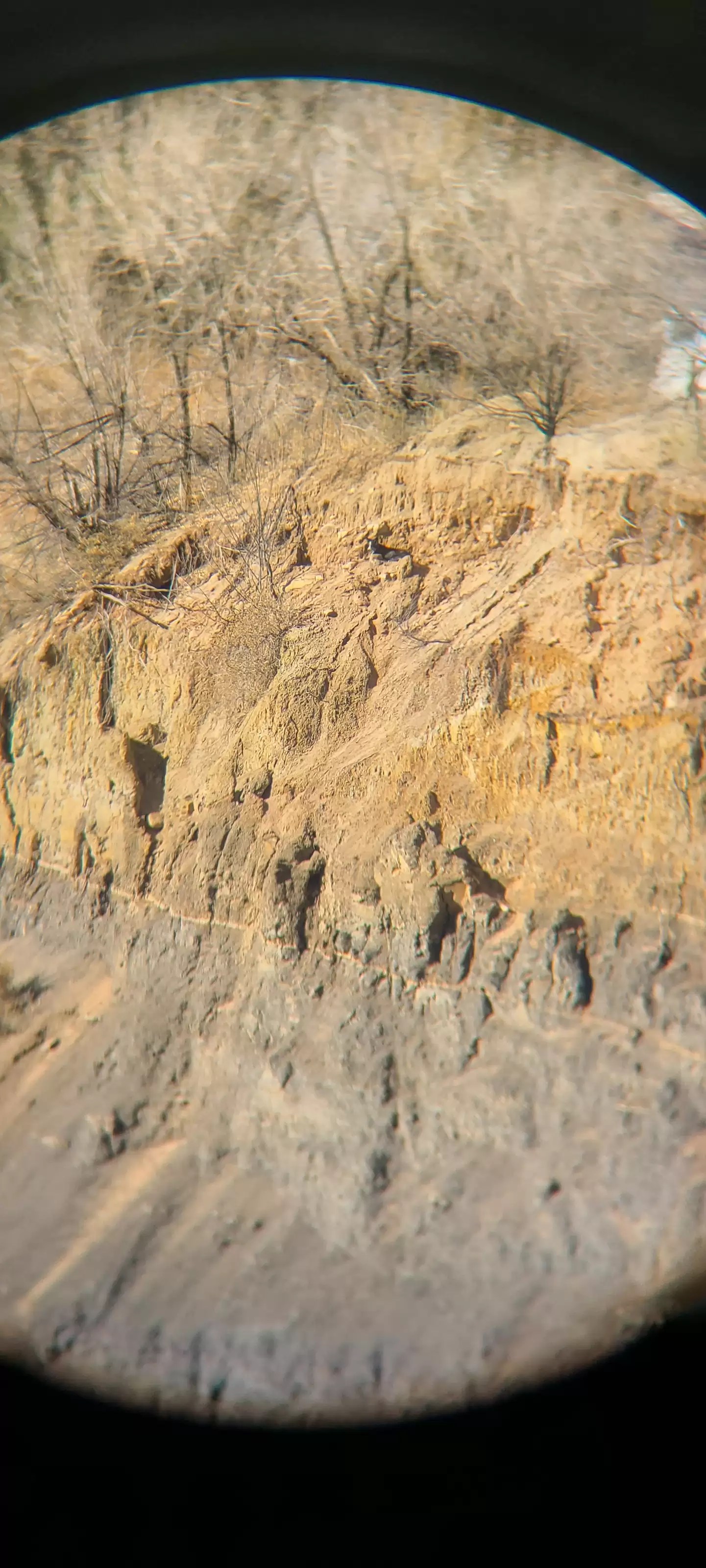
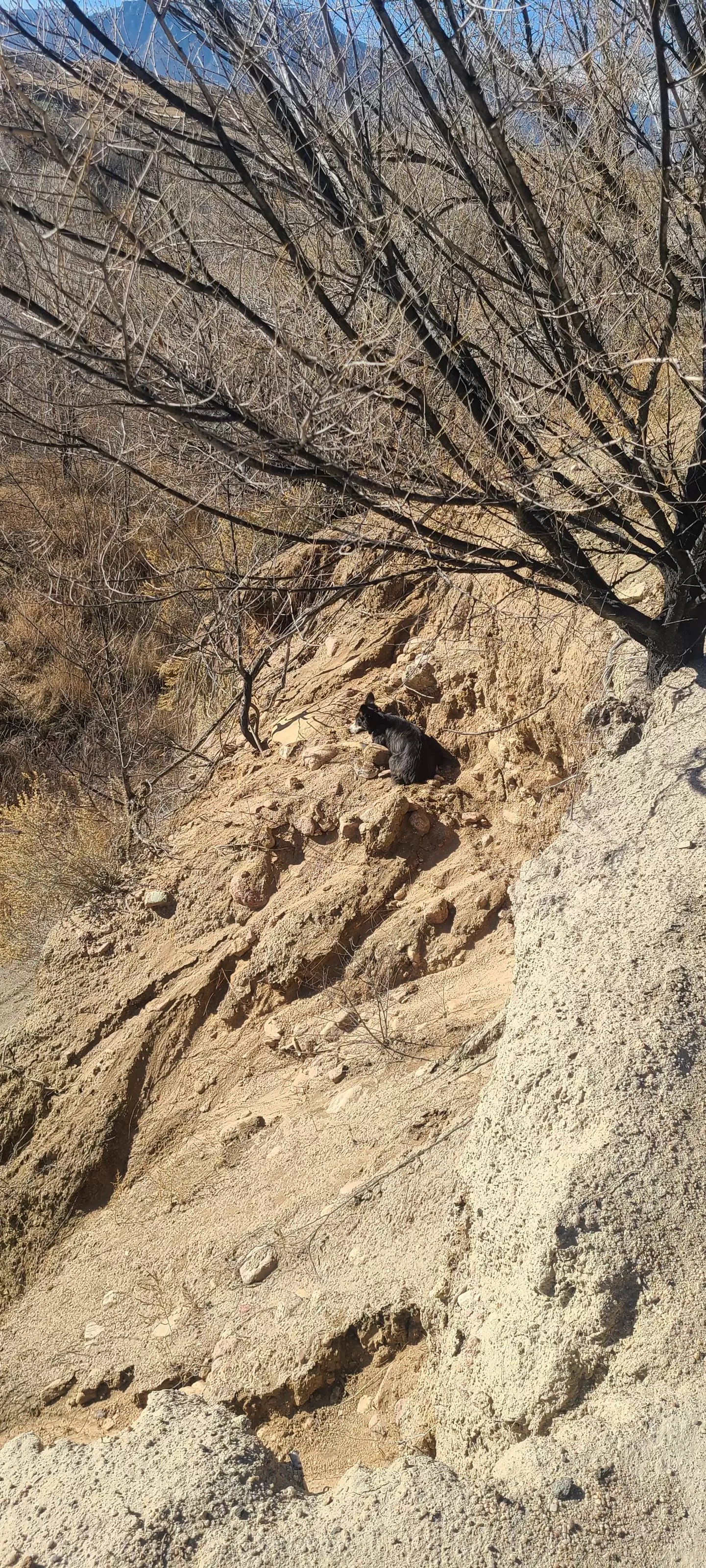
Man Sees Tiny Speck On Cliff In The Distance And Immediately Knows It’s A Dog In Need
“He was funny because I couldn’t see her without my binoculars, and he said he knew the ‘dot’ was an animal because he’s never seen that dot there before.”
An elderly man was having his morning coffee outside his motorcycle shop one day when he noticed something unusual on a cliff in the distance. He quickly concluded that the tiny speck he was seeing was actually a stuck animal in need of help, so he contacted the Humane Society of the Pikes Peak Region (HSPPR), and they sent two animal law enforcement officers to check it out.
The officers couldn’t see the dog without a little extra help, but the man never had any doubt that she was there and desperately needed help.
“He was funny because I couldn’t see her without my binoculars, and he said he knew the ‘dot’ was an animal because he’s never seen that dot there before,” Officer Kailie Barker told The Dodo.
The dog was stuck on a small ledge about 150 feet above a creek. They weren’t sure how long she’d been there and immediately started coming up with a plan to rescue her.
“It took two and a half hours total to be able to find out exactly where she was, how we were going to get to her, obtaining the equipment and formulating an exact plan,” Barker said.
The officers were able to obtain some climbing gear, and once they were ready, Barker rappelled down to the stuck dog — who was so excited that someone had finally come to help her.
“She was obviously very scared. She had her body pressed into the dirt, she was wagging her tail quickly and was trying to crawl towards us when she very first saw us,” Barker said. “The dirt kept sliding out from under her, but she kept trying. When I was down on the cliffside with her, she tried crawling towards me again. When I finally got to her, she kept licking my hands and face.”
Once the dog had been brought to safety, they read her collar and discovered that her name was Jessie Lee. They took her back to HSPPR, where the staff was able to find her family’s contact information. It turns out she had been missing for two weeks and was found only a few blocks away from her home. Her family had searched for her every single day and was absolutely overjoyed that someone had found her.
Luckily, Jessie Lee wasn’t injured after her ordeal and was able to head home to her family shortly after being rescued. It was the perfect happy ending, all thanks to the officers who rescued her — and the man who knew that tiny speck in the distance was actually a dog.
ooOOoo
(All photographs courtesy of the HUMANE SOCIETY OF THE PIKES PEAK REGION)
Time and time again men and women spot something that they know is a dog. Even though it is a tiny speck or a creature in the darkness.
It is this fundamental relationship that binds us humans to our dogs, whether we know them or not!
Jessie Lee was alright and, to repeat the closing sentence above: ‘It was the perfect happy ending, all thanks to the officers who rescued her — and the man who knew that tiny speck in the distance was actually a dog.‘
p.s. I was reading the draft article out to Jeannie yesterday evening and she said that I had previously published it, and not so long ago! Whoops!
I apologise but this is the next guest post from Indiana Lee not the one I published yesterday.
ooOOoo
Courtesy of Unsplash
Maximizing the Mental and Physical Health Benefits of Dog Ownership
Dogs do so much for us and our health. They help us overcome depression, prompt us to move more often, and give us joy through their play and cuddles — sometimes it feels as though they’re the ones looking after us!
But, not everyone who owns a dog maximizes the health benefits that our canine companions can bring. Oftentimes, owners get lazy and fall out of a regular walking schedule, or use their dog as an excuse to stay home and avoid travel or social events.
Finding ways to take advantage of the health benefits that dogs can bring is crucial for owners. So, here are a few tips to help you get the most from your relationship with your pup.
Dogs and Mental Health
The positive impact that dogs have on our mental health is gaining recognition amongst researchers and healthcare providers. There are a few different theories as to why dogs are so good for our mental health, but the leading idea involves the chemical oxytocin.
Ann Robinson, writing for the Guardian, calls Oxytocin “the so-called ‘hug’, ‘love’ or ‘cuddle’ hormone”, and is the chemical that is present when we form deep, meaningful relationships. This chemical is present when we form relationships with our parents or children, but is also at play in the pet-owner relationship.
While the research on oxytocin and mental health is still in its infancy, we do know that dogs help us combat stressors and mental health conditions. It should come as no surprise that service dogs can help folks who suffer from PTSD or anxiety manage their conditions. But, dogs can also help anyone who is struggling with stress from day-to-day sources.
Dogs and Physical Health
Dog owners spend about 200 more minutes a week walking than folks who don’t own a dog. This has a range of welcome health benefits, such as improved cardiovascular function, more effective immune systems, and a stronger muscle-skeletal system.
But, thousands of dog owners do not take their dogs out for a walk or to a local dog-play park. This may be for perfectly valid reasons like a disability, but if you can walk your dog, yet choose not to, then both you and your dog are missing out on the incredible health benefits of being outdoors.
You don’t need to start hiking mountains to enjoy the physical health benefits of dog walking. Start slow, with a walk that lasts about 15 minutes. This will ensure that neither you nor your dog will be “over walked”, which can lead to conditions like arthritis and joint pain. Preferably, aim to walk on grass or soft surfaces as these will be easier for your pup to walk on because they won’t burn their paws.
Modifying Your Home
You might not realize it, but the design and structure of your home significantly impact the health and wellbeing of your dog. By making design choices that improve your dog’s quality of life, you can expect to have a healthier, happier dog who will reward you with plenty of affection and attention.
First and foremost, you need to make sure your home is pup-proof. This means you need to remove any hazards like hanging objects or harmful substances like human food and cleaning chemicals. Following this, you should maintain a clean home, where your dog won’t choke or fall ill by eating something you’ve left lying around.
Once you’ve taken care of the basics, you can get a little more creative about what you choose to include in your house. You can, for example, include pest repellant plants that are also safe for your pup that will keep mosquitoes and other pests away from both you and your dog. Small changes like buying a dog bed for your office can also make a big difference to your dog’s quality of life.
By taking the time to keep your home clean and dog-safe, you can live with peace of mind knowing that your dog is happy, healthy, and wouldn’t want to be anywhere else.
Travel With Dogs
Many folks mistakenly believe that they can’t take their dogs with them when they travel, or that their pet will put a wrench in their travel plans. This couldn’t be further from the truth — bringing your dog with you on your travels is a great way to stimulate them, and will only improve the connection you have with your canine pal.
The key to ensuring you have a good time on the road is all about choosing the right mode of transportation. If you’re planning to travel with your dog in the car, then you might want to consider investing in dog cages for cars and make use of factory-installed barriers which keep everyone safe in the event of an accident.
You can also take your dog with you via other methods like trains or via planes. Nowadays, many airlines allow you to keep your dog with you while you fly, rather than having to place them in the hold. Trains are much the same, as many dog owners choose to travel with their pets via a good old locomotive.
Traveling with dogs is also great in the winter, as many dogs are well suited to colder climates, and love nothing more than playing in the snow and cold weather camping. This can help you beat the winter blues, and improve your overall health and wellness. Just be sure to follow winter-safety travel considerations that are designed to keep you and your four-legged friend safe.
Conclusion
Maximizing the mental and physical health benefits of owning a dog is tricky. If it’s been a while since your last walk, then it can be daunting to get out on the road again. Likewise, the idea of traveling with a canine pal is overwhelming for many folks. But, by planning ahead, and creating an environment your dog will enjoy, you can be sure to get the most from the special relationship you have with your four-legged friend.
ooOOoo
Dogs are the most amazing and wonderful animals ever. As has been said on this blog many times before dogs offer us unconditional love and that love presents itself in many ways.
I have written before about our Oliver.
Oliver’s eyes are to die for! His ability to read the smallest indications of an emotion on our human face is incredible.
Then there is Brandy. What a love!
Then we have Cleo who came as a puppy to be with Pharaoh.
June, 2007
Again the eyes! We still miss him.
The first day that Pharaoh was passed across to me. Devon, June 2003.
We are now down to five dogs: Pedi, Sheena, Oliver, Cleo and Brandy.
However all the dogs that we have had the greatest pleasure to love are still in our hearts.
I haven’t got a great deal of time today (as in yesterday) to write an introduction to this story that was published on The Dodo in December last year. So I am not going to! 😉
ooOOoo
Man Sees Tiny Speck On Cliff In The Distance And Immediately Knows It’s A Dog In Need
“He was funny because I couldn’t see her without my binoculars, and he said he knew the ‘dot’ was an animal because he’s never seen that dot there before.”
An elderly man was having his morning coffee outside his motorcycle shop one day when he noticed something unusual on a cliff in the distance. He quickly concluded that the tiny speck he was seeing was actually a stuck animal in need of help, so he contacted the Humane Society of the Pikes Peak Region (HSPPR), and they sent two animal law enforcement officers to check it out.
The officers couldn’t see the dog without a little extra help, but the man never had any doubt that she was there and desperately needed help.
“He was funny because I couldn’t see her without my binoculars, and he said he knew the ‘dot’ was an animal because he’s never seen that dot there before,” Officer Kailie Barker told The Dodo.
The dog was stuck on a small ledge about 150 feet above a creek. They weren’t sure how long she’d been there and immediately started coming up with a plan to rescue her.
“It took two and a half hours total to be able to find out exactly where she was, how we were going to get to her, obtaining the equipment and formulating an exact plan,” Barker said.
The officers were able to obtain some climbing gear, and once they were ready, Barker rappelled down to the stuck dog — who was so excited that someone had finally come to help her.
“She was obviously very scared. She had her body pressed into the dirt, she was wagging her tail quickly and was trying to crawl towards us when she very first saw us,” Barker said. “The dirt kept sliding out from under her, but she kept trying. When I was down on the cliffside with her, she tried crawling towards me again. When I finally got to her, she kept licking my hands and face.”
Once the dog had been brought to safety, they read her collar and discovered that her name was Jessie Lee. They took her back to HSPPR, where the staff was able to find her family’s contact information. It turns out she had been missing for two weeks and was found only a few blocks away from her home. Her family had searched for her every single day and was absolutely overjoyed that someone had found her.
Luckily, Jessie Lee wasn’t injured after her ordeal and was able to head home to her family shortly after being rescued. It was the perfect happy ending, all thanks to the officers who rescued her — and the man who knew that tiny speck in the distance was actually a dog.
ooOOoo
All the photographs are from the HUMANE SOCIETY OF THE PIKES PEAK REGION.
It is a precious story and just goes to show the magic we have in our hearts for dogs.Well done that man!
There are many things we just take for granted including, if I may say, celebrating a birthday for our dog. Now I’ve no way to check with readers if what I just said is correct; it is an assumption.
Earlier in the year, July to be exact, The Dodo published ideas that might be useful for you. Here they are:
ooOOoo
7 Ways To Celebrate Your Dog’s Birthday
For the absolute best birthday (or adoption day) ever 🥳
There are lots of ways to celebrate your dog’s birthday. But different dogs might like to celebrate in different ways depending on their personality — some dogs are more social, and others might just want to spend the day lounging around.
With all the different ways to celebrate and all the different dogs out there, it might be hard for you to decide what to do to give your dog the best birthday.
To help you decide, The Dodo made a list of seven fun ideas for ways to celebrate your dog’s birthday.
Dog birthday party ideas
Throw a dog party
Invite all your dog’s friends to his birthday party! To make sure everyone’s included, send out invites like this one. You can personalize the template and add whatever you want to say to the front!
You’ll need some decorations for the party, too, so get this banner of your dog’s face! Just send in a pic of your dog, and you’ll get this banner to hang your pup’s face all over your house.
Give your dog’s guests some party favors before they go. Fill up these paw print party bags with little treats or toys to say thanks for coming. They come in a set of 20, so you’ll have plenty to go around.
Have a pool party
If your dog’s birthday is in the summer, let him cool off by taking a dip in the pool! This doggie poolcomes in multiple sizes and doesn’t need to be inflated, so it’s super easy to set up.
Obviously your dog will need a cool outfit for his party. Get him this Birthday Boy (or Birthday Girl) shirt that comes in multiple sizes and keeps your dog warm enough to wear on outdoor walks.
Get this birthday crown to complete the look. It’s sparkly gold with pom poms on top and has a chin strap, so it will stay put all day long (or as long as your dog will keep it on).
Have a photo booth
Set up a photo booth with props! These birthday-themed props will let you take lots of Instagram-worthy pictures with your dog. There are glasses, balloons, cake and hats, so you’ll have a lot of options.
Make pupcakes
Make homemade pupcakes for your pup with this dog cake mix. The recipe is all-natural and peanut butter flavored, comes with an icing mix and can be made in either the oven or microwave for easy baking.
Spend time with your dog
Spend quality time with your dog and give him some exercise by taking him on a long walk. You can still dress your pup up for his birthday walk with a fun harness and leash combo like this mix-and-match one that earned The Dodo’s Paw of Approval. The harness is adjustable, and there are tons of different colors. It also comes with a cute poop bag carrier to make cleaning up after your pup a little more fun.
Take time out of your day just to play with your dog. Whether it’s throwing a ball or playing with a squeaky toy or tug-of-war, your dog will love it. Get him some new toys that he can play with on his birthday too.
Let your dog pick out a gift
Take your pup to a pet store and let him pick out his own gift! You’ll probably be getting him tons of presents, but it’ll be fun for him to pick one out for himself too. Plus, dogs go crazy for all the sights, smells and sounds in pet stores, so it’ll be an adventure.
ooOOoo
You should be aware that if you choose to purchase an item from The Dodo website then their statement is applicable:
We independently pick all the products we recommend because we love them and think you will too. If you buy a product from a link on our site, we may earn a commission.
I think there are some brilliant ideas and, upon reading this article, maybe many fewer people will take it for granted when their dogs have a birthday!
This is an article that was recently published in The Dodo. Indeed, published on the 11th November this year.
I started this post late in the day yesterday and was anxious to have it published before the evening took over. But the story is so clear and obvious, and lovely, that further rambling words of introduction would have got in the way.
So, here we are:
ooOOoo
Rescue Dog Waits All Day For The Man Who Saved Her To Get Home From Work
Earlier this year, Sara Fitzwater’s husband arrived to one of the coal mines he visits for work when he spotted a dog nearby, seemingly alone. He wasn’t sure where she’d come from, but after seeing her there again on later visits, it became obvious.
“Someone had dropped her off in the area,” Fitzwater told The Dodo. “Each time [my husband] would go to this mine, she would run to him and smile at him.”
The dog had won his heart. And he had landed a special place in hers.
Sara Fitzwater
During one fateful visit to that mine, Fitzwater’s husband decided to bring the sweet dog home with him to keep her safe and loved as his family’s new pet. They named her Sadie Kate.
The abandoned pup’s eager wait to be rescued was over. But each and every day since, there’s still something Sadie Kate so clearly looks forward to.
And that’s her hero coming home.
“I work from home, so I started noticing her just looking down the street waiting on him and thought it was cute,” Fitzwater said. “I never dreamed she would continue doing it every day.”
For Sadie Kate, it’s the sweetest homecoming.
Sara Fitzwater
The dog, once without a friend in the world, had found her soulmate.
And he’s always worth the wait.
For Fitzwater, it’s no surprise that Sadie Kate is so smitten with her husband. It seems he’s the type of man whose kind, caring spirit is easy to love.
“I tell her all the time she hit the jackpot when she smiled at him,” Fitzwater said.
ooOOoo
Sadie Kate is quite clearly now the name of the dog.
A recent new item in the Daily Courier caught our eye.
Like many who live in this corner of the world we read the Grants Pass Daily Courier. On Wednesday, November 3rd at the bottom of the front page was an article entitled: “A shelter dog for 22 months now, Manny continues on comeback trail“
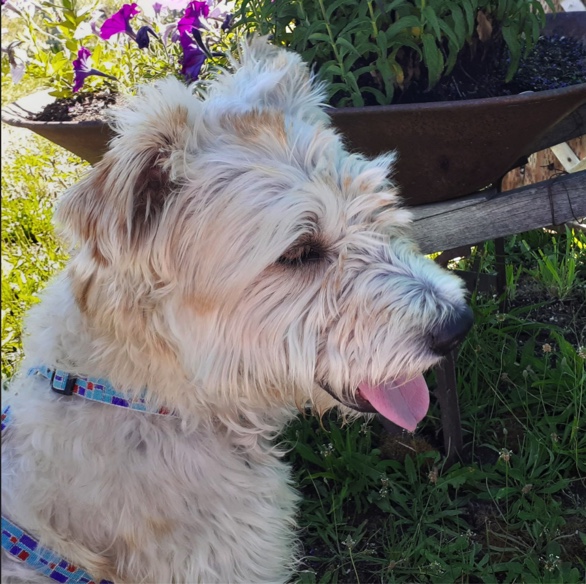
It was a story of a wheaten terrier found in January 2020 abandoned, suffering from wounds both old and new, and the Rogue Valley Humane Society (RVHS) took him in.
Margaret Varner, executive director of RVHS, who helped Manny said that he: “He came in with so many wounds”.
Manny eventually went to an animal trainer near Eugene, Roman Gottfried.
I have chosen to republish an article that appeared on the RVHS website about Roman Gottfried and Manny. Here it is.
ooOOoo
Training Sessions Can Make A Big Difference
Roman Gottfried, our trainer from Holistic Dog Traning, recently hosted another training session with Manny and Noodles. Manny is about 4 years old, loves people, likes to keep busy and is crazy about water! He has had an incredibly difficult past but that hasn’t stopped his zest for life. He’s been moving forward throughout his healing process both physically and emotionally. Our team works daily to provide the stimulation he needs and love he craves.
Manny is still waiting for his forever family
Noodle has since been adopted, but during his stay we learned he had some separation anxiety. His owner named him Noodle because of how he just melts when he is shown affection. When Roman worked with him he helped us determine that Noodle was able to get along well with young children, other dogs and farm animals. Noodle hadn’t had interactions with cats so we couldn’t say how he felt about them, but during his work with Roman we saw he had a lot of energy and absolutely loved his people. Noodle’s previous owners wanted to make sure we knew his perfect home would be with someone who could be with him most of the day, and that is the kind of forever family he found. Soon after getting adopted he began enjoying hikes with his new family and loving it.
Noodles has found his forever family!
During his Q and A that same afternoon, Roman answered common questions from dog owners such as what to do if your dog has separation anxiety, resource guarding or excessive barking issues. Owners wrote in their dog’s behaviors in the live session comments and Roman was able to respond with helpful advice.
ooOOoo
Back to the Courier.
The last two paragraphs of the story are as follows:
And watching him last week, one could see that “calm” is now part of Manny’s behavioural menu. This is an exceptional dog,” Gottfried said, “I’ve worked with a lot of weirdos. This one is a keeper.”
Please can someone soon be Manny’s forever family home. Anyone interested in having Manny please call RVHS on 541-479-5154.