First, let me will quote from the text that comes with the YouTube video.
This is the remarkable story of Zeus, who was effectively paralyzed at the time he was rescued from a high-kill animal shelter in Oklahoma by the wonderful people at St. Francis CARE in Murphysboro, Illinois.
Video edited and produced by Jason Greene
Next, this unmissable video confirms what so many now already: Dogs are stars in their own world.
There you go! A short, little post for today but one that highlights the power of dogs! They are incredible!
And, apologies, if I have shown them before. There are so many and I have been through quite a large number of them. But in the round of things, so what if they have been repeated!
The photographs, as usual, from many people all shared with you courtesy of Unsplash.
I have said it many times before and, knowing me, will undoubtedly say it many times again. That is that this blog wouldn’t still have in excess of 4,000 followers if all these good people had only me to read.
I know you will enjoy Jackie’s post and it is a most important post looking at the history of the dog. Jackie and her husband look at the dog back in Roman times. You will love this!
ooOOoo
Pup Pompeii – Discovering the Dogs of Ancient Rome
Research has now proven that dogs have been companions to humans for 40,000 years. DNA analysis of a 35,000-year-old bone fragment from an ancient wolf, discovered on the Taimyr peninsula in Siberia, presented evidence that dogs diverged from the wolf species much earlier than previously thought. The findings, published in the journal Current Biology, state that Siberian Huskies and Greenland Sled Dogs share many genes with the Taimyr Wolf.
As such, it is no surprise to learn that, a mere two thousand years ago, the ancient Romans kept dogs. However, on a recent road trip to the ruined city of Pompeii with The Fab Four, our four Cavapoos, my husband Mark and I discovered some fascinating facts about the relationship between ancient Romans and Man’s Best Friend.
Pompeii in southern Italy is the most extraordinary time capsule. It grants the onlooker a fascinating and sometimes painfully intimate window into an ancient civilisation. Snuffed out almost instantly by the eruption of Mount Vesuvius, metres of volcanic ash preserved the entire city for two millennia, exactly how it was on those two fateful days in 79 AD.
My husband, Mark, and I visited in April this year with The Fab Four, our four Cavapoos (Cavalier/Poodle cross.) Within thirty minutes of leaving our campsite, I had bought my first Pompeii souvenir – a coaster portraying the striking black-and-white mosaic of a dog wearing a spiked collar crouched and ready to pounce, along with the words Cave Canem – Beware of the Dog.
Cave has nothing to do with underground chasms. It comes from the same Latin root as caveat, as in caveat emptor – buyer beware. The original mosaic is in the entrance to the House of the Tragic Poet. Since we were investigating Pup Pompeii, we had to find the real thing and when we got there, The Fab Four thrilled me by lining up in front of it, unasked!
If you think about it, Rome’s canine connections go right back to the beginning. According to the legend, a she-wolf suckled the twins, Romulus and Remus. Although Remus was killed, Romulus went on to found Rome.
Many objects and artefacts confirm Romans kept dogs. It is no surprise to find pooches employed as guardians, hunters, soldiers, and entertainers; both on the racetrack and as gladiators in the arena. Sculptures, paintings, and mosaics often depict these large and muscular dogs wearing spiked collars to make them look fierce, or protect them from the dangerous predators that were their prey, such as wolves, bears, and boar.
They also protected against the supernatural. Trivia, the Roman goddess of sorcery and witchcraft, held sway over places of transition, such as graveyards and crossroads. Also known as ‘The Queen of Ghosts’, she wandered during the night and, like her Greek counterpart, Hecate, was silent and invisible. Yet, the Romans believed dogs could see and hear her, so a dog seemingly barking at nothing was warning its owner that Trivia or her ghosts were approaching.
I was touched to discover a softer side of dog ownership, too. Romans also kept dogs as companions, status symbols, used them as hot water bottles, and revered them as an emblem of loyalty and devotion. Infrared analysis of a dog’s collar discovered in Pompeii carries praise for it saving its master’s life in a wolf attack. The archetypal mutt’s name, ‘Fido’, is the Latin word for ‘trust’ or ‘fidelity’, which explains why dogs were popular gifts between lovers.
There was no Kennel Club in ancient Rome, so dog breeds, as we know them today, did not exist. Ever practical, the Romans classified dogs according to their function, or place of origin.
In 2020, archaeologists in Pompeii discovered the skeleton of a tiny adult dog, about 10 inches (25 cm) at the shoulder – the size of a Yorkshire Terrier or Maltese. Malta is just 60 miles south of Sicily, and the “Roman Ladies’ Dog”, Canis Melitae or Melitan, was an expensive status symbol, affordable only to the upper classes. Besides providing companionship and warmth, the Romans believed they drew fleas away from their owners.
The Cave Canem mosaic of a black-and-white dog wearing a spiked collar possibly depicts a Molossian, forbear of the Roman Canis Pugnaces. In modern English, pugnacious means ‘ready to fight’, so there are no prizes for guessing the purpose of CanisPugnaces!
The legions imported Molossians from Epirus, a mountainous region in the southern part of modern-day Albania. The name Molossian derives from the ruling dynasty of Epirus at the time. Alexander the Great’s ‘terrible mother’, Olympias, was a Molossian princess. Historian Plutarch suggested she slept with snakes in her bed!
Molossians may also have found their way to Britain with the Phoenicians, where they founded the Pugnaces Britanniae, which the Romans not only faced in battle, but subsequently captured, imported, and selectively bred with their own Pugnaces, because the British version was “inflamed with the spirit of Mars, the god of war.”
Roman classical poet Virgil praised the Molossian’s abilities as a guard dog. “Never, with them on guard, need you fear for your stalls a midnight thief, or onslaught of wolves, or Iberian brigands at your back.”
The Molossian and Pugnaces Britanniae are the ancestors ofthe Neapolitan Mastiff and the lighter Cane Corso. The Romans used both types in war, notably as piriferi (fire bearers).Greek writer Polybius notes thesefearless canine warriors charging towards enemy lines with containers of flaming oil strapped to their backs.
In 300 AD, the Greco-Syrian poet, Oppiano, described the Molossian as,
“A dog of large size, snub nosed, truculent with its frowning brows, not speedy but impetuous, a fighter of great courage and incredible strength, to be employed against bulls and wild boar, undaunted even when confronted with a lion.”
Alexander the Great’s favourite dog, Peritas, is believed to have been a Molossian. It reputedly changed the course of history by saving Alexander’s life twice; protecting him from a war elephant at the Battle of Gaugamela, and holding off Malian troops until reinforcements arrived, even though it was mortally wounded. The legend says it died with its head in Alexander’s lap.
Among the fabulous mosaics that adorn the floors of the house of Paquius Proculus in Pompeii, a rather regal lurcher-type dog guards the door – perhaps a Vertragus – ancestor of the modern Greyhound. The Romans prized this sighthound as a hunter as well as guarding, and, like the smaller lapdogs, also cuddled them for warmth.
Poet, Grattius, who lived from 63 BC to 14 AD, during the time of Emperor Augustus, praised the Vertragus for its speed and refined features, noting rather splendidly that it runs “swifter than thought or a winged bird.”
The Celtic people originated in the upper Danube basin and expanded their culture across great swathes of continental Europe, including France, Spain, Belgium, the Netherlands, the Balkans, as well as in the east in places such as Asia Minor and Anatolia (part of Turkey) – and took their dogs with them.
Curiously, despite its Celtic connections, studies in the 1970s and 2000 confirm that prior to Roman occupation, Greyhound-type dogs did not exist in Britain. The wooden Vindolanda tablets, the oldest handwritten account of life in the north of Roman Britain, do mention that Imperial troops either knew of the Vertragus, or had them with them.
Julius Caesar allegedly castigated Roman citizens for caring more for their dogs than their children. As is so often the case, funerary goods shed light on ancient civilisations. Many inscriptions on Roman tombs highlight the high regard in which the Romans held their dogs. They also suggest that in the past, dogs may have lived longer than in modern times, perhaps because of the interbreeding required to create pedigree strains.
These heartrending inscriptions will strike a chord with any modern dog owner. The first two could easily refer to Canis Melitae:
“Behold the tomb of Aeolis, the cheerful little dog, whose loss to fleeting fate pained me beyond measure.”
“Bedewed with tears I have carried you, our little dog, as in happier circumstances, I did fifteen years ago. So now, Patrice, you will no longer give me a thousand kisses nor will you be able to lie affectionately ’round my neck. You were a good dog and, in sorrow, I have placed you in a marble tomb and I have united you forever to myself when I die. You readily matched a human with your clever ways; alas, what a pet we have lost! You, sweet Patrice, were in the habit of joining us at table and fawningly asking for food in our lap, you were accustomed to lick with your greedy tongue the cup which my hands often held for you and regularly to welcome your tired master with wagging tail.”
Yet it wasn’t just lap dogs who earned tributes from their owners. Here is a truly beautiful and touching dedication on a Roman marble tablet from the first century AD in the British Museum, contemporary with Pompeii. It is written in verse, from the point of view of a prized hunting dog, Margarita (Pearl), from Gaul, who died giving birth. With allusions to the poetry of Virgil, who stated “Mantua gave birth to me”, the care taken over this memorial proves Margarita was clearly a very beloved family member.
“Gaul gave me my birth and the pearl-oyster from the seas full of treasure my name, an honour fitting to my beauty.
I was trained to run boldly through strange forests and to hunt out furry wild beasts in the hills, never accustomed to be held by heavy chains nor endure cruel beatings on my snow-white body.
I used to lie on the soft lap of my master and mistress and knew to go to bed when tired on my spread mattress and I did not speak more than allowed as a dog, given a silent mouth
No-one was scared by my barking but now I have been overcome by death from an ill-fated birth and earth has covered me beneath this small piece of marble.
Margarita (‘Pearl’)”
In the Monty Python film, The Life of Brian, an anti-Roman revolutionary famously asks, “What have the Romans ever done for us?”
Yet, besides roads, aqueducts, plumbing, sanitation, and fast food, they have clearly passed on a deep love and appreciation of dogs!
Attributions:
Photo of Romulus and Remus with the she-wolf courtesy of Benutzer:Wolpertinger on WP de, Public domain, via Wikimedia Commons
FREE Tickets – these are available for visits on the first Sunday of every month. They must be downloaded online and the gates close once a mere 15,000 have been admitted
Self-Guided Walking Tour App – there are few interpretive signs on the site. ‘These two expert-designed self-guided walking tours to explore Pompei, Italy on foot at your own pace. You can also create your own self-guided walk to visit the city attractions which interest you the most.’
Author Bio:
Jacqueline Lambert is an award-winning author and blogger, who gave up work in 2016 to tour Europe full-time with her husband and four dogs. “Laugh out loud funny and a great travel guide.” is just one of many five-star reviews of Jackie’s ‘Adventure Caravanning with Dogs’ series of light-hearted road trip memoirs.
Follow her blog www.WorldWideWalkies.com to keep up to date with their latest expedition, get travel tips and advice, or find out how they live their dream without a lottery win.
ooOOoo
The photograph below is from a collection of photos on the tombstones of ancient Roman dogs. More images may be seen here!
It just goes to show how long these incredible animals have been associated with humans.
This is another guest post from Indiana Lee. She writes with a compassionate and loving style and I am so pleased to be able to offer this post to you.
ooOOoo
How To Create a Healthy, Eco-Friendly Environment for Your Dog
As a dog owner, it’s perfectly normal to want an environment for your canine companion that is fun, happy, and healthy. That includes making sure they have a clean and secure place that’s comfortable and safe, as well as free from hazardous materials and harmful pests.
Creating a healthy environment for your dog is easier than you might think. By dedicating a specific space to your pooch and making some simple swaps, you can be an eco-friendly pet parent, doing something good for the planet and your pup all at once.
Create a Safe Space
First and foremost, try to create a safe space in your home for your dog. You can always consider a pet room, but even just an area in your living room or a comfy crate can do the trick.
Having a designated area for your dog in your home can make a big difference. Dogs are den animals and like having their own safe space to go to. While you don’t necessarily need to dedicate a whole room to your four-legged friend, your space should be pet-proofed to keep them safe.
That includes keeping things organized and clearing up clutter, so your dog doesn’t get into or chew on things they shouldn’t. You can also use baby gates to keep your dog in their space or to prevent them from going into areas of your home that haven’t been pet-proofed.
Use Eco-friendly Cleaning Products
Once you have set up that space, it’s important to keep it clean for your dog. Between rest and play and dinner time, it’s all too easy for your home to get dirty quickly. This means you have to keep your home clean, regularly pick up after your dog, and sanitize their space.
However, you must keep them away from potentially toxic substances — including the supplies you use to clean their area. Make sure your dog can’t get to any of the following:
Bleach
Aerosols
Ammonia
Phenol
Formaldehyde
You’ll quickly learn to become a “label reader” when it comes to the cleaning products you choose. Not only are the above ingredients bad for your pet, but they can also damage the environment.
When shopping for cleaning supplies, choose all-natural products as often as possible. Alternatively, consider making your own so you know exactly which ingredients are used. Vinegar, baking soda, and lemon juice are all common household items that you can use in cleaners — and they’re better for your pet and the planet.
Keep Pests Away
Creating a safe environment for your pet also means protecting your pooch from pests. You might not be able to control what comes into your house — especially since many pests can sneak in through tiny cracks — but you can discourage them from bothering your dog. You can do so while still making your yard a fun place for your dog.
You can reduce the risk of certain bugs and rodents entering your home by keeping your yard clean and trimmed. Don’t give wild animals a space to “hang out” and enjoy. The more time they spend in your yard, the more likely it is that they’ll get inside.
Additionally, the more wildlife you have in your yard, the more likely it is that your dog will bring in fleas or ticks that have “jumped” from raccoons, possums, or mice. Pests like fleas and ticks can be especially harmful to dogs, and they’re quick to get into rugs, carpets, and furniture, which can end up putting everyone’s health at risk. You can vacuum frequently if you’ve seen your dog with a tick or fleas and utilize some of the cleaning supplies listed earlier to deter them from sticking around.
If you see a bug on your dog, give them a thorough brushing and use natural shampooing solutions to get rid of the fleas quickly. Keep their fur trimmed back neatly and make sure they’re as clean as possible. Regular baths and grooming can also help keep pests away from your pet and ensure your dog doesn’t bring any extra visitors into your home.
Are you sensing a pattern?
A clean, healthy home typically means a happier, safer space for dogs. Whether you’re trying to live more sustainably or just focus on more natural ways of doing things, these suggestions will get you on the right track. Not only will your dog have a secure and pet-friendly environment to enjoy, but you can feel good knowing you’re doing something to improve the health of your entire family, as well as the future of the planet.
ooOOoo
This really hits the spot. For we live in the country in Southern Oregon and have more than our fair share of flies and fruit flies, and who knows what else!
Next, a few words from her website that explain a little more about Jill.
I started working in a photo studio in 1985 (yikes!). I’ve worked in studios in Maine and California, and started Lasting Image in 1997. I have photographed literally thousands of people of all ages.
I was a Grand Imaging Award finalist in 2019 (crazy hard to do!) and a PPA Silver Medalist in 2020. I regularly enter my work in Professional Photographers of America’s image competitions for judging and critique. It’s brutal. But it has made me a better photographer.
Here is Ziggy’s owner describing what it takes for Ziggy to become a service dog.
ooOOoo
Thank you to my friend Anne Marie Shumate from Lasting Image Photography for doing such a great job photographing Ziggy and me.
Ziggy is a SDIT or otherwise known as a Service Dog in Training. He has passed two of the three major test and four of the ten outings. Once he completes his other test he’ll get his final certificate from Soldiers Best Friend, a non-profit 501c3. Jamie Barilla is my trainer. She works with the two of us for two days a week. Sometimes Ziggy catches on quicker than I do, so I think Jamie is training me!
Jamie Barilla works with Soldiers Best Friend, a non-profit 501c3. Besides working on Photography with my own non-profit 501c3, I spend a great deal of time training Ziggy. Not counting the 2 1/2 hours of training Ziggy receives a day, I also have to write a daily report of what we do everyday.
I now can understand the complexities involved in training a service dog. He already knows over 64 commands, with a lot more coming down the road. A lot of the commands Ziggy first learned, even though they were OK at the beginning, had to be tweaked to make them even better.
So if you see a service dog now you know it takes a lot of work. Some 50 to 70 percent of dogs that enter a service dog program don’t make the grade; either because the dog doesn’t have the proper temperament or the person involved doesn’t have the time or energy to put into the dog.
ooOOoo
Well we hope that Ziggy gets the final certificate and I can see no reason why that doesn’t come about. And, finally, coming back to Jill to note that she is a great lover of dogs. Have a look at the page on her website that shows the awards that she has won. Please, take a peep and see the wonderful photos of dogs!
On this occasion it was the loss of our Pedi that had hearts ‘speaking’.
When it comes to dogs millions of people open their hearts to the love that exists between a dog and a dog’s close human. And I am not sure that I have cracked it yet; I know what is felt but putting it into words is more difficult.
So I shall turn to Jess and the guest post she sent to me. But just before sending me the story of Scruffy Jess sent me this email: “Sorry for the loss. Dogs have always been an important part of my life. I’ve cried like a baby every time I lost one. Truly man’s best friend. “
ooOOoo
Scruffy is getting up there in years and it breaks my heart to even think of losing him. He’s been my best friend for the past twelve years. He does everything that I do.
I never paint in my studio that he isn’t there beside me.
He will be 13 in February. I only hope that I can get a couple more years out of him. He is one of those special dogs. If someone said, “If there was one thing you would change about Scruffy, what would it be?” The only thing in this world I would change about him is to give him a longer life.
He minds me better than my kids ever minded and I’ve never laid an angry hand on him. I talk to him like I would a human, and he seems to understand everything that I say. I just bought another Schnauzer puppy, only four months old, hoping that some of Scruffy will rub off on him as he grows up. So far Scruffy is not too happy about sharing me with another dog, but hopefully time will change that.
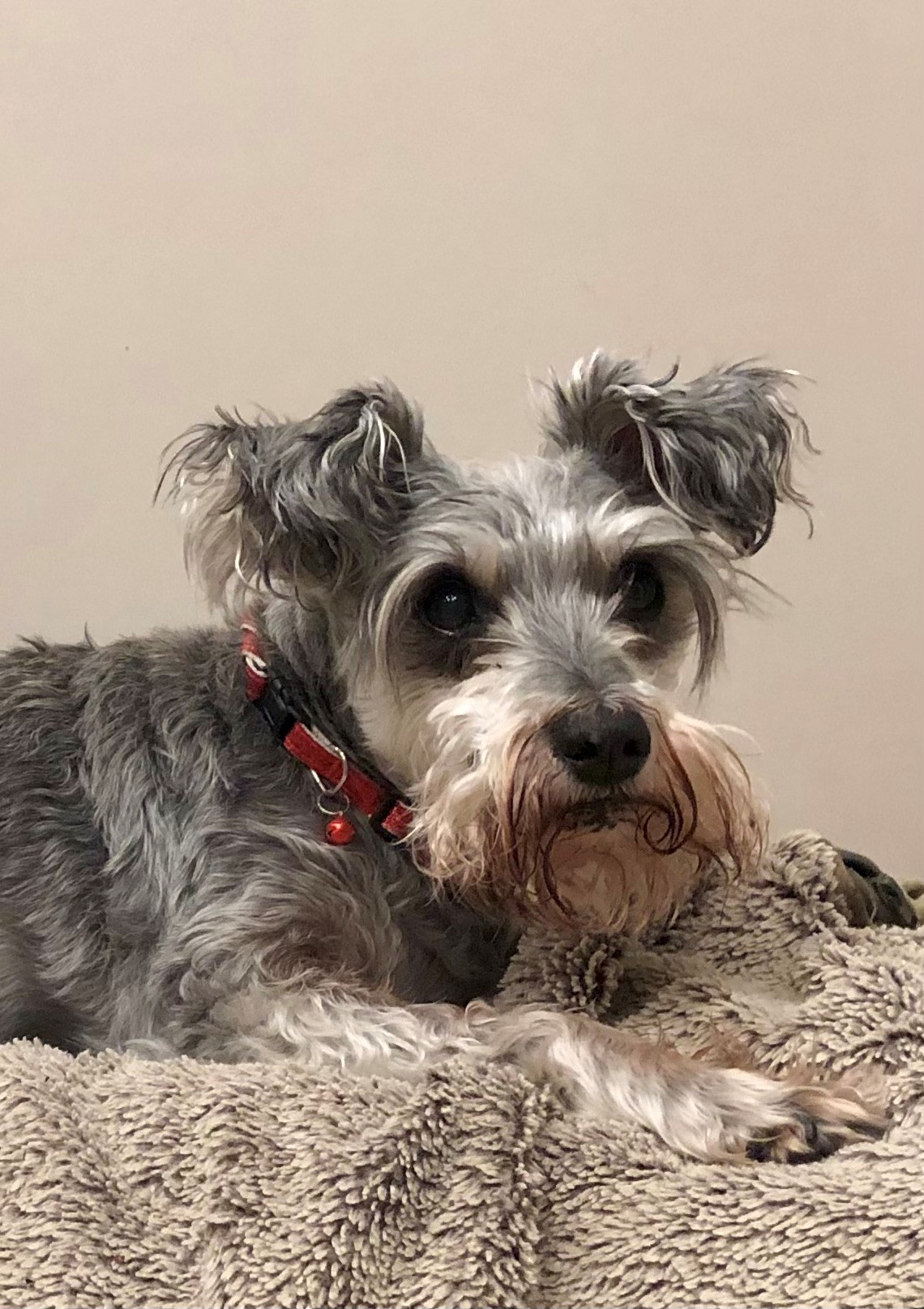
So this is Scruffy at age 12. He still is full of life.
oooo
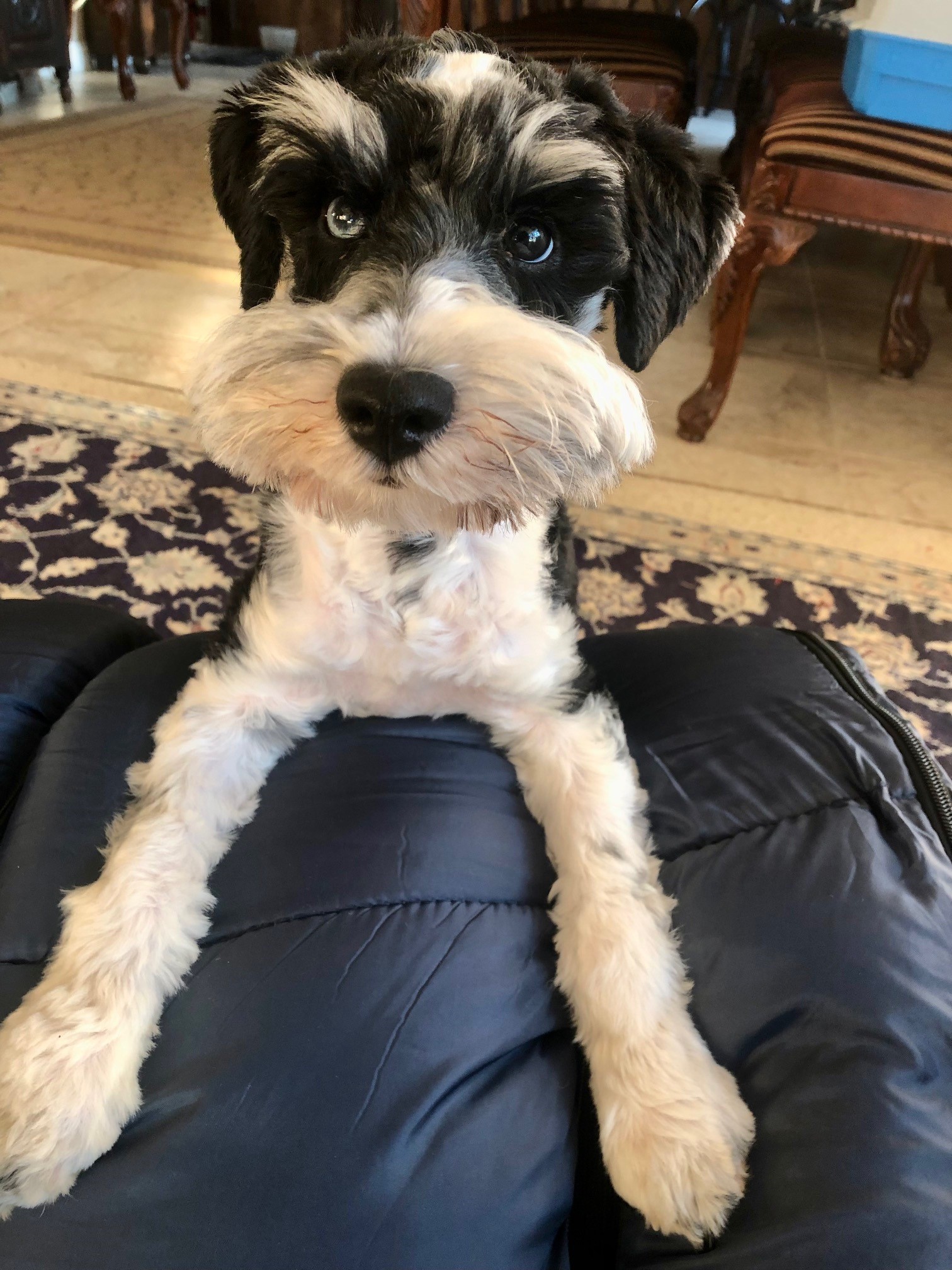
And this is Tux below, because of the Tuxedo that he always wears. He’s also a Miniature Schnauzer, but in an exotic color, and he has one blue eye that I love!
Yes, you should get another puppy to fill the hole in your heart. It seems, you are never sorry about it! You guys have a wonderful day! JESS
Poor Pedi finally succumbed to his failing liver at 5:30 pm yesterday.
It was also the reason why I didn’t have the stomach to post this for midnight yesterday.
On the 8th July, this year, Pedi was diagnosed with having diabetes and a failing liver. This was a photo taken at the time.
Pedi diagnosed on July 8th, 2022.
Dr Codd, of Lincoln Road Vet, suggested that Pedi might be put down immediately but Jean wouldn’t hear of it. Thus every day, at 06:30 and 18:30 (PDT), Jeannie applied an injection of Insulin; the amount depending on what Pedi had eaten.
Jeannie went beyond anything that I have ever seen before. This morning, the 27th, I was talking to her and Jean said that she had been rescuing dogs since 1980. That’s over 40 years! No wonder that Jean was taking this so very hard.
Now my opinion is that we should get a replacement for Pedi and keep the minimum number of dogs to four. But it is too soon to make that decision and part of the issue is that we are getting reasonably close, probably in the next ten years, to selling up and going into a care home of some sorts. We have seen a couple and we need to do a proper examination of the total market to find the right one.
In the meantime we both grieve for Pedi but Jean much, much more so than me. I shall have my guts kicked out of me when Oliver goes, but that’s for another time.
Penny wanted me to post this guest post from her a little earlier than the ‘chosen’ date. So, I am publishing it today!
ooOOoo
Tips and Tricks for Multistate Living with a Pet
As a senior, you get the best of both worlds by spending half the year in one state and half in another. But sometimes, things can get a little hectic along the way, especially when you own two homes in independent living communities and a pet on top of it. There may be days when your stress levels rise as you try to cope with everything. That’s why Learning from Dogs has assembled some handy tips and tricks to smooth out multistate living for you and your pet.
Saving Money
One of your first considerations may be to save some money as you switch from one home to the other. You might, for instance, register your cars and purchase auto insurance in a state that is less expensive. Do the same for health insurance and even pet insurance to save extra money. You might also stock up on nonperishable and freezer items for each house when your budget allows so that you’ll have supplies on hand when you transfer between homes. Finally, consider replacing double cable services with streaming options. This way, you can watch all your favorite shows whenever and wherever you want without paying for access in two states.
Staying Organized
It can be quite difficult to stay organized when you’re splitting your time between two different homes, but you can if you get in the habit of making lists. Keep a running tab of your possessions and current supplies, like food and cleaning products, at both homes. This way, you’ll know what you have and what you need to bring with you. If you find yourself overwhelmed by clutter, don’t be afraid to use a storage unit. There are plenty of self-storage options in San Diego, and you can check prices and reviews in advance.
When it comes to your pet’s needs, you might do well to have a set of care items like harnesses, crates, cat trees, and litter boxes at both homes. This way, you won’t have to drag things back and forth. When you’re shopping for pet supplies, be sure to read online reviews from customers but also from veterinarians and other animal experts so that you can ensure the quality of the products and the health and safety of your pet.
Keeping Your Pet Healthy
Dividing time between two homes in two different states can be stressful for your pet, so make sure you take care of your pet’s health. Find a trustworthy veterinarian in both locations, and take your pet for frequent checkups each time you settle into a new place. Make sure your pet has proper flea and tick prevention for both environments, and find a good pet sitter in both locations, too.
Also, consider pet insurance to help defray vet costs. One state may actually offer less expensive pet insurance policies than another — although you may find it more expensive in many ways — so shop around for the best policy. Research coverage options, prices, deductibles, limitations, and provider reputations before choosing a policy that is right for you and your pet.
Living Well in Two States
Multistate living can be a challenge, but it can also be a delightful experience for you and your pet. Use the tips above to save money, stay organized, keep your pet healthy, and enjoy the best of both worlds.
Learning from Dogs serves as a reminder of the values of life and the power of unconditional love – as so many, many dogs prove each and every day. Click here to get involved!
There are not many who achieve so much, but Sir David most definately has!
This is our planet. It is the only one we have (stating the obvious!).
This beautiful photograph taken from the Apollo 11 mission says it all. That Commander Neil Armstrong and lunar module pilot Buzz Aldrin landed the Apollo Lunar Module Eagle on July 20, 1969 changed everything.
But one thing that was not on anyone’s mind then; the state of the planet!
This view of Earth rising over the Moon’s horizon was taken from the Apollo 11 spacecraft. The lunar terrain pictured is in the area of Smyth’s Sea on the nearside. Coordinates of the center of the terrain are 85 degrees east longitude and 3 degrees north latitude. While astronaut Neil A. Armstrong, commander; and Edwin E. Aldrin Jr., lunar module pilot, descended in the Lunar Module (LM) “Eagle” to explore the Sea of Tranquility region of the moon, astronaut Michael Collins remained with the Command and Service Modules (CSM) “Columbia” in lunar orbit. Image Credit: NASA
How that has changed since 1969.
David Attenborough is a giant of a man, and I say this out of humility and respect for what he has done in his long life, he was born in May, 1926, and he is still fighting hard to get us humans to wake up to the crisis that is upon us.
Wikipedia has an entry that lists all the television shows, and more, that David Attenborough has made. As is quoted: “Attenborough’s name has become synonymous with the natural history programmes produced by the BBC Natural History Unit.”
Please take 45 minutes and watch this film. It is so important.
But before you do please read this extract taken from this site about the film:
For decades David Attenborough delighted millions of people with tales of life on Earth, exploring wild places and documenting the living world in all its variety and wonder. Now, for the first time he reflects upon both the defining moments of his lifetime as a naturalist and the devastating changes he has seen.
Honest, revealing and urgent, the film serves as a witness statement for the natural world – a first-hand account of humanity’s impact on nature, from Australia’s Great Barrier Reef to the jungles of central Africa, the North Pole and Antarctica. It also aims to provide a message of hope for future generations.
“I’ve had a most extraordinary life. It’s only now I appreciate how extraordinary,” Sir David says in the film’s trailer, in which he also promises to tell audiences how we can “work with nature rather than against it”.
The film retraces Sir David’s career, his life stages and natural history films, within the context of human population growth and the loss of wilderness areas. “I don’t think that the theoretical basis for the reason why biodiversity is important is a widely understood one,” he told the Guardian in September.
This autumn, a series of publications warned that “humanity is at a crossroads” in its relationship with nature, culminating in a UN report that the world has failed to meet a single target to stop the destruction of nature in the past decade.
Sir David has been vocal about the threat of climate change in recent years, calling on politicians to take their “last chance” to act rather than continue to “neglect long-term problems”.
“We need to learn how to work with nature, rather than against it”, according to Sir David. In the film, he is going to tell us how.
Now watch the film. Please!
As you can see, in the film Sir David states that the only way out of this mess is a massive focus on rewilding.
Coincidentally, Patrice Ayme last Sunday wrote about rewilding: California Grizzly: Rewilding Is A Moral Duty. In the latter half of that essay, he wrote: “One should strive to reintroduce American megafauna, starting with the more innocuous species (and that includes the grizzly). By the way, I have run and hiked in grizzly country (Alaska), with a huge bear pepper spray cannister at the ready. I nearly used the cannister on a charging moose (with her calf which was as big as a horse). The calf slipped off, and I eluded the mom through a thicket of very closely spaced tough trees. But I had my finger on the trigger, safety off. Moose attack more humans than grizzlies and wolves combined (although a bear attack is more dangerous). In any case, in the US, stinging insects kill around 100, deer around 200 (mostly through car collisions), and lightning around three dozen people, per year.
As it is, I run and hike a lot in California wilderness, out of rescue range. I generally try to stay aware of where and when I could come across bears, lions and rattlers. My last close call with a large rattlesnake, up a mountain slope, was partly due to hubris and not realizing I was moving in dangerous terrain. Fortunately I heard the slithering just in time. Dangerous animals make us aware of nature in its full glory, and the real nature of the human condition. They keep us more honest with what is real, what humanity is all about.
And that should be the primordial sense.“
I will close by offering you this photograph. May it inspire you to rewild, in small ways and also, if you can, in bigger ways. All of us must be involved. Otherwise…
Once again I am delighted to publish another post from Penny. This is a relatively short post but nevertheless of supreme importance.
With no more ado from me, here it is:
ooOOoo
Protecting Our Pets: Resources for Volunteering at Animal Shelters
By Penny Martin
August 10th, 2022
If animal welfare is close to your heart, you might want to consider helping out at a pet shelter for abandoned or unwanted animals. There are always a number of charities in the USA and beyond looking for eager volunteers.
Before You Apply
Animal welfare work can be challenging for an individual, even if you’re just volunteering. It’s important to take precautions before you commit to your decision.
Read about the experience of working at a shelter to better understand the challenges and obstacles you might encounter.
Often, volunteers need to undergo training, orientation, and background checks before they’re allowed to contribute.
Connect with your local shelters on social media to see the kind of work they do and whether there are opportunities to volunteer.
Organizations
Shelters for abandoned and neglected pets are frequently found throughout the country. If you want to do your part, the logical first step is to locate one close to you.
Institutions like Guide Star have been established to hold animal rescue services accountable and ensure they are being maintained properly.
Take some time to learn about the listed charities in your area.
If you find an abandoned pet and you’re not aware of shelters in your area, try reaching out to American Humane.
Ways to Help
If you’re unable to volunteer in person, there are still plenty of ways to get involved and do your part.
There’s good work to be done online via social media and you can help out by engaging in discussion and sharing posts about missing or unwanted pets.
If you have any spare supplies that you’re willing to donate, these can make a profound impact on the lives of animals.
If you’re purchasing supplies to donate, read expert reviews to choose the highest-quality products.
Unfortunately, across the USA and beyond, there are a great many pets in need of our help but even small acts of kindness can take us a significant way towards eradicating the problem altogether. Reach out to your local shelter and see how you can help.
Read the Learning from Dogs book for a reminder of the unconditional love dogs give us every day.









 Learning from Dogs