Category: Aircraft

Elinor Smith, pilot extraodinaire

A remarkable woman who died a week ago

There are many famous names in aviation but I would wager that Elinor Smith, despite being one of the greats in the history of flying, is not a name that falls off the lips of thousands.  It ought to.

Last Friday, just a week ago, Elinor Smith died at the amazing age of 98.

Elinor Smith

There are many accounts of her life accessible online.  Here’s an extract from an obituary published by the Wall Street Journal.

Ms. Smith, who died Friday at age 98, was one of the last survivors of aviation’s early barnstorming days. She flew with such legends as Amelia Earhart and James Doolittle. She recalled Charles Lindbergh seeing her off from Roosevelt Field in 1928 on her most notorious exploit, flying under four of New York City’s East River bridges.

and also from the WSJ:

Over the next few years, Ms. Smith would set numerous records, spurred on by a handful of other aviatrices, including Ms. Earhart, Bobbi Trout, and Pancho Barnes. All were trumpeted by the media. Ms. Smith’s “Flying Flapper” moniker was matched by “The Flying Cashier” and “The Flying Salesgirl.” Each strove to break free of the pack.

“That’s how you got jobs, by setting records,” said Dorothy Cochrane, a curator at the National Air and Space Museum. “Women had to take what they could get since careers in the military were closed to them.”

Ms. Smith set several endurance records, and once flew so high in an attempt to set the altitude record that she blacked out above 30,000 feet.

There is also a comprehensive account of her life on WikiPedia.

Plus a few days ago, someone posted a brief clip on YouTube.

More about Elinor Smith, courtesy of Cradle of Aviation:

Facts:

  • Born August 17, 1911 in New York City. In 1917, at the age of six, Smith took her first flight in a Farman pusher biplane and from then on she was hooked on aviation.Growing up in Freeport, Long Island during the heyday of the golden age of flight, Elinor Smith had access to some of the best flying fields in the country and some of the most famous flyers.
  • At the age of fifteen, Smith flew her first solo flight and one year later in 1928 she received her pilot’s license to become the world’s youngest licensed pilot.
  • One of her earliest and most famous stunts in 1928 was flying under all four East River suspension bridges—a feat never accomplished by another pilot.
  • In 1928, Smith set a light plane altitude record of 11,889 feet, the first of many records she was to set during her career. In 1929, alone she set four world records.
  • The following year Smith set the women’s solo endurance record after spending thirteen hours, sixteen minutes flying an open cockpit Brunner Winkle Bird on a frigid January night over Roosevelt Field.
  • Smith toured the U.S. air show circuit in 1929, piloting a Bellanca Pacemaker for a group of parachutists promoting the Irvin Parachute Company.
  • Flying with co-pilot Bobbie Trout, she set the first Women’s Refueling Record of 42 _ hours over Los Angeles.
    Smith was the first woman test pilot for both Fairchild Aviation Corporation and Bellanca Corporation.
  • Set Woman’s World Speed Record of 190.8 miles per hour in 1929 in a Curtiss Falcon over a closed course, Motor Parkway, Long Island.
  • In 1930, Elinor Smith received one of the greatest honors in her life when she was voted the best woman pilot in the United States.
  • From 1930 to 1935, Smith she worked as a radio commentator on aviation events for NBC.
  • After retiring from flying, Elinor Smith worked to preserve the history of Long Island aviation. She was a founding member of the Long Island Early Fliers and promoted the creation of an aviation museum on Long Island.
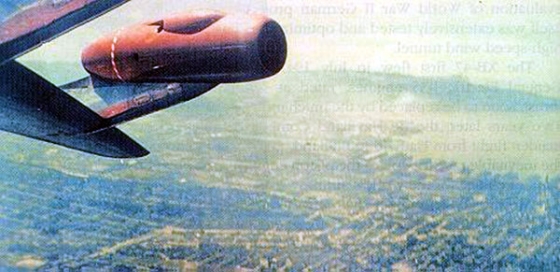
  • In 1960, she piloted a T-33 jet trainer at Mitchel Field.

By Paul Handover

Not your average airport!

The world’s 18 strangest airports

The American magazine Popular Mechanics had an interesting piece on some of the more bizarre airports around the world.  As the article says,

Engineers tasked with building an airport are faced with countless challenges: The ideal location needs ample space, endless flat ground, favorable winds and great visibility. But spots in the real world are rarely ideal, and engineers are forced to work with what they have, making sure that the end product is the safest possible structure for pilots. A survey of airports around the world turns up a mixed bag, ranging from dangerous and rugged landing strips to mega-size facilities that operate like small cities.

Apart from the general interest in these airports, there is also a personal resonance as three of them are in my aviation log-book: Barra; Gibralter; Courchevel.  Indeed my experiences of flying into Barra were the subject of a Post on this Blog a few months ago.

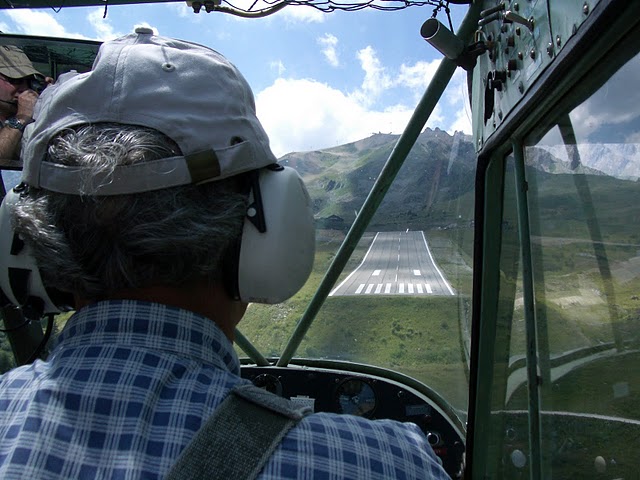
Courchevel in the French Alps is, for all pilots, one of the most amazing, butt-clenching arrivals one could ever imagine.

As Wikipedia puts it:

Courchevel’s airport also has a certain degree of infamy in the aviation industry as home to one of the shortest runways in the world, with a length of 525 metres and a gradient of 18.5% in order to help slow landing aircraft. The airport has a dangerous approach through deep valleys which can only be performed by specially certified pilots. On landing there is no go-around procedure, as most of the worlds airports have – there is merely a very steep hill which has seen a few accidents since the airport first opened.

Quite so!

Here’s an interesting video from YouTube

and a few personal memories:

Start of the approach into Courchevel
'short final' Courchevel
Author & aircraft on the apron - Courchevel

By Paul Handover

Crazy flying

This is not your usual air-show display

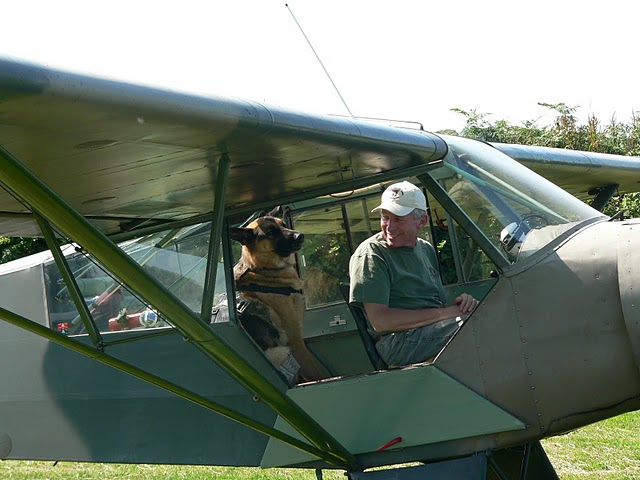
Author & author's dog in Piper Super Cub, R151

Three of the authors on Learning from Dogs are or have been pilots although only one, Bob Derham, is a real pilot!  I.e. he does it for a living!

Most pilots and many wannabes love the atmosphere of a good air show but after a few visits they can become rather predictable and that applies as much to the flying displays.  After all there is only so much that one can do to an aeroplane.

Not so the good people who comprise the Franklin’s Flying Circus.

Here’s a YouTube video showing Kyle Franklin ‘stealing’ a Piper Cub.  As a past owner of a Piper Super Cub, I have to tell you that the skills being used in this display are supremely clever.

Enjoy!

By Paul Handover

Selling airplanes!

Jet airliners any way up!

Back in 1955, air travel was an adventure and the age of the jet airliner had already dawned in the UK, albeit with some major setbacks along the way.

As the US prepared to enter the market that summer, there is the well known incident of Boeing test pilot “Tex” Johnston rolling a prototype Boeing 707.

From today’s perspective, under those circumstances , the integrity of the people involved was impressive. As the pilot describes, he was called into the office of the president of Boeing to explain his actions. For me, the most telling comment is his final line:

It was fine!

By John Lewis

Rationing – the New Paradigm?

A World War II practice may reappear.

Some little time ago I wrote about the word “fair”, which I tongue-in-cheek referred to as a Word of Mass Destruction (WOMD) insofar as if one REALLY put into place practices that were truly “fair” then western capitalism would break down completely. (The story of the CEO of Goldsmiths and his $100,000,000 bonus is for another day ….)

Well, my OTHER WOMD is “rationing”.

I was drawn to this topic by the words of a British minister about the desirability of introducing rationing into AIR TRAVEL.  The thinking goes (and to be honest it is in fact obvious, isn’t it?) that IF we are serious about reducing climate change (a VERY BIG IF!!) then we cannot continue to hope to fly where and when we want to as in the past. For aviation is a growth industry despite the current crisis, and as people in developing economies in Asia in particular grow more prosperous they will want to travel more and more. I have seen estimates to suggest that within a decade ONE HUNDRED MILLION Chinese will be travelling to Europe EVERY YEAR.

This is of course totally incompatible with any hope of doing anything serious about climate change. The logical conclusion is that (until some boffin invents an emission-free jet) we MUST reduce flying. This is likely for most adults to be about as palatable as denying burgers and chips to British teenagers, but I really cannot see the alternative IF Global Warming is to be taken seriously (which it probably won’t be until it’s too late).

But let’s for the moment remain positive …. supposing it is decided by some courageous government (are there any?) that we must reduce flying then there are two ways to do it.

A) TAX it so highly that only the rich can afford it

B) RATION it – everyone has a quota of air miles per annum.

Now option A is the usual free-market/capitalist way. After all, Ferraris are rationed by their price; otherwise all males over 18 would have one, or in my case several. But – much as I recognize what the free market has done in terms of wealth creation – we are in a new scenario, aren’t we? Can we really hope to say that only the rich can fly? I think not, and therefore rationing is the only way to do this.

Now, there is a minority of people that abuse anything, and no doubt rationing would be abused by some, somewhere, somehow. But it is the only FAIR way to go about it, isn’t it?

In London and other big cities we are now seeing a TAX imposed on driving into the city centres. Yes, very sensible, but of course, the RICH aren’t bothered. In effect, schemes like London’s are simply a way of excluding the masses from the city centre. The same idiocy is seen on French motorways, which are becoming increasingly expensive. The rich are not bothered by the tolls but the less well-off certainly ARE and so drive on other roads which are less safe; survival of the richest …….

No, the free-market is not going to work in the Brave New World which we are entering. If you have a birthday party for your kids then EVERYONE gets an equal share of the cake. This principle is going to have to be applied in other areas of life, otherwise we are going to get serious social unrest. Besides, any other way is just not FAIR, is it?

Of course, once you concede the point on AIR TRAVEL there is – in a world of increasing populations and diminishing resources – no way of limiting the concept purely to air travel, is there?

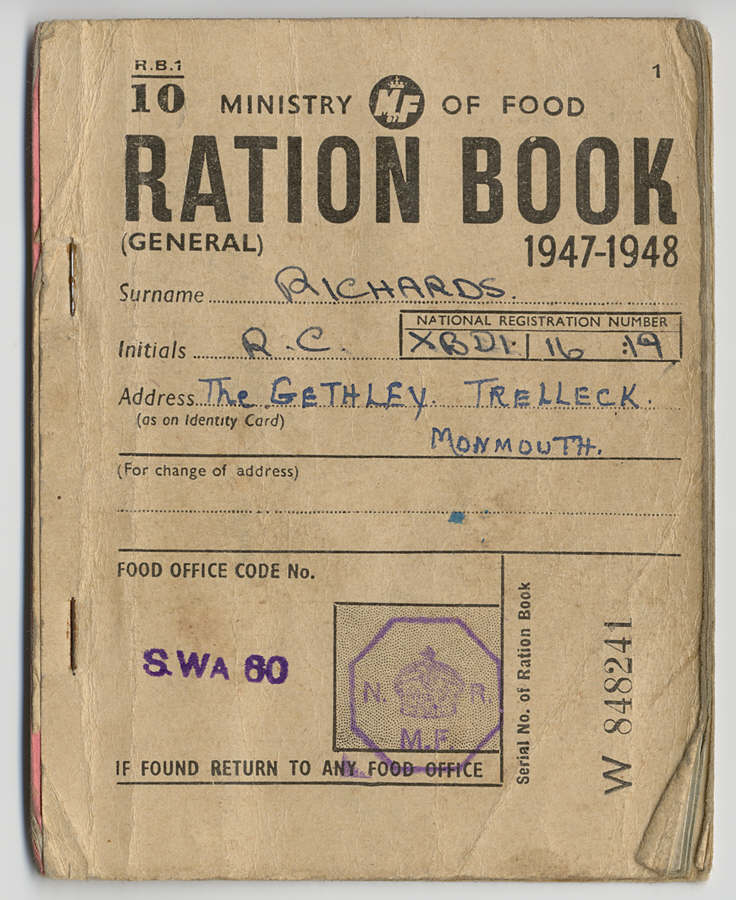
I am just old enough to remember my Mother’s WWII ration card, which she used up to the very early 50s I believe. Will we soon start to see a modern reincarnation, and not only in carbon credits?

By Chris Snuggs

WWII Ration Card - UK

A Government’s “Economy with the truth”

Citizens being let down by the standards of their governments.

Every so often – but sadly with a certain inevitability and one senses greater frequency – there descends from above the nasty stench of hypocrisy, cover-up and fraud.

No, I am not referring to the conviction recently of a British Minister for using a mobile telephone while driving, even though she was Minster of Justice when the law banning this was passed.

No, the case in question is that of the RAF Chinook Mark 2 helicopter that crashed on 2 June 1994 en route from Northern Ireland to Inverness, killing the special forces crew and 25 senior members of Northern Ireland’s intelligence community in the worst RAF helicopter accident in peacetime.

Now accidents happen, but from what has been said very clearly in a variety of sources (SEE HERE IN PARTICULAR), there seems no doubt that the pilots were made the scapegoats in the ensuing enquiry.

This is the key question. Of course, NOBODY may have been “to blame” OR it may be impossible to determine who was to blame, but on the other hand, someone MAY have been to blame, and if that person or persons is in the Ministry of Defence or the Government then it is clear that there may have been the temptation to fix it so that someone ELSE took the blame, in this case the dead and therefore defenceless pilots.

A synopsis of the official report passed to me by a fellow old-boy (alumnus!) with a scientific background in avionics summarizes the main points in this tragedy:

a) There is certainly no evidence to suggest that the pilots were at fault.

b) There is a lot of evidence to suggest that the Government hindered the enquiry.

Some key points:

  • The pilots were worried about the MKII aircraft and asked for a MKI version for this mission. The MoD declined this request.
  • The aircraft was flying low, in a straight line towards the Mull. 18 seconds before impact the pilot requested a left hand turn to miss the Mull. The aircraft never turned.
  • The FADECs (Full Authority Digital Engine Control) were programmed to record ‘failures in flight’. Looking at the FADEC’s memory after the crash showed no failures. This was the main evidence against the pilots. However, there had been several instances where other MKII pilots had lost control of the aircraft and the FADEC showed no ‘failures’. In their assessment of the code after the crash, EDS said that the error reporting software had been coded incorrectly.
  • The problem with the FADEC that had been seen by several pilots was the fact that the rotors started to rotate to 120%. (Faster than they should).
  • Two key personnel who should have given evidence at the enquiry (an engineer FADEC expert and a pilot who had experienced problems whilst flying the aircraft) were not allowed to give evidence.
  • Prior to the accident the Government were actually in the process of suing the FADEC manufacturer because of its failings.

Two points in particular strike me personally:

A) Point SIX above; the government was AT THE TIME of the accident SUING the FADEC manufacturer because the electronics were defective in some way. Now, as a layman, it seems to me bleedin’ obvious that modern aircraft are extremely dependent on their electronics. If there were such severe faults with the fundamental instruments on this plane as there seem to have been with the FADEC (the top pilot refused to fly the craft and the govt were suing the software providers; does it get more serious than that??!!) then WHY WAS IT ALLOWED TO FLY IN THE FIRST PLACE?

B) So, KNOWING all the above, WHO authorised this aircraft to fly in poor weather conditions (it was foggy) with 25 KEY intelligence personnel on board? Apart from the personal tragedy for so many families, the loss of these key people was a devastating blow to the then government in its campaign against terrorism in Northern Ireland.

Well, despite all the above it was the two dead pilots who got the blame for what seems to have been appalling management over a long period. The Chinook’s electronics were clearly known to be dodgy yet the machine had not been grounded. You cannot imagine this happening in the civil aviation business (I HOPE!), but this is not the first time that the British government has sought to exempt itself from the strict standards it imposes on the private sector.

But the bottom line is, it is pretty clear that JUSTICE has not been done and those whose poor management and decisions almost certainly led to the accident have never been brought to account.  The British Conservative party has pledged to re-examine the case. One has to ask why the CURRENT party has refused to do this. Could they themselves have something to hide?

IS this – as it seems to be – a genuine Government cover-up? and if so, do they do this sort of thing because they think that:

A) the public are idiots or B) they can get away with it? Or of course both.

We are not talking about a faceless, fascist bureaucracy here, but about BRITAIN, where standards of decency, honesty, openness and Justice are supposed to apply – or at least once applied. As for the MOD (Ministry of Defence) not only has it NOT accepted any responsibility for this accident but they are now paid BONUSES! Yes, just like City Bankers ….. And this at a time when I am unaware of bonuses being paid to soldiers fighting and often dying in Iraq and Afghanistan.

The families of those killed deserve the truth. Without the truth being primordial in our society, we descend into the realms of a banana republic or Central Asian dictatorship.

By Chris Snuggs

Frozen in ice

Serendipity

Vickers aircraft

Thanks to a small piece on AOPA Online (Aircraft Owners and Pilots Association), a wonderful insight into a hitherto unheard of organisation and a most charming story.

That organisation is Mawson’s Huts Foundation, an Australian organisation that describes itself as:

The Mawson’s Huts Foundation has been established to conserve in perpetuity for the Australian people the unique, historical buildings known as Mawson’s Huts, base for one of the most significant expeditions in Antarctic history. The Foundation’s website provides a variety of resources concerning current and future efforts to conserve the huts and information about the archaeology and heritage of the site.

Sir Douglas Mawson was an Australian Antarctic explorer and geologist born in 1882.  More background from the Mawson’s Huts website:

Sir Douglas Mawson, a geologist, who led the Australasian Antarctic Expedition of 1911, landed a party of

Sir Douglas Mawson

18 at Cape Denison on Commonwealth Bay in January, 1912, and remained there until December 1913. The site was not visited again until Mawson returned in 1931 with the British, Australian and New Zealand Antarctic Research Expedition and then not again until the 1950’s. Only a concerted public campaign would save and conserve this historic site for all Australians, and the Mawson’s Huts Foundation was formed in 1996 for this purpose.

Read more about this story

Remarkable people: John S Denker

Scientist and pilot

John S Denker is both a scientist and pilot. Now, I have no doubt that there are many scientists who are pilots, and that many of them combine these interests in a variety of ways. So in what way is he “remarkable”?

Experts as communicators

Sometimes experts dedicate considerable effort to communicate their understanding for the benefit of people who are much less knowledgeable. It is probably important that this happens, because it is the main means by which substantial topics are understood in any depth by other people. Without the experts’ thorough knowledge of a specific subject area, very little understanding is likely to be transferred. Continue reading “Remarkable people: John S Denker”

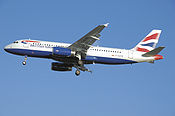
BA flies to the Brink

British Airways

I earnestly hope that we are not about to witness the crashing disappearance of what only a few years ago was one of Britain’s relatively few major world class businesses. It is said that those whom the Gods seek to destroy they first make mad, and the intention of BA cabin staff to launch a strike over the busy Christmas period would seem to be a clear sign of insanity.

Read more about BA

The Boeing 787 Dreamliner: an impressive aircraft

What does the much delayed maiden flight of the Boeing 787 tell us about integrity?

But how difficult can it be for Boeing to make yet another new aircraft? The answer depends on how different the 787 aircraft is from anything the company has built in the past. Some initial indication that is significantly different can be taken from its being named Dreamliner.

Read more about the B787