I am a bit stuck for time so forgive me for just posting this video.
The information that came with this video is posted first:
Are you worried your dog is looking a little down? Or do you just want to do everything you can to make your dog the happiest in the world? Any responsible owner will want their dog to be as happy as can be, so this AnimalWised videos brings you 10 essential tips on how to make your DOG HAPPIER. A happy dog will not only need their basic care needs met, but they will require a considerate and thoughtful human companion to go beyond the basics. We need to pay attention to what it is they are trying to communicate to us through their behavior and body language. We also need to ensure the way we behave towards the dog is making them happy and we do all we can to strengthen our bond together. It is also imperative to know that a healthy dog is a happy dog.
On AnimalWised you’ll discover a high quality channel that’s exclusively devoted to the Animal Kingdom. You’ll find all sorts of content: from training, diet or beauty and everything that can be useful for you as a pet owner or animal lover. Want to become AnimalWised? Take a look and have fun with us!
In fairness it does look like a decent video and website.
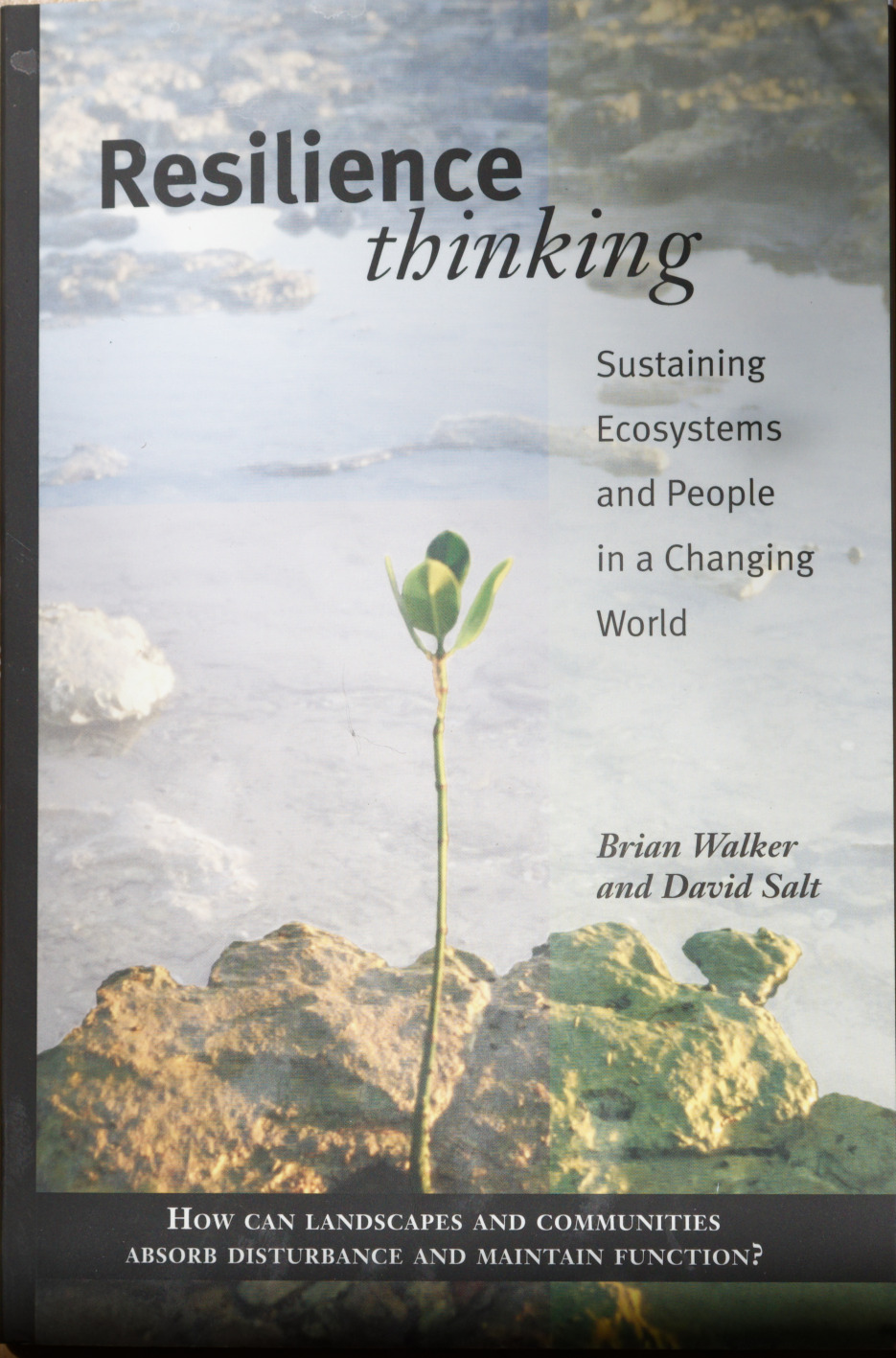
Let me make myself absolutely clear about this book, indeed I can do no better than to publish part of an email that I sent to the authors last Saturday:
To say that I was inspired by what you wrote is an understatement. More accurately it has changed my whole understanding of this planet, of the natural order of things, of the politics of the Western world, of vast numbers of us humans, and how precarious is our world just now. It has opened my eyes radically, and I thought before that I was fairly in touch with things.
Resilience is a simple idea but in its application has proved to be anything such. On page 2 the authors set out as they saw it The Drivers of Unsustainable Development. Here’s how that section develops:
Our world is facing a broad range of serious and growing resource issues. Human-induced soil degradation has been getting worse since the 1950s. About 85 percent of agriculture land contains areas degraded by erosion, rising salt, soil compaction, and various other factors. It has been estimated (Wood et al. 2000) that soil degradation has already reduced global agricultural productivity by around 15 percent in the last fifty years. In the last three hundred years, topsoil has been lost at a rate of 200 million tons per year; in the last fifty years it has more than doubled to 760 million tons per year.
As we move deeper into the twenty-first century we cannot afford to lose more of our resource base. The global population is now expanding by about 75 million people each year. Population growth rates are declining, but the world’s population will still be expanding by almost 60 million per year in 2030. The United Nations projections put the global population at nearly 8 billion in 2025. In addition, if current water consumption patterns continue unabated, half the world’s population will live in water-stressed river basins by 2025.
The Food and Agriculture Organization of the United Nations (FAO) 2004 Annual Hunger Report estimates that over 850 million people suffer from chronic hunger. Hunger kills 5 million children every year.
It goes on ….!
Now I want to quote from the end of the book, from their section on Resilience Thinking.
In our opening chapter we observed that there were many pathways into resilience thinking and suggested readers not worry too much if the finer details of a resilience framework are a bit obscure. We emphasized that what is of much more importance is an appreciation of the broader themes that underpin such a framework. Those broader themes revolve around humans existing within linked social and ecological systems. These are complex adaptive systems, and attempts to control or optimize parts of such systems without consideration of the responses that this creates in the broader system are fraught with risk. Much of this book has been spent on attempting to explore the consequences of such an approach.
In the broadest sense, optimizing and controlling components of a system in isolation of the broader system results in a decline in resilience, a reduction in options, and the shrinkage of the space in which we can safely operate. Resilience thinking moves us the other way.
It is our hope that readers who are persuaded of this basic premise will be encouraged to explore the inevitable consequences of such thinking. Even if you are not completely clear on the basins of attractions, thresholds, and adaptive cycles, if the concepts of ecological resilience and dynamic social-ecological systems have any resonance then you are in a better position to appreciate what is happening to the world around you.
The phrase complex adaptive system was new to me but intuitively I got what the authors meant. As they state on page 35: The three requirements for a complex adaptive system are:
That it has components that are independent and interacting,
There is some selection process at work on those components (and on the results of local interactions),
Variation and novelty are constantly being added to the system (through components changing over time or new ones coming in),
This was my eye-opener. It was now obvious that many processes, especially in nature, that I had hitherto regarded as constant were changing albeit usually on a timescale of many decades sometimes centuries.
And the other conclusion that was inescapable was that we humans were largely responsible for those changes because we couldn’t see the longterm consequences of what we were doing.
David writes that firstly carbon dioxide is not like other pollutants, for example like air particulants. Then later goes on to say:
The second difference is that climate change is irreversible.
As Joe Romm notes in a recent post, New York Times columnist Joe Nocera slipped up in his latest column and referred to technology that would “help reverse climate change.” I don’t know whether that reflects Nocera’s ignorance or just a slip of the pen, but I do think it captures the way many people subconsciously think about climate change. If we heat the planet up too much, we’ll just fix it! We’ll turn the temperature back down. We’ll get around to it once the market has delivered economically ideal solutions.
This paper shows that the climate change that takes place due to increases in carbon dioxide concentration is largely irreversible for 1,000 years after emissions stop. Following cessation of emissions, removal of atmospheric carbon dioxide decreases radiative forcing, but is largely compensated by slower loss of heat to the ocean, so that atmospheric temperatures do not drop significantly for at least 1,000 years. [my emphasis]
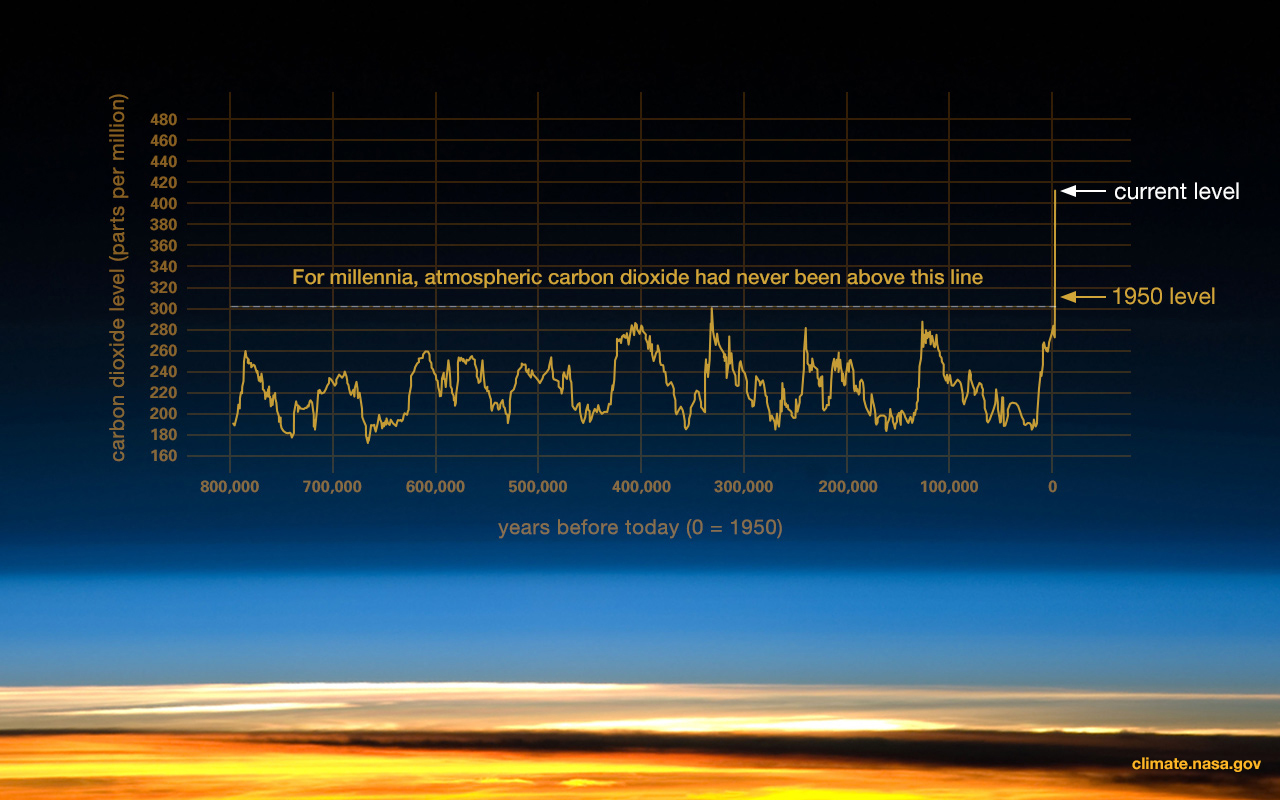
My last piece in this review is to republish a graph that is shown on the NASA Global Climate Changewebsite:
For all our sakes, dogs and humans and many other species, let us all please change our behaviours! Soon!
Back to the book: It is a remarkable book!
I will close with quoting one of the praises shown on the back cover. This one by Thomas Homer-Dixon, professor of political science, University of Toronto, and director of the Trudeau Centre for Peace and Conflict Studies.
Resilience Thinking is an essential guidebook to a powerful new way of understanding our world – and of living resiliently with it – developed in recent decades by an international team of ecologists. With five clear and compelling case studies drawn from regions as diverse as Florida, Sweden, and Australia, this book shows how all highly adaptive systems – from ecologies to economics – go through regular cycles of growth, reorganization, and renewal and how our failures to understand the basic principles of resilience have often led to disaster. Resilience Thinking gives us the conceptual tools to help us cope with the bewildering surprises and challenges of our new century.
This came in yesterday and I thought for some time that I wouldn’t be able to publish it quickly owing to me getting my knickers in a twist.
But all was resolved and therefore I am delighted to republish it.
ooOOoo
Donate to fund the dogs saving elephants
Ever heard of dogs saving elephants?
In the Serengeti, a small, specially trained team of rescue dogs sniff out poachers and sound the alarm. Just 4 dogs have helped arrest hundreds of poachers, saving countless elephants being murdered for their ivory.
Almost a quarter of the elephants in the park now live in the tiny area they protect — but poaching is on the rise everywhere else and there are thousands more elephants that still need protection.
That’s why the team behind this amazing project are asking for your help to train up more of these sniffer dogs — and save double the number of elephants.
With 96 of these gentle giants killed each day, every moment counts.
Can you chip in to help?
ooOOoo
Whatever you can spare please contribute to the donation request.
Just a short post for today but one that is long on feelings!
The following short video was broadcast by WPLG Local 10 on July 7th this year. It follows the collapse of the twelve-storey building at Surfside in Florida on June 24th.
“Comfort dogs arrive in South Florida to help first responders in Surfside.”
Did you just adopt a new dog and now you’re super excited to introduce her to all the awesome people and animals in your life?
While you might want to bring her everywhere you go right away, it’s also important to take the right steps inorder to set her up for success — especially when it comes to dog training and socialization skills.
To understand how to socialize your dog, The Dodo reached out Juliana Willems, head trainer at JW Dog Training in Washington, D.C., for some insight.
What does it mean to socialize a dog?
Socialization is the process of helping a dog enjoy and feel comfortable with people, other animals, places, novel objects and environments.
It means bringing your dog out into the world and introducing her to various kinds of people and situations — which helps to make sure she learns how to be a happy, friendly pup (with manners!), and can reduce fear in unknown situations.
It also helps to give your dog the skills she needs to learn about boundaries — meaning she’s not running around and bulldozing other dogs who clearly just want to sleep whenever she’s around them.
What’s the best age to socialize a dog?
According to Willems, the best age to socialize your dog is when she’s a puppy — because there’s a critical socialization window in a dog’s life between 3 and 16 weeks.
“This is the age where puppies are like sponges, soaking up information and using the experiences during this time to determine how they feel about the world later in life,” Willems said.
Experiences — or a lack of experiences — during this critical socialization window can have a direct impact on a dog’s behavior as an adult.
So what happens if you adopt an older dog outside of the socialization window?
Unless you adopt a puppy who’s 4 months old or younger, Willems said that the dog you’re bringing home is well outside the critical socialization period.
“What this means is you won’t be able to undo what did or didn’t happen during that window when they were a puppy,” Willems said. “That being said, a goal with newly adopted rescue dogs is always to introduce them to new people, animals, places and activities in a positive way.”
Of course, there’s a good chance your pup was already socialized, especially if she was living happily with a foster family before she went up for adoption. But no matter what stage she’s in socially, it doesn’t hurt to be aware of what to look out for.
As with puppies, being exposed to people, animals and places isn’t enough if you’re hoping to get your pup to truly love and be comfortable with these experiences. You should be paying attention to how she’s reacting to these situations as well.
According to Willems, simple exposure without looking at if your dog is having fun, feeling comfortable and enjoying herself leaves the door open for a negative experience.
That means it’s important you don’t overwhelm your dog by going to too many new places — or meeting too many new people — when she first comes home.
How to socialize your dog
According to Willems, the best way to socialize a new rescue dog is to go at her pace, use treats and always pay attention to body language.
“When you let your new rescue dog approach situations at their pace — allowing them to approach or retreat when they need to — you’re giving them choice in the interaction and you’re decreasing the chances that your dog will feel overwhelmed and scared,” Willems said.
And make sure you have some of your dog’s favorite treats ready to go during the process!
If you give your dog high-value treats when she meets new people or new animals or goes somewhere new, you’re increasing the chances that she ends up really liking those experiences. Why? Because she’s learning that new people, animals or places equal tasty treats!
While you’re keeping her happy with yummy treats, make sure you’re also paying attention to how she might be feeling in this new situation — and always give her the opportunity to take a breather if she needs one.
She should always have the option to leave a new situation if she’s uncomfortable — especially when it comes to meeting new people and dogs.
How can you tell if your dog’s uncomfortable?
According to Willems, your best bet is to look at your pup’s body language — and it’s helpful to be able to understand what certain signals mean.
Obvious ones include:
A tucked tail
Trying to move away
Avoiding interactions
Growling or barking
More subtle stress signals include:
Lip licking
Yawning
Ears back
Stiffening
If your dog exhibits stress signals like these, it’s important you advocate for her and move her out of the situation.
What should you do if your dog’s uncomfortable?
If you find yourself in a situation that’s making your dog uncomfortable, you’ll want to get her some relief by moving away — and you can also try adding something your dog loves to the equation.
“The most effective tool here is high-value treats — something squishy and stinky that your dog really enjoys,” Willems suggested.
Keep in mind, though, that you won’t want to give your pup a high-value treat or toy around a dog she isn’t comfortable with, to avoid sparking any possessive aggression.
Take your time — and socialize her slowly
It’s definitely worth it to put in the work with your new dog to help her get comfortable with her new life — but make sure to resist the urge to take her to tons of new places or introduce her to a bunch of new people or animals right away.
“Aggressive behaviors are rooted in fear, so all the more reason to be very intentional, patient and positive in your socialization practice to help your dog learn their world with you is not a scary place!” Willems said.
Your new dog has been through so many changes — so let her decompress and get acclimated to her new home, routine and family.
All those couch snuggles will be worth it.
ooOOoo
I don’t know about you but I found this article very useful and very informative. Now many books have been written on the subject and the odd blogpost or twenty.
But I hope that some readers found it informative. It would be lovely to hear from you if you are one of those people.
Alok Sharma on why COP26 is our best chance for a greener future.
I wanted to share the eight-minute video that appeared on TED Talks. But it hasn’t appeared on YouTube as yet.
But the link is embedded above so if you don’t want to watch the slightly longer version (just 22 minutes) then that is fine.
I will share the words that came with the TED Talks video.
Something powerful is happening around the world. The issue of climate change has moved from the margins to the mainstream, says Alok Sharma, the President-Designate of COP26, the United Nations climate conference set to take place in November 2021 in Glasgow, Scotland. He unpacks what this shift means for the world economy and the accelerating “green industrial revolution” — and lays out the urgent actions that need to happen in order to limit global temperature rise.
Plus on the speaker, Alok Sharma.
Alok Sharma is a British politician, Cabinet Minister and President-Designate of COP26, the United Nations Climate Change Conference being held in Glasgow from 31 October until 12 November.
Sharma was previously UK Secretary of State for Business, Energy and Industrial Strategy. Before that, he was UK Secretary of State for International Development. He has also served in ministerial roles in the Department of Work and Pensions, Department for Communities and Local Government, and at the Foreign and Commonwealth Office. Prior to politics, he worked in finance.
Please watch the video for all our sakes.
For the sake of our dogs, and for the sake of everyone on this planet.
It’s even a difficult title to write for today’s story.
There are some despicable people for whom having a dog is not a loving companion nor a humane business interest. I can’t define them and, frankly, they are not even worth the mental effort required to think of a term.
That makes it all the more important to share this article with you.
ooOOoo
Dogs Are Not Disposable
Some people dump pets that are too old, not ‘perfect,’ or to go on vacation.
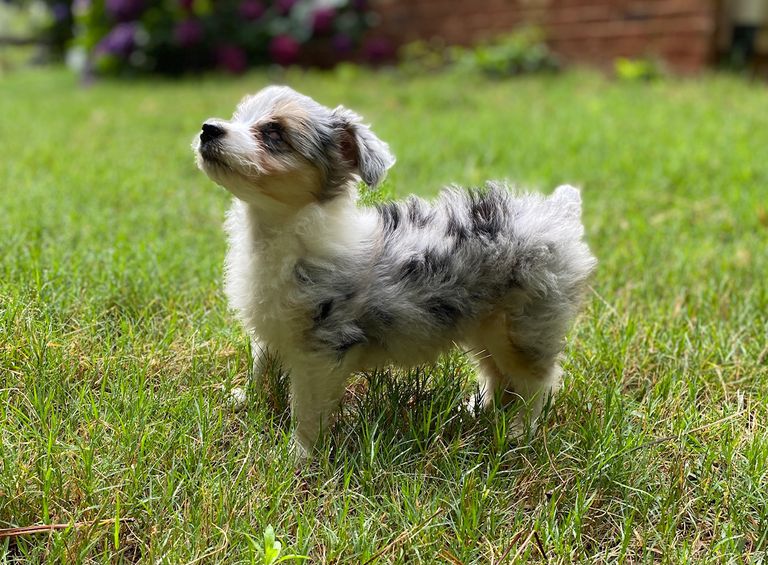
Blind puppy Gertie weighs just over 2 pounds. Mary Jo DiLonardo
This may seem like a no-brainer, but with all the news from overwhelmed shelters and rescues this summer, it’s probably worth saying out loud.
Dogs are not disposable.
Disreputable breeders toss out puppies that aren’t “perfect.” Some people give up the family pet when they go on vacation so they don’t have to pay for boarding. Others give up an older puppy whose cute behaviors are now obnoxious or a senior dog who may have other health issues.
That little mouse you see at the top of the page is one of two special needs puppies I’m fostering right now. She’s actually a 2.1-pound puppy that we were told is an Aussiedoodle. I still think she might be an exotic guinea pig.
Gertie was dropped off by a breeder at a vet’s office to be euthanized because she was blind. The vet contacted a rescue instead.
I also have a deaf puppy that was given up by a breeder. Many other fosters are also doubling up because the need is so great right now. Probably the biggest reason is that it’s the summer and people are traveling for the first time again in more than a year. That means it’s hard to find adopters and it’s hard to find fosters. Everyone wants out of the house.
I’ve seen messages and social media posts from rescuer and shelter workers who say they feel helpless because the requests for help right now are so crushing.
“My rescue cannot keep up trying to save them,” one wrote.
“I’m sickened at the number of rescue and surrender requests we are getting and I am completely heartbroken,” wrote another.
“We need a lifeline,” said another rescuer.
There are some news stories that claim many pandemic puppies are being returned, but the numbers don’t back that up. Instead, it’s just a crush of other reasons, many involving summer travel.
I think the hardest thing for most loving pet owners to fathom is the idea that some people would drop off their dog at a shelter on their way out of town. There’s just anecdotal evidence and no statistics about how often it happens, but it’s cited very often from disheartened rescuers and shelter workers.
The people who surrender their pets say they don’t want to pay for boarding and they’ll just get a new one when they return. Shelter workers say it’s heart-wrenching to hold a dog while they watch their person drive away. Some will stare out the door for hours, thinking for sure their family will return.
“Unfortunately, it doesn’t surprise us anymore which is really sad,” says Jen Schwarz, one of the directors of Speak! St. Louis, the special needs rescue I foster for. The rescuers hear the story often from shelter and humane society workers.
“They don’t want to pay for boarding or can’t find anybody to take their dog,” says Schwarz. “It’s basically being selfish.”
And people might think they’re doing their dog a favor by taking it to a shelter, hoping they’ll get adopted by someone else. But typically, if shelters have to euthanize for space, they’ll turn to owner-surrendered pets before strays because they know no one is looking for them.
“That’s the sad reality,” Schwarz says.
The other thing that happens often is people asking to have the family pet put to sleep because they’re too much hassle.
“That happens a lot. The kids are gone, they want to travel, the dog’s too much, and they have it euthanized,” Schwarz says. “That’s worse than dumping it at the shelter.”
Rescuers are saving as many as they can and that’s why I have one puppy sleeping behind me in my office and one napping in a playpen in the living room. Soon everyone will head outside for a game of tag where I’ll make sure everyone gets a chance to win.
And the only thing disposable here is an awful lot of very tiny puppy poo.
ooOOoo
When Jen Schwarz says: “That happens a lot. The kids are gone, they want to travel, the dog’s too much, and they have it euthanized,” I wonder what a lot is numerically. Anyone know?
The stories from the shelter workers breaks hearts here as well. Dogs are so intuitive; so smart. It is no surprise that they will stare for hours trying to work out what has happened.
Mikayla Sengle and her boyfriend, Anthony Noto, weren’t planning on adopting a dog. But when Wylie suddenly came into their lives, it seemed meant to be.
Last month, Noto was on his way home from work when he passed by a dog park near an apartment complex. In the back of the park, a white and brown pittie sat all alone, looking confused.
As Noto approached the dog, he noticed that he wasn’t wearing a collar and looked a bit banged up.
“He looked lost, but at the same time, he seemed like he was on a mission to find something,” Noto told The Dodo. “When I walked over towards where my work truck was, he came up [to me] all innocent with his head down, seeing if I’d accept him.”
“Maybe I was what he was looking for,” he added.
Noto slipped a loose rope around the pup’s neck and walked him around the area trying to find his owner. But when no one recognized the dog, Noto put him in his truck and drove him home.
The pup didn’t seem to want to upset his new friends and was determined to show Sengle and Noto that he had the best manners.
“With people, he would wait for them to give the OK to lick and pay attention to people,” Sengle told The Dodo. “He seemed extremely relieved and happy. He got a bath and some treats as soon as he came home.”
“He instantly would look at my boyfriend for permission for everything,” Sengle added. “When he got home and ran in the yard, he was thrilled. It seemed like he never experienced the opportunity to be free and fun.”
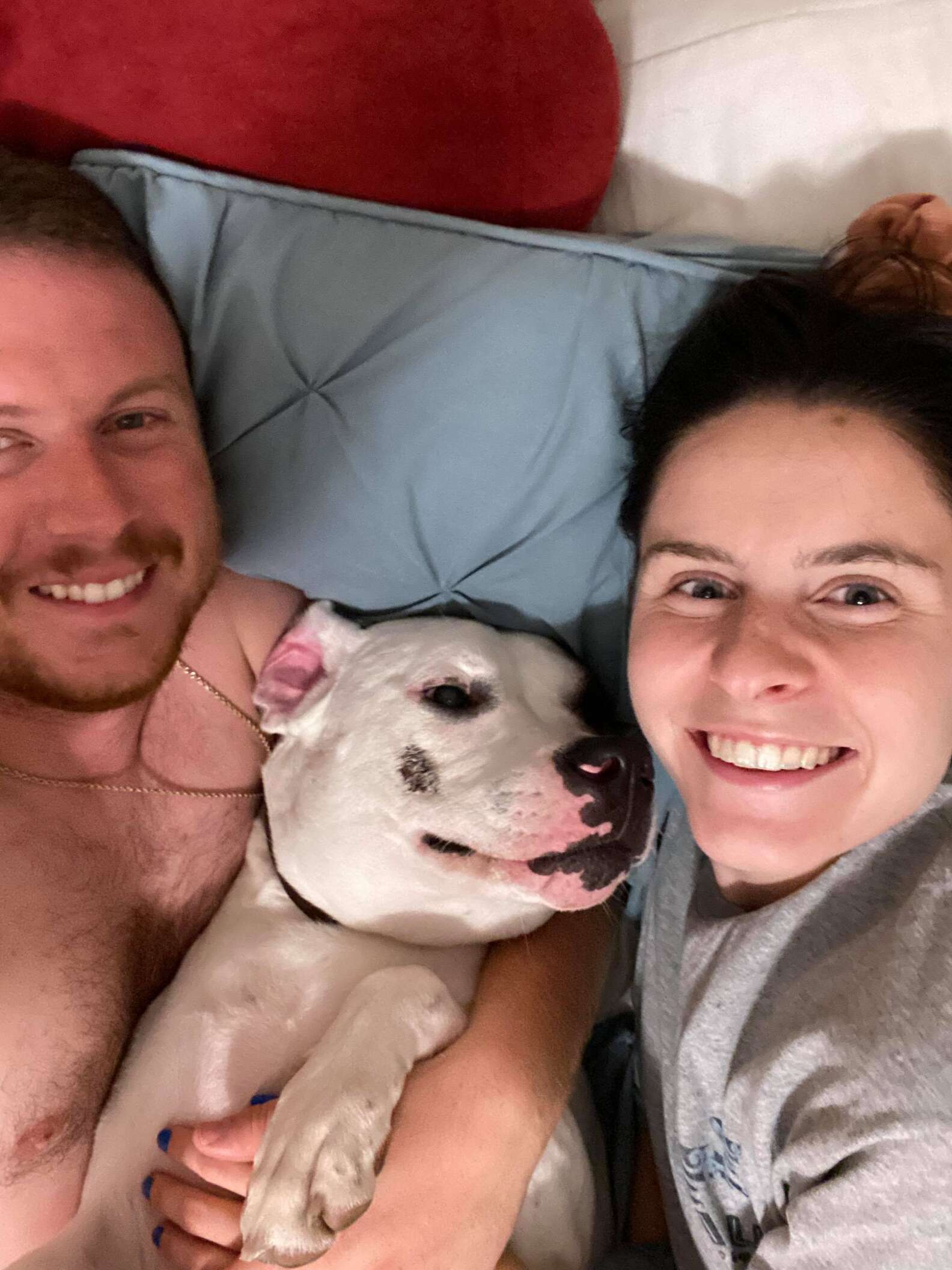
The first night, Wylie slept in bed between his rescuers, as if to make sure they wouldn’t leave him. And he’d never been more comfortable and happy in his life.
Sengle posted on social media searching for the dog’s family, but when she finally received a response, it broke her heart.
“A young girl reached out to us and basically said that it was her friend’s dog and [her friend] had seen the post and said she no longer wanted him anymore because he was annoying,” Sengle said. “She even begged us not to give him back if they did reach out to us because they used to hit him and were not nice to him.”
Sengle and Noto kept Wylie for the five-day stray hold, giving the owners time to claim him. But when the week was up, there was no question that he was staying with them — forever.
Sengle and Noto thought their family was complete, but now they can’t believe that they got so lucky.
“He is a very sweet dog and a great companion,” Sengle said. “My boyfriend and him grew a bond almost instantly. He slept right in between us the first night we got him and from then on, we knew in our hearts he was our dog.”
ooOOoo
All photographs by Mikala Sengle.
It shows again how quickly a dog can open up the heart strings of us humans. As Single and Noto remarked above, they now can’t believe they were so lucky. It’s how we feel about our dogs. It’s how countless others feel about their many, many four-legged loved ones!

:max_bytes(150000):strip_icc()/MaryJoDiLonardo-bw-treehugger-6d5044d7d4ae44298fb31df11a3d5a66.jpg)





 Learning from Dogs