Author: Paul Handover

Beams of light in the darkness

These are very strange times: thank goodness for Blogs.

Learning from Dogs is a relatively young Blog (first Post was July 15th, 2009) but already it has opened the eyes of all the authors to the power of plain speaking.  All of us involved in bringing you a dozen Posts a week find inspiration for our creative juices from the corners, far and wide, of the virtual world of digital communications, the World Wide Web.

Because we are in the midst of huge turmoil it’s very difficult to see the underlying trends of change at work.  But see them we must if we are to be smart and work out, for the best, what needs to be done at the scale of the individual and the family.

So with that theme in mind, go to the Blog called Jesse’s Café Américain and read a recent Post about the behaviour of the price of gold.  But also read beyond the subject of gold and reflect on the deeper message.

Here’s an extract from that Post:

Read the rest of this Post

Resignation, anger or possibilities

A recap on some important messages.

One of the great benefits of being a team of authors is that we, too, are learning from each other.  So on that theme I wanted to review some of the Posts that have been written by my fellow authors as a reminder of some powerful motivational ideas.

Sir Ranulph Fiennes

When asked about his approach to climbing Everest at the third attempt in May 2009 and, at age 65, the oldest Briton to do so, he captured the full spirit of separating actions from goals when he said:

Plod forever! Don’t expect to get there. Don’t think there is going to be a top to this mountain. Just plod forever!

Watch the video.

Read more about these examples

Consequences and probabilities

How Peter L Bernstein’s work helps us make the safest decision with regard to global warming.

Probably like me you hadn’t heard of Peter Bernstein. He was instrumental in understanding risk and that alone makes him worth knowing about.  Here’s the entry from Wikipedia:

Peter Lewyn Bernstein (January 22, 1919 – June 5, 2009) was a financial historian, economist and educator whose development and refinement of the efficient market theory made him one of the country’s [USA] best known authorities in popularizing and presenting investment economics to the general public.

Watch the YouTube video before reading on:

You could not have missed a fundamental message in the interview – if the consequence of something is critically harmful then don’t take ANY risks. Bernstein’s book on risk is Against the Gods.

Continue reading “Consequences and probabilities”

It’s all about timing!

An adjustment to when Posts are published on Learning from Dogs.

The editor of this Blog lives in the American Mountain Time (MT) zone.  That is 7 hours behind GMT.  Posts have been scheduled to be published at 09:00 MT, which is 16:00 GMT.

It has now struck us that this is daft because for our American readers East of MT and our European readers the daily Posts appear either mid-morning or in the afternoon, even later during the Summer.

Thus with effect from Wednesday, 25th November Posts will be published at 22:00 MT the previous evening.

This will ensure that your daily Learning from Dogs Post will be waiting in your in-box, and available on the Blog website, at the start of your day. (Apologies to our readers down under!)

For those that haven’t done this, you can easily set up an email subscription (and just as easily cancel it) to the Posts thus ensuring that they are always available to read via your email account.  To do that, click here.

The rights of the child

A reminder of the United Nations (UNICEF) Convention and a second view from yours truly.

On November 12th I was the author of a Post called Our next generation featuring the young Jessica Watson from Australia who is on course to try and win the record for the youngest person to sail, solo, unassisted, non-stop around the World.  Here’s a part of what was said:

Jessica Watson2
Jessica Watson

Jessica Watson is a teenager.  She is hoping to break the record for the youngest person to sail solo, non-stop and unassisted around the World.  Whatever modern materials and technology can do to make sailing easier, sailing solo for weeks on end is grindingly tough at any age.  She’s a wonderful example of the next generation!

Jessica left Sydney Harbour on October 18, 2009 sailing her sloop Ella’s Pink Lady. Her course is an estimated 23,000 nautical miles requiring her to be roughly 230 days at sea.

You can see that the tone of the Post was supportive.

However the comments that the Post attracted were critical of the pressures and influences that may have been brought to bear on this child.  For at 16 ‘child’ is what Jessica is.  One of our regular contributors pointed out that under the terms of the UNICEF Convention:

The Convention on the Rights of the Child is the first legally binding international instrument to incorporate the full range of human rights—civil, cultural, economic, political and social rights. In 1989, world leaders decided that children needed a special convention just for them because people under 18 years old often need special care and protection that adults do not.

(My underlining)

Read the rest of this Post

Black holes, colliders and paradoxes

This is a very strange world that we live in.

It would be fair to say that my knowledge about what I am writing in this Post is minimal to the point of total ignorance.  So why open my mouth and prove it!  Because the conquest of fundamental questions about our world is not only an example of mankind at its greatest but also something of broad appeal.

That is proved by the continuing popularity of the BBC Television Series – Horizon.  In that series there have recently been two fascinating programmes: Who’s afraid of a big Black Hole? and How long is a piece of string? (Readers outside the UK will not be able to view these programmes.)

Here are the programme summaries:

Black holes are one of the most destructive forces in the universe, capable of tearing a planet apart and swallowing an entire star. Yet scientists now believe they could hold the key to answering the ultimate question – what was there before the Big Bang?

The trouble is that researching them is next to impossible. Black holes are by definition invisible and there’s no scientific theory able to explain them. Despite these obvious obstacles, Horizon meets the astronomers attempting to image a black hole for the very first time and the theoretical physicists getting ever closer to unlocking their mysteries. It’s a story that takes us into the heart of a black hole and to the very edge of what we think we know about the universe.

and

Alan Davies attempts to answer the proverbial question: how long is a piece of string? But what appears to be a simple task soon turns into a mind-bending voyage of discovery where nothing is as it seems.

An encounter with leading mathematician Marcus du Sautoy reveals that Alan’s short length of string may in fact be infinitely long. When Alan attempts to measure his string at the atomic scale, events take an even stranger turn. Not only do objects appear in many places at once, but reality itself seems to be an illusion.

Ultimately, Alan finds that measuring his piece of string could – in theory at least – create a black hole, bringing about the end of the world.

Read more of this strange world

Goldman Sachs – doing God’s work!

A fascinating and revealing interview in the Sunday Times.

This article in the British Sunday Times was published on November 8th and I’m sure many will have read it.  But for those that didn’t it really is worth settling down to a reasonably long read.  For you will learn that Goldman Sachs:

It’s the site of the best cash-making machine that global capitalism has ever produced, and, some say, a political force more powerful than governments. The people who work behind the brass-trim glass doors make more money than some countries do. They are the rainmakers’ rainmakers, the biggest swinging dicks in the financial jungle. Their assets total $1 trillion, their annual revenues run into the tens of billions, and their profits are in the billions, which they distribute liberally among themselves. Average pay this recessionary year for the 30,000 staff is expected to be a record $700,000. Top earners will get tens of millions, several hundred thousand times more than a cleaner at the firm. When they have finished getting “filthy rich by 40”, as the company saying goes, these alpha dogs don’t put their feet up. They parachute into some of the most senior political posts in the US and beyond, prompting accusations that they “rule the world”. Number 85 Broad Street is the home of Goldman Sachs.

The world’s most successful investment bank likes to hide behind the tidal wave of money that it generates and sends crashing over Manhattan, the City of London and most of the world’s other financial capitals. But now the dark knights of banking are being forced, blinking, into the cold light of day. The public, politicians and the press blame bankers’ reckless trading for the credit crunch and, as the most successful bank still standing, Goldman is their prime target. Here, politicians and commentators compete to denounce Goldman in ever more robust terms — “robber barons”, “economic vandals”, “vulture capitalists”. Vince Cable, the Lib Dem Treasury spokesman, contrasts the bank’s recent record results — profits of $3.2 billion in the last quarter alone — and its planned bumper bonus payments with what has happened to ordinary people’s jobs and incomes in 2009.

and later on in conversation with the Chairman and CEO, Lloyd Blankfein:

“Is it possible to have too much ambition? Is it possible to be too successful?” Blankfein shoots back. “I don’t want people in this firm to think that they have accomplished as much for themselves as they can and go on vacation. As the guardian of the interests of the shareholders and, by the way, for the purposes of society, I’d like them to continue to do what they are doing. I don’t want to put a cap on their ambition. It’s hard for me to argue for a cap on their compensation.”

So, it’s business as usual, then, regardless of whether it makes most people howl at the moon with rage? Goldman Sachs, this pillar of the free market, breeder of super-citizens, object of envy and awe will go on raking it in, getting richer than God? An impish grin spreads across Blankfein’s face. Call him a fat cat who mocks the public. Call him wicked. Call him what you will. He is, he says, just a banker “doing God’s work”

Indeed!

By Paul Handover

In the shadow of a rainbow

A truly magical experience between man and bear.

Regular readers of this Blog will know that Naked Capitalism is a daily read for this author.  Yves Smith always includes her ‘antidote du jour’ picture of animals.  How Yves finds these is beyond me but her antidote of the 14th November really was special.  The original author of the piece, Tom Sears, is encouraging the distribution of his story and pictures and it’s a pleasure to do so via Learning from Dogs.

Black bears typically have two cubs; rarely, one or three. In 2007, in northern New Hampshire, a black bear Sow gave birth to five healthy young. There were two or three reports of sows with as many as 4 cubs, but five was, and is, very extraordinary. I learned of them shortly after they emerged from their den and set myself a goal of photographing all five cubs with their mom – no matter how much time and effort was involved. I knew the trail they followed on a fairly regular basis, usually shortly before dark. After spending nearly four hours a day, seven days a week, for more than six weeks, I had that once-in-a-lifetime opportunity and photographed them. I used the equivalent of a very fast film speed on my digital camera. The print is properly focused and well exposed, with all six bears posing as if they were in a studio for a family portrait.

bearfamilyadults

I stayed in touch with other people who saw the bears during the summer and into the fall hunting season. All six bears continued to thrive. As time for hibernation approached, I found still more folks who had seen them, and everything remained OK. I stayed away from the bears as I was concerned that they might become habituated to me, or to people in general, and treat them as `approachable friends’. This could easily become dangerous for both man and animal.

After Halloween, I received no further reports and could only hope the bears survived until they hibernated.

This spring, just before the snow disappeared, all six bears came out of their den and wandered all over the same familiar territory they trekked in the spring of 2007.

I saw them before mid-April and dreamed nightly of taking another family portrait, a highly improbable second once-in-a-lifetime photograph.

On 25 April 2008, I achieved my dream.

bearfamilybabies

When something as magical as this happens between man and animal, Native Americans say, “We have walked together in the shadow of a rainbow”. And so it is with humility and great pleasure that I share these exhilarating photos with you. Do pass them on!

By Paul Handover
The Moon and water!

NASA reveals that there is a significant amount of water on the Moon.

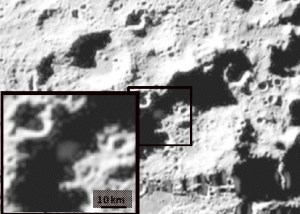
In a rather awful pun, NASA published update on the LCROSS Mission starts with the words, “The argument that the moon is a dry, desolate place no longer holds water.

LCROSS
The visible camera image showing the ejecta plume at about 20 seconds after impact.

Anyway, the significance of the update is enormous.  As the NASA release goes on to say,

Scientists have long speculated about the source of vast quantities of hydrogen that have been observed at the lunar poles. The LCROSS findings are shedding new light on the question of water, which could be more widespread and in greater quantity than previously suspected.

Permanently shadowed regions could hold a key to the history and evolution of the solar system, much as an ice core sample taken on Earth reveals ancient data. In addition, water, and other compounds represent potential resources that could sustain future lunar exploration.

The BBC also reports the NASA data but, I am bound to say, in a rather more reader-friendly format.

By Paul Handover

Single-handed sailing

A personal reflection on this rather strange way of travelling!

The recent Post about young Jessica Watson sailing alone around the world raised a few comments but also reminded me of my own experiences of solo sailing.

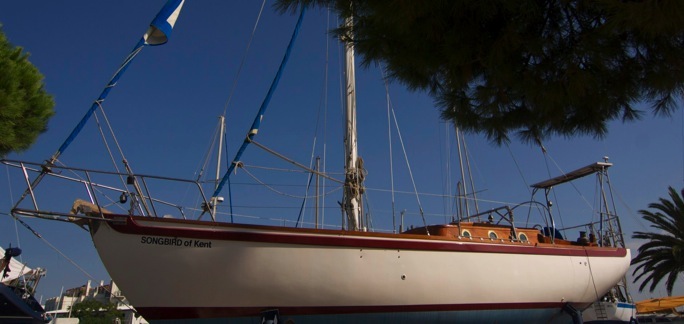
Some years ago, having successfully sold my own IT company, I warmed to the idea of being a full-time yachtie! A second-hand Tradewind 33 was discovered on the Island of Corfu.  (Now here’s a surprise!  I was just browsing the web looking for a picture of a Tradewind and came across my old yacht currently up for sale.  Her name is Songbird of Kent! Picture below.)

Songbird of Kent
Tradewind 33 - Songbird of Kent

Anyway, the deal was done and having sold my house in England I flew out to Corfu to collect Songbird of Kent. Inevitably it was a number of months before the boat was ready to head out into the Mediterranean but in early Spring 1988 it was time to explore the long coastlines of Greece and Turkey.

After a fantastic summer cruising from one idyllic anchorage to another mostly with friends or family on board, it was time to find a winter haven.  Many recommended Larnaca Marina in Cyprus.  Thus it was late in the summer of 1988 that I said goodbye to friends and set out on my own to cross from Antalya in Turkey to Cyprus and for Larnaca, on the SE side of the island.

That sea crossing, only a little over 200 nautical miles, was to become a regular solo experience at the start and end of each summer season. Impossible to do in a single day it was always a night at sea and rarely, if things didn’t go well with the weather, a couple of nights. I hated it! Maybe it was the sudden transition from coastal sailing to a deep water crossing, often going from having friends on board to being alone, but whatever it was I never enjoyed my time on my own and knew that long-distance solo sailing was never going to be my scene.

Read more of this Post