THERE are plenty of studies which show that dogs act as social catalysts, helping their owners forge intimate, long-term relationships with other people. But does that apply in the workplace? Christopher Honts and his colleagues at Central Michigan University in Mount Pleasant were surprised to find that there was not much research on this question, and decided to put that right.
And the article concludes:
Mr Honts found that those who had had a dog to slobber and pounce on them ranked their team-mates more highly on measures of trust, team cohesion and intimacy than those who had not.
But do read the article in full because the conclusions are quite significant. Once again, the link is below:
Again, apologies for a ‘thin’ posting – here’s why.
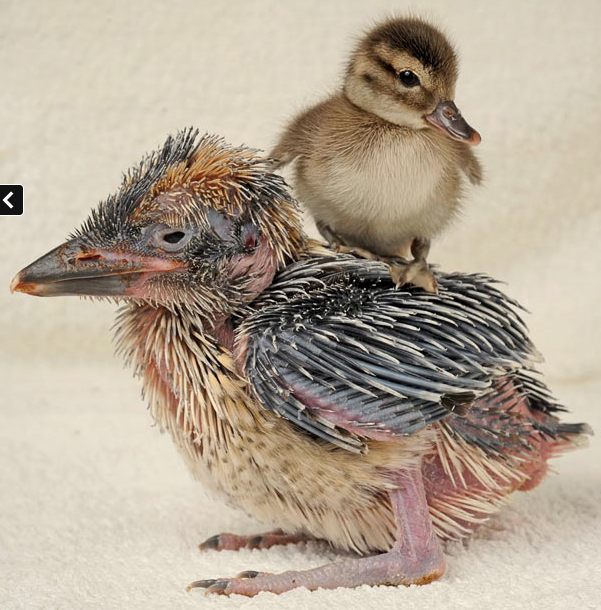
I first saw this in Naked Capitalism but the picture came from the UK’s Daily Telegraph newspaper 6th August, 2010.
Trust!
The accompanying text:
This baby six-week old kookaburra called Kookie and a tiny duckling have struck up a friendship at the Seaview Wildlife Encounter, near Ryde in the Isle of Wight. Kookie was saved by staff after they feared his parents would kill him. And the duckling was rescued from one of the park’s aviaries because he was thought too small to defend himself against larger birds. Keepers took a chance and decided to see what would happen if they were put together. The duckling instantly cuddled up under Kookie’s protective wing, thinking he was his mum and Kookie didn’t seem to mind playing the caring parent
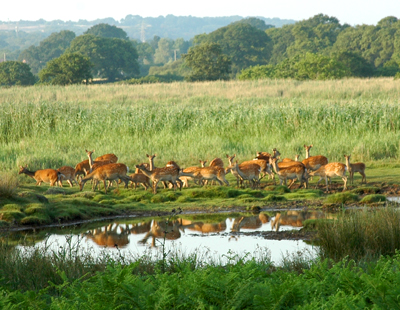
Julie has gone on ahead, but returns to tell me that the sika deer are feeding in the reed beds ahead of us. (These are one of two types of deer found at Holton Lee.) She offers to stay with Genie while I go and photograph them, so that Genie won’t frighten them off. They see me, but continue feeding whilst remaining alert.
It really is a magical sight – I am quite converted from my original anxiety about deer leaping out in front of the car!
There is something extremely primeval about deer, which is probably not surprising as their bodies have provided everything from meat and clothing to fish hooks and sinews for many indigenous people, while still remaining wild. It is hard to see why anyone would hunt them simply for sport, though, and I fear that Walt Disney has spoilt me for enjoying venison – ancient, organic, sustainable, non-farmed food source or not, it would be like eating Bambi!
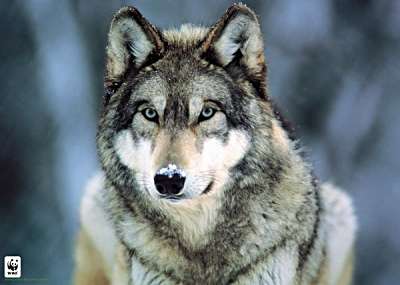
The wonderful news that US Gray Wolves are now back under protection reminded me of the beautiful story of Tim and his ‘pet’ wolf Luna that was published on Learning from Dogs September, 2009.
The first article opened up as follows:
An amazing true story of a relationship between a wild wolf and a man.
This is a story of a particular event in the life of Tim Woods told to me by his brother, DR. It revolves around the coming together of a man sleeping rough, with his dog, on Mingus Mountain, and a fully grown female Gray or Grey Wolf. Mingus is in the Black Hills mountain range between Cottonwood and Prescott in Arizona, USA
But then I added a postscript which I am going to reproduce in full again.
The story of Luna has some interesting connections.
The person taking the picture in the Post about Tim Woods was Willie Prescott. He just happens to be the grandson of William H. Prescott from whom the town of Prescott is named. Here’s that picture again.
Can’t better what was published in the New York Times a few days ago:
Donald Molloy, a Federal District Court judge in Montana, ruled Thursday that gray wolves in Montana and Idaho must be provided federal protection under the Endangered Species Act. This is a welcome decision. The immediate effect will be to spare the animals from hunts planned for this fall that are now illegal. The larger hope is that Washington will devise a protection plan ensuring the wolves’ survival not only in Montana and Idaho but across the northern Rocky Mountains.
Wolves in Montana and Idaho were removed from federal protection under rules proposed by the Bush administration. The rules were upheld by President Obama’s Interior Department, which said that both states had developed satisfactory management plans and that the wolves, in effect, could be released into their custody.
Wyoming’s plan was deemed inadequate, and federal protections remained. But in Montana and Idaho, the first reaction was to authorize limited wolf hunts that — though the states argued otherwise — would slowly guarantee the extinction of the species.
Judge Molloy ruled that protections for what is essentially a single species cannot be different in each state — either the wolf must be removed from the list or listed as an endangered species in every state, meaning throughout its range. Judging by early comments, the Interior Department’s preference seems to be to persuade Wyoming to improve its management plan so that the government can delist the wolf there — thus bringing the three states into harmony.
This is a terrible idea, and could end up authorizing hunts in three states, not two. The Interior Department, instead, should write an areawide management plan. There are roughly 1,700 wolves across the Rockies — far more than when they were reintroduced in the 1990s. But most biologists believe there should be a minimum of 2,000, with enough breeding pairs to ensure the long-term survival of a dynamic population across the range.
State plans meant to satisfy hunters rather than protect the wolves cannot do that. The gray wolf may need federal protection for years to come.
A Guest Post from Daniela Caride. Daniela writes the Blog The Daily Tail
Something about being a dog dazzles me. Maybe it’s the freedom. Dogs don’t care what others think of them. They do whatever pleases them most without guilt or worries.
This morning, it became so clear to me. My walk around Fresh Pond Reservation in Cambridge didn’t feel very pleasant. I was worried about my mother’s persistent headache.
Today promised to be the hottest day of the summer, and the heat was not helping my mood. It was only 9 a.m., and I was already convinced something had changed in our constellation, and the sun was about to barbeque the Earth.
But my dogs, Frieda, Geppetto and Lola, were oblivious to anything going on outside Fresh Pond. They trotted happily to the doggie pond awaiting them less than a mile away, stopping only to sniff around and greet other dogs.
At the pond, they refreshed themselves in the water, not minding that the water gets dirtier as the summer wears on. They love that stinky pond, from the day the ice starts cracking and we can finally see our reflections in the moving water, to the beginning of winter when the water turns into ice again.
We completed our lap and approached my car, parked in front of a huge grassy area, where dogs are not allowed. One
Dog days!
of the landscaping employees was testing the park’s brand new lawn sprinklers. He turned them on and watched as half a dozen sprinklers soaked the grass.
Geppetto ran toward the spinning sprinklers, ignoring leash laws, of course. He was dying for a sip. The water flowed so strong that Geppetto had to close his eyes when trying to get the spray into his mouth again and again.
Frieda and Lola followed him, first exploring the artificial rain until they felt comfortable enough to play beneath it. Soon they were romping under the sun without feeling the effects of the boiling heat.
I watched the beauty of that canine dance with envy. My dogs were free, living the moment, unfettered of any concern. Then I asked myself why we humans don’t act more like them, especially in situations like this, in which no harm would be done.
Geppetto and Daniela
First, I went into one of the sprinklers, wetting my hair and face. Then another sprinkler surprised me, showering me head to toe with a refreshing jet. I raised my arms to let the water reach the rest of my body.
Park regulars watched their dogs and me from careful distance, not wanting to get wet. I didn’t care any more. I felt whole.
On the 2nd August there was a Post that highlighted the way that officialdom was changing figures that painted a very different picture to that promoted at the time the figures were released.
I linked to a recent article from Karl Denninger showing how previous US GDP figures had been significantly revised downwards.
Well Karl has now published a smart chart showing what happened in a way that makes it very easy to understand.
The chart is below, but please support Karl by going to the article which is here.
Revised US GDP figures
Do read the original article at Karl’s Blog site simply because he sets out in his usual clear (and forthright) manner just what this all means. And it isn’t just affecting the US – this ripples across the pond!
Finally, another perspective on this issue is here – with the same implications being presented. It’s gloomy ahead!
I am rapidly approaching the point where I have to devote some considerable time and energy to persuading the US
Too many forms!
Government that I am a fit person to enter the USA and get married to my Jeannie!
It involves more form filling than one may imagine plus attending interviews in London, etc., etc.
Without doubt it is going to put that small creative part of my brain under some pressure and as a result I am concerned that regular fresh daily postings on Learning from Dogs may be a challenge.
My hope is that there is always something for you to read on a daily basis because that is the least that should be done for so many loyal supporters of this Blog.
But some of the Posts may be popular ones recycled from the archives, small snippets of items from the news that have caught my eye, or just a beautiful or funny picture to mark another day in all our lives.
If you have something you would like to contribute, then please feel free to email it to learningfromdogs [at] gmail [dot] com That would be most welcome and really appreciated.
JB Baptism
STOP PRESS: I was granted my fiancé visa by the kind folks at the US Embassy in London on the morning of the 26th October. Amazing that at my age, one can still feel like a love-sick teenager!
UPDATE: Arrived back in Payson on the 5th November – what a wonderful feeling that was. The wedding is just 2 weeks away!
Per Kurowski has been a loyal follower and supporter of this Blog and I’m indebted to him for this. Per writes the Blog
Per Kurowski
Tea with FT (Financial Times) but his busy life seems to allow sufficient space for the odd comment on Learning from Dogs.
Here’s what Per wrote as a comment to the recent Post entitled, “Is thinking going out of fashion?“. It seem worthy of being a guest post.
In reference to courage, here is a question on financial regulations, only for the brave.
Currently the financial regulators in the Basel Committee requires the bank to hold 8 percent when lending to unrated small businesses and entrepreneurs but only 1.6 percent when lending to triple A rated clients.
What would have happened if exactly the opposite capital requirements had been imposed? The banks having to hold instead 8 percent in capital when lending to triple-A rated clients and only 1.6 percent when lending to unrated small businesses and entrepreneurs.
It would most surely have created problems, any regulatory discrimination does, but I hold that a crisis as large as the current one would not have happened… since no gigantic financial crisis has ever resulted from excessive lending to those who are perceived as risky, they have always resulted from excessive lending to those who are perceived as not risky.
We could also have had a lot more of jobs, since almost always the next-generation of decent sustainable jobs is to be found among the current small businesses and entrepreneurs.
Our biggest financial systemic risk is without any doubt our financial regulators.