Author: Paul Handover

Europe Uber Alles, Pt 2.

A Guest post by Patrice Ayme

Part One ended saying:

The euro, long in planning by some European institutions, was introduced minimally, namely without the governmental apparatus generally associated to a currency. This is the way Europeans have found to progress peacefully towards greater harmony: do what is necessary, and nothing more than that, and do it with total consensus.

Everybody knew that a currency without a government to create and anchor it had never happened before, and was unlikely to endure.

The European Union

Part Two continues

That fit the European federalists just right, and could not have escaped the understanding of Paris and Berlin. As it turned out, the PIIGS’ crisis is putting back Paris and Berlin, the historical engine of Europe, back on top, and this, for an excellent reason.

“PIIGS” stand for Portugal Ireland Iceland Greece Spain. All of them ran bubble economies, partially propelled by taxes from the richest European countries (including France and Germany). It became ridiculous as, for example, Ireland was getting European subsidies while the Irish were already way richer than those subsidizing them. (OK Iceland is not in the EU, yet, but it begged to enter the Eurozone, and it has disappeared the savings of countless Brits and Dutch, which means it has some outstanding business with the rest of Europe, that it will have to sort out, after executing a few more whales, guilty as charged.)

Some acknowledge the convenience of a common European currency and easier border transits, while remaining obsessed by what they view as gigantic differences between European countries. Those quaint nationalists and parochial types obsess that core differences between countries are so strong and deep-rooted that any form of real European union is a ridiculous concept. This is triply erroneous.

Read the rest of this Post

Europe Uber Alles

Welcome Patrice Ayme

On the 22nd March, Learning from Dogs had the pleasure of a Post from our first Guest Author, Elliot Engstrom.  We were then doubly delighted to have Per Kurowski join us as our second Guest Author with his introductory Post.

Now we have the additional honour of welcoming Patrice Ayme to the growing ranks of Guest Author to Learning from Dogs.

Patrice, like Elliot and Per, also is a prolific blogger.  He describes himself as:

I was born in Europe, raised in Africa, and lived in America. So doing, I learned to compare different cultures, even during my early childhood, and to appreciate superiority of many of their traits, even the most surprising. I consider myself Senegalese, and proudly so. I studied, and know, several languages, not just Latin, and several cultures, deeply, by living through and inside them for years. I have done formal studies in mathematics and physics at three leading Universities receiving the highest degrees, and putting me in a good position to learn to differentiate between hard knowledge and wishful thinking, differently from many a common philosopher. I am a specialist of non commutative geometry, arguably the most abstract field of knowledge in existence (even hard core logic, model theory, is used in my approach).

Here is Patrice’s first Guest Post for Learning from Dogs.

——————————

GREEK TROJAN HORSE TO CONQUER BETTER EUROPEAN UNION

Abstract:

The European currency, the euro, is, foremost, a solution to a problem. War. All other problems, and the euro solves many, pale in significance relative to this one.

Many talk about “problems” with the euro, and, oozing with glee all over, perceive weakness. They are right, there is weakness, but it is not European weakness. Just the opposite.

What those skeptics are seeing with their uncomprehending neurology is the further construction of the European imperium, according to its core principle: fix what needs to be fixed, but with complete consensus of the parties concerned, which means do it just so. It appears messy, because it’s democratic, and before the people (demos) can use its kratos (power), it needs to think right, which means it has to argue thoroughly. It looks like squabbling, but it is thinking aloud. Europe is not built for some parties to gain advantage anymore (as it was with Napoleon, or Hitler), but to solve problems and gain opportunities for all.

The euro is, for the first time, used as a weapon against Europe’s enemies. Hence all the squealing. Far from weakening Franco-German resolve, the recourse to the IMF adds another layer of authority to the European Communities. When the IMF, speaking in the name of Franco-German taxpayers, tell restive exploiters in Greece that they have to pay more taxes (only 6 plutocrats declare more than one million euro income in Greece, and more than 500 professions can retire at 50 years of age, whereas Germany just brought up the retirement age to 67!), they will have to submit under orders (imperare, to use the Roman notion)

The European Union

Read more of Patrice’s fascinating article

Elinor Smith, pilot extraodinaire

A remarkable woman who died a week ago

There are many famous names in aviation but I would wager that Elinor Smith, despite being one of the greats in the history of flying, is not a name that falls off the lips of thousands.  It ought to.

Last Friday, just a week ago, Elinor Smith died at the amazing age of 98.

Elinor Smith

There are many accounts of her life accessible online.  Here’s an extract from an obituary published by the Wall Street Journal.

Ms. Smith, who died Friday at age 98, was one of the last survivors of aviation’s early barnstorming days. She flew with such legends as Amelia Earhart and James Doolittle. She recalled Charles Lindbergh seeing her off from Roosevelt Field in 1928 on her most notorious exploit, flying under four of New York City’s East River bridges.

and also from the WSJ:

Over the next few years, Ms. Smith would set numerous records, spurred on by a handful of other aviatrices, including Ms. Earhart, Bobbi Trout, and Pancho Barnes. All were trumpeted by the media. Ms. Smith’s “Flying Flapper” moniker was matched by “The Flying Cashier” and “The Flying Salesgirl.” Each strove to break free of the pack.

“That’s how you got jobs, by setting records,” said Dorothy Cochrane, a curator at the National Air and Space Museum. “Women had to take what they could get since careers in the military were closed to them.”

Ms. Smith set several endurance records, and once flew so high in an attempt to set the altitude record that she blacked out above 30,000 feet.

There is also a comprehensive account of her life on WikiPedia.

Plus a few days ago, someone posted a brief clip on YouTube.

More about Elinor Smith, courtesy of Cradle of Aviation:

Facts:

  • Born August 17, 1911 in New York City. In 1917, at the age of six, Smith took her first flight in a Farman pusher biplane and from then on she was hooked on aviation.Growing up in Freeport, Long Island during the heyday of the golden age of flight, Elinor Smith had access to some of the best flying fields in the country and some of the most famous flyers.
  • At the age of fifteen, Smith flew her first solo flight and one year later in 1928 she received her pilot’s license to become the world’s youngest licensed pilot.
  • One of her earliest and most famous stunts in 1928 was flying under all four East River suspension bridges—a feat never accomplished by another pilot.
  • In 1928, Smith set a light plane altitude record of 11,889 feet, the first of many records she was to set during her career. In 1929, alone she set four world records.
  • The following year Smith set the women’s solo endurance record after spending thirteen hours, sixteen minutes flying an open cockpit Brunner Winkle Bird on a frigid January night over Roosevelt Field.
  • Smith toured the U.S. air show circuit in 1929, piloting a Bellanca Pacemaker for a group of parachutists promoting the Irvin Parachute Company.
  • Flying with co-pilot Bobbie Trout, she set the first Women’s Refueling Record of 42 _ hours over Los Angeles.
    Smith was the first woman test pilot for both Fairchild Aviation Corporation and Bellanca Corporation.
  • Set Woman’s World Speed Record of 190.8 miles per hour in 1929 in a Curtiss Falcon over a closed course, Motor Parkway, Long Island.
  • In 1930, Elinor Smith received one of the greatest honors in her life when she was voted the best woman pilot in the United States.
  • From 1930 to 1935, Smith she worked as a radio commentator on aviation events for NBC.
  • After retiring from flying, Elinor Smith worked to preserve the history of Long Island aviation. She was a founding member of the Long Island Early Fliers and promoted the creation of an aviation museum on Long Island.
  • In 1960, she piloted a T-33 jet trainer at Mitchel Field.

By Paul Handover

US incomes

This isn’t just about America, it’s affecting us all!

Yesterday, Learning from Dogs published in full a Stratfor report about China.  The thrust of the report was:

U.S.-Chinese relations have become tenser in recent months, with the United States threatening to impose tariffs unless China agrees to revalue its currency and, ideally, allow it to become convertible like the yen or euro. China now follows Japan and Germany as one of the three major economies after the United States. Unlike the other two, it controls its currency’s value, allowing it to decrease the price of its exports and giving it an advantage not only over other exporters to the United States but also over domestic American manufacturers. The same is true in other regions that receive Chinese exports, such as Europe.

What Washington considered tolerable in a small developing economy is intolerable in one of the top five economies. The demand that Beijing raise the value of the yuan, however, poses dramatic challenges for the Chinese, as the ability to control their currency helps drive their exports. The issue is why China insists on controlling its currency, something embedded in the nature of the Chinese economy. A collision with the United States now seems inevitable. It is therefore important to understand the forces driving China, and it is time for STRATFOR to review its analysis of China.

(My italics)

So the state of US incomes is crucial, not only to Chinese exports to America but for global trade in general.

Karl Denninger

We have often congratulated Karl Denninger of Market Ticker for his commitment in analysing and reporting on the American economic scene and a recent piece on US Incomes was typical of his excellent reporting.  I am taking the liberty of publishing his Post in full because, frankly, this information is of importance to us all, wherever we live.

Where Did The Income Go?

It appears that the Federal Tit Pump is running out of power…

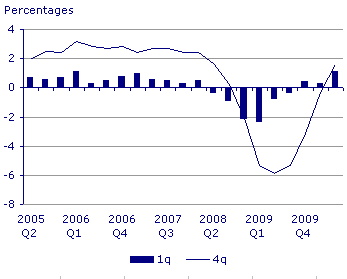
Personal income increased $1.2 billion, or less than 0.1 percent, and disposable personal income (DPI) increased $1.6 billion, or less than 0.1 percent, in February, according to the Bureau of Economic Analysis.  Personal consumption expenditures (PCE) increased $34.7 billion, or 0.3 percent.

Oh boy, now the $1.3 trillion in additional deficit spending is no longer contributing to personal income!  That’s not so positive – indeed, it’s not positive at all.

Private wage and salary disbursements increased $2.0 billion in February, compared with an increase of $16.6 billion in January.  Goods-producing industries’ payrolls decreased $3.5 billion, in contrast to an increase of $5.2 billion; manufacturing payrolls decreased $1.4 billion, in contrast to an increase of $5.0 billion.  Services-producing industries’ payrolls increased $5.5 billion, compared with an increase of $11.4 billion.

Goods down…. uh, where’s our so-called economic recovery?

Proprietors’ income decreased $6.1 billion in February, the same decrease as in January. Farm proprietors’ income decreased $7.1 billion, the same decrease as in January.  Nonfarm proprietors’ income increased $1.0 billion, the same increase as in January.

Very little change in proprietor’s income ex farming, but farmer income is down significantly.

Rental income of persons increased $2.2 billion in February, compared with an increase of $1.9 billion in January.  Personal income receipts on assets (personal interest income plus personal dividend income) decreased $16.5 billion, the same decrease as in January.

Rents up a bit, but dividends are down huge, continuing a trend.  This is not positive at all, and implies that assets are being sold to continue lifestyle choices.  This leads to a question that has begun to gnaw at me: Have we begun to cross into where boomers start pulling funds out of asset classes to live on?

Personal current transfer receipts increased $16.6 billion in February, compared with an increase of $29.8 billion in January.  The January change reflected the Making Work Pay Credit provision of the American Recovery and Reinvestment Act of 2009, which boosted January receipts by $19.8 billion. The Act provides for a refundable tax credit of up to $400 for working individuals and up to $800 for married taxpayers.  When an individual’s tax credit exceeds the taxes owed, the refundable tax credit payment is classified as “other” government social benefits to persons.

Government to the rescue!  $45 billion worth in the last two months, to be specific.  That’s a direct $270 billion in handouts, or 2% of GDP – and that’s only the direct handouts!  So subtract that off GDP and….. (oh, and don’t forget the rest of the $1.3 trillion too.)

Nothing to see here folks, as in “no evidence of sustainability in the recovery.”  We have a government that continues to “prime the pump” but there’s no water at the bottom of the well to generate self-sustaining economic growth.

By Paul Handover

20 years of the WWW

And a neat idea from the BBC

BBC Broadcasting House, Portland Place, London

For those living outside the UK (well so far as our IP address is concerned) watching BBC television via the Web has always been a bit of a challenge.  Presumably because of the way that the BBC is funded, a Licence Fee (aka tax!) on those UK householders that wish to watch public broadcasted television, it is deemed ‘unfair’ if those outside the UK, who do not pay this Fee, have unfettered access to the Beeb’s programming.  Thus if one attempts to access the BBC online from outside the UK you are met with the following message:

Currently BBC iPlayer TV programmes are available to play in the UK only, but all BBC iPlayer Radio programmes are available to you. Why?

However, the BBC have made a wonderful exception with regard to a series of programmes under the title of The Virtual Revolution. All about 20 years of the World Wide Web.

Most of, if not all, the key players of this last 20 years have been interviewed and the uncut footage of these interviews is here.  Fascinating viewing.

And if you fancy making your own documentary using this material, under a unique BBC permissive licence, then here’s where to start.

Well done, the Beeb!

By Paul Handover

So what next in the global merry-go-round?

Well, it is a Chinese saying, “May you live in interesting times”!

A couple of weeks ago on Learning from Dogs, there was an article reminding readers that the web has been around for 20 years and Sir ‘Tim’ Berners-Lee is still hard at it in terms of Internet innovations. And to support this, today accompanying this Post is one on what the BBC is doing to commemorate the event.

The Internet has completely reformed the way that ordinary people get access to information.  Stratfor is a great example.

From their web site:

STRATFOR’s global team of intelligence professionals provides an audience of decision-makers and sophisticated news consumers in the U.S. and around the world with unique insights into political, economic, and military developments. The company uses human intelligence and other sources combined with powerful analysis based on geopolitics to produce penetrating explanations of world events. This independent, non-ideological content enables users not only to better understand international events, but also to reduce risks and identify opportunities in every region of the globe.

One can subscribe to a range of free reports and it came to pass that a Stratfor report on China came into my in-box.

Stratfor generously allow free distribution of this report and because the relationship between China and the USA has so many global implications, the report is published in full, as follows:

Read the Stratfor report

Burning the Bridges in Europe

A very far-sighted view of European collaboration from 12 years ago!

Once again, Learning from Dogs welcomes a guest post from Per Kurowski.

Per Kurowski

——————-

I was intrigued by a recent Post on Learning from Dogs entitled Poor Old Europe.  It included two commentaries from elsewhere about the state of Europe and how the feeling of trying to force, politically, very disparate countries together was still ever so dominant.  It reminded me of an article that I wrote for my own Blog nearly 12 years ago just before the Euro came into effect.  Reading it today is interesting, to say the least.

In just a few weeks, on the 1st of January 1999, eleven European countries will forsake the right to issue their own currency and accept the circulation within their boundaries of a common currency, the Euro. Monetary policy related to the Euro will be set by a European Central Bank. One fact that struck me as curious is that in all the abundant legislation that regulates this process, there is no mention whatsoever of how to manage the withdrawal or future regret of any of the union’s members.

The absence of alternatives in this case evidently represents a burning of the bridges, but this may be necessary to achieve credibility. There is no turning back and there is no doubt that this is a truly historical moment. As participants in a globalized world in which Europe has an important role, we must naturally wish all members luck, no matter what worries we might secretly harbor.

Until 1971, all money used throughout the history of humanity was backed in one way or another by something physical to which a real value was attributed. Sometimes the backing was direct, pearls for example, while in other cases it was indirect such as the right to exchange bills for a certain quantity of gold.

This physical backing in itself did not necessarily mean it consisted of something of fixed value. The value of a pearl, for example, is in itself subjective. The promise to exchange bills for gold did not guarantee anything either, since this promise could easily be voided by fraud. Whatever the backing was, however, it did at least offer the holder of the money the illusion that it was supported by something concrete.

In 1971, the United States formally abandoned the gold standard and the direct backing, however imaginary, disappeared. Since the Dollar is a legal currency, it could always be used to repay Dollar denominated debt. Today, however, in spite of the fact that the Dollars may have lost some of their purchasing power, a holder of excess Dollars can only hope that the Government of the United States will exchange his old bills for new ones of the same tenor.

This apparently precarious situation must be the raison d’etre of the motto printed clearly on the bills which states “In God We Trust”.

Since 1971, the real value of the Dollar as an element of exchange, has lost some of its value due to inflation. Today, we would need many more Dollars to buy the same houses, cars, movie tickets and gold than we would have needed in 1971. In spite of the above, with few exceptions such as the end of the ‘70s during which inflation increased dramatically, few would dare qualify the United States’ elimination of the gold standard as a failure.

The world’s economies have managed to increase international commerce drastically and with it, sustain a healthy growth rate. Many analysts would explain this phenomenon by saying that the discipline exacted by the gold standard represented a brake on international commerce. The growth rate registered in commerce after 1971 was the result of the release of this brake. Other more critical analysts sustain the thesis that, due to the fact that we have abandoned the discipline required by the gold standard, the world has accumulated gigantic accounts payable, which we may be coming due very soon.

I personally swing back and forth between amazement of the fact that the world has accepted such a fragile system and satisfaction that it actually has done so.

The Euro has one characteristic that differentiates it from the Dollar. This characteristic makes me feel less optimistic as to its chances of success. The Dollar is backed by a solidly unified political entity, i.e. the United States of America. The Euro, on the other hand, seems to be aimed at creating unity and cohesion. It is not the result of these.

The possibility that the European countries will subordinate their political desires to the whims of a common Central Bank that may be theirs but really isn’t, is not a certainty. Exchange rates, while not perfect, are escape valves. By eliminating this valve, European countries must make their economic adjustments in real terms. This makes these adjustments much more explosive. High unemployment will not be confronted with a devaluation of the currency which reduces the real value of salaries in an indirect manner, but rather with a direct and open reduction of salaries or with an increase of emigration to areas offering better possibilities.

What worries me most is the timing. The world is facing the possibility of a global recession. This will require very flexible economic and monetary policies. The fact that the search for initial credibility for the Euro is based on trying to assure markets around the world that the new currency will be guided by a philosophy closer to that of Bonn than that of Rome, probably goes against the best interests of the world.

Published in Daily Journal, Caracas, November 19, 1998

By Per Kurowski

Poor old Europe!

Why has it seemed like pushing water uphill for so long?

I’m in my mid-60s, having been born six months before the end of WWII.  From the earliest days that I can remember, my parents loved to holiday in France and Spain.  In those days if one was to motor into Europe then it was a case of the car being craned aboard the ferry from England to France.  How things change!

Modern cross-channel ferry

Much later on in life, I did business extensively in many European countries and, for a while, taught sales and marketing at the international school, ISUGA, in Quimper, NW France.  (Indeed, fellow Blog author Chris Snuggs was my Director of Studies at ISUGA – that’s how we came to meet.)  I like to think that I have a reasonable understanding of the variety of cultures that is Europe.

So while acknowledging the convenience of a common currency (sort of) and ease of border transits, the one thing that has remained in my mind is that each country in Europe is very, very different to the other.  These core differences have always struck me as so strong and deep-rooted that any form of real union was a ridiculous concept.  The present deep problems with Greece seem to be the tip of this fundamental issue.  Thus a couple of recently published articles, on Baseline Scenario and The Financial Times seem worthy of being aired on Learning from Dogs.

First, the article by Simon Johnson on Baseline Scenario:
Read more of this Post

The Love of a Dog

Pharaoh – from whom I have learnt so much.

German Shepherd, Pharaoh, born June 3rd, 2003

I am your dog and have something I would love to whisper in your ear.

I know that you humans lead very busy lives.  Some have to work, some have children to raise, some have to do this alone.  It always seems like you are running here and there, often too fast, never noticing the truly grand things in life.

Look down at me now.  Stop looking at your computer and look at me.  See the way my dark, brown eyes look at yours.

You smile at me.  I see love in your eyes.

What do you see in mine?  Do you see a spirit?  A soul inside who loves you as no other could in the world? A spirit that would forgive all trespasses of prior wrong doing for just a single moment of your time?  That is all I ask. To slow down, if even for a few minutes, to be with me.

So many times you are saddened by others of my kind passing on.  Sometimes we die young and, oh, so quickly, so suddenly that it wrenches your heart out of your throat.

Sometimes, we age slowly before your eyes that you may not even seem to know until the very end, when we look at you with grizzled muzzles and cataract-clouded eyes.  Still the love is always there even when we must take that last, long sleep dreaming of running free in a distant, open land.

I may not be here tomorrow.  I may not be here next week.  Someday you will shed the water from your eyes, that humans have when grief fills their souls, and you will mourn the loss of just ‘one more day’ with me.

Because I love you so, this future sorrow even now touches my spirit and grieves me.  I read you in so many ways that you cannot even start to contemplate.

We have now together.  So come and sit next to me here on the floor and look deep into my eyes.  What do you see?  Do you see how if you look deeply at me we can talk, you and I, heart to heart.  Come not to me as my owner but as a living soul.  Stroke my fur and let us look deep into the other’s eyes and talk with our hearts.

I may tell you something about the fun of working the scents in the woods where you and I go.  Or I may tell you something profound about myself or how we dogs see life in general.

I know you decided to have me in your life because you wanted a soul to share things with. I know how much you have cared for me and always stood up for me even when others have been against me.  I know how hard you have worked to help me be the teacher that I was born to be.  That gift from you has been very precious to me.  I know too that you have been through troubled times and I have been there to guard you, to protect you and to be there always for you.  I am very different to you but here I am.  I am a dog but just as alive as you.

I feel emotion.  I feel physical senses.  I can revel in the differences of our spirits and souls.  I do not think of you as a dog on two feet; I know what you are.  You are human, in all your quirkiness, and I love you still.

So, come and sit with me.  Enter my world and let time slow down if only for a few minutes.  Look deep into my eyes and whisper in my ears.  Speak with your heart and I will know your true self.  We may not have tomorrow but we do have now.

(Based on an article sent to me, unfortunately from an unknown author, and modified to reflect the special relationship that I have with my 6 year old German Shepherd, Pharaoh.)

By Paul Handover

Even more Tim Berners-Lee

The powerful spread of open data.

Sir 'Tim' Berners-Lee

Tim Berners-Lee was, or is, the father of the Internet, that remarkable network that has done to connect millions together.  Indeed, my personal view is that the Internet may be the only real tool that people have to protect and defend democracy.

I’m sure thousands know the background of Sir Timothy John “Tim” Berners-Lee, to give him his full name, an Englishman living in the USA.

There was an introduction to the the way that Sir Tim wants to see the web move in yesterday’s Post.

But Tim recently (February 2010) gave a talk in Long Beach, California, entitled The year open data went worldwide. This takes the concept much further.

It’s a fascinating presentation.

By Paul Handover